Interpersonal Attraction
SOCIAL PSYCHOLOGY
WHAT IS INTERPERSONAL ATTRACTION?

It is the desire to approach other people.
WHY DO WE HAVE THIS DESIRE?
TWO REASONS FOR AFFILIATION
Social Comparison

Social Exchange

 The theory that

 The theory that

proposes that we
evaluate our thoughts
and actions by
comparing them with
those of others.

proposes that we seek
out and maintain those
relationships in which
the rewards exceed the
cost.
•

The information that
social comparison
provides is used to
evaluate the self.

•

Social comparison is
most likely when we are
in a state of uncertainty
concerning a relevant
self-aspect.

•

We generally prefer to
compare ourselves with
similar to others.

•

The more similar people
are to us, the more likely
we will be to use the
information gained
through social
comparison in better
understanding ourselves
and future actions.

•

We use social
comparison not only to
judge ourselves, but also
to judge our emotions
and choose our friends.

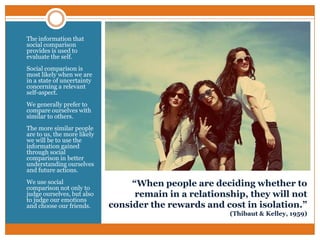
“When people are deciding whether to
remain in a relationship, they will not
consider the rewards and cost in isolation.”
(Thibaut & Kelley, 1959)
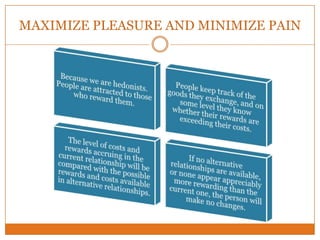
MAXIMIZE PLEASURE AND MINIMIZE PAIN
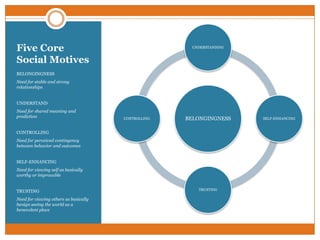
Five Core
Social Motives

UNDERSTANDING

BELONGINGNESS
Need for stable and strong
relationships
UNDERSTAND
Need for shared meaning and
prediction

CONTROLLING

BELONGINGNESS

CONTROLLING
Need for perceived contingency
between behavior and outcomes
SELF-ENHANCING
Need for viewing self as basically
worthy or improvable

TRUSTING
Need for viewing others as basically
benign seeing the world as a
benevolent place

TRUSTING

SELF-ENHANCING
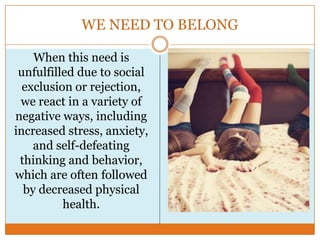
WE NEED TO BELONG
When this need is
unfulfilled due to social
exclusion or rejection,
we react in a variety of
negative ways, including
increased stress, anxiety,
and self-defeating
thinking and behavior,
which are often followed
by decreased physical
health.
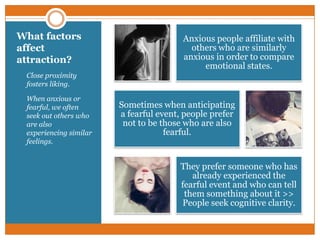
What factors
affect
attraction?
•

Close proximity
fosters liking.

•

When anxious or
fearful, we often
seek out others who
are also
experiencing similar
feelings.

Anxious people affiliate with
others who are similarly
anxious in order to compare
emotional states.

Sometimes when anticipating
a fearful event, people prefer
not to be those who are also
fearful.

They prefer someone who has
already experienced the
fearful event and who can tell
them something about it >>
People seek cognitive clarity.
PHYSICAL ATTRACTIVENESS STEREOTYPE
 The belief that physically attractive individuals possess a

socially desirable personality traits and lead happier lives
than less attractive persons.
 Good looking people do tend to be less socially anxious,
more socially skilled, and less lonesome than those who
are unattractive (Feingold, 1992).
 There is a self-fulfilling prophecy involved in the physical
attractiveness stereotype.
 The apparent reason physically attractive people tend to
be socially poised and confident is that those interact
with them convey the clear impression that they truly are
interesting and sociable individuals.
Matching Hypothesis
 The proposition that

people are attracted to
others who are similar
to them in particular
characteristics.
 The greater the
proportion of similar
attitudes held by
people the greater
their attraction to one
another.

Birds of a feather, flock
together.
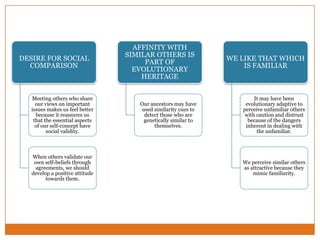
DESIRE FOR SOCIAL
COMPARISON

Meeting others who share
our views on important
issues makes us feel better
because it reassures us
that the essential aspects
of our self-concept have
social validity.

When others validate our
own self-beliefs through
agreements, we should
develop a positive attitude
towards them.

AFFINITY WITH
SIMILAR OTHERS IS
PART OF
EVOLUTIONARY
HERITAGE

Our ancestors may have
used similarity cues to
detect those who are
genetically similar to
themselves.

WE LIKE THAT WHICH
IS FAMILIAR

It may have been
evolutionary adaptive to
perceive unfamiliar others
with caution and distrust
because of the dangers
inherent in dealing with
the unfamiliar.

We perceive similar others
as attractive because they
mimic familiarity.
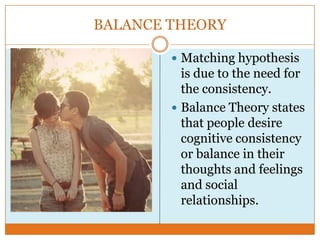
BALANCE THEORY
 Matching hypothesis

is due to the need for
the consistency.
 Balance Theory states
that people desire
cognitive consistency
or balance in their
thoughts and feelings
and social
relationships.
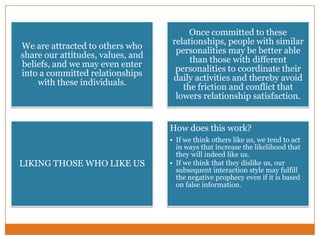
We are attracted to others who
share our attitudes, values, and
beliefs, and we may even enter
into a committed relationships
with these individuals.

Once committed to these
relationships, people with similar
personalities may be better able
than those with different
personalities to coordinate their
daily activities and thereby avoid
the friction and conflict that
lowers relationship satisfaction.
How does this work?

LIKING THOSE WHO LIKE US

• If we think others like us, we tend to act
in ways that increase the likelihood that
they will indeed like us.
• If we think that they dislike us, our
subsequent interaction style may fulfill
the negative prophecy even if it is based
on false information.

Interpersonal Attraction

  • 1.
  • 2.
    WHAT IS INTERPERSONALATTRACTION? It is the desire to approach other people.
  • 3.
    WHY DO WEHAVE THIS DESIRE?
  • 4.
    TWO REASONS FORAFFILIATION Social Comparison Social Exchange  The theory that  The theory that proposes that we evaluate our thoughts and actions by comparing them with those of others. proposes that we seek out and maintain those relationships in which the rewards exceed the cost.
  • 5.
    • The information that socialcomparison provides is used to evaluate the self. • Social comparison is most likely when we are in a state of uncertainty concerning a relevant self-aspect. • We generally prefer to compare ourselves with similar to others. • The more similar people are to us, the more likely we will be to use the information gained through social comparison in better understanding ourselves and future actions. • We use social comparison not only to judge ourselves, but also to judge our emotions and choose our friends. “When people are deciding whether to remain in a relationship, they will not consider the rewards and cost in isolation.” (Thibaut & Kelley, 1959)
  • 6.
    MAXIMIZE PLEASURE ANDMINIMIZE PAIN
  • 7.
    Five Core Social Motives UNDERSTANDING BELONGINGNESS Needfor stable and strong relationships UNDERSTAND Need for shared meaning and prediction CONTROLLING BELONGINGNESS CONTROLLING Need for perceived contingency between behavior and outcomes SELF-ENHANCING Need for viewing self as basically worthy or improvable TRUSTING Need for viewing others as basically benign seeing the world as a benevolent place TRUSTING SELF-ENHANCING
  • 8.
    WE NEED TOBELONG When this need is unfulfilled due to social exclusion or rejection, we react in a variety of negative ways, including increased stress, anxiety, and self-defeating thinking and behavior, which are often followed by decreased physical health.
  • 9.
    What factors affect attraction? • Close proximity fostersliking. • When anxious or fearful, we often seek out others who are also experiencing similar feelings. Anxious people affiliate with others who are similarly anxious in order to compare emotional states. Sometimes when anticipating a fearful event, people prefer not to be those who are also fearful. They prefer someone who has already experienced the fearful event and who can tell them something about it >> People seek cognitive clarity.
  • 10.
    PHYSICAL ATTRACTIVENESS STEREOTYPE The belief that physically attractive individuals possess a socially desirable personality traits and lead happier lives than less attractive persons.  Good looking people do tend to be less socially anxious, more socially skilled, and less lonesome than those who are unattractive (Feingold, 1992).  There is a self-fulfilling prophecy involved in the physical attractiveness stereotype.  The apparent reason physically attractive people tend to be socially poised and confident is that those interact with them convey the clear impression that they truly are interesting and sociable individuals.
  • 11.
    Matching Hypothesis  Theproposition that people are attracted to others who are similar to them in particular characteristics.  The greater the proportion of similar attitudes held by people the greater their attraction to one another. Birds of a feather, flock together.
  • 12.
    DESIRE FOR SOCIAL COMPARISON Meetingothers who share our views on important issues makes us feel better because it reassures us that the essential aspects of our self-concept have social validity. When others validate our own self-beliefs through agreements, we should develop a positive attitude towards them. AFFINITY WITH SIMILAR OTHERS IS PART OF EVOLUTIONARY HERITAGE Our ancestors may have used similarity cues to detect those who are genetically similar to themselves. WE LIKE THAT WHICH IS FAMILIAR It may have been evolutionary adaptive to perceive unfamiliar others with caution and distrust because of the dangers inherent in dealing with the unfamiliar. We perceive similar others as attractive because they mimic familiarity.
  • 13.
    BALANCE THEORY  Matchinghypothesis is due to the need for the consistency.  Balance Theory states that people desire cognitive consistency or balance in their thoughts and feelings and social relationships.
  • 14.
    We are attractedto others who share our attitudes, values, and beliefs, and we may even enter into a committed relationships with these individuals. Once committed to these relationships, people with similar personalities may be better able than those with different personalities to coordinate their daily activities and thereby avoid the friction and conflict that lowers relationship satisfaction. How does this work? LIKING THOSE WHO LIKE US • If we think others like us, we tend to act in ways that increase the likelihood that they will indeed like us. • If we think that they dislike us, our subsequent interaction style may fulfill the negative prophecy even if it is based on false information.