
Social Psychology


Slides By Rana Usman Sattar
Student Of BBA(Hons)
PMAS Arid Agriculture University Rawalpindi
Gmail: ranaa.usman@gmail.com
Facebook: usman.shan86@yahoo.com
Social Psychology

Conformity and
Obedience
Attribution
Attraction
What is social
psychology?
• Social psychology: The interaction
  between the individual and his/her social
  world.

• “The purpose of psychology is to give us a
  completely different idea of the things we
  know best.”
Why study it?

• To understand history
  – World War two


• To be less naive.
  – Conformity
  – Obedience
  – How products are sold


• To understand love.
Questions to answer

• How does the social situation affect our
  behavior?

• What influences the judgment of others?

• What are the roots of violence and
  terrorism?
Yielding to Others

•    Conformity: A change of beliefs in order to
     follow a groups norms

1. Informational social influence: Conform
   because other’s view and behaviors seem to
   be correct.
    a) Ambiguous
    b) Crisis
    c) Others are experts

       *Social comparison theory (Festinger): All people
       are driven to evaluate their abilities and opinions.
Conformity

•   Normative social influence: When we
    conform due to wanting to be liked or
    thought of positively.

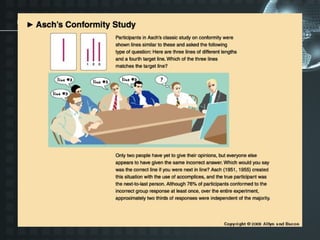
1) Solomon Ash experiment (1951) »
Asch experiment

• Used 7-9 people, only one a real subject

• Had people judging line lengths

• At first confederates told the truth

• Then they all began giving the same wrong
  answer (12/18 times)

• 123 subjects agreed with 36.8% of the
  erroneous selections.
Conformity
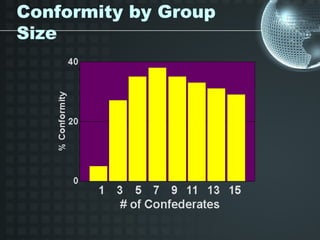
Conformity by Group
Size
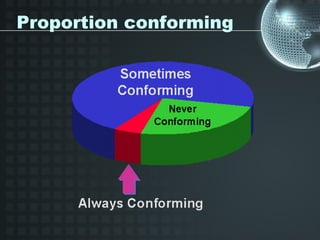
Proportion conforming
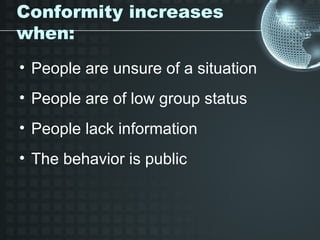
Conformity increases
when:
• People are unsure of a situation
• People are of low group status
• People lack information
• The behavior is public
Conformity and
Compliance
• Reduced conformity: Writing answers (98%
  correct) and social support.

• Compliance: Change in behavior prompted by
  direct request. Six principles (Cialdini, 1994).
  –   Friendship/liking
  –   Commitment/consistency
  –   Scarcity
  –   Reciprocity
  –   Social validation
  –   Authority
Compliance (and selling
products)
• Foot-in-the-door technique: Insignificant request
  is followed by a larger request.
  – Lottery example
  – Car dealership example
• Lowball technique: Get someone to make an
  agreement then increase the cost.
  – Selling houses, cars
• Door-in-the-face technique: Make a larger
  request (denied) then a smaller one.
  – Reciprocity principle
     • Girl scout leader example
     • Political sign example
Obedience

Milgram’s experiment (1963)
Design:
• 40 Naive subjects agree to participate in a
  “learning experiment” at Yale.
• An impassive, stern “experimenter”
• “Victim:” mild mannered 47 year old man.
• Subject was instructed to shock the learner each
  time he gives a wrong response to a paired-
  associate learning task.
• Four experimental “prods”
Obedience

• Instrument panel has 30 switches, ranging
  from 15-450 volts.
  – Labeled slight to extreme shock.
• 15 volt increment from one switch to next.
• After a preliminary run w/the word list,
  subject instructed to start with 15 volts and
  go up a level w/each missed word.
• Predetermined set of responses
Obedience

• Nothing is heard from the “learner” until
  the 300 shock level is reached.
• At 300 volts, learner pounds on the wall.
  – No answers from this point.
• Subject ordered to treat no response as
  wrong answer.
• Learner’s pounding is repeated at 315
  volts, nothing further.
Milgram

Findings:
• 14 Yale seniors predicted that only 0-3%
   would go to the most potent shock (450
   volts). Colleagues of Milgram agreed.
• Subjects showed signs of extreme
   tension
    – Sweat, tremble, nervous laughter
•   No one stopped prior to 300 volts
•   5/40 refused to go beyond 300
Milgram, findings con’t

•   4/40 administered 1 shock beyond 300
•   2/40 broke off at 330 volts
•   1 subject each broke off at 345, 360, and 375
•   26/40 (65%) obeyed orders until reaching the
    most potent shock

Why did this happen? Ideas?
Milgram

• Similar results were found with women, people
  from Jordan, Germany, and Australia
• Why?
  – Foot-in-door
  – Situational demands
  – Vague expectations and limits
  – Experiment was for a “worthy purpose.”
  – Perception that “victim” and subject both entered
    experiment willingly.
  – Can’t win: Either please experimenter or victim
        – Film clip
• What reduces conformity? »
What reduces
conformity?
• Closer proximity to learner
• Type of experimenter
  – College student: only 20%
• Proximity to experimenter
  – Phone in commands: only 21%
Attribution: Making
sense of events
• Attribution: Explanation for the cause of an
  event or a behavior. Two types:
  – Internal: Explanation focuses on person’s beliefs,
    goals, preferences, or other characteristics.
  – External: Explanation focuses on the situation.
     • Mental illness
     • Poor grades
     • Homeless
            ⇓
• Attributional biases: Are cognitive “shortcuts”
Attributional biases

• Fundamental attribution error: Strong tendency
  to attribute other people’s behavior as due to
  internal causes.
  – E.g. bad driver, homeless people


• Self-serving bias: Attribute own failures to
  external causes and success to internal causes,
  and the opposite for others.

• The belief in a just world: Assume people get
  what they deserve….blaming the victim.
  – Is NOT about not taking responsibility when
Next, love

• Do opposites attract?
• What are “ideal” characteristics in a
  partner?
• Can we define love? Are there different
  types?
• What types of personality characteristics
  do most people seek in a romantic
  partner?
Love - Ending on a good
note!
• Why are you attracted?
  – Repeated contact
  – Similarity
     • Opposites attract not supported by research
  – Physical attraction


• People are happiest with partners who are
  agreeable, conscientious, and emotionally
  stable.

• What is love? Sternberg again! 
Love - Ending on a good
note.
• Is a qualitatively different feeling than liking.
   – Passionate love: An intense feeling that
     involves sexual attraction, a desire for mutual
     love and physical closeness, arousal, and a
     fear the relationship will end.

   – Compassionate love: Very close friendship,
     mutual caring, liking, respect, attraction.
   So, how do these combine?

Social psychology conformty

  • 1.
    Social Psychology Slides ByRana Usman Sattar Student Of BBA(Hons) PMAS Arid Agriculture University Rawalpindi Gmail: ranaa.usman@gmail.com Facebook: usman.shan86@yahoo.com
  • 2.
  • 3.
    What is social psychology? •Social psychology: The interaction between the individual and his/her social world. • “The purpose of psychology is to give us a completely different idea of the things we know best.”
  • 4.
    Why study it? •To understand history – World War two • To be less naive. – Conformity – Obedience – How products are sold • To understand love.
  • 5.
    Questions to answer •How does the social situation affect our behavior? • What influences the judgment of others? • What are the roots of violence and terrorism?
  • 6.
    Yielding to Others • Conformity: A change of beliefs in order to follow a groups norms 1. Informational social influence: Conform because other’s view and behaviors seem to be correct. a) Ambiguous b) Crisis c) Others are experts *Social comparison theory (Festinger): All people are driven to evaluate their abilities and opinions.
  • 7.
    Conformity • Normative social influence: When we conform due to wanting to be liked or thought of positively. 1) Solomon Ash experiment (1951) »
  • 8.
    Asch experiment • Used7-9 people, only one a real subject • Had people judging line lengths • At first confederates told the truth • Then they all began giving the same wrong answer (12/18 times) • 123 subjects agreed with 36.8% of the erroneous selections.
  • 9.
  • 10.
  • 11.
  • 12.
    Conformity increases when: • Peopleare unsure of a situation • People are of low group status • People lack information • The behavior is public
  • 13.
    Conformity and Compliance • Reducedconformity: Writing answers (98% correct) and social support. • Compliance: Change in behavior prompted by direct request. Six principles (Cialdini, 1994). – Friendship/liking – Commitment/consistency – Scarcity – Reciprocity – Social validation – Authority
  • 14.
    Compliance (and selling products) •Foot-in-the-door technique: Insignificant request is followed by a larger request. – Lottery example – Car dealership example • Lowball technique: Get someone to make an agreement then increase the cost. – Selling houses, cars • Door-in-the-face technique: Make a larger request (denied) then a smaller one. – Reciprocity principle • Girl scout leader example • Political sign example
  • 15.
    Obedience Milgram’s experiment (1963) Design: •40 Naive subjects agree to participate in a “learning experiment” at Yale. • An impassive, stern “experimenter” • “Victim:” mild mannered 47 year old man. • Subject was instructed to shock the learner each time he gives a wrong response to a paired- associate learning task. • Four experimental “prods”
  • 16.
    Obedience • Instrument panelhas 30 switches, ranging from 15-450 volts. – Labeled slight to extreme shock. • 15 volt increment from one switch to next. • After a preliminary run w/the word list, subject instructed to start with 15 volts and go up a level w/each missed word. • Predetermined set of responses
  • 17.
    Obedience • Nothing isheard from the “learner” until the 300 shock level is reached. • At 300 volts, learner pounds on the wall. – No answers from this point. • Subject ordered to treat no response as wrong answer. • Learner’s pounding is repeated at 315 volts, nothing further.
  • 18.
    Milgram Findings: • 14 Yaleseniors predicted that only 0-3% would go to the most potent shock (450 volts). Colleagues of Milgram agreed. • Subjects showed signs of extreme tension – Sweat, tremble, nervous laughter • No one stopped prior to 300 volts • 5/40 refused to go beyond 300
  • 19.
    Milgram, findings con’t • 4/40 administered 1 shock beyond 300 • 2/40 broke off at 330 volts • 1 subject each broke off at 345, 360, and 375 • 26/40 (65%) obeyed orders until reaching the most potent shock Why did this happen? Ideas?
  • 20.
    Milgram • Similar resultswere found with women, people from Jordan, Germany, and Australia • Why? – Foot-in-door – Situational demands – Vague expectations and limits – Experiment was for a “worthy purpose.” – Perception that “victim” and subject both entered experiment willingly. – Can’t win: Either please experimenter or victim – Film clip • What reduces conformity? »
  • 21.
    What reduces conformity? • Closerproximity to learner • Type of experimenter – College student: only 20% • Proximity to experimenter – Phone in commands: only 21%
  • 22.
    Attribution: Making sense ofevents • Attribution: Explanation for the cause of an event or a behavior. Two types: – Internal: Explanation focuses on person’s beliefs, goals, preferences, or other characteristics. – External: Explanation focuses on the situation. • Mental illness • Poor grades • Homeless ⇓ • Attributional biases: Are cognitive “shortcuts”
  • 23.
    Attributional biases • Fundamentalattribution error: Strong tendency to attribute other people’s behavior as due to internal causes. – E.g. bad driver, homeless people • Self-serving bias: Attribute own failures to external causes and success to internal causes, and the opposite for others. • The belief in a just world: Assume people get what they deserve….blaming the victim. – Is NOT about not taking responsibility when
  • 24.
    Next, love • Doopposites attract? • What are “ideal” characteristics in a partner? • Can we define love? Are there different types? • What types of personality characteristics do most people seek in a romantic partner?
  • 25.
    Love - Endingon a good note! • Why are you attracted? – Repeated contact – Similarity • Opposites attract not supported by research – Physical attraction • People are happiest with partners who are agreeable, conscientious, and emotionally stable. • What is love? Sternberg again! 
  • 26.
    Love - Endingon a good note. • Is a qualitatively different feeling than liking. – Passionate love: An intense feeling that involves sexual attraction, a desire for mutual love and physical closeness, arousal, and a fear the relationship will end. – Compassionate love: Very close friendship, mutual caring, liking, respect, attraction. So, how do these combine?

Editor's Notes

  • #5 Esp. now when you are burned out!
  • #6 So we will do Milgram and Asch.
  • #7 Use video example.
  • #11 Doesn’t go up much past three….
  • #13 Low status: W/older people
  • #14 Car salesman example.
  • #17 They don’t write down shock gradations…see sheet.
  • #19 300 volts - kick wall. Read protests.
  • #20 Write down only last bullet??
  • #23 How do we determines what causes behavior? How we judge others? *Mental illness,
  • #24 Blame victim….crime, rape, car accidents.