STEREOCHEMICAL
ASPECTS
PREPARED BY- MOHAMAD HAIDER
ROLL NO.- 04/MPH/DIPSAR/19
DEPARTMENT OF PHARMACEUTICAL CHEMISTRY, DIPSAR
CONTENTS
 Fischer’s D and L notation
 Pseudo asymmetric centers
 Cis-Trans isomerism
 E-Z system
Fischer’s D and L notation
 The D-L system corresponds to
the configuration of the molecule: spatial
arrangement of its atoms around the
chirality center.
 D-L system tells us about the relative
configuration of the molecule, compared
to the enantiomers of glyceraldehyde as
the standard compound.
 Compounds with the same relative
configuration as (+)-glyceraldehyde are
assigned the D prefix, and those with the
relative configuration of (-)-glyceradehyde
are given the L prefix.
 It only relates the stereochemistry of the
compound with that of glyceraldehyde,
but says nothing about its optical activity.
 In assigning the D and L configurations of
sugars, we could directly look for the OH
group of the bottom asymmetric carbon in
the Fischer projection. If it's located on the
right, we designate it with D, and vice
versa.
Pseudo Asymmetric Centers
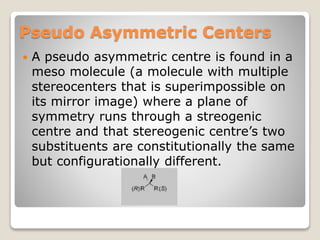
 A pseudo asymmetric centre is found in a
meso molecule (a molecule with multiple
stereocenters that is superimpossible on
its mirror image) where a plane of
symmetry runs through a streogenic
centre and that stereogenic centre’s two
substituents are constitutionally the same
but configurationally different.
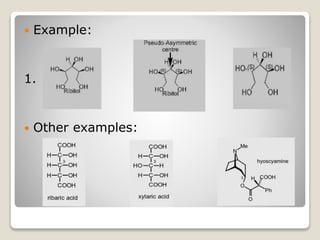
 Example:
1.
 Other examples:
Cis-Trans Isomerism
 Cis-trans isomerism (also known as
geometric isomerism) is a form of
stereoisomerism. These isomers occur
where there is restricted rotation
somewhere in a molecule, generally in
carbon-carbon double bond.
 Cis isomer is an isomer where two of the
same atoms are on the same side of the
double bond in a molecule.
 A trans isomer consists of molecule with
two same atoms but here the atoms lie in
the opposite side of the double bond.
 Example: Cis-2-butene has both methyl
groups on the same side of the molecule.
Trans-2-butene has the methyl groups on
opposite sides of the molecule. Their
structural formulas are as follows:
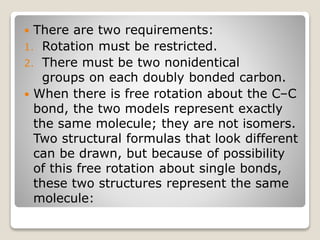
 There are two requirements:
1. Rotation must be restricted.
2. There must be two nonidentical
groups on each doubly bonded carbon.
 When there is free rotation about the C–C
bond, the two models represent exactly
the same molecule; they are not isomers.
Two structural formulas that look different
can be drawn, but because of possibility
of this free rotation about single bonds,
these two structures represent the same
molecule:
 The presence of a double bond
does not necessarily lead to cis-trans
isomerism as shown:
E-Z System
 The traditional system for naming the
geometric isomers of an alkene is to name
them as cis or trans. But if there are three
different groups (or four), then the
cis/trans approach is insufficient to
describe the different isomers.
 For such alkenes E-Z system is use. It is
based on the same set of ‘Priority rules’
on which the R-S is based. These priority
rules are often called the Cahn-Ingold-
Prelog (CIP) rules.
 The general strategy of the E-Z system is
to analyze the two groups at each end of
the double bond. At each end, rank the
two groups using the CIP priority rules.
Then, see whether the higher priority
group at one end of the double bond and
the higher priority group at the other end
of the double bond.
 If they are on the same side it will be Z
isomer (Z, from German zusammen =
together) and on opposite sides, E isomer
(E, from German entgegen = opposite).
• In simple cases, such as 2-butene, Z
corresponds to cis and E to trans.
However, that is not a rule as indicated
in the following example:
THANK YOU

Stereochemical aspects

  • 1.
    STEREOCHEMICAL ASPECTS PREPARED BY- MOHAMADHAIDER ROLL NO.- 04/MPH/DIPSAR/19 DEPARTMENT OF PHARMACEUTICAL CHEMISTRY, DIPSAR
  • 2.
    CONTENTS  Fischer’s Dand L notation  Pseudo asymmetric centers  Cis-Trans isomerism  E-Z system
  • 3.
    Fischer’s D andL notation  The D-L system corresponds to the configuration of the molecule: spatial arrangement of its atoms around the chirality center.  D-L system tells us about the relative configuration of the molecule, compared to the enantiomers of glyceraldehyde as the standard compound.
  • 4.
     Compounds withthe same relative configuration as (+)-glyceraldehyde are assigned the D prefix, and those with the relative configuration of (-)-glyceradehyde are given the L prefix.  It only relates the stereochemistry of the compound with that of glyceraldehyde, but says nothing about its optical activity.
  • 5.
     In assigningthe D and L configurations of sugars, we could directly look for the OH group of the bottom asymmetric carbon in the Fischer projection. If it's located on the right, we designate it with D, and vice versa.
  • 6.
    Pseudo Asymmetric Centers A pseudo asymmetric centre is found in a meso molecule (a molecule with multiple stereocenters that is superimpossible on its mirror image) where a plane of symmetry runs through a streogenic centre and that stereogenic centre’s two substituents are constitutionally the same but configurationally different.
  • 7.
  • 8.
    Cis-Trans Isomerism  Cis-transisomerism (also known as geometric isomerism) is a form of stereoisomerism. These isomers occur where there is restricted rotation somewhere in a molecule, generally in carbon-carbon double bond.  Cis isomer is an isomer where two of the same atoms are on the same side of the double bond in a molecule.
  • 9.
     A transisomer consists of molecule with two same atoms but here the atoms lie in the opposite side of the double bond.  Example: Cis-2-butene has both methyl groups on the same side of the molecule. Trans-2-butene has the methyl groups on opposite sides of the molecule. Their structural formulas are as follows:
  • 10.
     There aretwo requirements: 1. Rotation must be restricted. 2. There must be two nonidentical groups on each doubly bonded carbon.  When there is free rotation about the C–C bond, the two models represent exactly the same molecule; they are not isomers. Two structural formulas that look different can be drawn, but because of possibility of this free rotation about single bonds, these two structures represent the same molecule:
  • 11.
     The presenceof a double bond does not necessarily lead to cis-trans isomerism as shown:
  • 12.
    E-Z System  Thetraditional system for naming the geometric isomers of an alkene is to name them as cis or trans. But if there are three different groups (or four), then the cis/trans approach is insufficient to describe the different isomers.  For such alkenes E-Z system is use. It is based on the same set of ‘Priority rules’ on which the R-S is based. These priority rules are often called the Cahn-Ingold- Prelog (CIP) rules.
  • 13.
     The generalstrategy of the E-Z system is to analyze the two groups at each end of the double bond. At each end, rank the two groups using the CIP priority rules. Then, see whether the higher priority group at one end of the double bond and the higher priority group at the other end of the double bond.  If they are on the same side it will be Z isomer (Z, from German zusammen = together) and on opposite sides, E isomer (E, from German entgegen = opposite).
  • 14.
    • In simplecases, such as 2-butene, Z corresponds to cis and E to trans. However, that is not a rule as indicated in the following example:
  • 15.