Presented By;
Abutala & Vanshita Johar
M.Pharm 1st year
Department of Pharmaceutical Chemistry
SPER, Jamia
Hamdard
Content
Introductio
n
Types of nucleophilic
substitution reactions
Sn1 reactions
Mechanism of Sn1
reaction Sn2 reactions
Mechanism of Sn2
reactions
Applications
References
Introduction
NUCLEOPHILES
•The word nucleophile consists of
two nucleus, the positive part of an
atom, plus-phile from Greek word
philos meaning to love.
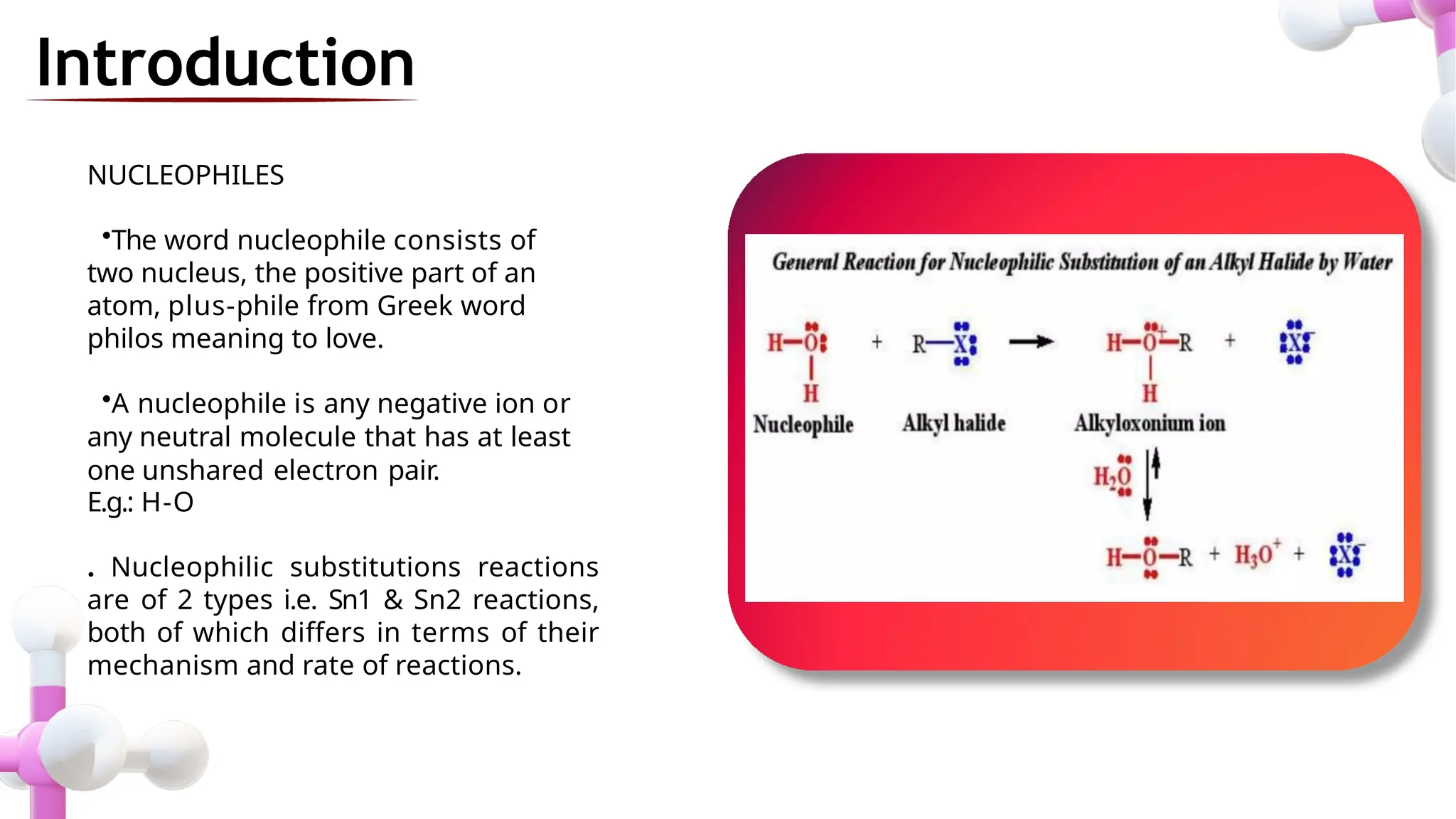
•A nucleophile is any negative ion or
any neutral molecule that has at least
one unshared electron pair.
E.g.: H-O
. Nucleophilic substitutions reactions
are of 2 types i.e. Sn1 & Sn2 reactions,
both of which differs in terms of their
mechanism and rate of reactions.
Types of substitution reactions
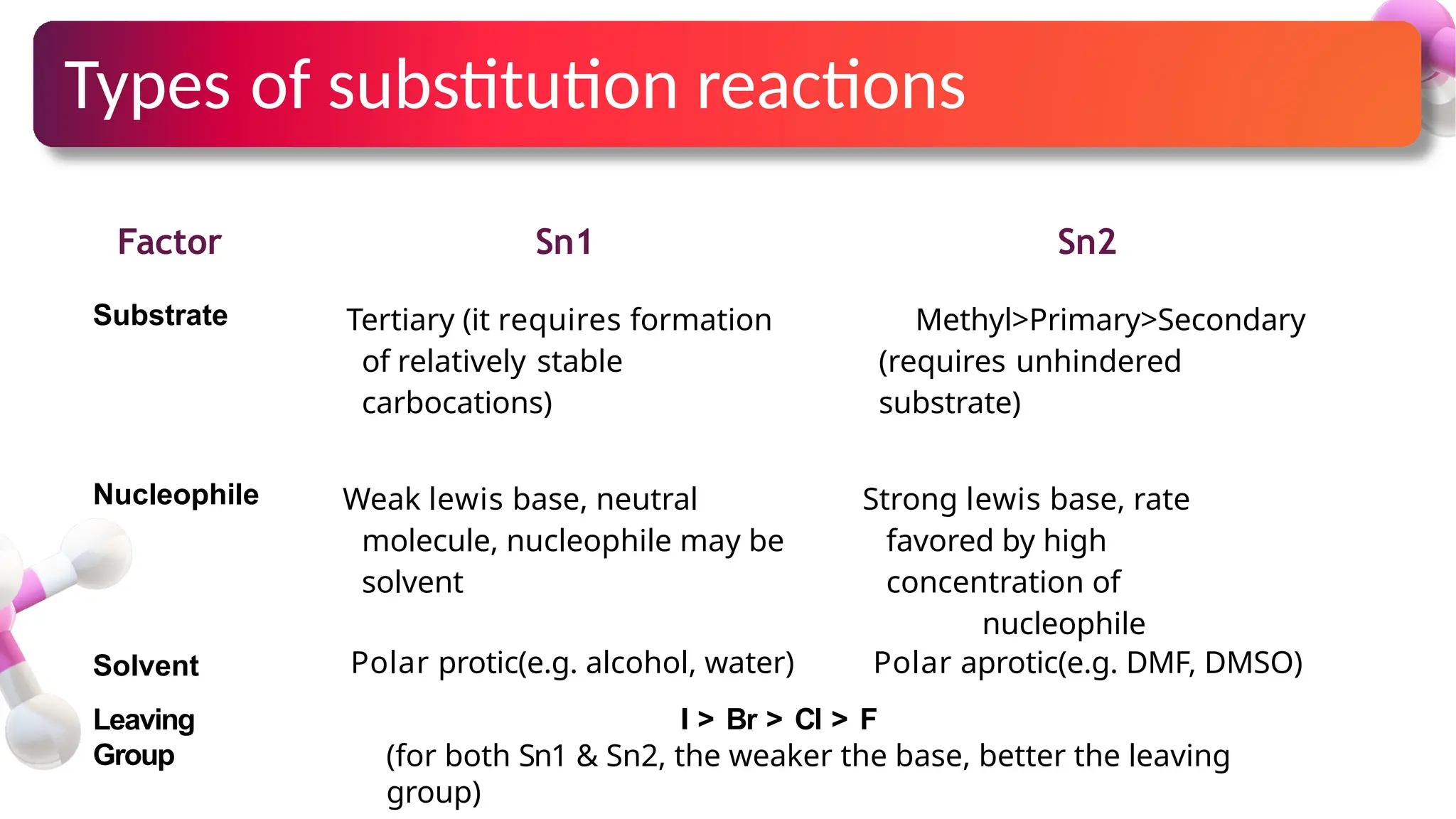
Factor Sn1 Sn2
Substrate Tertiary (it requires formation
of relatively stable
carbocations)
Methyl>Primary>Secondary
(requires unhindered
substrate)
Nucleophile Weak lewis base, neutral
molecule, nucleophile may be
solvent
Strong lewis base, rate
favored by high
concentration of
nucleophile
Solvent Polar protic(e.g. alcohol, water) Polar aprotic(e.g. DMF, DMSO)
Leaving
Group
I > Br > Cl > F
(for both Sn1 & Sn2, the weaker the base, better the leaving
group)
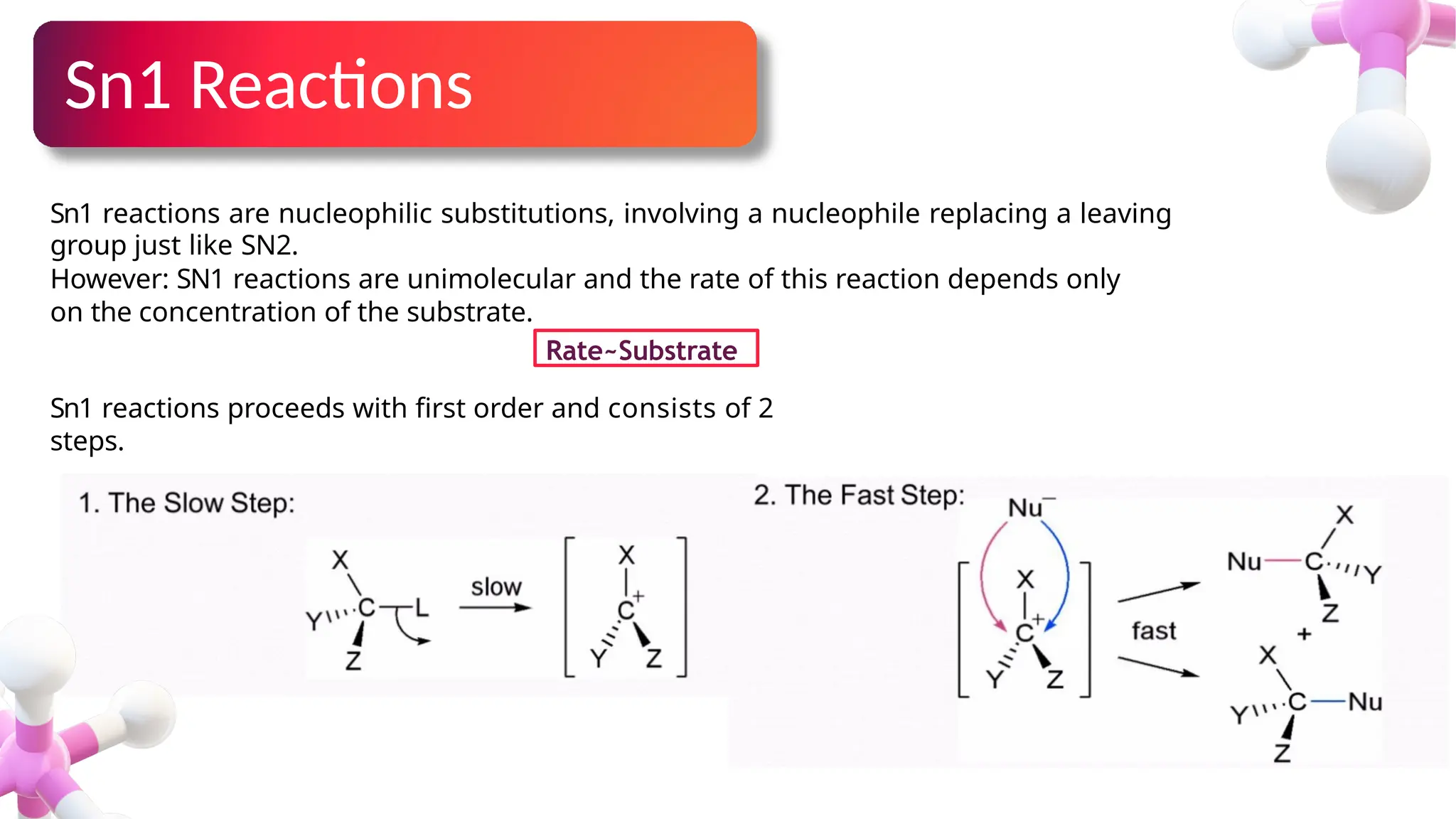
Sn1 reactions are nucleophilic substitutions, involving a nucleophile replacing a leaving
group just like SN2.
However: SN1 reactions are unimolecular and the rate of this reaction depends only
on the concentration of the substrate.
Sn1 reactions proceeds with first order and consists of 2
steps.
Sn1 Reactions
Rate~Substrate
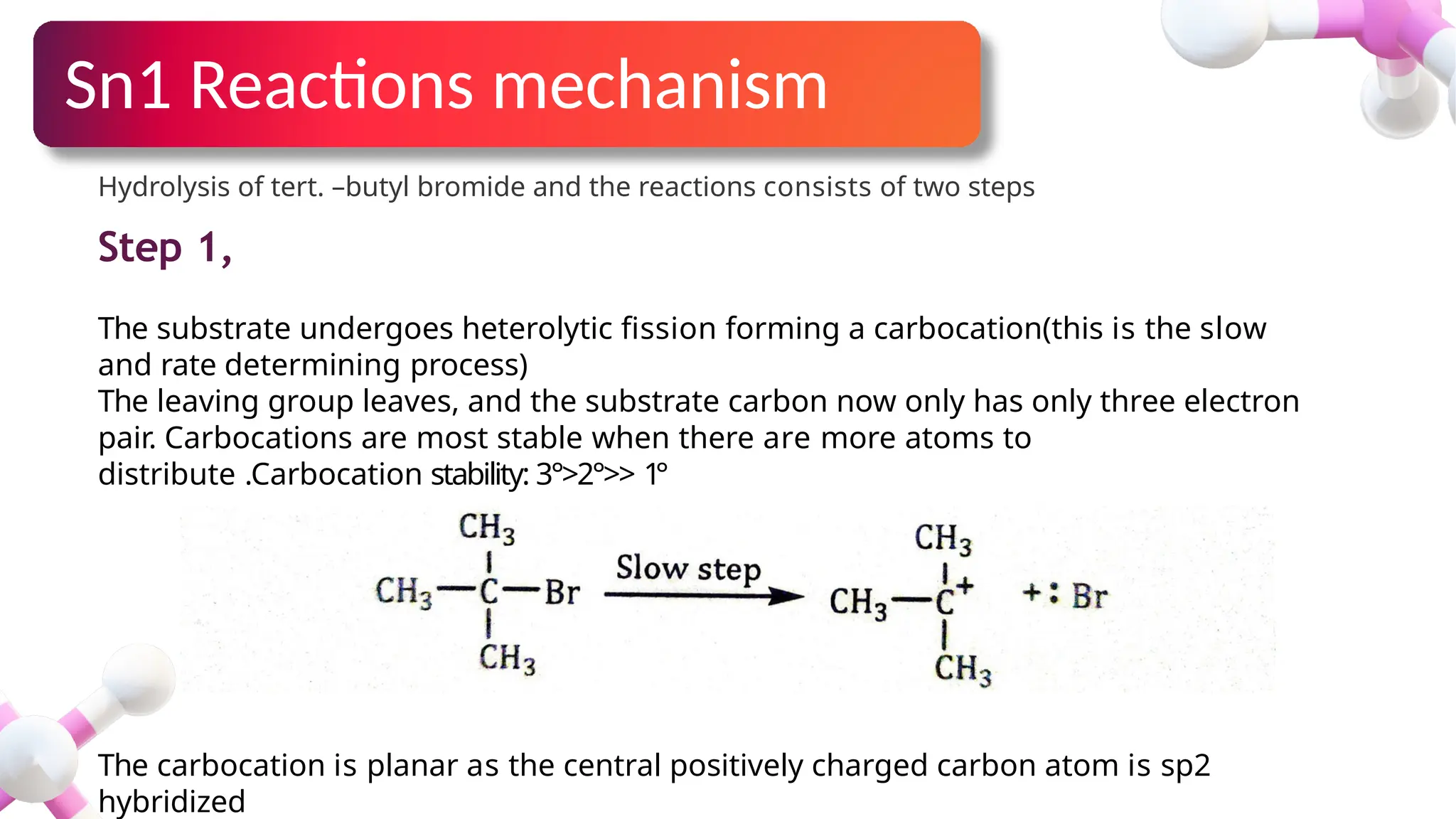
The carbocation is planar as the central positively charged carbon atom is sp2
hybridized
Sn1 Reactions mechanism
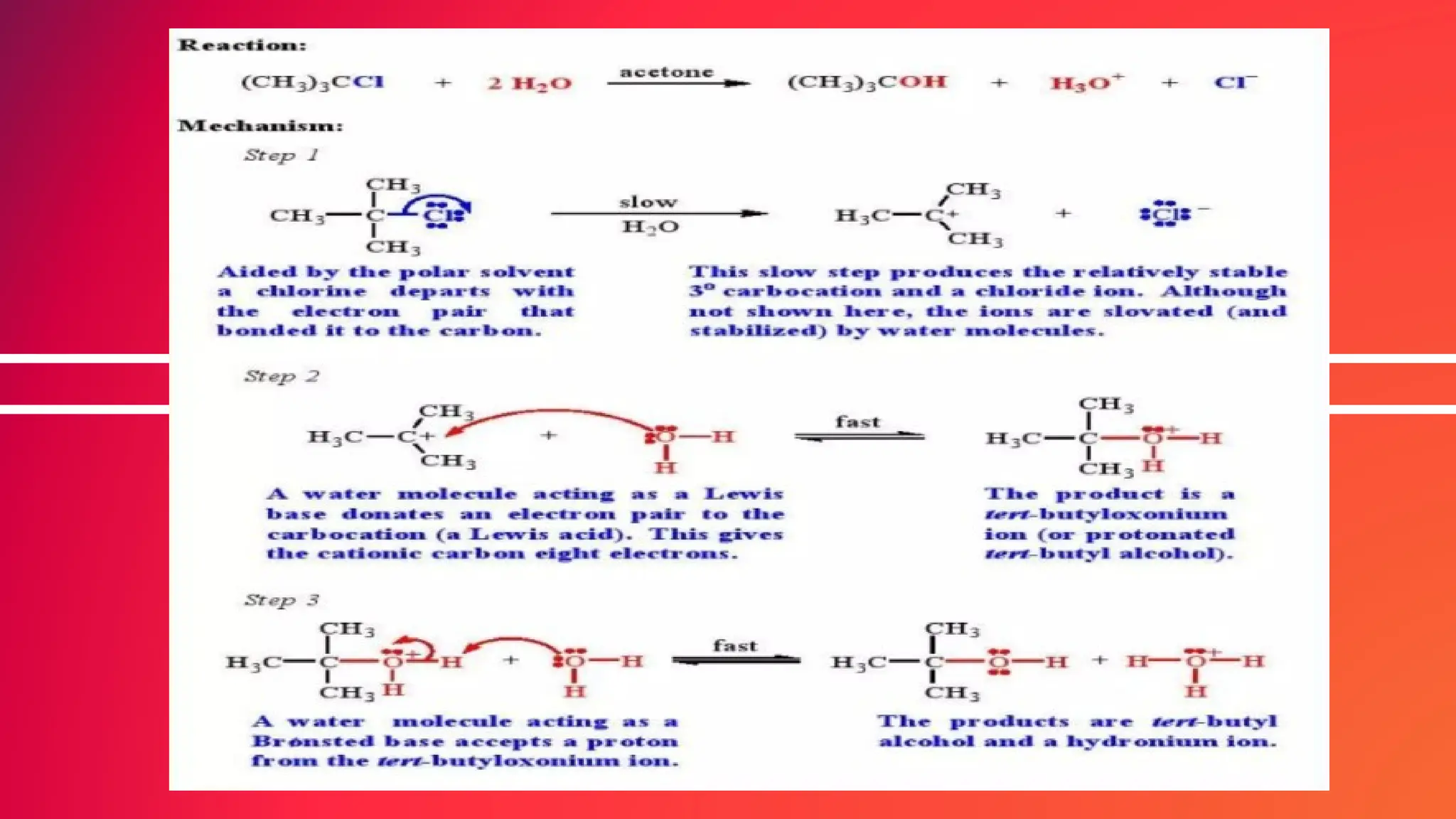
Hydrolysis of tert. –butyl bromide and the reactions consists of two steps
Step 1,
The substrate undergoes heterolytic fission forming a carbocation(this is the slow
and rate determining process)
The leaving group leaves, and the substrate carbon now only has only three electron
pair. Carbocations are most stable when there are more atoms to
distribute .Carbocation stability: 3°>2°>> 1°
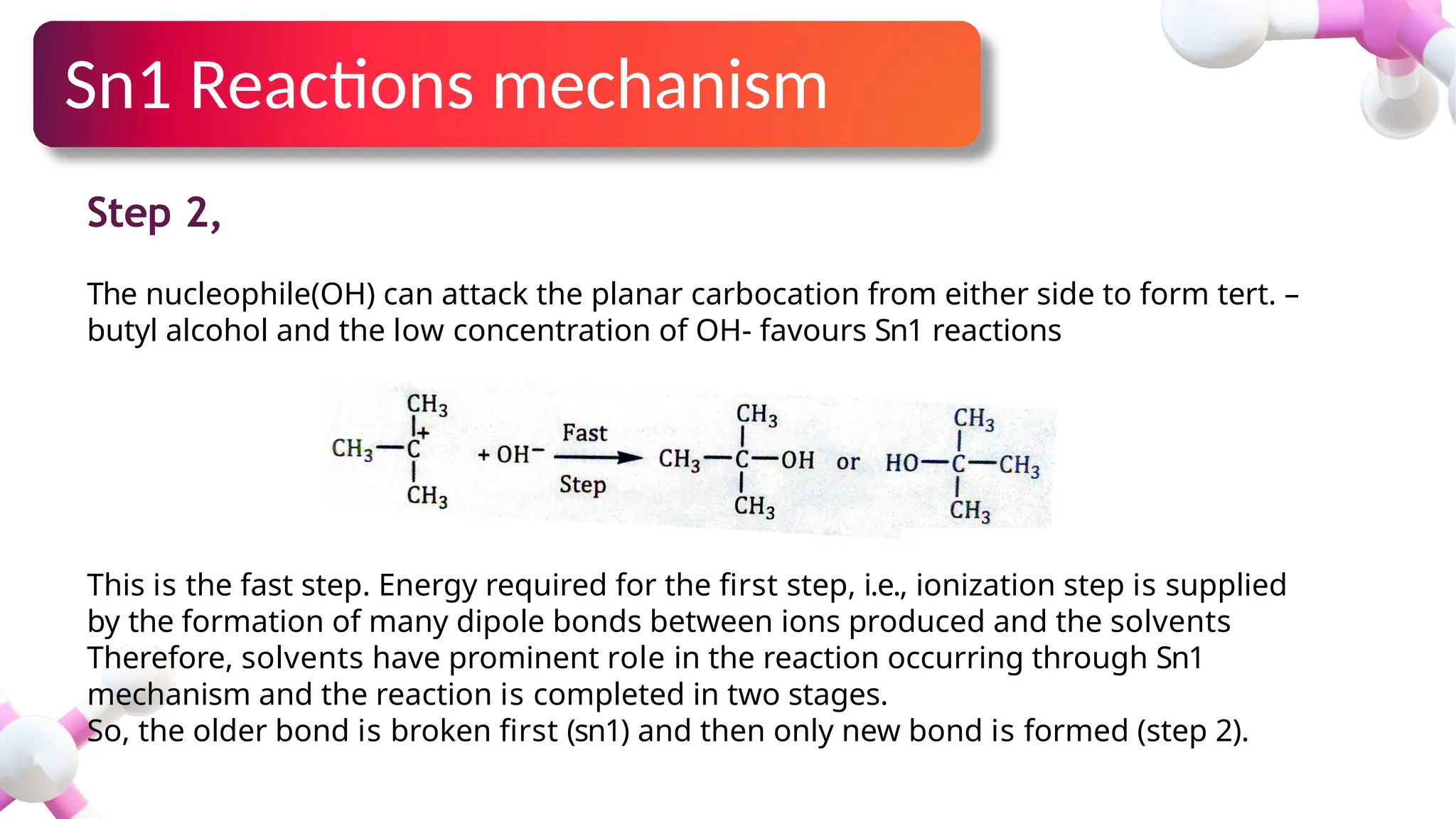
Step 2,
The nucleophile(OH) can attack the planar carbocation from either side to form tert. –
butyl alcohol and the low concentration of OH- favours Sn1 reactions
This is the fast step. Energy required for the first step, i.e., ionization step is supplied
by the formation of many dipole bonds between ions produced and the solvents
Therefore, solvents have prominent role in the reaction occurring through Sn1
mechanism and the reaction is completed in two stages.
So, the older bond is broken first (sn1) and then only new bond is formed (step 2).
Sn1 Reactions mechanism
Energy Profile
Progress of energy
Potential
Energy
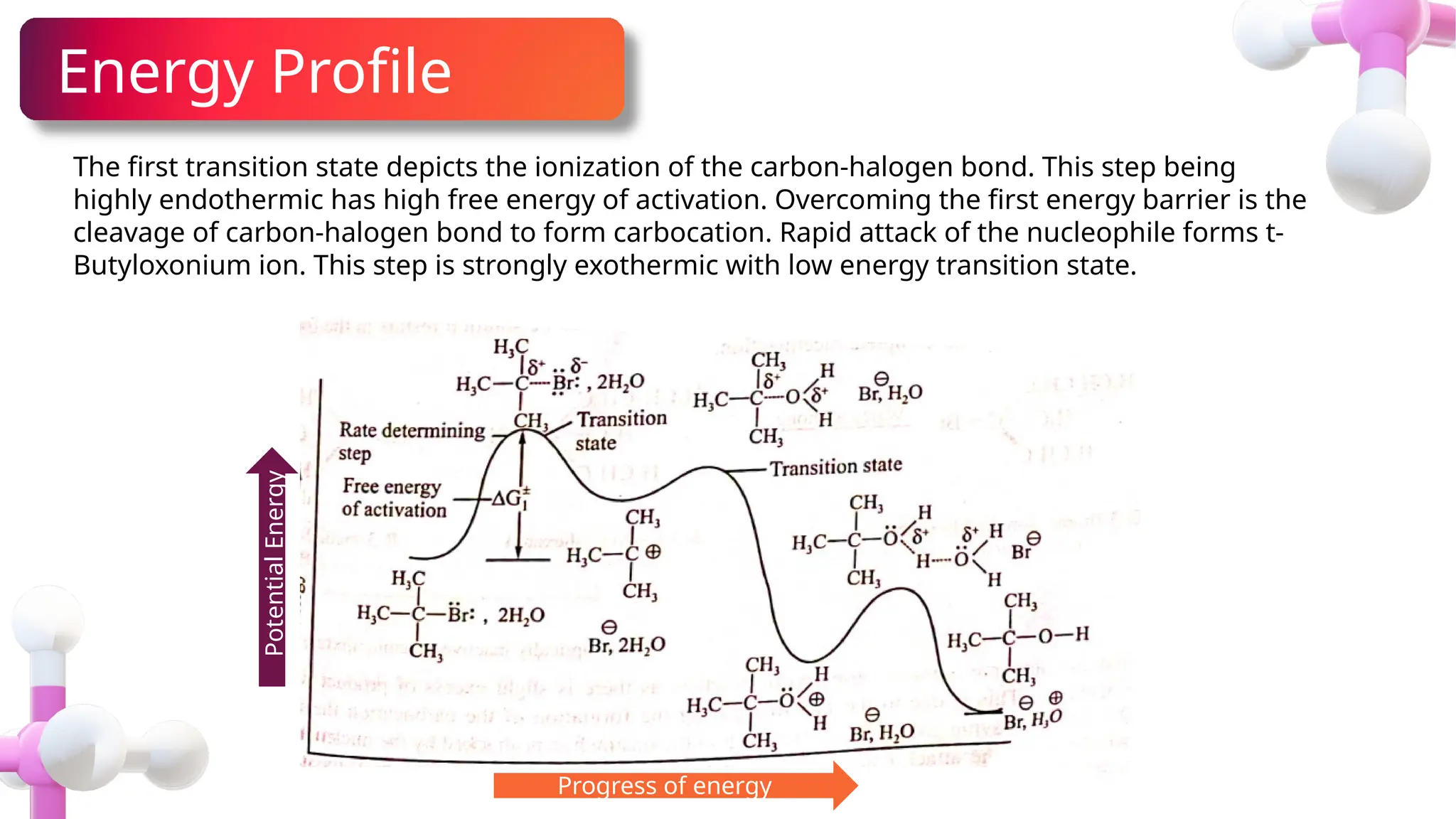
The first transition state depicts the ionization of the carbon-halogen bond. This step being
highly endothermic has high free energy of activation. Overcoming the first energy barrier is the
cleavage of carbon-halogen bond to form carbocation. Rapid attack of the nucleophile forms t-
Butyloxonium ion. This step is strongly exothermic with low energy transition state.
The SN2 reaction is a Substitution, Nucleophilic, bimolecular reaction. The transition state involves
both the nucleophile and the substrate, it accounts for the observed second- order reaction rate.
• The SN2 reaction usually involves the loss of a leaving group, which can be a halogen,
nitroxide, alkoxide, or aryloxide group.
• The reaction is catalyzed by bases and proceeds through a concerted mechanism. SN2
reactions are commonly used in the synthesis of new compounds and can be controlled by the
selection of appropriate reaction conditions.
• The reaction is a exothermic reaction where the free energy value G is negative
• Mechanism for SN2 reaction was proposed by Edward D. Hughes and Sir Christopher Ingold (the
University College, London) in 1937.
Example:-
Sn2 Reactions
Rate~[Substrate] [Nucleophile]
Sn2 Reactions Mechanism
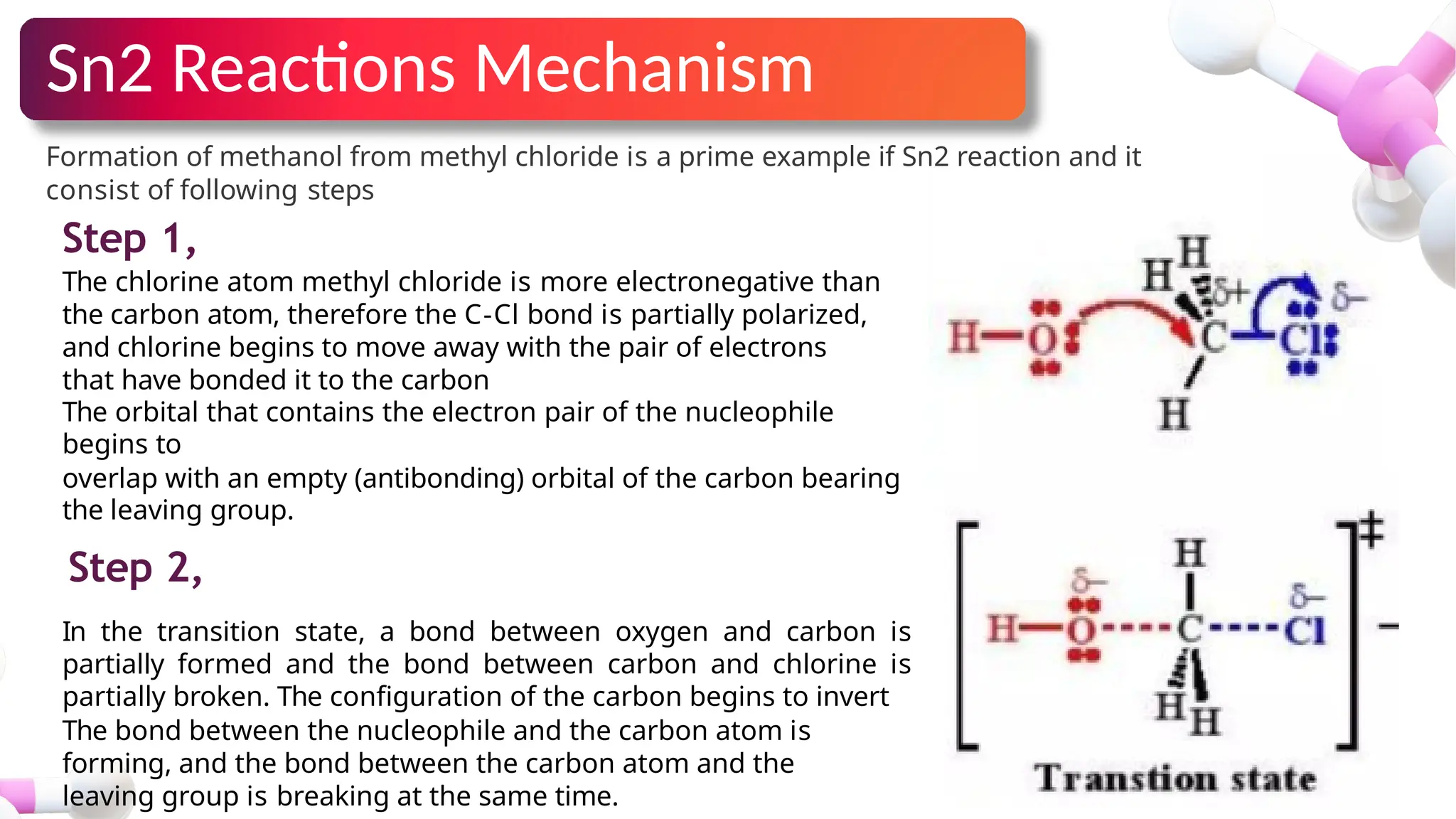
Formation of methanol from methyl chloride is a prime example if Sn2 reaction and it
consist of following steps
Step 1,
The chlorine atom methyl chloride is more electronegative than
the carbon atom, therefore the C-Cl bond is partially polarized,
and chlorine begins to move away with the pair of electrons
that have bonded it to the carbon
The orbital that contains the electron pair of the nucleophile
begins to
overlap with an empty (antibonding) orbital of the carbon bearing
the leaving group.
Step 2,
In the transition state, a bond between oxygen and carbon is
partially formed and the bond between carbon and chlorine is
partially broken. The configuration of the carbon begins to invert
The bond between the nucleophile and the carbon atom is
forming, and the bond between the carbon atom and the
leaving group is breaking at the same time.
Sn2 Reactions Mechanism
Step 3,
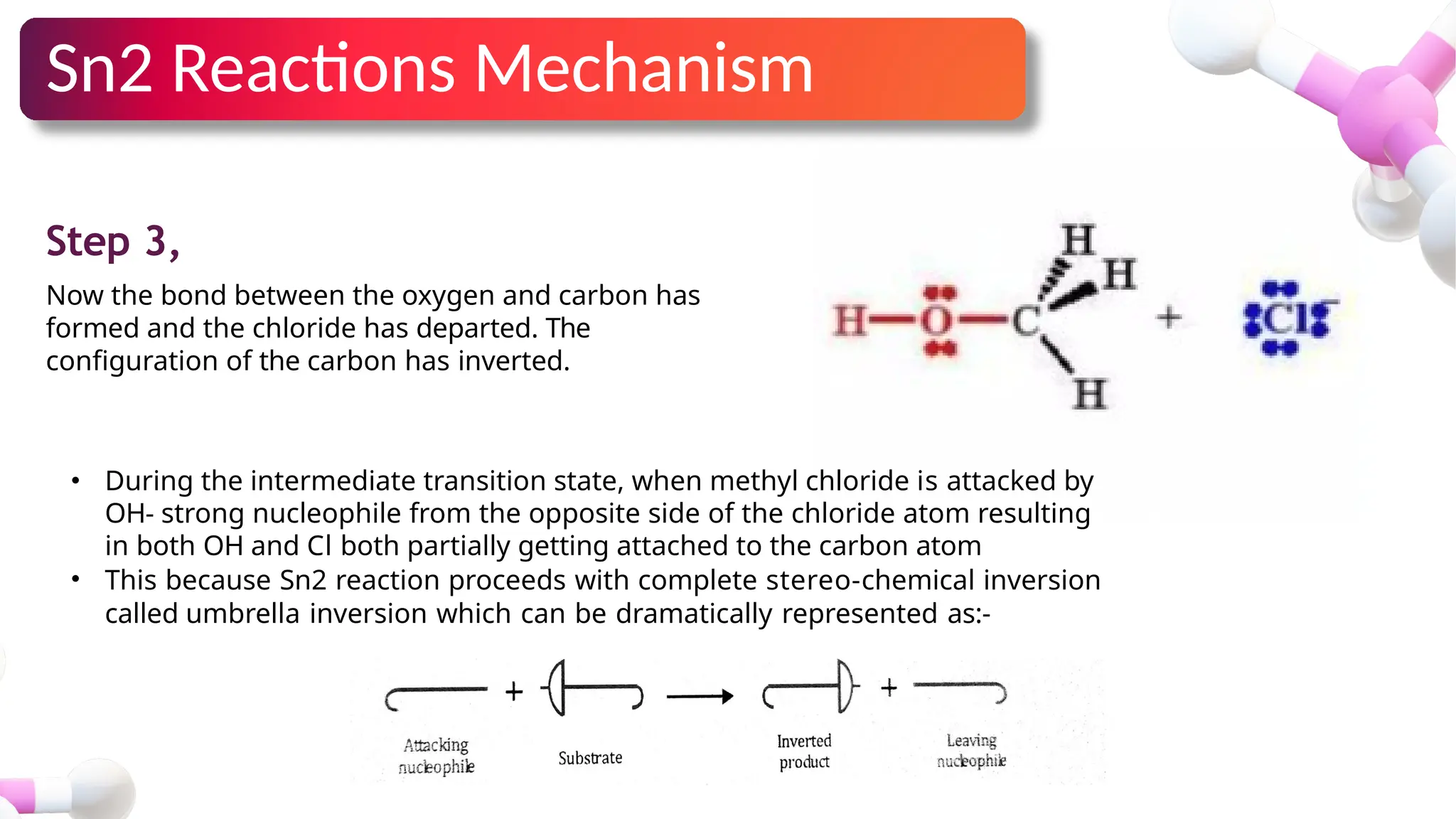
Now the bond between the oxygen and carbon has
formed and the chloride has departed. The
configuration of the carbon has inverted.
• During the intermediate transition state, when methyl chloride is attacked by
OH- strong nucleophile from the opposite side of the chloride atom resulting
in both OH and Cl both partially getting attached to the carbon atom
• This because Sn2 reaction proceeds with complete stereo-chemical inversion
called umbrella inversion which can be dramatically represented as:-
REACTION
MECHANISM
Stereochemistry
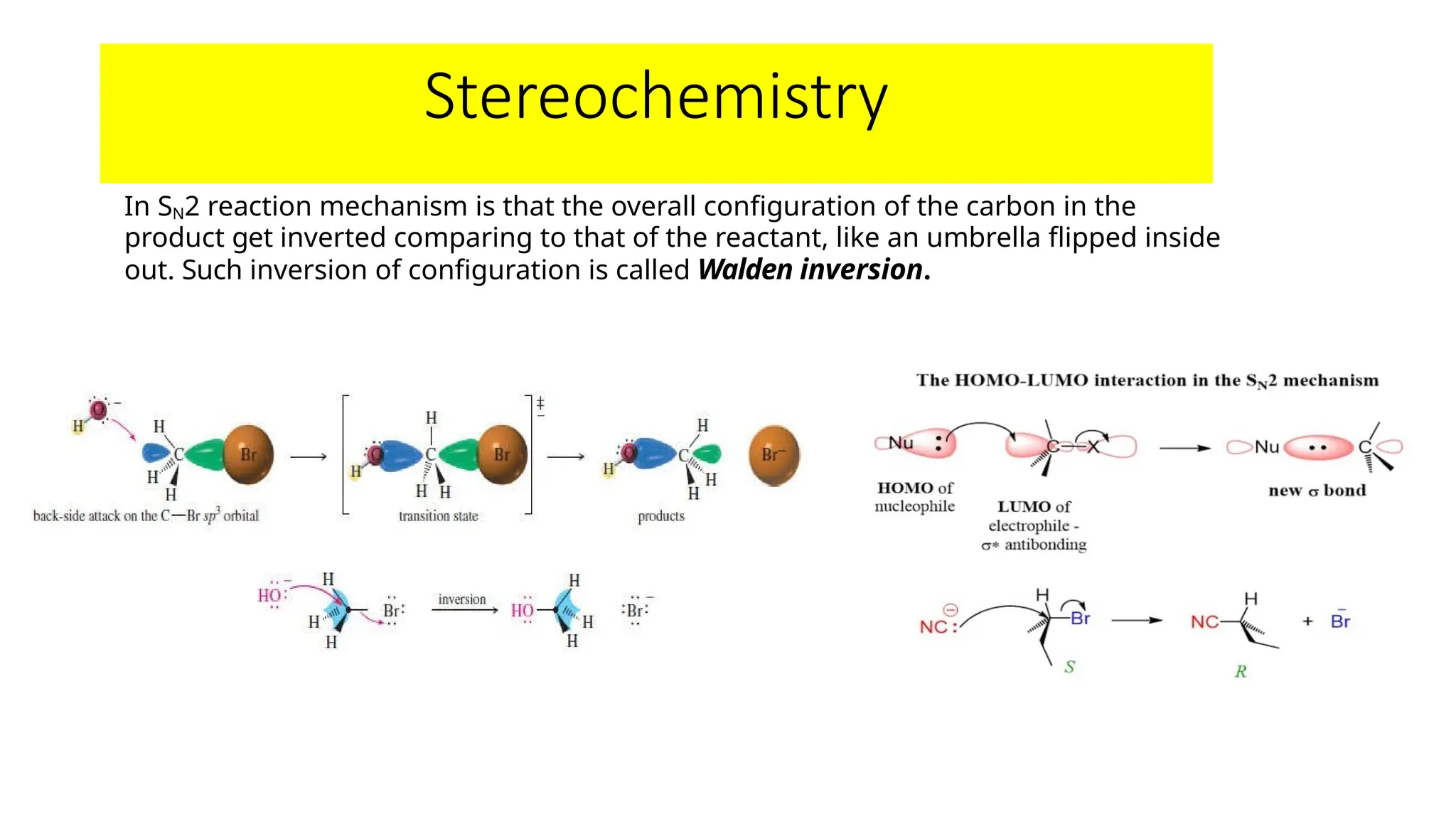
In SN2 reaction mechanism is that the overall configuration of the carbon in the
product get inverted comparing to that of the reactant, like an umbrella flipped inside
out. Such inversion of configuration is called Walden inversion.
Factors affecting SN2 reaction:
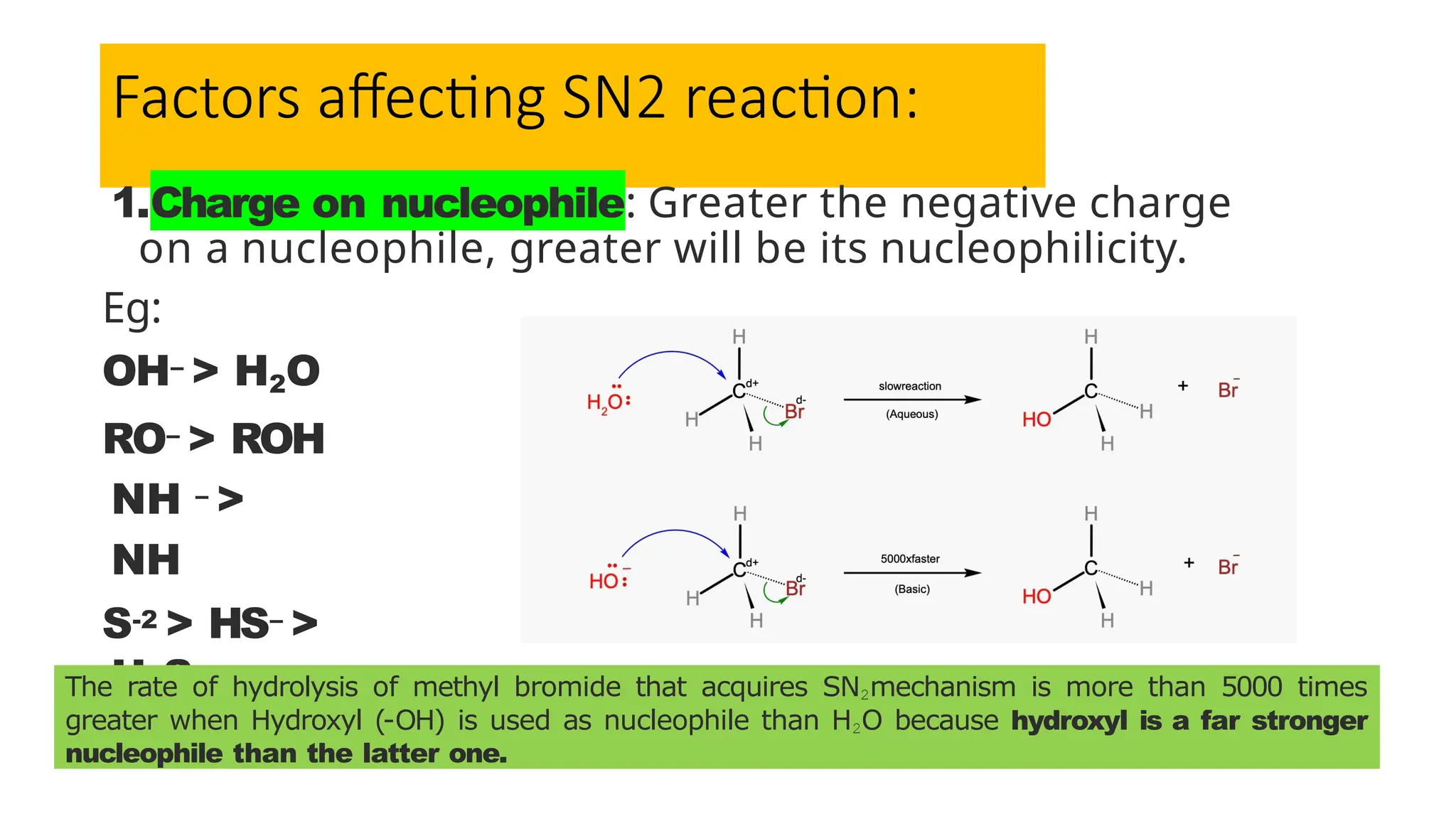
1.Charge on nucleophile: Greater the negative charge
on a nucleophile, greater will be its nucleophilicity.
Eg:
OH– > H2O
RO– > ROH
NH – >
NH
S-2 > HS– >
H2S
The rate of hydrolysis of methyl bromide that acquires SN2mechanism is more than 5000 times
greater when Hydroxyl (-OH) is used as nucleophile than H2O because hydroxyl is a far stronger
nucleophile than the latter one.
2.Electronegativity of nucleophile: Greater electronegativity of a
nucleophilic atom, suggests weaker nucleophilic strength because the
electronegativity of an atom decreases its ability to share electrons.
Eg: RSH >
ROH RS–
> RO–
I– > Br– >
Cl– > F–
3.Size of nucleophile: Nucleophilicity increases with the increasing
sizes of atoms and decreases with decreasing sizes because the relative
charge densities change directly with sizes.
4.Steric Hindrance: Sterically hindered nucleophile affects the rate of
reaction.
For the reaction to occur easily, the nucleophile must approach the
electrophilic center. If the nucleophile is a bulky molecule e.g. ter. butoxide
ion, it will face
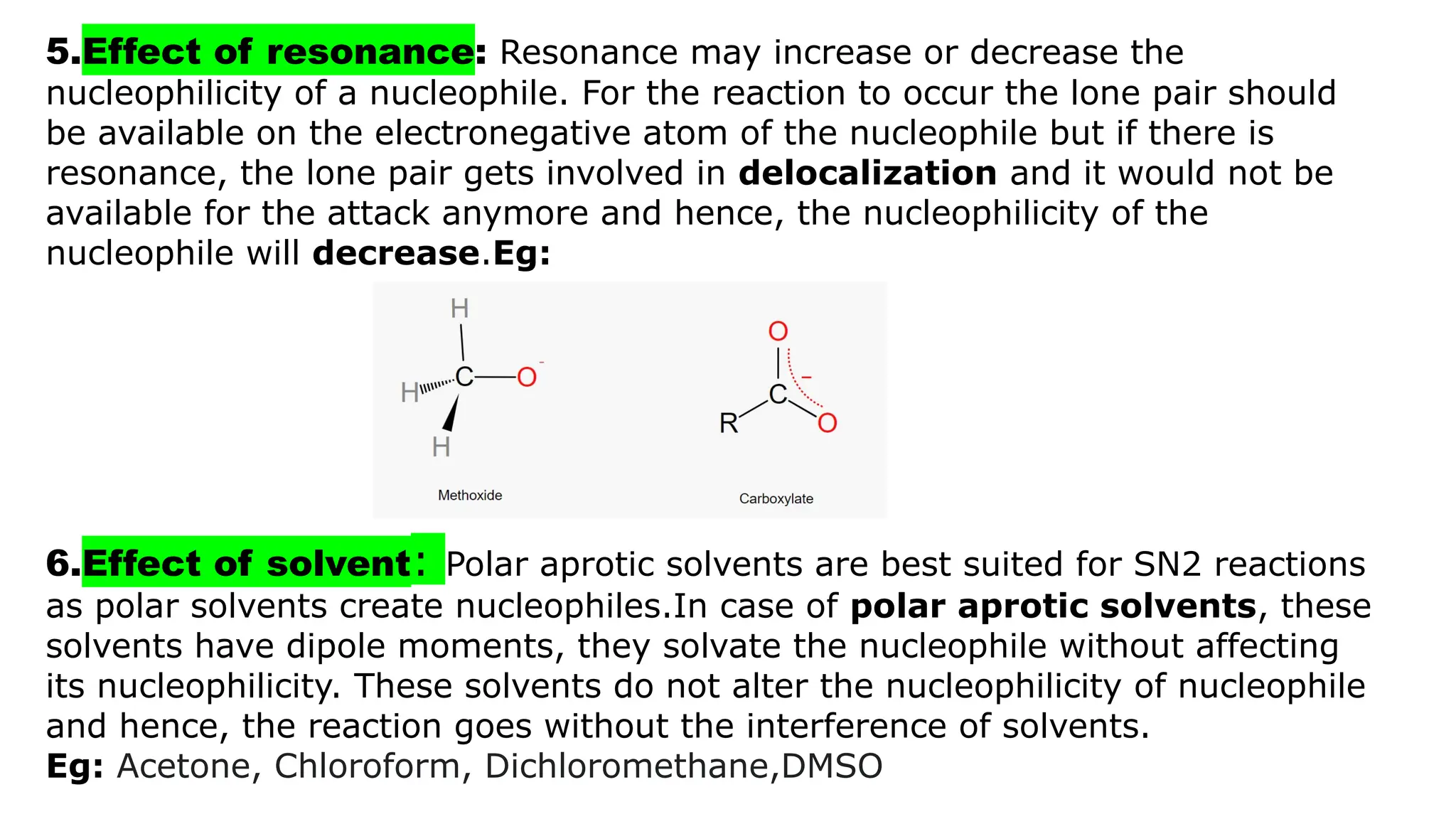
5.Effect of resonance: Resonance may increase or decrease the
nucleophilicity of a nucleophile. For the reaction to occur the lone pair should
be available on the electronegative atom of the nucleophile but if there is
resonance, the lone pair gets involved in delocalization and it would not be
available for the attack anymore and hence, the nucleophilicity of the
nucleophile will decrease.Eg:
6.Effect of solvent: Polar aprotic solvents are best suited for SN2 reactions
as polar solvents create nucleophiles.In case of polar aprotic solvents, these
solvents have dipole moments, they solvate the nucleophile without affecting
its nucleophilicity. These solvents do not alter the nucleophilicity of nucleophile
and hence, the reaction goes without the interference of solvents.
Eg: Acetone, Chloroform, Dichloromethane,DMSO
A
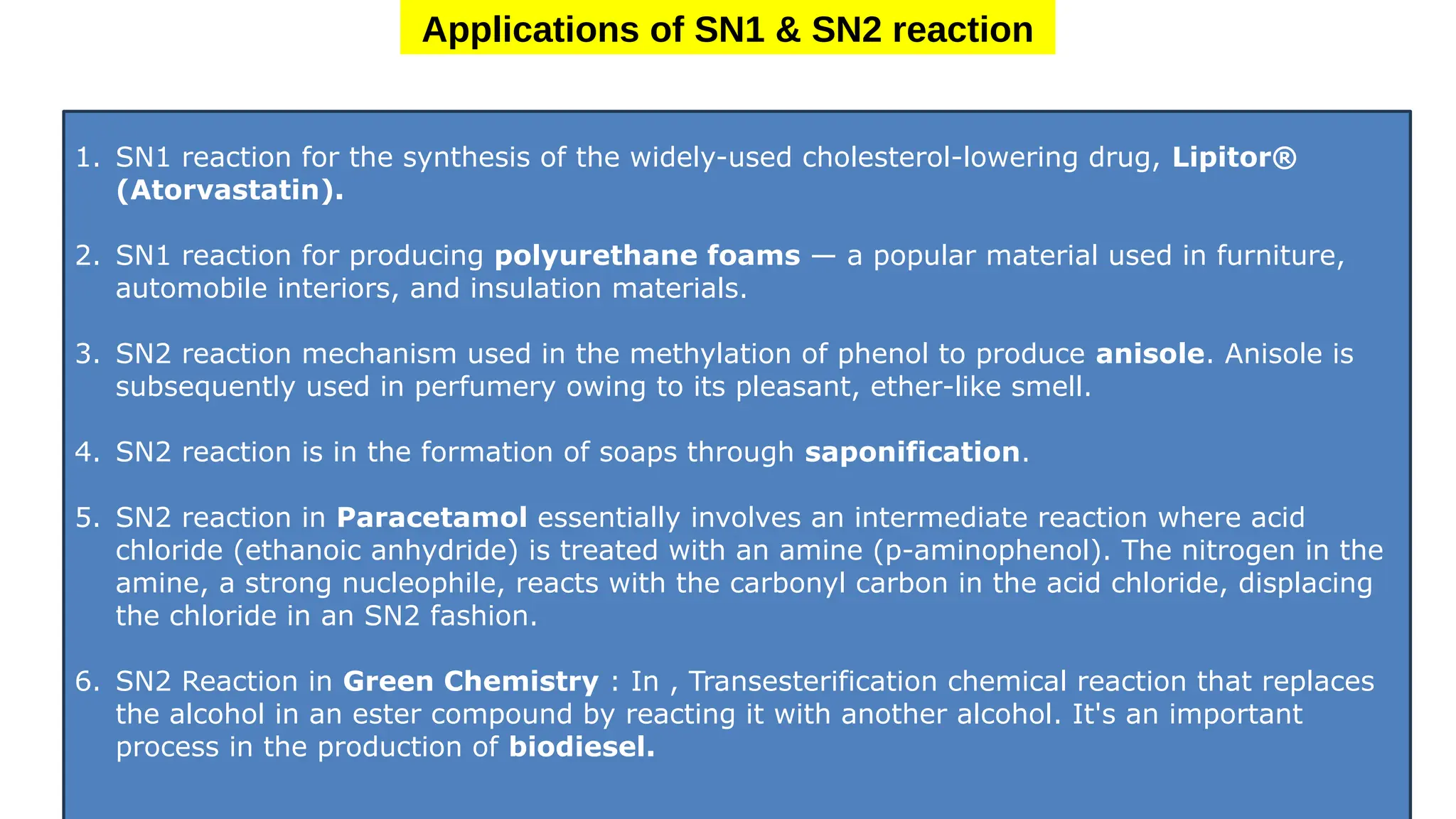
1. SN1 reaction for the synthesis of the widely-used cholesterol-lowering drug, Lipitor®
(Atorvastatin).
2. SN1 reaction for producing polyurethane foams — a popular material used in furniture,
automobile interiors, and insulation materials.
3. SN2 reaction mechanism used in the methylation of phenol to produce anisole. Anisole is
subsequently used in perfumery owing to its pleasant, ether-like smell.
4. SN2 reaction is in the formation of soaps through saponification.
5. SN2 reaction in Paracetamol essentially involves an intermediate reaction where acid
chloride (ethanoic anhydride) is treated with an amine (p-aminophenol). The nitrogen in the
amine, a strong nucleophile, reacts with the carbonyl carbon in the acid chloride, displacing
the chloride in an SN2 fashion.
6. SN2 Reaction in Green Chemistry : In , Transesterification chemical reaction that replaces
the alcohol in an ester compound by reacting it with another alcohol. It's an important
process in the production of biodiesel.
Applications of SN1 & SN2 reaction
• D. N. Kevill, B.-C. Park, K.-H. Park, M. J. D’Souza, L. Yaakoubd, S. L. Mlynarski, J. B.
Kyong, Org. Biomol. Chem. 2006, 4, 1580–1586.T.
• W. Bentley, H. C. Harris, Int. J. Mol. Sci. 2011, 12, 4805–4818.S. Yamabe, G. Zeng, W.
Guan, S. Sakaki, J. Comput. Chem. 2014, 35, 1140–1148.
• Wendlandt, A. E.; Vangal, P.; Jacobsen, E. N. Quaternary Stereocentres via an
Enantioconvergent Catalytic SN1 Reaction. Nature 2018, 556, 447 451.
−
• Smith, M. B.; Marsh, J. March’s Advanced Organic Chemistry: Reactions,
Mechanism, and Structure, 6th ed.; John Wiley & Sons, Inc.: Hoboken, NJ, USA,
2006; p 501.
• Karimova, N. V.; Chen, J.; Gord, J. R.; Staudt, S.; Bertram, T. H.; Nathanson, G. M.;
Gerber, R. B. SN2 Reactions of N2O5 With Ions in Water: Microscopic Mechanisms,
Intermediates, and Products. J. Phys. Chem. A 2020, 124, 711 720.
−
REFERNCES

Sn1 & Sn2 Reactions and their reaction mechanisms.pptx

  • 1.
    Presented By; Abutala &Vanshita Johar M.Pharm 1st year Department of Pharmaceutical Chemistry SPER, Jamia Hamdard
  • 2.
    Content Introductio n Types of nucleophilic substitutionreactions Sn1 reactions Mechanism of Sn1 reaction Sn2 reactions Mechanism of Sn2 reactions Applications References
  • 3.
    Introduction NUCLEOPHILES •The word nucleophileconsists of two nucleus, the positive part of an atom, plus-phile from Greek word philos meaning to love. •A nucleophile is any negative ion or any neutral molecule that has at least one unshared electron pair. E.g.: H-O . Nucleophilic substitutions reactions are of 2 types i.e. Sn1 & Sn2 reactions, both of which differs in terms of their mechanism and rate of reactions.
  • 4.
    Types of substitutionreactions Factor Sn1 Sn2 Substrate Tertiary (it requires formation of relatively stable carbocations) Methyl>Primary>Secondary (requires unhindered substrate) Nucleophile Weak lewis base, neutral molecule, nucleophile may be solvent Strong lewis base, rate favored by high concentration of nucleophile Solvent Polar protic(e.g. alcohol, water) Polar aprotic(e.g. DMF, DMSO) Leaving Group I > Br > Cl > F (for both Sn1 & Sn2, the weaker the base, better the leaving group)
  • 5.
    Sn1 reactions arenucleophilic substitutions, involving a nucleophile replacing a leaving group just like SN2. However: SN1 reactions are unimolecular and the rate of this reaction depends only on the concentration of the substrate. Sn1 reactions proceeds with first order and consists of 2 steps. Sn1 Reactions Rate~Substrate
  • 6.
    The carbocation isplanar as the central positively charged carbon atom is sp2 hybridized Sn1 Reactions mechanism Hydrolysis of tert. –butyl bromide and the reactions consists of two steps Step 1, The substrate undergoes heterolytic fission forming a carbocation(this is the slow and rate determining process) The leaving group leaves, and the substrate carbon now only has only three electron pair. Carbocations are most stable when there are more atoms to distribute .Carbocation stability: 3°>2°>> 1°
  • 7.
    Step 2, The nucleophile(OH)can attack the planar carbocation from either side to form tert. – butyl alcohol and the low concentration of OH- favours Sn1 reactions This is the fast step. Energy required for the first step, i.e., ionization step is supplied by the formation of many dipole bonds between ions produced and the solvents Therefore, solvents have prominent role in the reaction occurring through Sn1 mechanism and the reaction is completed in two stages. So, the older bond is broken first (sn1) and then only new bond is formed (step 2). Sn1 Reactions mechanism
  • 8.
    Energy Profile Progress ofenergy Potential Energy The first transition state depicts the ionization of the carbon-halogen bond. This step being highly endothermic has high free energy of activation. Overcoming the first energy barrier is the cleavage of carbon-halogen bond to form carbocation. Rapid attack of the nucleophile forms t- Butyloxonium ion. This step is strongly exothermic with low energy transition state.
  • 10.
    The SN2 reactionis a Substitution, Nucleophilic, bimolecular reaction. The transition state involves both the nucleophile and the substrate, it accounts for the observed second- order reaction rate. • The SN2 reaction usually involves the loss of a leaving group, which can be a halogen, nitroxide, alkoxide, or aryloxide group. • The reaction is catalyzed by bases and proceeds through a concerted mechanism. SN2 reactions are commonly used in the synthesis of new compounds and can be controlled by the selection of appropriate reaction conditions. • The reaction is a exothermic reaction where the free energy value G is negative • Mechanism for SN2 reaction was proposed by Edward D. Hughes and Sir Christopher Ingold (the University College, London) in 1937. Example:- Sn2 Reactions Rate~[Substrate] [Nucleophile]
  • 11.
    Sn2 Reactions Mechanism Formationof methanol from methyl chloride is a prime example if Sn2 reaction and it consist of following steps Step 1, The chlorine atom methyl chloride is more electronegative than the carbon atom, therefore the C-Cl bond is partially polarized, and chlorine begins to move away with the pair of electrons that have bonded it to the carbon The orbital that contains the electron pair of the nucleophile begins to overlap with an empty (antibonding) orbital of the carbon bearing the leaving group. Step 2, In the transition state, a bond between oxygen and carbon is partially formed and the bond between carbon and chlorine is partially broken. The configuration of the carbon begins to invert The bond between the nucleophile and the carbon atom is forming, and the bond between the carbon atom and the leaving group is breaking at the same time.
  • 12.
    Sn2 Reactions Mechanism Step3, Now the bond between the oxygen and carbon has formed and the chloride has departed. The configuration of the carbon has inverted. • During the intermediate transition state, when methyl chloride is attacked by OH- strong nucleophile from the opposite side of the chloride atom resulting in both OH and Cl both partially getting attached to the carbon atom • This because Sn2 reaction proceeds with complete stereo-chemical inversion called umbrella inversion which can be dramatically represented as:-
  • 13.
  • 15.
    Stereochemistry In SN2 reactionmechanism is that the overall configuration of the carbon in the product get inverted comparing to that of the reactant, like an umbrella flipped inside out. Such inversion of configuration is called Walden inversion.
  • 16.
    Factors affecting SN2reaction: 1.Charge on nucleophile: Greater the negative charge on a nucleophile, greater will be its nucleophilicity. Eg: OH– > H2O RO– > ROH NH – > NH S-2 > HS– > H2S The rate of hydrolysis of methyl bromide that acquires SN2mechanism is more than 5000 times greater when Hydroxyl (-OH) is used as nucleophile than H2O because hydroxyl is a far stronger nucleophile than the latter one.
  • 17.
    2.Electronegativity of nucleophile:Greater electronegativity of a nucleophilic atom, suggests weaker nucleophilic strength because the electronegativity of an atom decreases its ability to share electrons. Eg: RSH > ROH RS– > RO– I– > Br– > Cl– > F– 3.Size of nucleophile: Nucleophilicity increases with the increasing sizes of atoms and decreases with decreasing sizes because the relative charge densities change directly with sizes. 4.Steric Hindrance: Sterically hindered nucleophile affects the rate of reaction. For the reaction to occur easily, the nucleophile must approach the electrophilic center. If the nucleophile is a bulky molecule e.g. ter. butoxide ion, it will face
  • 18.
    5.Effect of resonance:Resonance may increase or decrease the nucleophilicity of a nucleophile. For the reaction to occur the lone pair should be available on the electronegative atom of the nucleophile but if there is resonance, the lone pair gets involved in delocalization and it would not be available for the attack anymore and hence, the nucleophilicity of the nucleophile will decrease.Eg: 6.Effect of solvent: Polar aprotic solvents are best suited for SN2 reactions as polar solvents create nucleophiles.In case of polar aprotic solvents, these solvents have dipole moments, they solvate the nucleophile without affecting its nucleophilicity. These solvents do not alter the nucleophilicity of nucleophile and hence, the reaction goes without the interference of solvents. Eg: Acetone, Chloroform, Dichloromethane,DMSO
  • 19.
    A 1. SN1 reactionfor the synthesis of the widely-used cholesterol-lowering drug, Lipitor® (Atorvastatin). 2. SN1 reaction for producing polyurethane foams — a popular material used in furniture, automobile interiors, and insulation materials. 3. SN2 reaction mechanism used in the methylation of phenol to produce anisole. Anisole is subsequently used in perfumery owing to its pleasant, ether-like smell. 4. SN2 reaction is in the formation of soaps through saponification. 5. SN2 reaction in Paracetamol essentially involves an intermediate reaction where acid chloride (ethanoic anhydride) is treated with an amine (p-aminophenol). The nitrogen in the amine, a strong nucleophile, reacts with the carbonyl carbon in the acid chloride, displacing the chloride in an SN2 fashion. 6. SN2 Reaction in Green Chemistry : In , Transesterification chemical reaction that replaces the alcohol in an ester compound by reacting it with another alcohol. It's an important process in the production of biodiesel. Applications of SN1 & SN2 reaction
  • 20.
    • D. N.Kevill, B.-C. Park, K.-H. Park, M. J. D’Souza, L. Yaakoubd, S. L. Mlynarski, J. B. Kyong, Org. Biomol. Chem. 2006, 4, 1580–1586.T. • W. Bentley, H. C. Harris, Int. J. Mol. Sci. 2011, 12, 4805–4818.S. Yamabe, G. Zeng, W. Guan, S. Sakaki, J. Comput. Chem. 2014, 35, 1140–1148. • Wendlandt, A. E.; Vangal, P.; Jacobsen, E. N. Quaternary Stereocentres via an Enantioconvergent Catalytic SN1 Reaction. Nature 2018, 556, 447 451. − • Smith, M. B.; Marsh, J. March’s Advanced Organic Chemistry: Reactions, Mechanism, and Structure, 6th ed.; John Wiley & Sons, Inc.: Hoboken, NJ, USA, 2006; p 501. • Karimova, N. V.; Chen, J.; Gord, J. R.; Staudt, S.; Bertram, T. H.; Nathanson, G. M.; Gerber, R. B. SN2 Reactions of N2O5 With Ions in Water: Microscopic Mechanisms, Intermediates, and Products. J. Phys. Chem. A 2020, 124, 711 720. − REFERNCES