Prepared By-
ANUSHI
ANJALI
JUHI
SHIVANI
1. INTRODUCTION TO CONFLICT
2. DEFINITION OF CONFLICT
3. NATURE OF CONFLICT
4. VIEWS ON CONFLICT
5. TYPES OF CONFLICT
6. RELATIONSHIP B/W ORGANISATION PERFORMANCE
& CONFLICT
7. POSITIVE AND NEGATIVE CONFLICT
8. PROCESS OF CONFLICT
9. LEVELS OF CONFLICT
10.CONFLICT RESOLUTION IN GROUPS & DIFFERENT
PROBLEMSOLVING STRATEGIES
11.LIVE CASE STUDY
12.CASE STUDY WITH EXAMPLES
The concept of conflict, being an outcome of behaviours, is
an integral part of human life. Wherever there is
interaction, there is conflict.
Conflict can be considered as an expression of hostility,
negative attitudes, antagonism, aggression, rivalry and
misunderstanding.
According to LOUIS R. PONDY, “CONFLICT” is:
ANTECEDENT CONDITIONS: For ex. Scarcity of resources,
policy differences among individuals, etc.
Effective states of the individuals involved, for ex. :
Stress, tension, hostility, anxiety, etc.
Cognitive states of individuals, i.e., their perception of
awareness of conflict situations.
It is a process that begins when one party
perceives that another party has negatively
affected, or is about to negatively affect
something that the first party cares about.
Conflict is a psychological state of mind when
people are in a dilemma whether to do or not to
do a thing, is a state of conflict.
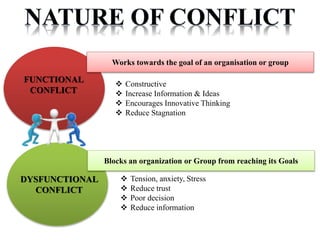
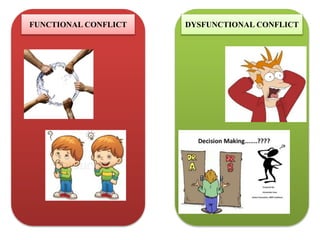
FUNCTIONAL
CONFLICT
DYSFUNCTIONAL
CONFLICT
Works towards the goal of an organisation or group
Blocks an organization or Group from reaching its Goals
 Constructive
 Increase Information & Ideas
 Encourages Innovative Thinking
 Reduce Stagnation
 Tension, anxiety, Stress
 Reduce trust
 Poor decision
 Reduce information
FUNCTIONAL CONFLICT DYSFUNCTIONAL CONFLICT
TRADITIONAL
• Bad, caused by trouble makers
• Should be avoided or suppressed
HUMAN
RELATIONS
• Natural, inevitable
• Cannot eliminate may contribute to group performance
INTERACTIONIST
• A positive force and essential to performance effectively.
Can be functional or dysfunctional.
• An atmosphere of tension is essential in any organization
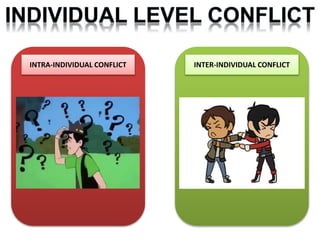
INDIVIDUAL
LEVEL
CONFLICT
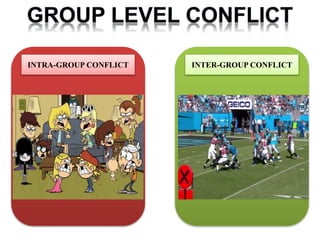
GROUP LEVEL
CONFLICT
ORGANIZATIONL
LEVEL CONFLICT
INTRA-
INDIVIDUAL
CONFLICT
INTER-
INDIVIDUAL
CONFLICT
INTRA GROUP
CONFLICT
INTER
GROUP
CONFLICT
INTRA
ORGANIS.
CONFLICT
INTER
ORGANIS.
CONFLIC
T
INTRA-INDIVIDUAL CONFLICT INTER-INDIVIDUAL CONFLICT
INTRA-GROUP CONFLICT INTER-GROUP CONFLICT
INTRA-ORG. CONFLICT INTER-ORG. CONFLICT
VS.
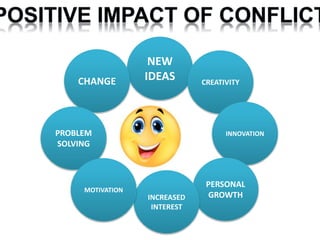
POSITIVE IMPACT NEGATIVE IMPACT
NEW
IDEASCHANGE
PROBLEM
SOLVING
CREATIVITY
INNOVATION
PERSONAL
GROWTHINCREASED
INTEREST
MOTIVATION
STRESS
ANGER
CONFUSION
FEAR
NON
PRODUCTIVITY
RESOURCE
WASTAGENEGATIVE
THOUGHTS
DE-
MOTIVATION
LATENT CONFLICT
PERCEIVED CONFLICT
FELT CONFLICT
MANIFEST CONFLICT
FUNCTIONAL CONFLICT DYSFUNCTIONAL CONFLICT
First, I need to
do the analysis
I need funds
for marketing.
INTERDEPENDENCE
I have to take
the risk to gain
more profit.
I have to stop
giving funds
unnecessarily or
we might incur
losses.
DIFFERENT GOALS
I am aware
about what is
to come…
Here, comes the
bomb TOM.
WHEN BOTH THE PARTIES ARE AWARE ABOUT THE
CONFLICT THAT CAN ARISE
I cannot work
with him…. Neither can I.
VS.
 RESPOND EMOTIONALLY
 COOPERATION DECREASES
 A SMALL PROBLEM ESCALATES INTO MUCH BIGGER
PROBLEM
STAGE WHERE CONFLICT BECOMES VISIBLE
BOTH THE PARTIES SHOW THEIR REACTIONS &
BEHAVIORS
Intractable
Situation
Fight
Contest
Disagreement
A problem to Solve
IN GROUP
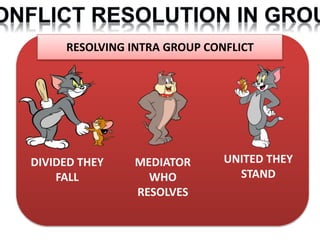
RESOLVING INTRA GROUP CONFLICT
DIVIDED THEY
FALL
UNITED THEY
STAND
MEDIATOR
WHO
RESOLVES
RESOLVING INTER GROUP CONFLICT
PROBLEM
SOLVING
SMOOTHEN
AVOIDANCE
COMPROMISE
EXPANSION
OF
RESOURCES
ORGANIZATION
REDESIGN
SUBORDINATE
GOALS
COMMUNICATE
• Taking things out &
explaining
• People need to express
thoughts & ideas
tactfully
NEGOTIATE
• When two or more
people want to work out
conflict themselves,
they might follow a set
of steps
MEDIATE
• The opposite parties
meet with a third party
who acts as a mediator.
ARBITRATE
• Is much more similar to
a formal litigation where
an arbitrator will act as
judge & hear out both
sides.
LITIGATE
• When people cant work
out their conflicts
themselves, then they
may go to court & have
a trial.
LEGISLATE
• To make something the
law or rule.
Explore the issues
Start the conversation
Find common ground
Discover solutions
Make the process
visible
CONFLICT
LISTEN
WIN-WIN
WIN-LOSE LOSE-LOSE
WIN-LOSE
FORCE OUTCOME REGARDLESS OF THE DESIRE
OF ONE PARTY
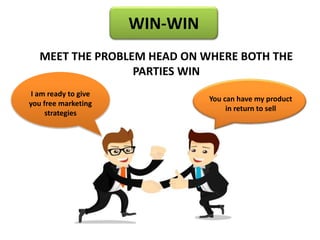
WIN-WIN
MEET THE PROBLEM HEAD ON WHERE BOTH THE
PARTIES WIN
I am ready to give
you free marketing
strategies
You can have my product
in return to sell
LOSE-LOSE
LITTLE OR NO SIGNIFICANCE TO OTHER PARTY
IF I AM GOING
DOWN YOU ARE
GOING WITH ME
YOU CANNOT
WIN
A CASE STUDY ON THE
OUSTER OF CYRUS
MISTRY AS THE
CHAIRMAN OF TATA
GROUP
CONFLICT OF
INTEREST
CYRUS MISTRY WAS APPOINTED AS CEO OF TATA GROUP
IN 2012
IT WAS A MANIFEST CONFLICT BETWEEN CYRUS MISTRY
AND RATAN TATA
ON 24TH OCT’16 HE WAS REMOVED AS A CEO OF THE
COMPANY
INTERFERENCE – NON-PERFORMANCE
NANO PROJECT
CONCLUSION
Cyrus Mistry still enjoys the support of the
biggest shareholder of the group, although this
cannot help him legally, but he could use this fact
to pressurize the group. He has filed his reply
stating that he was removed from his office
illegally and has submitted certain documents as
evidence to prove that Mr Ratan Tata has been
interfering in his work.
CONFLICT BETWEEN MCDONALD'S
AND VIKRAM BAKSHI CONFLICT
The conflict between McDonald's India Pvt.
Ltd. (MIPL) and its long-time local partner
Connaught Plaza Restaurants Pvt. Ltd.
(CPRL) seems to have reached a point of no
return.
ORIGIN & RESULTS OF
CONFLICT
Conflict resolution (1)

Conflict resolution (1)