Submission to:
Dr. Mohammad Khasro Miah
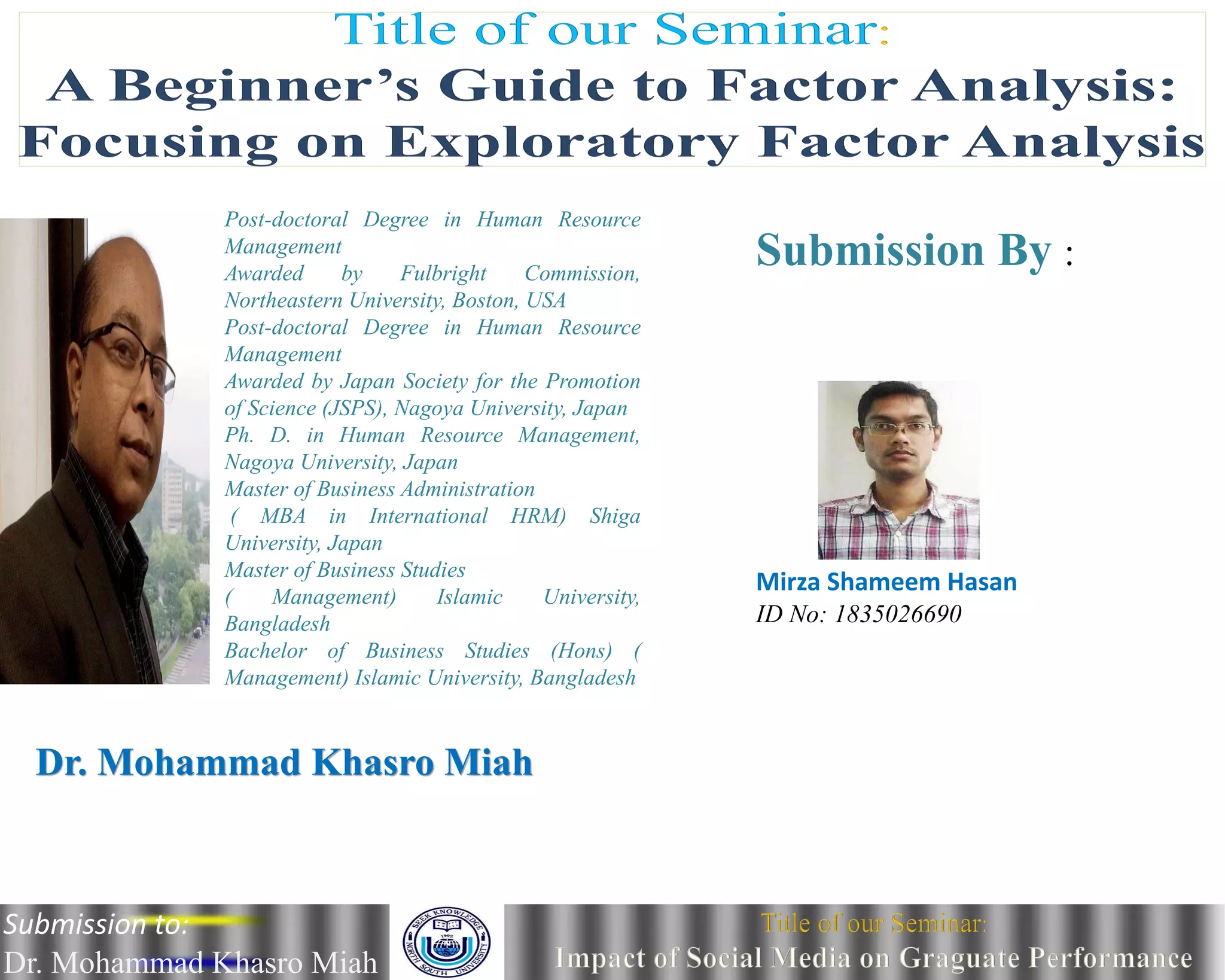
Post-doctoral Degree in Human Resource Management
Awarded by Fulbright Commission, Northeastern University, Boston, USA
Post-doctoral Degree in Human Resource Management
Awarded by Japan Society for the Promotion of Science (JSPS), Nagoya University, Japan
Ph. D. in Human Resource Management, Nagoya University, Japan
Master of Business Administration ( MBA in International HRM) Shiga University, Japan
Master of Business Studies ( Management) Islamic University, Bangladesh
Bachelor of Business Studies (Hons) ( Management) Islamic University, Bangladesh
Post-doctoral Degree in Human Resource
Management
Awarded by Fulbright Commission,
Northeastern University, Boston, USA
Post-doctoral Degree in Human Resource
Management
Awarded by Japan Society for the Promotion
of Science (JSPS), Nagoya University, Japan
Ph. D. in Human Resource Management,
Nagoya University, Japan
Master of Business Administration
( MBA in International HRM) Shiga
University, Japan
Master of Business Studies
( Management) Islamic University,
Bangladesh
Bachelor of Business Studies (Hons) (
Management) Islamic University, Bangladesh
Dr. Mohammad Khasro Miah
Submission to:
Dr. Mohammad Khasro Miah
Submission By :
Mirza Shameem Hasan
ID No: 1835026690
Submission to:
Dr. Mohammad Khasro Miah
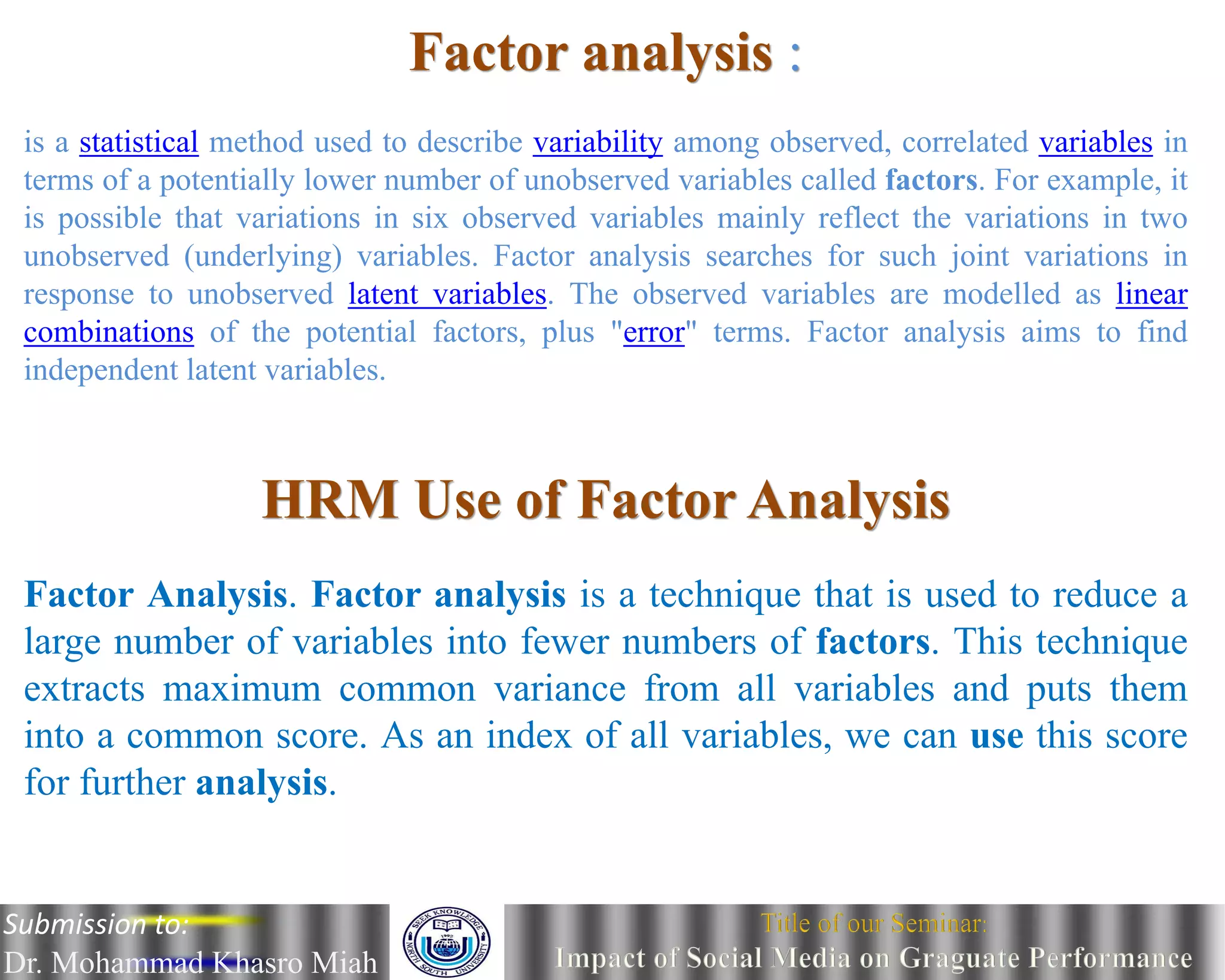
Factor analysis :
is a statistical method used to describe variability among observed, correlated variables in
terms of a potentially lower number of unobserved variables called factors. For example, it
is possible that variations in six observed variables mainly reflect the variations in two
unobserved (underlying) variables. Factor analysis searches for such joint variations in
response to unobserved latent variables. The observed variables are modelled as linear
combinations of the potential factors, plus "error" terms. Factor analysis aims to find
independent latent variables.
HRM Use of Factor Analysis
Factor Analysis. Factor analysis is a technique that is used to reduce a
large number of variables into fewer numbers of factors. This technique
extracts maximum common variance from all variables and puts them
into a common score. As an index of all variables, we can use this score
for further analysis.
Submission to:
Dr. Mohammad Khasro Miah
Submission to:
Dr. Mohammad Khasro Miah
Z-test
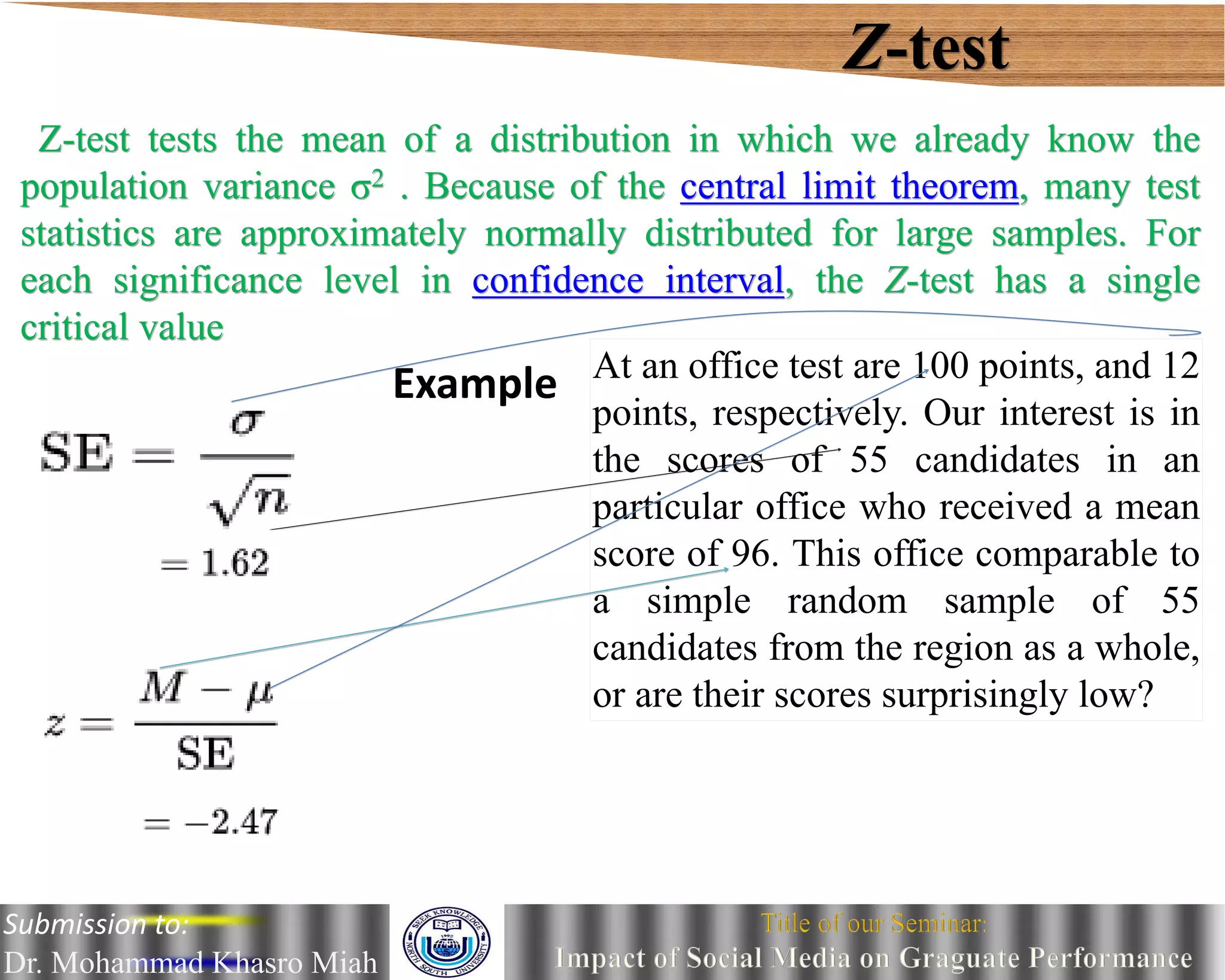
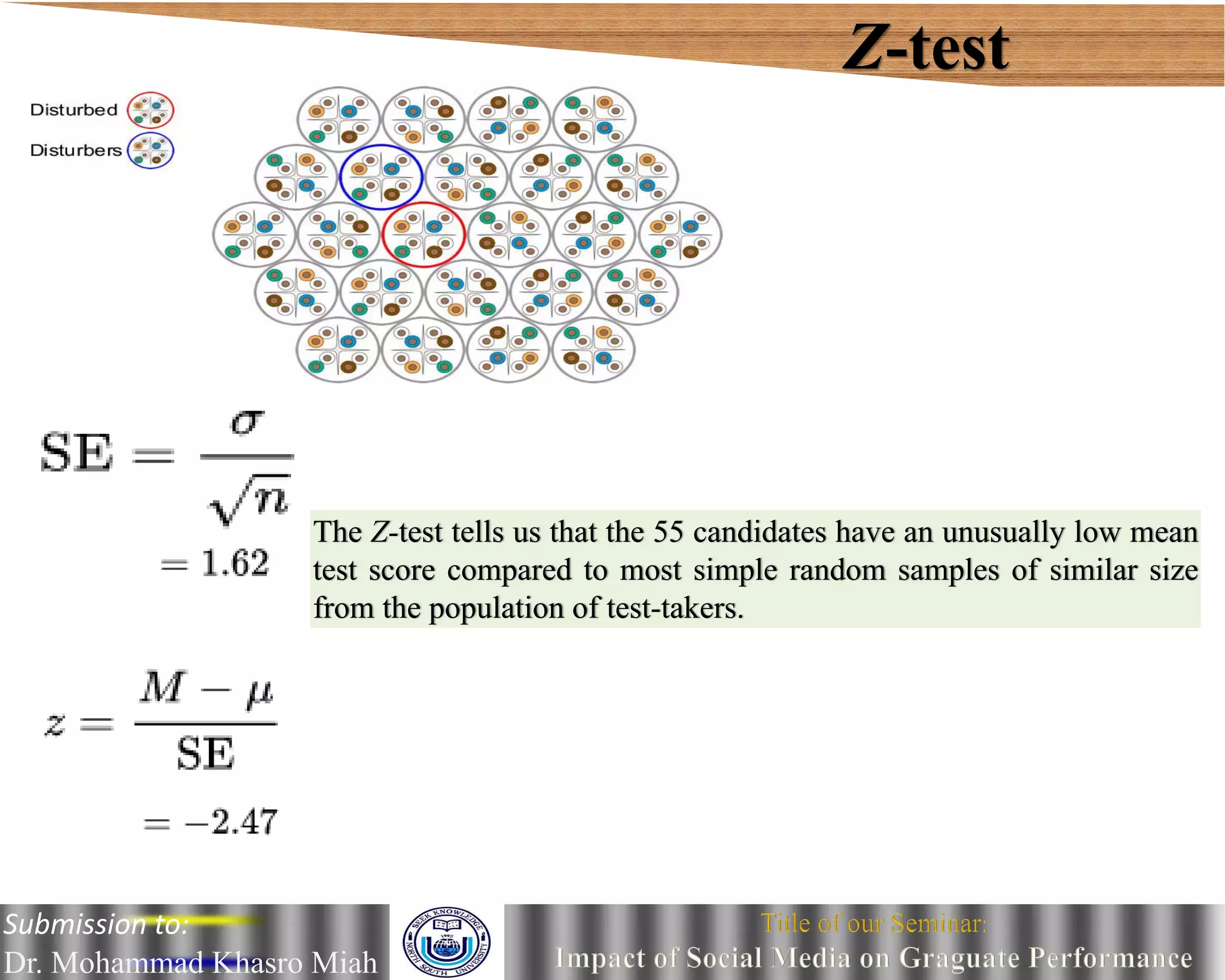
Z-test tests the mean of a distribution in which we already know the
population variance σ2 . Because of the central limit theorem, many test
statistics are approximately normally distributed for large samples. For
each significance level in confidence interval, the Z-test has a single
critical value
Example At an office test are 100 points, and 12
points, respectively. Our interest is in
the scores of 55 candidates in an
particular office who received a mean
score of 96. This office comparable to
a simple random sample of 55
candidates from the region as a whole,
or are their scores surprisingly low?
Submission to:
Dr. Mohammad Khasro Miah
Z-test
The Z-test tells us that the 55 candidates have an unusually low mean
test score compared to most simple random samples of similar size
from the population of test-takers.
Submission to:
Dr. Mohammad Khasro Miah
Submission to:
Dr. Mohammad Khasro Miah
T Test
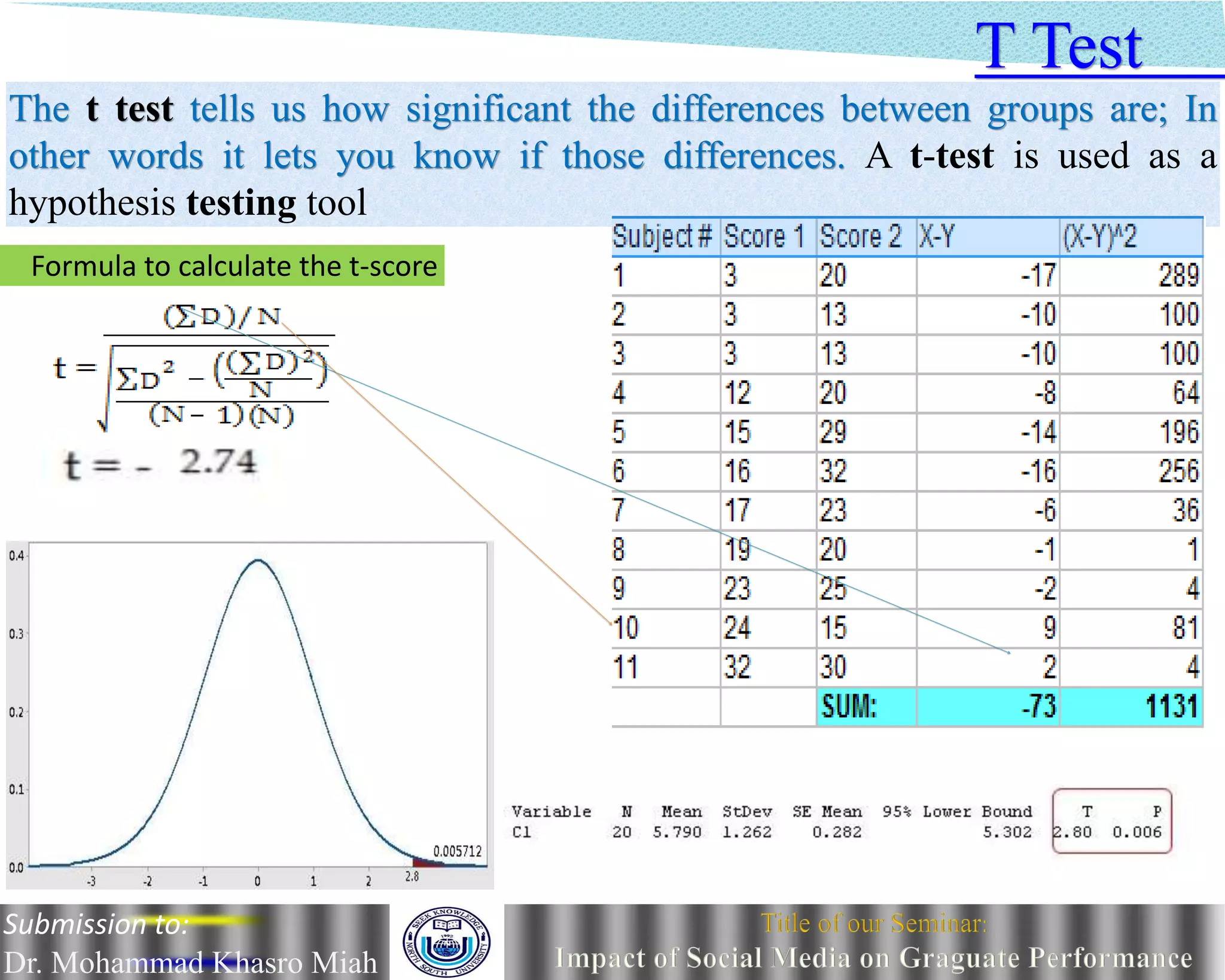
The t test tells us how significant the differences between groups are; In
other words it lets you know if those differences. A t-test is used as a
hypothesis testing tool
Formula to calculate the t-score
Submission to:
Dr. Mohammad Khasro Miah
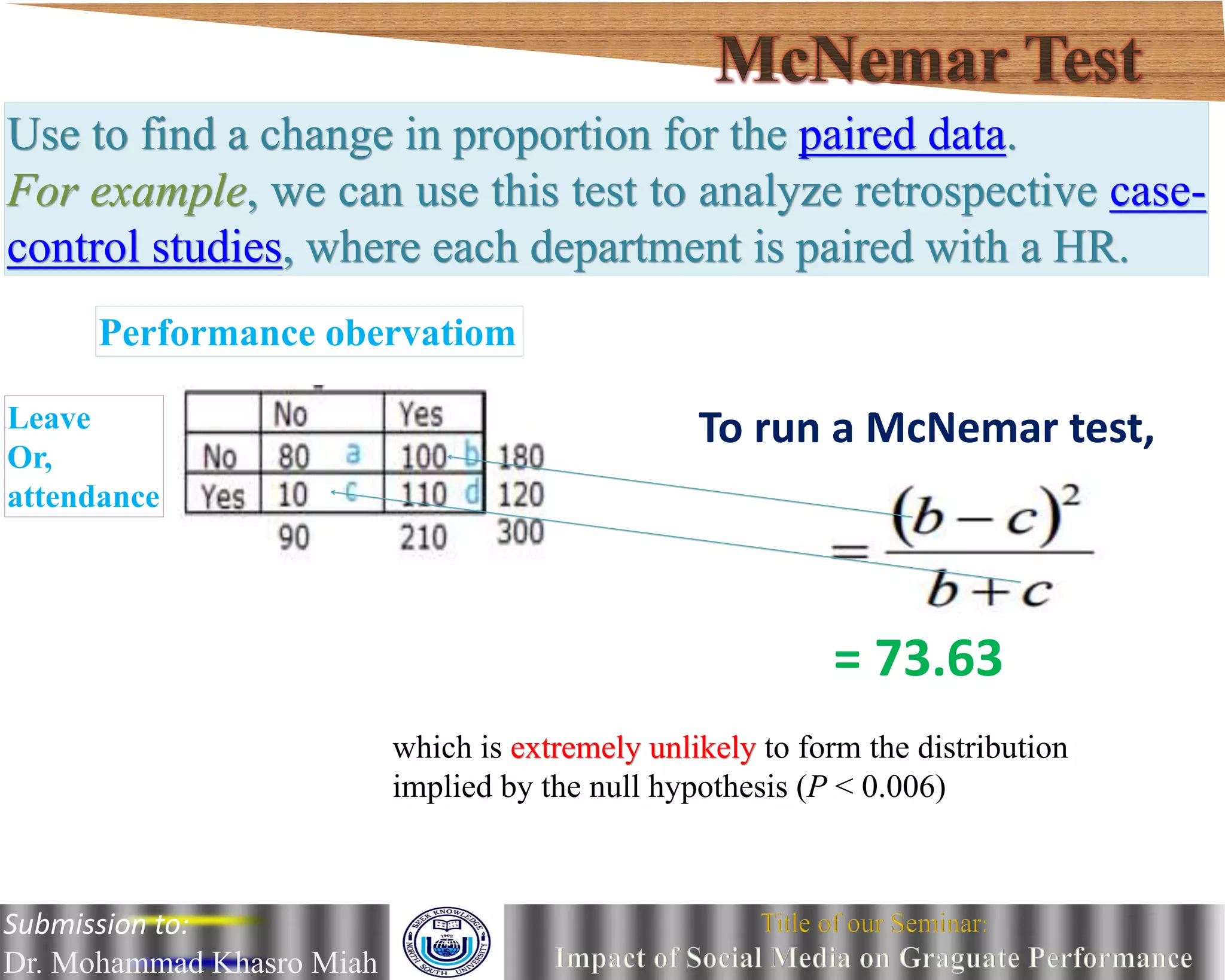
Use to find a change in proportion for the paired data.
For example, we can use this test to analyze retrospective case-
control studies, where each department is paired with a HR.
Performance obervatiom
Leave
Or,
attendance
To run a McNemar test,
= 73.63
which is extremely unlikely to form the distribution
implied by the null hypothesis (P < 0.006)
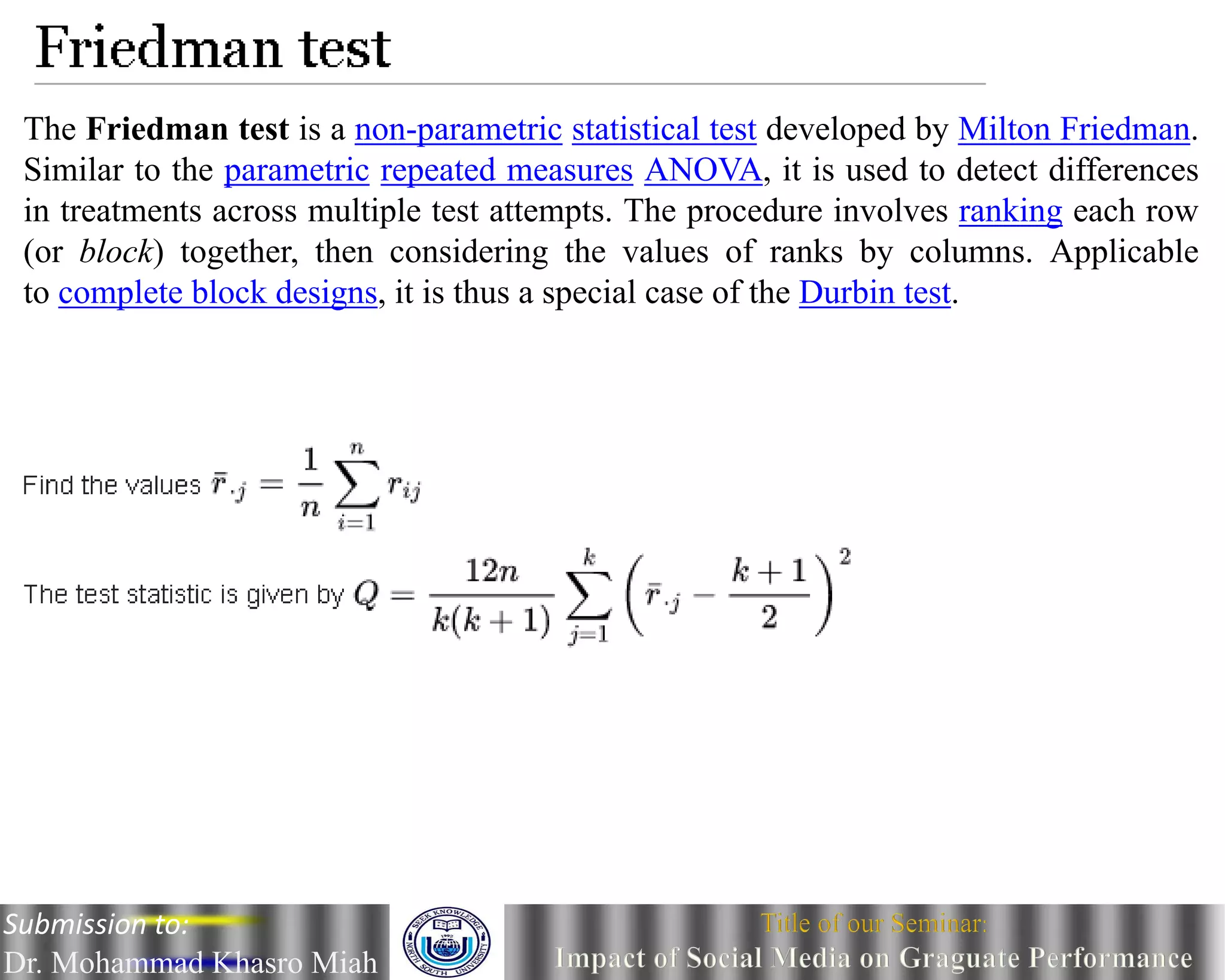
The Friedman test is a non-parametric statistical test developed by Milton Friedman.
Similar to the parametric repeated measures ANOVA, it is used to detect differences
in treatments across multiple test attempts. The procedure involves ranking each row
(or block) together, then considering the values of ranks by columns. Applicable
to complete block designs, it is thus a special case of the Durbin test.
Submission to:
Dr. Mohammad Khasro Miah
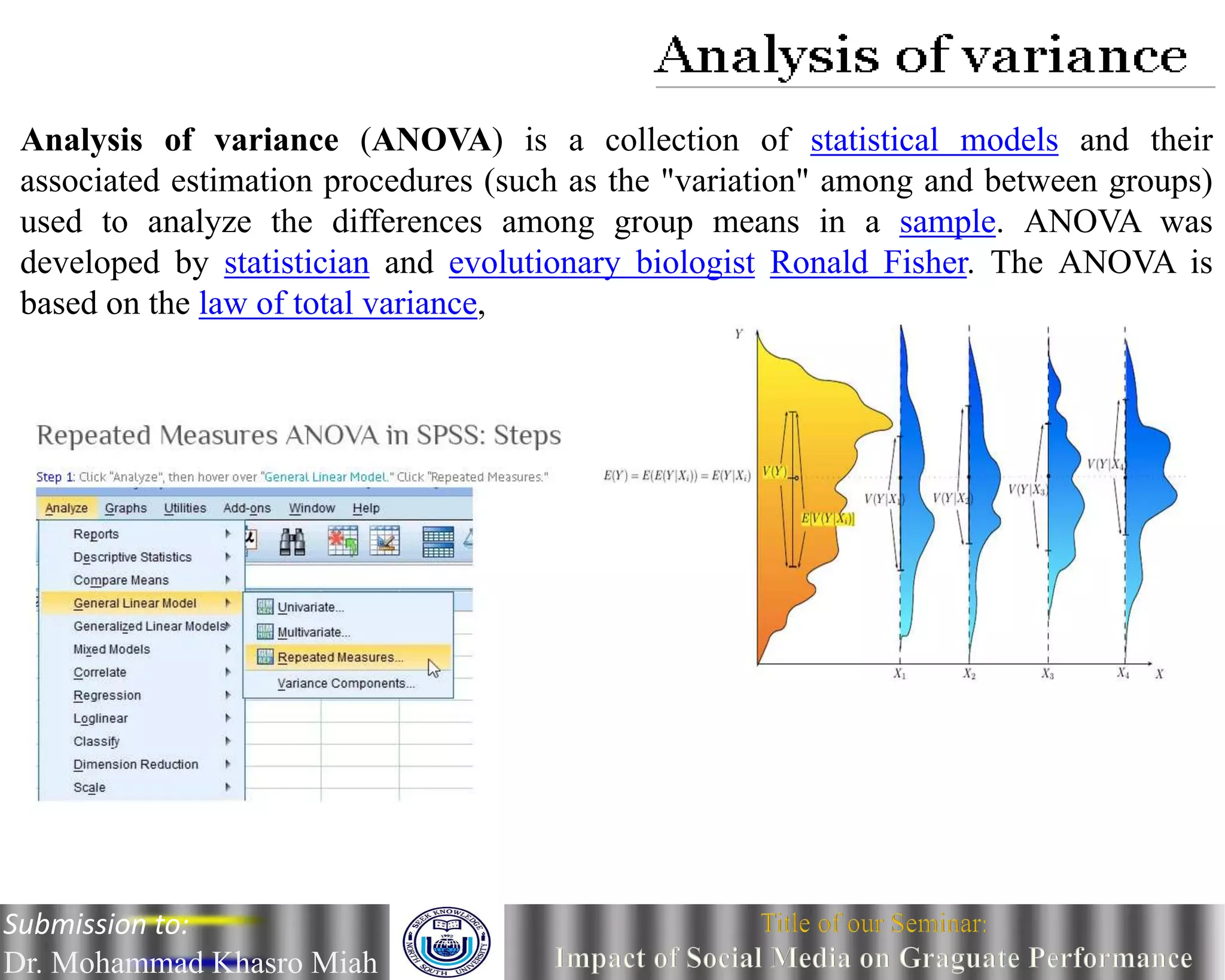
Analysis of variance (ANOVA) is a collection of statistical models and their
associated estimation procedures (such as the "variation" among and between groups)
used to analyze the differences among group means in a sample. ANOVA was
developed by statistician and evolutionary biologist Ronald Fisher. The ANOVA is
based on the law of total variance,
Submission to:
Dr. Mohammad Khasro Miah
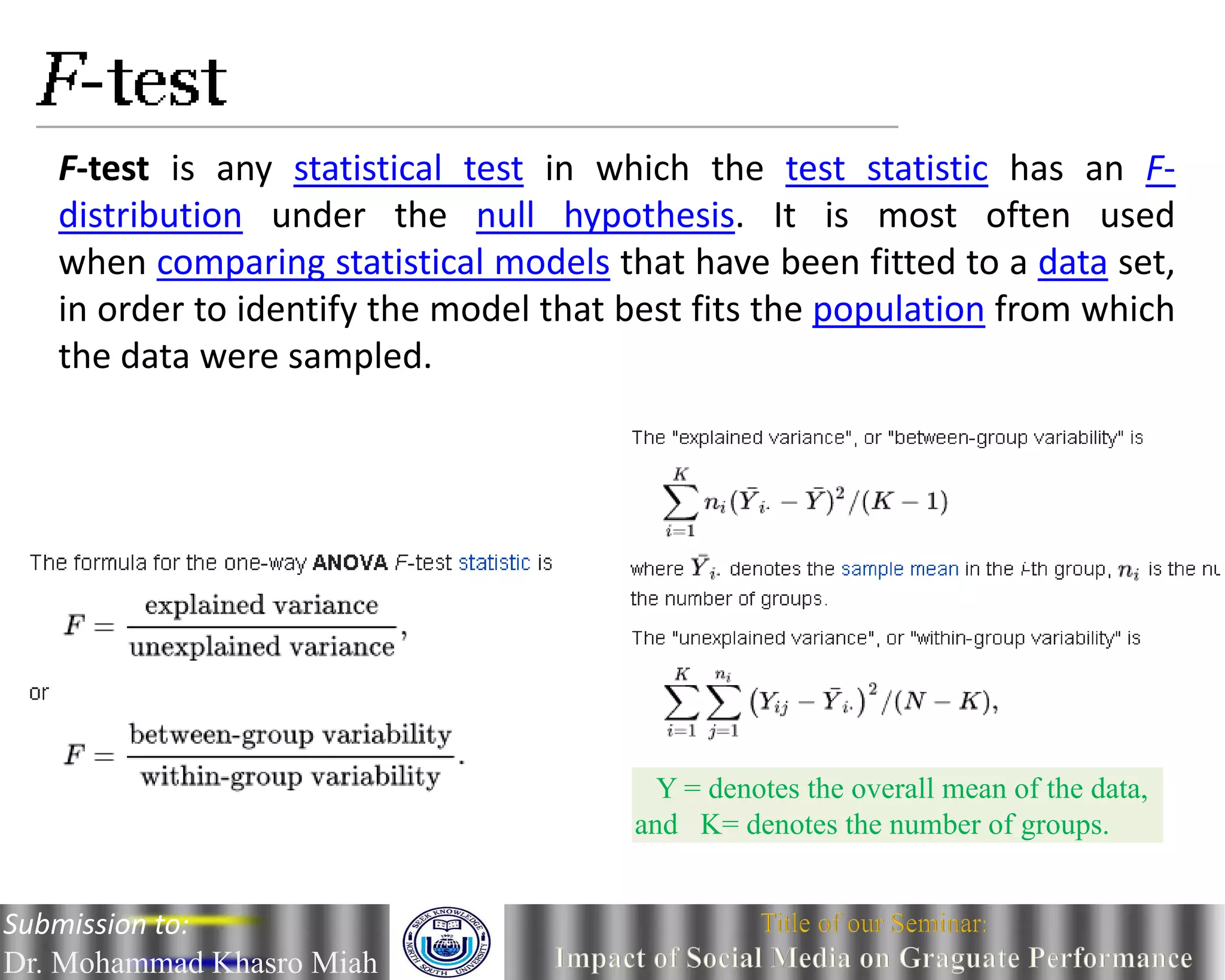
F-test is any statistical test in which the test statistic has an F-
distribution under the null hypothesis. It is most often used
when comparing statistical models that have been fitted to a data set,
in order to identify the model that best fits the population from which
the data were sampled.
Y = denotes the overall mean of the data,
and K= denotes the number of groups.
Submission to:
Dr. Mohammad Khasro Miah
In inferential statistics, the null hypothesis is a general statement or
default position that there is nothing new happening, like there is no
association among groups, or no relationship between two measured
phenomena
Null hypothesis
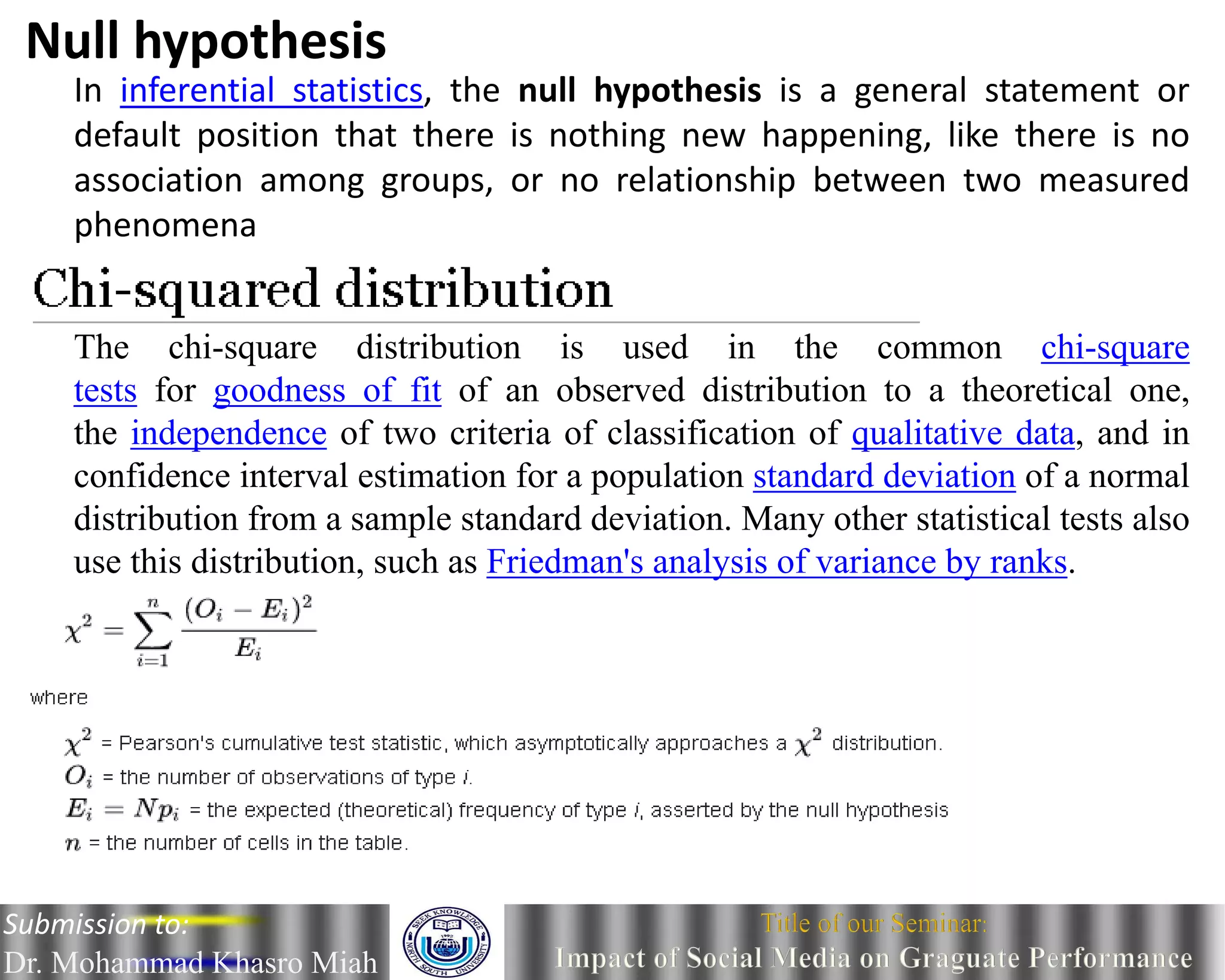
The chi-square distribution is used in the common chi-square
tests for goodness of fit of an observed distribution to a theoretical one,
the independence of two criteria of classification of qualitative data, and in
confidence interval estimation for a population standard deviation of a normal
distribution from a sample standard deviation. Many other statistical tests also
use this distribution, such as Friedman's analysis of variance by ranks.
Submission to:
Dr. Mohammad Khasro Miah
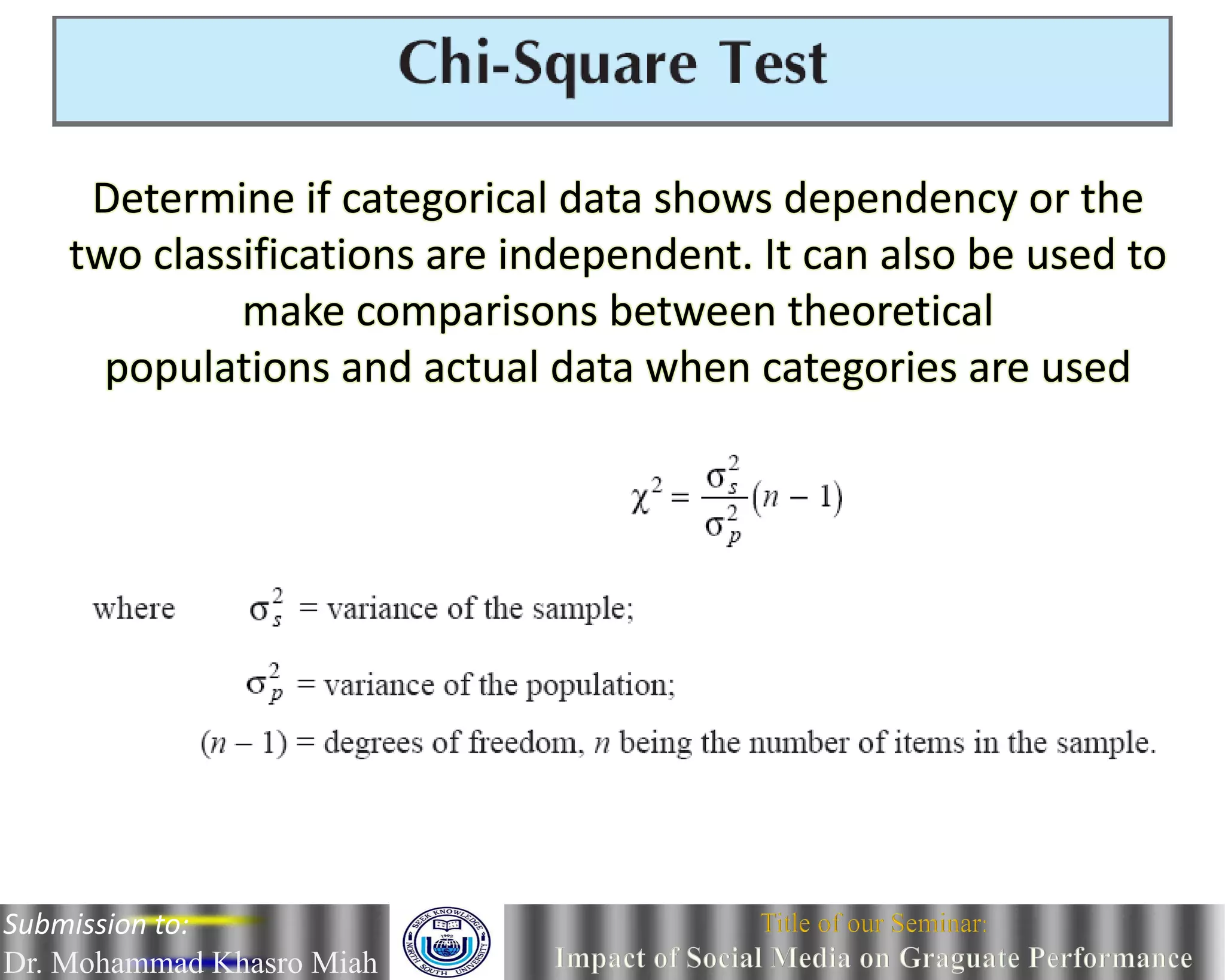
Determine if categorical data shows dependency or the
two classifications are independent. It can also be used to
make comparisons between theoretical
populations and actual data when categories are used
Submission to:
Dr. Mohammad Khasro Miah
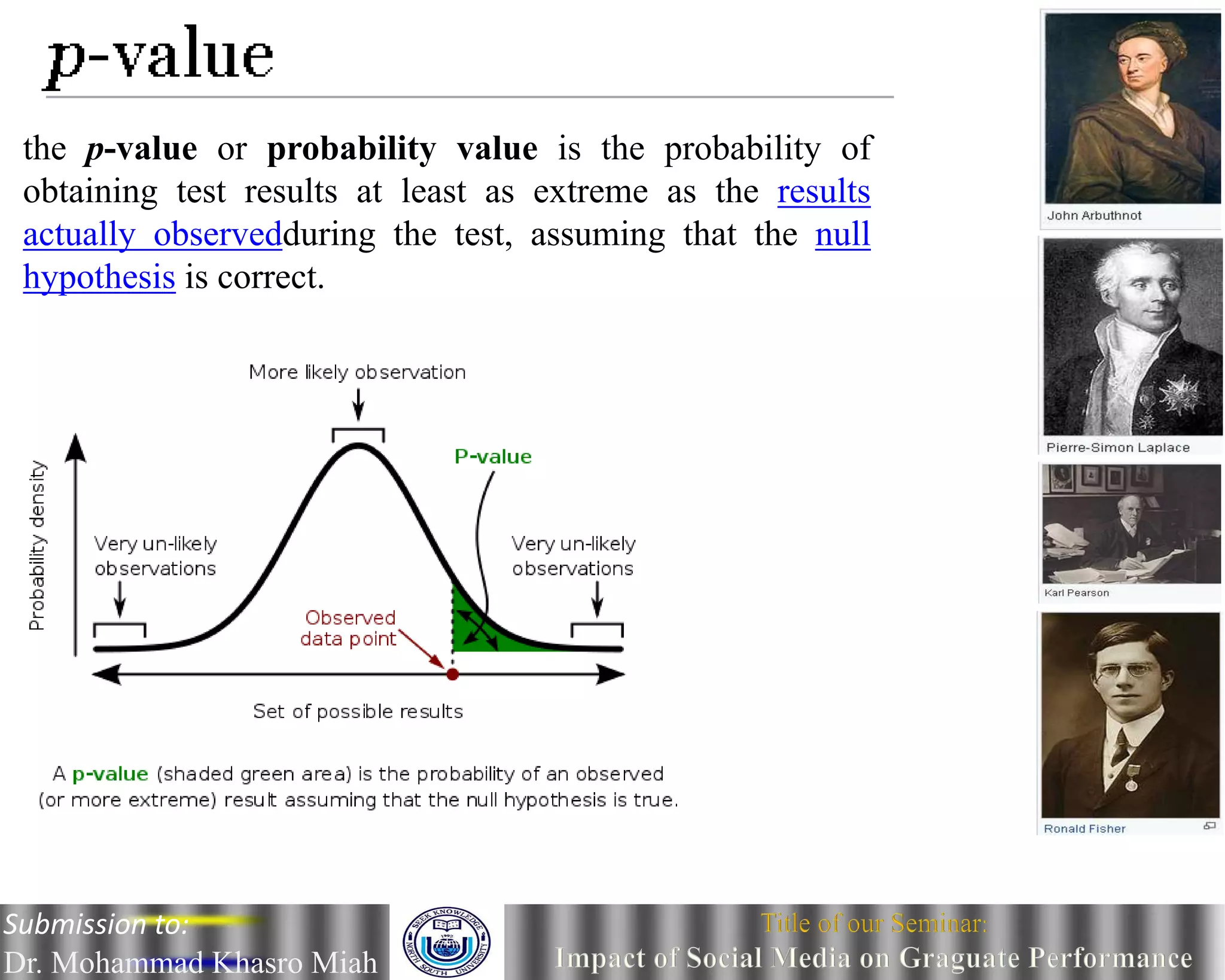
the p-value or probability value is the probability of
obtaining test results at least as extreme as the results
actually observedduring the test, assuming that the null
hypothesis is correct.
Submission to:
Dr. Mohammad Khasro Miah
Why Factor Analysis is Used
Factor analysis is mostly used in:
a) Data reduction
b) Scale development
c) The evaluation of the psychometric quality of a measure, and
d) The assessment of the dimensionality of a set of variables
e) In the determination of a small number of factors based on a
particular number of inter-related quantitative variables factor
analysis is used
f) FA analysis can directly measure speed, height, weight, etc., some
variables such as egoism, creativity, happiness, religiosity,
comfort are not a single measurable entity.
Submission to:
Dr. Mohammad Khasro Miah
Limitations and Directions for Future Research
This research has limitations and consequently recommendations for future studies.
Our proposal represents an attempt to build and test a conceptual framework of
HRM policies and practices. Then, a first limitation is that the present findings
are therefore indicative rather than conclusive. It would be useful to further
assess the generalizability of the HRM to other business environments such as
American, European and Asian countries. Moreover, with more replicative and
creative research, a more comprehensive conceptual framework related to HRM
policies and practices can be developed in the future.
Second, in spite of having a reasonable fit, the six-factor model didn't present a good
incremental index (CFI), indicating the necessity of new tests and other
specifications, to generally improve the model fit. The models using structural
equations tend to present excellent fit indices in situations where the measures
have a good delimitation and theoretical precision, besides having validity and
reliability confirmed by several samples (Tabachnick & Fidell, 2007). In the case
of this study, the fit indices reached by the confirmatory validation could be
considered reasonable considering the high complexity of the construct.
Submission to:
Dr. Mohammad Khasro Miah
HR view point :
(i) What is the study about?
(ii) Why is the study being made?
(iii) Where will the study be carried out?
(iv) What type of data is required?
(v) Where can the required data be found?
(vi) What periods of time will the study include?
(vii) What will be the sample design?
(viii) What techniques of data collection will be used?
(ix) How will the data be analysed?
(x) In what style will the report be prepared?
Submission to:
Dr. Mohammad Khasro Miah
Submission to:
Dr. Mohammad Khasro Miah
Submission to:
Dr. Mohammad Khasro Miah
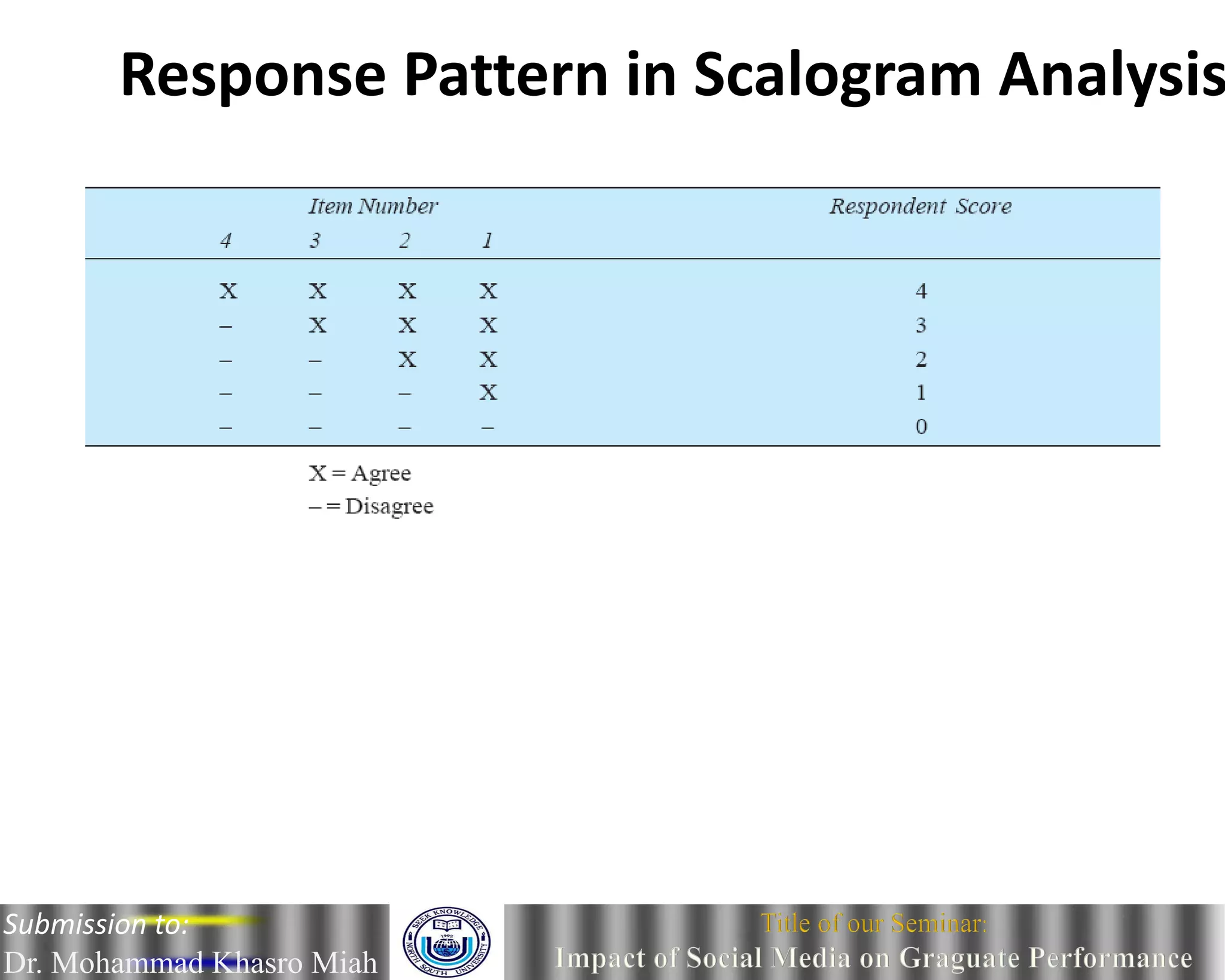
Response Pattern in Scalogram Analysis
Submission to:
Dr. Mohammad Khasro Miah
Submission to:
Dr. Mohammad Khasro Miah
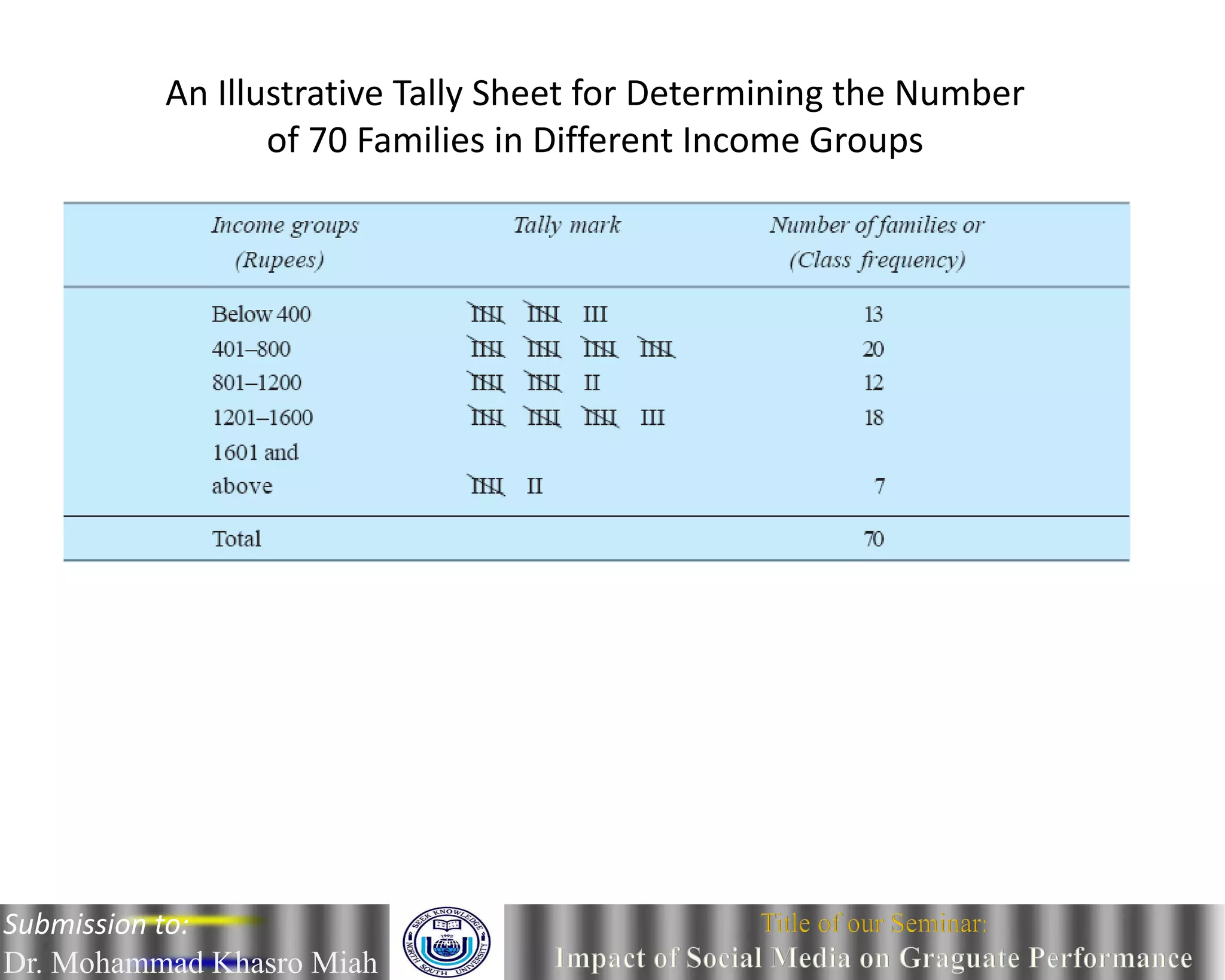
An Illustrative Tally Sheet for Determining the Number
of 70 Families in Different Income Groups
Submission to:
Dr. Mohammad Khasro Miah
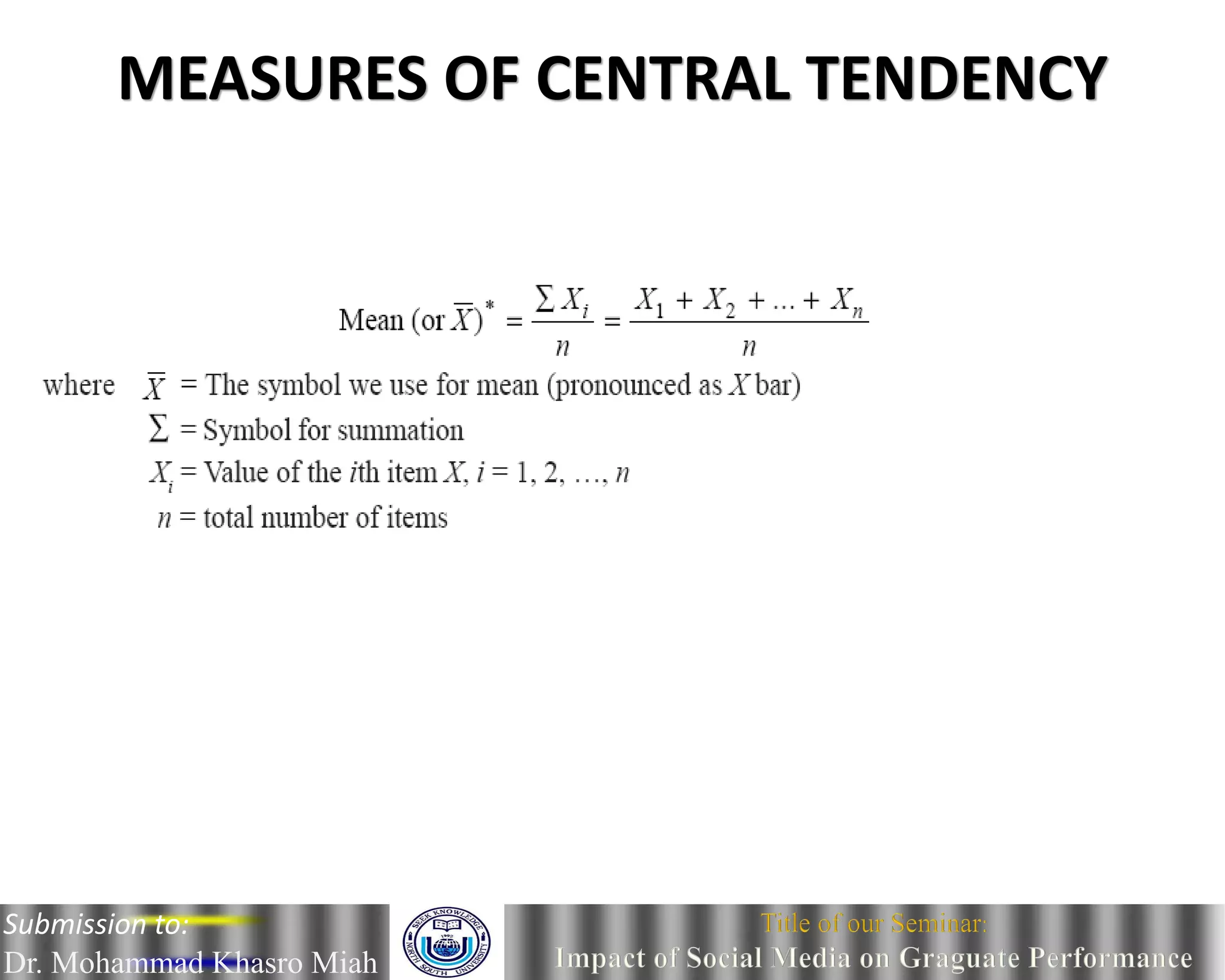
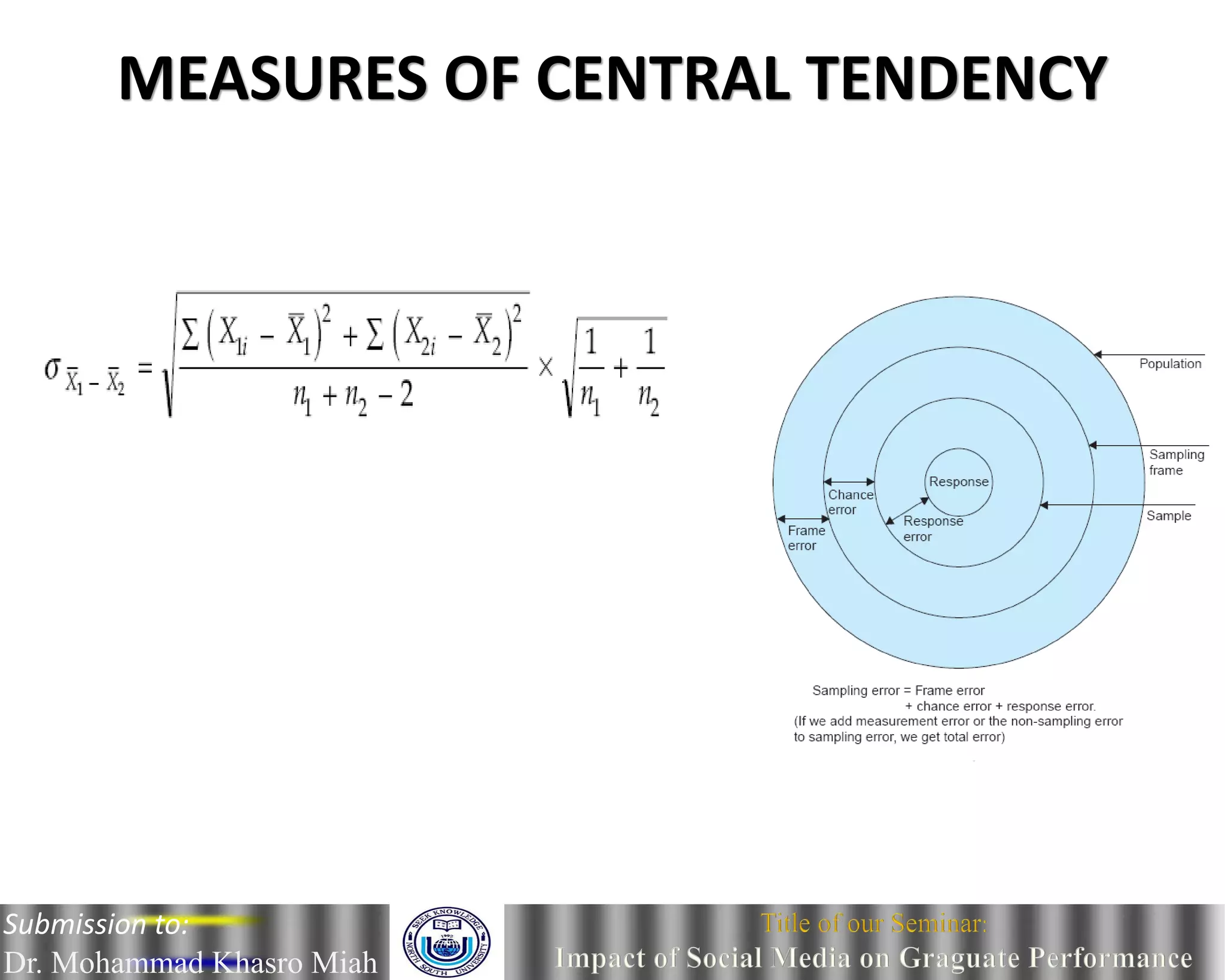
MEASURES OF CENTRAL TENDENCY
Submission to:
Dr. Mohammad Khasro Miah
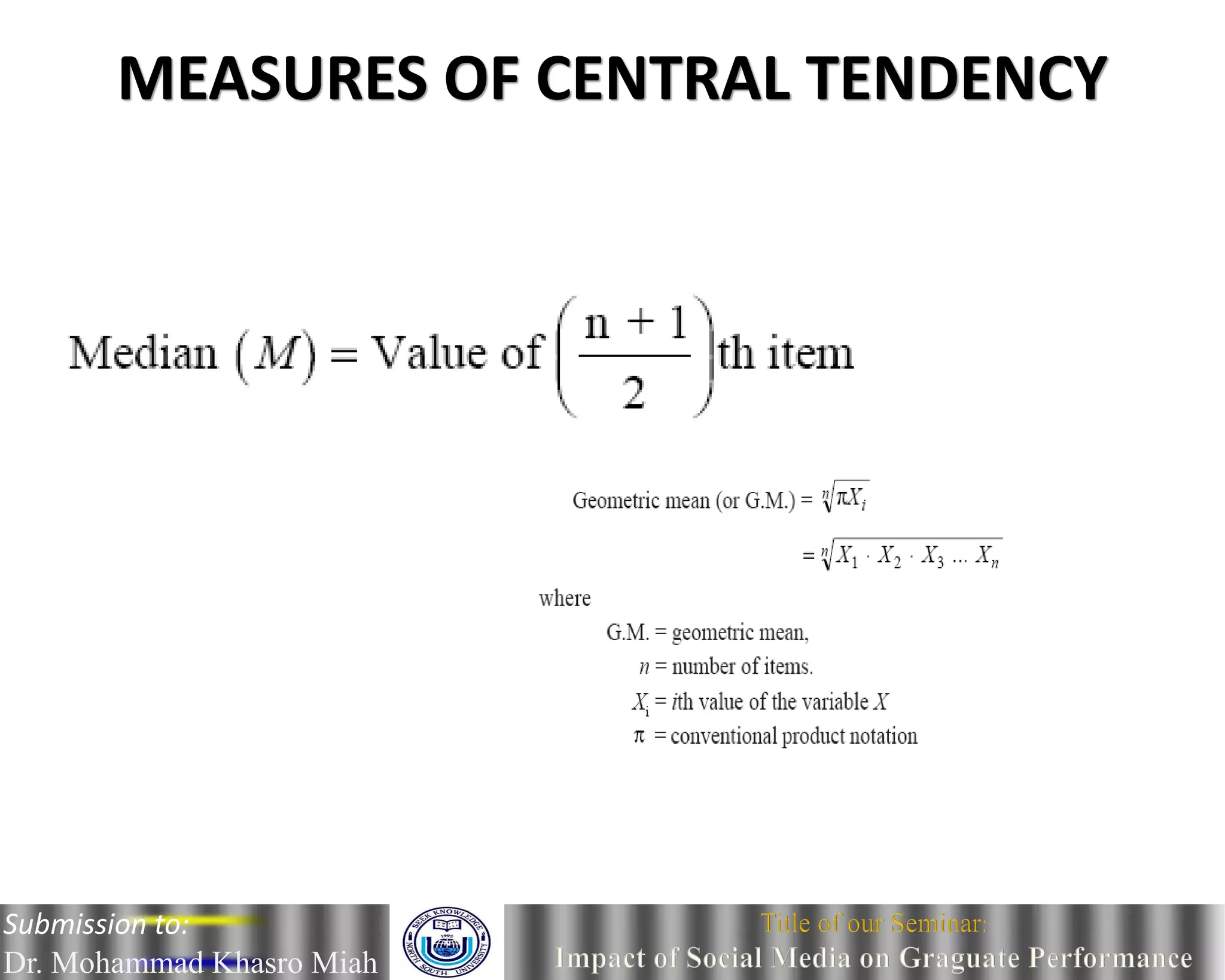
MEASURES OF CENTRAL TENDENCY
Submission to:
Dr. Mohammad Khasro Miah
Submission to:
Dr. Mohammad Khasro Miah
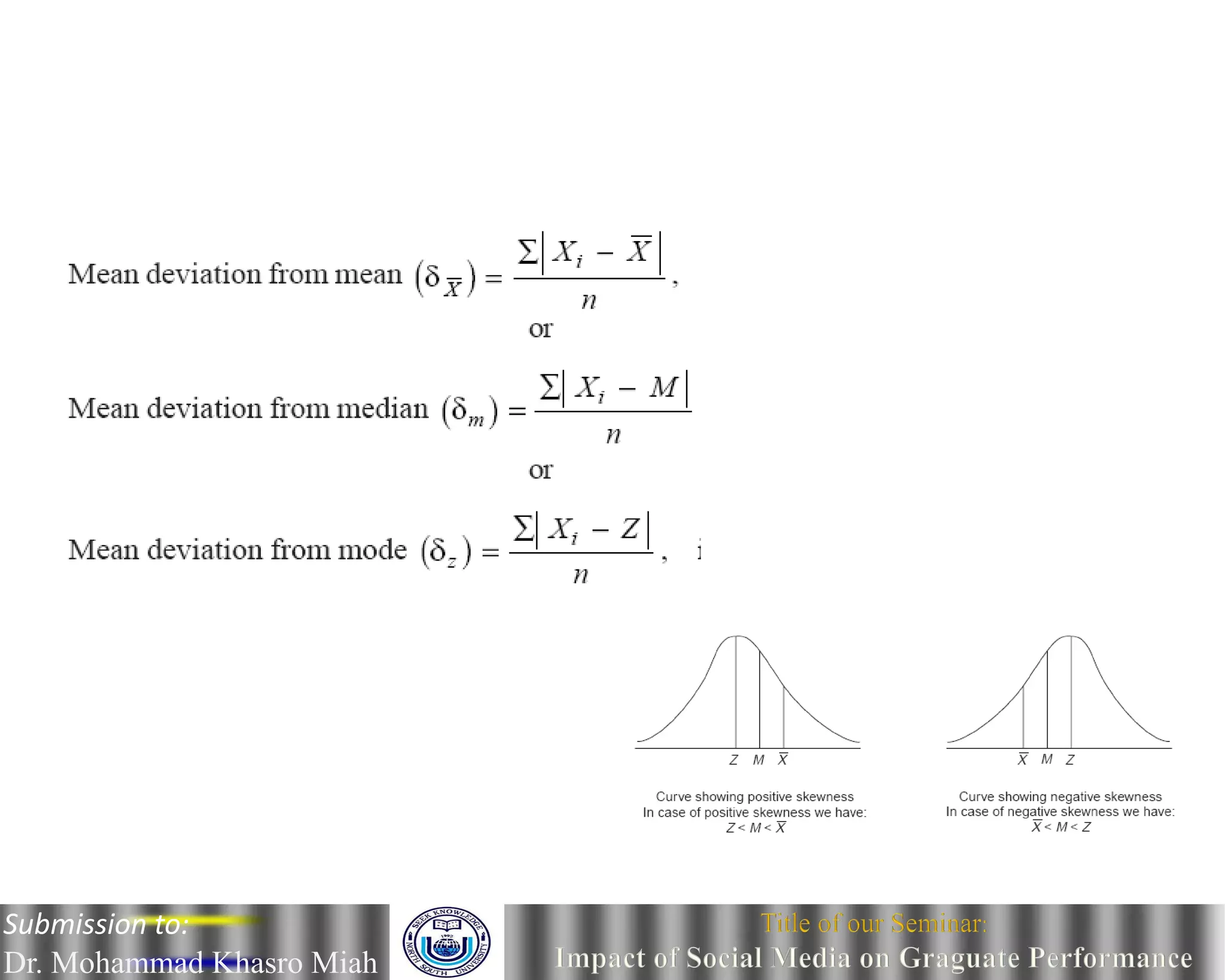
MEASURES OF CENTRAL TENDENCY
Submission to:
Dr. Mohammad Khasro Miah
Submission to:
Dr. Mohammad Khasro Miah
Submission to:
Dr. Mohammad Khasro Miah
References and Recommended Readings

A Beginner’s Guide to Factor Analysis: Focusing on Exploratory Factor Analysis

  • 1.
    Submission to: Dr. MohammadKhasro Miah Post-doctoral Degree in Human Resource Management Awarded by Fulbright Commission, Northeastern University, Boston, USA Post-doctoral Degree in Human Resource Management Awarded by Japan Society for the Promotion of Science (JSPS), Nagoya University, Japan Ph. D. in Human Resource Management, Nagoya University, Japan Master of Business Administration ( MBA in International HRM) Shiga University, Japan Master of Business Studies ( Management) Islamic University, Bangladesh Bachelor of Business Studies (Hons) ( Management) Islamic University, Bangladesh
  • 2.
    Post-doctoral Degree inHuman Resource Management Awarded by Fulbright Commission, Northeastern University, Boston, USA Post-doctoral Degree in Human Resource Management Awarded by Japan Society for the Promotion of Science (JSPS), Nagoya University, Japan Ph. D. in Human Resource Management, Nagoya University, Japan Master of Business Administration ( MBA in International HRM) Shiga University, Japan Master of Business Studies ( Management) Islamic University, Bangladesh Bachelor of Business Studies (Hons) ( Management) Islamic University, Bangladesh Dr. Mohammad Khasro Miah Submission to: Dr. Mohammad Khasro Miah Submission By : Mirza Shameem Hasan ID No: 1835026690
  • 3.
    Submission to: Dr. MohammadKhasro Miah Factor analysis : is a statistical method used to describe variability among observed, correlated variables in terms of a potentially lower number of unobserved variables called factors. For example, it is possible that variations in six observed variables mainly reflect the variations in two unobserved (underlying) variables. Factor analysis searches for such joint variations in response to unobserved latent variables. The observed variables are modelled as linear combinations of the potential factors, plus "error" terms. Factor analysis aims to find independent latent variables. HRM Use of Factor Analysis Factor Analysis. Factor analysis is a technique that is used to reduce a large number of variables into fewer numbers of factors. This technique extracts maximum common variance from all variables and puts them into a common score. As an index of all variables, we can use this score for further analysis. Submission to: Dr. Mohammad Khasro Miah
  • 4.
  • 5.
    Z-test Z-test tests themean of a distribution in which we already know the population variance σ2 . Because of the central limit theorem, many test statistics are approximately normally distributed for large samples. For each significance level in confidence interval, the Z-test has a single critical value Example At an office test are 100 points, and 12 points, respectively. Our interest is in the scores of 55 candidates in an particular office who received a mean score of 96. This office comparable to a simple random sample of 55 candidates from the region as a whole, or are their scores surprisingly low? Submission to: Dr. Mohammad Khasro Miah
  • 6.
    Z-test The Z-test tellsus that the 55 candidates have an unusually low mean test score compared to most simple random samples of similar size from the population of test-takers. Submission to: Dr. Mohammad Khasro Miah
  • 7.
    Submission to: Dr. MohammadKhasro Miah T Test The t test tells us how significant the differences between groups are; In other words it lets you know if those differences. A t-test is used as a hypothesis testing tool Formula to calculate the t-score
  • 8.
    Submission to: Dr. MohammadKhasro Miah Use to find a change in proportion for the paired data. For example, we can use this test to analyze retrospective case- control studies, where each department is paired with a HR. Performance obervatiom Leave Or, attendance To run a McNemar test, = 73.63 which is extremely unlikely to form the distribution implied by the null hypothesis (P < 0.006)
  • 9.
    The Friedman testis a non-parametric statistical test developed by Milton Friedman. Similar to the parametric repeated measures ANOVA, it is used to detect differences in treatments across multiple test attempts. The procedure involves ranking each row (or block) together, then considering the values of ranks by columns. Applicable to complete block designs, it is thus a special case of the Durbin test. Submission to: Dr. Mohammad Khasro Miah
  • 10.
    Analysis of variance(ANOVA) is a collection of statistical models and their associated estimation procedures (such as the "variation" among and between groups) used to analyze the differences among group means in a sample. ANOVA was developed by statistician and evolutionary biologist Ronald Fisher. The ANOVA is based on the law of total variance, Submission to: Dr. Mohammad Khasro Miah
  • 11.
    F-test is anystatistical test in which the test statistic has an F- distribution under the null hypothesis. It is most often used when comparing statistical models that have been fitted to a data set, in order to identify the model that best fits the population from which the data were sampled. Y = denotes the overall mean of the data, and K= denotes the number of groups. Submission to: Dr. Mohammad Khasro Miah
  • 12.
    In inferential statistics,the null hypothesis is a general statement or default position that there is nothing new happening, like there is no association among groups, or no relationship between two measured phenomena Null hypothesis The chi-square distribution is used in the common chi-square tests for goodness of fit of an observed distribution to a theoretical one, the independence of two criteria of classification of qualitative data, and in confidence interval estimation for a population standard deviation of a normal distribution from a sample standard deviation. Many other statistical tests also use this distribution, such as Friedman's analysis of variance by ranks. Submission to: Dr. Mohammad Khasro Miah
  • 13.
    Determine if categoricaldata shows dependency or the two classifications are independent. It can also be used to make comparisons between theoretical populations and actual data when categories are used Submission to: Dr. Mohammad Khasro Miah
  • 14.
    the p-value orprobability value is the probability of obtaining test results at least as extreme as the results actually observedduring the test, assuming that the null hypothesis is correct. Submission to: Dr. Mohammad Khasro Miah
  • 15.
    Why Factor Analysisis Used Factor analysis is mostly used in: a) Data reduction b) Scale development c) The evaluation of the psychometric quality of a measure, and d) The assessment of the dimensionality of a set of variables e) In the determination of a small number of factors based on a particular number of inter-related quantitative variables factor analysis is used f) FA analysis can directly measure speed, height, weight, etc., some variables such as egoism, creativity, happiness, religiosity, comfort are not a single measurable entity. Submission to: Dr. Mohammad Khasro Miah
  • 16.
    Limitations and Directionsfor Future Research This research has limitations and consequently recommendations for future studies. Our proposal represents an attempt to build and test a conceptual framework of HRM policies and practices. Then, a first limitation is that the present findings are therefore indicative rather than conclusive. It would be useful to further assess the generalizability of the HRM to other business environments such as American, European and Asian countries. Moreover, with more replicative and creative research, a more comprehensive conceptual framework related to HRM policies and practices can be developed in the future. Second, in spite of having a reasonable fit, the six-factor model didn't present a good incremental index (CFI), indicating the necessity of new tests and other specifications, to generally improve the model fit. The models using structural equations tend to present excellent fit indices in situations where the measures have a good delimitation and theoretical precision, besides having validity and reliability confirmed by several samples (Tabachnick & Fidell, 2007). In the case of this study, the fit indices reached by the confirmatory validation could be considered reasonable considering the high complexity of the construct. Submission to: Dr. Mohammad Khasro Miah
  • 17.
    HR view point: (i) What is the study about? (ii) Why is the study being made? (iii) Where will the study be carried out? (iv) What type of data is required? (v) Where can the required data be found? (vi) What periods of time will the study include? (vii) What will be the sample design? (viii) What techniques of data collection will be used? (ix) How will the data be analysed? (x) In what style will the report be prepared? Submission to: Dr. Mohammad Khasro Miah
  • 18.
  • 19.
  • 20.
    Response Pattern inScalogram Analysis Submission to: Dr. Mohammad Khasro Miah
  • 21.
  • 22.
    An Illustrative TallySheet for Determining the Number of 70 Families in Different Income Groups Submission to: Dr. Mohammad Khasro Miah
  • 23.
    MEASURES OF CENTRALTENDENCY Submission to: Dr. Mohammad Khasro Miah
  • 24.
    MEASURES OF CENTRALTENDENCY Submission to: Dr. Mohammad Khasro Miah
  • 25.
  • 26.
    MEASURES OF CENTRALTENDENCY Submission to: Dr. Mohammad Khasro Miah
  • 27.
  • 28.
  • 29.

Editor's Notes

  • #13 http://www.scielo.br/scielo.php?pid=S1807-76922012000400003&script=sci_arttext