Probability
Unit-III for SBD
Unit-II for BS
By:
Dr. Parveen Vashisth
Assistant Professor
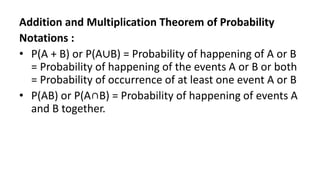
Addition and Multiplication Theorem of Probability
Notations :
• P(A + B) or P(A∪B) = Probability of happening of A or B
= Probability of happening of the events A or B or both
= Probability of occurrence of at least one event A or B
• P(AB) or P(A∩B) = Probability of happening of events A
and B together.
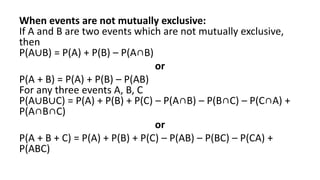
When events are not mutually exclusive:
If A and B are two events which are not mutually exclusive,
then
P(A∪B) = P(A) + P(B) – P(A∩B)
or
P(A + B) = P(A) + P(B) – P(AB)
For any three events A, B, C
P(A∪B∪C) = P(A) + P(B) + P(C) – P(A∩B) – P(B∩C) – P(C∩A) +
P(A∩B∩C)
or
P(A + B + C) = P(A) + P(B) + P(C) – P(AB) – P(BC) – P(CA) +
P(ABC)
Addition & Multiplication Law
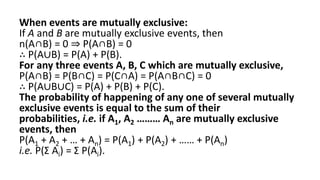
When events are mutually exclusive:
If A and B are mutually exclusive events, then
n(A∩B) = 0 ⇒ P(A∩B) = 0
∴ P(A∪B) = P(A) + P(B).
For any three events A, B, C which are mutually exclusive,
P(A∩B) = P(B∩C) = P(C∩A) = P(A∩B∩C) = 0
∴ P(A∪B∪C) = P(A) + P(B) + P(C).
The probability of happening of any one of several mutually
exclusive events is equal to the sum of their
probabilities, i.e. if A1, A2 ……… An are mutually exclusive
events, then
P(A1 + A2 + … + An) = P(A1) + P(A2) + …… + P(An)
i.e. P(Σ Ai) = Σ P(Ai).
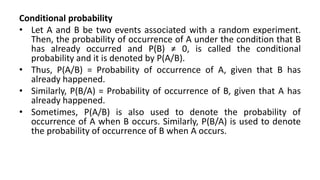
Conditional probability
• Let A and B be two events associated with a random experiment.
Then, the probability of occurrence of A under the condition that B
has already occurred and P(B) ≠ 0, is called the conditional
probability and it is denoted by P(A/B).
• Thus, P(A/B) = Probability of occurrence of A, given that B has
already happened.
• Similarly, P(B/A) = Probability of occurrence of B, given that A has
already happened.
• Sometimes, P(A/B) is also used to denote the probability of
occurrence of A when B occurs. Similarly, P(B/A) is used to denote
the probability of occurrence of B when A occurs.
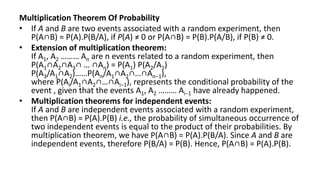
Multiplication Theorem Of Probability
• If A and B are two events associated with a random experiment, then
P(A∩B) = P(A).P(B/A), if P(A) ≠ 0 or P(A∩B) = P(B).P(A/B), if P(B) ≠ 0.
• Extension of multiplication theorem:
If A1, A2 ……… An are n events related to a random experiment, then
P(A1∩A2∩A3∩ … ∩An) = P(A1) P(A2/A1)
P(A3/A1∩A2)……P(An/A1∩A2∩…∩An−1),
where P(Ai/A1∩A2∩…∩Ai−1), represents the conditional probability of the
event , given that the events A1, A2 ……… Ai−1 have already happened.
• Multiplication theorems for independent events:
If A and B are independent events associated with a random experiment,
then P(A∩B) = P(A).P(B) i.e., the probability of simultaneous occurrence of
two independent events is equal to the product of their probabilities. By
multiplication theorem, we have P(A∩B) = P(A).P(B/A). Since A and B are
independent events, therefore P(B/A) = P(B). Hence, P(A∩B) = P(A).P(B).
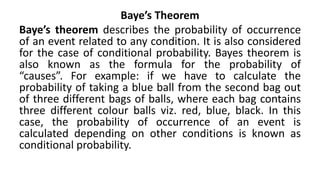
Baye’s Theorem
Baye’s theorem describes the probability of occurrence
of an event related to any condition. It is also considered
for the case of conditional probability. Bayes theorem is
also known as the formula for the probability of
“causes”. For example: if we have to calculate the
probability of taking a blue ball from the second bag out
of three different bags of balls, where each bag contains
three different colour balls viz. red, blue, black. In this
case, the probability of occurrence of an event is
calculated depending on other conditions is known as
conditional probability.
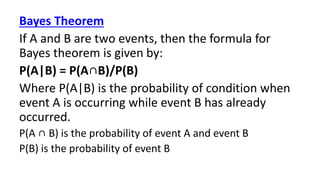
Bayes Theorem
If A and B are two events, then the formula for
Bayes theorem is given by:
P(A|B) = P(A∩B)/P(B)
Where P(A|B) is the probability of condition when
event A is occurring while event B has already
occurred.
P(A ∩ B) is the probability of event A and event B
P(B) is the probability of event B
Binomial
Normal
&
Poisson

Probability

  • 1.
    Probability Unit-III for SBD Unit-IIfor BS By: Dr. Parveen Vashisth Assistant Professor
  • 2.
    Addition and MultiplicationTheorem of Probability Notations : • P(A + B) or P(A∪B) = Probability of happening of A or B = Probability of happening of the events A or B or both = Probability of occurrence of at least one event A or B • P(AB) or P(A∩B) = Probability of happening of events A and B together.
  • 3.
    When events arenot mutually exclusive: If A and B are two events which are not mutually exclusive, then P(A∪B) = P(A) + P(B) – P(A∩B) or P(A + B) = P(A) + P(B) – P(AB) For any three events A, B, C P(A∪B∪C) = P(A) + P(B) + P(C) – P(A∩B) – P(B∩C) – P(C∩A) + P(A∩B∩C) or P(A + B + C) = P(A) + P(B) + P(C) – P(AB) – P(BC) – P(CA) + P(ABC)
  • 4.
  • 5.
    When events aremutually exclusive: If A and B are mutually exclusive events, then n(A∩B) = 0 ⇒ P(A∩B) = 0 ∴ P(A∪B) = P(A) + P(B). For any three events A, B, C which are mutually exclusive, P(A∩B) = P(B∩C) = P(C∩A) = P(A∩B∩C) = 0 ∴ P(A∪B∪C) = P(A) + P(B) + P(C). The probability of happening of any one of several mutually exclusive events is equal to the sum of their probabilities, i.e. if A1, A2 ……… An are mutually exclusive events, then P(A1 + A2 + … + An) = P(A1) + P(A2) + …… + P(An) i.e. P(Σ Ai) = Σ P(Ai).
  • 6.
    Conditional probability • LetA and B be two events associated with a random experiment. Then, the probability of occurrence of A under the condition that B has already occurred and P(B) ≠ 0, is called the conditional probability and it is denoted by P(A/B). • Thus, P(A/B) = Probability of occurrence of A, given that B has already happened. • Similarly, P(B/A) = Probability of occurrence of B, given that A has already happened. • Sometimes, P(A/B) is also used to denote the probability of occurrence of A when B occurs. Similarly, P(B/A) is used to denote the probability of occurrence of B when A occurs.
  • 7.
    Multiplication Theorem OfProbability • If A and B are two events associated with a random experiment, then P(A∩B) = P(A).P(B/A), if P(A) ≠ 0 or P(A∩B) = P(B).P(A/B), if P(B) ≠ 0. • Extension of multiplication theorem: If A1, A2 ……… An are n events related to a random experiment, then P(A1∩A2∩A3∩ … ∩An) = P(A1) P(A2/A1) P(A3/A1∩A2)……P(An/A1∩A2∩…∩An−1), where P(Ai/A1∩A2∩…∩Ai−1), represents the conditional probability of the event , given that the events A1, A2 ……… Ai−1 have already happened. • Multiplication theorems for independent events: If A and B are independent events associated with a random experiment, then P(A∩B) = P(A).P(B) i.e., the probability of simultaneous occurrence of two independent events is equal to the product of their probabilities. By multiplication theorem, we have P(A∩B) = P(A).P(B/A). Since A and B are independent events, therefore P(B/A) = P(B). Hence, P(A∩B) = P(A).P(B).
  • 8.
    Baye’s Theorem Baye’s theoremdescribes the probability of occurrence of an event related to any condition. It is also considered for the case of conditional probability. Bayes theorem is also known as the formula for the probability of “causes”. For example: if we have to calculate the probability of taking a blue ball from the second bag out of three different bags of balls, where each bag contains three different colour balls viz. red, blue, black. In this case, the probability of occurrence of an event is calculated depending on other conditions is known as conditional probability.
  • 9.
    Bayes Theorem If Aand B are two events, then the formula for Bayes theorem is given by: P(A|B) = P(A∩B)/P(B) Where P(A|B) is the probability of condition when event A is occurring while event B has already occurred. P(A ∩ B) is the probability of event A and event B P(B) is the probability of event B
  • 10.