Understanding Randomness
Slide 11- 2
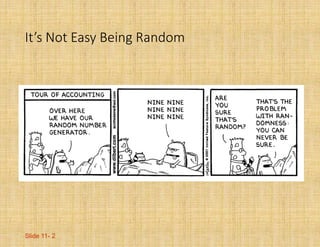
It’s Not Easy Being Random
Slide 11- 3
It’s Not Easy Being Random (cont.)
• It’s surprisingly difficult to generate random values even
when they’re equally likely.
• Computers have become a popular way to generate
random numbers.
• Even though they often do much better than humans,
computers can’t generate truly random numbers either.
• Since computers follow programs, the “random”
numbers we get from computers are really
pseudorandom.
• Fortunately, pseudorandom values are good enough for
most purposes.
Slide 11- 4
It’s Not Easy Being Random (cont.)
• There are ways to generate random numbers so that they are both
equally likely and truly random.
• The best ways we know to generate data that give a fair and accurate
picture of the world rely on randomness, and the ways in which we
draw conclusions from those data depend on the randomness, too.
Slide 11- 5
Practical Randomness
• We need an imitation of a real process so we can manipulate and control
it.
• In short, we are going to simulate reality.
Slide 11- 6
A Simulation
• The sequence of events we want to investigate is called a trial.
• The basic building block of a simulation is called a component.
• There are seven steps to a simulation…
Slide 11- 7
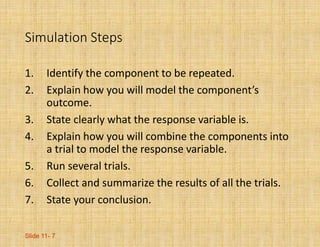
Simulation Steps
1. Identify the component to be repeated.
2. Explain how you will model the component’s
outcome.
3. State clearly what the response variable is.
4. Explain how you will combine the components into
a trial to model the response variable.
5. Run several trials.
6. Collect and summarize the results of all the trials.
7. State your conclusion.
Slide 11- 8
What Can Go Wrong?
• Don’t overstate your case.
• Beware of confusing what really happens with what a simulation suggests
might happen.
• Model outcome chances accurately.
• A common mistake in constructing a simulation is to adopt a strategy that
may appear to produce the right kind of results.
• Run enough trials.
• Simulation is cheap and fairly easy to do.
Slide 11- 9
What Have We Learned?
• How to harness the power of randomness.
• A simulation model can help us investigate a question when we can’t
(or don’t want to) collect data, and a mathematical answer is hard to
calculate.
• How to base our simulation on random values generated by a
computer, generated by a randomizing device, or found on the
Internet.
• Simulations can provide us with useful insights about the real world.

Understanding randomness

  • 1.
  • 2.
    Slide 11- 2 It’sNot Easy Being Random
  • 3.
    Slide 11- 3 It’sNot Easy Being Random (cont.) • It’s surprisingly difficult to generate random values even when they’re equally likely. • Computers have become a popular way to generate random numbers. • Even though they often do much better than humans, computers can’t generate truly random numbers either. • Since computers follow programs, the “random” numbers we get from computers are really pseudorandom. • Fortunately, pseudorandom values are good enough for most purposes.
  • 4.
    Slide 11- 4 It’sNot Easy Being Random (cont.) • There are ways to generate random numbers so that they are both equally likely and truly random. • The best ways we know to generate data that give a fair and accurate picture of the world rely on randomness, and the ways in which we draw conclusions from those data depend on the randomness, too.
  • 5.
    Slide 11- 5 PracticalRandomness • We need an imitation of a real process so we can manipulate and control it. • In short, we are going to simulate reality.
  • 6.
    Slide 11- 6 ASimulation • The sequence of events we want to investigate is called a trial. • The basic building block of a simulation is called a component. • There are seven steps to a simulation…
  • 7.
    Slide 11- 7 SimulationSteps 1. Identify the component to be repeated. 2. Explain how you will model the component’s outcome. 3. State clearly what the response variable is. 4. Explain how you will combine the components into a trial to model the response variable. 5. Run several trials. 6. Collect and summarize the results of all the trials. 7. State your conclusion.
  • 8.
    Slide 11- 8 WhatCan Go Wrong? • Don’t overstate your case. • Beware of confusing what really happens with what a simulation suggests might happen. • Model outcome chances accurately. • A common mistake in constructing a simulation is to adopt a strategy that may appear to produce the right kind of results. • Run enough trials. • Simulation is cheap and fairly easy to do.
  • 9.
    Slide 11- 9 WhatHave We Learned? • How to harness the power of randomness. • A simulation model can help us investigate a question when we can’t (or don’t want to) collect data, and a mathematical answer is hard to calculate. • How to base our simulation on random values generated by a computer, generated by a randomizing device, or found on the Internet. • Simulations can provide us with useful insights about the real world.