Epidemiological Surveillance
Lans Mans
Epidemiological Surveillance
Definition
 Surveillance is defined as the continuous (ongoing) scrutiny
of the factors that determine the occurrence and distribution of
diseases and other health related events through a systematic
collection of data.
Purpose of surveillance
 To be able to identify diseases, injuries, hazards and other
health related factors as early as possible, i.e. prediction
and early detection of outbreaks.
 To provide scientific baseline data and information for
priority setting, planning, implementing and evaluating
disease control program for both communicable and non-
communicable health problems.
 To define the magnitude and distribution of diseases by
Types of surveillance
 The two common types of surveillance are passive and
active surveillance.
 Passive surveillance
 Passive surveillance may be defined as a mechanism for
routine surveillance based on passive case detection and on
the routine recording and reporting system. The information
provider comes to the health institutions for help, be it
medical or other preventive and promotive health services. It
involves collection of data as part of routine provision of
health services
Advantages of passive surveillance
 covers a wide range of problems
 does not require special arrangement
 it is relatively cheap
 covers a wider area
The disadvantages of passive surveillance
 The information generated is to a large extent unreliable,
incomplete and inaccurate
 Most of the time, data from passive surveillance is not
available on time
 Most of the time, you may not get the kind of information
you desire
 It lacks representativeness of the whole population since
passive surveillance is mainly based on health institution
reports
Active surveillance
 Active surveillance is defined as a method of data collection
usually on a specific disease, for relatively limited period of
time. It involves collection of data from communities such as
in house-to-house surveys or mobilizing communities to
some central point where data can be collected. This can
be arranged by assigning health personnel to collect
information on presence or absence of new cases of a
particular disease at regular intervals. Example:
investigation of out-breaks
The advantages of active surveillance
 the collected data is complete and accurate
 information collected is timely.
The disadvantages of active surveillance
 it requires good organization,
 it is expensive
 it requires skilled human power
 it is for short period of time (not a continuous process)
 it is directed towards specific disease conditions
Conditions in which active surveillance is appropriate
 Active surveillance has limited scope. Unlike passive
surveillance, it cannot be used for routine purposes. There
are certain conditions where active surveillance is
appropriate. These conditions are:
 For periodic evaluation of an ongoing program
 For programs with limited time of operation such as
eradication program
Conditions in which active surveillance is appropriate
In unusual situations such as:
 New disease discovery
 New mode of transmission
 When a disease is found to affect a new subgroup of the
population.
 When a previously eradicated disease reappears
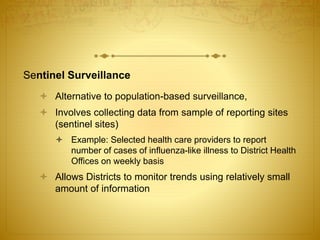
Sentinel Surveillance
 Alternative to population-based surveillance,
 Involves collecting data from sample of reporting sites
(sentinel sites)
 Example: Selected health care providers to report
number of cases of influenza-like illness to District Health
Offices on weekly basis
 Allows Districts to monitor trends using relatively small
amount of information
Sentinel Surveillance (cont)
 Monitoring of key health events, through sentinel sites,
events, providers, vectors/animals
 Case report indicates a failure of the health care system
or indicates that Alternative to population-based
surveillance,
Sentinel Surveillance (cont)
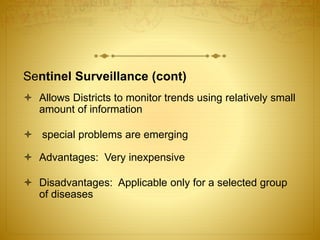
 Allows Districts to monitor trends using relatively small
amount of information
 special problems are emerging
 Advantages: Very inexpensive
 Disadvantages: Applicable only for a selected group
of diseases
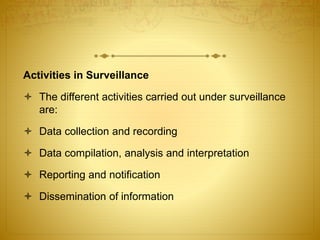
Activities in Surveillance
 The different activities carried out under surveillance
are:
 Data collection and recording
 Data compilation, analysis and interpretation
 Reporting and notification
 Dissemination of information
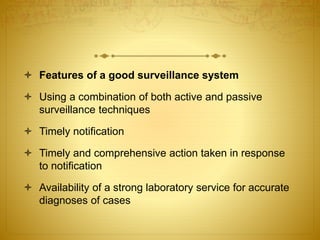
 Features of a good surveillance system
 Using a combination of both active and passive
surveillance techniques
 Timely notification
 Timely and comprehensive action taken in response
to notification
 Availability of a strong laboratory service for accurate
diagnoses of cases
The integrated disease surveillance system
 The integrated disease surveillance system is a
strategy in which several activities from the different
vertical programs are coordinated and streamlined in
order to make best use of scarce resources. The
activities are combined taking advantage of similar
surveillance functions, skills, resources, and target
population.
 Integrated disease surveillance strategy recommends
coordination and integration of surveillance activities
for diseases of public health importance.
Diseases included in the integrated disease surveillance
system
 Among the most prevalent health problems, 21 (twenty
one) communicable diseases and conditions are selected
for integrated disease surveillance in Sierra Leone. The
diseases are recommended because they fall into one or
more of the following categories:
 Are top causes of high morbidity and mortality in Sierra
Leone (for example, malaria, pneumonia, diarrheal diseases,
tuberculosis, and HIV/AIDS)
 Have epidemic potential (for example yellow fever and
cholera)
 Surveillance required internationally (for example plague,
yellow fever and cholera)
 Have available effective control and prevention
interventions for addressing the public health problem
they pose (for example schistosomiasis,
onchocerciasis, trypanosomiasis)
 Can easily be identified using simple case definition;
and
 Have intervention programs for prevention, control,
eradication or elimination of the diseases (for example
EPI and Integrated Management of Childhood Illness
Strategy (IMCI)
List of Priority Disease in Sierra Leone
 A. Epidemic-Prone Diseases
 Cholera
 Diarrhea with blood (Shigella)
 Yellow fever
 Measles
 Meningitis
 Diseases Targeted for Eradication and Elimination
 Acute flaccid paralysis (AFP)/ polio
 Leprosy
 Neonatal tetanus
 Other Diseases of Public Health Importance
 Pneumonia in children less than 5 years of age
 Diarrhea in children less than 5 years of age
 New AIDS cases
 Onchocerciasis
 Sexually Transmitted Infections (STIs)
 Tuberculosis

Epidemiological Surveillance.pptx

  • 1.
  • 2.
    Epidemiological Surveillance Definition  Surveillanceis defined as the continuous (ongoing) scrutiny of the factors that determine the occurrence and distribution of diseases and other health related events through a systematic collection of data.
  • 3.
    Purpose of surveillance To be able to identify diseases, injuries, hazards and other health related factors as early as possible, i.e. prediction and early detection of outbreaks.  To provide scientific baseline data and information for priority setting, planning, implementing and evaluating disease control program for both communicable and non- communicable health problems.  To define the magnitude and distribution of diseases by
  • 4.
    Types of surveillance The two common types of surveillance are passive and active surveillance.  Passive surveillance  Passive surveillance may be defined as a mechanism for routine surveillance based on passive case detection and on the routine recording and reporting system. The information provider comes to the health institutions for help, be it medical or other preventive and promotive health services. It involves collection of data as part of routine provision of health services
  • 5.
    Advantages of passivesurveillance  covers a wide range of problems  does not require special arrangement  it is relatively cheap  covers a wider area
  • 6.
    The disadvantages ofpassive surveillance  The information generated is to a large extent unreliable, incomplete and inaccurate  Most of the time, data from passive surveillance is not available on time  Most of the time, you may not get the kind of information you desire  It lacks representativeness of the whole population since passive surveillance is mainly based on health institution reports
  • 7.
    Active surveillance  Activesurveillance is defined as a method of data collection usually on a specific disease, for relatively limited period of time. It involves collection of data from communities such as in house-to-house surveys or mobilizing communities to some central point where data can be collected. This can be arranged by assigning health personnel to collect information on presence or absence of new cases of a particular disease at regular intervals. Example: investigation of out-breaks
  • 8.
    The advantages ofactive surveillance  the collected data is complete and accurate  information collected is timely. The disadvantages of active surveillance  it requires good organization,  it is expensive  it requires skilled human power  it is for short period of time (not a continuous process)  it is directed towards specific disease conditions
  • 9.
    Conditions in whichactive surveillance is appropriate  Active surveillance has limited scope. Unlike passive surveillance, it cannot be used for routine purposes. There are certain conditions where active surveillance is appropriate. These conditions are:  For periodic evaluation of an ongoing program  For programs with limited time of operation such as eradication program
  • 10.
    Conditions in whichactive surveillance is appropriate In unusual situations such as:  New disease discovery  New mode of transmission  When a disease is found to affect a new subgroup of the population.  When a previously eradicated disease reappears
  • 11.
    Sentinel Surveillance  Alternativeto population-based surveillance,  Involves collecting data from sample of reporting sites (sentinel sites)  Example: Selected health care providers to report number of cases of influenza-like illness to District Health Offices on weekly basis  Allows Districts to monitor trends using relatively small amount of information
  • 12.
    Sentinel Surveillance (cont) Monitoring of key health events, through sentinel sites, events, providers, vectors/animals  Case report indicates a failure of the health care system or indicates that Alternative to population-based surveillance,
  • 13.
    Sentinel Surveillance (cont) Allows Districts to monitor trends using relatively small amount of information  special problems are emerging  Advantages: Very inexpensive  Disadvantages: Applicable only for a selected group of diseases
  • 14.
    Activities in Surveillance The different activities carried out under surveillance are:  Data collection and recording  Data compilation, analysis and interpretation  Reporting and notification  Dissemination of information
  • 15.
     Features ofa good surveillance system  Using a combination of both active and passive surveillance techniques  Timely notification  Timely and comprehensive action taken in response to notification  Availability of a strong laboratory service for accurate diagnoses of cases
  • 16.
    The integrated diseasesurveillance system  The integrated disease surveillance system is a strategy in which several activities from the different vertical programs are coordinated and streamlined in order to make best use of scarce resources. The activities are combined taking advantage of similar surveillance functions, skills, resources, and target population.  Integrated disease surveillance strategy recommends coordination and integration of surveillance activities for diseases of public health importance.
  • 17.
    Diseases included inthe integrated disease surveillance system  Among the most prevalent health problems, 21 (twenty one) communicable diseases and conditions are selected for integrated disease surveillance in Sierra Leone. The diseases are recommended because they fall into one or more of the following categories:  Are top causes of high morbidity and mortality in Sierra Leone (for example, malaria, pneumonia, diarrheal diseases, tuberculosis, and HIV/AIDS)  Have epidemic potential (for example yellow fever and cholera)  Surveillance required internationally (for example plague, yellow fever and cholera)
  • 18.
     Have availableeffective control and prevention interventions for addressing the public health problem they pose (for example schistosomiasis, onchocerciasis, trypanosomiasis)  Can easily be identified using simple case definition; and  Have intervention programs for prevention, control, eradication or elimination of the diseases (for example EPI and Integrated Management of Childhood Illness Strategy (IMCI)
  • 19.
    List of PriorityDisease in Sierra Leone  A. Epidemic-Prone Diseases  Cholera  Diarrhea with blood (Shigella)  Yellow fever  Measles  Meningitis
  • 20.
     Diseases Targetedfor Eradication and Elimination  Acute flaccid paralysis (AFP)/ polio  Leprosy  Neonatal tetanus
  • 21.
     Other Diseasesof Public Health Importance  Pneumonia in children less than 5 years of age  Diarrhea in children less than 5 years of age  New AIDS cases  Onchocerciasis  Sexually Transmitted Infections (STIs)  Tuberculosis