Introduction to the
Concepts of the
Curriculum
INTERNATIONAL ISLAMIC UNIVERSITY MALAYSIA
CURRICULUM OF ISLAMIC EDUCATION (EDC 6301)
KAIYISAH NURULSYAKUR BINTI YUSOF
G1628472
Concepts of Curriculum
 The definition varies, depend on the society we are living in.
 In Latin, it refers to run a course or “racecourse”; a racecourse
of subject matter to be mastered.
 Marsh and Willis (2003) define curriculum as :
 Permanent subjects.
 Those subjects that are most useful for living in a
contemporary society.
 All planned learning for which the school is responsible.
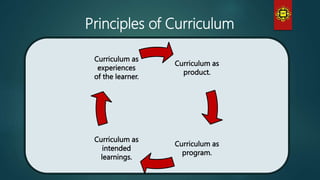
Principles of Curriculum
Curriculum as
product.
Curriculum as
program.
Curriculum as
intended
learnings.
Curriculum as
experiences
of the learner.
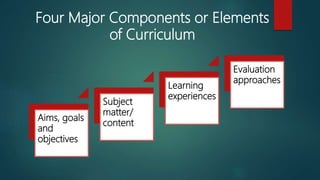
Four Major Components or Elements
of Curriculum
Aims, goals
and
objectives
Subject
matter/
content
Learning
experiences
Evaluation
approaches
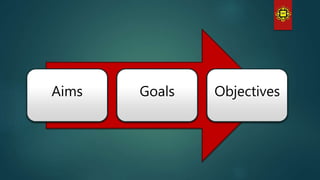
Aims Goals Objectives
Goals of Curriculum
 Goals are more general and involve the achievement of a relatively
large number of objectives for their attainment.
 School outcomes.
 Examples:
1. “appreciation of literature”
2. “ability to think or read critically”
3. “knowledge of American heritage”
Objectives of Curriculum
 The most immediate specific outcomes of classroom curriculum.
 Generally, they refer to the:
1. everyday business of the operative curriculum.
2. degree to which they have been achieved is assessable, at least
theoretically at any given point in time.
 Examples:
1. The student will be able to solve correctly four out of five quadratic
equations.
2. The students will master the principles of chemistry.
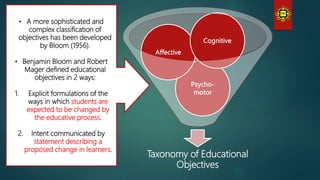
Taxonomy of Educational
Objectives
Psycho-
motor
Affective
Cognitive
• A more sophisticated and
complex classification of
objectives has been developed
by Bloom (1956).
• Benjamin Bloom and Robert
Mager defined educational
objectives in 2 ways:
1. Explicit formulations of the
ways in which students are
expected to be changed by
the educative process.
2. Intent communicated by
statement describing a
proposed change in learners.
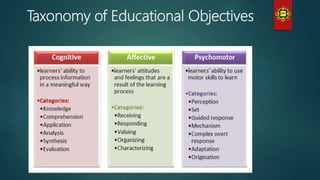
Taxonomy of Educational Objectives
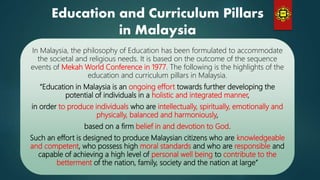
In Malaysia, the philosophy of Education has been formulated to accommodate
the societal and religious needs. It is based on the outcome of the sequence
events of Mekah World Conference in 1977. The following is the highlights of the
education and curriculum pillars in Malaysia.
“Education in Malaysia is an ongoing effort towards further developing the
potential of individuals in a holistic and integrated manner,
in order to produce individuals who are intellectually, spiritually, emotionally and
physically, balanced and harmoniously,
based on a firm belief in and devotion to God.
Such an effort is designed to produce Malaysian citizens who are knowledgeable
and competent, who possess high moral standards and who are responsible and
capable of achieving a high level of personal well being to contribute to the
betterment of the nation, family, society and the nation at large”
Education and Curriculum Pillars
in Malaysia
Beane, J. A., Alessi, S. J., & Toepfer, C. F. (1988). Curriculum
planning and development. Boston: Allyn and Bacon.
Zais, R. S. (1976). Curriculum: principles and foundations. New
York: Crowell.
References

Concepts of curriculum

  • 1.
    Introduction to the Conceptsof the Curriculum INTERNATIONAL ISLAMIC UNIVERSITY MALAYSIA CURRICULUM OF ISLAMIC EDUCATION (EDC 6301) KAIYISAH NURULSYAKUR BINTI YUSOF G1628472
  • 2.
    Concepts of Curriculum The definition varies, depend on the society we are living in.  In Latin, it refers to run a course or “racecourse”; a racecourse of subject matter to be mastered.  Marsh and Willis (2003) define curriculum as :  Permanent subjects.  Those subjects that are most useful for living in a contemporary society.  All planned learning for which the school is responsible.
  • 3.
    Principles of Curriculum Curriculumas product. Curriculum as program. Curriculum as intended learnings. Curriculum as experiences of the learner.
  • 4.
    Four Major Componentsor Elements of Curriculum Aims, goals and objectives Subject matter/ content Learning experiences Evaluation approaches
  • 5.
  • 6.
    Goals of Curriculum Goals are more general and involve the achievement of a relatively large number of objectives for their attainment.  School outcomes.  Examples: 1. “appreciation of literature” 2. “ability to think or read critically” 3. “knowledge of American heritage”
  • 7.
    Objectives of Curriculum The most immediate specific outcomes of classroom curriculum.  Generally, they refer to the: 1. everyday business of the operative curriculum. 2. degree to which they have been achieved is assessable, at least theoretically at any given point in time.  Examples: 1. The student will be able to solve correctly four out of five quadratic equations. 2. The students will master the principles of chemistry.
  • 8.
    Taxonomy of Educational Objectives Psycho- motor Affective Cognitive •A more sophisticated and complex classification of objectives has been developed by Bloom (1956). • Benjamin Bloom and Robert Mager defined educational objectives in 2 ways: 1. Explicit formulations of the ways in which students are expected to be changed by the educative process. 2. Intent communicated by statement describing a proposed change in learners.
  • 9.
  • 10.
    In Malaysia, thephilosophy of Education has been formulated to accommodate the societal and religious needs. It is based on the outcome of the sequence events of Mekah World Conference in 1977. The following is the highlights of the education and curriculum pillars in Malaysia. “Education in Malaysia is an ongoing effort towards further developing the potential of individuals in a holistic and integrated manner, in order to produce individuals who are intellectually, spiritually, emotionally and physically, balanced and harmoniously, based on a firm belief in and devotion to God. Such an effort is designed to produce Malaysian citizens who are knowledgeable and competent, who possess high moral standards and who are responsible and capable of achieving a high level of personal well being to contribute to the betterment of the nation, family, society and the nation at large” Education and Curriculum Pillars in Malaysia
  • 11.
    Beane, J. A.,Alessi, S. J., & Toepfer, C. F. (1988). Curriculum planning and development. Boston: Allyn and Bacon. Zais, R. S. (1976). Curriculum: principles and foundations. New York: Crowell. References