What is Meant by the Term “Curriculum” ? (part 1) ECS Year 1 The Curriculum: Historical and Philosophical Perspectives
What is  Curriculum?? Turn to the people sitting around you to  discuss and write down what you think curriculum is.
Curriculum Definitions “ The word curriculum is derived from its Latin root, meaning ‘race-course’ and for many, the school curriculum is just that. A race to be run, a series of obstacles or hurdles (subjects to be passed).” ( March, C & Stafford, K: 1992:2) “ Curriculum is a term often confused with syllabus.”  (Ibid:1)
More Definitions 1. Lawton (1975) – a selection of the best of a culture  2. Wylie (1970) – compared curriculum to a tripod with  “…one foot planted down in past traditions… one foot set down in present beliefs and practices and one foot extended ahead into predicted requirements and hoped for improvements for the future”  (In Connell, W (1974:134)  3. Sharpes (1988) – a plan in action | someone knowing what and how to teach   A teaching act   What the teacher does    What the teacher knows   Who the teacher is (behavior, knowledge & personality)
Oliva (1989) states... To some people the curriculum consists of all of the experiences undergone by children wherever they may be:  in school, at home, on the street.  To others the curriculum is a set of subjects which children “take.”
Crunkilton and Finch (1999) say... Curriculum is the sum of the learning activities and experiences that a student has under the auspices or direction of the school.
Their ideas includes two supporting concepts. The focus is on the student (each has his or her own curriculum). Formal courses are only part of the curriculum. *The focus is on the “whole” student…
Curriculum development is… A conscious planning of curriculum (aims, objectives, goals, outcomes etc.) to ensure quality education  (both of processes ad product [outcomes]).
Key Distinctions in attempting to define Curriculum ‘ Syllabus’ is part of the curriculum. The syllabus is typically a list of examinable content, aims, objectives and student activities Curriculum includes a list of content and details of other elements (aims/ objectives, learning experiences, evaluation and so on) Conscious planning to be reflected in actual learning outcomes What is a curriculum document? Can you think of a few examples?
Culture and Context Perspectives, Values and Ideas Influence Curriculum Development Lawton (1975) uses the phrase ‘value laden’. If something is value laden, it means that it is based on values or that it has underpinning values attached to it. It is important because different cultures have different values.  Thaman (2000) states that  “values determine the kinds of meanings that you ascribe to people, events and things”  .
Culture, Context and Curriculum Matsimoto (2000) :  “ Culture exists in each and every individual as a set of psychological rules, attitudes, values and beliefs, and strong associations exist between those rules and our emotions, judgments of morality and personality.” “ We perceive events and behaviors and make interpretations about those events and behaviors based on our own cultural filters and rules”   Thaman (2002) takes the discussion further when she argues that because formal education was (and remains) Eurocentric in nature, it aims at cultural transformation.  (What do you think this means?)
How do we come up with a curriculum framework? Before a curriculum can be developed, the purpose or goals (direction) of education must be established i.e. Education for what?  In simple terms how can you draw up a plan, if you don’t know what you are planning for?  In Educational terms, the outcomes must be determined before the various player/ components and ways by which to achieve these desired outcomes can be ascertained.
The educational goals of the organization can affect the curriculum What are the purposes or goals of education, in general?? Discuss with the people near you and write down your thoughts…
So the purposes you discovered are….
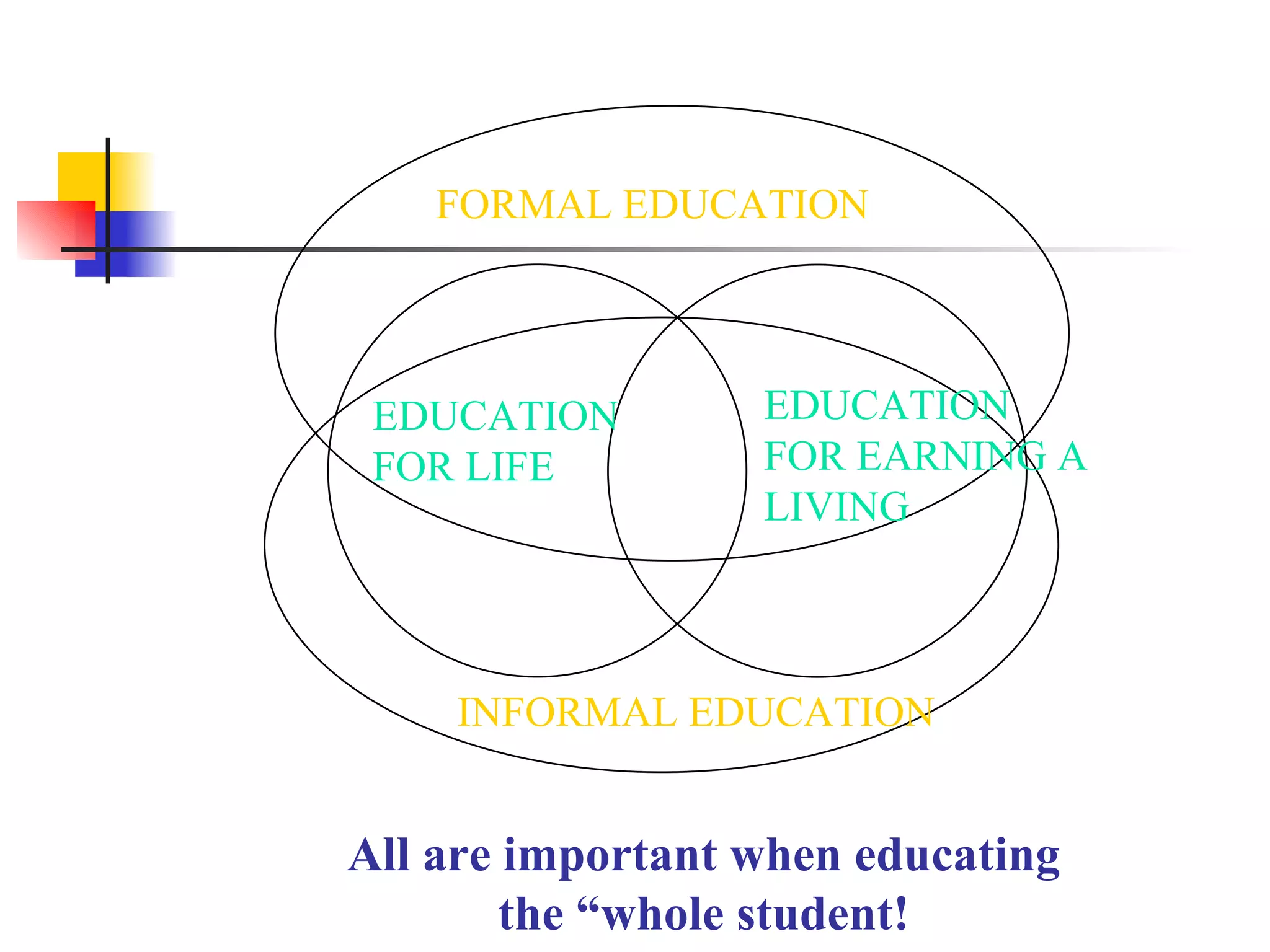
FORMAL EDUCATION INFORMAL EDUCATION EDUCATION FOR LIFE EDUCATION FOR EARNING A LIVING All are important when educating the “whole student!
In the seminar…. Define culture and the impact it has on a curriculum. Discuss the curricula you have encountered- Who developed the curriculum? Who delivered the curriculum? What was used to decide whether you succeeded in using the curriculum?
References March, C & Stafford, K (1992).  Curriculum Practices and Issues  (2nd Edition). Sydney:McGraw Book Company, pp. 1 - 19  Matsimoto, D (2000).  Culture and Psychology  (2nd Edition). USA: Wadsworth Thomson Learning  Subramani (2000).  Reinscribing Vision  in  Learning Together- Directions for Education in the Fiji Islands , Fiji, Government Printers Suva Tafe’ulungaki, A (2002).  Tree of Opportunity – Rethinking Pacific Education.  Suva: IOE, USP  UNESCO (2000).  The Dakar Framework for Action – Education for All – Meeting our Collective Commitments.  Paris France.

Curriculum I

  • 1.
    What is Meantby the Term “Curriculum” ? (part 1) ECS Year 1 The Curriculum: Historical and Philosophical Perspectives
  • 2.
    What is Curriculum?? Turn to the people sitting around you to discuss and write down what you think curriculum is.
  • 3.
    Curriculum Definitions “The word curriculum is derived from its Latin root, meaning ‘race-course’ and for many, the school curriculum is just that. A race to be run, a series of obstacles or hurdles (subjects to be passed).” ( March, C & Stafford, K: 1992:2) “ Curriculum is a term often confused with syllabus.” (Ibid:1)
  • 4.
    More Definitions 1.Lawton (1975) – a selection of the best of a culture 2. Wylie (1970) – compared curriculum to a tripod with “…one foot planted down in past traditions… one foot set down in present beliefs and practices and one foot extended ahead into predicted requirements and hoped for improvements for the future” (In Connell, W (1974:134) 3. Sharpes (1988) – a plan in action | someone knowing what and how to teach A teaching act What the teacher does What the teacher knows Who the teacher is (behavior, knowledge & personality)
  • 5.
    Oliva (1989) states...To some people the curriculum consists of all of the experiences undergone by children wherever they may be: in school, at home, on the street. To others the curriculum is a set of subjects which children “take.”
  • 6.
    Crunkilton and Finch(1999) say... Curriculum is the sum of the learning activities and experiences that a student has under the auspices or direction of the school.
  • 7.
    Their ideas includestwo supporting concepts. The focus is on the student (each has his or her own curriculum). Formal courses are only part of the curriculum. *The focus is on the “whole” student…
  • 8.
    Curriculum development is…A conscious planning of curriculum (aims, objectives, goals, outcomes etc.) to ensure quality education (both of processes ad product [outcomes]).
  • 9.
    Key Distinctions inattempting to define Curriculum ‘ Syllabus’ is part of the curriculum. The syllabus is typically a list of examinable content, aims, objectives and student activities Curriculum includes a list of content and details of other elements (aims/ objectives, learning experiences, evaluation and so on) Conscious planning to be reflected in actual learning outcomes What is a curriculum document? Can you think of a few examples?
  • 10.
    Culture and ContextPerspectives, Values and Ideas Influence Curriculum Development Lawton (1975) uses the phrase ‘value laden’. If something is value laden, it means that it is based on values or that it has underpinning values attached to it. It is important because different cultures have different values. Thaman (2000) states that “values determine the kinds of meanings that you ascribe to people, events and things” .
  • 11.
    Culture, Context andCurriculum Matsimoto (2000) : “ Culture exists in each and every individual as a set of psychological rules, attitudes, values and beliefs, and strong associations exist between those rules and our emotions, judgments of morality and personality.” “ We perceive events and behaviors and make interpretations about those events and behaviors based on our own cultural filters and rules” Thaman (2002) takes the discussion further when she argues that because formal education was (and remains) Eurocentric in nature, it aims at cultural transformation. (What do you think this means?)
  • 12.
    How do wecome up with a curriculum framework? Before a curriculum can be developed, the purpose or goals (direction) of education must be established i.e. Education for what? In simple terms how can you draw up a plan, if you don’t know what you are planning for? In Educational terms, the outcomes must be determined before the various player/ components and ways by which to achieve these desired outcomes can be ascertained.
  • 13.
    The educational goalsof the organization can affect the curriculum What are the purposes or goals of education, in general?? Discuss with the people near you and write down your thoughts…
  • 14.
    So the purposesyou discovered are….
  • 15.
    FORMAL EDUCATION INFORMALEDUCATION EDUCATION FOR LIFE EDUCATION FOR EARNING A LIVING All are important when educating the “whole student!
  • 16.
    In the seminar….Define culture and the impact it has on a curriculum. Discuss the curricula you have encountered- Who developed the curriculum? Who delivered the curriculum? What was used to decide whether you succeeded in using the curriculum?
  • 17.
    References March, C& Stafford, K (1992). Curriculum Practices and Issues (2nd Edition). Sydney:McGraw Book Company, pp. 1 - 19 Matsimoto, D (2000). Culture and Psychology (2nd Edition). USA: Wadsworth Thomson Learning Subramani (2000). Reinscribing Vision in Learning Together- Directions for Education in the Fiji Islands , Fiji, Government Printers Suva Tafe’ulungaki, A (2002). Tree of Opportunity – Rethinking Pacific Education. Suva: IOE, USP UNESCO (2000). The Dakar Framework for Action – Education for All – Meeting our Collective Commitments. Paris France.