Definitions of Curriculum
Objectives:
Bythe end of the lesson, students must be able to:
1. Narrate the origins for the concept ‘curriculum’.
2. Explain with examples the dictionary definition of ‘ curriculum’’.
3. Share some common definitions by educators and curriculum experts of
the term ‘curriculum’’.
4. Describe the four categories of definitions according to Beane et al
5. Analyze the advantages of the fourth category of definitions of Curriculum
as ‘Planned Learning Experiences’.
6. Discuss the general characteristics of curriculum.
7. Discuss the contents of the curriculum
3.
What is Curriculum?
•The word curriculum, as an idea, has its roots from the Latin word that means
a race or the course of a race (race course/track). It is derived from the verb
currere, meaning to run/to proceed.
• The Term /Word curriculum first came into usage with the Greeks (Gaius Julius
Caesar and his cohorts in 1st BC).
Activity 1: Group Discussion Question
Suggest any seven (7) activities a race may involve that compares it to a
curriculum.
4.
Suggested Answers
1. Hasgoals/aims/purpose
2. Has rules and regulations (Terms of reference (ToR’s)
3. Content (Knowledge, skills, abilities, values, attitudes)
4. Assessment/Evaluation practices
5. Experiences/activities participants engage in to demonstrate/prove
acquisition of (3)
6. Methodology (The how to /the means through which the participant
acquires (3)
7. Trainer/facilitator/teacher
8. Participant/learner
5.
Curriculum Defined
There isno generally agreed-upon definition of curriculum.
• Nobody ever dreamt that C21s later, the word curriculum would be used
almost daily by educators.
• The race-course/track, the curriculum has become one of the key concerns of
today’s schools. Its meaning has expanded from tangible racecourse to an
abstract concept. Professionally, the concept of Curriculum has taken an
elusive , almost esoteric connotation, possessing an aura of mystery.
6.
How Curriculum isan Elusive Mystery Term in
Educational circles
• Whereas other professional educational concepts are strong action-oriented
words i.e. Administration, Instruction, supervision;
• They can be turned to activities such as:
- administration is the act of administrating,
- instruction is the act of instructing and
- supervision is the act of supervising.
• They can be personalized as by one acting:
- Administrator
- Instructor
- Supervisor
• The contrary is true about curriculum. It has no distinct established position as a
strong action-oriented word. No school person curricules!
- The term Curricularist has sometimes been used and rarely have we come across a
curricularist, curricularizing!
7.
Curriculum Definition Critiqued
Thequest for a definition has taxed many educators. Among them include the
following:
• Dwayne Huebner (1976), concluded that the term curriculum was ambiguous
and lacked precision.
• Elizabeth Valence (1980) observed that the curriculum field is by no means
clear; as a discipline of study and as a field of practice, curriculum lacks clean
boundaries…
• At the turn of the century, Arthur W Foshay attributed a lack of specificity to
the curriculum
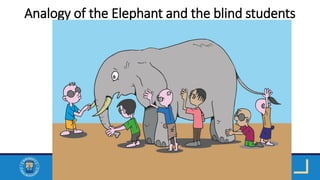
Explanation of theAnalogy
• Each person touches a different part of the elephant (e.g., the trunk, leg, tail,
ear, etc.) and describes the elephant based on their limited experience:
• One says the elephant is like a rope (tail).
• Another says it is like a tree trunk (leg).
• Another claims it is like a fan (ear), and so on.
• Moral of the Analogy:
1.Subjectivity: Individual perspectives are limited and shaped by personal
experience.
2.Partial Truths: Each person is partially correct but misses the whole picture.
3.Value of Collaboration: Understanding the complete truth requires combining
perspectives.
10.
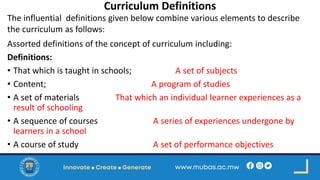
Curriculum Definitions
The influentialdefinitions given below combine various elements to describe
the curriculum as follows:
Assorted definitions of the concept of curriculum including:
Definitions:
• That which is taught in schools; A set of subjects
• Content; A program of studies
• A set of materials That which an individual learner experiences as a
result of schooling
• A sequence of courses A series of experiences undergone by
learners in a school
• A course of study A set of performance objectives
11.
Dictionary definition:
All hecourses of study offered at any university /college/school
Other Definitions by educators and curriculum experts
- Everything that goes around at an education institution
- A Plan or program of all experiences which the learner encounters under the
direction of a school
- The totality of the experiences of children for which schools are responsible
- That which a student is supposed to encounter, study practice and master after
undergoing learning
- Prescribed series of courses or programs of study
12.
Curriculum Meanings
Meanings:
• Everythingthat goes on within the school including extra class activities,
guidance, and interpersonal relationships
• Everything that is planned by school personnel.
• A broad plan made by the school and it includes educational experiences to
achieve its aims, goals and objectives with students.
• Broadly defined as the totality of student experiences that occur in the
educational process.
• Planned sequence of instruction, or to a view of the student’s experiences in
terms of the educator’s or school’s instructional goals.
• Combination of instructional practices, learning experiences, and students’
performance assessments.
13.
Derived Definition ofCurriculum
Curriculum is a comprehensive plan for an
educational/training program/course tailored to
offer new/improved manpower to fulfill rising
needs of a dynamic society.
14.
Key Definitions
• Kerrdefines curriculum as all the learning which is planned and guided by the
school , whether it is carried on in groups or individually, inside or outside of
school.
• Curriculum is an agreement among communities, educational professionals,
and the state on what learners should take on during specific periods of their
lives.
• Beane et al. (1986) have grouped most of these definitions under the following
four categories:
a) Curriculum as a product/outcomes/knowledge/skills/attitudes/values
b) Curriculum as a program/course/subject
c) Curriculum as intended learning outcomes/objectives
d) Curriculum as planned learner experiences/activities
15.
Curriculum as aProduct
• It is the document which consists a list of courses and syllabi of those
courses.
• Curriculum is something tangible. A product of the mind bound into
booklet.
• When curriculum is a product, it describes the courses of events to be
followed in the schools and colleges.
Advantage since it written, it is more systematic as it bears little chaos
for the education system because of its uniform curriculum which is
followed by all schools.
Disadvantage of this category of curriculum definitions is that it is rigid
to booklet knowledge
16.
Curriculum as aProgram
•Curriculum as the entire learning program of the
school or college.
•It refers to the courses of study by the school
•It could also mean a student’s choice of courses
in a given program of the school.
•This definition of curriculum is most widely
accepted by schools
17.
Curriculum as IntendedLearning Outcomes (ILOs)
• It refers to the planned learning outcomes, which are
intended for the learners
• Curriculum could be defined as ‘what is to be learned’, that
is, the content, the skills, values, altitudes and behavior that
students are supposed to learn in school/college
• Advantage: it is easy to measure the attainment of
objectives.
• Disadvantage: It puts more emphasis on what is to be
learned.
18.
Curriculum as PlannedLearning Experiences
•Curriculum is regarded as experiences of the learners
which is an outcome of the planned situations.
•The belief is what happens is not always in accordance
with what was planned.
•The outcomes of the planned course contents are
more important than the course content itself.
• Curriculum should include an analysis of the students’
learning experiences
19.
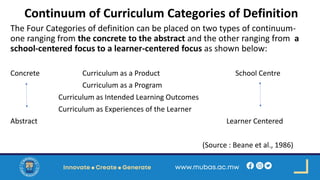
Continuum of CurriculumCategories of Definition
The Four Categories of definition can be placed on two types of continuum-
one ranging from the concrete to the abstract and the other ranging from a
school-centered focus to a learner-centered focus as shown below:
Concrete Curriculum as a Product School Centre
Curriculum as a Program
Curriculum as Intended Learning Outcomes
Curriculum as Experiences of the Learner
Abstract Learner Centered
(Source : Beane et al., 1986)
20.
General Characteristics ofa Curriculum
•It comprises the experiences to be acquired by
learner
•It has content
•It is planned
•It is a series of courses to be taken by students
•A curriculum considers interaction between the
learners, the teacher and the materials.
•The output and outcomes of a curriculum are
evaluated
21.
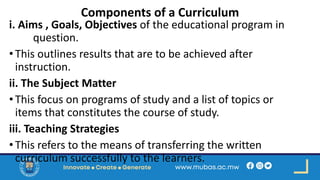
Components of aCurriculum
i. Aims , Goals, Objectives of the educational program in
question.
•This outlines results that are to be achieved after
instruction.
ii. The Subject Matter
•This focus on programs of study and a list of topics or
items that constitutes the course of study.
iii. Teaching Strategies
•This refers to the means of transferring the written
curriculum successfully to the learners.
22.
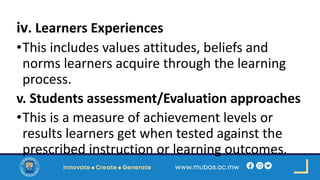
iv. Learners Experiences
•Thisincludes values attitudes, beliefs and
norms learners acquire through the learning
process.
v. Students assessment/Evaluation approaches
•This is a measure of achievement levels or
results learners get when tested against the
prescribed instruction or learning outcomes.
23.
Derived Definition ofCurriculum
Curriculum is a comprehensive plan for an
educational/training program/course
tailored to offer new/improved manpower
to fulfill rising needs of a dynamic society.
24.
Curriculum
•Refers to thetotality of experiences, courses, content,
and instructional materials designed and organized by
an educational institution to guide teaching and
learning.
•It encompasses what is taught (content), how it is
taught (pedagogy), and the intended outcomes
(learning objectives).
25.
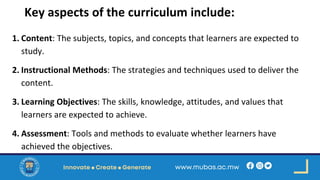
Key aspects ofthe curriculum include:
1. Content: The subjects, topics, and concepts that learners are expected to
study.
2. Instructional Methods: The strategies and techniques used to deliver the
content.
3. Learning Objectives: The skills, knowledge, attitudes, and values that
learners are expected to achieve.
4. Assessment: Tools and methods to evaluate whether learners have
achieved the objectives.