Curriculum Objectives & Alternative Approaches to Curriculum Development Presented by:   Bryan H. Gervacio, MAIED   Ph. D. – EPM, Student   EVSU-Tacloban City
In the Philippines the education system aims to: Provide a broad general education that will assist each individual in society to attain his/her potential as a human being, and enhance the range and quality of the individual and the group;     Help the individual participate in the basic functions of society and acquire the essential educational foundation for his/her development into a productive and versatile citizen;    
In the Philippines the education system aims to: Train the nation’s manpower in the middle-level skills required for national development; Develop the high-level professions that will provide leadership for the nation, advance knowledge through research, and apply new knowledge for improving the quality of human life; Respond effectively to changing needs and conditions through a system of educational planning  and evaluation.    
Structure and Organization of the Education System Pre-school education  consists of nurseries and kindergartens that cater to children aged 3-6. This level of education is not compulsory.    
Structure and Organization of the Education System Elementary education  is compulsory and provides basic education to pupils aged 7-12. It consists of six years of study except in a few schools––mainly private––offering a seven-year course. Elementary education is organized into two levels: primary, which covers Grades I-IV; and intermediate, which covers Grades V and VI (or VII). After completing the six-year elementary programme, pupils receive a certificate of graduation.    
Structure and Organization of the Education System Secondary education  (high school) is a continuation of the basic education provided at the first level. It is expanded to include learning (general education) and training in basic employable skills (vocational/technical education). This covers a period of four years of formal schooling and is addressed to students aged 13-16.
Structure and Organization of the Education System Tertiary education  (higher education) provides prescribed courses of studies which are credited towards degrees in academic disciplines or professions. It includes two-year post-secondary technical and vocational courses, various professional courses, and general higher education, including graduate and post-graduate studies (for students aged 17-25). Normally, a baccalaureate degree takes four years.  Graduate and post-graduate courses  normally take two to three years to complete
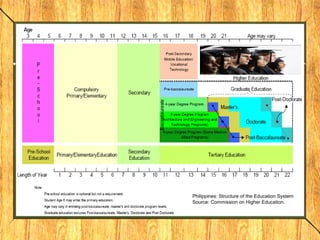
Philippines: Structure of the Education System Source: Commission on Higher Education.
Current Educational Priorities and Concerns In recent years, the DepEd has pursued several development programmes and projects through government funding and overseas economic co-operation both multilateral and bilateral.
Current Educational Priorities and Concerns The strategies to improve education include overall review of elementary and secondary education, universal access to and quality of education (notably by emphasizing teaching of English, science, technology and mathematics), provision of alternative delivery schemes (such as multigrade teaching, mobile teaching, and instructional management by parents, community and teachers in disaster areas), management training for principals and school administrators, development of research, improvement of school libraries and teachers welfare.
Current Educational Priorities and Concerns Technical and vocational education was also revised in an effort to cope with rapid technological advancements and to provide young people with more meaningful preparation for their future employment. The strategies include curriculum development, improvement of pre- and in-service education of teachers in both public and private schools, updated instructional materials in various fields, and upgrading of equipment for both public and private institutions.    
Current Educational Priorities and Concerns At the higher education level, the strategies include improving access of the poor and disadvantaged, improving quality––notably by focusing on pre-service and in-service training of teachers––, liberalizing policies for private schools, rationalizing state colleges and universities (SUCs), and strengthening linkages with government professional boards for evaluation.    
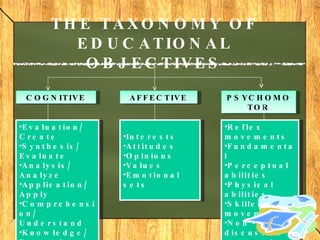
THE TAXONOMY OF EDUCATIONAL OBJECTIVES COGNITIVE AFFECTIVE PSYCHOMOTOR Evaluation/ Create Synthesis/ Evaluate Analysis/ Analyze Application/ Apply Comprehension/ Understand Knowledge/ Remember Interests Attitudes Opinions Values Emotional sets Reflex movements Fundamental Perceptual abilities Physical abilities Skilled movements Non - discussive communication
 
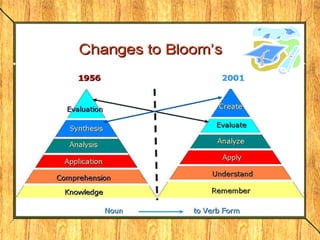
THE TAXONOMY OF EDUCATIONAL OBJECTIVES The taxonomy on the right is the more recent adaptation and is the redefined work of one of Bloom's former students, Lorin Anderson, working with one of Bloom's partners in the original work on cognition, David Krathwohl.
THE TAXONOMY OF EDUCATIONAL OBJECTIVES As you will see the primary differences are not just in the listings or rewordings from nouns to verbs, or in the renaming of some of the components, or even in the repositioning of the last two categories. The major differences in the updated version is in the more useful and comprehensive additions of how the taxonomy intersects and acts upon different types and levels of knowledge -- factual, conceptual, procedural and metacognitive.
Alternative Approaches to Curriculum Development   Technical- Scientific Approach Something similar to engineering or architecture, superintendents, principals and coordinators who use instruments and empirical methods in preparing a blueprint with well defined elements, orderly sequenced procedures, and quality control measures to increase the probability of success in its implementation.
Alternative Approaches to Curriculum Development   Behavioural- Rational Approach It is a means-end which is logical and prescriptive. It clearly defines why (objective) what (content) how (method) when (sequence) and how much (scope) it relies on technical and scientific principles and involves the preparation of a detail plan, prescribing step-by-step strategies for formulating curricula.
Alternative Approaches to Curriculum Development   Intellectual- Academic Approach Emphasizes the importance of theories and principles in curriculum planning. It attempts to analyze and synthesize the historical development, cultural demands and philosophical ideas which underpin the curriculum, including issues and trends.
Alternative Approaches to Curriculum Development   Non-Technical/ Non-Scientific Approach Is flexible and less structured without predetermined objectives to guide the learning teaching process. This approach is based on the progressive philosophy where the needs and interests of individual learners and the needs of society are the priority concerns.
Alternative Approaches to Curriculum Development   Humanistic- Aesthetic Approach The humanistic-aesthetic approach is rooted in progressive philosophy which promotes the liberation of learners from authoritarian teachers. These stereotypical teachers emphasize rote learning and recitations and believe that books are the only source of knowledge.
Alternative Approaches to Curriculum Development   Reconceptualist Approach The reconceptualist approach reflects an existentialist orientation. Proponents argue that the aim of education is not to control instruction in order to preserve existing orders. Instead, the purpose of education is to emancipate society from traditional, outmoded orders through individual free choice.
Alternative Approaches to Curriculum Development   Eclectic Models Oftentimes, educators prefer eclectic models (halo-halo) which are a combination of several approaches, rather than commit themselves to one particular approach only. Eclectic models are not mere path work (pagtatagpi-tagpi) but a synthesis (pagbubuo o paghahabi) where desired features from several models are selected and integrated into a new whole. Many established curricula in the Philippines exhibit eclectic models.
Thank you for listening…

Curriculum Objectives@ibryevsugradskul

  • 1.
    Curriculum Objectives &Alternative Approaches to Curriculum Development Presented by: Bryan H. Gervacio, MAIED Ph. D. – EPM, Student EVSU-Tacloban City
  • 2.
    In the Philippinesthe education system aims to: Provide a broad general education that will assist each individual in society to attain his/her potential as a human being, and enhance the range and quality of the individual and the group;   Help the individual participate in the basic functions of society and acquire the essential educational foundation for his/her development into a productive and versatile citizen;  
  • 3.
    In the Philippinesthe education system aims to: Train the nation’s manpower in the middle-level skills required for national development; Develop the high-level professions that will provide leadership for the nation, advance knowledge through research, and apply new knowledge for improving the quality of human life; Respond effectively to changing needs and conditions through a system of educational planning and evaluation.  
  • 4.
    Structure and Organizationof the Education System Pre-school education consists of nurseries and kindergartens that cater to children aged 3-6. This level of education is not compulsory.  
  • 5.
    Structure and Organizationof the Education System Elementary education is compulsory and provides basic education to pupils aged 7-12. It consists of six years of study except in a few schools––mainly private––offering a seven-year course. Elementary education is organized into two levels: primary, which covers Grades I-IV; and intermediate, which covers Grades V and VI (or VII). After completing the six-year elementary programme, pupils receive a certificate of graduation.  
  • 6.
    Structure and Organizationof the Education System Secondary education (high school) is a continuation of the basic education provided at the first level. It is expanded to include learning (general education) and training in basic employable skills (vocational/technical education). This covers a period of four years of formal schooling and is addressed to students aged 13-16.
  • 7.
    Structure and Organizationof the Education System Tertiary education (higher education) provides prescribed courses of studies which are credited towards degrees in academic disciplines or professions. It includes two-year post-secondary technical and vocational courses, various professional courses, and general higher education, including graduate and post-graduate studies (for students aged 17-25). Normally, a baccalaureate degree takes four years. Graduate and post-graduate courses normally take two to three years to complete
  • 8.
    Philippines: Structure ofthe Education System Source: Commission on Higher Education.
  • 9.
    Current Educational Prioritiesand Concerns In recent years, the DepEd has pursued several development programmes and projects through government funding and overseas economic co-operation both multilateral and bilateral.
  • 10.
    Current Educational Prioritiesand Concerns The strategies to improve education include overall review of elementary and secondary education, universal access to and quality of education (notably by emphasizing teaching of English, science, technology and mathematics), provision of alternative delivery schemes (such as multigrade teaching, mobile teaching, and instructional management by parents, community and teachers in disaster areas), management training for principals and school administrators, development of research, improvement of school libraries and teachers welfare.
  • 11.
    Current Educational Prioritiesand Concerns Technical and vocational education was also revised in an effort to cope with rapid technological advancements and to provide young people with more meaningful preparation for their future employment. The strategies include curriculum development, improvement of pre- and in-service education of teachers in both public and private schools, updated instructional materials in various fields, and upgrading of equipment for both public and private institutions.  
  • 12.
    Current Educational Prioritiesand Concerns At the higher education level, the strategies include improving access of the poor and disadvantaged, improving quality––notably by focusing on pre-service and in-service training of teachers––, liberalizing policies for private schools, rationalizing state colleges and universities (SUCs), and strengthening linkages with government professional boards for evaluation.  
  • 13.
    THE TAXONOMY OFEDUCATIONAL OBJECTIVES COGNITIVE AFFECTIVE PSYCHOMOTOR Evaluation/ Create Synthesis/ Evaluate Analysis/ Analyze Application/ Apply Comprehension/ Understand Knowledge/ Remember Interests Attitudes Opinions Values Emotional sets Reflex movements Fundamental Perceptual abilities Physical abilities Skilled movements Non - discussive communication
  • 14.
  • 15.
    THE TAXONOMY OFEDUCATIONAL OBJECTIVES The taxonomy on the right is the more recent adaptation and is the redefined work of one of Bloom's former students, Lorin Anderson, working with one of Bloom's partners in the original work on cognition, David Krathwohl.
  • 16.
    THE TAXONOMY OFEDUCATIONAL OBJECTIVES As you will see the primary differences are not just in the listings or rewordings from nouns to verbs, or in the renaming of some of the components, or even in the repositioning of the last two categories. The major differences in the updated version is in the more useful and comprehensive additions of how the taxonomy intersects and acts upon different types and levels of knowledge -- factual, conceptual, procedural and metacognitive.
  • 17.
    Alternative Approaches toCurriculum Development   Technical- Scientific Approach Something similar to engineering or architecture, superintendents, principals and coordinators who use instruments and empirical methods in preparing a blueprint with well defined elements, orderly sequenced procedures, and quality control measures to increase the probability of success in its implementation.
  • 18.
    Alternative Approaches toCurriculum Development   Behavioural- Rational Approach It is a means-end which is logical and prescriptive. It clearly defines why (objective) what (content) how (method) when (sequence) and how much (scope) it relies on technical and scientific principles and involves the preparation of a detail plan, prescribing step-by-step strategies for formulating curricula.
  • 19.
    Alternative Approaches toCurriculum Development   Intellectual- Academic Approach Emphasizes the importance of theories and principles in curriculum planning. It attempts to analyze and synthesize the historical development, cultural demands and philosophical ideas which underpin the curriculum, including issues and trends.
  • 20.
    Alternative Approaches toCurriculum Development   Non-Technical/ Non-Scientific Approach Is flexible and less structured without predetermined objectives to guide the learning teaching process. This approach is based on the progressive philosophy where the needs and interests of individual learners and the needs of society are the priority concerns.
  • 21.
    Alternative Approaches toCurriculum Development   Humanistic- Aesthetic Approach The humanistic-aesthetic approach is rooted in progressive philosophy which promotes the liberation of learners from authoritarian teachers. These stereotypical teachers emphasize rote learning and recitations and believe that books are the only source of knowledge.
  • 22.
    Alternative Approaches toCurriculum Development   Reconceptualist Approach The reconceptualist approach reflects an existentialist orientation. Proponents argue that the aim of education is not to control instruction in order to preserve existing orders. Instead, the purpose of education is to emancipate society from traditional, outmoded orders through individual free choice.
  • 23.
    Alternative Approaches toCurriculum Development   Eclectic Models Oftentimes, educators prefer eclectic models (halo-halo) which are a combination of several approaches, rather than commit themselves to one particular approach only. Eclectic models are not mere path work (pagtatagpi-tagpi) but a synthesis (pagbubuo o paghahabi) where desired features from several models are selected and integrated into a new whole. Many established curricula in the Philippines exhibit eclectic models.
  • 24.
    Thank you forlistening…