What is Language Across the Curriculum (LAC)?
 A Language Across the Curriculum (LAC) approach is one
that integrates language learning and content learning.
 LAC is an approach to learning that focuses on improving
language proficiency in all subjects in order to enhance
students’ learning and outcomes. In our school, which is
a 100% EMI, this means a focus on English language.
 LAC acknowledges that language education does not only
take place in specific subjects such as English Lessons, but
language learning also takes place in each and every
subject; in every learning activity; and across the whole
curriculum.
 LAC emphasizes that language development is the
responsibility of all teachers across the school and in all
subject areas. It involves a focus on the use of English in
each subject, as each subject area has both similar
language to other areas and its own specific language
usage and style.
 Each subject area also has its own specialized vocabulary
and different writing genres, e.g. Science report writing is
different to History report writing.
Why Language Across the Curriculum
 Plays a central role in learning. No matter what the subject
area, students assimilate new concepts when they listen, talk,
read and write about what they are learning.
 Speaking & writing reflects the thinking process that is taking
place. Students learn in language, therefore if their language
is weak, so is their learning.
 Focusing on the teaching & learning of language within a
subject, the teacher will improve the students’ results in that
subject, for example, by explicitly teaching students how to
write History
essays, or how best to write ‘for and against’
arguments in Liberal Studies. Experienced
teachers know that it is essential to teach their
students how to ‘answer’ the types of questions
they are likely to find in their exams.
 After understanding and working with the LAC
concept, teachers across disciplines will thus be
improving students learning within their own
subject while also supporting the efforts of the
whole school to improve English proficiency.
Implement an LAC approach
 All experienced teachers will know that in order to
be successful in their subject, students must have
good skills in reading and decoding exam questions,
as well as the knowledge of how to write answers in
ways relevant to the assessment in their subject.
 Inexperienced teachers may “inadvertently” teach
their students how to answer “styles” of questions
through practice, i.e. by doing mock exams or
quizzes which are based on exam questions.
Experienced teachers, in contrast, have a structured,
monitored and assessed approach to explicitly
teaching the language of their subject.
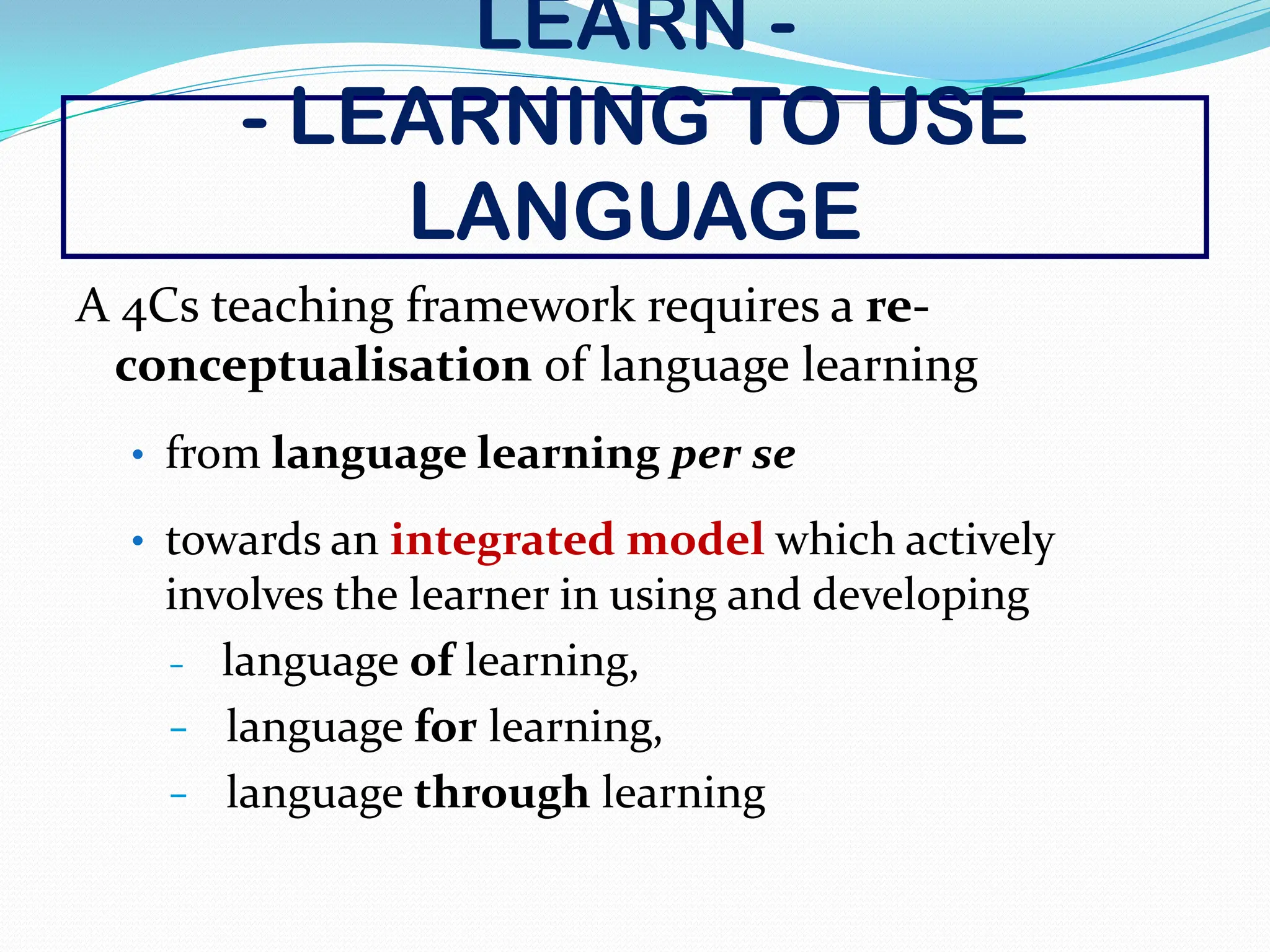
LEARN -
- LEARNING TO USE
LANGUAGE
A 4Cs teaching framework requires a re-
conceptualisation of language learning
• from language learning per se
• towards an integrated model which actively
involves the learner in using and developing
− language of learning,
− language for learning,
− language through learning
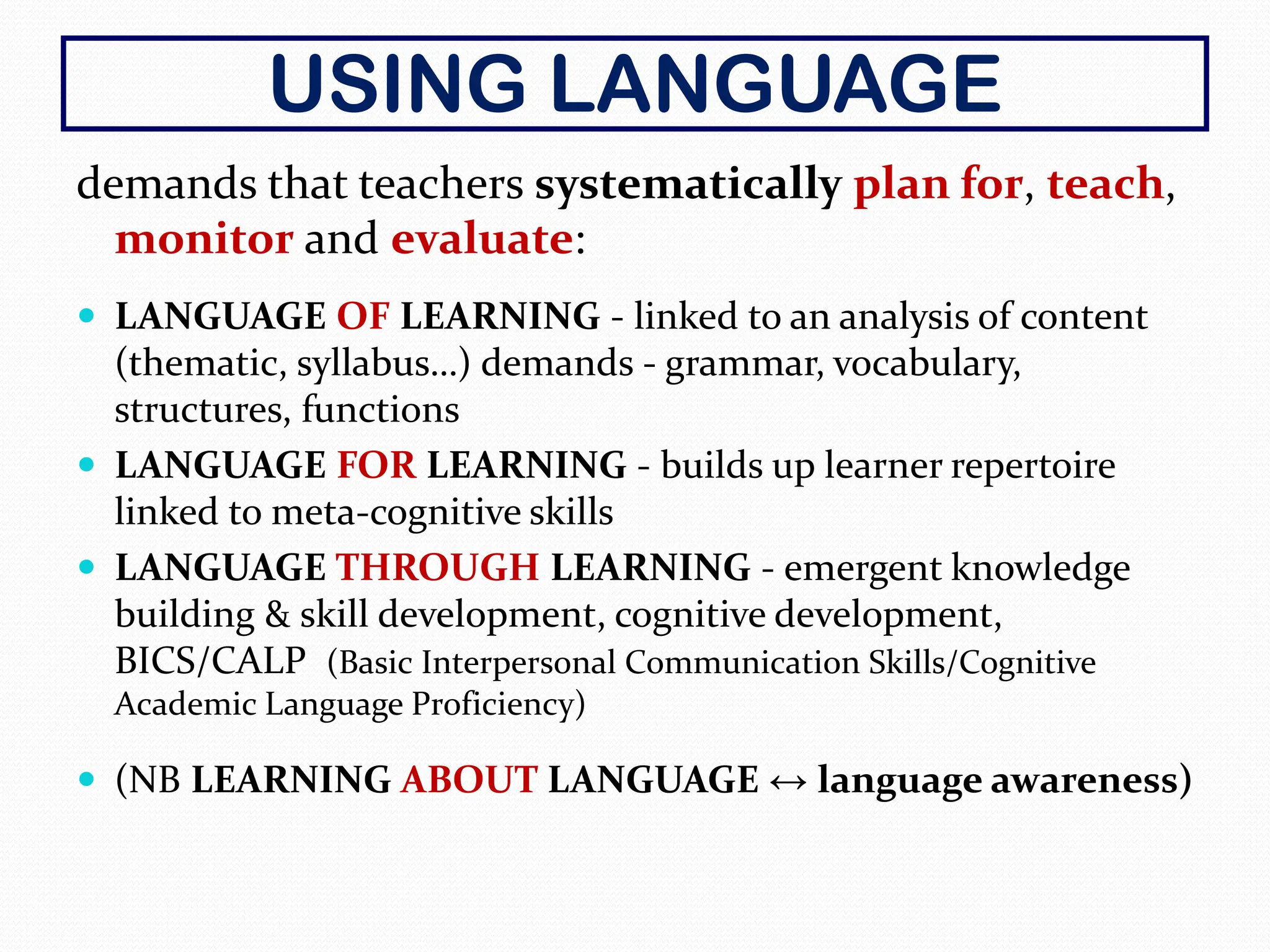
USING LANGUAGE
demands that teachers systematically plan for, teach,
monitor and evaluate:
 LANGUAGE OF LEARNING - linked to an analysis of content
(thematic, syllabus…) demands - grammar, vocabulary,
structures, functions
 LANGUAGE FOR LEARNING - builds up learner repertoire
linked to meta-cognitive skills
 LANGUAGE THROUGH LEARNING - emergent knowledge
building & skill development, cognitive development,
BICS/CALP (Basic Interpersonal Communication Skills/Cognitive
Academic Language Proficiency)
 (NB LEARNING ABOUT LANGUAGE ↔ language awareness)
LAC and CLIL
 Implementing innovative approaches to foreign language
teaching through foreign teachers inclusion into the school
curriculum
 builds its strategies and activities on the following two
approaches to (F)LL:
 LAC - Languages Across the Curriculum
 CLIL - Content and Language Integrated
Learning
Language(s) Across the
Curriculum
LAC
 Languages Across the Curriculum (LAC) refers to
the approach/practice through which the study
and use of languages take place throughout
the curriculum (cf. Key competences: communication
in mother tongue – communication in foreign languages).
 Its purpose is to prepare students for the
intercultural and multilingual demands and
opportunities of a global society. LAC is
appropriate at all levels of education.
Language Across the
Curriculum
 The concept of Language Across the Curriculum is
 to give all students the opportunity to apply their
foreign language skills in other disciplines, and
 to learn that knowledge of a second language can
enhance and deepen their understanding of subject
matter.
 Language Across the Curriculum extends the development
of language skills beyond the traditional language courses
and programs, and
 offers students an opportunity to read and discuss
relevant texts in more languages than one (mother
tongue & foreign).
GOALS OF LAC
 The long-term goal of LAC is
 to integrate multiple languages into the teaching of
all disciplines
 in order to enrich their intercultural and international
content.
 The short-term goal is
 to enlist the support of teachers and administrators
 to expand opportunities for the content-specific
acquisition and discipline-focused use of language and
cultural knowledge.
GOALS OF LAC
 Cross-cultural and multilingual inquiry leads to a more
complete learning experience and provides a basis for
comparative understanding unavailable when students
and teachers are limited to the use of resources in only one
language.
 Learners develop a deeper and more precise
understanding of a new language and culture by
studying
 how that language and culture address precisely
defined topics about which they have already
established a certain familiarity in their native
language.
RATIONALE OF LAC
 Understanding of a given culture and its documents and
artifacts is greatly enhanced through a knowledge of its
language.
 A curriculum that includes materials in multiple
languages provides
 access to a wider range of perspectives,
 encourages greater depth of exploration, and
 opens the door to greater understanding.
 The use of materials in multiple languages significantly
enhances any and all disciplinary inquiry.
Language(s) Across the
Curriculum approach:
 enhances intercultural competence;
 encourages students and teachers to venture beyond their
own cultural and linguistic borders in order to gain
additional perspectives and additional knowledge;
 bridges existing curricular and disciplinary
boundaries,
 creating a more integrated learning environment ,
 energizing the disciplines in new ways;
 by integrating the use of multiple languages into
disciplines across the curriculum, reinforces the
centrality of language study at all levels of education.
Content and Language
Integrated Learning - CLIL
CLIL refers to any dual-focused educational context
in which
 an additional language is used as a medium in
the teaching and learning of non-language
content.
 It is an umbrella term covering aspects of:
 Language Across the Curriculum
 Bilingual Education
 Content-based instruction/learning
ROLE OF TEACHER
 LAC learning outcomes that teacher use to
explicitly teach language in every subject, may
include the following:
 Subject-specific vocabulary, e.g. balance sheet,
reagent bottles, legato, etc.
 Familiarity with subject specific word formation,
i.e. prefixes, suffixes, word roots, etc, e.g. in
Science the suffix ‘…ology’
 Forms of expression, e.g. “The sum of 100 and X is
less than half of X, what is the value of X?”; or, “Do
you agree with the viewpoint portrayed in the
cartoon? Justify your argument.” etc.
 Competency and skills required for comprehending,
identifying, selecting and integrating information in
connection with specific text types, tasks and
materials, e.g. “Extrapolate from the graph”, “Write a
hypothesis relevant to the experiment”, “Compare
Source A and Source B”, etc.

Language Across Curriculum_LAC. Basic concept

  • 1.
    What is LanguageAcross the Curriculum (LAC)?  A Language Across the Curriculum (LAC) approach is one that integrates language learning and content learning.  LAC is an approach to learning that focuses on improving language proficiency in all subjects in order to enhance students’ learning and outcomes. In our school, which is a 100% EMI, this means a focus on English language.  LAC acknowledges that language education does not only take place in specific subjects such as English Lessons, but language learning also takes place in each and every subject; in every learning activity; and across the whole curriculum.
  • 2.
     LAC emphasizesthat language development is the responsibility of all teachers across the school and in all subject areas. It involves a focus on the use of English in each subject, as each subject area has both similar language to other areas and its own specific language usage and style.  Each subject area also has its own specialized vocabulary and different writing genres, e.g. Science report writing is different to History report writing.
  • 3.
    Why Language Acrossthe Curriculum  Plays a central role in learning. No matter what the subject area, students assimilate new concepts when they listen, talk, read and write about what they are learning.  Speaking & writing reflects the thinking process that is taking place. Students learn in language, therefore if their language is weak, so is their learning.  Focusing on the teaching & learning of language within a subject, the teacher will improve the students’ results in that subject, for example, by explicitly teaching students how to write History
  • 4.
    essays, or howbest to write ‘for and against’ arguments in Liberal Studies. Experienced teachers know that it is essential to teach their students how to ‘answer’ the types of questions they are likely to find in their exams.  After understanding and working with the LAC concept, teachers across disciplines will thus be improving students learning within their own subject while also supporting the efforts of the whole school to improve English proficiency.
  • 5.
    Implement an LACapproach  All experienced teachers will know that in order to be successful in their subject, students must have good skills in reading and decoding exam questions, as well as the knowledge of how to write answers in ways relevant to the assessment in their subject.  Inexperienced teachers may “inadvertently” teach their students how to answer “styles” of questions through practice, i.e. by doing mock exams or quizzes which are based on exam questions. Experienced teachers, in contrast, have a structured, monitored and assessed approach to explicitly teaching the language of their subject.
  • 6.
    LEARN - - LEARNINGTO USE LANGUAGE A 4Cs teaching framework requires a re- conceptualisation of language learning • from language learning per se • towards an integrated model which actively involves the learner in using and developing − language of learning, − language for learning, − language through learning
  • 7.
    USING LANGUAGE demands thatteachers systematically plan for, teach, monitor and evaluate:  LANGUAGE OF LEARNING - linked to an analysis of content (thematic, syllabus…) demands - grammar, vocabulary, structures, functions  LANGUAGE FOR LEARNING - builds up learner repertoire linked to meta-cognitive skills  LANGUAGE THROUGH LEARNING - emergent knowledge building & skill development, cognitive development, BICS/CALP (Basic Interpersonal Communication Skills/Cognitive Academic Language Proficiency)  (NB LEARNING ABOUT LANGUAGE ↔ language awareness)
  • 8.
    LAC and CLIL Implementing innovative approaches to foreign language teaching through foreign teachers inclusion into the school curriculum  builds its strategies and activities on the following two approaches to (F)LL:  LAC - Languages Across the Curriculum  CLIL - Content and Language Integrated Learning
  • 9.
    Language(s) Across the Curriculum LAC Languages Across the Curriculum (LAC) refers to the approach/practice through which the study and use of languages take place throughout the curriculum (cf. Key competences: communication in mother tongue – communication in foreign languages).  Its purpose is to prepare students for the intercultural and multilingual demands and opportunities of a global society. LAC is appropriate at all levels of education.
  • 10.
    Language Across the Curriculum The concept of Language Across the Curriculum is  to give all students the opportunity to apply their foreign language skills in other disciplines, and  to learn that knowledge of a second language can enhance and deepen their understanding of subject matter.  Language Across the Curriculum extends the development of language skills beyond the traditional language courses and programs, and  offers students an opportunity to read and discuss relevant texts in more languages than one (mother tongue & foreign).
  • 11.
    GOALS OF LAC The long-term goal of LAC is  to integrate multiple languages into the teaching of all disciplines  in order to enrich their intercultural and international content.  The short-term goal is  to enlist the support of teachers and administrators  to expand opportunities for the content-specific acquisition and discipline-focused use of language and cultural knowledge.
  • 12.
    GOALS OF LAC Cross-cultural and multilingual inquiry leads to a more complete learning experience and provides a basis for comparative understanding unavailable when students and teachers are limited to the use of resources in only one language.  Learners develop a deeper and more precise understanding of a new language and culture by studying  how that language and culture address precisely defined topics about which they have already established a certain familiarity in their native language.
  • 13.
    RATIONALE OF LAC Understanding of a given culture and its documents and artifacts is greatly enhanced through a knowledge of its language.  A curriculum that includes materials in multiple languages provides  access to a wider range of perspectives,  encourages greater depth of exploration, and  opens the door to greater understanding.  The use of materials in multiple languages significantly enhances any and all disciplinary inquiry.
  • 14.
    Language(s) Across the Curriculumapproach:  enhances intercultural competence;  encourages students and teachers to venture beyond their own cultural and linguistic borders in order to gain additional perspectives and additional knowledge;  bridges existing curricular and disciplinary boundaries,  creating a more integrated learning environment ,  energizing the disciplines in new ways;  by integrating the use of multiple languages into disciplines across the curriculum, reinforces the centrality of language study at all levels of education.
  • 15.
    Content and Language IntegratedLearning - CLIL CLIL refers to any dual-focused educational context in which  an additional language is used as a medium in the teaching and learning of non-language content.  It is an umbrella term covering aspects of:  Language Across the Curriculum  Bilingual Education  Content-based instruction/learning
  • 16.
    ROLE OF TEACHER LAC learning outcomes that teacher use to explicitly teach language in every subject, may include the following:  Subject-specific vocabulary, e.g. balance sheet, reagent bottles, legato, etc.  Familiarity with subject specific word formation, i.e. prefixes, suffixes, word roots, etc, e.g. in Science the suffix ‘…ology’  Forms of expression, e.g. “The sum of 100 and X is less than half of X, what is the value of X?”; or, “Do you agree with the viewpoint portrayed in the cartoon? Justify your argument.” etc.
  • 17.
     Competency andskills required for comprehending, identifying, selecting and integrating information in connection with specific text types, tasks and materials, e.g. “Extrapolate from the graph”, “Write a hypothesis relevant to the experiment”, “Compare Source A and Source B”, etc.