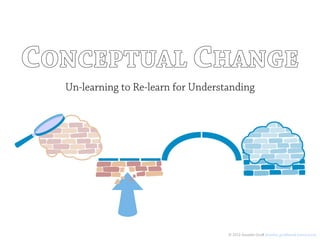
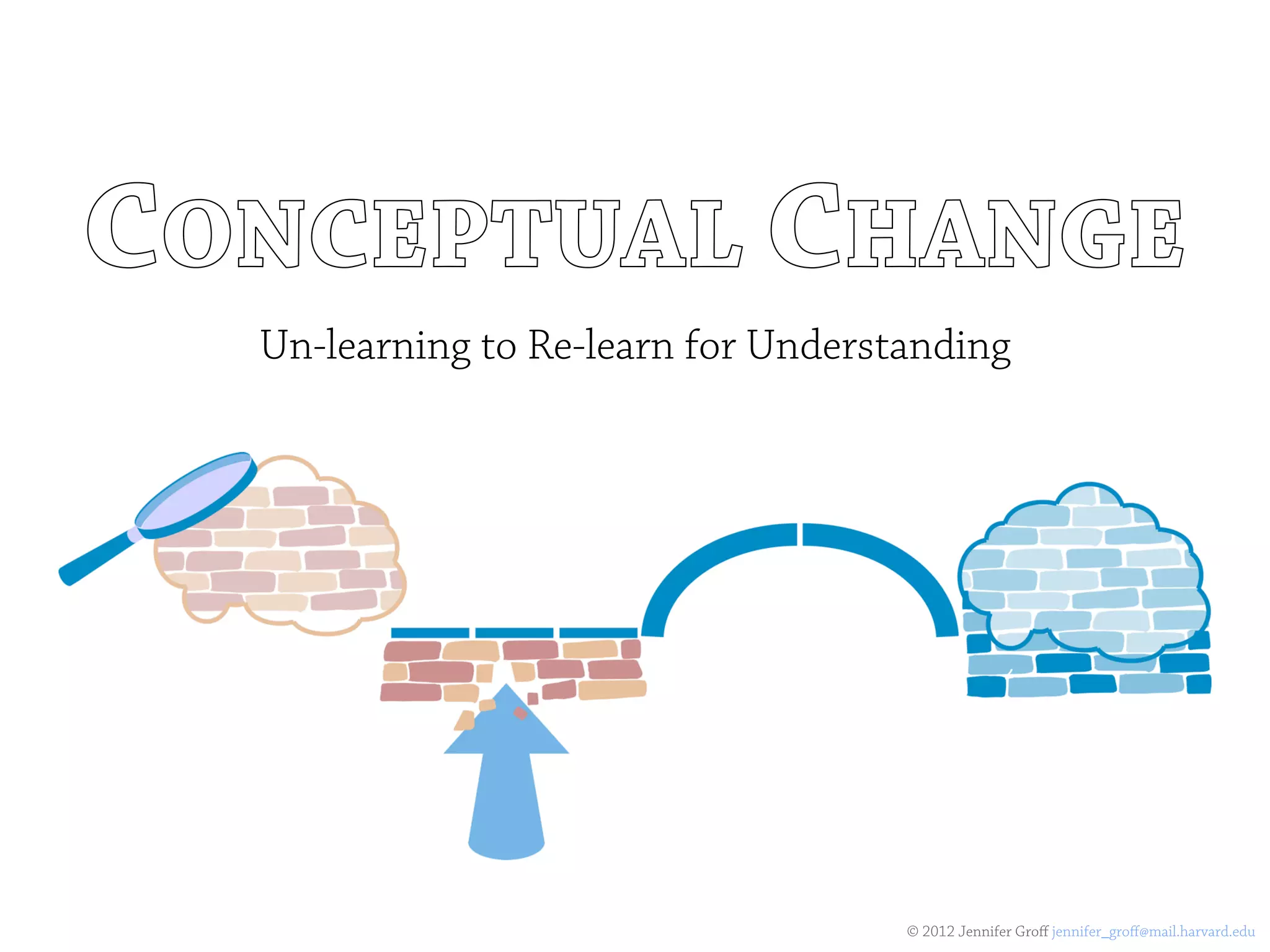
CONCEPTUAL CHANGE
  Un-learning to Re-learn for Understanding


                                     © 2012 Jennifer Groff jennifer_groff@mail.harvard.edu
When a new idea is introduced to a learner, it doesn’t just get
poured into their mind like water into a bucket. e new idea
is faced with integrating itself into the learner’s personal
cognitive landscape.
Each person has their own, unique Cognitive Ecology—
knowledge, concepts, experiences, schemas, and beliefs that
makeup what Kenneth Strike and George Posner call a
“Semantic Syntactical Network of Concepts.” [Hang onto that
notion—we’ll come back to it later]. Generally speaking,
people don’t let go of aspects of their Cognitive Ecology easily
—if a new idea introduced doesn’t fit into their network of
concepts easily (known as ‘assimilation’), then the individual
must alter their network of concepts in order to fit this new
idea into it (or ‘accommodate’ it). It’s kinda like having a
typical two-story home and saying you want to put an indoor
pool in the middle of it—successfully doing so isn’t like just
adding a wing onto the house, instead you’d have to take
apart the whole thing and rebuild it in a new way.
As a result, a person’s current Cognitive Ecology will influence
their production of a new conception.
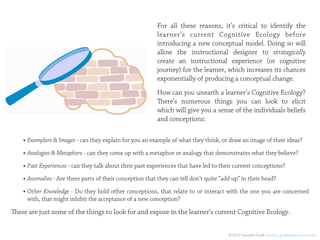
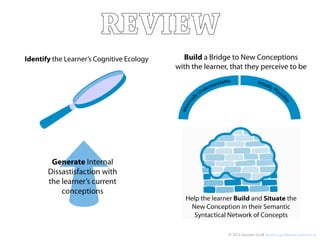
For all these reasons, it’s critical to identify the
                                                           learner’s current Cognitive Ecology before
                                                           introducing a new conceptual model. Doing so will
                                                           allow the instructional designer to strategically
                                                           create an instructional experience (or cognitive
                                                           journey) for the learner, which increases its chances
                                                           exponentially of producing a conceptual change.
                                                           How can you unearth a learner’s Cognitive Ecology?
                                                           ere’s numerous things you can look to elicit
                                                           which will give you a sense of the individuals beliefs
                                                           and conceptions:

    • Exemplars & Images - can they explain for you an example of what they think, or draw an image of their ideas?
    • Analogies & Metaphors - can they come up with a metaphor or analogy that demonstrates what they believe?
    • Past Experiences - can they talk about their past experiences that have led to their current conceptions?
    • Anomalies - Are there parts of their conception that they can tell don’t quite “add up” in their head?
    • Other Knowledge - Do they hold other conceptions, that relate to or interact with the one you are concerned
     with, that might inhibit the acceptance of a new conception?

ese are just some of the things to look for and expose in the learner’s current Cognitive Ecology.


                                                                                        © 2012 Jennifer Groff jennifer_groff@mail.harvard.edu
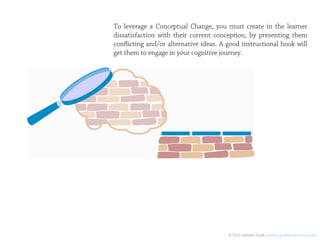
To leverage a Conceptual Change, you must create in the learner
dissatisfaction with their current conception, by presenting them
conflicting and/or alternative ideas. A good instructional hook will
get them to engage in your cognitive journey.


                                        © 2012 Jennifer Groff jennifer_groff@mail.harvard.edu
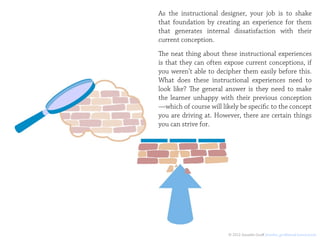
As the instructional designer, your job is to shake
that foundation by creating an experience for them
that generates internal dissatisfaction with their
current conception.
e neat thing about these instructional experiences
is that they can often expose current conceptions, if
you weren’t able to decipher them easily before this.
What does these instructional experiences need to
look like? e general answer is they need to make
the learner unhappy with their previous conception
—which of course will likely be specific to the concept
you are driving at. However, there are certain things
you can strive for.


                         © 2012 Jennifer Groff jennifer_groff@mail.harvard.edu
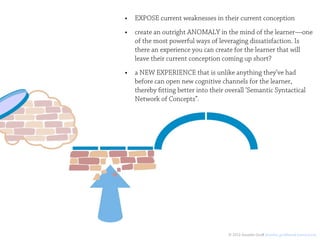
• EXPOSE current weaknesses in their current conception
• create an outright ANOMALY in the mind of the learner—one
   of the most powerful ways of leveraging dissatisfaction. Is
   there an experience you can create for the learner that will
   leave their current conception coming up short?

• a NEW EXPERIENCE that is unlike anything they’ve had
   before can open new cognitive channels for the learner,
   thereby fitting better into their overall ‘Semantic Syntactical
   Network of Concepts”.


                                     © 2012 Jennifer Groff jennifer_groff@mail.harvard.edu
NOTE:   Although ANOMALIES are one of the most powerful mechanisms
        for leveraging cognitive dissonance, they don’t come easily.
        Providing the learner with an anomaly leaves their conceptual
        ecology on very shaky ground. Changing their cognitive ecology to
        accommodate the anomaly is the most difficult of the learner’s
        options—it’s much easier for the learner to just reject what they
        experienced, disregard the experience as irrelevant, or just try to
        compartmentalize their knowledge so that the new beliefs they are
        forming do not interact with their prior conceptions.

        In order for the anomaly to successfully do its job, the learner must:
         1. understand why the experience produced an anomaly
         2. believe they must reconcile this experience with their previous
               conceptions
         3. have the desire to put the cognitive work into doing this
         4. fail at attempts to assimilate the new knowledge

        It may seem daunting, but the good news is that there is extensive
        research showing the cognitive dissonance is a powerful
        mechanism, and many learners will seek to reconcile disconnects in
        conceptions in order to relieve this dissonance.


                                                  © 2012 Jennifer Groff jennifer_groff@mail.harvard.edu
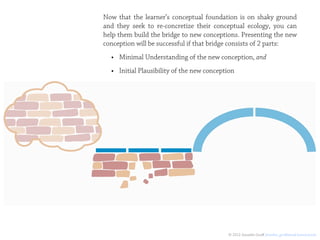
Now that the learner’s conceptual foundation is on shaky ground
and they seek to re-concretize their conceptual ecology, you can
help them build the bridge to new conceptions. Presenting the new
conception will be successful if that bridge consists of 2 parts:
  • Minimal Understanding of the new conception, and
  • Initial Plausibility of the new conception


                                           © 2012 Jennifer Groff jennifer_groff@mail.harvard.edu
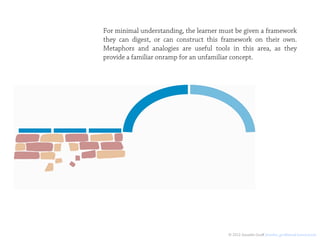
For minimal understanding, the learner must be given a framework
they can digest, or can construct this framework on their own.
Metaphors and analogies are useful tools in this area, as they
provide a familiar onramp for an unfamiliar concept.


                                         © 2012 Jennifer Groff jennifer_groff@mail.harvard.edu
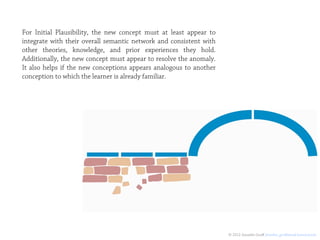
For Initial Plausibility, the new concept must at least appear to
integrate with their overall semantic network and consistent with
other theories, knowledge, and prior experiences they hold.
Additionally, the new concept must appear to resolve the anomaly.
It also helps if the new conceptions appears analogous to another
conception to which the learner is already familiar.


                                                                    © 2012 Jennifer Groff jennifer_groff@mail.harvard.edu
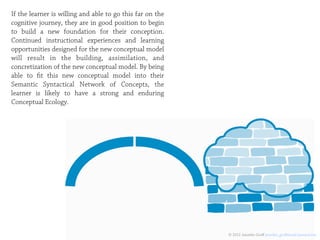
If the learner is willing and able to go this far on the
cognitive journey, they are in good position to begin
to build a new foundation for their conception.
Continued instructional experiences and learning
opportunities designed for the new conceptual model
will result in the building, assimilation, and
concretization of the new conceptual model. By being
able to fit this new conceptual model into their
Semantic Syntactical Network of Concepts, the
learner is likely to have a strong and enduring
Conceptual Ecology.


                                                           © 2012 Jennifer Groff jennifer_groff@mail.harvard.edu
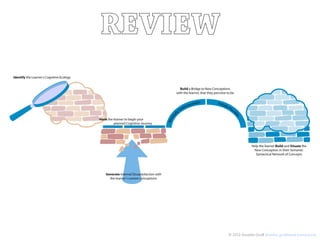
REVIEW


         © 2012 Jennifer Groff jennifer_groff@mail.harvard.edu
REVIEW


         © 2012 Jennifer Groff jennifer_groff@mail.harvard.edu

Conceptual Change - Unlearn to Relearn

  • 1.
    CONCEPTUAL CHANGE Un-learning to Re-learn for Understanding © 2012 Jennifer Groff jennifer_groff@mail.harvard.edu
  • 2.
    When a newidea is introduced to a learner, it doesn’t just get poured into their mind like water into a bucket. e new idea is faced with integrating itself into the learner’s personal cognitive landscape. Each person has their own, unique Cognitive Ecology— knowledge, concepts, experiences, schemas, and beliefs that makeup what Kenneth Strike and George Posner call a “Semantic Syntactical Network of Concepts.” [Hang onto that notion—we’ll come back to it later]. Generally speaking, people don’t let go of aspects of their Cognitive Ecology easily —if a new idea introduced doesn’t fit into their network of concepts easily (known as ‘assimilation’), then the individual must alter their network of concepts in order to fit this new idea into it (or ‘accommodate’ it). It’s kinda like having a typical two-story home and saying you want to put an indoor pool in the middle of it—successfully doing so isn’t like just adding a wing onto the house, instead you’d have to take apart the whole thing and rebuild it in a new way. As a result, a person’s current Cognitive Ecology will influence their production of a new conception.
  • 3.
    For all thesereasons, it’s critical to identify the learner’s current Cognitive Ecology before introducing a new conceptual model. Doing so will allow the instructional designer to strategically create an instructional experience (or cognitive journey) for the learner, which increases its chances exponentially of producing a conceptual change. How can you unearth a learner’s Cognitive Ecology? ere’s numerous things you can look to elicit which will give you a sense of the individuals beliefs and conceptions: • Exemplars & Images - can they explain for you an example of what they think, or draw an image of their ideas? • Analogies & Metaphors - can they come up with a metaphor or analogy that demonstrates what they believe? • Past Experiences - can they talk about their past experiences that have led to their current conceptions? • Anomalies - Are there parts of their conception that they can tell don’t quite “add up” in their head? • Other Knowledge - Do they hold other conceptions, that relate to or interact with the one you are concerned with, that might inhibit the acceptance of a new conception? ese are just some of the things to look for and expose in the learner’s current Cognitive Ecology. © 2012 Jennifer Groff jennifer_groff@mail.harvard.edu
  • 4.
    To leverage aConceptual Change, you must create in the learner dissatisfaction with their current conception, by presenting them conflicting and/or alternative ideas. A good instructional hook will get them to engage in your cognitive journey. © 2012 Jennifer Groff jennifer_groff@mail.harvard.edu
  • 5.
    As the instructionaldesigner, your job is to shake that foundation by creating an experience for them that generates internal dissatisfaction with their current conception. e neat thing about these instructional experiences is that they can often expose current conceptions, if you weren’t able to decipher them easily before this. What does these instructional experiences need to look like? e general answer is they need to make the learner unhappy with their previous conception —which of course will likely be specific to the concept you are driving at. However, there are certain things you can strive for. © 2012 Jennifer Groff jennifer_groff@mail.harvard.edu
  • 6.
    • EXPOSE currentweaknesses in their current conception • create an outright ANOMALY in the mind of the learner—one of the most powerful ways of leveraging dissatisfaction. Is there an experience you can create for the learner that will leave their current conception coming up short? • a NEW EXPERIENCE that is unlike anything they’ve had before can open new cognitive channels for the learner, thereby fitting better into their overall ‘Semantic Syntactical Network of Concepts”. © 2012 Jennifer Groff jennifer_groff@mail.harvard.edu
  • 7.
    NOTE: Although ANOMALIES are one of the most powerful mechanisms for leveraging cognitive dissonance, they don’t come easily. Providing the learner with an anomaly leaves their conceptual ecology on very shaky ground. Changing their cognitive ecology to accommodate the anomaly is the most difficult of the learner’s options—it’s much easier for the learner to just reject what they experienced, disregard the experience as irrelevant, or just try to compartmentalize their knowledge so that the new beliefs they are forming do not interact with their prior conceptions. In order for the anomaly to successfully do its job, the learner must: 1. understand why the experience produced an anomaly 2. believe they must reconcile this experience with their previous conceptions 3. have the desire to put the cognitive work into doing this 4. fail at attempts to assimilate the new knowledge It may seem daunting, but the good news is that there is extensive research showing the cognitive dissonance is a powerful mechanism, and many learners will seek to reconcile disconnects in conceptions in order to relieve this dissonance. © 2012 Jennifer Groff jennifer_groff@mail.harvard.edu
  • 8.
    Now that thelearner’s conceptual foundation is on shaky ground and they seek to re-concretize their conceptual ecology, you can help them build the bridge to new conceptions. Presenting the new conception will be successful if that bridge consists of 2 parts: • Minimal Understanding of the new conception, and • Initial Plausibility of the new conception © 2012 Jennifer Groff jennifer_groff@mail.harvard.edu
  • 9.
    For minimal understanding,the learner must be given a framework they can digest, or can construct this framework on their own. Metaphors and analogies are useful tools in this area, as they provide a familiar onramp for an unfamiliar concept. © 2012 Jennifer Groff jennifer_groff@mail.harvard.edu
  • 10.
    For Initial Plausibility,the new concept must at least appear to integrate with their overall semantic network and consistent with other theories, knowledge, and prior experiences they hold. Additionally, the new concept must appear to resolve the anomaly. It also helps if the new conceptions appears analogous to another conception to which the learner is already familiar. © 2012 Jennifer Groff jennifer_groff@mail.harvard.edu
  • 11.
    If the learneris willing and able to go this far on the cognitive journey, they are in good position to begin to build a new foundation for their conception. Continued instructional experiences and learning opportunities designed for the new conceptual model will result in the building, assimilation, and concretization of the new conceptual model. By being able to fit this new conceptual model into their Semantic Syntactical Network of Concepts, the learner is likely to have a strong and enduring Conceptual Ecology. © 2012 Jennifer Groff jennifer_groff@mail.harvard.edu
  • 12.
    REVIEW © 2012 Jennifer Groff jennifer_groff@mail.harvard.edu
  • 13.
    REVIEW © 2012 Jennifer Groff jennifer_groff@mail.harvard.edu