METHODS OF
TEACHING
MATHEMATICS
TOPIC: MATHEMATICAL
GENERALIZATION
Presented by: GUNJAN AWASTHI
B.Sc.B.Ed. 5th sem.
Roll no. 13
“
”
A lesson without the opportunity for
learners to generalise is not a
mathematics lesson.
- J Mason, 1996
MATHEMATICAL GENERALIZATION
• In mathematics, generalization can be both a process and a
product.
• When one looks at specific instances, notices a pattern, and uses
inductive reasoning to conjecture a statement about all such
patterns, one is generalizing. The symbolic, verbal, or visual
representation of the pattern in your conjecture might be called a
generalization.
• What is generalization?
• There are three meanings attached to generalization from
the literature. The first is as a synonym for abstraction. That
is, the process of generalization is the process of “finding and
singling out [of properties] in a whole class of similar objects.
In this sense it is a synonym for abstraction.
• The second meaning includes extension (empirical or
mathematical) of existing concept or a mathematical
invention.
• The third meaning defines generalization in terms of its
product. If the product of abstraction is a concept, the
product of generalization is a statement relating the
concepts, that is, a theorem.
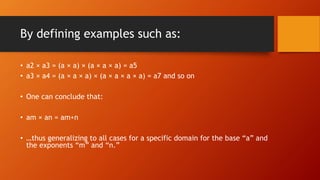
By defining examples such as:
• a2 × a3 = (a × a) × (a × a × a) = a5
• a3 × a4 = (a × a × a) × (a × a × a × a) = a7 and so on
• One can conclude that:
• am × an = am+n
• …thus generalizing to all cases for a specific domain for the base “a” and
the exponents “m” and “n.”
One more example-
• When a student notices that the sum of an even and an odd
integer always results in an odd integer, that student is
generalizing.
Generalizations such as this allow students to think about
computations independently of the particular numbers that are
used. Without this, and many other generalizations made in
mathematics from the early grades, all work in mathematics would
be cumbersome and inefficient.
Role of generalization in advanced
mathematical thinking
• Generalization and abstraction both play an important role in the
minds of mathematics students as they study higher-level
concepts.generalization as the derivation or induction from
something particular to something general by looking at the
common things and expanding their domains of validity. As we
teach our own math courses, we can look out for opportunities to
introduce generalization and abstraction in order to help our
students better understand the pattern behind what they are
learning.
Importance of mathematical generalization
in teaching mathematics
There are several advantages to applying
generalization in our math classes, and its positive
effect on teaching and learning is a fundamental
way to provide our students with the tools needed
for successful advanced thinking in mathematics.
“
”
Generalizing is the process of "seeing through
the particular" by not dwelling in the
particularities but rather stressing
relationships… whenever we stress some
features we consequently ignore others, and
this is how generalizing comes about.
- Mason
Thank you

Mathematical generalization

  • 1.
  • 2.
    TOPIC: MATHEMATICAL GENERALIZATION Presented by:GUNJAN AWASTHI B.Sc.B.Ed. 5th sem. Roll no. 13
  • 3.
    “ ” A lesson withoutthe opportunity for learners to generalise is not a mathematics lesson. - J Mason, 1996
  • 4.
    MATHEMATICAL GENERALIZATION • Inmathematics, generalization can be both a process and a product. • When one looks at specific instances, notices a pattern, and uses inductive reasoning to conjecture a statement about all such patterns, one is generalizing. The symbolic, verbal, or visual representation of the pattern in your conjecture might be called a generalization.
  • 5.
    • What isgeneralization? • There are three meanings attached to generalization from the literature. The first is as a synonym for abstraction. That is, the process of generalization is the process of “finding and singling out [of properties] in a whole class of similar objects. In this sense it is a synonym for abstraction. • The second meaning includes extension (empirical or mathematical) of existing concept or a mathematical invention. • The third meaning defines generalization in terms of its product. If the product of abstraction is a concept, the product of generalization is a statement relating the concepts, that is, a theorem.
  • 6.
    By defining examplessuch as: • a2 × a3 = (a × a) × (a × a × a) = a5 • a3 × a4 = (a × a × a) × (a × a × a × a) = a7 and so on • One can conclude that: • am × an = am+n • …thus generalizing to all cases for a specific domain for the base “a” and the exponents “m” and “n.”
  • 7.
    One more example- •When a student notices that the sum of an even and an odd integer always results in an odd integer, that student is generalizing. Generalizations such as this allow students to think about computations independently of the particular numbers that are used. Without this, and many other generalizations made in mathematics from the early grades, all work in mathematics would be cumbersome and inefficient.
  • 8.
    Role of generalizationin advanced mathematical thinking • Generalization and abstraction both play an important role in the minds of mathematics students as they study higher-level concepts.generalization as the derivation or induction from something particular to something general by looking at the common things and expanding their domains of validity. As we teach our own math courses, we can look out for opportunities to introduce generalization and abstraction in order to help our students better understand the pattern behind what they are learning.
  • 9.
    Importance of mathematicalgeneralization in teaching mathematics There are several advantages to applying generalization in our math classes, and its positive effect on teaching and learning is a fundamental way to provide our students with the tools needed for successful advanced thinking in mathematics.
  • 10.
    “ ” Generalizing is theprocess of "seeing through the particular" by not dwelling in the particularities but rather stressing relationships… whenever we stress some features we consequently ignore others, and this is how generalizing comes about. - Mason
  • 11.