Computer Viruses and Worms
BY: HARENDRA
Overview
• Introduction
• Definitions
• Virus through the Internet
• Virus Languages
• Background
• Worms
• Trojan Horses
Overview Cont…
• Melissa virus
• I LOVE YOU VIRUS
• CODE RED (WORM)
• SYMPTOMS OF AN INFECTION
• Protection measures
• Conclusion
Introduction
• Computer virus have become today’s headline news
• With the increasing use of the Internet, it has
become easier for virus to spread
• Virus show us loopholes in software
• Most virus are targeted at the MS Windows OS
Virus
Virus : A true virus is capable of self replication
on a machine. It may spread between files or
disks, but the defining character is that it can
recreate itself on it’s own with out traveling to
a new host
Virus through the Internet
• Today almost 87% of all viruses are spread
through the internet
• Transmission time to a new host is relatively
low, on the order of hours to days
• “Latent virus”
Virus Languages
ANSI COBOL
C/C++
Pascal
VBA
Unix Shell Scripts
JavaScript
Basically any language that works on the system
that is the target
Which was the
First Computer
Virus
1. The Creeper Virus occurred in 1971 on
ARPANET was written by Bob Thomas at the
BBN Technologies lab.
2. Elk Cloner was the first personal computer
virus to appear in 1982 written by Richard
Skrenta.
3. Brain The first IBM PC virus created in 1986
by the Farooq Alvi Brothers in Lahore,
Pakistan
Background
• There are estimated 30,000
computer viruses in existence
• Over 300 new ones are created each
month
• First virus was created to show
loopholes in software
E-mail Viruses
• Moves around in e-mail messages
• Usually replicate itself by automatically
mailing itself to dozens of people in the
victim’s email address book.
• Example “MELISSA VIRUS”
• Example “I LOVE YOU VIRUS”
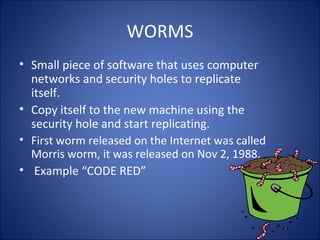
WORMS
• Small piece of software that uses computer
networks and security holes to replicate
itself.
• Copy itself to the new machine using the
security hole and start replicating.
• First worm released on the Internet was called
Morris worm, it was released on Nov 2, 1988.
• Example “CODE RED”
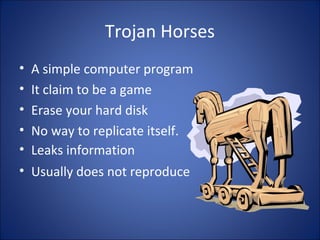
Trojan Horses
• A simple computer program
• It claim to be a game
• Erase your hard disk
• No way to replicate itself.
• Leaks information
• Usually does not reproduce
Hoaxes . . .
Too Good to be True
You receive an e-mail telling you that:
• There is a problem with your PayPal account. Your
personal information is needed to correct it.
• The government has discovered a problem with your
tax records. Your personal information is needed to
correct it.
• You just won a lottery that you didn't even know that
you had entered. Send a handling fee to receive your
winnings.
Melissa Virus (March 1999)
Melissa virus spread in Microsoft Word documents sent
via e-mail.
How it works ?
• Created the virus as word document
• Uploaded to an internet newsgroup
• Anyone who download the document and opened it
would trigger the virus.
• Send friendly email messages to first 50 people in
person’s address book.
Melissa Virus
• Melissa Virus was the fastest spreading virus
ever seen.
• Forced a number of large companies to shut
down their e-mail systems.
I Love You Virus (May,2000)
• Contained a piece of code as an attachment.
• Double Click on the attachment triggered the
code.
• Sent copies of itself to everyone in the victim’s
address book
• Started corrupting files on the victim’s
machine.
Code Red (Worm)
• Code Red made huge headlines in 2001
• It slowed down internet traffic when it began
to replicate itself.
• Each copy of the worm scanned the internet
for Windows NT or Windows 2000 that don’t
have security patch installed.
• Each time it found an unsecured server, the
worm copied itself to that server.
Code Red Worm
Designed to do three things
 Replicate itself for the first 20 days of each
month.
 Replace web pages on infected servers with a
page that declares “Hacked by Chinese”
 Launch a concreted attack on the White
House Web server
Symptoms of Infection
• Programs take longer to load than normal.
• Computer’s hard drive constantly runs out of
free space.
• The floppy disk drive or hard drive runs when
you are not using it.
• New files keep appearing on the system and
you don’t know where it come frm.
Symptoms of Infection Cont..
• Strange sounds or beeping noises come from
the computer.
• Strange graphics are displayed on your
computer monitor.
• Unable to access the hard drive when booting
from the floppy drive.
• Program sizes keep changing.
Protection/Prevention
• Knowledge
• Proper configurations
• Run only necessary programs
• Anti-virus software
Conclusion
• Have seen how viruses show us a loophole in
popular software
• Most viruses show that they can cause great
damage due to loopholes in programming
• Always backup your data.
• Keep up-to-date on new Anti virus software.
• Simply avoid programs from unknown
sources.
Computer viruses

Computer viruses

  • 1.
    Computer Viruses andWorms BY: HARENDRA
  • 2.
    Overview • Introduction • Definitions •Virus through the Internet • Virus Languages • Background • Worms • Trojan Horses
  • 3.
    Overview Cont… • Melissavirus • I LOVE YOU VIRUS • CODE RED (WORM) • SYMPTOMS OF AN INFECTION • Protection measures • Conclusion
  • 4.
    Introduction • Computer virushave become today’s headline news • With the increasing use of the Internet, it has become easier for virus to spread • Virus show us loopholes in software • Most virus are targeted at the MS Windows OS
  • 5.
    Virus Virus : Atrue virus is capable of self replication on a machine. It may spread between files or disks, but the defining character is that it can recreate itself on it’s own with out traveling to a new host
  • 6.
    Virus through theInternet • Today almost 87% of all viruses are spread through the internet • Transmission time to a new host is relatively low, on the order of hours to days • “Latent virus”
  • 7.
    Virus Languages ANSI COBOL C/C++ Pascal VBA UnixShell Scripts JavaScript Basically any language that works on the system that is the target
  • 8.
    Which was the FirstComputer Virus
  • 9.
    1. The CreeperVirus occurred in 1971 on ARPANET was written by Bob Thomas at the BBN Technologies lab. 2. Elk Cloner was the first personal computer virus to appear in 1982 written by Richard Skrenta. 3. Brain The first IBM PC virus created in 1986 by the Farooq Alvi Brothers in Lahore, Pakistan
  • 10.
    Background • There areestimated 30,000 computer viruses in existence • Over 300 new ones are created each month • First virus was created to show loopholes in software
  • 11.
    E-mail Viruses • Movesaround in e-mail messages • Usually replicate itself by automatically mailing itself to dozens of people in the victim’s email address book. • Example “MELISSA VIRUS” • Example “I LOVE YOU VIRUS”
  • 12.
    WORMS • Small pieceof software that uses computer networks and security holes to replicate itself. • Copy itself to the new machine using the security hole and start replicating. • First worm released on the Internet was called Morris worm, it was released on Nov 2, 1988. • Example “CODE RED”
  • 13.
    Trojan Horses • Asimple computer program • It claim to be a game • Erase your hard disk • No way to replicate itself. • Leaks information • Usually does not reproduce
  • 14.
    Hoaxes . .. Too Good to be True You receive an e-mail telling you that: • There is a problem with your PayPal account. Your personal information is needed to correct it. • The government has discovered a problem with your tax records. Your personal information is needed to correct it. • You just won a lottery that you didn't even know that you had entered. Send a handling fee to receive your winnings.
  • 15.
    Melissa Virus (March1999) Melissa virus spread in Microsoft Word documents sent via e-mail. How it works ? • Created the virus as word document • Uploaded to an internet newsgroup • Anyone who download the document and opened it would trigger the virus. • Send friendly email messages to first 50 people in person’s address book.
  • 16.
    Melissa Virus • MelissaVirus was the fastest spreading virus ever seen. • Forced a number of large companies to shut down their e-mail systems.
  • 17.
    I Love YouVirus (May,2000) • Contained a piece of code as an attachment. • Double Click on the attachment triggered the code. • Sent copies of itself to everyone in the victim’s address book • Started corrupting files on the victim’s machine.
  • 18.
    Code Red (Worm) •Code Red made huge headlines in 2001 • It slowed down internet traffic when it began to replicate itself. • Each copy of the worm scanned the internet for Windows NT or Windows 2000 that don’t have security patch installed. • Each time it found an unsecured server, the worm copied itself to that server.
  • 19.
    Code Red Worm Designedto do three things  Replicate itself for the first 20 days of each month.  Replace web pages on infected servers with a page that declares “Hacked by Chinese”  Launch a concreted attack on the White House Web server
  • 20.
    Symptoms of Infection •Programs take longer to load than normal. • Computer’s hard drive constantly runs out of free space. • The floppy disk drive or hard drive runs when you are not using it. • New files keep appearing on the system and you don’t know where it come frm.
  • 21.
    Symptoms of InfectionCont.. • Strange sounds or beeping noises come from the computer. • Strange graphics are displayed on your computer monitor. • Unable to access the hard drive when booting from the floppy drive. • Program sizes keep changing.
  • 22.
    Protection/Prevention • Knowledge • Properconfigurations • Run only necessary programs • Anti-virus software
  • 23.
    Conclusion • Have seenhow viruses show us a loophole in popular software • Most viruses show that they can cause great damage due to loopholes in programming • Always backup your data. • Keep up-to-date on new Anti virus software. • Simply avoid programs from unknown sources.
Editor's Notes

  • #10 ARPANET, the scientific/military network that preceded the modern internet.