Computer Viruses and Worms
Shubhanshu Kumar Srivastav
Definition of Virus
Definition of Virus
 A virus is a small piece of software that
A virus is a small piece of software that
piggybacks on real programs in order to get
executed
executed
 Once it
Once it’
’s running, it spreads by inserting
s running, it spreads by inserting
copies of itself into other executable code or
documents
documents
Computer Virus Timeline
 1949
1949
Theories for self-replicating programs are first developed.
 1981
1981
Apple Viruses 1, 2, and 3 are some of the first viruses “in the wild,” or in the public domain. Found on
the Apple II operating system, the viruses spread through Texas A&M via pirated computer games.
 1983
1983
Fred Cohen, while working on his dissertation, formally defines a computer virus as “a computer
program that can affect other computer programs by modifying them in such a way as to include a
(possibly evolved) copy of itself.”
 1986
1986
Two programmers named Basit and Amjad replace the executable code in the boot sector of a floppy
disk with their own code designed to infect each 360kb floppy accessed on any drive. Infected floppies
had “© Brain” for a volume label.
 1987
1987
The Lehigh virus, one of the first file viruses, infects command.com files.
 1988
1988
One of the most common viruses, Jerusalem, is unleashed. Activated every Friday the 13th, the virus
affects both .exe and .com files and deletes any programs run on that day.
MacMag and the Scores virus cause the first major Macintosh outbreaks.
 …
…
Worms
Worms
 Worm
Worm - is a self-replicating program,
- is a self-replicating program,
similar to a computer virus. A virus attaches
itself to, and becomes part of, another
executable program; however, a worm is
self-contained and does not need to be part
of another program to propagate itself.
History of Worms
History of Worms
 The first worm to attract wide attention, the Morris
The first worm to attract wide attention, the Morris
worm, was written by Robert Tappan Morris, who at
the time was a graduate student at Cornell University.
 It was released on November 2, 1988
It was released on November 2, 1988
 Morris himself was convicted under the US
Morris himself was convicted under the US
Computer Crime and Abuse Act and received three
years probation, community service and a fine in
excess of $10,000.
excess of $10,000.
 Xerox PARC
Xerox PARC
Worms…
Worms…
 Worms
Worms – is a small piece of software that uses
– is a small piece of software that uses
computer networks and security holes to replicate
itself. A copy of the worm scans the network for
another machine that has a specific security hole.
It copies itself to the new machine using the
security hole, and then starts replicating from
there, as well.
there, as well.
 They are often designed to exploit the file
They are often designed to exploit the file
transmission capabilities found on many
computers.
computers.
Zombies
Zombies
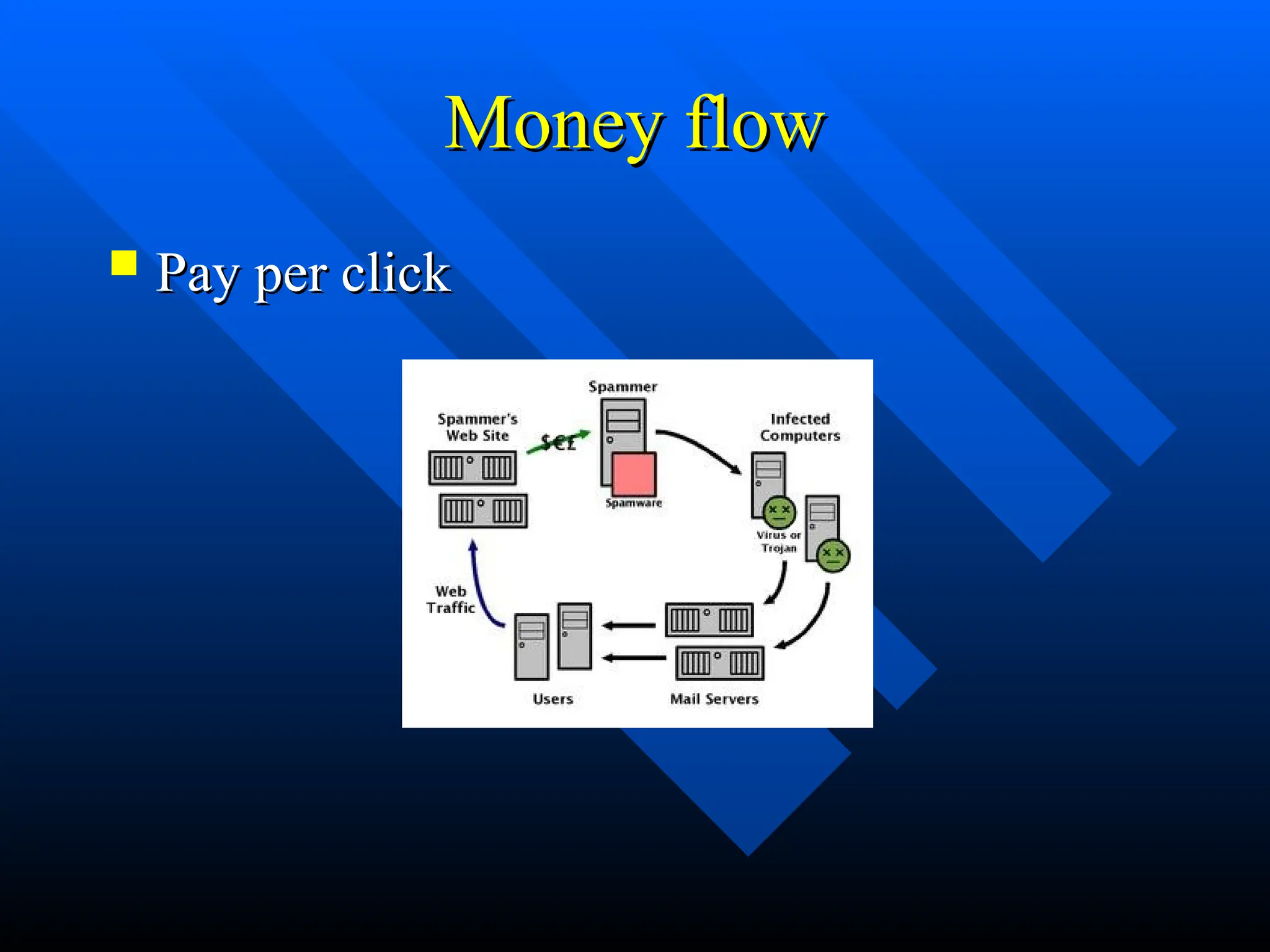
 Infected computers — mostly Windows
Infected computers — mostly Windows
machines — are now the major delivery
method of spam.
method of spam.
 Zombies have been used extensively to send
Zombies have been used extensively to send
e-mail spam; between 50% to 80% of all
spam worldwide is now sent by zombie
computers
computers
Money flow
Money flow
 Pay per click
Pay per click
Typical things that some current
Personal Computer (PC) viruses do
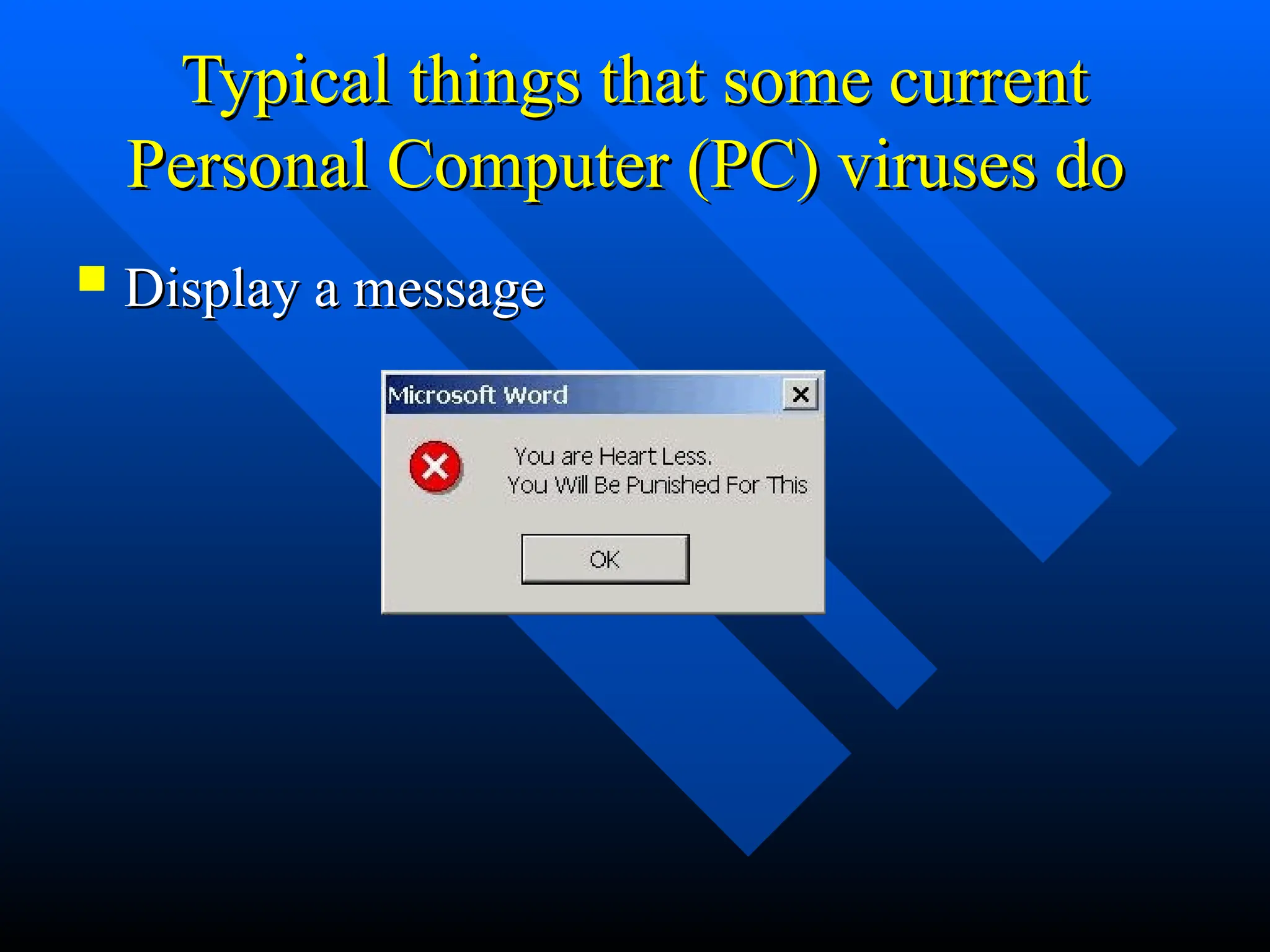
 Display a message
Display a message
Typical things that some current
Personal Computer (PC) viruses do
 Erase files
Erase files
 Scramble data on a hard disk
Scramble data on a hard disk
 Cause erratic screen behavior
Cause erratic screen behavior
 Halt the PC
Halt the PC
 Many viruses do nothing obvious at all
Many viruses do nothing obvious at all
except spread!
except spread!
 Display a message
Display a message
Distributed Denial of Service
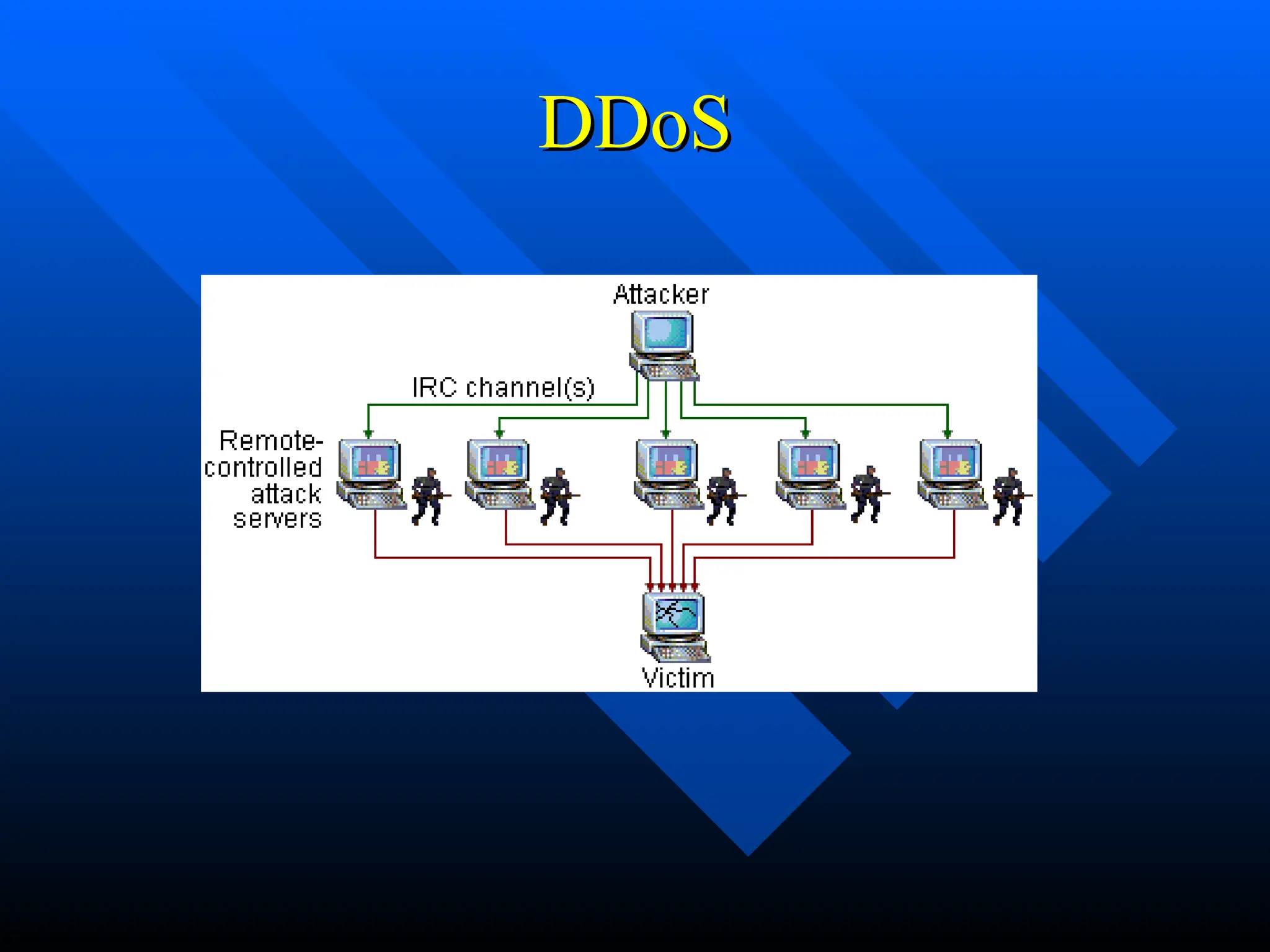
 A
A denial-of-service attack
denial-of-service attack is an attack that
is an attack that
causes a loss of service to users, typically
the loss of network connectivity and
services by consuming the bandwidth of the
victim network or overloading the
computational resources of the victim
system.
system.
How it works?
How it works?
 The flood of incoming messages to the target
The flood of incoming messages to the target
system essentially forces it to shut down, thereby
denying service to the system to legitimate users.
 Victim's IP address.
Victim's IP address.
 Victim's port number.
Victim's port number.
 Attacking packet size.
Attacking packet size.
 Attacking interpacket delay.
Attacking interpacket delay.
 Duration of attack.
Duration of attack.
 MyDoom – SCO Group
MyDoom – SCO Group
DDoS
DDoS
MyDoom
MyDoom
 26 January 2004:
26 January 2004: The Mydoom virus is
The Mydoom virus is
first identified around 8am. Computer
security companies report that Mydoom is
responsible for approximately one in ten e-
mail messages at this time. Slows overall
internet performance by approximately ten
percent and average web page load times by
approximately fifty percent
MyDoom…
MyDoom…
 27 January:
27 January: SCO Group offers a US $250,000
SCO Group offers a US $250,000
reward for information leading to the arrest of the
worm's creator
worm's creator.
.
 1 February:
1 February: An estimated one million computers
An estimated one million computers
around the world infected with Mydoom begin the
virus's massive distributed denial of service attack
—the largest such attack to date.
 2 February:
2 February: The SCO Group moves its site to
The SCO Group moves its site to
www.thescogroup.com.
Executable Viruses
Executable Viruses
 Traditional Viruses
Traditional Viruses
 pieces of code attached to a legitimate
pieces of code attached to a legitimate
program
program
 run when the legitimate program gets
run when the legitimate program gets
executed
executed
 loads itself into memory and looks around
loads itself into memory and looks around
to see if it can find any other programs on
the disk
the disk
Boot Sector Viruses
Boot Sector Viruses
 Traditional Virus
Traditional Virus
 infect the boot sector on floppy disks and
infect the boot sector on floppy disks and
hard disks
hard disks
 By putting its code in the boot sector, a
By putting its code in the boot sector, a
virus can guarantee it gets executed
 load itself into memory immediately, and it
load itself into memory immediately, and it
is able to run whenever the computer is on
Decline of traditional viruses
 Reasons:
Reasons:
– Huge size of today’s programs storing on a
Huge size of today’s programs storing on a
compact disk
compact disk
– Operating systmes now protect the boot sector
Operating systmes now protect the boot sector
E-mail Viruses
E-mail Viruses
 Moves around in e-mail messages
Moves around in e-mail messages
 Replicates itself by automatically mailing
Replicates itself by automatically mailing
itself to dozens of people in the victim
itself to dozens of people in the victim’
’s e-
s e-
mail address book
mail address book
 Example:
Example: Melissa virus
Melissa virus,
, ILOVEYOU virus
ILOVEYOU virus
Melissa virus
Melissa virus
 March 1999
March 1999
 the Melissa virus was the fastest-spreading virus
the Melissa virus was the fastest-spreading virus
ever seen
ever seen
 Someone created the virus as a Word document
Someone created the virus as a Word document
uploaded to an
uploaded to an Internet newsgroup
 People who downloaded the document and opened
People who downloaded the document and opened
it would trigger the virus
 The virus would then send the document in an e-
The virus would then send the document in an e-
mail message to the first 50 people in the person's
address book
address book
Melissa virus
Melissa virus
 Took advantage of the programming
Took advantage of the programming
language built into Microsoft Word called
VBA (Visual Basic for Applications)
Prevention
Prevention
 Updates
Updates
 Anti-Viruses
Anti-Viruses
 More secure operating systems
More secure operating systems
e.g. UNIX
e.g. UNIX
Reference
Reference
 http://mirror.aarnet.edu.au/pub/code-red/newframes-small-log.gif
http://mirror.aarnet.edu.au/pub/code-red/newframes-small-log.gif
 http://www.factmonster.com/ipka/A0872842.html
http://www.factmonster.com/ipka/A0872842.html
http://www.faqs.org/faqs/computer-virus/new-users/
 http://www.mines.edu/academic/computer/viri-sysadmin.htm
http://www.mines.edu/academic/computer/viri-sysadmin.htm

computer virus and about its details and types

  • 1.
    Computer Viruses andWorms Computer Viruses and Worms Shubhanshu Kumar Srivastav Shubhanshu Kumar Srivastav
  • 2.
    Definition of Virus Definitionof Virus  A virus is a small piece of software that A virus is a small piece of software that piggybacks on real programs in order to get piggybacks on real programs in order to get executed executed  Once it Once it’ ’s running, it spreads by inserting s running, it spreads by inserting copies of itself into other executable code or copies of itself into other executable code or documents documents
  • 3.
    Computer Virus Timeline ComputerVirus Timeline  1949 1949 Theories for self-replicating programs are first developed. Theories for self-replicating programs are first developed.  1981 1981 Apple Viruses 1, 2, and 3 are some of the first viruses “in the wild,” or in the public domain. Found on Apple Viruses 1, 2, and 3 are some of the first viruses “in the wild,” or in the public domain. Found on the Apple II operating system, the viruses spread through Texas A&M via pirated computer games. the Apple II operating system, the viruses spread through Texas A&M via pirated computer games.  1983 1983 Fred Cohen, while working on his dissertation, formally defines a computer virus as “a computer Fred Cohen, while working on his dissertation, formally defines a computer virus as “a computer program that can affect other computer programs by modifying them in such a way as to include a program that can affect other computer programs by modifying them in such a way as to include a (possibly evolved) copy of itself.” (possibly evolved) copy of itself.”  1986 1986 Two programmers named Basit and Amjad replace the executable code in the boot sector of a floppy Two programmers named Basit and Amjad replace the executable code in the boot sector of a floppy disk with their own code designed to infect each 360kb floppy accessed on any drive. Infected floppies disk with their own code designed to infect each 360kb floppy accessed on any drive. Infected floppies had “© Brain” for a volume label. had “© Brain” for a volume label.  1987 1987 The Lehigh virus, one of the first file viruses, infects command.com files. The Lehigh virus, one of the first file viruses, infects command.com files.  1988 1988 One of the most common viruses, Jerusalem, is unleashed. Activated every Friday the 13th, the virus One of the most common viruses, Jerusalem, is unleashed. Activated every Friday the 13th, the virus affects both .exe and .com files and deletes any programs run on that day. affects both .exe and .com files and deletes any programs run on that day. MacMag and the Scores virus cause the first major Macintosh outbreaks. MacMag and the Scores virus cause the first major Macintosh outbreaks.  … …
  • 4.
    Worms Worms  Worm Worm -is a self-replicating program, - is a self-replicating program, similar to a computer virus. A virus attaches similar to a computer virus. A virus attaches itself to, and becomes part of, another itself to, and becomes part of, another executable program; however, a worm is executable program; however, a worm is self-contained and does not need to be part self-contained and does not need to be part of another program to propagate itself. of another program to propagate itself.
  • 5.
    History of Worms Historyof Worms  The first worm to attract wide attention, the Morris The first worm to attract wide attention, the Morris worm, was written by Robert Tappan Morris, who at worm, was written by Robert Tappan Morris, who at the time was a graduate student at Cornell University. the time was a graduate student at Cornell University.  It was released on November 2, 1988 It was released on November 2, 1988  Morris himself was convicted under the US Morris himself was convicted under the US Computer Crime and Abuse Act and received three Computer Crime and Abuse Act and received three years probation, community service and a fine in years probation, community service and a fine in excess of $10,000. excess of $10,000.  Xerox PARC Xerox PARC
  • 6.
    Worms… Worms…  Worms Worms –is a small piece of software that uses – is a small piece of software that uses computer networks and security holes to replicate computer networks and security holes to replicate itself. A copy of the worm scans the network for itself. A copy of the worm scans the network for another machine that has a specific security hole. another machine that has a specific security hole. It copies itself to the new machine using the It copies itself to the new machine using the security hole, and then starts replicating from security hole, and then starts replicating from there, as well. there, as well.  They are often designed to exploit the file They are often designed to exploit the file transmission capabilities found on many transmission capabilities found on many computers. computers.
  • 7.
    Zombies Zombies  Infected computers— mostly Windows Infected computers — mostly Windows machines — are now the major delivery machines — are now the major delivery method of spam. method of spam.  Zombies have been used extensively to send Zombies have been used extensively to send e-mail spam; between 50% to 80% of all e-mail spam; between 50% to 80% of all spam worldwide is now sent by zombie spam worldwide is now sent by zombie computers computers
  • 8.
    Money flow Money flow Pay per click Pay per click
  • 9.
    Typical things thatsome current Typical things that some current Personal Computer (PC) viruses do Personal Computer (PC) viruses do  Display a message Display a message
  • 10.
    Typical things thatsome current Typical things that some current Personal Computer (PC) viruses do Personal Computer (PC) viruses do  Erase files Erase files  Scramble data on a hard disk Scramble data on a hard disk  Cause erratic screen behavior Cause erratic screen behavior  Halt the PC Halt the PC  Many viruses do nothing obvious at all Many viruses do nothing obvious at all except spread! except spread!  Display a message Display a message
  • 11.
    Distributed Denial ofService Distributed Denial of Service  A A denial-of-service attack denial-of-service attack is an attack that is an attack that causes a loss of service to users, typically causes a loss of service to users, typically the loss of network connectivity and the loss of network connectivity and services by consuming the bandwidth of the services by consuming the bandwidth of the victim network or overloading the victim network or overloading the computational resources of the victim computational resources of the victim system. system.
  • 12.
    How it works? Howit works?  The flood of incoming messages to the target The flood of incoming messages to the target system essentially forces it to shut down, thereby system essentially forces it to shut down, thereby denying service to the system to legitimate users. denying service to the system to legitimate users.  Victim's IP address. Victim's IP address.  Victim's port number. Victim's port number.  Attacking packet size. Attacking packet size.  Attacking interpacket delay. Attacking interpacket delay.  Duration of attack. Duration of attack.  MyDoom – SCO Group MyDoom – SCO Group
  • 13.
  • 14.
    MyDoom MyDoom  26 January2004: 26 January 2004: The Mydoom virus is The Mydoom virus is first identified around 8am. Computer first identified around 8am. Computer security companies report that Mydoom is security companies report that Mydoom is responsible for approximately one in ten e- responsible for approximately one in ten e- mail messages at this time. Slows overall mail messages at this time. Slows overall internet performance by approximately ten internet performance by approximately ten percent and average web page load times by percent and average web page load times by approximately fifty percent approximately fifty percent
  • 15.
    MyDoom… MyDoom…  27 January: 27January: SCO Group offers a US $250,000 SCO Group offers a US $250,000 reward for information leading to the arrest of the reward for information leading to the arrest of the worm's creator worm's creator. .  1 February: 1 February: An estimated one million computers An estimated one million computers around the world infected with Mydoom begin the around the world infected with Mydoom begin the virus's massive distributed denial of service attack virus's massive distributed denial of service attack —the largest such attack to date. —the largest such attack to date.  2 February: 2 February: The SCO Group moves its site to The SCO Group moves its site to www.thescogroup.com. www.thescogroup.com.
  • 16.
    Executable Viruses Executable Viruses Traditional Viruses Traditional Viruses  pieces of code attached to a legitimate pieces of code attached to a legitimate program program  run when the legitimate program gets run when the legitimate program gets executed executed  loads itself into memory and looks around loads itself into memory and looks around to see if it can find any other programs on to see if it can find any other programs on the disk the disk
  • 17.
    Boot Sector Viruses BootSector Viruses  Traditional Virus Traditional Virus  infect the boot sector on floppy disks and infect the boot sector on floppy disks and hard disks hard disks  By putting its code in the boot sector, a By putting its code in the boot sector, a virus can guarantee it gets executed virus can guarantee it gets executed  load itself into memory immediately, and it load itself into memory immediately, and it is able to run whenever the computer is on is able to run whenever the computer is on
  • 18.
    Decline of traditionalviruses Decline of traditional viruses  Reasons: Reasons: – Huge size of today’s programs storing on a Huge size of today’s programs storing on a compact disk compact disk – Operating systmes now protect the boot sector Operating systmes now protect the boot sector
  • 19.
    E-mail Viruses E-mail Viruses Moves around in e-mail messages Moves around in e-mail messages  Replicates itself by automatically mailing Replicates itself by automatically mailing itself to dozens of people in the victim itself to dozens of people in the victim’ ’s e- s e- mail address book mail address book  Example: Example: Melissa virus Melissa virus, , ILOVEYOU virus ILOVEYOU virus
  • 20.
    Melissa virus Melissa virus March 1999 March 1999  the Melissa virus was the fastest-spreading virus the Melissa virus was the fastest-spreading virus ever seen ever seen  Someone created the virus as a Word document Someone created the virus as a Word document uploaded to an uploaded to an Internet newsgroup  People who downloaded the document and opened People who downloaded the document and opened it would trigger the virus it would trigger the virus  The virus would then send the document in an e- The virus would then send the document in an e- mail message to the first 50 people in the person's mail message to the first 50 people in the person's address book address book
  • 21.
    Melissa virus Melissa virus Took advantage of the programming Took advantage of the programming language built into Microsoft Word called language built into Microsoft Word called VBA (Visual Basic for Applications) VBA (Visual Basic for Applications)
  • 22.
    Prevention Prevention  Updates Updates  Anti-Viruses Anti-Viruses More secure operating systems More secure operating systems e.g. UNIX e.g. UNIX
  • 23.