
SHRI RAM COLLEGE OF ENGINEERING & MANAGEMENT
PALWAL
PRESENTATION
ON
COMPUTER GRAPHICS
Presented By:
Ms. Nandini Sharma
Assistant Professor
WHAT IS COMPUTER GRAPHICS?
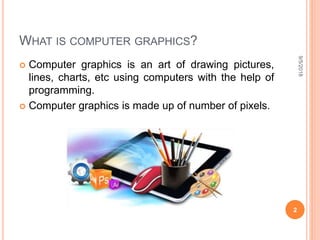
 Computer graphics is an art of drawing pictures,
lines, charts, etc using computers with the help of
programming.
 Computer graphics is made up of number of pixels.
9/5/2018
2
BASIC TERMINOLOGY
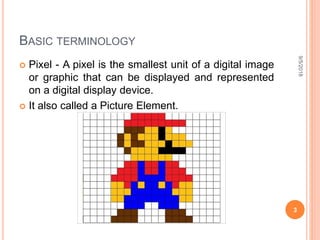
 Pixel - A pixel is the smallest unit of a digital image
or graphic that can be displayed and represented
on a digital display device.
 It also called a Picture Element.
9/5/2018
3
CONTINUE….
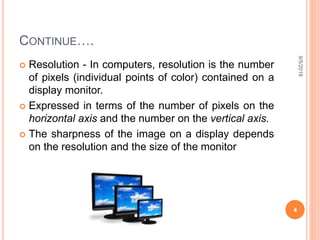
 Resolution - In computers, resolution is the number
of pixels (individual points of color) contained on a
display monitor.
 Expressed in terms of the number of pixels on the
horizontal axis and the number on the vertical axis.
 The sharpness of the image on a display depends
on the resolution and the size of the monitor
9/5/2018
4
CONTINUE
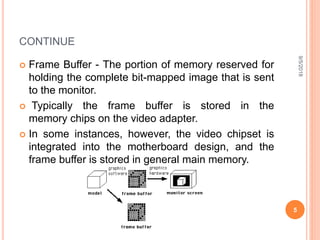
 Frame Buffer - The portion of memory reserved for
holding the complete bit-mapped image that is sent
to the monitor.
 Typically the frame buffer is stored in the
memory chips on the video adapter.
 In some instances, however, the video chipset is
integrated into the motherboard design, and the
frame buffer is stored in general main memory.
9/5/2018
5
CATHODE RAY TUBE
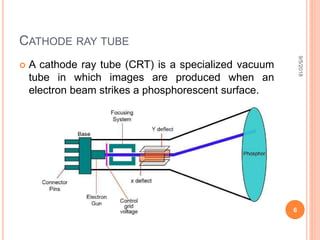
 A cathode ray tube (CRT) is a specialized vacuum
tube in which images are produced when an
electron beam strikes a phosphorescent surface.
9/5/2018
6
INTERLACING
 When referring to a computer monitor or another
display, interlace or interlacing is a description of
how the picture is created.
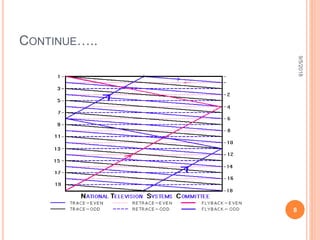
 With an interlaced display the picture is created by
scanning every other line, and on the next scan,
scanning every opposite line.
 Interlacing allows for a faster refresh rate by having
less information during each scan at a lower cost.
 Unfortunately, this may cause flickering or
noticeable line movements in some situations.
9/5/2018
7
CONTINUE…..
9/5/2018
8
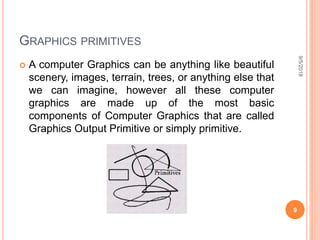
GRAPHICS PRIMITIVES
 A computer Graphics can be anything like beautiful
scenery, images, terrain, trees, or anything else that
we can imagine, however all these computer
graphics are made up of the most basic
components of Computer Graphics that are called
Graphics Output Primitive or simply primitive.
9/5/2018
9
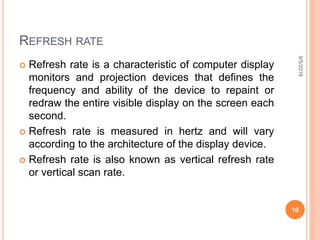
REFRESH RATE
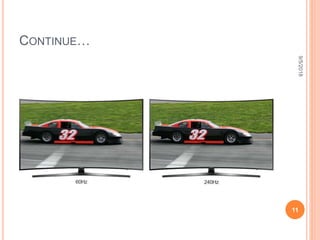
 Refresh rate is a characteristic of computer display
monitors and projection devices that defines the
frequency and ability of the device to repaint or
redraw the entire visible display on the screen each
second.
 Refresh rate is measured in hertz and will vary
according to the architecture of the display device.
 Refresh rate is also known as vertical refresh rate
or vertical scan rate.
9/5/2018
10
CONTINUE…
9/5/2018
11
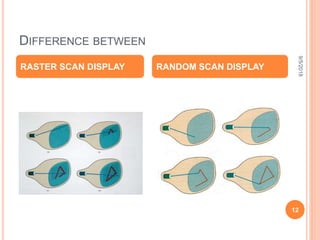
DIFFERENCE BETWEEN
RASTER SCAN DISPLAY RANDOM SCAN DISPLAY
9/5/2018
12
CONTINUE,,,
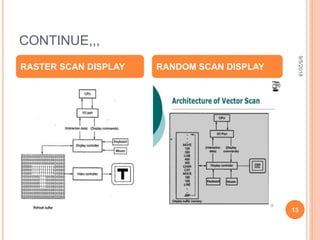
RASTER SCAN DISPLAY RANDOM SCAN DISPLAY
9/5/2018
13
APPLICATIONS
 Computational Biology and Physics
 Information of Graphics
 Scientific Visualization
 Graphic Design
 Computer-aided Design
 Web Design
 Digital Art
 Video Games
 Virtual Reality
 Computer Simulation
 Education
 Information Visualization
9/5/2018
14
THANKS
FOR
READING
9/5/2018
15

Computer Graphics

  • 1.
    SHRI RAM COLLEGEOF ENGINEERING & MANAGEMENT PALWAL PRESENTATION ON COMPUTER GRAPHICS Presented By: Ms. Nandini Sharma Assistant Professor
  • 2.
    WHAT IS COMPUTERGRAPHICS?  Computer graphics is an art of drawing pictures, lines, charts, etc using computers with the help of programming.  Computer graphics is made up of number of pixels. 9/5/2018 2
  • 3.
    BASIC TERMINOLOGY  Pixel- A pixel is the smallest unit of a digital image or graphic that can be displayed and represented on a digital display device.  It also called a Picture Element. 9/5/2018 3
  • 4.
    CONTINUE….  Resolution -In computers, resolution is the number of pixels (individual points of color) contained on a display monitor.  Expressed in terms of the number of pixels on the horizontal axis and the number on the vertical axis.  The sharpness of the image on a display depends on the resolution and the size of the monitor 9/5/2018 4
  • 5.
    CONTINUE  Frame Buffer- The portion of memory reserved for holding the complete bit-mapped image that is sent to the monitor.  Typically the frame buffer is stored in the memory chips on the video adapter.  In some instances, however, the video chipset is integrated into the motherboard design, and the frame buffer is stored in general main memory. 9/5/2018 5
  • 6.
    CATHODE RAY TUBE A cathode ray tube (CRT) is a specialized vacuum tube in which images are produced when an electron beam strikes a phosphorescent surface. 9/5/2018 6
  • 7.
    INTERLACING  When referringto a computer monitor or another display, interlace or interlacing is a description of how the picture is created.  With an interlaced display the picture is created by scanning every other line, and on the next scan, scanning every opposite line.  Interlacing allows for a faster refresh rate by having less information during each scan at a lower cost.  Unfortunately, this may cause flickering or noticeable line movements in some situations. 9/5/2018 7
  • 8.
  • 9.
    GRAPHICS PRIMITIVES  Acomputer Graphics can be anything like beautiful scenery, images, terrain, trees, or anything else that we can imagine, however all these computer graphics are made up of the most basic components of Computer Graphics that are called Graphics Output Primitive or simply primitive. 9/5/2018 9
  • 10.
    REFRESH RATE  Refreshrate is a characteristic of computer display monitors and projection devices that defines the frequency and ability of the device to repaint or redraw the entire visible display on the screen each second.  Refresh rate is measured in hertz and will vary according to the architecture of the display device.  Refresh rate is also known as vertical refresh rate or vertical scan rate. 9/5/2018 10
  • 11.
  • 12.
    DIFFERENCE BETWEEN RASTER SCANDISPLAY RANDOM SCAN DISPLAY 9/5/2018 12
  • 13.
    CONTINUE,,, RASTER SCAN DISPLAYRANDOM SCAN DISPLAY 9/5/2018 13
  • 14.
    APPLICATIONS  Computational Biologyand Physics  Information of Graphics  Scientific Visualization  Graphic Design  Computer-aided Design  Web Design  Digital Art  Video Games  Virtual Reality  Computer Simulation  Education  Information Visualization 9/5/2018 14
  • 15.