Computer Vision
Presented by:- Kartik N. Kalpande
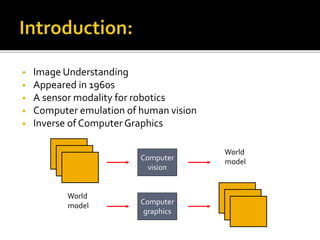
• Image Understanding
• Appeared in 1960s
• A sensor modality for robotics
• Computer emulation of human vision
• Inverse of Computer Graphics
Computer
vision
World
model
Computer
graphics
World
model
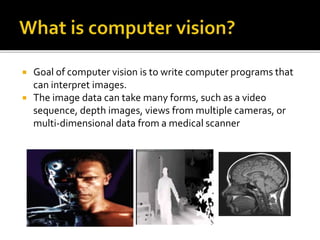
 Goal of computer vision is to write computer programs that
can interpret images.
 The image data can take many forms, such as a video
sequence, depth images, views from multiple cameras, or
multi-dimensional data from a medical scanner
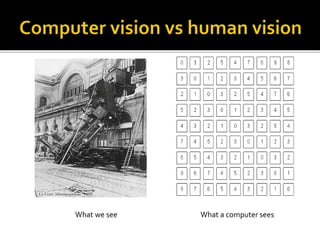
What we see What a computer sees
 It is many-to-one mapping.
 It is computationally intensive.
 We do not understand the recognition problem.
 Image acquisition
 Pre-processing
 Feature extraction
 Detection/segmentation
 Recognition an interpretation
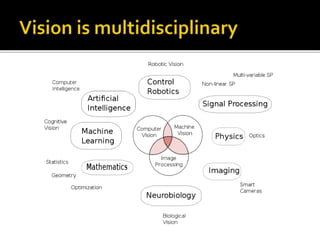
 Calculus
 Linear Algebra
 Probabilities and Statistics
 Signal processing
 Projective geometry
 Computational geometry
 OptimizationTheory
 ControlTheory
 Controlling processes
 Navigation
 Detecting events
 Organizing information
 Modeling objects or environments
 Interaction
 Automatic inspection
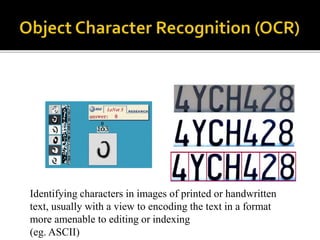
Identifying characters in images of printed or handwritten
text, usually with a view to encoding the text in a format
more amenable to editing or indexing
(eg. ASCII)
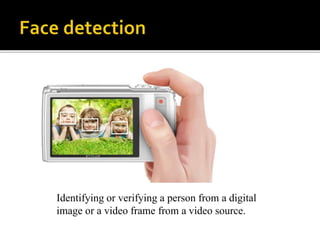
Identifying or verifying a person from a digital
image or a video frame from a video source.
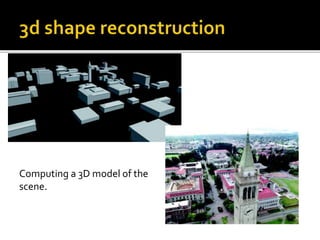
Computing a 3D model of the
scene.
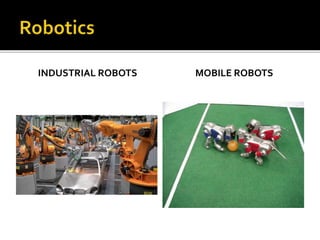
INDUSTRIAL ROBOTS MOBILE ROBOTS
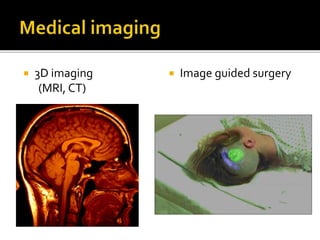
 3D imaging
(MRI, CT)
 Image guided surgery
 Simpler and faster processes – fast computers replace
lengthy visual checks
 Reliability – cameras and computers, as opposed to a
human eye, never get tired. The human factor is
eliminated.
 Accuracy – your final products will be, thanks to
computer vision, flawless
 A wide range of use – ranging from banks to medical
care
 Cost reduction – you save time on people and devices,
faulty products are eliminated
 The field of computer vision has vastly
improved since it began in the 1960s.
Computers can now quickly and accurately
recognize thousands of faces, as well as a
growing number of other objects. Although
computer vision currently lacks the subtlety,
versatility, and general capabilities of human
vision, the gap is steadily closing.
 https//www.google.com
 https://wikipedia.org/wiki/computer_vision
Machines can’t replicate human image recognition.

Computer vision

  • 1.
  • 2.
    • Image Understanding •Appeared in 1960s • A sensor modality for robotics • Computer emulation of human vision • Inverse of Computer Graphics Computer vision World model Computer graphics World model
  • 3.
     Goal ofcomputer vision is to write computer programs that can interpret images.  The image data can take many forms, such as a video sequence, depth images, views from multiple cameras, or multi-dimensional data from a medical scanner
  • 4.
    What we seeWhat a computer sees
  • 5.
     It ismany-to-one mapping.  It is computationally intensive.  We do not understand the recognition problem.
  • 7.
     Image acquisition Pre-processing  Feature extraction  Detection/segmentation  Recognition an interpretation
  • 8.
     Calculus  LinearAlgebra  Probabilities and Statistics  Signal processing  Projective geometry  Computational geometry  OptimizationTheory  ControlTheory
  • 9.
     Controlling processes Navigation  Detecting events  Organizing information  Modeling objects or environments  Interaction  Automatic inspection
  • 10.
    Identifying characters inimages of printed or handwritten text, usually with a view to encoding the text in a format more amenable to editing or indexing (eg. ASCII)
  • 11.
    Identifying or verifyinga person from a digital image or a video frame from a video source.
  • 12.
    Computing a 3Dmodel of the scene.
  • 16.
  • 17.
     3D imaging (MRI,CT)  Image guided surgery
  • 18.
     Simpler andfaster processes – fast computers replace lengthy visual checks  Reliability – cameras and computers, as opposed to a human eye, never get tired. The human factor is eliminated.  Accuracy – your final products will be, thanks to computer vision, flawless  A wide range of use – ranging from banks to medical care  Cost reduction – you save time on people and devices, faulty products are eliminated
  • 19.
     The fieldof computer vision has vastly improved since it began in the 1960s. Computers can now quickly and accurately recognize thousands of faces, as well as a growing number of other objects. Although computer vision currently lacks the subtlety, versatility, and general capabilities of human vision, the gap is steadily closing.
  • 20.
  • 21.
    Machines can’t replicatehuman image recognition.