Computer Numerical Control 
(CNC) 
Banu Akar Neşe Kaynak 
Duygu Gökçe Meltem Erdi 
Hacettepe University 
Chemical Engineering Department 
22.12.2010
CONTENT 
1. What are NC & CNC? 
2. History 
3. CNC system Elements 
4. Properties of CNC machine 
5. Types of CNC machines 
6. CNC applications 
7. Advantages& Disadvantages 
8. Conclusion 
9. References
What are NC & CNC ? 
 Numerical control (NC) is a method of automatically 
operating a manufacturing machine based on a code 
letters, numbers and special characters. 
 The numerical data required to produce a part is 
provided to a machine in the form of program, called part 
program or CNC (computer numerical control)
What are NC & CNC ? 
 The program is translated into the appropriate electrical 
signals for input to motors that run the machine. 
 A CNC machine is an numerical control machine with 
the added feature of an on board computer. The 
computer is referred to as the machine control unit 
(MCU)
HISTORY 
 In 1775, John Wilkinson- cannon boring machine (lathe). 
 In 1881, Eli Whitney- milling machine. 
 In 1947, Mr. John Parsons began experimenting for 
using 3-axis curvature data to control the machine tool 
motion for the production for aircraft components. 
 In 1949, parsons- first NC machine. 
 In 1951, MIT was involved in the project. 
 In 1955, after refinements NC became available in 
industry 
 Today, modern machinery are CNC milling machines 
and lathes.
CNC SYSTEM ELEMENTS 
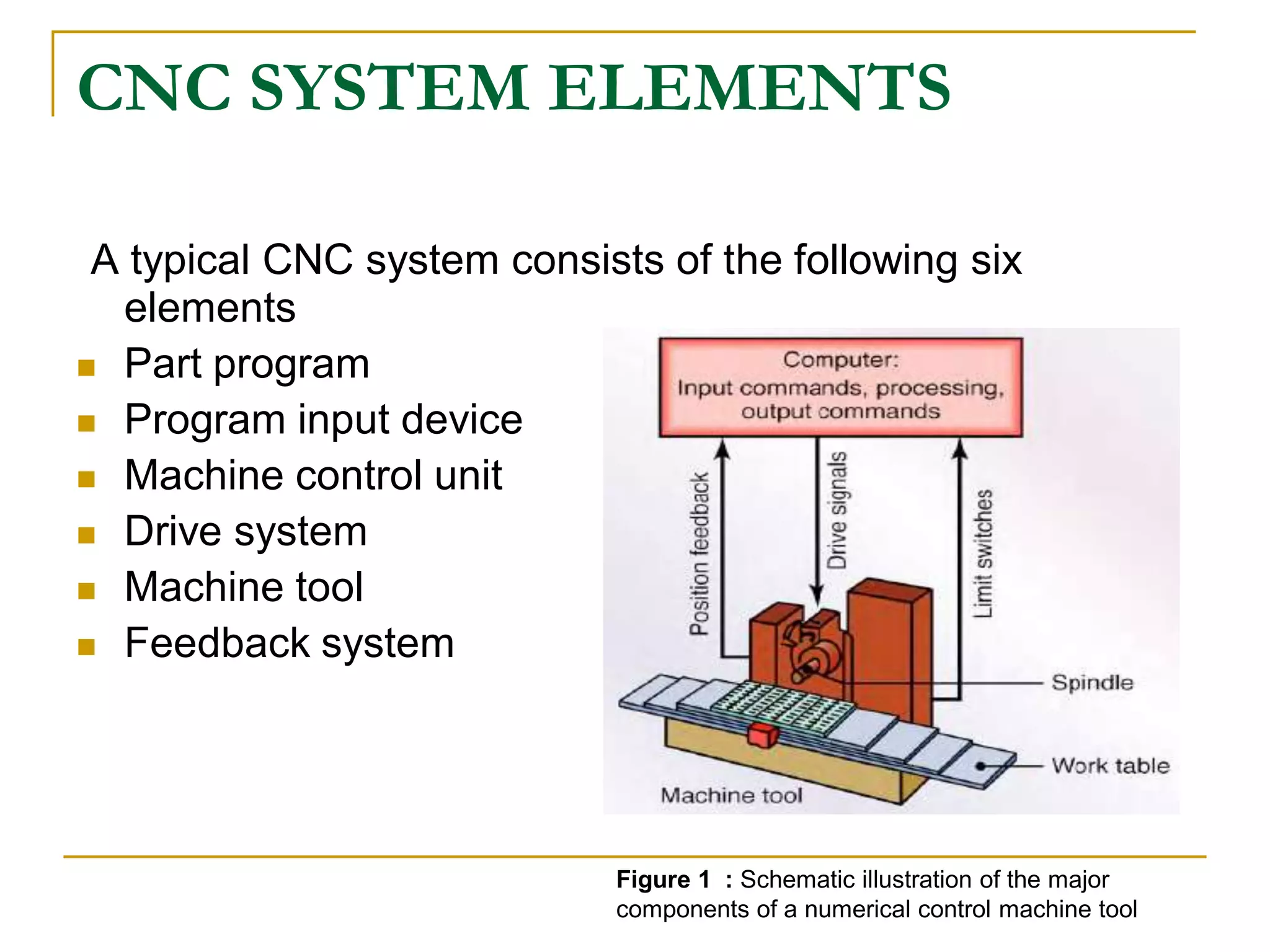
A typical CNC system consists of the following six 
elements 
 Part program 
 Program input device 
 Machine control unit 
 Drive system 
 Machine tool 
 Feedback system 
Figure 1 : Schematic illustration of the major 
components of a numerical control machine tool
Basic Concept of Part Programming 
 Part programming contains geometric data about the part and 
motion information to move the cutting tool with respect to the work 
piece. 
 Basically, the machine receives instructions as a sequence of blocks 
containing commands to set machine parameters; speed, feed and 
other relevant information. 
 A block is equivalent to a line of codes in a part program. 
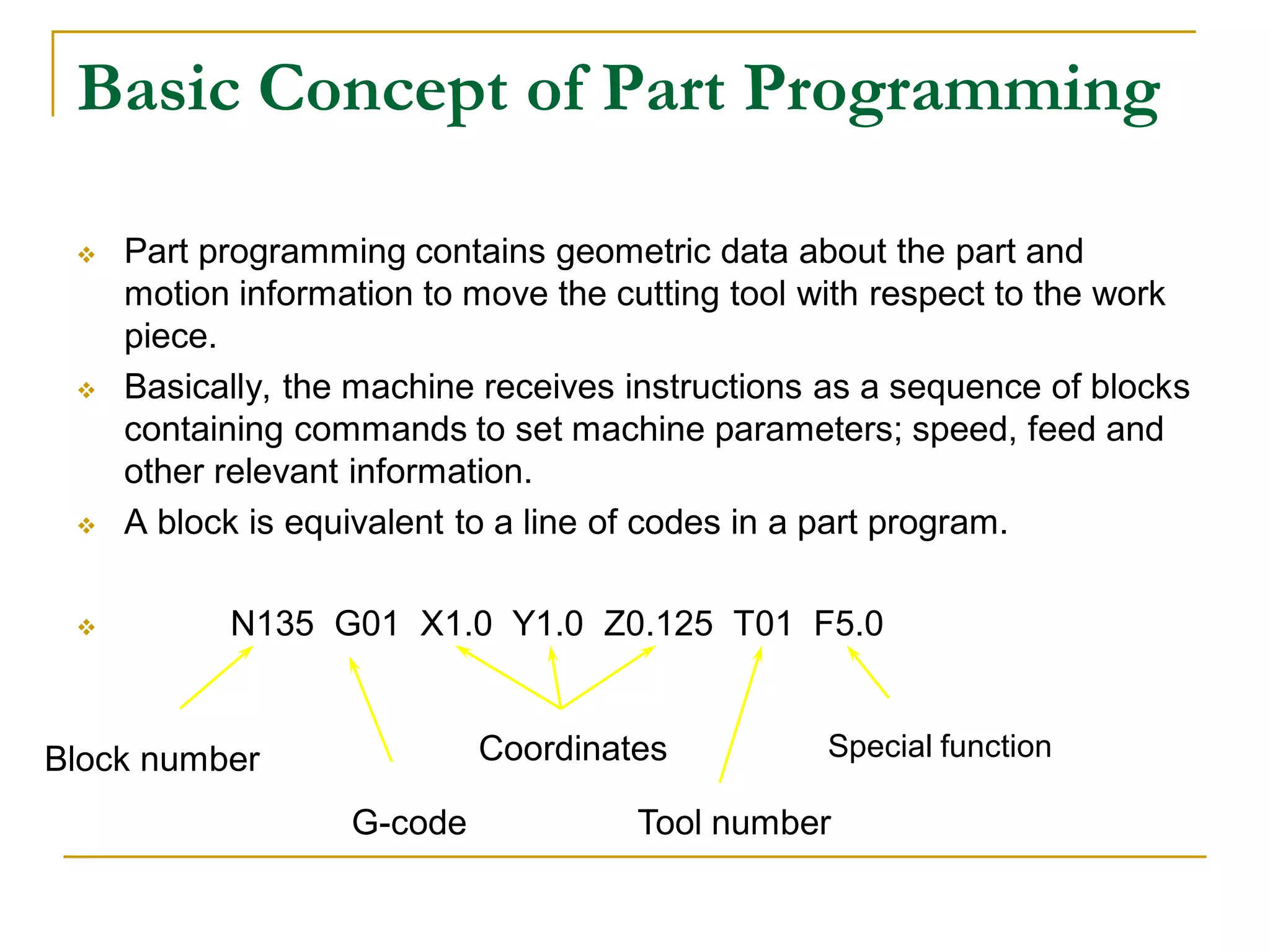
 N135 G01 X1.0 Y1.0 Z0.125 T01 F5.0 
Block number Coordinates 
Special function 
Tool number 
G-code
Programming Methods 
 Automatically Programmed Tools (APT) 
 A text based system in which a programmer defines a 
series of lines, arcs, and points which define the 
overall part geometry locations. 
 These features are then used to generate a cutter 
location (CL) file.
Programming Methods 
 Computer Aided Machining (CAM) Systems- 
Computer Aided Design (CAD) Systems 
 CAD/CAM systems allow for rapid development and 
modifying of designs and documentation. 
 The 3D geometric model produced becomes a common 
element for engineering analysis (FEA), machining 
process planning (including CNC part programming, 
documentation (including engineering drawings), quality 
control, and so on.
Drives of CNC machine tool 
 Hydraulic actuator 
- high power machine tool 
 Stepping motor 
- small machine due to limited power and torque 
 DC motor 
- excellent speed regulation, high torque, most widely 
used
Properties of CNC machines 
 Based on Motion Type: Motion control - the heart of 
CNC 
Point-to-Point or Continuous path 
 Based on Control Loops: 
Open loop or Closed loop 
 Based on Power Supply: 
Electric or Hydraulic or Pneumatic 
 Based on Positioning System 
Incremental or Absolute
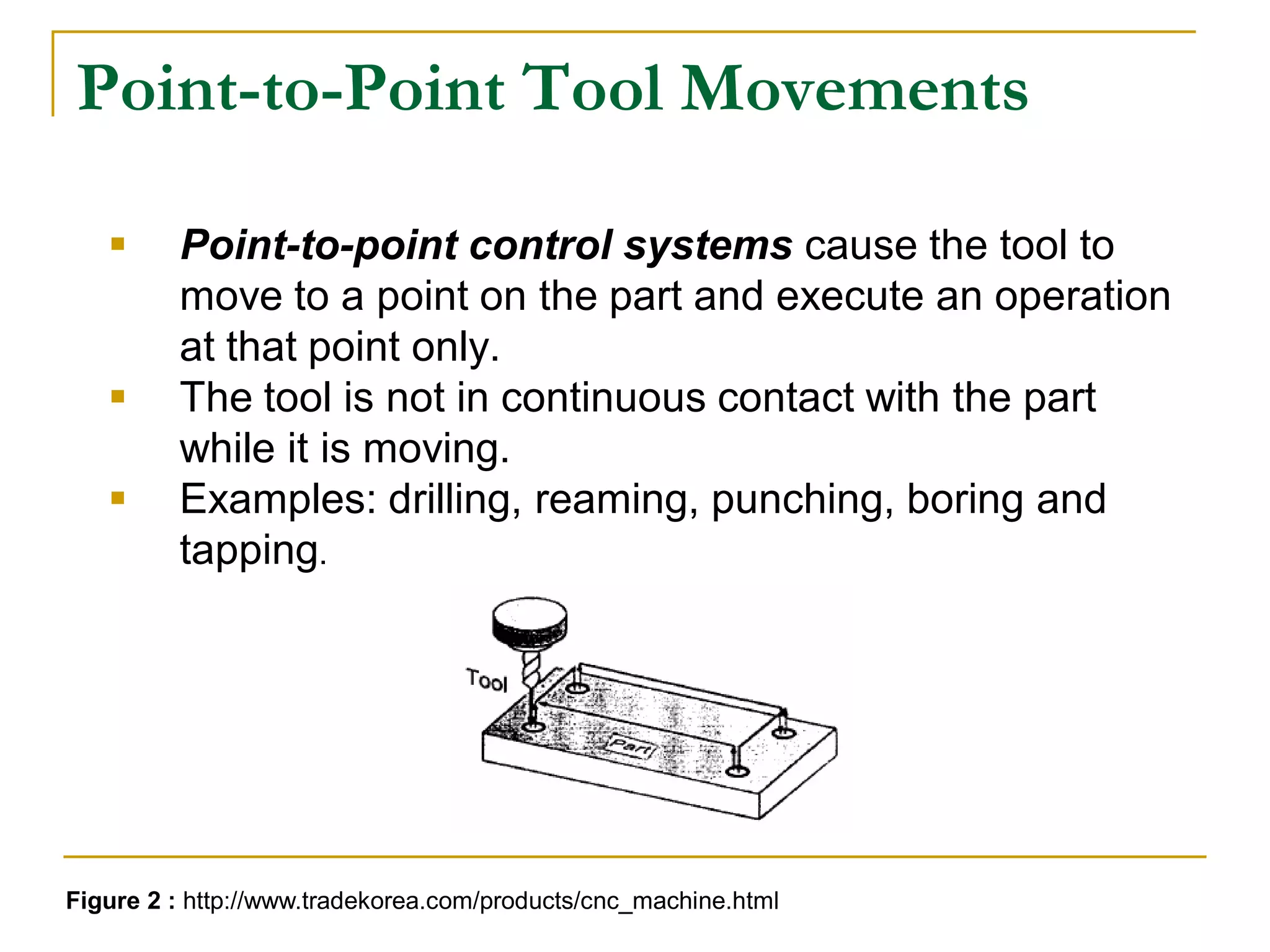
Point-to-Point Tool Movements 
 Point-to-point control systems cause the tool to 
move to a point on the part and execute an operation 
at that point only. 
 The tool is not in continuous contact with the part 
while it is moving. 
 Examples: drilling, reaming, punching, boring and 
tapping. 
Figure 2 : http://www.tradekorea.com/products/cnc_machine.html
Continuous-Path Tool Movements 
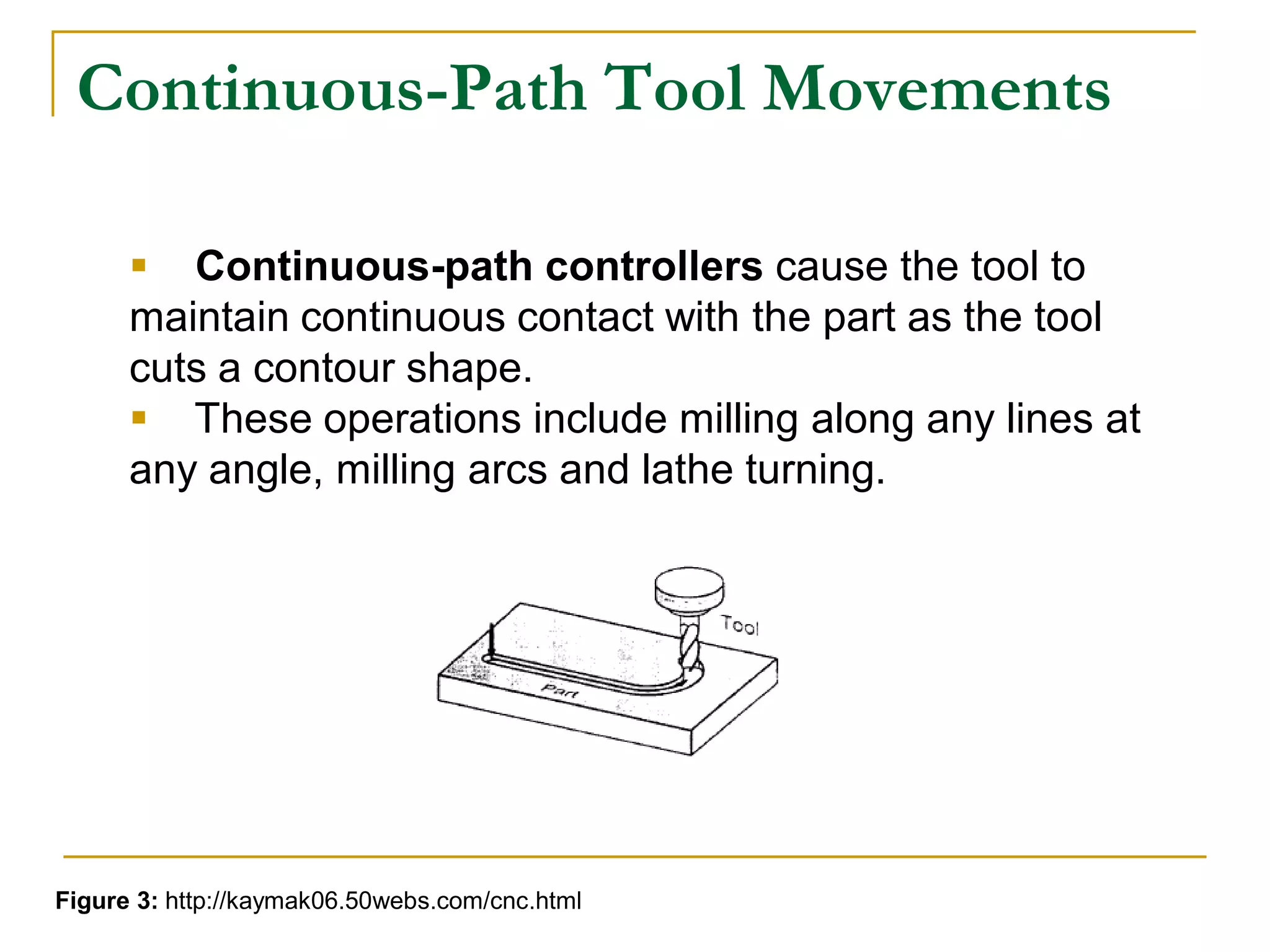
 Continuous-path controllers cause the tool to 
maintain continuous contact with the part as the tool 
cuts a contour shape. 
 These operations include milling along any lines at 
any angle, milling arcs and lathe turning. 
Figure 3: http://kaymak06.50webs.com/cnc.html
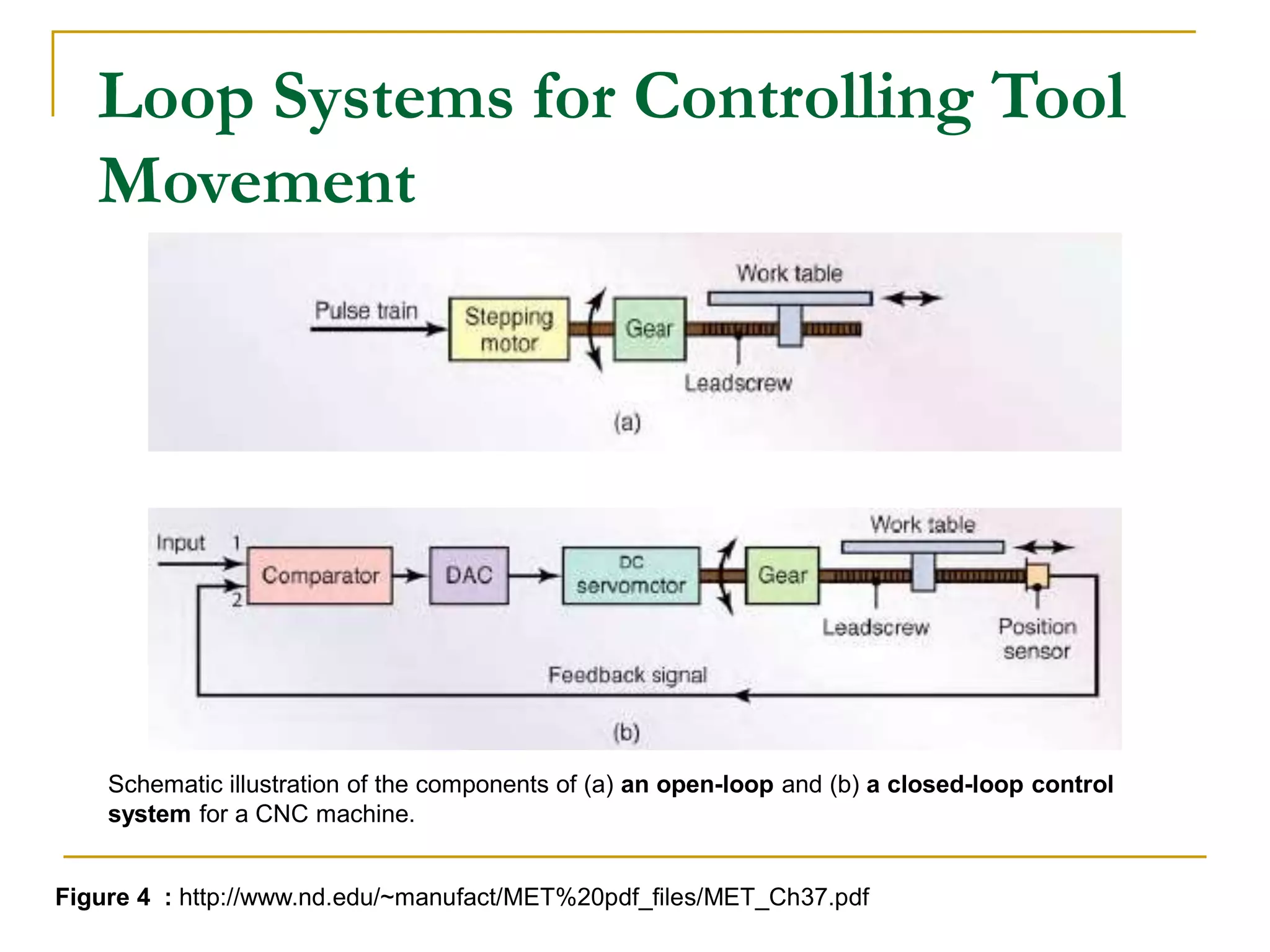
Loop Systems for Controlling Tool 
Movement 
Schematic illustration of the components of (a) an open-loop and (b) a closed-loop control 
system for a CNC machine. 
Figure 4 : http://www.nd.edu/~manufact/MET%20pdf_files/MET_Ch37.pdf
Types of CNC Machines 
 Lathe Machine 
 Milling Machine 
 Drilling Machine 
The bench drill 
The pillar drill 
 Boring Machine 
 Grinding Machine
Types of CNC Machines 
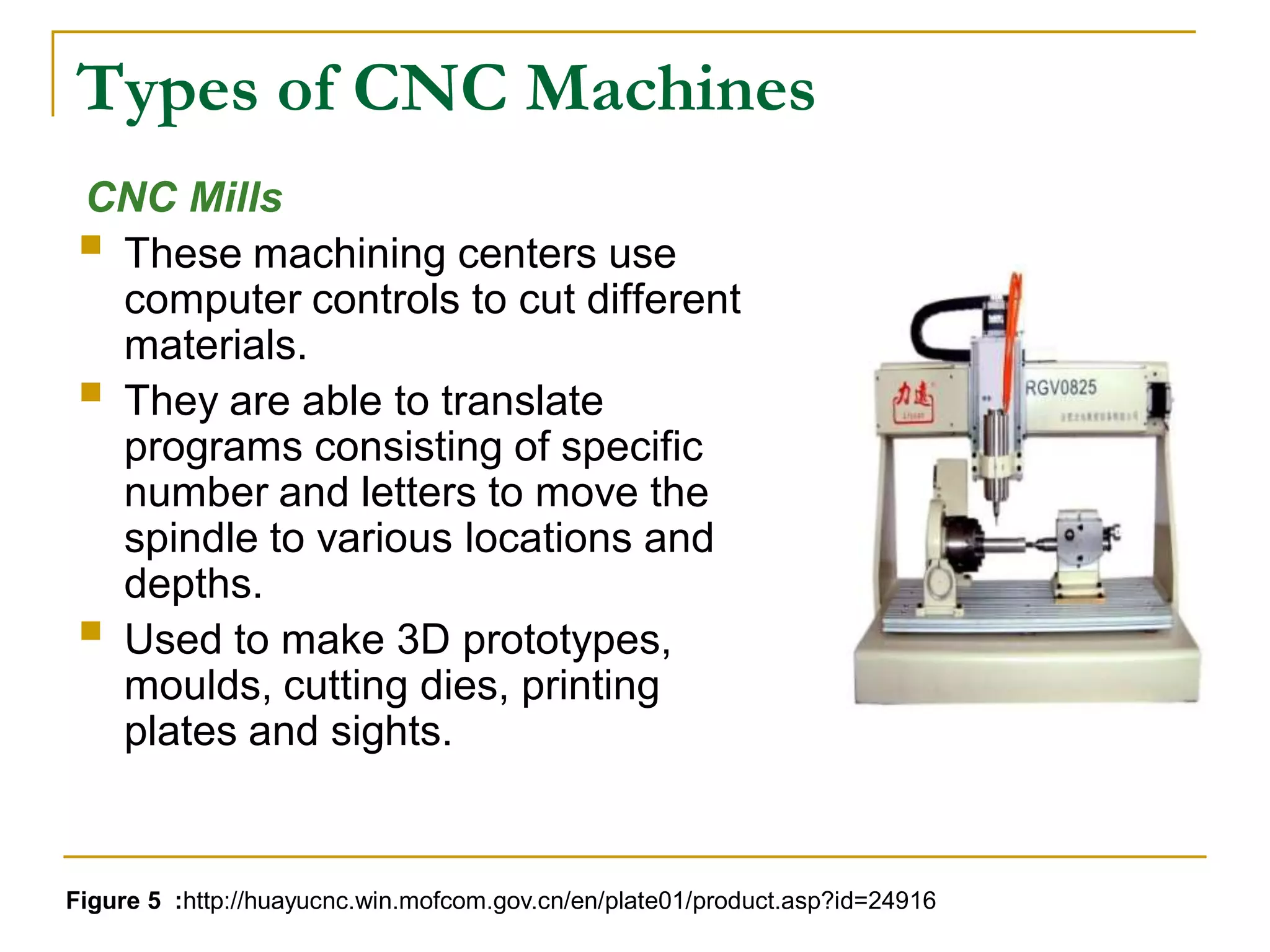
CNC Mills 
 
These machining centers use 
computer controls to cut different 
materials. 
 
They are able to translate 
programs consisting of specific 
number and letters to move the 
spindle to various locations and 
depths. 
 
Used to make 3D prototypes, 
moulds, cutting dies, printing 
plates and sights. 
Figure 5 :http://huayucnc.win.mofcom.gov.cn/en/plate01/product.asp?id=24916
Types of CNC Machines 
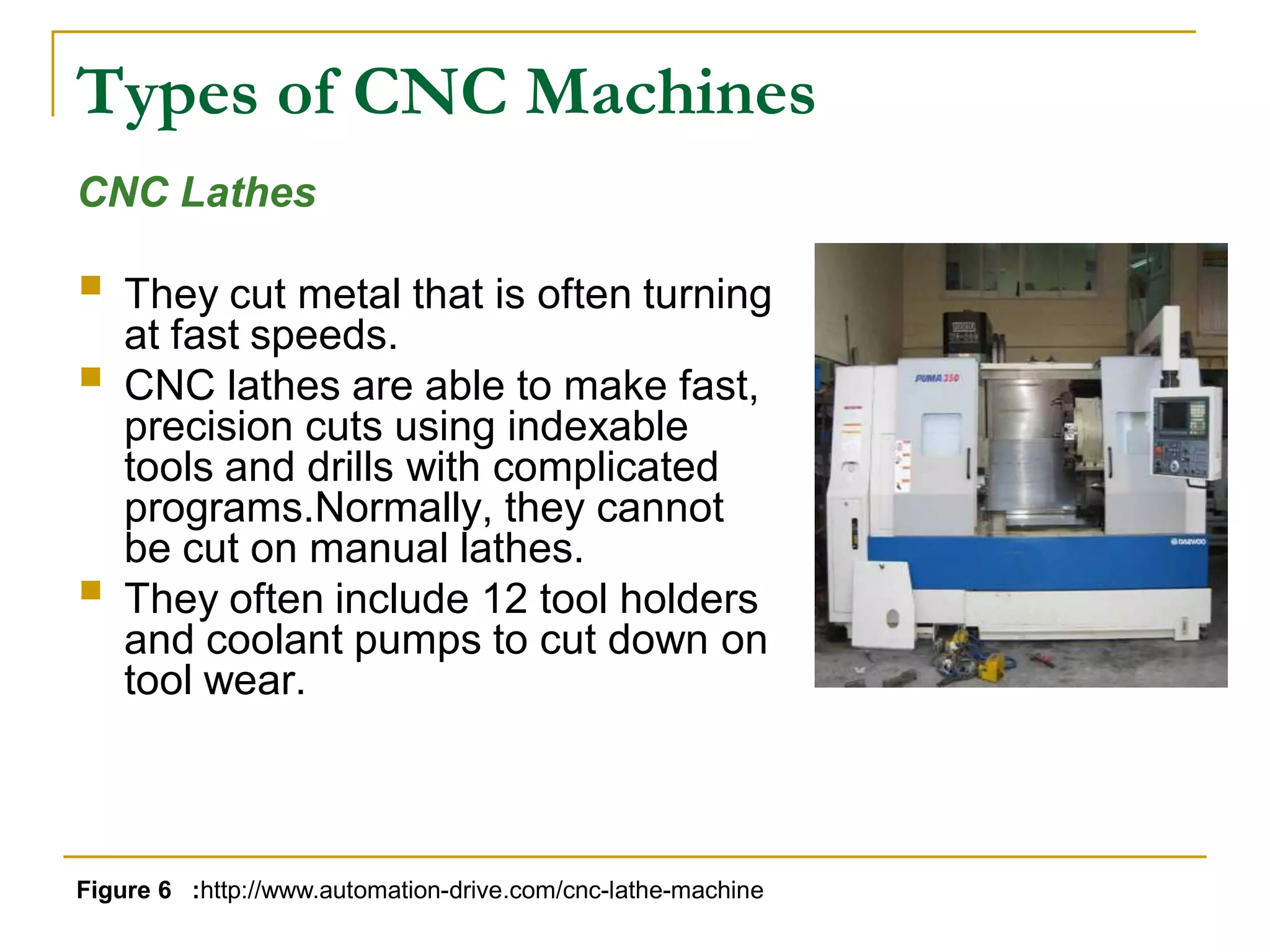
CNC Lathes 
 
They cut metal that is often turning 
at fast speeds. 
 
CNC lathes are able to make fast, 
precision cuts using indexable 
tools and drills with complicated 
programs.Normally, they cannot 
be cut on manual lathes. 
 
They often include 12 tool holders 
and coolant pumps to cut down on 
tool wear. 
Figure 6 :http://www.automation-drive.com/cnc-lathe-machine
Types of CNC Machines 
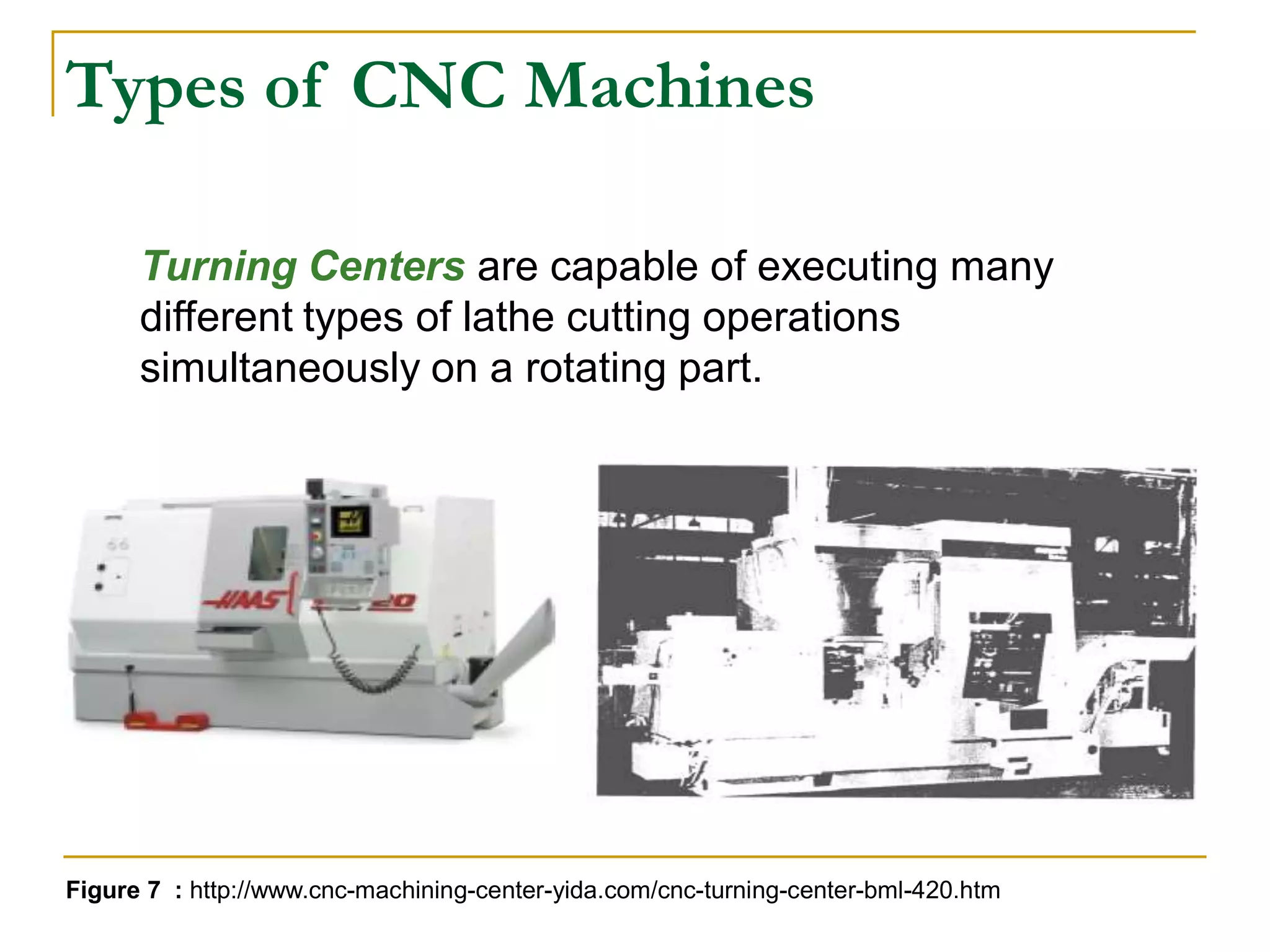
Turning Centers are capable of executing many 
different types of lathe cutting operations 
simultaneously on a rotating part. 
Figure 7 : http://www.cnc-machining-center-yida.com/cnc-turning-center-bml-420.htm
Types of CNC Machines 
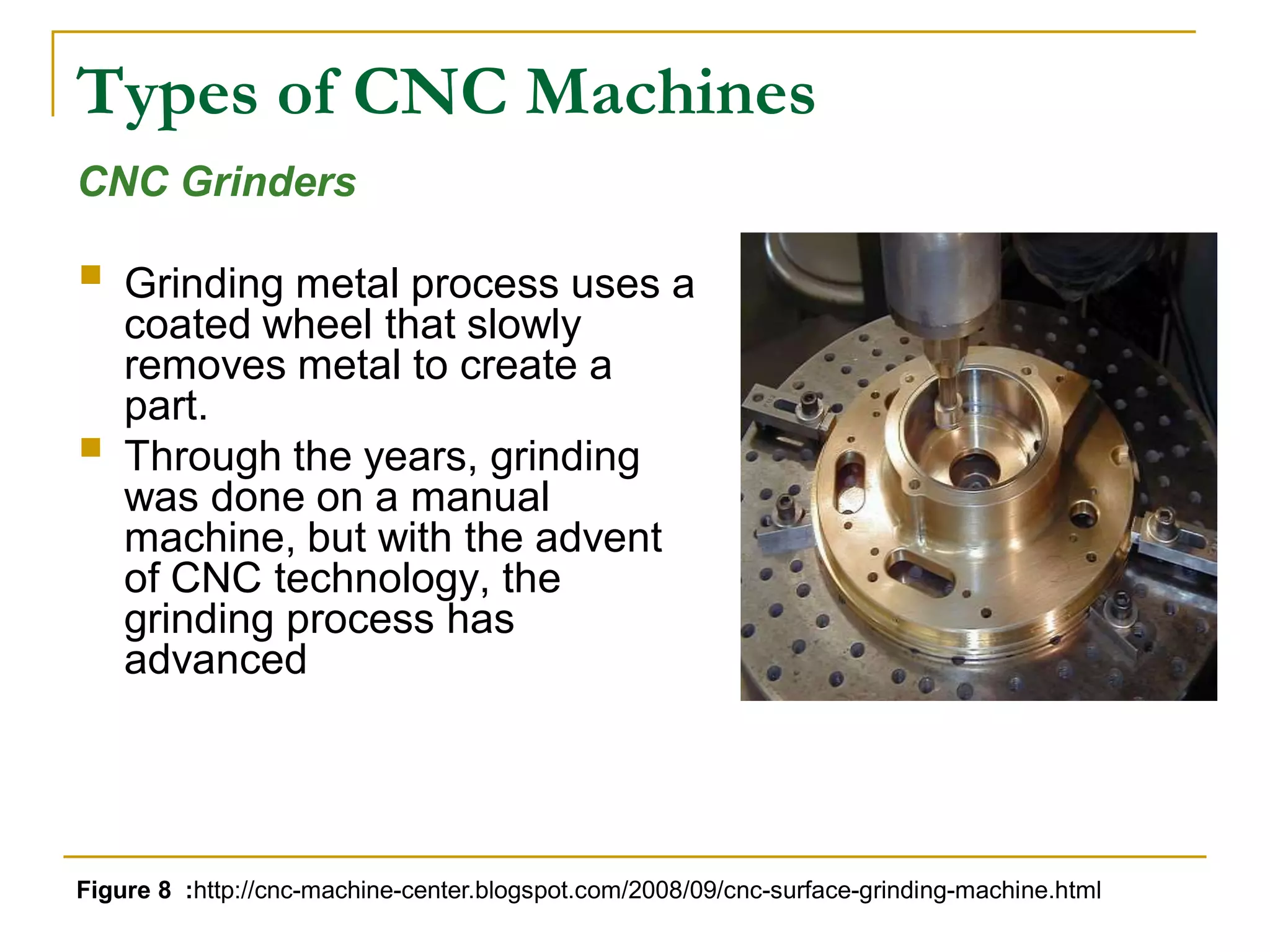
CNC Grinders 
 
Grinding metal process uses a 
coated wheel that slowly 
removes metal to create a 
part. 
 
Through the years, grinding 
was done on a manual 
machine, but with the advent 
of CNC technology, the 
grinding process has 
advanced 
Figure 8 :http://cnc-machine-center.blogspot.com/2008/09/cnc-surface-grinding-machine.html
Types of CNC Machines 
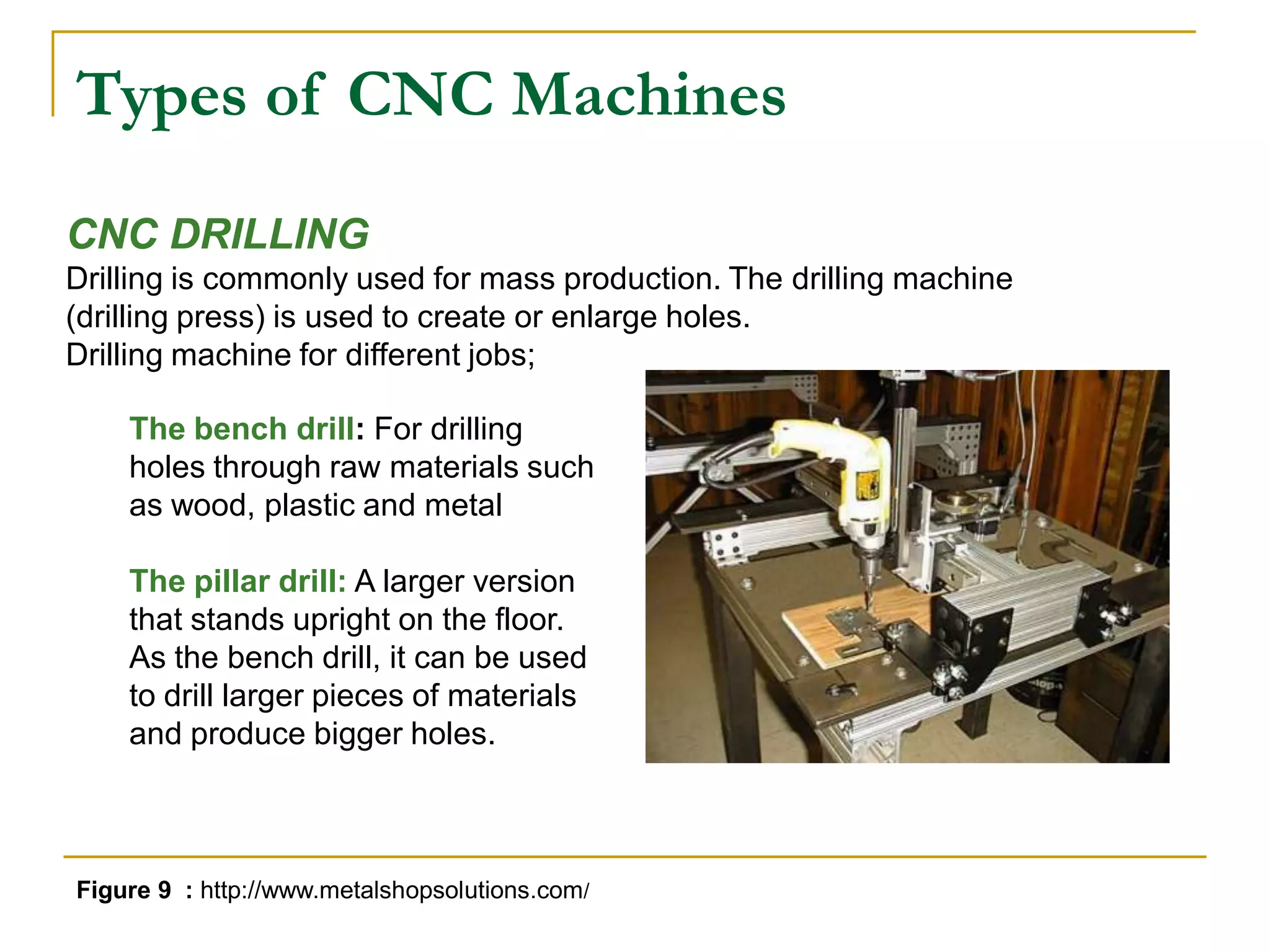
CNC DRILLING 
Drilling is commonly used for mass production. The drilling machine 
(drilling press) is used to create or enlarge holes. 
Drilling machine for different jobs; 
The bench drill: For drilling 
holes through raw materials such 
as wood, plastic and metal 
The pillar drill: A larger version 
that stands upright on the floor. 
As the bench drill, it can be used 
to drill larger pieces of materials 
and produce bigger holes. 
Figure 9 : http://www.metalshopsolutions.com/
Types of CNC Machines 
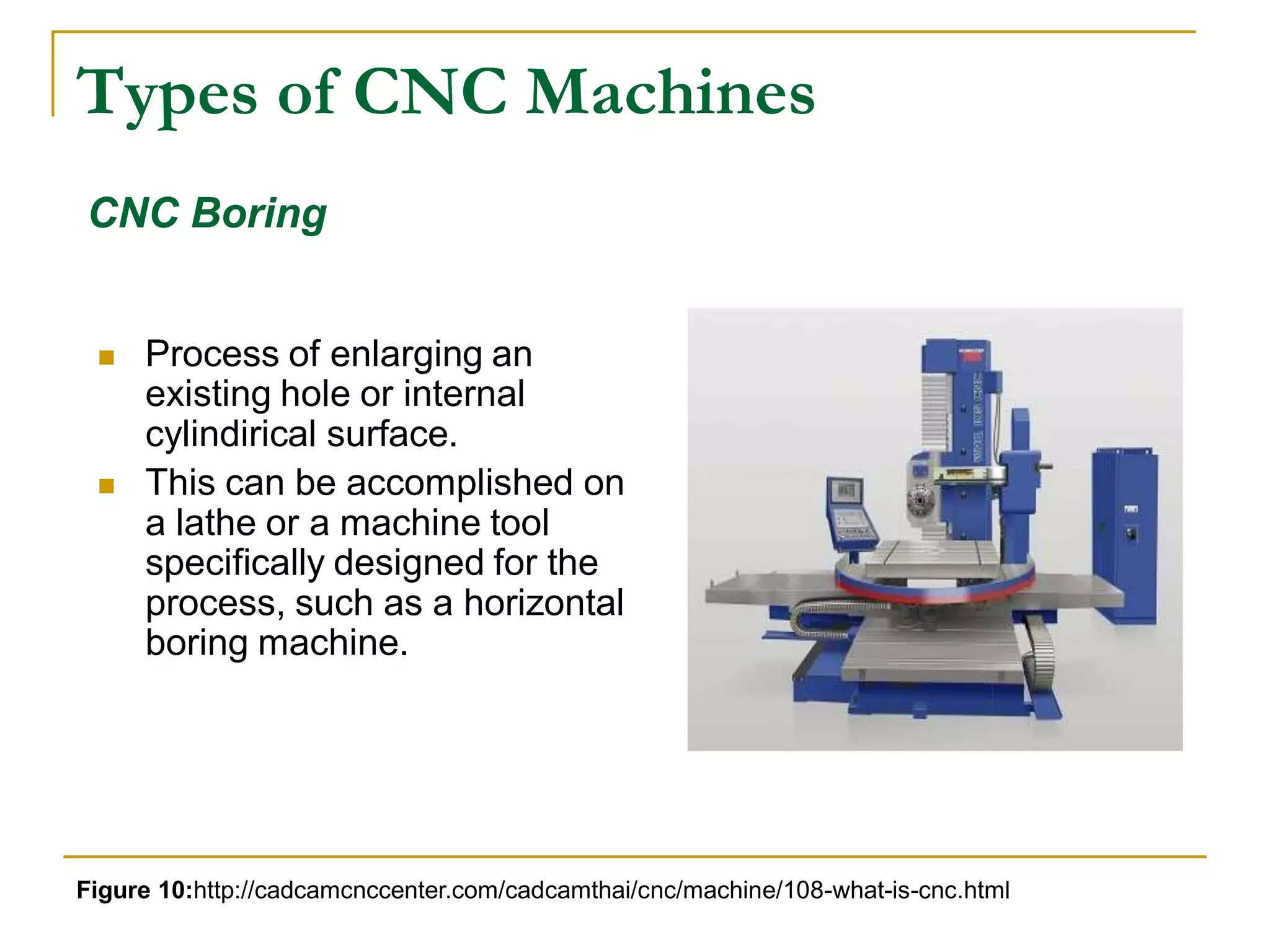
CNC Boring 
 Process of enlarging an 
existing hole or internal 
cylindirical surface. 
 This can be accomplished on 
a lathe or a machine tool 
specifically designed for the 
process, such as a horizontal 
boring machine. 
Figure 10:http://cadcamcnccenter.com/cadcamthai/cnc/machine/108-what-is-cnc.html
Types of CNC Machines 
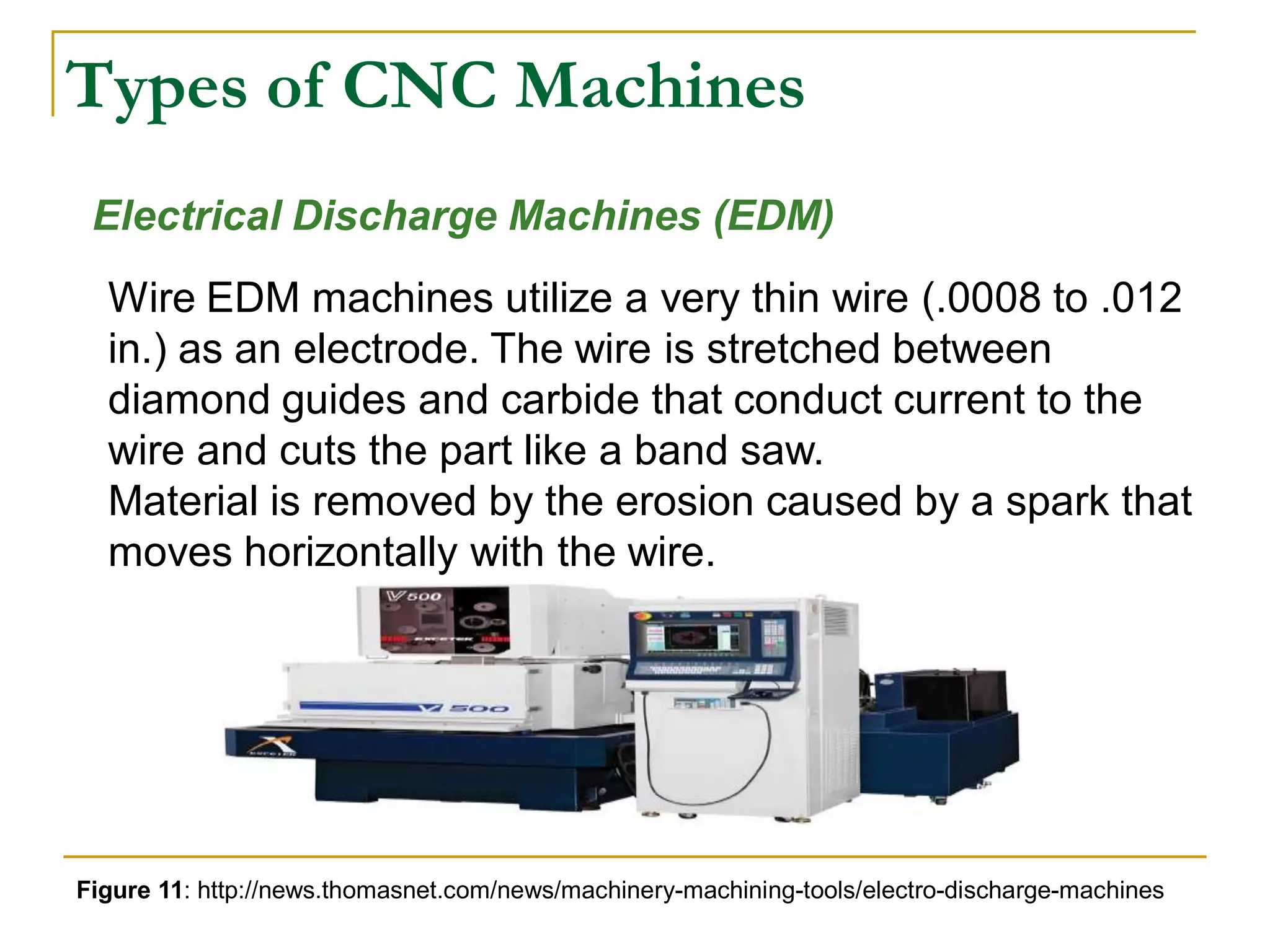
Electrical Discharge Machines (EDM) 
Wire EDM machines utilize a very thin wire (.0008 to .012 
in.) as an electrode. The wire is stretched between 
diamond guides and carbide that conduct current to the 
wire and cuts the part like a band saw. 
Material is removed by the erosion caused by a spark that 
moves horizontally with the wire. 
Figure 11: http://news.thomasnet.com/news/machinery-machining-tools/electro-discharge-machines
Types of CNC Machines 
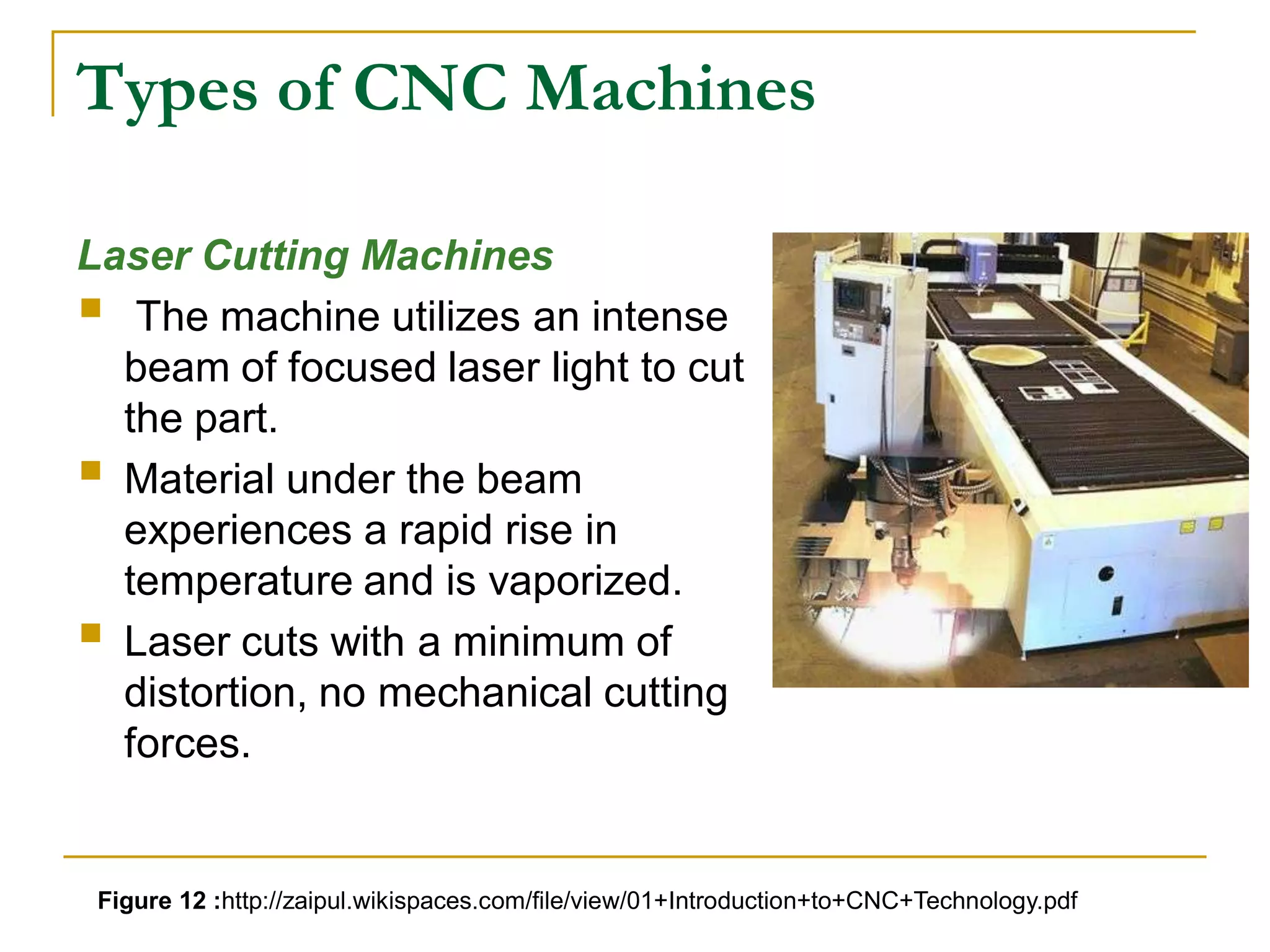
Laser Cutting Machines 
 
The machine utilizes an intense 
beam of focused laser light to cut 
the part. 
 
Material under the beam 
experiences a rapid rise in 
temperature and is vaporized. 
 
Laser cuts with a minimum of 
distortion, no mechanical cutting 
forces. 
Figure 12 :http://zaipul.wikispaces.com/file/view/01+Introduction+to+CNC+Technology.pdf
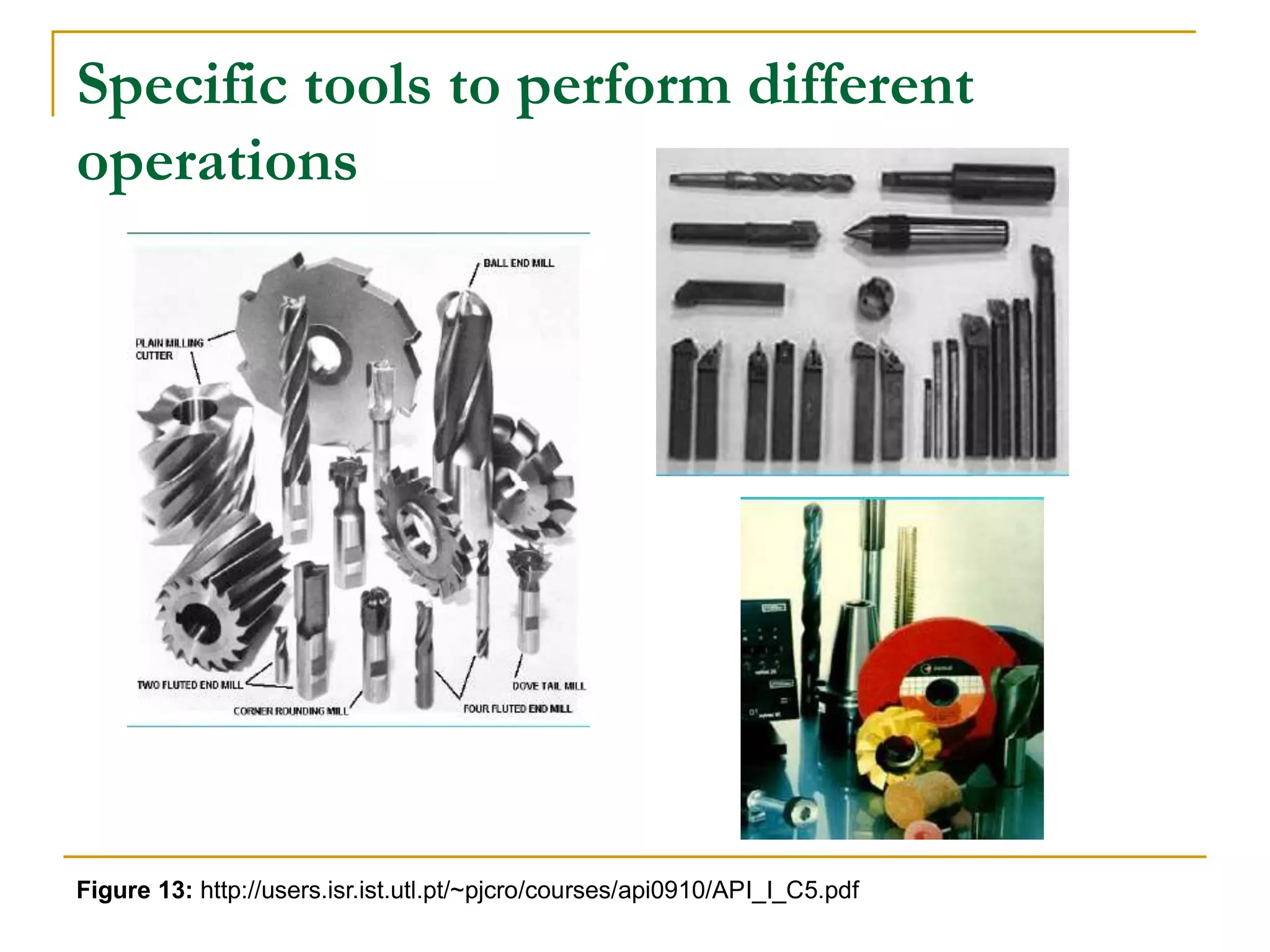
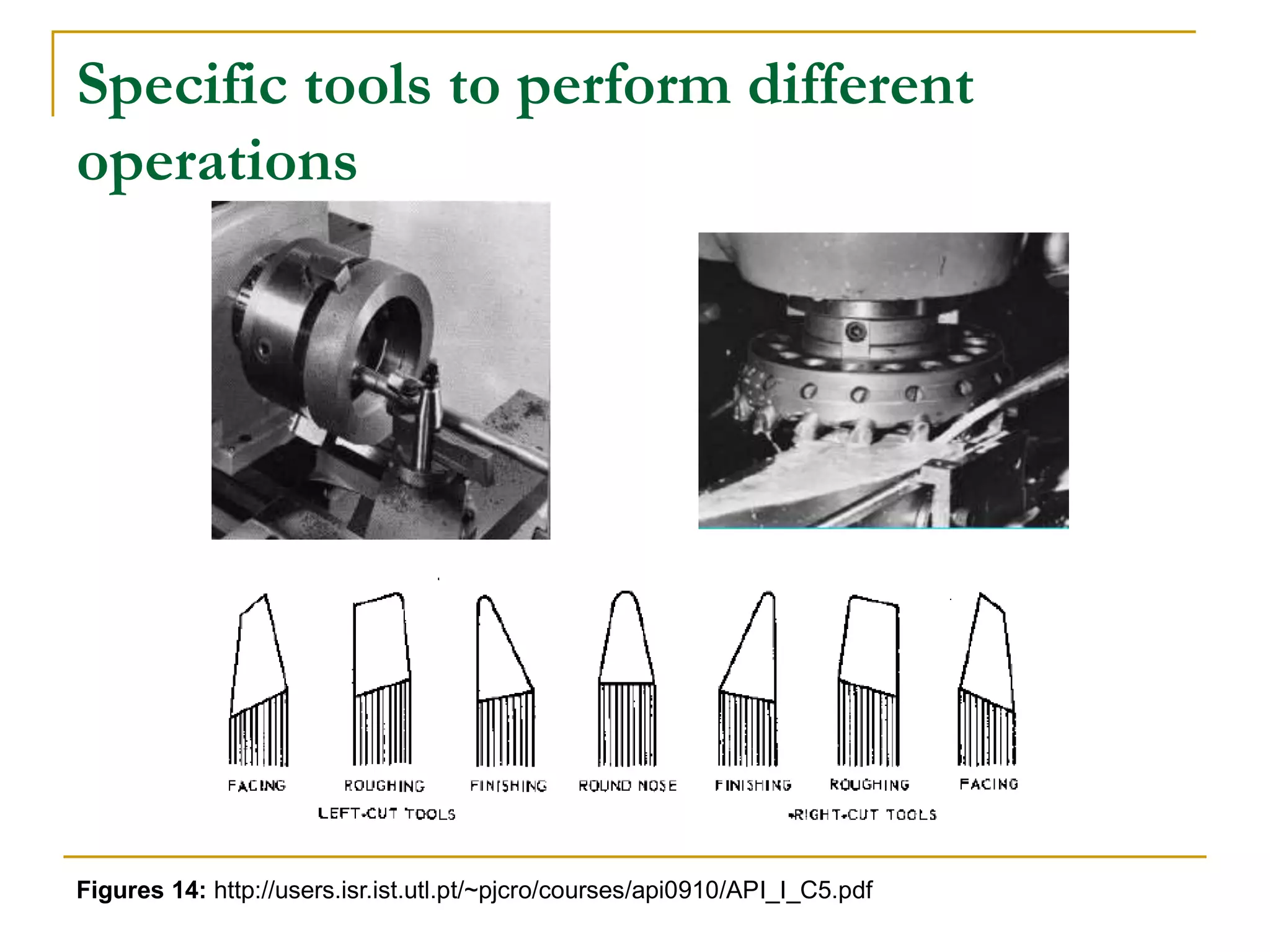
Specific tools to perform different 
operations 
Figure 13: http://users.isr.ist.utl.pt/~pjcro/courses/api0910/API_I_C5.pdf
Specific tools to perform different 
operations 
Figures 14: http://users.isr.ist.utl.pt/~pjcro/courses/api0910/API_I_C5.pdf
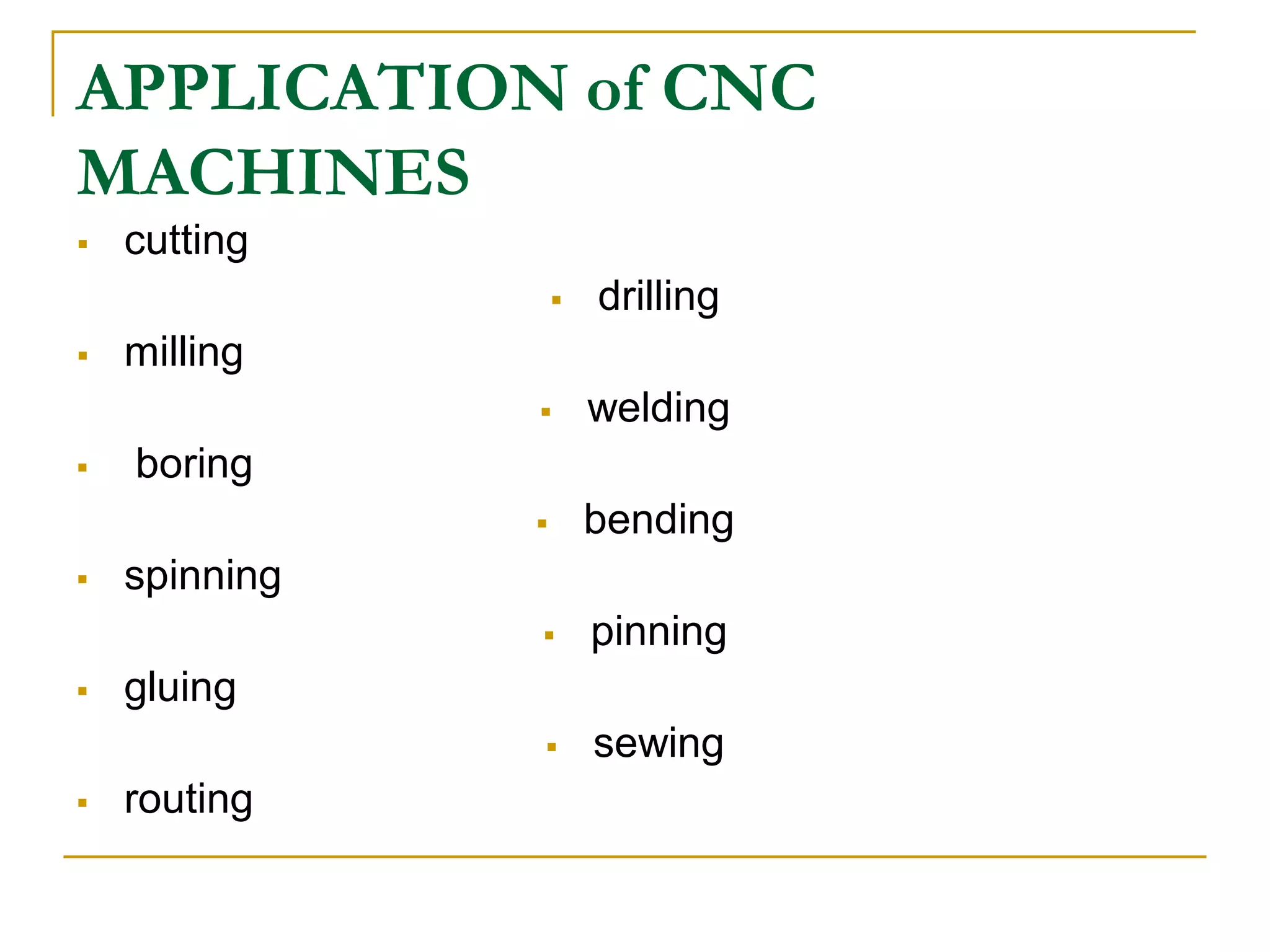
APPLICATION of CNC 
MACHINES 
 cutting 
 drilling 
 milling 
 welding 
 boring 
 bending 
 spinning 
 pinning 
 gluing 
 sewing 
 routing
Application of CNC in Some 
Industries 
 Automotive Industry 
 Aerospace Industry 
 Machinery Industry 
 Electrical Industry 
 Instrumentation Industry
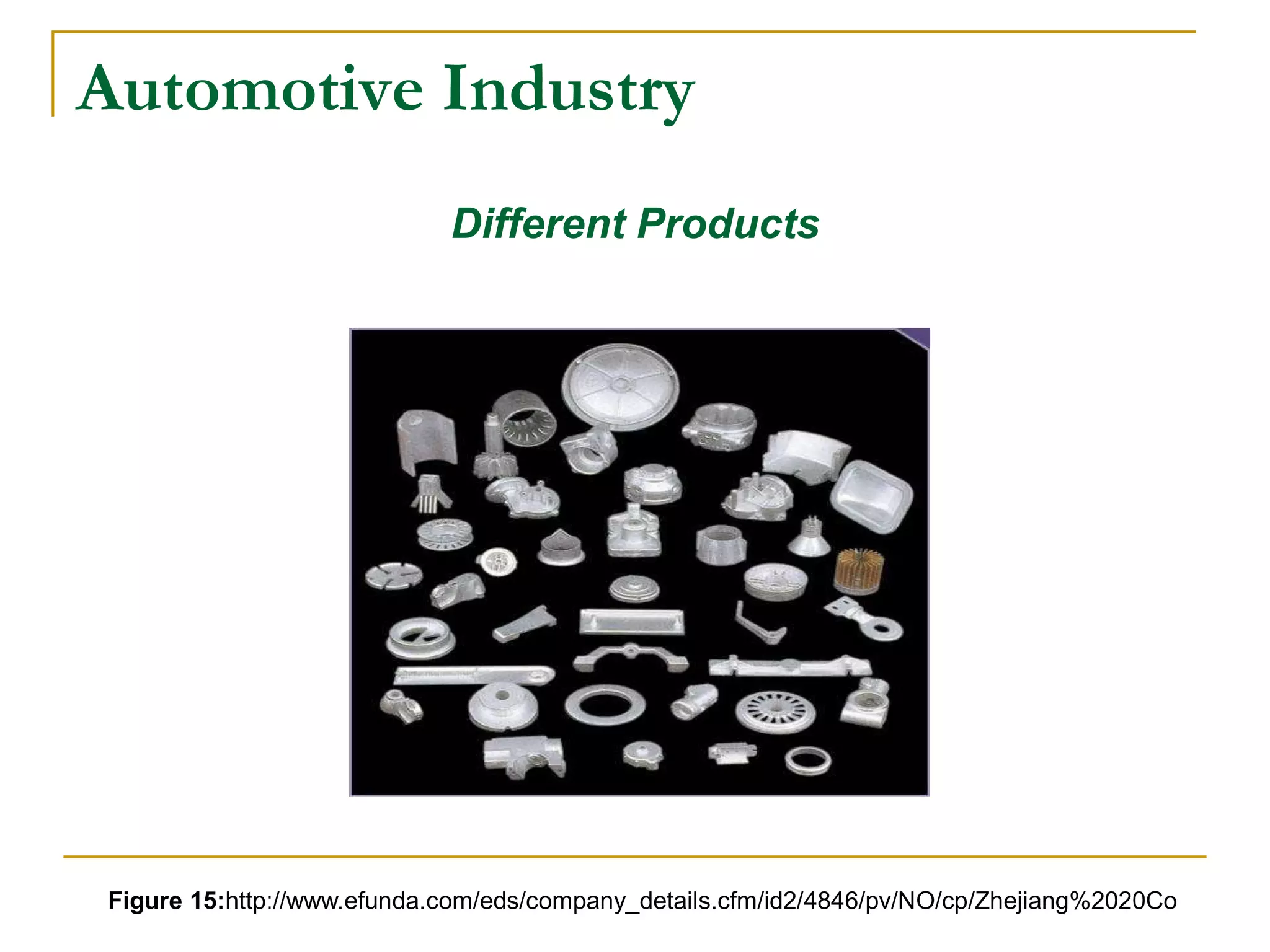
Automotive Industry 
Different Products 
Figure 15:http://www.efunda.com/eds/company_details.cfm/id2/4846/pv/NO/cp/Zhejiang%2020Co
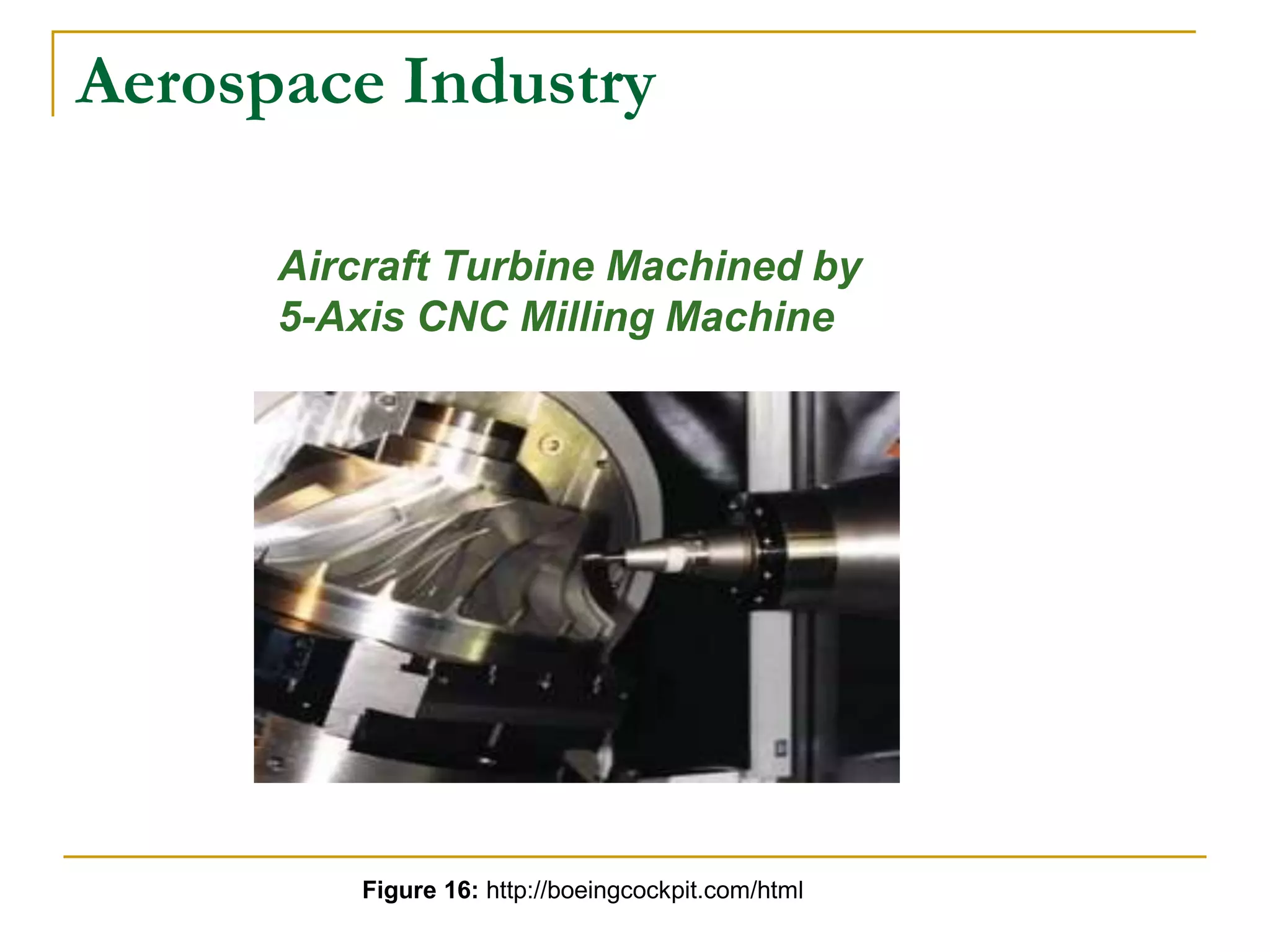
Aerospace Industry 
Aircraft Turbine Machined by 
5-Axis CNC Milling Machine 
Figure 16: http://boeingcockpit.com/html
Advantages of CNC Machines 
Ease of Use 
 CNC machines are easier for beginners 
 operation of several CNC machines at same time 
 some CNC machines don’t need any operator 
●call their operator in case of the emergencies. 
High Efficiency 
 operate almost continuously 24 hours a day, 365 days a 
year
Expanding Options 
 Expand the machine's capabilities with Software 
changes and updates 
No Prototyping 
 New programmes provide elimination build a prototype, 
save time and money 
Precision 
 Parts are identical to each other
Reduce Waste 
 Reduce waste as errors allows minimize wasted 
material.
Disadvantage of CNC Machines 
Cost 
CNC machinery: 
 costs quite a lot more than conventional machinery 
 does not eliminate the need for expensive tools 
 expensive to repair
CONCLUSION 
 CNC machines which are applicable any type of 
processing 
 manufacturing anything is identical in shorter time 
 CNC machines provide many advantages 
 many industries prefer using CNC machines
Thank you 
☻
REFERENCES 
 http://www.ehow.com/about_5415088_types-cnc-machines.html 
 http://www.cncci.com/resources/articles/what%20is%20cnc.htm 
 http://www.bracingsystemsinc.com/basic-motion-types-in-a-cnc-machine 
 http://www.madehow.com/Volume-2/CNC-Machine-Tool.html 
 http://dget.nic.in/lisdapp/Trade/syllabus/pdf/TTCNC.pdf 
 http://users.isr.ist.utl.pt/~pjcro/courses/api0910/API_I_C5.pdf 
 http://www.tradekorea.com/products/cnc_machine.html 
 http://kaymak06.50webs.com/cnc.html 
 http://www.nd.edu/~manufact/MET%20pdf_files/MET_Ch37.pdf 
 http://huayucnc.win.mofcom.gov.cn/en/plate01/product.asp?id=24916 
 http://www.automation-drive.com/cnc-lathe-machine 
 http://www.cnc-machining-center-yida.com/cnc-turning-center-bml-420.htm 
 http://cnc-machine-center.blogspot.com/2008/09/cnc-surface-grinding-machine.html 
 http://cadcamcnccenter.com/cadcamthai/cnc/machine/108-what-is-cnc 
 http://news.thomasnet.com/news/machinery-machining-tools/electro-discharge-machines 
 http://zaipul.wikispaces.com/file/view/01+Introduction+to+CNC+Technology.pdf 
 http://www.metalshopsolutions.com/ 
 http://www.efunda.com/eds/company_details.cfm/id2/4846/pv/NO/cp/Zhejiang%2020Com 
 http://boeingcockpit.com/html 
 http://www.westone.wa.gov.au/toolbox8/furniture/toolbox/shared/resources_mw/ask_expert 
/tony/advantages.htm

Cnc 2 0

  • 1.
    Computer Numerical Control (CNC) Banu Akar Neşe Kaynak Duygu Gökçe Meltem Erdi Hacettepe University Chemical Engineering Department 22.12.2010
  • 2.
    CONTENT 1. Whatare NC & CNC? 2. History 3. CNC system Elements 4. Properties of CNC machine 5. Types of CNC machines 6. CNC applications 7. Advantages& Disadvantages 8. Conclusion 9. References
  • 3.
    What are NC& CNC ?  Numerical control (NC) is a method of automatically operating a manufacturing machine based on a code letters, numbers and special characters.  The numerical data required to produce a part is provided to a machine in the form of program, called part program or CNC (computer numerical control)
  • 4.
    What are NC& CNC ?  The program is translated into the appropriate electrical signals for input to motors that run the machine.  A CNC machine is an numerical control machine with the added feature of an on board computer. The computer is referred to as the machine control unit (MCU)
  • 5.
    HISTORY  In1775, John Wilkinson- cannon boring machine (lathe).  In 1881, Eli Whitney- milling machine.  In 1947, Mr. John Parsons began experimenting for using 3-axis curvature data to control the machine tool motion for the production for aircraft components.  In 1949, parsons- first NC machine.  In 1951, MIT was involved in the project.  In 1955, after refinements NC became available in industry  Today, modern machinery are CNC milling machines and lathes.
  • 6.
    CNC SYSTEM ELEMENTS A typical CNC system consists of the following six elements  Part program  Program input device  Machine control unit  Drive system  Machine tool  Feedback system Figure 1 : Schematic illustration of the major components of a numerical control machine tool
  • 7.
    Basic Concept ofPart Programming  Part programming contains geometric data about the part and motion information to move the cutting tool with respect to the work piece.  Basically, the machine receives instructions as a sequence of blocks containing commands to set machine parameters; speed, feed and other relevant information.  A block is equivalent to a line of codes in a part program.  N135 G01 X1.0 Y1.0 Z0.125 T01 F5.0 Block number Coordinates Special function Tool number G-code
  • 8.
    Programming Methods Automatically Programmed Tools (APT)  A text based system in which a programmer defines a series of lines, arcs, and points which define the overall part geometry locations.  These features are then used to generate a cutter location (CL) file.
  • 9.
    Programming Methods Computer Aided Machining (CAM) Systems- Computer Aided Design (CAD) Systems  CAD/CAM systems allow for rapid development and modifying of designs and documentation.  The 3D geometric model produced becomes a common element for engineering analysis (FEA), machining process planning (including CNC part programming, documentation (including engineering drawings), quality control, and so on.
  • 10.
    Drives of CNCmachine tool  Hydraulic actuator - high power machine tool  Stepping motor - small machine due to limited power and torque  DC motor - excellent speed regulation, high torque, most widely used
  • 11.
    Properties of CNCmachines  Based on Motion Type: Motion control - the heart of CNC Point-to-Point or Continuous path  Based on Control Loops: Open loop or Closed loop  Based on Power Supply: Electric or Hydraulic or Pneumatic  Based on Positioning System Incremental or Absolute
  • 12.
    Point-to-Point Tool Movements  Point-to-point control systems cause the tool to move to a point on the part and execute an operation at that point only.  The tool is not in continuous contact with the part while it is moving.  Examples: drilling, reaming, punching, boring and tapping. Figure 2 : http://www.tradekorea.com/products/cnc_machine.html
  • 13.
    Continuous-Path Tool Movements  Continuous-path controllers cause the tool to maintain continuous contact with the part as the tool cuts a contour shape.  These operations include milling along any lines at any angle, milling arcs and lathe turning. Figure 3: http://kaymak06.50webs.com/cnc.html
  • 14.
    Loop Systems forControlling Tool Movement Schematic illustration of the components of (a) an open-loop and (b) a closed-loop control system for a CNC machine. Figure 4 : http://www.nd.edu/~manufact/MET%20pdf_files/MET_Ch37.pdf
  • 15.
    Types of CNCMachines  Lathe Machine  Milling Machine  Drilling Machine The bench drill The pillar drill  Boring Machine  Grinding Machine
  • 16.
    Types of CNCMachines CNC Mills  These machining centers use computer controls to cut different materials.  They are able to translate programs consisting of specific number and letters to move the spindle to various locations and depths.  Used to make 3D prototypes, moulds, cutting dies, printing plates and sights. Figure 5 :http://huayucnc.win.mofcom.gov.cn/en/plate01/product.asp?id=24916
  • 17.
    Types of CNCMachines CNC Lathes  They cut metal that is often turning at fast speeds.  CNC lathes are able to make fast, precision cuts using indexable tools and drills with complicated programs.Normally, they cannot be cut on manual lathes.  They often include 12 tool holders and coolant pumps to cut down on tool wear. Figure 6 :http://www.automation-drive.com/cnc-lathe-machine
  • 18.
    Types of CNCMachines Turning Centers are capable of executing many different types of lathe cutting operations simultaneously on a rotating part. Figure 7 : http://www.cnc-machining-center-yida.com/cnc-turning-center-bml-420.htm
  • 19.
    Types of CNCMachines CNC Grinders  Grinding metal process uses a coated wheel that slowly removes metal to create a part.  Through the years, grinding was done on a manual machine, but with the advent of CNC technology, the grinding process has advanced Figure 8 :http://cnc-machine-center.blogspot.com/2008/09/cnc-surface-grinding-machine.html
  • 20.
    Types of CNCMachines CNC DRILLING Drilling is commonly used for mass production. The drilling machine (drilling press) is used to create or enlarge holes. Drilling machine for different jobs; The bench drill: For drilling holes through raw materials such as wood, plastic and metal The pillar drill: A larger version that stands upright on the floor. As the bench drill, it can be used to drill larger pieces of materials and produce bigger holes. Figure 9 : http://www.metalshopsolutions.com/
  • 21.
    Types of CNCMachines CNC Boring  Process of enlarging an existing hole or internal cylindirical surface.  This can be accomplished on a lathe or a machine tool specifically designed for the process, such as a horizontal boring machine. Figure 10:http://cadcamcnccenter.com/cadcamthai/cnc/machine/108-what-is-cnc.html
  • 22.
    Types of CNCMachines Electrical Discharge Machines (EDM) Wire EDM machines utilize a very thin wire (.0008 to .012 in.) as an electrode. The wire is stretched between diamond guides and carbide that conduct current to the wire and cuts the part like a band saw. Material is removed by the erosion caused by a spark that moves horizontally with the wire. Figure 11: http://news.thomasnet.com/news/machinery-machining-tools/electro-discharge-machines
  • 23.
    Types of CNCMachines Laser Cutting Machines  The machine utilizes an intense beam of focused laser light to cut the part.  Material under the beam experiences a rapid rise in temperature and is vaporized.  Laser cuts with a minimum of distortion, no mechanical cutting forces. Figure 12 :http://zaipul.wikispaces.com/file/view/01+Introduction+to+CNC+Technology.pdf
  • 24.
    Specific tools toperform different operations Figure 13: http://users.isr.ist.utl.pt/~pjcro/courses/api0910/API_I_C5.pdf
  • 25.
    Specific tools toperform different operations Figures 14: http://users.isr.ist.utl.pt/~pjcro/courses/api0910/API_I_C5.pdf
  • 26.
    APPLICATION of CNC MACHINES  cutting  drilling  milling  welding  boring  bending  spinning  pinning  gluing  sewing  routing
  • 27.
    Application of CNCin Some Industries  Automotive Industry  Aerospace Industry  Machinery Industry  Electrical Industry  Instrumentation Industry
  • 28.
    Automotive Industry DifferentProducts Figure 15:http://www.efunda.com/eds/company_details.cfm/id2/4846/pv/NO/cp/Zhejiang%2020Co
  • 29.
    Aerospace Industry AircraftTurbine Machined by 5-Axis CNC Milling Machine Figure 16: http://boeingcockpit.com/html
  • 30.
    Advantages of CNCMachines Ease of Use  CNC machines are easier for beginners  operation of several CNC machines at same time  some CNC machines don’t need any operator ●call their operator in case of the emergencies. High Efficiency  operate almost continuously 24 hours a day, 365 days a year
  • 31.
    Expanding Options Expand the machine's capabilities with Software changes and updates No Prototyping  New programmes provide elimination build a prototype, save time and money Precision  Parts are identical to each other
  • 32.
    Reduce Waste Reduce waste as errors allows minimize wasted material.
  • 33.
    Disadvantage of CNCMachines Cost CNC machinery:  costs quite a lot more than conventional machinery  does not eliminate the need for expensive tools  expensive to repair
  • 34.
    CONCLUSION  CNCmachines which are applicable any type of processing  manufacturing anything is identical in shorter time  CNC machines provide many advantages  many industries prefer using CNC machines
  • 35.
  • 36.
    REFERENCES  http://www.ehow.com/about_5415088_types-cnc-machines.html  http://www.cncci.com/resources/articles/what%20is%20cnc.htm  http://www.bracingsystemsinc.com/basic-motion-types-in-a-cnc-machine  http://www.madehow.com/Volume-2/CNC-Machine-Tool.html  http://dget.nic.in/lisdapp/Trade/syllabus/pdf/TTCNC.pdf  http://users.isr.ist.utl.pt/~pjcro/courses/api0910/API_I_C5.pdf  http://www.tradekorea.com/products/cnc_machine.html  http://kaymak06.50webs.com/cnc.html  http://www.nd.edu/~manufact/MET%20pdf_files/MET_Ch37.pdf  http://huayucnc.win.mofcom.gov.cn/en/plate01/product.asp?id=24916  http://www.automation-drive.com/cnc-lathe-machine  http://www.cnc-machining-center-yida.com/cnc-turning-center-bml-420.htm  http://cnc-machine-center.blogspot.com/2008/09/cnc-surface-grinding-machine.html  http://cadcamcnccenter.com/cadcamthai/cnc/machine/108-what-is-cnc  http://news.thomasnet.com/news/machinery-machining-tools/electro-discharge-machines  http://zaipul.wikispaces.com/file/view/01+Introduction+to+CNC+Technology.pdf  http://www.metalshopsolutions.com/  http://www.efunda.com/eds/company_details.cfm/id2/4846/pv/NO/cp/Zhejiang%2020Com  http://boeingcockpit.com/html  http://www.westone.wa.gov.au/toolbox8/furniture/toolbox/shared/resources_mw/ask_expert /tony/advantages.htm