 Projections: Transform points in coordinate system of
dimension N into a coordinate system of dimension less
than N.
 In other word, take a point from m dimensions to n
dimensions where N<M.
 In this chapter we will deal with projection from 3d to
2d
 There are two types of projections:
1. Parallel.
Orthographic.
Oblique.
2. Perspective.
 Projection of a 3D object is defined by straight
projection rays (projectors) coming from the center of
projection passing through each point of the object and
intersecting the projection plane.
 Projections requires:
1. Projections plane.
2. Projections Reference Point (PRP) or Center of
Projection (CRP).
 The projected view of an object is determined by
calculating the intersection of projection lines with the
view plane.
 Projectors: Lines from coordinate in original space to
coordinate in projected space.
 In parallel projections, coordinate positions are
transformed to the view plane (projection plane) along
parallel lines (projectors).
 In perspective, object position are transformed to the
view plane along lines that converge to COP.
 In orthographic the direction of projection = normal to
the projection plane.
 In oblique the direction of projection != normal to the
projection plane.
 Direction/Center of projection: The main key factors in
projection are DOP and COP.
 If the DOP is the same for all point, then we have
parallel projection, else we have perspective projection.
 If the distance of COP is finite, then we have
perspective projection, else we have parallel projection.
 In general, projection is determined by where you
place the projection plane relative to principle axes of
object (relative angle and position), and what angle the
projection make within the projection plane.
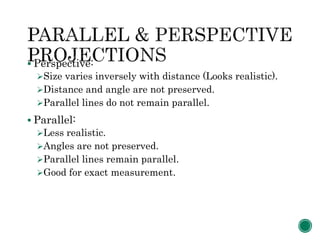
 Perspective:
Size varies inversely with distance (Looks realistic).
Distance and angle are not preserved.
Parallel lines do not remain parallel.
 Parallel:
Less realistic.
Angles are not preserved.
Parallel lines remain parallel.
Good for exact measurement.
 In Orthographic there is no COP at infinity and A=A’
and B=B’, but in Oblique COP at infinity
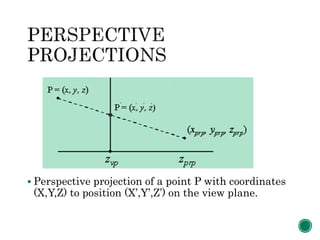
 Perspective projection of a point P with coordinates
(X,Y,Z) to position (X’,Y’,Z’) on the view plane.
 X’= X - XU.
 Y’= Y - YU.
 Z’= Z – (Z-ZPRP).
 Parameter U takes values from 0 to 1.
 When U= 0.
X’= X. Orthographic parallel projection
Y’= Y.
 When U= 1.
X’= 0
Y’= 0 (0,0,ZPRP) so the point is at projection
Z’= ZPRP. Reference point PRP
 On the view plane Z’= ZVP.
 U= (ZVP – Z) / (ZPRP – Z).
 XP= X ((ZPRP – ZVP) / (Z – ZPRP)) = X (dP / (Z-ZPRP))
 YP= Y ((ZPRP – ZVP) / (Z – ZPRP)) = Y (dP / (Z-ZPRP))
 Where dP = ZPRP – ZVP is the distance of the view plane
VP from the projection reference plane PRP.
 Using 3d homogeneous-coordinate representation, we
can write the perspective projection transformation as
 Xh = X.
 Yh = Y.
 Zh = Z (ZVP / dP) – ZVP (ZPRP / dP).
 h= (Z / dP) – (ZPRP / dP)
 XP = Xh / h.
 YP = Yh / h.
 EX: If you have a point (2,4,6) and you want to project
using perspective projection, suppose that ZPRP=20 and
ZVP=10.
 dP= ZPRP – ZVP= 20-10 = 10.
 XP= X (dP / (Z-ZPRP))= 2 (10/-14).
 YP= Y (dP / (Z-ZPRP))= 4 (10/-14).
 Using 3d homogenous coordinate:
 Xh = 2, Yh = 4.
 h= (6 / 10) – (20 / 10)= -14/10.
 XP = 2 / (-14/10)= 20/-14.
 YP = 4 / (-14/10)= 40/-14.
 Oblique projection of coordinate position (X,Y,Z) to
position (XP,YP) on the view plan.
 X’= L * Cos θ.
 Y’= L * Sin θ.
 XP= X + X’= X + L * Cos θ.
 YP= Y + Y’= Y + L * Sin θ.
 Length L depends on the angle α and the Z coordinate of
the point to be projected
 Tan α= Z/L.
 L= Z/tan α= ZL1, where L1 is the inverse of tan α which
is also the value of L when Z = 1. We can then write the
oblique projection equations as:
XP= X + Z(L1 Cos θ).
YP= Y + Z(L1 Sin θ).
 X’= L * Cos θ.
 An orthographic projection obtained when L= 0.
 Common choices for θ in 30 and 45, which display a
combination view of the top, bottom and sides.
 EX: If you have a point (2,5,7) and you want to project
using oblique projection, suppose that θ=45 and α=45.
 L1= 1/tan α= 1.
 XP= X + Z(L1 Cos θ)= 2 + 7(1 Cos 45)= 2+(7/ 2).
 YP= Y + Z(L1 Sin θ)= 5 + 7(1 Sin 45)= 5+(7/ 2).
 EX: If you have a point (3,4,6) and you have θ=45,α=45,
ZPRP=5 and ZVP=2. Find the new coordinate using :
(A)Perspective (B)Orthographic (C)Oblique.
 (A) dP= ZPRP – ZVP= 5-2 = 3.
XP= X (dP / (Z-ZPRP))= 3 (3/1)= 9.
YP= Y (dP / (Z-ZPRP))= 4 (3/1)= 12.
 (B) XP= 3, YP= 4 Just drop Z.
 (C) L1= 1/tan α= 1.
XP= X + Z(L1 Cos θ)= 3 + 6(1 Cos 45)= 3+(6/ 2).
YP= Y + Z(L1 Sin θ)= 4 + 6(1 Sin 45)= 4+(6/ 2).

Computer Graphics - Projections

  • 2.
     Projections: Transformpoints in coordinate system of dimension N into a coordinate system of dimension less than N.  In other word, take a point from m dimensions to n dimensions where N<M.  In this chapter we will deal with projection from 3d to 2d  There are two types of projections: 1. Parallel. Orthographic. Oblique. 2. Perspective.
  • 3.
     Projection ofa 3D object is defined by straight projection rays (projectors) coming from the center of projection passing through each point of the object and intersecting the projection plane.  Projections requires: 1. Projections plane. 2. Projections Reference Point (PRP) or Center of Projection (CRP).  The projected view of an object is determined by calculating the intersection of projection lines with the view plane.  Projectors: Lines from coordinate in original space to coordinate in projected space.
  • 4.
     In parallelprojections, coordinate positions are transformed to the view plane (projection plane) along parallel lines (projectors).  In perspective, object position are transformed to the view plane along lines that converge to COP.  In orthographic the direction of projection = normal to the projection plane.  In oblique the direction of projection != normal to the projection plane.  Direction/Center of projection: The main key factors in projection are DOP and COP.
  • 5.
     If theDOP is the same for all point, then we have parallel projection, else we have perspective projection.  If the distance of COP is finite, then we have perspective projection, else we have parallel projection.  In general, projection is determined by where you place the projection plane relative to principle axes of object (relative angle and position), and what angle the projection make within the projection plane.
  • 6.
     Perspective: Size variesinversely with distance (Looks realistic). Distance and angle are not preserved. Parallel lines do not remain parallel.  Parallel: Less realistic. Angles are not preserved. Parallel lines remain parallel. Good for exact measurement.
  • 8.
     In Orthographicthere is no COP at infinity and A=A’ and B=B’, but in Oblique COP at infinity
  • 9.
     Perspective projectionof a point P with coordinates (X,Y,Z) to position (X’,Y’,Z’) on the view plane.
  • 10.
     X’= X- XU.  Y’= Y - YU.  Z’= Z – (Z-ZPRP).  Parameter U takes values from 0 to 1.  When U= 0. X’= X. Orthographic parallel projection Y’= Y.  When U= 1. X’= 0 Y’= 0 (0,0,ZPRP) so the point is at projection Z’= ZPRP. Reference point PRP
  • 11.
     On theview plane Z’= ZVP.  U= (ZVP – Z) / (ZPRP – Z).  XP= X ((ZPRP – ZVP) / (Z – ZPRP)) = X (dP / (Z-ZPRP))  YP= Y ((ZPRP – ZVP) / (Z – ZPRP)) = Y (dP / (Z-ZPRP))  Where dP = ZPRP – ZVP is the distance of the view plane VP from the projection reference plane PRP.  Using 3d homogeneous-coordinate representation, we can write the perspective projection transformation as
  • 12.
     Xh =X.  Yh = Y.  Zh = Z (ZVP / dP) – ZVP (ZPRP / dP).  h= (Z / dP) – (ZPRP / dP)  XP = Xh / h.  YP = Yh / h.
  • 13.
     EX: Ifyou have a point (2,4,6) and you want to project using perspective projection, suppose that ZPRP=20 and ZVP=10.  dP= ZPRP – ZVP= 20-10 = 10.  XP= X (dP / (Z-ZPRP))= 2 (10/-14).  YP= Y (dP / (Z-ZPRP))= 4 (10/-14).  Using 3d homogenous coordinate:  Xh = 2, Yh = 4.  h= (6 / 10) – (20 / 10)= -14/10.  XP = 2 / (-14/10)= 20/-14.  YP = 4 / (-14/10)= 40/-14.
  • 14.
     Oblique projectionof coordinate position (X,Y,Z) to position (XP,YP) on the view plan.
  • 15.
     X’= L* Cos θ.  Y’= L * Sin θ.  XP= X + X’= X + L * Cos θ.  YP= Y + Y’= Y + L * Sin θ.  Length L depends on the angle α and the Z coordinate of the point to be projected  Tan α= Z/L.  L= Z/tan α= ZL1, where L1 is the inverse of tan α which is also the value of L when Z = 1. We can then write the oblique projection equations as: XP= X + Z(L1 Cos θ). YP= Y + Z(L1 Sin θ).
  • 16.
     X’= L* Cos θ.  An orthographic projection obtained when L= 0.  Common choices for θ in 30 and 45, which display a combination view of the top, bottom and sides.
  • 17.
     EX: Ifyou have a point (2,5,7) and you want to project using oblique projection, suppose that θ=45 and α=45.  L1= 1/tan α= 1.  XP= X + Z(L1 Cos θ)= 2 + 7(1 Cos 45)= 2+(7/ 2).  YP= Y + Z(L1 Sin θ)= 5 + 7(1 Sin 45)= 5+(7/ 2).
  • 18.
     EX: Ifyou have a point (3,4,6) and you have θ=45,α=45, ZPRP=5 and ZVP=2. Find the new coordinate using : (A)Perspective (B)Orthographic (C)Oblique.  (A) dP= ZPRP – ZVP= 5-2 = 3. XP= X (dP / (Z-ZPRP))= 3 (3/1)= 9. YP= Y (dP / (Z-ZPRP))= 4 (3/1)= 12.  (B) XP= 3, YP= 4 Just drop Z.  (C) L1= 1/tan α= 1. XP= X + Z(L1 Cos θ)= 3 + 6(1 Cos 45)= 3+(6/ 2). YP= Y + Z(L1 Sin θ)= 4 + 6(1 Sin 45)= 4+(6/ 2).