


Presenting to:-
Prof. Satish Bansal
Presented by:-
Susant Yadav
Saurabh Soni
B.C.A. 3rd (B)
CONTENT
 what is clipping ?
 What is it’s type ?
 What is line clipping ?
 Method to clip the line .
 How and what technique we use for clipping with
example?
 Difference b/w brute-force and cohen-sutharland
algorithm.
CLIPPING
 A clipping is the method by which we can select the image using a
rectangular window and which part we have select by the window it’s
call clipping.
wymax
wymin
wxmin wxmax
wymax
wymin
wxmin wxmax
TYPES OF CLIPPING…!!
There are 3 types of clipping :-
1. Point clipping
2. Line clipping
3. Area clipping
4. Text clipping
LINE CLIPPING
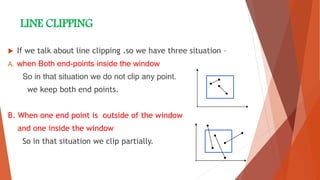
 If we talk about line clipping .so we have three situation –
A. when Both end-points inside the window
So in that situation we do not clip any point.
we keep both end points.
B. When one end point is outside of the window
and one inside the window
So in that situation we clip partially.
C. When both end points are outside the window .
there may be two cases-
1. when both end points outside the window.
so we clip both end points.
2. when both end points outside the window
but the line passes through the window.
so we must solve it’s intersection point.
How we clip the line ?
 There are two method by which we can clip
the line on our computer machine.
1. Brute Force Line Clipping.
2. Cohen-Sutherland line Clipping Algorithm.
Brute Force Line Clipping
Brute force line clipping can be performed as follows:
1. Don’t clip lines with both
end-points within the
window
2. For lines with one end-point
inside the window and one end-point
outside, calculate the intersection
point (using the equation of the line)
and clip from this point out.
Brute Force Line Clipping
3. For lines with both end-points outside the window test
the line for intersection with all of the window
boundaries, and clip appropriately.
Disadvantage:-
 However, calculating line intersections Is
computationally expensive
 Because a scene can contain so many
lines, the brute force approach to clipping is much too
slow
Cohen-Sutherland line Clipping Algorithm
Dr Ivan E. Sutherland co-developed the Cohen-
Sutherland clipping algorithm.
An efficient line clipping algorithm The
key advantage of the algorithm is that it vastly
reduces the number of line intersections that
must be calculated.
Cohen-Sutherland line Clipping Algorithm
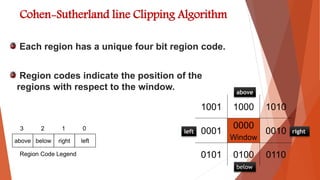
Each region has a unique four bit region code.
Region codes indicate the position of the
regions with respect to the window.
above below right left
3 2 1 0
Region Code Legend
1001 1000 1010
0001
0000
Window
0010
0101 0100 0110
below
Line in the window:-Lines completely contained within the window
boundaries have region code [0000] for both end-points so are not clipped.
 Line out of window:-Any lines with a common
set bit in the region codes of both end-points
can be clipped
when Lines In The Window and out of the window
wymax
wymin
wxmin wxmax
Window
P3 [0001]
P6 [0000]
P5 [0000]
P7 [0001]
P10 [0100]
P9 [0000]
P4 [1000]
P8 [0010]
P12 [0010]
P11 [1010]
P13 [0101] P14 [0110]
wymax
wymin
wxmin wxmax
Window
P3 [0001]
P6 [0000]
P5 [0000]
P7 [0001]
P10 [0100]
P9 [0000]
P4 [1000]
P8 [0010]
P12 [0010]
P11 [1010]
P13 [0101] P14 [0110]
Other Lines
Lines that cannot be identified as completely inside or outside
the window may or may not cross the window interior.
These lines are processed as follows:
 Compare an end-point outside the window to a boundary
(choose any order in which to consider boundaries e.g. left,
right, bottom, top) and determine how much can be
discarded.
 If the remainder of the line is entirely inside or outside the
window, retain it or clip it respectively.
 Otherwise, compare the remainder of the line against
the other window boundaries
 Continue until the line is either discarded or a segment
inside the window is found
We can use the region codes to determine which window
boundaries should be considered for intersection
 To check if a line crosses a particular boundary we
compare the appropriate bits in the region codes of its
end-points
 If one of these is a 1 and the other is a 0 then the line
crosses the boundary
Some examples
Consider the line P9 to P10 below
 Start at P10
 From the region codes of the two end-points we
know the line doesn’t cross the left or right
boundary
 Calculate the intersection of the line with
the bottom boundary to generate point P10’
 The line P9 to P10’ is completely inside
the window so is retained
wymax
wymin
wxmin wxmax
Window
P10 [0100]
P9 [0000]
P10’ [0000]
P9 [0000]
Consider the line P3 to P4 below
 Start at P4
 From the region codes of the two end-points we know the line
crosses the left boundary so calculate the intersection point
to generate P4’
 The line P3 to P4’ is completely outside the window so is clipped
wymax
wymin
wxmin wxmax
Window
P4’ [1001]
P3 [0001]
P4 [1000]
P3 [0001]
Consider the line P7 to P8 below
 Start at P7
 From the two region codes of the two end-points we know
the line crosses the left boundary so
calculate the intersection point to
generate P7’
wymax
wymin
wxmin wxmax
Window
P7’ [0000]
P7 [0001] P8 [0010]
P8’ [0000]
After all working we get this window
wymax
wymin
wxmin wxmax
Window
Calculating Line Intersections
Intersection points with the window boundaries are
calculated using the line-equation parameters
 Consider a line with the end-points (x1, y1) and (x2, y2)
 The y-coordinate of an intersection with a vertical window
boundary can be calculated using:
y = y1 + m (xboundary - x1)
where xboundary can be set to either wxmin or wxmax
Calculating Line Intersections (cont…)
 The x-coordinate of an intersection with a horizontal window
boundary can be calculated using:
x = x1 + (yboundary - y1) / m
where yboundary can be set to either wymin or wymax
 m is the slope of the line in question and can be calculated as
m = (y2 - y1) / (x2 - x1)
Compare b/w
Brute force & Cohen-sutherland
Brute force
1. It is slow process method.
2. It is very time consuming
algorithm because if we want to
clip a line so we can calculate all
the condition to check where the
line clip the window and this
process take much time.
3. It is very simple method to clip
the line.
Cohen-Sutherland
1. It is fast process .
2. In this algorithm with the help of
region-code we simply identify that
where is the line clip the window ,
so It takes less time.
3. It is very complicated method .
Program

line clipping

  • 1.
    Presenting to:- Prof. SatishBansal Presented by:- Susant Yadav Saurabh Soni B.C.A. 3rd (B)
  • 2.
    CONTENT  what isclipping ?  What is it’s type ?  What is line clipping ?  Method to clip the line .  How and what technique we use for clipping with example?  Difference b/w brute-force and cohen-sutharland algorithm.
  • 3.
    CLIPPING  A clippingis the method by which we can select the image using a rectangular window and which part we have select by the window it’s call clipping. wymax wymin wxmin wxmax wymax wymin wxmin wxmax
  • 4.
    TYPES OF CLIPPING…!! Thereare 3 types of clipping :- 1. Point clipping 2. Line clipping 3. Area clipping 4. Text clipping
  • 5.
    LINE CLIPPING  Ifwe talk about line clipping .so we have three situation – A. when Both end-points inside the window So in that situation we do not clip any point. we keep both end points. B. When one end point is outside of the window and one inside the window So in that situation we clip partially.
  • 6.
    C. When bothend points are outside the window . there may be two cases- 1. when both end points outside the window. so we clip both end points. 2. when both end points outside the window but the line passes through the window. so we must solve it’s intersection point.
  • 7.
    How we clipthe line ?  There are two method by which we can clip the line on our computer machine. 1. Brute Force Line Clipping. 2. Cohen-Sutherland line Clipping Algorithm.
  • 8.
    Brute Force LineClipping Brute force line clipping can be performed as follows: 1. Don’t clip lines with both end-points within the window 2. For lines with one end-point inside the window and one end-point outside, calculate the intersection point (using the equation of the line) and clip from this point out.
  • 9.
    Brute Force LineClipping 3. For lines with both end-points outside the window test the line for intersection with all of the window boundaries, and clip appropriately. Disadvantage:-  However, calculating line intersections Is computationally expensive  Because a scene can contain so many lines, the brute force approach to clipping is much too slow
  • 10.
    Cohen-Sutherland line ClippingAlgorithm Dr Ivan E. Sutherland co-developed the Cohen- Sutherland clipping algorithm. An efficient line clipping algorithm The key advantage of the algorithm is that it vastly reduces the number of line intersections that must be calculated.
  • 11.
    Cohen-Sutherland line ClippingAlgorithm Each region has a unique four bit region code. Region codes indicate the position of the regions with respect to the window. above below right left 3 2 1 0 Region Code Legend 1001 1000 1010 0001 0000 Window 0010 0101 0100 0110 below
  • 12.
    Line in thewindow:-Lines completely contained within the window boundaries have region code [0000] for both end-points so are not clipped.  Line out of window:-Any lines with a common set bit in the region codes of both end-points can be clipped when Lines In The Window and out of the window wymax wymin wxmin wxmax Window P3 [0001] P6 [0000] P5 [0000] P7 [0001] P10 [0100] P9 [0000] P4 [1000] P8 [0010] P12 [0010] P11 [1010] P13 [0101] P14 [0110] wymax wymin wxmin wxmax Window P3 [0001] P6 [0000] P5 [0000] P7 [0001] P10 [0100] P9 [0000] P4 [1000] P8 [0010] P12 [0010] P11 [1010] P13 [0101] P14 [0110]
  • 13.
    Other Lines Lines thatcannot be identified as completely inside or outside the window may or may not cross the window interior. These lines are processed as follows:  Compare an end-point outside the window to a boundary (choose any order in which to consider boundaries e.g. left, right, bottom, top) and determine how much can be discarded.  If the remainder of the line is entirely inside or outside the window, retain it or clip it respectively.
  • 14.
     Otherwise, comparethe remainder of the line against the other window boundaries  Continue until the line is either discarded or a segment inside the window is found We can use the region codes to determine which window boundaries should be considered for intersection  To check if a line crosses a particular boundary we compare the appropriate bits in the region codes of its end-points  If one of these is a 1 and the other is a 0 then the line crosses the boundary
  • 15.
    Some examples Consider theline P9 to P10 below  Start at P10  From the region codes of the two end-points we know the line doesn’t cross the left or right boundary  Calculate the intersection of the line with the bottom boundary to generate point P10’  The line P9 to P10’ is completely inside the window so is retained wymax wymin wxmin wxmax Window P10 [0100] P9 [0000] P10’ [0000] P9 [0000]
  • 16.
    Consider the lineP3 to P4 below  Start at P4  From the region codes of the two end-points we know the line crosses the left boundary so calculate the intersection point to generate P4’  The line P3 to P4’ is completely outside the window so is clipped wymax wymin wxmin wxmax Window P4’ [1001] P3 [0001] P4 [1000] P3 [0001]
  • 17.
    Consider the lineP7 to P8 below  Start at P7  From the two region codes of the two end-points we know the line crosses the left boundary so calculate the intersection point to generate P7’ wymax wymin wxmin wxmax Window P7’ [0000] P7 [0001] P8 [0010] P8’ [0000]
  • 18.
    After all workingwe get this window wymax wymin wxmin wxmax Window
  • 19.
    Calculating Line Intersections Intersectionpoints with the window boundaries are calculated using the line-equation parameters  Consider a line with the end-points (x1, y1) and (x2, y2)  The y-coordinate of an intersection with a vertical window boundary can be calculated using: y = y1 + m (xboundary - x1) where xboundary can be set to either wxmin or wxmax
  • 20.
    Calculating Line Intersections(cont…)  The x-coordinate of an intersection with a horizontal window boundary can be calculated using: x = x1 + (yboundary - y1) / m where yboundary can be set to either wymin or wymax  m is the slope of the line in question and can be calculated as m = (y2 - y1) / (x2 - x1)
  • 21.
    Compare b/w Brute force& Cohen-sutherland Brute force 1. It is slow process method. 2. It is very time consuming algorithm because if we want to clip a line so we can calculate all the condition to check where the line clip the window and this process take much time. 3. It is very simple method to clip the line. Cohen-Sutherland 1. It is fast process . 2. In this algorithm with the help of region-code we simply identify that where is the line clip the window , so It takes less time. 3. It is very complicated method .
  • 22.