Multiprocessors and Thread-Level Parallelism  Introduction “ The blueprints for our UltraSPARC T2, the core design files and test suites, will be available to the open source community, via its most popular license: the GPL.” Sun President Jonathan Schwartz (2007)‏
Multiprocessing Reliance Factors A growing interest in servers and server performance A growth in data-intensive applications The insight that increasing performance on the desktop is less important (outside of graphics, at least)‏ An improved understanding of how to use multiprocessors effectively, especially in server environments where there is significant natural thread-level parallelism The advantages of leveraging a design investment by replication rather than unique design — all multiprocessor designs provide such leverage
Taxonomy of Parallel Architectures Four Categories ( Flynn[1966] ): SISD:  Single Instruction Stream, Single Data Stream SIMD:  Single Instruction Stream, Multiple Data Stream MISD:  Multiple Instruction Stream, Single Data Stream MIMD:  Multiple Instruction Stream, Multiple Data Stream
Why Multiple Instruction, Multiple Data MIMDs offer flexibility. MIMDs can function as single-user multiprocessors, as multiprocessors running many tasks simultaneously, or as some combination of these functions. MIMDs can build on the cost-performance advantages of off-the-shelf processors. Multicore chips leverage the design investment in a single processor core by replicating it.
Centralized Shared-memory Multiprocessor
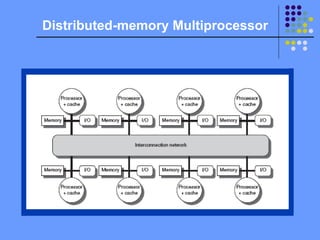
Distributed-memory Multiprocessor
Communication and Memory Architecture Distributed Shared-Memory (DSM)‏ Message-Passing Multiprocessors
Challenges of Parallel Processing Limited parallelism available in programs Large latency of remote access in a parallel processor
Thank you! Author: Prof. Sergio Takeo, Marcelo Arbore. Bibliography: Patterson, D. A.; Hennessy, J. L. Computer Architecture: A Quantitative Approach, 4 th  Ed. Morgan Kaufmann Publishers. “ The blueprints for our UltraSPARC T2, the core design files and test suites, will be available to the open source community, via its most popular license: the GPL.” Sun President Jonathan Schwartz (2007)‏

Computer Architecture: A quantitative approach - Cap4 - Section 1

  • 1.
    Multiprocessors and Thread-LevelParallelism Introduction “ The blueprints for our UltraSPARC T2, the core design files and test suites, will be available to the open source community, via its most popular license: the GPL.” Sun President Jonathan Schwartz (2007)‏
  • 2.
    Multiprocessing Reliance FactorsA growing interest in servers and server performance A growth in data-intensive applications The insight that increasing performance on the desktop is less important (outside of graphics, at least)‏ An improved understanding of how to use multiprocessors effectively, especially in server environments where there is significant natural thread-level parallelism The advantages of leveraging a design investment by replication rather than unique design — all multiprocessor designs provide such leverage
  • 3.
    Taxonomy of ParallelArchitectures Four Categories ( Flynn[1966] ): SISD: Single Instruction Stream, Single Data Stream SIMD: Single Instruction Stream, Multiple Data Stream MISD: Multiple Instruction Stream, Single Data Stream MIMD: Multiple Instruction Stream, Multiple Data Stream
  • 4.
    Why Multiple Instruction,Multiple Data MIMDs offer flexibility. MIMDs can function as single-user multiprocessors, as multiprocessors running many tasks simultaneously, or as some combination of these functions. MIMDs can build on the cost-performance advantages of off-the-shelf processors. Multicore chips leverage the design investment in a single processor core by replicating it.
  • 5.
  • 6.
  • 7.
    Communication and MemoryArchitecture Distributed Shared-Memory (DSM)‏ Message-Passing Multiprocessors
  • 8.
    Challenges of ParallelProcessing Limited parallelism available in programs Large latency of remote access in a parallel processor
  • 9.
    Thank you! Author:Prof. Sergio Takeo, Marcelo Arbore. Bibliography: Patterson, D. A.; Hennessy, J. L. Computer Architecture: A Quantitative Approach, 4 th Ed. Morgan Kaufmann Publishers. “ The blueprints for our UltraSPARC T2, the core design files and test suites, will be available to the open source community, via its most popular license: the GPL.” Sun President Jonathan Schwartz (2007)‏