Tutorial on Parallel Computing and Message Passing Model Marcirio Silveira Chaves [email_address]
Course Structure Part I Parallel Computing Overview Concepts and Terminology Parallel Computer Memory Architecture Parallel Programming Models Design Parallel Programs June - 2009 LNEC-DHA-NTI
Course Structure Part II MPI – Message Passing Interface Getting Started with MPI  MPI Program Structure  Point-to-Point Communication Communicating Non-contiguous Data or Mixed Datatypes Collective Communications Virtual Topologies Communicators Parallel I/O – MPI-2 Parallel Mathematical Libraries Parallel Algorithms Underlying MPI Implementations One-Sided Communications  Practical Section June - 2009 LNEC-DHA-NTI
Objectives Today Most of you have general notions about parallel computing On the end of this tutorial The main  parallel terminology  and  concepts  will be familiar to you. You will be able  to identify problems which need to be parallelized  to understand simple parallel code using the MPI standard June - 2009 LNEC-DHA-NTI
Bibliography Main Introduction to Parallel Computing Blaise Barney, Lawrence Livermore National Laboratory  https://computing.llnl.gov/tutorials/ parallel_comp   Introduction to MPI  Illinois University http://ci-tutor.ncsa.uiuc.edu   Message Passing Interface (MPI) Blaise Barney, Lawrence Livermore National Laboratory https://computing.llnl.gov/tutorials/mpi   Additional http://delicious.com/mchaves/pcc June - 2009 LNEC-DHA-NTI
Overview Parallel Computing
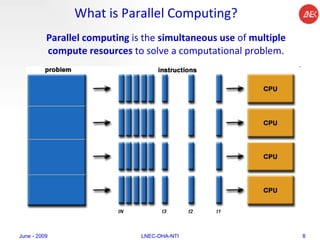
What is Parallel Computing? Parallel computing  is the  simultaneous use  of  multiple compute resources  to solve a computational problem. To be run using multiple CPUs  A problem is broken into  discrete parts  that can be  solved concurrently  Each part is further broken down to a series of instructions  Instructions from each part  execute simultaneously on different CPUs  June - 2009 LNEC-DHA-NTI
What is Parallel Computing? Parallel computing  is the  simultaneous use  of  multiple compute resources  to solve a computational problem. June - 2009 LNEC-DHA-NTI
What is Parallel Computing? The compute resources can include A single computer with multiple processors An arbitrary number of computers connected by a network A combination of both The computational problem usually demonstrates characteristics such as the ability to be Broken apart into discrete pieces of work that can be solved simultaneously Execute multiple program instructions at any moment in time Solved in less time with multiple compute resources than with a single compute resource June - 2009 LNEC-DHA-NTI
Why Use Parallel Computing? Save time and/or money Solve larger problems Provide concurrency Use of non-local resources Limits to serial computing June - 2009 LNEC-DHA-NTI
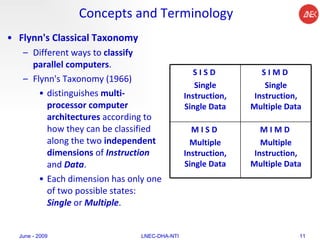
Concepts and Terminology Flynn's Classical Taxonomy Different ways to  classify parallel computers .  Flynn's Taxonomy (1966)  distinguishes  multi-processor computer architectures  according to how they can be classified along the two  independent   dimensions  of  Instruction  and  Data .  Each dimension has only one of two possible states:  Single  or  Multiple .  June - 2009 LNEC-DHA-NTI S I S D  Single Instruction, Single Data S I M D  Single Instruction, Multiple Data M I S D  Multiple Instruction, Single Data M I M D  Multiple Instruction, Multiple Data
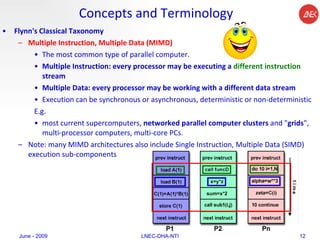
Concepts and Terminology Flynn's Classical Taxonomy Multiple Instruction, Multiple Data (MIMD) The most common type of parallel computer.  Multiple Instruction: every processor may be executing a  different instruction  stream  Multiple Data: every processor may be working with a different data stream  Execution can be synchronous or asynchronous, deterministic or non-deterministic  E.g. most current supercomputers,  networked parallel computer clusters  and " grids ", multi-processor computers, multi-core PCs.  Note: many MIMD architectures also include Single Instruction, Multiple Data (SIMD) execution sub-components  June - 2009 LNEC-DHA-NTI
Concepts and Terminology More commonly used terms: Task:  A logically discrete section of computational work.  A task is typically a program or program-like set of instructions that is executed by a processor.  Parallel Task:  A task that can be executed by multiple processors safely (yields correct results).  Serial Execution:  Execution of a program sequentially, one statement at a time.  In the simplest sense, this is what happens on a one processor machine.  However, virtually all parallel tasks will have sections of a parallel program that must be executed serially.  June - 2009 LNEC-DHA-NTI
Concepts and Terminology More commonly used terms: Parallel Execution:  Execution of a program by more than one task, with each task being able to execute the same or different statement at the same moment in time.  Pipelining:  Breaking a task into steps performed by different processor units, with inputs streaming through, much like an assembly line; a type of parallel computing.  June - 2009 LNEC-DHA-NTI
Concepts and Terminology More commonly used terms: Shared Memory:  From a  hardware  point of view: describes a computer architecture where  all processors have direct (usually bus based) access to common physical memory .  In a  programming  sense: it describes a model where  parallel tasks all  have the  same "picture"  of memory and can  directly address and access  the  same logical memory locations  regardless of where the physical memory actually exists.  Symmetric Multi-Processor (SMP):  Hardware architecture where  multiple processors share a single address space and access to all resources ; shared memory computing.  June - 2009 LNEC-DHA-NTI
Concepts and Terminology More commonly used terms: Distributed Memory:  In  hardware : refers to network based memory access for physical memory that is not common.  As a  programming  model: tasks can only logically "see" local machine memory and must use communications to access memory on other machines where other tasks are executing.  Communications:  Parallel tasks typically need to exchange data.  E.g.: through a shared memory bus or over a network. - However the actual event of data exchange is commonly referred to as  communications  regardless of the method employed.   June - 2009 LNEC-DHA-NTI
Concepts and Terminology More commonly used terms: Synchronization:  The coordination of parallel tasks in real time, very often associated with communications.  - Synchronization:  waiting by at least one task , and can therefore cause a  parallel application's wall clock execution time to increase .  Granularity  is a qualitative measure of the ratio of computation to communication.  Coarse:  relatively  large amounts of computational work  are done between communication events  Fine:  relatively  small amounts of computational work  are done between communication events  June - 2009 LNEC-DHA-NTI
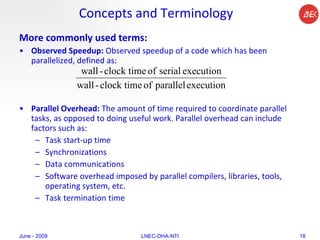
Concepts and Terminology More commonly used terms: Observed Speedup:  Observed speedup of a code which has been parallelized, defined as:  Parallel Overhead:  The amount of time required to coordinate parallel tasks, as opposed to doing useful work. Parallel overhead can include factors such as:  Task start-up time  Synchronizations  Data communications  Software overhead imposed by parallel compilers, libraries, tools, operating system, etc.  Task termination time  June - 2009 LNEC-DHA-NTI
Concepts and Terminology More commonly used terms: Massively Parallel:  Refers to the hardware that comprises a given parallel system - having  many processors .  The meaning of "many" keeps increasing, but currently, the largest parallel computers can be comprised of processors numbering in the  hundreds of thousands .  Embarrassingly Parallel:  Solving  many similar , but  independent tasks  simultaneously; little to no need for coordination  between the tasks.   E.g.  tasks such as 3D projection, where each pixel on the screen may be rendered independently.  June - 2009 LNEC-DHA-NTI
Concepts and Terminology More commonly used terms: Scalability   Refers to a parallel system's (hardware and/or software) ability to demonstrate a proportionate increase in parallel speedup with the addition of more processors.  Factors that contribute to scalability include:  Hardware - particularly memory-CPU bandwidths and network communications  Application algorithm  Parallel overhead related  Characteristics of your specific application and coding  June - 2009 LNEC-DHA-NTI
Concepts and Terminology More commonly used terms: Multi-core Processors   Multiple processors (cores) on a single chip.  Cluster Computing   Use of a combination of commodity units (processors, networks or SMPs) to build a parallel system.  Supercomputing / High Performance Computing   Use of the world's fastest, largest machines to solve large problems.   June - 2009 LNEC-DHA-NTI
Any questions, so far?
Parallel Computer Memory Architectures  Shared Memory  Distributed Memory  Hybrid Distributed-Shared Memory
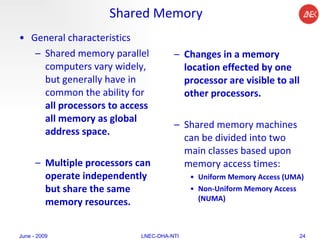
Shared Memory General characteristics Shared memory parallel computers vary widely, but generally have in common the ability for  all processors to access all memory as global address space.  Multiple processors can operate independently but share the same memory resources.  Changes in a memory location effected by one processor are visible to all other processors.  Shared memory machines can be divided into two main classes based upon memory access times:  Uniform Memory Access (UMA) Non-Uniform Memory Access (NUMA)   June - 2009 LNEC-DHA-NTI
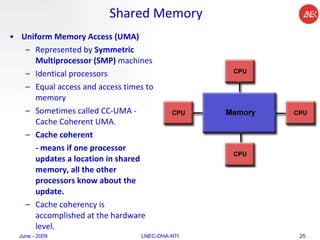
Shared Memory Uniform Memory Access (UMA)  Represented by  Symmetric Multiprocessor (SMP)  machines  Identical processors  Equal access and access times to memory  Sometimes called CC-UMA - Cache Coherent UMA.  Cache coherent  - means if one processor updates a location in shared memory, all the other processors know about the update.  Cache coherency is accomplished at the hardware level.  June - 2009 LNEC-DHA-NTI
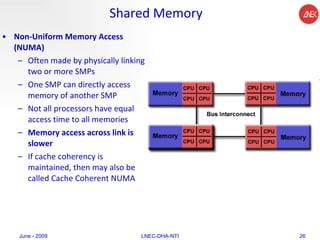
Shared Memory Non-Uniform Memory Access (NUMA)   Often made by physically linking two or more SMPs  One SMP can directly access memory of another SMP  Not all processors have equal access time to all memories  Memory access across link is slower  If cache coherency is maintained, then may also be called Cache Coherent NUMA  June - 2009 LNEC-DHA-NTI
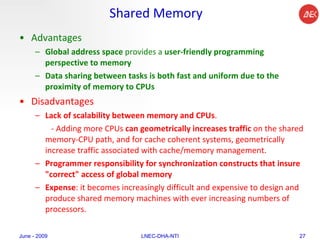
Shared Memory Advantages Global address space  provides a  user-friendly programming perspective to memory   Data sharing between tasks is both fast and uniform due to the proximity of memory to CPUs  Disadvantages Lack of scalability between memory and CPUs .  - Adding more CPUs  can geometrically increases traffic  on the shared memory-CPU path, and for cache coherent systems, geometrically increase traffic associated with cache/memory management. Programmer responsibility for synchronization constructs that insure "correct" access of global memory Expense : it becomes increasingly difficult and expensive to design and produce shared memory machines with ever increasing numbers of processors.  June - 2009 LNEC-DHA-NTI
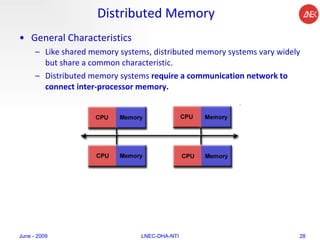
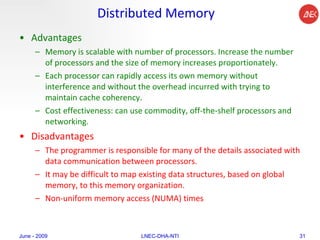
Distributed Memory General Characteristics Like shared memory systems, distributed memory systems vary widely but share a common characteristic.  Distributed memory systems  require a communication network to connect inter-processor memory.  June - 2009 LNEC-DHA-NTI
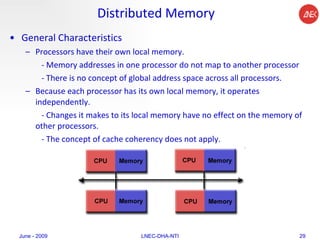
Distributed Memory General Characteristics Processors have their own local memory.  - Memory addresses in one processor do not map to another processor - There is no concept of global address space across all processors.  Because each processor has its own local memory, it operates independently.  - Changes it makes to its local memory have no effect on the memory of other processors.  - The concept of cache coherency does not apply.  June - 2009 LNEC-DHA-NTI
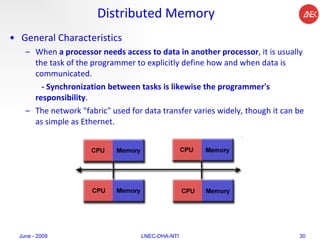
Distributed Memory General Characteristics When  a   processor needs access to data in another processor , it is usually the task of the programmer to explicitly define how and when data is communicated. - Synchronization between tasks is likewise the programmer's responsibility .  The network "fabric" used for data transfer varies widely, though it can be as simple as Ethernet.  June - 2009 LNEC-DHA-NTI
Distributed Memory Advantages Memory is scalable with number of processors. Increase the number of processors and the size of memory increases proportionately.  Each processor can rapidly access its own memory without interference and without the overhead incurred with trying to maintain cache coherency.  Cost effectiveness: can use commodity, off-the-shelf processors and networking.  Disadvantages The programmer is responsible for many of the details associated with data communication between processors.  It may be difficult to map existing data structures, based on global memory, to this memory organization.  Non-uniform memory access (NUMA) times  June - 2009 LNEC-DHA-NTI
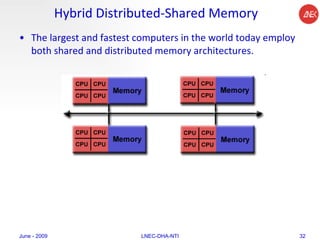
Hybrid Distributed-Shared Memory The largest and fastest computers in the world today employ both shared and distributed memory architectures. June - 2009 LNEC-DHA-NTI
Hybrid Distributed-Shared Memory Two components the shared memory : a cache coherent Symmetric Multi-Processor   (SMP) machine.  Processors on a given SMP can address that machine's memory as global.  the distributed memory : is the networking of multiple SMPs.  SMPs know only about their own memory - not the memory on another SMP.  Therefore,  network communications are required to move data from one SMP to another.   Current trends: Hybrid Distributed-Shared Memory architecture will continue to prevail and increase at the high end of computing for the foreseeable future.  Advantages and Disadvantages: whatever is common to both shared and distributed memory architectures.  June - 2009 LNEC-DHA-NTI
Any questions, so far?
Parallel Programming Models
Overview Several parallel programming models in common use:  Shared Memory  Threads  Message Passing  Data Parallel  Others: Hybrid, Single Program Multiple Data (SPMD), Multiple Program Multiple Data (MPMD).  Parallel programming  models  exist as an  abstraction  above hardware and memory architectures.  June - 2009 LNEC-DHA-NTI
Overview These models are NOT specific to a particular type of machine or memory architecture . In fact, any of these models can (theoretically) be implemented on any underlying hardware.  Examples:  Shared memory model on a distributed memory machine:  Kendall Square Research (KSR) ALLCACHE approach .  Message passing model on a shared memory machine :  MPI on SGI Origin .  Which model to use is often a combination of what is available and personal choice.  There is no "best" model , although there certainly are better implementations of some models over others.  June - 2009 LNEC-DHA-NTI
Shared Memory Model Tasks share a common address space, which they read and write asynchronously.  Various mechanisms such as locks/semaphores may be used to control access to the shared memory.  Advantage from the programmer's point of view is that the notion of data "ownership" is lacking, so  there is no need to specify explicitly the communication of data between tasks . Program development can often be simplified.  Disadvantage  in terms of performance it becomes more difficult to understand and manage data locality.  Keeping data local to the processor that works on it conserves memory accesses, cache refreshes and bus traffic that occurs when multiple processors use the same data.  Unfortunately, controlling data locality is hard to understand and beyond the control of the average user.  June - 2009 LNEC-DHA-NTI
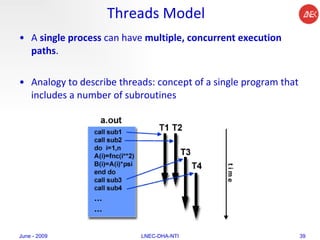
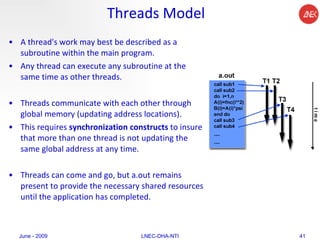
Threads Model A  single process  can have  multiple, concurrent execution paths . Analogy to describe threads: concept of a single program that includes a number of subroutines  June - 2009 LNEC-DHA-NTI
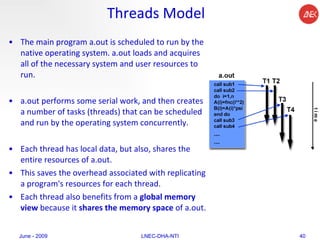
Threads Model The main program a.out is scheduled to run by the native operating system. a.out loads and acquires all of the necessary system and user resources to run. a.out performs some serial work, and then creates a number of tasks (threads) that can be scheduled and run by the operating system concurrently. Each thread has local data, but also, shares the entire resources of a.out.  This saves the overhead associated with replicating a program's resources for each thread.  Each thread also benefits from a  global memory view  because it  shares the memory space  of a.out.  June - 2009 LNEC-DHA-NTI
Threads Model A thread's work may best be described as a subroutine within the main program.  Any thread can execute any subroutine at the same time as other threads. Threads communicate with each other through global memory (updating address locations).  This requires  synchronization constructs  to insure that more than one thread is not updating the same global address at any time. Threads can come and go, but a.out remains present to provide the necessary shared resources until the application has completed.  June - 2009 LNEC-DHA-NTI
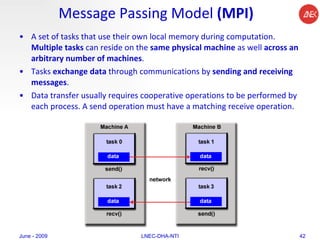
Message Passing Model  (MPI) A set of tasks that use their own local memory during computation.  Multiple tasks  can reside on the  same physical machine  as well  across an arbitrary number of machines . Tasks  exchange data  through communications by  sending and receiving messages . Data transfer usually requires cooperative operations to be performed by each process. A send operation must have a matching receive operation.  June - 2009 LNEC-DHA-NTI
Message Passing Model Implementations: From a programming perspective, message passing implementations comprise a  library of subroutines  that are  imbedded in source code . Programmer: responsible for determining all parallelism. A  variety  of message passing libraries have been available since the 1980s.  Differed substantially from each other making it  difficult   for programmers to develop portable applications. In 1992, the MPI Forum was formed with the primary goal of  establishing a standard  interface for message passing implementations. June - 2009 LNEC-DHA-NTI
Message Passing Model Implementations: Part 1 of the MPI was released in 1994.  Part 2 (MPI-2) was released in 1996.  - Both MPI specifications at  http://www-unix.mcs.anl.gov/mpi/ MPI is now the industry  standard for message passing , replacing virtually all other message passing implementations used for production work.  - Most, if not all of the popular parallel computing platforms offer at least one implementation of MPI.  - A few offer a full implementation of MPI-2. For shared memory architectures, MPI implementations usually don't use a network for task communications.  - Instead, they use  shared memory (memory copies) for performance reasons . June - 2009 LNEC-DHA-NTI
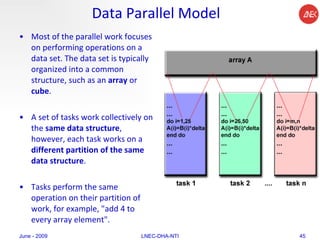
Data Parallel Model Most of the parallel work focuses on performing operations on a data set. The data set is typically organized into a common structure, such as an  array  or  cube . A set of tasks work collectively on the  same data structure , however, each task works on a  different partition of the same data structure . Tasks perform the same operation on their partition of work, for example, "add 4 to every array element".  June - 2009 LNEC-DHA-NTI
Any questions, so far? Pit-stop ?
Designing Parallel Programs
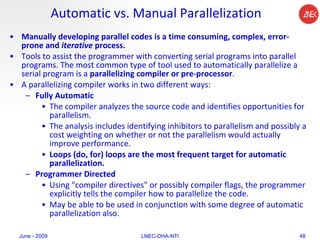
Automatic vs. Manual Parallelization Manually developing parallel codes is a time consuming, complex, error-prone and  iterative  process.  Tools to assist the programmer with converting serial programs into parallel programs. The most common type of tool used to automatically parallelize a serial program is a  parallelizing compiler or pre-processor .  A parallelizing compiler works in two different ways:  Fully Automatic  The compiler analyzes the source code and identifies opportunities for parallelism.  The analysis includes identifying inhibitors to parallelism and possibly a cost weighting on whether or not the parallelism would actually improve performance.  Loops (do, for) loops are the most frequent target for automatic parallelization.  Programmer Directed   Using "compiler directives" or possibly compiler flags, the programmer explicitly tells the compiler how to parallelize the code.  May be able to be used in conjunction with some degree of automatic parallelization also.  June - 2009 LNEC-DHA-NTI
Automatic vs. Manual Parallelization Caveats that apply to automatic parallelization:  Wrong results may be produced  Performance may actually degrade  Much less flexible than manual parallelization  Limited to a subset (mostly loops) of code  May actually not parallelize code if the analysis suggests there are inhibitors or the code is too complex  June - 2009 LNEC-DHA-NTI
Understand the Problem and the Program Understand the problem that you wish to solve in parallel. If you are starting with a serial program, this necessitates understanding the existing code also.  Determine whether or not the problem is one that can actually be parallelized.  Example of Parallelizable Problem:  Calculate the potential energy for each of several thousand  independent conformations of a molecule .  - When done, find the minimum energy conformation.  This problem is able to be solved in parallel.  Each of the molecular conformations is  independently  determinable. The calculation of the minimum energy conformation is also a parallelizable problem.  June - 2009 LNEC-DHA-NTI
Understand the Problem and the Program Example of a Non-parallelizable Problem Calculation of the Fibonacci series (1,1,2,3,5,8,13,21,...) by use of the formula: F(k + 2) = F(k + 1) + F(k)  calculation of the Fibonacci sequence as shown would entail  dependent  calculations rather than independent ones.  The calculation of the k + 2 value uses those of both k + 1 and k .  These three terms cannot be calculated independently and therefore, not in parallel.  June - 2009 LNEC-DHA-NTI
Understand the Problem and the Program Identify the program's  hotspots Know  where most of the real work  is being done.  Focus on parallelizing the hotspots  and  ignore  those  sections  of the program that account for  little CPU usage .  Identify  bottlenecks  in the program  Are there areas that are disproportionately slow, or cause parallelizable work to halt or be deferred?  E.g.: I/O is usually something that slows a program down.  May be possible to restructure the program or use a different algorithm to reduce or eliminate unnecessary slow areas  June - 2009 LNEC-DHA-NTI
Understand the Problem and the Program Identify inhibitors to parallelism.  One common class of inhibitor is  data dependence , as demonstrated by the Fibonacci sequence above.  Investigate other algorithms if possible.  This may be the single most important consideration when designing a parallel application.  June - 2009 LNEC-DHA-NTI
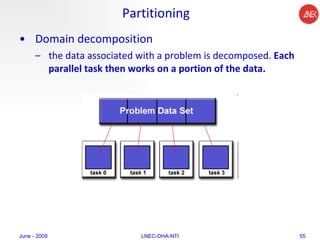
Partitioning One of the first steps in designing a parallel program is to break the problem into  discrete "chunks"  of work that can be  distributed to multiple tasks .  This is known as  decomposition  or  partitioning .  Two ways to partition computational work among parallel tasks:  domain decomposition functional decomposition.  June - 2009 LNEC-DHA-NTI
Partitioning Domain decomposition the data associated with a problem is decomposed.  Each parallel task then works on a portion of the data.  June - 2009 LNEC-DHA-NTI
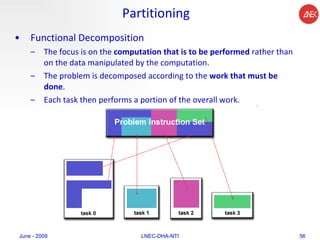
Partitioning Functional Decomposition The focus is on the  computation that is to be performed  rather than on the data manipulated by the computation.  The problem is decomposed according to the  work that must be done .  Each task then performs a portion of the overall work.  June - 2009 LNEC-DHA-NTI
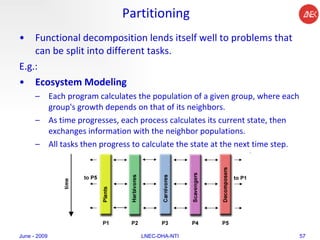
Partitioning Functional decomposition lends itself well to problems that can be split into different tasks.  E.g.:  Ecosystem Modeling   Each program calculates the population of a given group, where each group's growth depends on that of its neighbors.  As time progresses, each process calculates its current state, then exchanges information with the neighbor populations.  All tasks then progress to calculate the state at the next time step.  June - 2009 LNEC-DHA-NTI
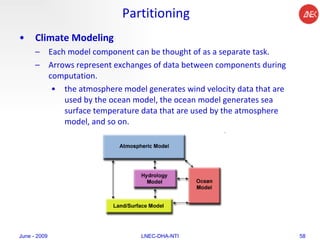
Partitioning Climate Modeling   Each model component can be thought of as a separate task.  Arrows represent exchanges of data between components during computation. the atmosphere model generates wind velocity data that are used by the ocean model, the ocean model generates sea surface temperature data that are used by the atmosphere model, and so on.  June - 2009 LNEC-DHA-NTI
Communications The need for communications between tasks depends upon your problem:  You DON'T need communications   Some types of problems can be decomposed and executed in parallel with virtually no need for tasks to share data.  E.g.: An image processing operation where every pixel in a black and white image needs to have its color reversed.  The image data can be distributed to multiple tasks that act independently to do their portion of the work.  These types of problems are often called  embarrassingly parallel  because they are so straight-forward. Very little inter-task communication is required.  You DO need communications   Most parallel applications are not quite so simple, and do require tasks to share data with each other.  E.g.: A 3-D heat diffusion problem requires a task to know the temperatures calculated by the tasks that have neighboring data.  Changes to neighboring data has a direct effect on that task's data.  June - 2009 LNEC-DHA-NTI
Communications Factors to consider when designing your program's inter-task communications:  Cost of communications   Inter-task communication virtually always implies overhead.  Machine cycles and resources that could be used for computation are instead used to package and transmit data.  Communications frequently require some type of synchronization between tasks, which can result in tasks spending time "waiting" instead of doing work.  Competing communication traffic can saturate the available network bandwidth, further aggravating performance problems.  June - 2009 LNEC-DHA-NTI
Communications Factors to consider when designing your program's inter-task communications:  Latency vs. Bandwidth   latency  is the time it takes to send a minimal (0 byte) message from point A to point B. Commonly expressed as microseconds.  bandwidth  is the amount of data that can be communicated per unit of time. Commonly expressed as megabytes/sec or gigabytes/sec.  Sending many small messages can cause latency to dominate communication overheads. Often it is more efficient to package small messages into a larger message, thus increasing the effective communications bandwidth.  June - 2009 LNEC-DHA-NTI
Communications Factors to consider when designing your program's inter-task communications:  Visibility of communications   With the Message Passing Model, communications are explicit and generally quite visible and under the control of the programmer.  With the Data Parallel Model, communications often occur transparently to the programmer, particularly on distributed memory architectures. The programmer may not even be able to know exactly how inter-task communications are being accomplished.  June - 2009 LNEC-DHA-NTI
Communications Factors to consider when designing your program's inter-task communications:  Synchronous vs. asynchronous communications   Synchronous  communications: require some type of "handshaking" between tasks that are sharing data.  This can be explicitly structured in code by the programmer, or it may happen at a lower level unknown to the programmer.  are often referred to as  blocking  communications since other work must wait until the communications have completed.  June - 2009 LNEC-DHA-NTI
Communications Factors to consider when designing your program's inter-task communications:  Synchronous vs. asynchronous communications   Asynchronous  communications  allow tasks to transfer data independently from one another.  E.g.: Task 1 can prepare and send a message to task 2, and then immediately begin doing other work. When task 2 actually receives the data doesn't matter.  are often referred to as  non-blocking   communications since other work can be done while the communications are taking place.  June - 2009 LNEC-DHA-NTI
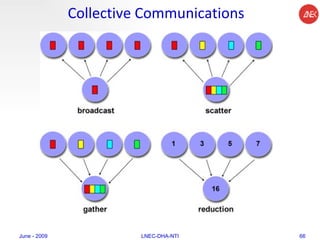
Communications Factors to consider when designing your program's inter-task communications:  Scope of communications   Knowing which tasks must communicate with each other is critical during the design stage of a parallel code. Both of the two scopings described below can be implemented synchronously or asynchronously.  Point-to-point  - involves two tasks with one task acting as the sender/producer of data, and the other acting as the receiver/consumer.  Collective  - involves data sharing between more than two tasks, which are often specified as being members in a common group, or collective. Some common variations (there are more):  June - 2009 LNEC-DHA-NTI
Collective Communications June - 2009 LNEC-DHA-NTI
Communications Factors to consider when designing your program's inter-task communications:  Efficiency of communications   What type of communication operations should be used?  As mentioned previously, asynchronous communication operations can improve overall program performance.  Network media - some platforms may offer more than one network for communications. Which one is best?  June - 2009 LNEC-DHA-NTI Very often, the programmer will have a choice with regard to factors that can affect communications performance. Only a few are mentioned here.  Which implementation for a given model should be used? Using the  Message Passing Model  as an example, one  MPI  implementation  may be faster on a given hardware platform than another.
Any questions,  so far?
   Nano-Self-Test     http://ci-tutor.ncsa.uiuc.edu/content.php?cid=1294
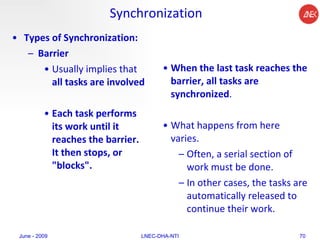
Synchronization Types of Synchronization:   Barrier   Usually implies that  all tasks are involved   Each task performs its work until it reaches the barrier. It then stops, or "blocks".  When the last task reaches the barrier, all tasks are synchronized .  What happens from here varies.  Often, a serial section of work must be done.  In other cases, the tasks are automatically released to continue their work.  June - 2009 LNEC-DHA-NTI
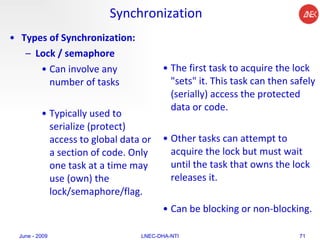
Synchronization Types of Synchronization:   Lock / semaphore   Can involve any number of tasks  Typically used to serialize (protect) access to global data or a section of code. Only one task at a time may use (own) the lock/semaphore/flag.  The first task to acquire the lock "sets" it. This task can then safely (serially) access the protected data or code.  Other tasks can attempt to acquire the lock but must wait until the task that owns the lock releases it.  Can be blocking or non-blocking.  June - 2009 LNEC-DHA-NTI
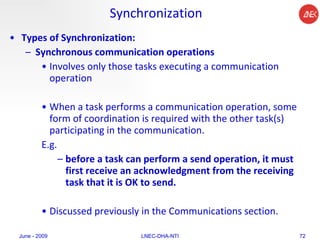
Synchronization Types of Synchronization:   Synchronous communication operations   Involves only those tasks executing a communication operation  When a task performs a communication operation, some form of coordination is required with the other task(s) participating in the communication.  E.g.  before a task can perform a send operation, it must first receive an acknowledgment from the receiving task that it is OK to send.  Discussed previously in the Communications section.  June - 2009 LNEC-DHA-NTI
Data Dependencies A  dependence  exists between program statements when the order of statement execution affects the results of the program.  A  data dependence  results from multiple use of the same location(s) in storage by different tasks.  Dependencies  are important to parallel programming because they are one of the  primary inhibitors to parallelism .  June - 2009 LNEC-DHA-NTI
Data Dependencies How to Handle Data Dependencies:  Distributed memory architectures -  communicate required data at synchronization points .  Shared memory architectures -  synchronize read/write operations between tasks .  June - 2009 LNEC-DHA-NTI
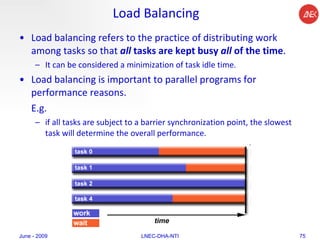
Load Balancing Load balancing refers to the practice of distributing work among tasks so that  all  tasks are kept busy  all  of the time .  It can be considered a minimization of task idle time.  Load balancing is important to parallel programs for performance reasons.  E.g. if all tasks are subject to a barrier synchronization point, the slowest task will determine the overall performance.  June - 2009 LNEC-DHA-NTI
Load Balancing How to Achieve Load Balance:  Equally partition the work each task receives   For array/matrix operations where each task performs similar work, evenly distribute the data set among the tasks.  For loop iterations where the work done in each iteration is similar, evenly distribute the iterations across the tasks.  If a heterogeneous mix of machines with varying performance characteristics are being used, be sure to use some type of performance analysis tool to detect any load imbalances. Adjust work accordingly.  June - 2009 LNEC-DHA-NTI
Load Balancing How to Achieve Load Balance:  Use dynamic work assignment   Certain classes of problems result in load imbalances even if data is evenly distributed among tasks:  Sparse arrays - some tasks will have actual data to work on while others have mostly "zeros".  Adaptive grid methods - some tasks may need to refine their mesh while others don't.  N -body simulations - where some particles may migrate to/from their original task domain to another task's; where the particles owned by some tasks require more work than those owned by other tasks.  June - 2009 LNEC-DHA-NTI
Load Balancing How to Achieve Load Balance:  Use dynamic work assignment   When the amount of work each task will perform is intentionally variable, or is unable to be predicted, it may be helpful to use a  scheduler - task pool  approach.  As each task finishes its work, it queues to get a new piece of work.  It may become necessary to design an algorithm which detects and handles load imbalances as they occur dynamically within the code.  June - 2009 LNEC-DHA-NTI
Execution Time Total  execution time  is always a primary concern in parallel programming because it is an essential component for comparing and improving all programs.  Three components make up execution time:  Computation time  Idle time  Communication time  June - 2009 LNEC-DHA-NTI
Execution Time Computation time  is the time spent performing computations on the data.  Ideally, if you had  N  processors working on a problem, the computation should complete in 1/Nth the time of the serial job.  This would be the case if all the processes' time was spent in computation.  All of a processor's time is not spent doing computations.  June - 2009 LNEC-DHA-NTI
Execution Time Idle time  is the time a process spends  waiting for data from other processors .  During this time, the processors do no useful work.  E.g.: ongoing problem of dealing with input and output (I/O) in parallel programs.  Many message-passing specifications do not address parallel I/O, leaving all the work to one process while all other processes are in an idle state.  June - 2009 LNEC-DHA-NTI
Execution Time The cost of communication in the execution time can be measured in terms of  latency  and  bandwidth .  Latency  is the time it takes to set up the envelope for communication Bandwidth  is the actual speed of transmission, or bits per unit time.  Serial programs do not use interprocess communication.  In a parallel program,  communication time must be minimized to ensure optimal performance improvement .  June - 2009 LNEC-DHA-NTI Communication time  is the time it takes for processes  to send and receive messages.
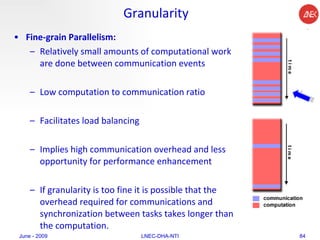
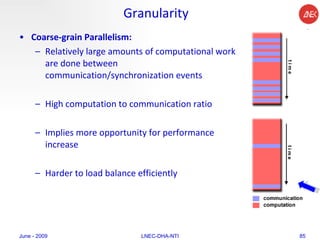
Granularity Computation / Communication Ratio:  In parallel computing, granularity is  a qualitative measure of the ratio of computation to communication.  Periods of computation are typically separated from periods of communication by synchronization events.  June - 2009 LNEC-DHA-NTI
Granularity Fine-grain Parallelism:  Relatively small amounts of computational work are done between communication events  Low computation to communication ratio  Facilitates load balancing  Implies high communication overhead and less opportunity for performance enhancement  If granularity is too fine it is possible that the overhead required for communications and synchronization between tasks takes longer than the computation.  June - 2009 LNEC-DHA-NTI
Granularity Coarse-grain Parallelism:  Relatively large amounts of computational work are done between communication/synchronization events  High computation to communication ratio  Implies more opportunity for performance increase  Harder to load balance efficiently  June - 2009 LNEC-DHA-NTI
Granularity Which is Best?  The most efficient granularity is dependent on the algorithm and the hardware environment in which it runs.  In most cases  the overhead associated with communications and synchronization is high  relative to execution speed so it is  advantageous  to have  coarse granularity .  Fine-grain parallelism can help reduce overheads due to load imbalance.  June - 2009 LNEC-DHA-NTI
I/O The Bad News:  I/O operations are generally regarded as  inhibitors to parallelism  Parallel I/O systems  may be  immature  or  not available  for all platforms  In an environment where all tasks see the same file space, write operations can result in file overwriting  Read operations can be affected by the file server's ability to handle multiple read requests at the same time  I/O that must be conducted over the network (NFS, non-local) can cause severe bottlenecks and even crash file servers.  June - 2009 LNEC-DHA-NTI
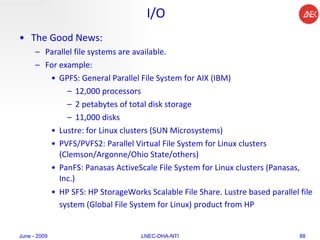
I/O The Good News:  Parallel file systems are available.  For example:  GPFS: General Parallel File System for AIX (IBM) 12,000 processors  2 petabytes of total disk storage 11,000 disks  Lustre: for Linux clusters (SUN Microsystems)  PVFS/PVFS2: Parallel Virtual File System for Linux clusters (Clemson/Argonne/Ohio State/others)  PanFS: Panasas ActiveScale File System for Linux clusters (Panasas, Inc.)  HP SFS: HP StorageWorks Scalable File Share. Lustre based parallel file system (Global File System for Linux) product from HP   June - 2009 LNEC-DHA-NTI
I/O The parallel I/O programming interface specification for MPI has been available since 1996 as part of MPI-2. Vendor and "free" implementations are now commonly available.  Some options:  If you have access to a parallel file system, investigate using it. If you don't, keep reading...  Rule #1: Reduce overall I/O as much as possible  Confine I/O to specific serial portions of the job Use  parallel communications  to  distribute data  to  parallel tasks .  E.g.  Task 1 could read an input file and then communicate required data to other tasks. Likewise, Task 1 could perform write operation after receiving required data from all other tasks.  June - 2009 LNEC-DHA-NTI
I/O Some options:  For distributed memory systems with shared filespace,  perform I/O in local, non-shared filespace.  E.g.: Each processor may have /tmp filespace which can used. This is usually much more efficient than performing I/O over the network to one's home directory.  Create unique filenames for each task's input/output file(s)  June - 2009 LNEC-DHA-NTI
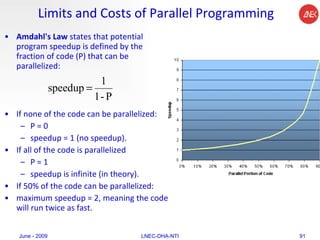
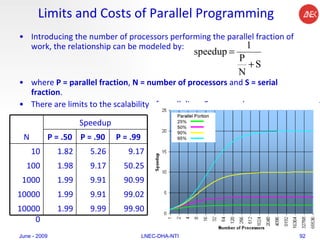
Limits and Costs of Parallel Programming Amdahl's Law  states that potential program speedup is defined by the fraction of code (P) that can be parallelized:  If none of the code can be parallelized: P = 0  speedup = 1 (no speedup).  If all of the code is parallelized P = 1  speedup is infinite (in theory).  If 50% of the code can be parallelized: maximum speedup = 2, meaning the code will run twice as fast.  June - 2009 LNEC-DHA-NTI
Limits and Costs of Parallel Programming Introducing the number of processors performing the parallel fraction of work, the relationship can be modeled by:  where  P = parallel fraction ,  N = number of processors  and  S = serial fraction .  There are limits to the scalability of parallelism. For example:  June - 2009 LNEC-DHA-NTI Speedup N P = .50   P = .90   P = .99 10 1.82 5.26 9.17 100 1.98 9.17 50.25 1000 1.99 9.91 90.99 10000 1.99 9.91 99.02 100000 1.99 9.99 99.90
Limits and Costs of Parallel Programming Complexity In general, parallel applications are much more complex than corresponding serial applications, perhaps  an order of magnitude .  Not only do you have  multiple instruction streams  executing at the same time, but you also have  data flowing between them .  The costs of complexity are measured in programmer time in virtually every aspect of the software development cycle:  Design  Coding  Debugging  Tuning  Maintenance  June - 2009 LNEC-DHA-NTI
Limits and Costs of Parallel Programming Portability Thanks to standardization in several APIs, such as MPI, POSIX threads, HPF and OpenMP, portability issues with parallel programs are not as serious as in years past. However...  All of the usual portability issues associated with serial programs apply to parallel programs. E.g. if you use vendor "enhancements" to Fortran, C or C++, portability will be a problem.  June - 2009 LNEC-DHA-NTI
Limits and Costs of Parallel Programming Portability Even though standards exist for several APIs, implementations will differ in a number of details, sometimes to the point of requiring code modifications in order to effect portability.  Operating systems can play a key role in code portability issues.  Hardware architectures are characteristically highly variable and can affect portability.  June - 2009 LNEC-DHA-NTI
Limits and Costs of Parallel Programming Resource Requirements The primary intent of parallel programming is to  decrease execution wall clock time* , however in order to accomplish this, more CPU time is required.  E.g: a parallel code that runs in 1 hour on 8 processors actually uses 8 hours of CPU time.  *  The elapsed time between when a process starts to run and when it is finished. This is usually longer than the  processor time  consumed by the process because the  CPU is doing other things besides running the process  such as running other user and operating system processes or waiting for disk or network I/O. June - 2009 LNEC-DHA-NTI
Limits and Costs of Parallel Programming Resource Requirements The amount of memory required can be greater for parallel codes than serial codes, due to the need to replicate data and for overheads associated with parallel support libraries and subsystems.  For short running parallel programs, there can actually be a decrease in performance compared to a similar serial implementation.  The overhead costs associated with setting up the parallel environment, task creation, communications and task termination can comprise a significant portion of the total execution time for short runs.  June - 2009 LNEC-DHA-NTI
Limits and Costs of Parallel Programming Scalability:  The ability of a parallel program's performance to scale is a result of a number of interrelated factors.  Simply adding more machines is rarely the answer .  The algorithm may have inherent limits to scalability.  At some point, adding more resources causes performance to decrease.  June - 2009 LNEC-DHA-NTI
Limits and Costs of Parallel Programming Scalability:  Hardware factors play a significant role in scalability.  Examples:  Memory-CPU bus bandwidth on an SMP machine  Communications network bandwidth  Amount of memory available on any given machine or set of machines  Processor clock speed  Parallel support libraries and subsystems software can limit scalability independent of your application.  June - 2009 LNEC-DHA-NTI

Tutorial on Parallel Computing and Message Passing Model - C1

  • 1.
    Tutorial on ParallelComputing and Message Passing Model Marcirio Silveira Chaves [email_address]
  • 2.
    Course Structure PartI Parallel Computing Overview Concepts and Terminology Parallel Computer Memory Architecture Parallel Programming Models Design Parallel Programs June - 2009 LNEC-DHA-NTI
  • 3.
    Course Structure PartII MPI – Message Passing Interface Getting Started with MPI MPI Program Structure Point-to-Point Communication Communicating Non-contiguous Data or Mixed Datatypes Collective Communications Virtual Topologies Communicators Parallel I/O – MPI-2 Parallel Mathematical Libraries Parallel Algorithms Underlying MPI Implementations One-Sided Communications Practical Section June - 2009 LNEC-DHA-NTI
  • 4.
    Objectives Today Mostof you have general notions about parallel computing On the end of this tutorial The main parallel terminology and concepts will be familiar to you. You will be able to identify problems which need to be parallelized to understand simple parallel code using the MPI standard June - 2009 LNEC-DHA-NTI
  • 5.
    Bibliography Main Introductionto Parallel Computing Blaise Barney, Lawrence Livermore National Laboratory https://computing.llnl.gov/tutorials/ parallel_comp Introduction to MPI Illinois University http://ci-tutor.ncsa.uiuc.edu Message Passing Interface (MPI) Blaise Barney, Lawrence Livermore National Laboratory https://computing.llnl.gov/tutorials/mpi Additional http://delicious.com/mchaves/pcc June - 2009 LNEC-DHA-NTI
  • 6.
  • 7.
    What is ParallelComputing? Parallel computing is the simultaneous use of multiple compute resources to solve a computational problem. To be run using multiple CPUs A problem is broken into discrete parts that can be solved concurrently Each part is further broken down to a series of instructions Instructions from each part execute simultaneously on different CPUs June - 2009 LNEC-DHA-NTI
  • 8.
    What is ParallelComputing? Parallel computing is the simultaneous use of multiple compute resources to solve a computational problem. June - 2009 LNEC-DHA-NTI
  • 9.
    What is ParallelComputing? The compute resources can include A single computer with multiple processors An arbitrary number of computers connected by a network A combination of both The computational problem usually demonstrates characteristics such as the ability to be Broken apart into discrete pieces of work that can be solved simultaneously Execute multiple program instructions at any moment in time Solved in less time with multiple compute resources than with a single compute resource June - 2009 LNEC-DHA-NTI
  • 10.
    Why Use ParallelComputing? Save time and/or money Solve larger problems Provide concurrency Use of non-local resources Limits to serial computing June - 2009 LNEC-DHA-NTI
  • 11.
    Concepts and TerminologyFlynn's Classical Taxonomy Different ways to classify parallel computers . Flynn's Taxonomy (1966) distinguishes multi-processor computer architectures according to how they can be classified along the two independent dimensions of Instruction and Data . Each dimension has only one of two possible states: Single or Multiple . June - 2009 LNEC-DHA-NTI S I S D Single Instruction, Single Data S I M D Single Instruction, Multiple Data M I S D Multiple Instruction, Single Data M I M D Multiple Instruction, Multiple Data
  • 12.
    Concepts and TerminologyFlynn's Classical Taxonomy Multiple Instruction, Multiple Data (MIMD) The most common type of parallel computer. Multiple Instruction: every processor may be executing a different instruction stream Multiple Data: every processor may be working with a different data stream Execution can be synchronous or asynchronous, deterministic or non-deterministic E.g. most current supercomputers, networked parallel computer clusters and " grids ", multi-processor computers, multi-core PCs. Note: many MIMD architectures also include Single Instruction, Multiple Data (SIMD) execution sub-components June - 2009 LNEC-DHA-NTI
  • 13.
    Concepts and TerminologyMore commonly used terms: Task: A logically discrete section of computational work. A task is typically a program or program-like set of instructions that is executed by a processor. Parallel Task: A task that can be executed by multiple processors safely (yields correct results). Serial Execution: Execution of a program sequentially, one statement at a time. In the simplest sense, this is what happens on a one processor machine. However, virtually all parallel tasks will have sections of a parallel program that must be executed serially. June - 2009 LNEC-DHA-NTI
  • 14.
    Concepts and TerminologyMore commonly used terms: Parallel Execution: Execution of a program by more than one task, with each task being able to execute the same or different statement at the same moment in time. Pipelining: Breaking a task into steps performed by different processor units, with inputs streaming through, much like an assembly line; a type of parallel computing. June - 2009 LNEC-DHA-NTI
  • 15.
    Concepts and TerminologyMore commonly used terms: Shared Memory: From a hardware point of view: describes a computer architecture where all processors have direct (usually bus based) access to common physical memory . In a programming sense: it describes a model where parallel tasks all have the same "picture" of memory and can directly address and access the same logical memory locations regardless of where the physical memory actually exists. Symmetric Multi-Processor (SMP): Hardware architecture where multiple processors share a single address space and access to all resources ; shared memory computing. June - 2009 LNEC-DHA-NTI
  • 16.
    Concepts and TerminologyMore commonly used terms: Distributed Memory: In hardware : refers to network based memory access for physical memory that is not common. As a programming model: tasks can only logically "see" local machine memory and must use communications to access memory on other machines where other tasks are executing. Communications: Parallel tasks typically need to exchange data. E.g.: through a shared memory bus or over a network. - However the actual event of data exchange is commonly referred to as communications regardless of the method employed. June - 2009 LNEC-DHA-NTI
  • 17.
    Concepts and TerminologyMore commonly used terms: Synchronization: The coordination of parallel tasks in real time, very often associated with communications. - Synchronization: waiting by at least one task , and can therefore cause a parallel application's wall clock execution time to increase . Granularity is a qualitative measure of the ratio of computation to communication. Coarse: relatively large amounts of computational work are done between communication events Fine: relatively small amounts of computational work are done between communication events June - 2009 LNEC-DHA-NTI
  • 18.
    Concepts and TerminologyMore commonly used terms: Observed Speedup: Observed speedup of a code which has been parallelized, defined as: Parallel Overhead: The amount of time required to coordinate parallel tasks, as opposed to doing useful work. Parallel overhead can include factors such as: Task start-up time Synchronizations Data communications Software overhead imposed by parallel compilers, libraries, tools, operating system, etc. Task termination time June - 2009 LNEC-DHA-NTI
  • 19.
    Concepts and TerminologyMore commonly used terms: Massively Parallel: Refers to the hardware that comprises a given parallel system - having many processors . The meaning of "many" keeps increasing, but currently, the largest parallel computers can be comprised of processors numbering in the hundreds of thousands . Embarrassingly Parallel: Solving many similar , but independent tasks simultaneously; little to no need for coordination between the tasks. E.g. tasks such as 3D projection, where each pixel on the screen may be rendered independently. June - 2009 LNEC-DHA-NTI
  • 20.
    Concepts and TerminologyMore commonly used terms: Scalability Refers to a parallel system's (hardware and/or software) ability to demonstrate a proportionate increase in parallel speedup with the addition of more processors. Factors that contribute to scalability include: Hardware - particularly memory-CPU bandwidths and network communications Application algorithm Parallel overhead related Characteristics of your specific application and coding June - 2009 LNEC-DHA-NTI
  • 21.
    Concepts and TerminologyMore commonly used terms: Multi-core Processors Multiple processors (cores) on a single chip. Cluster Computing Use of a combination of commodity units (processors, networks or SMPs) to build a parallel system. Supercomputing / High Performance Computing Use of the world's fastest, largest machines to solve large problems. June - 2009 LNEC-DHA-NTI
  • 22.
  • 23.
    Parallel Computer MemoryArchitectures Shared Memory Distributed Memory Hybrid Distributed-Shared Memory
  • 24.
    Shared Memory Generalcharacteristics Shared memory parallel computers vary widely, but generally have in common the ability for all processors to access all memory as global address space. Multiple processors can operate independently but share the same memory resources. Changes in a memory location effected by one processor are visible to all other processors. Shared memory machines can be divided into two main classes based upon memory access times: Uniform Memory Access (UMA) Non-Uniform Memory Access (NUMA) June - 2009 LNEC-DHA-NTI
  • 25.
    Shared Memory UniformMemory Access (UMA) Represented by Symmetric Multiprocessor (SMP) machines Identical processors Equal access and access times to memory Sometimes called CC-UMA - Cache Coherent UMA. Cache coherent - means if one processor updates a location in shared memory, all the other processors know about the update. Cache coherency is accomplished at the hardware level. June - 2009 LNEC-DHA-NTI
  • 26.
    Shared Memory Non-UniformMemory Access (NUMA) Often made by physically linking two or more SMPs One SMP can directly access memory of another SMP Not all processors have equal access time to all memories Memory access across link is slower If cache coherency is maintained, then may also be called Cache Coherent NUMA June - 2009 LNEC-DHA-NTI
  • 27.
    Shared Memory AdvantagesGlobal address space provides a user-friendly programming perspective to memory Data sharing between tasks is both fast and uniform due to the proximity of memory to CPUs Disadvantages Lack of scalability between memory and CPUs . - Adding more CPUs can geometrically increases traffic on the shared memory-CPU path, and for cache coherent systems, geometrically increase traffic associated with cache/memory management. Programmer responsibility for synchronization constructs that insure "correct" access of global memory Expense : it becomes increasingly difficult and expensive to design and produce shared memory machines with ever increasing numbers of processors. June - 2009 LNEC-DHA-NTI
  • 28.
    Distributed Memory GeneralCharacteristics Like shared memory systems, distributed memory systems vary widely but share a common characteristic. Distributed memory systems require a communication network to connect inter-processor memory. June - 2009 LNEC-DHA-NTI
  • 29.
    Distributed Memory GeneralCharacteristics Processors have their own local memory. - Memory addresses in one processor do not map to another processor - There is no concept of global address space across all processors. Because each processor has its own local memory, it operates independently. - Changes it makes to its local memory have no effect on the memory of other processors. - The concept of cache coherency does not apply. June - 2009 LNEC-DHA-NTI
  • 30.
    Distributed Memory GeneralCharacteristics When a processor needs access to data in another processor , it is usually the task of the programmer to explicitly define how and when data is communicated. - Synchronization between tasks is likewise the programmer's responsibility . The network "fabric" used for data transfer varies widely, though it can be as simple as Ethernet. June - 2009 LNEC-DHA-NTI
  • 31.
    Distributed Memory AdvantagesMemory is scalable with number of processors. Increase the number of processors and the size of memory increases proportionately. Each processor can rapidly access its own memory without interference and without the overhead incurred with trying to maintain cache coherency. Cost effectiveness: can use commodity, off-the-shelf processors and networking. Disadvantages The programmer is responsible for many of the details associated with data communication between processors. It may be difficult to map existing data structures, based on global memory, to this memory organization. Non-uniform memory access (NUMA) times June - 2009 LNEC-DHA-NTI
  • 32.
    Hybrid Distributed-Shared MemoryThe largest and fastest computers in the world today employ both shared and distributed memory architectures. June - 2009 LNEC-DHA-NTI
  • 33.
    Hybrid Distributed-Shared MemoryTwo components the shared memory : a cache coherent Symmetric Multi-Processor (SMP) machine. Processors on a given SMP can address that machine's memory as global. the distributed memory : is the networking of multiple SMPs. SMPs know only about their own memory - not the memory on another SMP. Therefore, network communications are required to move data from one SMP to another. Current trends: Hybrid Distributed-Shared Memory architecture will continue to prevail and increase at the high end of computing for the foreseeable future. Advantages and Disadvantages: whatever is common to both shared and distributed memory architectures. June - 2009 LNEC-DHA-NTI
  • 34.
  • 35.
  • 36.
    Overview Several parallelprogramming models in common use: Shared Memory Threads Message Passing Data Parallel Others: Hybrid, Single Program Multiple Data (SPMD), Multiple Program Multiple Data (MPMD). Parallel programming models exist as an abstraction above hardware and memory architectures. June - 2009 LNEC-DHA-NTI
  • 37.
    Overview These modelsare NOT specific to a particular type of machine or memory architecture . In fact, any of these models can (theoretically) be implemented on any underlying hardware. Examples: Shared memory model on a distributed memory machine: Kendall Square Research (KSR) ALLCACHE approach . Message passing model on a shared memory machine : MPI on SGI Origin . Which model to use is often a combination of what is available and personal choice. There is no "best" model , although there certainly are better implementations of some models over others. June - 2009 LNEC-DHA-NTI
  • 38.
    Shared Memory ModelTasks share a common address space, which they read and write asynchronously. Various mechanisms such as locks/semaphores may be used to control access to the shared memory. Advantage from the programmer's point of view is that the notion of data "ownership" is lacking, so there is no need to specify explicitly the communication of data between tasks . Program development can often be simplified. Disadvantage in terms of performance it becomes more difficult to understand and manage data locality. Keeping data local to the processor that works on it conserves memory accesses, cache refreshes and bus traffic that occurs when multiple processors use the same data. Unfortunately, controlling data locality is hard to understand and beyond the control of the average user. June - 2009 LNEC-DHA-NTI
  • 39.
    Threads Model A single process can have multiple, concurrent execution paths . Analogy to describe threads: concept of a single program that includes a number of subroutines June - 2009 LNEC-DHA-NTI
  • 40.
    Threads Model Themain program a.out is scheduled to run by the native operating system. a.out loads and acquires all of the necessary system and user resources to run. a.out performs some serial work, and then creates a number of tasks (threads) that can be scheduled and run by the operating system concurrently. Each thread has local data, but also, shares the entire resources of a.out. This saves the overhead associated with replicating a program's resources for each thread. Each thread also benefits from a global memory view because it shares the memory space of a.out. June - 2009 LNEC-DHA-NTI
  • 41.
    Threads Model Athread's work may best be described as a subroutine within the main program. Any thread can execute any subroutine at the same time as other threads. Threads communicate with each other through global memory (updating address locations). This requires synchronization constructs to insure that more than one thread is not updating the same global address at any time. Threads can come and go, but a.out remains present to provide the necessary shared resources until the application has completed. June - 2009 LNEC-DHA-NTI
  • 42.
    Message Passing Model (MPI) A set of tasks that use their own local memory during computation. Multiple tasks can reside on the same physical machine as well across an arbitrary number of machines . Tasks exchange data through communications by sending and receiving messages . Data transfer usually requires cooperative operations to be performed by each process. A send operation must have a matching receive operation. June - 2009 LNEC-DHA-NTI
  • 43.
    Message Passing ModelImplementations: From a programming perspective, message passing implementations comprise a library of subroutines that are imbedded in source code . Programmer: responsible for determining all parallelism. A variety of message passing libraries have been available since the 1980s. Differed substantially from each other making it difficult for programmers to develop portable applications. In 1992, the MPI Forum was formed with the primary goal of establishing a standard interface for message passing implementations. June - 2009 LNEC-DHA-NTI
  • 44.
    Message Passing ModelImplementations: Part 1 of the MPI was released in 1994. Part 2 (MPI-2) was released in 1996. - Both MPI specifications at http://www-unix.mcs.anl.gov/mpi/ MPI is now the industry standard for message passing , replacing virtually all other message passing implementations used for production work. - Most, if not all of the popular parallel computing platforms offer at least one implementation of MPI. - A few offer a full implementation of MPI-2. For shared memory architectures, MPI implementations usually don't use a network for task communications. - Instead, they use shared memory (memory copies) for performance reasons . June - 2009 LNEC-DHA-NTI
  • 45.
    Data Parallel ModelMost of the parallel work focuses on performing operations on a data set. The data set is typically organized into a common structure, such as an array or cube . A set of tasks work collectively on the same data structure , however, each task works on a different partition of the same data structure . Tasks perform the same operation on their partition of work, for example, "add 4 to every array element". June - 2009 LNEC-DHA-NTI
  • 46.
    Any questions, sofar? Pit-stop ?
  • 47.
  • 48.
    Automatic vs. ManualParallelization Manually developing parallel codes is a time consuming, complex, error-prone and iterative process. Tools to assist the programmer with converting serial programs into parallel programs. The most common type of tool used to automatically parallelize a serial program is a parallelizing compiler or pre-processor . A parallelizing compiler works in two different ways: Fully Automatic The compiler analyzes the source code and identifies opportunities for parallelism. The analysis includes identifying inhibitors to parallelism and possibly a cost weighting on whether or not the parallelism would actually improve performance. Loops (do, for) loops are the most frequent target for automatic parallelization. Programmer Directed Using "compiler directives" or possibly compiler flags, the programmer explicitly tells the compiler how to parallelize the code. May be able to be used in conjunction with some degree of automatic parallelization also. June - 2009 LNEC-DHA-NTI
  • 49.
    Automatic vs. ManualParallelization Caveats that apply to automatic parallelization: Wrong results may be produced Performance may actually degrade Much less flexible than manual parallelization Limited to a subset (mostly loops) of code May actually not parallelize code if the analysis suggests there are inhibitors or the code is too complex June - 2009 LNEC-DHA-NTI
  • 50.
    Understand the Problemand the Program Understand the problem that you wish to solve in parallel. If you are starting with a serial program, this necessitates understanding the existing code also. Determine whether or not the problem is one that can actually be parallelized. Example of Parallelizable Problem: Calculate the potential energy for each of several thousand independent conformations of a molecule . - When done, find the minimum energy conformation. This problem is able to be solved in parallel. Each of the molecular conformations is independently determinable. The calculation of the minimum energy conformation is also a parallelizable problem. June - 2009 LNEC-DHA-NTI
  • 51.
    Understand the Problemand the Program Example of a Non-parallelizable Problem Calculation of the Fibonacci series (1,1,2,3,5,8,13,21,...) by use of the formula: F(k + 2) = F(k + 1) + F(k) calculation of the Fibonacci sequence as shown would entail dependent calculations rather than independent ones. The calculation of the k + 2 value uses those of both k + 1 and k . These three terms cannot be calculated independently and therefore, not in parallel. June - 2009 LNEC-DHA-NTI
  • 52.
    Understand the Problemand the Program Identify the program's hotspots Know where most of the real work is being done. Focus on parallelizing the hotspots and ignore those sections of the program that account for little CPU usage . Identify bottlenecks in the program Are there areas that are disproportionately slow, or cause parallelizable work to halt or be deferred? E.g.: I/O is usually something that slows a program down. May be possible to restructure the program or use a different algorithm to reduce or eliminate unnecessary slow areas June - 2009 LNEC-DHA-NTI
  • 53.
    Understand the Problemand the Program Identify inhibitors to parallelism. One common class of inhibitor is data dependence , as demonstrated by the Fibonacci sequence above. Investigate other algorithms if possible. This may be the single most important consideration when designing a parallel application. June - 2009 LNEC-DHA-NTI
  • 54.
    Partitioning One ofthe first steps in designing a parallel program is to break the problem into discrete "chunks" of work that can be distributed to multiple tasks . This is known as decomposition or partitioning . Two ways to partition computational work among parallel tasks: domain decomposition functional decomposition. June - 2009 LNEC-DHA-NTI
  • 55.
    Partitioning Domain decompositionthe data associated with a problem is decomposed. Each parallel task then works on a portion of the data. June - 2009 LNEC-DHA-NTI
  • 56.
    Partitioning Functional DecompositionThe focus is on the computation that is to be performed rather than on the data manipulated by the computation. The problem is decomposed according to the work that must be done . Each task then performs a portion of the overall work. June - 2009 LNEC-DHA-NTI
  • 57.
    Partitioning Functional decompositionlends itself well to problems that can be split into different tasks. E.g.: Ecosystem Modeling Each program calculates the population of a given group, where each group's growth depends on that of its neighbors. As time progresses, each process calculates its current state, then exchanges information with the neighbor populations. All tasks then progress to calculate the state at the next time step. June - 2009 LNEC-DHA-NTI
  • 58.
    Partitioning Climate Modeling Each model component can be thought of as a separate task. Arrows represent exchanges of data between components during computation. the atmosphere model generates wind velocity data that are used by the ocean model, the ocean model generates sea surface temperature data that are used by the atmosphere model, and so on. June - 2009 LNEC-DHA-NTI
  • 59.
    Communications The needfor communications between tasks depends upon your problem: You DON'T need communications Some types of problems can be decomposed and executed in parallel with virtually no need for tasks to share data. E.g.: An image processing operation where every pixel in a black and white image needs to have its color reversed. The image data can be distributed to multiple tasks that act independently to do their portion of the work. These types of problems are often called embarrassingly parallel because they are so straight-forward. Very little inter-task communication is required. You DO need communications Most parallel applications are not quite so simple, and do require tasks to share data with each other. E.g.: A 3-D heat diffusion problem requires a task to know the temperatures calculated by the tasks that have neighboring data. Changes to neighboring data has a direct effect on that task's data. June - 2009 LNEC-DHA-NTI
  • 60.
    Communications Factors toconsider when designing your program's inter-task communications: Cost of communications Inter-task communication virtually always implies overhead. Machine cycles and resources that could be used for computation are instead used to package and transmit data. Communications frequently require some type of synchronization between tasks, which can result in tasks spending time "waiting" instead of doing work. Competing communication traffic can saturate the available network bandwidth, further aggravating performance problems. June - 2009 LNEC-DHA-NTI
  • 61.
    Communications Factors toconsider when designing your program's inter-task communications: Latency vs. Bandwidth latency is the time it takes to send a minimal (0 byte) message from point A to point B. Commonly expressed as microseconds. bandwidth is the amount of data that can be communicated per unit of time. Commonly expressed as megabytes/sec or gigabytes/sec. Sending many small messages can cause latency to dominate communication overheads. Often it is more efficient to package small messages into a larger message, thus increasing the effective communications bandwidth. June - 2009 LNEC-DHA-NTI
  • 62.
    Communications Factors toconsider when designing your program's inter-task communications: Visibility of communications With the Message Passing Model, communications are explicit and generally quite visible and under the control of the programmer. With the Data Parallel Model, communications often occur transparently to the programmer, particularly on distributed memory architectures. The programmer may not even be able to know exactly how inter-task communications are being accomplished. June - 2009 LNEC-DHA-NTI
  • 63.
    Communications Factors toconsider when designing your program's inter-task communications: Synchronous vs. asynchronous communications Synchronous communications: require some type of "handshaking" between tasks that are sharing data. This can be explicitly structured in code by the programmer, or it may happen at a lower level unknown to the programmer. are often referred to as blocking communications since other work must wait until the communications have completed. June - 2009 LNEC-DHA-NTI
  • 64.
    Communications Factors toconsider when designing your program's inter-task communications: Synchronous vs. asynchronous communications Asynchronous communications allow tasks to transfer data independently from one another. E.g.: Task 1 can prepare and send a message to task 2, and then immediately begin doing other work. When task 2 actually receives the data doesn't matter. are often referred to as non-blocking communications since other work can be done while the communications are taking place. June - 2009 LNEC-DHA-NTI
  • 65.
    Communications Factors toconsider when designing your program's inter-task communications: Scope of communications Knowing which tasks must communicate with each other is critical during the design stage of a parallel code. Both of the two scopings described below can be implemented synchronously or asynchronously. Point-to-point - involves two tasks with one task acting as the sender/producer of data, and the other acting as the receiver/consumer. Collective - involves data sharing between more than two tasks, which are often specified as being members in a common group, or collective. Some common variations (there are more): June - 2009 LNEC-DHA-NTI
  • 66.
    Collective Communications June- 2009 LNEC-DHA-NTI
  • 67.
    Communications Factors toconsider when designing your program's inter-task communications: Efficiency of communications What type of communication operations should be used? As mentioned previously, asynchronous communication operations can improve overall program performance. Network media - some platforms may offer more than one network for communications. Which one is best? June - 2009 LNEC-DHA-NTI Very often, the programmer will have a choice with regard to factors that can affect communications performance. Only a few are mentioned here. Which implementation for a given model should be used? Using the Message Passing Model as an example, one MPI implementation may be faster on a given hardware platform than another.
  • 68.
  • 69.
    Nano-Self-Test  http://ci-tutor.ncsa.uiuc.edu/content.php?cid=1294
  • 70.
    Synchronization Types ofSynchronization: Barrier Usually implies that all tasks are involved Each task performs its work until it reaches the barrier. It then stops, or "blocks". When the last task reaches the barrier, all tasks are synchronized . What happens from here varies. Often, a serial section of work must be done. In other cases, the tasks are automatically released to continue their work. June - 2009 LNEC-DHA-NTI
  • 71.
    Synchronization Types ofSynchronization: Lock / semaphore Can involve any number of tasks Typically used to serialize (protect) access to global data or a section of code. Only one task at a time may use (own) the lock/semaphore/flag. The first task to acquire the lock "sets" it. This task can then safely (serially) access the protected data or code. Other tasks can attempt to acquire the lock but must wait until the task that owns the lock releases it. Can be blocking or non-blocking. June - 2009 LNEC-DHA-NTI
  • 72.
    Synchronization Types ofSynchronization: Synchronous communication operations Involves only those tasks executing a communication operation When a task performs a communication operation, some form of coordination is required with the other task(s) participating in the communication. E.g. before a task can perform a send operation, it must first receive an acknowledgment from the receiving task that it is OK to send. Discussed previously in the Communications section. June - 2009 LNEC-DHA-NTI
  • 73.
    Data Dependencies A dependence exists between program statements when the order of statement execution affects the results of the program. A data dependence results from multiple use of the same location(s) in storage by different tasks. Dependencies are important to parallel programming because they are one of the primary inhibitors to parallelism . June - 2009 LNEC-DHA-NTI
  • 74.
    Data Dependencies Howto Handle Data Dependencies: Distributed memory architectures - communicate required data at synchronization points . Shared memory architectures - synchronize read/write operations between tasks . June - 2009 LNEC-DHA-NTI
  • 75.
    Load Balancing Loadbalancing refers to the practice of distributing work among tasks so that all tasks are kept busy all of the time . It can be considered a minimization of task idle time. Load balancing is important to parallel programs for performance reasons. E.g. if all tasks are subject to a barrier synchronization point, the slowest task will determine the overall performance. June - 2009 LNEC-DHA-NTI
  • 76.
    Load Balancing Howto Achieve Load Balance: Equally partition the work each task receives For array/matrix operations where each task performs similar work, evenly distribute the data set among the tasks. For loop iterations where the work done in each iteration is similar, evenly distribute the iterations across the tasks. If a heterogeneous mix of machines with varying performance characteristics are being used, be sure to use some type of performance analysis tool to detect any load imbalances. Adjust work accordingly. June - 2009 LNEC-DHA-NTI
  • 77.
    Load Balancing Howto Achieve Load Balance: Use dynamic work assignment Certain classes of problems result in load imbalances even if data is evenly distributed among tasks: Sparse arrays - some tasks will have actual data to work on while others have mostly "zeros". Adaptive grid methods - some tasks may need to refine their mesh while others don't. N -body simulations - where some particles may migrate to/from their original task domain to another task's; where the particles owned by some tasks require more work than those owned by other tasks. June - 2009 LNEC-DHA-NTI
  • 78.
    Load Balancing Howto Achieve Load Balance: Use dynamic work assignment When the amount of work each task will perform is intentionally variable, or is unable to be predicted, it may be helpful to use a scheduler - task pool approach. As each task finishes its work, it queues to get a new piece of work. It may become necessary to design an algorithm which detects and handles load imbalances as they occur dynamically within the code. June - 2009 LNEC-DHA-NTI
  • 79.
    Execution Time Total execution time is always a primary concern in parallel programming because it is an essential component for comparing and improving all programs. Three components make up execution time: Computation time Idle time Communication time June - 2009 LNEC-DHA-NTI
  • 80.
    Execution Time Computationtime is the time spent performing computations on the data. Ideally, if you had N processors working on a problem, the computation should complete in 1/Nth the time of the serial job. This would be the case if all the processes' time was spent in computation. All of a processor's time is not spent doing computations. June - 2009 LNEC-DHA-NTI
  • 81.
    Execution Time Idletime is the time a process spends waiting for data from other processors . During this time, the processors do no useful work. E.g.: ongoing problem of dealing with input and output (I/O) in parallel programs. Many message-passing specifications do not address parallel I/O, leaving all the work to one process while all other processes are in an idle state. June - 2009 LNEC-DHA-NTI
  • 82.
    Execution Time Thecost of communication in the execution time can be measured in terms of latency and bandwidth . Latency is the time it takes to set up the envelope for communication Bandwidth is the actual speed of transmission, or bits per unit time. Serial programs do not use interprocess communication. In a parallel program, communication time must be minimized to ensure optimal performance improvement . June - 2009 LNEC-DHA-NTI Communication time is the time it takes for processes to send and receive messages.
  • 83.
    Granularity Computation /Communication Ratio: In parallel computing, granularity is a qualitative measure of the ratio of computation to communication. Periods of computation are typically separated from periods of communication by synchronization events. June - 2009 LNEC-DHA-NTI
  • 84.
    Granularity Fine-grain Parallelism: Relatively small amounts of computational work are done between communication events Low computation to communication ratio Facilitates load balancing Implies high communication overhead and less opportunity for performance enhancement If granularity is too fine it is possible that the overhead required for communications and synchronization between tasks takes longer than the computation. June - 2009 LNEC-DHA-NTI
  • 85.
    Granularity Coarse-grain Parallelism: Relatively large amounts of computational work are done between communication/synchronization events High computation to communication ratio Implies more opportunity for performance increase Harder to load balance efficiently June - 2009 LNEC-DHA-NTI
  • 86.
    Granularity Which isBest? The most efficient granularity is dependent on the algorithm and the hardware environment in which it runs. In most cases the overhead associated with communications and synchronization is high relative to execution speed so it is advantageous to have coarse granularity . Fine-grain parallelism can help reduce overheads due to load imbalance. June - 2009 LNEC-DHA-NTI
  • 87.
    I/O The BadNews: I/O operations are generally regarded as inhibitors to parallelism Parallel I/O systems may be immature or not available for all platforms In an environment where all tasks see the same file space, write operations can result in file overwriting Read operations can be affected by the file server's ability to handle multiple read requests at the same time I/O that must be conducted over the network (NFS, non-local) can cause severe bottlenecks and even crash file servers. June - 2009 LNEC-DHA-NTI
  • 88.
    I/O The GoodNews: Parallel file systems are available. For example: GPFS: General Parallel File System for AIX (IBM) 12,000 processors 2 petabytes of total disk storage 11,000 disks Lustre: for Linux clusters (SUN Microsystems) PVFS/PVFS2: Parallel Virtual File System for Linux clusters (Clemson/Argonne/Ohio State/others) PanFS: Panasas ActiveScale File System for Linux clusters (Panasas, Inc.) HP SFS: HP StorageWorks Scalable File Share. Lustre based parallel file system (Global File System for Linux) product from HP June - 2009 LNEC-DHA-NTI
  • 89.
    I/O The parallelI/O programming interface specification for MPI has been available since 1996 as part of MPI-2. Vendor and "free" implementations are now commonly available. Some options: If you have access to a parallel file system, investigate using it. If you don't, keep reading... Rule #1: Reduce overall I/O as much as possible Confine I/O to specific serial portions of the job Use parallel communications to distribute data to parallel tasks . E.g. Task 1 could read an input file and then communicate required data to other tasks. Likewise, Task 1 could perform write operation after receiving required data from all other tasks. June - 2009 LNEC-DHA-NTI
  • 90.
    I/O Some options: For distributed memory systems with shared filespace, perform I/O in local, non-shared filespace. E.g.: Each processor may have /tmp filespace which can used. This is usually much more efficient than performing I/O over the network to one's home directory. Create unique filenames for each task's input/output file(s) June - 2009 LNEC-DHA-NTI
  • 91.
    Limits and Costsof Parallel Programming Amdahl's Law states that potential program speedup is defined by the fraction of code (P) that can be parallelized: If none of the code can be parallelized: P = 0 speedup = 1 (no speedup). If all of the code is parallelized P = 1 speedup is infinite (in theory). If 50% of the code can be parallelized: maximum speedup = 2, meaning the code will run twice as fast. June - 2009 LNEC-DHA-NTI
  • 92.
    Limits and Costsof Parallel Programming Introducing the number of processors performing the parallel fraction of work, the relationship can be modeled by: where P = parallel fraction , N = number of processors and S = serial fraction . There are limits to the scalability of parallelism. For example: June - 2009 LNEC-DHA-NTI Speedup N P = .50 P = .90 P = .99 10 1.82 5.26 9.17 100 1.98 9.17 50.25 1000 1.99 9.91 90.99 10000 1.99 9.91 99.02 100000 1.99 9.99 99.90
  • 93.
    Limits and Costsof Parallel Programming Complexity In general, parallel applications are much more complex than corresponding serial applications, perhaps an order of magnitude . Not only do you have multiple instruction streams executing at the same time, but you also have data flowing between them . The costs of complexity are measured in programmer time in virtually every aspect of the software development cycle: Design Coding Debugging Tuning Maintenance June - 2009 LNEC-DHA-NTI
  • 94.
    Limits and Costsof Parallel Programming Portability Thanks to standardization in several APIs, such as MPI, POSIX threads, HPF and OpenMP, portability issues with parallel programs are not as serious as in years past. However... All of the usual portability issues associated with serial programs apply to parallel programs. E.g. if you use vendor "enhancements" to Fortran, C or C++, portability will be a problem. June - 2009 LNEC-DHA-NTI
  • 95.
    Limits and Costsof Parallel Programming Portability Even though standards exist for several APIs, implementations will differ in a number of details, sometimes to the point of requiring code modifications in order to effect portability. Operating systems can play a key role in code portability issues. Hardware architectures are characteristically highly variable and can affect portability. June - 2009 LNEC-DHA-NTI
  • 96.
    Limits and Costsof Parallel Programming Resource Requirements The primary intent of parallel programming is to decrease execution wall clock time* , however in order to accomplish this, more CPU time is required. E.g: a parallel code that runs in 1 hour on 8 processors actually uses 8 hours of CPU time. * The elapsed time between when a process starts to run and when it is finished. This is usually longer than the processor time consumed by the process because the CPU is doing other things besides running the process such as running other user and operating system processes or waiting for disk or network I/O. June - 2009 LNEC-DHA-NTI
  • 97.
    Limits and Costsof Parallel Programming Resource Requirements The amount of memory required can be greater for parallel codes than serial codes, due to the need to replicate data and for overheads associated with parallel support libraries and subsystems. For short running parallel programs, there can actually be a decrease in performance compared to a similar serial implementation. The overhead costs associated with setting up the parallel environment, task creation, communications and task termination can comprise a significant portion of the total execution time for short runs. June - 2009 LNEC-DHA-NTI
  • 98.
    Limits and Costsof Parallel Programming Scalability: The ability of a parallel program's performance to scale is a result of a number of interrelated factors. Simply adding more machines is rarely the answer . The algorithm may have inherent limits to scalability. At some point, adding more resources causes performance to decrease. June - 2009 LNEC-DHA-NTI
  • 99.
    Limits and Costsof Parallel Programming Scalability: Hardware factors play a significant role in scalability. Examples: Memory-CPU bus bandwidth on an SMP machine Communications network bandwidth Amount of memory available on any given machine or set of machines Processor clock speed Parallel support libraries and subsystems software can limit scalability independent of your application. June - 2009 LNEC-DHA-NTI

Editor's Notes

  • #11 Limits to serial computing: - Transmission speeds - the speed of a serial computer is directly dependent upon how fast data can move through hardware. - Limits to miniaturization - processor technology is allowing an increasing number of transistors to be placed on a chip. - However, even with molecular or atomic-level components, a limit will be reached on how small components can be. Economic limitations - it is increasingly expensive to make a single processor faster.
  • #18 Coarse: grossa
  • #19 overhead é geralmente considerado qualquer processamento ou armazenamento em excesso, seja de tempo de computação , de memória , de largura de banda ou qualquer outro recurso que seja requerido para ser utilizado ou gasto para executar uma determinada tarefa. Como consequência pode piorar o desempenho do aparelho que sofreu o overhead.
  • #20 Rendering is the process of generating an image from a model , by means of computer programs. The model is a description of three-dimensional objects in a strictly defined language or data structure. It would contain geometry, viewpoint, texture , lighting , and shading information.
  • #25 Uniform Memory Access (UMA): Non-Uniform Memory Access (NUMA):
  • #26 Uniform Memory Access (UMA): Non-Uniform Memory Access (NUMA):
  • #27 Uniform Memory Access (UMA): Non-Uniform Memory Access (NUMA):
  • #28 Uniform Memory Access (UMA): Non-Uniform Memory Access (NUMA):
  • #34 Symmetric Multi-Processor (SMP): Hardware architecture where multiple processors share a single address space and access to all resources ; shared memory computing.
  • #38 Shared memory model on a distributed memory machine: Kendall Square Research (KSR) ALLCACHE approach . Machine memory was physically distributed, but appeared to the user as a single shared memory (global address space). Generically, this approach is referred to as "virtual shared memory". Note: although KSR is no longer in business, there is no reason to suggest that a similar implementation will not be made available by another vendor in the future. Message passing model on a shared memory machine : MPI on SGI Origin . The SGI Origin employed the CC-NUMA type of shared memory architecture, where every task has direct access to global memory. However, the ability to send and receive messages with MPI, as is commonly done over a network of distributed memory machines, is not only implemented but is very commonly used.
  • #50 The remainder of this section applies to the manual method of developing parallel codes.
  • #53 The majority of scientific and technical programs usually accomplish most of their work in a few places.
  • #54 The majority of scientific and technical programs usually accomplish most of their work in a few places.
  • #55 The majority of scientific and technical programs usually accomplish most of their work in a few places.
  • #56 The majority of scientific and technical programs usually accomplish most of their work in a few places.
  • #57 The majority of scientific and technical programs usually accomplish most of their work in a few places.
  • #58 The majority of scientific and technical programs usually accomplish most of their work in a few places.
  • #59 The majority of scientific and technical programs usually accomplish most of their work in a few places.
  • #97 The elapsed time between when a process starts to run and when it is finished. This is usually longer than the processor time consumed by the process because the CPU is doing other things besides running the process such as running other user and operating system processes or waiting for disk or network I/O .
  • #98 The elapsed time between when a process starts to run and when it is finished. This is usually longer than the processor time consumed by the process because the CPU is doing other things besides running the process such as running other user and operating system processes or waiting for disk or network I/O .