Cache Coherence
Shyam Krishna Khadka
MS in Computer Systems and Knowledge Engineering
Institue of Engineering (IoE)
Pulchowk campus, Nepal
Cache Coherence problem – what ?
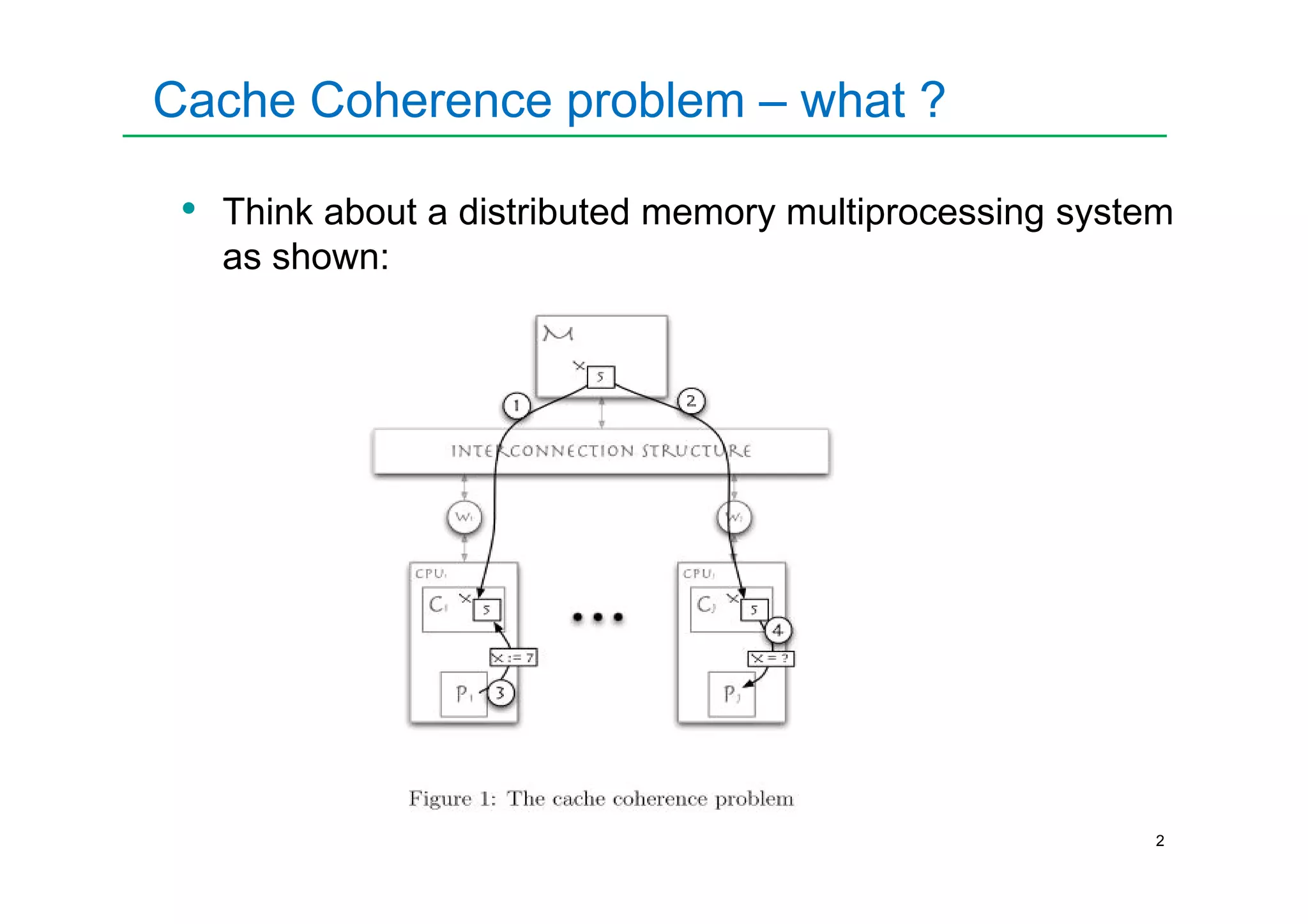
• Think about a distributed memory multiprocessing system
as shown:
2
Example picture contd..
• M – shared memory
• Processors Pi,Pj with their caches Ci,Cj respectively
• X is some variable in shared memory
• If Pi modifies X, the X copy in Cj becomes inconsistent.
• Thus inconsistency problem arises.
• Cache coherence is intended to maintain consistency of
3
• Cache coherence is intended to maintain consistency of
shared resource data that ends up stored in multiple local
caches
Cache coherence techniques – how ?
• Snoopy based
– Individual caches monitor address lines for accesses
to memory locations that they have cached
– Write invalidate protocol
– When a write operation is observed to a location that a
cache has a copy of, the cache controller invalidates
its own copy of the snooped memory location
4
its own copy of the snooped memory location
• Snarfing based
– cache controller watches both address and data
– When a write operation is observed to a location that a
cache has a copy of, the cache controller updates its
own copy of the snarfed memory location with the new
data
Cache coherence techniques – how ? Contd..
• Directory based
– Data being shared is placed in a common directory
– Directory acts as a filter through which the processor
must ask permission to load an entry from the primary
memory to its cache
– When an entry is changed, the directory either updates
or invalidates the other caches with that entry.
5
or invalidates the other caches with that entry.
• Note: Various protocols exist for such techniques
• Example : MSI, MESI (aka Illinois), MOSI, MOESI,
MERSI, MESIF, write-once, and Synapse, Berkeley,
Firefly and Dragon protocol
References
• Silvia Lametti, Cache Coherence Techniques, December 1, 2010.
Available from http://www.di.unipi.it/~vannesch/SPA%202011-
12/Silvia-cache-coherence-.pdf
• Scott B. Baden, Latency Hiding, Department of Computer Science
and Engineering,University of California, San Diego.
Available from https://www.pdc.kth.se/education/historical/previous-
years-summer-schools/2009/handouts/PDC_Su09.pdf
• http://en.wikipedia.org/wiki/Cache_coherence
6
• http://en.wikipedia.org/wiki/Cache_coherence
• http://en.wikipedia.org/wiki/Bus_sniffing
• http://en.wikipedia.org/wiki/Snarfing
Questions ??
Thank you
7
Thank you

Cache coherence

  • 1.
    Cache Coherence Shyam KrishnaKhadka MS in Computer Systems and Knowledge Engineering Institue of Engineering (IoE) Pulchowk campus, Nepal
  • 2.
    Cache Coherence problem– what ? • Think about a distributed memory multiprocessing system as shown: 2
  • 3.
    Example picture contd.. •M – shared memory • Processors Pi,Pj with their caches Ci,Cj respectively • X is some variable in shared memory • If Pi modifies X, the X copy in Cj becomes inconsistent. • Thus inconsistency problem arises. • Cache coherence is intended to maintain consistency of 3 • Cache coherence is intended to maintain consistency of shared resource data that ends up stored in multiple local caches
  • 4.
    Cache coherence techniques– how ? • Snoopy based – Individual caches monitor address lines for accesses to memory locations that they have cached – Write invalidate protocol – When a write operation is observed to a location that a cache has a copy of, the cache controller invalidates its own copy of the snooped memory location 4 its own copy of the snooped memory location • Snarfing based – cache controller watches both address and data – When a write operation is observed to a location that a cache has a copy of, the cache controller updates its own copy of the snarfed memory location with the new data
  • 5.
    Cache coherence techniques– how ? Contd.. • Directory based – Data being shared is placed in a common directory – Directory acts as a filter through which the processor must ask permission to load an entry from the primary memory to its cache – When an entry is changed, the directory either updates or invalidates the other caches with that entry. 5 or invalidates the other caches with that entry. • Note: Various protocols exist for such techniques • Example : MSI, MESI (aka Illinois), MOSI, MOESI, MERSI, MESIF, write-once, and Synapse, Berkeley, Firefly and Dragon protocol
  • 6.
    References • Silvia Lametti,Cache Coherence Techniques, December 1, 2010. Available from http://www.di.unipi.it/~vannesch/SPA%202011- 12/Silvia-cache-coherence-.pdf • Scott B. Baden, Latency Hiding, Department of Computer Science and Engineering,University of California, San Diego. Available from https://www.pdc.kth.se/education/historical/previous- years-summer-schools/2009/handouts/PDC_Su09.pdf • http://en.wikipedia.org/wiki/Cache_coherence 6 • http://en.wikipedia.org/wiki/Cache_coherence • http://en.wikipedia.org/wiki/Bus_sniffing • http://en.wikipedia.org/wiki/Snarfing
  • 7.