ENGINEERING MECHANICS -
SYSTEM OF FORCES
© S.Thirumalvalavan, Assistant Professor,
Department of Mechanical Engineering,
E-Mail : thirumalbemech@gmail.com
INTRODUCTION
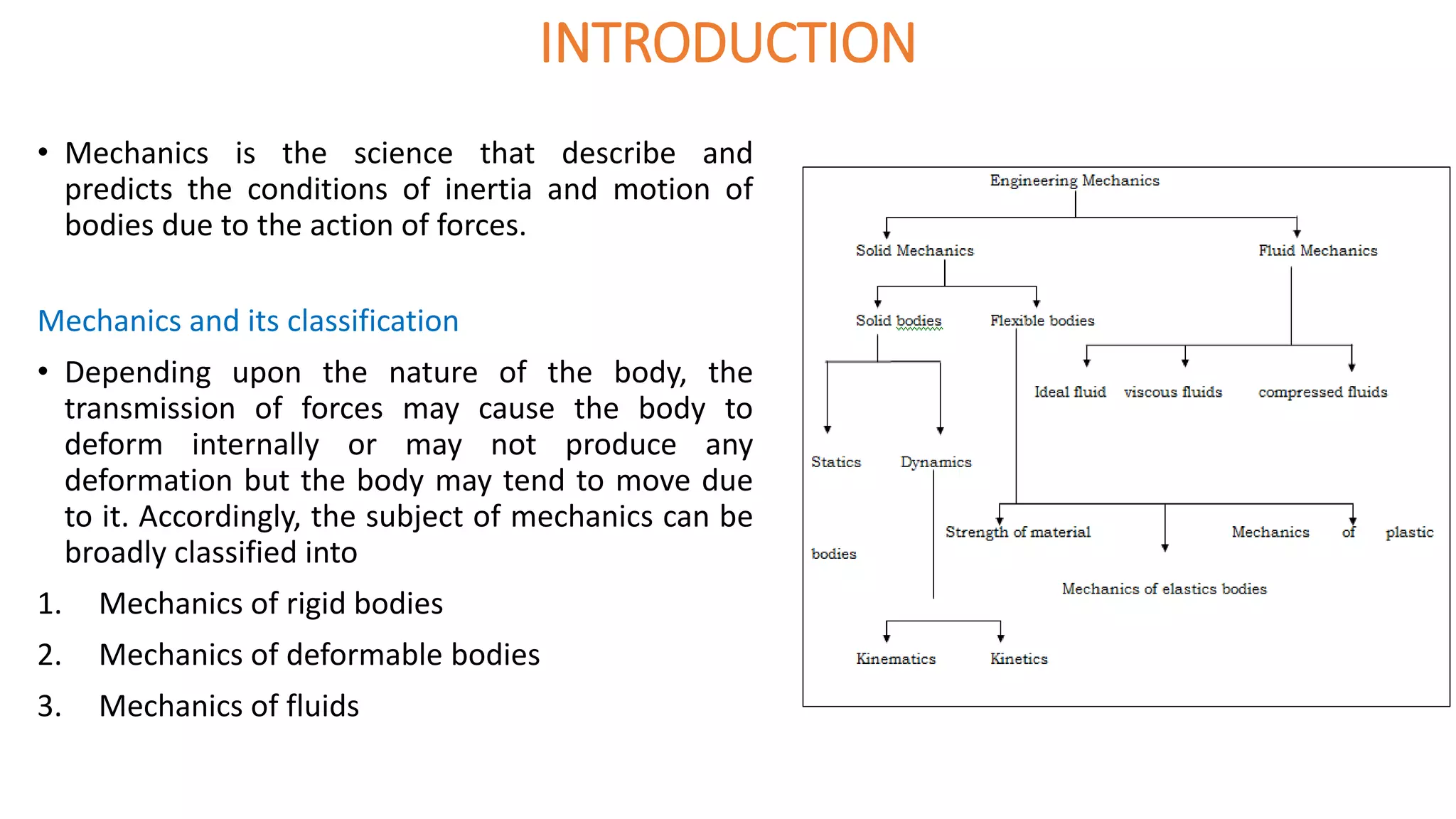
• Mechanics is the science that describe and
predicts the conditions of inertia and motion of
bodies due to the action of forces.
Mechanics and its classification
• Depending upon the nature of the body, the
transmission of forces may cause the body to
deform internally or may not produce any
deformation but the body may tend to move due
to it. Accordingly, the subject of mechanics can be
broadly classified into
1. Mechanics of rigid bodies
2. Mechanics of deformable bodies
3. Mechanics of fluids
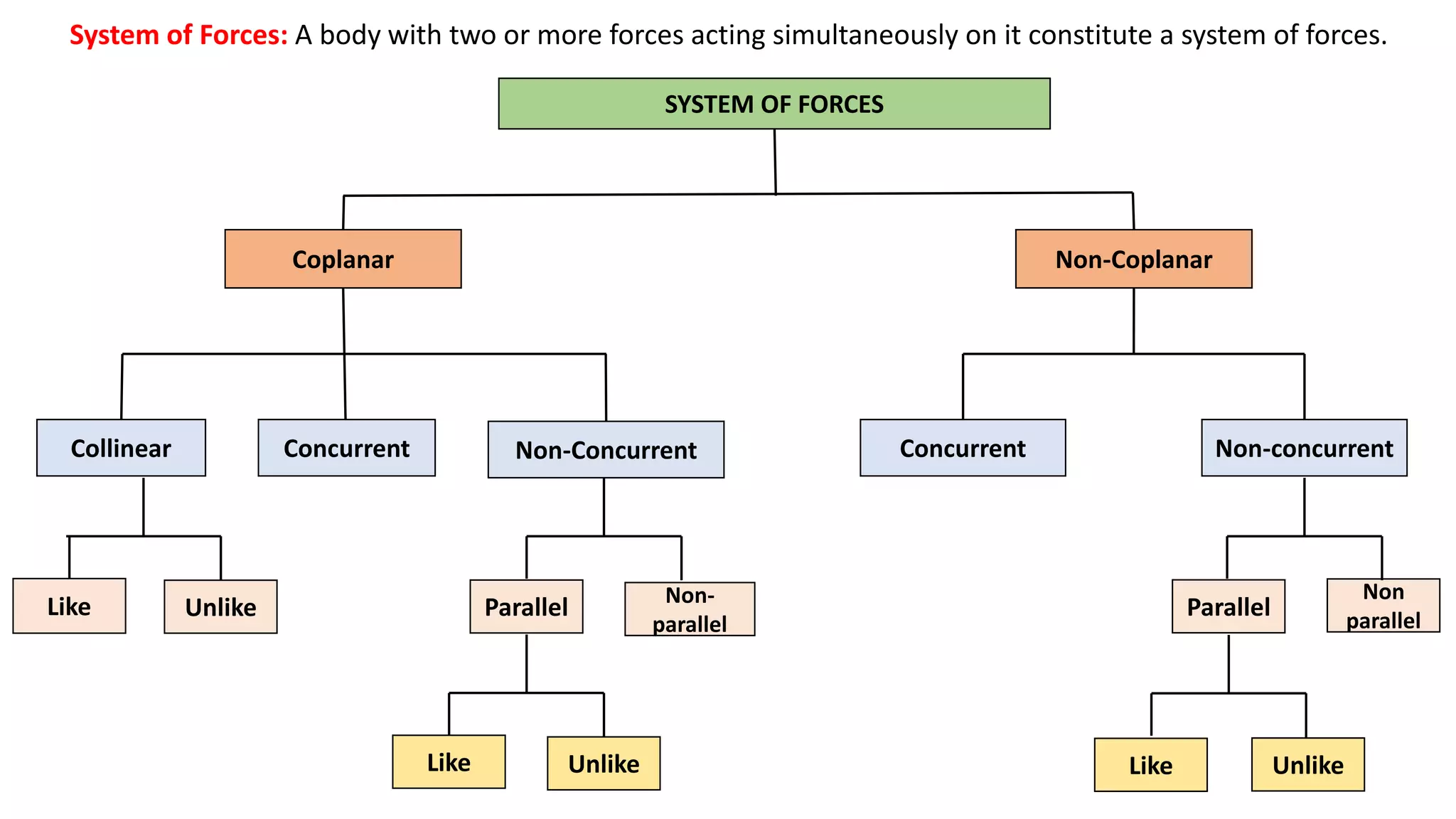
SYSTEM OF FORCES
Collinear
Coplanar Non-Coplanar
Concurrent Non-Concurrent Concurrent Non-concurrent
Like Unlike Parallel Non-
parallel
Like Unlike
Parallel
Non
parallel
Like Unlike
System of Forces: A body with two or more forces acting simultaneously on it constitute a system of forces.
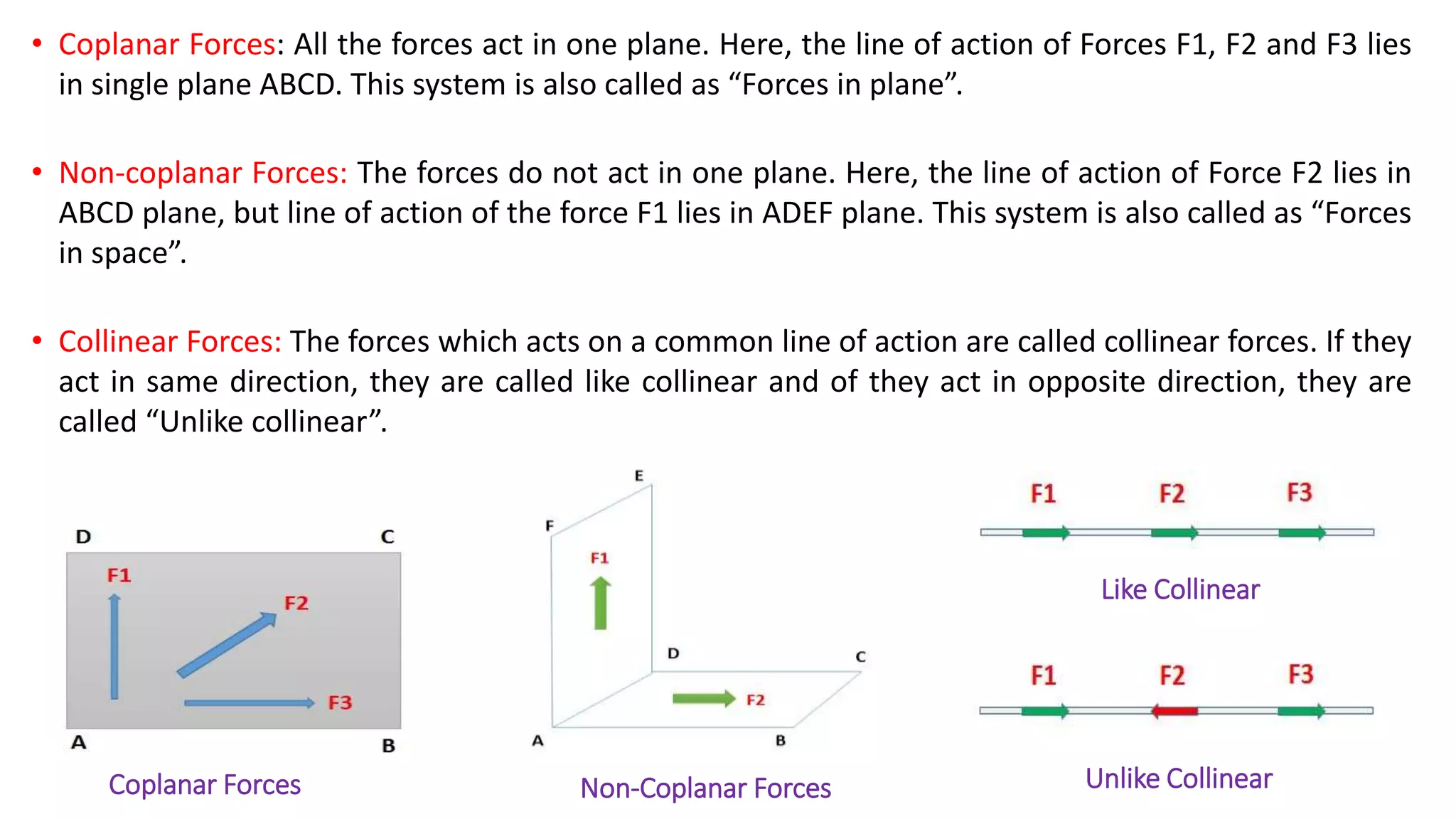
• Coplanar Forces: All the forces act in one plane. Here, the line of action of Forces F1, F2 and F3 lies
in single plane ABCD. This system is also called as “Forces in plane”.
• Non-coplanar Forces: The forces do not act in one plane. Here, the line of action of Force F2 lies in
ABCD plane, but line of action of the force F1 lies in ADEF plane. This system is also called as “Forces
in space”.
• Collinear Forces: The forces which acts on a common line of action are called collinear forces. If they
act in same direction, they are called like collinear and of they act in opposite direction, they are
called “Unlike collinear”.
Like Collinear
Unlike CollinearCoplanar Forces Non-Coplanar Forces
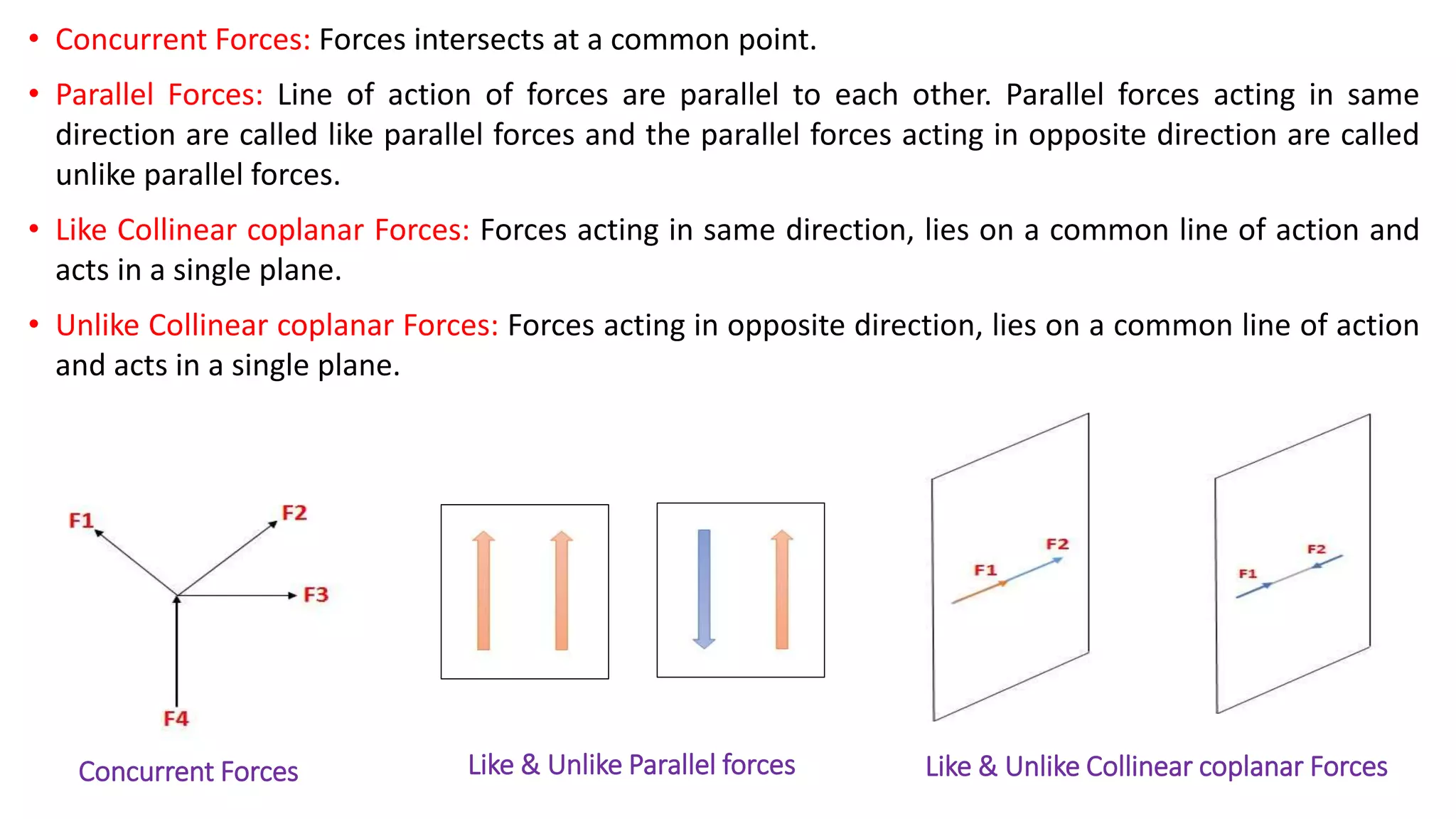
• Concurrent Forces: Forces intersects at a common point.
• Parallel Forces: Line of action of forces are parallel to each other. Parallel forces acting in same
direction are called like parallel forces and the parallel forces acting in opposite direction are called
unlike parallel forces.
• Like Collinear coplanar Forces: Forces acting in same direction, lies on a common line of action and
acts in a single plane.
• Unlike Collinear coplanar Forces: Forces acting in opposite direction, lies on a common line of action
and acts in a single plane.
Like & Unlike Parallel forcesConcurrent Forces Like & Unlike Collinear coplanar Forces
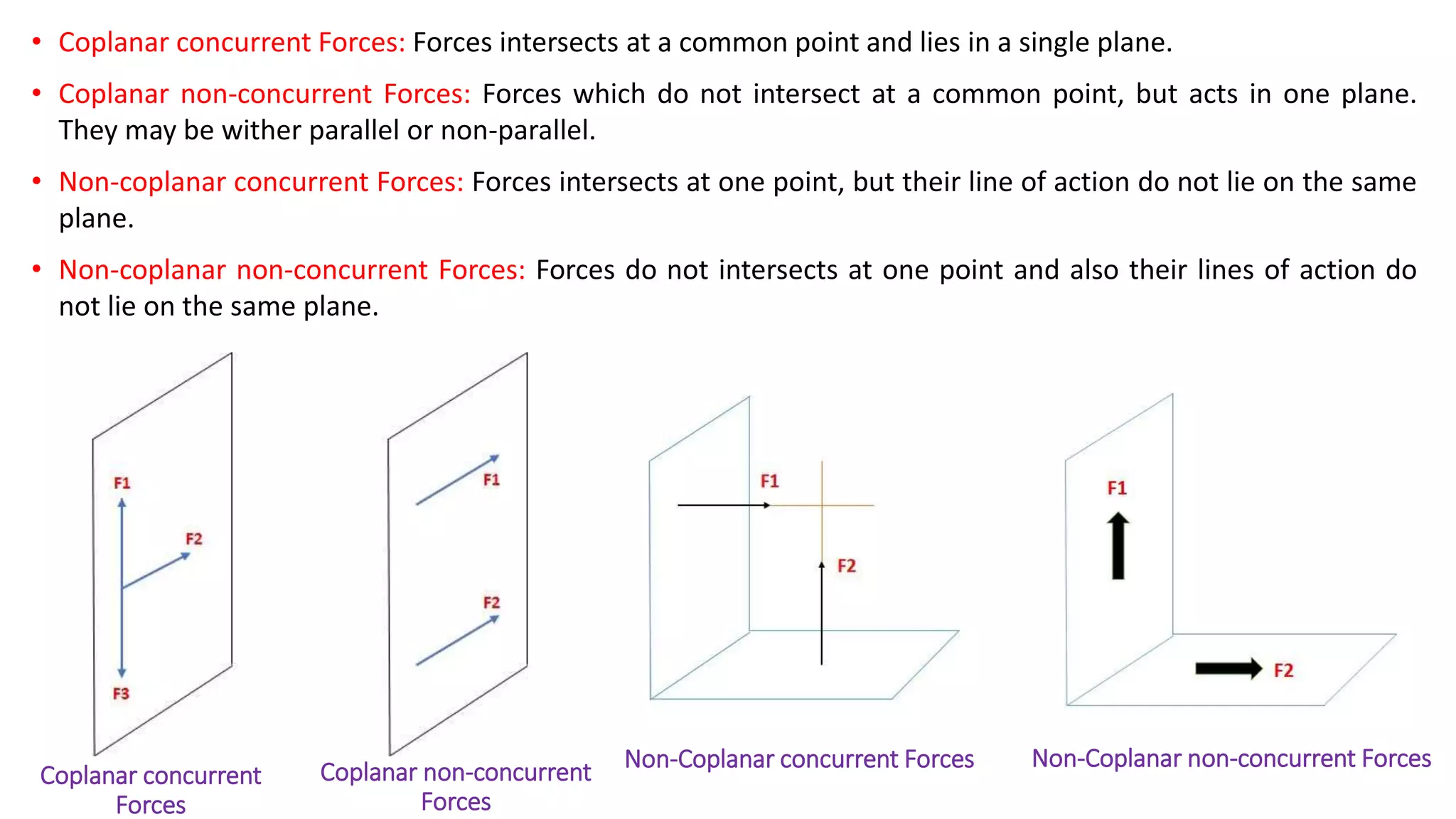
• Coplanar concurrent Forces: Forces intersects at a common point and lies in a single plane.
• Coplanar non-concurrent Forces: Forces which do not intersect at a common point, but acts in one plane.
They may be wither parallel or non-parallel.
• Non-coplanar concurrent Forces: Forces intersects at one point, but their line of action do not lie on the same
plane.
• Non-coplanar non-concurrent Forces: Forces do not intersects at one point and also their lines of action do
not lie on the same plane.
Coplanar concurrent
Forces
Coplanar non-concurrent
Forces
Non-Coplanar non-concurrent ForcesNon-Coplanar concurrent Forces
THANK YOU
© S.Thirumalvalavan, Assistant Professor,
Department of Mechanical Engineering,
E-Mail : thirumalbemech@gmail.com

System of Forces - Engineering Mechanics

  • 1.
    ENGINEERING MECHANICS - SYSTEMOF FORCES © S.Thirumalvalavan, Assistant Professor, Department of Mechanical Engineering, E-Mail : thirumalbemech@gmail.com
  • 2.
    INTRODUCTION • Mechanics isthe science that describe and predicts the conditions of inertia and motion of bodies due to the action of forces. Mechanics and its classification • Depending upon the nature of the body, the transmission of forces may cause the body to deform internally or may not produce any deformation but the body may tend to move due to it. Accordingly, the subject of mechanics can be broadly classified into 1. Mechanics of rigid bodies 2. Mechanics of deformable bodies 3. Mechanics of fluids
  • 3.
    SYSTEM OF FORCES Collinear CoplanarNon-Coplanar Concurrent Non-Concurrent Concurrent Non-concurrent Like Unlike Parallel Non- parallel Like Unlike Parallel Non parallel Like Unlike System of Forces: A body with two or more forces acting simultaneously on it constitute a system of forces.
  • 4.
    • Coplanar Forces:All the forces act in one plane. Here, the line of action of Forces F1, F2 and F3 lies in single plane ABCD. This system is also called as “Forces in plane”. • Non-coplanar Forces: The forces do not act in one plane. Here, the line of action of Force F2 lies in ABCD plane, but line of action of the force F1 lies in ADEF plane. This system is also called as “Forces in space”. • Collinear Forces: The forces which acts on a common line of action are called collinear forces. If they act in same direction, they are called like collinear and of they act in opposite direction, they are called “Unlike collinear”. Like Collinear Unlike CollinearCoplanar Forces Non-Coplanar Forces
  • 5.
    • Concurrent Forces:Forces intersects at a common point. • Parallel Forces: Line of action of forces are parallel to each other. Parallel forces acting in same direction are called like parallel forces and the parallel forces acting in opposite direction are called unlike parallel forces. • Like Collinear coplanar Forces: Forces acting in same direction, lies on a common line of action and acts in a single plane. • Unlike Collinear coplanar Forces: Forces acting in opposite direction, lies on a common line of action and acts in a single plane. Like & Unlike Parallel forcesConcurrent Forces Like & Unlike Collinear coplanar Forces
  • 6.
    • Coplanar concurrentForces: Forces intersects at a common point and lies in a single plane. • Coplanar non-concurrent Forces: Forces which do not intersect at a common point, but acts in one plane. They may be wither parallel or non-parallel. • Non-coplanar concurrent Forces: Forces intersects at one point, but their line of action do not lie on the same plane. • Non-coplanar non-concurrent Forces: Forces do not intersects at one point and also their lines of action do not lie on the same plane. Coplanar concurrent Forces Coplanar non-concurrent Forces Non-Coplanar non-concurrent ForcesNon-Coplanar concurrent Forces
  • 7.
    THANK YOU © S.Thirumalvalavan,Assistant Professor, Department of Mechanical Engineering, E-Mail : thirumalbemech@gmail.com