PHYSICS OF TABLET
COMPRESSION
HEMANGA HAZARIKA
M. Pharm 1st Semester (2013 batch)
Roll no- MP/13/02 Dept. of Pharmaceutics
Girijananda Chowdhury Institute of pharmaceutical Science, Azara, Guwahati-17
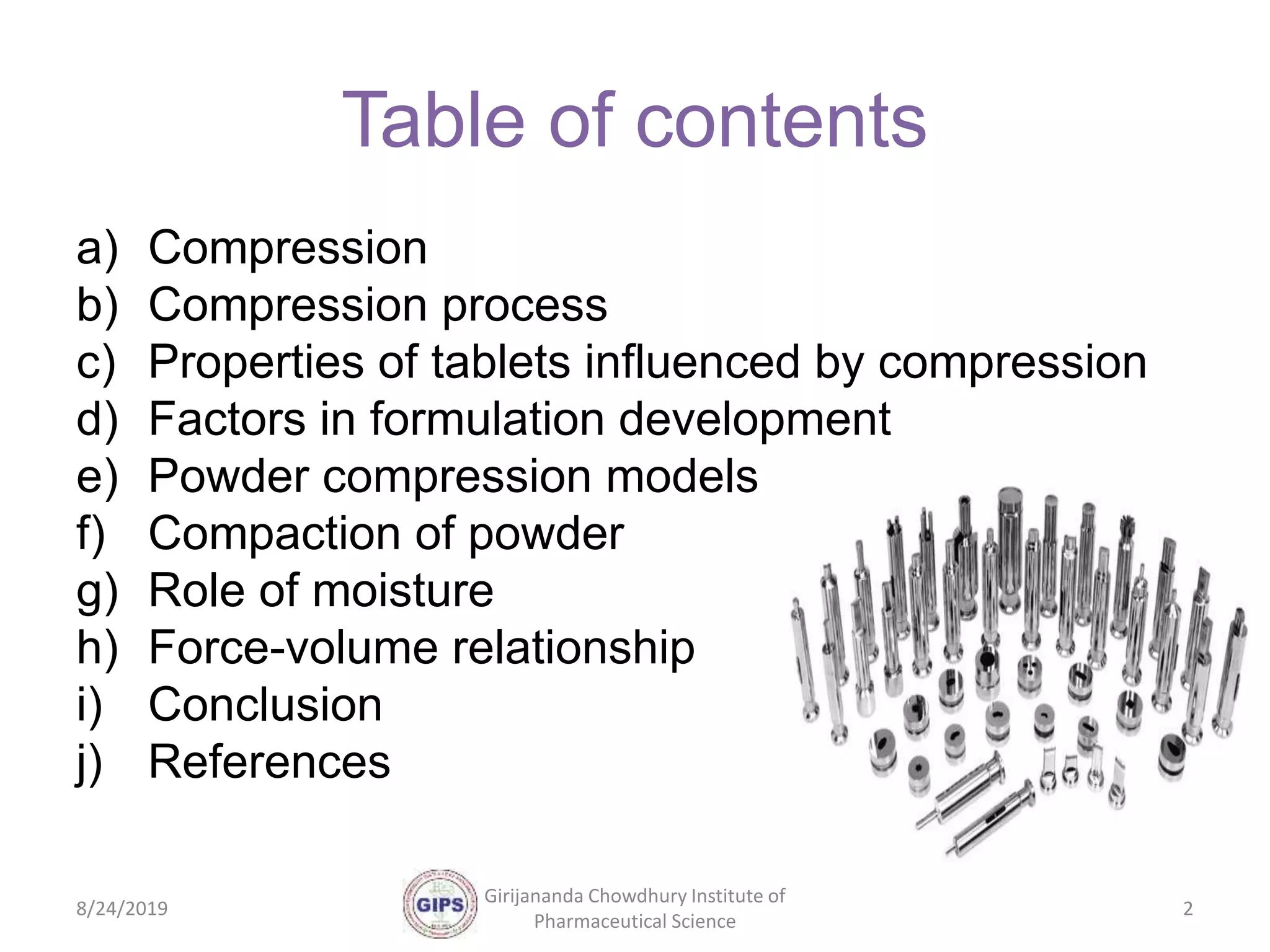
Table of contents
a) Compression
b) Compression process
c) Properties of tablets influenced by compression
d) Factors in formulation development
e) Powder compression models
f) Compaction of powder
g) Role of moisture
h) Force-volume relationship
i) Conclusion
j) References
8/24/2019
Girijananda Chowdhury Institute of
Pharmaceutical Science
2
Compression- the reduction in the bulk
volume of a material as a result of the removal of
the gaseous phase (air) by applied pressure.
In Pharmaceutical tablet manufacturing an
appropriate volume of granules in a die cavity is
compressed between an upper and lower punch to
consolidate the material into a single solid matrix
which is subsequently ejected from the die cavity
as an intact tablet
Girijananda Chowdhury Institute of
Pharmaceutical Science
8/24/2019 3
Tablet Compression
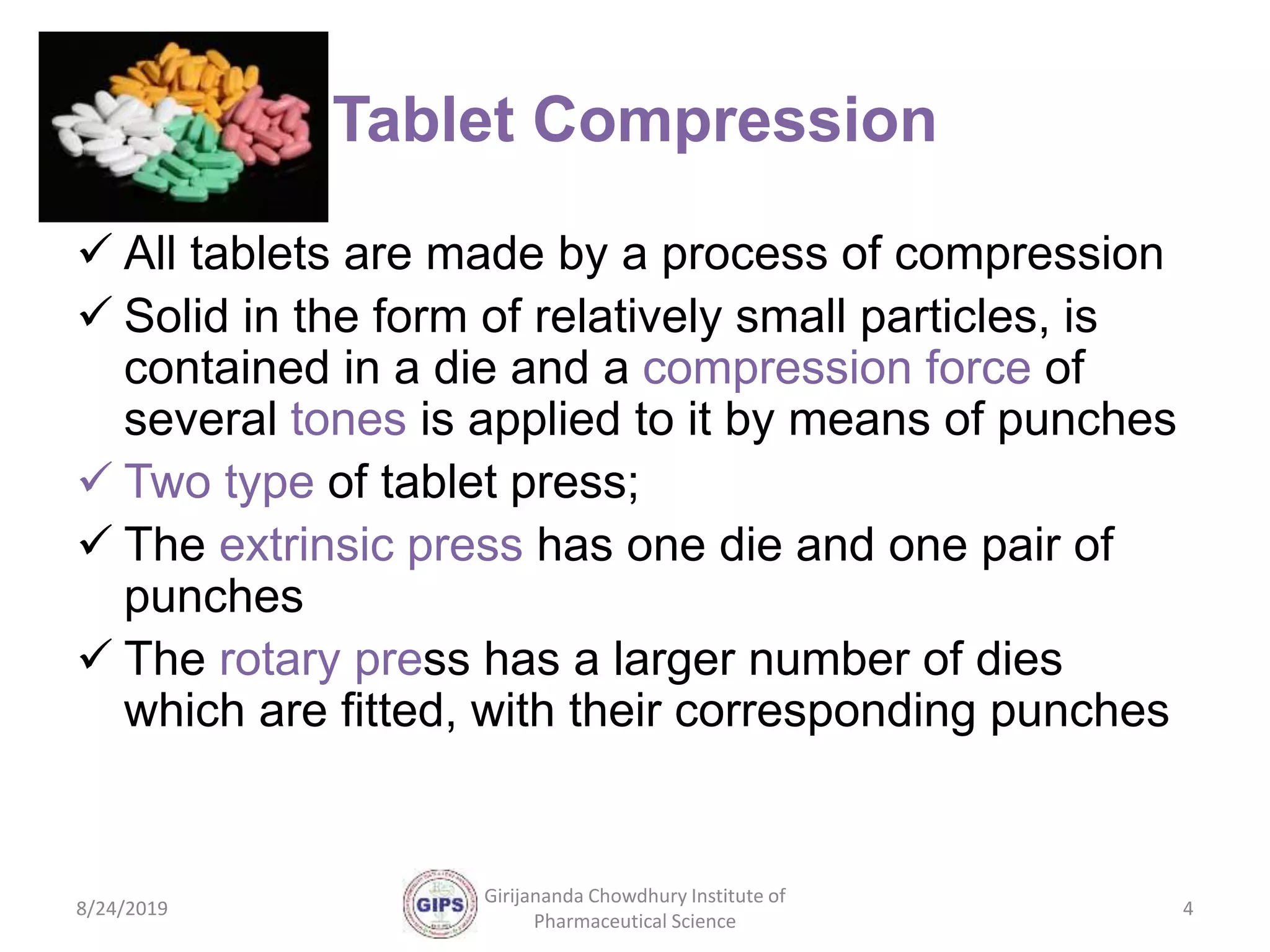
 All tablets are made by a process of compression
 Solid in the form of relatively small particles, is
contained in a die and a compression force of
several tones is applied to it by means of punches
 Two type of tablet press;
 The extrinsic press has one die and one pair of
punches
 The rotary press has a larger number of dies
which are fitted, with their corresponding punches
8/24/2019
Girijananda Chowdhury Institute of
Pharmaceutical Science
4
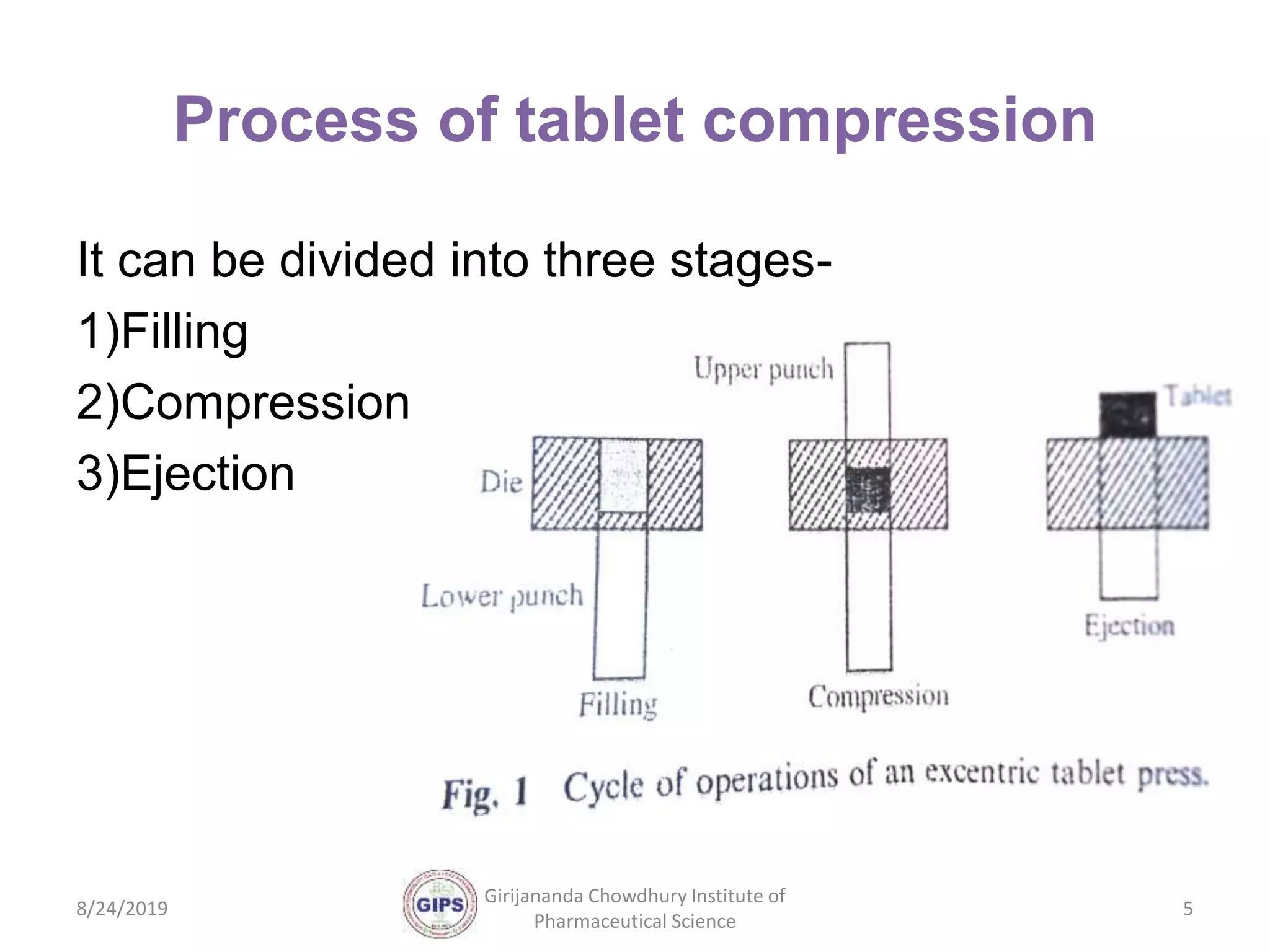
Process of tablet compression
It can be divided into three stages-
1)Filling
2)Compression
3)Ejection
8/24/2019
Girijananda Chowdhury Institute of
Pharmaceutical Science
5
8/24/2019
Girijananda Chowdhury Institute of
Pharmaceutical Science
6
8/24/2019
Girijananda Chowdhury Institute of
Pharmaceutical Science
7
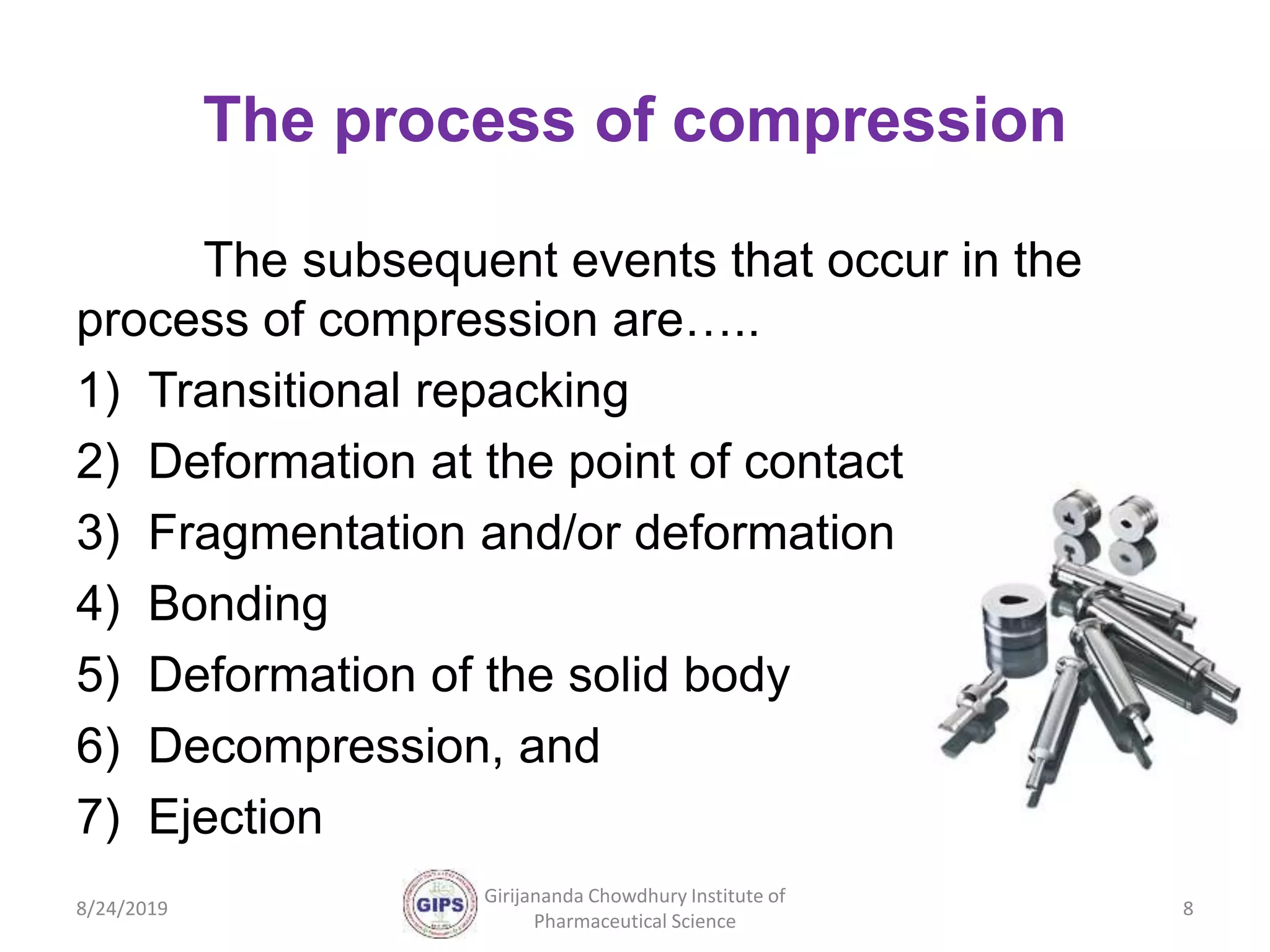
The process of compression
The subsequent events that occur in the
process of compression are…..
1) Transitional repacking
2) Deformation at the point of contact
3) Fragmentation and/or deformation
4) Bonding
5) Deformation of the solid body
6) Decompression, and
7) Ejection
Girijananda Chowdhury Institute of
Pharmaceutical Science
8/24/2019 8
1)Transitional repacking
 The granules flow with respect to each other
with the finer particles entering the void between
the larger particles and the bulk density of the
granulation increased
 Spherical particles undergo less particle
rearrangement then the irregular particles
Girijananda Chowdhury Institute of
Pharmaceutical Science
8/24/2019 9
2)Deformation at the point of contact
After closely packed of the granulation particles,
no further filling of the void can occur. A further
increase of compression force causes deformation
at the point of contact
 Elastic deformation
 Plastic deformation
 Yield stress
Girijananda Chowdhury Institute of
Pharmaceutical Science
8/24/2019 10
3)Fragmentation and/or deformation
Fracture occurs when the stress within the
particle become great enough to propagate
Fragmentation cause furthers densification
with the infiltration of the smaller fragments
into the void space
With some materials fragmentation doesn’t
occur because the stress is released by
plastic deformation
Girijananda Chowdhury Institute of
Pharmaceutical Science
8/24/2019 11
4)Bonding
a. The mechanical theory- If only the mechanical
bond exists, the total energy of compression is
equal to the sum of the energy of deformation,
heat and energy absorbed for each constituent
Girijananda Chowdhury Institute of
Pharmaceutical Science
8/24/2019 12
b. The inter molecular theory- The molecules(or
ions) at the surface of solid have unsatisfied
forces(surface free energy), which interact with
the other particles in true contact.
Girijananda Chowdhury Institute of
Pharmaceutical Science
8/24/2019 13
c. The liquid surface film theory- Bonding to the
presence of a thin liquid film which may be
consequence of fusion or solution at the
surface of the particle induced by the energy of
compression. It may classified into two ways-
#Hot welding
#Cold welding
Girijananda Chowdhury Institute of
Pharmaceutical Science
8/24/2019 14
Hot welding
 On macro scale, irregular particle shape ,there is
no. of points of contact.
 Application of load under appreciable force, results
in generation of frictional heat.
 If this heat is not dissipated, local rise in
temperature.
 This heat is sufficient to melt the contact surfaces.
 Melt solidifies gives rise to fusion bonding.
 Which results in increasing mechanical strength of
tablet.
Girijananda Chowdhury Institute of
Pharmaceutical Science
8/24/2019 15
Cold welding
 Particles approach each other very closely
(>50nm)
 Their free surface energies result in a strong
attractive bond formation.
 This bond depends on interior nature of the
particles.
 This phenomenon is called cold welding
 Cold welding results in increasing mechanical
strength of tablet.
Girijananda Chowdhury Institute of
Pharmaceutical Science
8/24/2019 16
The influence of applied pressure on specific
surface area is shown in figure 1
8/24/2019
Girijananda Chowdhury Institute of
Pharmaceutical Science
17
5)Deformation of the solid body
Applied pressure further increased the bonded solid;
consolidated toward a limiting density by plastic and/or
elastic deformation of the tablet within the die
Strain : The relative amount of deformation produced on
a solid body due to applied force .
It is dimensionless quantity .
Compressive strain ,
Z = ΔH / Hο where,
H- Thickness
Stress (σ) :
σ = F / A
here , F is force required to produce strain in area A
.
Girijananda Chowdhury Institute of
Pharmaceutical Science
8/24/2019 18
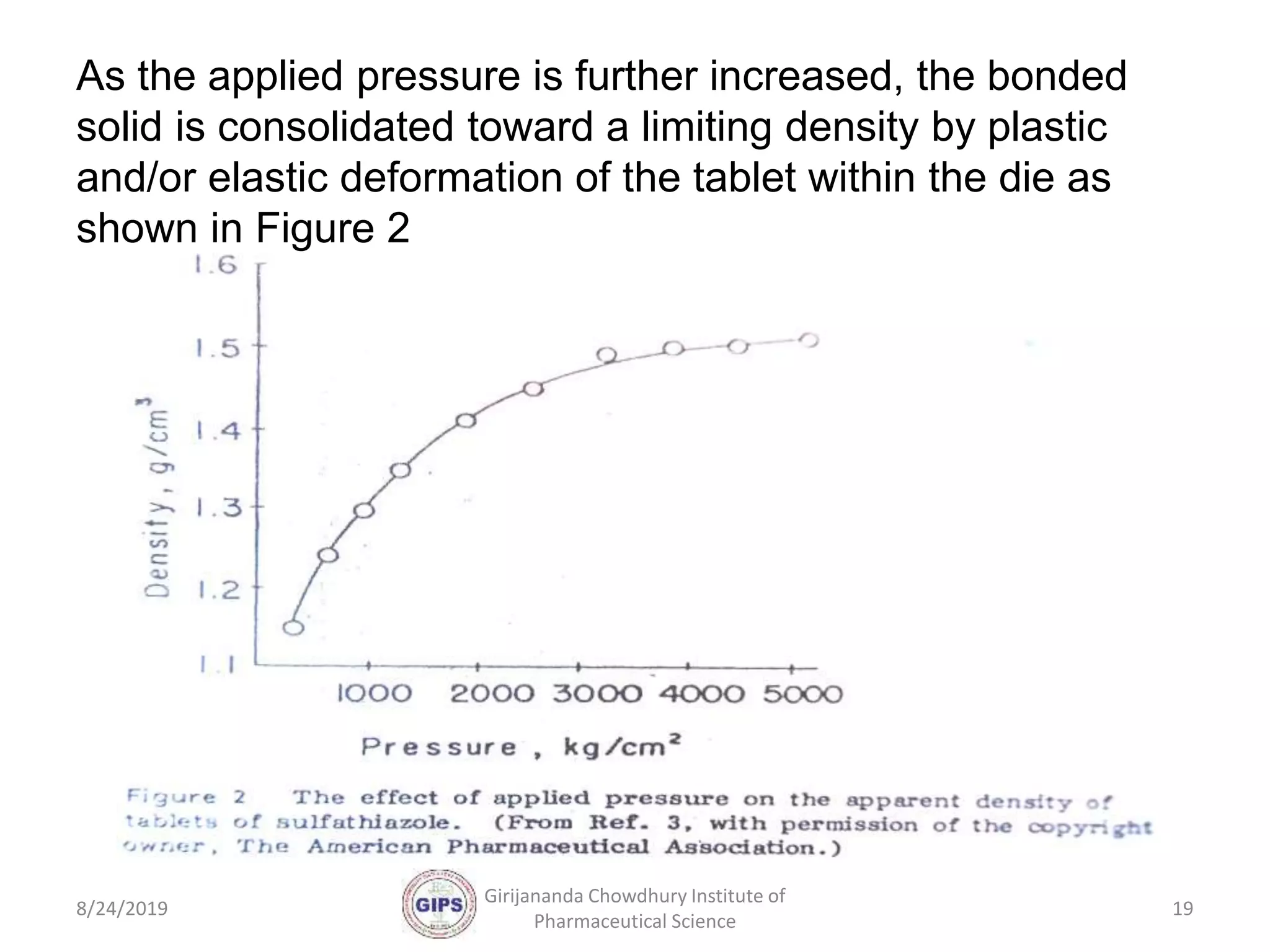
As the applied pressure is further increased, the bonded
solid is consolidated toward a limiting density by plastic
and/or elastic deformation of the tablet within the die as
shown in Figure 2
8/24/2019
Girijananda Chowdhury Institute of
Pharmaceutical Science
19
6)Decompression
As the upper punch withdraw from the die cavity,
the tablet is confined in the die by a radial
pressure. Consequently any dimensional change
during decompression must occur in the axial
direction
Plastoelasticity (γ)
γ = [Hο/H – (H -H )/Hο-H ]
where,
Hο, H , H = thickness of tablet mass at onset of
loading , at max. applied pressure and on ejection
from die.
γ > 9 produce tablets that are laminated or capped.
Girijananda Chowdhury Institute of
Pharmaceutical Science
8/24/2019 20
The process of compression has been described in terms
of the relative volume (ratio of volume of the compressed
mass to the volume of the mass at zero void) and applied
pressure as shown in Figure 4
8/24/2019
Girijananda Chowdhury Institute of
Pharmaceutical Science
21
7)Ejection
The lower punch rises and pushes the tablet
upward there is a continued residual die wall
friction.
As the tablet removed from the die the lateral
pressure is relieved and the tablet undergoes
elastic recovery with an increased (2-10%) of the
volume of that portion of the tablet removed from
the die
Girijananda Chowdhury Institute of
Pharmaceutical Science
8/24/2019 22
The ratio of the pressure at time t to the maximum
pressure is plotted against the logarithm of time
8/24/2019
Girijananda Chowdhury Institute of
Pharmaceutical Science
23
Properties of tablets influenced by
compression
1) Density and porisity
2) Hardness and tensile strength
3) Specific surface
4) Disintegration
5) Dissolution
8/24/2019
Girijananda Chowdhury Institute of
Pharmaceutical Science
24
1)Density and porosity
 The apparent density of a tablet is exponentially
related to the compressional pressure
 Porosity and apparent density are inversely
proportional
8/24/2019
Girijananda Chowdhury Institute of
Pharmaceutical Science
25
8/24/2019
Girijananda Chowdhury Institute of
Pharmaceutical Science
26
2)Hardness and tensile strength
 There is a linear relationship between tablet
hardness and the logarithm of applied pressure
except at high pressure
8/24/2019
Girijananda Chowdhury Institute of
Pharmaceutical Science
27
 The radial tensile strength is proportional to the applied
pressure.
 For an isotopic, Homogenous tablet, the radial and axial
tensile strength are equal
 As applied pressure is increased, fragmentation results
in a stronger, radial tensile strength than axial tensile
strength
8/24/2019
Girijananda Chowdhury Institute of
Pharmaceutical Science
28
 The influence of concentration of providone on the
tensile strengths of hydrous lactose is shown in figure 11
8/24/2019
Girijananda Chowdhury Institute of
Pharmaceutical Science
29
3)Surface area
 Specific surface area is the surface area of 1g of
material
 As the relationship between applied pressure
and apparent density is independent of the
material being compressed, the influence of
starch on the specific surface and porosity is not
significant
 As the lactose granules, which were granulated
by adding 10%starch paste, are compressed,
the specific surface is increased to a maximal
value(four time that the initial value)
8/24/2019
Girijananda Chowdhury Institute of
Pharmaceutical Science
30
The influence of applied pressure on the specific
surface area of a tablet is typified by Figure 15
8/24/2019
Girijananda Chowdhury Institute of
Pharmaceutical Science
31
8/24/2019
Girijananda Chowdhury Institute of
Pharmaceutical Science
32
4)Disintegration
 Usually, as the applied pressure used to prepare
a tablet is increased, the disintegration time is
longer
 There is an exponential relationship between the
disintegration time and the applied pressure, as
shown for aspirin and lactose in Figure 16
8/24/2019
Girijananda Chowdhury Institute of
Pharmaceutical Science
33
8/24/2019
Girijananda Chowdhury Institute of
Pharmaceutical Science
34
5)Dissolution
Four most common dissolution-pressure relations are-
 Dissolution is more rapid as the applied pressure is
increased
 Dissolution is slowed as the applied pressure is
increased
 Dissolution is faster to a maximum, as the applied force
is increased, and then a further increase in applied
pressure slows dissolution
 Dissolution is slowed to a minimum as the applied
pressure is increased, and then further an increase in
applied pressure speeds dissolution
8/24/2019
Girijananda Chowdhury Institute of
Pharmaceutical Science
35
8/24/2019
Girijananda Chowdhury Institute of
Pharmaceutical Science
36
Factors in formulation
development
More than any other type of tablets, successful
formulations of direct compression tablets depend
on careful consideration of excipient properties
and optimization of the compressibility, fluidity, and
lubricability of powder blends
Girijananda Chowdhury Institute of
Pharmaceutical Science
8/24/2019 37
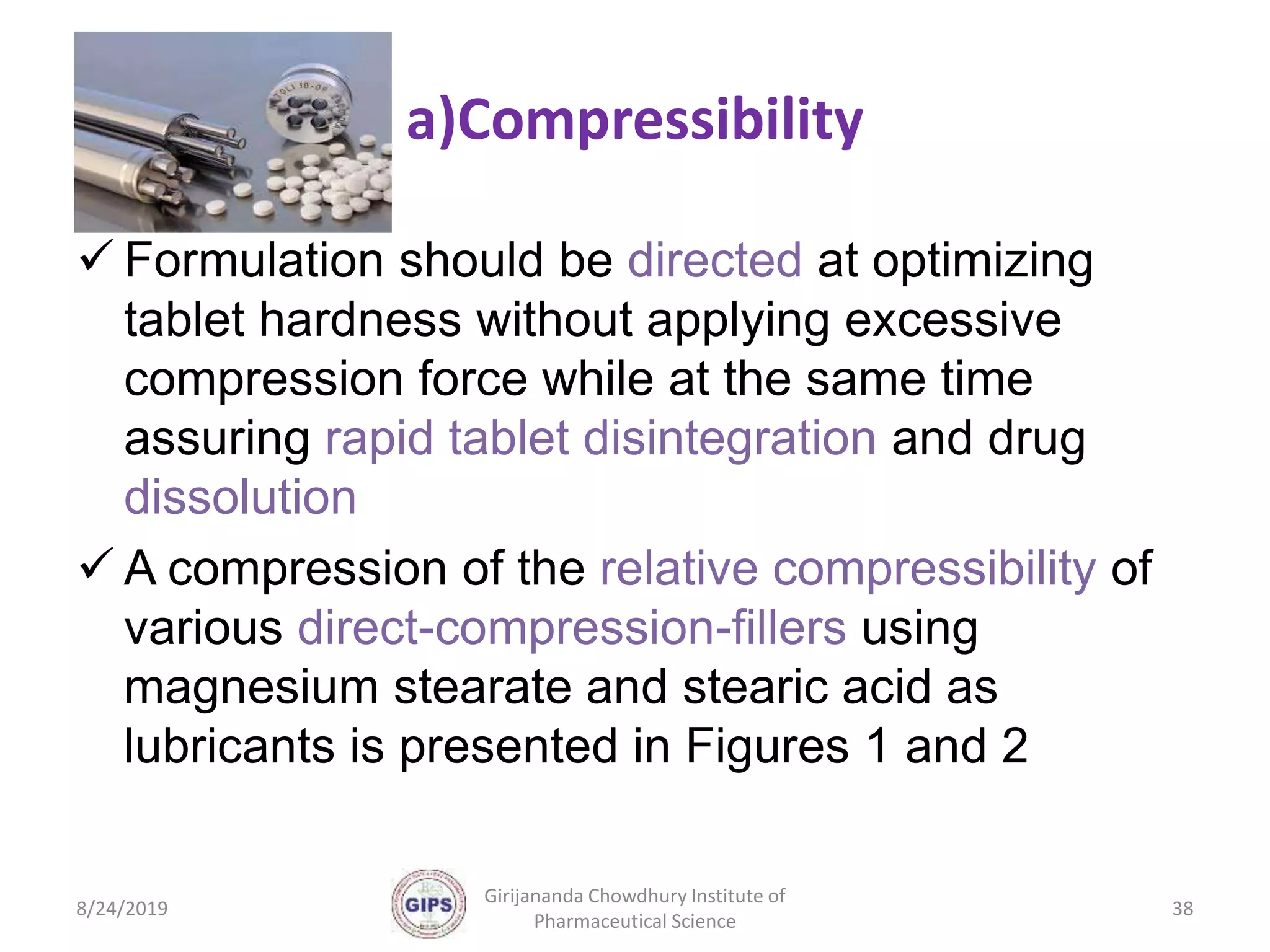
a)Compressibility
 Formulation should be directed at optimizing
tablet hardness without applying excessive
compression force while at the same time
assuring rapid tablet disintegration and drug
dissolution
 A compression of the relative compressibility of
various direct-compression-fillers using
magnesium stearate and stearic acid as
lubricants is presented in Figures 1 and 2
Girijananda Chowdhury Institute of
Pharmaceutical Science
8/24/2019 38
Girijananda Chowdhury Institute of
Pharmaceutical Science
8/24/2019 39
Girijananda Chowdhury Institute of
Pharmaceutical Science
8/24/2019 40
b)Fluidity
The fluidity of tablet blends is important not
only from the direct effect on uniformity of
tablet weight, but also from the role it plays in
blending and powder homogenecity
Fluidity of active ingredients become a factor
when the drug has been micronized to
improve dissolution rate or provide more key
particles of drug per tablet
Girijananda Chowdhury Institute of
Pharmaceutical Science
8/24/2019 41
Girijananda Chowdhury Institute of
Pharmaceutical Science
8/24/2019 42
c)Content uniformity
Particle size range of all components and the
more alike the particle densities, the less
chance for unbending or segregation
Small and angular particle shape of MCC
makes it difficult for higher density particles to
shift down through the spaces between the
blend of materials
Cellulose and starch products tend to have
lower true densities than sugars and inorganic
chemicals
Girijananda Chowdhury Institute of
Pharmaceutical Science
8/24/2019 43
d)Lubrication
The overall mean particle size of direct-
compression blends is less than that for
granulations, higher concentrations of
lubricants are often needed
Length of blending becomes much more
critical in direct compression than in
lubrication of tablet granulations
The problem associated with the lubricating
direct compression blends can be divided into
two categories- a) Type and amount
needed to produce adequate lubrication
b)The softening effect of lubrication
Girijananda Chowdhury Institute of
Pharmaceutical Science
8/24/2019 44
Powder compression models
#The Heckel equation
ln 1/E =kP+A
where E is the porosity of the powder bed and P the
applied compression pressure, A and k are parameters.
Girijananda Chowdhury Institute of
Pharmaceutical Science
8/24/2019 45
8/24/2019
Girijananda Chowdhury Institute of
Pharmaceutical Science
46
# The Shapiro General Compression Equation
1/K = Pk = 3σ0
Py, is commonly used as an indication of the
plasticity or hardness of a particle. This
assumption originated from an empirical
relationship between the parameter k and the yield
strength (σ0)
# The Kawakita equation
p/c = 1/ab + p /a
Where C is the degree of volume reduction, P is
the applied pressure, and a and b are parameters.
Girijananda Chowdhury Institute of
Pharmaceutical Science
8/24/2019 47
Fig. Effect of increasing compressional forces on specific surface
area of powder mass
Increased surface area (from O to A), initial
particle fracture due to increased
compression point A. Particle rebonding
predominates and then surface area
decreases (from A to B).
Girijananda Chowdhury Institute of
Pharmaceutical Science
8/24/2019 48
Compaction of powder
The physics of compaction is simply stated as …
“The compression and consolidation of two
phases due to applied forces”
COMPACTION CONSOLIDATION
• It is defined as formation
of solid geometry by
compression.
• The compaction takes
place in a die by action of
two punches, the lower
and upper by which
compression force is
applied.
It is in increasing in
mechanical strength of
material by particle- particle
interaction.
Girijananda Chowdhury Institute of
Pharmaceutical Science
8/24/2019 49
*(In fig .dash line is original shape and solid line is deformed
shape.)
Diagram shows changes in geometry
(strain) of solid body resulting from
various types of applied forces. Here the
figure
a)Tensile strain
b)Compressive strain
c)Shear strain
Girijananda Chowdhury Institute of
Pharmaceutical Science
8/24/2019 50
Role of moisture
# As little as 0.02% moisture can affect the
proportion of applied forces transmitted to lower
punch.
# At 0.55% moisture the behavior is actually the
reverse of that for totally dry material.
Girijananda Chowdhury Institute of
Pharmaceutical Science
8/24/2019 51
Force-volume relationship
# Compression process ends when ,
bulk volume= tapped volume ( porosity = 0)
# Decrease in porosity is due to two process.
1. Filling large spaces by Interparticulate slippage.
2. Filling small voids by deformation or
fragmentation at high load.
Girijananda Chowdhury Institute of
Pharmaceutical Science
8/24/2019 52
Fig. Decreasing porosity with increasing compressional
forces
1. Initial repacking
2. Elastic deformation
3. Plastic deformation
4. Compression
Girijananda Chowdhury Institute of
Pharmaceutical Science
8/24/2019 53
Conclusion
 The physics of tablet compression gives
knowledge of compatibility and flow ability of
pharmaceutical powder which is essential for
formulation of tablets.
 The tendency of material for plastic deformation,
fragmentation and elasticity could be expressed
and are compared with different material.
 The bonding theories in tablet preparation is
studied to increase the strength of tablet.
 The different parameters of powder like flow
rates, effect of moisture etc. are studied with
there effect on the compression of tablet.
Girijananda Chowdhury Institute of
Pharmaceutical Science
8/24/2019 54
References
1) Leon Lachman, Herbert A. Lieberman. Pharmaceutical
Dosage Forms: Tablets. Volume 1. Second edition; First
Indian reprint 2005,214-219
2) Leon Lachman, Herbert A. Lieberman. Pharmaceutical
Dosage Forms: Tablets. Volume 2. Second edition; First
Indian reprint 2005, 201-241.
3) Leon Lachman, Herbert A. Lieberman. The Theory and
Practice of Industrial Pharmacy; Special Indian Edition
2009, 66-99.
4) Jens Thuro Carstensen. Solid Pharmaceutics:Mechanical
Properties and Rate Phenomena; Tabletting and
Compression; University of Wisconsin, 173-214
5) Eugene L. Parrot. Compression; University of Iowa;221-241
6) Norman Anthony Armstrong; Tablet Manufacture; Welsh
School of Pharmacy, Cardiff University, U.K., 3653-3670
7) M. E. Aulton. Pharmaceutics: The Science of Dosage Form
Design; Second edition, 423-438.
8) Til familien. Compression Analysis of Pharmaceutical
Powders: Assessment of Mechanical Properties and
Tablet Manufacturability Prediction.
Girijananda Chowdhury Institute of
Pharmaceutical Science
8/24/2019 55
8/24/2019
Girijananda Chowdhury Institute of
Pharmaceutical Science
56

Physics of tablet compression

  • 1.
    PHYSICS OF TABLET COMPRESSION HEMANGAHAZARIKA M. Pharm 1st Semester (2013 batch) Roll no- MP/13/02 Dept. of Pharmaceutics Girijananda Chowdhury Institute of pharmaceutical Science, Azara, Guwahati-17
  • 2.
    Table of contents a)Compression b) Compression process c) Properties of tablets influenced by compression d) Factors in formulation development e) Powder compression models f) Compaction of powder g) Role of moisture h) Force-volume relationship i) Conclusion j) References 8/24/2019 Girijananda Chowdhury Institute of Pharmaceutical Science 2
  • 3.
    Compression- the reductionin the bulk volume of a material as a result of the removal of the gaseous phase (air) by applied pressure. In Pharmaceutical tablet manufacturing an appropriate volume of granules in a die cavity is compressed between an upper and lower punch to consolidate the material into a single solid matrix which is subsequently ejected from the die cavity as an intact tablet Girijananda Chowdhury Institute of Pharmaceutical Science 8/24/2019 3
  • 4.
    Tablet Compression  Alltablets are made by a process of compression  Solid in the form of relatively small particles, is contained in a die and a compression force of several tones is applied to it by means of punches  Two type of tablet press;  The extrinsic press has one die and one pair of punches  The rotary press has a larger number of dies which are fitted, with their corresponding punches 8/24/2019 Girijananda Chowdhury Institute of Pharmaceutical Science 4
  • 5.
    Process of tabletcompression It can be divided into three stages- 1)Filling 2)Compression 3)Ejection 8/24/2019 Girijananda Chowdhury Institute of Pharmaceutical Science 5
  • 6.
    8/24/2019 Girijananda Chowdhury Instituteof Pharmaceutical Science 6
  • 7.
    8/24/2019 Girijananda Chowdhury Instituteof Pharmaceutical Science 7
  • 8.
    The process ofcompression The subsequent events that occur in the process of compression are….. 1) Transitional repacking 2) Deformation at the point of contact 3) Fragmentation and/or deformation 4) Bonding 5) Deformation of the solid body 6) Decompression, and 7) Ejection Girijananda Chowdhury Institute of Pharmaceutical Science 8/24/2019 8
  • 9.
    1)Transitional repacking  Thegranules flow with respect to each other with the finer particles entering the void between the larger particles and the bulk density of the granulation increased  Spherical particles undergo less particle rearrangement then the irregular particles Girijananda Chowdhury Institute of Pharmaceutical Science 8/24/2019 9
  • 10.
    2)Deformation at thepoint of contact After closely packed of the granulation particles, no further filling of the void can occur. A further increase of compression force causes deformation at the point of contact  Elastic deformation  Plastic deformation  Yield stress Girijananda Chowdhury Institute of Pharmaceutical Science 8/24/2019 10
  • 11.
    3)Fragmentation and/or deformation Fractureoccurs when the stress within the particle become great enough to propagate Fragmentation cause furthers densification with the infiltration of the smaller fragments into the void space With some materials fragmentation doesn’t occur because the stress is released by plastic deformation Girijananda Chowdhury Institute of Pharmaceutical Science 8/24/2019 11
  • 12.
    4)Bonding a. The mechanicaltheory- If only the mechanical bond exists, the total energy of compression is equal to the sum of the energy of deformation, heat and energy absorbed for each constituent Girijananda Chowdhury Institute of Pharmaceutical Science 8/24/2019 12
  • 13.
    b. The intermolecular theory- The molecules(or ions) at the surface of solid have unsatisfied forces(surface free energy), which interact with the other particles in true contact. Girijananda Chowdhury Institute of Pharmaceutical Science 8/24/2019 13
  • 14.
    c. The liquidsurface film theory- Bonding to the presence of a thin liquid film which may be consequence of fusion or solution at the surface of the particle induced by the energy of compression. It may classified into two ways- #Hot welding #Cold welding Girijananda Chowdhury Institute of Pharmaceutical Science 8/24/2019 14
  • 15.
    Hot welding  Onmacro scale, irregular particle shape ,there is no. of points of contact.  Application of load under appreciable force, results in generation of frictional heat.  If this heat is not dissipated, local rise in temperature.  This heat is sufficient to melt the contact surfaces.  Melt solidifies gives rise to fusion bonding.  Which results in increasing mechanical strength of tablet. Girijananda Chowdhury Institute of Pharmaceutical Science 8/24/2019 15
  • 16.
    Cold welding  Particlesapproach each other very closely (>50nm)  Their free surface energies result in a strong attractive bond formation.  This bond depends on interior nature of the particles.  This phenomenon is called cold welding  Cold welding results in increasing mechanical strength of tablet. Girijananda Chowdhury Institute of Pharmaceutical Science 8/24/2019 16
  • 17.
    The influence ofapplied pressure on specific surface area is shown in figure 1 8/24/2019 Girijananda Chowdhury Institute of Pharmaceutical Science 17
  • 18.
    5)Deformation of thesolid body Applied pressure further increased the bonded solid; consolidated toward a limiting density by plastic and/or elastic deformation of the tablet within the die Strain : The relative amount of deformation produced on a solid body due to applied force . It is dimensionless quantity . Compressive strain , Z = ΔH / Hο where, H- Thickness Stress (σ) : σ = F / A here , F is force required to produce strain in area A . Girijananda Chowdhury Institute of Pharmaceutical Science 8/24/2019 18
  • 19.
    As the appliedpressure is further increased, the bonded solid is consolidated toward a limiting density by plastic and/or elastic deformation of the tablet within the die as shown in Figure 2 8/24/2019 Girijananda Chowdhury Institute of Pharmaceutical Science 19
  • 20.
    6)Decompression As the upperpunch withdraw from the die cavity, the tablet is confined in the die by a radial pressure. Consequently any dimensional change during decompression must occur in the axial direction Plastoelasticity (γ) γ = [Hο/H – (H -H )/Hο-H ] where, Hο, H , H = thickness of tablet mass at onset of loading , at max. applied pressure and on ejection from die. γ > 9 produce tablets that are laminated or capped. Girijananda Chowdhury Institute of Pharmaceutical Science 8/24/2019 20
  • 21.
    The process ofcompression has been described in terms of the relative volume (ratio of volume of the compressed mass to the volume of the mass at zero void) and applied pressure as shown in Figure 4 8/24/2019 Girijananda Chowdhury Institute of Pharmaceutical Science 21
  • 22.
    7)Ejection The lower punchrises and pushes the tablet upward there is a continued residual die wall friction. As the tablet removed from the die the lateral pressure is relieved and the tablet undergoes elastic recovery with an increased (2-10%) of the volume of that portion of the tablet removed from the die Girijananda Chowdhury Institute of Pharmaceutical Science 8/24/2019 22
  • 23.
    The ratio ofthe pressure at time t to the maximum pressure is plotted against the logarithm of time 8/24/2019 Girijananda Chowdhury Institute of Pharmaceutical Science 23
  • 24.
    Properties of tabletsinfluenced by compression 1) Density and porisity 2) Hardness and tensile strength 3) Specific surface 4) Disintegration 5) Dissolution 8/24/2019 Girijananda Chowdhury Institute of Pharmaceutical Science 24
  • 25.
    1)Density and porosity The apparent density of a tablet is exponentially related to the compressional pressure  Porosity and apparent density are inversely proportional 8/24/2019 Girijananda Chowdhury Institute of Pharmaceutical Science 25
  • 26.
    8/24/2019 Girijananda Chowdhury Instituteof Pharmaceutical Science 26
  • 27.
    2)Hardness and tensilestrength  There is a linear relationship between tablet hardness and the logarithm of applied pressure except at high pressure 8/24/2019 Girijananda Chowdhury Institute of Pharmaceutical Science 27
  • 28.
     The radialtensile strength is proportional to the applied pressure.  For an isotopic, Homogenous tablet, the radial and axial tensile strength are equal  As applied pressure is increased, fragmentation results in a stronger, radial tensile strength than axial tensile strength 8/24/2019 Girijananda Chowdhury Institute of Pharmaceutical Science 28
  • 29.
     The influenceof concentration of providone on the tensile strengths of hydrous lactose is shown in figure 11 8/24/2019 Girijananda Chowdhury Institute of Pharmaceutical Science 29
  • 30.
    3)Surface area  Specificsurface area is the surface area of 1g of material  As the relationship between applied pressure and apparent density is independent of the material being compressed, the influence of starch on the specific surface and porosity is not significant  As the lactose granules, which were granulated by adding 10%starch paste, are compressed, the specific surface is increased to a maximal value(four time that the initial value) 8/24/2019 Girijananda Chowdhury Institute of Pharmaceutical Science 30
  • 31.
    The influence ofapplied pressure on the specific surface area of a tablet is typified by Figure 15 8/24/2019 Girijananda Chowdhury Institute of Pharmaceutical Science 31
  • 32.
    8/24/2019 Girijananda Chowdhury Instituteof Pharmaceutical Science 32
  • 33.
    4)Disintegration  Usually, asthe applied pressure used to prepare a tablet is increased, the disintegration time is longer  There is an exponential relationship between the disintegration time and the applied pressure, as shown for aspirin and lactose in Figure 16 8/24/2019 Girijananda Chowdhury Institute of Pharmaceutical Science 33
  • 34.
    8/24/2019 Girijananda Chowdhury Instituteof Pharmaceutical Science 34
  • 35.
    5)Dissolution Four most commondissolution-pressure relations are-  Dissolution is more rapid as the applied pressure is increased  Dissolution is slowed as the applied pressure is increased  Dissolution is faster to a maximum, as the applied force is increased, and then a further increase in applied pressure slows dissolution  Dissolution is slowed to a minimum as the applied pressure is increased, and then further an increase in applied pressure speeds dissolution 8/24/2019 Girijananda Chowdhury Institute of Pharmaceutical Science 35
  • 36.
    8/24/2019 Girijananda Chowdhury Instituteof Pharmaceutical Science 36
  • 37.
    Factors in formulation development Morethan any other type of tablets, successful formulations of direct compression tablets depend on careful consideration of excipient properties and optimization of the compressibility, fluidity, and lubricability of powder blends Girijananda Chowdhury Institute of Pharmaceutical Science 8/24/2019 37
  • 38.
    a)Compressibility  Formulation shouldbe directed at optimizing tablet hardness without applying excessive compression force while at the same time assuring rapid tablet disintegration and drug dissolution  A compression of the relative compressibility of various direct-compression-fillers using magnesium stearate and stearic acid as lubricants is presented in Figures 1 and 2 Girijananda Chowdhury Institute of Pharmaceutical Science 8/24/2019 38
  • 39.
    Girijananda Chowdhury Instituteof Pharmaceutical Science 8/24/2019 39
  • 40.
    Girijananda Chowdhury Instituteof Pharmaceutical Science 8/24/2019 40
  • 41.
    b)Fluidity The fluidity oftablet blends is important not only from the direct effect on uniformity of tablet weight, but also from the role it plays in blending and powder homogenecity Fluidity of active ingredients become a factor when the drug has been micronized to improve dissolution rate or provide more key particles of drug per tablet Girijananda Chowdhury Institute of Pharmaceutical Science 8/24/2019 41
  • 42.
    Girijananda Chowdhury Instituteof Pharmaceutical Science 8/24/2019 42
  • 43.
    c)Content uniformity Particle sizerange of all components and the more alike the particle densities, the less chance for unbending or segregation Small and angular particle shape of MCC makes it difficult for higher density particles to shift down through the spaces between the blend of materials Cellulose and starch products tend to have lower true densities than sugars and inorganic chemicals Girijananda Chowdhury Institute of Pharmaceutical Science 8/24/2019 43
  • 44.
    d)Lubrication The overall meanparticle size of direct- compression blends is less than that for granulations, higher concentrations of lubricants are often needed Length of blending becomes much more critical in direct compression than in lubrication of tablet granulations The problem associated with the lubricating direct compression blends can be divided into two categories- a) Type and amount needed to produce adequate lubrication b)The softening effect of lubrication Girijananda Chowdhury Institute of Pharmaceutical Science 8/24/2019 44
  • 45.
    Powder compression models #TheHeckel equation ln 1/E =kP+A where E is the porosity of the powder bed and P the applied compression pressure, A and k are parameters. Girijananda Chowdhury Institute of Pharmaceutical Science 8/24/2019 45
  • 46.
    8/24/2019 Girijananda Chowdhury Instituteof Pharmaceutical Science 46
  • 47.
    # The ShapiroGeneral Compression Equation 1/K = Pk = 3σ0 Py, is commonly used as an indication of the plasticity or hardness of a particle. This assumption originated from an empirical relationship between the parameter k and the yield strength (σ0) # The Kawakita equation p/c = 1/ab + p /a Where C is the degree of volume reduction, P is the applied pressure, and a and b are parameters. Girijananda Chowdhury Institute of Pharmaceutical Science 8/24/2019 47
  • 48.
    Fig. Effect ofincreasing compressional forces on specific surface area of powder mass Increased surface area (from O to A), initial particle fracture due to increased compression point A. Particle rebonding predominates and then surface area decreases (from A to B). Girijananda Chowdhury Institute of Pharmaceutical Science 8/24/2019 48
  • 49.
    Compaction of powder Thephysics of compaction is simply stated as … “The compression and consolidation of two phases due to applied forces” COMPACTION CONSOLIDATION • It is defined as formation of solid geometry by compression. • The compaction takes place in a die by action of two punches, the lower and upper by which compression force is applied. It is in increasing in mechanical strength of material by particle- particle interaction. Girijananda Chowdhury Institute of Pharmaceutical Science 8/24/2019 49
  • 50.
    *(In fig .dashline is original shape and solid line is deformed shape.) Diagram shows changes in geometry (strain) of solid body resulting from various types of applied forces. Here the figure a)Tensile strain b)Compressive strain c)Shear strain Girijananda Chowdhury Institute of Pharmaceutical Science 8/24/2019 50
  • 51.
    Role of moisture #As little as 0.02% moisture can affect the proportion of applied forces transmitted to lower punch. # At 0.55% moisture the behavior is actually the reverse of that for totally dry material. Girijananda Chowdhury Institute of Pharmaceutical Science 8/24/2019 51
  • 52.
    Force-volume relationship # Compressionprocess ends when , bulk volume= tapped volume ( porosity = 0) # Decrease in porosity is due to two process. 1. Filling large spaces by Interparticulate slippage. 2. Filling small voids by deformation or fragmentation at high load. Girijananda Chowdhury Institute of Pharmaceutical Science 8/24/2019 52
  • 53.
    Fig. Decreasing porositywith increasing compressional forces 1. Initial repacking 2. Elastic deformation 3. Plastic deformation 4. Compression Girijananda Chowdhury Institute of Pharmaceutical Science 8/24/2019 53
  • 54.
    Conclusion  The physicsof tablet compression gives knowledge of compatibility and flow ability of pharmaceutical powder which is essential for formulation of tablets.  The tendency of material for plastic deformation, fragmentation and elasticity could be expressed and are compared with different material.  The bonding theories in tablet preparation is studied to increase the strength of tablet.  The different parameters of powder like flow rates, effect of moisture etc. are studied with there effect on the compression of tablet. Girijananda Chowdhury Institute of Pharmaceutical Science 8/24/2019 54
  • 55.
    References 1) Leon Lachman,Herbert A. Lieberman. Pharmaceutical Dosage Forms: Tablets. Volume 1. Second edition; First Indian reprint 2005,214-219 2) Leon Lachman, Herbert A. Lieberman. Pharmaceutical Dosage Forms: Tablets. Volume 2. Second edition; First Indian reprint 2005, 201-241. 3) Leon Lachman, Herbert A. Lieberman. The Theory and Practice of Industrial Pharmacy; Special Indian Edition 2009, 66-99. 4) Jens Thuro Carstensen. Solid Pharmaceutics:Mechanical Properties and Rate Phenomena; Tabletting and Compression; University of Wisconsin, 173-214 5) Eugene L. Parrot. Compression; University of Iowa;221-241 6) Norman Anthony Armstrong; Tablet Manufacture; Welsh School of Pharmacy, Cardiff University, U.K., 3653-3670 7) M. E. Aulton. Pharmaceutics: The Science of Dosage Form Design; Second edition, 423-438. 8) Til familien. Compression Analysis of Pharmaceutical Powders: Assessment of Mechanical Properties and Tablet Manufacturability Prediction. Girijananda Chowdhury Institute of Pharmaceutical Science 8/24/2019 55
  • 56.
    8/24/2019 Girijananda Chowdhury Instituteof Pharmaceutical Science 56