COMPACTION
Presented By P.Ramya
M.Pharmacy
Pharmaceutics
Jawaharlal Nehru Technological
University
Interparticulate friction:
 Friction between particle/particle and expressed as coefficient of “interparticulate friction” addition of
glidants reduces die wall friction arises as material being pressed to die wall and moved down it, can be
expressed as “coefficient of die wall friction lubricants reduces force wall friction.
 Most of the investigations of the fundamentals of tabletting have been carried out on single station
presses or even on isolated punch and die sets in conjunction with a hydraulic press.
This compaction system provides a convenient way to examine the process in greater detail.
More specifically the following basic relationships apply.
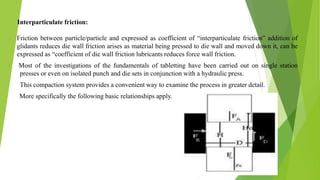
FA=FL+FD
FA=force applied to the upper punch
FL= force transmitted to the lower punch
FD= reaction at the die wall to the friction at this surface.
The mean compaction force (FM):
FM = (FA+F)L/2
A recent report confirms that FM offers a practical friction- independent measure
of
compaction load, which is generally more relevant than FA.
The geometric mean force (FG):
FG = (FA . FL)0.5
 After compression process the material was regarded as single solid
body.
 As with all othersolids if compressional force is applied I one direction
i.e., vertical results in decrease in height and It unconfined body
accompanied by an expansion in the horizontal direction.
 Poisson ratio is the ratio between these two dimensional changes is
characteristic constant for each solid.
 If material is confined to die then it is not free to expand in the horizontal
plane.
• Die wall lubrication:
Die wall lubricants act by forming a film of low shear strength between tabletting
mass and die wall
Chemical bonding occurs between boundary lubricant and the surface of the die
wall as well as at the edge of the tablet
• A radial die wall force FR develops perpendicular to diewall
• Materials with larger Poisson ratios giving rise to higher FR
values.
 Best lubricants have low shear strength but strong cohesive
tendencies at right angles to the
plane of shear. Shear strength of lubricants can be measure by
“punch penetration”.
 Ejection force:
 Radial die wall forces and die wall friction affect the ejection of tablet.
 Force required to eject a tablet follows 3 stages.
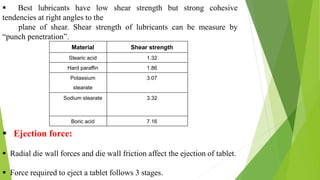
Material Shear strength
Stearic acid 1.32
Hard paraffin 1.86
Potassium
stearate
3.07
Sodium stearate 3.32
Boric acid 7.16
1. A peak required to ejection by breaking of tablet and die wall
adhesions.
2. A smaller force required to push the tablet up the die wall.
3.Declining force of ejection as the tablet emerges from the die.
 Variations in this pattern occurs especially when lubrication is
inadequate, slip-stick
conditions. Worn dies causes the die bore to become barrel shaped
and may leads to
structural failure of tablets .Ex: well lubricated system has low FE.
 After the completion of compression air spaces are removed i.e Vb=Vt and
E=0.
 Residual porosity is required, a relation exists between applied force FA and
remaining
 porosity ‘E’. Decreased porosity was due to. Filling of air spaces by
interparticulate slippage
 Filling of small voids by deformation (or) fragmentation at higher loads.
This process was
expressed as
E0= initial porosity
E = porosity at pressure P
K1 K2 K3 K4 = constants
 COMPACTION ANALYSIS:
Compaction is analysed by compaction simulators , which are attached to
punching machines. These simulators collect or measure the data from forces on
punches, displacement of punches, die wall friction, ejection force and temperature
change. From these data we can study the impact of force on tablet.
 COMPACTION PROFILES:
Compaction data obtained from tableting machine are 3 types:
1. Force-time profile
2. Force- displacement profile
3. Die wall force profile .
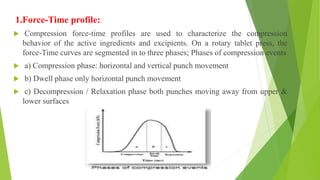
1.Force-Time profile:
 Compression force-time profiles are used to characterize the compression
behavior of the active ingredients and excipients. On a rotary tablet press, the
force-Time curves are segmented in to three phases; Phases of compression events
 a) Compression phase: horizontal and vertical punch movement
 b) Dwell phase only horizontal punch movement
 c) Decompression / Relaxation phase both punches moving away from upper &
lower surfaces
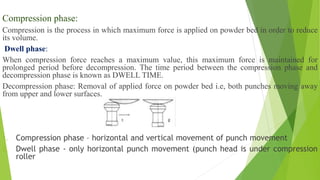
Compression phase:
Compression is the process in which maximum force is applied on powder bed in order to reduce
its volume.
Dwell phase:
When compression force reaches a maximum value, this maximum force is maintained for
prolonged period before decompression. The time period between the compression phase and
decompression phase is known as DWELL TIME.
Decompression phase: Removal of applied force on powder bed i.e, both punches moving away
from upper and lower surfaces.
1. Compression phase – horizontal and vertical movement of punch movement
2. Dwell phase - only horizontal punch movement (punch head is under compression
roller
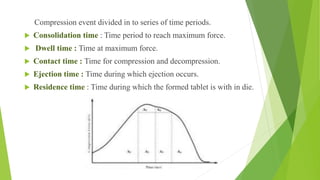
Compression event divided in to series of time periods.
 Consolidation time : Time period to reach maximum force.
 Dwell time : Time at maximum force.
 Contact time : Time for compression and decompression.
 Ejection time : Time during which ejection occurs.
 Residence time : Time during which the formed tablet is with in die.
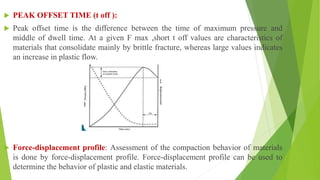
 PEAK OFFSET TIME (t off ):
 Peak offset time is the difference between the time of maximum pressure and
middle of dwell time. At a given F max ,short t off values are characteristics of
materials that consolidate mainly by brittle fracture, whereas large values indicates
an increase in plastic flow.
 Force-displacement profile: Assessment of the compaction behavior of materials
is done by force-displacement profile. Force-displacement profile can be used to
determine the behavior of plastic and elastic materials.
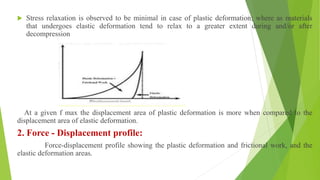
 Stress relaxation is observed to be minimal in case of plastic deformation; where as materials
that undergoes elastic deformation tend to relax to a greater extent during and/or after
decompression
At a given f max the displacement area of plastic deformation is more when compared to the
displacement area of elastic deformation.
2. Force - Displacement profile:
Force-displacement profile showing the plastic deformation and frictional work, and the
elastic deformation areas.
 DIE WALL FORCE PROFILE:
During tableting friction arises between the material and the die wall
and also between particles (Interparticulate or internal friction). Internal friction is
significant only during particle slippage and rearrangement at low applied pressures.
The coefficients of friction related to tableting process are;
 a) Static friction
 b) Dynamic friction.
 Static friction : Force require to initiate sliding
 Dynamic friction: Force to maintain sliding between two surfaces
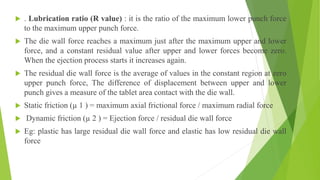
 . Lubrication ratio (R value) : it is the ratio of the maximum lower punch force
to the maximum upper punch force.
 The die wall force reaches a maximum just after the maximum upper and lower
force, and a constant residual value after upper and lower forces become zero.
When the ejection process starts it increases again.
 The residual die wall force is the average of values in the constant region at zero
upper punch force, The difference of displacement between upper and lower
punch gives a measure of the tablet area contact with the die wall.
 Static friction (µ 1 ) = maximum axial frictional force / maximum radial force
 Dynamic friction (µ 2 ) = Ejection force / residual die wall force
 Eg: plastic has large residual die wall force and elastic has low residual die wall
force
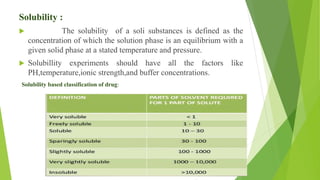
Solubility :
 The solubility of a soli substances is defined as the
concentration of which the solution phase is an equilibrium with a
given solid phase at a stated temperature and pressure.
 Solubillity experiments should have all the factors like
PH,temperature,ionic strength,and buffer concentrations.
Solubility based classification of drug:
Techniques of solubility enhancement
1. physical Modification:
A. Particle size reduction
1. Microionization 3.sonocrystalization
2. Nanosuspension 4.supercritical fluid process
B. Modification of the crystal habit
1.polymorphs 2.pseudopolymorphs
C. Drug dispersion in carriers
1.Eutectic mixtures 2.solid despersion
3.solid solutions
D. Complexation
Use of complexing agent
E. Solubilization by surfactant
Microemulsion
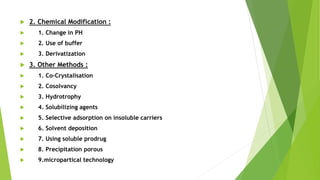
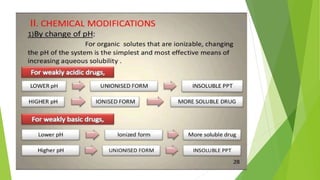
 2. Chemical Modification :
 1. Change in PH
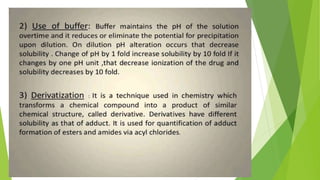
 2. Use of buffer
 3. Derivatization
 3. Other Methods :
 1. Co-Crystalisation
 2. Cosolvancy
 3. Hydrotrophy
 4. Solubilizing agents
 5. Selective adsorption on insoluble carriers
 6. Solvent deposition
 7. Using soluble prodrug
 8. Precipitation porous
 9.micropartical technology
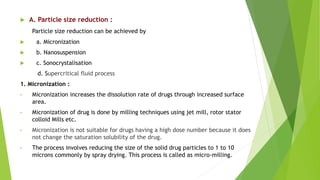
 A. Particle size reduction :
Particle size reduction can be achieved by
 a. Micronization
 b. Nanosuspension
 c. Sonocrystalisation
d. Supercritical fluid process
1. Micronization :
• Micronization increases the dissolution rate of drugs through increased surface
area.
• Micronization of drug is done by milling techniques using jet mill, rotor stator
colloid Mills etc.
• Micronization is not suitable for drugs having a high dose number because it does
not change the saturation solubility of the drug.
• The process involves reducing the size of the solid drug particles to 1 to 10
microns commonly by spray drying. This process is called as micro-milling.
 2. Sonocrystalisation :
• Particle size reduction on the basis of crystallisation by using
ultrasound is sonocrystalisation.
• Sonocrystalisation utilized ultrasound power for inducing
crystallisation.
• It not only enhances the nucleation rate but also an effective
means of size reduction and controlling size distribution of the
active pharmaceutical ingredients.
• Most applications use ultrasound in the range 20kHz-5MHz.
 Cosolvency :
• The solubility of poorly soluble drugs in water can be increased by mixing it with some
water miscible solvent in which the drug is readily soluble.
• This process is known as cosolvency and the solvent used in combination are known as
cosolvent.
• Cosolvent system works by reducing the interfacial tension between the aqueous
solution and hydrophobic solute.
• It is also commonly known as solvent blending. There is a dramatic change in the
solubility of drugs by addition of organic co-solvent into the water.
• The cosolvents are having hydrogen acceptor or donor groups with a small hydrocarbon
region.
• The hydrophobic hydrocarbon region usually interferes with the hydrogen bonding
network of water which consequently reduces the intermolecular attraction of water
while the hydrophilic hydrogen bonds ensures water solubility.
 Hydrotropy:
• The term hydropic agent was first introduced by Neuberg (1916) to designate anionic organic
salts.
• Hydrotropy is defined as a solubilisation process where by addition of a large amount of second
solute results in an increase in the aqueous solubility of another solute and the chemicals which
are used in hydrotropy are called as hydrotropes.
 Ex: Sodium benzoate, urea, Ibuprofen Sodium etc
• The chemical structure of the conventional Neuberg's hydrotropic salts consists of two essential
parts, an anionic group and a hydrotropic aromatic ring or ring system.
• Hydrotropic agents are ionic organic salts
• Additives or salts that increase solubility in given solvent are said to "salt in" the solute & those
salts that decrease solubility "salt out" the solute.
• Several salts with large anions or cations that are themselves very soluble in water result in
"salting in" of non electrolytes called "hydrotropic salts" a phenomenon known as
"hydrotropism".
• Hydrotropic solution do not show colloidal properties and involve a weak interaction between the
hydrotropic agent and solute.
compaction of tablet

compaction of tablet

  • 1.
  • 2.
    Interparticulate friction:  Frictionbetween particle/particle and expressed as coefficient of “interparticulate friction” addition of glidants reduces die wall friction arises as material being pressed to die wall and moved down it, can be expressed as “coefficient of die wall friction lubricants reduces force wall friction.  Most of the investigations of the fundamentals of tabletting have been carried out on single station presses or even on isolated punch and die sets in conjunction with a hydraulic press. This compaction system provides a convenient way to examine the process in greater detail. More specifically the following basic relationships apply.
  • 3.
    FA=FL+FD FA=force applied tothe upper punch FL= force transmitted to the lower punch FD= reaction at the die wall to the friction at this surface. The mean compaction force (FM): FM = (FA+F)L/2 A recent report confirms that FM offers a practical friction- independent measure of compaction load, which is generally more relevant than FA.
  • 4.
    The geometric meanforce (FG): FG = (FA . FL)0.5  After compression process the material was regarded as single solid body.  As with all othersolids if compressional force is applied I one direction i.e., vertical results in decrease in height and It unconfined body accompanied by an expansion in the horizontal direction.  Poisson ratio is the ratio between these two dimensional changes is characteristic constant for each solid.  If material is confined to die then it is not free to expand in the horizontal plane.
  • 5.
    • Die walllubrication: Die wall lubricants act by forming a film of low shear strength between tabletting mass and die wall Chemical bonding occurs between boundary lubricant and the surface of the die wall as well as at the edge of the tablet • A radial die wall force FR develops perpendicular to diewall • Materials with larger Poisson ratios giving rise to higher FR values.
  • 6.
     Best lubricantshave low shear strength but strong cohesive tendencies at right angles to the plane of shear. Shear strength of lubricants can be measure by “punch penetration”.  Ejection force:  Radial die wall forces and die wall friction affect the ejection of tablet.  Force required to eject a tablet follows 3 stages. Material Shear strength Stearic acid 1.32 Hard paraffin 1.86 Potassium stearate 3.07 Sodium stearate 3.32 Boric acid 7.16
  • 7.
    1. A peakrequired to ejection by breaking of tablet and die wall adhesions. 2. A smaller force required to push the tablet up the die wall. 3.Declining force of ejection as the tablet emerges from the die.  Variations in this pattern occurs especially when lubrication is inadequate, slip-stick conditions. Worn dies causes the die bore to become barrel shaped and may leads to structural failure of tablets .Ex: well lubricated system has low FE.
  • 8.
     After thecompletion of compression air spaces are removed i.e Vb=Vt and E=0.  Residual porosity is required, a relation exists between applied force FA and remaining  porosity ‘E’. Decreased porosity was due to. Filling of air spaces by interparticulate slippage  Filling of small voids by deformation (or) fragmentation at higher loads. This process was expressed as E0= initial porosity E = porosity at pressure P K1 K2 K3 K4 = constants
  • 9.
     COMPACTION ANALYSIS: Compactionis analysed by compaction simulators , which are attached to punching machines. These simulators collect or measure the data from forces on punches, displacement of punches, die wall friction, ejection force and temperature change. From these data we can study the impact of force on tablet.  COMPACTION PROFILES: Compaction data obtained from tableting machine are 3 types: 1. Force-time profile 2. Force- displacement profile 3. Die wall force profile .
  • 10.
    1.Force-Time profile:  Compressionforce-time profiles are used to characterize the compression behavior of the active ingredients and excipients. On a rotary tablet press, the force-Time curves are segmented in to three phases; Phases of compression events  a) Compression phase: horizontal and vertical punch movement  b) Dwell phase only horizontal punch movement  c) Decompression / Relaxation phase both punches moving away from upper & lower surfaces
  • 11.
    Compression phase: Compression isthe process in which maximum force is applied on powder bed in order to reduce its volume. Dwell phase: When compression force reaches a maximum value, this maximum force is maintained for prolonged period before decompression. The time period between the compression phase and decompression phase is known as DWELL TIME. Decompression phase: Removal of applied force on powder bed i.e, both punches moving away from upper and lower surfaces. 1. Compression phase – horizontal and vertical movement of punch movement 2. Dwell phase - only horizontal punch movement (punch head is under compression roller
  • 12.
    Compression event dividedin to series of time periods.  Consolidation time : Time period to reach maximum force.  Dwell time : Time at maximum force.  Contact time : Time for compression and decompression.  Ejection time : Time during which ejection occurs.  Residence time : Time during which the formed tablet is with in die.
  • 13.
     PEAK OFFSETTIME (t off ):  Peak offset time is the difference between the time of maximum pressure and middle of dwell time. At a given F max ,short t off values are characteristics of materials that consolidate mainly by brittle fracture, whereas large values indicates an increase in plastic flow.  Force-displacement profile: Assessment of the compaction behavior of materials is done by force-displacement profile. Force-displacement profile can be used to determine the behavior of plastic and elastic materials.
  • 14.
     Stress relaxationis observed to be minimal in case of plastic deformation; where as materials that undergoes elastic deformation tend to relax to a greater extent during and/or after decompression At a given f max the displacement area of plastic deformation is more when compared to the displacement area of elastic deformation. 2. Force - Displacement profile: Force-displacement profile showing the plastic deformation and frictional work, and the elastic deformation areas.
  • 15.
     DIE WALLFORCE PROFILE: During tableting friction arises between the material and the die wall and also between particles (Interparticulate or internal friction). Internal friction is significant only during particle slippage and rearrangement at low applied pressures. The coefficients of friction related to tableting process are;  a) Static friction  b) Dynamic friction.  Static friction : Force require to initiate sliding  Dynamic friction: Force to maintain sliding between two surfaces
  • 16.
     . Lubricationratio (R value) : it is the ratio of the maximum lower punch force to the maximum upper punch force.  The die wall force reaches a maximum just after the maximum upper and lower force, and a constant residual value after upper and lower forces become zero. When the ejection process starts it increases again.  The residual die wall force is the average of values in the constant region at zero upper punch force, The difference of displacement between upper and lower punch gives a measure of the tablet area contact with the die wall.  Static friction (µ 1 ) = maximum axial frictional force / maximum radial force  Dynamic friction (µ 2 ) = Ejection force / residual die wall force  Eg: plastic has large residual die wall force and elastic has low residual die wall force
  • 17.
    Solubility :  Thesolubility of a soli substances is defined as the concentration of which the solution phase is an equilibrium with a given solid phase at a stated temperature and pressure.  Solubillity experiments should have all the factors like PH,temperature,ionic strength,and buffer concentrations. Solubility based classification of drug:
  • 18.
    Techniques of solubilityenhancement 1. physical Modification: A. Particle size reduction 1. Microionization 3.sonocrystalization 2. Nanosuspension 4.supercritical fluid process B. Modification of the crystal habit 1.polymorphs 2.pseudopolymorphs C. Drug dispersion in carriers 1.Eutectic mixtures 2.solid despersion 3.solid solutions D. Complexation Use of complexing agent E. Solubilization by surfactant Microemulsion
  • 19.
     2. ChemicalModification :  1. Change in PH  2. Use of buffer  3. Derivatization  3. Other Methods :  1. Co-Crystalisation  2. Cosolvancy  3. Hydrotrophy  4. Solubilizing agents  5. Selective adsorption on insoluble carriers  6. Solvent deposition  7. Using soluble prodrug  8. Precipitation porous  9.micropartical technology
  • 20.
     A. Particlesize reduction : Particle size reduction can be achieved by  a. Micronization  b. Nanosuspension  c. Sonocrystalisation d. Supercritical fluid process 1. Micronization : • Micronization increases the dissolution rate of drugs through increased surface area. • Micronization of drug is done by milling techniques using jet mill, rotor stator colloid Mills etc. • Micronization is not suitable for drugs having a high dose number because it does not change the saturation solubility of the drug. • The process involves reducing the size of the solid drug particles to 1 to 10 microns commonly by spray drying. This process is called as micro-milling.
  • 21.
     2. Sonocrystalisation: • Particle size reduction on the basis of crystallisation by using ultrasound is sonocrystalisation. • Sonocrystalisation utilized ultrasound power for inducing crystallisation. • It not only enhances the nucleation rate but also an effective means of size reduction and controlling size distribution of the active pharmaceutical ingredients. • Most applications use ultrasound in the range 20kHz-5MHz.
  • 24.
     Cosolvency : •The solubility of poorly soluble drugs in water can be increased by mixing it with some water miscible solvent in which the drug is readily soluble. • This process is known as cosolvency and the solvent used in combination are known as cosolvent. • Cosolvent system works by reducing the interfacial tension between the aqueous solution and hydrophobic solute. • It is also commonly known as solvent blending. There is a dramatic change in the solubility of drugs by addition of organic co-solvent into the water. • The cosolvents are having hydrogen acceptor or donor groups with a small hydrocarbon region. • The hydrophobic hydrocarbon region usually interferes with the hydrogen bonding network of water which consequently reduces the intermolecular attraction of water while the hydrophilic hydrogen bonds ensures water solubility.
  • 25.
     Hydrotropy: • Theterm hydropic agent was first introduced by Neuberg (1916) to designate anionic organic salts. • Hydrotropy is defined as a solubilisation process where by addition of a large amount of second solute results in an increase in the aqueous solubility of another solute and the chemicals which are used in hydrotropy are called as hydrotropes.  Ex: Sodium benzoate, urea, Ibuprofen Sodium etc • The chemical structure of the conventional Neuberg's hydrotropic salts consists of two essential parts, an anionic group and a hydrotropic aromatic ring or ring system. • Hydrotropic agents are ionic organic salts • Additives or salts that increase solubility in given solvent are said to "salt in" the solute & those salts that decrease solubility "salt out" the solute. • Several salts with large anions or cations that are themselves very soluble in water result in "salting in" of non electrolytes called "hydrotropic salts" a phenomenon known as "hydrotropism". • Hydrotropic solution do not show colloidal properties and involve a weak interaction between the hydrotropic agent and solute.