These guidelines were prepared for the Government of Nepal, Ministry of
Education Science and Technology with financial support from USAID and
technical assistance of NDRC and UNICEF.
COMPREHENSIVE SCHOOL SAFETY
IMPLEMENTATION GUIDELINES
The Government of Nepal
Ministry of Education Science and Technology
Singhadurbar
2075
The Government of Nepal
Ministry of Education Science and Technology
Singhadurbar
Phone: 014200383
Website: www.moest.gov.np
Email: info@moe.gov.np
© Ministry of Education Science and Technology, Singhadurbar
Publisher:
Ministry of Education Science and Technology, Singhadurbar
Citation
Comprehensive School Safety Implementation Guidelines 2075,
Ministry of Education Science and Technology, Singhadurbar
COMPREHENSIVE SCHOOL SAFETY
IMPLEMENTATION GUIDELINES
The Government of Nepal
Ministry of Education Science and Technology
Singhadurbar
2075
(Approved by the Office of the Minister, Ministry of Education Science and
Technology on 25th of February, 2019)
•	 These Comprehensive School Safety Implementation Guidelines (the guidelines) are a comprehensive
standalone guide for schools and local governments to implement the Government of Nepal’s Comprehensive
School Safety Minimum Package.
•	 These guidelines have been developed to guide the implementation of the CSS Minimum Package (CEHRD
2018a). They specify how to implement the minimum activities that were envisaged under the School Sector
Development Plan (SSDP) 2016–2023 (MoE 2016) and provisioned in the CSS Master Plan (MoEST 2017).
A separate CSS Communication and Dissemination Strategy guides government agencies and supporting
partners to run and support campaigns to communicate and disseminate key messages on CSS and promote
the implementation of CSS (CEHRD 2018b).
•	 These guidelines cover the minimum activities that need to be implemented to achieve a minimum level of
safety in schools. However, it is recommended that schools implement other measures to aim for maximum
school safety to (i) protect students and teachers from death, injury and harm in school; (ii) enable school
continuity after foreseeable disasters and emergencies; (iii) safeguard investments in the education sector;
and (iv) strengthen risk reduction and resilience through education.
•	 Students are the main intended beneficiaries and are key actors for comprehensive school safety and hence,
they should participate in the assessment, planning and execution of the CSS process. The guidelines stress
that school management committees (SMCs) and teachers should be fully aware of and accountable towards
their students and ensure students’ engagement in implementing CSS as far as is possible and practical.
•	 A central focus of these guidelines is the production and annual updating of CSS action plans as an integral
part of school improvement plans (SIPs) to plan and budget for CSS activities.
The overall objective of these guidelines is to guide the operationalization of the CSS Minimum Package in a
systematic and strategic way, including by specifying the roles and responsibilities of stakeholders to promote the
minimum level of school safety at all levels of public and private schools including early childhood development
centres.
The specific objectives of the guidelines are as follows:
•	 To improve the safety of schools’ physical infrastructure through construction, reconstruction and
retrofitting that addresses potential hazard risks.
•	 To facilitate the mainstreaming and institutionalization of disaster risk management in school education in
federal, provincial and local governments and schools.
•	 To provide a reference guide to develop and integrate CSS into curricula and teaching-learning practices
and to disseminate related guidance to students, teachers, SMCs and parent-teachers associations (PTAs).
•	 To support institutional capacity and readiness in the education sector to meet the above objectives,
especially developing the capacity of schools and local governments to implement the Minimum Package.
ABOUT THE COMPREHENSIVE SCHOOL SAFETY IMPLEMENTATION GUIDELINES
a. What are the CSS Implementation Guidelines?
b. The objectives of the CSS Implementation Guidelines
These guidelines are designed specifically for schools and local governments and overall for the range of
education sector stakeholders, who include government and non-government agencies, development partners
working on education and disaster risk reduction (DRR), planners, policymakers, programme developers, CSS
programme-facilitating agencies, and provincial and federal governments.
These guidelines contain the introduction and background in Chapter 1, the guidelines for schools and local,
provincial, and federal governments in Chapter 2 and more than 30 annexes of practical and technical tools
and guides for implementing CSS. The guidelines in Chapter 2 are the heart of the document. They present the
activities that need to be carried out including step-wise guides for each activity.
The primary users of these guidelines are schools and local governments:
•	 Schools – The guidelines guide members of SMCs, PTAs, head teachers, CSS focal teachers, GESI focal
teachers, teachers, parents, and child clubs to implement activities to achieve the minimum level of safety
in schools.
•	 Local government – The guidelines guide elected local representatives and education officials, (including
engineers, district education development coordination units [EDCUs], local government education and
DRR committees), to assist decision-making on school safety, resource allocation, monitoring, and the
preparation of local education regulations.
The secondary users are provincial and federal governments, and district education development coordination
units:
•	 District education development coordination units – The guidelines guide the units to collect and
disseminate information in coordination with all local governments, schools and other organizations within
the district, and to facilitate monitoring and reporting.
•	 Provincial governments – The guidelines guide provincial ministries of social development and other
province-level education stakeholders to build an enabling policy environment for school safety, to harmonize
norms and standards, to enable decision-making, to allocate resources, to monitor CSS activities, and to
manage data under their education management information system (EMIS).
•	 The federal government – The guidelines guide the Ministry of Education, Science and Technology
(MoEST), the Centre for Education and Human Resource Development (CEHRD), MoEST’s Central Level
Project Implementation Unit (CLPIU), and other central level education stakeholders to develop an enabling
CSS policy environment, to harmonize CSS norms and standards, to enable CSS-related decision-making,
to guide the allocation of resources for CSS, and to support CSS data management.
The guidelines also serve as reference material for other education-related stakeholders, including development
partners, United Nations agencies, international and national non-governmental organizations and community-
based organizations working on school safety.
c. Who are the CSS Implementation Guidelines for?
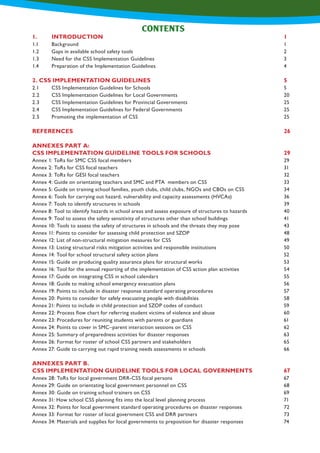
These guidelines are a reference document for implementing the school safety activities in the CSS Minimum
Package. The Minimum Package categorizes essential school safety activities on the basis of the three pillars
of the CSS framework of (i) safe learning facilities, (ii) school disaster management, and (iii) risk reduction and
resilience education.
These guidelines categorize CSS activities based on the respective roles of schools and local governments for
local planning, budgeting, and monitoring and evaluation (M&E), rather than grouping them pillar-wise.
In the past, the implementation of Pillar 1 on safe learning facilities was emphasised than the other two pillars.
However, Pillar 1 was seen as involving technical tasks that only governments and technical experts could
implement meaning that local stakeholders only had limited involvement. These Implementation Guidelines
therefore take the more user-friendly approach of recommending, enabling and specifying the greater involvement
of school and local government stakeholders across all activities. The guidelines cover activities under all three
pillars and recognize that all three pillars need to be addressed simultaneously to ensure comprehensive school
safety.
These guidelines guide the preparation and updating of school improvement plan (SIPs) and the Minimum
Package activities in SIP’s CSS action plans. The guidelines also help annual planning, resource mobilization, and
budget allocation on CSS by local governments.
The guidelines indicate how schools and local, provincial, and federal governments can cooperate to achieve
comprehensive school safety. They provide step-wise activities for making schools safer. While doing so,
the physical and social barriers faced by vulnerable children (adolescent girls, children with disabilities, Dalit
students, and students from socially excluded castes and groups), and pregnant or lactating teachers and SMC
members are also considered.
The users of these guidelines are encouraged to adapt the activities and the tools and other things provided in
the annexes to their own contexts, such as by preparing context-specific training and orientation models that
address the main types of local hazards.
These guidelines are meant to be a dynamic document and should be regularly revised based on good practices
and lesson learned.
d. How should the CSS Implementation Guidelines be used?
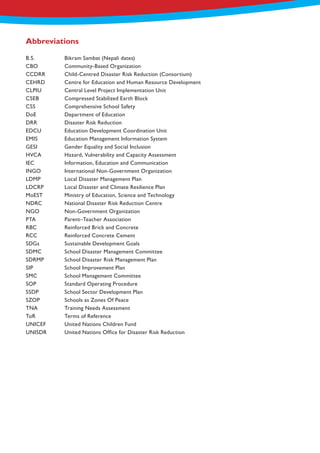
CONTENTS
1.	INTRODUCTION										1
1.1	 Background											 1
1.2	 Gaps in available school safety tools								 2
1.3	 Need for the CSS Implementation Guidelines							 3
1.4	 Preparation of the Implementation Guidelines							 4
2. CSS IMPLEMENTATION GUIDELINES							5
2.1	 CSS Implementation Guidelines for Schools							 5
2.2	 CSS Implementation Guidelines for Local Governments						 20
2.3	 CSS Implementation Guidelines for Provincial Governments					 25
2.4	 CSS Implementation Guidelines for Federal Governments						 25
2.5	 Promoting the implementation of CSS 								 25
REFERENCES											26
ANNEXES PART A:
CSS IMPLEMENTATION GUIDELINE TOOLS FOR SCHOOLS				 29
Annex 1: ToRs for SMC CSS focal members								 29
Annex 2: ToRs for CSS focal teachers									 31
Annex 3: ToRs for GESI focal teachers									 32
Annex 4: Guide on orientating teachers and SMC and PTA 	members on CSS				 33
Annex 5: Guide on training school families, youth clubs, child clubs, NGOs and CBOs on CSS			 34
Annex 6: Tools for carrying out hazard, vulnerability and capacity assessments (HVCAs)			 36
Annex 7: Tools to identify structures in schools								 39
Annex 8: Tool to identify hazards in school areas and assess exposure of structures to hazards		 40
Annex 9: Tool to assess the safety sensitivity of structures other than school buildings			 41
Annex 10: Tools to assess the safety of structures in schools and the threats they may pose			 43
Annex 11: Points to consider for assessing child protection and SZOP					 48
Annex 12: List of non-structural mitigation measures for CSS						 49
Annex 13: Listing structural risks mitigation activities and responsible institutions				 50
Annex 14: Tool for school structural safety action plans							 52
Annex 15: Guide on producing quality assurance plans for structural works					 53
Annex 16: Tool for the annual reporting of the implementation of CSS action plan activities			 54
Annex 17: Guide on integrating CSS in school calendars							 55
Annex 18: Guide to making school emergency evacuation plans						 56
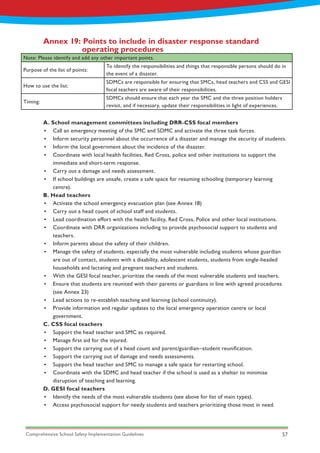
Annex 19: Points to include in disaster response standard operating procedures				 57
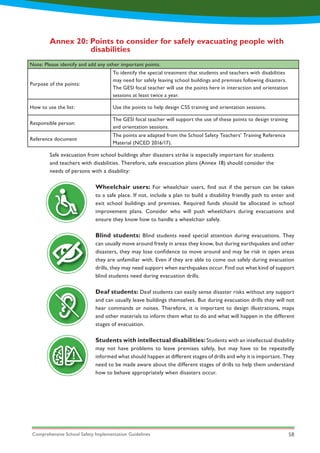
Annex 20: Points to consider for safely evacuating people with disabilities					 58
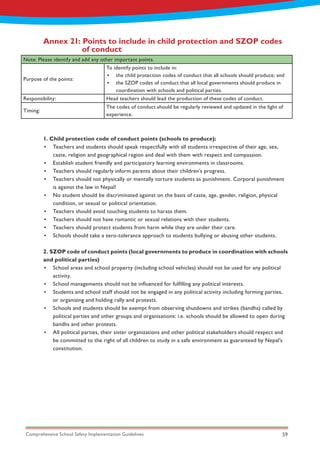
Annex 21: Points to include in child protection and SZOP codes of conduct					 59
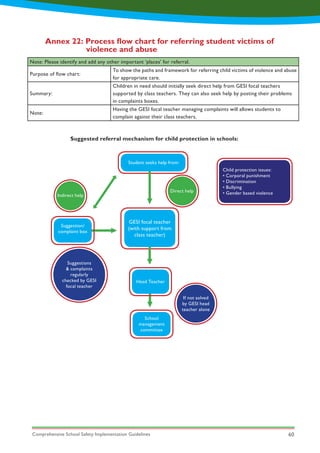
Annex 22: Process flow chart for referring student victims of violence and abuse				 60
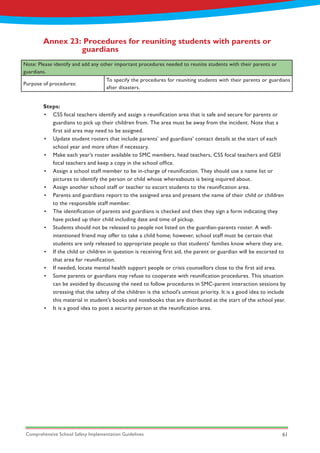
Annex 23: Procedures for reuniting students with parents or guardians					 61
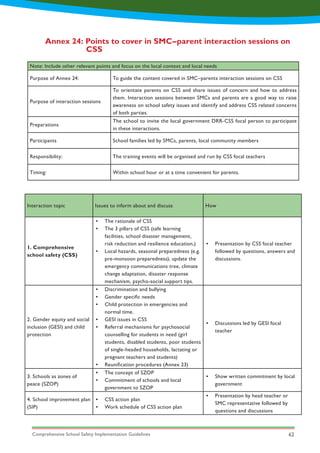
Annex 24: Points to cover in SMC–parent interaction sessions on CSS					 62
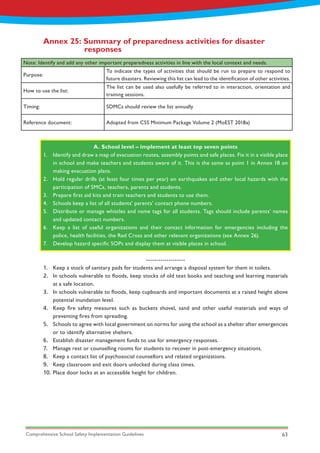
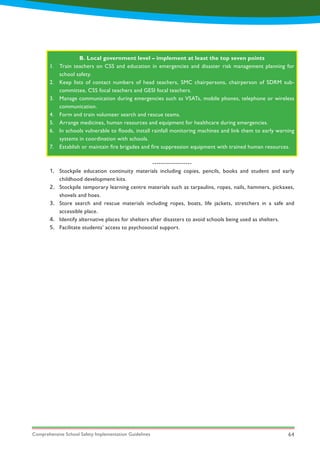
Annex 25: Summary of preparedness activities for disaster responses					 63
Annex 26: Format for roster of school CSS partners and stakeholders					 65
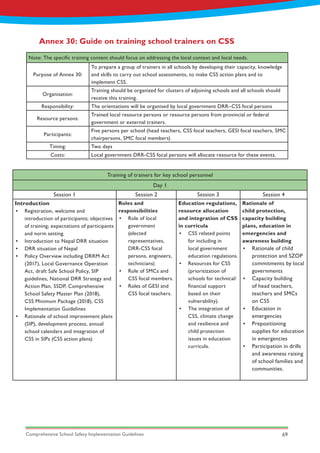
Annex 27: Guide to carrying out rapid training needs assessments in schools					 66
ANNEXES PART B.
CSS IMPLEMENTATION GUIDELINE TOOLS FOR LOCAL GOVERNMENTS		 67
Annex 28: ToRs for local government DRR-CSS focal persons						 67
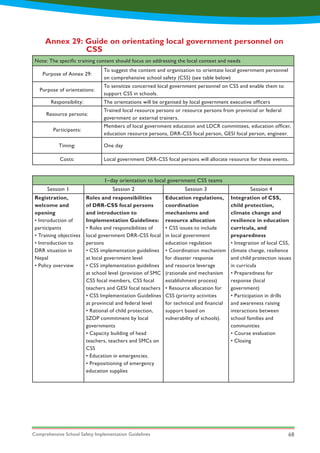
Annex 29: Guide on orientating local government personnel on CSS						 68
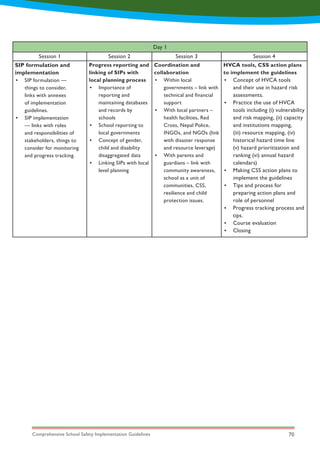
Annex 30: Guide on training school trainers on CSS							 69
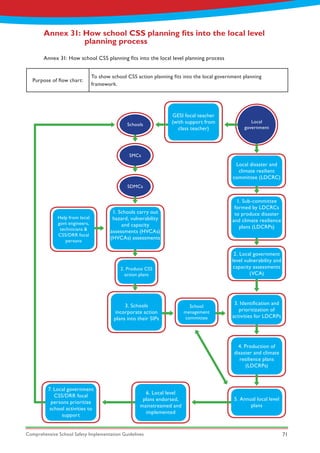
Annex 31: How school CSS planning fits into the local level 	planning process					 71
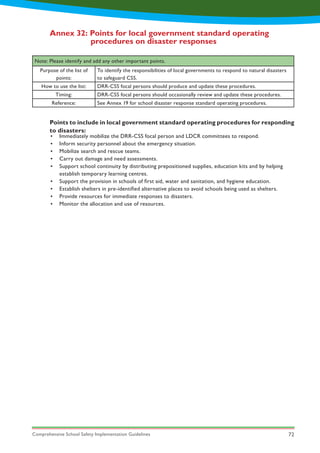
Annex 32: Points for local government standard operating procedures on disaster responses			 72
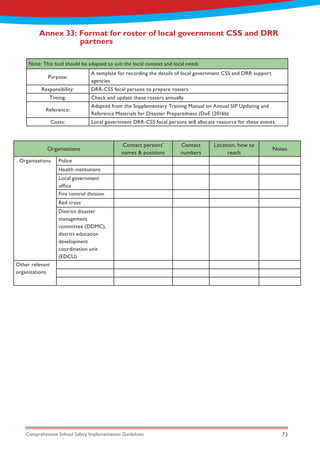
Annex 33: Format for roster of local government CSS and DRR partners					 73
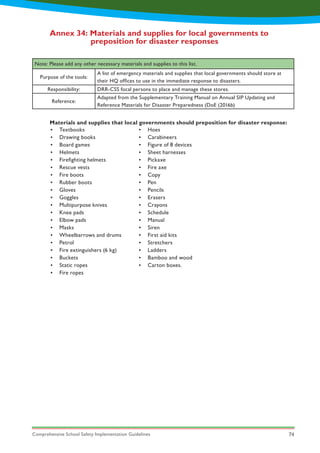
Annex 34: Materials and supplies for local governments to preposition for disaster responses			 74
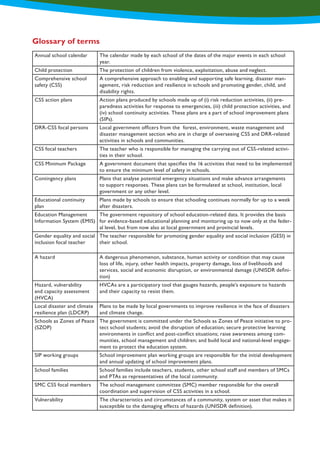
B.S.		 Bikram Sambat (Nepali dates)
CBO		 Community-Based Organization
CCDRR	 Child-Centred Disaster Risk Reduction (Consortium)
CEHRD 	 Centre for Education and Human Resource Development
CLPIU		 Central Level Project Implementation Unit
CSEB		 Compressed Stabilized Earth Block
CSS		 Comprehensive School Safety
DoE		 Department of Education
DRR		 Disaster Risk Reduction
EDCU		 Education Development Coordination Unit
EMIS		 Education Management Information System
GESI		 Gender Equality and Social Inclusion
HVCA		 Hazard, Vulnerability and Capacity Assessment
IEC		 Information, Education and Communication
INGO		 International Non-Government Organization
LDMP		 Local Disaster Management Plan
LDCRP		 Local Disaster and Climate Resilience Plan
MoEST		 Ministry of Education, Science and Technology
NDRC		 National Disaster Risk Reduction Centre
NGO		 Non-Government Organization
PTA		 Parent–Teacher Association
RBC		 Reinforced Brick and Concrete
RCC		 Reinforced Concrete Cement
SDGs		 Sustainable Development Goals
SDMC		 School Disaster Management Committee
SDRMP		 School Disaster Risk Management Plan
SIP		 School Improvement Plan
SMC		 School Management Committee
SOP		 Standard Operating Procedure
SSDP		 School Sector Development Plan
SZOP		 Schools as Zones Of Peace
TNA		 Training Needs Assessment
ToR		 Terms of Reference
UNICEF	 United Nations Children Fund
UNISDR	 United Nations Office for Disaster Risk Reduction
Abbreviations
Glossary of terms
Annual school calendar The calendar made by each school of the dates of the major events in each school
year.
Child protection The protection of children from violence, exploitation, abuse and neglect.
Comprehensive school
safety (CSS)
A comprehensive approach to enabling and supporting safe learning, disaster man-
agement, risk reduction and resilience in schools and promoting gender, child, and
disability rights.
CSS action plans Action plans produced by schools made up of (i) risk reduction activities, (ii) pre-
paredness activities for response to emergencies, (iii) child protection activities, and
(iv) school continuity activities. These plans are a part of school improvement plans
(SIPs).
DRR-CSS focal persons Local government officers from the forest, environment, waste management and
disaster management section who are in charge of overseeing CSS and DRR-related
activities in schools and communities.
CSS focal teachers The teacher who is responsible for managing the carrying out of CSS-related activi-
ties in their school.
CSS Minimum Package A government document that specifies the 16 activities that need to be implemented
to ensure the minimum level of safety in schools.
Contingency plans Plans that analyse potential emergency situations and make advance arrangements
to support responses. These plans can be formulated at school, institution, local
government or any other level.
Educational continuity
plan
Plans made by schools to ensure that schooling continues normally for up to a week
after disasters.
Education Management
Information System (EMIS)
The government repository of school education-related data. It provides the basis
for evidence-based educational planning and monitoring up to now only at the feder-
al level, but from now also at local government and provincial levels.
Gender equality and social
inclusion focal teacher
The teacher responsible for promoting gender equality and social inclusion (GESI) in
their school.
A hazard A dangerous phenomenon, substance, human activity or condition that may cause
loss of life, injury, other health impacts, property damage, loss of livelihoods and
services, social and economic disruption, or environmental damage (UNISDR defini-
tion)
Hazard, vulnerability
and capacity assessment
(HVCA)
HVCAs are a participatory tool that gauges hazards, people's exposure to hazards
and their capacity to resist them.
Local disaster and climate
resilience plan (LDCRP)
Plans to be made by local governments to improve resilience in the face of disasters
and climate change.
Schools as Zones of Peace
(SZOP)
The government is committed under the Schools as Zones of Peace initiative to pro-
tect school students; avoid the disruption of education; secure protective learning
environments in conflict and post-conflict situations; raise awareness among com-
munities, school management and children; and build local and national-level engage-
ment to protect the education system.
SIP working groups School improvement plan working groups are responsible for the initial development
and annual updating of school improvement plans.
School families School families include teachers, students, other school staff and members of SMCs
and PTAs as representatives of the local community.
SMC CSS focal members The school management committee (SMC) member responsible for the overall
coordination and supervision of CSS activities in a school.
Vulnerability The characteristics and circumstances of a community, system or asset that makes it
susceptible to the damaging effects of hazards (UNISDR definition).
Comprehensive School Safety Implementation Guidelines 1
The Comprehensive School Safety Master Plan aims to ensure every child’s right to access quality education
in safe learning environments (MoEST2017). The government’s strategic plan for the school sector – the
School Sector Development Plan (SSDP) (2016/17–2022/23), highlights comprehensive school safety (CSS)
as a key component to increase the resilience of the education system to disasters and hazards (MoE
2016). The associated CSS Minimum Package presents a set of minimum conditions needed in schools for
them to be deemed safe, including the facilitating arrangements that need to be in place at local, provincial,
and federal levels of government (CEHRD 2018a).
In Nepal, disasters regularly impact the education sector by damaging school infrastructure, disrupting
teaching and learning, forcing children to drop out of school, and shaking the resilience of local communities.
Time and again, disasters have exposed the lack of safe learning environments for most children in Nepal.
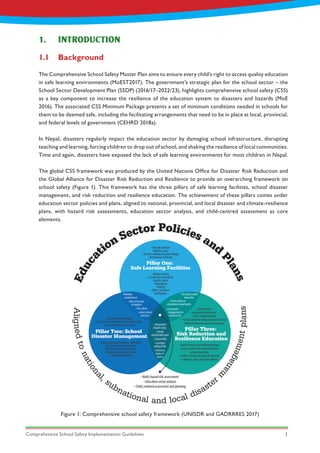
The global CSS framework was produced by the United Nations Office for Disaster Risk Reduction and
the Global Alliance for Disaster Risk Reduction and Resilience to provide an overarching framework on
school safety (Figure 1). This framework has the three pillars of safe learning facilities, school disaster
management, and risk reduction and resilience education. The achievement of these pillars comes under
education sector policies and plans, aligned to national, provincial, and local disaster and climate-resilience
plans, with hazard risk assessments, education sector analysis, and child-centred assessment as core
elements.
Figure 1: Comprehensive school safety framework (UNISDR and GADRRRES 2017)
1.	INTRODUCTION
1.1	Background
Comprehensive School Safety Implementation Guidelines 2
Although launched in 1997, and recognized as one of Nepal’s DRR flagship programmes in 2011, school safety
gained insufficient momentum in Nepal as it has not been mainstreamed in policies. The understanding of
CSS by the key education stakeholders of school management committees (SMCs) and local governments,
is limited.
Disaster risk reduction (DRR) activities are often considered as extra work and are thus given little
attention. However, a few donor-funded projects were implemented under the school DRR and
retrofitting component of Flagship 1 of the Nepal Risk Reduction Consortium (2011–2015); but the notion
of comprehensiveness was largely missing. This was evident in the aftermath of the April and May 2015
earthquakes were education recovery programmes mostly focussed on Pillar I of providing safe learning
facilities.
The Government of Nepal has taken several policy initiatives for DRR and school safety since 2008. The
School Sector Reform Plan (SSRP) (MoE 2009) led to the establishment of the Disaster Management
Section under the Department of Education (DoE) in 2011.1
The SSDP identifies school safety and resilience
education as one of the five dimensions for strengthening school education in Nepal.
The Ministry of Education developed the CSS Master Plan under the SSDP in 2017 based on the three pillars
of the global CSS framework. The Master Plan has the three associated components of a CSS Minimum
Package, CSS Implementation Guidelines, and a Comprehensive CSS Communication and Dissemination
Strategy. These Implementation Guidelines comprise a range of facilitating tools and techniques to translate
the CSS Minimum Package into action at different levels.
A variety of school safety tools and techniques have been developed by government organizations, United
Nations (UN) agencies, international and national non-government organizations (INGOs and NGOs) and
community-based organizations (CBOs).
The following are the main government policy and other documents on comprehensive school safety.
Note that they are mostly focused on federal central level concerns:
•	 Child Friendly Schools National Framework for Quality Education (DoE 2010).
•	 Supplementary Training Manual on Annual School Improvement Plan Updating and Reference Materials
for Disaster Preparedness (DoE 2016b);
•	 Contingency Plan for Nepal Education Cluster (DoE 2017b);
•	 School Improvement Plan (SIP) Development Guidelines (2017a);
•	 Nepal Safe School Policy (MoE 2017, draft);
•	 CSS Master Plan (MoEST 2017); and
•	 CSS Minimum Package (CEHRD 2018a).
NGOs and INGOs working in Nepal have developed the toolkits, standards, and guidelines for school
safety and DRR, with the major ones listed in Box 1.
1
Note that the DoE is now called the Centre for Education and Human Resource Development (CEHRD).
1.2	 Gaps in available school safety tools
Comprehensive School Safety Implementation Guidelines 3
Box 1: Toolkits, standards, and guidelines for school safety and DRR in Nepal
•	 Working Together for School Safety (Save the Children 2017/18).
•	 Teachers Resource Manual on School Safety and Teachers Professional Development: (NCED
2016/17).
•	 School-based Child-Centred Disaster Risk Reduction and Child Protection Training book,
(Lalitpur DEO and Luniva 2016).
•	 Training Manual on School-based Disaster Risk Reduction and Climate Change Adaptation (DoE,
UNICEF and NSET 2015).
•	 Safe School Policies and Practices: Good Initiatives, Gaps, Implications and the Way Forward.
(Plan International Nepal 2013a).
•	 Safe School Toolkit (Plan International Nepal 2013b).
•	 Disaster Preparedness for Safer Schools in Nepal (DPSS-2 and NRCS 2012)
•	 Guidelines to Safe School Standards for the Terai Region of Nepal. (DoE, Mercy Corps, Action
Aid Nepal and NDRC Nepal 2012).
•	 School-Based Disaster Preparedness and Facilitators Reference Book for conducting Model
Sessions (ActionAid 2010).
•	 School Safety Approach (ActionAid Nepal 2007).
However, these tools and techniques are yet to be mainstreamed into the management of schools.
Furthermore, many of them relate to specific contexts and are mostly confined to the achievement of
the objectives of particular projects, cover limited geographical areas and tend to recommend costly
interventions. There is an urgent need to integrate and align their contents and in particular align them
with the school improvement plan (SIP) development and updating process that all schools carry out.
Schools generally require the following support from their local governments:
•	 technical support on engineering; health, water, sanitation and hygiene (WASH), environment and
child protection (from violence, exploitation, abuse and neglect);
•	 financial support (materials and cash);
•	 management support for updating SIPs, for declaring schools as zones of peace (SZOP), for child
protection, and for monitoring and supervision of CSS activities; and
•	 other support including human resources, books and information, and education and communication
materials.
These CSS Implementation Guidelines enable Nepal’s schools to implement the CSS Minimum Package
and institute safe learning environments. They guide schools and local governments how to implement the
Minimum Package. They address all children’s right to education in a safe learning environment as guar-
anteed under Nepal’s Constitution (2015) and advocated for under the Child-Friendly Schools National
Framework (DoE 2010) and the draft Safe Schools Policy (MoE 2017). They present practical steps to carry
out school safety activities and incorporate interventions in annual government plans.
The guidelines present a wealth of ideas for assessing potential hazards to schools, identifying resources
available for responding to disasters, formulating school disaster management plans, integrating these
plans in SIPs to strengthen school disaster risk management. Furthermore, they pave the way for educa-
tional continuity and education in emergencies planning at the local level.
1.3	 Need for the CSS Implementation Guidelines
Comprehensive School Safety Implementation Guidelines 4
These guidelines were prepared by the Centre for Education and Human Resource Development (CEHRD),
with technical assistance from UNICEF Nepal and the National Disaster Risk Reduction Centre (NDRC),
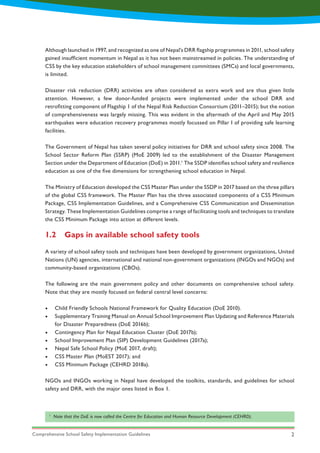
through the four steps in Figure 2:
a. Review of documents: First, existing related guidelines were reviewed to see how they aligned with
the CSS Minimum Package and to identify areas that needed modifying in light of the on-going administrative
reforms, including within MoEST. The major CSS related national legal framework documents were
identified as:
•	 The Local Disaster and Climate Resilient Planning Guidelines, 2075 (draft) (MoFALD2018).
•	 The Guidelines for Water, Sanitation and Hygiene in Schools, 2075 (draft) (DoE 2017d).
•	 The Local Government Operations Act, 2074 (MoFALD 2017).
•	 The National Disaster Risk Reduction Policy and Strategic Action Plan, 2075 (MoHA 2017b).
•	 The Nepal Disaster Risk Reduction Management Act. Kathmandu: Ministry of Home Affairs (MoHA
2017a).
•	 The Guidelines for Developing Type Designs for School Building in Nepal, 2073 (DoE 2016a).
b. Information collection at consultations and interactions: Information for the guidelines was
collected at a national-level consultation on 13 July 2018 with officials from MoEST, CLPIU, CEHRD, and
Kathmandu Metropolitan City’s Education Unit; and at other interactions. The draft guidelines were shared
and feedback solicited at the main consultation meeting on 3 August 2018, Major development partners,
including the Japan International Cooperation Agency (JICA), United Nations Children’s Fund (UNICEF),
the Nepal Safe School Project (NSSP) consortium (supported by DFID), the Asian Development Bank, the
CCDRR Consortium, and the SMC Federation were also consulted.
c. Information validation: A field visit to Shankharapur municipality in the northeast of the Kathmandu
Valley was carried out by NDRC to share the CSS Minimum Package and draft Implementation Guidelines
with local stakeholders, triangulate secondary information, and assess the user-friendliness of the
guidelines. Discussions were held with a private school, a government school, the municipality’s education
section and with SMC and PTA members, teachers, students and guardians and relevant feedback and
suggestions were subsequently incorporated in the guidelines.
d. Synthesis, analysis, and amendment: The information was synthesized, analysed, and modified
in congruence with the CSS Master Plan and Minimum Package. Appropriate tools and techniques were
compiled for schools and local governments to execute. The improved guidelines were then shared at the
national consultation and relevant feedback and suggestions incorporated into this final version.
1.4	 Preparation of the Implementation Guidelines
Received feedback from
government and other
stakeholders
Synthesis, analysis and
guidelines preparation
Figure 2: The preparation of the CSS Implementation Guidelines
Review of
documents
Interactions
and consultations
Comprehensive School Safety Implementation Guidelines 5
These guidelines guide the implementation of the 16 school safety activities in the CSS Minimum Package
that are detailed in Chapter 6 of the Minimum Package. The Minimum Package categorizes essential
school safety activities on the basis of the three pillars of the CSS framework. These guidelines categorize
activities based on the respective roles of school and local governments, which makes them more user-
friendly and less complex and technical.
The promotion of SZOP and child protection (protecting children from violence, exploitation, abuse and
neglect), as committed to by the Government of Nepal, is incorporated along with measures to develop
the capacity of parents and communities on comprehensive school safety.
This chapter outlines the guidelines for implementing the key minimum actions that schools and local
governments need to take for school safety. Related details and tools are given in the annexes.
One key initial point is to emphasize that, as far as possible, students should be involved through curricular
and extra-curricular activities in the range of activities to implement these guidelines.
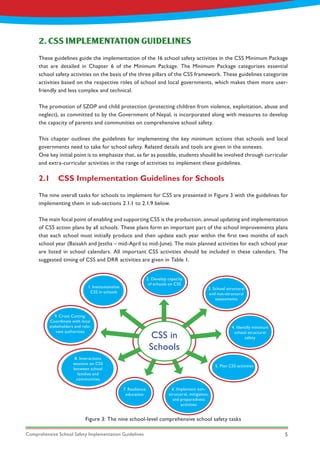
The nine overall tasks for schools to implement for CSS are presented in Figure 3 with the guidelines for
implementing them in sub-sections 2.1.1 to 2.1.9 below.
The main focal point of enabling and supporting CSS is the production, annual updating and implementation
of CSS action plans by all schools. These plans form an important part of the school improvements plans
that each school must initially produce and then update each year within the first two months of each
school year (Baisakh and Jestha – mid-April to mid-June). The main planned activities for each school year
are listed in school calendars. All important CSS activities should be included in these calendars. The
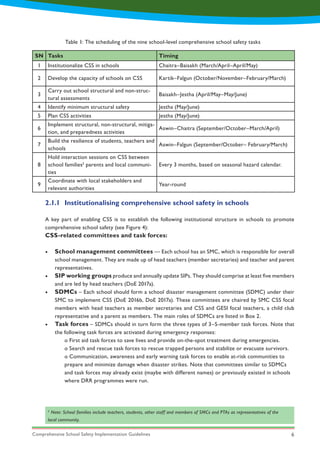
suggested timing of CSS and DRR activities are given in Table 1.
2. CSS IMPLEMENTATION GUIDELINES
2.1	 CSS Implementation Guidelines for Schools
Figure 3: The nine school-level comprehensive school safety tasks
1. Institutionalize
CSS in schools
5. Plan CSS activities
7. Resilience
education
2. Develop capacity
of schools on CSS
3. School structural
and non-structural
assessments
4. Identify minimum
school structural
safety
9. Cross Cutting:
Coordinate with local
stakeholders and rele-
vant authorities
6. Implement non-
strucutral, mitigation,
and preparedness
activities
8. Interactions
sessions on CSS
between school
families and
communities
CSS in
Schools
Comprehensive School Safety Implementation Guidelines 6
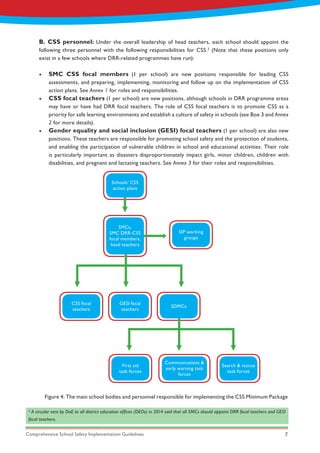
A key part of enabling CSS is to establish the following institutional structure in schools to promote
comprehensive school safety (see Figure 4):
CSS-related committees and task forces:
•	 School management committees — Each school has an SMC, which is responsible for overall
school management. They are made up of head teachers (member secretaries) and teacher and parent
representatives.
•	 SIP working groups produce and annually update SIPs. They should comprise at least five members
and are led by head teachers (DoE 2017a).
•	 SDMCs – Each school should form a school disaster management committee (SDMC) under their
SMC to implement CSS (DoE 2016b, DoE 2017a). These committees are chaired by SMC CSS focal
members with head teachers as member secretaries and CSS and GESI focal teachers, a child club
representative and a parent as members. The main roles of SDMCs are listed in Box 2.
•	 Task forces – SDMCs should in turn form the three types of 3–5-member task forces. Note that
the following task forces are activated during emergency responses:
	 o First aid task forces to save lives and provide on-the-spot treatment during emergencies.
	 o Search and rescue task forces to rescue trapped persons and stabilize or evacuate survivors.
	 o Communication, awareness and early warning task forces to enable at-risk communities to 	
	 prepare and minimize damage when disaster strikes. Note that committees similar to SDMCs 	
	 and task forces may already exist (maybe with different names) or previously existed in schools 	
	 where DRR programmes were run.
2.1.1	 Institutionalising comprehensive school safety in schools
Table 1: The scheduling of the nine school-level comprehensive school safety tasks
SN Tasks Timing
1 Institutionalize CSS in schools Chaitra–Baisakh (March/April–April/May)
2 Develop the capacity of schools on CSS Kartik–Falgun (October/November–February/March)
3
Carry out school structural and non-struc-
tural assessments
Baisakh–Jestha (April/May–May/June)
4 Identify minimum structural safety Jestha (May/June)
5 Plan CSS activities Jestha (May/June)
6
Implement structural, non-structural, mitiga-
tion, and preparedness activities
Aswin–Chaitra (September/October–March/April)
7
Build the resilience of students, teachers and
schools
Aswin–Falgun (September/October– February/March)
8
Hold interaction sessions on CSS between
school families2
parents and local communi-
ties
Every 3 months, based on seasonal hazard calendar.
9
Coordinate with local stakeholders and
relevant authorities
Year-round
2
Note: School families include teachers, students, other staff and members of SMCs and PTAs as representatives of the
local community.
Comprehensive School Safety Implementation Guidelines 7
B. CSS personnel: Under the overall leadership of head teachers, each school should appoint the
following three personnel with the following responsibilities for CSS.3
(Note that these positions only
exist in a few schools where DRR-related programmes have run):
•	 SMC CSS focal members (1 per school) are new positions responsible for leading CSS
assessments, and preparing, implementing, monitoring and follow up on the implementation of CSS
action plans. See Annex 1 for roles and responsibilities.
•	 CSS focal teachers (1 per school) are new positions, although schools in DRR programme areas
may have or have had DRR focal teachers. The role of CSS focal teachers is to promote CSS as a
priority for safe learning environments and establish a culture of safety in schools (see Box 3 and Annex
2 for more details).
•	 Gender equality and social inclusion (GESI) focal teachers (1 per school) are also new
positions. These teachers are responsible for promoting school safety and the protection of students,
and enabling the participation of vulnerable children in school and educational activities. Their role
is particularly important as disasters disproportionately impact girls, minor children, children with
disabilities, and pregnant and lactating teachers. See Annex 3 for their roles and responsibilities.
3
A circular sent by DoE to all district education offices (DEOs) in 2014 said that all SMCs should appoint DRR focal teachers and GESI
focal teachers.
Figure 4: The main school bodies and personnel responsible for implementing the CSS Minimum Package
Schools’ CSS
action plans
SMCs,
SMC DRR-CSS
focal members,
head teachers
CSS focal
teachers
First aid
task forces
GESI focal
teachers
Communications &
early warning task
forces
Search & rescue
task forces
SIP working
groups
SDMCs
Comprehensive School Safety Implementation Guidelines 8
Box 2: The roles and responsibilities of SDMCs (based on DoE 2017a)
•	 Maintaining an updating record of parents’ contact details.
•	 Anchoring heavy furniture and hanging objects in classrooms and on walls.
•	 Overseeing the regular maintenance of school buildings, WASH structures, furniture and
temporary learning centres.
•	 Establishing emergency tools kits, first aid boxes, go bags and teaching-learning aids
•	 Identifying safe and unsafe places and assembly points for after and during disasters.
•	 Establishing emergency funds to support emergency response and early recovery.
•	 Regularly conducting natural disaster response drills.
•	 Preparing long-term plans for earthquake-resistance building construction and retrofitting.
Box 3: The roles and responsibilities of CSS focal teachers (based on DoE 2016b)
•	 Support head teachers to carry out all SDMC-related tasks.
•	 Participate in training events related to school disaster risk management and train other teachers
and staff on this subject.
•	 Develop CSS action plans and lead the facilitation and mobilization of school families for
implementation of the plan.
•	 Lead the carrying out of CSS simulation and drill exercises.
•	 Maintain an emergency communication tree for the school family.
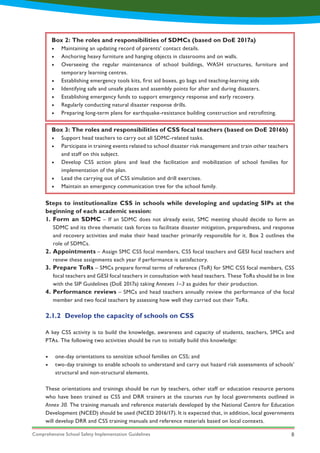
Steps to institutionalize CSS in schools while developing and updating SIPs at the
beginning of each academic session:
Form an SDMC – If an SDMC does not already exist, SMC meeting should decide to form an
SDMC and its three thematic task forces to facilitate disaster mitigation, preparedness, and response
and recovery activities and make their head teacher primarily responsible for it. Box 2 outlines the
role of SDMCs.
Appointments – Assign SMC CSS focal members, CSS focal teachers and GESI focal teachers and
renew these assignments each year if performance is satisfactory.
Prepare ToRs – SMCs prepare formal terms of reference (ToR) for SMC CSS focal members, CSS
focal teachers and GESI focal teachers in consultation with head teachers. These ToRs should be in line
with the SIP Guidelines (DoE 2017a) taking Annexes 1–3 as guides for their production.
Performance reviews – SMCs and head teachers annually review the performance of the focal
member and two focal teachers by assessing how well they carried out their ToRs.
1.
2.
3.
4.
2.1.2	 Develop the capacity of schools on CSS
A key CSS activity is to build the knowledge, awareness and capacity of students, teachers, SMCs and
PTAs. The following two activities should be run to initially build this knowledge:
•	 one-day orientations to sensitize school families on CSS; and
•	 two-day trainings to enable schools to understand and carry out hazard risk assessments of schools’
structural and non-structural elements.
These orientations and trainings should be run by teachers, other staff or education resource persons
who have been trained as CSS and DRR trainers at the courses run by local governments outlined in
Annex 30. The training manuals and reference materials developed by the National Centre for Education
Development (NCED) should be used (NCED 2016/17). It is expected that, in addition, local governments
will develop DRR and CSS training manuals and reference materials based on local contexts.
Comprehensive School Safety Implementation Guidelines 9
Knowledge and skills on CSS need to be continuously developed. Therefore, school families will be
enabled and encouraged to take part in special day celebrations, and interaction sessions, as well as to use
teaching–learning and communication materials and extra-curricular activities related to CSS
Steps for schools to build knowledge, awareness and capacity on CSS:
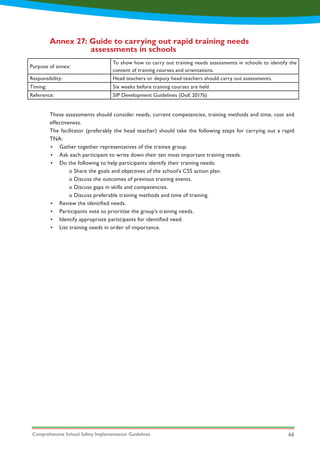
Needs assessments – Head teachers lead the carrying out of rapid training need assessments
(TNAs) supported by SDMCs, SMC CSS focal members, focal teachers and local government
education officers to identify capacity gaps and develop training content and session plans for one-day
orientations and two-day trainings. See Annex 27 for how to carry out a rapid TNA.
Design curriculum – Design training curricula for the one-day CSS orientation guided by the
suggested content in Annex 4 and for the two-day training on CSS guided by the suggested content in
Annex 5. The content should be in line with the training manual and reference materials for education
resource persons developed by the National Centre for Education Development (NCED 2016/17).
Training – Hold two-day trainings on CSS for the members of SIP working groups, SMC CSS focal
persons, CSS and GESI focal teachers, youth and child club members and representatives of local
NGOs and CBOs. This training should clarify the concept of CSS and enable participants to carry out
hazard risk assessments of their schools and prepare CSS action plans. Trainers will use CEHRD’S
orientation and training manuals on DRR and School Safety including the SIP development guidelines
and the School Safety Teachers’ Training Reference Materials (DoE 2017a; NCED 2016/17). These
training events a major means of strengthening SDMCs.
Orientations – Conduct one-day orientations for SMC and PTA members and teachers.
1.
2.
3.
4.
2.1.3	 Carry out school structural and non-structural assessments
Structural and non-structural hazard
assessments need carrying out to identify
activities to include in updated CSS action
plans. These two types of assessment should
be carried out simultaneously, using hazard,
vulnerability and capacity assessment (HVCA)
tools prior to SIPs being prepared or updated.
Annex 6 gives the assessment tools. The
assessments should be updated every year as
part of the SIP updating process. The aim is to
make school structures and facilities safe and
able to withstand potential the various hazards
i. Structural assessments
Structural assessments assess the potential exposure of school structures to hazards that create
vulnerability. All fixed and permanent elements in school buildings and premises need assessing. Structural
assessments should be carried out by SIP working groups. If necessary, schools should consult with and
make use of the expertise of local government engineers, education officers, trainers, environmental
officers, social welfare officers, paramedical officers, in coordination with the local government education
unit to carry out assessments. Local government may also coordinate with provincial and federal bodies
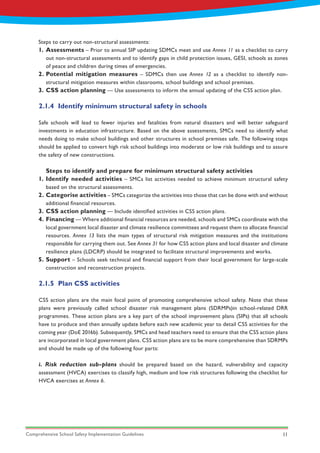
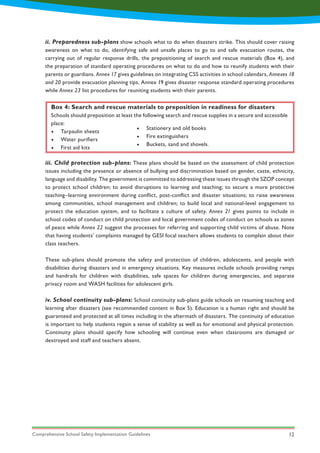
for assistance in assessing complicated engineering structures. Figure 5 shows the persons and bodies who
are responsible for and should be involved in carrying out HVCAs and structural assessments of schools.
We have implemented
structural, non-structural,
mitigation, and preparedness
activities in our school.
Indeed. That's why
we have safe learning
environment.
Comprehensive School Safety Implementation Guidelines 10
Steps to assess school buildings and other structures:
Figure 5: Entities to be involved in carrying out hazard, vulnerability and capacity (HVCAs) and
structural assessments
1.
2.
3.
4.
5.
Request technical assistance – Head teachers request their local government to provide a
local government DRR-CSS focal person and engineer to support and facilitate the carrying out of
the structural assessments of the school buildings and premises.
The assessments – SIP working groups manage the carrying out of the structural assessments
through the following steps:
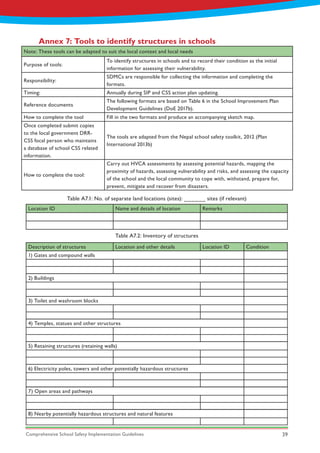
o Identify structures in schools and their premises using the tool in Annex 7.
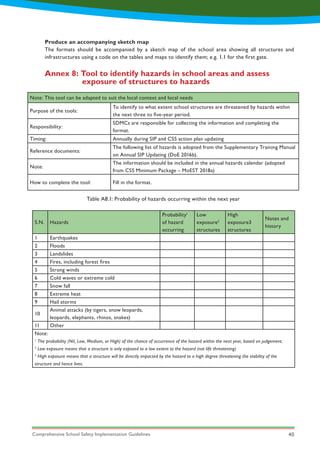
o Identify hazards in school areas and assess the exposure of structures to particular hazards using
the tool in Annex 8.
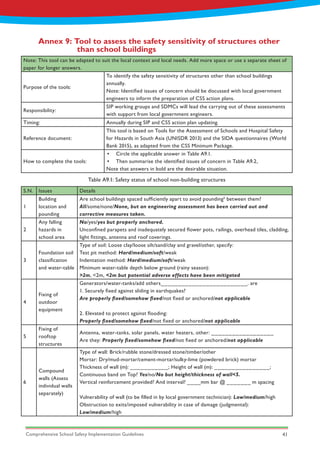
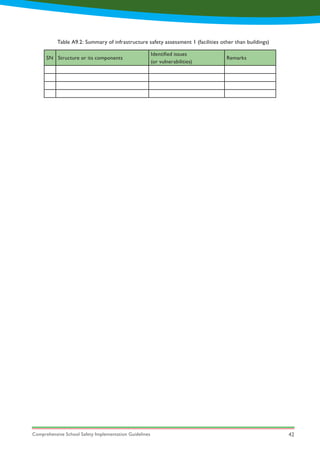
o Assess the safety sensitivity of structures other than school buildings using the tool in Annex 9.
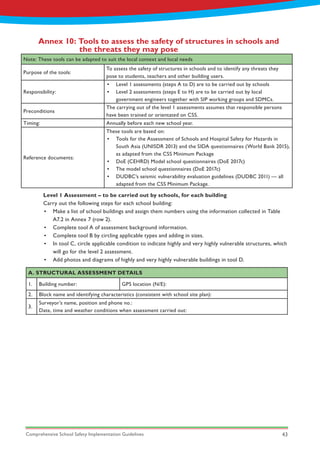
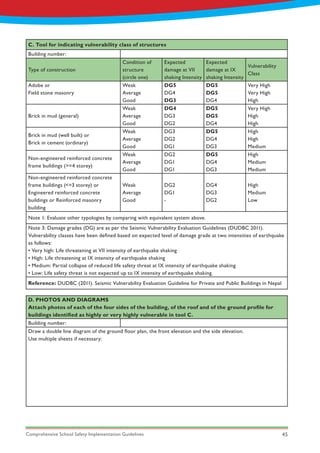
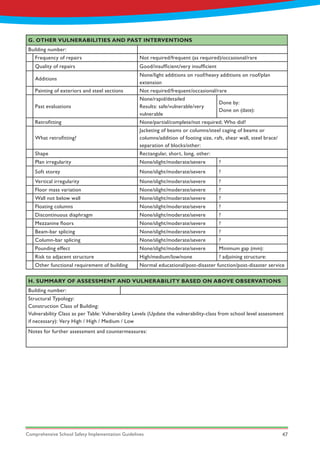
o Assess the capacity of structures and determine the scale of vulnerability using tool in Annex 10.
First level assessment –SDMCs lead the carrying out of first level structural assessments by
assessing the typology, size, photos and diagrams, site for foundation, materials and workmanship,
structural details, other vulnerabilities and past interventions.
Second level assessment –SDMCs, with the help of a local government engineer, carry out the
second type of assessment on any highly vulnerable structures identified in the first level assessment.
An engineer should carry these out as per the seismic vulnerability assessment guidelines (DUDBC
2011).
Other subjects – SIP working groups ensure that structural assessments also cover the impact of
climate change (by advising climate-resilient structures), and the needs and issues of adolescent girls
and women, people with disabilities, pregnant and lactating teachers, and children from marginalized
and socially excluded groups.
ii. Non-structural assessments
Non-structural assessments identify and assess the physical environment around schools, social
protection issues, and safety factors, school support institutions (focal persons and teachers, SDMCs,
task forces and child clubs), and assesses gaps.
Students
GESI focal
teacher
CBO
representatives
SMC Chair
CSS focal
teacher
CSS focal
memberChild club
representatives
PTA
members
Engineers &
technicians
HVCAs &
structural
assessments
Comprehensive School Safety Implementation Guidelines 11
Steps to carry out non-structural assessments:
1.
2.
3.
4.
5.
1.
2.
3.
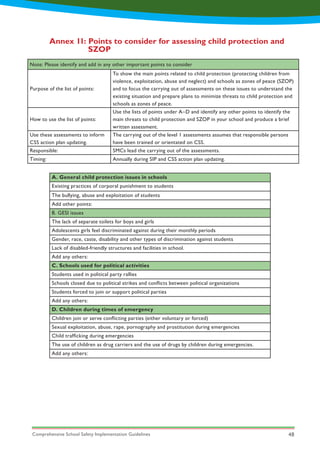
Assessments – Prior to annual SIP updating SDMCs meet and use Annex 11 as a checklist to carry
out non-structural assessments and to identify gaps in child protection issues, GESI, schools as zones
of peace and children during times of emergencies.
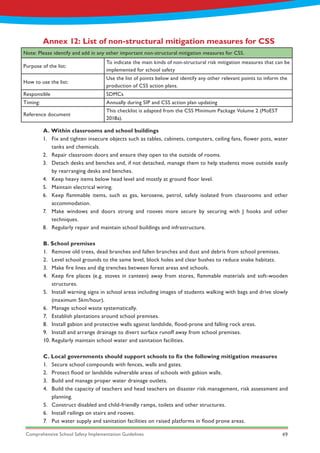
Potential mitigation measures – SDMCs then use Annex 12 as a checklist to identify non-
structural mitigation measures within classrooms, school buildings and school premises.
CSS action planning — Use assessments to inform the annual updating of the CSS action plan.
2.1.4	 Identify minimum structural safety in schools
2.1.5	 Plan CSS activities
Safe schools will lead to fewer injuries and fatalities from natural disasters and will better safeguard
investments in education infrastructure. Based on the above assessments, SMCs need to identify what
needs doing to make school buildings and other structures in school premises safe. The following steps
should be applied to convert high risk school buildings into moderate or low risk buildings and to assure
the safety of new constructions.
CSS action plans are the main focal point of promoting comprehensive school safety. Note that these
plans were previously called school disaster risk management plans (SDRMPs)in school-related DRR
programmes. These action plans are a key part of the school improvement plans (SIPs) that all schools
have to produce and then annually update before each new academic year to detail CSS activities for the
coming year (DoE 2016b). Subsequently, SMCs and head teachers need to ensure that the CSS action plans
are incorporated in local government plans. CSS action plans are to be more comprehensive than SDRMPs
and should be made up of the following four parts:
i. Risk reduction sub-plans should be prepared based on the hazard, vulnerability and capacity
assessment (HVCA) exercises to classify high, medium and low risk structures following the checklist for
HVCA exercises at Annex 6.
Steps to identify and prepare for minimum structural safety activities
Identify needed activities – SMCs list activities needed to achieve minimum structural safety
based on the structural assessments.
Categorise activities – SMCs categorize the activities into those that can be done with and without
additional financial resources.
CSS action planning — Include identified activities in CSS action plans.
Financing — Where additional financial resources are needed, schools and SMCs coordinate with the
local government local disaster and climate resilience committees and request them to allocate financial
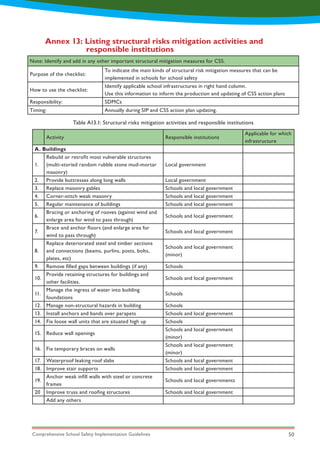
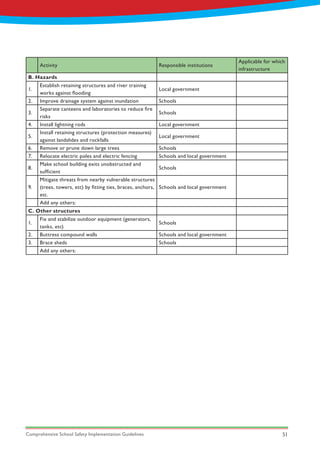
resources. Annex 13 lists the main types of structural risk mitigation measures and the institutions
responsible for carrying them out. See Annex 31 for how CSS action plans and local disaster and climate
resilience plans (LDCRP) should be integrated to facilitate structural improvements and works.
Support – Schools seek technical and financial support from their local government for large-scale
construction and reconstruction projects.
Comprehensive School Safety Implementation Guidelines 12
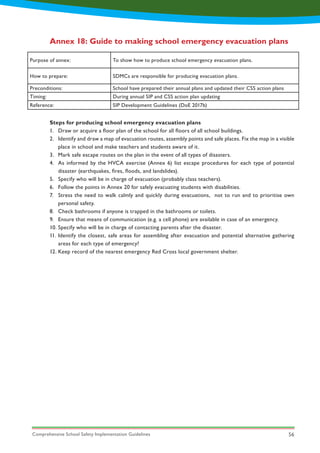
ii. Preparedness sub-plans show schools what to do when disasters strike. This should cover raising
awareness on what to do, identifying safe and unsafe places to go to and safe evacuation routes, the
carrying out of regular response drills, the prepositioning of search and rescue materials (Box 4), and
the preparation of standard operating procedures on what to do and how to reunify students with their
parents or guardians. Annex 17 gives guidelines on integrating CSS activities in school calendars, Annexes 18
and 20 provide evacuation planning tips, Annex 19 gives disaster response standard operating procedures
while Annex 23 list procedures for reuniting students with their parents.
iii. Child protection sub-plans: These plans should be based on the assessment of child protection
issues including the presence or absence of bullying and discrimination based on gender, caste, ethnicity,
language and disability. The government is committed to addressing these issues through the SZOP concept
to protect school children; to avoid disruptions to learning and teaching; to secure a more protective
teaching–learning environment during conflict, post-conflict and disaster situations; to raise awareness
among communities, school management and children; to build local and national-level engagement to
protect the education system, and to facilitate a culture of safety. Annex 21 gives points to include in
school codes of conduct on child protection and local government codes of conduct on schools as zones
of peace while Annex 22 suggest the processes for referring and supporting child victims of abuse. Note
that having students’ complaints managed by GESI focal teachers allows students to complain about their
class teachers.
These sub-plans should promote the safety and protection of children, adolescents, and people with
disabilities during disasters and in emergency situations. Key measures include schools providing ramps
and handrails for children with disabilities, safe spaces for children during emergencies, and separate
privacy room and WASH facilities for adolescent girls.
iv. School continuity sub-plans: School continuity sub-plans guide schools on resuming teaching and
learning after disasters (see recommended content in Box 5). Education is a human right and should be
guaranteed and protected at all times including in the aftermath of disasters. The continuity of education
is important to help students regain a sense of stability as well as for emotional and physical protection.
Continuity plans should specify how schooling will continue even when classrooms are damaged or
destroyed and staff and teachers absent.
Box 4: Search and rescue materials to preposition in readiness for disasters
Schools should preposition at least the following search and rescue supplies in a secure and accessible
place:
•	 Tarpaulin sheets
•	 Water purifiers
•	 First aid kits	
•	 Stationery and old books
•	 Fire extinguishers
•	 Buckets, sand and shovels.
Comprehensive School Safety Implementation Guidelines 13
Box 5: Recommended components of education continuity plans (NCED 2016/17)
•	 Reimburse lost time: Estimate the missed days or hours of schooling and make up for them
either by using leave days or by running additional sessions and adding teacher shifts.
•	 Establish temporary learning centres – When school buildings are heavily damaged, shift
schools to temporary learning centres or another suitable building.
•	 Flexible calendar and alternative teaching methodologies – Encourage pair education,
home working, and independent study by students.
•	 Develop the capacity of teachers and staff – Where teachers and staff are unable to
perform their regular tasks, try and build their capacity on how to teach amidst disruption.
•	 Use of schools as temporary shelters – Generally, schools should not be used as temporary
shelters for displaced persons. However, where communities need to use them, sub-plans should
consider how to minimise disruption to schooling, such as by providing access to classrooms for
teaching and learning during school hours.
•	 Child protection – If available, provide psychosocial counselling to traumatised students.
1.
2.
3.
4.
Steps for producing CSS action plans
Production – SDMCs lead the production and annual updating of CSS action plans with support
from SIP working groups as these plans are a part of SIPs.
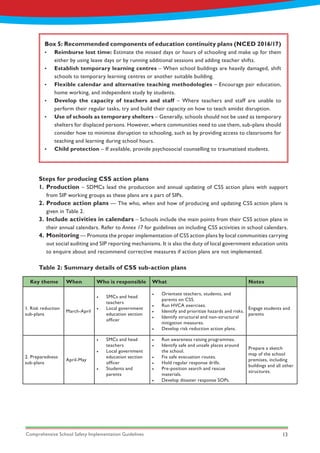
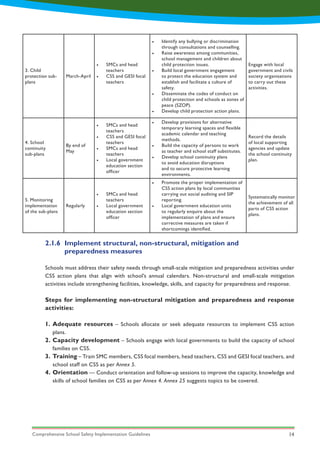
Produce action plans — The who, when and how of producing and updating CSS action plans is
given in Table 2.
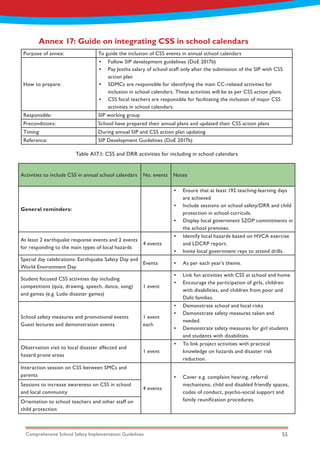
Include activities in calendars – Schools include the main points from their CSS action plans in
their annual calendars. Refer to Annex 17 for guidelines on including CSS activities in school calendars.
Monitoring — Promote the proper implementation of CSS action plans by local communities carrying
out social auditing and SIP reporting mechanisms. It is also the duty of local government education units
to enquire about and recommend corrective measures if action plans are not implemented.
Table 2: Summary details of CSS sub-action plans
Key theme When Who is responsible What Notes
1. Risk reduction
sub-plans
March-April
•	 SMCs and head
teachers
•	 Local government
education section
officer
•	 Orientate teachers, students, and
parents on CSS.
•	 Run HVCA exercises.
•	 Identify and prioritize hazards and risks.
•	 Identify structural and non-structural
mitigation measures.
•	 Develop risk reduction action plans.
Engage students and
parents
2. Preparedness
sub-plans
April-May
•	 SMCs and head
teachers
•	 Local government
education section
officer
•	 Students and
parents
•	 Run awareness raising programmes.
•	 Identify safe and unsafe places around
the school.
•	 Fix safe evacuation routes.
•	 Hold regular response drills.
•	 Pre-position search and rescue
materials.
•	 Develop disaster response SOPs.
Prepare a sketch
map of the school
premises, including
buildings and all other
structures.
Comprehensive School Safety Implementation Guidelines 14
3. Child
protection sub-
plans
March-April
•	 SMCs and head
teachers
•	 CSS and GESI focal
teachers
•	 Identify any bullying or discrimination
through consultations and counselling.
•	 Raise awareness among communities,
school management and children about
child protection issues.
•	 Build local government engagement
to protect the education system and
establish and facilitate a culture of
safety.
•	 Disseminate the codes of conduct on
child protection and schools as zones of
peace (SZOP).
•	 Develop child protection action plans.
Engage with local
government and civils
society organisations
to carry out these
activities.
4. School
continuity
sub-plans
By end of
May
•	 SMCs and head
teachers
•	 CSS and GESI focal
teachers
•	 SMCs and head
teachers
•	 Local government
education section
officer
•	 Develop provisions for alternative
temporary learning spaces and flexible
academic calendar and teaching
methods.
•	 Build the capacity of persons to work
as teacher and school staff substitutes.
•	 Develop school continuity plans
to avoid education disruptions
and to secure protective learning
environments.
Record the details
of local supporting
agencies and update
the school continuity
plan.
5. Monitoring
implementation
of the sub-plans
Regularly
•	 SMCs and head
teachers
•	 Local government
education section
officer
•	 Promote the proper implementation of
CSS action plans by local communities
carrying out social auditing and SIP
reporting.
•	 Local government education units
to regularly enquire about the
implementation of plans and ensure
corrective measures are taken if
shortcomings identified.
Systematically monitor
the achievement of all
parts of CSS action
plans.
2.1.6	 Implement structural, non-structural, mitigation and
	 preparedness measures
Schools must address their safety needs through small-scale mitigation and preparedness activities under
CSS action plans that align with school’s annual calendars. Non-structural and small-scale mitigation
activities include strengthening facilities, knowledge, skills, and capacity for preparedness and response.
Steps for implementing non-structural mitigation and preparedness and response
activities:
1.
2.
3.
4.
Adequate resources – Schools allocate or seek adequate resources to implement CSS action
plans.
Capacity development – Schools engage with local governments to build the capacity of school
families on CSS.
Training – Train SMC members, CSS focal members, head teachers, CSS and GESI focal teachers, and
school staff on CSS as per Annex 5.
Orientation — Conduct orientation and follow-up sessions to improve the capacity, knowledge and
skills of school families on CSS as per Annex 4. Annex 25 suggests topics to be covered.
Comprehensive School Safety Implementation Guidelines 15
Calendars – Head teachers ensure that the main CSS action plans activities are included in school’s
annual calendars including the dates for drills and other capacity-building activities, and for monitoring
progress.
Technical support – Schools seek technical support from local government and other stakeholders
to implement CSS action plans.
Implementation — Carry out response drills (see Box 6) and other non-structural mitigation and
preparedness and response activities.
5.
6.
7.
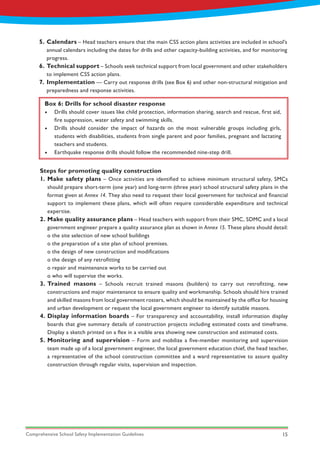
Box 6: Drills for school disaster response
•	 Drills should cover issues like child protection, information sharing, search and rescue, first aid,
fire suppression, water safety and swimming skills.
•	 Drills should consider the impact of hazards on the most vulnerable groups including girls,
students with disabilities, students from single parent and poor families, pregnant and lactating
teachers and students.
•	 Earthquake response drills should follow the recommended nine-step drill.
Steps for promoting quality construction
1.
2.
3.
4.
5.
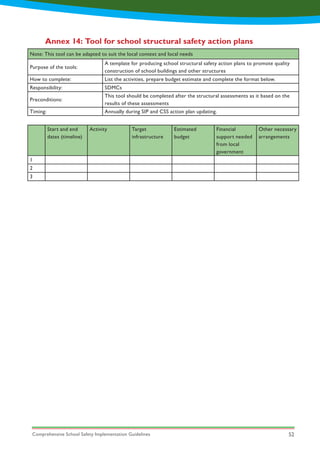
Make safety plans – Once activities are identified to achieve minimum structural safety, SMCs
should prepare short-term (one year) and long-term (three year) school structural safety plans in the
format given at Annex 14. They also need to request their local government for technical and financial
support to implement these plans, which will often require considerable expenditure and technical
expertise.
Make quality assurance plans – Head teachers with support from their SMC, SDMC and a local
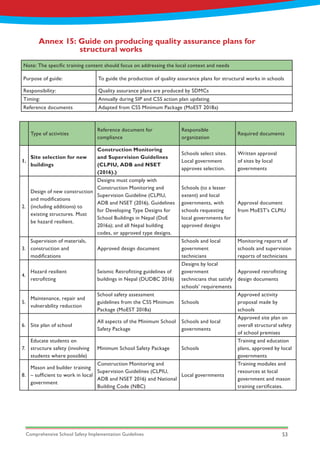
government engineer prepare a quality assurance plan as shown in Annex 15. These plans should detail:
o the site selection of new school buildings
o the preparation of a site plan of school premises.
o the design of new construction and modifications
o the design of any retrofitting
o repair and maintenance works to be carried out
o who will supervise the works.
Trained masons – Schools recruit trained masons (builders) to carry out retrofitting, new
constructions and major maintenance to ensure quality and workmanship. Schools should hire trained
and skilled masons from local government rosters, which should be maintained by the office for housing
and urban development or request the local government engineer to identify suitable masons.
Display information boards – For transparency and accountability, install information display
boards that give summary details of construction projects including estimated costs and timeframe.
Display a sketch printed on a flex in a visible area showing new construction and estimated costs.
Monitoring and supervision – Form and mobilize a five-member monitoring and supervision
team made up of a local government engineer, the local government education chief, the head teacher,
a representative of the school construction committee and a ward representative to assure quality
construction through regular visits, supervision and inspection.
Comprehensive School Safety Implementation Guidelines 16
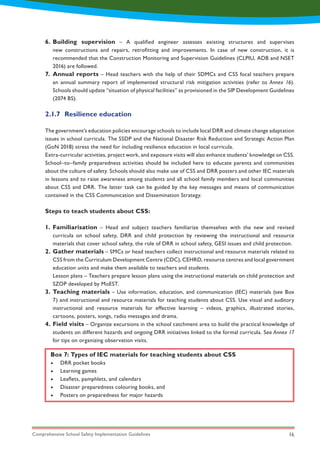
Box 7: Types of IEC materials for teaching students about CSS
•	 DRR pocket books
•	 Learning games
•	 Leaflets, pamphlets, and calendars
•	 Disaster preparedness colouring books, and
•	 Posters on preparedness for major hazards
1.
2.
3.
4.
6.
7.
Familiarisation – Head and subject teachers familiarize themselves with the new and revised
curricula on school safety, DRR and child protection by reviewing the instructional and resource
materials that cover school safety, the role of DRR in school safety, GESI issues and child protection.
Gather materials – SMCs or head teachers collect instructional and resource materials related to
CSS from the Curriculum Development Centre (CDC), CEHRD, resource centres and local government
education units and make them available to teachers and students.
Lesson plans – Teachers prepare lesson plans using the instructional materials on child protection and
SZOP developed by MoEST.
Teaching materials – Use information, education, and communication (IEC) materials (see Box
7) and instructional and resource materials for teaching students about CSS. Use visual and auditory
instructional and resource materials for effective learning – videos, graphics, illustrated stories,
cartoons, posters, songs, radio messages and drama.
Field visits – Organize excursions in the school catchment area to build the practical knowledge of
students on different hazards and ongoing DRR initiatives linked to the formal curricula. See Annex 17
for tips on organizing observation visits.
Building supervision – A qualified engineer assesses existing structures and supervises
new constructions and repairs, retrofitting and improvements. In case of new construction, it is
recommended that the Construction Monitoring and Supervision Guidelines (CLPIU, ADB and NSET
2016) are followed.
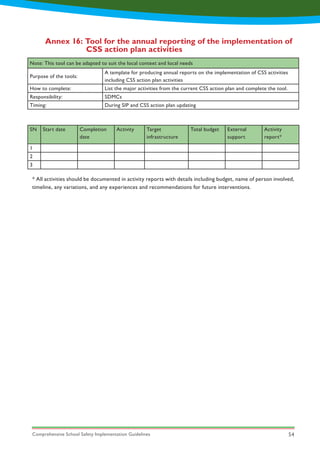
Annual reports – Head teachers with the help of their SDMCs and CSS focal teachers prepare
an annual summary report of implemented structural risk mitigation activities (refer to Annex 16).
Schools should update “situation of physical facilities” as provisioned in the SIP Development Guidelines
(2074 BS).
2.1.7	 Resilience education
The government’s education policies encourage schools to include local DRR and climate change adaptation
issues in school curricula. The SSDP and the National Disaster Risk Reduction and Strategic Action Plan
(GoN 2018) stress the need for including resilience education in local curricula.
Extra-curricular activities, project work, and exposure visits will also enhance students’ knowledge on CSS.
School–to–family preparedness activities should be included here to educate parents and communities
about the culture of safety. Schools should also make use of CSS and DRR posters and other IEC materials
in lessons and to raise awareness among students and all school family members and local communities
about CSS and DRR. The latter task can be guided by the key messages and means of communication
contained in the CSS Communication and Dissemination Strategy.
Steps to teach students about CSS:
Comprehensive School Safety Implementation Guidelines 17
1.
2.
3.
4.
5.
6.
7.
Steps to raise awareness on child protection and SZOP in schools:
Building the awareness of students and school families on the importance of child protection and SZOP
is very important to ensure child rights and to encourage, build and protect the psychosocial well-being
and resilience of students and also of teachers and schools in general. Schools will only be truly safe when
there is adequate awareness of child protection and SZOP among all school staff, teachers and students.
Sensitise school families on CSS through the following steps:
Steps to run extra-curricular activities on CSS and promotional events
Extra-curricular activities on CSS, child protection and SZOP, along with celebrating national and
international days, and student involvement in CSS activities can enhance knowledge and improve the
attitudes and behaviour of students (and teachers). Activities should be based on CSS action plans to help
students (and teachers) internalize CSS issues whilst having fun. CSS and GESI focal teachers are mainly
responsible for running these activities. Box 8 lists three key approaches for building the resilience of
students and their awareness on CSS issues.
Child protection codes of conduct – Schools develop, adopt, disseminate and enforce school
child protection codes of conduct on including points from part 1 of Annex 21.
Referral mechanism – Establish referral mechanisms for student victims of violence and abuse
and ensure that proper remedy, care, and support is provided using the processes shown in Annex 22.
SZOP – Schools are involved in the production of local government-produced SZOP codes of conduct.
Display SZOP commitments — Schools to display their local government produced commitment
on SZOP as committed to by local political parties. Refer to Section 2.2 below for ideas on SZOP
commitments.
Feedback mechanism — Each school establishes a feedback-cum complaint and grievance
handling mechanism with a box for delivering points to. These boxes should be checked regularly, and
all genuine points addressed immediately. Fix the boxes at accessible places and heights for children.
Address feedback – Head teachers ensure that received suggestions, feedback, complaints and
grievances are registered and resolved.
Communicate performance – Schools to communicate their performance on handling feedback
etc. to parents at annual meetings and social auditing events.
Box 8: Approaches to building student awareness on CSS through extra-
curricular activities
•	 Encourage the involvement of students in the range of CSS activities to build their awareness
on CSS.
•	 Encourage the participation of girl students, children with disabilities, and children from socially
excluded groups in CSS extra-curricular activities.
•	 Focus on solutions and precautionary measures, particularly for the most vulnerable (children,
adolescent girls, lactating/pregnant teachers and students, the elderly and students with
disabilities.
Comprehensive School Safety Implementation Guidelines 18
1.
2.
3.
4.
5.
Include in calendars – Include school safety-related activities and informal promotional events in
annual school calendars. Annex 17 gives tips on CSS-related extra-curricular activities and promotional
events.
Student involvement – Schools to encourage and facilitate students to run CSS activities such as
child clubs forming school safety groups and students taking part in extra-curricular activities on CSS.
See Box 9 for the main types of student involvement in promoting CSS.
Publicise dates – Communicate dates of activities to local government and education resource
persons for their participation in CSS extra-curricular activities.
Resourcing – Schools allocate funding in their budgets and mobilize local resources in coordination
with local stakeholders for school’s promotional events.
Keep records — Record CSS extra-curricular activities including photos and news coverage for
reporting against the achievement of CSS action plans.
Box 9: Student participation in implementing and promoting CSS
•	 Representatives from youth and child clubs are to be members of SDMCs, which are the main
school bodies for implementing CSS.
•	 Representatives from youth and child clubs are to be involved in carrying out non-structural
assessments and so will ‘learn by doing’.
•	 Youth clubs and child clubs will be encouraged to form school safety groups
Note: Students will directly learn about CSS and DRR in the curriculum, during field visits and in
CSS-related extra-curricular activities and representatives from youth and child clubs are to be
trained on CSS in the two-day CSS training events.
2.1.8	 Interactions on CSS between school families, parents and
	 local communities
Schools should regularly hold CSS interaction meetings to raise awareness in local communities on
CSS, child protection and SZOP and to encourage local people’s participation and ownership of the
CSS process. Increased community understanding will help schools facilitate children from different
castes, ethnic backgrounds, and economic status to grow up in safe learning environments. School safety
is enabled by disseminating CSS messages to local communities. These interactions should also cover
emergency preparedness, response and evacuation plans. CSS and GESI focal teachers should participate
and encourage the participation of parents with disabilities, women and parents from disadvantaged
groups.
Comprehensive School Safety Implementation Guidelines 19
Steps for holding CSS interaction events:
Steps for schools to coordinate with local stakeholders and authorities
1.
2.
3.
4.
1.
2.
3.
Identify topics – Identify topics and issues to be discussed in interaction sessions beforehand at
meetings of CSS and GESI focal teachers and head teachers and guided by the suggested content in
Annex 24. Topics should include the outcomes of CSS assessment and action plans, information on local
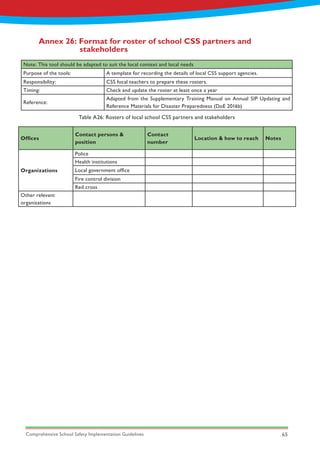
hazards, seasonal preparedness issues, updating emergency communication trees, disaster response
mechanisms, psycho-social support tips and the contents of CSS action plans and local disaster and
climate resilience plans (LDCRPs).
Regular interactions – Schools hold interaction sessions between SMC members and parents
every three months to raise awareness among parents and local community members about CSS, child
protection and SZOP. Manage the interactions to encourage less vocal and people from excluded and
disadvantaged groups to participate.
Communicate dates – Communicate the dates of interactions to local governments and their
DRR-CSS focal persons and include dates in school calendars.
Keep records —CSS focal teachers keep a record of interaction sessions (attendance of participants
and issues discussed) for reporting against the achievement of CSS action plans.
Identification – Identify local agencies that can support school safety, disaster preparedness,
disaster responses and school continuity activities.
Prepare a roster – CSS focal teachers prepare rosters of local support agencies and focal persons
using the format at Annex 26 listing area of expertise and contact details.
Update – Update rosters annually or as changes become apparent.
2.1.9	 Coordination with local stakeholders and authorities
Apart from school families and surrounding communities, schools also need to coordinate with local
stakeholders across all the above eight activities to foster shared ownership on CSS interventions and
optimize resource sharing. Schools should coordinate CSS and DRR activities with local governments
through their DRR-CSS focal persons, local disaster and climate resilience committees and education
committees. Other key local stakeholders include local government ward offices, service centres,
cooperatives, hospitals, health posts, Red Cross societies, police posts, CBOs, NGOs and INGOs. The
basis of this should be school rosters of institutions that could support the school after disasters. Note
that local governments are also mandated to produce rosters of DRR support agencies (see Section 2.2).
Comprehensive School Safety Implementation Guidelines 20
The main elements of the local government framework for promoting CSS and DRR in schools are as
follows (Figure 6):
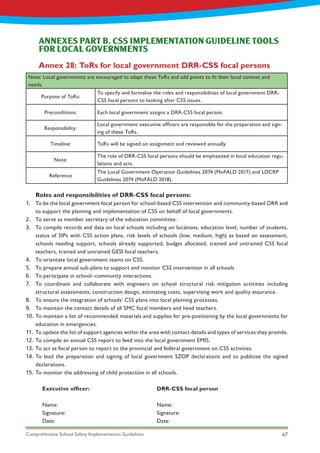
•	 Local government DRR-CSS focal persons (previously called DRR focal persons), who cover school
and non-school related DRR. They are officers from the forest, environment, waste management, and
disaster management section.
•	 Local government education officers.
•	 Local government engineers.
•	 Local government GESI focal persons.
•	 Local disaster and climate resilience committees (previously called local DRR committees.
•	 Local government education committees.
•	 The production and annual updating of local disaster and climate resilience plans (LDCRP), previously
called local disaster management plans.
This section highlights the seven key areas of responsibility of local government on CSS (see Figure 7).
2.2	 CSS Implementation Guidelines for Local Governments
Local governments4
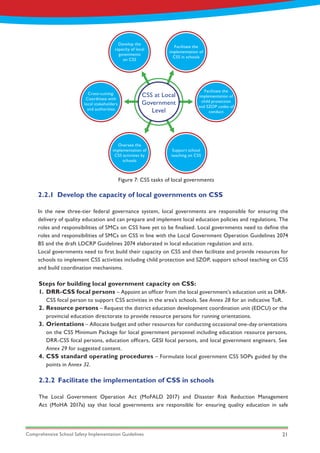
have an important role to play in ensuring every child’s access to quality education in a
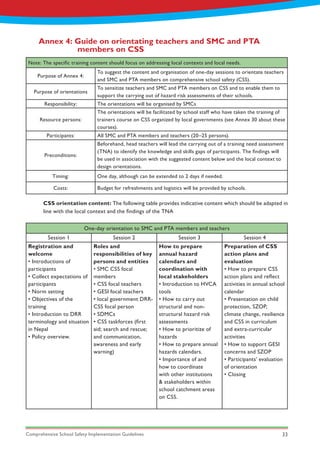
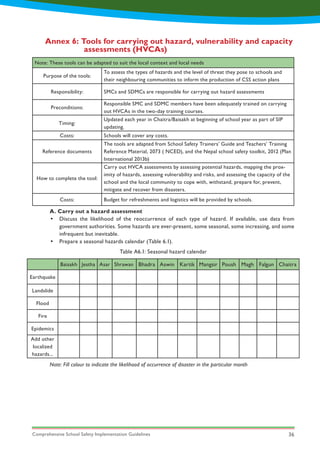
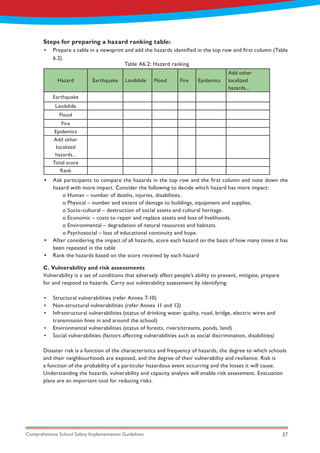
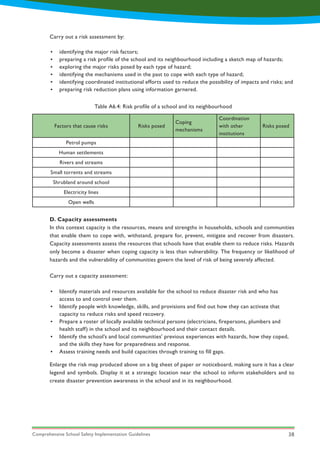
safe learning environment. Under the new decentralised federal system of government local governments
have a leading role to play in promoting school safety by developing and enforcing favourable policies,
guidelines, and locally suitable education regulations.
4
Under the new federal system of government, instituted in 2016/17, Nepal has four types of local governments — metropolitan cities,
sub-metropolitan cities, municipalities and village municipalities, made up of elected officials and bureaucrats.
Figure 6: Local government personnel, bodies and planning processes on CSS and DRR
School
Local governments and
their local disaster and
climate resilience plans
(LDCRPs)
Education officer
and education
committees
Engineers
GESI focal
persons
Local disaster
and climate
resilience
committees
DRR-CSS focal
persons
Comprehensive School Safety Implementation Guidelines 21
Figure 7: CSS tasks of local governments
Steps for building local government capacity on CSS:
1.
2.
3.
4.
DRR-CSS focal persons – Appoint an officer from the local government’s education unit as DRR-
CSS focal person to support CSS activities in the area’s schools. See Annex 28 for an indicative ToR.
Resource persons – Request the district education development coordination unit (EDCU) or the
provincial education directorate to provide resource persons for running orientations.
Orientations – Allocate budget and other resources for conducting occasional one-day orientations
on the CSS Minimum Package for local government personnel including education resource persons,
DRR-CSS focal persons, education officers, GESI focal persons, and local government engineers. See
Annex 29 for suggested content.
CSS standard operating procedures – Formulate local government CSS SOPs guided by the
points in Annex 32.
2.2.1	 Develop the capacity of local governments on CSS
2.2.2	 Facilitate the implementation of CSS in schools
In the new three-tier federal governance system, local governments are responsible for ensuring the
delivery of quality education and can prepare and implement local education policies and regulations. The
roles and responsibilities of SMCs on CSS have yet to be finalised. Local governments need to define the
roles and responsibilities of SMCs on CSS in line with the Local Government Operation Guidelines 2074
BS and the draft LDCRP Guidelines 2074 elaborated in local education regulation and acts.
Local governments need to first build their capacity on CSS and then facilitate and provide resources for
schools to implement CSS activities including child protection and SZOP, support school teaching on CSS
and build coordination mechanisms.
The Local Government Operation Act (MoFALD 2017) and Disaster Risk Reduction Management
Act (MoHA 2017a) say that local governments are responsible for ensuring quality education in safe
Support school
teaching on CSS
Cross-cutting:
Coordinate with
local stakeholders
and authorities
Develop the
capacity of local
govenments
on CSS
Facilitate the
implementation of
CSS in schools
Facilitate the
implementation of
child protection
and SZOP codes of
conduct
Oversee the
implementation of
CSS activities by
schools
CSS at Local
Government
Level
Comprehensive School Safety Implementation Guidelines 22
Steps to support schools to build their capacity on CSS:
Steps to support schools to carry out CSS activities
1.
2.
3.
1.
2.
3.
4.
5.
6.
7.
8.
9.
1.
2.
Train trainers – Allocate budget and other resources for conducting the local government-facilitated
two-day training of school trainers on CSS for head teachers, CSS focal teachers, GESI focal teachers,
SMC chairs, and SMC focal members. These should be run occasionally as per need. See Annex 30 for
suggested content.
Training – Local governments to mobilize social development officers, child protection officers and
DRR-CSS focal persons to facilitate training on child protection and SZOP in all schools.
Roster — DRR-CSS focal persons to maintain a database of trainers to be used as facilitators for CSS
training events.
Support – Provide technical, resource and mobilization support for schools toto run orientations and
training of trainer events.
CSS action planning – Provide technical support to schools to help them develop CSS action plans.
See Section 5 of the SIP Development Guidelines (DoE 2017a) and Section 2.1 above for how schools
should prepare CSS action plans.
Integration of CSS in local plans – Ensure that the main points of school’s CSS action plans are
covered in settlement and ward level (cluster level) plans and subsequently included in local government
annual plans and local disaster and climate resilience plans. See Annex 31 for how CSS action planning
should be fed into the production of local disaster and climate resilient committee (LDCRC), which are
a part of local government plans.
Allocate budgets – Allocate annual budgets to schools to carry out CSS activities with the amounts
based on the level of risk identified in structural and non-structural assessments.
Mobilise funds – Request additional funds and resources from provincial and federal education bodies
and elsewhere where costly reconstruction is needed.
Mobilise technical support – Mobilize and assign technicians to support schools to carry out
assessments, monitoring, supervision, quality assurance and the preparation of reports.
Lead HVCAs – Lead hazard risk assessments of schools using HVCA tools (see Annex 6 tools).
Awareness raising – Provide technical and coordination support and monitor and follow-up with
schools to organize CSS awareness-raising events and activities for school families and communities in
collaboration with district-level agencies and other stakeholders.
Support structural safety assessments — Deploy DRR-CSS focal persons and orient them
to support schools to carryout structural safety assessments of schools as per Annexes 9 and 10. Focal
persons should be supported by engineers, sub-engineers and others to do this technical backstopping
work.
Databases – Encourage and enable DRR-CSS focal persons to develop and use appropriate forms and
templates (written or computer-based) to maintain databases of CSS-related plans and interventions to
feed into the EMIS at local government level.
Records —DRR-CSS focal persons to maintain records of CSS trainings and orientations for feeding
into the EMIS.
environments. A key responsibility of local governments is to provide technical and financial support
for structural safety in schools as few schools possess the technical human resources to carry out such
activities. Local governments therefore need to provide DRR-CSS focal persons, engineers, technicians and
other human resources and budget for CSS activities. Facilitation by local governments is crucial to support
schools to implement CSS interventions.
Comprehensive School Safety Implementation Guidelines 23
Step to preposition supplies:
1. Preposition supplies – Preposition education in emergency and child protection in emergency materials
and supplies at local government HQ in a safe, secure and accessible place.
Steps for local governments to promote child protection and schools as zones of peace:
Steps to ensure that CSS and child protection are covered in school teaching:
1.
2.
3.
4.
5.
1.
2.
SZOP preparation – Take the lead in preparing and adopting SZOP declarations based on the points in
the second part of Annex 21. Prepare declarations in coordination with local schools and political parties,
and once finalised facilitate agreement and signing by all local political parties, SMCs and teachers.
Publicise SZOP declarations – Make the SZOP declarations public and disseminate them through
different channels and the mass and social media and display at all schools.
Transparency – Maintain a transparency board, a citizen’s charter and a feedback-complaint-grievances
box to cover all subjects including CSS.
Press releases – Issue SZOP press releases to local media stressing the points in Box 10.
Enforce codes of conduct — Monitor and review the following of school’s codes of conduct on
child protection and ensure that each school provides a minimum of 192 teaching–learning days as verified
through SIP progress reports.
Identify needs – Identify local needs (CSS, climate change, child protection and GESI issues) through gap
analysis, and by reviewing SIPs (CSS assessment report, HVCA, and action plans) and LDCRPs.
Local curricula content– Prepare local content for all levels of curricula from early childhood
development to secondary school level on the basis of identified needs as per the weightage per subject for
local content specified by the Curriculum Development Centre (CDC).
2.2.3	 Facilitate the development and implementation of child protection 		
and SZOP codes of conduct
2.2.4	 Support school teaching on CSS
Nepal’s Constitution guarantees the protection of children and every child’s right to be educated in safe and
peaceful environments. Schools need local government commitment and support to be zones of peace.
Local governments should aim for every citizen to be aware of CSS issues. The simplest way to sensitize citizens
to CSS is to include the subject in school curricula.
Box 10: Points to include in media press releases on SZOP (MoE 2011)
•	 Keep schools free of armed conflict and other types of violence.
•	 Keep schools free of political and other types of interference.
•	 Keep schools free of discrimination, violence, harassment, indifference, and exploitation.
•	 Ensure a minimum of 192 teaching–learning days for students and that schools open for at least
220 days per school year.
Step to promote the implementation of CSS:
Use available CSS-related IEC and communications materials and approaches outlined in the CSS Communication
and Dissemination Strategy to promote schools and other CSS stakeholders to implement and support the
implementation of CSS activities.
Comprehensive School Safety Implementation Guidelines 24
Steps for local governments to oversee the implementation of CSS by schools:
Steps for establishing and promoting local coordination for CSS:
1.
2.
1.
2.
3.
4.
5.
6.
School CSS personnel – Ensure that all schools assign SMC CSS focal members, CSS focal teachers and
GESI focal teachers. See Annexes 1, 2, and 3 for ToRs of these personnel.
Monitoring – Monitor and facilitate schools to do the following:
o Have CSS action plans that are integrated into their SIPs and annual calendars (see Annexes 17 and 31);
o Carry out minimum preparedness and mitigation measures are being carried out via HVCA exercises.
o Carry out other school-level CSS activities including child protection, SZOP, and resilience education.
o Produce and update continuity plans to resume schooling immediately after disasters.
o Maintain a roster of organizations that provide psychosocial counselling support.
o Maintain a CSS-related database and reporting.
o Ensure the participation of a local government representative in interactions between schools, parents
and local communities on CSS.
Map local CSS agencies – Local government CSS-DRR focal person identify and map local agencies
involved in CSS and DRR including search and rescue teams, Nepal Red Cross Society, Nepal Police, INGOs,
NGOs, CBOs and schools.
Rosters – The focal persons develop and regularly maintain and update a roster with the contact details
and expertise of the above agencies and their focal persons. See Annex 33 for a format.
2.2.5	 Oversee the implementation of CSS in schools
2.2.6	 Coordination with local stakeholders and authorities
Local governments have a crucial role to play in overseeing the implementation of CSS by schools.
At all times and as appropriate local governments should coordinate with local agencies to implement CSS
activities and leverage resources for them.
Materials – Prepare or source disaster risk
reduction, climate change and resilience-related
educational reference and instructional materials,
considering the needs of vulnerable groups
identified in the needs analysis.
Orientations – Mobilize experts and education
section officer to orientate head and subject
teachers on local curriculum content.
Update – Revise and update educational
materials to include the most pertinent CSS, DRR
and climate change issues, in consultation with
expert agencies, provincial education directorate,
and the Curriculum Development Centre, as
appropriate.
Exam questions – Incorporate questions on CSS, DRR, climate change, child protection in emergencies,
education in emergencies and SZOP in tests and examination for different levels of schooling and exams to
recruit bureaucrats.
Launching of curriculum on DRR
and climate change
adaptation
Comprehensive School Safety Implementation Guidelines 25
Points:
Points:
1.
2.
3.
4.
5.
1.
2.
3.
Provincial ministries of social development and non-government education stakeholders should
support schools and local governments on preparing CSS action plans, accessing resources (including
for rebuilding and retrofitting school buildings), and enhance CSS interventions in their province.
The full implementation of these Implementation Guidelines in schools and local governments and the
carrying out of reporting responsibilities will enable province level EMISsto provide a complete picture
of CSS in their schools. Notethat theEMIS is currently only maintained at the federal level.
These guidelines can help harmonize CSS interventions across provinces.
These guidelines can unlock opportunities for resource sharing within provincial ministries and other
education stakeholders to achieve results.
Note that these guidelines facilitate the adoption of the Sendai Framework for Disaster Risk Reduction
and worldwide initiatives for safe schools at the provincial level by engaging with academia, children,
and the youth through school-level activities.
These guidelines are a tool to enable the federal government to develop CSS-friendly education
regulations, guidelines and policies.
The implementation of these guidelines will enable the federal government to develop a more
comprehensive EMIS for more informed decision making for allocating resources on CSS.
The implementation of these guidelines will generate information and support the federal government
to negotiate with development partners for more support for CSS activities.
2.3	 CSS Implementation Guidelines for Provincial Governments
2.4	 CSS Implementation Guidelines for Federal Governments
2.5	 Promoting the implementation of CSS
Schools and local governments are the primary users of these guidelines. However, strategic inputs are
needed from provincial and federal governments to support schools and especially local governments to
carry out their CSS and DRR responsibilities.
Note that the brief nature of provincial and federal responsibilities reflects the fact that most responsibilities
lie with schools and local governments.
These guidelines facilitate informed decision-making, resource allocation, planning and mobilization of
resources at the federal level.
A separate CSS Communication and Dissemination Strategy has been prepared to provide information
and guidance for federal and provincial governments, MoEST and its subordinate offices and agencies and
non-government supporting agencies and partners (INGOs, NGOs, donors and the media) to run and
support campaigns to communicate and disseminate key messages on CSS (CEHRD 2018b). The aim of
such campaigns will be to encourage schools and local governments to be ready and willing to implement
CSS measures and especially the Minimum Package. The package will also be useful for schools and local
governments themselves to promote CSS to their local stakeholders.
Comprehensive School Safety Implementation Guidelines 26
ActionAid (2010). School-Based Disaster Preparedness and Facilitators Reference Book for
	 Conducting Model Sessions. Kathmandu: ActionAid.
ActionAid Nepal (2007). School Safety Approach. Kathmandu: ActionAid Nepal.
ADB, DoE and JICA (2016a). Guidelines for Developing Type Design for School Buildings 			
Nepal: Post earthquake Reconstruction of Schools. Kathmandu: Asian Development
	 Bank, Department of Education and Japan International Corporation Agency.
CCDRR Consortium (2016). Head Teachers’ Training Manual on School Safety. Kathmandu:
	 Child-Centred Disaster Risk Reduction Consortium.
CEHRD (2018a). Comprehensive School Safety Minimum Package (CSSMP) Volumes 1
	 (Report) and 2 (Annexes). Kathmandu: Thimi, Bhaktapur: Centre for Education and
	 Human Resources Development, Government of Nepal.
CEHRD (2018b). Communication and Dissemination Strategy for Comprehensive School
	 Safety in Nepal. Kathmandu: Government of Nepal.
CLPIU, ADB and NSET (2016). Construction Monitoring and Supervision Guidelines Volumes
	 1 and 2. Kathmandu: Central-Level Project Implementation Unit, Asian Development
	 Bank and National Society for Earthquake Technologies (NSET) 2016.
DoE (2010). National Framework of Child-friendly Schools for Quality Education, 2067. Sano
	 Thimi, Bhaktapur: Department of Education.
DoE (2016b). Supplementary Training Manual on Annual SIP Updating and Reference
	 Materials for Disaster Preparedness (in Nepali). January 2016. Sano Thimi, Bhaktapur.
DoE (2017a). School Improvement Plan (SIP) Development Guidelines, 2074. Sano Thimi,
	 Bhaktapur: Department of Education.
DoE (2017b). Contingency Plan for Nepal Education Cluster. Endorsed January 2017.
	 Kathmandu: Nepal Education Cluster.
DoE (2017c). Model School Survey Form. Nepal School Reconstruction Project. Kathmandu:
	 Asian Development Bank.
DoE (2017d). Guidelines for Water, Sanitation and Hygiene in School 2075 (draft). New
	 Thimi, Bhaktapur: Department of Education.
DoE, Mercy Corps, Action Aid Nepal and NDRC Nepal (2012). Guidelines to Safe School
	 Standards for the Terai Region of Nepal. Thimi Bhaktapur: Department of Education,
	 Mercy Corps, Action Aid Nepal and National Disaster Risk Reduction Centre Nepal.
REFERENCES
Comprehensive School Safety Implementation Guidelines 27
DoE, UNICEF and NSET (2015). Training Manual on School-based Disaster Risk Reduction
	 and Climate Change Adaptation, 2072. Thimi, Bhaktapur: Department of Education,
	 UNICEF and National Society for Earthquake Technology.
DPSS-2 Project and NRCS (2012). Disaster Preparedness for Safer Schools in Nepal (DPSS-2).
	 Kathmandu: DPSS-2 Project and Nepal Red Cross Society.
DUDBC (2011). Seismic Vulnerability Evaluation Guidelines for Private and Public Buildings,
	 2011. Kathmandu: Department of Urban Development and Building Construction.
DUDBC (2016). Seismic Retrofitting Guidelines of Buildings in Nepal. Kathmandu:
	 Department of Urban Development and Building Construction.
GoN (2018). National Disaster Risk Reduction and Strategic Action Plan (2018–2030), 2075.
	 In Nepali. Kathmandu: Government of Nepal.
Lalitpur DEO and Luniva (2016). School-based Child-Centred Disaster Risk Reduction and
	 Child Protection Training book. Supported by Finn Church Aid. Lalitpur: Lalitpur
	 District Education Office and Luniva Child Focused Group.
MoE (2009). School Sector Reform Plan: 2009–2017. Kathmandu: Ministry of Education.
MoE (2011). Schools as Zones of Peace National Framework and Implementation Guidelines,
	 2068. Kathmandu: Ministry of Education.
MoE (2016). School Sector Development Plan (2016-2023). Kathmandu: Ministry of
	 Education.
MoE (2017). Safe Schools Policy, 2073. Draft unofficial English translation. Kathmandu:
	 Ministry of Education.
MoEST (2017). Comprehensive School Safety Master Plan, Nepal, 2017. Kathmandu:
	 Government of Nepal, Ministry of Education.
MoFALD (2017). Local Government Operation Act, 2074. Kathmandu: Ministry of Federal
	 Affairs and Local Government.
MoFALD (2018). Local Disaster and Climate Resilience Planning Guidelines, 2075 (draft).
	 Kathmandu, Nepal: Ministry of Federal Affairs and Local Development.
MoHA (2017a). Nepal Disaster Risk Reduction Management Act. Kathmandu: Ministry of
	 Home Affairs.
Comprehensive School Safety Implementation Guidelines 28
MoHA (2017b). National Disaster Risk Reduction Policy and Strategic Action Plan, 2075.
	 Kathmandu: Ministry of Home Affairs.
NCED (2016/17). School Safety Teachers’ Training Reference Material, 2073. Kathmandu:
	 National Centre for Education Development.
Plan International Nepal (2013a). Safe School Policies and Practices: Good Initiatives, Gaps,
	 Implications and the Way Forward. Kathmandu: Plan International Nepal.
Plan International Nepal (2013b). Safe School Toolkit. Kathmandu: Plan International Nepal.
Save the Children (2017/18). Working Together for School Safety. Kathmandu: Save the
	Children
UNISDR (2013). Tools for the Assessment of School and Hospital Safety for Multi-hazards in
	 South Asia (four parts). United Nations Office for Disaster Risk Reduction.
UNISDR and GADRRRES (2017) Comprehensive School Safety. United Nations International
	 Strategy for Disaster Reduction and Global Alliance for Disaster Risk Reduction &
	 Resilience in the Education Sector.
World Bank (2015). Structural Integrity and Damage Assessment (SIDA) questionnaires.
	 Kathmandu: World Bank.
Comprehensive School Safety Implementation Guidelines 29
Introduction to the ToR: The SMC CSS focal member will be chairperson of their school’s
school disaster management committee (SDMC), appointed as an active SMC member with
knowledge of DRR.
Overall role: The main role of SMC CSS focal members is to lead CSS interventions in schools
including the carrying out of structural and non-structural assessments, the implementation,
monitoring and regular follow-up of CSS activities, and mobilizing school families for carrying out
hazard risk assessments and developing CSS action plans.
Specific responsibilities:
3.1 Training and assessment
•	 Organise sensitization and capacity development training on the CSS Minimum Package and
Implementation Guidelines to SMC members and school family.
•	 Lead the carrying out of hazard risk assessments of structural and non-structural elements
using HVCA tools at school before annual SIPs are prepared or updated.
3.2 Planning for preparedness and response
•	 Lead the preparation of CSS action plans by mobilizing other SMC and PTA members,
teachers, and CSS and GESI focal teachers.
•	 Form and mobilize the three CSS SDMC taskforces (first aid; search and rescue; communication,
awareness raising, and early warning.
•	 Liaise with local government on the prepositioning of education supplies for emergency
situations. See Annex 34 for a list of materials that need to be prepositioned.
3.3 Implementation
•	 Ensure that schools’ CSS action plans are part of their SIPs and the main activities are included
in the annual school calendar.
•	 Promote and ensure the implementation of the school’s CSS action plan.
•	 Mobilize and manage resources for CSS interventions.
ANNEXES PART A: CSS IMPLEMENTATION GUIDELINE TOOLS
FOR SCHOOLS
Annex 1: ToRs for SMC CSS focal members
Note: Schools are encouraged to adapt these ToRs and add points to fit their local context and needs.
Purpose of ToRs:
To specify and formalise the roles and responsibilities of school management com-
mittee comprehensive school safety (SMC CSS) focal members.
Preconditions:
Each school assigns an SMC CSS focal member. These assignments will be renewed
annually on satisfactory performance.
Responsibility: SMCs are responsible for preparing and signing ToRs.
Timeline:
ToRs will be signed on assignment and reviewed annually at the start of the school
year.
1.
2.
3.
Comprehensive School Safety Implementation Guidelines 30
•	 Establish coordination with local stakeholders and authorities within the school’s catchment
area.
3.4. Monitoring and follow up
•	 Lead the regular monitoring and follow-up of the implementation of the CSS action plan.
•	 Take part in support and monitoring visits of local government engineers, sub-engineers,
technicians, and DRR-CSS focal persons.
•	 Coordinate with stakeholders to promote their participation in interaction sessions between
SMCs and parents to raise awareness of CSS at school and community levels.
•	 Ensure that the CSS action plan has a parent–student reunification system.
•	 Ensure that a complaint handling and feedback mechanism and referral system is in place for
students and that the school as zone of peace (SZOP) code of conduct is functioning.
SMC chairperson:
Name:
Signature:
Date:
SMC CSS focal member
Name:
Signature:
Date:
Local
Government
Chief of
Education
Development
SCHOOL
Comprehensive School Safety Implementation Guidelines 31
Introduction: Each SMC will appoint a CSS focal teacher and assess their performance annually based
on these terms of reference. The focal teachers should be either a social studies or science teacher and
a permanent local resident. Their name and contact details should be provided to the local government’s
DRR-CSS focal person for compilation and database management.
Overall role: CSS focal teachers will support the implementation of their school’s CSS action plan
under the leadership of the SMC CSS focal person, the school disaster management committee (SDMC)
and the local government DRR-CSS focal person.
Key roles and responsibilities:
•	 Support the head teacher in all tasks of the SDMC.
•	 Participate in all types of training related to CSS and train other teachers and staff on CSS.
•	 Develop and update school CSS action plans and take the lead in facilitating and mobilizing the
school family to implement the plan.
•	 Take the lead in carrying out natural disaster response simulation and drill exercises.
•	 Work in coordination with SMC and PTA members on CSS activities.
Additional roles and responsibilities for capacity development, preparedness and response:
•	 Lead the carrying out of one-day school level orientations on the importance of CSS interventions
in school to SMC and PTA members and other teachers.
•	 Support the carrying out of hazard risk assessments of structural and non-structural elements using
HVCA tools and techniques.
•	 Support the identification of small-scale mitigation and non-structural activities.
•	 Work closely with the SIP working group on carrying out assessments.
•	 Support head teachers to integrate CSS action plan in local government planning.
•	 Facilitate coordination meetings with local government and other stakeholders.
•	 Maintain a written inventory of active local CSS-related institutions, the support they offer, contact
persons and their contact numbers.
•	 Invite and host interaction sessions between SMCs and parents to raise awareness on CSS.
•	 Help prepare local DRR-related learning materials.
•	 Assist SMC and local government CSS focal member in response and recovery activities.
Annex 2: ToRs for CSS focal teachers
Note: Schools are encouraged to adapt these ToRs and add points to fit their local context and needs.
Purpose of ToRs:
To specify and formalise the roles and responsibilities of comprehensive school
safety (CSS) focal teachers.
Preconditions:
Each school will assign a CSS focal teacher. These assignments will be renewed
each year if they perform satisfactorily.
Responsibility: Head teachers are responsible for the preparation and signing of these ToRs.
Timeline:
ToRs will be signed on assignment and reviewed annually at the start of each
school year.
Reference doc: DoE 2016b
Head teacher:
Name:
Signature:
Date:
CSS focal teacher
Name:
Signature:
Date:
Comprehensive School Safety Implementation Guidelines 32
Introduction: Each SMC will appoint a gender equality and social inclusion (GESI) focal teacher and
annually assess their performance based on their terms of reference. They will preferably be local
permanently resident women teachers with knowledge of or training on GESI.
Overall role: To promote school safety and the protection of students, and enable the participation of
vulnerable children in school and educational activities.
Major roles and responsibilities
•	 Ensure that GESI components are fully integrated in CSS interventions and the school’s action plan.
•	 Ensure that the SDMC and the SMDC task forces are inclusive and have representation of women,
people with disabilities and socially excluded groups.
•	 Ensure that their school has gender, child and disable-friendly structures such as ramps and railings.
•	 Ensure that their school has safe drinking water and well-maintained sanitation facilities.
•	 Ensure that their schools have separate toilets for girls and safe spaces for menstrual hygiene
management.
•	 Ensure that their school has a referral system for students in need of psychosocial counselling.
•	 Maintain a contact list of psychosocial counsellors and related organizations.
•	 Ensure the participation of women, people with disabilities, and socially excluded people in capacity
development training on CSS.
•	 Take the lead in implementing child protection and schools as zones of peace (SZOP) commitments.
•	 Play an active role in coordination meetings with local partners, health facilities, the Red Cross,
Nepal Police, INGOs and NGOs on school safety, disaster response and continuity activities.
•	 Play an active role in interaction sessions between SMCs and parents to raise awareness of GESI
issues in the school and local community.
Annex 3: ToRs for GESI focal teachers
Note: Schools are encouraged to adapt these ToRs and add points to fit their local context and needs.
Purpose of ToRs:
To specify and formalise the roles and responsibilities of gender equality and social
inclusion (GESI) focal teachers.
Preconditions:
Each school will assign a GESI focal teacher. These assignments will be renewed
each year if they perform satisfactorily.
Responsibility: SMCs are responsible for the preparation and signing of these ToRs.
Timeline:
ToRs will be signed on assignment and reviewed annually at the start of each
school year.
Head teacher:
Name:
Signature:
Date:
GESI focal teacher
Name:
Signature:
Date:
Comprehensive School Safety Implementation Guidelines 33
CSS orientation content: The following table provides indicative content which should be adapted in
line with the local context and the findings of the TNA
Annex 4: Guide on orientating teachers and SMC and PTA 		
		 members on CSS
Note: The specific training content should focus on addressing local contexts and local needs.
Purpose of Annex 4:
To suggest the content and organisation of one-day sessions to orientate teachers
and SMC and PTA members on comprehensive school safety (CSS).
Purpose of orientations
To sensitize teachers and SMC and PTA members on CSS and to enable them to
support the carrying out of hazard risk assessments of their schools.
Responsibility: The orientations will be organised by SMCs
Resource persons:
The orientations will be facilitated by school staff who have taken the training of
trainers course on CSS organized by local governments (see Annex 30 about these
courses).
Participants: All SMC and PTA members and teachers (20–25 persons).
Preconditions:
Beforehand, head teachers will lead the carrying out of a training need assessment
(TNA) to identify the knowledge and skills gaps of participants. The findings will
be used in association with the suggested content below and the local context to
design orientations.
Timing: One day, although can be extended to 2 days if needed.
Costs: Budget for refreshments and logistics will be provided by schools.
One-day orientation to SMC and PTA members and teachers
Session 1 Session 2 Session 3 Session 4
Registration and
welcome
• Introductions of
participants
• Collect expectations of
participants
• Norm setting
• Objectives of the
training
• Introduction to DRR
terminology and situation
in Nepal
• Policy overview.
Roles and
responsibilities of key
persons and entities
• SMC CSS focal
members
• CSS focal teachers
• GESI focal teachers
• local government DRR-
CSS focal person
• SDMCs
• CSS taskforces (first
aid; search and rescue;
and communication,
awareness and early
warning)
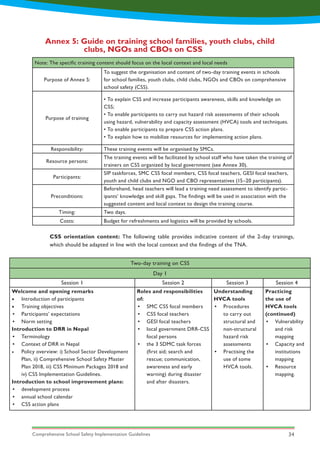
How to prepare
annual hazard
calendars and
coordination with
local stakeholders
• Introduction to HVCA
tools
• How to carry out
structural and non-
structural hazard risk
assessments
• How to prioritize of
hazards
• How to prepare annual
hazards calendars.
• Importance of and
how to coordinate
with other institutions
& stakeholders within
school catchment areas
on CSS.
Preparation of CSS
action plans and
evaluation
• How to prepare CSS
action plans and reflect
activities in annual school
calendar
• Presentation on child
protection, SZOP,
climate change, resilience
and CSS in curriculum
and extra-curricular
activities
• How to support GESI
concerns and SZOP
• Participants’ evaluation
of orientation
• Closing
Comprehensive School Safety Implementation Guidelines 34
CSS orientation content: The following table provides indicative content of the 2-day trainings,
which should be adapted in line with the local context and the findings of the TNA.
Annex 5: Guide on training school families, youth clubs, child 		
		 clubs, NGOs and CBOs on CSS
Note: The specific training content should focus on the local context and local needs
Purpose of Annex 5:
To suggest the organisation and content of two-day training events in schools
for school families, youth clubs, child clubs, NGOs and CBOs on comprehensive
school safety (CSS).
Purpose of training
• To explain CSS and increase participants awareness, skills and knowledge on
CSS;
• To enable participants to carry out hazard risk assessments of their schools
using hazard, vulnerability and capacity assessment (HVCA) tools and techniques.
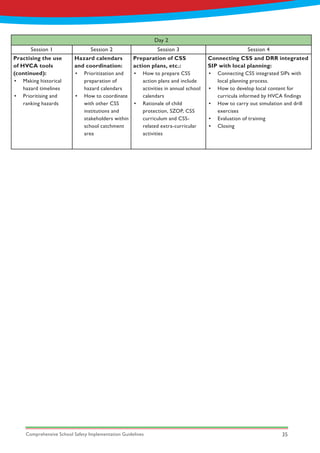
• To enable participants to prepare CSS action plans.
• To explain how to mobilize resources for implementing action plans.
Responsibility: These training events will be organised by SMCs.
Resource persons:
The training events will be facilitated by school staff who have taken the training of
trainers on CSS organized by local government (see Annex 30).
Participants:
SIP taskforces, SMC CSS focal members, CSS focal teachers, GESI focal teachers,
youth and child clubs and NGO and CBO representatives (15–20 participants).
Preconditions:
Beforehand, head teachers will lead a training need assessment to identify partic-
ipants’ knowledge and skill gaps. The findings will be used in association with the
suggested content and local context to design the training course.
Timing: Two days.
Costs: Budget for refreshments and logistics will be provided by schools.
Two-day training on CSS
Day 1
Session 1 Session 2 Session 3 Session 4
Welcome and opening remarks
•	 Introduction of participants
•	 Training objectives
•	 Participants’ expectations
•	 Norm setting
Introduction to DRR in Nepal
•	 Terminology
•	 Context of DRR in Nepal
•	 Policy overview: i) School Sector Development
Plan, ii) Comprehensive School Safety Master
Plan 2018, iii) CSS Minimum Packages 2018 and
iv) CSS Implementation Guidelines.
Introduction to school improvement plans:
•	 development process
•	 annual school calendar
•	 CSS action plans
Roles and responsibilities
of:
•	 SMC CSS focal members
•	 CSS focal teachers
•	 GESI focal teachers
•	 local government DRR-CSS
focal persons
•	 the 3 SDMC task forces
(first aid; search and
rescue; communication,
awareness and early
warning) during disaster
and after disasters.
Understanding
HVCA tools
•	 Procedures
to carry out
structural and
non-structural
hazard risk
assessments
•	 Practising the
use of some
HVCA tools.
Practicing
the use of
HVCA tools
(continued)
•	 Vulnerability
and risk
mapping
•	 Capacity and
institutions
mapping
•	 Resource
mapping.
Comprehensive School Safety Implementation Guidelines 35
Day 2
Session 1 Session 2 Session 3 Session 4
Practising the use
of HVCA tools
(continued):
•	 Making historical
hazard timelines
•	 Prioritising and
ranking hazards
Hazard calendars
and coordination:
•	 Prioritization and
preparation of
hazard calendars
•	 How to coordinate
with other CSS
institutions and
stakeholders within
school catchment
area
Preparation of CSS
action plans, etc.:
•	 How to prepare CSS
action plans and include
activities in annual school
calendars
•	 Rationale of child
protection, SZOP, CSS
curriculum and CSS-
related extra-curricular
activities
Connecting CSS and DRR integrated
SIP with local planning:
•	 Connecting CSS integrated SIPs with
local planning process.
•	 How to develop local content for
curricula informed by HVCA findings
•	 How to carry out simulation and drill
exercises
•	 Evaluation of training
•	 Closing
Comprehensive School Safety Implementation Guidelines 36
A. Carry out a hazard assessment
•	 Discuss the likelihood of the reoccurrence of each type of hazard. If available, use data from
government authorities. Some hazards are ever-present, some seasonal, some increasing, and some
infrequent but inevitable.
•	 Prepare a seasonal hazards calendar (Table 6.1).
Note: Fill colour to indicate the likelihood of occurrence of disaster in the particular month
Annex 6: Tools for carrying out hazard, vulnerability and capacity 	
		assessments (HVCAs)
Note: These tools can be adapted to suit the local context and local needs
Purpose of the tools:
To assess the types of hazards and the level of threat they pose to schools and
their neighbouring communities to inform the production of CSS action plans
Responsibility: SMCs and SDMCs are responsible for carrying out hazard assessments
Preconditions:
Responsible SMC and SDMC members have been adequately trained on carrying
out HVCAs in the two-day training courses.
Timing:
Updated each year in Chaitra/Baisakh at beginning of school year as part of SIP
updating.
Costs: Schools will cover any costs.
Reference documents
The tools are adapted from School Safety Trainers’ Guide and Teachers’ Training
Reference Material, 2073 ( NCED), and the Nepal school safety toolkit, 2012 (Plan
International 2013b)
How to complete the tool:
Carry out HVCA assessments by assessing potential hazards, mapping the prox-
imity of hazards, assessing vulnerability and risks, and assessing the capacity of the
school and the local community to cope with, withstand, prepare for, prevent,
mitigate and recover from disasters.
Costs: Budget for refreshments and logistics will be provided by schools.
Baisakh Jestha Asar Shrawan Bhadra Aswin Kartik Mangsir Poush Magh Falgun Chaitra
Earthquake
Landslide
Flood
Fire
Epidemics
Add other
localized
hazards...
Table A6.1: Seasonal hazard calendar
Comprehensive School Safety Implementation Guidelines 37
Steps for preparing a hazard ranking table:
•	 Prepare a table in a newsprint and add the hazards identified in the top row and first column (Table
6.2).
Hazard Earthquake Landslide Flood Fire Epidemics
Add other
localized
hazards...
Earthquake
Landslide
Flood
Fire
Epidemics
Add other
localized
hazards...
Total score
Rank
Table A6.2: Hazard ranking
C. Vulnerability and risk assessments
Vulnerability is a set of conditions that adversely affect people’s ability to prevent, mitigate, prepare
for and respond to hazards. Carry out vulnerability assessment by identifying:
•	 Structural vulnerabilities (refer Annex 7-10)
•	 Non-structural vulnerabilities (refer Annex 11 and 12)
•	 Infrastructural vulnerabilities (status of drinking water quality, road, bridge, electric wires and
transmission lines in and around the school)
•	 Environmental vulnerabilities (status of forests, rivers/streams, ponds, land)
•	 Social vulnerabilities (factors affecting vulnerabilities such as social discrimination, disabilities)
Disaster risk is a function of the characteristics and frequency of hazards, the degree to which schools
and their neighbourhoods are exposed, and the degree of their vulnerability and resilience. Risk is
a function of the probability of a particular hazardous event occurring and the losses it will cause.
Understanding the hazards, vulnerability and capacity analysis will enable risk assessment. Evacuation
plans are an important tool for reducing risks.
•	 Ask participants to compare the hazards in the top row and the first column and note down the
hazard with more impact. Consider the following to decide which hazard has more impact:
	 o Human – number of deaths, injuries, disabilities.
	 o Physical – number and extent of damage to buildings, equipment and supplies.
	 o Socio-cultural – destruction of social assets and cultural heritage.
	 o Economic – costs to repair and replace assets and loss of livelihoods.
	 o Environmental – degradation of natural resources and habitats.
	 o Psychosocial – loss of educational continuity and hope.
•	 After considering the impact of all hazards, score each hazard on the basis of how many times it has
been repeated in the table
•	 Rank the hazards based on the score received by each hazard
Comprehensive School Safety Implementation Guidelines 38
Factors that cause risks Risks posed
Coping
mechanisms
Coordination
with other
institutions
Risks posed
Petrol pumps
Human settlements
Rivers and streams
Small torrents and streams
Shrubland around school
Electricity lines
Open wells
Table A6.4: Risk profile of a school and its neighbourhood
D. Capacity assessments
In this context capacity is the resources, means and strengths in households, schools and communities
that enable them to cope with, withstand, prepare for, prevent, mitigate and recover from disasters.
Capacity assessments assess the resources that schools have that enable them to reduce risks. Hazards
only become a disaster when coping capacity is less than vulnerability. The frequency or likelihood of
hazards and the vulnerability of communities govern the level of risk of being severely affected.
Carry out a capacity assessment:
•	 Identify materials and resources available for the school to reduce disaster risk and who has
access to and control over them.
•	 Identify people with knowledge, skills, and provisions and find out how they can activate that
capacity to reduce risks and speed recovery.
•	 Prepare a roster of locally available technical persons (electricians, firepersons, plumbers and
health staff) in the school and its neighbourhood and their contact details.
•	 Identify the school’s and local communities’ previous experiences with hazards, how they coped,
and the skills they have for preparedness and response.
•	 Assess training needs and build capacities through training to fill gaps.
Enlarge the risk map produced above on a big sheet of paper or noticeboard, making sure it has a clear
legend and symbols. Display it at a strategic location near the school to inform stakeholders and to
create disaster prevention awareness in the school and in its neighbourhood.
Carry out a risk assessment by:
•	 identifying the major risk factors;
•	 preparing a risk profile of the school and its neighbourhood including a sketch map of hazards;
•	 exploring the major risks posed by each type of hazard;
•	 identifying the mechanisms used in the past to cope with each type of hazard;
•	 identifying coordinated institutional efforts used to reduce the possibility of impacts and risks; and
•	 preparing risk reduction plans using information garnered.
Comprehensive School Safety Implementation Guidelines 39
Annex 7: Tools to identify structures in schools
Note: These tools can be adapted to suit the local context and local needs
Purpose of tools:
To identify structures in schools and to record their condition as the initial
information for assessing their vulnerability.
Responsibility:
SDMCs are responsible for collecting the information and completing the
formats.
Timing: Annually during SIP and CSS action plan updating.
Reference documents
The following formats are based on Table 6 in the School Improvement Plan
Development Guidelines (DoE 2017b).
How to complete the tool Fill in the two formats and produce an accompanying sketch map.
Once completed submit copies
to the local government DRR-
CSS focal person who maintains
a database of school CSS related
information.
The tools are adapted from the Nepal school safety toolkit, 2012 (Plan
International 2013b)
How to complete the tool:
Carry out HVCA assessments by assessing potential hazards, mapping the
proximity of hazards, assessing vulnerability and risks, and assessing the capacity
of the school and the local community to cope with, withstand, prepare for,
prevent, mitigate and recover from disasters.
Location ID Name and details of location Remarks
Description of structures Location and other details Location ID Condition
1) Gates and compound walls
Table A7.1: No. of separate land locations (sites): ______ sites (if relevant)
Table A7.2: Inventory of structures
2) Buildings
3) Toilet and washroom blocks
4) Temples, statues and other structures
5) Retaining structures (retaining walls)
6) Electricity poles, towers and other potentially hazardous structures
7) Open areas and pathways
8) Nearby potentially hazardous structures and natural features
Comprehensive School Safety Implementation Guidelines 40
Annex 8: Tool to identify hazards in school areas and assess 		
	 exposure of structures to hazards
Note: This tool can be adapted to suit the local context and local needs
Purpose of the tools:
To identify to what extent school structures are threatened by hazards within
the next three to five-year period.
Responsibility:
SDMCs are responsible for collecting the information and completing the
format.
Timing: Annually during SIP and CSS action plan updating
Reference documents:
The following list of hazards is adopted from the Supplementary Training Manual
on Annual SIP Updating (DoE 2016b).
Note:
The information should be included in the annual hazards calendar (adopted
from CSS Minimum Package – MoEST 2018a)
How to complete the tool: Fill in the format.
S.N. Hazards
Probability1
of hazard
occurring
Low
exposure2
structures
High
exposure3
structures
Notes and
history
1 Earthquakes
2 Floods
3 Landslides
4 Fires, including forest fires
5 Strong winds
6 Cold waves or extreme cold
7 Snow fall
8 Extreme heat
9 Hail storms
10
Animal attacks (by tigers, snow leopards,
leopards, elephants, rhinos, snakes)
11 Other
Note:
1
The probability (Nil, Low, Medium, or High) of the chance of occurrence of the hazard within the next year, based on judgement.
2
Low exposure means that a structure is only exposed to a low extent to the hazard (not life threatening)
3
High exposure means that a structure will be directly impacted by the hazard to a high degree threatening the stability of the
structure and hence lives.
Table A8.1: Probability of hazards occurring within the next year
Produce an accompanying sketch map
The formats should be accompanied by a sketch map of the school area showing all structures and
infrastructures using a code on the tables and maps to identify them; e.g. 1.1 for the first gate.
Comprehensive School Safety Implementation Guidelines 41
Annex 9: Tool to assess the safety sensitivity of structures other 	
		 than school buildings
Note: This tool can be adapted to suit the local context and local needs. Add more space or use a separate sheet of
paper for longer answers.
Purpose of the tools:
To identify the safety sensitivity of structures other than school buildings
annually.
Note: Identified issues of concern should be discussed with local government
engineers to inform the preparation of CSS action plans.
Responsibility:
SIP working groups and SDMCs will lead the carrying out of these assessments
with support from local government engineers.
Timing: Annually during SIP and CSS action plan updating.
Reference document:
This tool is based on Tools for the Assessment of Schools and Hospital Safety
for Hazards in South Asia (UNISDR 2013) and the SIDA questionnaires (World
Bank 2015), as adapted from the CSS Minimum Package.
How to complete the tools:
•	 Circle the applicable answer in Table A9.1.
•	 Then summarise the identified issues of concern in Table A9.2,
Note that answers in bold are the desirable situation.
S.N. Issues Details
1
Building
location and
pounding
Are school buildings spaced sufficiently apart to avoid pounding5
between them?
All/some/none/None, but an engineering assessment has been carried out and
corrective measures taken.
2
Any falling
hazards in
school area
No/yes/yes but properly anchored.
Unconfined parapets and inadequately secured flower pots, railings, overhead tiles, cladding,
light fittings, antenna and roof coverings.
3
Foundation soil
classification
and water-table
Type of soil: Loose clay/loose silt/sand/clay and gravel/other, specify:
Test pit method: Hard/medium/soft/weak
Indentation method: Hard/medium/soft/weak
Minimum water-table depth below ground (rainy season):
>2m, <2m, <2m but potential adverse effects have been mitigated
4
Fixing of
outdoor
equipment
Generators/water-tanks/add others_________________________. are
1. Securely fixed against sliding in earthquakes?
Are properly fixed/somehow fixed/not fixed or anchored/not applicable
2. Elevated to protect against flooding:
Properly fixed/somehow fixed/not fixed or anchored/not applicable
5
Fixing of
rooftop
structures
Antenna, water-tanks, solar panels, water heaters, other: __________________
Are they: Properly fixed/somehow fixed/not fixed or anchored/not applicable
6
Compound
walls (Assess
individual walls
separately)
Type of wall: Brick/rubble stone/dressed stone/timber/other
Mortar: Dry/mud-mortar/cement-mortar/sulky-lime (powdered brick) mortar
Thickness of wall (m): ___________; Height of wall (m): ________________;
Continuous band on Top? Yes/no/No but height/thickness of wall<5.
Vertical reinforcement provided? And interval? ____mm bar @ _______ m spacing
Vulnerability of wall (to be filled in by local government technician): Low/medium/high
Obstruction to exits/imposed vulnerability in case of damage (judgmental):
Low/medium/high
Table A9.1: Safety status of school non-building structures
Comprehensive School Safety Implementation Guidelines 42
Table A9.2: Summary of infrastructure safety assessment 1 (facilities other than buildings)
SN Structure or its components
Identified issues
(or vulnerabilities)
Remarks
Comprehensive School Safety Implementation Guidelines 43
Annex 10: Tools to assess the safety of structures in schools and 	
		 the threats they may pose
Note: These tools can be adapted to suit the local context and local needs
Purpose of the tools:
To assess the safety of structures in schools and to identify any threats they
pose to students, teachers and other building users.
Responsibility:
•	 Level 1 assessments (steps A to D) are to be carried out by schools
•	 Level 2 assessments (steps E to H) are to be carried out by local
government engineers together with SIP working groups and SDMCs.
Preconditions
The carrying out of the level 1 assessments assumes that responsible persons
have been trained or orientated on CSS.
Timing: Annually before each new school year.
Reference documents:
These tools are based on:
•	 Tools for the Assessment of Schools and Hospital Safety for Hazards in
South Asia (UNISDR 2013) and the SIDA questionnaires (World Bank 2015),
as adapted from the CSS Minimum Package
•	 DoE (CEHRD) Model school questionnaires (DoE 2017c)
•	 The model school questionnaires (DoE 2017c)
•	 DUDBC’s seismic vulnerability evaluation guidelines (DUDBC 2011) — all
adapted from the CSS Minimum Package.
A. STRUCTURAL ASSESSMENT DETAILS
1. Building number: GPS location (N/E):
2. Block name and identifying characteristics (consistent with school site plan):
3.
Surveyor’s name, position and phone no.:
Date, time and weather conditions when assessment carried out:
Level 1 Assessment – to be carried out by schools, for each building
Carry out the following steps for each school building:
•	 Make a list of school buildings and assign them numbers using the information collected in Table
A7.2 in Annex 7 (row 2).
•	 Complete tool A of assessment background information.
•	 Complete tool B by circling applicable types and adding in sizes.
•	 In tool C, circle applicable condition to indicate highly and very highly vulnerable structures, which
will go for the level 2 assessment.
•	 Add photos and diagrams of highly and very highly vulnerable buildings in tool D.
Comprehensive School Safety Implementation Guidelines 44
B. TYPOLOGY AND SIZE
Building number:
Types Notes
1.
Structural typology
(Tick the major system and make
short note)
a) Reinforced concrete:
b) Load bearing:
c) Steel frame:
d) Reinforced concrete & load bearing:
e) Steel post & load bearing:
f) Timber posts & load bearing:
g) Timber frame:
h) Other:
Load bearing wall:
Masonry unit: Brick/rubble stone/dressed stone/compressed stabilized
earth blocks (CSEB) / concrete block/other:
Mortar: Dry/mud/lime/lime-surki/cement / other:
Non-Bearing wall (including infill and partition):
Masonry unit: Brick/rubble stone/dressed stone / CSEB / concrete
block / other:
Mortar: Dry/mud/lime/lime-surki/cement / other:
2. Storeys No. of storeys above ground:
Storey heights of ground
floor (m)
3. Building size Length (m) = Breadth (B) = Height (m) =
4.
Floor Type
(for multi-storeys)
Rigid (reinforced concrete cement [RCC] slab, reinforced brick and
concrete (RBC) slab, steel plate with concrete topping)
Semi-rigid (timber joists with brace, steel plate with brace)
Flexible (timber without brace, steel without brace)
5. Roof Type
Rigid (RCC Slab, RBC Slab, Steel plate with concrete topping)
Semi-Rigid (Timber joists with brace, Steel plate with brace)
Flexible (Timber without brace, Steel without brace)
6. Construction Class
Weak: No seismic enhancements
Average: Few seismic enhancements like lintels, continuous roof-band
Good: Many seismic enhancements like through stones, lock on timber
joists, continuous lintel bands, limited opening (<50% for 1 storey,
<40% for two storey, <30% for 3 storeys)
7. Past Intervention None / repairs / rehabilitation / retrofitting / other:
8.
Summary (based on vulnerability
class definition table)
Vulnerability Class: Very High / High / Medium / Low
Buildings under Vulnerability Class “Very High” and not retrofitted
in past must be attended to immediately (retrofit or demolish as
appropriate). For other, at least local (component-level) vulnerability
should be reduced through appropriate vulnerability reduction
activities.
Comprehensive School Safety Implementation Guidelines 45
C. Tool for indicating vulnerability class of structures
Building number:
Type of construction
Condition of
structure
(circle one)
Expected
damage at VII
shaking Intensity
Expected
damage at IX
shaking Intensity
Vulnerability
Class
Adobe or
Field stone masonry
Weak
Average
Good
DG5
DG4
DG3
DG5
DG5
DG4
Very High
Very High
High
Brick in mud (general)
Weak
Average
Good
DG4
DG3
DG2
DG5
DG5
DG4
Very High
High
High
Brick in mud (well built) or
Brick in cement (ordinary)
Weak
Average
Good
DG3
DG2
DG1
DG5
DG4
DG3
High
High
Medium
Non-engineered reinforced concrete
frame buildings (>=4 storey)
Weak
Average
Good
DG2
DG1
DG1
DG5
DG4
DG3
High
Medium
Medium
Non-engineered reinforced concrete
frame buildings (<=3 storey) or
Engineered reinforced concrete
buildings or Reinforced masonry
building
Weak
Average
Good
DG2
DG1
-
DG4
DG3
DG2
High
Medium
Low
Note 1: Evaluate other typologies by comparing with equivalent system above.
Note 3: Damage grades (DG) are as per the Seismic Vulnerability Evaluation Guidelines (DUDBC 2011).
Vulnerability classes have been defined based on expected level of damage grade at two intensities of earthquake
as follows:
• Very high: Life threatening at VII intensity of earthquake shaking
• High: Life threatening at IX intensity of earthquake shaking
• Medium: Partial collapse of reduced life safety threat at IX intensity of earthquake shaking
• Low: Life safety threat is not expected up to IX intensity of earthquake shaking.
Reference: DUDBC (2011). Seismic Vulnerability Evaluation Guideline for Private and Public Buildings in Nepal
D. PHOTOS AND DIAGRAMS
Attach photos of each of the four sides of the building, of the roof and of the ground profile for
buildings identified as highly or very highly vulnerable in tool C.
Building number:
Draw a double line diagram of the ground floor plan, the front elevation and the side elevation.
Use multiple sheets if necessary:
Comprehensive School Safety Implementation Guidelines 46
Level 2 Assessment – to be carried out by local government engineers
These assessments should be carried out by local government engineers for buildings identified as in the
very high and high vulnerability classes in tool C.
E. SITE FOR FOUNDATION (Tick)
Building number:
1. Terrain
[] Flat (<5-degree slope) [] Mild slope (up to 20 degree)
[] Steep slope: (>20 degree) [] Depressed area
Explain measures taken against the sloped terrain:
2.
Foundation soil [As per visual soil
classification]
Weak/fill Soft
Medium Hard
3. Notes:
F. MATERIALS AND WORKMANSHIP
Building number:
1. Construction
Started: B.S. Completed: B.S.
Funded by: Supervised by:
2.
Construction funded by
[ ] None [ ] school [ ] DoE [ ] project [ ] NRA [ ] NGO
Specify any other:
Supervision frequency (by
engineer/ overseer)	
[ ] Continuous, intermittent (up to 20 visits per storey),
[ ] Few visits (up to 10 visits per storey),
[ ] Rare visits (less than 3 visits per storey)
Who supervised construction
[ ] None [ ] school [ ] DoE [ ] project [ ] NRA [ ] NGO.
Specify any other:
3.
Quality of construction
materials
[Scale between 1 to 5] with
1=poor to 5=best; U=unknown,
N=unused]
Give scale and add details (brands,
observations, issues, etc)
Scale Detail
Cement:
Sand:
Rebar:
Aggregate:
Steel:
Brick:
Stone:
Water:
Timber:
4.
Material handling
Masons: Untrained/experienced/trained
Mortar proportion (for walls):
Plastering done?
None/mud/cement /lime / lime-
surki /
Vibrator used:
Footing/pedestal/tie-beam/column/
beam/slab
Mixer used:
Footing/pedestal/tie-beam/column/
beam/slab
Any defect observations
Out of plumb construction:
Honeycombed concrete:
Insufficient mortar:
5. Other Observation:
6. Notes:
Comprehensive School Safety Implementation Guidelines 47
G. OTHER VULNERABILITIES AND PAST INTERVENTIONS
Building number:
Frequency of repairs Not required/frequent (as required)/occasional/rare
Quality of repairs Good/insufficient/very insufficient
Additions
None/light additions on roof/heavy additions on roof/plan
extension
Painting of exteriors and steel sections Not required/frequent/occasional/rare
Past evaluations
None/rapid/detailed
Results: safe/vulnerable/very
vulnerable
Done by:
Done on (date):
Retrofitting None/partial/complete/not required; Who did?
What retrofitting?
Jacketing of beams or columns/steel caging of beams or
columns/addition of footing size, raft, shear wall, steel brace/
separation of blocks/other:
Shape Rectangular, short, long, other:
Plan irregularity None/slight/moderate/severe ?
Soft storey None/slight/moderate/severe ?
Vertical irregularity None/slight/moderate/severe ?
Floor mass variation None/slight/moderate/severe ?
Wall not below wall None/slight/moderate/severe ?
Floating columns None/slight/moderate/severe ?
Discontinuous diaphragm None/slight/moderate/severe ?
Mezzanine floors None/slight/moderate/severe ?
Beam-bar splicing None/slight/moderate/severe ?
Column-bar splicing None/slight/moderate/severe ?
Pounding effect None/slight/moderate/severe Minimum gap (mm):
Risk to adjacent structure High/medium/low/none ? adjoining structure:
Other functional requirement of building Normal educational/post-disaster function/post-disaster service
H. SUMMARY OF ASSESSMENT AND VULNERABILITY BASED ON ABOVE OBSERVATIONS
Building number:
Structural Typology:
Construction Class of Building:
Vulnerability Class as per Table: Vulnerability Levels (Update the vulnerability-class from school level assessment
if necessary): Very High / High / Medium / Low
Notes for further assessment and countermeasures:
Comprehensive School Safety Implementation Guidelines 48
Annex 11: Points to consider for assessing child protection and 	
		SZOP
Note: Please identify and add in any other important points to consider
Purpose of the list of points:
To show the main points related to child protection (protecting children from
violence, exploitation, abuse and neglect) and schools as zones of peace (SZOP)
and to focus the carrying out of assessments on these issues to understand the
existing situation and prepare plans to minimize threats to child protection and
schools as zones of peace.
How to use the list of points:
Use the lists of points under A–D and identify any other points to identify the
main threats to child protection and SZOP in your school and produce a brief
written assessment.
Use these assessments to inform
CSS action plan updating.
The carrying out of the level 1 assessments assumes that responsible persons
have been trained or orientated on CSS.
Responsible: SMCs lead the carrying out of the assessments.
Timing: Annually during SIP and CSS action plan updating.
A. General child protection issues in schools
Existing practices of corporal punishment to students
The bullying, abuse and exploitation of students
Add other points:
B. GESI issues
The lack of separate toilets for boys and girls
Adolescents girls feel discriminated against during their monthly periods
Gender, race, caste, disability and other types of discrimination against students
Lack of disabled-friendly structures and facilities in school.
Add any others:
C. Schools used for political activities
Students used in political party rallies
Schools closed due to political strikes and conflicts between political organizations
Students forced to join or support political parties
Add any others:
D. Children during times of emergency
Children join or serve conflicting parties (either voluntary or forced)
Sexual exploitation, abuse, rape, pornography and prostitution during emergencies
Child trafficking during emergencies
The use of children as drug carriers and the use of drugs by children during emergencies.
Add any others:
Comprehensive School Safety Implementation Guidelines 49
Annex 12: List of non-structural mitigation measures for CSS
Note: Please identify and add in any other important non-structural mitigation measures for CSS.
Purpose of the list:
To indicate the main kinds of non-structural risk mitigation measures that can be
implemented for school safety
How to use the list:
Use the list of points below and identify any other relevant points to inform the
production of CSS action plans.
Responsible SDMCs
Timing: Annually during SIP and CSS action plan updating
Reference document
This checklist is adapted from the CSS Minimum Package Volume 2 (MoEST
2018a).
A. Within classrooms and school buildings
B. School premises
C. Local governments should support schools to fix the following mitigation measures
1.
2.
3.
4.
5.
6.
7.
8.
1.
2.
3.
4.
5.
6.
7.
8.
9.
10.
1.
2.
3.
4.
5.
6.
7.
Fix and tighten insecure objects such as tables, cabinets, computers, ceiling fans, flower pots, water
tanks and chemicals.
Repair classroom doors and ensure they open to the outside of rooms.
Detach desks and benches and, if not detached, manage them to help students move outside easily
by rearranging desks and benches.
Keep heavy items below head level and mostly at ground floor level.
Maintain electrical wiring.
Keep flammable items, such as gas, kerosene, petrol, safely isolated from classrooms and other
accommodation.
Make windows and doors strong and rooves more secure by securing with J hooks and other
techniques.
Regularly repair and maintain school buildings and infrastructure.
Remove old trees, dead branches and fallen branches and dust and debris from school premises.
Level school grounds to the same level, block holes and clear bushes to reduce snake habitats.
Make fire lines and dig trenches between forest areas and schools.
Keep fire places (e.g. stoves in canteen) away from stores, flammable materials and soft-wooden
structures.
Install warning signs in school areas including images of students walking with bags and drive slowly
(maximum 5km/hour).
Manage school waste systematically.
Establish plantations around school premises.
Install gabion and protective walls against landslide, flood-prone and falling rock areas.
Install and arrange drainage to divert surface runoff away from school premises.
Regularly maintain school water and sanitation facilities.
Secure school compounds with fences, walls and gates.
Protect flood or landslide vulnerable areas of schools with gabion walls.
Build and manage proper water drainage outlets.
Build the capacity of teachers and head teachers on disaster risk management, risk assessment and
planning.
Construct disabled and child-friendly ramps, toilets and other structures.
Install railings on stairs and rooves.
Put water supply and sanitation facilities on raised platforms in flood prone areas.
Comprehensive School Safety Implementation Guidelines 50
Annex 13: Listing structural risks mitigation activities and 		
		 responsible institutions
Note: Identify and add in any other important structural mitigation measures for CSS.
Purpose of the checklist:
To indicate the main kinds of structural risk mitigation measures that can be
implemented in schools for school safety
How to use the checklist:
Identify applicable school infrastructures in right hand column.
Use this information to inform the production and updating of CSS action plans
Responsibility: SDMCs
Timing: Annually during SIP and CSS action plan updating.
Table A13.1: Structural risks mitigation activities and responsible institutions
Activity Responsible institutions
Applicable for which
infrastructure
A. Buildings
1.
Rebuild or retrofit most vulnerable structures
(multi-storied random rubble stone mud-mortar
masonry)
Local government
2. Provide buttresses along long walls Local government
3. Replace masonry gables Schools and local government
4. Corner-stitch weak masonry Schools and local government
5. Regular maintenance of buildings Schools and local government
6.
Bracing or anchoring of rooves (against wind and
enlarge area for wind to pass through)
Schools and local government
7.
Brace and anchor floors (and enlarge area for
wind to pass through)
Schools and local government
8.
Replace deteriorated steel and timber sections
and connections (beams, purlins, posts, bolts,
plates, etc)
Schools and local government
(minor)
9. Remove filled gaps between buildings (if any) Schools
10.
Provide retaining structures for buildings and
other facilities.
Schools and local government
11.
Manage the ingress of water into building
foundations
Schools
12. Manage non-structural hazards in building Schools
13. Install anchors and bands over parapets Schools and local government
14. Fix loose wall units that are situated high up Schools
15. Reduce wall openings
Schools and local government
(minor)
16. Fix temporary braces on walls
Schools and local government
(minor)
17. Waterproof leaking roof slabs Schools and local government
18. Improve stair supports Schools and local government
19.
Anchor weak infill walls with steel or concrete
frames
Schools and local governments
20 Improve truss and roofing structures Schools and local government
Add any others
Comprehensive School Safety Implementation Guidelines 51
Activity Responsible institutions
Applicable for which
infrastructure
B. Hazards
1.
Establish retaining structures and river training
works against flooding
Local government
2. Improve drainage system against inundation Schools
3.
Separate canteens and laboratories to reduce fire
risks
Schools
4. Install lightning rods Local government
5.
Install retaining structures (protection measures)
against landslides and rockfalls
Local government
6. Remove or prune down large trees Schools
7. Relocate electric poles and electric fencing Schools and local government
8.
Make school building exits unobstructed and
sufficient
Schools
9.
Mitigate threats from nearby vulnerable structures
(trees, towers, etc) by fitting ties, braces, anchors,
etc.
Schools and local government
Add any others:
C. Other structures
1.
Fix and stabilize outdoor equipment (generators,
tanks, etc)
Schools
2. Buttress compound walls Schools and local government
3. Brace sheds Schools
Add any others:
Comprehensive School Safety Implementation Guidelines 52
Annex 14: Tool for school structural safety action plans
Note: This tool can be adapted to suit the local context and local needs
Purpose of the tools:
A template for producing school structural safety action plans to promote quality
construction of school buildings and other structures
How to complete: List the activities, prepare budget estimate and complete the format below.
Responsibility: SDMCs
Preconditions:
This tool should be completed after the structural assessments as it based on the
results of these assessments
Timing: Annually during SIP and CSS action plan updating.
Start and end
dates (timeline)
Activity Target
infrastructure
Estimated
budget
Financial
support needed
from local
government
Other necessary
arrangements
1
2
3
Comprehensive School Safety Implementation Guidelines 53
Annex 15: Guide on producing quality assurance plans for 		
		 structural works
Note: The specific training content should focus on addressing the local context and needs
Purpose of guide: To guide the production of quality assurance plans for structural works in schools
Responsibility: Quality assurance plans are produced by SDMCs
Timing: Annually during SIP and CSS action plan updating.
Reference documents Adapted from CSS Minimum Package (MoEST 2018a)
Type of activities
Reference document for
compliance
Responsible
organization
Required documents
1.
Site selection for new
buildings
Construction Monitoring
and Supervision Guidelines
(CLPIU, ADB and NSET
(2016).)
Schools select sites.
Local government
approves selection.
Written approval
of sites by local
governments
2.
Design of new construction
and modifications
(including additions) to
existing structures. Must
be hazard resilient.
Designs must comply with
Construction Monitoring and
Supervision Guideline (CLPIU,
ADB and NSET (2016), Guidelines
for Developing Type Designs for
School Buildings in Nepal (DoE
2016a); and all Nepal building
codes, or approved type designs.
Schools (to a lesser
extent) and local
governments, with
schools requesting
local governments for
approved designs
Approval document
from MoEST’s CLPIU
3.
Supervision of materials,
construction and
modifications
Approved design document
Schools and local
government
technicians
Monitoring reports of
schools and supervision
reports of technicians
4.
Hazard resilient
retrofitting
Seismic Retrofitting guidelines of
buildings in Nepal (DUDBC 2016)
Designs by local
government
technicians that satisfy
schools’ requirements
Approved retrofitting
design documents
5.
Maintenance, repair and
vulnerability reduction
School safety assessment
guidelines from the CSS Minimum
Package (MoEST 2018a)
Schools
Approved activity
proposal made by
schools
6. Site plan of school
All aspects of the Minimum School
Safety Package
Schools and local
governments
Approved site plan on
overall structural safety
of school premises
7.
Educate students on
structure safety (involving
students where possible)
Minimum School Safety Package Schools
Training and education
plans, approved by local
governments
8.
Mason and builder training
– sufficient to work in local
government
Construction Monitoring and
Supervision Guidelines (CLPIU,
ADB and NSET 2016) and National
Building Code (NBC)
Local governments
Training modules and
resources at local
government and mason
training certificates.
Comprehensive School Safety Implementation Guidelines 54
Annex 16: Tool for the annual reporting of the implementation of 	
		 CSS action plan activities
Note: This tool can be adapted to suit the local context and local needs
Purpose of the tools:
A template for producing annual reports on the implementation of CSS activities
including CSS action plan activities
How to complete: List the major activities from the current CSS action plan and complete the tool.
Responsibility: SDMCs
Timing: During SIP and CSS action plan updating
SN Start date Completion
date
Activity Target
infrastructure
Total budget External
support
Activity
report*
1
2
3
* All activities should be documented in activity reports with details including budget, name of person involved,
timeline, any variations, and any experiences and recommendations for future interventions.
Comprehensive School Safety Implementation Guidelines 55
Annex 17: Guide on integrating CSS in school calendars
Purpose of annex: To guide the inclusion of CSS events in annual school calendars
How to prepare:
•	 Follow SIP development guidelines (DoE 2017b)
•	 Pay Jestha salary of school staff only after the submission of the SIP with CSS
action plan
•	 SDMCs are responsible for identifying the main CC-related activities for
inclusion in school calendars. These activities will be as per CSS action plans.
•	 CSS focal teachers are responsible for facilitating the inclusion of major CSS
activities in school calendars.
Responsible: SIP working group
Preconditions: School have prepared their annual plans and updated their CSS action plans
Timing: During annual SIP and CSS action plan updating
Reference: SIP Development Guidelines (DoE 2017b)
Activities to include CSS in annual school calendars No. events Notes
General reminders:
•	 Ensure that at least 192 teaching-learning days
are achieved
•	 Include sessions on school safety/DRR and child
protection in school curricula.
•	 Display local government SZOP commitments in
the school premises.
At least 2 earthquake response events and 2 events
for responding to the main types of local hazards
4 events
•	 Identify local hazards based on HVCA exercise
and LDCRP report.
•	 Invite local government reps to attend drills.
Special day celebrations: Earthquake Safety Day and
World Environment Day
Events •	 As per each year’s theme.
Student focused CSS activities day including
competitions (quiz, drawing, speech, dance, song)
and games (e.g. Ludo disaster games)
1 event
•	 Link fun activities with CSS at school and home
•	 Encourage the participation of girls, children
with disabilities, and children from poor and
Dalit families.
School safety measures and promotional events
Guest lectures and demonstration events
1 event
each
•	 Demonstrate school and local risks
•	 Demonstrate safety measures taken and
needed.
•	 Demonstrate safety measures for girl students
and students with disabilities.
Observation visit to local disaster affected and
hazard prone areas
1 event
•	 To link project activities with practical
knowledge on hazards and disaster risk
reduction.
Interaction session on CSS between SMCs and
parents
4 events
•	 Cover e.g. complaint hearing, referral
mechanisms, child and disabled friendly spaces,
codes of conduct, psycho-social support and
family reunification procedures.
Sessions to increase awareness on CSS in school
and local community
Orientation to school teachers and other staff on
child protection
Table A17.1: CSS and DRR activities for including in school calendars
Comprehensive School Safety Implementation Guidelines 56
Annex 18: Guide to making school emergency evacuation plans
Purpose of annex: To show how to produce school emergency evacuation plans.
How to prepare: SDMCs are responsible for producing evacuation plans.
Preconditions: School have prepared their annual plans and updated their CSS action plans
Timing: During annual SIP and CSS action plan updating
Reference: SIP Development Guidelines (DoE 2017b)
Steps for producing school emergency evacuation plans
1.
2.
3.
4.
5.
6.
7.
8.
9.
10.
11.
12.
Draw or acquire a floor plan of the school for all floors of all school buildings.
Identify and draw a map of evacuation routes, assembly points and safe places. Fix the map in a visible
place in school and make teachers and students aware of it.
Mark safe escape routes on the plan in the event of all types of disasters.
As informed by the HVCA exercise (Annex 6) list escape procedures for each type of potential
disaster (earthquakes, fires, floods, and landslides).
Specify who will be in charge of evacuation (probably class teachers).
Follow the points in Annex 20 for safely evacuating students with disabilities.
Stress the need to walk calmly and quickly during evacuations, not to run and to prioritise own
personal safety.
Check bathrooms if anyone is trapped in the bathrooms or toilets.
Ensure that means of communication (e.g. a cell phone) are available in case of an emergency.
Specify who will be in charge of contacting parents after the disaster.
Identify the closest, safe areas for assembling after evacuation and potential alternative gathering
areas for each type of emergency?
Keep record of the nearest emergency Red Cross local government shelter.
Comprehensive School Safety Implementation Guidelines 57
Annex 19: Points to include in disaster response standard 		
		operating procedures
Note: Please identify and add any other important points.
Purpose of the list of points:
To identify the responsibilities and things that responsible persons should do in
the event of a disaster.
How to use the list:
SDMCs are responsible for ensuring that SMCs, head teachers and CSS and GESI
focal teachers are aware of their responsibilities.
Timing:
SDMCs should ensure that each year the SMC and the three position holders
revisit, and if necessary, update their responsibilities in light of experiences.
A. School management committees including DRR-CSS focal members
B. Head teachers
C. CSS focal teachers
D. GESI focal teachers
•	 Call an emergency meeting of the SMC and SDMC and activate the three task forces.
•	 Inform security personnel about the occurrence of a disaster and manage the security of students.
•	 Inform the local government about the incidence of the disaster.
•	 Coordinate with local health facilities, Red Cross, police and other institutions to support the
immediate and short-term response.
•	 Carry out a damage and needs assessment.
•	 If school buildings are unsafe, create a safe space for resuming schooling (temporary learning
centre).
•	 Activate the school emergency evacuation plan (see Annex 18)
•	 Carry out a head count of school staff and students.
•	 Lead coordination effort with the health facility, Red Cross, Police and other local institutions.
•	 Coordinate with DRR organizations including to provide psychosocial support to students and
teachers.
•	 Inform parents about the safety of their children.
•	 Manage the safety of students, especially the most vulnerable including students whose guardian
are out of contact, students with a disability, adolescent students, students from single-headed
households and lactating and pregnant teachers and students.
•	 With the GESI focal teacher, prioritize the needs of the most vulnerable students and teachers.
•	 Ensure that students are reunited with their parents or guardians in line with agreed procedures
(see Annex 23)
•	 Lead actions to re-establish teaching and learning (school continuity).
•	 Provide information and regular updates to the local emergency operation centre or local
government.
•	 Support the head teacher and SMC as required.
•	 Manage first aid for the injured.
•	 Support the carrying out of a head count and parent/guardian–student reunification.
•	 Support the carrying out of damage and needs assessments.
•	 Support the head teacher and SMC to manage a safe space for restarting school.
•	 Coordinate with the SDMC and head teacher if the school is used as a shelter to minimise
disruption of teaching and learning.
•	 Identify the needs of the most vulnerable students (see above for list of main types).
•	 Access psychosocial support for needy students and teachers prioritizing those most in need.
Comprehensive School Safety Implementation Guidelines 58
Annex 20: Points to consider for safely evacuating people with 	
		 disabilities
Note: Please identify and add any other important points.
Purpose of the points:
To identify the special treatment that students and teachers with disabilities
may need for safely leaving school buildings and premises following disasters.
The GESI focal teacher will use the points here in interaction and orientation
sessions at least twice a year.
How to use the list: Use the points to help design CSS training and orientation sessions.
Responsible person:
The GESI focal teacher will support the use of these points to design training
and orientation sessions.
Reference document
The points are adapted from the School Safety Teachers’ Training Reference
Material (NCED 2016/17).
Safe evacuation from school buildings after disasters strike is especially important for students
and teachers with disabilities. Therefore, safe evacuation plans (Annex 18) should consider the
needs of persons with a disability:
Wheelchair users: For wheelchair users, find out if the person can be taken
to a safe place. If not, include a plan to build a disability friendly path to enter and
exit school buildings and premises. Required funds should be allocated in school
improvement plans. Consider who will push wheelchairs during evacuations and
ensure they know how to handle a wheelchair safely.
Blind students: Blind students need special attention during evacuations. They
can usually move around freely in areas they know, but during earthquakes and other
disasters, they may lose confidence to move around and may be risk in open areas
they are unfamiliar with. Even if they are able to come out safely during evacuation
drills, they may need support when earthquakes occur. Find out what kind of support
blind students need during evacuation drills.
Deaf students: Deaf students can easily sense disaster risks without any support
and can usually leave buildings themselves. But during evacuation drills they will not
hear commands or noises. Therefore, it is important to design illustrations, maps
and other materials to inform them what to do and what will happen in the different
stages of evacuation.
Students with intellectual disabilities: Students with an intellectual disability
may not have problems to leave premises safely, but may have to be repeatedly
informed what should happen at different stages of drills and why it is important. They
need to be made aware about the different stages of drills to help them understand
how to behave appropriately when disasters occur.
Comprehensive School Safety Implementation Guidelines 59
Annex 21: Points to include in child protection and SZOP codes 	
		of conduct
Note: Please identify and add any other important points.
Purpose of the points:
To identify points to include in:
•	 the child protection codes of conduct that all schools should produce; and
•	 the SZOP codes of conduct that all local governments should produce in
coordination with schools and political parties.
Responsibility: Head teachers should lead the production of these codes of conduct.
Timing:
The codes of conduct should be regularly reviewed and updated in the light of
experience.
1. Child protection code of conduct points (schools to produce):
2. SZOP code of conduct points (local governments to produce in coordination with schools
and political parties)
•	 Teachers and students should speak respectfully with all students irrespective of their age, sex,
caste, religion and geographical region and deal with them with respect and compassion.
•	 Establish student friendly and participatory learning environments in classrooms.
•	 Teachers should regularly inform parents about their children’s progress.
•	 Teachers should not physically or mentally torture students as punishment. Corporal punishment
is against the law in Nepal!
•	 No student should be discriminated against on the basis of caste, age, gender, religion, physical
condition, or sexual or political orientation.
•	 Teachers should avoid touching students to harass them.
•	 Teachers should not have romantic or sexual relations with their students.
•	 Teachers should protect students from harm while they are under their care.
•	 Schools should take a zero-tolerance approach to students bullying or abusing other students.
•	 School areas and school property (including school vehicles) should not be used for any political
activity.
•	 School managements should not be influenced for fulfilling any political interests.
•	 Students and school staff should not be engaged in any political activity including forming parties,
or organizing and holding rally and protests.
•	 Schools and students should be exempt from observing shutdowns and strikes (bandhs) called by
political parties and other groups and organisations: i.e. schools should be allowed to open during
bandhs and other protests.
•	 All political parties, their sister organizations and other political stakeholders should respect and
be committed to the right of all children to study in a safe environment as guaranteed by Nepal’s
constitution.
Comprehensive School Safety Implementation Guidelines 60
Annex 22: Process flow chart for referring student victims of 		
		 violence and abuse
Note: Please identify and add any other important ‘places’ for referral.
Purpose of flow chart:
To show the paths and framework for referring child victims of violence and abuse
for appropriate care.
Summary:
Children in need should initially seek direct help from GESI focal teachers
supported by class teachers. They can also seek help by posting their problems
in complaints boxes.
Note:
Having the GESI focal teacher managing complaints will allows students to
complain against their class teachers.
Suggested referral mechanism for child protection in schools:
Student seeks help from:
Child protection issues:
• Corporal punishment
• Discrimination
• Bullying
• Gender based violence
GESI focal teacher
(with support from
class teacher)
Head Teacher
School
management
committee
Suggestion/
complaint box
Direct help
Indirect help
Suggestions
& complaints
regularly
checked by GESI
focal teacher
If not solved
by GESI head
teacher alone
Comprehensive School Safety Implementation Guidelines 61
Annex 23: Procedures for reuniting students with parents or 		
		guardians
Note: Please identify and add any other important procedures needed to reunite students with their parents or
guardians.
Purpose of procedures:
To specify the procedures for reuniting students with their parents or guardians
after disasters.
Steps:
•	 CSS focal teachers identify and assign a reunification area that is safe and secure for parents or
guardians to pick up their children from. The area must be away from the incident. Note that a
first aid area may need to be assigned.
•	 Update student rosters that include parents’ and guardians’ contact details at the start of each
school year and more often if necessary.
•	 Make each year’s roster available to SMC members, head teachers, CSS focal teachers and GESI
focal teachers and keep a copy in the school office.
•	 Assign a school staff member to be in-charge of reunification. They should use a name list or
pictures to identify the person or child whose whereabouts is being inquired about.
•	 Assign another school staff or teacher to escort students to the reunification area.
•	 Parents and guardians report to the assigned area and present the name of their child or children
to the responsible staff member.
•	 The identification of parents and guardians is checked and then they sign a form indicating they
have picked up their child including date and time of pickup.
•	 Students should not be released to people not listed on the guardian-parents roster. A well-
intentioned friend may offer to take a child home; however, school staff must be certain that
students are only released to appropriate people so that students’ families know where they are.
•	 If the child or children in question is receiving first aid, the parent or guardian will be escorted to
that area for reunification.
•	 If needed, locate mental health support people or crisis counsellors close to the first aid area.
•	 Some parents or guardians may refuse to cooperate with reunification procedures. This situation
can be avoided by discussing the need to follow procedures in SMC-parent interaction sessions by
stressing that the safety of the children is the school's utmost priority. It is a good idea to include
this material in student's books and notebooks that are distributed at the start of the school year.
•	 It is a good idea to post a security person at the reunification area.
Comprehensive School Safety Implementation Guidelines 62
Annex 24: Points to cover in SMC–parent interaction sessions on 	
		 CSS
Note: Include other relevant points and focus on the local context and local needs
Purpose of Annex 24: To guide the content covered in SMC–parents interaction sessions on CSS
Purpose of interaction sessions
To orientate parents on CSS and share issues of concern and how to address
them. Interaction sessions between SMCs and parents are a good way to raise
awareness on school safety issues and identify and address CSS related concerns
of both parties.
Preparations
The school to invite the local government DRR-CSS focal person to participate
in these interactions.
Participants School families led by SMCs, parents, local community members
Responsibility: The training events will be organised and run by CSS focal teachers
Timing: Within school hour or at a time convenient for parents.
Interaction topic Issues to inform about and discuss How
1. Comprehensive
school safety (CSS)
•	 The rationale of CSS
•	 The 3 pillars of CSS (safe learning
facilities, school disaster management,
risk reduction and resilience education,)
•	 Local hazards, seasonal preparedness (e.g.
pre-monsoon preparedness), update the
emergency communications tree, climate
change adaptation, disaster response
mechanism, psycho-social support tips.
•	 Presentation by CSS focal teacher
followed by questions, answers and
discussions.
2. Gender equity and social
inclusion (GESI) and child
protection
•	 Discrimination and bullying
•	 Gender specific needs
•	 Child protection in emergencies and
normal time.
•	 GESI issues in CSS
•	 Referral mechanisms for psychosocial
counselling for students in need (girl
students, disabled students, poor students
of single-headed households, lactating or
pregnant teachers and students)
•	 Reunification procedures (Annex 23)
•	 Discussions led by GESI focal
teacher
3. Schools as zones of
peace (SZOP)
•	 The concept of SZOP
•	 Commitment of schools and local
government to SZOP
•	 Show written commitment by local
government
4. School improvement plan
(SIP)
•	 CSS action plan
•	 Work schedule of CSS action plan
•	 Presentation by head teacher or
SMC representative followed by
questions and discussions
Comprehensive School Safety Implementation Guidelines 63
Annex 25: Summary of preparedness activities for disaster 		
		 responses
Note: Identify and add any other important preparedness activities in line with the local context and needs.
Purpose:
To indicate the types of activities that should be run to prepare to respond to
future disasters. Reviewing this list can lead to the identification of other activities.
How to use the list:
The list can be used also usefully be referred to in interaction, orientation and
training sessions.
Timing: SDMCs should review the list annually
Reference document: Adopted from CSS Minimum Package Volume 2 (MoEST 2018a)
A. School level – implement at least top seven points
1.	 Identify and draw a map of evacuation routes, assembly points and safe places. Fix it in a visible place
in school and make teachers and students aware of it. This is the same as point 1 in Annex 18 on
making evacuation plans.
2.	 Hold regular drills (at least four times per year) on earthquakes and other local hazards with the
participation of SMCs, teachers, parents and students.
3.	 Prepare first aid kits and train teachers and students to use them.
4.	 Schools keep a list of all students’ parents’ contact phone numbers.
5.	 Distribute or manage whistles and name tags for all students. Tags should include parents’ names
and updated contact numbers.
6.	 Keep a list of useful organizations and their contact information for emergencies including the
police, health facilities, the Red Cross and other relevant organizations (see Annex 26).
7.	 Develop hazard specific SOPs and display them at visible places in school.
-------------------
1.	 Keep a stock of sanitary pads for students and arrange a disposal system for them in toilets.
2.	 In schools vulnerable to floods, keep stocks of old text books and teaching and learning materials
at a safe location.
3.	 In schools vulnerable to floods, keep cupboards and important documents at a raised height above
potential inundation level.
4.	 Keep fire safety measures such as buckets shovel, sand and other useful materials and ways of
preventing fires from spreading.
5.	 Schools to agree with local government on norms for using the school as a shelter after emergencies
or to identify alternative shelters.
6.	 Establish disaster management funds to use for emergency responses.
7.	 Manage rest or counselling rooms for students to recover in post-emergency situations.
8.	 Keep a contact list of psychosocial counsellors and related organizations.
9.	 Keep classroom and exit doors unlocked during class times.
10.	Place door locks at an accessible height for children.
Comprehensive School Safety Implementation Guidelines 64
B. Local government level – implement at least the top seven points
1.	 Train teachers on CSS and education in emergencies and disaster risk management planning for
school safety.
2.	 Keep lists of contact numbers of head teachers, SMC chairpersons, chairperson of SDRM sub-
committee, CSS focal teachers and GESI focal teachers.
3.	 Manage communication during emergencies such as VSATs, mobile phones, telephone or wireless
communication.
4.	 Form and train volunteer search and rescue teams.
5.	 Arrange medicines, human resources and equipment for healthcare during emergencies.
6.	 In schools vulnerable to floods, install rainfall monitoring machines and link them to early warning
systems in coordination with schools.
7.	 Establish or maintain fire brigades and fire suppression equipment with trained human resources.
-------------------
1.	 Stockpile education continuity materials including copies, pencils, books and student and early
childhood development kits.
2.	 Stockpile temporary learning centre materials such as tarpaulins, ropes, nails, hammers, pickaxes,
shovels and hoes.
3.	 Store search and rescue materials including ropes, boats, life jackets, stretchers in a safe and
accessible place.
4.	 Identify alternative places for shelters after disasters to avoid schools being used as shelters.
5.	 Facilitate students’ access to psychosocial support.
Comprehensive School Safety Implementation Guidelines 65
Annex 26: Format for roster of school CSS partners and 		
		 stakeholders
Note: This tool should be adapted to suit the local context and local needs
Purpose of the tools: A template for recording the details of local CSS support agencies.
Responsibility: CSS focal teachers to prepare these rosters.
Timing: Check and update the roster at least once a year
Reference:
Adapted from the Supplementary Training Manual on Annual SIP Updating and
Reference Materials for Disaster Preparedness (DoE 2016b)
Offices
Contact persons &
position
Contact
number
Location & how to reach Notes
Organizations
Police
Health institutions
Local government office
Fire control division
Red cross
Other relevant
organizations
Table A26: Rosters of local school CSS partners and stakeholders
Comprehensive School Safety Implementation Guidelines 66
Annex 27: Guide to carrying out rapid training needs 			
		 assessments in schools
Purpose of annex:
To show how to carry out training needs assessments in schools to identify the
content of training courses and orientations.
Responsibility: Head teachers or deputy head teachers should carry out assessments.
Timing: Six weeks before training courses are held
Reference: SIP Development Guidelines (DoE 2017b)
These assessments should consider needs, current competencies, training methods and time, cost and
effectiveness.
The facilitator (preferably the head teacher) should take the following steps for carrying out a rapid
TNA:
•	 Gather together representatives of the trainee group.
•	 Ask each participant to write down their ten most important training needs.
•	 Do the following to help participants identify their training needs:
	 o Share the goals and objectives of the school’s CSS action plan.
	 o Discuss the outcomes of previous training events.
	 o Discuss gaps in skills and competencies.
	 o Discuss preferable training methods and time of training.
•	 Review the identified needs.
•	 Participants vote to prioritize the group’s training needs.
•	 Identify appropriate participants for identified need.
•	 List training needs in order of importance.
Comprehensive School Safety Implementation Guidelines 67
ANNEXES PART B. CSS IMPLEMENTATION GUIDELINE TOOLS
FOR LOCAL GOVERNMENTS
Annex 28: ToRs for local government DRR-CSS focal persons
Note: Local governments are encouraged to adapt these ToRs and add points to fit their local context and
needs.
Purpose of ToRs:
To specify and formalise the roles and responsibilities of local government DRR-
CSS focal persons to looking after CSS issues.
Preconditions: Each local government assigns a DRR-CSS focal person.
Responsibility:
Local government executive officers are responsible for the preparation and sign-
ing of these ToRs.
Timeline: ToRs will be signed on assignment and reviewed annually.
Note:
The role of DRR-CSS focal persons should be emphasized in local education regu-
lations and acts.
Reference
The Local Government Operation Guidelines 2074 (MoFALD 2017) and LDCRP
Guidelines 2074 (MoFALD 2018).
Roles and responsibilities of DRR-CSS focal persons:
1.	 To be the local government focal person for school-based CSS intervention and community-based DRR and
to support the planning and implementation of CSS on behalf of local governments.
2.	 To serve as member secretary of the education committee.
3.	 To compile records and data on local schools including on locations, education level, number of students,
status of SIPs with CSS action plans, risk levels of schools (low, medium, high) as based on assessment,
schools needing support, schools already supported, budget allocated, trained and untrained CSS focal
teachers, trained and untrained GESI focal teachers.
4.	 To orientate local government teams on CSS.
5.	 To prepare annual sub-plans to support and monitor CSS intervention in all schools
6.	 To participate in school–community interactions.
7.	 To coordinate and collaborate with engineers on school structural risk mitigation activities including
structural assessments, construction design, estimating costs, supervising work and quality assurance.
8.	 To ensure the integration of schools’ CSS plans into local planning processes.
9.	 To maintain the contact details of all SMC focal members and head teachers.
10.	To maintain a list of recommended materials and supplies for pre-positioning by the local governments for
education in emergencies.
11.	To update the list of support agencies within the area with contact details and types of services they provide.
12.	To compile an annual CSS report to feed into the local government EMIS.
13.	To act as focal person to report to the provincial and federal government on CSS activities.
14.	To lead the preparation and signing of local government SZOP declarations and to publicise the signed
declarations.
15.	To monitor the addressing of child protection in all schools.
Executive officer:
Name:
Signature:
Date:
DRR-CSS focal person
Name:
Signature:
Date:
Comprehensive School Safety Implementation Guidelines 68
Annex 29: Guide on orientating local government personnel on 	
		 CSS
Note: The specific training content should focus on addressing the local context and needs
Purpose of Annex 29:
To suggest the content and organisation to orientate local government personnel
on comprehensive school safety (CSS) (see table below)
Purpose of orientations:
To sensitize concerned local government personnel on CSS and enable them to
support CSS in schools.
Responsibility: The orientations will be organised by local government executive officers
Resource persons:
Trained local resource persons or resource persons from provincial or federal
government or external trainers.
Participants:
Members of local government education and LDCR committees, education officer,
education resource persons, DRR-CSS focal person, GESI focal person, engineer.
Timing: One day
Costs: Local government DRR-CSS focal persons will allocate resource for these events.
1–day orientation to local government CSS teams
Session 1 Session 2 Session 3 Session 4
Registration,
welcome and
opening
• Introduction of
participants
• Training objectives
• Introduction to
DRR situation in
Nepal
• Policy overview
Roles and responsibilities
of DRR-CSS focal persons
and introduction to
Implementation Guidelines:
• Roles and responsibilities of
local government DRR-CSS focal
persons
• CSS implementation guidelines
at local government level
• CSS implementation guidelines
at school level (provision of SMC
CSS focal members, CSS focal
teachers and GESI focal teachers
• CSS Implementation Guidelines
at provincial and federal level
• Rational of child protection,
SZOP commitment by local
governments
• Capacity building of head
teachers, teachers and SMCs on
CSS
• Education in emergencies.
• Prepositioning of emergency
education supplies
Education regulations,
coordination
mechanisms and
resource allocation
• CSS issues to include
in local government
education regulation
• Coordination mechanism
for disaster response
and resource leverage
(rationale and mechanism
establishment process)
• Resource allocation for
CSS (priority activities
for technical and financial
support based on
vulnerability of schools).
Integration of CSS,
child protection,
climate change and
resilience in education
curricula, and
preparedness
• Integration of local CSS,
climate change, resilience
and child protection issues
in curricula
• Preparedness for
response (local
government)
• Participation in drills
and awareness raising
interactions between
school families and
communities
• Course evaluation
• Closing
Comprehensive School Safety Implementation Guidelines 69
Annex 30: Guide on training school trainers on CSS
Note: The specific training content should focus on addressing the local context and local needs.
Purpose of Annex 30:
To prepare a group of trainers in all schools by developing their capacity, knowledge
and skills to carry out school assessments, to make CSS action plans and to
implement CSS.
Organisation:
Training should be organized for clusters of adjoining schools and all schools should
receive this training.
Responsibility: The orientations will be organised by local government DRR–CSS focal persons
Resource persons:
Trained local resource persons or resource persons from provincial or federal
government or external trainers.
Participants:
Five persons per school (head teachers, CSS focal teachers, GESI focal teachers, SMC
chairpersons, SMC focal members)
Timing: Two days
Costs: Local government DRR-CSS focal persons will allocate resource for these events.
Training of trainers for key school personnel
Day 1
Session 1 Session 2 Session 3 Session 4
Introduction
•	 Registration, welcome and
introduction of participants; objectives
of training; expectations of participants
and norm setting.
•	 Introduction to Nepal DRR situation
•	 DRR situation of Nepal
•	 Policy Overview including DRRM Act
(2017), Local Governance Operation
Act, draft Safe School Policy, SIP
guidelines, National DRR Strategy and
Action Plan, SSDP, Comprehensive
School Safety Master Plan (2018),
CSS Minimum Package (2018), CSS
Implementation Guidelines
•	 Rationale of school improvement plans
(SIP), development process, annual
school calendars and integration of
CSS in SIPs (CSS action plans)
Roles and
responsibilities
•	 Role of local
government
(elected
representatives,
DRR-CSS focal
persons, engineers,
technicians)
•	 Role of SMCs and
CSS focal members.
•	 Roles of GESI and
CSS focal teachers.
Education regulations,
resource allocation
and integration of CSS
in curricula
•	 CSS related points
for including in
local government
education regulations.
•	 Resources for CSS
(prioritization of
schools for technical/
financial support
based on their
vulnerability).
•	 The integration of
CSS, climate change
and resilience and
child protection
issues in education
curricula.
Rationale of
child protection,
capacity building
plans, education in
emergencies and
awareness building
•	 Rationale of child
protection and SZOP
commitments by local
governments
•	 Capacity building
of head teachers,
teachers and SMCs
on CSS
•	 Education in
emergencies
•	 Prepositioning
supplies for education
in emergencies
•	 Participation in drills
and awareness raising
of school families and
communities.
Comprehensive School Safety Implementation Guidelines 70
Day 1
Session 1 Session 2 Session 3 Session 4
SIP formulation and
implementation
•	 SIP formulation —
things to consider,
links with annexes
of implementation
guidelines.
•	 SIP implementation
— links with roles
and responsibilities of
stakeholders, things to
consider for monitoring
and progress tracking.
Progress reporting and
linking of SIPs with
local planning process
•	 Importance of
reporting and
maintaining databases
and records by
schools
•	 School reporting to
local governments
•	 Concept of gender,
child and disability
disaggregated data
•	 Linking SIPs with local
level planning
Coordination and
collaboration
•	 Within local
governments – link with
technical and financial
support
•	 With local partners –
health facilities, Red
Cross, Nepal Police,
INGOs, and NGOs (link
with disaster response
and resource leverage)
•	 With parents and
guardians – link with
community awareness,
school as a unit of
communities, CSS,
resilience and child
protection issues.
HVCA tools, CSS action plans
to implement the guidelines
•	 Concept of HVCA tools
and their use in hazard risk
assessments.
•	 Practice the use of HVCA
tools including (i) vulnerability
and risk mapping, (ii) capacity
and institutions mapping,
(iii) resource mapping, (iv)
historical hazard time line
(v) hazard prioritization and
ranking (vi) annual hazard
calendars)
•	 Making CSS action plans to
implement the guidelines
•	 Tips and process for
preparing action plans and
role of personnel
•	 Progress tracking process and
tips.
•	 Course evaluation
•	 Closing
Comprehensive School Safety Implementation Guidelines 71
Annex 31: How school CSS planning fits into the local level 		
		 planning process
Purpose of flow chart:
To show school CSS action planning fits into the local government planning
framework.
Annex 31: How school CSS planning fits into the local level planning process
GESI focal teacher
(with support from
class teacher)
1. Schools carry out
hazard, vulnerability
and capacity
assessments (HVCAs)
(HVCAs) assessments
Local disaster and
climate resilient
committee (LDCRC)
3. Identification and
prioritization of
activities for LDCRPs
1. Sub-committee
formed by LDCRCs
to produce disaster
and climate resilience
plans (LDCRPs)
4. Production of
disaster and climate
resilience plans
(LDCRPs)
2. Local government
level vulnerability and
capacity assessments
(VCA)
5. Annual local level
plans
6. Local level
plans endorsed,
mainstreamed and
implemented
7. Local government
CSS/DRR focal
persons prioritize
school activities to
support
3. Schools
incorporate action
plans into their SIPs
2. Produce CSS
action plans
School
management
committee
Help from local
govt engineers,
technicians &
CSS/DRR focal
persons
Local
government
Schools
SMCs
SDMCs
Comprehensive School Safety Implementation Guidelines 72
Annex 32: Points for local government standard operating 		
		 procedures on disaster responses
Note: Please identify and add any other important points.
Purpose of the list of
points:
To identify the responsibilities of local governments to respond to natural disasters
to safeguard CSS.
How to use the list: DRR-CSS focal persons should produce and update these procedures.
Timing: DRR-CSS focal persons should occasionally review and update these procedures.
Reference: See Annex 19 for school disaster response standard operating procedures.
Points to include in local government standard operating procedures for responding
to disasters:
•	 Immediately mobilize the DRR-CSS focal person and LDCR committees to respond.
•	 Inform security personnel about the emergency situation.
•	 Mobilize search and rescue teams.
•	 Carry out damage and need assessments.
•	 Support school continuity by distributing prepositioned supplies, education kits and by helping
establish temporary learning centres.
•	 Support the provision in schools of first aid, water and sanitation, and hygiene education.
•	 Establish shelters in pre-identified alternative places to avoid schools being used as shelters.
•	 Provide resources for immediate responses to disasters.
•	 Monitor the allocation and use of resources.
Comprehensive School Safety Implementation Guidelines 73
Annex 33: Format for roster of local government CSS and DRR 	
		 partners
Note: This tool should be adapted to suit the local context and local needs
Purpose:
A template for recording the details of local government CSS and DRR support
agencies
Responsibility: DRR-CSS focal persons to prepare rosters
Timing: Check and update these rosters annually.
Reference:
Adapted from the Supplementary Training Manual on Annual SIP Updating and
Reference Materials for Disaster Preparedness (DoE (2016b)
Costs: Local government DRR-CSS focal persons will allocate resource for these events.
Organisations
Contact persons’
names & positions
Contact
numbers
Location, how to
reach
Notes
Organizations Police
Health institutions
Local government
office
Fire control division
Red cross
District disaster
management
committee (DDMC),
district education
development
coordination unit
(EDCU)
Other relevant
organizations
Comprehensive School Safety Implementation Guidelines 74
Annex 34: Materials and supplies for local governments to 		
		 preposition for disaster responses
Note: Please add any other necessary materials and supplies to this list.
Purpose of the tools:
A list of emergency materials and supplies that local governments should store at
their HQ offices to use in the immediate response to disasters.
Responsibility: DRR-CSS focal persons to place and manage these stores.
Reference:
Adapted from the Supplementary Training Manual on Annual SIP Updating and
Reference Materials for Disaster Preparedness (DoE (2016b)
Materials and supplies that local governments should preposition for disaster response:
•	 Textbooks
•	 Drawing books
•	 Board games
•	 Helmets
•	 Firefighting helmets
•	 Rescue vests
•	 Fire boots
•	 Rubber boots
•	 Gloves
•	 Goggles
•	 Multipurpose knives
•	 Knee pads
•	 Elbow pads
•	 Masks
•	 Wheelbarrows and drums
•	 Petrol
•	 Fire extinguishers (6 kg)
•	 Buckets
•	 Static ropes
•	 Fire ropes
•	 Hoes
•	 Carabineers
•	 Figure of 8 devices
•	 Sheet harnesses
•	 Pickaxe
•	 Fire axe
•	 Copy
•	 Pen
•	 Pencils
•	 Erasers
•	 Crayons
•	 Schedule
•	 Manual
•	 Siren
•	 First aid kits
•	 Stretchers
•	 Ladders
•	 Bamboo and wood
•	 Carton boxes.

Comprehensive School Safety Implementation Guidelines Nepal (English)

  • 1.
    These guidelines wereprepared for the Government of Nepal, Ministry of Education Science and Technology with financial support from USAID and technical assistance of NDRC and UNICEF.
  • 2.
    COMPREHENSIVE SCHOOL SAFETY IMPLEMENTATIONGUIDELINES The Government of Nepal Ministry of Education Science and Technology Singhadurbar 2075
  • 3.
    The Government ofNepal Ministry of Education Science and Technology Singhadurbar Phone: 014200383 Website: www.moest.gov.np Email: info@moe.gov.np © Ministry of Education Science and Technology, Singhadurbar Publisher: Ministry of Education Science and Technology, Singhadurbar Citation Comprehensive School Safety Implementation Guidelines 2075, Ministry of Education Science and Technology, Singhadurbar
  • 4.
    COMPREHENSIVE SCHOOL SAFETY IMPLEMENTATIONGUIDELINES The Government of Nepal Ministry of Education Science and Technology Singhadurbar 2075 (Approved by the Office of the Minister, Ministry of Education Science and Technology on 25th of February, 2019)
  • 5.
    • These ComprehensiveSchool Safety Implementation Guidelines (the guidelines) are a comprehensive standalone guide for schools and local governments to implement the Government of Nepal’s Comprehensive School Safety Minimum Package. • These guidelines have been developed to guide the implementation of the CSS Minimum Package (CEHRD 2018a). They specify how to implement the minimum activities that were envisaged under the School Sector Development Plan (SSDP) 2016–2023 (MoE 2016) and provisioned in the CSS Master Plan (MoEST 2017). A separate CSS Communication and Dissemination Strategy guides government agencies and supporting partners to run and support campaigns to communicate and disseminate key messages on CSS and promote the implementation of CSS (CEHRD 2018b). • These guidelines cover the minimum activities that need to be implemented to achieve a minimum level of safety in schools. However, it is recommended that schools implement other measures to aim for maximum school safety to (i) protect students and teachers from death, injury and harm in school; (ii) enable school continuity after foreseeable disasters and emergencies; (iii) safeguard investments in the education sector; and (iv) strengthen risk reduction and resilience through education. • Students are the main intended beneficiaries and are key actors for comprehensive school safety and hence, they should participate in the assessment, planning and execution of the CSS process. The guidelines stress that school management committees (SMCs) and teachers should be fully aware of and accountable towards their students and ensure students’ engagement in implementing CSS as far as is possible and practical. • A central focus of these guidelines is the production and annual updating of CSS action plans as an integral part of school improvement plans (SIPs) to plan and budget for CSS activities. The overall objective of these guidelines is to guide the operationalization of the CSS Minimum Package in a systematic and strategic way, including by specifying the roles and responsibilities of stakeholders to promote the minimum level of school safety at all levels of public and private schools including early childhood development centres. The specific objectives of the guidelines are as follows: • To improve the safety of schools’ physical infrastructure through construction, reconstruction and retrofitting that addresses potential hazard risks. • To facilitate the mainstreaming and institutionalization of disaster risk management in school education in federal, provincial and local governments and schools. • To provide a reference guide to develop and integrate CSS into curricula and teaching-learning practices and to disseminate related guidance to students, teachers, SMCs and parent-teachers associations (PTAs). • To support institutional capacity and readiness in the education sector to meet the above objectives, especially developing the capacity of schools and local governments to implement the Minimum Package. ABOUT THE COMPREHENSIVE SCHOOL SAFETY IMPLEMENTATION GUIDELINES a. What are the CSS Implementation Guidelines? b. The objectives of the CSS Implementation Guidelines
  • 6.
    These guidelines aredesigned specifically for schools and local governments and overall for the range of education sector stakeholders, who include government and non-government agencies, development partners working on education and disaster risk reduction (DRR), planners, policymakers, programme developers, CSS programme-facilitating agencies, and provincial and federal governments. These guidelines contain the introduction and background in Chapter 1, the guidelines for schools and local, provincial, and federal governments in Chapter 2 and more than 30 annexes of practical and technical tools and guides for implementing CSS. The guidelines in Chapter 2 are the heart of the document. They present the activities that need to be carried out including step-wise guides for each activity. The primary users of these guidelines are schools and local governments: • Schools – The guidelines guide members of SMCs, PTAs, head teachers, CSS focal teachers, GESI focal teachers, teachers, parents, and child clubs to implement activities to achieve the minimum level of safety in schools. • Local government – The guidelines guide elected local representatives and education officials, (including engineers, district education development coordination units [EDCUs], local government education and DRR committees), to assist decision-making on school safety, resource allocation, monitoring, and the preparation of local education regulations. The secondary users are provincial and federal governments, and district education development coordination units: • District education development coordination units – The guidelines guide the units to collect and disseminate information in coordination with all local governments, schools and other organizations within the district, and to facilitate monitoring and reporting. • Provincial governments – The guidelines guide provincial ministries of social development and other province-level education stakeholders to build an enabling policy environment for school safety, to harmonize norms and standards, to enable decision-making, to allocate resources, to monitor CSS activities, and to manage data under their education management information system (EMIS). • The federal government – The guidelines guide the Ministry of Education, Science and Technology (MoEST), the Centre for Education and Human Resource Development (CEHRD), MoEST’s Central Level Project Implementation Unit (CLPIU), and other central level education stakeholders to develop an enabling CSS policy environment, to harmonize CSS norms and standards, to enable CSS-related decision-making, to guide the allocation of resources for CSS, and to support CSS data management. The guidelines also serve as reference material for other education-related stakeholders, including development partners, United Nations agencies, international and national non-governmental organizations and community- based organizations working on school safety. c. Who are the CSS Implementation Guidelines for?
  • 7.
    These guidelines area reference document for implementing the school safety activities in the CSS Minimum Package. The Minimum Package categorizes essential school safety activities on the basis of the three pillars of the CSS framework of (i) safe learning facilities, (ii) school disaster management, and (iii) risk reduction and resilience education. These guidelines categorize CSS activities based on the respective roles of schools and local governments for local planning, budgeting, and monitoring and evaluation (M&E), rather than grouping them pillar-wise. In the past, the implementation of Pillar 1 on safe learning facilities was emphasised than the other two pillars. However, Pillar 1 was seen as involving technical tasks that only governments and technical experts could implement meaning that local stakeholders only had limited involvement. These Implementation Guidelines therefore take the more user-friendly approach of recommending, enabling and specifying the greater involvement of school and local government stakeholders across all activities. The guidelines cover activities under all three pillars and recognize that all three pillars need to be addressed simultaneously to ensure comprehensive school safety. These guidelines guide the preparation and updating of school improvement plan (SIPs) and the Minimum Package activities in SIP’s CSS action plans. The guidelines also help annual planning, resource mobilization, and budget allocation on CSS by local governments. The guidelines indicate how schools and local, provincial, and federal governments can cooperate to achieve comprehensive school safety. They provide step-wise activities for making schools safer. While doing so, the physical and social barriers faced by vulnerable children (adolescent girls, children with disabilities, Dalit students, and students from socially excluded castes and groups), and pregnant or lactating teachers and SMC members are also considered. The users of these guidelines are encouraged to adapt the activities and the tools and other things provided in the annexes to their own contexts, such as by preparing context-specific training and orientation models that address the main types of local hazards. These guidelines are meant to be a dynamic document and should be regularly revised based on good practices and lesson learned. d. How should the CSS Implementation Guidelines be used?
  • 8.
    CONTENTS 1. INTRODUCTION 1 1.1 Background 1 1.2 Gaps in available school safety tools 2 1.3 Need for the CSS Implementation Guidelines 3 1.4 Preparation of the Implementation Guidelines 4 2. CSS IMPLEMENTATION GUIDELINES 5 2.1 CSS Implementation Guidelines for Schools 5 2.2 CSS Implementation Guidelines for Local Governments 20 2.3 CSS Implementation Guidelines for Provincial Governments 25 2.4 CSS Implementation Guidelines for Federal Governments 25 2.5 Promoting the implementation of CSS 25 REFERENCES 26 ANNEXES PART A: CSS IMPLEMENTATION GUIDELINE TOOLS FOR SCHOOLS 29 Annex 1: ToRs for SMC CSS focal members 29 Annex 2: ToRs for CSS focal teachers 31 Annex 3: ToRs for GESI focal teachers 32 Annex 4: Guide on orientating teachers and SMC and PTA members on CSS 33 Annex 5: Guide on training school families, youth clubs, child clubs, NGOs and CBOs on CSS 34 Annex 6: Tools for carrying out hazard, vulnerability and capacity assessments (HVCAs) 36 Annex 7: Tools to identify structures in schools 39 Annex 8: Tool to identify hazards in school areas and assess exposure of structures to hazards 40 Annex 9: Tool to assess the safety sensitivity of structures other than school buildings 41 Annex 10: Tools to assess the safety of structures in schools and the threats they may pose 43 Annex 11: Points to consider for assessing child protection and SZOP 48 Annex 12: List of non-structural mitigation measures for CSS 49 Annex 13: Listing structural risks mitigation activities and responsible institutions 50 Annex 14: Tool for school structural safety action plans 52 Annex 15: Guide on producing quality assurance plans for structural works 53 Annex 16: Tool for the annual reporting of the implementation of CSS action plan activities 54 Annex 17: Guide on integrating CSS in school calendars 55 Annex 18: Guide to making school emergency evacuation plans 56 Annex 19: Points to include in disaster response standard operating procedures 57 Annex 20: Points to consider for safely evacuating people with disabilities 58 Annex 21: Points to include in child protection and SZOP codes of conduct 59 Annex 22: Process flow chart for referring student victims of violence and abuse 60 Annex 23: Procedures for reuniting students with parents or guardians 61 Annex 24: Points to cover in SMC–parent interaction sessions on CSS 62 Annex 25: Summary of preparedness activities for disaster responses 63 Annex 26: Format for roster of school CSS partners and stakeholders 65 Annex 27: Guide to carrying out rapid training needs assessments in schools 66 ANNEXES PART B. CSS IMPLEMENTATION GUIDELINE TOOLS FOR LOCAL GOVERNMENTS 67 Annex 28: ToRs for local government DRR-CSS focal persons 67 Annex 29: Guide on orientating local government personnel on CSS 68 Annex 30: Guide on training school trainers on CSS 69 Annex 31: How school CSS planning fits into the local level planning process 71 Annex 32: Points for local government standard operating procedures on disaster responses 72 Annex 33: Format for roster of local government CSS and DRR partners 73 Annex 34: Materials and supplies for local governments to preposition for disaster responses 74
  • 9.
    B.S. Bikram Sambat(Nepali dates) CBO Community-Based Organization CCDRR Child-Centred Disaster Risk Reduction (Consortium) CEHRD Centre for Education and Human Resource Development CLPIU Central Level Project Implementation Unit CSEB Compressed Stabilized Earth Block CSS Comprehensive School Safety DoE Department of Education DRR Disaster Risk Reduction EDCU Education Development Coordination Unit EMIS Education Management Information System GESI Gender Equality and Social Inclusion HVCA Hazard, Vulnerability and Capacity Assessment IEC Information, Education and Communication INGO International Non-Government Organization LDMP Local Disaster Management Plan LDCRP Local Disaster and Climate Resilience Plan MoEST Ministry of Education, Science and Technology NDRC National Disaster Risk Reduction Centre NGO Non-Government Organization PTA Parent–Teacher Association RBC Reinforced Brick and Concrete RCC Reinforced Concrete Cement SDGs Sustainable Development Goals SDMC School Disaster Management Committee SDRMP School Disaster Risk Management Plan SIP School Improvement Plan SMC School Management Committee SOP Standard Operating Procedure SSDP School Sector Development Plan SZOP Schools as Zones Of Peace TNA Training Needs Assessment ToR Terms of Reference UNICEF United Nations Children Fund UNISDR United Nations Office for Disaster Risk Reduction Abbreviations
  • 10.
    Glossary of terms Annualschool calendar The calendar made by each school of the dates of the major events in each school year. Child protection The protection of children from violence, exploitation, abuse and neglect. Comprehensive school safety (CSS) A comprehensive approach to enabling and supporting safe learning, disaster man- agement, risk reduction and resilience in schools and promoting gender, child, and disability rights. CSS action plans Action plans produced by schools made up of (i) risk reduction activities, (ii) pre- paredness activities for response to emergencies, (iii) child protection activities, and (iv) school continuity activities. These plans are a part of school improvement plans (SIPs). DRR-CSS focal persons Local government officers from the forest, environment, waste management and disaster management section who are in charge of overseeing CSS and DRR-related activities in schools and communities. CSS focal teachers The teacher who is responsible for managing the carrying out of CSS-related activi- ties in their school. CSS Minimum Package A government document that specifies the 16 activities that need to be implemented to ensure the minimum level of safety in schools. Contingency plans Plans that analyse potential emergency situations and make advance arrangements to support responses. These plans can be formulated at school, institution, local government or any other level. Educational continuity plan Plans made by schools to ensure that schooling continues normally for up to a week after disasters. Education Management Information System (EMIS) The government repository of school education-related data. It provides the basis for evidence-based educational planning and monitoring up to now only at the feder- al level, but from now also at local government and provincial levels. Gender equality and social inclusion focal teacher The teacher responsible for promoting gender equality and social inclusion (GESI) in their school. A hazard A dangerous phenomenon, substance, human activity or condition that may cause loss of life, injury, other health impacts, property damage, loss of livelihoods and services, social and economic disruption, or environmental damage (UNISDR defini- tion) Hazard, vulnerability and capacity assessment (HVCA) HVCAs are a participatory tool that gauges hazards, people's exposure to hazards and their capacity to resist them. Local disaster and climate resilience plan (LDCRP) Plans to be made by local governments to improve resilience in the face of disasters and climate change. Schools as Zones of Peace (SZOP) The government is committed under the Schools as Zones of Peace initiative to pro- tect school students; avoid the disruption of education; secure protective learning environments in conflict and post-conflict situations; raise awareness among com- munities, school management and children; and build local and national-level engage- ment to protect the education system. SIP working groups School improvement plan working groups are responsible for the initial development and annual updating of school improvement plans. School families School families include teachers, students, other school staff and members of SMCs and PTAs as representatives of the local community. SMC CSS focal members The school management committee (SMC) member responsible for the overall coordination and supervision of CSS activities in a school. Vulnerability The characteristics and circumstances of a community, system or asset that makes it susceptible to the damaging effects of hazards (UNISDR definition).
  • 11.
    Comprehensive School SafetyImplementation Guidelines 1 The Comprehensive School Safety Master Plan aims to ensure every child’s right to access quality education in safe learning environments (MoEST2017). The government’s strategic plan for the school sector – the School Sector Development Plan (SSDP) (2016/17–2022/23), highlights comprehensive school safety (CSS) as a key component to increase the resilience of the education system to disasters and hazards (MoE 2016). The associated CSS Minimum Package presents a set of minimum conditions needed in schools for them to be deemed safe, including the facilitating arrangements that need to be in place at local, provincial, and federal levels of government (CEHRD 2018a). In Nepal, disasters regularly impact the education sector by damaging school infrastructure, disrupting teaching and learning, forcing children to drop out of school, and shaking the resilience of local communities. Time and again, disasters have exposed the lack of safe learning environments for most children in Nepal. The global CSS framework was produced by the United Nations Office for Disaster Risk Reduction and the Global Alliance for Disaster Risk Reduction and Resilience to provide an overarching framework on school safety (Figure 1). This framework has the three pillars of safe learning facilities, school disaster management, and risk reduction and resilience education. The achievement of these pillars comes under education sector policies and plans, aligned to national, provincial, and local disaster and climate-resilience plans, with hazard risk assessments, education sector analysis, and child-centred assessment as core elements. Figure 1: Comprehensive school safety framework (UNISDR and GADRRRES 2017) 1. INTRODUCTION 1.1 Background
  • 12.
    Comprehensive School SafetyImplementation Guidelines 2 Although launched in 1997, and recognized as one of Nepal’s DRR flagship programmes in 2011, school safety gained insufficient momentum in Nepal as it has not been mainstreamed in policies. The understanding of CSS by the key education stakeholders of school management committees (SMCs) and local governments, is limited. Disaster risk reduction (DRR) activities are often considered as extra work and are thus given little attention. However, a few donor-funded projects were implemented under the school DRR and retrofitting component of Flagship 1 of the Nepal Risk Reduction Consortium (2011–2015); but the notion of comprehensiveness was largely missing. This was evident in the aftermath of the April and May 2015 earthquakes were education recovery programmes mostly focussed on Pillar I of providing safe learning facilities. The Government of Nepal has taken several policy initiatives for DRR and school safety since 2008. The School Sector Reform Plan (SSRP) (MoE 2009) led to the establishment of the Disaster Management Section under the Department of Education (DoE) in 2011.1 The SSDP identifies school safety and resilience education as one of the five dimensions for strengthening school education in Nepal. The Ministry of Education developed the CSS Master Plan under the SSDP in 2017 based on the three pillars of the global CSS framework. The Master Plan has the three associated components of a CSS Minimum Package, CSS Implementation Guidelines, and a Comprehensive CSS Communication and Dissemination Strategy. These Implementation Guidelines comprise a range of facilitating tools and techniques to translate the CSS Minimum Package into action at different levels. A variety of school safety tools and techniques have been developed by government organizations, United Nations (UN) agencies, international and national non-government organizations (INGOs and NGOs) and community-based organizations (CBOs). The following are the main government policy and other documents on comprehensive school safety. Note that they are mostly focused on federal central level concerns: • Child Friendly Schools National Framework for Quality Education (DoE 2010). • Supplementary Training Manual on Annual School Improvement Plan Updating and Reference Materials for Disaster Preparedness (DoE 2016b); • Contingency Plan for Nepal Education Cluster (DoE 2017b); • School Improvement Plan (SIP) Development Guidelines (2017a); • Nepal Safe School Policy (MoE 2017, draft); • CSS Master Plan (MoEST 2017); and • CSS Minimum Package (CEHRD 2018a). NGOs and INGOs working in Nepal have developed the toolkits, standards, and guidelines for school safety and DRR, with the major ones listed in Box 1. 1 Note that the DoE is now called the Centre for Education and Human Resource Development (CEHRD). 1.2 Gaps in available school safety tools
  • 13.
    Comprehensive School SafetyImplementation Guidelines 3 Box 1: Toolkits, standards, and guidelines for school safety and DRR in Nepal • Working Together for School Safety (Save the Children 2017/18). • Teachers Resource Manual on School Safety and Teachers Professional Development: (NCED 2016/17). • School-based Child-Centred Disaster Risk Reduction and Child Protection Training book, (Lalitpur DEO and Luniva 2016). • Training Manual on School-based Disaster Risk Reduction and Climate Change Adaptation (DoE, UNICEF and NSET 2015). • Safe School Policies and Practices: Good Initiatives, Gaps, Implications and the Way Forward. (Plan International Nepal 2013a). • Safe School Toolkit (Plan International Nepal 2013b). • Disaster Preparedness for Safer Schools in Nepal (DPSS-2 and NRCS 2012) • Guidelines to Safe School Standards for the Terai Region of Nepal. (DoE, Mercy Corps, Action Aid Nepal and NDRC Nepal 2012). • School-Based Disaster Preparedness and Facilitators Reference Book for conducting Model Sessions (ActionAid 2010). • School Safety Approach (ActionAid Nepal 2007). However, these tools and techniques are yet to be mainstreamed into the management of schools. Furthermore, many of them relate to specific contexts and are mostly confined to the achievement of the objectives of particular projects, cover limited geographical areas and tend to recommend costly interventions. There is an urgent need to integrate and align their contents and in particular align them with the school improvement plan (SIP) development and updating process that all schools carry out. Schools generally require the following support from their local governments: • technical support on engineering; health, water, sanitation and hygiene (WASH), environment and child protection (from violence, exploitation, abuse and neglect); • financial support (materials and cash); • management support for updating SIPs, for declaring schools as zones of peace (SZOP), for child protection, and for monitoring and supervision of CSS activities; and • other support including human resources, books and information, and education and communication materials. These CSS Implementation Guidelines enable Nepal’s schools to implement the CSS Minimum Package and institute safe learning environments. They guide schools and local governments how to implement the Minimum Package. They address all children’s right to education in a safe learning environment as guar- anteed under Nepal’s Constitution (2015) and advocated for under the Child-Friendly Schools National Framework (DoE 2010) and the draft Safe Schools Policy (MoE 2017). They present practical steps to carry out school safety activities and incorporate interventions in annual government plans. The guidelines present a wealth of ideas for assessing potential hazards to schools, identifying resources available for responding to disasters, formulating school disaster management plans, integrating these plans in SIPs to strengthen school disaster risk management. Furthermore, they pave the way for educa- tional continuity and education in emergencies planning at the local level. 1.3 Need for the CSS Implementation Guidelines
  • 14.
    Comprehensive School SafetyImplementation Guidelines 4 These guidelines were prepared by the Centre for Education and Human Resource Development (CEHRD), with technical assistance from UNICEF Nepal and the National Disaster Risk Reduction Centre (NDRC), through the four steps in Figure 2: a. Review of documents: First, existing related guidelines were reviewed to see how they aligned with the CSS Minimum Package and to identify areas that needed modifying in light of the on-going administrative reforms, including within MoEST. The major CSS related national legal framework documents were identified as: • The Local Disaster and Climate Resilient Planning Guidelines, 2075 (draft) (MoFALD2018). • The Guidelines for Water, Sanitation and Hygiene in Schools, 2075 (draft) (DoE 2017d). • The Local Government Operations Act, 2074 (MoFALD 2017). • The National Disaster Risk Reduction Policy and Strategic Action Plan, 2075 (MoHA 2017b). • The Nepal Disaster Risk Reduction Management Act. Kathmandu: Ministry of Home Affairs (MoHA 2017a). • The Guidelines for Developing Type Designs for School Building in Nepal, 2073 (DoE 2016a). b. Information collection at consultations and interactions: Information for the guidelines was collected at a national-level consultation on 13 July 2018 with officials from MoEST, CLPIU, CEHRD, and Kathmandu Metropolitan City’s Education Unit; and at other interactions. The draft guidelines were shared and feedback solicited at the main consultation meeting on 3 August 2018, Major development partners, including the Japan International Cooperation Agency (JICA), United Nations Children’s Fund (UNICEF), the Nepal Safe School Project (NSSP) consortium (supported by DFID), the Asian Development Bank, the CCDRR Consortium, and the SMC Federation were also consulted. c. Information validation: A field visit to Shankharapur municipality in the northeast of the Kathmandu Valley was carried out by NDRC to share the CSS Minimum Package and draft Implementation Guidelines with local stakeholders, triangulate secondary information, and assess the user-friendliness of the guidelines. Discussions were held with a private school, a government school, the municipality’s education section and with SMC and PTA members, teachers, students and guardians and relevant feedback and suggestions were subsequently incorporated in the guidelines. d. Synthesis, analysis, and amendment: The information was synthesized, analysed, and modified in congruence with the CSS Master Plan and Minimum Package. Appropriate tools and techniques were compiled for schools and local governments to execute. The improved guidelines were then shared at the national consultation and relevant feedback and suggestions incorporated into this final version. 1.4 Preparation of the Implementation Guidelines Received feedback from government and other stakeholders Synthesis, analysis and guidelines preparation Figure 2: The preparation of the CSS Implementation Guidelines Review of documents Interactions and consultations
  • 15.
    Comprehensive School SafetyImplementation Guidelines 5 These guidelines guide the implementation of the 16 school safety activities in the CSS Minimum Package that are detailed in Chapter 6 of the Minimum Package. The Minimum Package categorizes essential school safety activities on the basis of the three pillars of the CSS framework. These guidelines categorize activities based on the respective roles of school and local governments, which makes them more user- friendly and less complex and technical. The promotion of SZOP and child protection (protecting children from violence, exploitation, abuse and neglect), as committed to by the Government of Nepal, is incorporated along with measures to develop the capacity of parents and communities on comprehensive school safety. This chapter outlines the guidelines for implementing the key minimum actions that schools and local governments need to take for school safety. Related details and tools are given in the annexes. One key initial point is to emphasize that, as far as possible, students should be involved through curricular and extra-curricular activities in the range of activities to implement these guidelines. The nine overall tasks for schools to implement for CSS are presented in Figure 3 with the guidelines for implementing them in sub-sections 2.1.1 to 2.1.9 below. The main focal point of enabling and supporting CSS is the production, annual updating and implementation of CSS action plans by all schools. These plans form an important part of the school improvements plans that each school must initially produce and then update each year within the first two months of each school year (Baisakh and Jestha – mid-April to mid-June). The main planned activities for each school year are listed in school calendars. All important CSS activities should be included in these calendars. The suggested timing of CSS and DRR activities are given in Table 1. 2. CSS IMPLEMENTATION GUIDELINES 2.1 CSS Implementation Guidelines for Schools Figure 3: The nine school-level comprehensive school safety tasks 1. Institutionalize CSS in schools 5. Plan CSS activities 7. Resilience education 2. Develop capacity of schools on CSS 3. School structural and non-structural assessments 4. Identify minimum school structural safety 9. Cross Cutting: Coordinate with local stakeholders and rele- vant authorities 6. Implement non- strucutral, mitigation, and preparedness activities 8. Interactions sessions on CSS between school families and communities CSS in Schools
  • 16.
    Comprehensive School SafetyImplementation Guidelines 6 A key part of enabling CSS is to establish the following institutional structure in schools to promote comprehensive school safety (see Figure 4): CSS-related committees and task forces: • School management committees — Each school has an SMC, which is responsible for overall school management. They are made up of head teachers (member secretaries) and teacher and parent representatives. • SIP working groups produce and annually update SIPs. They should comprise at least five members and are led by head teachers (DoE 2017a). • SDMCs – Each school should form a school disaster management committee (SDMC) under their SMC to implement CSS (DoE 2016b, DoE 2017a). These committees are chaired by SMC CSS focal members with head teachers as member secretaries and CSS and GESI focal teachers, a child club representative and a parent as members. The main roles of SDMCs are listed in Box 2. • Task forces – SDMCs should in turn form the three types of 3–5-member task forces. Note that the following task forces are activated during emergency responses: o First aid task forces to save lives and provide on-the-spot treatment during emergencies. o Search and rescue task forces to rescue trapped persons and stabilize or evacuate survivors. o Communication, awareness and early warning task forces to enable at-risk communities to prepare and minimize damage when disaster strikes. Note that committees similar to SDMCs and task forces may already exist (maybe with different names) or previously existed in schools where DRR programmes were run. 2.1.1 Institutionalising comprehensive school safety in schools Table 1: The scheduling of the nine school-level comprehensive school safety tasks SN Tasks Timing 1 Institutionalize CSS in schools Chaitra–Baisakh (March/April–April/May) 2 Develop the capacity of schools on CSS Kartik–Falgun (October/November–February/March) 3 Carry out school structural and non-struc- tural assessments Baisakh–Jestha (April/May–May/June) 4 Identify minimum structural safety Jestha (May/June) 5 Plan CSS activities Jestha (May/June) 6 Implement structural, non-structural, mitiga- tion, and preparedness activities Aswin–Chaitra (September/October–March/April) 7 Build the resilience of students, teachers and schools Aswin–Falgun (September/October– February/March) 8 Hold interaction sessions on CSS between school families2 parents and local communi- ties Every 3 months, based on seasonal hazard calendar. 9 Coordinate with local stakeholders and relevant authorities Year-round 2 Note: School families include teachers, students, other staff and members of SMCs and PTAs as representatives of the local community.
  • 17.
    Comprehensive School SafetyImplementation Guidelines 7 B. CSS personnel: Under the overall leadership of head teachers, each school should appoint the following three personnel with the following responsibilities for CSS.3 (Note that these positions only exist in a few schools where DRR-related programmes have run): • SMC CSS focal members (1 per school) are new positions responsible for leading CSS assessments, and preparing, implementing, monitoring and follow up on the implementation of CSS action plans. See Annex 1 for roles and responsibilities. • CSS focal teachers (1 per school) are new positions, although schools in DRR programme areas may have or have had DRR focal teachers. The role of CSS focal teachers is to promote CSS as a priority for safe learning environments and establish a culture of safety in schools (see Box 3 and Annex 2 for more details). • Gender equality and social inclusion (GESI) focal teachers (1 per school) are also new positions. These teachers are responsible for promoting school safety and the protection of students, and enabling the participation of vulnerable children in school and educational activities. Their role is particularly important as disasters disproportionately impact girls, minor children, children with disabilities, and pregnant and lactating teachers. See Annex 3 for their roles and responsibilities. 3 A circular sent by DoE to all district education offices (DEOs) in 2014 said that all SMCs should appoint DRR focal teachers and GESI focal teachers. Figure 4: The main school bodies and personnel responsible for implementing the CSS Minimum Package Schools’ CSS action plans SMCs, SMC DRR-CSS focal members, head teachers CSS focal teachers First aid task forces GESI focal teachers Communications & early warning task forces Search & rescue task forces SIP working groups SDMCs
  • 18.
    Comprehensive School SafetyImplementation Guidelines 8 Box 2: The roles and responsibilities of SDMCs (based on DoE 2017a) • Maintaining an updating record of parents’ contact details. • Anchoring heavy furniture and hanging objects in classrooms and on walls. • Overseeing the regular maintenance of school buildings, WASH structures, furniture and temporary learning centres. • Establishing emergency tools kits, first aid boxes, go bags and teaching-learning aids • Identifying safe and unsafe places and assembly points for after and during disasters. • Establishing emergency funds to support emergency response and early recovery. • Regularly conducting natural disaster response drills. • Preparing long-term plans for earthquake-resistance building construction and retrofitting. Box 3: The roles and responsibilities of CSS focal teachers (based on DoE 2016b) • Support head teachers to carry out all SDMC-related tasks. • Participate in training events related to school disaster risk management and train other teachers and staff on this subject. • Develop CSS action plans and lead the facilitation and mobilization of school families for implementation of the plan. • Lead the carrying out of CSS simulation and drill exercises. • Maintain an emergency communication tree for the school family. Steps to institutionalize CSS in schools while developing and updating SIPs at the beginning of each academic session: Form an SDMC – If an SDMC does not already exist, SMC meeting should decide to form an SDMC and its three thematic task forces to facilitate disaster mitigation, preparedness, and response and recovery activities and make their head teacher primarily responsible for it. Box 2 outlines the role of SDMCs. Appointments – Assign SMC CSS focal members, CSS focal teachers and GESI focal teachers and renew these assignments each year if performance is satisfactory. Prepare ToRs – SMCs prepare formal terms of reference (ToR) for SMC CSS focal members, CSS focal teachers and GESI focal teachers in consultation with head teachers. These ToRs should be in line with the SIP Guidelines (DoE 2017a) taking Annexes 1–3 as guides for their production. Performance reviews – SMCs and head teachers annually review the performance of the focal member and two focal teachers by assessing how well they carried out their ToRs. 1. 2. 3. 4. 2.1.2 Develop the capacity of schools on CSS A key CSS activity is to build the knowledge, awareness and capacity of students, teachers, SMCs and PTAs. The following two activities should be run to initially build this knowledge: • one-day orientations to sensitize school families on CSS; and • two-day trainings to enable schools to understand and carry out hazard risk assessments of schools’ structural and non-structural elements. These orientations and trainings should be run by teachers, other staff or education resource persons who have been trained as CSS and DRR trainers at the courses run by local governments outlined in Annex 30. The training manuals and reference materials developed by the National Centre for Education Development (NCED) should be used (NCED 2016/17). It is expected that, in addition, local governments will develop DRR and CSS training manuals and reference materials based on local contexts.
  • 19.
    Comprehensive School SafetyImplementation Guidelines 9 Knowledge and skills on CSS need to be continuously developed. Therefore, school families will be enabled and encouraged to take part in special day celebrations, and interaction sessions, as well as to use teaching–learning and communication materials and extra-curricular activities related to CSS Steps for schools to build knowledge, awareness and capacity on CSS: Needs assessments – Head teachers lead the carrying out of rapid training need assessments (TNAs) supported by SDMCs, SMC CSS focal members, focal teachers and local government education officers to identify capacity gaps and develop training content and session plans for one-day orientations and two-day trainings. See Annex 27 for how to carry out a rapid TNA. Design curriculum – Design training curricula for the one-day CSS orientation guided by the suggested content in Annex 4 and for the two-day training on CSS guided by the suggested content in Annex 5. The content should be in line with the training manual and reference materials for education resource persons developed by the National Centre for Education Development (NCED 2016/17). Training – Hold two-day trainings on CSS for the members of SIP working groups, SMC CSS focal persons, CSS and GESI focal teachers, youth and child club members and representatives of local NGOs and CBOs. This training should clarify the concept of CSS and enable participants to carry out hazard risk assessments of their schools and prepare CSS action plans. Trainers will use CEHRD’S orientation and training manuals on DRR and School Safety including the SIP development guidelines and the School Safety Teachers’ Training Reference Materials (DoE 2017a; NCED 2016/17). These training events a major means of strengthening SDMCs. Orientations – Conduct one-day orientations for SMC and PTA members and teachers. 1. 2. 3. 4. 2.1.3 Carry out school structural and non-structural assessments Structural and non-structural hazard assessments need carrying out to identify activities to include in updated CSS action plans. These two types of assessment should be carried out simultaneously, using hazard, vulnerability and capacity assessment (HVCA) tools prior to SIPs being prepared or updated. Annex 6 gives the assessment tools. The assessments should be updated every year as part of the SIP updating process. The aim is to make school structures and facilities safe and able to withstand potential the various hazards i. Structural assessments Structural assessments assess the potential exposure of school structures to hazards that create vulnerability. All fixed and permanent elements in school buildings and premises need assessing. Structural assessments should be carried out by SIP working groups. If necessary, schools should consult with and make use of the expertise of local government engineers, education officers, trainers, environmental officers, social welfare officers, paramedical officers, in coordination with the local government education unit to carry out assessments. Local government may also coordinate with provincial and federal bodies for assistance in assessing complicated engineering structures. Figure 5 shows the persons and bodies who are responsible for and should be involved in carrying out HVCAs and structural assessments of schools. We have implemented structural, non-structural, mitigation, and preparedness activities in our school. Indeed. That's why we have safe learning environment.
  • 20.
    Comprehensive School SafetyImplementation Guidelines 10 Steps to assess school buildings and other structures: Figure 5: Entities to be involved in carrying out hazard, vulnerability and capacity (HVCAs) and structural assessments 1. 2. 3. 4. 5. Request technical assistance – Head teachers request their local government to provide a local government DRR-CSS focal person and engineer to support and facilitate the carrying out of the structural assessments of the school buildings and premises. The assessments – SIP working groups manage the carrying out of the structural assessments through the following steps: o Identify structures in schools and their premises using the tool in Annex 7. o Identify hazards in school areas and assess the exposure of structures to particular hazards using the tool in Annex 8. o Assess the safety sensitivity of structures other than school buildings using the tool in Annex 9. o Assess the capacity of structures and determine the scale of vulnerability using tool in Annex 10. First level assessment –SDMCs lead the carrying out of first level structural assessments by assessing the typology, size, photos and diagrams, site for foundation, materials and workmanship, structural details, other vulnerabilities and past interventions. Second level assessment –SDMCs, with the help of a local government engineer, carry out the second type of assessment on any highly vulnerable structures identified in the first level assessment. An engineer should carry these out as per the seismic vulnerability assessment guidelines (DUDBC 2011). Other subjects – SIP working groups ensure that structural assessments also cover the impact of climate change (by advising climate-resilient structures), and the needs and issues of adolescent girls and women, people with disabilities, pregnant and lactating teachers, and children from marginalized and socially excluded groups. ii. Non-structural assessments Non-structural assessments identify and assess the physical environment around schools, social protection issues, and safety factors, school support institutions (focal persons and teachers, SDMCs, task forces and child clubs), and assesses gaps. Students GESI focal teacher CBO representatives SMC Chair CSS focal teacher CSS focal memberChild club representatives PTA members Engineers & technicians HVCAs & structural assessments
  • 21.
    Comprehensive School SafetyImplementation Guidelines 11 Steps to carry out non-structural assessments: 1. 2. 3. 4. 5. 1. 2. 3. Assessments – Prior to annual SIP updating SDMCs meet and use Annex 11 as a checklist to carry out non-structural assessments and to identify gaps in child protection issues, GESI, schools as zones of peace and children during times of emergencies. Potential mitigation measures – SDMCs then use Annex 12 as a checklist to identify non- structural mitigation measures within classrooms, school buildings and school premises. CSS action planning — Use assessments to inform the annual updating of the CSS action plan. 2.1.4 Identify minimum structural safety in schools 2.1.5 Plan CSS activities Safe schools will lead to fewer injuries and fatalities from natural disasters and will better safeguard investments in education infrastructure. Based on the above assessments, SMCs need to identify what needs doing to make school buildings and other structures in school premises safe. The following steps should be applied to convert high risk school buildings into moderate or low risk buildings and to assure the safety of new constructions. CSS action plans are the main focal point of promoting comprehensive school safety. Note that these plans were previously called school disaster risk management plans (SDRMPs)in school-related DRR programmes. These action plans are a key part of the school improvement plans (SIPs) that all schools have to produce and then annually update before each new academic year to detail CSS activities for the coming year (DoE 2016b). Subsequently, SMCs and head teachers need to ensure that the CSS action plans are incorporated in local government plans. CSS action plans are to be more comprehensive than SDRMPs and should be made up of the following four parts: i. Risk reduction sub-plans should be prepared based on the hazard, vulnerability and capacity assessment (HVCA) exercises to classify high, medium and low risk structures following the checklist for HVCA exercises at Annex 6. Steps to identify and prepare for minimum structural safety activities Identify needed activities – SMCs list activities needed to achieve minimum structural safety based on the structural assessments. Categorise activities – SMCs categorize the activities into those that can be done with and without additional financial resources. CSS action planning — Include identified activities in CSS action plans. Financing — Where additional financial resources are needed, schools and SMCs coordinate with the local government local disaster and climate resilience committees and request them to allocate financial resources. Annex 13 lists the main types of structural risk mitigation measures and the institutions responsible for carrying them out. See Annex 31 for how CSS action plans and local disaster and climate resilience plans (LDCRP) should be integrated to facilitate structural improvements and works. Support – Schools seek technical and financial support from their local government for large-scale construction and reconstruction projects.
  • 22.
    Comprehensive School SafetyImplementation Guidelines 12 ii. Preparedness sub-plans show schools what to do when disasters strike. This should cover raising awareness on what to do, identifying safe and unsafe places to go to and safe evacuation routes, the carrying out of regular response drills, the prepositioning of search and rescue materials (Box 4), and the preparation of standard operating procedures on what to do and how to reunify students with their parents or guardians. Annex 17 gives guidelines on integrating CSS activities in school calendars, Annexes 18 and 20 provide evacuation planning tips, Annex 19 gives disaster response standard operating procedures while Annex 23 list procedures for reuniting students with their parents. iii. Child protection sub-plans: These plans should be based on the assessment of child protection issues including the presence or absence of bullying and discrimination based on gender, caste, ethnicity, language and disability. The government is committed to addressing these issues through the SZOP concept to protect school children; to avoid disruptions to learning and teaching; to secure a more protective teaching–learning environment during conflict, post-conflict and disaster situations; to raise awareness among communities, school management and children; to build local and national-level engagement to protect the education system, and to facilitate a culture of safety. Annex 21 gives points to include in school codes of conduct on child protection and local government codes of conduct on schools as zones of peace while Annex 22 suggest the processes for referring and supporting child victims of abuse. Note that having students’ complaints managed by GESI focal teachers allows students to complain about their class teachers. These sub-plans should promote the safety and protection of children, adolescents, and people with disabilities during disasters and in emergency situations. Key measures include schools providing ramps and handrails for children with disabilities, safe spaces for children during emergencies, and separate privacy room and WASH facilities for adolescent girls. iv. School continuity sub-plans: School continuity sub-plans guide schools on resuming teaching and learning after disasters (see recommended content in Box 5). Education is a human right and should be guaranteed and protected at all times including in the aftermath of disasters. The continuity of education is important to help students regain a sense of stability as well as for emotional and physical protection. Continuity plans should specify how schooling will continue even when classrooms are damaged or destroyed and staff and teachers absent. Box 4: Search and rescue materials to preposition in readiness for disasters Schools should preposition at least the following search and rescue supplies in a secure and accessible place: • Tarpaulin sheets • Water purifiers • First aid kits • Stationery and old books • Fire extinguishers • Buckets, sand and shovels.
  • 23.
    Comprehensive School SafetyImplementation Guidelines 13 Box 5: Recommended components of education continuity plans (NCED 2016/17) • Reimburse lost time: Estimate the missed days or hours of schooling and make up for them either by using leave days or by running additional sessions and adding teacher shifts. • Establish temporary learning centres – When school buildings are heavily damaged, shift schools to temporary learning centres or another suitable building. • Flexible calendar and alternative teaching methodologies – Encourage pair education, home working, and independent study by students. • Develop the capacity of teachers and staff – Where teachers and staff are unable to perform their regular tasks, try and build their capacity on how to teach amidst disruption. • Use of schools as temporary shelters – Generally, schools should not be used as temporary shelters for displaced persons. However, where communities need to use them, sub-plans should consider how to minimise disruption to schooling, such as by providing access to classrooms for teaching and learning during school hours. • Child protection – If available, provide psychosocial counselling to traumatised students. 1. 2. 3. 4. Steps for producing CSS action plans Production – SDMCs lead the production and annual updating of CSS action plans with support from SIP working groups as these plans are a part of SIPs. Produce action plans — The who, when and how of producing and updating CSS action plans is given in Table 2. Include activities in calendars – Schools include the main points from their CSS action plans in their annual calendars. Refer to Annex 17 for guidelines on including CSS activities in school calendars. Monitoring — Promote the proper implementation of CSS action plans by local communities carrying out social auditing and SIP reporting mechanisms. It is also the duty of local government education units to enquire about and recommend corrective measures if action plans are not implemented. Table 2: Summary details of CSS sub-action plans Key theme When Who is responsible What Notes 1. Risk reduction sub-plans March-April • SMCs and head teachers • Local government education section officer • Orientate teachers, students, and parents on CSS. • Run HVCA exercises. • Identify and prioritize hazards and risks. • Identify structural and non-structural mitigation measures. • Develop risk reduction action plans. Engage students and parents 2. Preparedness sub-plans April-May • SMCs and head teachers • Local government education section officer • Students and parents • Run awareness raising programmes. • Identify safe and unsafe places around the school. • Fix safe evacuation routes. • Hold regular response drills. • Pre-position search and rescue materials. • Develop disaster response SOPs. Prepare a sketch map of the school premises, including buildings and all other structures.
  • 24.
    Comprehensive School SafetyImplementation Guidelines 14 3. Child protection sub- plans March-April • SMCs and head teachers • CSS and GESI focal teachers • Identify any bullying or discrimination through consultations and counselling. • Raise awareness among communities, school management and children about child protection issues. • Build local government engagement to protect the education system and establish and facilitate a culture of safety. • Disseminate the codes of conduct on child protection and schools as zones of peace (SZOP). • Develop child protection action plans. Engage with local government and civils society organisations to carry out these activities. 4. School continuity sub-plans By end of May • SMCs and head teachers • CSS and GESI focal teachers • SMCs and head teachers • Local government education section officer • Develop provisions for alternative temporary learning spaces and flexible academic calendar and teaching methods. • Build the capacity of persons to work as teacher and school staff substitutes. • Develop school continuity plans to avoid education disruptions and to secure protective learning environments. Record the details of local supporting agencies and update the school continuity plan. 5. Monitoring implementation of the sub-plans Regularly • SMCs and head teachers • Local government education section officer • Promote the proper implementation of CSS action plans by local communities carrying out social auditing and SIP reporting. • Local government education units to regularly enquire about the implementation of plans and ensure corrective measures are taken if shortcomings identified. Systematically monitor the achievement of all parts of CSS action plans. 2.1.6 Implement structural, non-structural, mitigation and preparedness measures Schools must address their safety needs through small-scale mitigation and preparedness activities under CSS action plans that align with school’s annual calendars. Non-structural and small-scale mitigation activities include strengthening facilities, knowledge, skills, and capacity for preparedness and response. Steps for implementing non-structural mitigation and preparedness and response activities: 1. 2. 3. 4. Adequate resources – Schools allocate or seek adequate resources to implement CSS action plans. Capacity development – Schools engage with local governments to build the capacity of school families on CSS. Training – Train SMC members, CSS focal members, head teachers, CSS and GESI focal teachers, and school staff on CSS as per Annex 5. Orientation — Conduct orientation and follow-up sessions to improve the capacity, knowledge and skills of school families on CSS as per Annex 4. Annex 25 suggests topics to be covered.
  • 25.
    Comprehensive School SafetyImplementation Guidelines 15 Calendars – Head teachers ensure that the main CSS action plans activities are included in school’s annual calendars including the dates for drills and other capacity-building activities, and for monitoring progress. Technical support – Schools seek technical support from local government and other stakeholders to implement CSS action plans. Implementation — Carry out response drills (see Box 6) and other non-structural mitigation and preparedness and response activities. 5. 6. 7. Box 6: Drills for school disaster response • Drills should cover issues like child protection, information sharing, search and rescue, first aid, fire suppression, water safety and swimming skills. • Drills should consider the impact of hazards on the most vulnerable groups including girls, students with disabilities, students from single parent and poor families, pregnant and lactating teachers and students. • Earthquake response drills should follow the recommended nine-step drill. Steps for promoting quality construction 1. 2. 3. 4. 5. Make safety plans – Once activities are identified to achieve minimum structural safety, SMCs should prepare short-term (one year) and long-term (three year) school structural safety plans in the format given at Annex 14. They also need to request their local government for technical and financial support to implement these plans, which will often require considerable expenditure and technical expertise. Make quality assurance plans – Head teachers with support from their SMC, SDMC and a local government engineer prepare a quality assurance plan as shown in Annex 15. These plans should detail: o the site selection of new school buildings o the preparation of a site plan of school premises. o the design of new construction and modifications o the design of any retrofitting o repair and maintenance works to be carried out o who will supervise the works. Trained masons – Schools recruit trained masons (builders) to carry out retrofitting, new constructions and major maintenance to ensure quality and workmanship. Schools should hire trained and skilled masons from local government rosters, which should be maintained by the office for housing and urban development or request the local government engineer to identify suitable masons. Display information boards – For transparency and accountability, install information display boards that give summary details of construction projects including estimated costs and timeframe. Display a sketch printed on a flex in a visible area showing new construction and estimated costs. Monitoring and supervision – Form and mobilize a five-member monitoring and supervision team made up of a local government engineer, the local government education chief, the head teacher, a representative of the school construction committee and a ward representative to assure quality construction through regular visits, supervision and inspection.
  • 26.
    Comprehensive School SafetyImplementation Guidelines 16 Box 7: Types of IEC materials for teaching students about CSS • DRR pocket books • Learning games • Leaflets, pamphlets, and calendars • Disaster preparedness colouring books, and • Posters on preparedness for major hazards 1. 2. 3. 4. 6. 7. Familiarisation – Head and subject teachers familiarize themselves with the new and revised curricula on school safety, DRR and child protection by reviewing the instructional and resource materials that cover school safety, the role of DRR in school safety, GESI issues and child protection. Gather materials – SMCs or head teachers collect instructional and resource materials related to CSS from the Curriculum Development Centre (CDC), CEHRD, resource centres and local government education units and make them available to teachers and students. Lesson plans – Teachers prepare lesson plans using the instructional materials on child protection and SZOP developed by MoEST. Teaching materials – Use information, education, and communication (IEC) materials (see Box 7) and instructional and resource materials for teaching students about CSS. Use visual and auditory instructional and resource materials for effective learning – videos, graphics, illustrated stories, cartoons, posters, songs, radio messages and drama. Field visits – Organize excursions in the school catchment area to build the practical knowledge of students on different hazards and ongoing DRR initiatives linked to the formal curricula. See Annex 17 for tips on organizing observation visits. Building supervision – A qualified engineer assesses existing structures and supervises new constructions and repairs, retrofitting and improvements. In case of new construction, it is recommended that the Construction Monitoring and Supervision Guidelines (CLPIU, ADB and NSET 2016) are followed. Annual reports – Head teachers with the help of their SDMCs and CSS focal teachers prepare an annual summary report of implemented structural risk mitigation activities (refer to Annex 16). Schools should update “situation of physical facilities” as provisioned in the SIP Development Guidelines (2074 BS). 2.1.7 Resilience education The government’s education policies encourage schools to include local DRR and climate change adaptation issues in school curricula. The SSDP and the National Disaster Risk Reduction and Strategic Action Plan (GoN 2018) stress the need for including resilience education in local curricula. Extra-curricular activities, project work, and exposure visits will also enhance students’ knowledge on CSS. School–to–family preparedness activities should be included here to educate parents and communities about the culture of safety. Schools should also make use of CSS and DRR posters and other IEC materials in lessons and to raise awareness among students and all school family members and local communities about CSS and DRR. The latter task can be guided by the key messages and means of communication contained in the CSS Communication and Dissemination Strategy. Steps to teach students about CSS:
  • 27.
    Comprehensive School SafetyImplementation Guidelines 17 1. 2. 3. 4. 5. 6. 7. Steps to raise awareness on child protection and SZOP in schools: Building the awareness of students and school families on the importance of child protection and SZOP is very important to ensure child rights and to encourage, build and protect the psychosocial well-being and resilience of students and also of teachers and schools in general. Schools will only be truly safe when there is adequate awareness of child protection and SZOP among all school staff, teachers and students. Sensitise school families on CSS through the following steps: Steps to run extra-curricular activities on CSS and promotional events Extra-curricular activities on CSS, child protection and SZOP, along with celebrating national and international days, and student involvement in CSS activities can enhance knowledge and improve the attitudes and behaviour of students (and teachers). Activities should be based on CSS action plans to help students (and teachers) internalize CSS issues whilst having fun. CSS and GESI focal teachers are mainly responsible for running these activities. Box 8 lists three key approaches for building the resilience of students and their awareness on CSS issues. Child protection codes of conduct – Schools develop, adopt, disseminate and enforce school child protection codes of conduct on including points from part 1 of Annex 21. Referral mechanism – Establish referral mechanisms for student victims of violence and abuse and ensure that proper remedy, care, and support is provided using the processes shown in Annex 22. SZOP – Schools are involved in the production of local government-produced SZOP codes of conduct. Display SZOP commitments — Schools to display their local government produced commitment on SZOP as committed to by local political parties. Refer to Section 2.2 below for ideas on SZOP commitments. Feedback mechanism — Each school establishes a feedback-cum complaint and grievance handling mechanism with a box for delivering points to. These boxes should be checked regularly, and all genuine points addressed immediately. Fix the boxes at accessible places and heights for children. Address feedback – Head teachers ensure that received suggestions, feedback, complaints and grievances are registered and resolved. Communicate performance – Schools to communicate their performance on handling feedback etc. to parents at annual meetings and social auditing events. Box 8: Approaches to building student awareness on CSS through extra- curricular activities • Encourage the involvement of students in the range of CSS activities to build their awareness on CSS. • Encourage the participation of girl students, children with disabilities, and children from socially excluded groups in CSS extra-curricular activities. • Focus on solutions and precautionary measures, particularly for the most vulnerable (children, adolescent girls, lactating/pregnant teachers and students, the elderly and students with disabilities.
  • 28.
    Comprehensive School SafetyImplementation Guidelines 18 1. 2. 3. 4. 5. Include in calendars – Include school safety-related activities and informal promotional events in annual school calendars. Annex 17 gives tips on CSS-related extra-curricular activities and promotional events. Student involvement – Schools to encourage and facilitate students to run CSS activities such as child clubs forming school safety groups and students taking part in extra-curricular activities on CSS. See Box 9 for the main types of student involvement in promoting CSS. Publicise dates – Communicate dates of activities to local government and education resource persons for their participation in CSS extra-curricular activities. Resourcing – Schools allocate funding in their budgets and mobilize local resources in coordination with local stakeholders for school’s promotional events. Keep records — Record CSS extra-curricular activities including photos and news coverage for reporting against the achievement of CSS action plans. Box 9: Student participation in implementing and promoting CSS • Representatives from youth and child clubs are to be members of SDMCs, which are the main school bodies for implementing CSS. • Representatives from youth and child clubs are to be involved in carrying out non-structural assessments and so will ‘learn by doing’. • Youth clubs and child clubs will be encouraged to form school safety groups Note: Students will directly learn about CSS and DRR in the curriculum, during field visits and in CSS-related extra-curricular activities and representatives from youth and child clubs are to be trained on CSS in the two-day CSS training events. 2.1.8 Interactions on CSS between school families, parents and local communities Schools should regularly hold CSS interaction meetings to raise awareness in local communities on CSS, child protection and SZOP and to encourage local people’s participation and ownership of the CSS process. Increased community understanding will help schools facilitate children from different castes, ethnic backgrounds, and economic status to grow up in safe learning environments. School safety is enabled by disseminating CSS messages to local communities. These interactions should also cover emergency preparedness, response and evacuation plans. CSS and GESI focal teachers should participate and encourage the participation of parents with disabilities, women and parents from disadvantaged groups.
  • 29.
    Comprehensive School SafetyImplementation Guidelines 19 Steps for holding CSS interaction events: Steps for schools to coordinate with local stakeholders and authorities 1. 2. 3. 4. 1. 2. 3. Identify topics – Identify topics and issues to be discussed in interaction sessions beforehand at meetings of CSS and GESI focal teachers and head teachers and guided by the suggested content in Annex 24. Topics should include the outcomes of CSS assessment and action plans, information on local hazards, seasonal preparedness issues, updating emergency communication trees, disaster response mechanisms, psycho-social support tips and the contents of CSS action plans and local disaster and climate resilience plans (LDCRPs). Regular interactions – Schools hold interaction sessions between SMC members and parents every three months to raise awareness among parents and local community members about CSS, child protection and SZOP. Manage the interactions to encourage less vocal and people from excluded and disadvantaged groups to participate. Communicate dates – Communicate the dates of interactions to local governments and their DRR-CSS focal persons and include dates in school calendars. Keep records —CSS focal teachers keep a record of interaction sessions (attendance of participants and issues discussed) for reporting against the achievement of CSS action plans. Identification – Identify local agencies that can support school safety, disaster preparedness, disaster responses and school continuity activities. Prepare a roster – CSS focal teachers prepare rosters of local support agencies and focal persons using the format at Annex 26 listing area of expertise and contact details. Update – Update rosters annually or as changes become apparent. 2.1.9 Coordination with local stakeholders and authorities Apart from school families and surrounding communities, schools also need to coordinate with local stakeholders across all the above eight activities to foster shared ownership on CSS interventions and optimize resource sharing. Schools should coordinate CSS and DRR activities with local governments through their DRR-CSS focal persons, local disaster and climate resilience committees and education committees. Other key local stakeholders include local government ward offices, service centres, cooperatives, hospitals, health posts, Red Cross societies, police posts, CBOs, NGOs and INGOs. The basis of this should be school rosters of institutions that could support the school after disasters. Note that local governments are also mandated to produce rosters of DRR support agencies (see Section 2.2).
  • 30.
    Comprehensive School SafetyImplementation Guidelines 20 The main elements of the local government framework for promoting CSS and DRR in schools are as follows (Figure 6): • Local government DRR-CSS focal persons (previously called DRR focal persons), who cover school and non-school related DRR. They are officers from the forest, environment, waste management, and disaster management section. • Local government education officers. • Local government engineers. • Local government GESI focal persons. • Local disaster and climate resilience committees (previously called local DRR committees. • Local government education committees. • The production and annual updating of local disaster and climate resilience plans (LDCRP), previously called local disaster management plans. This section highlights the seven key areas of responsibility of local government on CSS (see Figure 7). 2.2 CSS Implementation Guidelines for Local Governments Local governments4 have an important role to play in ensuring every child’s access to quality education in a safe learning environment. Under the new decentralised federal system of government local governments have a leading role to play in promoting school safety by developing and enforcing favourable policies, guidelines, and locally suitable education regulations. 4 Under the new federal system of government, instituted in 2016/17, Nepal has four types of local governments — metropolitan cities, sub-metropolitan cities, municipalities and village municipalities, made up of elected officials and bureaucrats. Figure 6: Local government personnel, bodies and planning processes on CSS and DRR School Local governments and their local disaster and climate resilience plans (LDCRPs) Education officer and education committees Engineers GESI focal persons Local disaster and climate resilience committees DRR-CSS focal persons
  • 31.
    Comprehensive School SafetyImplementation Guidelines 21 Figure 7: CSS tasks of local governments Steps for building local government capacity on CSS: 1. 2. 3. 4. DRR-CSS focal persons – Appoint an officer from the local government’s education unit as DRR- CSS focal person to support CSS activities in the area’s schools. See Annex 28 for an indicative ToR. Resource persons – Request the district education development coordination unit (EDCU) or the provincial education directorate to provide resource persons for running orientations. Orientations – Allocate budget and other resources for conducting occasional one-day orientations on the CSS Minimum Package for local government personnel including education resource persons, DRR-CSS focal persons, education officers, GESI focal persons, and local government engineers. See Annex 29 for suggested content. CSS standard operating procedures – Formulate local government CSS SOPs guided by the points in Annex 32. 2.2.1 Develop the capacity of local governments on CSS 2.2.2 Facilitate the implementation of CSS in schools In the new three-tier federal governance system, local governments are responsible for ensuring the delivery of quality education and can prepare and implement local education policies and regulations. The roles and responsibilities of SMCs on CSS have yet to be finalised. Local governments need to define the roles and responsibilities of SMCs on CSS in line with the Local Government Operation Guidelines 2074 BS and the draft LDCRP Guidelines 2074 elaborated in local education regulation and acts. Local governments need to first build their capacity on CSS and then facilitate and provide resources for schools to implement CSS activities including child protection and SZOP, support school teaching on CSS and build coordination mechanisms. The Local Government Operation Act (MoFALD 2017) and Disaster Risk Reduction Management Act (MoHA 2017a) say that local governments are responsible for ensuring quality education in safe Support school teaching on CSS Cross-cutting: Coordinate with local stakeholders and authorities Develop the capacity of local govenments on CSS Facilitate the implementation of CSS in schools Facilitate the implementation of child protection and SZOP codes of conduct Oversee the implementation of CSS activities by schools CSS at Local Government Level
  • 32.
    Comprehensive School SafetyImplementation Guidelines 22 Steps to support schools to build their capacity on CSS: Steps to support schools to carry out CSS activities 1. 2. 3. 1. 2. 3. 4. 5. 6. 7. 8. 9. 1. 2. Train trainers – Allocate budget and other resources for conducting the local government-facilitated two-day training of school trainers on CSS for head teachers, CSS focal teachers, GESI focal teachers, SMC chairs, and SMC focal members. These should be run occasionally as per need. See Annex 30 for suggested content. Training – Local governments to mobilize social development officers, child protection officers and DRR-CSS focal persons to facilitate training on child protection and SZOP in all schools. Roster — DRR-CSS focal persons to maintain a database of trainers to be used as facilitators for CSS training events. Support – Provide technical, resource and mobilization support for schools toto run orientations and training of trainer events. CSS action planning – Provide technical support to schools to help them develop CSS action plans. See Section 5 of the SIP Development Guidelines (DoE 2017a) and Section 2.1 above for how schools should prepare CSS action plans. Integration of CSS in local plans – Ensure that the main points of school’s CSS action plans are covered in settlement and ward level (cluster level) plans and subsequently included in local government annual plans and local disaster and climate resilience plans. See Annex 31 for how CSS action planning should be fed into the production of local disaster and climate resilient committee (LDCRC), which are a part of local government plans. Allocate budgets – Allocate annual budgets to schools to carry out CSS activities with the amounts based on the level of risk identified in structural and non-structural assessments. Mobilise funds – Request additional funds and resources from provincial and federal education bodies and elsewhere where costly reconstruction is needed. Mobilise technical support – Mobilize and assign technicians to support schools to carry out assessments, monitoring, supervision, quality assurance and the preparation of reports. Lead HVCAs – Lead hazard risk assessments of schools using HVCA tools (see Annex 6 tools). Awareness raising – Provide technical and coordination support and monitor and follow-up with schools to organize CSS awareness-raising events and activities for school families and communities in collaboration with district-level agencies and other stakeholders. Support structural safety assessments — Deploy DRR-CSS focal persons and orient them to support schools to carryout structural safety assessments of schools as per Annexes 9 and 10. Focal persons should be supported by engineers, sub-engineers and others to do this technical backstopping work. Databases – Encourage and enable DRR-CSS focal persons to develop and use appropriate forms and templates (written or computer-based) to maintain databases of CSS-related plans and interventions to feed into the EMIS at local government level. Records —DRR-CSS focal persons to maintain records of CSS trainings and orientations for feeding into the EMIS. environments. A key responsibility of local governments is to provide technical and financial support for structural safety in schools as few schools possess the technical human resources to carry out such activities. Local governments therefore need to provide DRR-CSS focal persons, engineers, technicians and other human resources and budget for CSS activities. Facilitation by local governments is crucial to support schools to implement CSS interventions.
  • 33.
    Comprehensive School SafetyImplementation Guidelines 23 Step to preposition supplies: 1. Preposition supplies – Preposition education in emergency and child protection in emergency materials and supplies at local government HQ in a safe, secure and accessible place. Steps for local governments to promote child protection and schools as zones of peace: Steps to ensure that CSS and child protection are covered in school teaching: 1. 2. 3. 4. 5. 1. 2. SZOP preparation – Take the lead in preparing and adopting SZOP declarations based on the points in the second part of Annex 21. Prepare declarations in coordination with local schools and political parties, and once finalised facilitate agreement and signing by all local political parties, SMCs and teachers. Publicise SZOP declarations – Make the SZOP declarations public and disseminate them through different channels and the mass and social media and display at all schools. Transparency – Maintain a transparency board, a citizen’s charter and a feedback-complaint-grievances box to cover all subjects including CSS. Press releases – Issue SZOP press releases to local media stressing the points in Box 10. Enforce codes of conduct — Monitor and review the following of school’s codes of conduct on child protection and ensure that each school provides a minimum of 192 teaching–learning days as verified through SIP progress reports. Identify needs – Identify local needs (CSS, climate change, child protection and GESI issues) through gap analysis, and by reviewing SIPs (CSS assessment report, HVCA, and action plans) and LDCRPs. Local curricula content– Prepare local content for all levels of curricula from early childhood development to secondary school level on the basis of identified needs as per the weightage per subject for local content specified by the Curriculum Development Centre (CDC). 2.2.3 Facilitate the development and implementation of child protection and SZOP codes of conduct 2.2.4 Support school teaching on CSS Nepal’s Constitution guarantees the protection of children and every child’s right to be educated in safe and peaceful environments. Schools need local government commitment and support to be zones of peace. Local governments should aim for every citizen to be aware of CSS issues. The simplest way to sensitize citizens to CSS is to include the subject in school curricula. Box 10: Points to include in media press releases on SZOP (MoE 2011) • Keep schools free of armed conflict and other types of violence. • Keep schools free of political and other types of interference. • Keep schools free of discrimination, violence, harassment, indifference, and exploitation. • Ensure a minimum of 192 teaching–learning days for students and that schools open for at least 220 days per school year. Step to promote the implementation of CSS: Use available CSS-related IEC and communications materials and approaches outlined in the CSS Communication and Dissemination Strategy to promote schools and other CSS stakeholders to implement and support the implementation of CSS activities.
  • 34.
    Comprehensive School SafetyImplementation Guidelines 24 Steps for local governments to oversee the implementation of CSS by schools: Steps for establishing and promoting local coordination for CSS: 1. 2. 1. 2. 3. 4. 5. 6. School CSS personnel – Ensure that all schools assign SMC CSS focal members, CSS focal teachers and GESI focal teachers. See Annexes 1, 2, and 3 for ToRs of these personnel. Monitoring – Monitor and facilitate schools to do the following: o Have CSS action plans that are integrated into their SIPs and annual calendars (see Annexes 17 and 31); o Carry out minimum preparedness and mitigation measures are being carried out via HVCA exercises. o Carry out other school-level CSS activities including child protection, SZOP, and resilience education. o Produce and update continuity plans to resume schooling immediately after disasters. o Maintain a roster of organizations that provide psychosocial counselling support. o Maintain a CSS-related database and reporting. o Ensure the participation of a local government representative in interactions between schools, parents and local communities on CSS. Map local CSS agencies – Local government CSS-DRR focal person identify and map local agencies involved in CSS and DRR including search and rescue teams, Nepal Red Cross Society, Nepal Police, INGOs, NGOs, CBOs and schools. Rosters – The focal persons develop and regularly maintain and update a roster with the contact details and expertise of the above agencies and their focal persons. See Annex 33 for a format. 2.2.5 Oversee the implementation of CSS in schools 2.2.6 Coordination with local stakeholders and authorities Local governments have a crucial role to play in overseeing the implementation of CSS by schools. At all times and as appropriate local governments should coordinate with local agencies to implement CSS activities and leverage resources for them. Materials – Prepare or source disaster risk reduction, climate change and resilience-related educational reference and instructional materials, considering the needs of vulnerable groups identified in the needs analysis. Orientations – Mobilize experts and education section officer to orientate head and subject teachers on local curriculum content. Update – Revise and update educational materials to include the most pertinent CSS, DRR and climate change issues, in consultation with expert agencies, provincial education directorate, and the Curriculum Development Centre, as appropriate. Exam questions – Incorporate questions on CSS, DRR, climate change, child protection in emergencies, education in emergencies and SZOP in tests and examination for different levels of schooling and exams to recruit bureaucrats. Launching of curriculum on DRR and climate change adaptation
  • 35.
    Comprehensive School SafetyImplementation Guidelines 25 Points: Points: 1. 2. 3. 4. 5. 1. 2. 3. Provincial ministries of social development and non-government education stakeholders should support schools and local governments on preparing CSS action plans, accessing resources (including for rebuilding and retrofitting school buildings), and enhance CSS interventions in their province. The full implementation of these Implementation Guidelines in schools and local governments and the carrying out of reporting responsibilities will enable province level EMISsto provide a complete picture of CSS in their schools. Notethat theEMIS is currently only maintained at the federal level. These guidelines can help harmonize CSS interventions across provinces. These guidelines can unlock opportunities for resource sharing within provincial ministries and other education stakeholders to achieve results. Note that these guidelines facilitate the adoption of the Sendai Framework for Disaster Risk Reduction and worldwide initiatives for safe schools at the provincial level by engaging with academia, children, and the youth through school-level activities. These guidelines are a tool to enable the federal government to develop CSS-friendly education regulations, guidelines and policies. The implementation of these guidelines will enable the federal government to develop a more comprehensive EMIS for more informed decision making for allocating resources on CSS. The implementation of these guidelines will generate information and support the federal government to negotiate with development partners for more support for CSS activities. 2.3 CSS Implementation Guidelines for Provincial Governments 2.4 CSS Implementation Guidelines for Federal Governments 2.5 Promoting the implementation of CSS Schools and local governments are the primary users of these guidelines. However, strategic inputs are needed from provincial and federal governments to support schools and especially local governments to carry out their CSS and DRR responsibilities. Note that the brief nature of provincial and federal responsibilities reflects the fact that most responsibilities lie with schools and local governments. These guidelines facilitate informed decision-making, resource allocation, planning and mobilization of resources at the federal level. A separate CSS Communication and Dissemination Strategy has been prepared to provide information and guidance for federal and provincial governments, MoEST and its subordinate offices and agencies and non-government supporting agencies and partners (INGOs, NGOs, donors and the media) to run and support campaigns to communicate and disseminate key messages on CSS (CEHRD 2018b). The aim of such campaigns will be to encourage schools and local governments to be ready and willing to implement CSS measures and especially the Minimum Package. The package will also be useful for schools and local governments themselves to promote CSS to their local stakeholders.
  • 36.
    Comprehensive School SafetyImplementation Guidelines 26 ActionAid (2010). School-Based Disaster Preparedness and Facilitators Reference Book for Conducting Model Sessions. Kathmandu: ActionAid. ActionAid Nepal (2007). School Safety Approach. Kathmandu: ActionAid Nepal. ADB, DoE and JICA (2016a). Guidelines for Developing Type Design for School Buildings Nepal: Post earthquake Reconstruction of Schools. Kathmandu: Asian Development Bank, Department of Education and Japan International Corporation Agency. CCDRR Consortium (2016). Head Teachers’ Training Manual on School Safety. Kathmandu: Child-Centred Disaster Risk Reduction Consortium. CEHRD (2018a). Comprehensive School Safety Minimum Package (CSSMP) Volumes 1 (Report) and 2 (Annexes). Kathmandu: Thimi, Bhaktapur: Centre for Education and Human Resources Development, Government of Nepal. CEHRD (2018b). Communication and Dissemination Strategy for Comprehensive School Safety in Nepal. Kathmandu: Government of Nepal. CLPIU, ADB and NSET (2016). Construction Monitoring and Supervision Guidelines Volumes 1 and 2. Kathmandu: Central-Level Project Implementation Unit, Asian Development Bank and National Society for Earthquake Technologies (NSET) 2016. DoE (2010). National Framework of Child-friendly Schools for Quality Education, 2067. Sano Thimi, Bhaktapur: Department of Education. DoE (2016b). Supplementary Training Manual on Annual SIP Updating and Reference Materials for Disaster Preparedness (in Nepali). January 2016. Sano Thimi, Bhaktapur. DoE (2017a). School Improvement Plan (SIP) Development Guidelines, 2074. Sano Thimi, Bhaktapur: Department of Education. DoE (2017b). Contingency Plan for Nepal Education Cluster. Endorsed January 2017. Kathmandu: Nepal Education Cluster. DoE (2017c). Model School Survey Form. Nepal School Reconstruction Project. Kathmandu: Asian Development Bank. DoE (2017d). Guidelines for Water, Sanitation and Hygiene in School 2075 (draft). New Thimi, Bhaktapur: Department of Education. DoE, Mercy Corps, Action Aid Nepal and NDRC Nepal (2012). Guidelines to Safe School Standards for the Terai Region of Nepal. Thimi Bhaktapur: Department of Education, Mercy Corps, Action Aid Nepal and National Disaster Risk Reduction Centre Nepal. REFERENCES
  • 37.
    Comprehensive School SafetyImplementation Guidelines 27 DoE, UNICEF and NSET (2015). Training Manual on School-based Disaster Risk Reduction and Climate Change Adaptation, 2072. Thimi, Bhaktapur: Department of Education, UNICEF and National Society for Earthquake Technology. DPSS-2 Project and NRCS (2012). Disaster Preparedness for Safer Schools in Nepal (DPSS-2). Kathmandu: DPSS-2 Project and Nepal Red Cross Society. DUDBC (2011). Seismic Vulnerability Evaluation Guidelines for Private and Public Buildings, 2011. Kathmandu: Department of Urban Development and Building Construction. DUDBC (2016). Seismic Retrofitting Guidelines of Buildings in Nepal. Kathmandu: Department of Urban Development and Building Construction. GoN (2018). National Disaster Risk Reduction and Strategic Action Plan (2018–2030), 2075. In Nepali. Kathmandu: Government of Nepal. Lalitpur DEO and Luniva (2016). School-based Child-Centred Disaster Risk Reduction and Child Protection Training book. Supported by Finn Church Aid. Lalitpur: Lalitpur District Education Office and Luniva Child Focused Group. MoE (2009). School Sector Reform Plan: 2009–2017. Kathmandu: Ministry of Education. MoE (2011). Schools as Zones of Peace National Framework and Implementation Guidelines, 2068. Kathmandu: Ministry of Education. MoE (2016). School Sector Development Plan (2016-2023). Kathmandu: Ministry of Education. MoE (2017). Safe Schools Policy, 2073. Draft unofficial English translation. Kathmandu: Ministry of Education. MoEST (2017). Comprehensive School Safety Master Plan, Nepal, 2017. Kathmandu: Government of Nepal, Ministry of Education. MoFALD (2017). Local Government Operation Act, 2074. Kathmandu: Ministry of Federal Affairs and Local Government. MoFALD (2018). Local Disaster and Climate Resilience Planning Guidelines, 2075 (draft). Kathmandu, Nepal: Ministry of Federal Affairs and Local Development. MoHA (2017a). Nepal Disaster Risk Reduction Management Act. Kathmandu: Ministry of Home Affairs.
  • 38.
    Comprehensive School SafetyImplementation Guidelines 28 MoHA (2017b). National Disaster Risk Reduction Policy and Strategic Action Plan, 2075. Kathmandu: Ministry of Home Affairs. NCED (2016/17). School Safety Teachers’ Training Reference Material, 2073. Kathmandu: National Centre for Education Development. Plan International Nepal (2013a). Safe School Policies and Practices: Good Initiatives, Gaps, Implications and the Way Forward. Kathmandu: Plan International Nepal. Plan International Nepal (2013b). Safe School Toolkit. Kathmandu: Plan International Nepal. Save the Children (2017/18). Working Together for School Safety. Kathmandu: Save the Children UNISDR (2013). Tools for the Assessment of School and Hospital Safety for Multi-hazards in South Asia (four parts). United Nations Office for Disaster Risk Reduction. UNISDR and GADRRRES (2017) Comprehensive School Safety. United Nations International Strategy for Disaster Reduction and Global Alliance for Disaster Risk Reduction & Resilience in the Education Sector. World Bank (2015). Structural Integrity and Damage Assessment (SIDA) questionnaires. Kathmandu: World Bank.
  • 39.
    Comprehensive School SafetyImplementation Guidelines 29 Introduction to the ToR: The SMC CSS focal member will be chairperson of their school’s school disaster management committee (SDMC), appointed as an active SMC member with knowledge of DRR. Overall role: The main role of SMC CSS focal members is to lead CSS interventions in schools including the carrying out of structural and non-structural assessments, the implementation, monitoring and regular follow-up of CSS activities, and mobilizing school families for carrying out hazard risk assessments and developing CSS action plans. Specific responsibilities: 3.1 Training and assessment • Organise sensitization and capacity development training on the CSS Minimum Package and Implementation Guidelines to SMC members and school family. • Lead the carrying out of hazard risk assessments of structural and non-structural elements using HVCA tools at school before annual SIPs are prepared or updated. 3.2 Planning for preparedness and response • Lead the preparation of CSS action plans by mobilizing other SMC and PTA members, teachers, and CSS and GESI focal teachers. • Form and mobilize the three CSS SDMC taskforces (first aid; search and rescue; communication, awareness raising, and early warning. • Liaise with local government on the prepositioning of education supplies for emergency situations. See Annex 34 for a list of materials that need to be prepositioned. 3.3 Implementation • Ensure that schools’ CSS action plans are part of their SIPs and the main activities are included in the annual school calendar. • Promote and ensure the implementation of the school’s CSS action plan. • Mobilize and manage resources for CSS interventions. ANNEXES PART A: CSS IMPLEMENTATION GUIDELINE TOOLS FOR SCHOOLS Annex 1: ToRs for SMC CSS focal members Note: Schools are encouraged to adapt these ToRs and add points to fit their local context and needs. Purpose of ToRs: To specify and formalise the roles and responsibilities of school management com- mittee comprehensive school safety (SMC CSS) focal members. Preconditions: Each school assigns an SMC CSS focal member. These assignments will be renewed annually on satisfactory performance. Responsibility: SMCs are responsible for preparing and signing ToRs. Timeline: ToRs will be signed on assignment and reviewed annually at the start of the school year. 1. 2. 3.
  • 40.
    Comprehensive School SafetyImplementation Guidelines 30 • Establish coordination with local stakeholders and authorities within the school’s catchment area. 3.4. Monitoring and follow up • Lead the regular monitoring and follow-up of the implementation of the CSS action plan. • Take part in support and monitoring visits of local government engineers, sub-engineers, technicians, and DRR-CSS focal persons. • Coordinate with stakeholders to promote their participation in interaction sessions between SMCs and parents to raise awareness of CSS at school and community levels. • Ensure that the CSS action plan has a parent–student reunification system. • Ensure that a complaint handling and feedback mechanism and referral system is in place for students and that the school as zone of peace (SZOP) code of conduct is functioning. SMC chairperson: Name: Signature: Date: SMC CSS focal member Name: Signature: Date: Local Government Chief of Education Development SCHOOL
  • 41.
    Comprehensive School SafetyImplementation Guidelines 31 Introduction: Each SMC will appoint a CSS focal teacher and assess their performance annually based on these terms of reference. The focal teachers should be either a social studies or science teacher and a permanent local resident. Their name and contact details should be provided to the local government’s DRR-CSS focal person for compilation and database management. Overall role: CSS focal teachers will support the implementation of their school’s CSS action plan under the leadership of the SMC CSS focal person, the school disaster management committee (SDMC) and the local government DRR-CSS focal person. Key roles and responsibilities: • Support the head teacher in all tasks of the SDMC. • Participate in all types of training related to CSS and train other teachers and staff on CSS. • Develop and update school CSS action plans and take the lead in facilitating and mobilizing the school family to implement the plan. • Take the lead in carrying out natural disaster response simulation and drill exercises. • Work in coordination with SMC and PTA members on CSS activities. Additional roles and responsibilities for capacity development, preparedness and response: • Lead the carrying out of one-day school level orientations on the importance of CSS interventions in school to SMC and PTA members and other teachers. • Support the carrying out of hazard risk assessments of structural and non-structural elements using HVCA tools and techniques. • Support the identification of small-scale mitigation and non-structural activities. • Work closely with the SIP working group on carrying out assessments. • Support head teachers to integrate CSS action plan in local government planning. • Facilitate coordination meetings with local government and other stakeholders. • Maintain a written inventory of active local CSS-related institutions, the support they offer, contact persons and their contact numbers. • Invite and host interaction sessions between SMCs and parents to raise awareness on CSS. • Help prepare local DRR-related learning materials. • Assist SMC and local government CSS focal member in response and recovery activities. Annex 2: ToRs for CSS focal teachers Note: Schools are encouraged to adapt these ToRs and add points to fit their local context and needs. Purpose of ToRs: To specify and formalise the roles and responsibilities of comprehensive school safety (CSS) focal teachers. Preconditions: Each school will assign a CSS focal teacher. These assignments will be renewed each year if they perform satisfactorily. Responsibility: Head teachers are responsible for the preparation and signing of these ToRs. Timeline: ToRs will be signed on assignment and reviewed annually at the start of each school year. Reference doc: DoE 2016b Head teacher: Name: Signature: Date: CSS focal teacher Name: Signature: Date:
  • 42.
    Comprehensive School SafetyImplementation Guidelines 32 Introduction: Each SMC will appoint a gender equality and social inclusion (GESI) focal teacher and annually assess their performance based on their terms of reference. They will preferably be local permanently resident women teachers with knowledge of or training on GESI. Overall role: To promote school safety and the protection of students, and enable the participation of vulnerable children in school and educational activities. Major roles and responsibilities • Ensure that GESI components are fully integrated in CSS interventions and the school’s action plan. • Ensure that the SDMC and the SMDC task forces are inclusive and have representation of women, people with disabilities and socially excluded groups. • Ensure that their school has gender, child and disable-friendly structures such as ramps and railings. • Ensure that their school has safe drinking water and well-maintained sanitation facilities. • Ensure that their schools have separate toilets for girls and safe spaces for menstrual hygiene management. • Ensure that their school has a referral system for students in need of psychosocial counselling. • Maintain a contact list of psychosocial counsellors and related organizations. • Ensure the participation of women, people with disabilities, and socially excluded people in capacity development training on CSS. • Take the lead in implementing child protection and schools as zones of peace (SZOP) commitments. • Play an active role in coordination meetings with local partners, health facilities, the Red Cross, Nepal Police, INGOs and NGOs on school safety, disaster response and continuity activities. • Play an active role in interaction sessions between SMCs and parents to raise awareness of GESI issues in the school and local community. Annex 3: ToRs for GESI focal teachers Note: Schools are encouraged to adapt these ToRs and add points to fit their local context and needs. Purpose of ToRs: To specify and formalise the roles and responsibilities of gender equality and social inclusion (GESI) focal teachers. Preconditions: Each school will assign a GESI focal teacher. These assignments will be renewed each year if they perform satisfactorily. Responsibility: SMCs are responsible for the preparation and signing of these ToRs. Timeline: ToRs will be signed on assignment and reviewed annually at the start of each school year. Head teacher: Name: Signature: Date: GESI focal teacher Name: Signature: Date:
  • 43.
    Comprehensive School SafetyImplementation Guidelines 33 CSS orientation content: The following table provides indicative content which should be adapted in line with the local context and the findings of the TNA Annex 4: Guide on orientating teachers and SMC and PTA members on CSS Note: The specific training content should focus on addressing local contexts and local needs. Purpose of Annex 4: To suggest the content and organisation of one-day sessions to orientate teachers and SMC and PTA members on comprehensive school safety (CSS). Purpose of orientations To sensitize teachers and SMC and PTA members on CSS and to enable them to support the carrying out of hazard risk assessments of their schools. Responsibility: The orientations will be organised by SMCs Resource persons: The orientations will be facilitated by school staff who have taken the training of trainers course on CSS organized by local governments (see Annex 30 about these courses). Participants: All SMC and PTA members and teachers (20–25 persons). Preconditions: Beforehand, head teachers will lead the carrying out of a training need assessment (TNA) to identify the knowledge and skills gaps of participants. The findings will be used in association with the suggested content below and the local context to design orientations. Timing: One day, although can be extended to 2 days if needed. Costs: Budget for refreshments and logistics will be provided by schools. One-day orientation to SMC and PTA members and teachers Session 1 Session 2 Session 3 Session 4 Registration and welcome • Introductions of participants • Collect expectations of participants • Norm setting • Objectives of the training • Introduction to DRR terminology and situation in Nepal • Policy overview. Roles and responsibilities of key persons and entities • SMC CSS focal members • CSS focal teachers • GESI focal teachers • local government DRR- CSS focal person • SDMCs • CSS taskforces (first aid; search and rescue; and communication, awareness and early warning) How to prepare annual hazard calendars and coordination with local stakeholders • Introduction to HVCA tools • How to carry out structural and non- structural hazard risk assessments • How to prioritize of hazards • How to prepare annual hazards calendars. • Importance of and how to coordinate with other institutions & stakeholders within school catchment areas on CSS. Preparation of CSS action plans and evaluation • How to prepare CSS action plans and reflect activities in annual school calendar • Presentation on child protection, SZOP, climate change, resilience and CSS in curriculum and extra-curricular activities • How to support GESI concerns and SZOP • Participants’ evaluation of orientation • Closing
  • 44.
    Comprehensive School SafetyImplementation Guidelines 34 CSS orientation content: The following table provides indicative content of the 2-day trainings, which should be adapted in line with the local context and the findings of the TNA. Annex 5: Guide on training school families, youth clubs, child clubs, NGOs and CBOs on CSS Note: The specific training content should focus on the local context and local needs Purpose of Annex 5: To suggest the organisation and content of two-day training events in schools for school families, youth clubs, child clubs, NGOs and CBOs on comprehensive school safety (CSS). Purpose of training • To explain CSS and increase participants awareness, skills and knowledge on CSS; • To enable participants to carry out hazard risk assessments of their schools using hazard, vulnerability and capacity assessment (HVCA) tools and techniques. • To enable participants to prepare CSS action plans. • To explain how to mobilize resources for implementing action plans. Responsibility: These training events will be organised by SMCs. Resource persons: The training events will be facilitated by school staff who have taken the training of trainers on CSS organized by local government (see Annex 30). Participants: SIP taskforces, SMC CSS focal members, CSS focal teachers, GESI focal teachers, youth and child clubs and NGO and CBO representatives (15–20 participants). Preconditions: Beforehand, head teachers will lead a training need assessment to identify partic- ipants’ knowledge and skill gaps. The findings will be used in association with the suggested content and local context to design the training course. Timing: Two days. Costs: Budget for refreshments and logistics will be provided by schools. Two-day training on CSS Day 1 Session 1 Session 2 Session 3 Session 4 Welcome and opening remarks • Introduction of participants • Training objectives • Participants’ expectations • Norm setting Introduction to DRR in Nepal • Terminology • Context of DRR in Nepal • Policy overview: i) School Sector Development Plan, ii) Comprehensive School Safety Master Plan 2018, iii) CSS Minimum Packages 2018 and iv) CSS Implementation Guidelines. Introduction to school improvement plans: • development process • annual school calendar • CSS action plans Roles and responsibilities of: • SMC CSS focal members • CSS focal teachers • GESI focal teachers • local government DRR-CSS focal persons • the 3 SDMC task forces (first aid; search and rescue; communication, awareness and early warning) during disaster and after disasters. Understanding HVCA tools • Procedures to carry out structural and non-structural hazard risk assessments • Practising the use of some HVCA tools. Practicing the use of HVCA tools (continued) • Vulnerability and risk mapping • Capacity and institutions mapping • Resource mapping.
  • 45.
    Comprehensive School SafetyImplementation Guidelines 35 Day 2 Session 1 Session 2 Session 3 Session 4 Practising the use of HVCA tools (continued): • Making historical hazard timelines • Prioritising and ranking hazards Hazard calendars and coordination: • Prioritization and preparation of hazard calendars • How to coordinate with other CSS institutions and stakeholders within school catchment area Preparation of CSS action plans, etc.: • How to prepare CSS action plans and include activities in annual school calendars • Rationale of child protection, SZOP, CSS curriculum and CSS- related extra-curricular activities Connecting CSS and DRR integrated SIP with local planning: • Connecting CSS integrated SIPs with local planning process. • How to develop local content for curricula informed by HVCA findings • How to carry out simulation and drill exercises • Evaluation of training • Closing
  • 46.
    Comprehensive School SafetyImplementation Guidelines 36 A. Carry out a hazard assessment • Discuss the likelihood of the reoccurrence of each type of hazard. If available, use data from government authorities. Some hazards are ever-present, some seasonal, some increasing, and some infrequent but inevitable. • Prepare a seasonal hazards calendar (Table 6.1). Note: Fill colour to indicate the likelihood of occurrence of disaster in the particular month Annex 6: Tools for carrying out hazard, vulnerability and capacity assessments (HVCAs) Note: These tools can be adapted to suit the local context and local needs Purpose of the tools: To assess the types of hazards and the level of threat they pose to schools and their neighbouring communities to inform the production of CSS action plans Responsibility: SMCs and SDMCs are responsible for carrying out hazard assessments Preconditions: Responsible SMC and SDMC members have been adequately trained on carrying out HVCAs in the two-day training courses. Timing: Updated each year in Chaitra/Baisakh at beginning of school year as part of SIP updating. Costs: Schools will cover any costs. Reference documents The tools are adapted from School Safety Trainers’ Guide and Teachers’ Training Reference Material, 2073 ( NCED), and the Nepal school safety toolkit, 2012 (Plan International 2013b) How to complete the tool: Carry out HVCA assessments by assessing potential hazards, mapping the prox- imity of hazards, assessing vulnerability and risks, and assessing the capacity of the school and the local community to cope with, withstand, prepare for, prevent, mitigate and recover from disasters. Costs: Budget for refreshments and logistics will be provided by schools. Baisakh Jestha Asar Shrawan Bhadra Aswin Kartik Mangsir Poush Magh Falgun Chaitra Earthquake Landslide Flood Fire Epidemics Add other localized hazards... Table A6.1: Seasonal hazard calendar
  • 47.
    Comprehensive School SafetyImplementation Guidelines 37 Steps for preparing a hazard ranking table: • Prepare a table in a newsprint and add the hazards identified in the top row and first column (Table 6.2). Hazard Earthquake Landslide Flood Fire Epidemics Add other localized hazards... Earthquake Landslide Flood Fire Epidemics Add other localized hazards... Total score Rank Table A6.2: Hazard ranking C. Vulnerability and risk assessments Vulnerability is a set of conditions that adversely affect people’s ability to prevent, mitigate, prepare for and respond to hazards. Carry out vulnerability assessment by identifying: • Structural vulnerabilities (refer Annex 7-10) • Non-structural vulnerabilities (refer Annex 11 and 12) • Infrastructural vulnerabilities (status of drinking water quality, road, bridge, electric wires and transmission lines in and around the school) • Environmental vulnerabilities (status of forests, rivers/streams, ponds, land) • Social vulnerabilities (factors affecting vulnerabilities such as social discrimination, disabilities) Disaster risk is a function of the characteristics and frequency of hazards, the degree to which schools and their neighbourhoods are exposed, and the degree of their vulnerability and resilience. Risk is a function of the probability of a particular hazardous event occurring and the losses it will cause. Understanding the hazards, vulnerability and capacity analysis will enable risk assessment. Evacuation plans are an important tool for reducing risks. • Ask participants to compare the hazards in the top row and the first column and note down the hazard with more impact. Consider the following to decide which hazard has more impact: o Human – number of deaths, injuries, disabilities. o Physical – number and extent of damage to buildings, equipment and supplies. o Socio-cultural – destruction of social assets and cultural heritage. o Economic – costs to repair and replace assets and loss of livelihoods. o Environmental – degradation of natural resources and habitats. o Psychosocial – loss of educational continuity and hope. • After considering the impact of all hazards, score each hazard on the basis of how many times it has been repeated in the table • Rank the hazards based on the score received by each hazard
  • 48.
    Comprehensive School SafetyImplementation Guidelines 38 Factors that cause risks Risks posed Coping mechanisms Coordination with other institutions Risks posed Petrol pumps Human settlements Rivers and streams Small torrents and streams Shrubland around school Electricity lines Open wells Table A6.4: Risk profile of a school and its neighbourhood D. Capacity assessments In this context capacity is the resources, means and strengths in households, schools and communities that enable them to cope with, withstand, prepare for, prevent, mitigate and recover from disasters. Capacity assessments assess the resources that schools have that enable them to reduce risks. Hazards only become a disaster when coping capacity is less than vulnerability. The frequency or likelihood of hazards and the vulnerability of communities govern the level of risk of being severely affected. Carry out a capacity assessment: • Identify materials and resources available for the school to reduce disaster risk and who has access to and control over them. • Identify people with knowledge, skills, and provisions and find out how they can activate that capacity to reduce risks and speed recovery. • Prepare a roster of locally available technical persons (electricians, firepersons, plumbers and health staff) in the school and its neighbourhood and their contact details. • Identify the school’s and local communities’ previous experiences with hazards, how they coped, and the skills they have for preparedness and response. • Assess training needs and build capacities through training to fill gaps. Enlarge the risk map produced above on a big sheet of paper or noticeboard, making sure it has a clear legend and symbols. Display it at a strategic location near the school to inform stakeholders and to create disaster prevention awareness in the school and in its neighbourhood. Carry out a risk assessment by: • identifying the major risk factors; • preparing a risk profile of the school and its neighbourhood including a sketch map of hazards; • exploring the major risks posed by each type of hazard; • identifying the mechanisms used in the past to cope with each type of hazard; • identifying coordinated institutional efforts used to reduce the possibility of impacts and risks; and • preparing risk reduction plans using information garnered.
  • 49.
    Comprehensive School SafetyImplementation Guidelines 39 Annex 7: Tools to identify structures in schools Note: These tools can be adapted to suit the local context and local needs Purpose of tools: To identify structures in schools and to record their condition as the initial information for assessing their vulnerability. Responsibility: SDMCs are responsible for collecting the information and completing the formats. Timing: Annually during SIP and CSS action plan updating. Reference documents The following formats are based on Table 6 in the School Improvement Plan Development Guidelines (DoE 2017b). How to complete the tool Fill in the two formats and produce an accompanying sketch map. Once completed submit copies to the local government DRR- CSS focal person who maintains a database of school CSS related information. The tools are adapted from the Nepal school safety toolkit, 2012 (Plan International 2013b) How to complete the tool: Carry out HVCA assessments by assessing potential hazards, mapping the proximity of hazards, assessing vulnerability and risks, and assessing the capacity of the school and the local community to cope with, withstand, prepare for, prevent, mitigate and recover from disasters. Location ID Name and details of location Remarks Description of structures Location and other details Location ID Condition 1) Gates and compound walls Table A7.1: No. of separate land locations (sites): ______ sites (if relevant) Table A7.2: Inventory of structures 2) Buildings 3) Toilet and washroom blocks 4) Temples, statues and other structures 5) Retaining structures (retaining walls) 6) Electricity poles, towers and other potentially hazardous structures 7) Open areas and pathways 8) Nearby potentially hazardous structures and natural features
  • 50.
    Comprehensive School SafetyImplementation Guidelines 40 Annex 8: Tool to identify hazards in school areas and assess exposure of structures to hazards Note: This tool can be adapted to suit the local context and local needs Purpose of the tools: To identify to what extent school structures are threatened by hazards within the next three to five-year period. Responsibility: SDMCs are responsible for collecting the information and completing the format. Timing: Annually during SIP and CSS action plan updating Reference documents: The following list of hazards is adopted from the Supplementary Training Manual on Annual SIP Updating (DoE 2016b). Note: The information should be included in the annual hazards calendar (adopted from CSS Minimum Package – MoEST 2018a) How to complete the tool: Fill in the format. S.N. Hazards Probability1 of hazard occurring Low exposure2 structures High exposure3 structures Notes and history 1 Earthquakes 2 Floods 3 Landslides 4 Fires, including forest fires 5 Strong winds 6 Cold waves or extreme cold 7 Snow fall 8 Extreme heat 9 Hail storms 10 Animal attacks (by tigers, snow leopards, leopards, elephants, rhinos, snakes) 11 Other Note: 1 The probability (Nil, Low, Medium, or High) of the chance of occurrence of the hazard within the next year, based on judgement. 2 Low exposure means that a structure is only exposed to a low extent to the hazard (not life threatening) 3 High exposure means that a structure will be directly impacted by the hazard to a high degree threatening the stability of the structure and hence lives. Table A8.1: Probability of hazards occurring within the next year Produce an accompanying sketch map The formats should be accompanied by a sketch map of the school area showing all structures and infrastructures using a code on the tables and maps to identify them; e.g. 1.1 for the first gate.
  • 51.
    Comprehensive School SafetyImplementation Guidelines 41 Annex 9: Tool to assess the safety sensitivity of structures other than school buildings Note: This tool can be adapted to suit the local context and local needs. Add more space or use a separate sheet of paper for longer answers. Purpose of the tools: To identify the safety sensitivity of structures other than school buildings annually. Note: Identified issues of concern should be discussed with local government engineers to inform the preparation of CSS action plans. Responsibility: SIP working groups and SDMCs will lead the carrying out of these assessments with support from local government engineers. Timing: Annually during SIP and CSS action plan updating. Reference document: This tool is based on Tools for the Assessment of Schools and Hospital Safety for Hazards in South Asia (UNISDR 2013) and the SIDA questionnaires (World Bank 2015), as adapted from the CSS Minimum Package. How to complete the tools: • Circle the applicable answer in Table A9.1. • Then summarise the identified issues of concern in Table A9.2, Note that answers in bold are the desirable situation. S.N. Issues Details 1 Building location and pounding Are school buildings spaced sufficiently apart to avoid pounding5 between them? All/some/none/None, but an engineering assessment has been carried out and corrective measures taken. 2 Any falling hazards in school area No/yes/yes but properly anchored. Unconfined parapets and inadequately secured flower pots, railings, overhead tiles, cladding, light fittings, antenna and roof coverings. 3 Foundation soil classification and water-table Type of soil: Loose clay/loose silt/sand/clay and gravel/other, specify: Test pit method: Hard/medium/soft/weak Indentation method: Hard/medium/soft/weak Minimum water-table depth below ground (rainy season): >2m, <2m, <2m but potential adverse effects have been mitigated 4 Fixing of outdoor equipment Generators/water-tanks/add others_________________________. are 1. Securely fixed against sliding in earthquakes? Are properly fixed/somehow fixed/not fixed or anchored/not applicable 2. Elevated to protect against flooding: Properly fixed/somehow fixed/not fixed or anchored/not applicable 5 Fixing of rooftop structures Antenna, water-tanks, solar panels, water heaters, other: __________________ Are they: Properly fixed/somehow fixed/not fixed or anchored/not applicable 6 Compound walls (Assess individual walls separately) Type of wall: Brick/rubble stone/dressed stone/timber/other Mortar: Dry/mud-mortar/cement-mortar/sulky-lime (powdered brick) mortar Thickness of wall (m): ___________; Height of wall (m): ________________; Continuous band on Top? Yes/no/No but height/thickness of wall<5. Vertical reinforcement provided? And interval? ____mm bar @ _______ m spacing Vulnerability of wall (to be filled in by local government technician): Low/medium/high Obstruction to exits/imposed vulnerability in case of damage (judgmental): Low/medium/high Table A9.1: Safety status of school non-building structures
  • 52.
    Comprehensive School SafetyImplementation Guidelines 42 Table A9.2: Summary of infrastructure safety assessment 1 (facilities other than buildings) SN Structure or its components Identified issues (or vulnerabilities) Remarks
  • 53.
    Comprehensive School SafetyImplementation Guidelines 43 Annex 10: Tools to assess the safety of structures in schools and the threats they may pose Note: These tools can be adapted to suit the local context and local needs Purpose of the tools: To assess the safety of structures in schools and to identify any threats they pose to students, teachers and other building users. Responsibility: • Level 1 assessments (steps A to D) are to be carried out by schools • Level 2 assessments (steps E to H) are to be carried out by local government engineers together with SIP working groups and SDMCs. Preconditions The carrying out of the level 1 assessments assumes that responsible persons have been trained or orientated on CSS. Timing: Annually before each new school year. Reference documents: These tools are based on: • Tools for the Assessment of Schools and Hospital Safety for Hazards in South Asia (UNISDR 2013) and the SIDA questionnaires (World Bank 2015), as adapted from the CSS Minimum Package • DoE (CEHRD) Model school questionnaires (DoE 2017c) • The model school questionnaires (DoE 2017c) • DUDBC’s seismic vulnerability evaluation guidelines (DUDBC 2011) — all adapted from the CSS Minimum Package. A. STRUCTURAL ASSESSMENT DETAILS 1. Building number: GPS location (N/E): 2. Block name and identifying characteristics (consistent with school site plan): 3. Surveyor’s name, position and phone no.: Date, time and weather conditions when assessment carried out: Level 1 Assessment – to be carried out by schools, for each building Carry out the following steps for each school building: • Make a list of school buildings and assign them numbers using the information collected in Table A7.2 in Annex 7 (row 2). • Complete tool A of assessment background information. • Complete tool B by circling applicable types and adding in sizes. • In tool C, circle applicable condition to indicate highly and very highly vulnerable structures, which will go for the level 2 assessment. • Add photos and diagrams of highly and very highly vulnerable buildings in tool D.
  • 54.
    Comprehensive School SafetyImplementation Guidelines 44 B. TYPOLOGY AND SIZE Building number: Types Notes 1. Structural typology (Tick the major system and make short note) a) Reinforced concrete: b) Load bearing: c) Steel frame: d) Reinforced concrete & load bearing: e) Steel post & load bearing: f) Timber posts & load bearing: g) Timber frame: h) Other: Load bearing wall: Masonry unit: Brick/rubble stone/dressed stone/compressed stabilized earth blocks (CSEB) / concrete block/other: Mortar: Dry/mud/lime/lime-surki/cement / other: Non-Bearing wall (including infill and partition): Masonry unit: Brick/rubble stone/dressed stone / CSEB / concrete block / other: Mortar: Dry/mud/lime/lime-surki/cement / other: 2. Storeys No. of storeys above ground: Storey heights of ground floor (m) 3. Building size Length (m) = Breadth (B) = Height (m) = 4. Floor Type (for multi-storeys) Rigid (reinforced concrete cement [RCC] slab, reinforced brick and concrete (RBC) slab, steel plate with concrete topping) Semi-rigid (timber joists with brace, steel plate with brace) Flexible (timber without brace, steel without brace) 5. Roof Type Rigid (RCC Slab, RBC Slab, Steel plate with concrete topping) Semi-Rigid (Timber joists with brace, Steel plate with brace) Flexible (Timber without brace, Steel without brace) 6. Construction Class Weak: No seismic enhancements Average: Few seismic enhancements like lintels, continuous roof-band Good: Many seismic enhancements like through stones, lock on timber joists, continuous lintel bands, limited opening (<50% for 1 storey, <40% for two storey, <30% for 3 storeys) 7. Past Intervention None / repairs / rehabilitation / retrofitting / other: 8. Summary (based on vulnerability class definition table) Vulnerability Class: Very High / High / Medium / Low Buildings under Vulnerability Class “Very High” and not retrofitted in past must be attended to immediately (retrofit or demolish as appropriate). For other, at least local (component-level) vulnerability should be reduced through appropriate vulnerability reduction activities.
  • 55.
    Comprehensive School SafetyImplementation Guidelines 45 C. Tool for indicating vulnerability class of structures Building number: Type of construction Condition of structure (circle one) Expected damage at VII shaking Intensity Expected damage at IX shaking Intensity Vulnerability Class Adobe or Field stone masonry Weak Average Good DG5 DG4 DG3 DG5 DG5 DG4 Very High Very High High Brick in mud (general) Weak Average Good DG4 DG3 DG2 DG5 DG5 DG4 Very High High High Brick in mud (well built) or Brick in cement (ordinary) Weak Average Good DG3 DG2 DG1 DG5 DG4 DG3 High High Medium Non-engineered reinforced concrete frame buildings (>=4 storey) Weak Average Good DG2 DG1 DG1 DG5 DG4 DG3 High Medium Medium Non-engineered reinforced concrete frame buildings (<=3 storey) or Engineered reinforced concrete buildings or Reinforced masonry building Weak Average Good DG2 DG1 - DG4 DG3 DG2 High Medium Low Note 1: Evaluate other typologies by comparing with equivalent system above. Note 3: Damage grades (DG) are as per the Seismic Vulnerability Evaluation Guidelines (DUDBC 2011). Vulnerability classes have been defined based on expected level of damage grade at two intensities of earthquake as follows: • Very high: Life threatening at VII intensity of earthquake shaking • High: Life threatening at IX intensity of earthquake shaking • Medium: Partial collapse of reduced life safety threat at IX intensity of earthquake shaking • Low: Life safety threat is not expected up to IX intensity of earthquake shaking. Reference: DUDBC (2011). Seismic Vulnerability Evaluation Guideline for Private and Public Buildings in Nepal D. PHOTOS AND DIAGRAMS Attach photos of each of the four sides of the building, of the roof and of the ground profile for buildings identified as highly or very highly vulnerable in tool C. Building number: Draw a double line diagram of the ground floor plan, the front elevation and the side elevation. Use multiple sheets if necessary:
  • 56.
    Comprehensive School SafetyImplementation Guidelines 46 Level 2 Assessment – to be carried out by local government engineers These assessments should be carried out by local government engineers for buildings identified as in the very high and high vulnerability classes in tool C. E. SITE FOR FOUNDATION (Tick) Building number: 1. Terrain [] Flat (<5-degree slope) [] Mild slope (up to 20 degree) [] Steep slope: (>20 degree) [] Depressed area Explain measures taken against the sloped terrain: 2. Foundation soil [As per visual soil classification] Weak/fill Soft Medium Hard 3. Notes: F. MATERIALS AND WORKMANSHIP Building number: 1. Construction Started: B.S. Completed: B.S. Funded by: Supervised by: 2. Construction funded by [ ] None [ ] school [ ] DoE [ ] project [ ] NRA [ ] NGO Specify any other: Supervision frequency (by engineer/ overseer) [ ] Continuous, intermittent (up to 20 visits per storey), [ ] Few visits (up to 10 visits per storey), [ ] Rare visits (less than 3 visits per storey) Who supervised construction [ ] None [ ] school [ ] DoE [ ] project [ ] NRA [ ] NGO. Specify any other: 3. Quality of construction materials [Scale between 1 to 5] with 1=poor to 5=best; U=unknown, N=unused] Give scale and add details (brands, observations, issues, etc) Scale Detail Cement: Sand: Rebar: Aggregate: Steel: Brick: Stone: Water: Timber: 4. Material handling Masons: Untrained/experienced/trained Mortar proportion (for walls): Plastering done? None/mud/cement /lime / lime- surki / Vibrator used: Footing/pedestal/tie-beam/column/ beam/slab Mixer used: Footing/pedestal/tie-beam/column/ beam/slab Any defect observations Out of plumb construction: Honeycombed concrete: Insufficient mortar: 5. Other Observation: 6. Notes:
  • 57.
    Comprehensive School SafetyImplementation Guidelines 47 G. OTHER VULNERABILITIES AND PAST INTERVENTIONS Building number: Frequency of repairs Not required/frequent (as required)/occasional/rare Quality of repairs Good/insufficient/very insufficient Additions None/light additions on roof/heavy additions on roof/plan extension Painting of exteriors and steel sections Not required/frequent/occasional/rare Past evaluations None/rapid/detailed Results: safe/vulnerable/very vulnerable Done by: Done on (date): Retrofitting None/partial/complete/not required; Who did? What retrofitting? Jacketing of beams or columns/steel caging of beams or columns/addition of footing size, raft, shear wall, steel brace/ separation of blocks/other: Shape Rectangular, short, long, other: Plan irregularity None/slight/moderate/severe ? Soft storey None/slight/moderate/severe ? Vertical irregularity None/slight/moderate/severe ? Floor mass variation None/slight/moderate/severe ? Wall not below wall None/slight/moderate/severe ? Floating columns None/slight/moderate/severe ? Discontinuous diaphragm None/slight/moderate/severe ? Mezzanine floors None/slight/moderate/severe ? Beam-bar splicing None/slight/moderate/severe ? Column-bar splicing None/slight/moderate/severe ? Pounding effect None/slight/moderate/severe Minimum gap (mm): Risk to adjacent structure High/medium/low/none ? adjoining structure: Other functional requirement of building Normal educational/post-disaster function/post-disaster service H. SUMMARY OF ASSESSMENT AND VULNERABILITY BASED ON ABOVE OBSERVATIONS Building number: Structural Typology: Construction Class of Building: Vulnerability Class as per Table: Vulnerability Levels (Update the vulnerability-class from school level assessment if necessary): Very High / High / Medium / Low Notes for further assessment and countermeasures:
  • 58.
    Comprehensive School SafetyImplementation Guidelines 48 Annex 11: Points to consider for assessing child protection and SZOP Note: Please identify and add in any other important points to consider Purpose of the list of points: To show the main points related to child protection (protecting children from violence, exploitation, abuse and neglect) and schools as zones of peace (SZOP) and to focus the carrying out of assessments on these issues to understand the existing situation and prepare plans to minimize threats to child protection and schools as zones of peace. How to use the list of points: Use the lists of points under A–D and identify any other points to identify the main threats to child protection and SZOP in your school and produce a brief written assessment. Use these assessments to inform CSS action plan updating. The carrying out of the level 1 assessments assumes that responsible persons have been trained or orientated on CSS. Responsible: SMCs lead the carrying out of the assessments. Timing: Annually during SIP and CSS action plan updating. A. General child protection issues in schools Existing practices of corporal punishment to students The bullying, abuse and exploitation of students Add other points: B. GESI issues The lack of separate toilets for boys and girls Adolescents girls feel discriminated against during their monthly periods Gender, race, caste, disability and other types of discrimination against students Lack of disabled-friendly structures and facilities in school. Add any others: C. Schools used for political activities Students used in political party rallies Schools closed due to political strikes and conflicts between political organizations Students forced to join or support political parties Add any others: D. Children during times of emergency Children join or serve conflicting parties (either voluntary or forced) Sexual exploitation, abuse, rape, pornography and prostitution during emergencies Child trafficking during emergencies The use of children as drug carriers and the use of drugs by children during emergencies. Add any others:
  • 59.
    Comprehensive School SafetyImplementation Guidelines 49 Annex 12: List of non-structural mitigation measures for CSS Note: Please identify and add in any other important non-structural mitigation measures for CSS. Purpose of the list: To indicate the main kinds of non-structural risk mitigation measures that can be implemented for school safety How to use the list: Use the list of points below and identify any other relevant points to inform the production of CSS action plans. Responsible SDMCs Timing: Annually during SIP and CSS action plan updating Reference document This checklist is adapted from the CSS Minimum Package Volume 2 (MoEST 2018a). A. Within classrooms and school buildings B. School premises C. Local governments should support schools to fix the following mitigation measures 1. 2. 3. 4. 5. 6. 7. 8. 1. 2. 3. 4. 5. 6. 7. 8. 9. 10. 1. 2. 3. 4. 5. 6. 7. Fix and tighten insecure objects such as tables, cabinets, computers, ceiling fans, flower pots, water tanks and chemicals. Repair classroom doors and ensure they open to the outside of rooms. Detach desks and benches and, if not detached, manage them to help students move outside easily by rearranging desks and benches. Keep heavy items below head level and mostly at ground floor level. Maintain electrical wiring. Keep flammable items, such as gas, kerosene, petrol, safely isolated from classrooms and other accommodation. Make windows and doors strong and rooves more secure by securing with J hooks and other techniques. Regularly repair and maintain school buildings and infrastructure. Remove old trees, dead branches and fallen branches and dust and debris from school premises. Level school grounds to the same level, block holes and clear bushes to reduce snake habitats. Make fire lines and dig trenches between forest areas and schools. Keep fire places (e.g. stoves in canteen) away from stores, flammable materials and soft-wooden structures. Install warning signs in school areas including images of students walking with bags and drive slowly (maximum 5km/hour). Manage school waste systematically. Establish plantations around school premises. Install gabion and protective walls against landslide, flood-prone and falling rock areas. Install and arrange drainage to divert surface runoff away from school premises. Regularly maintain school water and sanitation facilities. Secure school compounds with fences, walls and gates. Protect flood or landslide vulnerable areas of schools with gabion walls. Build and manage proper water drainage outlets. Build the capacity of teachers and head teachers on disaster risk management, risk assessment and planning. Construct disabled and child-friendly ramps, toilets and other structures. Install railings on stairs and rooves. Put water supply and sanitation facilities on raised platforms in flood prone areas.
  • 60.
    Comprehensive School SafetyImplementation Guidelines 50 Annex 13: Listing structural risks mitigation activities and responsible institutions Note: Identify and add in any other important structural mitigation measures for CSS. Purpose of the checklist: To indicate the main kinds of structural risk mitigation measures that can be implemented in schools for school safety How to use the checklist: Identify applicable school infrastructures in right hand column. Use this information to inform the production and updating of CSS action plans Responsibility: SDMCs Timing: Annually during SIP and CSS action plan updating. Table A13.1: Structural risks mitigation activities and responsible institutions Activity Responsible institutions Applicable for which infrastructure A. Buildings 1. Rebuild or retrofit most vulnerable structures (multi-storied random rubble stone mud-mortar masonry) Local government 2. Provide buttresses along long walls Local government 3. Replace masonry gables Schools and local government 4. Corner-stitch weak masonry Schools and local government 5. Regular maintenance of buildings Schools and local government 6. Bracing or anchoring of rooves (against wind and enlarge area for wind to pass through) Schools and local government 7. Brace and anchor floors (and enlarge area for wind to pass through) Schools and local government 8. Replace deteriorated steel and timber sections and connections (beams, purlins, posts, bolts, plates, etc) Schools and local government (minor) 9. Remove filled gaps between buildings (if any) Schools 10. Provide retaining structures for buildings and other facilities. Schools and local government 11. Manage the ingress of water into building foundations Schools 12. Manage non-structural hazards in building Schools 13. Install anchors and bands over parapets Schools and local government 14. Fix loose wall units that are situated high up Schools 15. Reduce wall openings Schools and local government (minor) 16. Fix temporary braces on walls Schools and local government (minor) 17. Waterproof leaking roof slabs Schools and local government 18. Improve stair supports Schools and local government 19. Anchor weak infill walls with steel or concrete frames Schools and local governments 20 Improve truss and roofing structures Schools and local government Add any others
  • 61.
    Comprehensive School SafetyImplementation Guidelines 51 Activity Responsible institutions Applicable for which infrastructure B. Hazards 1. Establish retaining structures and river training works against flooding Local government 2. Improve drainage system against inundation Schools 3. Separate canteens and laboratories to reduce fire risks Schools 4. Install lightning rods Local government 5. Install retaining structures (protection measures) against landslides and rockfalls Local government 6. Remove or prune down large trees Schools 7. Relocate electric poles and electric fencing Schools and local government 8. Make school building exits unobstructed and sufficient Schools 9. Mitigate threats from nearby vulnerable structures (trees, towers, etc) by fitting ties, braces, anchors, etc. Schools and local government Add any others: C. Other structures 1. Fix and stabilize outdoor equipment (generators, tanks, etc) Schools 2. Buttress compound walls Schools and local government 3. Brace sheds Schools Add any others:
  • 62.
    Comprehensive School SafetyImplementation Guidelines 52 Annex 14: Tool for school structural safety action plans Note: This tool can be adapted to suit the local context and local needs Purpose of the tools: A template for producing school structural safety action plans to promote quality construction of school buildings and other structures How to complete: List the activities, prepare budget estimate and complete the format below. Responsibility: SDMCs Preconditions: This tool should be completed after the structural assessments as it based on the results of these assessments Timing: Annually during SIP and CSS action plan updating. Start and end dates (timeline) Activity Target infrastructure Estimated budget Financial support needed from local government Other necessary arrangements 1 2 3
  • 63.
    Comprehensive School SafetyImplementation Guidelines 53 Annex 15: Guide on producing quality assurance plans for structural works Note: The specific training content should focus on addressing the local context and needs Purpose of guide: To guide the production of quality assurance plans for structural works in schools Responsibility: Quality assurance plans are produced by SDMCs Timing: Annually during SIP and CSS action plan updating. Reference documents Adapted from CSS Minimum Package (MoEST 2018a) Type of activities Reference document for compliance Responsible organization Required documents 1. Site selection for new buildings Construction Monitoring and Supervision Guidelines (CLPIU, ADB and NSET (2016).) Schools select sites. Local government approves selection. Written approval of sites by local governments 2. Design of new construction and modifications (including additions) to existing structures. Must be hazard resilient. Designs must comply with Construction Monitoring and Supervision Guideline (CLPIU, ADB and NSET (2016), Guidelines for Developing Type Designs for School Buildings in Nepal (DoE 2016a); and all Nepal building codes, or approved type designs. Schools (to a lesser extent) and local governments, with schools requesting local governments for approved designs Approval document from MoEST’s CLPIU 3. Supervision of materials, construction and modifications Approved design document Schools and local government technicians Monitoring reports of schools and supervision reports of technicians 4. Hazard resilient retrofitting Seismic Retrofitting guidelines of buildings in Nepal (DUDBC 2016) Designs by local government technicians that satisfy schools’ requirements Approved retrofitting design documents 5. Maintenance, repair and vulnerability reduction School safety assessment guidelines from the CSS Minimum Package (MoEST 2018a) Schools Approved activity proposal made by schools 6. Site plan of school All aspects of the Minimum School Safety Package Schools and local governments Approved site plan on overall structural safety of school premises 7. Educate students on structure safety (involving students where possible) Minimum School Safety Package Schools Training and education plans, approved by local governments 8. Mason and builder training – sufficient to work in local government Construction Monitoring and Supervision Guidelines (CLPIU, ADB and NSET 2016) and National Building Code (NBC) Local governments Training modules and resources at local government and mason training certificates.
  • 64.
    Comprehensive School SafetyImplementation Guidelines 54 Annex 16: Tool for the annual reporting of the implementation of CSS action plan activities Note: This tool can be adapted to suit the local context and local needs Purpose of the tools: A template for producing annual reports on the implementation of CSS activities including CSS action plan activities How to complete: List the major activities from the current CSS action plan and complete the tool. Responsibility: SDMCs Timing: During SIP and CSS action plan updating SN Start date Completion date Activity Target infrastructure Total budget External support Activity report* 1 2 3 * All activities should be documented in activity reports with details including budget, name of person involved, timeline, any variations, and any experiences and recommendations for future interventions.
  • 65.
    Comprehensive School SafetyImplementation Guidelines 55 Annex 17: Guide on integrating CSS in school calendars Purpose of annex: To guide the inclusion of CSS events in annual school calendars How to prepare: • Follow SIP development guidelines (DoE 2017b) • Pay Jestha salary of school staff only after the submission of the SIP with CSS action plan • SDMCs are responsible for identifying the main CC-related activities for inclusion in school calendars. These activities will be as per CSS action plans. • CSS focal teachers are responsible for facilitating the inclusion of major CSS activities in school calendars. Responsible: SIP working group Preconditions: School have prepared their annual plans and updated their CSS action plans Timing: During annual SIP and CSS action plan updating Reference: SIP Development Guidelines (DoE 2017b) Activities to include CSS in annual school calendars No. events Notes General reminders: • Ensure that at least 192 teaching-learning days are achieved • Include sessions on school safety/DRR and child protection in school curricula. • Display local government SZOP commitments in the school premises. At least 2 earthquake response events and 2 events for responding to the main types of local hazards 4 events • Identify local hazards based on HVCA exercise and LDCRP report. • Invite local government reps to attend drills. Special day celebrations: Earthquake Safety Day and World Environment Day Events • As per each year’s theme. Student focused CSS activities day including competitions (quiz, drawing, speech, dance, song) and games (e.g. Ludo disaster games) 1 event • Link fun activities with CSS at school and home • Encourage the participation of girls, children with disabilities, and children from poor and Dalit families. School safety measures and promotional events Guest lectures and demonstration events 1 event each • Demonstrate school and local risks • Demonstrate safety measures taken and needed. • Demonstrate safety measures for girl students and students with disabilities. Observation visit to local disaster affected and hazard prone areas 1 event • To link project activities with practical knowledge on hazards and disaster risk reduction. Interaction session on CSS between SMCs and parents 4 events • Cover e.g. complaint hearing, referral mechanisms, child and disabled friendly spaces, codes of conduct, psycho-social support and family reunification procedures. Sessions to increase awareness on CSS in school and local community Orientation to school teachers and other staff on child protection Table A17.1: CSS and DRR activities for including in school calendars
  • 66.
    Comprehensive School SafetyImplementation Guidelines 56 Annex 18: Guide to making school emergency evacuation plans Purpose of annex: To show how to produce school emergency evacuation plans. How to prepare: SDMCs are responsible for producing evacuation plans. Preconditions: School have prepared their annual plans and updated their CSS action plans Timing: During annual SIP and CSS action plan updating Reference: SIP Development Guidelines (DoE 2017b) Steps for producing school emergency evacuation plans 1. 2. 3. 4. 5. 6. 7. 8. 9. 10. 11. 12. Draw or acquire a floor plan of the school for all floors of all school buildings. Identify and draw a map of evacuation routes, assembly points and safe places. Fix the map in a visible place in school and make teachers and students aware of it. Mark safe escape routes on the plan in the event of all types of disasters. As informed by the HVCA exercise (Annex 6) list escape procedures for each type of potential disaster (earthquakes, fires, floods, and landslides). Specify who will be in charge of evacuation (probably class teachers). Follow the points in Annex 20 for safely evacuating students with disabilities. Stress the need to walk calmly and quickly during evacuations, not to run and to prioritise own personal safety. Check bathrooms if anyone is trapped in the bathrooms or toilets. Ensure that means of communication (e.g. a cell phone) are available in case of an emergency. Specify who will be in charge of contacting parents after the disaster. Identify the closest, safe areas for assembling after evacuation and potential alternative gathering areas for each type of emergency? Keep record of the nearest emergency Red Cross local government shelter.
  • 67.
    Comprehensive School SafetyImplementation Guidelines 57 Annex 19: Points to include in disaster response standard operating procedures Note: Please identify and add any other important points. Purpose of the list of points: To identify the responsibilities and things that responsible persons should do in the event of a disaster. How to use the list: SDMCs are responsible for ensuring that SMCs, head teachers and CSS and GESI focal teachers are aware of their responsibilities. Timing: SDMCs should ensure that each year the SMC and the three position holders revisit, and if necessary, update their responsibilities in light of experiences. A. School management committees including DRR-CSS focal members B. Head teachers C. CSS focal teachers D. GESI focal teachers • Call an emergency meeting of the SMC and SDMC and activate the three task forces. • Inform security personnel about the occurrence of a disaster and manage the security of students. • Inform the local government about the incidence of the disaster. • Coordinate with local health facilities, Red Cross, police and other institutions to support the immediate and short-term response. • Carry out a damage and needs assessment. • If school buildings are unsafe, create a safe space for resuming schooling (temporary learning centre). • Activate the school emergency evacuation plan (see Annex 18) • Carry out a head count of school staff and students. • Lead coordination effort with the health facility, Red Cross, Police and other local institutions. • Coordinate with DRR organizations including to provide psychosocial support to students and teachers. • Inform parents about the safety of their children. • Manage the safety of students, especially the most vulnerable including students whose guardian are out of contact, students with a disability, adolescent students, students from single-headed households and lactating and pregnant teachers and students. • With the GESI focal teacher, prioritize the needs of the most vulnerable students and teachers. • Ensure that students are reunited with their parents or guardians in line with agreed procedures (see Annex 23) • Lead actions to re-establish teaching and learning (school continuity). • Provide information and regular updates to the local emergency operation centre or local government. • Support the head teacher and SMC as required. • Manage first aid for the injured. • Support the carrying out of a head count and parent/guardian–student reunification. • Support the carrying out of damage and needs assessments. • Support the head teacher and SMC to manage a safe space for restarting school. • Coordinate with the SDMC and head teacher if the school is used as a shelter to minimise disruption of teaching and learning. • Identify the needs of the most vulnerable students (see above for list of main types). • Access psychosocial support for needy students and teachers prioritizing those most in need.
  • 68.
    Comprehensive School SafetyImplementation Guidelines 58 Annex 20: Points to consider for safely evacuating people with disabilities Note: Please identify and add any other important points. Purpose of the points: To identify the special treatment that students and teachers with disabilities may need for safely leaving school buildings and premises following disasters. The GESI focal teacher will use the points here in interaction and orientation sessions at least twice a year. How to use the list: Use the points to help design CSS training and orientation sessions. Responsible person: The GESI focal teacher will support the use of these points to design training and orientation sessions. Reference document The points are adapted from the School Safety Teachers’ Training Reference Material (NCED 2016/17). Safe evacuation from school buildings after disasters strike is especially important for students and teachers with disabilities. Therefore, safe evacuation plans (Annex 18) should consider the needs of persons with a disability: Wheelchair users: For wheelchair users, find out if the person can be taken to a safe place. If not, include a plan to build a disability friendly path to enter and exit school buildings and premises. Required funds should be allocated in school improvement plans. Consider who will push wheelchairs during evacuations and ensure they know how to handle a wheelchair safely. Blind students: Blind students need special attention during evacuations. They can usually move around freely in areas they know, but during earthquakes and other disasters, they may lose confidence to move around and may be risk in open areas they are unfamiliar with. Even if they are able to come out safely during evacuation drills, they may need support when earthquakes occur. Find out what kind of support blind students need during evacuation drills. Deaf students: Deaf students can easily sense disaster risks without any support and can usually leave buildings themselves. But during evacuation drills they will not hear commands or noises. Therefore, it is important to design illustrations, maps and other materials to inform them what to do and what will happen in the different stages of evacuation. Students with intellectual disabilities: Students with an intellectual disability may not have problems to leave premises safely, but may have to be repeatedly informed what should happen at different stages of drills and why it is important. They need to be made aware about the different stages of drills to help them understand how to behave appropriately when disasters occur.
  • 69.
    Comprehensive School SafetyImplementation Guidelines 59 Annex 21: Points to include in child protection and SZOP codes of conduct Note: Please identify and add any other important points. Purpose of the points: To identify points to include in: • the child protection codes of conduct that all schools should produce; and • the SZOP codes of conduct that all local governments should produce in coordination with schools and political parties. Responsibility: Head teachers should lead the production of these codes of conduct. Timing: The codes of conduct should be regularly reviewed and updated in the light of experience. 1. Child protection code of conduct points (schools to produce): 2. SZOP code of conduct points (local governments to produce in coordination with schools and political parties) • Teachers and students should speak respectfully with all students irrespective of their age, sex, caste, religion and geographical region and deal with them with respect and compassion. • Establish student friendly and participatory learning environments in classrooms. • Teachers should regularly inform parents about their children’s progress. • Teachers should not physically or mentally torture students as punishment. Corporal punishment is against the law in Nepal! • No student should be discriminated against on the basis of caste, age, gender, religion, physical condition, or sexual or political orientation. • Teachers should avoid touching students to harass them. • Teachers should not have romantic or sexual relations with their students. • Teachers should protect students from harm while they are under their care. • Schools should take a zero-tolerance approach to students bullying or abusing other students. • School areas and school property (including school vehicles) should not be used for any political activity. • School managements should not be influenced for fulfilling any political interests. • Students and school staff should not be engaged in any political activity including forming parties, or organizing and holding rally and protests. • Schools and students should be exempt from observing shutdowns and strikes (bandhs) called by political parties and other groups and organisations: i.e. schools should be allowed to open during bandhs and other protests. • All political parties, their sister organizations and other political stakeholders should respect and be committed to the right of all children to study in a safe environment as guaranteed by Nepal’s constitution.
  • 70.
    Comprehensive School SafetyImplementation Guidelines 60 Annex 22: Process flow chart for referring student victims of violence and abuse Note: Please identify and add any other important ‘places’ for referral. Purpose of flow chart: To show the paths and framework for referring child victims of violence and abuse for appropriate care. Summary: Children in need should initially seek direct help from GESI focal teachers supported by class teachers. They can also seek help by posting their problems in complaints boxes. Note: Having the GESI focal teacher managing complaints will allows students to complain against their class teachers. Suggested referral mechanism for child protection in schools: Student seeks help from: Child protection issues: • Corporal punishment • Discrimination • Bullying • Gender based violence GESI focal teacher (with support from class teacher) Head Teacher School management committee Suggestion/ complaint box Direct help Indirect help Suggestions & complaints regularly checked by GESI focal teacher If not solved by GESI head teacher alone
  • 71.
    Comprehensive School SafetyImplementation Guidelines 61 Annex 23: Procedures for reuniting students with parents or guardians Note: Please identify and add any other important procedures needed to reunite students with their parents or guardians. Purpose of procedures: To specify the procedures for reuniting students with their parents or guardians after disasters. Steps: • CSS focal teachers identify and assign a reunification area that is safe and secure for parents or guardians to pick up their children from. The area must be away from the incident. Note that a first aid area may need to be assigned. • Update student rosters that include parents’ and guardians’ contact details at the start of each school year and more often if necessary. • Make each year’s roster available to SMC members, head teachers, CSS focal teachers and GESI focal teachers and keep a copy in the school office. • Assign a school staff member to be in-charge of reunification. They should use a name list or pictures to identify the person or child whose whereabouts is being inquired about. • Assign another school staff or teacher to escort students to the reunification area. • Parents and guardians report to the assigned area and present the name of their child or children to the responsible staff member. • The identification of parents and guardians is checked and then they sign a form indicating they have picked up their child including date and time of pickup. • Students should not be released to people not listed on the guardian-parents roster. A well- intentioned friend may offer to take a child home; however, school staff must be certain that students are only released to appropriate people so that students’ families know where they are. • If the child or children in question is receiving first aid, the parent or guardian will be escorted to that area for reunification. • If needed, locate mental health support people or crisis counsellors close to the first aid area. • Some parents or guardians may refuse to cooperate with reunification procedures. This situation can be avoided by discussing the need to follow procedures in SMC-parent interaction sessions by stressing that the safety of the children is the school's utmost priority. It is a good idea to include this material in student's books and notebooks that are distributed at the start of the school year. • It is a good idea to post a security person at the reunification area.
  • 72.
    Comprehensive School SafetyImplementation Guidelines 62 Annex 24: Points to cover in SMC–parent interaction sessions on CSS Note: Include other relevant points and focus on the local context and local needs Purpose of Annex 24: To guide the content covered in SMC–parents interaction sessions on CSS Purpose of interaction sessions To orientate parents on CSS and share issues of concern and how to address them. Interaction sessions between SMCs and parents are a good way to raise awareness on school safety issues and identify and address CSS related concerns of both parties. Preparations The school to invite the local government DRR-CSS focal person to participate in these interactions. Participants School families led by SMCs, parents, local community members Responsibility: The training events will be organised and run by CSS focal teachers Timing: Within school hour or at a time convenient for parents. Interaction topic Issues to inform about and discuss How 1. Comprehensive school safety (CSS) • The rationale of CSS • The 3 pillars of CSS (safe learning facilities, school disaster management, risk reduction and resilience education,) • Local hazards, seasonal preparedness (e.g. pre-monsoon preparedness), update the emergency communications tree, climate change adaptation, disaster response mechanism, psycho-social support tips. • Presentation by CSS focal teacher followed by questions, answers and discussions. 2. Gender equity and social inclusion (GESI) and child protection • Discrimination and bullying • Gender specific needs • Child protection in emergencies and normal time. • GESI issues in CSS • Referral mechanisms for psychosocial counselling for students in need (girl students, disabled students, poor students of single-headed households, lactating or pregnant teachers and students) • Reunification procedures (Annex 23) • Discussions led by GESI focal teacher 3. Schools as zones of peace (SZOP) • The concept of SZOP • Commitment of schools and local government to SZOP • Show written commitment by local government 4. School improvement plan (SIP) • CSS action plan • Work schedule of CSS action plan • Presentation by head teacher or SMC representative followed by questions and discussions
  • 73.
    Comprehensive School SafetyImplementation Guidelines 63 Annex 25: Summary of preparedness activities for disaster responses Note: Identify and add any other important preparedness activities in line with the local context and needs. Purpose: To indicate the types of activities that should be run to prepare to respond to future disasters. Reviewing this list can lead to the identification of other activities. How to use the list: The list can be used also usefully be referred to in interaction, orientation and training sessions. Timing: SDMCs should review the list annually Reference document: Adopted from CSS Minimum Package Volume 2 (MoEST 2018a) A. School level – implement at least top seven points 1. Identify and draw a map of evacuation routes, assembly points and safe places. Fix it in a visible place in school and make teachers and students aware of it. This is the same as point 1 in Annex 18 on making evacuation plans. 2. Hold regular drills (at least four times per year) on earthquakes and other local hazards with the participation of SMCs, teachers, parents and students. 3. Prepare first aid kits and train teachers and students to use them. 4. Schools keep a list of all students’ parents’ contact phone numbers. 5. Distribute or manage whistles and name tags for all students. Tags should include parents’ names and updated contact numbers. 6. Keep a list of useful organizations and their contact information for emergencies including the police, health facilities, the Red Cross and other relevant organizations (see Annex 26). 7. Develop hazard specific SOPs and display them at visible places in school. ------------------- 1. Keep a stock of sanitary pads for students and arrange a disposal system for them in toilets. 2. In schools vulnerable to floods, keep stocks of old text books and teaching and learning materials at a safe location. 3. In schools vulnerable to floods, keep cupboards and important documents at a raised height above potential inundation level. 4. Keep fire safety measures such as buckets shovel, sand and other useful materials and ways of preventing fires from spreading. 5. Schools to agree with local government on norms for using the school as a shelter after emergencies or to identify alternative shelters. 6. Establish disaster management funds to use for emergency responses. 7. Manage rest or counselling rooms for students to recover in post-emergency situations. 8. Keep a contact list of psychosocial counsellors and related organizations. 9. Keep classroom and exit doors unlocked during class times. 10. Place door locks at an accessible height for children.
  • 74.
    Comprehensive School SafetyImplementation Guidelines 64 B. Local government level – implement at least the top seven points 1. Train teachers on CSS and education in emergencies and disaster risk management planning for school safety. 2. Keep lists of contact numbers of head teachers, SMC chairpersons, chairperson of SDRM sub- committee, CSS focal teachers and GESI focal teachers. 3. Manage communication during emergencies such as VSATs, mobile phones, telephone or wireless communication. 4. Form and train volunteer search and rescue teams. 5. Arrange medicines, human resources and equipment for healthcare during emergencies. 6. In schools vulnerable to floods, install rainfall monitoring machines and link them to early warning systems in coordination with schools. 7. Establish or maintain fire brigades and fire suppression equipment with trained human resources. ------------------- 1. Stockpile education continuity materials including copies, pencils, books and student and early childhood development kits. 2. Stockpile temporary learning centre materials such as tarpaulins, ropes, nails, hammers, pickaxes, shovels and hoes. 3. Store search and rescue materials including ropes, boats, life jackets, stretchers in a safe and accessible place. 4. Identify alternative places for shelters after disasters to avoid schools being used as shelters. 5. Facilitate students’ access to psychosocial support.
  • 75.
    Comprehensive School SafetyImplementation Guidelines 65 Annex 26: Format for roster of school CSS partners and stakeholders Note: This tool should be adapted to suit the local context and local needs Purpose of the tools: A template for recording the details of local CSS support agencies. Responsibility: CSS focal teachers to prepare these rosters. Timing: Check and update the roster at least once a year Reference: Adapted from the Supplementary Training Manual on Annual SIP Updating and Reference Materials for Disaster Preparedness (DoE 2016b) Offices Contact persons & position Contact number Location & how to reach Notes Organizations Police Health institutions Local government office Fire control division Red cross Other relevant organizations Table A26: Rosters of local school CSS partners and stakeholders
  • 76.
    Comprehensive School SafetyImplementation Guidelines 66 Annex 27: Guide to carrying out rapid training needs assessments in schools Purpose of annex: To show how to carry out training needs assessments in schools to identify the content of training courses and orientations. Responsibility: Head teachers or deputy head teachers should carry out assessments. Timing: Six weeks before training courses are held Reference: SIP Development Guidelines (DoE 2017b) These assessments should consider needs, current competencies, training methods and time, cost and effectiveness. The facilitator (preferably the head teacher) should take the following steps for carrying out a rapid TNA: • Gather together representatives of the trainee group. • Ask each participant to write down their ten most important training needs. • Do the following to help participants identify their training needs: o Share the goals and objectives of the school’s CSS action plan. o Discuss the outcomes of previous training events. o Discuss gaps in skills and competencies. o Discuss preferable training methods and time of training. • Review the identified needs. • Participants vote to prioritize the group’s training needs. • Identify appropriate participants for identified need. • List training needs in order of importance.
  • 77.
    Comprehensive School SafetyImplementation Guidelines 67 ANNEXES PART B. CSS IMPLEMENTATION GUIDELINE TOOLS FOR LOCAL GOVERNMENTS Annex 28: ToRs for local government DRR-CSS focal persons Note: Local governments are encouraged to adapt these ToRs and add points to fit their local context and needs. Purpose of ToRs: To specify and formalise the roles and responsibilities of local government DRR- CSS focal persons to looking after CSS issues. Preconditions: Each local government assigns a DRR-CSS focal person. Responsibility: Local government executive officers are responsible for the preparation and sign- ing of these ToRs. Timeline: ToRs will be signed on assignment and reviewed annually. Note: The role of DRR-CSS focal persons should be emphasized in local education regu- lations and acts. Reference The Local Government Operation Guidelines 2074 (MoFALD 2017) and LDCRP Guidelines 2074 (MoFALD 2018). Roles and responsibilities of DRR-CSS focal persons: 1. To be the local government focal person for school-based CSS intervention and community-based DRR and to support the planning and implementation of CSS on behalf of local governments. 2. To serve as member secretary of the education committee. 3. To compile records and data on local schools including on locations, education level, number of students, status of SIPs with CSS action plans, risk levels of schools (low, medium, high) as based on assessment, schools needing support, schools already supported, budget allocated, trained and untrained CSS focal teachers, trained and untrained GESI focal teachers. 4. To orientate local government teams on CSS. 5. To prepare annual sub-plans to support and monitor CSS intervention in all schools 6. To participate in school–community interactions. 7. To coordinate and collaborate with engineers on school structural risk mitigation activities including structural assessments, construction design, estimating costs, supervising work and quality assurance. 8. To ensure the integration of schools’ CSS plans into local planning processes. 9. To maintain the contact details of all SMC focal members and head teachers. 10. To maintain a list of recommended materials and supplies for pre-positioning by the local governments for education in emergencies. 11. To update the list of support agencies within the area with contact details and types of services they provide. 12. To compile an annual CSS report to feed into the local government EMIS. 13. To act as focal person to report to the provincial and federal government on CSS activities. 14. To lead the preparation and signing of local government SZOP declarations and to publicise the signed declarations. 15. To monitor the addressing of child protection in all schools. Executive officer: Name: Signature: Date: DRR-CSS focal person Name: Signature: Date:
  • 78.
    Comprehensive School SafetyImplementation Guidelines 68 Annex 29: Guide on orientating local government personnel on CSS Note: The specific training content should focus on addressing the local context and needs Purpose of Annex 29: To suggest the content and organisation to orientate local government personnel on comprehensive school safety (CSS) (see table below) Purpose of orientations: To sensitize concerned local government personnel on CSS and enable them to support CSS in schools. Responsibility: The orientations will be organised by local government executive officers Resource persons: Trained local resource persons or resource persons from provincial or federal government or external trainers. Participants: Members of local government education and LDCR committees, education officer, education resource persons, DRR-CSS focal person, GESI focal person, engineer. Timing: One day Costs: Local government DRR-CSS focal persons will allocate resource for these events. 1–day orientation to local government CSS teams Session 1 Session 2 Session 3 Session 4 Registration, welcome and opening • Introduction of participants • Training objectives • Introduction to DRR situation in Nepal • Policy overview Roles and responsibilities of DRR-CSS focal persons and introduction to Implementation Guidelines: • Roles and responsibilities of local government DRR-CSS focal persons • CSS implementation guidelines at local government level • CSS implementation guidelines at school level (provision of SMC CSS focal members, CSS focal teachers and GESI focal teachers • CSS Implementation Guidelines at provincial and federal level • Rational of child protection, SZOP commitment by local governments • Capacity building of head teachers, teachers and SMCs on CSS • Education in emergencies. • Prepositioning of emergency education supplies Education regulations, coordination mechanisms and resource allocation • CSS issues to include in local government education regulation • Coordination mechanism for disaster response and resource leverage (rationale and mechanism establishment process) • Resource allocation for CSS (priority activities for technical and financial support based on vulnerability of schools). Integration of CSS, child protection, climate change and resilience in education curricula, and preparedness • Integration of local CSS, climate change, resilience and child protection issues in curricula • Preparedness for response (local government) • Participation in drills and awareness raising interactions between school families and communities • Course evaluation • Closing
  • 79.
    Comprehensive School SafetyImplementation Guidelines 69 Annex 30: Guide on training school trainers on CSS Note: The specific training content should focus on addressing the local context and local needs. Purpose of Annex 30: To prepare a group of trainers in all schools by developing their capacity, knowledge and skills to carry out school assessments, to make CSS action plans and to implement CSS. Organisation: Training should be organized for clusters of adjoining schools and all schools should receive this training. Responsibility: The orientations will be organised by local government DRR–CSS focal persons Resource persons: Trained local resource persons or resource persons from provincial or federal government or external trainers. Participants: Five persons per school (head teachers, CSS focal teachers, GESI focal teachers, SMC chairpersons, SMC focal members) Timing: Two days Costs: Local government DRR-CSS focal persons will allocate resource for these events. Training of trainers for key school personnel Day 1 Session 1 Session 2 Session 3 Session 4 Introduction • Registration, welcome and introduction of participants; objectives of training; expectations of participants and norm setting. • Introduction to Nepal DRR situation • DRR situation of Nepal • Policy Overview including DRRM Act (2017), Local Governance Operation Act, draft Safe School Policy, SIP guidelines, National DRR Strategy and Action Plan, SSDP, Comprehensive School Safety Master Plan (2018), CSS Minimum Package (2018), CSS Implementation Guidelines • Rationale of school improvement plans (SIP), development process, annual school calendars and integration of CSS in SIPs (CSS action plans) Roles and responsibilities • Role of local government (elected representatives, DRR-CSS focal persons, engineers, technicians) • Role of SMCs and CSS focal members. • Roles of GESI and CSS focal teachers. Education regulations, resource allocation and integration of CSS in curricula • CSS related points for including in local government education regulations. • Resources for CSS (prioritization of schools for technical/ financial support based on their vulnerability). • The integration of CSS, climate change and resilience and child protection issues in education curricula. Rationale of child protection, capacity building plans, education in emergencies and awareness building • Rationale of child protection and SZOP commitments by local governments • Capacity building of head teachers, teachers and SMCs on CSS • Education in emergencies • Prepositioning supplies for education in emergencies • Participation in drills and awareness raising of school families and communities.
  • 80.
    Comprehensive School SafetyImplementation Guidelines 70 Day 1 Session 1 Session 2 Session 3 Session 4 SIP formulation and implementation • SIP formulation — things to consider, links with annexes of implementation guidelines. • SIP implementation — links with roles and responsibilities of stakeholders, things to consider for monitoring and progress tracking. Progress reporting and linking of SIPs with local planning process • Importance of reporting and maintaining databases and records by schools • School reporting to local governments • Concept of gender, child and disability disaggregated data • Linking SIPs with local level planning Coordination and collaboration • Within local governments – link with technical and financial support • With local partners – health facilities, Red Cross, Nepal Police, INGOs, and NGOs (link with disaster response and resource leverage) • With parents and guardians – link with community awareness, school as a unit of communities, CSS, resilience and child protection issues. HVCA tools, CSS action plans to implement the guidelines • Concept of HVCA tools and their use in hazard risk assessments. • Practice the use of HVCA tools including (i) vulnerability and risk mapping, (ii) capacity and institutions mapping, (iii) resource mapping, (iv) historical hazard time line (v) hazard prioritization and ranking (vi) annual hazard calendars) • Making CSS action plans to implement the guidelines • Tips and process for preparing action plans and role of personnel • Progress tracking process and tips. • Course evaluation • Closing
  • 81.
    Comprehensive School SafetyImplementation Guidelines 71 Annex 31: How school CSS planning fits into the local level planning process Purpose of flow chart: To show school CSS action planning fits into the local government planning framework. Annex 31: How school CSS planning fits into the local level planning process GESI focal teacher (with support from class teacher) 1. Schools carry out hazard, vulnerability and capacity assessments (HVCAs) (HVCAs) assessments Local disaster and climate resilient committee (LDCRC) 3. Identification and prioritization of activities for LDCRPs 1. Sub-committee formed by LDCRCs to produce disaster and climate resilience plans (LDCRPs) 4. Production of disaster and climate resilience plans (LDCRPs) 2. Local government level vulnerability and capacity assessments (VCA) 5. Annual local level plans 6. Local level plans endorsed, mainstreamed and implemented 7. Local government CSS/DRR focal persons prioritize school activities to support 3. Schools incorporate action plans into their SIPs 2. Produce CSS action plans School management committee Help from local govt engineers, technicians & CSS/DRR focal persons Local government Schools SMCs SDMCs
  • 82.
    Comprehensive School SafetyImplementation Guidelines 72 Annex 32: Points for local government standard operating procedures on disaster responses Note: Please identify and add any other important points. Purpose of the list of points: To identify the responsibilities of local governments to respond to natural disasters to safeguard CSS. How to use the list: DRR-CSS focal persons should produce and update these procedures. Timing: DRR-CSS focal persons should occasionally review and update these procedures. Reference: See Annex 19 for school disaster response standard operating procedures. Points to include in local government standard operating procedures for responding to disasters: • Immediately mobilize the DRR-CSS focal person and LDCR committees to respond. • Inform security personnel about the emergency situation. • Mobilize search and rescue teams. • Carry out damage and need assessments. • Support school continuity by distributing prepositioned supplies, education kits and by helping establish temporary learning centres. • Support the provision in schools of first aid, water and sanitation, and hygiene education. • Establish shelters in pre-identified alternative places to avoid schools being used as shelters. • Provide resources for immediate responses to disasters. • Monitor the allocation and use of resources.
  • 83.
    Comprehensive School SafetyImplementation Guidelines 73 Annex 33: Format for roster of local government CSS and DRR partners Note: This tool should be adapted to suit the local context and local needs Purpose: A template for recording the details of local government CSS and DRR support agencies Responsibility: DRR-CSS focal persons to prepare rosters Timing: Check and update these rosters annually. Reference: Adapted from the Supplementary Training Manual on Annual SIP Updating and Reference Materials for Disaster Preparedness (DoE (2016b) Costs: Local government DRR-CSS focal persons will allocate resource for these events. Organisations Contact persons’ names & positions Contact numbers Location, how to reach Notes Organizations Police Health institutions Local government office Fire control division Red cross District disaster management committee (DDMC), district education development coordination unit (EDCU) Other relevant organizations
  • 84.
    Comprehensive School SafetyImplementation Guidelines 74 Annex 34: Materials and supplies for local governments to preposition for disaster responses Note: Please add any other necessary materials and supplies to this list. Purpose of the tools: A list of emergency materials and supplies that local governments should store at their HQ offices to use in the immediate response to disasters. Responsibility: DRR-CSS focal persons to place and manage these stores. Reference: Adapted from the Supplementary Training Manual on Annual SIP Updating and Reference Materials for Disaster Preparedness (DoE (2016b) Materials and supplies that local governments should preposition for disaster response: • Textbooks • Drawing books • Board games • Helmets • Firefighting helmets • Rescue vests • Fire boots • Rubber boots • Gloves • Goggles • Multipurpose knives • Knee pads • Elbow pads • Masks • Wheelbarrows and drums • Petrol • Fire extinguishers (6 kg) • Buckets • Static ropes • Fire ropes • Hoes • Carabineers • Figure of 8 devices • Sheet harnesses • Pickaxe • Fire axe • Copy • Pen • Pencils • Erasers • Crayons • Schedule • Manual • Siren • First aid kits • Stretchers • Ladders • Bamboo and wood • Carton boxes.