Presented by
MD. SAHED KHAN
RS15-JD01M
TABASSUM WAHID
RS15-JD02M
 Process of improving the quality of life and
economic wellbeing of people living in relatively
isolated and sparsely populated areas
 According to World Bank (2006),
“Rural development is a strategy designed to
improve the economic and social life of a specific
group of people-the rural poor.”
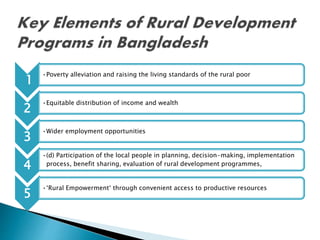
1
•Poverty alleviation and raising the living standards of the rural poor
2
•Equitable distribution of income and wealth
3
•Wider employment opportunities
4
•(d) Participation of the local people in planning, decision-making, implementation
process, benefit sharing, evaluation of rural development programmes,
5
•‘Rural Empowerment‘ through convenient access to productive resources
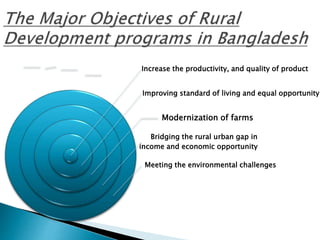
Increase the productivity, and quality of product
Improving standard of living and equal opportunity
Modernization of farms
Bridging the rural urban gap in
income and economic opportunity
Meeting the environmental challenges
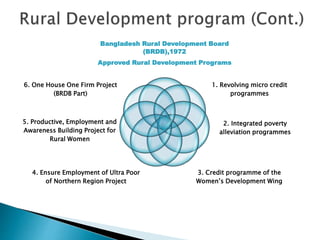
Bangladesh Rural Development Board
(BRDB),1972
Approved Rural Development Programs
1. Revolving micro credit
programmes
2. Integrated poverty
alleviation programmes
3. Credit programme of the
Women’s Development Wing
4. Ensure Employment of Ultra Poor
of Northern Region Project
5. Productive, Employment and
Awareness Building Project for
Rural Women
6. One House One Firm Project
(BRDB Part)
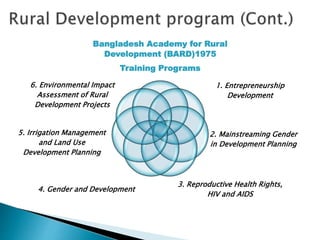
Bangladesh Academy for Rural
Development (BARD)1975
Training Programs
1. Entrepreneurship
Development
2. Mainstreaming Gender
in Development Planning
3. Reproductive Health Rights,
HIV and AIDS
4. Gender and Development
5. Irrigation Management
and Land Use
Development Planning
6. Environmental Impact
Assessment of Rural
Development Projects
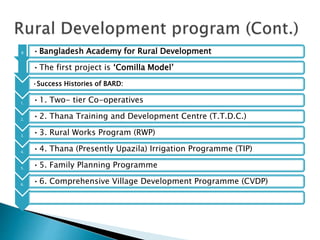
B •Bangladesh Academy for Rural Development
•The first project is ‘Comilla Model’
•Success Histories of BARD:
1.
•1. Two- tier Co-operatives
2.
•2. Thana Training and Development Centre (T.T.D.C.)
3.
•3. Rural Works Program (RWP)
4.
•4. Thana (Presently Upazila) Irrigation Programme (TIP)
5.
•5. Family Planning Programme
6.
•6. Comprehensive Village Development Programme (CVDP)
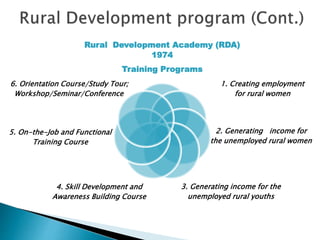
Rural Development Academy (RDA)
1974
Training Programs
1. Creating employment
for rural women
2. Generating income for
the unemployed rural women
3. Generating income for the
unemployed rural youths
4. Skill Development and
Awareness Building Course
5. On-the-Job and Functional
Training Course
6. Orientation Course/Study Tour;
Workshop/Seminar/Conference.
development of income and employment;
 health and sanitation;
agriculture and rural craft;
Vocational education;
relief and rehabilitation;
family planning;
mother and childcare.
1. Donor Agencies;
2. International Action NGO’s;
3. National action NGO’s and
4. Local Action NGO’s.
•BRAC •Green Village
•CARITAS Bangladesh • PROSHIKA
•ASA •POPI
•ASD-Bangladesh (Association
for Sustainable Development)
•Bangladesh Rural Development
Academy (BARD)
Bangladesh Gram Bikash
Sangstha
•Rural Development Academy
(RDA)
•Bangladesh Rural Development
committee (BRDC)
•UCEP-Bangladesh
•Gana Unnayan Society (GUS) •CARE Bangladesh
Gram Unnayan Kendra (GUK) •Global Village
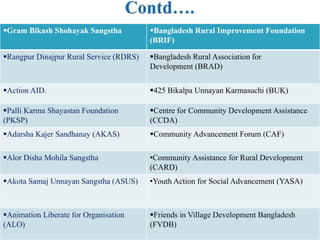
Gram Bikash Shohayak Sangstha Bangladesh Rural Improvement Foundation
(BRIF)
Rangpur Dinajpur Rural Service (RDRS) Bangladesh Rural Association for
Development (BRAD)
Action AID. 425 Bikalpa Unnayan Karmasuchi (BUK)
Palli Karma Shayastan Foundation
(PKSP)
Centre for Community Development Assistance
(CCDA)
Adarsha Kajer Sandhanay (AKAS) Community Advancement Forum (CAF)
Alor Disha Mohila Sangstha •Community Assistance for Rural Development
(CARD)
Akota Samaj Unnayan Sangstha (ASUS) •Youth Action for Social Advancement (YASA)
Animation Liberate for Organisation
(ALO)
Friends in Village Development Bangladesh
(FVDB)
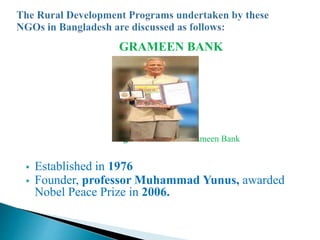
GRAMEEN BANK
Figure: Founder of Grameen Bank
 Established in 1976
 Founder, professor Muhammad Yunus, awarded
Nobel Peace Prize in 2006.
 Microcredit programs;
 Village Phone program;
 Struggling members program;
 Grameen kolyan health program;
 Grameen international dialogue program;
 Grameen basic training program.
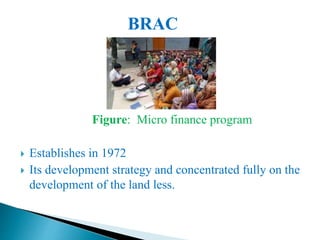
Figure: Micro finance program
 Establishes in 1972
 Its development strategy and concentrated fully on the
development of the land less.
BRAC
1. Water, Sanitation and Hygine program;
2. BRAC education program;
3. BRAC microfinance program;
4. Adolescent development program;
5. BRAC migration program;
6. Economic competitiveness leadership program.
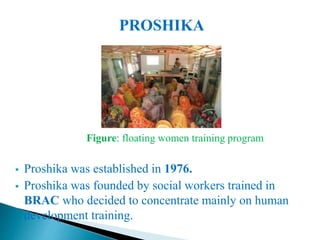
PROSHIKA
Figure: floating women training program
 Proshika was established in 1976.
 Proshika was founded by social workers trained in
BRAC who decided to concentrate mainly on human
development training.
1. Building self-awareness and confidence.
2. Promotion of income.
3. Development education. Especially 40%
groups are formed for women.
TMMS
 develop the socioeconomic status of the poor;
 condition of the poorest to the poor, especially
ultra hard core poor ;
 through implementation of grassroots decision
and;
 utilizing local human and material resources.
 training programs;
 poverty alleviation program through financial
services;
 Raising awareness program;
 Health & nutrition program;
 Microcredit program.
 Establishes in 1978.
Rural development programs taken by ASA are:
 Loan
 Savings.
 Insurance.
 Health awareness.
 Primary education.
 Higher education.
 Partnership building among rural people.
Objectives of ASA are:
 To alleviate poverty and improve the quality of
lives.
 Providing them with access to financial services.
 To ensure women participation in the society
 To create jobs through women involvement
 To provide human rights to improve the situation
of the society.
 Established on 8,February 1972.
 its programme to gain-
the necessary skills, understanding, confidence,
institutions and services; and ensure that the
rural communities have the necessary economic,
social and environmental resources.
Health & sanitation:
NGOs use village-based community health workers to
provide door-to-door health services,
Education:
NGO education programmes are effectively targeted to
the poor, and to poor girls in particular.
Rural Development
Programs/Projects in
Bangladesh
 To create facilities for self-employment.
 To eradicate rural poverty.
 Development of small and landless
farmers.
 For rural physical and social
Infrastructural development.
 To promote resource mobilization.
 To create favorable environment for
micro-credits for rural poor.
 Enhancing nutrition to destitute and poor
women.
 Creating Self-employment.
 Causing economic development.
 Reducing the nutrition deficit.
 To improve the socio-economic
condition.
 Strength of rural people in getting
human rights and justice.
 Participating women in the micro-credit
program.
 Eradicate villages Mohajoni credit
system.
 Reduction of unemployment among poor
people through credit program.
 Create awareness about health,
►Improve living standard of rural people.
►Assisting them in implementing income
generating activities.
►Create employment opportunities and
assist in tourism development activities.
►Exploration of tourist spots in the region.
►Organize trainings, awareness programs,
exploratory and research activities
welfare.
 To support the government poverty
reduction efforts.
 To create facilities for self-
employment, development of small and
landless farmers and eradicate rural
poverty.
 To create favourable environment for
micro-credits for rural poor people.
 Comprehensive village development.
 Empowerment of the rural women.
 Reduction of the number of poor.
 Generation of awareness with mindset
for increased Human Development
Index.
 Promotion of Income Generating
Activities with micro-finance.
 Reduction of migration of the rural
population.
 To improve the quality of life of the
rural poor
 Improve living standard of rural people
 implementation income generating
activities.
 Create employment opportunities and
assist in tourism development activities.
 4. Organize trainings, awareness
programs, exploratory and research
activities welfare.
 H) Name Of the project: Chittagong Hill Tracts Rural
Development Project
 To reducing poverty of rural people, including
indigenous people and poor women, in three hill
districts.
 Strengthen infrastructure and agribusiness support.
 Increases access of growth centre markets.
 Establishment of new private institutions and
enterprises.
 Establishment of more rigorous social safeguards to
avoid resettlement impacts on rural communities
(particularly indigenous peoples).
 Area Covered: Faridgonj and Sharasti Upazila of Chandpur district
 Major Service: Rehabilitation through Housing Construction
 Beneficiaries: 274 families
 Goals: To promote
General Family Welfare
Skill Development
Health Care
Literacy
Nutrition
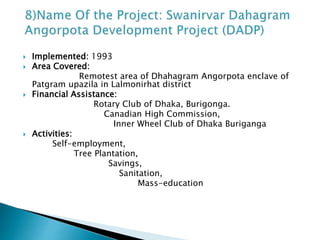
 Implemented: 1993
 Area Covered:
Remotest area of Dhahagram Angorpota enclave of
Patgram upazila in Lalmonirhat district
 Financial Assistance:
Rotary Club of Dhaka, Burigonga.
Canadian High Commission,
Inner Wheel Club of Dhaka Buriganga
 Activities:
Self-employment,
Tree Plantation,
Savings,
Sanitation,
Mass-education
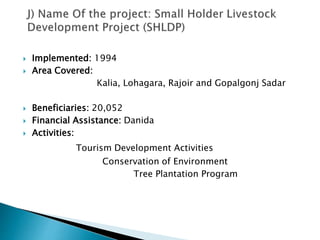
 Implemented: 1994
 Area Covered:
Kalia, Lohagara, Rajoir and Gopalgonj Sadar
 Beneficiaries: 20,052
 Financial Assistance: Danida
 Activities:
Tourism Development Activities
Conservation of Environment
Tree Plantation Program
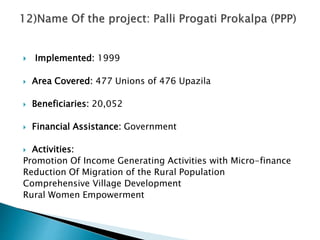
 Implemented: 1999
 Area Covered: 477 Unions of 476 Upazila
 Beneficiaries: 20,052
 Financial Assistance: Government
 Activities:
Promotion Of Income Generating Activities with Micro-finance
Reduction Of Migration of the Rural Population
Comprehensive Village Development
Rural Women Empowerment
 L) Greater Rangpur Agriculture & Rural Development
Project (GRARDP)
 Activities:
 Promotion, formation and strengthening of management
support for target groups
 Carrying out training for group leaders, group members and if
required for DAE field and other staff in participating process
 Executing PRA study in collaborating with DAE field staff
Generally assisting in targeted delivery of services to the rural
poor
 Pre-credit services, credit outreach, delivery and recovery of
backstopping and monitoring promotion of savings
 Promotion, development and monitoring by group activities
 Development of innovative credit mechanism, e.g. establishment
of small rotating credit funds managed by groups themselves,
rental or hired purchase of farm implements, irrigation pumps
and motors etc.
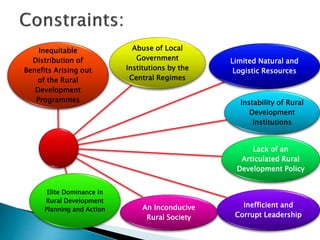
An Inconducive
Rural Society
Inefficient and
Corrupt Leadership
Limited Natural and
Logistic Resources
Instability of Rural
Development
Institutions
Lack of an
Articulated Rural
Development Policy
Elite Dominance in
Rural Development
Planning and Action
Abuse of Local
Government
Institutions by the
Central Regimes
Inequitable
Distribution of
Benefits Arising out
of the Rural
Development
Programmes
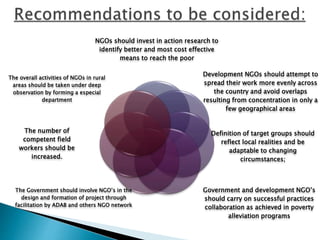
NGOs should invest in action research to
identify better and most cost effective
means to reach the poor
Development NGOs should attempt to
spread their work more evenly across
the country and avoid overlaps
resulting from concentration in only a
few geographical areas
Definition of target groups should
reflect local realities and be
adaptable to changing
circumstances;
Government and development NGO’s
should carry on successful practices
collaboration as achieved in poverty
alleviation programs
The Government should involve NGO’s in the
design and formation of project through
facilitation by ADAB and others NGO network
The number of
competent field
workers should be
increased.
The overall activities of NGOs in rural
areas should be taken under deep
observation by forming a especial
department
THANK YOU FOR
YOUR KIND
ATTENTION
16-09-2015

Rural development programs in bangladesh

  • 1.
    Presented by MD. SAHEDKHAN RS15-JD01M TABASSUM WAHID RS15-JD02M
  • 2.
     Process ofimproving the quality of life and economic wellbeing of people living in relatively isolated and sparsely populated areas  According to World Bank (2006), “Rural development is a strategy designed to improve the economic and social life of a specific group of people-the rural poor.”
  • 3.
    1 •Poverty alleviation andraising the living standards of the rural poor 2 •Equitable distribution of income and wealth 3 •Wider employment opportunities 4 •(d) Participation of the local people in planning, decision-making, implementation process, benefit sharing, evaluation of rural development programmes, 5 •‘Rural Empowerment‘ through convenient access to productive resources
  • 4.
    Increase the productivity,and quality of product Improving standard of living and equal opportunity Modernization of farms Bridging the rural urban gap in income and economic opportunity Meeting the environmental challenges
  • 6.
    Bangladesh Rural DevelopmentBoard (BRDB),1972 Approved Rural Development Programs 1. Revolving micro credit programmes 2. Integrated poverty alleviation programmes 3. Credit programme of the Women’s Development Wing 4. Ensure Employment of Ultra Poor of Northern Region Project 5. Productive, Employment and Awareness Building Project for Rural Women 6. One House One Firm Project (BRDB Part)
  • 7.
    Bangladesh Academy forRural Development (BARD)1975 Training Programs 1. Entrepreneurship Development 2. Mainstreaming Gender in Development Planning 3. Reproductive Health Rights, HIV and AIDS 4. Gender and Development 5. Irrigation Management and Land Use Development Planning 6. Environmental Impact Assessment of Rural Development Projects
  • 8.
    B •Bangladesh Academyfor Rural Development •The first project is ‘Comilla Model’ •Success Histories of BARD: 1. •1. Two- tier Co-operatives 2. •2. Thana Training and Development Centre (T.T.D.C.) 3. •3. Rural Works Program (RWP) 4. •4. Thana (Presently Upazila) Irrigation Programme (TIP) 5. •5. Family Planning Programme 6. •6. Comprehensive Village Development Programme (CVDP)
  • 9.
    Rural Development Academy(RDA) 1974 Training Programs 1. Creating employment for rural women 2. Generating income for the unemployed rural women 3. Generating income for the unemployed rural youths 4. Skill Development and Awareness Building Course 5. On-the-Job and Functional Training Course 6. Orientation Course/Study Tour; Workshop/Seminar/Conference.
  • 10.
    development of incomeand employment;  health and sanitation; agriculture and rural craft; Vocational education; relief and rehabilitation; family planning; mother and childcare.
  • 11.
    1. Donor Agencies; 2.International Action NGO’s; 3. National action NGO’s and 4. Local Action NGO’s.
  • 12.
    •BRAC •Green Village •CARITASBangladesh • PROSHIKA •ASA •POPI •ASD-Bangladesh (Association for Sustainable Development) •Bangladesh Rural Development Academy (BARD) Bangladesh Gram Bikash Sangstha •Rural Development Academy (RDA) •Bangladesh Rural Development committee (BRDC) •UCEP-Bangladesh •Gana Unnayan Society (GUS) •CARE Bangladesh Gram Unnayan Kendra (GUK) •Global Village
  • 13.
    Gram Bikash ShohayakSangstha Bangladesh Rural Improvement Foundation (BRIF) Rangpur Dinajpur Rural Service (RDRS) Bangladesh Rural Association for Development (BRAD) Action AID. 425 Bikalpa Unnayan Karmasuchi (BUK) Palli Karma Shayastan Foundation (PKSP) Centre for Community Development Assistance (CCDA) Adarsha Kajer Sandhanay (AKAS) Community Advancement Forum (CAF) Alor Disha Mohila Sangstha •Community Assistance for Rural Development (CARD) Akota Samaj Unnayan Sangstha (ASUS) •Youth Action for Social Advancement (YASA) Animation Liberate for Organisation (ALO) Friends in Village Development Bangladesh (FVDB)
  • 14.
    GRAMEEN BANK Figure: Founderof Grameen Bank  Established in 1976  Founder, professor Muhammad Yunus, awarded Nobel Peace Prize in 2006.
  • 15.
     Microcredit programs; Village Phone program;  Struggling members program;  Grameen kolyan health program;  Grameen international dialogue program;  Grameen basic training program.
  • 16.
    Figure: Micro financeprogram  Establishes in 1972  Its development strategy and concentrated fully on the development of the land less. BRAC
  • 17.
    1. Water, Sanitationand Hygine program; 2. BRAC education program; 3. BRAC microfinance program; 4. Adolescent development program; 5. BRAC migration program; 6. Economic competitiveness leadership program.
  • 18.
    PROSHIKA Figure: floating womentraining program  Proshika was established in 1976.  Proshika was founded by social workers trained in BRAC who decided to concentrate mainly on human development training.
  • 19.
    1. Building self-awarenessand confidence. 2. Promotion of income. 3. Development education. Especially 40% groups are formed for women.
  • 20.
    TMMS  develop thesocioeconomic status of the poor;  condition of the poorest to the poor, especially ultra hard core poor ;  through implementation of grassroots decision and;  utilizing local human and material resources.
  • 21.
     training programs; poverty alleviation program through financial services;  Raising awareness program;  Health & nutrition program;  Microcredit program.
  • 22.
     Establishes in1978. Rural development programs taken by ASA are:  Loan  Savings.  Insurance.  Health awareness.  Primary education.  Higher education.  Partnership building among rural people.
  • 23.
    Objectives of ASAare:  To alleviate poverty and improve the quality of lives.  Providing them with access to financial services.  To ensure women participation in the society  To create jobs through women involvement  To provide human rights to improve the situation of the society.
  • 24.
     Established on8,February 1972.  its programme to gain- the necessary skills, understanding, confidence, institutions and services; and ensure that the rural communities have the necessary economic, social and environmental resources.
  • 25.
    Health & sanitation: NGOsuse village-based community health workers to provide door-to-door health services, Education: NGO education programmes are effectively targeted to the poor, and to poor girls in particular.
  • 26.
  • 27.
     To createfacilities for self-employment.  To eradicate rural poverty.  Development of small and landless farmers.  For rural physical and social Infrastructural development.  To promote resource mobilization.  To create favorable environment for micro-credits for rural poor.
  • 28.
     Enhancing nutritionto destitute and poor women.  Creating Self-employment.  Causing economic development.  Reducing the nutrition deficit.
  • 29.
     To improvethe socio-economic condition.  Strength of rural people in getting human rights and justice.  Participating women in the micro-credit program.  Eradicate villages Mohajoni credit system.  Reduction of unemployment among poor people through credit program.  Create awareness about health,
  • 30.
    ►Improve living standardof rural people. ►Assisting them in implementing income generating activities. ►Create employment opportunities and assist in tourism development activities. ►Exploration of tourist spots in the region. ►Organize trainings, awareness programs, exploratory and research activities welfare.
  • 31.
     To supportthe government poverty reduction efforts.  To create facilities for self- employment, development of small and landless farmers and eradicate rural poverty.  To create favourable environment for micro-credits for rural poor people.
  • 32.
     Comprehensive villagedevelopment.  Empowerment of the rural women.  Reduction of the number of poor.  Generation of awareness with mindset for increased Human Development Index.  Promotion of Income Generating Activities with micro-finance.  Reduction of migration of the rural population.
  • 33.
     To improvethe quality of life of the rural poor  Improve living standard of rural people  implementation income generating activities.  Create employment opportunities and assist in tourism development activities.  4. Organize trainings, awareness programs, exploratory and research activities welfare.
  • 34.
     H) NameOf the project: Chittagong Hill Tracts Rural Development Project  To reducing poverty of rural people, including indigenous people and poor women, in three hill districts.  Strengthen infrastructure and agribusiness support.  Increases access of growth centre markets.  Establishment of new private institutions and enterprises.  Establishment of more rigorous social safeguards to avoid resettlement impacts on rural communities (particularly indigenous peoples).
  • 35.
     Area Covered:Faridgonj and Sharasti Upazila of Chandpur district  Major Service: Rehabilitation through Housing Construction  Beneficiaries: 274 families  Goals: To promote General Family Welfare Skill Development Health Care Literacy Nutrition
  • 36.
     Implemented: 1993 Area Covered: Remotest area of Dhahagram Angorpota enclave of Patgram upazila in Lalmonirhat district  Financial Assistance: Rotary Club of Dhaka, Burigonga. Canadian High Commission, Inner Wheel Club of Dhaka Buriganga  Activities: Self-employment, Tree Plantation, Savings, Sanitation, Mass-education
  • 37.
     Implemented: 1994 Area Covered: Kalia, Lohagara, Rajoir and Gopalgonj Sadar  Beneficiaries: 20,052  Financial Assistance: Danida  Activities: Tourism Development Activities Conservation of Environment Tree Plantation Program
  • 38.
     Implemented: 1999 Area Covered: 477 Unions of 476 Upazila  Beneficiaries: 20,052  Financial Assistance: Government  Activities: Promotion Of Income Generating Activities with Micro-finance Reduction Of Migration of the Rural Population Comprehensive Village Development Rural Women Empowerment
  • 39.
     L) GreaterRangpur Agriculture & Rural Development Project (GRARDP)  Activities:  Promotion, formation and strengthening of management support for target groups  Carrying out training for group leaders, group members and if required for DAE field and other staff in participating process  Executing PRA study in collaborating with DAE field staff Generally assisting in targeted delivery of services to the rural poor  Pre-credit services, credit outreach, delivery and recovery of backstopping and monitoring promotion of savings  Promotion, development and monitoring by group activities  Development of innovative credit mechanism, e.g. establishment of small rotating credit funds managed by groups themselves, rental or hired purchase of farm implements, irrigation pumps and motors etc.
  • 40.
    An Inconducive Rural Society Inefficientand Corrupt Leadership Limited Natural and Logistic Resources Instability of Rural Development Institutions Lack of an Articulated Rural Development Policy Elite Dominance in Rural Development Planning and Action Abuse of Local Government Institutions by the Central Regimes Inequitable Distribution of Benefits Arising out of the Rural Development Programmes
  • 41.
    NGOs should investin action research to identify better and most cost effective means to reach the poor Development NGOs should attempt to spread their work more evenly across the country and avoid overlaps resulting from concentration in only a few geographical areas Definition of target groups should reflect local realities and be adaptable to changing circumstances; Government and development NGO’s should carry on successful practices collaboration as achieved in poverty alleviation programs The Government should involve NGO’s in the design and formation of project through facilitation by ADAB and others NGO network The number of competent field workers should be increased. The overall activities of NGOs in rural areas should be taken under deep observation by forming a especial department
  • 42.
    THANK YOU FOR YOURKIND ATTENTION 16-09-2015