EDWARA MICHEL
Author
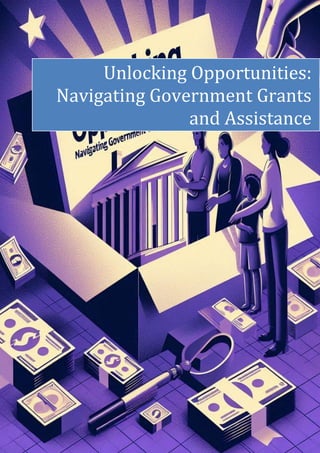
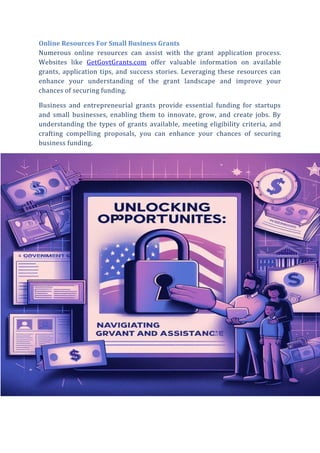
Unlocking Opportunities:
Navigating Government Grants
and Assistance
Welcome to "Unlocking Opportunities: Navigating Government Grants and
Assistance," your comprehensive guide to understanding, applying for, and
securing government grants and assistance programs. Whether you're an
aspiring student, a budding entrepreneur, a dedicated non-profit leader, or
someone seeking financial support for a significant project, this book is
crafted to help you navigate the often complex world of government funding.
Government grants and assistance programs offer immense opportunities for
individuals and organizations to achieve their goals and make a difference.
These programs provide the necessary financial support for education,
business development, health initiatives, cultural projects, and more.
However, understanding the various grants available, their eligibility criteria,
and the application process can be overwhelming.
This book is designed to demystify government grants and provide you with
the knowledge and tools you need to successfully secure funding. Each
chapter delves into specific types of grants, offering detailed information,
practical examples, and actionable advice. By the end of this book, you will be
well-equipped to pursue government grants and make your dreams a reality.
Author Edwara Michel brings years of expertise in the field of government
grants, sharing valuable insights and strategies to enhance your chances of
success. Throughout the book, references to GetGovtGrants.com will guide
you to additional resources and up-to-date information on available grants.
Embark on this journey with us and unlock the opportunities that
government grants and assistance programs can offer. Let’s begin by
understanding the foundational concepts of government grants and
assistance.
Disclaimer
The information provided in this book is for general informational purposes
only. While every effort has been made to ensure the accuracy and
completeness of the information provided, the author and publisher assume
no responsibility for errors, omissions, or inconsistencies. The content of this
book is not intended to serve as legal, financial, or professional advice.
Readers are encouraged to consult with appropriate professionals for specific
guidance tailored to their individual circumstances.
The programs and resources listed in this book are subject to change, and the
availability of funding or support may vary based on factors beyond the
control of the author and publisher. Readers are advised to verify the details
and eligibility criteria of each program by visiting the official websites or
contacting the administering agencies directly.
The author and publisher disclaim any liability for any loss, damage, or
inconvenience caused as a result of reliance on the information contained in
this book. The inclusion of any program, agency, or organization in this book
does not imply endorsement or recommendation by the author or publisher.
Acknowledgements
The author would like to extend heartfelt gratitude to the numerous
individuals and organizations whose work and dedication have made the
compilation of this book possible. Your unwavering commitment to providing
assistance and improving the lives of others is truly inspiring. Thank you for
your invaluable contributions. Special Thanks to ALEX JOHN, It Can not be
Don’t Without Your Guidance.
Table of Contents
1. Introduction to Government Grants and Assistance
2. Understanding Eligibility Criteria
3. The Application Process
4. Required Documentation
5. Exploring Educational Grants
6. Business and Entrepreneurial Grants
7. Grants for Non-Profit Organizations
8. Housing and Urban Development Grants
9. Health and Medical Grants
10. Grants for Artists and Cultural Programs
11. Research and Development Grants
12. Environmental and Conservation Grants
13. Agricultural and Rural Development Grants
14. Technology and Innovation Grants
15. Workforce Development and Training Grants
16. Youth and Sports Grants
17. International Development Grants
18. Disaster Relief and Emergency Grants
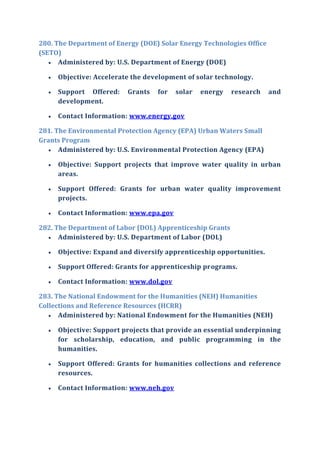
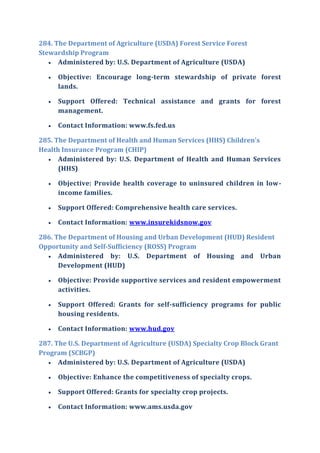
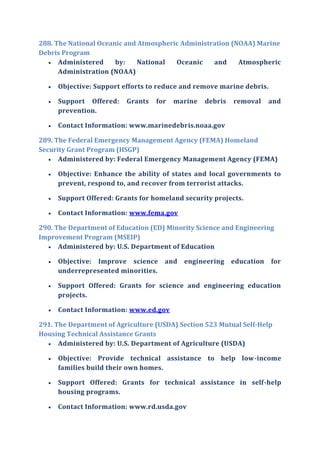
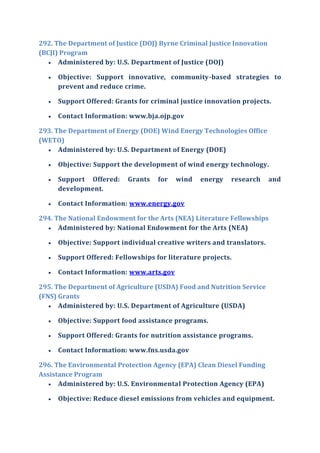
19.Popular Government Programs You Should Not Miss
20. Popular Organizations Offering Grants for the Needy
21. How to Write a Successful Grant Proposal
22. Case Studies of Successful Grant Recipients
23. Frequently Asked Questions
Chapter 1: Introduction to Government
Grants and Assistance
Government grants and assistance programs are vital tools used by
governments to support various sectors, promote public welfare, and
stimulate economic growth. These grants provide financial support for a wide
range of initiatives, from education and healthcare to business development
and environmental conservation. Understanding the basics of government
grants is the first step toward accessing these valuable resources.
What Are Government Grants?
A government grant is a financial award given by a government entity to
support a specific public purpose. Unlike loans, grants do not require
repayment, making them an attractive source of funding for eligible
recipients. Government grants can come from federal, state, or local
governments and are intended to address societal needs such as improving
education, fostering innovation, supporting small businesses, and enhancing
public health.
Types of Government Grants
Government grants can be broadly categorized into several types, each
serving different purposes:
1. Educational Grants: Support students and educational institutions.
These grants can be used for tuition, research, and development of
educational programs.
2. Business and Entrepreneurial Grants: Provide funding for business
development, innovation, and expansion, particularly for startups and
small businesses.
3. Non-Profit Organization Grants: Help non-profit organizations carry
out their missions, whether in health, education, social services, or
other areas.
4. Health and Medical Grants: Fund medical research, public health
initiatives, and healthcare services.
5. Environmental and Conservation Grants: Support projects focused
on environmental protection, conservation, and sustainability.
6. Arts and Culture Grants: Promote the arts by funding artistic projects,
cultural programs, and preservation of cultural heritage.
7. Research and Development Grants: Support scientific research and
technological innovation aimed at solving critical challenges in various
fields.
8. Agricultural and Rural Development Grants: Provide funding to
support agricultural projects, rural development, and food security
initiatives.
9. Technology and Innovation Grants: Encourage technological
advancements and innovation across various industries.
10.Workforce Development and Training Grants: Support job training,
skill development, and workforce readiness programs.
11.Youth and Sports Grants: Fund youth programs, sports initiatives, and
recreational activities.
12.International Development Grants: Support global development
projects, humanitarian aid, and international partnerships.
13.Disaster Relief and Emergency Grants: Provide funding for disaster
response, recovery, and emergency preparedness.
Importance of Government Grants
Government grants play a crucial role in fostering growth and development
across different sectors. They:
1. Support Education: Making higher education accessible to more
students, reducing financial barriers, and enabling academic and
professional growth.
2. Boost Economic Development: Stimulate economic growth by
providing startups and small businesses with the capital needed to
innovate, expand, and create jobs.
3. Enhance Public Health: Fund critical research and public health
initiatives, leading to improved healthcare services and better health
outcomes.
4. Promote Social Welfare: Enable non-profit organizations to address
societal issues, provide essential services, and improve quality of life
for underserved populations.
5. Encourage Environmental Conservation: Support projects that
protect natural resources, promote sustainability, and address
environmental challenges.
What Is the Grant Application Process?
Securing a government grant involves a thorough and strategic approach. The
application process typically includes the following steps:
1. Identifying Relevant Grants: Research and identify grants that align
with your goals and objectives. Each grant has specific criteria and
focuses on different areas, so it’s essential to find the ones that best
match your needs.
2. Understanding Eligibility Requirements: Carefully review the
eligibility criteria for each grant to ensure you meet the requirements.
This may include factors such as residency, organizational status, and
project focus.
3. Preparing a Strong Proposal: A compelling grant proposal is critical
to success. It should clearly articulate your project’s objectives,
methodology, expected outcomes, and budget. Providing evidence of
feasibility and potential impact is also crucial.
4. Submitting Required Documentation: Gather and submit all
necessary documents, such as identification, financial records, and
project plans. Ensuring that your application is complete and accurate
is essential to avoid disqualification.
5. Following Up: After submitting your application, follow up to confirm
receipt and address any questions or additional information requests
from the grantor.
Online Resources For Government Grants
In today’s digital age, numerous online resources can assist with the grant
application process. Websites like GetGovtGrants.com offer valuable
information on available grants, application tips, and success stories.
Leveraging these resources can enhance your understanding of the grant
landscape and improve your chances of securing funding.
Government grants and assistance programs are powerful tools for driving
positive change and fostering growth across various sectors. By
understanding the different types of grants, their importance, and the
application process, you can unlock new opportunities and achieve your
goals.
Chapter 2: Understanding Eligibility
Criteria
Understanding eligibility criteria is a crucial step in the grant application
process. Each grant has specific requirements that applicants must meet to be
considered for funding. This chapter will cover the common eligibility criteria
for various types of government grants and provide tips for determining your
eligibility.
Common Eligibility Criteria
While eligibility criteria vary depending on the grant, some common factors
include:
1. Residency: Many grants require applicants to be residents of a specific
country, state, or locality.
2. Organizational Status: Some grants are only available to certain types
of organizations, such as non-profits, educational institutions, or small
businesses.
3. Project Focus: Grants often target specific areas of interest, such as
education, health, or environmental conservation. Your project must
align with the grant’s objectives.
4. Financial Need: Some grants are based on financial need, requiring
applicants to demonstrate their inability to fund the project without
assistance.
5. Past Performance: For recurring grants, previous recipients may need
to show successful project completion and effective use of funds.
Determining Your Eligibility
To determine your eligibility for a grant:
1. Read the Guidelines: Carefully review the grant guidelines provided
by the funding agency. These guidelines outline the eligibility criteria,
application process, and required documentation.
2. Conduct Self-Assessment: Compare your qualifications and project
details against the eligibility criteria. Ensure you meet all the
requirements before applying.
3. Seek Clarification: If you have questions about your eligibility, contact
the grantor or visit their website for clarification. It’s better to ask
questions upfront than to submit an ineligible application.
4. Consult with Experts: Consider seeking advice from grant consultants
or experts who can help assess your eligibility and improve your
application.
Tips for Meeting Eligibility Requirements
Meeting eligibility requirements is essential for a successful grant application.
Here are some tips to help you meet the criteria:
1. Keep Detailed Records: Maintain comprehensive records of your
organization’s status, financial information, and past projects. This
documentation can support your eligibility claims.
2. Align Your Project: Ensure your project aligns with the grant’s
objectives. Tailor your proposal to highlight how your project meets
the grant’s goals and addresses the funding agency’s priorities.
3. Demonstrate Need: Clearly articulate your financial need and how the
grant will enable you to achieve your project’s objectives. Provide
evidence of your inability to fund the project without assistance.
4. Showcase Past Success: If applicable, highlight your past successes
and effective use of previous grant funds. Demonstrating a track record
of successful projects can strengthen your application.
Understanding and meeting eligibility criteria is the foundation of a
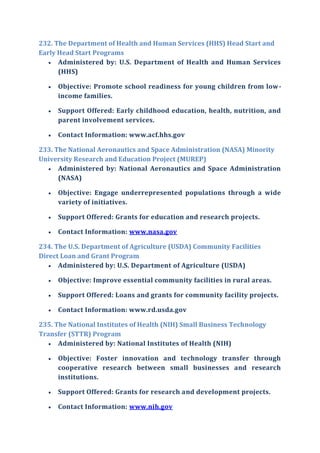
successful grant application. By carefully reviewing the requirements and
aligning your project with the grant’s objectives, you can enhance your
chances of securing funding.
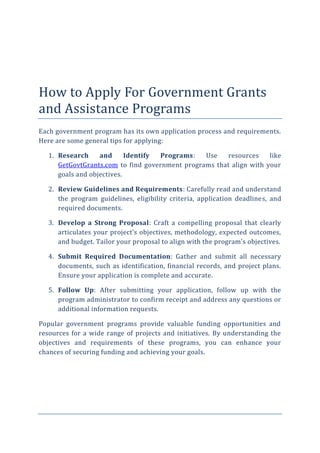
Chapter 3: The Application Process
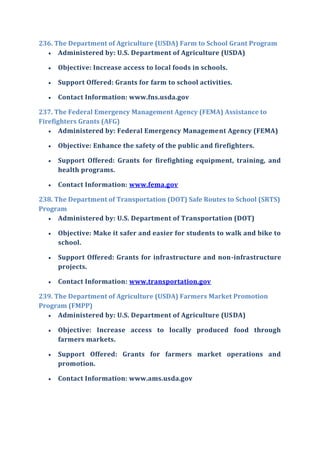
The application process for government grants involves several steps, from
identifying relevant grants to submitting a compelling proposal. This chapter
will guide you through each step, providing tips and best practices to increase
your chances of success.
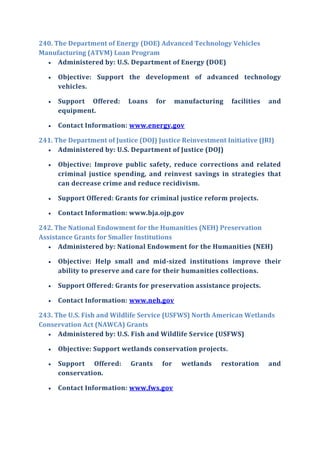
Identifying Relevant Grants
The first step in the application process is identifying grants that align with
your project’s goals and objectives. To find relevant grants:
1. Research Online: Use websites like GetGovtGrants.com to search for
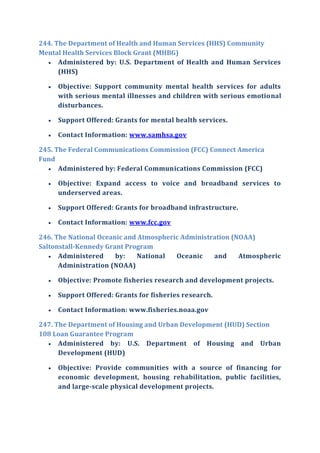
available grants. These platforms provide detailed information on
various grants, including eligibility criteria and application deadlines.
2. Sign Up for Alerts: Subscribe to newsletters and grant alert services to
receive notifications about new grant opportunities. Staying informed
about upcoming grants can help you plan and prepare in advance.
3. Network: Connect with other grant seekers, organizations, and
professionals in your field. Networking can provide valuable insights
and recommendations for relevant grants.
Preparing a Strong Proposal
A strong grant proposal is crucial for securing funding. Your proposal should
clearly articulate your project’s objectives, methodology, expected outcomes,
and budget. Here are some tips for crafting a compelling proposal:
1. Understand the Grant’s Goals: Read the grant guidelines carefully to
understand the funding agency’s objectives and priorities. Tailor your
proposal to align with these goals.
2. Provide a Clear and Concise Description: Clearly describe your
project, its purpose, and how it addresses the grant’s objectives. Avoid
jargon and use simple, straightforward language.
3. Detail Your Methodology: Outline the steps you will take to achieve
your project’s objectives. Include a timeline and explain how you will
measure success.
4. Present a Realistic Budget: Provide a detailed budget that outlines
how you will use the grant funds. Ensure your budget is realistic and
aligns with your project’s scope and objectives.
5. Demonstrate Feasibility and Impact: Provide evidence of your
project’s feasibility and potential impact. Use data, case studies, and
examples to support your claims.
Submitting Required Documentation
Along with your proposal, you will need to submit various documents to
support your application. Commonly required documents include:
1. Identification: Proof of identity and residency for individual applicants
or organizational status for organizations.
2. Financial Records: Financial statements, tax returns, and other
documents that demonstrate your financial need and ability to manage
grant funds.
3. Project Plans: Detailed project plans, including timelines,
methodologies, and expected outcomes.
4. Letters of Support: Letters from partners, stakeholders, or
beneficiaries that endorse your project and demonstrate community
support.
Following Up
After submitting your application, follow up with the funding agency to
confirm receipt and address any questions or additional information
requests. Staying engaged throughout the review process can demonstrate
your commitment and professionalism.
The application process for government grants requires careful planning,
attention to detail, and a strategic approach. By following these steps and best
practices, you can enhance your chances of securing the funding you need to
achieve your project’s goals.
Chapter 4: Required Documentation
Submitting complete and accurate documentation is essential for a successful
grant application. This chapter will outline the common types of documents
required for government grants and provide tips for organizing and
preparing your paperwork.
Commonly Required Documents
The specific documents required for a grant application vary depending on
the grant and the funding agency. However, some commonly required
documents include:
1. Identification: Proof of identity and residency for individual applicants
or proof of organizational status for organizations.
2. Financial Records: Financial statements, tax returns, and other
documents that demonstrate your financial need and ability to manage
grant funds.
3. Project Plans: Detailed project plans, including timelines,
methodologies, and expected outcomes.
4. Budget: A detailed budget outlining how you will use the grant funds.
Include estimates for all project costs and justify each expense.
5. Letters of Support: Letters from partners, stakeholders, or
beneficiaries that endorse your project and demonstrate community
support.
6. Past Performance: For recurring grants, documentation of previous
projects funded by the grant, including outcomes and financial
management.
Tips for Organizing and Preparing Documents
Organizing and preparing your documents is crucial for a successful grant
application. Here are some tips to help you:
1. Create a Checklist: Make a checklist of all required documents based
on the grant guidelines. Check off each item as you prepare it to ensure
nothing is missed.
2. Use a Filing System: Establish a filing system to organize your
documents. Use folders or digital files to categorize documents by type
and grant application.
3. Gather Documents Early: Start gathering required documents well in
advance of the application deadline. This will give you time to request
any missing documents or clarification from the grantor.
4. Ensure Accuracy and Completeness: Double-check all documents for
accuracy and completeness. Incomplete or inaccurate documentation
can lead to disqualification.
5. Provide Clear and Legible Copies: Ensure all copies of documents are
clear and legible. If submitting digital copies, use high-quality scans or
PDFs.
Importance of Documentation
Accurate and complete documentation is critical for a successful grant
application. It provides evidence of your eligibility, financial need, and project
feasibility. Well-organized documentation also demonstrates your
professionalism and attention to detail, which can positively influence the
grant review process.
By understanding the common types of required documents and following
best practices for organizing and preparing your paperwork, you can enhance
your chances of securing government grants.
Chapter 5: Exploring Educational
Grants
Educational grants are a cornerstone of government funding, providing
financial support to students and educational institutions. This chapter will
explore the different types of educational grants available, their eligibility
criteria, and tips for applying.
Types of Educational Grants
Educational grants can be categorized into several types, each serving
different purposes:
1. Federal Grants: These grants are funded by the federal government
and include programs such as the Pell Grant and the Federal
Supplemental Educational Opportunity Grant (FSEOG). They are
typically based on financial need and are available to undergraduate
students.
2. State Grants: State governments offer grants to residents attending in-
state colleges or universities. Eligibility criteria and award amounts
vary by state.
3. Institutional Grants: Many colleges and universities offer their own
grants to students. These grants are often based on financial need,
academic merit, or specific talents.
4. Private Grants: Private organizations, foundations, and corporations
provide grants to students. These grants can be based on various
criteria, including academic achievement, field of study, or community
involvement.
Eligibility Criteria for Educational Grants
Eligibility criteria for educational grants vary depending on the grant.
Common criteria include:
1. Financial Need: Many educational grants are based on financial need,
determined by the Free Application for Federal Student Aid (FAFSA) or
other financial aid forms.
2. Residency: Some grants require applicants to be residents of a specific
state or locality.
3. Enrollment Status: Grants may be available only to full-time or part-
time students enrolled in accredited institutions.
4. Academic Achievement: Some grants are awarded based on academic
merit, requiring a minimum GPA or other academic achievements.
5. Field of Study: Certain grants are targeted at students pursuing
specific fields of study, such as STEM (Science, Technology,
Engineering, and Mathematics) or education.
Tips for Applying for Educational Grants
To enhance your chances of securing educational grants, consider the
following tips:
1. Complete the FAFSA: Submit the FAFSA as early as possible to
determine your eligibility for federal and state grants. Many grants
require the FAFSA as part of the application process.
2. Research and Apply for Multiple Grants: Identify and apply for
multiple grants to increase your chances of receiving funding. Use
resources like GetGovtGrants.com to find relevant grants.
3. Meet Deadlines: Pay attention to application deadlines and submit
your applications on time. Missing a deadline can disqualify you from
receiving a grant.
4. Tailor Your Application: Customize your application for each grant,
highlighting how you meet the specific eligibility criteria and objectives
of the grant.
5. Seek Guidance: Consult with financial aid advisors, teachers, and
mentors who can provide guidance and support throughout the
application process.
Educational grants provide crucial financial support to students, making
higher education more accessible and affordable. By understanding the types
of grants available, meeting eligibility criteria, and following best practices
for applying, you can increase your chances of securing educational funding.
Chapter 6: Business and
Entrepreneurial Grants
Business and entrepreneurial grants provide vital support for startups, small
businesses, and entrepreneurs looking to innovate and grow. This chapter
will explore the different types of business grants available, their eligibility
criteria, and tips for crafting compelling business proposals.
Types of Business Grants
Business grants can be categorized into several types, each serving different
purposes:
1. Federal Grants: These grants are funded by the federal government
and support various business activities, including research and
development, innovation, and business expansion. Examples include
the Small Business Innovation Research (SBIR) and Small Business
Technology Transfer (STTR) programs.
2. State and Local Grants: State and local governments offer grants to
support economic development within their regions. These grants can
be used for business startup costs, expansion, and job creation.
3. Industry-Specific Grants: Certain grants are targeted at specific
industries, such as agriculture, manufacturing, or technology. These
grants aim to support innovation and growth within these sectors.
4. Minority and Women-Owned Business Grants: Grants are available
to support minority and women-owned businesses. These grants aim to
promote diversity and inclusion in the business community.
Eligibility Criteria for Business Grants
Eligibility criteria for business grants vary depending on the grant. Common
criteria include:
1. Business Size: Many grants are targeted at small businesses, defined
by the number of employees or annual revenue.
2. Industry: Some grants are available only to businesses within specific
industries or sectors.
3. Location: Certain grants require businesses to operate within a specific
state, city, or region.
4. Ownership: Grants for minority and women-owned businesses require
proof of ownership status.
5. Project Scope: Grants often fund specific projects or initiatives, such as
research and development, technology adoption, or business
expansion.
Tips for Crafting Compelling Business Proposals
To enhance your chances of securing business grants, consider the following
tips:
1. Research and Identify Relevant Grants: Use resources like
GetGovtGrants.com to find grants that align with your business goals
and objectives.
2. Understand the Grant’s Objectives: Tailor your proposal to align with
the funding agency’s objectives. Clearly articulate how your project
meets the grant’s goals.
3. Provide a Clear Business Plan: Include a detailed business plan that
outlines your project’s objectives, methodology, expected outcomes,
and budget. Demonstrate the feasibility and potential impact of your
project.
4. Showcase Your Team: Highlight the qualifications and expertise of
your team members. Demonstrating a strong and capable team can
strengthen your proposal.
5. Provide Evidence of Success: If applicable, include evidence of past
successes, such as previous projects funded by grants, customer
testimonials, or financial performance.
Online Resources For Small Business Grants
Numerous online resources can assist with the grant application process.
Websites like GetGovtGrants.com offer valuable information on available
grants, application tips, and success stories. Leveraging these resources can
enhance your understanding of the grant landscape and improve your
chances of securing funding.
Business and entrepreneurial grants provide essential funding for startups
and small businesses, enabling them to innovate, grow, and create jobs. By
understanding the types of grants available, meeting eligibility criteria, and
crafting compelling proposals, you can enhance your chances of securing
business funding.
Chapter 7: Grants for Non-Profit
Organizations
Non-profit organizations play a vital role in addressing societal issues and
providing essential services. This chapter will explore the different types of
grants available to non-profits, their eligibility criteria, and tips for writing
successful grant proposals.
Types of Grants for Non-Profit Organizations
Non-profit grants can be categorized into several types, each serving different
purposes:
1. Federal Grants: These grants are funded by the federal government
and support a wide range of non-profit activities, including health,
education, social services, and community development.
2. State and Local Grants: State and local governments offer grants to
support non-profit organizations within their regions. These grants can
be used for program development, capacity building, and community
services.
3. Foundation Grants: Private foundations and philanthropic
organizations provide grants to non-profits. These grants often focus
on specific causes, such as education, healthcare, or the arts.
4. Corporate Grants: Corporations offer grants to non-profit
organizations as part of their corporate social responsibility (CSR)
initiatives. These grants can support a variety of projects and
programs.
Eligibility Criteria for Non-Profit Grants
Eligibility criteria for non-profit grants vary depending on the grant. Common
criteria include:
1. Non-Profit Status: Grants typically require proof of non-profit status,
such as 501(c)(3) designation in the United States.
2. Mission Alignment: Your organization’s mission and activities must
align with the grant’s objectives and focus areas.
3. Location: Certain grants require non-profits to operate within a
specific state, city, or region.
4. Program Focus: Grants often fund specific programs or initiatives,
such as youth development, healthcare, or environmental conservation.
5. Capacity and Experience: Non-profits may need to demonstrate their
capacity to manage the grant funds and successfully implement the
project.
Tips for Writing Successful Grant Proposals
To enhance your chances of securing non-profit grants, consider the following
tips:
1. Research and Identify Relevant Grants: Use resources like
GetGovtGrants.com to find grants that align with your organization’s
mission and programs.
2. Understand the Grant’s Objectives: Tailor your proposal to align with
the funding agency’s objectives. Clearly articulate how your program
meets the grant’s goals and addresses the funding priorities.
3. Provide a Clear Program Plan: Include a detailed program plan that
outlines your project’s objectives, methodology, expected outcomes,
and budget. Demonstrate the feasibility and potential impact of your
program.
4. Showcase Your Organization’s Impact: Highlight your organization’s
achievements and impact. Include data, success stories, and
testimonials that demonstrate your organization’s effectiveness.
5. Build Partnerships: Collaborate with other organizations,
stakeholders, and community members. Partnerships can strengthen
your proposal and demonstrate community support.
Online Resources For Non Profit Grants
Numerous online resources can assist with the grant application process.
Websites like GetGovtGrants.com offer valuable information on available
grants, application tips, and success stories. Leveraging these resources can
enhance your understanding of the grant landscape and improve your
chances of securing funding.
Grants for non-profit organizations provide essential funding to support their
missions and programs. By understanding the types of grants available,
meeting eligibility criteria, and writing compelling proposals, non-profits can
enhance their chances of securing funding and making a positive impact on
their communities.
Chapter 8: Housing and Urban
Development Grants
Housing and urban development grants play a crucial role in supporting
affordable housing, community development, and urban revitalization
projects. This chapter will explore the different types of housing grants
available, their eligibility criteria, and tips for applying.
Types of Housing and Urban Development Grants
Housing and urban development grants can be categorized into several types,
each serving different purposes:
1. Federal Housing Grants: These grants are funded by the federal
government and include programs such as the Community
Development Block Grant (CDBG) and the HOME Investment
Partnerships Program. They support affordable housing, community
development, and infrastructure projects.
2. State and Local Housing Grants: State and local governments offer
grants to support housing and urban development within their regions.
These grants can be used for affordable housing projects, homebuyer
assistance, and neighborhood revitalization.
3. Non-Profit and Foundation Grants: Non-profit organizations and
foundations provide grants to support housing initiatives, including
homeless shelters, affordable housing developments, and community
services.
4. Corporate Grants: Corporations offer grants to support housing and
urban development projects as part of their corporate social
responsibility (CSR) initiatives. These grants can fund a variety of
projects, from affordable housing to community centers.
Eligibility Criteria for Housing and Urban Development Grants
Eligibility criteria for housing grants vary depending on the grant. Common
criteria include:
1. Organizational Status: Grants may be available to non-profit
organizations, government agencies, or private developers.
2. Project Focus: Grants often fund specific types of projects, such as
affordable housing, community development, or urban revitalization.
3. Location: Certain grants require projects to be located within a specific
state, city, or neighborhood.
4. Income Levels: Some grants target low- and moderate-income
households, requiring proof of income levels for beneficiaries.
5. Community Impact: Grants may require evidence of the project’s
potential impact on the community, including benefits for residents and
overall neighborhood improvement.
Tips for Applying for Housing and Urban Development Grants
To enhance your chances of securing housing grants, consider the following
tips:
1. Research and Identify Relevant Grants: Use resources like
GetGovtGrants.com to find grants that align with your housing project’s
goals and objectives.
2. Understand the Grant’s Objectives: Tailor your proposal to align with
the funding agency’s objectives. Clearly articulate how your project
meets the grant’s goals and addresses the funding priorities.
3. Provide a Detailed Project Plan: Include a detailed project plan that
outlines your project’s objectives, methodology, expected outcomes,
and budget. Demonstrate the feasibility and potential impact of your
project.
4. Engage the Community: Involve community members and
stakeholders in the planning and implementation of your project.
Community support can strengthen your proposal and demonstrate the
project’s potential impact.
5. Leverage Partnerships: Collaborate with other organizations,
government agencies, and private developers. Partnerships can
enhance your project’s feasibility and impact, making your proposal
more compelling.
Online Resources For Housing and Urban Development (HUD) Grants
Numerous online resources can assist with the grant application process.
Websites like GetGovtGrants.com offer valuable information on available
grants, application tips, and success stories. Leveraging these resources can
enhance your understanding of the grant landscape and improve your
chances of securing funding.
Housing and urban development grants provide essential funding to support
affordable housing, community development, and urban revitalization
projects. By understanding the types of grants available, meeting eligibility
criteria, and writing compelling proposals, you can enhance your chances of
securing funding and making a positive impact on your community.
Chapter 9: Health and Medical Grants
Health and medical grants provide vital funding for medical research, public
health initiatives, and healthcare services. This chapter will explore the
different types of health grants available, their eligibility criteria, and tips for
applying.
Types of Health and Medical Grants
Health and medical grants can be categorized into several types, each serving
different purposes:
1. Federal Health Grants: These grants are funded by the federal
government and support a wide range of health-related activities,
including medical research, public health initiatives, and healthcare
services. Examples include grants from agencies like the National
Institutes of Health (NIH), Centers for Disease Control and Prevention
(CDC), and Health Resources and Services Administration (HRSA).
2. Foundation Grants: Private foundations and philanthropic
organizations provide grants to support health-related initiatives.
These grants may focus on specific health issues, populations, or
geographic regions.
3. Non-Profit Grants: Non-profit organizations offer grants to support
healthcare services, community health programs, and medical research.
These grants often target underserved populations and address
healthcare disparities.
4. Corporate Grants: Corporations provide grants to support health and
wellness programs, disease prevention efforts, and healthcare
infrastructure. These grants may be part of corporate social
responsibility (CSR) initiatives.
Eligibility Criteria for Health and Medical Grants
Eligibility criteria for health grants vary depending on the grant and funding
agency. Common criteria include:
1. Non-Profit Status: Many health grants are available only to non-profit
organizations, healthcare providers, or research institutions.
2. Project Focus: Grants may target specific health issues, such as cancer
research, mental health services, or infectious disease prevention.
3. Geographic Focus: Some grants prioritize projects serving rural or
underserved communities, addressing healthcare disparities and access
issues.
4. Collaboration: Grants may require collaboration with healthcare
professionals, community organizations, or government agencies to
enhance project impact.
5. Evidence-Based Approach: Proposals that demonstrate evidence-
based interventions, innovative strategies, and potential for
measurable impact are often favored.
Tips for Applying for Health and Medical Grants
To enhance your chances of securing health grants, consider the following
tips:
1. Research and Identify Relevant Grants: Use resources like
GetGovtGrants.com to search for health grants that align with your
organization’s mission and project goals.
2. Understand the Grant’s Objectives: Tailor your proposal to address
the funding agency’s objectives and priorities. Clearly articulate how
your project aligns with these goals.
3. Demonstrate Impact: Provide data and evidence of the potential
impact of your project on improving health outcomes, reducing
healthcare costs, or addressing health disparities.
4. Engage Stakeholders: Involve stakeholders, including patients,
healthcare providers, community leaders, and policymakers, in project
planning and implementation.
5. Budget Wisely: Develop a detailed budget that accurately reflects
project costs, including personnel, supplies, equipment, and evaluation
expenses.
6. Evaluation Plan: Include an evaluation plan to assess the effectiveness
and outcomes of your project. Demonstrating accountability and
continuous improvement is crucial for securing funding.
Online Resources For Medical and Health Grants
Online resources can assist with finding, applying for, and managing health
grants. Websites like GetGovtGrants.com provide information on available
grants, application tips, and success stories. Additionally, funding agencies’
websites offer guidelines, application forms, and resources for grant seekers.
Health and medical grants play a significant role in advancing research,
improving healthcare access, and addressing public health challenges. By
understanding grant opportunities, meeting eligibility criteria, and crafting
compelling proposals, organizations can secure the necessary funding to
conduct groundbreaking studies and contribute to global progress.
Chapter 10: Grants for Artists and
Cultural Programs
Grants for artists and cultural programs support creativity, artistic
expression, and cultural enrichment. This chapter will explore the different
types of grants available, their eligibility criteria, and tips for applying.
Types of Grants for Artists and Cultural Programs
Grants for artists and cultural programs can be categorized into several types,
each serving different purposes:
1. Government Arts Grants: These grants are funded by government
agencies at the federal, state, and local levels. They support a wide
range of artistic disciplines, including visual arts, performing arts,
literature, and cultural preservation.
2. Foundation Grants: Private foundations and philanthropic
organizations provide grants to support artists, arts organizations, and
cultural initiatives. These grants may focus on specific artistic genres,
diversity in the arts, or community engagement through the arts.
3. Non-Profit Grants: Non-profit organizations offer grants to artists, arts
collectives, and cultural institutions. These grants support artistic
projects, exhibitions, performances, and educational programs.
4. Corporate Sponsorships: Corporations sponsor artistic and cultural
events, festivals, exhibitions, and performances as part of their
corporate social responsibility (CSR) initiatives. These sponsorships
often include financial support, venue partnerships, and marketing
collaborations.
Eligibility Criteria for Artists and Cultural Grants
Eligibility criteria for grants in the arts and cultural sector vary depending on
the grant provider and program. Common criteria include:
1. Artistic Discipline: Grants may be specific to certain artistic
disciplines, such as visual arts, music, theater, dance, literature, or
cultural heritage.
2. Project Scope: Grants may fund artistic projects, exhibitions,
performances, residencies, cultural exchanges, educational programs,
or community outreach initiatives.
3. Artistic Merit: Proposals are evaluated based on artistic merit,
innovation, creativity, cultural significance, and potential impact on the
community.
4. Audience Engagement: Projects that engage diverse audiences,
promote inclusivity, and contribute to cultural understanding and
appreciation are often favored.
5. Collaboration: Collaborative projects involving artists, cultural
organizations, community partners, and audiences may receive priority
consideration.
Tips for Applying for Artists and Cultural Grants
To enhance your chances of securing grants in the arts and cultural sector,
consider the following tips:
1. Research and Identify Opportunities: Use resources like
GetGovtGrants.com to find grants, fellowships, residencies, and funding
opportunities in your artistic discipline and geographic region.
2. Review Guidelines and Requirements: Carefully read and understand
the grant guidelines, eligibility criteria, application deadlines, required
documents, and evaluation criteria.
3. Develop a Compelling Proposal: Craft a compelling proposal that
clearly articulates your artistic vision, project goals, methodology,
audience engagement strategies, timeline, budget, and anticipated
outcomes.
4. Provide Work Samples: Include work samples, portfolios, recordings,
or documentation of previous projects to showcase your artistic skills,
achievements, and experience.
5. Demonstrate Community Impact: Describe how your project
contributes to cultural enrichment, artistic innovation, audience
engagement, community development, or cultural heritage
preservation.
6. Budget Wisely: Develop a realistic budget that accurately reflects
project costs, including artist fees, materials, equipment, venue rental,
marketing, outreach, evaluation, and administration.
Online Resources For artists and cultural Grants
Online resources can assist artists and cultural organizations in finding,
applying for, and managing grants. Websites like GetGovtGrants.com provide
information on available grants, application tips, funding deadlines, and
success stories. Additionally, arts councils, cultural agencies, and
grantmakers’ websites offer guidelines, application forms, workshops, and
resources for grant seekers in the arts and cultural sector.
Grants for artists and cultural programs play a crucial role in fostering
creativity, supporting artistic expression, preserving cultural heritage, and
enriching communities. By exploring grant opportunities, understanding
eligibility criteria, crafting compelling proposals, and leveraging online
resources, artists and cultural organizations can secure funding to bring their
artistic visions to life and make a positive impact on society.
Chapter 11: Research and Development Grants
Research and development (R&D) grants support innovation, scientific
research, and technological advancement across various industries. This
chapter will explore the different types of R&D grants available, their
eligibility criteria, and tips for applying.
Types of R&D Grants
R&D grants can be categorized into several types, each supporting different
aspects of research and innovation:
1. Federal R&D Grants: These are provided by government agencies like
the National Science Foundation (NSF), National Institutes of Health
(NIH), and Department of Energy (DOE). They support scientific
research, technological innovation, and development projects in
various fields, including health, engineering, environmental science,
and more.
2. State and Local Government Grants: Some state and local
governments offer R&D grants to promote regional economic
development, support local universities and research institutions, and
encourage innovation in key industries.
3. Corporate R&D Grants: Many corporations provide grants for R&D
activities, particularly in areas relevant to their business operations,
such as pharmaceuticals, technology, and energy. These grants often
aim to foster partnerships with academic and research institutions.
4. Foundation Grants: Private foundations and philanthropic
organizations fund R&D projects that align with their mission. These
grants typically focus on innovative solutions to social, environmental,
or health-related challenges.
Eligibility Criteria for R&D Grants
Eligibility for R&D grants varies by program and funding agency. Common
criteria include:
1. Research Focus: Applicants must propose projects that align with the
specific research priorities and objectives of the grant program.
2. Organizational Type: Eligibility may be restricted to certain types of
institutions, such as universities, research institutions, non-profits, or
small businesses.
3. Principal Investigator Qualifications: Principal investigators (PIs)
are often required to have appropriate academic credentials, research
experience, and expertise in the field related to the grant application.
4. Innovation and Feasibility: Proposals must demonstrate innovative
approaches and the potential for significant scientific or technological
advancements. Feasibility studies and preliminary data are often
required to support the application.
5. Collaboration: Many R&D grants encourage or require collaboration
among researchers, institutions, industries, and sometimes
international partners.
Tips for Applying for R&D Grants
Securing R&D grants requires a well-prepared application that demonstrates
the value and feasibility of the research project. Here are some tips for a
successful application:
1. Understand the Grant’s Objectives: Thoroughly review the funding
agency’s goals and align your project with these objectives. Tailor your
proposal to meet the specific requirements of the grant.
2. Develop a Clear Research Plan: Outline a clear, detailed research plan
that includes objectives, methodology, expected outcomes, timeline,
and budget.
3. Demonstrate Impact: Show how your research can lead to significant
advancements in the field. Include potential commercial applications,
societal benefits, and contributions to scientific knowledge.
4. Include Collaborative Elements: If applicable, demonstrate strong
collaboration with industry partners, other research institutions, or
international entities. Highlight the roles and contributions of all
partners.
5. Prepare a Detailed Budget: Provide a comprehensive budget that
justifies all proposed expenses. Ensure the budget aligns with the
project goals and funding agency’s guidelines.
Online Resources For R&D Grants
Websites like GetGovtGrants.com and agency-specific sites (e.g., NSF, NIH) are
valuable resources for finding R&D grants. These platforms offer detailed
information about available grants, application procedures, and deadlines.
Additionally, academic journals, conferences, and professional networks can
provide insights and opportunities for securing R&D funding.
Research and development grants are crucial for advancing knowledge,
driving innovation, and developing new technologies. By effectively
navigating the grant application process, researchers and organizations can
secure the necessary funding to conduct groundbreaking studies and
contribute to global progress.
Chapter 12: Environmental and
Conservation Grants
Environmental and conservation grants support projects that protect natural
resources, promote sustainability, and address environmental challenges.
This chapter will explore the different types of environmental grants
available, their eligibility criteria, and tips for applying.
Types of Environmental and Conservation Grants
Environmental and conservation grants can be categorized into several types,
each serving different purposes:
1. Federal Environmental Grants: These grants are funded by federal
agencies such as the Environmental Protection Agency (EPA),
Department of Agriculture (USDA), and Department of the Interior
(DOI). They support projects related to environmental protection,
conservation, and sustainability.
2. State and Local Environmental Grants: State and local governments
offer grants to support environmental projects within their regions.
These grants can be used for activities such as land conservation, water
quality improvement, and renewable energy development.
3. Foundation Grants: Private foundations and philanthropic
organizations provide grants for environmental and conservation
projects. These grants often focus on specific issues such as climate
change, biodiversity preservation, and sustainable agriculture.
4. Corporate Grants: Corporations provide grants to support
environmental and sustainability initiatives as part of their corporate
social responsibility (CSR) programs. These grants can fund a variety of
projects, from energy efficiency to community clean-up efforts.
Eligibility Criteria for Environmental and Conservation Grants
Eligibility criteria for environmental grants vary depending on the grant and
funding agency. Common criteria include:
1. Organizational Type: Grants may be available to non-profit
organizations, government agencies, research institutions, and
sometimes private companies.
2. Project Focus: Grants often fund specific types of projects, such as
habitat restoration, pollution prevention, and sustainable development.
3. Geographic Focus: Some grants prioritize projects located in specific
regions or ecosystems.
4. Community Impact: Grants may require evidence of the project’s
potential impact on the environment and local communities.
5. Collaboration: Projects that involve collaboration with multiple
stakeholders, such as community groups, government agencies, and
industry partners, are often favored.
Tips for Applying for Environmental and Conservation Grants
To enhance your chances of securing environmental grants, consider the
following tips:
1. Research and Identify Relevant Grants: Use resources like
GetGovtGrants.com to find grants that align with your environmental
project’s goals and objectives.
2. Understand the Grant’s Objectives: Tailor your proposal to align with
the funding agency’s objectives. Clearly articulate how your project
meets the grant’s goals and addresses the funding priorities.
3. Provide a Detailed Project Plan: Include a detailed project plan that
outlines your project’s objectives, methodology, expected outcomes,
and budget. Demonstrate the feasibility and potential impact of your
project.
4. Engage the Community: Involve community members and
stakeholders in the planning and implementation of your project.
Community support can strengthen your proposal and demonstrate the
project’s potential impact.
5. Leverage Partnerships: Collaborate with other organizations,
government agencies, and industry partners. Partnerships can enhance
your project’s feasibility and impact, making your proposal more
compelling.
Online Resources For Environmental and Conservation Grants
Numerous online resources can assist with the grant application process.
Websites like GetGovtGrants.com offer valuable information on available
grants, application tips, and success stories. Leveraging these resources can
enhance your understanding of the grant landscape and improve your
chances of securing funding.
Environmental and conservation grants provide essential funding to support
projects that protect natural resources, promote sustainability, and address
environmental challenges. By understanding the types of grants available,
meeting eligibility criteria, and writing compelling proposals, you can
enhance your chances of securing funding and making a positive impact on
the environment.
Chapter 13: Agricultural and Rural
Development Grants
Agricultural and rural development grants support projects that enhance
agricultural productivity, promote rural development, and ensure food
security. This chapter will explore the different types of agricultural grants
available, their eligibility criteria, and tips for applying.
Types of Agricultural and Rural Development Grants
Agricultural and rural development grants can be categorized into several
types, each serving different purposes:
1. Federal Agricultural Grants: These grants are funded by federal
agencies such as the U.S. Department of Agriculture (USDA). They
support projects related to agricultural research, rural development,
and food security.
2. State and Local Agricultural Grants: State and local governments
offer grants to support agricultural projects and rural development
within their regions. These grants can be used for activities such as
farm improvements, agribusiness development, and rural
infrastructure.
3. Foundation Grants: Private foundations and philanthropic
organizations provide grants for agricultural and rural development
projects. These grants often focus on sustainable agriculture, food
systems, and rural community development.
4. Corporate Grants: Corporations provide grants to support agricultural
and rural development initiatives as part of their corporate social
responsibility (CSR) programs. These grants can fund a variety of
projects, from agricultural research to community development.
Eligibility Criteria for Agricultural and Rural Development Grants
Eligibility criteria for agricultural and rural development grants vary
depending on the grant and funding agency. Common criteria include:
1. Organizational Type: Grants may be available to non-profit
organizations, government agencies, research institutions, and private
farmers or agribusinesses.
2. Project Focus: Grants often fund specific types of projects, such as
sustainable farming practices, rural infrastructure development, and
food security initiatives.
3. Geographic Focus: Some grants prioritize projects located in rural
areas or specific agricultural regions.
4. Community Impact: Grants may require evidence of the project’s
potential impact on rural communities and agricultural productivity.
5. Innovation and Feasibility: Proposals must demonstrate innovative
approaches and the potential for significant improvements in
agriculture or rural development.
Tips for Applying for Agricultural and Rural Development Grants
To enhance your chances of securing agricultural and rural development
grants, consider the following tips:
1. Research and Identify Relevant Grants: Use resources like
GetGovtGrants.com to find grants that align with your agricultural or
rural development project’s goals and objectives.
2. Understand the Grant’s Objectives: Tailor your proposal to align with
the funding agency’s objectives. Clearly articulate how your project
meets the grant’s goals and addresses the funding priorities.
3. Provide a Detailed Project Plan: Include a detailed project plan that
outlines your project’s objectives, methodology, expected outcomes,
and budget. Demonstrate the feasibility and potential impact of your
project.
4. Engage the Community: Involve community members and
stakeholders in the planning and implementation of your project.
Community support can strengthen your proposal and demonstrate the
project’s potential impact.
5. Leverage Partnerships: Collaborate with other organizations,
government agencies, and industry partners. Partnerships can enhance
your project’s feasibility and impact, making your proposal more
compelling.
Online Resources For Agricultural and Rural Development Grants
Numerous online resources can assist with the grant application process.
Websites like GetGovtGrants.com offer valuable information on available
grants, application tips, and success stories. Leveraging these resources can
enhance your understanding of the grant landscape and improve your
chances of securing funding.
Agricultural and rural development grants provide essential funding to
support projects that enhance agricultural productivity, promote rural
development, and ensure food security. By understanding the types of grants
available, meeting eligibility criteria, and writing compelling proposals, you
can enhance your chances of securing funding and making a positive impact
on rural communities and agriculture.
Chapter 14: Technology and Innovation
Grants
Technology and innovation grants support projects that advance
technological development, foster innovation, and promote economic growth.
This chapter will explore the different types of technology grants available,
their eligibility criteria, and tips for applying.
Types of Technology and Innovation Grants
Technology and innovation grants can be categorized into several types, each
serving different purposes:
1. Federal Technology Grants: These grants are funded by federal
agencies such as the National Science Foundation (NSF), Department of
Energy (DOE), and National Institute of Standards and Technology
(NIST). They support projects related to technological research,
development, and commercialization.
2. State and Local Technology Grants: State and local governments offer
grants to support technology development and innovation within their
regions. These grants can be used for activities such as tech startups,
innovation hubs, and research collaborations.
3. Foundation Grants: Private foundations and philanthropic
organizations provide grants for technology and innovation projects.
These grants often focus on areas such as digital inclusion, tech
education, and sustainable technology.
4. Corporate Grants: Corporations provide grants to support technology
and innovation initiatives as part of their corporate social
responsibility (CSR) programs. These grants can fund a variety of
projects, from tech startups to research and development.
Eligibility Criteria for Technology and Innovation Grants
Eligibility criteria for technology and innovation grants vary depending on
the grant and funding agency. Common criteria include:
1. Organizational Type: Grants may be available to non-profit
organizations, research institutions, tech startups, and private
companies.
2. Project Focus: Grants often fund specific types of projects, such as
technological research, product development, and tech education
programs.
3. Geographic Focus: Some grants prioritize projects located in specific
regions or innovation districts.
4. Innovation and Feasibility: Proposals must demonstrate innovative
approaches and the potential for significant technological
advancements.
5. Collaboration: Many technology grants encourage or require
collaboration among researchers, institutions, industries, and
sometimes international partners.
Tips for Applying for Technology and Innovation Grants
To enhance your chances of securing technology and innovation grants,
consider the following tips:
1. Research and Identify Relevant Grants: Use resources like
GetGovtGrants.com to find grants that align with your technology
project’s goals and objectives.
2. Understand the Grant’s Objectives: Tailor your proposal to align with
the funding agency’s objectives. Clearly articulate how your project
meets the grant’s goals and addresses the funding priorities.
3. Develop a Clear Research Plan: Outline a clear, detailed research plan
that includes objectives, methodology, expected outcomes, timeline,
and budget.
4. Demonstrate Impact: Show how your research can lead to significant
advancements in the field. Include potential commercial applications,
societal benefits, and contributions to scientific knowledge.
5. Include Collaborative Elements: If applicable, demonstrate strong
collaboration with industry partners, other research institutions, or
international entities. Highlight the roles and contributions of all
partners.
6. Prepare a Detailed Budget: Provide a comprehensive budget that
justifies all proposed expenses. Ensure the budget aligns with the
project goals and funding agency’s guidelines.
Online Resources for Technology and Innovation Grants
Websites like GetGovtGrants.com and agency-specific sites (e.g., NSF, DOE)
are valuable resources for finding technology and innovation grants. These
platforms offer detailed information about available grants, application
procedures, and deadlines. Additionally, tech conferences, professional
networks, and innovation hubs can provide insights and opportunities for
securing funding.
Technology and innovation grants are crucial for advancing research, driving
innovation, and developing new technologies. By effectively navigating the
grant application process, researchers and organizations can secure the
necessary funding to conduct groundbreaking studies and contribute to
global progress.
Chapter 15: Workforce Development
and Training Grants
Workforce development and training grants support initiatives that enhance
job skills, improve workforce readiness, and promote economic growth. This
chapter will explore the different types of workforce grants available, their
eligibility criteria, and tips for applying.
Types of Workforce Development and Training Grants
Workforce development and training grants can be categorized into several
types, each serving different purposes:
1. Federal Workforce Grants: These grants are funded by federal
agencies such as the Department of Labor (DOL) and the Employment
and Training Administration (ETA). They support projects related to
job training, skills development, and workforce readiness.
2. State and Local Workforce Grants: State and local governments offer
grants to support workforce development and training within their
regions. These grants can be used for activities such as apprenticeship
programs, job training centers, and skills development initiatives.
3. Foundation Grants: Private foundations and philanthropic
organizations provide grants for workforce development projects.
These grants often focus on areas such as adult education, vocational
training, and employment services.
4. Corporate Grants: Corporations provide grants to support workforce
development initiatives as part of their corporate social responsibility
(CSR) programs. These grants can fund a variety of projects, from job
training programs to employee development.
Eligibility Criteria for Workforce Development and Training Grants
Eligibility criteria for workforce development and training grants vary
depending on the grant and funding agency. Common criteria include:
1. Organizational Type: Grants may be available to non-profit
organizations, educational institutions, job training centers, and private
companies.
2. Project Focus: Grants often fund specific types of projects, such as
vocational training, skills development, and workforce readiness
programs.
3. Geographic Focus: Some grants prioritize projects located in specific
regions or serving certain populations.
4. Community Impact: Grants may require evidence of the project’s
potential impact on the local workforce and economy.
5. Collaboration: Many workforce grants encourage or require
collaboration among employers, training providers, educational
institutions, and community organizations.
Tips for Applying for Workforce Development and Training Grants
To enhance your chances of securing workforce development and training
grants, consider the following tips:
1. Research and Identify Relevant Grants: Use resources like
GetGovtGrants.com to find grants that align with your workforce
development project’s goals and objectives.
2. Understand the Grant’s Objectives: Tailor your proposal to align with
the funding agency’s objectives. Clearly articulate how your project
meets the grant’s goals and addresses the funding priorities.
3. Develop a Clear Training Plan: Outline a clear, detailed training plan
that includes objectives, methodology, expected outcomes, timeline,
and budget.
4. Demonstrate Impact: Show how your training program can lead to
significant improvements in job skills, workforce readiness, and
employment outcomes.
5. Include Collaborative Elements: If applicable, demonstrate strong
collaboration with employers, training providers, educational
institutions, and community organizations. Highlight the roles and
contributions of all partners.
6. Prepare a Detailed Budget: Provide a comprehensive budget that
justifies all proposed expenses. Ensure the budget aligns with the
project goals and funding agency’s guidelines.
Online Resources for Workforce Development and Training Grants
Websites like GetGovtGrants.com and agency-specific sites (e.g., DOL, ETA)
are valuable resources for finding workforce development and training
grants. These platforms offer detailed information about available grants,
application procedures, and deadlines. Additionally, workforce development
conferences, professional networks, and training centers can provide insights
and opportunities for securing funding.
Workforce development and training grants are crucial for enhancing job
skills, improving workforce readiness, and promoting economic growth. By
effectively navigating the grant application process, organizations can secure
the necessary funding to implement impactful training programs and
contribute to a stronger, more skilled workforce.
Chapter 16: Youth and Sports Grants
Youth and sports grants support initiatives that promote youth development,
physical fitness, and community engagement through sports. This chapter
will explore the different types of youth and sports grants available, their
eligibility criteria, and tips for applying.
Types of Youth and Sports Grants
Youth and sports grants can be categorized into several types, each serving
different purposes:
1. Federal Youth and Sports Grants: These grants are funded by federal
agencies such as the Department of Education (DOE) and the Office of
Juvenile Justice and Delinquency Prevention (OJJDP). They support
projects related to youth development, sports programs, and physical
education.
2. State and Local Youth and Sports Grants: State and local
governments offer grants to support youth and sports initiatives within
their regions. These grants can be used for activities such as after-
school programs, sports leagues, and youth centers.
3. Foundation Grants: Private foundations and philanthropic
organizations provide grants for youth and sports projects. These
grants often focus on areas such as youth leadership, physical fitness,
and community sports programs.
4. Corporate Grants: Corporations provide grants to support youth and
sports initiatives as part of their corporate social responsibility (CSR)
programs. These grants can fund a variety of projects, from youth
sports leagues to fitness programs.
Eligibility Criteria for Youth and Sports Grants
Eligibility criteria for youth and sports grants vary depending on the grant
and funding agency. Common criteria include:
1. Organizational Type: Grants may be available to non-profit
organizations, schools, community centers, and sports clubs.
2. Project Focus: Grants often fund specific types of projects, such as
youth development programs, sports leagues, and physical education
initiatives.
3. Geographic Focus: Some grants prioritize projects located in specific
regions or serving certain populations.
4. Community Impact: Grants may require evidence of the project’s
potential impact on youth development, physical fitness, and
community engagement.
5. Collaboration: Many youth and sports grants encourage or require
collaboration among schools, community organizations, sports clubs,
and local governments.
Tips for Applying for Youth and Sports Grants
To enhance your chances of securing youth and sports grants, consider the
following tips:
1. Research and Identify Relevant Grants: Use resources like
GetGovtGrants.com to find grants that align with your youth and sports
project’s goals and objectives.
2. Understand the Grant’s Objectives: Tailor your proposal to align with
the funding agency’s objectives. Clearly articulate how your project
meets the grant’s goals and addresses the funding priorities.
3. Develop a Clear Program Plan: Outline a clear, detailed program plan
that includes objectives, methodology, expected outcomes, timeline,
and budget.
4. Demonstrate Impact: Show how your program can lead to significant
improvements in youth development, physical fitness, and community
engagement.
5. Include Collaborative Elements: If applicable, demonstrate strong
collaboration with schools, community organizations, sports clubs, and
local governments. Highlight the roles and contributions of all partners.
6. Prepare a Detailed Budget: Provide a comprehensive budget that
justifies all proposed expenses. Ensure the budget aligns with the
project goals and funding agency’s guidelines.
Online Resources For Youth and Sports Grants
Websites like GetGovtGrants.com and agency-specific sites (e.g., DOE, OJJDP)
are valuable resources for finding youth and sports grants. These platforms
offer detailed information about available grants, application procedures, and
deadlines. Additionally, youth development conferences, professional
networks, and sports associations can provide insights and opportunities for
securing funding.
Youth and sports grants are crucial for promoting youth development,
physical fitness, and community engagement. By effectively navigating the
grant application process, organizations can secure the necessary funding to
implement impactful youth and sports programs and contribute to healthier,
more engaged communities.
Chapter 17: International Development
Grants
International development grants support projects that address global
challenges, promote sustainable development, and improve the quality of life
in developing countries. This chapter will explore the different types of
international development grants available, their eligibility criteria, and tips
for applying.
Types of International Development Grants
International development grants can be categorized into several types, each
serving different purposes:
1. Federal International Grants: These grants are funded by federal
agencies such as the United States Agency for International
Development (USAID) and the Department of State. They support
projects related to global health, education, economic development, and
humanitarian assistance.
2. International Organizations: International organizations such as the
United Nations (UN), World Bank, and International Monetary Fund
(IMF) provide grants for development projects in various sectors,
including health, education, and infrastructure.
3. Foundation Grants: Private foundations and philanthropic
organizations provide grants for international development projects.
These grants often focus on areas such as poverty alleviation,
healthcare, and education in developing countries.
4. Corporate Grants: Corporations provide grants to support
international development initiatives as part of their corporate social
responsibility (CSR) programs. These grants can fund a variety of
projects, from healthcare to economic development.
Eligibility Criteria for International Development Grants
Eligibility criteria for international development grants vary depending on
the grant and funding agency. Common criteria include:
1. Organizational Type: Grants may be available to non-profit
organizations, non-governmental organizations (NGOs), research
institutions, and sometimes private companies.
2. Project Focus: Grants often fund specific types of projects, such as
global health initiatives, education programs, and economic
development projects.
3. Geographic Focus: Some grants prioritize projects located in specific
regions or countries, particularly in developing areas.
4. Sustainability and Impact: Proposals must demonstrate sustainable
approaches and the potential for significant improvements in quality of
life.
5. Collaboration: Many international development grants encourage or
require collaboration among international partners, local
organizations, and governments.
Tips for Applying for International Development Grants
To enhance your chances of securing international development grants,
consider the following tips:
1. Research and Identify Relevant Grants: Use resources like
GetGovtGrants.com to find grants that align with your international
development project’s goals and objectives.
2. Understand the Grant’s Objectives: Tailor your proposal to align with
the funding agency’s objectives. Clearly articulate how your project
meets the grant’s goals and addresses the funding priorities.
3. Develop a Clear Project Plan: Outline a clear, detailed project plan
that includes objectives, methodology, expected outcomes, timeline,
and budget.
4. Demonstrate Impact: Show how your project can lead to significant
improvements in quality of life, economic development, and
sustainability in the target regions.
5. Include Collaborative Elements: If applicable, demonstrate strong
collaboration with international partners, local organizations, and
governments. Highlight the roles and contributions of all partners.
6. Prepare a Detailed Budget: Provide a comprehensive budget that
justifies all proposed expenses. Ensure the budget aligns with the
project goals and funding agency’s guidelines.
Online Resources For International Development Grants
Websites like GetGovtGrants.com and agency-specific sites (e.g., USAID, UN)
are valuable resources for finding international development grants. These
platforms offer detailed information about available grants, application
procedures, and deadlines. Additionally, international development
conferences, professional networks, and NGOs can provide insights and
opportunities for securing funding.
International development grants are crucial for addressing global
challenges, promoting sustainable development, and improving the quality of
life in developing countries. By effectively navigating the grant application
process, organizations can secure the necessary funding to implement
impactful international development projects and contribute to global
progress.
Chapter 18: Disaster Relief and
Emergency Grants
Disaster relief and emergency grants provide funding for immediate
response, recovery, and preparedness efforts following natural disasters,
emergencies, and crises. This chapter will explore the different types of
disaster relief grants available, their eligibility criteria, and tips for applying.
Types of Disaster Relief and Emergency Grants
Disaster relief and emergency grants can be categorized into several types,
each serving different purposes:
1. Federal Disaster Grants: These grants are funded by federal agencies
such as the Federal Emergency Management Agency (FEMA) and the
Department of Homeland Security (DHS). They support projects related
to disaster response, recovery, and preparedness.
2. State and Local Disaster Grants: State and local governments offer
grants to support disaster relief and emergency preparedness within
their regions. These grants can be used for activities such as emergency
response, infrastructure repair, and community resilience.
3. Foundation Grants: Private foundations and philanthropic
organizations provide grants for disaster relief and emergency projects.
These grants often focus on areas such as humanitarian assistance,
emergency shelter, and disaster recovery.
4. Corporate Grants: Corporations provide grants to support disaster
relief and emergency initiatives as part of their corporate social
responsibility (CSR) programs. These grants can fund a variety of
projects, from immediate response efforts to long-term recovery.
Eligibility Criteria for Disaster Relief and Emergency Grants
Eligibility criteria for disaster relief and emergency grants vary depending on
the grant and funding agency. Common criteria include:
1. Organizational Type: Grants may be available to non-profit
organizations, government agencies, emergency response teams, and
sometimes private companies.
2. Project Focus: Grants often fund specific types of projects, such as
immediate disaster response, recovery efforts, and preparedness
initiatives.
3. Geographic Focus: Some grants prioritize projects located in regions
affected by recent disasters or areas at high risk for emergencies.
4. Community Impact: Grants may require evidence of the project’s
potential impact on affected communities and their ability to recover.
5. Collaboration: Many disaster relief grants encourage or require
collaboration among emergency response teams, local organizations,
and governments.
Tips for Applying for Disaster Relief and Emergency Grants
To enhance your chances of securing disaster relief and emergency grants,
consider the following tips:
1. Research and Identify Relevant Grants: Use resources like
GetGovtGrants.com to find grants that align with your disaster relief
and emergency project’s goals and objectives.
2. Understand the Grant’s Objectives: Tailor your proposal to align with
the funding agency’s objectives. Clearly articulate how your project
meets the grant’s goals and addresses the funding priorities.
3. Develop a Clear Response Plan: Outline a clear, detailed response
plan that includes objectives, methodology, expected outcomes,
timeline, and budget.
4. Demonstrate Impact: Show how your project can lead to significant
improvements in disaster response, community recovery, and
preparedness.
5. Include Collaborative Elements: If applicable, demonstrate strong
collaboration with emergency response teams, local organizations, and
governments. Highlight the roles and contributions of all partners.
6. Prepare a Detailed Budget: Provide a comprehensive budget that
justifies all proposed expenses. Ensure the budget aligns with the
project goals and funding agency’s guidelines.
Online Resources For Disaster Relief and Emergency Grants
Websites like GetGovtGrants.com and agency-specific sites (e.g., FEMA, DHS)
are valuable resources for finding disaster relief and emergency grants. These
platforms offer detailed information about available grants, application
procedures, and deadlines. Additionally, disaster response conferences,
professional networks, and emergency management organizations can
provide insights and opportunities for securing funding.
Disaster relief and emergency grants are crucial for providing immediate
response, supporting recovery efforts, and enhancing preparedness for future
crises. By effectively navigating the grant application process, organizations
can secure the necessary funding to implement impactful disaster relief and
emergency projects and contribute to community resilience.
Chapter 19: Popular Government
Programs You Should Not Miss
Government programs provide a wide range of funding opportunities and
resources for individuals, businesses, non-profits, and communities. This
chapter will highlight some of the most popular government programs that
offer grants and assistance, their objectives, and how to apply.
1. Pell Grant Program
 Administered by: U.S. Department of Education
 Objective: Provide financial aid to undergraduate students based
on financial need.
 Support Offered: Grants for tuition and educational expenses.
 Contact Information: www.studentaid.gov
2. Community Development Block Grant (CDBG) Program
 Administered by: U.S. Department of Housing and Urban
Development (HUD)
 Objective: Support community development projects, including
affordable housing and infrastructure.
 Support Offered: Grants to local governments for community
improvement projects.
 Contact Information: www.hud.gov
3. Head Start Program
 Administered by: U.S. Department of Health and Human Services
(HHS)
 Objective: Promote school readiness for young children from low-
income families.
 Support Offered: Early childhood education, health, nutrition, and
parent involvement services.
 Contact Information: www.acf.hhs.gov/ohs
4. Supplemental Nutrition Assistance Program (SNAP)
 Administered by: U.S. Department of Agriculture (USDA)
 Objective: Provide food-purchasing assistance to low-income
individuals and families.
 Support Offered: Financial assistance for purchasing groceries.
 Contact Information: www.fns.usda.gov/snap
5. Section 8 Housing Choice Voucher Program
 Administered by: U.S. Department of Housing and Urban
Development (HUD)
 Objective: Assist low-income families in obtaining safe and
affordable housing.
 Support Offered: Vouchers to cover a portion of rental costs.
 Contact Information: www.hud.gov
6. Small Business Innovation Research (SBIR) Program
 Administered by: Various federal agencies
 Objective: Encourage small businesses to engage in federal
research and development.
 Support Offered: Grants for research and development projects
with commercialization potential.
 Contact Information: www.sbir.gov
7. Federal Pell Grant Program
 Administered by: U.S. Department of Education
 Objective: Provide need-based grants to low-income
undergraduate students.
 Support Offered: Financial aid for tuition and educational
expenses.
 Contact Information: www.studentaid.gov
8. Temporary Assistance for Needy Families (TANF)
 Administered by: U.S. Department of Health and Human Services
(HHS)
 Objective: Provide financial assistance and support services to
low-income families.
 Support Offered: Cash assistance, job training, and child care
support.
 Contact Information: www.acf.hhs.gov/ofa/programs/tanf
9. Medicaid Program
 Administered by: U.S. Department of Health and Human Services
(HHS)
 Objective: Provide health coverage to low-income individuals and
families.
 Support Offered: Medical and health-related services.
 Contact Information: www.medicaid.gov
10. Low Income Home Energy Assistance Program (LIHEAP)
 Administered by: U.S. Department of Health and Human Services
(HHS)
 Objective: Assist low-income households with their home energy
bills.
 Support Offered: Financial assistance for heating and cooling costs.
 Contact Information: www.acf.hhs.gov/ocs/programs/liheap
11. Federal Work-Study Program
 Administered by: U.S. Department of Education
 Objective: Provide part-time jobs for undergraduate and graduate
students with financial need.
 Support Offered: Employment opportunities to help pay for
education expenses.
 Contact Information: www.studentaid.gov
12. Children's Health Insurance Program (CHIP)
 Administered by: U.S. Department of Health and Human Services
(HHS)
 Objective: Provide health coverage to uninsured children in low-
income families.
 Support Offered: Comprehensive health care services.
 Contact Information: www.insurekidsnow.gov
13. Lifeline Program
 Administered by: Federal Communications Commission (FCC)
 Objective: Provide discounted phone and internet services to low-
income households.
 Support Offered: Subsidies for phone and broadband services.
 Contact Information: www.lifelinesupport.org
14. Special Supplemental Nutrition Program for Women, Infants, and
Children (WIC)
 Administered by: U.S. Department of Agriculture (USDA)
 Objective: Provide nutritious foods, education, and health care
referrals to low-income pregnant women, new mothers, and young
children.
 Support Offered: Vouchers for healthy foods, nutrition education,
and health screenings.
 Contact Information: www.fns.usda.gov/wic
15. Public Housing Program
 Administered by: U.S. Department of Housing and Urban
Development (HUD)
 Objective: Provide affordable rental housing to low-income
families, the elderly, and individuals with disabilities.
 Support Offered: Subsidized rental housing.
 Contact Information: www.hud.gov
16. State Children's Health Insurance Program (SCHIP)
 Administered by: U.S. Department of Health and Human Services
(HHS)
 Objective: Provide health insurance to children in families that
earn too much to qualify for Medicaid but cannot afford private
coverage.
 Support Offered: Comprehensive health insurance for children.
 Contact Information: www.insurekidsnow.gov
17. Job Corps
 Administered by: U.S. Department of Labor (DOL)
 Objective: Provide free education and vocational training to young
adults.
 Support Offered: Job training, education, and support services.
 Contact Information: www.jobcorps.gov
18. Subsidized Housing for the Elderly (Section 202)
 Administered by: U.S. Department of Housing and Urban
Development (HUD)
 Objective: Provide affordable housing options for elderly
individuals.
 Support Offered: Rental assistance for elderly housing.
 Contact Information: www.hud.gov
19. Supplemental Security Income (SSI)
 Administered by: Social Security Administration (SSA)
 Objective: Provide financial assistance to elderly, blind, and
disabled individuals with limited income and resources.
 Support Offered: Monthly cash benefits.
 Contact Information: www.ssa.gov/ssi
20. Earned Income Tax Credit (EITC)
 Administered by: Internal Revenue Service (IRS)
 Objective: Provide tax credits to low- to moderate-income working
individuals and families.
 Support Offered: Refundable tax credits to reduce tax liability.
 Contact Information: www.irs.gov/eitc
21. Housing Opportunities for Persons with AIDS (HOPWA)
 Administered by: U.S. Department of Housing and Urban
Development (HUD)
 Objective: Provide housing assistance and supportive services to
individuals with HIV/AIDS.
 Support Offered: Housing subsidies and supportive services.
 Contact Information: www.hud.gov/hopwa
22. State Energy Program (SEP)
 Administered by: U.S. Department of Energy (DOE)
 Objective: Promote energy efficiency and renewable energy
initiatives at the state level.
 Support Offered: Grants for state energy programs.
 Contact Information: www.energy.gov
23. Rural Housing Repair Loans and Grants
 Administered by: U.S. Department of Agriculture (USDA)
 Objective: Assist low-income homeowners in rural areas with
home repairs and improvements.
 Support Offered: Loans and grants for home repairs.
 Contact Information: www.rd.usda.gov
24. Weatherization Assistance Program (WAP)
 Administered by: U.S. Department of Energy (DOE)
 Objective: Improve the energy efficiency of low-income homes.
 Support Offered: Free weatherization services, such as insulation
and energy-efficient appliances.
 Contact Information: www.energy.gov/eere/wap
25. Senior Community Service Employment Program (SCSEP)
 Administered by: U.S. Department of Labor (DOL)
 Objective: Provide job training and employment opportunities for
older adults.
 Support Offered: Paid community service and job training for
seniors.
 Contact Information: www.dol.gov/agencies/eta/seniors
26. Head Start and Early Head Start Programs
 Administered by: U.S. Department of Health and Human Services
(HHS)
 Objective: Promote school readiness for young children from low-
income families.
 Support Offered: Early childhood education, health, nutrition, and
parent involvement services.
 Contact Information: www.acf.hhs.gov/ohs
27. Community Services Block Grant (CSBG)
 Administered by: U.S. Department of Health and Human Services
(HHS)
 Objective: Provide funding to alleviate poverty and support self-
sufficiency.
 Support Offered: Grants for community action agencies to provide
various services.
 Contact Information: www.acf.hhs.gov/ocs/programs/csbg
28. Maternal and Child Health Services Block Grant
 Administered by: U.S. Department of Health and Human Services
(HHS)
 Objective: Improve the health of mothers and children.
 Support Offered: Grants for maternal and child health programs.
 Contact Information: www.mchb.hrsa.gov
29. Special Milk Program (SMP)
 Administered by: U.S. Department of Agriculture (USDA)
 Objective: Provide milk to children in schools and childcare
institutions.
 Support Offered: Subsidies for milk served to children.
 Contact Information: www.fns.usda.gov/smp
30. Women, Infants, and Children (WIC) Farmers' Market Nutrition
Program
 Administered by: U.S. Department of Agriculture (USDA)
 Objective: Provide fresh, nutritious, locally grown fruits and
vegetables to WIC participants.
 Support Offered: Coupons to purchase produce at farmers'
markets.
 Contact Information: www.fns.usda.gov/wic
31. Child and Adult Care Food Program (CACFP)
 Administered by: U.S. Department of Agriculture (USDA)
 Objective: Provide nutritious meals and snacks to children and
adults in care settings.
 Support Offered: Reimbursement for meals and snacks served.
 Contact Information: www.fns.usda.gov/cacfp
32. School Breakfast Program (SBP)
 Administered by: U.S. Department of Agriculture (USDA)
 Objective: Provide nutritious breakfasts to children in schools.
 Support Offered: Reimbursement for breakfasts served.
 Contact Information: www.fns.usda.gov/sbp
33. National School Lunch Program (NSLP)
 Administered by: U.S. Department of Agriculture (USDA)
 Objective: Provide nutritious lunches to children in schools.
 Support Offered: Reimbursement for lunches served.
 Contact Information: www.fns.usda.gov/nslp
34. Farmers' Market Promotion Program (FMPP)
 Administered by: U.S. Department of Agriculture (USDA)
 Objective: Increase access to locally produced food through
farmers' markets.
 Support Offered: Grants to support farmers' market operations
and promotion.
 Contact Information: www.ams.usda.gov
35. Senior Farmers' Market Nutrition Program (SFMNP)
 Administered by: U.S. Department of Agriculture (USDA)
 Objective: Provide low-income seniors with access to fresh,
nutritious, locally grown produce.
 Support Offered: Coupons to purchase produce at farmers'
markets.
 Contact Information: www.fns.usda.gov/sfmnp
36. Health Resources and Services Administration (HRSA) Grants
 Administered by: U.S. Department of Health and Human Services
(HHS)
 Objective: Improve access to health care services for underserved
populations.
 Support Offered: Grants for health centers and other health care
providers.
 Contact Information: www.hrsa.gov
37. Ryan White HIV/AIDS Program
 Administered by: U.S. Department of Health and Human Services
(HHS)
 Objective: Provide care and support services to individuals living
with HIV/AIDS.
 Support Offered: Grants for medical care, support services, and
medication.
 Contact Information: www.hab.hrsa.gov
38. Substance Abuse Prevention and Treatment Block Grant (SABG)
 Administered by: U.S. Department of Health and Human Services
(HHS)
 Objective: Support substance abuse prevention and treatment
programs.
 Support Offered: Grants for state and local substance abuse
programs.
 Contact Information: www.samhsa.gov
39. Mental Health Block Grant (MHBG)
 Administered by: U.S. Department of Health and Human Services
(HHS)
 Objective: Support mental health services and programs.
 Support Offered: Grants for state and local mental health
programs.
 Contact Information: www.samhsa.gov
40. The Emergency Food Assistance Program (TEFAP)
 Administered by: U.S. Department of Agriculture (USDA)
 Objective: Provide emergency food assistance to low-income
individuals and families.
 Support Offered: Distribution of food commodities to local
agencies.
 Contact Information: www.fns.usda.gov/tefap
41. Emergency Solutions Grants (ESG) Program
 Administered by: U.S. Department of Housing and Urban
Development (HUD)
 Objective: Assist individuals and families to quickly regain
stability in permanent housing after experiencing a housing crisis
or homelessness.
 Support Offered: Grants for emergency shelter, homelessness
prevention, and rapid re-housing.
 Contact Information: www.hud.gov
42. Community Development Financial Institutions (CDFI) Fund
 Administered by: U.S. Department of the Treasury
 Objective: Expand economic opportunity for underserved people
and communities by supporting the growth and capacity of CDFIs.
 Support Offered: Grants for CDFIs to provide financial services and
investments.
 Contact Information: www.cdfifund.gov
43. AmeriCorps State and National
 Administered by: Corporation for National and Community Service
(CNCS)
 Objective: Engage adults in public service work to help meet
community needs.
 Support Offered: Grants to support service programs in education,
the environment, public safety, and health.
 Contact Information: www.nationalservice.gov
44. Legal Services Corporation (LSC) Grants
 Administered by: Legal Services Corporation
 Objective: Provide financial support for civil legal aid to low-
income Americans.
 Support Offered: Grants for legal aid organizations.
 Contact Information: www.lsc.gov
45. Land and Water Conservation Fund (LWCF)
 Administered by: U.S. Department of the Interior (DOI)
 Objective: Support the preservation and development of outdoor
recreation resources.
 Support Offered: Grants for state and local outdoor recreation
projects.
 Contact Information: www.nps.gov/subjects/lwcf
46. Healthy Homes and Lead Hazard Control Grants
 Administered by: U.S. Department of Housing and Urban
Development (HUD)
 Objective: Reduce lead-based paint hazards and other health
hazards in homes.
 Support Offered: Grants for lead hazard control and healthy homes
initiatives.
 Contact Information: www.hud.gov
47. Economic Development Administration (EDA) Grants
 Administered by: U.S. Department of Commerce (DOC)
 Objective: Promote economic development and job creation in
distressed communities.
 Support Offered: Grants for economic development projects and
planning.
 Contact Information: www.eda.gov
48. Senior Nutrition Program
 Administered by: U.S. Department of Health and Human Services
(HHS)
 Objective: Provide nutritious meals to older adults.
 Support Offered: Funding for congregate and home-delivered meal
services.
 Contact Information: www.acl.gov/programs
49. State Vocational Rehabilitation Services Program
 Administered by: U.S. Department of Education
 Objective: Assist individuals with disabilities to prepare for and
obtain employment.
 Support Offered: Grants for vocational rehabilitation services.
 Contact Information: www2.ed.gov
50. Disaster Unemployment Assistance (DUA)
 Administered by: U.S. Department of Labor (DOL)
 Objective: Provide financial assistance to individuals whose
employment has been impacted by a major disaster.
 Support Offered: Unemployment benefits and reemployment
services.
 Contact Information: www.dol.gov
51. National Endowment for the Humanities (NEH) Grants
 Administered by: National Endowment for the Humanities (NEH)
 Objective: Support research, education, preservation, and public
programs in the humanities.
 Support Offered: Grants for humanities projects and initiatives.
 Contact Information: www.neh.gov
52. National Endowment for the Arts (NEA) Grants
 Administered by: National Endowment for the Arts (NEA)
 Objective: Support excellence in the arts, foster public
engagement, and promote access to the arts.
 Support Offered: Grants for artistic projects and programs.
 Contact Information: www.arts.gov
53. The Conservation Reserve Program (CRP)
 Administered by: U.S. Department of Agriculture (USDA)
 Objective: Encourage farmers to convert environmentally
sensitive agricultural land to natural vegetation.
 Support Offered: Rental payments and cost-share assistance for
land conservation.
 Contact Information: www.fsa.usda.gov
54. The Clean Water State Revolving Fund (CWSRF)
 Administered by: U.S. Environmental Protection Agency (EPA)
 Objective: Provide funding for water quality improvement
projects.
 Support Offered: Low-interest loans for wastewater treatment and
water quality projects.
 Contact Information: www.epa.gov
55. The Drinking Water State Revolving Fund (DWSRF)
 Administered by: U.S. Environmental Protection Agency (EPA)
 Objective: Provide funding for drinking water infrastructure
improvements.
 Support Offered: Low-interest loans for public water system
improvements.
 Contact Information: www.epa.gov
56. The Public Safety Officers' Benefits (PSOB) Program
 Administered by: U.S. Department of Justice (DOJ)
 Objective: Provide death and education benefits to survivors of
fallen law enforcement officers, firefighters, and other public
safety officers.
 Support Offered: Financial assistance and educational benefits.
 Contact Information: www.psob.gov
57. The Community Facilities Direct Loan & Grant Program
 Administered by: U.S. Department of Agriculture (USDA)
 Objective: Improve essential community facilities in rural areas.
 Support Offered: Loans and grants for community facility projects.
 Contact Information: www.rd.usda.gov
58. YouthBuild Program
 Administered by: U.S. Department of Labor (DOL)
 Objective: Provide job training and educational opportunities for
at-risk youth.
 Support Offered: Grants for training programs that combine
education and occupational skills development.
 Contact Information: www.dol.gov
59. The Comprehensive Environmental Response, Compensation, and
Liability Act (CERCLA) or Superfund Program
 Administered by: U.S. Environmental Protection Agency (EPA)
 Objective: Clean up contaminated sites and respond to
environmental emergencies.
 Support Offered: Funding for site cleanup and emergency
response.
 Contact Information: www.epa.gov/superfund
60. The Edward Byrne Memorial Justice Assistance Grant (JAG) Program
 Administered by: U.S. Department of Justice (DOJ)
 Objective: Support law enforcement, crime prevention, and justice
system improvements.
 Support Offered: Grants for a wide range of criminal justice
activities.
 Contact Information: www.bja.ojp.gov
61. The AmeriCorps VISTA Program
 Administered by: Corporation for National and Community Service
(CNCS)
 Objective: Alleviate poverty through volunteer service.
 Support Offered: Living allowance, education award, and
professional development for volunteers.
 Contact Information: www.nationalservice.gov
62. The Emergency Food and Shelter Program (EFSP)
 Administered by: Federal Emergency Management Agency (FEMA)
 Objective: Provide funding for food and shelter in times of
emergency.
 Support Offered: Grants to local agencies for food and shelter
services.
 Contact Information: www.efsp.unitedway.org
63. The Teacher Quality Partnership (TQP) Grant Program
 Administered by: U.S. Department of Education
 Objective: Improve the quality of teacher preparation and
professional development.
 Support Offered: Grants for teacher preparation programs and
partnerships.
 Contact Information: www2.ed.gov
64. The Farm to School Grant Program
 Administered by: U.S. Department of Agriculture (USDA)
 Objective: Connect schools with local farms to improve access to
fresh, local foods.
 Support Offered: Grants for farm to school activities.
 Contact Information: www.fns.usda.gov
65. The Byrne Criminal Justice Innovation (BCJI) Program
 Administered by: U.S. Department of Justice (DOJ)
 Objective: Reduce crime and improve public safety in distressed
neighborhoods.
 Support Offered: Grants for community-based crime reduction
strategies.
 Contact Information: www.bja.ojp.gov
66. The Environmental Quality Incentives Program (EQIP)
 Administered by: U.S. Department of Agriculture (USDA)
 Objective: Provide financial and technical assistance to
agricultural producers for environmental conservation.
 Support Offered: Cost-share assistance for conservation practices.
 Contact Information: www.nrcs.usda.gov
67. The Renewable Energy for America Program (REAP)
 Administered by: U.S. Department of Agriculture (USDA)
 Objective: Promote energy efficiency and renewable energy
projects in rural areas.
 Support Offered: Grants and loans for energy projects.
 Contact Information: www.rd.usda.gov
68. The Child Care and Development Block Grant (CCDBG)
 Administered by: U.S. Department of Health and Human Services
(HHS)
 Objective: Provide funding for child care services to low-income
families.
 Support Offered: Grants for child care subsidies and quality
improvement.
 Contact Information: www.acf.hhs.gov
69. The Community Oriented Policing Services (COPS) Hiring Program
 Administered by: U.S. Department of Justice (DOJ)
 Objective: Increase the number of law enforcement officers in
communities.
 Support Offered: Grants to hire and train law enforcement officers.
 Contact Information: www.cops.usdoj.gov
70. The HOME Investment Partnerships Program
 Administered by: U.S. Department of Housing and Urban
Development (HUD)
 Objective: Create affordable housing for low-income households.
 Support Offered: Grants for building, buying, and rehabilitating
affordable housing.
 Contact Information: www.hud.gov
71. The Veterans Housing Rehabilitation and Modification Pilot Program
 Administered by: U.S. Department of Housing and Urban
Development (HUD)
 Objective: Modify and rehabilitate homes for veterans with
disabilities.
 Support Offered: Grants for home modifications.
 Contact Information: www.hud.gov
72. The Social Services Block Grant (SSBG)
 Administered by: U.S. Department of Health and Human Services
(HHS)
 Objective: Provide flexible funding for social services programs.
 Support Offered: Grants for a wide range of social services.
 Contact Information: www.acf.hhs.gov
73. The Choice Neighborhoods Program
 Administered by: U.S. Department of Housing and Urban
Development (HUD)
 Objective: Transform distressed neighborhoods into viable,
mixed-income communities.
 Support Offered: Grants for housing, people, and neighborhood
improvements.
 Contact Information: www.hud.gov
74. The Healthy Food Financing Initiative (HFFI)
 Administered by: U.S. Department of Agriculture (USDA)
 Objective: Improve access to healthy foods in underserved areas.
 Support Offered: Grants and loans for grocery stores and other
healthy food retailers.
 Contact Information: www.rd.usda.gov
75. The Rural Energy Savings Program (RESP)
 Administered by: U.S. Department of Agriculture (USDA)
 Objective: Promote energy efficiency in rural communities.
 Support Offered: Loans for energy efficiency improvements.
 Contact Information: www.rd.usda.gov
76. The Small Rural School Achievement (SRSA) Program
 Administered by: U.S. Department of Education
 Objective: Provide financial assistance to small, rural schools.
 Support Offered: Grants for educational programs and activities.
 Contact Information: www2.ed.gov
77. The Community Connect Grant Program
 Administered by: U.S. Department of Agriculture (USDA)
 Objective: Provide broadband service to rural, economically
distressed communities.
 Support Offered: Grants for broadband infrastructure projects.
 Contact Information: www.rd.usda.gov
78. The Economic Adjustment Assistance Program
 Administered by: U.S. Department of Commerce (DOC)
 Objective: Help communities plan and implement economic
recovery strategies.
 Support Offered: Grants for economic development projects.
 Contact Information: www.eda.gov
79. The AmeriCorps NCCC Program
 Administered by: Corporation for National and Community Service
(CNCS)
 Objective: Strengthen communities through team-based national
and community service.
 Support Offered: Volunteer service opportunities with a living
allowance and education award.
 Contact Information: www.nationalservice.gov
80. The Wildlife Habitat Incentive Program (WHIP)
 Administered by: U.S. Department of Agriculture (USDA)
 Objective: Improve wildlife habitat on private lands.
 Support Offered: Technical and financial assistance for habitat
improvement.
 Contact Information: www.nrcs.usda.gov
81. The Broadband Infrastructure Program
 Administered by: National Telecommunications and Information
Administration (NTIA)
 Objective: Expand broadband access in underserved areas.
 Support Offered: Grants for broadband infrastructure projects.
 Contact Information: www.ntia.doc.gov
82. The Trade Adjustment Assistance (TAA) Program
 Administered by: U.S. Department of Labor (DOL)
 Objective: Assist workers who have lost their jobs due to foreign
trade.
 Support Offered: Job training, employment services, and income
support.
 Contact Information: www.dol.gov
83. The National Oceanic and Atmospheric Administration (NOAA) Grants
 Administered by: U.S. Department of Commerce (DOC)
 Objective: Support research and conservation efforts related to
oceans and the atmosphere.
 Support Offered: Grants for scientific research and environmental
conservation.
 Contact Information: www.noaa.gov
84. The Low-Income Housing Tax Credit (LIHTC) Program
 Administered by: U.S. Department of the Treasury
 Objective: Encourage private investment in affordable rental
housing for low-income households.
 Support Offered: Tax credits for affordable housing developers.
 Contact Information: www.irs.gov
85. The National Institute of Food and Agriculture (NIFA) Grants
 Administered by: U.S. Department of Agriculture (USDA)
 Objective: Support agricultural research, education, and extension
programs.
 Support Offered: Grants for agricultural projects and initiatives.
 Contact Information: www.nifa.usda.gov
86. The Distance Learning and Telemedicine (DLT) Program
 Administered by: U.S. Department of Agriculture (USDA)
 Objective: Improve access to education and healthcare in rural
areas.
 Support Offered: Grants for distance learning and telemedicine
projects.
 Contact Information: www.rd.usda.gov
87. The Early Head Start-Child Care Partnerships Program
 Administered by: U.S. Department of Health and Human Services
(HHS)
 Objective: Enhance early childhood development and education
services for infants and toddlers.
 Support Offered: Grants for partnerships between Early Head Start
programs and child care providers.
 Contact Information: www.acf.hhs.gov
88. The ReConnect Program
 Administered by: U.S. Department of Agriculture (USDA)
 Objective: Expand broadband service in rural areas.
 Support Offered: Grants and loans for broadband infrastructure
projects.
 Contact Information: www.usda.gov/reconnect
89. The Appalachian Regional Commission (ARC) Grants
 Administered by: Appalachian Regional Commission
 Objective: Promote economic development and improve quality of
life in the Appalachian region.
 Support Offered: Grants for economic development, infrastructure,
and education projects.
 Contact Information: www.arc.gov
90. The Juvenile Justice and Delinquency Prevention (JJDP) Act Grants
 Administered by: U.S. Department of Justice (DOJ)
 Objective: Support programs to prevent and reduce juvenile
delinquency.
 Support Offered: Grants for juvenile justice programs and services.
 Contact Information: www.ojjdp.ojp.gov
91. The Sustainable Agriculture Research and Education (SARE) Program
 Administered by: U.S. Department of Agriculture (USDA)
 Objective: Promote sustainable agriculture practices.
 Support Offered: Grants for sustainable agriculture research and
education.
 Contact Information: www.sare.org
92. The Community Food Projects Competitive Grant Program (CFPCGP)
 Administered by: U.S. Department of Agriculture (USDA)
 Objective: Increase food security in low-income communities.
 Support Offered: Grants for community food projects.
 Contact Information: www.nifa.usda.gov
93. The Sustainable Communities Regional Planning Grant Program
 Administered by: U.S. Department of Housing and Urban
Development (HUD)
 Objective: Support regional planning efforts to integrate housing,
land use, economic development, and transportation.
 Support Offered: Grants for regional planning projects.
 Contact Information: www.hud.gov
94. The National Institute on Disability, Independent Living, and
Rehabilitation Research (NIDILRR) Grants
 Administered by: U.S. Department of Health and Human Services
(HHS)
 Objective: Conduct research and promote policies to enhance the
lives of individuals with disabilities.
 Support Offered: Grants for disability research and rehabilitation
projects.
 Contact Information: www.acl.gov
95. The Science and Technology Centers: Integrative Partnerships Program
 Administered by: National Science Foundation (NSF)
 Objective: Support innovative research and education projects
that integrate science and technology.
 Support Offered: Grants for interdisciplinary research and
education centers.
 Contact Information: www.nsf.gov
96. The Institute of Museum and Library Services (IMLS) Grants
 Administered by: Institute of Museum and Library Services
 Objective: Support museums and libraries to enhance learning and
innovation.
 Support Offered: Grants for museum and library projects and
programs.
 Contact Information: www.imls.gov
97. The Victims of Crime Act (VOCA) Victim Assistance Formula Grant
Program
 Administered by: U.S. Department of Justice (DOJ)
 Objective: Support services for victims of crime.
 Support Offered: Grants for victim assistance programs.
 Contact Information: www.ovc.ojp.gov
98. The National Robotics Initiative (NRI)
 Administered by: National Science Foundation (NSF)
 Objective: Promote the development and use of robots that work
cooperatively with humans.
 Support Offered: Grants for robotics research and development.
 Contact Information: www.nsf.gov
99. The Environmental Education (EE) Grants Program
 Administered by: U.S. Environmental Protection Agency (EPA)
 Objective: Support environmental education projects that promote
environmental awareness and stewardship.
 Support Offered: Grants for environmental education programs.
 Contact Information: www.epa.gov
100. The Choice Neighborhoods Implementation Grants
 Administered by: U.S. Department of Housing and Urban
Development (HUD)
 Objective: Support the transformation of distressed
neighborhoods into vibrant, mixed-income communities.
 Support Offered: Grants for comprehensive neighborhood
revitalization.
 Contact Information: www.hud.gov
101. YouthBuild USA
 Administered by: U.S. Department of Labor (DOL)
 Objective: Help young people learn construction skills while
earning their high school diploma or GED.
 Support Offered: Grants for education and training programs.
 Contact Information: www.youthbuild.org
102. Coastal Impact Assistance Program (CIAP)
 Administered by: U.S. Department of the Interior (DOI)
 Objective: Provide financial assistance to states and local
governments for coastal restoration and conservation.
 Support Offered: Grants for coastal impact projects.
 Contact Information: www.doi.gov
103. National Farmworker Jobs Program (NFJP)
 Administered by: U.S. Department of Labor (DOL)
 Objective: Assist migrant and seasonal farmworkers with
employment and training services.
 Support Offered: Grants for job training and employment services.
 Contact Information: www.dol.gov
104. Environmental Protection Agency (EPA) Brownfields Program
 Administered by: U.S. Environmental Protection Agency (EPA)
 Objective: Support the cleanup and redevelopment of brownfield
sites.
 Support Offered: Grants for assessment, cleanup, and job training.
 Contact Information: www.epa.gov/brownfields
105. The Department of Defense (DoD) Research and Education Program
 Administered by: U.S. Department of Defense (DoD)
 Objective: Support research and education initiatives that align
with DoD needs.
 Support Offered: Grants for research projects and educational
programs.
 Contact Information: www.defense.gov
106. Corporation for Public Broadcasting (CPB) Community Service Grant
Program
 Administered by: Corporation for Public Broadcasting (CPB)
 Objective: Support public broadcasting stations.
 Support Offered: Grants for programming and operations.
 Contact Information: www.cpb.org
107. National Historical Publications and Records Commission (NHPRC)
Grants
 Administered by: National Archives and Records Administration
(NARA)
 Objective: Preserve and publish historical records.
 Support Offered: Grants for archival projects.
 Contact Information: www.archives.gov/nhprc
108. Delta Regional Authority (DRA) Grants
 Administered by: Delta Regional Authority
 Objective: Promote economic development in the Mississippi Delta
region.
 Support Offered: Grants for community and economic
development projects.
 Contact Information: www.dra.gov
109. Federal Transit Administration (FTA) Section 5307 Urbanized Area
Formula Grants
 Administered by: U.S. Department of Transportation (DOT)
 Objective: Support public transportation in urbanized areas.
 Support Offered: Grants for transit capital, planning, and
operating assistance.
 Contact Information: www.transit.dot.gov
110. The Agricultural Marketing Service (AMS) Specialty Crop Block Grant
Program
 Administered by: U.S. Department of Agriculture (USDA)
 Objective: Enhance the competitiveness of specialty crops.
 Support Offered: Grants for specialty crop projects.
 Contact Information: www.ams.usda.gov
111. The Tribal Energy Program
 Administered by: U.S. Department of Energy (DOE)
 Objective: Promote energy development and efficiency in tribal
communities.
 Support Offered: Grants for energy projects.
 Contact Information: www.energy.gov
112. The Migrant Education Program (MEP)
 Administered by: U.S. Department of Education
 Objective: Support educational programs for migrant children.
 Support Offered: Grants for educational services and support.
 Contact Information: www2.ed.gov
113. The U.S. Fish and Wildlife Service (USFWS) Wildlife Restoration
Program
 Administered by: U.S. Fish and Wildlife Service (USFWS)
 Objective: Support wildlife restoration and conservation projects.
 Support Offered: Grants for wildlife management and habitat
improvement.
 Contact Information: www.fws.gov
114. The National Science Foundation (NSF) Major Research
Instrumentation (MRI) Program
 Administered by: National Science Foundation (NSF)
 Objective: Improve the quality and capability of scientific and
engineering research.
 Support Offered: Grants for the acquisition and development of
research instrumentation.
 Contact Information: www.nsf.gov
115. The National Fish and Wildlife Foundation (NFWF) Grants
 Administered by: National Fish and Wildlife Foundation
 Objective: Support conservation projects.
 Support Offered: Grants for wildlife and habitat conservation.
 Contact Information: www.nfwf.org
116. The Solar Energy Technologies Office (SETO) Funding Programs
 Administered by: U.S. Department of Energy (DOE)
 Objective: Advance solar energy technologies.
 Support Offered: Grants for solar energy research and
development.
 Contact Information: www.energy.gov
117. The National Institutes of Health (NIH) Small Business Innovation
Research (SBIR) Program
 Administered by: National Institutes of Health (NIH)
 Objective: Support innovative research and development in small
businesses.
 Support Offered: Grants for biomedical and behavioral research.
 Contact Information: www.nih.gov
118. The Social Innovation Fund (SIF)
 Administered by: Corporation for National and Community Service
(CNCS)
 Objective: Support community-based solutions to social problems.
 Support Offered: Grants for innovative, effective community
programs.
 Contact Information: www.nationalservice.gov
119. The WaterSMART (Sustain and Manage America’s Resources for
Tomorrow) Program
 Administered by: U.S. Department of the Interior (DOI)
 Objective: Improve water conservation and sustainability.
 Support Offered: Grants for water management projects.
 Contact Information: www.usbr.gov
120. The Biomedical Advanced Research and Development Authority
(BARDA)
 Administered by: U.S. Department of Health and Human Services
(HHS)
 Objective: Develop and procure medical countermeasures against
bioterrorism and pandemics.
 Support Offered: Grants and contracts for research and
development.
 Contact Information: www.phe.gov
121. The Energy Efficiency and Conservation Block Grant (EECBG) Program
 Administered by: U.S. Department of Energy (DOE)
 Objective: Support energy efficiency and conservation projects.
 Support Offered: Grants for state and local energy projects.
 Contact Information: www.energy.gov
122. The Regional Innovation Strategies (RIS) Program
 Administered by: U.S. Department of Commerce (DOC)
 Objective: Foster innovation and regional growth.
 Support Offered: Grants for innovation and entrepreneurship
projects.
 Contact Information: www.eda.gov
123. The Juvenile Accountability Block Grant (JABG) Program
 Administered by: U.S. Department of Justice (DOJ)
 Objective: Reduce juvenile offending through accountability-based
programs.
 Support Offered: Grants for juvenile justice programs.
 Contact Information: www.ojjdp.ojp.gov
124. The Rural Business Development Grant (RBDG) Program
 Administered by: U.S. Department of Agriculture (USDA)
 Objective: Support business development in rural areas.
 Support Offered: Grants for rural business projects.
 Contact Information: www.rd.usda.gov
125. The Institute of Education Sciences (IES) Research Grants
 Administered by: U.S. Department of Education
 Objective: Improve education through research.
 Support Offered: Grants for education research projects.
 Contact Information: www.ies.ed.gov
126. The State Homeland Security Program (SHSP)
 Administered by: Federal Emergency Management Agency (FEMA)
 Objective: Enhance the capability of states to prevent and respond
to terrorist attacks.
 Support Offered: Grants for homeland security projects.
 Contact Information: www.fema.gov
127. The Transportation Investment Generating Economic Recovery
(TIGER) Grants
 Administered by: U.S. Department of Transportation (DOT)
 Objective: Support transportation infrastructure projects.
 Support Offered: Grants for transportation projects.
 Contact Information: www.transportation.gov
128. The Partnerships for Opportunity and Workforce and Economic
Revitalization (POWER) Initiative
 Administered by: Appalachian Regional Commission
 Objective: Support economic development in coal-impacted
communities.
 Support Offered: Grants for economic diversification projects.
 Contact Information: www.arc.gov
129. The State Energy Conservation Program (SECP)
 Administered by: U.S. Department of Energy (DOE)
 Objective: Improve energy efficiency and reduce energy
consumption.
 Support Offered: Grants for state energy programs.
 Contact Information: www.energy.gov
130. The Rural Community Development Initiative (RCDI)
 Administered by: U.S. Department of Agriculture (USDA)
 Objective: Support capacity building for housing, community
facilities, and economic development in rural areas.
 Support Offered: Grants for rural development projects.
 Contact Information: www.rd.usda.gov
131. The Safe and Drug-Free Schools and Communities Act (SDFSCA)
 Administered by: U.S. Department of Education
 Objective: Support programs to prevent violence and drug use in
schools.
 Support Offered: Grants for school safety and drug prevention
programs.
 Contact Information: www2.ed.gov
132. The Teacher Incentive Fund (TIF)
 Administered by: U.S. Department of Education
 Objective: Support innovative teacher compensation systems.
 Support Offered: Grants for teacher performance-based
compensation systems.
 Contact Information: www2.ed.gov
133. The Specialty Crop Research Initiative (SCRI)
 Administered by: U.S. Department of Agriculture (USDA)
 Objective: Address critical issues facing specialty crops.
 Support Offered: Grants for research and extension projects.
 Contact Information: www.nifa.usda.gov
134. The National Coastal Resilience Fund (NCRF)
 Administered by: National Fish and Wildlife Foundation (NFWF)
 Objective: Enhance coastal community resilience.
 Support Offered: Grants for coastal resilience projects.
 Contact Information: www.nfwf.org
135. The Intermediary Relending Program (IRP)
 Administered by: U.S. Department of Agriculture (USDA)
 Objective: Finance business facilities and community development
projects in rural areas.
 Support Offered: Loans for rural development.
 Contact Information: www.rd.usda.gov
136. The Manufacturing Extension Partnership (MEP)
 Administered by: National Institute of Standards and Technology
(NIST)
 Objective: Support small and medium-sized manufacturing
businesses.
 Support Offered: Technical assistance and grants.
 Contact Information: www.nist.gov/mep
137. The Rural Housing Preservation Grant (HPG) Program
 Administered by: U.S. Department of Agriculture (USDA)
 Objective: Repair and rehabilitate rural housing.
 Support Offered: Grants for housing repair and rehabilitation.
 Contact Information: www.rd.usda.gov
138. The Assistance to Firefighters Grant (AFG) Program
 Administered by: Federal Emergency Management Agency (FEMA)
 Objective: Enhance the safety of the public and firefighters.
 Support Offered: Grants for firefighting equipment, training, and
health programs.
 Contact Information: www.fema.gov
139. The Small Community Air Service Development Program (SCASDP)
 Administered by: U.S. Department of Transportation (DOT)
 Objective: Improve air service to small communities.
 Support Offered: Grants for air service improvement projects.
 Contact Information: www.transportation.gov
140. The Defense Logistics Agency (DLA) Small Business Innovation
Research (SBIR) Program
 Administered by: U.S. Department of Defense (DoD)
 Objective: Support small businesses in research and development
for defense needs.
 Support Offered: Grants for defense-related research projects.
 Contact Information: www.dla.mil
141. The Emergency Management Performance Grant (EMPG) Program
 Administered by: Federal Emergency Management Agency (FEMA)
 Objective: Support comprehensive emergency management at the
state and local levels.
 Support Offered: Grants for emergency management programs.
 Contact Information: www.fema.gov
142. The U.S. Department of Transportation (DOT) BUILD Discretionary
Grants Program
 Administered by: U.S. Department of Transportation (DOT)
 Objective: Support surface transportation infrastructure projects.
 Support Offered: Grants for infrastructure projects.
 Contact Information: www.transportation.gov
143. The Workforce Innovation and Opportunity Act (WIOA) Programs
 Administered by: U.S. Department of Labor (DOL)
 Objective: Provide job training and employment services.
 Support Offered: Grants for workforce development programs.
 Contact Information: www.dol.gov
144. The Environmental Protection Agency (EPA) Great Lakes Restoration
Initiative (GLRI)
 Administered by: U.S. Environmental Protection Agency (EPA)
 Objective: Restore and protect the Great Lakes.
 Support Offered: Grants for restoration and protection projects.
 Contact Information: www.epa.gov
145. The National Park Service (NPS) Historic Preservation Fund (HPF)
 Administered by: National Park Service (NPS)
 Objective: Support the preservation of historic properties.
 Support Offered: Grants for historic preservation projects.
 Contact Information: www.nps.gov
146. The Food Insecurity Nutrition Incentive (FINI) Grant Program
 Administered by: U.S. Department of Agriculture (USDA)
 Objective: Increase the purchase of fruits and vegetables among
low-income consumers.
 Support Offered: Grants for nutrition incentive programs.
 Contact Information: www.nifa.usda.gov
147. The Reentry Employment Opportunities (REO) Program
 Administered by: U.S. Department of Labor (DOL)
 Objective: Support the reintegration of formerly incarcerated
individuals into the workforce.
 Support Offered: Grants for reentry employment programs.
 Contact Information: www.dol.gov
148. The National Endowment for the Arts (NEA) Challenge America
Program
 Administered by: National Endowment for the Arts (NEA)
 Objective: Support projects that extend the reach of the arts to
underserved populations.
 Support Offered: Grants for arts projects.
 Contact Information: www.arts.gov
149. The Department of Energy (DOE) Weatherization and
Intergovernmental Programs Office (WIPO)
 Administered by: U.S. Department of Energy (DOE)
 Objective: Improve energy efficiency in homes and buildings.
 Support Offered: Grants for weatherization and energy efficiency
projects.
 Contact Information: www.energy.gov
150. The National Forest Foundation (NFF) Matching Awards Program
 Administered by: National Forest Foundation (NFF)
 Objective: Support community-based conservation projects on
National Forests and Grasslands.
 Support Offered: Matching grants for conservation projects.
 Contact Information: www.nationalforests.org
151. The Farm Service Agency (FSA) Direct Farm Ownership Loan Program
 Administered by: U.S. Department of Agriculture (USDA)
 Objective: Help farmers purchase or expand their farms.
 Support Offered: Direct loans for farm ownership.
 Contact Information: www.fsa.usda.gov
152. The Department of Housing and Urban Development (HUD) Section
811 Supportive Housing for Persons with Disabilities Program
 Administered by: U.S. Department of Housing and Urban
Development (HUD)
 Objective: Provide supportive housing for persons with
disabilities.
 Support Offered: Grants for housing and support services.
 Contact Information: www.hud.gov
153. The Department of Energy (DOE) Advanced Research Projects Agency-
Energy (ARPA-E)
 Administered by: U.S. Department of Energy (DOE)
 Objective: Promote and fund research and development of
advanced energy technologies.
 Support Offered: Grants for energy innovation projects.
 Contact Information: www.arpa-e.energy.gov
154. The Department of Agriculture (USDA) Value-Added Producer Grant
(VAPG) Program
 Administered by: U.S. Department of Agriculture (USDA)
 Objective: Help agricultural producers enter into value-added
activities.
 Support Offered: Grants for value-added agricultural projects.
 Contact Information: www.rd.usda.gov
155. The Department of Transportation (DOT) Federal Lands Access
Program (FLAP)
 Administered by: U.S. Department of Transportation (DOT)
 Objective: Improve transportation facilities that provide access to
federal lands.
 Support Offered: Grants for transportation projects.
 Contact Information: www.flh.fhwa.dot.gov
156. The National Institute of Justice (NIJ) Grants
 Administered by: U.S. Department of Justice (DOJ)
 Objective: Support research and development in the field of
criminal justice.
 Support Offered: Grants for criminal justice research.
 Contact Information: www.nij.ojp.gov
157. The U.S. Environmental Protection Agency (EPA) Science to Achieve
Results (STAR) Program
 Administered by: U.S. Environmental Protection Agency (EPA)
 Objective: Support environmental research and education.
 Support Offered: Grants for environmental research projects.
 Contact Information: www.epa.gov
158. The Federal Motor Carrier Safety Administration (FMCSA) Grant
Programs
 Administered by: U.S. Department of Transportation (DOT)
 Objective: Improve commercial motor vehicle safety.
 Support Offered: Grants for safety programs and initiatives.
 Contact Information: www.fmcsa.dot.gov
159. The Federal Railroad Administration (FRA) Consolidated Rail
Infrastructure and Safety Improvements (CRISI) Program
 Administered by: U.S. Department of Transportation (DOT)
 Objective: Improve the safety, efficiency, and reliability of
passenger and freight rail.
 Support Offered: Grants for rail infrastructure projects.
 Contact Information: www.fra.dot.gov
160. The Department of Agriculture (USDA) Rural Cooperative
Development Grant (RCDG) Program
 Administered by: U.S. Department of Agriculture (USDA)
 Objective: Improve the economic condition of rural areas through
cooperative development.
 Support Offered: Grants for cooperative development projects.
 Contact Information: www.rd.usda.gov
161. The Department of Energy (DOE) Office of Science Financial Assistance
Program
 Administered by: U.S. Department of Energy (DOE)
 Objective: Support basic research in the physical sciences.
 Support Offered: Grants for scientific research projects.
 Contact Information: www.science.energy.gov
162. The National Aeronautics and Space Administration (NASA) Research
Opportunities in Space and Earth Sciences (ROSES)
 Administered by: National Aeronautics and Space Administration
(NASA)
 Objective: Support research in space and Earth sciences.
 Support Offered: Grants for scientific research projects.
 Contact Information: www.nasa.gov
163. The National Fish and Wildlife Foundation (NFWF) Conservation
Partners Program
 Administered by: National Fish and Wildlife Foundation (NFWF)
 Objective: Support conservation projects in partnership with the
private sector.
 Support Offered: Grants for wildlife and habitat conservation.
 Contact Information: www.nfwf.org
164. The Department of Education (ED) Fulbright-Hays Doctoral
Dissertation Research Abroad (DDRA) Fellowship Program
 Administered by: U.S. Department of Education
 Objective: Support research abroad in modern foreign languages
and area studies.
 Support Offered: Fellowships for doctoral dissertation research.
 Contact Information: www.ed.gov
165. The Environmental Protection Agency (EPA) Environmental Education
(EE) Grants Program
 Administered by: U.S. Environmental Protection Agency (EPA)
 Objective: Support environmental education projects that promote
environmental awareness and stewardship.
 Support Offered: Grants for environmental education programs.
 Contact Information: www.epa.gov
166. The Federal Emergency Management Agency (FEMA) Hazard
Mitigation Grant Program (HMGP)
 Administered by: Federal Emergency Management Agency (FEMA)
 Objective: Reduce the risk of future damage and loss from natural
disasters.
 Support Offered: Grants for hazard mitigation projects.
 Contact Information: www.fema.gov
167. The Department of Housing and Urban Development (HUD)
Emergency Solutions Grants (ESG) Program
 Administered by: U.S. Department of Housing and Urban
Development (HUD)
 Objective: Assist individuals and families to quickly regain
stability in permanent housing after experiencing a housing crisis
or homelessness.
 Support Offered: Grants for emergency shelter, homelessness
prevention, and rapid re-housing.
 Contact Information: www.hud.gov
168. The Federal Transit Administration (FTA) Transit Oriented
Development (TOD) Planning Pilot Program
 Administered by: U.S. Department of Transportation (DOT)
 Objective: Integrate land use and transportation planning.
 Support Offered: Grants for transit-oriented development projects.
 Contact Information: www.transit.dot.gov
169. The Department of Agriculture (USDA) Beginning Farmer and Rancher
Development Program (BFRDP)
 Administered by: U.S. Department of Agriculture (USDA)
 Objective: Support new and beginning farmers and ranchers.
 Support Offered: Grants for education, training, and technical
assistance.
 Contact Information: www.nifa.usda.gov
170. The Economic Development Administration (EDA) Public Works
Program
 Administered by: U.S. Department of Commerce (DOC)
 Objective: Promote long-term economic development and
infrastructure.
 Support Offered: Grants for public works projects.
 Contact Information: www.eda.gov
171. The National Oceanic and Atmospheric Administration (NOAA) Marine
Debris Program
 Administered by: National Oceanic and Atmospheric
Administration (NOAA)
 Objective: Support efforts to reduce and remove marine debris.
 Support Offered: Grants for marine debris removal and
prevention.
 Contact Information: www.marinedebris.noaa.gov
172. The Federal Highway Administration (FHWA) Recreational Trails
Program (RTP)
 Administered by: U.S. Department of Transportation (DOT)
 Objective: Support the development and maintenance of
recreational trails.
 Support Offered: Grants for trail projects.
 Contact Information: www.fhwa.dot.gov
173. The National Institute of Standards and Technology (NIST) Fire
Research Grants
 Administered by: National Institute of Standards and Technology
(NIST)
 Objective: Support research to improve fire safety.
 Support Offered: Grants for fire safety research.
 Contact Information: www.nist.gov
174. The Department of Justice (DOJ) Community Oriented Policing
Services (COPS) Anti-Heroin Task Force (AHTF)
 Administered by: U.S. Department of Justice (DOJ)
 Objective: Combat heroin distribution and trafficking.
 Support Offered: Grants for law enforcement anti-heroin efforts.
 Contact Information: www.cops.usdoj.gov
175. The National Endowment for the Humanities (NEH) Digital Humanities
Advancement Grants
 Administered by: National Endowment for the Humanities (NEH)
 Objective: Support innovative digital projects in the humanities.
 Support Offered: Grants for digital humanities projects.
 Contact Information: www.neh.gov
176. The Department of Agriculture (USDA) Regional Conservation
Partnership Program (RCPP)
 Administered by: U.S. Department of Agriculture (USDA)
 Objective: Promote innovative conservation solutions through
partnerships.
 Support Offered: Grants for conservation projects.
 Contact Information: www.nrcs.usda.gov
177. The Department of Energy (DOE) Office of Energy Efficiency and
Renewable Energy (EERE) Grants
 Administered by: U.S. Department of Energy (DOE)
 Objective: Support research and development of energy efficiency
and renewable energy technologies.
 Support Offered: Grants for energy research projects.
 Contact Information: www.eere.energy.gov
178. The U.S. Department of Agriculture (USDA) Rural Energy for America
Program (REAP)
 Administered by: U.S. Department of Agriculture (USDA)
 Objective: Promote energy efficiency and renewable energy
development in rural areas.
 Support Offered: Grants and loans for energy projects.
 Contact Information: www.rd.usda.gov
179. The U.S. Environmental Protection Agency (EPA) Diesel Emissions
Reduction Act (DERA) Program
 Administered by: U.S. Environmental Protection Agency (EPA)
 Objective: Reduce diesel emissions from vehicles and equipment.
 Support Offered: Grants for emission reduction projects.
 Contact Information: www.epa.gov
180. The Department of Housing and Urban Development (HUD) Housing
Counseling Program
 Administered by: U.S. Department of Housing and Urban
Development (HUD)
 Objective: Provide housing counseling to homebuyers,
homeowners, renters, and homeless individuals.
 Support Offered: Grants for housing counseling services.
 Contact Information: www.hud.gov
181. The Department of Labor (DOL) Homeless Veterans’ Reintegration
Program (HVRP)
 Administered by: U.S. Department of Labor (DOL)
 Objective: Provide services to help homeless veterans reintegrate
into the workforce.
 Support Offered: Grants for employment and training services.
 Contact Information: www.dol.gov
182. The Federal Communications Commission (FCC) E-Rate Program
 Administered by: Federal Communications Commission (FCC)
 Objective: Provide discounts for telecommunications and internet
access for schools and libraries.
 Support Offered: Grants for telecommunications and internet
services.
 Contact Information: www.fcc.gov
183. The Department of Agriculture (USDA) Forest Stewardship Program
(FSP)
 Administered by: U.S. Department of Agriculture (USDA)
 Objective: Encourage long-term stewardship of private forest
lands.
 Support Offered: Technical assistance and grants for forest
management.
 Contact Information: www.fs.fed.us
184. The National Aeronautics and Space Administration (NASA) Space
Technology Research Grants (STRG)
 Administered by: National Aeronautics and Space Administration
(NASA)
 Objective: Support research in space technology development.
 Support Offered: Grants for space technology research projects.
 Contact Information: www.nasa.gov
185. The Department of Agriculture (USDA) Farmers Market Promotion
Program (FMPP)
 Administered by: U.S. Department of Agriculture (USDA)
 Objective: Increase access to locally produced food through
farmers markets.
 Support Offered: Grants for farmers market operations and
promotion.
 Contact Information: www.ams.usda.gov
186. The Department of Justice (DOJ) Office on Violence Against Women
(OVW) Grants
 Administered by: U.S. Department of Justice (DOJ)
 Objective: Combat domestic violence, dating violence, sexual
assault, and stalking.
 Support Offered: Grants for victim services, prevention, and
enforcement.
 Contact Information: www.justice.gov
187. The U.S. Environmental Protection Agency (EPA) Water Infrastructure
Finance and Innovation Act (WIFIA) Program
 Administered by: U.S. Environmental Protection Agency (EPA)
 Objective: Support water infrastructure projects.
 Support Offered: Loans for water infrastructure projects.
 Contact Information: www.epa.gov
188. The Department of Labor (DOL) Employment and Training
Administration (ETA) Grants
 Administered by: U.S. Department of Labor (DOL)
 Objective: Provide job training and employment services.
 Support Offered: Grants for workforce development programs.
 Contact Information: www.dol.gov
189. The Department of Agriculture (USDA) Conservation Reserve Program
(CRP)
 Administered by: U.S. Department of Agriculture (USDA)
 Objective: Encourage farmers to convert environmentally
sensitive agricultural land to natural vegetation.
 Support Offered: Rental payments and cost-share assistance for
land conservation.
 Contact Information: www.fsa.usda.gov
190. The Department of Education (ED) 21st Century Community Learning
Centers (21st CCLC) Program
 Administered by: U.S. Department of Education
 Objective: Provide academic enrichment opportunities during
non-school hours.
 Support Offered: Grants for afterschool programs.
 Contact Information: www2.ed.gov
191. The Federal Aviation Administration (FAA) Airport Improvement
Program (AIP)
 Administered by: U.S. Department of Transportation (DOT)
 Objective: Support airport development and planning.
 Support Offered: Grants for airport improvement projects.
 Contact Information: www.faa.gov
192. The Department of Justice (DOJ) Bulletproof Vest Partnership
(BVP) Program
 Administered by: U.S. Department of Justice (DOJ)
 Objective: Provide bulletproof vests to law enforcement officers.
 Support Offered: Grants for the purchase of bulletproof vests.
 Contact Information: www.ojp.gov
193. The Department of Agriculture (USDA) Community Facilities Direct
Loan & Grant Program
 Administered by: U.S. Department of Agriculture (USDA)
 Objective: Improve essential community facilities in rural areas.
 Support Offered: Loans and grants for community facility projects.
 Contact Information: www.rd.usda.gov
194. The Department of Health and Human Services (HHS) Project AWARE
(Advancing Wellness and Resilience in Education)
 Administered by: U.S. Department of Health and Human Services
(HHS)
 Objective: Promote mental health awareness among youth.
 Support Offered: Grants for mental health programs in schools.
 Contact Information: www.samhsa.gov
195. The Department of Transportation (DOT) University Transportation
Centers (UTC) Program
 Administered by: U.S. Department of Transportation (DOT)
 Objective: Support research, education, and technology transfer in
transportation.
 Support Offered: Grants for university-based transportation
research.
 Contact Information: www.transportation.gov
196. The Department of Agriculture (USDA) Specialty Crop Block Grant
Program (SCBGP)
 Administered by: U.S. Department of Agriculture (USDA)
 Objective: Enhance the competitiveness of specialty crops.
 Support Offered: Grants for specialty crop projects.
 Contact Information: www.ams.usda.gov
197. The Federal Railroad Administration (FRA) State of Good Repair (SGR)
Grants Program
 Administered by: U.S. Department of Transportation (DOT)
 Objective: Maintain and improve the condition of public
transportation assets.
 Support Offered: Grants for transit infrastructure maintenance.
 Contact Information: www.fra.dot.gov
198. The National Institute on Aging (NIA) Grants
 Administered by: National Institutes of Health (NIH)
 Objective: Support research on aging and the health of older
adults.
 Support Offered: Grants for aging-related research projects.
 Contact Information: www.nia.nih.gov
199. The Department of Education (ED) Rehabilitation Services
Administration (RSA)
 Administered by: U.S. Department of Education
 Objective: Assist individuals with disabilities in achieving
employment and independence.
 Support Offered: Grants for vocational rehabilitation services.
 Contact Information: www2.ed.gov
200. The Federal Transit Administration (FTA) Bus and Bus Facilities
Program
 Administered by: U.S. Department of Transportation (DOT)
 Objective: Support the purchase and rehabilitation of buses and
bus facilities.
 Support Offered: Grants for bus and bus facility projects.
 Contact Information: www.transit.dot.gov
201. The Small Business Technology Transfer (STTR) Program
 Administered by: Various federal agencies
 Objective: Promote innovation through small business and
research institution collaboration.
 Support Offered: Grants for research and development projects.
 Contact Information: www.sbir.gov
202. The Weatherization Assistance Program for Low-Income Persons
 Administered by: U.S. Department of Energy (DOE)
 Objective: Improve the energy efficiency of homes for low-income
families.
 Support Offered: Grants for weatherization services.
 Contact Information: www.energy.gov
203. The Community Oriented Policing Services (COPS) School Violence
Prevention Program (SVPP)
 Administered by: U.S. Department of Justice (DOJ)
 Objective: Improve security at schools and on school grounds.
 Support Offered: Grants for school safety improvements.
 Contact Information: www.cops.usdoj.gov
204. The Rural Economic Development Loan and Grant (REDLG) Program
 Administered by: U.S. Department of Agriculture (USDA)
 Objective: Support rural economic development and job creation
projects.
 Support Offered: Loans and grants for economic development
projects.
 Contact Information: www.rd.usda.gov
205. The U.S. Fish and Wildlife Service (USFWS) Coastal Program
 Administered by: U.S. Fish and Wildlife Service (USFWS)
 Objective: Conserve coastal habitats for fish and wildlife.
 Support Offered: Grants for coastal habitat conservation.
 Contact Information: www.fws.gov
206. The Economic Development Administration (EDA) Regional
Innovation Strategies (RIS) Program
 Administered by: U.S. Department of Commerce (DOC)
 Objective: Foster innovation and regional growth.
 Support Offered: Grants for innovation and entrepreneurship
projects.
 Contact Information: www.eda.gov
207. The Emergency Management Performance Grant (EMPG) Program
 Administered by: Federal Emergency Management Agency (FEMA)
 Objective: Support comprehensive emergency management at the
state and local levels.
 Support Offered: Grants for emergency management programs.
 Contact Information: www.fema.gov
208. The Department of Education (ED) Teacher Quality Partnership (TQP)
Grant Program
 Administered by: U.S. Department of Education
 Objective: Improve the quality of teacher preparation and
professional development.
 Support Offered: Grants for teacher preparation programs and
partnerships.
 Contact Information: www.ed.gov
209. The Department of Housing and Urban Development (HUD) Self-Help
Homeownership Opportunity Program (SHOP)
 Administered by: U.S. Department of Housing and Urban
Development (HUD)
 Objective: Assist low-income individuals and families in becoming
homeowners.
 Support Offered: Grants for self-help housing programs.
 Contact Information: www.hud.gov
210. The Department of Justice (DOJ) Justice and Mental Health
Collaboration Program (JMHCP)
 Administered by: U.S. Department of Justice (DOJ)
 Objective: Improve outcomes for individuals with mental illnesses
in the criminal justice system.
 Support Offered: Grants for mental health and criminal justice
collaboration projects.
 Contact Information: www.bja.ojp.gov
211. The Department of Agriculture (USDA) Rural Development Water &
Waste Disposal Loan & Grant Program
 Administered by: U.S. Department of Agriculture (USDA)
 Objective: Provide clean and reliable drinking water systems,
sanitary sewage disposal, sanitary solid waste disposal, and
stormwater drainage.
 Support Offered: Loans and grants for water and waste disposal
projects.
 Contact Information: www.rd.usda.gov
212. The National Institutes of Health (NIH) Academic Research
Enhancement Award (AREA)
 Administered by: National Institutes of Health (NIH)
 Objective: Support small-scale research projects in biomedical and
behavioral sciences.
 Support Offered: Grants for research projects at institutions that
do not receive significant NIH funding.
 Contact Information: www.nih.gov
213. The U.S. Department of Agriculture (USDA) Beginning Farmer and
Rancher Development Program (BFRDP)
 Administered by: U.S. Department of Agriculture (USDA)
 Objective: Support new and beginning farmers and ranchers.
 Support Offered: Grants for education, training, and technical
assistance.
 Contact Information: www.nifa.usda.gov
214. The Department of Labor (DOL) Job Corps
 Administered by: U.S. Department of Labor (DOL)
 Objective: Provide free education and vocational training to young
adults.
 Support Offered: Job training, education, and support services.
 Contact Information: www.jobcorps.gov
215. The National Science Foundation (NSF) Engineering Research Centers
(ERC) Program
 Administered by: National Science Foundation (NSF)
 Objective: Integrate engineering research and education with
technological innovation.
 Support Offered: Grants for engineering research centers.
 Contact Information: www.nsf.gov
216. The Department of Energy (DOE) SunShot Initiative
 Administered by: U.S. Department of Energy (DOE)
 Objective: Make solar energy cost-competitive with other forms of
electricity.
 Support Offered: Grants for solar energy research and
development.
 Contact Information: www.energy.gov
217. The Federal Emergency Management Agency (FEMA) Pre-Disaster
Mitigation (PDM) Program
 Administered by: Federal Emergency Management Agency (FEMA)
 Objective: Reduce the risk of future damage and loss from natural
disasters.
 Support Offered: Grants for hazard mitigation planning and
projects.
 Contact Information: www.fema.gov
218. The Department of Transportation (DOT) Enhanced Mobility of
Seniors and Individuals with Disabilities (Section 5310) Program
 Administered by: U.S. Department of Transportation (DOT)
 Objective: Improve mobility for seniors and individuals with
disabilities.
 Support Offered: Grants for transportation services.
 Contact Information: www.transit.dot.gov
219. The Department of Agriculture (USDA) Rural Business Development
Grants (RBDG)
 Administered by: U.S. Department of Agriculture (USDA)
 Objective: Support business development in rural areas.
 Support Offered: Grants for rural business projects.
 Contact Information: www.rd.usda.gov
220. The National Institutes of Health (NIH) High-Risk, High-Reward
Research Program
 Administered by: National Institutes of Health (NIH)
 Objective: Support highly innovative research with the potential
for significant impact.
 Support Offered: Grants for high-risk, high-reward research
projects.
 Contact Information: www.nih.gov
221. The U.S. Department of Agriculture (USDA) Agriculture and Food
Research Initiative (AFRI)
 Administered by: U.S. Department of Agriculture (USDA)
 Objective: Support research, education, and extension projects in
the food and agricultural sciences.
 Support Offered: Grants for agricultural research and education.
 Contact Information: www.nifa.usda.gov
222. The Department of Energy (DOE) Office of Science Graduate Student
Research (SCGSR) Program
 Administered by: U.S. Department of Energy (DOE)
 Objective: Provide graduate thesis research opportunities at DOE
national laboratories.
 Support Offered: Grants for graduate student research.
 Contact Information: www.energy.gov
223. The National Endowment for the Arts (NEA) Our Town Grant Program
 Administered by: National Endowment for the Arts (NEA)
 Objective: Support creative placemaking projects that help
transform communities.
 Support Offered: Grants for arts-based community development
projects.
 Contact Information: www.arts.gov
224. The U.S. Fish and Wildlife Service (USFWS) Partners for Fish and
Wildlife Program
 Administered by: U.S. Fish and Wildlife Service (USFWS)
 Objective: Restore and enhance fish and wildlife habitats on
private lands.
 Support Offered: Grants for habitat restoration projects.
 Contact Information: www.fws.gov
225. The Department of Justice (DOJ) Comprehensive School Safety
Initiative (CSSI)
 Administered by: U.S. Department of Justice (DOJ)
 Objective: Improve the safety of schools through research and
implementation of evidence-based practices.
 Support Offered: Grants for school safety research and programs.
 Contact Information: www.nij.ojp.gov
226. The Department of Agriculture (USDA) Local Food Promotion Program
(LFPP)
 Administered by: U.S. Department of Agriculture (USDA)
 Objective: Increase domestic consumption of and access to locally
produced agricultural products.
 Support Offered: Grants for local food projects.
 Contact Information: www.ams.usda.gov
227. The Department of Education (ED) Full-Service Community Schools
Program
 Administered by: U.S. Department of Education
 Objective: Provide comprehensive academic, social, and health
services for students and their families.
 Support Offered: Grants for community schools.
 Contact Information: www.ed.gov
228. The Department of Housing and Urban Development (HUD) Section
202 Supportive Housing for the Elderly Program
 Administered by: U.S. Department of Housing and Urban
Development (HUD)
 Objective: Provide supportive housing for very low-income elderly
persons.
 Support Offered: Grants for supportive housing development and
services.
 Contact Information: www.hud.gov
229. The National Institutes of Health (NIH) Research Project Grant (R01)
Program
 Administered by: National Institutes of Health (NIH)
 Objective: Support health-related research and development
based on the mission of the NIH.
 Support Offered: Grants for research projects.
 Contact Information: www.nih.gov
230. The Department of Agriculture (USDA) Community Connect Grant
Program
 Administered by: U.S. Department of Agriculture (USDA)
 Objective: Provide broadband service to rural, economically
distressed communities.
 Support Offered: Grants for broadband infrastructure projects.
 Contact Information: www.rd.usda.gov
231. The Department of Energy (DOE) Office of Science Early Career
Research Program
 Administered by: U.S. Department of Energy (DOE)
 Objective: Support the development of individual research
programs of outstanding scientists early in their careers.
 Support Offered: Grants for early career research.
 Contact Information: www.energy.gov
232. The Department of Health and Human Services (HHS) Head Start and
Early Head Start Programs
 Administered by: U.S. Department of Health and Human Services
(HHS)
 Objective: Promote school readiness for young children from low-
income families.
 Support Offered: Early childhood education, health, nutrition, and
parent involvement services.
 Contact Information: www.acf.hhs.gov
233. The National Aeronautics and Space Administration (NASA) Minority
University Research and Education Project (MUREP)
 Administered by: National Aeronautics and Space Administration
(NASA)
 Objective: Engage underrepresented populations through a wide
variety of initiatives.
 Support Offered: Grants for education and research projects.
 Contact Information: www.nasa.gov
234. The U.S. Department of Agriculture (USDA) Community Facilities
Direct Loan and Grant Program
 Administered by: U.S. Department of Agriculture (USDA)
 Objective: Improve essential community facilities in rural areas.
 Support Offered: Loans and grants for community facility projects.
 Contact Information: www.rd.usda.gov
235. The National Institutes of Health (NIH) Small Business Technology
Transfer (STTR) Program
 Administered by: National Institutes of Health (NIH)
 Objective: Foster innovation and technology transfer through
cooperative research between small businesses and research
institutions.
 Support Offered: Grants for research and development projects.
 Contact Information: www.nih.gov
236. The Department of Agriculture (USDA) Farm to School Grant Program
 Administered by: U.S. Department of Agriculture (USDA)
 Objective: Increase access to local foods in schools.
 Support Offered: Grants for farm to school activities.
 Contact Information: www.fns.usda.gov
237. The Federal Emergency Management Agency (FEMA) Assistance to
Firefighters Grants (AFG)
 Administered by: Federal Emergency Management Agency (FEMA)
 Objective: Enhance the safety of the public and firefighters.
 Support Offered: Grants for firefighting equipment, training, and
health programs.
 Contact Information: www.fema.gov
238. The Department of Transportation (DOT) Safe Routes to School (SRTS)
Program
 Administered by: U.S. Department of Transportation (DOT)
 Objective: Make it safer and easier for students to walk and bike to
school.
 Support Offered: Grants for infrastructure and non-infrastructure
projects.
 Contact Information: www.transportation.gov
239. The Department of Agriculture (USDA) Farmers Market Promotion
Program (FMPP)
 Administered by: U.S. Department of Agriculture (USDA)
 Objective: Increase access to locally produced food through
farmers markets.
 Support Offered: Grants for farmers market operations and
promotion.
 Contact Information: www.ams.usda.gov
240. The Department of Energy (DOE) Advanced Technology Vehicles
Manufacturing (ATVM) Loan Program
 Administered by: U.S. Department of Energy (DOE)
 Objective: Support the development of advanced technology
vehicles.
 Support Offered: Loans for manufacturing facilities and
equipment.
 Contact Information: www.energy.gov
241. The Department of Justice (DOJ) Justice Reinvestment Initiative (JRI)
 Administered by: U.S. Department of Justice (DOJ)
 Objective: Improve public safety, reduce corrections and related
criminal justice spending, and reinvest savings in strategies that
can decrease crime and reduce recidivism.
 Support Offered: Grants for criminal justice reform projects.
 Contact Information: www.bja.ojp.gov
242. The National Endowment for the Humanities (NEH) Preservation
Assistance Grants for Smaller Institutions
 Administered by: National Endowment for the Humanities (NEH)
 Objective: Help small and mid-sized institutions improve their
ability to preserve and care for their humanities collections.
 Support Offered: Grants for preservation assistance projects.
 Contact Information: www.neh.gov
243. The U.S. Fish and Wildlife Service (USFWS) North American Wetlands
Conservation Act (NAWCA) Grants
 Administered by: U.S. Fish and Wildlife Service (USFWS)
 Objective: Support wetlands conservation projects.
 Support Offered: Grants for wetlands restoration and
conservation.
 Contact Information: www.fws.gov
244. The Department of Health and Human Services (HHS) Community
Mental Health Services Block Grant (MHBG)
 Administered by: U.S. Department of Health and Human Services
(HHS)
 Objective: Support community mental health services for adults
with serious mental illnesses and children with serious emotional
disturbances.
 Support Offered: Grants for mental health services.
 Contact Information: www.samhsa.gov
245. The Federal Communications Commission (FCC) Connect America
Fund
 Administered by: Federal Communications Commission (FCC)
 Objective: Expand access to voice and broadband services to
underserved areas.
 Support Offered: Grants for broadband infrastructure.
 Contact Information: www.fcc.gov
246. The National Oceanic and Atmospheric Administration (NOAA)
Saltonstall-Kennedy Grant Program
 Administered by: National Oceanic and Atmospheric
Administration (NOAA)
 Objective: Promote fisheries research and development projects.
 Support Offered: Grants for fisheries research.
 Contact Information: www.fisheries.noaa.gov
247. The Department of Housing and Urban Development (HUD) Section
108 Loan Guarantee Program
 Administered by: U.S. Department of Housing and Urban
Development (HUD)
 Objective: Provide communities with a source of financing for
economic development, housing rehabilitation, public facilities,
and large-scale physical development projects.
 Support Offered: Loan guarantees for community development
projects.
 Contact Information: www.hud.gov
248. The Department of Agriculture (USDA) Rural Economic Development
Loan and Grant (REDLG) Program
 Administered by: U.S. Department of Agriculture (USDA)
 Objective: Support rural economic development and job creation
projects.
 Support Offered: Loans and grants for economic development
projects.
 Contact Information: www.rd.usda.gov
249. The Department of Energy (DOE) Office of Energy Efficiency and
Renewable Energy (EERE) Grants
 Administered by: U.S. Department of Energy (DOE)
 Objective: Support research and development of energy efficiency
and renewable energy technologies.
 Support Offered: Grants for energy research projects.
 Contact Information: www.eere.energy.gov
250. The Department of Health and Human Services (HHS) Social Services
Block Grant (SSBG)
 Administered by: U.S. Department of Health and Human Services
(HHS)
 Objective: Support social services for vulnerable individuals and
families.
 Support Offered: Grants for social services programs.
 Contact Information: www.acf.hhs.gov
251. The National Institute of Standards and Technology (NIST) Hollings
Manufacturing Extension Partnership (MEP)
 Administered by: National Institute of Standards and Technology
(NIST)
 Objective: Support small and medium-sized manufacturers.
 Support Offered: Technical assistance and grants for
manufacturing improvements.
 Contact Information: www.nist.gov/mep
252. The U.S. Economic Development Administration (EDA) Public Works
Program
 Administered by: U.S. Department of Commerce (DOC)
 Objective: Support the construction or rehabilitation of essential
public infrastructure and facilities.
 Support Offered: Grants for public works and economic
development projects.
 Contact Information: www.eda.gov
253. The Department of Health and Human Services (HHS) Maternal, Infant,
and Early Childhood Home Visiting Program (MIECHV)
 Administered by: U.S. Department of Health and Human Services
(HHS)
 Objective: Improve maternal and child health outcomes.
 Support Offered: Grants for home visiting programs for at-risk
families.
 Contact Information: www.hrsa.gov
254. The Department of Justice (DOJ) Second Chance Act Grant Program
 Administered by: U.S. Department of Justice (DOJ)
 Objective: Support reentry services for individuals leaving
incarceration.
 Support Offered: Grants for programs that help former inmates
reintegrate into society.
 Contact Information: www.bja.ojp.gov
255. The National Endowment for the Arts (NEA) Challenge America Grants
 Administered by: National Endowment for the Arts (NEA)
 Objective: Support projects that extend the reach of the arts to
underserved populations.
 Support Offered: Grants for arts projects in underserved
communities.
 Contact Information: www.arts.gov
256. The U.S. Department of Agriculture (USDA) Farm Labor Housing Loans
and Grants
 Administered by: U.S. Department of Agriculture (USDA)
 Objective: Provide affordable housing for farm laborers.
 Support Offered: Loans and grants for the construction and
renovation of farm labor housing.
 Contact Information: www.rd.usda.gov
257. The Environmental Protection Agency (EPA) Environmental Justice
Collaborative Problem-Solving Cooperative Agreement Program
 Administered by: U.S. Environmental Protection Agency (EPA)
 Objective: Support community-based organizations in addressing
local environmental and public health issues.
 Support Offered: Grants for collaborative problem-solving
projects.
 Contact Information: www.epa.gov
258. The Department of Transportation (DOT) TIGER Discretionary Grants
 Administered by: U.S. Department of Transportation (DOT)
 Objective: Support innovative transportation projects.
 Support Offered: Grants for transportation infrastructure projects.
 Contact Information: www.transportation.gov
259. The U.S. Department of Agriculture (USDA) Sustainable Agriculture
Research and Education (SARE) Program
 Administered by: U.S. Department of Agriculture (USDA)
 Objective: Advance sustainable farming practices.
 Support Offered: Grants for sustainable agriculture research and
education.
 Contact Information: www.sare.org
260. The National Science Foundation (NSF) Graduate Research Fellowship
Program (GRFP)
 Administered by: National Science Foundation (NSF)
 Objective: Support outstanding graduate students in NSF-
supported science, technology, engineering, and mathematics
disciplines.
 Support Offered: Fellowships for graduate research.
 Contact Information: www.nsf.gov
261. The Department of Education (ED) Upward Bound Program
 Administered by: U.S. Department of Education
 Objective: Provide fundamental support to participants in their
preparation for college entrance.
 Support Offered: Grants for educational support services to high
school students.
 Contact Information: www2.ed.gov
262. The Department of Housing and Urban Development (HUD) Lead-
Based Paint Hazard Control (LBPHC) Grant Program
 Administered by: U.S. Department of Housing and Urban
Development (HUD)
 Objective: Reduce lead-based paint hazards in residential
properties.
 Support Offered: Grants for lead hazard control.
 Contact Information: www.hud.gov
263. The Department of Agriculture (USDA) Rural Utilities Service (RUS)
Electric Program
 Administered by: U.S. Department of Agriculture (USDA)
 Objective: Provide funding for rural electric infrastructure.
 Support Offered: Loans and grants for electric service
improvements.
 Contact Information: www.rd.usda.gov
264. The National Oceanic and Atmospheric Administration (NOAA) Coastal
Resilience Grants
 Administered by: National Oceanic and Atmospheric
Administration (NOAA)
 Objective: Improve the resilience of coastal communities.
 Support Offered: Grants for coastal resilience projects.
 Contact Information: www.noaa.gov
265. The Federal Communications Commission (FCC) Rural Health Care
Program
 Administered by: Federal Communications Commission (FCC)
 Objective: Support telehealth services in rural areas.
 Support Offered: Grants for broadband services for rural health
care providers.
 Contact Information: www.fcc.gov
266. The Department of Justice (DOJ) Body-Worn Camera Policy and
Implementation Program
 Administered by: U.S. Department of Justice (DOJ)
 Objective: Enhance transparency and accountability in law
enforcement.
 Support Offered: Grants for the purchase and implementation of
body-worn cameras.
 Contact Information: www.bja.ojp.gov
267. The U.S. Department of Agriculture (USDA) Distance Learning and
Telemedicine (DLT) Program
 Administered by: U.S. Department of Agriculture (USDA)
 Objective: Improve access to education and healthcare in rural
areas.
 Support Offered: Grants for distance learning and telemedicine
projects.
 Contact Information: www.rd.usda.gov
268. The Environmental Protection Agency (EPA) Brownfields Assessment
and Cleanup Grants
 Administered by: U.S. Environmental Protection Agency (EPA)
 Objective: Support the cleanup and redevelopment of brownfield
sites.
 Support Offered: Grants for site assessment and cleanup.
 Contact Information: www.epa.gov
269. The Department of Labor (DOL) Trade Adjustment Assistance (TAA)
Program
 Administered by: U.S. Department of Labor (DOL)
 Objective: Provide reemployment services to workers who have
lost their jobs due to foreign trade.
 Support Offered: Grants for job training, employment services, and
income support.
 Contact Information: www.dol.gov
270. The National Endowment for the Humanities (NEH) Public Humanities
Projects
 Administered by: National Endowment for the Humanities (NEH)
 Objective: Support projects that bring the humanities to the public.
 Support Offered: Grants for public humanities programs.
 Contact Information: www.neh.gov
271. The Department of Agriculture (USDA) Value-Added Producer Grant
(VAPG) Program
 Administered by: U.S. Department of Agriculture (USDA)
 Objective: Help agricultural producers enter into value-added
activities.
 Support Offered: Grants for value-added agricultural projects.
 Contact Information: www.rd.usda.gov
272. The Department of Education (ED) Gaining Early Awareness and
Readiness for Undergraduate Programs (GEAR UP)
 Administered by: U.S. Department of Education
 Objective: Increase the number of low-income students who are
prepared to enter and succeed in postsecondary education.
 Support Offered: Grants for educational support services.
 Contact Information: www.ed.gov
273. The Department of Housing and Urban Development (HUD)
Community Development Block Grant Disaster Recovery (CDBG-DR)
Program
 Administered by: U.S. Department of Housing and Urban
Development (HUD)
 Objective: Provide flexible grants to help cities, counties, and
states recover from Presidentially declared disasters.
 Support Offered: Grants for disaster recovery and rebuilding.
 Contact Information: www.hud.gov
274. The National Institutes of Health (NIH) Institutional Development
Award (IDeA) Program
 Administered by: National Institutes of Health (NIH)
 Objective: Broaden the geographic distribution of NIH funding for
biomedical and behavioral research.
 Support Offered: Grants for research capacity building.
 Contact Information: www.nih.gov
275. The U.S. Fish and Wildlife Service (USFWS) National Coastal Wetlands
Conservation Grant Program
 Administered by: U.S. Fish and Wildlife Service (USFWS)
 Objective: Protect and restore coastal wetlands.
 Support Offered: Grants for wetlands conservation projects.
 Contact Information: www.fws.gov
276. The Department of Health and Human Services (HHS) Health Center
Program
 Administered by: U.S. Department of Health and Human Services
(HHS)
 Objective: Support health centers that provide primary health care
services in underserved areas.
 Support Offered: Grants for community health centers.
 Contact Information: www.bphc.hrsa.gov
277. The Federal Communications Commission (FCC) Lifeline Program
 Administered by: Federal Communications Commission (FCC)
 Objective: Provide discounted phone and internet services to low-
income households.
 Support Offered: Subsidies for phone and broadband services.
 Contact Information: www.lifelinesupport.org
278. The Department of Agriculture (USDA) Section 515 Rural Rental
Housing Direct Loan Program
 Administered by: U.S. Department of Agriculture (USDA)
 Objective: Provide affordable rental housing for low-income
individuals and families.
 Support Offered: Loans for the development of rural rental
housing.
 Contact Information: www.rd.usda.gov
279. The Department of Justice (DOJ) Juvenile Justice and Delinquency
Prevention (JJDP) Program
 Administered by: U.S. Department of Justice (DOJ)
 Objective: Support state and local efforts to prevent delinquency
and improve the juvenile justice system.
 Support Offered: Grants for juvenile justice programs.
 Contact Information: www.ojjdp.ojp.gov
280. The Department of Energy (DOE) Solar Energy Technologies Office
(SETO)
 Administered by: U.S. Department of Energy (DOE)
 Objective: Accelerate the development of solar technology.
 Support Offered: Grants for solar energy research and
development.
 Contact Information: www.energy.gov
281. The Environmental Protection Agency (EPA) Urban Waters Small
Grants Program
 Administered by: U.S. Environmental Protection Agency (EPA)
 Objective: Support projects that improve water quality in urban
areas.
 Support Offered: Grants for urban water quality improvement
projects.
 Contact Information: www.epa.gov
282. The Department of Labor (DOL) Apprenticeship Grants
 Administered by: U.S. Department of Labor (DOL)
 Objective: Expand and diversify apprenticeship opportunities.
 Support Offered: Grants for apprenticeship programs.
 Contact Information: www.dol.gov
283. The National Endowment for the Humanities (NEH) Humanities
Collections and Reference Resources (HCRR)
 Administered by: National Endowment for the Humanities (NEH)
 Objective: Support projects that provide an essential underpinning
for scholarship, education, and public programming in the
humanities.
 Support Offered: Grants for humanities collections and reference
resources.
 Contact Information: www.neh.gov
284. The Department of Agriculture (USDA) Forest Service Forest
Stewardship Program
 Administered by: U.S. Department of Agriculture (USDA)
 Objective: Encourage long-term stewardship of private forest
lands.
 Support Offered: Technical assistance and grants for forest
management.
 Contact Information: www.fs.fed.us
285. The Department of Health and Human Services (HHS) Children's
Health Insurance Program (CHIP)
 Administered by: U.S. Department of Health and Human Services
(HHS)
 Objective: Provide health coverage to uninsured children in low-
income families.
 Support Offered: Comprehensive health care services.
 Contact Information: www.insurekidsnow.gov
286. The Department of Housing and Urban Development (HUD) Resident
Opportunity and Self-Sufficiency (ROSS) Program
 Administered by: U.S. Department of Housing and Urban
Development (HUD)
 Objective: Provide supportive services and resident empowerment
activities.
 Support Offered: Grants for self-sufficiency programs for public
housing residents.
 Contact Information: www.hud.gov
287. The U.S. Department of Agriculture (USDA) Specialty Crop Block Grant
Program (SCBGP)
 Administered by: U.S. Department of Agriculture (USDA)
 Objective: Enhance the competitiveness of specialty crops.
 Support Offered: Grants for specialty crop projects.
 Contact Information: www.ams.usda.gov
288. The National Oceanic and Atmospheric Administration (NOAA) Marine
Debris Program
 Administered by: National Oceanic and Atmospheric
Administration (NOAA)
 Objective: Support efforts to reduce and remove marine debris.
 Support Offered: Grants for marine debris removal and
prevention.
 Contact Information: www.marinedebris.noaa.gov
289. The Federal Emergency Management Agency (FEMA) Homeland
Security Grant Program (HSGP)
 Administered by: Federal Emergency Management Agency (FEMA)
 Objective: Enhance the ability of states and local governments to
prevent, respond to, and recover from terrorist attacks.
 Support Offered: Grants for homeland security projects.
 Contact Information: www.fema.gov
290. The Department of Education (ED) Minority Science and Engineering
Improvement Program (MSEIP)
 Administered by: U.S. Department of Education
 Objective: Improve science and engineering education for
underrepresented minorities.
 Support Offered: Grants for science and engineering education
projects.
 Contact Information: www.ed.gov
291. The Department of Agriculture (USDA) Section 523 Mutual Self-Help
Housing Technical Assistance Grants
 Administered by: U.S. Department of Agriculture (USDA)
 Objective: Provide technical assistance to help low-income
families build their own homes.
 Support Offered: Grants for technical assistance in self-help
housing programs.
 Contact Information: www.rd.usda.gov
292. The Department of Justice (DOJ) Byrne Criminal Justice Innovation
(BCJI) Program
 Administered by: U.S. Department of Justice (DOJ)
 Objective: Support innovative, community-based strategies to
prevent and reduce crime.
 Support Offered: Grants for criminal justice innovation projects.
 Contact Information: www.bja.ojp.gov
293. The Department of Energy (DOE) Wind Energy Technologies Office
(WETO)
 Administered by: U.S. Department of Energy (DOE)
 Objective: Support the development of wind energy technology.
 Support Offered: Grants for wind energy research and
development.
 Contact Information: www.energy.gov
294. The National Endowment for the Arts (NEA) Literature Fellowships
 Administered by: National Endowment for the Arts (NEA)
 Objective: Support individual creative writers and translators.
 Support Offered: Fellowships for literature projects.
 Contact Information: www.arts.gov
295. The Department of Agriculture (USDA) Food and Nutrition Service
(FNS) Grants
 Administered by: U.S. Department of Agriculture (USDA)
 Objective: Support food assistance programs.
 Support Offered: Grants for nutrition assistance programs.
 Contact Information: www.fns.usda.gov
296. The Environmental Protection Agency (EPA) Clean Diesel Funding
Assistance Program
 Administered by: U.S. Environmental Protection Agency (EPA)
 Objective: Reduce diesel emissions from vehicles and equipment.
 Support Offered: Grants for emission reduction projects.
 Contact Information: www.epa.gov
297. The Department of Health and Human Services (HHS) Ryan White
HIV/AIDS Program
 Administered by: U.S. Department of Health and Human Services
(HHS)
 Objective: Provide care and support services to individuals living
with HIV/AIDS.
 Support Offered: Grants for medical care, support services, and
medication.
 Contact Information: www.hab.hrsa.gov
298. The Department of Education (ED) Special Education Research Grants
 Administered by: U.S. Department of Education
 Objective: Support research to improve educational outcomes for
children with disabilities.
 Support Offered: Grants for special education research projects.
 Contact Information: www.ies.ed.gov
299. The Department of Agriculture (USDA) Rural Cooperative
Development Grant (RCDG) Program
 Administered by: U.S. Department of Agriculture (USDA)
 Objective: Improve the economic condition of rural areas through
cooperative development.
 Support Offered: Grants for cooperative development projects.
 Contact Information: www.rd.usda.gov
300. The Department of Justice (DOJ) Tribal Justice Support Directorate
(TJSD)
 Administered by: U.S. Department of Justice (DOJ)
 Objective: Support the development and enhancement of tribal
justice systems.
 Support Offered: Grants for tribal justice programs.
 Contact Information: bja.ojp.gov
Popular Organizations Offering Grants
for the Needy
In times of need, many organizations stand ready to offer a helping hand.
These organizations provide essential funding, support, and resources to
individuals and communities facing challenges. In this chapter, we will
highlight 50 organizations that offer grants to those in need, providing you
with the information necessary to seek their assistance. Each organization is
dedicated to making a difference, and their support can be life-changing.
1. Bill & Melinda Gates Foundation
 Founded: 2000
 Founder: Bill and Melinda Gates
 Areas of Operation: Global health, education, poverty alleviation
 Support Offered: Grants for global health initiatives, educational
programs, and poverty reduction projects
 Contact Information: www.gatesfoundation.org
 Eligibility: Non-profit organizations, educational institutions,
community organizations
2. Ford Foundation
 Founded: 1936
 Founder: Edsel Ford
 Areas of Operation: Social justice, economic fairness, human rights
 Support Offered: Grants for social justice projects, economic
development, and human rights initiatives
 Contact Information: www.fordfoundation.org
 Eligibility: Non-profit organizations with a focus on social justice
issues
3. Robert Wood Johnson Foundation
 Founded: 1972
 Founder: Robert Wood Johnson II
 Areas of Operation: Public health, healthcare access
 Support Offered: Grants to improve public health and healthcare
access
 Contact Information: www.rwjf.org
 Eligibility: Non-profit organizations, research institutions, healthcare
providers
4. MacArthur Foundation
 Founded: 1978
 Founder: John D. and Catherine T. MacArthur
 Areas of Operation: Social, environmental, and economic challenges
 Support Offered: Grants for innovative solutions to global challenges
 Contact Information: www.macfound.org
 Eligibility: Non-profit organizations, research institutions, community
organizations
5. Wal-Mart Foundation
 Founded: 1979
 Founder: Sam Walton
 Areas of Operation: Hunger relief, health and wellness, community
development
 Support Offered: Grants for hunger relief programs, health initiatives,
and community development projects
 Contact Information: www.walmart.org
 Eligibility: Non-profit organizations, community groups
6. Kresge Foundation
 Founded: 1924
 Founder: Sebastian S. Kresge
 Areas of Operation: Health, education, arts and culture, community
development
 Support Offered: Grants for health initiatives, educational programs,
and arts and culture projects
 Contact Information: www.kresge.org
 Eligibility: Non-profit organizations, educational institutions
7. Annenberg Foundation
 Founded: 1989
 Founder: Walter Annenberg
 Areas of Operation: Education, health, arts, and civic engagement
 Support Offered: Grants for educational programs, health initiatives,
arts projects, and civic engagement
 Contact Information: www.annenberg.org
 Eligibility: Non-profit organizations, educational institutions
8. The Rockefeller Foundation
 Founded: 1913
 Founder: John D. Rockefeller
 Areas of Operation: Health, science, agriculture, humanities
 Support Offered: Grants for health research, agricultural development,
and scientific innovation
 Contact Information: www.rockefellerfoundation.org
 Eligibility: Non-profit organizations, research institutions, community
organizations
9. The Andrew W. Mellon Foundation
 Founded: 1969
 Founder: Andrew W. Mellon
 Areas of Operation: Higher education, arts and culture, humanities
 Support Offered: Grants for higher education institutions, arts
organizations, and humanities projects
 Contact Information: www.mellon.org
 Eligibility: Educational institutions, arts organizations, non-profits
10. The Kellogg Foundation
 Founded: 1930
 Founder: Will Keith Kellogg
 Areas of Operation: Education, health, community development
 Support Offered: Grants for educational programs, health initiatives,
and community development projects
 Contact Information: www.wkkf.org
 Eligibility: Non-profit organizations, educational institutions,
community groups
11. Open Society Foundations
 Founded: 1979
 Founder: George Soros
 Areas of Operation: Human rights, education, public health, and
governance
 Support Offered: Grants for human rights projects, educational
initiatives, public health programs, and governance reforms
 Contact Information: www.opensocietyfoundations.org
 Eligibility: Non-profit organizations, educational institutions, advocacy
groups
12. The David and Lucile Packard Foundation
 Founded: 1964
 Founder: David Packard
 Areas of Operation: Conservation, science, children, and community
 Support Offered: Grants for conservation projects, scientific research,
child development programs, and community initiatives
 Contact Information: www.packard.org
 Eligibility: Non-profit organizations, research institutions, community
organizations
13. The Heinz Endowments
 Founded: 1986
 Founder: H.J. Heinz II
 Areas of Operation: Arts and culture, children and families,
community and economic development, education, and environment
 Support Offered: Grants for arts programs, child and family services,
community development, education, and environmental initiatives
 Contact Information: www.heinz.org
 Eligibility: Non-profit organizations, community groups
14. The Carnegie Corporation of New York
 Founded: 1911
 Founder: Andrew Carnegie
 Areas of Operation: Education, international peace, and the
advancement of knowledge
 Support Offered: Grants for educational initiatives, international peace
efforts, and research projects
 Contact Information: www.carnegie.org
 Eligibility: Educational institutions, non-profit organizations
15. The William and Flora Hewlett Foundation
 Founded: 1966
 Founder: William R. Hewlett and Flora Lamson Hewlett
 Areas of Operation: Education, environment, global development,
performing arts, and philanthropy
 Support Offered: Grants for educational programs, environmental
projects, global development initiatives, and arts organizations
 Contact Information: www.hewlett.org
 Eligibility: Non-profit organizations, educational institutions
16. The Gordon and Betty Moore Foundation
 Founded: 2000
 Founder: Gordon Moore
 Areas of Operation: Environmental conservation, science, patient care,
and the San Francisco Bay Area
 Support Offered: Grants for environmental conservation, scientific
research, patient care improvements, and community projects in the
San Francisco Bay Area
 Contact Information: www.moore.org
 Eligibility: Non-profit organizations, research institutions, community
groups
17. The Wallace Foundation
 Founded: 1956
 Founder: DeWitt Wallace and Lila Acheson Wallace
 Areas of Operation: Education, arts, and community development
 Support Offered: Grants for educational programs, arts organizations,
and community development projects
 Contact Information: www.wallacefoundation.org
 Eligibility: Non-profit organizations, educational institutions,
community groups
18. The John D. and Catherine T. MacArthur Foundation
 Founded: 1978
 Founder: John D. and Catherine T. MacArthur
 Areas of Operation: Social, environmental, and economic challenges
 Support Offered: Grants for innovative solutions to global challenges
 Contact Information: www.macfound.org
 Eligibility: Non-profit organizations, research institutions, community
organizations
19. The Rockefeller Brothers Fund
 Founded: 1940
 Founder: Rockefeller family
 Areas of Operation: Sustainable development, peacebuilding, and
vibrant democracy
 Support Offered: Grants for sustainable development projects,
peacebuilding initiatives, and democratic governance
 Contact Information: www.rbf.org
 Eligibility: Non-profit organizations, research institutions, advocacy
groups
20. The James Irvine Foundation
 Founded: 1937
 Founder: James Irvine
 Areas of Operation: Education, employment, and civic engagement
 Support Offered: Grants for educational programs, workforce
development, and civic engagement initiatives
 Contact Information: www.irvine.org
 Eligibility: Non-profit organizations, educational institutions,
community groups
21. The Lilly Endowment
 Founded: 1937
 Founder: J.K. Lilly Sr.
 Areas of Operation: Community development, education, religion
 Support Offered: Grants for community development projects,
educational initiatives, and religious programs
 Contact Information: www.lillyendowment.org
 Eligibility: Non-profit organizations, educational institutions, religious
organizations
22. The Pew Charitable Trusts
 Founded: 1948
 Founder: J. Howard Pew
 Areas of Operation: Health, public policy, environment, and civic
initiatives
 Support Offered: Grants for health initiatives, public policy research,
environmental conservation, and civic engagement
 Contact Information: www.pewtrusts.org
 Eligibility: Non-profit organizations, research institutions, community
groups
23. The Walton Family Foundation
 Founded: 1987
 Founder: Sam Walton
 Areas of Operation: K-12 education, environment, home region
 Support Offered: Grants for K-12 education programs, environmental
conservation projects, and community development in the Walton
family’s home region
 Contact Information: www.waltonfamilyfoundation.org
 Eligibility: Non-profit organizations, educational institutions,
community groups
24. The Duke Endowment
 Founded: 1924
 Founder: James B. Duke
 Areas of Operation: Health care, higher education, rural churches,
child care
 Support Offered: Grants for health care improvements, higher
education initiatives, support for rural churches, and child care
programs
 Contact Information: www.dukeendowment.org
 Eligibility: Non-profit organizations, educational institutions, religious
organizations
25. The Andrew W. Mellon Foundation
 Founded: 1969
 Founder: Andrew W. Mellon
 Areas of Operation: Higher education, arts and culture, humanities
 Support Offered: Grants for higher education institutions, arts
organizations, and humanities projects
 Contact Information: www.mellon.org
 Eligibility: Educational institutions, arts organizations, non-profits
26. The California Endowment
 Founded: 1996
 Founder: Blue Cross of California
 Areas of Operation: Health, wellness, community development
 Support Offered: Grants for health and wellness initiatives,
community development projects, and public health programs
 Contact Information: www.calendow.org
 Eligibility: Non-profit organizations, community groups
27. The Leona M. and Harry B. Helmsley Charitable Trust
 Founded: 1999
 Founder: Leona Helmsley
 Areas of Operation: Health, medical research, community services
 Support Offered: Grants for health initiatives, medical research, and
community services projects
 Contact Information: www.helmsleytrust.org
 Eligibility: Non-profit organizations, research institutions
28. The Simons Foundation
 Founded: 1994
 Founder: James and Marilyn Simons
 Areas of Operation: Science, mathematics, autism research
 Support Offered: Grants for scientific research, mathematics
education, and autism research
 Contact Information: www.simonsfoundation.org
 Eligibility: Non-profit organizations, research institutions, educational
institutions
29. The Michael & Susan Dell Foundation
 Founded: 1999
 Founder: Michael and Susan Dell
 Areas of Operation: Education, health, family economic stability
 Support Offered: Grants for educational programs, health initiatives,
and family economic stability projects
 Contact Information: www.msdf.org
 Eligibility: Non-profit organizations, educational institutions
30. The Conrad N. Hilton Foundation
 Founded: 1944
 Founder: Conrad Hilton
 Areas of Operation: Safe water, disaster relief, education,
homelessness, substance use prevention
 Support Offered: Grants for safe water projects, disaster relief,
educational initiatives, homelessness programs, and substance use
prevention
 Contact Information: www.hiltonfoundation.org
 Eligibility: Non-profit organizations, community groups
31. The William and Flora Hewlett Foundation
 Founded: 1966
 Founder: William R. Hewlett and Flora Lamson Hewlett
 Areas of Operation: Education, environment, global development,
performing arts, and philanthropy
 Support Offered: Grants for educational programs, environmental
projects, global development initiatives, and arts organizations
 Contact Information: www.hewlett.org
 Eligibility: Non-profit organizations, educational institutions
32. The Goldman Sachs Foundation
 Founded: 1999
 Founder: Goldman Sachs
 Areas of Operation: Education, entrepreneurship, economic growth
 Support Offered: Grants for educational programs, entrepreneurship
initiatives, and economic growth projects
 ContactInformation: goldmansachs.com/citizenship/philanthropy
 Eligibility: Non-profit organizations, educational institutions,
community groups
33. The Carnegie Corporation of New York
 Founded: 1911
 Founder: Andrew Carnegie
 Areas of Operation: Education, international peace, and the
advancement of knowledge
 Support Offered: Grants for educational initiatives, international peace
efforts, and research projects
 Contact Information: www.carnegie.org
 Eligibility: Educational institutions, non-profit organizations
34. The Gordon and Betty Moore Foundation
 Founded: 2000
 Founder: Gordon Moore
 Areas of Operation: Environmental conservation, science, patient care,
and the San Francisco Bay Area
 Support Offered: Grants for environmental conservation, scientific
research, patient care improvements, and community projects in the
San Francisco Bay Area
 Contact Information: www.moore.org
 Eligibility: Non-profit organizations, research institutions, community
groups
35. The Wallace Foundation
 Founded: 1956
 Founder: DeWitt Wallace and Lila Acheson Wallace
 Areas of Operation: Education, arts, and community development
 Support Offered: Grants for educational programs, arts organizations,
and community development projects
 Contact Information: www.wallacefoundation.org
 Eligibility: Non-profit organizations, educational institutions,
community groups
36. The Duke Endowment
 Founded: 1924
 Founder: James B. Duke
 Areas of Operation: Health care, higher education, rural churches,
child care
 Support Offered: Grants for health care improvements, higher
education initiatives, support for rural churches, and child care
programs
 Contact Information: www.dukeendowment.org
 Eligibility: Non-profit organizations, educational institutions, religious
organizations
37. The Nathan Cummings Foundation
 Founded: 1949
 Founder: Nathan Cummings
 Areas of Operation: Health care, arts and culture, environmental
sustainability, economic justice
 Support Offered: Grants for health care initiatives, arts and culture
projects, environmental sustainability, and economic justice
 Contact Information: www.nathancummings.org
 Eligibility: Non-profit organizations, community groups
38. The Sobrato Family Foundation
 Founded: 1996
 Founder: John A. Sobrato
 Areas of Operation: Education, health and human services, community
development
 Support Offered: Grants for educational programs, health and human
services initiatives, and community development projects
 Contact Information: www.sobrato.org
 Eligibility: Non-profit organizations, community groups
39. The Edna McConnell Clark Foundation
 Founded: 1969
 Founder: Edna McConnell Clark
 Areas of Operation: Youth development, education, family economic
stability
 Support Offered: Grants for youth development programs, educational
initiatives, and family economic stability projects
 Contact Information: www.emcf.org
 Eligibility: Non-profit organizations, community groups
40. The Joyce Foundation
 Founded: 1948
 Founder: Beatrice Joyce Kean
 Areas of Operation: Education, environment, economic mobility,
democracy
 Support Offered: Grants for educational initiatives, environmental
conservation, economic mobility projects, and democracy building
 Contact Information: www.joycefdn.org
 Eligibility: Non-profit organizations, community groups
41. The Surdna Foundation
 Founded: 1917
 Founder: John Emory Andrus
 Areas of Operation: Sustainable environments, strong local
economies, thriving cultures
 Support Offered: Grants for environmental sustainability projects,
local economic development, and cultural initiatives
 Contact Information: www.surdna.org
 Eligibility: Non-profit organizations, community groups
42. The Rasmuson Foundation
 Founded: 1955
 Founder: E.A. Rasmuson
 Areas of Operation: Arts and culture, health and wellness, community
development
 Support Offered: Grants for arts and culture projects, health and
wellness initiatives, and community development
 Contact Information: www.rasmuson.org
 Eligibility: Non-profit organizations, community groups
43. The Peter G. Peterson Foundation
 Founded: 2008
 Founder: Peter G. Peterson
 Areas of Operation: Fiscal sustainability, economic policy
 Support Offered: Grants for fiscal sustainability and economic policy
research
 Contact Information: www.pgpf.org
 Eligibility: Non-profit organizations, research institutions
44. The Doris Duke Charitable Foundation
 Founded: 1996
 Founder: Doris Duke
 Areas of Operation: Arts, environment, medical research, child well-
being
 Support Offered: Grants for arts organizations, environmental
projects, medical research, and child well-being initiatives
 Contact Information: www.ddcf.org
 Eligibility: Non-profit organizations, research institutions
45. The Barr Foundation
 Founded: 1997
 Founder: Amos and Barbara Hostetter
 Areas of Operation: Arts, climate, education
 Support Offered: Grants for arts organizations, climate initiatives, and
educational programs
 Contact Information: www.barrfoundation.org
 Eligibility: Non-profit organizations, educational institutions
46. The Bush Foundation
 Founded: 1953
 Founder: Archibald Bush
 Areas of Operation: Education, community development, leadership
 Support Offered: Grants for educational initiatives, community
development projects, and leadership programs
 Contact Information: www.bushfoundation.org
 Eligibility: Non-profit organizations, educational institutions
47. The Simons Foundation
 Founded: 1994
 Founder: James and Marilyn Simons
 Areas of Operation: Science, mathematics, autism research
 Support Offered: Grants for scientific research, mathematics
education, and autism research
 Contact Information: www.simonsfoundation.org
 Eligibility: Non-profit organizations, research institutions, educational
institutions
48. The Skoll Foundation
 Founded: 1999
 Founder: Jeff Skoll
 Areas of Operation: Social entrepreneurship, economic opportunity,
sustainability
 Support Offered: Grants for social entrepreneurship projects,
economic opportunity initiatives, and sustainability efforts
 Contact Information: www.skoll.org
 Eligibility: Non-profit organizations, social enterprises
49. The Harry and Jeanette Weinberg Foundation
 Founded: 1959
 Founder: Harry Weinberg
 Areas of Operation: Health, housing, education, human services
 Support Offered: Grants for health initiatives, affordable housing
projects, educational programs, and human services
 Contact Information: www.hjweinbergfoundation.org
 Eligibility: Non-profit organizations, community groups
50. The James Irvine Foundation
 Founded: 1937
 Founder: James Irvine
 Areas of Operation: Education, employment, and civic engagement
 Support Offered: Grants for educational programs, workforce
development, and civic engagement initiatives
 Contact Information: www.irvine.org
 Eligibility: Non-profit organizations, educational institutions,
community groups
How to Apply For Government Grants
and Assistance Programs
Each government program has its own application process and requirements.
Here are some general tips for applying:
1. Research and Identify Programs: Use resources like
GetGovtGrants.com to find government programs that align with your
goals and objectives.
2. Review Guidelines and Requirements: Carefully read and understand
the program guidelines, eligibility criteria, application deadlines, and
required documents.
3. Develop a Strong Proposal: Craft a compelling proposal that clearly
articulates your project’s objectives, methodology, expected outcomes,
and budget. Tailor your proposal to align with the program’s objectives.
4. Submit Required Documentation: Gather and submit all necessary
documents, such as identification, financial records, and project plans.
Ensure your application is complete and accurate.
5. Follow Up: After submitting your application, follow up with the
program administrator to confirm receipt and address any questions or
additional information requests.
Popular government programs provide valuable funding opportunities and
resources for a wide range of projects and initiatives. By understanding the
objectives and requirements of these programs, you can enhance your
chances of securing funding and achieving your goals.
Chapter 21: How to Write a Successful
Grant Proposal
Writing a successful grant proposal is both an art and a science. This chapter
will provide detailed tips and strategies for crafting a compelling proposal
that increases your chances of securing funding.
Key Components of a Grant Proposal
1. Executive Summary: Provide a concise overview of your project,
including its objectives, methodology, and expected outcomes. This
section should capture the reader’s attention and provide a clear
summary of your proposal.
2. Project Description: Describe the project in detail, including the
problem it addresses, the target population, and the proposed solution.
Include background information, a needs assessment, and the
significance of the project.
3. Goals and Objectives: Clearly articulate the goals and objectives of the
project. Objectives should be specific, measurable, achievable, relevant,
and time-bound (SMART).
4. Methodology: Outline the methods and strategies you will use to
achieve the project’s objectives. Include a detailed work plan, timeline,
and activities.
5. Evaluation Plan: Describe how you will measure the success and
impact of the project. Include specific evaluation criteria, data
collection methods, and analysis techniques.
6. Budget: Provide a detailed budget that outlines all project costs and
funding sources. Justify each expense and ensure the budget aligns with
the project’s objectives and timeline.
7. Sustainability Plan: Explain how the project will be sustained beyond
the grant period. Include plans for future funding, partnerships, and
long-term impact.
8. Organizational Background: Provide information about your
organization, including its mission, history, and relevant experience.
Highlight past successes and the qualifications of key personnel.
9. Letters of Support: Include letters of support from partners,
stakeholders, and beneficiaries that endorse your project and
demonstrate community support.
Tips for Writing a Successful Grant Proposal
1. Follow Guidelines: Carefully read and follow the grant guidelines
provided by the funding agency. Adhere to the specified format, length,
and submission requirements.
2. Be Clear and Concise: Use clear and concise language to articulate
your ideas. Avoid jargon and ensure your proposal is easy to
understand.
3. Tell a Compelling Story: Engage the reader with a compelling
narrative that highlights the significance of your project and its
potential impact. Use data and personal stories to illustrate the need
and proposed solution.
4. Align with Funders’ Priorities: Tailor your proposal to align with the
funding agency’s priorities and objectives. Clearly demonstrate how
your project meets their goals and addresses their funding priorities.
5. Provide Evidence of Need: Use data, research, and testimonials to
provide evidence of the need for your project. Clearly articulate the
problem and its impact on the target population.
6. Demonstrate Feasibility: Provide evidence of your organization’s
ability to successfully implement the project. Highlight relevant
experience, qualifications, and past successes.
7. Review and Edit: Carefully review and edit your proposal for clarity,
accuracy, and completeness. Seek feedback from colleagues, partners,
and experts to strengthen your proposal.
8. Submit Early: Aim to submit your proposal well before the deadline to
avoid any last-minute issues. Confirm receipt with the funding agency
and address any follow-up questions promptly.
Writing a successful grant proposal requires careful planning, attention to
detail, and a strategic approach. By following these tips and best practices,
you can enhance your chances of securing funding and achieving your
project’s goals.
Chapter 22: Case Studies of Successful
Grant Recipients
Learning from the experiences of successful grant recipients can provide
valuable insights and inspiration for your own grant applications. This
chapter will highlight several case studies of organizations and projects that
have successfully secured grants, including their strategies, challenges, and
outcomes.
Case Study 1: Educational Grant for STEM Program
Organization: ABC Education Foundation Grant: Federal STEM Education
Grant Objective: To enhance STEM education in underserved communities.
Strategy:
 Conducted a needs assessment to identify gaps in STEM education.
 Developed a comprehensive program plan with clear objectives and
activities.
 Collaborated with local schools, universities, and industry partners.
 Provided professional development for teachers and hands-on STEM
activities for students. Challenges:
 Securing buy-in from stakeholders and partners.
 Ensuring sustainability beyond the grant period. Outcomes:
 Increased student engagement and achievement in STEM subjects.
 Established ongoing partnerships with local schools and universities.
 Secured additional funding for program expansion.
Case Study 2: Non-Profit Grant for Health Initiative
Organization: Health for All Grant: Foundation Health Grant Objective: To
improve access to healthcare services for low-income families. Strategy:
 Conducted community surveys to assess healthcare needs.
 Developed a mobile health clinic program to provide services in
underserved areas.
 Collaborated with local healthcare providers, volunteers, and
community organizations.
 Implemented a comprehensive evaluation plan to measure impact.
Challenges:
 Coordinating logistics for the mobile clinic.
 Securing ongoing funding for operational costs. Outcomes:
 Increased access to healthcare services for hundreds of families.
 Improved health outcomes and reduced emergency room visits.
 Strengthened community partnerships and support.
Case Study 3: Environmental Grant for Conservation Project
Organization: Green Earth Initiative Grant: State Environmental
Conservation Grant Objective: To restore and protect a local wetland
ecosystem. Strategy:
 Conducted ecological assessments to identify restoration needs.
 Developed a detailed restoration plan with clear goals and activities.
 Engaged community volunteers and local schools in the restoration
process.
 Implemented a monitoring and evaluation plan to track progress.
Challenges:
 Addressing regulatory requirements and obtaining necessary permits.
 Managing volunteer coordination and training. Outcomes:
 Restored native vegetation and improved habitat for wildlife.
 Increased community awareness and involvement in conservation
efforts.
 Established long-term monitoring and maintenance plans.
These case studies demonstrate the importance of thorough planning,
collaboration, and community engagement in securing and successfully
implementing grant-funded projects. By learning from these examples, you
can apply similar strategies to your own grant applications and projects.
Chapter 23: Frequently Asked
Questions
Navigating the world of government grants and assistance can be complex.
This chapter will address some of the most frequently asked questions to
provide clarity and guidance.
Q1: What is a government grant?
A government grant is a financial award given by a government entity to
support a specific public purpose. Unlike loans, grants do not require
repayment.
Q2: Who is eligible for government grants?
Eligibility criteria vary by grant and funding agency. Common eligibility
factors include residency, organizational status, project focus, and financial
need.
Q3: How do I find government grants?
Use online resources such as GetGovtGrants.com to search for available
grants. These platforms provide detailed information on various grants,
including eligibility criteria and application deadlines.
Q4: What is the application process for government grants?
The application process typically involves identifying relevant grants,
understanding eligibility requirements, preparing a strong proposal,
submitting required documentation, and following up with the funding
agency.
Q5: What documents are required for a grant application?
Required documents vary by grant but commonly include identification,
financial records, project plans, budgets, and letters of support.
Q6: How can I increase my chances of securing a grant?
To increase your chances, follow the grant guidelines closely, tailor your
proposal to align with the funder's priorities, provide clear and compelling
evidence of need and feasibility, and submit all required documentation
accurately and on time.
Q7: How long does it take to receive grant funding?
The timeline for receiving grant funding varies by program and funding
agency. It can take several months from the application deadline to receive
funding.
Q8: Can I apply for multiple grants at the same time?
Yes, you can apply for multiple grants simultaneously. However, ensure that
each application is tailored to meet the specific requirements of each grant.
Q9: What should I do if my grant application is rejected?
If your grant application is rejected, seek feedback from the funding agency to
understand the reasons for rejection. Use this feedback to improve your
proposal for future applications.
Q10: How do I ensure the sustainability of my project beyond the grant
period?
Develop a sustainability plan that includes securing additional funding,
building partnerships, and establishing long-term strategies for maintaining
project impact.
By addressing these frequently asked questions, we hope to provide clarity
and guidance for navigating the complex world of government grants and
assistance. Remember to leverage online resources, seek advice from experts,
and continuously refine your approach to enhance your chances of securing
funding.
This book, "Unlocking Opportunities: Navigating Government Grants and
Assistance," provides a comprehensive guide to understanding, applying for,
and securing government grants and assistance. By exploring various types of
grants, understanding eligibility criteria, following best practices for
application, and learning from successful case studies, you can enhance your
chances of securing funding and achieving your goals.
Author Edwara Michel brings years of expertise in the field of government
grants, offering valuable insights and strategies to help you navigate the often
complex world of government funding. Use this book as your roadmap to
unlock new opportunities and make a positive impact in your community and
beyond.
Copyright
© 2024 Getgovtgrants All rights reserved.
No part of this book may be reproduced, distributed, or transmitted in any
form or by any means, including photocopying, recording, or other electronic
or mechanical methods, without the prior written permission of the author,
except in the case of brief quotations embodied in critical reviews and certain
other noncommercial uses permitted by copyright law. For permission
requests, write to the author at the address below.
EdwaraMichel
[Chief Editor Getgovtgrants.com]
This book is a work of fiction. Names, characters, businesses, places, events,
and incidents are either the products of the author’s imagination or used in a
fictitious manner. Any resemblance to actual persons, living or dead, or actual
events is purely coincidental.

Get Government Grants and Assistance Program

  • 1.
  • 2.
    Welcome to "UnlockingOpportunities: Navigating Government Grants and Assistance," your comprehensive guide to understanding, applying for, and securing government grants and assistance programs. Whether you're an aspiring student, a budding entrepreneur, a dedicated non-profit leader, or someone seeking financial support for a significant project, this book is crafted to help you navigate the often complex world of government funding. Government grants and assistance programs offer immense opportunities for individuals and organizations to achieve their goals and make a difference. These programs provide the necessary financial support for education, business development, health initiatives, cultural projects, and more. However, understanding the various grants available, their eligibility criteria, and the application process can be overwhelming. This book is designed to demystify government grants and provide you with the knowledge and tools you need to successfully secure funding. Each chapter delves into specific types of grants, offering detailed information, practical examples, and actionable advice. By the end of this book, you will be well-equipped to pursue government grants and make your dreams a reality. Author Edwara Michel brings years of expertise in the field of government grants, sharing valuable insights and strategies to enhance your chances of success. Throughout the book, references to GetGovtGrants.com will guide you to additional resources and up-to-date information on available grants. Embark on this journey with us and unlock the opportunities that government grants and assistance programs can offer. Let’s begin by understanding the foundational concepts of government grants and assistance.
  • 3.
    Disclaimer The information providedin this book is for general informational purposes only. While every effort has been made to ensure the accuracy and completeness of the information provided, the author and publisher assume no responsibility for errors, omissions, or inconsistencies. The content of this book is not intended to serve as legal, financial, or professional advice. Readers are encouraged to consult with appropriate professionals for specific guidance tailored to their individual circumstances. The programs and resources listed in this book are subject to change, and the availability of funding or support may vary based on factors beyond the control of the author and publisher. Readers are advised to verify the details and eligibility criteria of each program by visiting the official websites or contacting the administering agencies directly. The author and publisher disclaim any liability for any loss, damage, or inconvenience caused as a result of reliance on the information contained in this book. The inclusion of any program, agency, or organization in this book does not imply endorsement or recommendation by the author or publisher. Acknowledgements The author would like to extend heartfelt gratitude to the numerous individuals and organizations whose work and dedication have made the compilation of this book possible. Your unwavering commitment to providing assistance and improving the lives of others is truly inspiring. Thank you for your invaluable contributions. Special Thanks to ALEX JOHN, It Can not be Don’t Without Your Guidance.
  • 4.
    Table of Contents 1.Introduction to Government Grants and Assistance 2. Understanding Eligibility Criteria 3. The Application Process 4. Required Documentation 5. Exploring Educational Grants 6. Business and Entrepreneurial Grants 7. Grants for Non-Profit Organizations 8. Housing and Urban Development Grants 9. Health and Medical Grants 10. Grants for Artists and Cultural Programs 11. Research and Development Grants 12. Environmental and Conservation Grants 13. Agricultural and Rural Development Grants 14. Technology and Innovation Grants 15. Workforce Development and Training Grants 16. Youth and Sports Grants 17. International Development Grants 18. Disaster Relief and Emergency Grants 19.Popular Government Programs You Should Not Miss 20. Popular Organizations Offering Grants for the Needy 21. How to Write a Successful Grant Proposal 22. Case Studies of Successful Grant Recipients 23. Frequently Asked Questions
  • 5.
    Chapter 1: Introductionto Government Grants and Assistance Government grants and assistance programs are vital tools used by governments to support various sectors, promote public welfare, and stimulate economic growth. These grants provide financial support for a wide range of initiatives, from education and healthcare to business development and environmental conservation. Understanding the basics of government grants is the first step toward accessing these valuable resources. What Are Government Grants? A government grant is a financial award given by a government entity to support a specific public purpose. Unlike loans, grants do not require repayment, making them an attractive source of funding for eligible recipients. Government grants can come from federal, state, or local governments and are intended to address societal needs such as improving education, fostering innovation, supporting small businesses, and enhancing public health. Types of Government Grants Government grants can be broadly categorized into several types, each serving different purposes: 1. Educational Grants: Support students and educational institutions. These grants can be used for tuition, research, and development of educational programs. 2. Business and Entrepreneurial Grants: Provide funding for business development, innovation, and expansion, particularly for startups and small businesses. 3. Non-Profit Organization Grants: Help non-profit organizations carry out their missions, whether in health, education, social services, or other areas. 4. Health and Medical Grants: Fund medical research, public health initiatives, and healthcare services.
  • 6.
    5. Environmental andConservation Grants: Support projects focused on environmental protection, conservation, and sustainability. 6. Arts and Culture Grants: Promote the arts by funding artistic projects, cultural programs, and preservation of cultural heritage. 7. Research and Development Grants: Support scientific research and technological innovation aimed at solving critical challenges in various fields. 8. Agricultural and Rural Development Grants: Provide funding to support agricultural projects, rural development, and food security initiatives. 9. Technology and Innovation Grants: Encourage technological advancements and innovation across various industries. 10.Workforce Development and Training Grants: Support job training, skill development, and workforce readiness programs. 11.Youth and Sports Grants: Fund youth programs, sports initiatives, and recreational activities. 12.International Development Grants: Support global development projects, humanitarian aid, and international partnerships. 13.Disaster Relief and Emergency Grants: Provide funding for disaster response, recovery, and emergency preparedness. Importance of Government Grants Government grants play a crucial role in fostering growth and development across different sectors. They: 1. Support Education: Making higher education accessible to more students, reducing financial barriers, and enabling academic and professional growth. 2. Boost Economic Development: Stimulate economic growth by providing startups and small businesses with the capital needed to innovate, expand, and create jobs. 3. Enhance Public Health: Fund critical research and public health initiatives, leading to improved healthcare services and better health outcomes.
  • 7.
    4. Promote SocialWelfare: Enable non-profit organizations to address societal issues, provide essential services, and improve quality of life for underserved populations. 5. Encourage Environmental Conservation: Support projects that protect natural resources, promote sustainability, and address environmental challenges. What Is the Grant Application Process? Securing a government grant involves a thorough and strategic approach. The application process typically includes the following steps: 1. Identifying Relevant Grants: Research and identify grants that align with your goals and objectives. Each grant has specific criteria and focuses on different areas, so it’s essential to find the ones that best match your needs. 2. Understanding Eligibility Requirements: Carefully review the eligibility criteria for each grant to ensure you meet the requirements. This may include factors such as residency, organizational status, and project focus. 3. Preparing a Strong Proposal: A compelling grant proposal is critical to success. It should clearly articulate your project’s objectives, methodology, expected outcomes, and budget. Providing evidence of feasibility and potential impact is also crucial. 4. Submitting Required Documentation: Gather and submit all necessary documents, such as identification, financial records, and project plans. Ensuring that your application is complete and accurate is essential to avoid disqualification. 5. Following Up: After submitting your application, follow up to confirm receipt and address any questions or additional information requests from the grantor.
  • 8.
    Online Resources ForGovernment Grants In today’s digital age, numerous online resources can assist with the grant application process. Websites like GetGovtGrants.com offer valuable information on available grants, application tips, and success stories. Leveraging these resources can enhance your understanding of the grant landscape and improve your chances of securing funding. Government grants and assistance programs are powerful tools for driving positive change and fostering growth across various sectors. By understanding the different types of grants, their importance, and the application process, you can unlock new opportunities and achieve your goals.
  • 9.
    Chapter 2: UnderstandingEligibility Criteria Understanding eligibility criteria is a crucial step in the grant application process. Each grant has specific requirements that applicants must meet to be considered for funding. This chapter will cover the common eligibility criteria for various types of government grants and provide tips for determining your eligibility. Common Eligibility Criteria While eligibility criteria vary depending on the grant, some common factors include: 1. Residency: Many grants require applicants to be residents of a specific country, state, or locality. 2. Organizational Status: Some grants are only available to certain types of organizations, such as non-profits, educational institutions, or small businesses. 3. Project Focus: Grants often target specific areas of interest, such as education, health, or environmental conservation. Your project must align with the grant’s objectives. 4. Financial Need: Some grants are based on financial need, requiring applicants to demonstrate their inability to fund the project without assistance. 5. Past Performance: For recurring grants, previous recipients may need to show successful project completion and effective use of funds. Determining Your Eligibility To determine your eligibility for a grant: 1. Read the Guidelines: Carefully review the grant guidelines provided by the funding agency. These guidelines outline the eligibility criteria, application process, and required documentation.
  • 10.
    2. Conduct Self-Assessment:Compare your qualifications and project details against the eligibility criteria. Ensure you meet all the requirements before applying. 3. Seek Clarification: If you have questions about your eligibility, contact the grantor or visit their website for clarification. It’s better to ask questions upfront than to submit an ineligible application. 4. Consult with Experts: Consider seeking advice from grant consultants or experts who can help assess your eligibility and improve your application. Tips for Meeting Eligibility Requirements Meeting eligibility requirements is essential for a successful grant application. Here are some tips to help you meet the criteria: 1. Keep Detailed Records: Maintain comprehensive records of your organization’s status, financial information, and past projects. This documentation can support your eligibility claims. 2. Align Your Project: Ensure your project aligns with the grant’s objectives. Tailor your proposal to highlight how your project meets the grant’s goals and addresses the funding agency’s priorities. 3. Demonstrate Need: Clearly articulate your financial need and how the grant will enable you to achieve your project’s objectives. Provide evidence of your inability to fund the project without assistance. 4. Showcase Past Success: If applicable, highlight your past successes and effective use of previous grant funds. Demonstrating a track record of successful projects can strengthen your application. Understanding and meeting eligibility criteria is the foundation of a successful grant application. By carefully reviewing the requirements and aligning your project with the grant’s objectives, you can enhance your chances of securing funding.
  • 11.
    Chapter 3: TheApplication Process The application process for government grants involves several steps, from identifying relevant grants to submitting a compelling proposal. This chapter will guide you through each step, providing tips and best practices to increase your chances of success. Identifying Relevant Grants The first step in the application process is identifying grants that align with your project’s goals and objectives. To find relevant grants: 1. Research Online: Use websites like GetGovtGrants.com to search for available grants. These platforms provide detailed information on various grants, including eligibility criteria and application deadlines. 2. Sign Up for Alerts: Subscribe to newsletters and grant alert services to receive notifications about new grant opportunities. Staying informed about upcoming grants can help you plan and prepare in advance. 3. Network: Connect with other grant seekers, organizations, and professionals in your field. Networking can provide valuable insights and recommendations for relevant grants. Preparing a Strong Proposal A strong grant proposal is crucial for securing funding. Your proposal should clearly articulate your project’s objectives, methodology, expected outcomes, and budget. Here are some tips for crafting a compelling proposal: 1. Understand the Grant’s Goals: Read the grant guidelines carefully to understand the funding agency’s objectives and priorities. Tailor your proposal to align with these goals. 2. Provide a Clear and Concise Description: Clearly describe your project, its purpose, and how it addresses the grant’s objectives. Avoid jargon and use simple, straightforward language. 3. Detail Your Methodology: Outline the steps you will take to achieve your project’s objectives. Include a timeline and explain how you will measure success.
  • 12.
    4. Present aRealistic Budget: Provide a detailed budget that outlines how you will use the grant funds. Ensure your budget is realistic and aligns with your project’s scope and objectives. 5. Demonstrate Feasibility and Impact: Provide evidence of your project’s feasibility and potential impact. Use data, case studies, and examples to support your claims. Submitting Required Documentation Along with your proposal, you will need to submit various documents to support your application. Commonly required documents include: 1. Identification: Proof of identity and residency for individual applicants or organizational status for organizations. 2. Financial Records: Financial statements, tax returns, and other documents that demonstrate your financial need and ability to manage grant funds. 3. Project Plans: Detailed project plans, including timelines, methodologies, and expected outcomes. 4. Letters of Support: Letters from partners, stakeholders, or beneficiaries that endorse your project and demonstrate community support. Following Up After submitting your application, follow up with the funding agency to confirm receipt and address any questions or additional information requests. Staying engaged throughout the review process can demonstrate your commitment and professionalism. The application process for government grants requires careful planning, attention to detail, and a strategic approach. By following these steps and best practices, you can enhance your chances of securing the funding you need to achieve your project’s goals.
  • 13.
    Chapter 4: RequiredDocumentation
  • 14.
    Submitting complete andaccurate documentation is essential for a successful grant application. This chapter will outline the common types of documents required for government grants and provide tips for organizing and preparing your paperwork. Commonly Required Documents The specific documents required for a grant application vary depending on the grant and the funding agency. However, some commonly required documents include: 1. Identification: Proof of identity and residency for individual applicants or proof of organizational status for organizations. 2. Financial Records: Financial statements, tax returns, and other documents that demonstrate your financial need and ability to manage grant funds. 3. Project Plans: Detailed project plans, including timelines, methodologies, and expected outcomes. 4. Budget: A detailed budget outlining how you will use the grant funds. Include estimates for all project costs and justify each expense. 5. Letters of Support: Letters from partners, stakeholders, or beneficiaries that endorse your project and demonstrate community support. 6. Past Performance: For recurring grants, documentation of previous projects funded by the grant, including outcomes and financial management. Tips for Organizing and Preparing Documents Organizing and preparing your documents is crucial for a successful grant application. Here are some tips to help you: 1. Create a Checklist: Make a checklist of all required documents based on the grant guidelines. Check off each item as you prepare it to ensure nothing is missed. 2. Use a Filing System: Establish a filing system to organize your documents. Use folders or digital files to categorize documents by type and grant application.
  • 15.
    3. Gather DocumentsEarly: Start gathering required documents well in advance of the application deadline. This will give you time to request any missing documents or clarification from the grantor. 4. Ensure Accuracy and Completeness: Double-check all documents for accuracy and completeness. Incomplete or inaccurate documentation can lead to disqualification. 5. Provide Clear and Legible Copies: Ensure all copies of documents are clear and legible. If submitting digital copies, use high-quality scans or PDFs. Importance of Documentation Accurate and complete documentation is critical for a successful grant application. It provides evidence of your eligibility, financial need, and project feasibility. Well-organized documentation also demonstrates your professionalism and attention to detail, which can positively influence the grant review process. By understanding the common types of required documents and following best practices for organizing and preparing your paperwork, you can enhance your chances of securing government grants.
  • 16.
    Chapter 5: ExploringEducational Grants Educational grants are a cornerstone of government funding, providing financial support to students and educational institutions. This chapter will explore the different types of educational grants available, their eligibility criteria, and tips for applying. Types of Educational Grants Educational grants can be categorized into several types, each serving different purposes: 1. Federal Grants: These grants are funded by the federal government and include programs such as the Pell Grant and the Federal Supplemental Educational Opportunity Grant (FSEOG). They are typically based on financial need and are available to undergraduate students. 2. State Grants: State governments offer grants to residents attending in- state colleges or universities. Eligibility criteria and award amounts vary by state. 3. Institutional Grants: Many colleges and universities offer their own grants to students. These grants are often based on financial need, academic merit, or specific talents. 4. Private Grants: Private organizations, foundations, and corporations provide grants to students. These grants can be based on various criteria, including academic achievement, field of study, or community involvement. Eligibility Criteria for Educational Grants Eligibility criteria for educational grants vary depending on the grant. Common criteria include: 1. Financial Need: Many educational grants are based on financial need, determined by the Free Application for Federal Student Aid (FAFSA) or other financial aid forms. 2. Residency: Some grants require applicants to be residents of a specific state or locality.
  • 17.
    3. Enrollment Status:Grants may be available only to full-time or part- time students enrolled in accredited institutions. 4. Academic Achievement: Some grants are awarded based on academic merit, requiring a minimum GPA or other academic achievements. 5. Field of Study: Certain grants are targeted at students pursuing specific fields of study, such as STEM (Science, Technology, Engineering, and Mathematics) or education. Tips for Applying for Educational Grants To enhance your chances of securing educational grants, consider the following tips: 1. Complete the FAFSA: Submit the FAFSA as early as possible to determine your eligibility for federal and state grants. Many grants require the FAFSA as part of the application process. 2. Research and Apply for Multiple Grants: Identify and apply for multiple grants to increase your chances of receiving funding. Use resources like GetGovtGrants.com to find relevant grants. 3. Meet Deadlines: Pay attention to application deadlines and submit your applications on time. Missing a deadline can disqualify you from receiving a grant. 4. Tailor Your Application: Customize your application for each grant, highlighting how you meet the specific eligibility criteria and objectives of the grant. 5. Seek Guidance: Consult with financial aid advisors, teachers, and mentors who can provide guidance and support throughout the application process. Educational grants provide crucial financial support to students, making higher education more accessible and affordable. By understanding the types of grants available, meeting eligibility criteria, and following best practices for applying, you can increase your chances of securing educational funding.
  • 18.
    Chapter 6: Businessand Entrepreneurial Grants Business and entrepreneurial grants provide vital support for startups, small businesses, and entrepreneurs looking to innovate and grow. This chapter will explore the different types of business grants available, their eligibility criteria, and tips for crafting compelling business proposals. Types of Business Grants Business grants can be categorized into several types, each serving different purposes: 1. Federal Grants: These grants are funded by the federal government and support various business activities, including research and development, innovation, and business expansion. Examples include the Small Business Innovation Research (SBIR) and Small Business Technology Transfer (STTR) programs. 2. State and Local Grants: State and local governments offer grants to support economic development within their regions. These grants can be used for business startup costs, expansion, and job creation. 3. Industry-Specific Grants: Certain grants are targeted at specific industries, such as agriculture, manufacturing, or technology. These grants aim to support innovation and growth within these sectors. 4. Minority and Women-Owned Business Grants: Grants are available to support minority and women-owned businesses. These grants aim to promote diversity and inclusion in the business community. Eligibility Criteria for Business Grants Eligibility criteria for business grants vary depending on the grant. Common criteria include: 1. Business Size: Many grants are targeted at small businesses, defined by the number of employees or annual revenue. 2. Industry: Some grants are available only to businesses within specific industries or sectors. 3. Location: Certain grants require businesses to operate within a specific state, city, or region.
  • 19.
    4. Ownership: Grantsfor minority and women-owned businesses require proof of ownership status. 5. Project Scope: Grants often fund specific projects or initiatives, such as research and development, technology adoption, or business expansion. Tips for Crafting Compelling Business Proposals To enhance your chances of securing business grants, consider the following tips: 1. Research and Identify Relevant Grants: Use resources like GetGovtGrants.com to find grants that align with your business goals and objectives. 2. Understand the Grant’s Objectives: Tailor your proposal to align with the funding agency’s objectives. Clearly articulate how your project meets the grant’s goals. 3. Provide a Clear Business Plan: Include a detailed business plan that outlines your project’s objectives, methodology, expected outcomes, and budget. Demonstrate the feasibility and potential impact of your project. 4. Showcase Your Team: Highlight the qualifications and expertise of your team members. Demonstrating a strong and capable team can strengthen your proposal. 5. Provide Evidence of Success: If applicable, include evidence of past successes, such as previous projects funded by grants, customer testimonials, or financial performance.
  • 20.
    Online Resources ForSmall Business Grants Numerous online resources can assist with the grant application process. Websites like GetGovtGrants.com offer valuable information on available grants, application tips, and success stories. Leveraging these resources can enhance your understanding of the grant landscape and improve your chances of securing funding. Business and entrepreneurial grants provide essential funding for startups and small businesses, enabling them to innovate, grow, and create jobs. By understanding the types of grants available, meeting eligibility criteria, and crafting compelling proposals, you can enhance your chances of securing business funding.
  • 21.
    Chapter 7: Grantsfor Non-Profit Organizations Non-profit organizations play a vital role in addressing societal issues and providing essential services. This chapter will explore the different types of grants available to non-profits, their eligibility criteria, and tips for writing successful grant proposals. Types of Grants for Non-Profit Organizations Non-profit grants can be categorized into several types, each serving different purposes: 1. Federal Grants: These grants are funded by the federal government and support a wide range of non-profit activities, including health, education, social services, and community development. 2. State and Local Grants: State and local governments offer grants to support non-profit organizations within their regions. These grants can be used for program development, capacity building, and community services. 3. Foundation Grants: Private foundations and philanthropic organizations provide grants to non-profits. These grants often focus on specific causes, such as education, healthcare, or the arts. 4. Corporate Grants: Corporations offer grants to non-profit organizations as part of their corporate social responsibility (CSR) initiatives. These grants can support a variety of projects and programs. Eligibility Criteria for Non-Profit Grants Eligibility criteria for non-profit grants vary depending on the grant. Common criteria include: 1. Non-Profit Status: Grants typically require proof of non-profit status, such as 501(c)(3) designation in the United States. 2. Mission Alignment: Your organization’s mission and activities must align with the grant’s objectives and focus areas. 3. Location: Certain grants require non-profits to operate within a specific state, city, or region.
  • 22.
    4. Program Focus:Grants often fund specific programs or initiatives, such as youth development, healthcare, or environmental conservation. 5. Capacity and Experience: Non-profits may need to demonstrate their capacity to manage the grant funds and successfully implement the project. Tips for Writing Successful Grant Proposals To enhance your chances of securing non-profit grants, consider the following tips: 1. Research and Identify Relevant Grants: Use resources like GetGovtGrants.com to find grants that align with your organization’s mission and programs. 2. Understand the Grant’s Objectives: Tailor your proposal to align with the funding agency’s objectives. Clearly articulate how your program meets the grant’s goals and addresses the funding priorities. 3. Provide a Clear Program Plan: Include a detailed program plan that outlines your project’s objectives, methodology, expected outcomes, and budget. Demonstrate the feasibility and potential impact of your program. 4. Showcase Your Organization’s Impact: Highlight your organization’s achievements and impact. Include data, success stories, and testimonials that demonstrate your organization’s effectiveness. 5. Build Partnerships: Collaborate with other organizations, stakeholders, and community members. Partnerships can strengthen your proposal and demonstrate community support. Online Resources For Non Profit Grants Numerous online resources can assist with the grant application process. Websites like GetGovtGrants.com offer valuable information on available grants, application tips, and success stories. Leveraging these resources can enhance your understanding of the grant landscape and improve your chances of securing funding. Grants for non-profit organizations provide essential funding to support their missions and programs. By understanding the types of grants available, meeting eligibility criteria, and writing compelling proposals, non-profits can
  • 23.
    enhance their chancesof securing funding and making a positive impact on their communities. Chapter 8: Housing and Urban Development Grants Housing and urban development grants play a crucial role in supporting affordable housing, community development, and urban revitalization projects. This chapter will explore the different types of housing grants available, their eligibility criteria, and tips for applying. Types of Housing and Urban Development Grants Housing and urban development grants can be categorized into several types, each serving different purposes: 1. Federal Housing Grants: These grants are funded by the federal government and include programs such as the Community Development Block Grant (CDBG) and the HOME Investment Partnerships Program. They support affordable housing, community development, and infrastructure projects. 2. State and Local Housing Grants: State and local governments offer grants to support housing and urban development within their regions. These grants can be used for affordable housing projects, homebuyer assistance, and neighborhood revitalization. 3. Non-Profit and Foundation Grants: Non-profit organizations and foundations provide grants to support housing initiatives, including homeless shelters, affordable housing developments, and community services. 4. Corporate Grants: Corporations offer grants to support housing and urban development projects as part of their corporate social responsibility (CSR) initiatives. These grants can fund a variety of projects, from affordable housing to community centers.
  • 24.
    Eligibility Criteria forHousing and Urban Development Grants Eligibility criteria for housing grants vary depending on the grant. Common criteria include: 1. Organizational Status: Grants may be available to non-profit organizations, government agencies, or private developers. 2. Project Focus: Grants often fund specific types of projects, such as affordable housing, community development, or urban revitalization. 3. Location: Certain grants require projects to be located within a specific state, city, or neighborhood. 4. Income Levels: Some grants target low- and moderate-income households, requiring proof of income levels for beneficiaries. 5. Community Impact: Grants may require evidence of the project’s potential impact on the community, including benefits for residents and overall neighborhood improvement. Tips for Applying for Housing and Urban Development Grants To enhance your chances of securing housing grants, consider the following tips: 1. Research and Identify Relevant Grants: Use resources like GetGovtGrants.com to find grants that align with your housing project’s goals and objectives. 2. Understand the Grant’s Objectives: Tailor your proposal to align with the funding agency’s objectives. Clearly articulate how your project meets the grant’s goals and addresses the funding priorities. 3. Provide a Detailed Project Plan: Include a detailed project plan that outlines your project’s objectives, methodology, expected outcomes, and budget. Demonstrate the feasibility and potential impact of your project. 4. Engage the Community: Involve community members and stakeholders in the planning and implementation of your project. Community support can strengthen your proposal and demonstrate the project’s potential impact. 5. Leverage Partnerships: Collaborate with other organizations, government agencies, and private developers. Partnerships can
  • 25.
    enhance your project’sfeasibility and impact, making your proposal more compelling. Online Resources For Housing and Urban Development (HUD) Grants Numerous online resources can assist with the grant application process. Websites like GetGovtGrants.com offer valuable information on available grants, application tips, and success stories. Leveraging these resources can enhance your understanding of the grant landscape and improve your chances of securing funding. Housing and urban development grants provide essential funding to support affordable housing, community development, and urban revitalization projects. By understanding the types of grants available, meeting eligibility criteria, and writing compelling proposals, you can enhance your chances of securing funding and making a positive impact on your community.
  • 26.
    Chapter 9: Healthand Medical Grants Health and medical grants provide vital funding for medical research, public health initiatives, and healthcare services. This chapter will explore the different types of health grants available, their eligibility criteria, and tips for applying. Types of Health and Medical Grants Health and medical grants can be categorized into several types, each serving different purposes: 1. Federal Health Grants: These grants are funded by the federal government and support a wide range of health-related activities, including medical research, public health initiatives, and healthcare services. Examples include grants from agencies like the National Institutes of Health (NIH), Centers for Disease Control and Prevention (CDC), and Health Resources and Services Administration (HRSA). 2. Foundation Grants: Private foundations and philanthropic organizations provide grants to support health-related initiatives. These grants may focus on specific health issues, populations, or geographic regions. 3. Non-Profit Grants: Non-profit organizations offer grants to support healthcare services, community health programs, and medical research. These grants often target underserved populations and address healthcare disparities. 4. Corporate Grants: Corporations provide grants to support health and wellness programs, disease prevention efforts, and healthcare infrastructure. These grants may be part of corporate social responsibility (CSR) initiatives. Eligibility Criteria for Health and Medical Grants Eligibility criteria for health grants vary depending on the grant and funding agency. Common criteria include: 1. Non-Profit Status: Many health grants are available only to non-profit organizations, healthcare providers, or research institutions. 2. Project Focus: Grants may target specific health issues, such as cancer research, mental health services, or infectious disease prevention.
  • 27.
    3. Geographic Focus:Some grants prioritize projects serving rural or underserved communities, addressing healthcare disparities and access issues. 4. Collaboration: Grants may require collaboration with healthcare professionals, community organizations, or government agencies to enhance project impact. 5. Evidence-Based Approach: Proposals that demonstrate evidence- based interventions, innovative strategies, and potential for measurable impact are often favored. Tips for Applying for Health and Medical Grants To enhance your chances of securing health grants, consider the following tips: 1. Research and Identify Relevant Grants: Use resources like GetGovtGrants.com to search for health grants that align with your organization’s mission and project goals. 2. Understand the Grant’s Objectives: Tailor your proposal to address the funding agency’s objectives and priorities. Clearly articulate how your project aligns with these goals. 3. Demonstrate Impact: Provide data and evidence of the potential impact of your project on improving health outcomes, reducing healthcare costs, or addressing health disparities. 4. Engage Stakeholders: Involve stakeholders, including patients, healthcare providers, community leaders, and policymakers, in project planning and implementation. 5. Budget Wisely: Develop a detailed budget that accurately reflects project costs, including personnel, supplies, equipment, and evaluation expenses. 6. Evaluation Plan: Include an evaluation plan to assess the effectiveness and outcomes of your project. Demonstrating accountability and continuous improvement is crucial for securing funding. Online Resources For Medical and Health Grants Online resources can assist with finding, applying for, and managing health grants. Websites like GetGovtGrants.com provide information on available
  • 28.
    grants, application tips,and success stories. Additionally, funding agencies’ websites offer guidelines, application forms, and resources for grant seekers. Health and medical grants play a significant role in advancing research, improving healthcare access, and addressing public health challenges. By understanding grant opportunities, meeting eligibility criteria, and crafting compelling proposals, organizations can secure the necessary funding to conduct groundbreaking studies and contribute to global progress.
  • 29.
    Chapter 10: Grantsfor Artists and Cultural Programs Grants for artists and cultural programs support creativity, artistic expression, and cultural enrichment. This chapter will explore the different types of grants available, their eligibility criteria, and tips for applying. Types of Grants for Artists and Cultural Programs Grants for artists and cultural programs can be categorized into several types, each serving different purposes: 1. Government Arts Grants: These grants are funded by government agencies at the federal, state, and local levels. They support a wide range of artistic disciplines, including visual arts, performing arts, literature, and cultural preservation. 2. Foundation Grants: Private foundations and philanthropic organizations provide grants to support artists, arts organizations, and cultural initiatives. These grants may focus on specific artistic genres, diversity in the arts, or community engagement through the arts. 3. Non-Profit Grants: Non-profit organizations offer grants to artists, arts collectives, and cultural institutions. These grants support artistic projects, exhibitions, performances, and educational programs. 4. Corporate Sponsorships: Corporations sponsor artistic and cultural events, festivals, exhibitions, and performances as part of their corporate social responsibility (CSR) initiatives. These sponsorships often include financial support, venue partnerships, and marketing collaborations. Eligibility Criteria for Artists and Cultural Grants Eligibility criteria for grants in the arts and cultural sector vary depending on the grant provider and program. Common criteria include: 1. Artistic Discipline: Grants may be specific to certain artistic disciplines, such as visual arts, music, theater, dance, literature, or cultural heritage.
  • 30.
    2. Project Scope:Grants may fund artistic projects, exhibitions, performances, residencies, cultural exchanges, educational programs, or community outreach initiatives. 3. Artistic Merit: Proposals are evaluated based on artistic merit, innovation, creativity, cultural significance, and potential impact on the community. 4. Audience Engagement: Projects that engage diverse audiences, promote inclusivity, and contribute to cultural understanding and appreciation are often favored. 5. Collaboration: Collaborative projects involving artists, cultural organizations, community partners, and audiences may receive priority consideration. Tips for Applying for Artists and Cultural Grants To enhance your chances of securing grants in the arts and cultural sector, consider the following tips: 1. Research and Identify Opportunities: Use resources like GetGovtGrants.com to find grants, fellowships, residencies, and funding opportunities in your artistic discipline and geographic region. 2. Review Guidelines and Requirements: Carefully read and understand the grant guidelines, eligibility criteria, application deadlines, required documents, and evaluation criteria. 3. Develop a Compelling Proposal: Craft a compelling proposal that clearly articulates your artistic vision, project goals, methodology, audience engagement strategies, timeline, budget, and anticipated outcomes. 4. Provide Work Samples: Include work samples, portfolios, recordings, or documentation of previous projects to showcase your artistic skills, achievements, and experience. 5. Demonstrate Community Impact: Describe how your project contributes to cultural enrichment, artistic innovation, audience engagement, community development, or cultural heritage preservation.
  • 31.
    6. Budget Wisely:Develop a realistic budget that accurately reflects project costs, including artist fees, materials, equipment, venue rental, marketing, outreach, evaluation, and administration. Online Resources For artists and cultural Grants Online resources can assist artists and cultural organizations in finding, applying for, and managing grants. Websites like GetGovtGrants.com provide information on available grants, application tips, funding deadlines, and success stories. Additionally, arts councils, cultural agencies, and grantmakers’ websites offer guidelines, application forms, workshops, and resources for grant seekers in the arts and cultural sector. Grants for artists and cultural programs play a crucial role in fostering creativity, supporting artistic expression, preserving cultural heritage, and enriching communities. By exploring grant opportunities, understanding eligibility criteria, crafting compelling proposals, and leveraging online resources, artists and cultural organizations can secure funding to bring their artistic visions to life and make a positive impact on society.
  • 32.
    Chapter 11: Researchand Development Grants Research and development (R&D) grants support innovation, scientific research, and technological advancement across various industries. This chapter will explore the different types of R&D grants available, their eligibility criteria, and tips for applying. Types of R&D Grants R&D grants can be categorized into several types, each supporting different aspects of research and innovation: 1. Federal R&D Grants: These are provided by government agencies like the National Science Foundation (NSF), National Institutes of Health (NIH), and Department of Energy (DOE). They support scientific research, technological innovation, and development projects in various fields, including health, engineering, environmental science, and more. 2. State and Local Government Grants: Some state and local governments offer R&D grants to promote regional economic development, support local universities and research institutions, and encourage innovation in key industries. 3. Corporate R&D Grants: Many corporations provide grants for R&D activities, particularly in areas relevant to their business operations, such as pharmaceuticals, technology, and energy. These grants often aim to foster partnerships with academic and research institutions. 4. Foundation Grants: Private foundations and philanthropic organizations fund R&D projects that align with their mission. These grants typically focus on innovative solutions to social, environmental, or health-related challenges. Eligibility Criteria for R&D Grants Eligibility for R&D grants varies by program and funding agency. Common criteria include: 1. Research Focus: Applicants must propose projects that align with the specific research priorities and objectives of the grant program. 2. Organizational Type: Eligibility may be restricted to certain types of institutions, such as universities, research institutions, non-profits, or small businesses.
  • 33.
    3. Principal InvestigatorQualifications: Principal investigators (PIs) are often required to have appropriate academic credentials, research experience, and expertise in the field related to the grant application. 4. Innovation and Feasibility: Proposals must demonstrate innovative approaches and the potential for significant scientific or technological advancements. Feasibility studies and preliminary data are often required to support the application. 5. Collaboration: Many R&D grants encourage or require collaboration among researchers, institutions, industries, and sometimes international partners. Tips for Applying for R&D Grants Securing R&D grants requires a well-prepared application that demonstrates the value and feasibility of the research project. Here are some tips for a successful application: 1. Understand the Grant’s Objectives: Thoroughly review the funding agency’s goals and align your project with these objectives. Tailor your proposal to meet the specific requirements of the grant. 2. Develop a Clear Research Plan: Outline a clear, detailed research plan that includes objectives, methodology, expected outcomes, timeline, and budget. 3. Demonstrate Impact: Show how your research can lead to significant advancements in the field. Include potential commercial applications, societal benefits, and contributions to scientific knowledge. 4. Include Collaborative Elements: If applicable, demonstrate strong collaboration with industry partners, other research institutions, or international entities. Highlight the roles and contributions of all partners. 5. Prepare a Detailed Budget: Provide a comprehensive budget that justifies all proposed expenses. Ensure the budget aligns with the project goals and funding agency’s guidelines.
  • 34.
    Online Resources ForR&D Grants Websites like GetGovtGrants.com and agency-specific sites (e.g., NSF, NIH) are valuable resources for finding R&D grants. These platforms offer detailed information about available grants, application procedures, and deadlines. Additionally, academic journals, conferences, and professional networks can provide insights and opportunities for securing R&D funding. Research and development grants are crucial for advancing knowledge, driving innovation, and developing new technologies. By effectively navigating the grant application process, researchers and organizations can secure the necessary funding to conduct groundbreaking studies and contribute to global progress.
  • 35.
    Chapter 12: Environmentaland Conservation Grants Environmental and conservation grants support projects that protect natural resources, promote sustainability, and address environmental challenges. This chapter will explore the different types of environmental grants available, their eligibility criteria, and tips for applying. Types of Environmental and Conservation Grants Environmental and conservation grants can be categorized into several types, each serving different purposes: 1. Federal Environmental Grants: These grants are funded by federal agencies such as the Environmental Protection Agency (EPA), Department of Agriculture (USDA), and Department of the Interior (DOI). They support projects related to environmental protection, conservation, and sustainability. 2. State and Local Environmental Grants: State and local governments offer grants to support environmental projects within their regions. These grants can be used for activities such as land conservation, water quality improvement, and renewable energy development. 3. Foundation Grants: Private foundations and philanthropic organizations provide grants for environmental and conservation projects. These grants often focus on specific issues such as climate change, biodiversity preservation, and sustainable agriculture. 4. Corporate Grants: Corporations provide grants to support environmental and sustainability initiatives as part of their corporate social responsibility (CSR) programs. These grants can fund a variety of projects, from energy efficiency to community clean-up efforts.
  • 36.
    Eligibility Criteria forEnvironmental and Conservation Grants Eligibility criteria for environmental grants vary depending on the grant and funding agency. Common criteria include: 1. Organizational Type: Grants may be available to non-profit organizations, government agencies, research institutions, and sometimes private companies. 2. Project Focus: Grants often fund specific types of projects, such as habitat restoration, pollution prevention, and sustainable development. 3. Geographic Focus: Some grants prioritize projects located in specific regions or ecosystems. 4. Community Impact: Grants may require evidence of the project’s potential impact on the environment and local communities. 5. Collaboration: Projects that involve collaboration with multiple stakeholders, such as community groups, government agencies, and industry partners, are often favored. Tips for Applying for Environmental and Conservation Grants To enhance your chances of securing environmental grants, consider the following tips: 1. Research and Identify Relevant Grants: Use resources like GetGovtGrants.com to find grants that align with your environmental project’s goals and objectives. 2. Understand the Grant’s Objectives: Tailor your proposal to align with the funding agency’s objectives. Clearly articulate how your project meets the grant’s goals and addresses the funding priorities. 3. Provide a Detailed Project Plan: Include a detailed project plan that outlines your project’s objectives, methodology, expected outcomes, and budget. Demonstrate the feasibility and potential impact of your project. 4. Engage the Community: Involve community members and stakeholders in the planning and implementation of your project. Community support can strengthen your proposal and demonstrate the project’s potential impact.
  • 37.
    5. Leverage Partnerships:Collaborate with other organizations, government agencies, and industry partners. Partnerships can enhance your project’s feasibility and impact, making your proposal more compelling. Online Resources For Environmental and Conservation Grants Numerous online resources can assist with the grant application process. Websites like GetGovtGrants.com offer valuable information on available grants, application tips, and success stories. Leveraging these resources can enhance your understanding of the grant landscape and improve your chances of securing funding. Environmental and conservation grants provide essential funding to support projects that protect natural resources, promote sustainability, and address environmental challenges. By understanding the types of grants available, meeting eligibility criteria, and writing compelling proposals, you can enhance your chances of securing funding and making a positive impact on the environment.
  • 38.
    Chapter 13: Agriculturaland Rural Development Grants Agricultural and rural development grants support projects that enhance agricultural productivity, promote rural development, and ensure food security. This chapter will explore the different types of agricultural grants available, their eligibility criteria, and tips for applying. Types of Agricultural and Rural Development Grants Agricultural and rural development grants can be categorized into several types, each serving different purposes: 1. Federal Agricultural Grants: These grants are funded by federal agencies such as the U.S. Department of Agriculture (USDA). They support projects related to agricultural research, rural development, and food security. 2. State and Local Agricultural Grants: State and local governments offer grants to support agricultural projects and rural development within their regions. These grants can be used for activities such as farm improvements, agribusiness development, and rural infrastructure. 3. Foundation Grants: Private foundations and philanthropic organizations provide grants for agricultural and rural development projects. These grants often focus on sustainable agriculture, food systems, and rural community development. 4. Corporate Grants: Corporations provide grants to support agricultural and rural development initiatives as part of their corporate social responsibility (CSR) programs. These grants can fund a variety of projects, from agricultural research to community development. Eligibility Criteria for Agricultural and Rural Development Grants Eligibility criteria for agricultural and rural development grants vary depending on the grant and funding agency. Common criteria include: 1. Organizational Type: Grants may be available to non-profit organizations, government agencies, research institutions, and private farmers or agribusinesses.
  • 39.
    2. Project Focus:Grants often fund specific types of projects, such as sustainable farming practices, rural infrastructure development, and food security initiatives. 3. Geographic Focus: Some grants prioritize projects located in rural areas or specific agricultural regions. 4. Community Impact: Grants may require evidence of the project’s potential impact on rural communities and agricultural productivity. 5. Innovation and Feasibility: Proposals must demonstrate innovative approaches and the potential for significant improvements in agriculture or rural development. Tips for Applying for Agricultural and Rural Development Grants To enhance your chances of securing agricultural and rural development grants, consider the following tips: 1. Research and Identify Relevant Grants: Use resources like GetGovtGrants.com to find grants that align with your agricultural or rural development project’s goals and objectives. 2. Understand the Grant’s Objectives: Tailor your proposal to align with the funding agency’s objectives. Clearly articulate how your project meets the grant’s goals and addresses the funding priorities. 3. Provide a Detailed Project Plan: Include a detailed project plan that outlines your project’s objectives, methodology, expected outcomes, and budget. Demonstrate the feasibility and potential impact of your project. 4. Engage the Community: Involve community members and stakeholders in the planning and implementation of your project. Community support can strengthen your proposal and demonstrate the project’s potential impact. 5. Leverage Partnerships: Collaborate with other organizations, government agencies, and industry partners. Partnerships can enhance your project’s feasibility and impact, making your proposal more compelling.
  • 40.
    Online Resources ForAgricultural and Rural Development Grants Numerous online resources can assist with the grant application process. Websites like GetGovtGrants.com offer valuable information on available grants, application tips, and success stories. Leveraging these resources can enhance your understanding of the grant landscape and improve your chances of securing funding. Agricultural and rural development grants provide essential funding to support projects that enhance agricultural productivity, promote rural development, and ensure food security. By understanding the types of grants available, meeting eligibility criteria, and writing compelling proposals, you can enhance your chances of securing funding and making a positive impact on rural communities and agriculture.
  • 41.
    Chapter 14: Technologyand Innovation Grants Technology and innovation grants support projects that advance technological development, foster innovation, and promote economic growth. This chapter will explore the different types of technology grants available, their eligibility criteria, and tips for applying. Types of Technology and Innovation Grants Technology and innovation grants can be categorized into several types, each serving different purposes: 1. Federal Technology Grants: These grants are funded by federal agencies such as the National Science Foundation (NSF), Department of Energy (DOE), and National Institute of Standards and Technology (NIST). They support projects related to technological research, development, and commercialization. 2. State and Local Technology Grants: State and local governments offer grants to support technology development and innovation within their regions. These grants can be used for activities such as tech startups, innovation hubs, and research collaborations. 3. Foundation Grants: Private foundations and philanthropic organizations provide grants for technology and innovation projects. These grants often focus on areas such as digital inclusion, tech education, and sustainable technology. 4. Corporate Grants: Corporations provide grants to support technology and innovation initiatives as part of their corporate social responsibility (CSR) programs. These grants can fund a variety of projects, from tech startups to research and development. Eligibility Criteria for Technology and Innovation Grants Eligibility criteria for technology and innovation grants vary depending on the grant and funding agency. Common criteria include: 1. Organizational Type: Grants may be available to non-profit organizations, research institutions, tech startups, and private companies.
  • 42.
    2. Project Focus:Grants often fund specific types of projects, such as technological research, product development, and tech education programs. 3. Geographic Focus: Some grants prioritize projects located in specific regions or innovation districts. 4. Innovation and Feasibility: Proposals must demonstrate innovative approaches and the potential for significant technological advancements. 5. Collaboration: Many technology grants encourage or require collaboration among researchers, institutions, industries, and sometimes international partners. Tips for Applying for Technology and Innovation Grants To enhance your chances of securing technology and innovation grants, consider the following tips: 1. Research and Identify Relevant Grants: Use resources like GetGovtGrants.com to find grants that align with your technology project’s goals and objectives. 2. Understand the Grant’s Objectives: Tailor your proposal to align with the funding agency’s objectives. Clearly articulate how your project meets the grant’s goals and addresses the funding priorities. 3. Develop a Clear Research Plan: Outline a clear, detailed research plan that includes objectives, methodology, expected outcomes, timeline, and budget. 4. Demonstrate Impact: Show how your research can lead to significant advancements in the field. Include potential commercial applications, societal benefits, and contributions to scientific knowledge. 5. Include Collaborative Elements: If applicable, demonstrate strong collaboration with industry partners, other research institutions, or international entities. Highlight the roles and contributions of all partners. 6. Prepare a Detailed Budget: Provide a comprehensive budget that justifies all proposed expenses. Ensure the budget aligns with the project goals and funding agency’s guidelines.
  • 43.
    Online Resources forTechnology and Innovation Grants Websites like GetGovtGrants.com and agency-specific sites (e.g., NSF, DOE) are valuable resources for finding technology and innovation grants. These platforms offer detailed information about available grants, application procedures, and deadlines. Additionally, tech conferences, professional networks, and innovation hubs can provide insights and opportunities for securing funding. Technology and innovation grants are crucial for advancing research, driving innovation, and developing new technologies. By effectively navigating the grant application process, researchers and organizations can secure the necessary funding to conduct groundbreaking studies and contribute to global progress.
  • 44.
    Chapter 15: WorkforceDevelopment and Training Grants Workforce development and training grants support initiatives that enhance job skills, improve workforce readiness, and promote economic growth. This chapter will explore the different types of workforce grants available, their eligibility criteria, and tips for applying. Types of Workforce Development and Training Grants Workforce development and training grants can be categorized into several types, each serving different purposes: 1. Federal Workforce Grants: These grants are funded by federal agencies such as the Department of Labor (DOL) and the Employment and Training Administration (ETA). They support projects related to job training, skills development, and workforce readiness. 2. State and Local Workforce Grants: State and local governments offer grants to support workforce development and training within their regions. These grants can be used for activities such as apprenticeship programs, job training centers, and skills development initiatives. 3. Foundation Grants: Private foundations and philanthropic organizations provide grants for workforce development projects. These grants often focus on areas such as adult education, vocational training, and employment services. 4. Corporate Grants: Corporations provide grants to support workforce development initiatives as part of their corporate social responsibility (CSR) programs. These grants can fund a variety of projects, from job training programs to employee development. Eligibility Criteria for Workforce Development and Training Grants Eligibility criteria for workforce development and training grants vary depending on the grant and funding agency. Common criteria include: 1. Organizational Type: Grants may be available to non-profit organizations, educational institutions, job training centers, and private companies.
  • 45.
    2. Project Focus:Grants often fund specific types of projects, such as vocational training, skills development, and workforce readiness programs. 3. Geographic Focus: Some grants prioritize projects located in specific regions or serving certain populations. 4. Community Impact: Grants may require evidence of the project’s potential impact on the local workforce and economy. 5. Collaboration: Many workforce grants encourage or require collaboration among employers, training providers, educational institutions, and community organizations. Tips for Applying for Workforce Development and Training Grants To enhance your chances of securing workforce development and training grants, consider the following tips: 1. Research and Identify Relevant Grants: Use resources like GetGovtGrants.com to find grants that align with your workforce development project’s goals and objectives. 2. Understand the Grant’s Objectives: Tailor your proposal to align with the funding agency’s objectives. Clearly articulate how your project meets the grant’s goals and addresses the funding priorities. 3. Develop a Clear Training Plan: Outline a clear, detailed training plan that includes objectives, methodology, expected outcomes, timeline, and budget. 4. Demonstrate Impact: Show how your training program can lead to significant improvements in job skills, workforce readiness, and employment outcomes. 5. Include Collaborative Elements: If applicable, demonstrate strong collaboration with employers, training providers, educational institutions, and community organizations. Highlight the roles and contributions of all partners. 6. Prepare a Detailed Budget: Provide a comprehensive budget that justifies all proposed expenses. Ensure the budget aligns with the project goals and funding agency’s guidelines.
  • 46.
    Online Resources forWorkforce Development and Training Grants Websites like GetGovtGrants.com and agency-specific sites (e.g., DOL, ETA) are valuable resources for finding workforce development and training grants. These platforms offer detailed information about available grants, application procedures, and deadlines. Additionally, workforce development conferences, professional networks, and training centers can provide insights and opportunities for securing funding. Workforce development and training grants are crucial for enhancing job skills, improving workforce readiness, and promoting economic growth. By effectively navigating the grant application process, organizations can secure the necessary funding to implement impactful training programs and contribute to a stronger, more skilled workforce.
  • 47.
    Chapter 16: Youthand Sports Grants Youth and sports grants support initiatives that promote youth development, physical fitness, and community engagement through sports. This chapter will explore the different types of youth and sports grants available, their eligibility criteria, and tips for applying. Types of Youth and Sports Grants Youth and sports grants can be categorized into several types, each serving different purposes: 1. Federal Youth and Sports Grants: These grants are funded by federal agencies such as the Department of Education (DOE) and the Office of Juvenile Justice and Delinquency Prevention (OJJDP). They support projects related to youth development, sports programs, and physical education. 2. State and Local Youth and Sports Grants: State and local governments offer grants to support youth and sports initiatives within their regions. These grants can be used for activities such as after- school programs, sports leagues, and youth centers. 3. Foundation Grants: Private foundations and philanthropic organizations provide grants for youth and sports projects. These grants often focus on areas such as youth leadership, physical fitness, and community sports programs. 4. Corporate Grants: Corporations provide grants to support youth and sports initiatives as part of their corporate social responsibility (CSR) programs. These grants can fund a variety of projects, from youth sports leagues to fitness programs. Eligibility Criteria for Youth and Sports Grants Eligibility criteria for youth and sports grants vary depending on the grant and funding agency. Common criteria include: 1. Organizational Type: Grants may be available to non-profit organizations, schools, community centers, and sports clubs. 2. Project Focus: Grants often fund specific types of projects, such as youth development programs, sports leagues, and physical education initiatives.
  • 48.
    3. Geographic Focus:Some grants prioritize projects located in specific regions or serving certain populations. 4. Community Impact: Grants may require evidence of the project’s potential impact on youth development, physical fitness, and community engagement. 5. Collaboration: Many youth and sports grants encourage or require collaboration among schools, community organizations, sports clubs, and local governments. Tips for Applying for Youth and Sports Grants To enhance your chances of securing youth and sports grants, consider the following tips: 1. Research and Identify Relevant Grants: Use resources like GetGovtGrants.com to find grants that align with your youth and sports project’s goals and objectives. 2. Understand the Grant’s Objectives: Tailor your proposal to align with the funding agency’s objectives. Clearly articulate how your project meets the grant’s goals and addresses the funding priorities. 3. Develop a Clear Program Plan: Outline a clear, detailed program plan that includes objectives, methodology, expected outcomes, timeline, and budget. 4. Demonstrate Impact: Show how your program can lead to significant improvements in youth development, physical fitness, and community engagement. 5. Include Collaborative Elements: If applicable, demonstrate strong collaboration with schools, community organizations, sports clubs, and local governments. Highlight the roles and contributions of all partners. 6. Prepare a Detailed Budget: Provide a comprehensive budget that justifies all proposed expenses. Ensure the budget aligns with the project goals and funding agency’s guidelines. Online Resources For Youth and Sports Grants Websites like GetGovtGrants.com and agency-specific sites (e.g., DOE, OJJDP) are valuable resources for finding youth and sports grants. These platforms offer detailed information about available grants, application procedures, and deadlines. Additionally, youth development conferences, professional
  • 49.
    networks, and sportsassociations can provide insights and opportunities for securing funding. Youth and sports grants are crucial for promoting youth development, physical fitness, and community engagement. By effectively navigating the grant application process, organizations can secure the necessary funding to implement impactful youth and sports programs and contribute to healthier, more engaged communities.
  • 50.
    Chapter 17: InternationalDevelopment Grants International development grants support projects that address global challenges, promote sustainable development, and improve the quality of life in developing countries. This chapter will explore the different types of international development grants available, their eligibility criteria, and tips for applying. Types of International Development Grants International development grants can be categorized into several types, each serving different purposes: 1. Federal International Grants: These grants are funded by federal agencies such as the United States Agency for International Development (USAID) and the Department of State. They support projects related to global health, education, economic development, and humanitarian assistance. 2. International Organizations: International organizations such as the United Nations (UN), World Bank, and International Monetary Fund (IMF) provide grants for development projects in various sectors, including health, education, and infrastructure. 3. Foundation Grants: Private foundations and philanthropic organizations provide grants for international development projects. These grants often focus on areas such as poverty alleviation, healthcare, and education in developing countries. 4. Corporate Grants: Corporations provide grants to support international development initiatives as part of their corporate social responsibility (CSR) programs. These grants can fund a variety of projects, from healthcare to economic development. Eligibility Criteria for International Development Grants Eligibility criteria for international development grants vary depending on the grant and funding agency. Common criteria include: 1. Organizational Type: Grants may be available to non-profit organizations, non-governmental organizations (NGOs), research institutions, and sometimes private companies.
  • 51.
    2. Project Focus:Grants often fund specific types of projects, such as global health initiatives, education programs, and economic development projects. 3. Geographic Focus: Some grants prioritize projects located in specific regions or countries, particularly in developing areas. 4. Sustainability and Impact: Proposals must demonstrate sustainable approaches and the potential for significant improvements in quality of life. 5. Collaboration: Many international development grants encourage or require collaboration among international partners, local organizations, and governments. Tips for Applying for International Development Grants To enhance your chances of securing international development grants, consider the following tips: 1. Research and Identify Relevant Grants: Use resources like GetGovtGrants.com to find grants that align with your international development project’s goals and objectives. 2. Understand the Grant’s Objectives: Tailor your proposal to align with the funding agency’s objectives. Clearly articulate how your project meets the grant’s goals and addresses the funding priorities. 3. Develop a Clear Project Plan: Outline a clear, detailed project plan that includes objectives, methodology, expected outcomes, timeline, and budget. 4. Demonstrate Impact: Show how your project can lead to significant improvements in quality of life, economic development, and sustainability in the target regions. 5. Include Collaborative Elements: If applicable, demonstrate strong collaboration with international partners, local organizations, and governments. Highlight the roles and contributions of all partners. 6. Prepare a Detailed Budget: Provide a comprehensive budget that justifies all proposed expenses. Ensure the budget aligns with the project goals and funding agency’s guidelines.
  • 52.
    Online Resources ForInternational Development Grants Websites like GetGovtGrants.com and agency-specific sites (e.g., USAID, UN) are valuable resources for finding international development grants. These platforms offer detailed information about available grants, application procedures, and deadlines. Additionally, international development conferences, professional networks, and NGOs can provide insights and opportunities for securing funding. International development grants are crucial for addressing global challenges, promoting sustainable development, and improving the quality of life in developing countries. By effectively navigating the grant application process, organizations can secure the necessary funding to implement impactful international development projects and contribute to global progress.
  • 53.
    Chapter 18: DisasterRelief and Emergency Grants Disaster relief and emergency grants provide funding for immediate response, recovery, and preparedness efforts following natural disasters, emergencies, and crises. This chapter will explore the different types of disaster relief grants available, their eligibility criteria, and tips for applying. Types of Disaster Relief and Emergency Grants Disaster relief and emergency grants can be categorized into several types, each serving different purposes: 1. Federal Disaster Grants: These grants are funded by federal agencies such as the Federal Emergency Management Agency (FEMA) and the Department of Homeland Security (DHS). They support projects related to disaster response, recovery, and preparedness. 2. State and Local Disaster Grants: State and local governments offer grants to support disaster relief and emergency preparedness within their regions. These grants can be used for activities such as emergency response, infrastructure repair, and community resilience. 3. Foundation Grants: Private foundations and philanthropic organizations provide grants for disaster relief and emergency projects. These grants often focus on areas such as humanitarian assistance, emergency shelter, and disaster recovery. 4. Corporate Grants: Corporations provide grants to support disaster relief and emergency initiatives as part of their corporate social responsibility (CSR) programs. These grants can fund a variety of projects, from immediate response efforts to long-term recovery. Eligibility Criteria for Disaster Relief and Emergency Grants Eligibility criteria for disaster relief and emergency grants vary depending on the grant and funding agency. Common criteria include: 1. Organizational Type: Grants may be available to non-profit organizations, government agencies, emergency response teams, and sometimes private companies.
  • 54.
    2. Project Focus:Grants often fund specific types of projects, such as immediate disaster response, recovery efforts, and preparedness initiatives. 3. Geographic Focus: Some grants prioritize projects located in regions affected by recent disasters or areas at high risk for emergencies. 4. Community Impact: Grants may require evidence of the project’s potential impact on affected communities and their ability to recover. 5. Collaboration: Many disaster relief grants encourage or require collaboration among emergency response teams, local organizations, and governments. Tips for Applying for Disaster Relief and Emergency Grants To enhance your chances of securing disaster relief and emergency grants, consider the following tips: 1. Research and Identify Relevant Grants: Use resources like GetGovtGrants.com to find grants that align with your disaster relief and emergency project’s goals and objectives. 2. Understand the Grant’s Objectives: Tailor your proposal to align with the funding agency’s objectives. Clearly articulate how your project meets the grant’s goals and addresses the funding priorities. 3. Develop a Clear Response Plan: Outline a clear, detailed response plan that includes objectives, methodology, expected outcomes, timeline, and budget. 4. Demonstrate Impact: Show how your project can lead to significant improvements in disaster response, community recovery, and preparedness. 5. Include Collaborative Elements: If applicable, demonstrate strong collaboration with emergency response teams, local organizations, and governments. Highlight the roles and contributions of all partners. 6. Prepare a Detailed Budget: Provide a comprehensive budget that justifies all proposed expenses. Ensure the budget aligns with the project goals and funding agency’s guidelines.
  • 55.
    Online Resources ForDisaster Relief and Emergency Grants Websites like GetGovtGrants.com and agency-specific sites (e.g., FEMA, DHS) are valuable resources for finding disaster relief and emergency grants. These platforms offer detailed information about available grants, application procedures, and deadlines. Additionally, disaster response conferences, professional networks, and emergency management organizations can provide insights and opportunities for securing funding. Disaster relief and emergency grants are crucial for providing immediate response, supporting recovery efforts, and enhancing preparedness for future crises. By effectively navigating the grant application process, organizations can secure the necessary funding to implement impactful disaster relief and emergency projects and contribute to community resilience.
  • 56.
    Chapter 19: PopularGovernment Programs You Should Not Miss Government programs provide a wide range of funding opportunities and resources for individuals, businesses, non-profits, and communities. This chapter will highlight some of the most popular government programs that offer grants and assistance, their objectives, and how to apply. 1. Pell Grant Program  Administered by: U.S. Department of Education  Objective: Provide financial aid to undergraduate students based on financial need.  Support Offered: Grants for tuition and educational expenses.  Contact Information: www.studentaid.gov 2. Community Development Block Grant (CDBG) Program  Administered by: U.S. Department of Housing and Urban Development (HUD)  Objective: Support community development projects, including affordable housing and infrastructure.  Support Offered: Grants to local governments for community improvement projects.  Contact Information: www.hud.gov 3. Head Start Program  Administered by: U.S. Department of Health and Human Services (HHS)  Objective: Promote school readiness for young children from low- income families.  Support Offered: Early childhood education, health, nutrition, and parent involvement services.  Contact Information: www.acf.hhs.gov/ohs 4. Supplemental Nutrition Assistance Program (SNAP)  Administered by: U.S. Department of Agriculture (USDA)
  • 57.
     Objective: Providefood-purchasing assistance to low-income individuals and families.  Support Offered: Financial assistance for purchasing groceries.  Contact Information: www.fns.usda.gov/snap 5. Section 8 Housing Choice Voucher Program  Administered by: U.S. Department of Housing and Urban Development (HUD)  Objective: Assist low-income families in obtaining safe and affordable housing.  Support Offered: Vouchers to cover a portion of rental costs.  Contact Information: www.hud.gov 6. Small Business Innovation Research (SBIR) Program  Administered by: Various federal agencies  Objective: Encourage small businesses to engage in federal research and development.  Support Offered: Grants for research and development projects with commercialization potential.  Contact Information: www.sbir.gov 7. Federal Pell Grant Program  Administered by: U.S. Department of Education  Objective: Provide need-based grants to low-income undergraduate students.  Support Offered: Financial aid for tuition and educational expenses.  Contact Information: www.studentaid.gov 8. Temporary Assistance for Needy Families (TANF)  Administered by: U.S. Department of Health and Human Services (HHS)  Objective: Provide financial assistance and support services to low-income families.
  • 58.
     Support Offered:Cash assistance, job training, and child care support.  Contact Information: www.acf.hhs.gov/ofa/programs/tanf 9. Medicaid Program  Administered by: U.S. Department of Health and Human Services (HHS)  Objective: Provide health coverage to low-income individuals and families.  Support Offered: Medical and health-related services.  Contact Information: www.medicaid.gov 10. Low Income Home Energy Assistance Program (LIHEAP)  Administered by: U.S. Department of Health and Human Services (HHS)  Objective: Assist low-income households with their home energy bills.  Support Offered: Financial assistance for heating and cooling costs.  Contact Information: www.acf.hhs.gov/ocs/programs/liheap 11. Federal Work-Study Program  Administered by: U.S. Department of Education  Objective: Provide part-time jobs for undergraduate and graduate students with financial need.  Support Offered: Employment opportunities to help pay for education expenses.  Contact Information: www.studentaid.gov 12. Children's Health Insurance Program (CHIP)  Administered by: U.S. Department of Health and Human Services (HHS)  Objective: Provide health coverage to uninsured children in low- income families.  Support Offered: Comprehensive health care services.
  • 59.
     Contact Information:www.insurekidsnow.gov 13. Lifeline Program  Administered by: Federal Communications Commission (FCC)  Objective: Provide discounted phone and internet services to low- income households.  Support Offered: Subsidies for phone and broadband services.  Contact Information: www.lifelinesupport.org 14. Special Supplemental Nutrition Program for Women, Infants, and Children (WIC)  Administered by: U.S. Department of Agriculture (USDA)  Objective: Provide nutritious foods, education, and health care referrals to low-income pregnant women, new mothers, and young children.  Support Offered: Vouchers for healthy foods, nutrition education, and health screenings.  Contact Information: www.fns.usda.gov/wic 15. Public Housing Program  Administered by: U.S. Department of Housing and Urban Development (HUD)  Objective: Provide affordable rental housing to low-income families, the elderly, and individuals with disabilities.  Support Offered: Subsidized rental housing.  Contact Information: www.hud.gov 16. State Children's Health Insurance Program (SCHIP)  Administered by: U.S. Department of Health and Human Services (HHS)  Objective: Provide health insurance to children in families that earn too much to qualify for Medicaid but cannot afford private coverage.  Support Offered: Comprehensive health insurance for children.
  • 60.
     Contact Information:www.insurekidsnow.gov 17. Job Corps  Administered by: U.S. Department of Labor (DOL)  Objective: Provide free education and vocational training to young adults.  Support Offered: Job training, education, and support services.  Contact Information: www.jobcorps.gov 18. Subsidized Housing for the Elderly (Section 202)  Administered by: U.S. Department of Housing and Urban Development (HUD)  Objective: Provide affordable housing options for elderly individuals.  Support Offered: Rental assistance for elderly housing.  Contact Information: www.hud.gov 19. Supplemental Security Income (SSI)  Administered by: Social Security Administration (SSA)  Objective: Provide financial assistance to elderly, blind, and disabled individuals with limited income and resources.  Support Offered: Monthly cash benefits.  Contact Information: www.ssa.gov/ssi 20. Earned Income Tax Credit (EITC)  Administered by: Internal Revenue Service (IRS)  Objective: Provide tax credits to low- to moderate-income working individuals and families.  Support Offered: Refundable tax credits to reduce tax liability.  Contact Information: www.irs.gov/eitc 21. Housing Opportunities for Persons with AIDS (HOPWA)  Administered by: U.S. Department of Housing and Urban Development (HUD)
  • 61.
     Objective: Providehousing assistance and supportive services to individuals with HIV/AIDS.  Support Offered: Housing subsidies and supportive services.  Contact Information: www.hud.gov/hopwa 22. State Energy Program (SEP)  Administered by: U.S. Department of Energy (DOE)  Objective: Promote energy efficiency and renewable energy initiatives at the state level.  Support Offered: Grants for state energy programs.  Contact Information: www.energy.gov 23. Rural Housing Repair Loans and Grants  Administered by: U.S. Department of Agriculture (USDA)  Objective: Assist low-income homeowners in rural areas with home repairs and improvements.  Support Offered: Loans and grants for home repairs.  Contact Information: www.rd.usda.gov 24. Weatherization Assistance Program (WAP)  Administered by: U.S. Department of Energy (DOE)  Objective: Improve the energy efficiency of low-income homes.  Support Offered: Free weatherization services, such as insulation and energy-efficient appliances.  Contact Information: www.energy.gov/eere/wap 25. Senior Community Service Employment Program (SCSEP)  Administered by: U.S. Department of Labor (DOL)  Objective: Provide job training and employment opportunities for older adults.  Support Offered: Paid community service and job training for seniors.  Contact Information: www.dol.gov/agencies/eta/seniors
  • 62.
    26. Head Startand Early Head Start Programs  Administered by: U.S. Department of Health and Human Services (HHS)  Objective: Promote school readiness for young children from low- income families.  Support Offered: Early childhood education, health, nutrition, and parent involvement services.  Contact Information: www.acf.hhs.gov/ohs 27. Community Services Block Grant (CSBG)  Administered by: U.S. Department of Health and Human Services (HHS)  Objective: Provide funding to alleviate poverty and support self- sufficiency.  Support Offered: Grants for community action agencies to provide various services.  Contact Information: www.acf.hhs.gov/ocs/programs/csbg 28. Maternal and Child Health Services Block Grant  Administered by: U.S. Department of Health and Human Services (HHS)  Objective: Improve the health of mothers and children.  Support Offered: Grants for maternal and child health programs.  Contact Information: www.mchb.hrsa.gov 29. Special Milk Program (SMP)  Administered by: U.S. Department of Agriculture (USDA)  Objective: Provide milk to children in schools and childcare institutions.  Support Offered: Subsidies for milk served to children.  Contact Information: www.fns.usda.gov/smp
  • 63.
    30. Women, Infants,and Children (WIC) Farmers' Market Nutrition Program  Administered by: U.S. Department of Agriculture (USDA)  Objective: Provide fresh, nutritious, locally grown fruits and vegetables to WIC participants.  Support Offered: Coupons to purchase produce at farmers' markets.  Contact Information: www.fns.usda.gov/wic 31. Child and Adult Care Food Program (CACFP)  Administered by: U.S. Department of Agriculture (USDA)  Objective: Provide nutritious meals and snacks to children and adults in care settings.  Support Offered: Reimbursement for meals and snacks served.  Contact Information: www.fns.usda.gov/cacfp 32. School Breakfast Program (SBP)  Administered by: U.S. Department of Agriculture (USDA)  Objective: Provide nutritious breakfasts to children in schools.  Support Offered: Reimbursement for breakfasts served.  Contact Information: www.fns.usda.gov/sbp 33. National School Lunch Program (NSLP)  Administered by: U.S. Department of Agriculture (USDA)  Objective: Provide nutritious lunches to children in schools.  Support Offered: Reimbursement for lunches served.  Contact Information: www.fns.usda.gov/nslp 34. Farmers' Market Promotion Program (FMPP)  Administered by: U.S. Department of Agriculture (USDA)  Objective: Increase access to locally produced food through farmers' markets.
  • 64.
     Support Offered:Grants to support farmers' market operations and promotion.  Contact Information: www.ams.usda.gov 35. Senior Farmers' Market Nutrition Program (SFMNP)  Administered by: U.S. Department of Agriculture (USDA)  Objective: Provide low-income seniors with access to fresh, nutritious, locally grown produce.  Support Offered: Coupons to purchase produce at farmers' markets.  Contact Information: www.fns.usda.gov/sfmnp 36. Health Resources and Services Administration (HRSA) Grants  Administered by: U.S. Department of Health and Human Services (HHS)  Objective: Improve access to health care services for underserved populations.  Support Offered: Grants for health centers and other health care providers.  Contact Information: www.hrsa.gov 37. Ryan White HIV/AIDS Program  Administered by: U.S. Department of Health and Human Services (HHS)  Objective: Provide care and support services to individuals living with HIV/AIDS.  Support Offered: Grants for medical care, support services, and medication.  Contact Information: www.hab.hrsa.gov 38. Substance Abuse Prevention and Treatment Block Grant (SABG)  Administered by: U.S. Department of Health and Human Services (HHS)  Objective: Support substance abuse prevention and treatment programs.
  • 65.
     Support Offered:Grants for state and local substance abuse programs.  Contact Information: www.samhsa.gov 39. Mental Health Block Grant (MHBG)  Administered by: U.S. Department of Health and Human Services (HHS)  Objective: Support mental health services and programs.  Support Offered: Grants for state and local mental health programs.  Contact Information: www.samhsa.gov 40. The Emergency Food Assistance Program (TEFAP)  Administered by: U.S. Department of Agriculture (USDA)  Objective: Provide emergency food assistance to low-income individuals and families.  Support Offered: Distribution of food commodities to local agencies.  Contact Information: www.fns.usda.gov/tefap 41. Emergency Solutions Grants (ESG) Program  Administered by: U.S. Department of Housing and Urban Development (HUD)  Objective: Assist individuals and families to quickly regain stability in permanent housing after experiencing a housing crisis or homelessness.  Support Offered: Grants for emergency shelter, homelessness prevention, and rapid re-housing.  Contact Information: www.hud.gov 42. Community Development Financial Institutions (CDFI) Fund  Administered by: U.S. Department of the Treasury  Objective: Expand economic opportunity for underserved people and communities by supporting the growth and capacity of CDFIs.
  • 66.
     Support Offered:Grants for CDFIs to provide financial services and investments.  Contact Information: www.cdfifund.gov 43. AmeriCorps State and National  Administered by: Corporation for National and Community Service (CNCS)  Objective: Engage adults in public service work to help meet community needs.  Support Offered: Grants to support service programs in education, the environment, public safety, and health.  Contact Information: www.nationalservice.gov 44. Legal Services Corporation (LSC) Grants  Administered by: Legal Services Corporation  Objective: Provide financial support for civil legal aid to low- income Americans.  Support Offered: Grants for legal aid organizations.  Contact Information: www.lsc.gov 45. Land and Water Conservation Fund (LWCF)  Administered by: U.S. Department of the Interior (DOI)  Objective: Support the preservation and development of outdoor recreation resources.  Support Offered: Grants for state and local outdoor recreation projects.  Contact Information: www.nps.gov/subjects/lwcf 46. Healthy Homes and Lead Hazard Control Grants  Administered by: U.S. Department of Housing and Urban Development (HUD)  Objective: Reduce lead-based paint hazards and other health hazards in homes.
  • 67.
     Support Offered:Grants for lead hazard control and healthy homes initiatives.  Contact Information: www.hud.gov 47. Economic Development Administration (EDA) Grants  Administered by: U.S. Department of Commerce (DOC)  Objective: Promote economic development and job creation in distressed communities.  Support Offered: Grants for economic development projects and planning.  Contact Information: www.eda.gov 48. Senior Nutrition Program  Administered by: U.S. Department of Health and Human Services (HHS)  Objective: Provide nutritious meals to older adults.  Support Offered: Funding for congregate and home-delivered meal services.  Contact Information: www.acl.gov/programs 49. State Vocational Rehabilitation Services Program  Administered by: U.S. Department of Education  Objective: Assist individuals with disabilities to prepare for and obtain employment.  Support Offered: Grants for vocational rehabilitation services.  Contact Information: www2.ed.gov 50. Disaster Unemployment Assistance (DUA)  Administered by: U.S. Department of Labor (DOL)  Objective: Provide financial assistance to individuals whose employment has been impacted by a major disaster.  Support Offered: Unemployment benefits and reemployment services.  Contact Information: www.dol.gov
  • 68.
    51. National Endowmentfor the Humanities (NEH) Grants  Administered by: National Endowment for the Humanities (NEH)  Objective: Support research, education, preservation, and public programs in the humanities.  Support Offered: Grants for humanities projects and initiatives.  Contact Information: www.neh.gov 52. National Endowment for the Arts (NEA) Grants  Administered by: National Endowment for the Arts (NEA)  Objective: Support excellence in the arts, foster public engagement, and promote access to the arts.  Support Offered: Grants for artistic projects and programs.  Contact Information: www.arts.gov 53. The Conservation Reserve Program (CRP)  Administered by: U.S. Department of Agriculture (USDA)  Objective: Encourage farmers to convert environmentally sensitive agricultural land to natural vegetation.  Support Offered: Rental payments and cost-share assistance for land conservation.  Contact Information: www.fsa.usda.gov 54. The Clean Water State Revolving Fund (CWSRF)  Administered by: U.S. Environmental Protection Agency (EPA)  Objective: Provide funding for water quality improvement projects.  Support Offered: Low-interest loans for wastewater treatment and water quality projects.  Contact Information: www.epa.gov 55. The Drinking Water State Revolving Fund (DWSRF)  Administered by: U.S. Environmental Protection Agency (EPA)  Objective: Provide funding for drinking water infrastructure improvements.
  • 69.
     Support Offered:Low-interest loans for public water system improvements.  Contact Information: www.epa.gov 56. The Public Safety Officers' Benefits (PSOB) Program  Administered by: U.S. Department of Justice (DOJ)  Objective: Provide death and education benefits to survivors of fallen law enforcement officers, firefighters, and other public safety officers.  Support Offered: Financial assistance and educational benefits.  Contact Information: www.psob.gov 57. The Community Facilities Direct Loan & Grant Program  Administered by: U.S. Department of Agriculture (USDA)  Objective: Improve essential community facilities in rural areas.  Support Offered: Loans and grants for community facility projects.  Contact Information: www.rd.usda.gov 58. YouthBuild Program  Administered by: U.S. Department of Labor (DOL)  Objective: Provide job training and educational opportunities for at-risk youth.  Support Offered: Grants for training programs that combine education and occupational skills development.  Contact Information: www.dol.gov 59. The Comprehensive Environmental Response, Compensation, and Liability Act (CERCLA) or Superfund Program  Administered by: U.S. Environmental Protection Agency (EPA)  Objective: Clean up contaminated sites and respond to environmental emergencies.  Support Offered: Funding for site cleanup and emergency response.  Contact Information: www.epa.gov/superfund
  • 70.
    60. The EdwardByrne Memorial Justice Assistance Grant (JAG) Program  Administered by: U.S. Department of Justice (DOJ)  Objective: Support law enforcement, crime prevention, and justice system improvements.  Support Offered: Grants for a wide range of criminal justice activities.  Contact Information: www.bja.ojp.gov 61. The AmeriCorps VISTA Program  Administered by: Corporation for National and Community Service (CNCS)  Objective: Alleviate poverty through volunteer service.  Support Offered: Living allowance, education award, and professional development for volunteers.  Contact Information: www.nationalservice.gov 62. The Emergency Food and Shelter Program (EFSP)  Administered by: Federal Emergency Management Agency (FEMA)  Objective: Provide funding for food and shelter in times of emergency.  Support Offered: Grants to local agencies for food and shelter services.  Contact Information: www.efsp.unitedway.org 63. The Teacher Quality Partnership (TQP) Grant Program  Administered by: U.S. Department of Education  Objective: Improve the quality of teacher preparation and professional development.  Support Offered: Grants for teacher preparation programs and partnerships.  Contact Information: www2.ed.gov 64. The Farm to School Grant Program  Administered by: U.S. Department of Agriculture (USDA)
  • 71.
     Objective: Connectschools with local farms to improve access to fresh, local foods.  Support Offered: Grants for farm to school activities.  Contact Information: www.fns.usda.gov 65. The Byrne Criminal Justice Innovation (BCJI) Program  Administered by: U.S. Department of Justice (DOJ)  Objective: Reduce crime and improve public safety in distressed neighborhoods.  Support Offered: Grants for community-based crime reduction strategies.  Contact Information: www.bja.ojp.gov 66. The Environmental Quality Incentives Program (EQIP)  Administered by: U.S. Department of Agriculture (USDA)  Objective: Provide financial and technical assistance to agricultural producers for environmental conservation.  Support Offered: Cost-share assistance for conservation practices.  Contact Information: www.nrcs.usda.gov 67. The Renewable Energy for America Program (REAP)  Administered by: U.S. Department of Agriculture (USDA)  Objective: Promote energy efficiency and renewable energy projects in rural areas.  Support Offered: Grants and loans for energy projects.  Contact Information: www.rd.usda.gov 68. The Child Care and Development Block Grant (CCDBG)  Administered by: U.S. Department of Health and Human Services (HHS)  Objective: Provide funding for child care services to low-income families.  Support Offered: Grants for child care subsidies and quality improvement.
  • 72.
     Contact Information:www.acf.hhs.gov 69. The Community Oriented Policing Services (COPS) Hiring Program  Administered by: U.S. Department of Justice (DOJ)  Objective: Increase the number of law enforcement officers in communities.  Support Offered: Grants to hire and train law enforcement officers.  Contact Information: www.cops.usdoj.gov 70. The HOME Investment Partnerships Program  Administered by: U.S. Department of Housing and Urban Development (HUD)  Objective: Create affordable housing for low-income households.  Support Offered: Grants for building, buying, and rehabilitating affordable housing.  Contact Information: www.hud.gov 71. The Veterans Housing Rehabilitation and Modification Pilot Program  Administered by: U.S. Department of Housing and Urban Development (HUD)  Objective: Modify and rehabilitate homes for veterans with disabilities.  Support Offered: Grants for home modifications.  Contact Information: www.hud.gov 72. The Social Services Block Grant (SSBG)  Administered by: U.S. Department of Health and Human Services (HHS)  Objective: Provide flexible funding for social services programs.  Support Offered: Grants for a wide range of social services.  Contact Information: www.acf.hhs.gov
  • 73.
    73. The ChoiceNeighborhoods Program  Administered by: U.S. Department of Housing and Urban Development (HUD)  Objective: Transform distressed neighborhoods into viable, mixed-income communities.  Support Offered: Grants for housing, people, and neighborhood improvements.  Contact Information: www.hud.gov 74. The Healthy Food Financing Initiative (HFFI)  Administered by: U.S. Department of Agriculture (USDA)  Objective: Improve access to healthy foods in underserved areas.  Support Offered: Grants and loans for grocery stores and other healthy food retailers.  Contact Information: www.rd.usda.gov 75. The Rural Energy Savings Program (RESP)  Administered by: U.S. Department of Agriculture (USDA)  Objective: Promote energy efficiency in rural communities.  Support Offered: Loans for energy efficiency improvements.  Contact Information: www.rd.usda.gov 76. The Small Rural School Achievement (SRSA) Program  Administered by: U.S. Department of Education  Objective: Provide financial assistance to small, rural schools.  Support Offered: Grants for educational programs and activities.  Contact Information: www2.ed.gov 77. The Community Connect Grant Program  Administered by: U.S. Department of Agriculture (USDA)  Objective: Provide broadband service to rural, economically distressed communities.
  • 74.
     Support Offered:Grants for broadband infrastructure projects.  Contact Information: www.rd.usda.gov 78. The Economic Adjustment Assistance Program  Administered by: U.S. Department of Commerce (DOC)  Objective: Help communities plan and implement economic recovery strategies.  Support Offered: Grants for economic development projects.  Contact Information: www.eda.gov 79. The AmeriCorps NCCC Program  Administered by: Corporation for National and Community Service (CNCS)  Objective: Strengthen communities through team-based national and community service.  Support Offered: Volunteer service opportunities with a living allowance and education award.  Contact Information: www.nationalservice.gov 80. The Wildlife Habitat Incentive Program (WHIP)  Administered by: U.S. Department of Agriculture (USDA)  Objective: Improve wildlife habitat on private lands.  Support Offered: Technical and financial assistance for habitat improvement.  Contact Information: www.nrcs.usda.gov 81. The Broadband Infrastructure Program  Administered by: National Telecommunications and Information Administration (NTIA)  Objective: Expand broadband access in underserved areas.  Support Offered: Grants for broadband infrastructure projects.  Contact Information: www.ntia.doc.gov
  • 75.
    82. The TradeAdjustment Assistance (TAA) Program  Administered by: U.S. Department of Labor (DOL)  Objective: Assist workers who have lost their jobs due to foreign trade.  Support Offered: Job training, employment services, and income support.  Contact Information: www.dol.gov 83. The National Oceanic and Atmospheric Administration (NOAA) Grants  Administered by: U.S. Department of Commerce (DOC)  Objective: Support research and conservation efforts related to oceans and the atmosphere.  Support Offered: Grants for scientific research and environmental conservation.  Contact Information: www.noaa.gov 84. The Low-Income Housing Tax Credit (LIHTC) Program  Administered by: U.S. Department of the Treasury  Objective: Encourage private investment in affordable rental housing for low-income households.  Support Offered: Tax credits for affordable housing developers.  Contact Information: www.irs.gov 85. The National Institute of Food and Agriculture (NIFA) Grants  Administered by: U.S. Department of Agriculture (USDA)  Objective: Support agricultural research, education, and extension programs.  Support Offered: Grants for agricultural projects and initiatives.  Contact Information: www.nifa.usda.gov 86. The Distance Learning and Telemedicine (DLT) Program  Administered by: U.S. Department of Agriculture (USDA)  Objective: Improve access to education and healthcare in rural areas.
  • 76.
     Support Offered:Grants for distance learning and telemedicine projects.  Contact Information: www.rd.usda.gov 87. The Early Head Start-Child Care Partnerships Program  Administered by: U.S. Department of Health and Human Services (HHS)  Objective: Enhance early childhood development and education services for infants and toddlers.  Support Offered: Grants for partnerships between Early Head Start programs and child care providers.  Contact Information: www.acf.hhs.gov 88. The ReConnect Program  Administered by: U.S. Department of Agriculture (USDA)  Objective: Expand broadband service in rural areas.  Support Offered: Grants and loans for broadband infrastructure projects.  Contact Information: www.usda.gov/reconnect 89. The Appalachian Regional Commission (ARC) Grants  Administered by: Appalachian Regional Commission  Objective: Promote economic development and improve quality of life in the Appalachian region.  Support Offered: Grants for economic development, infrastructure, and education projects.  Contact Information: www.arc.gov 90. The Juvenile Justice and Delinquency Prevention (JJDP) Act Grants  Administered by: U.S. Department of Justice (DOJ)  Objective: Support programs to prevent and reduce juvenile delinquency.  Support Offered: Grants for juvenile justice programs and services.  Contact Information: www.ojjdp.ojp.gov
  • 77.
    91. The SustainableAgriculture Research and Education (SARE) Program  Administered by: U.S. Department of Agriculture (USDA)  Objective: Promote sustainable agriculture practices.  Support Offered: Grants for sustainable agriculture research and education.  Contact Information: www.sare.org 92. The Community Food Projects Competitive Grant Program (CFPCGP)  Administered by: U.S. Department of Agriculture (USDA)  Objective: Increase food security in low-income communities.  Support Offered: Grants for community food projects.  Contact Information: www.nifa.usda.gov 93. The Sustainable Communities Regional Planning Grant Program  Administered by: U.S. Department of Housing and Urban Development (HUD)  Objective: Support regional planning efforts to integrate housing, land use, economic development, and transportation.  Support Offered: Grants for regional planning projects.  Contact Information: www.hud.gov 94. The National Institute on Disability, Independent Living, and Rehabilitation Research (NIDILRR) Grants  Administered by: U.S. Department of Health and Human Services (HHS)  Objective: Conduct research and promote policies to enhance the lives of individuals with disabilities.  Support Offered: Grants for disability research and rehabilitation projects.  Contact Information: www.acl.gov 95. The Science and Technology Centers: Integrative Partnerships Program  Administered by: National Science Foundation (NSF)
  • 78.
     Objective: Supportinnovative research and education projects that integrate science and technology.  Support Offered: Grants for interdisciplinary research and education centers.  Contact Information: www.nsf.gov 96. The Institute of Museum and Library Services (IMLS) Grants  Administered by: Institute of Museum and Library Services  Objective: Support museums and libraries to enhance learning and innovation.  Support Offered: Grants for museum and library projects and programs.  Contact Information: www.imls.gov 97. The Victims of Crime Act (VOCA) Victim Assistance Formula Grant Program  Administered by: U.S. Department of Justice (DOJ)  Objective: Support services for victims of crime.  Support Offered: Grants for victim assistance programs.  Contact Information: www.ovc.ojp.gov 98. The National Robotics Initiative (NRI)  Administered by: National Science Foundation (NSF)  Objective: Promote the development and use of robots that work cooperatively with humans.  Support Offered: Grants for robotics research and development.  Contact Information: www.nsf.gov 99. The Environmental Education (EE) Grants Program  Administered by: U.S. Environmental Protection Agency (EPA)  Objective: Support environmental education projects that promote environmental awareness and stewardship.  Support Offered: Grants for environmental education programs.
  • 79.
     Contact Information:www.epa.gov 100. The Choice Neighborhoods Implementation Grants  Administered by: U.S. Department of Housing and Urban Development (HUD)  Objective: Support the transformation of distressed neighborhoods into vibrant, mixed-income communities.  Support Offered: Grants for comprehensive neighborhood revitalization.  Contact Information: www.hud.gov 101. YouthBuild USA  Administered by: U.S. Department of Labor (DOL)  Objective: Help young people learn construction skills while earning their high school diploma or GED.  Support Offered: Grants for education and training programs.  Contact Information: www.youthbuild.org 102. Coastal Impact Assistance Program (CIAP)  Administered by: U.S. Department of the Interior (DOI)  Objective: Provide financial assistance to states and local governments for coastal restoration and conservation.  Support Offered: Grants for coastal impact projects.  Contact Information: www.doi.gov 103. National Farmworker Jobs Program (NFJP)  Administered by: U.S. Department of Labor (DOL)  Objective: Assist migrant and seasonal farmworkers with employment and training services.  Support Offered: Grants for job training and employment services.  Contact Information: www.dol.gov 104. Environmental Protection Agency (EPA) Brownfields Program  Administered by: U.S. Environmental Protection Agency (EPA)
  • 80.
     Objective: Supportthe cleanup and redevelopment of brownfield sites.  Support Offered: Grants for assessment, cleanup, and job training.  Contact Information: www.epa.gov/brownfields 105. The Department of Defense (DoD) Research and Education Program  Administered by: U.S. Department of Defense (DoD)  Objective: Support research and education initiatives that align with DoD needs.  Support Offered: Grants for research projects and educational programs.  Contact Information: www.defense.gov 106. Corporation for Public Broadcasting (CPB) Community Service Grant Program  Administered by: Corporation for Public Broadcasting (CPB)  Objective: Support public broadcasting stations.  Support Offered: Grants for programming and operations.  Contact Information: www.cpb.org 107. National Historical Publications and Records Commission (NHPRC) Grants  Administered by: National Archives and Records Administration (NARA)  Objective: Preserve and publish historical records.  Support Offered: Grants for archival projects.  Contact Information: www.archives.gov/nhprc 108. Delta Regional Authority (DRA) Grants  Administered by: Delta Regional Authority  Objective: Promote economic development in the Mississippi Delta region.  Support Offered: Grants for community and economic development projects.
  • 81.
     Contact Information:www.dra.gov 109. Federal Transit Administration (FTA) Section 5307 Urbanized Area Formula Grants  Administered by: U.S. Department of Transportation (DOT)  Objective: Support public transportation in urbanized areas.  Support Offered: Grants for transit capital, planning, and operating assistance.  Contact Information: www.transit.dot.gov 110. The Agricultural Marketing Service (AMS) Specialty Crop Block Grant Program  Administered by: U.S. Department of Agriculture (USDA)  Objective: Enhance the competitiveness of specialty crops.  Support Offered: Grants for specialty crop projects.  Contact Information: www.ams.usda.gov 111. The Tribal Energy Program  Administered by: U.S. Department of Energy (DOE)  Objective: Promote energy development and efficiency in tribal communities.  Support Offered: Grants for energy projects.  Contact Information: www.energy.gov 112. The Migrant Education Program (MEP)  Administered by: U.S. Department of Education  Objective: Support educational programs for migrant children.  Support Offered: Grants for educational services and support.  Contact Information: www2.ed.gov 113. The U.S. Fish and Wildlife Service (USFWS) Wildlife Restoration Program  Administered by: U.S. Fish and Wildlife Service (USFWS)  Objective: Support wildlife restoration and conservation projects.
  • 82.
     Support Offered:Grants for wildlife management and habitat improvement.  Contact Information: www.fws.gov 114. The National Science Foundation (NSF) Major Research Instrumentation (MRI) Program  Administered by: National Science Foundation (NSF)  Objective: Improve the quality and capability of scientific and engineering research.  Support Offered: Grants for the acquisition and development of research instrumentation.  Contact Information: www.nsf.gov 115. The National Fish and Wildlife Foundation (NFWF) Grants  Administered by: National Fish and Wildlife Foundation  Objective: Support conservation projects.  Support Offered: Grants for wildlife and habitat conservation.  Contact Information: www.nfwf.org 116. The Solar Energy Technologies Office (SETO) Funding Programs  Administered by: U.S. Department of Energy (DOE)  Objective: Advance solar energy technologies.  Support Offered: Grants for solar energy research and development.  Contact Information: www.energy.gov 117. The National Institutes of Health (NIH) Small Business Innovation Research (SBIR) Program  Administered by: National Institutes of Health (NIH)  Objective: Support innovative research and development in small businesses.  Support Offered: Grants for biomedical and behavioral research.  Contact Information: www.nih.gov
  • 83.
    118. The SocialInnovation Fund (SIF)  Administered by: Corporation for National and Community Service (CNCS)  Objective: Support community-based solutions to social problems.  Support Offered: Grants for innovative, effective community programs.  Contact Information: www.nationalservice.gov 119. The WaterSMART (Sustain and Manage America’s Resources for Tomorrow) Program  Administered by: U.S. Department of the Interior (DOI)  Objective: Improve water conservation and sustainability.  Support Offered: Grants for water management projects.  Contact Information: www.usbr.gov 120. The Biomedical Advanced Research and Development Authority (BARDA)  Administered by: U.S. Department of Health and Human Services (HHS)  Objective: Develop and procure medical countermeasures against bioterrorism and pandemics.  Support Offered: Grants and contracts for research and development.  Contact Information: www.phe.gov 121. The Energy Efficiency and Conservation Block Grant (EECBG) Program  Administered by: U.S. Department of Energy (DOE)  Objective: Support energy efficiency and conservation projects.  Support Offered: Grants for state and local energy projects.  Contact Information: www.energy.gov 122. The Regional Innovation Strategies (RIS) Program  Administered by: U.S. Department of Commerce (DOC)  Objective: Foster innovation and regional growth.
  • 84.
     Support Offered:Grants for innovation and entrepreneurship projects.  Contact Information: www.eda.gov 123. The Juvenile Accountability Block Grant (JABG) Program  Administered by: U.S. Department of Justice (DOJ)  Objective: Reduce juvenile offending through accountability-based programs.  Support Offered: Grants for juvenile justice programs.  Contact Information: www.ojjdp.ojp.gov 124. The Rural Business Development Grant (RBDG) Program  Administered by: U.S. Department of Agriculture (USDA)  Objective: Support business development in rural areas.  Support Offered: Grants for rural business projects.  Contact Information: www.rd.usda.gov 125. The Institute of Education Sciences (IES) Research Grants  Administered by: U.S. Department of Education  Objective: Improve education through research.  Support Offered: Grants for education research projects.  Contact Information: www.ies.ed.gov 126. The State Homeland Security Program (SHSP)  Administered by: Federal Emergency Management Agency (FEMA)  Objective: Enhance the capability of states to prevent and respond to terrorist attacks.  Support Offered: Grants for homeland security projects.  Contact Information: www.fema.gov 127. The Transportation Investment Generating Economic Recovery (TIGER) Grants  Administered by: U.S. Department of Transportation (DOT)  Objective: Support transportation infrastructure projects.
  • 85.
     Support Offered:Grants for transportation projects.  Contact Information: www.transportation.gov 128. The Partnerships for Opportunity and Workforce and Economic Revitalization (POWER) Initiative  Administered by: Appalachian Regional Commission  Objective: Support economic development in coal-impacted communities.  Support Offered: Grants for economic diversification projects.  Contact Information: www.arc.gov 129. The State Energy Conservation Program (SECP)  Administered by: U.S. Department of Energy (DOE)  Objective: Improve energy efficiency and reduce energy consumption.  Support Offered: Grants for state energy programs.  Contact Information: www.energy.gov 130. The Rural Community Development Initiative (RCDI)  Administered by: U.S. Department of Agriculture (USDA)  Objective: Support capacity building for housing, community facilities, and economic development in rural areas.  Support Offered: Grants for rural development projects.  Contact Information: www.rd.usda.gov 131. The Safe and Drug-Free Schools and Communities Act (SDFSCA)  Administered by: U.S. Department of Education  Objective: Support programs to prevent violence and drug use in schools.  Support Offered: Grants for school safety and drug prevention programs.  Contact Information: www2.ed.gov
  • 86.
    132. The TeacherIncentive Fund (TIF)  Administered by: U.S. Department of Education  Objective: Support innovative teacher compensation systems.  Support Offered: Grants for teacher performance-based compensation systems.  Contact Information: www2.ed.gov 133. The Specialty Crop Research Initiative (SCRI)  Administered by: U.S. Department of Agriculture (USDA)  Objective: Address critical issues facing specialty crops.  Support Offered: Grants for research and extension projects.  Contact Information: www.nifa.usda.gov 134. The National Coastal Resilience Fund (NCRF)  Administered by: National Fish and Wildlife Foundation (NFWF)  Objective: Enhance coastal community resilience.  Support Offered: Grants for coastal resilience projects.  Contact Information: www.nfwf.org 135. The Intermediary Relending Program (IRP)  Administered by: U.S. Department of Agriculture (USDA)  Objective: Finance business facilities and community development projects in rural areas.  Support Offered: Loans for rural development.  Contact Information: www.rd.usda.gov 136. The Manufacturing Extension Partnership (MEP)  Administered by: National Institute of Standards and Technology (NIST)  Objective: Support small and medium-sized manufacturing businesses.  Support Offered: Technical assistance and grants.  Contact Information: www.nist.gov/mep
  • 87.
    137. The RuralHousing Preservation Grant (HPG) Program  Administered by: U.S. Department of Agriculture (USDA)  Objective: Repair and rehabilitate rural housing.  Support Offered: Grants for housing repair and rehabilitation.  Contact Information: www.rd.usda.gov 138. The Assistance to Firefighters Grant (AFG) Program  Administered by: Federal Emergency Management Agency (FEMA)  Objective: Enhance the safety of the public and firefighters.  Support Offered: Grants for firefighting equipment, training, and health programs.  Contact Information: www.fema.gov 139. The Small Community Air Service Development Program (SCASDP)  Administered by: U.S. Department of Transportation (DOT)  Objective: Improve air service to small communities.  Support Offered: Grants for air service improvement projects.  Contact Information: www.transportation.gov 140. The Defense Logistics Agency (DLA) Small Business Innovation Research (SBIR) Program  Administered by: U.S. Department of Defense (DoD)  Objective: Support small businesses in research and development for defense needs.  Support Offered: Grants for defense-related research projects.  Contact Information: www.dla.mil 141. The Emergency Management Performance Grant (EMPG) Program  Administered by: Federal Emergency Management Agency (FEMA)  Objective: Support comprehensive emergency management at the state and local levels.  Support Offered: Grants for emergency management programs.  Contact Information: www.fema.gov
  • 88.
    142. The U.S.Department of Transportation (DOT) BUILD Discretionary Grants Program  Administered by: U.S. Department of Transportation (DOT)  Objective: Support surface transportation infrastructure projects.  Support Offered: Grants for infrastructure projects.  Contact Information: www.transportation.gov 143. The Workforce Innovation and Opportunity Act (WIOA) Programs  Administered by: U.S. Department of Labor (DOL)  Objective: Provide job training and employment services.  Support Offered: Grants for workforce development programs.  Contact Information: www.dol.gov 144. The Environmental Protection Agency (EPA) Great Lakes Restoration Initiative (GLRI)  Administered by: U.S. Environmental Protection Agency (EPA)  Objective: Restore and protect the Great Lakes.  Support Offered: Grants for restoration and protection projects.  Contact Information: www.epa.gov 145. The National Park Service (NPS) Historic Preservation Fund (HPF)  Administered by: National Park Service (NPS)  Objective: Support the preservation of historic properties.  Support Offered: Grants for historic preservation projects.  Contact Information: www.nps.gov 146. The Food Insecurity Nutrition Incentive (FINI) Grant Program  Administered by: U.S. Department of Agriculture (USDA)  Objective: Increase the purchase of fruits and vegetables among low-income consumers.  Support Offered: Grants for nutrition incentive programs.  Contact Information: www.nifa.usda.gov
  • 89.
    147. The ReentryEmployment Opportunities (REO) Program  Administered by: U.S. Department of Labor (DOL)  Objective: Support the reintegration of formerly incarcerated individuals into the workforce.  Support Offered: Grants for reentry employment programs.  Contact Information: www.dol.gov 148. The National Endowment for the Arts (NEA) Challenge America Program  Administered by: National Endowment for the Arts (NEA)  Objective: Support projects that extend the reach of the arts to underserved populations.  Support Offered: Grants for arts projects.  Contact Information: www.arts.gov 149. The Department of Energy (DOE) Weatherization and Intergovernmental Programs Office (WIPO)  Administered by: U.S. Department of Energy (DOE)  Objective: Improve energy efficiency in homes and buildings.  Support Offered: Grants for weatherization and energy efficiency projects.  Contact Information: www.energy.gov 150. The National Forest Foundation (NFF) Matching Awards Program  Administered by: National Forest Foundation (NFF)  Objective: Support community-based conservation projects on National Forests and Grasslands.  Support Offered: Matching grants for conservation projects.  Contact Information: www.nationalforests.org 151. The Farm Service Agency (FSA) Direct Farm Ownership Loan Program  Administered by: U.S. Department of Agriculture (USDA)  Objective: Help farmers purchase or expand their farms.
  • 90.
     Support Offered:Direct loans for farm ownership.  Contact Information: www.fsa.usda.gov 152. The Department of Housing and Urban Development (HUD) Section 811 Supportive Housing for Persons with Disabilities Program  Administered by: U.S. Department of Housing and Urban Development (HUD)  Objective: Provide supportive housing for persons with disabilities.  Support Offered: Grants for housing and support services.  Contact Information: www.hud.gov 153. The Department of Energy (DOE) Advanced Research Projects Agency- Energy (ARPA-E)  Administered by: U.S. Department of Energy (DOE)  Objective: Promote and fund research and development of advanced energy technologies.  Support Offered: Grants for energy innovation projects.  Contact Information: www.arpa-e.energy.gov 154. The Department of Agriculture (USDA) Value-Added Producer Grant (VAPG) Program  Administered by: U.S. Department of Agriculture (USDA)  Objective: Help agricultural producers enter into value-added activities.  Support Offered: Grants for value-added agricultural projects.  Contact Information: www.rd.usda.gov 155. The Department of Transportation (DOT) Federal Lands Access Program (FLAP)  Administered by: U.S. Department of Transportation (DOT)  Objective: Improve transportation facilities that provide access to federal lands.  Support Offered: Grants for transportation projects.
  • 91.
     Contact Information:www.flh.fhwa.dot.gov 156. The National Institute of Justice (NIJ) Grants  Administered by: U.S. Department of Justice (DOJ)  Objective: Support research and development in the field of criminal justice.  Support Offered: Grants for criminal justice research.  Contact Information: www.nij.ojp.gov 157. The U.S. Environmental Protection Agency (EPA) Science to Achieve Results (STAR) Program  Administered by: U.S. Environmental Protection Agency (EPA)  Objective: Support environmental research and education.  Support Offered: Grants for environmental research projects.  Contact Information: www.epa.gov 158. The Federal Motor Carrier Safety Administration (FMCSA) Grant Programs  Administered by: U.S. Department of Transportation (DOT)  Objective: Improve commercial motor vehicle safety.  Support Offered: Grants for safety programs and initiatives.  Contact Information: www.fmcsa.dot.gov 159. The Federal Railroad Administration (FRA) Consolidated Rail Infrastructure and Safety Improvements (CRISI) Program  Administered by: U.S. Department of Transportation (DOT)  Objective: Improve the safety, efficiency, and reliability of passenger and freight rail.  Support Offered: Grants for rail infrastructure projects.  Contact Information: www.fra.dot.gov 160. The Department of Agriculture (USDA) Rural Cooperative Development Grant (RCDG) Program  Administered by: U.S. Department of Agriculture (USDA)
  • 92.
     Objective: Improvethe economic condition of rural areas through cooperative development.  Support Offered: Grants for cooperative development projects.  Contact Information: www.rd.usda.gov 161. The Department of Energy (DOE) Office of Science Financial Assistance Program  Administered by: U.S. Department of Energy (DOE)  Objective: Support basic research in the physical sciences.  Support Offered: Grants for scientific research projects.  Contact Information: www.science.energy.gov 162. The National Aeronautics and Space Administration (NASA) Research Opportunities in Space and Earth Sciences (ROSES)  Administered by: National Aeronautics and Space Administration (NASA)  Objective: Support research in space and Earth sciences.  Support Offered: Grants for scientific research projects.  Contact Information: www.nasa.gov 163. The National Fish and Wildlife Foundation (NFWF) Conservation Partners Program  Administered by: National Fish and Wildlife Foundation (NFWF)  Objective: Support conservation projects in partnership with the private sector.  Support Offered: Grants for wildlife and habitat conservation.  Contact Information: www.nfwf.org 164. The Department of Education (ED) Fulbright-Hays Doctoral Dissertation Research Abroad (DDRA) Fellowship Program  Administered by: U.S. Department of Education  Objective: Support research abroad in modern foreign languages and area studies.  Support Offered: Fellowships for doctoral dissertation research.
  • 93.
     Contact Information:www.ed.gov 165. The Environmental Protection Agency (EPA) Environmental Education (EE) Grants Program  Administered by: U.S. Environmental Protection Agency (EPA)  Objective: Support environmental education projects that promote environmental awareness and stewardship.  Support Offered: Grants for environmental education programs.  Contact Information: www.epa.gov 166. The Federal Emergency Management Agency (FEMA) Hazard Mitigation Grant Program (HMGP)  Administered by: Federal Emergency Management Agency (FEMA)  Objective: Reduce the risk of future damage and loss from natural disasters.  Support Offered: Grants for hazard mitigation projects.  Contact Information: www.fema.gov 167. The Department of Housing and Urban Development (HUD) Emergency Solutions Grants (ESG) Program  Administered by: U.S. Department of Housing and Urban Development (HUD)  Objective: Assist individuals and families to quickly regain stability in permanent housing after experiencing a housing crisis or homelessness.  Support Offered: Grants for emergency shelter, homelessness prevention, and rapid re-housing.  Contact Information: www.hud.gov 168. The Federal Transit Administration (FTA) Transit Oriented Development (TOD) Planning Pilot Program  Administered by: U.S. Department of Transportation (DOT)  Objective: Integrate land use and transportation planning.  Support Offered: Grants for transit-oriented development projects.
  • 94.
     Contact Information:www.transit.dot.gov 169. The Department of Agriculture (USDA) Beginning Farmer and Rancher Development Program (BFRDP)  Administered by: U.S. Department of Agriculture (USDA)  Objective: Support new and beginning farmers and ranchers.  Support Offered: Grants for education, training, and technical assistance.  Contact Information: www.nifa.usda.gov 170. The Economic Development Administration (EDA) Public Works Program  Administered by: U.S. Department of Commerce (DOC)  Objective: Promote long-term economic development and infrastructure.  Support Offered: Grants for public works projects.  Contact Information: www.eda.gov 171. The National Oceanic and Atmospheric Administration (NOAA) Marine Debris Program  Administered by: National Oceanic and Atmospheric Administration (NOAA)  Objective: Support efforts to reduce and remove marine debris.  Support Offered: Grants for marine debris removal and prevention.  Contact Information: www.marinedebris.noaa.gov 172. The Federal Highway Administration (FHWA) Recreational Trails Program (RTP)  Administered by: U.S. Department of Transportation (DOT)  Objective: Support the development and maintenance of recreational trails.  Support Offered: Grants for trail projects.  Contact Information: www.fhwa.dot.gov
  • 95.
    173. The NationalInstitute of Standards and Technology (NIST) Fire Research Grants  Administered by: National Institute of Standards and Technology (NIST)  Objective: Support research to improve fire safety.  Support Offered: Grants for fire safety research.  Contact Information: www.nist.gov 174. The Department of Justice (DOJ) Community Oriented Policing Services (COPS) Anti-Heroin Task Force (AHTF)  Administered by: U.S. Department of Justice (DOJ)  Objective: Combat heroin distribution and trafficking.  Support Offered: Grants for law enforcement anti-heroin efforts.  Contact Information: www.cops.usdoj.gov 175. The National Endowment for the Humanities (NEH) Digital Humanities Advancement Grants  Administered by: National Endowment for the Humanities (NEH)  Objective: Support innovative digital projects in the humanities.  Support Offered: Grants for digital humanities projects.  Contact Information: www.neh.gov 176. The Department of Agriculture (USDA) Regional Conservation Partnership Program (RCPP)  Administered by: U.S. Department of Agriculture (USDA)  Objective: Promote innovative conservation solutions through partnerships.  Support Offered: Grants for conservation projects.  Contact Information: www.nrcs.usda.gov 177. The Department of Energy (DOE) Office of Energy Efficiency and Renewable Energy (EERE) Grants  Administered by: U.S. Department of Energy (DOE)
  • 96.
     Objective: Supportresearch and development of energy efficiency and renewable energy technologies.  Support Offered: Grants for energy research projects.  Contact Information: www.eere.energy.gov 178. The U.S. Department of Agriculture (USDA) Rural Energy for America Program (REAP)  Administered by: U.S. Department of Agriculture (USDA)  Objective: Promote energy efficiency and renewable energy development in rural areas.  Support Offered: Grants and loans for energy projects.  Contact Information: www.rd.usda.gov 179. The U.S. Environmental Protection Agency (EPA) Diesel Emissions Reduction Act (DERA) Program  Administered by: U.S. Environmental Protection Agency (EPA)  Objective: Reduce diesel emissions from vehicles and equipment.  Support Offered: Grants for emission reduction projects.  Contact Information: www.epa.gov 180. The Department of Housing and Urban Development (HUD) Housing Counseling Program  Administered by: U.S. Department of Housing and Urban Development (HUD)  Objective: Provide housing counseling to homebuyers, homeowners, renters, and homeless individuals.  Support Offered: Grants for housing counseling services.  Contact Information: www.hud.gov 181. The Department of Labor (DOL) Homeless Veterans’ Reintegration Program (HVRP)  Administered by: U.S. Department of Labor (DOL)  Objective: Provide services to help homeless veterans reintegrate into the workforce.
  • 97.
     Support Offered:Grants for employment and training services.  Contact Information: www.dol.gov 182. The Federal Communications Commission (FCC) E-Rate Program  Administered by: Federal Communications Commission (FCC)  Objective: Provide discounts for telecommunications and internet access for schools and libraries.  Support Offered: Grants for telecommunications and internet services.  Contact Information: www.fcc.gov 183. The Department of Agriculture (USDA) Forest Stewardship Program (FSP)  Administered by: U.S. Department of Agriculture (USDA)  Objective: Encourage long-term stewardship of private forest lands.  Support Offered: Technical assistance and grants for forest management.  Contact Information: www.fs.fed.us 184. The National Aeronautics and Space Administration (NASA) Space Technology Research Grants (STRG)  Administered by: National Aeronautics and Space Administration (NASA)  Objective: Support research in space technology development.  Support Offered: Grants for space technology research projects.  Contact Information: www.nasa.gov 185. The Department of Agriculture (USDA) Farmers Market Promotion Program (FMPP)  Administered by: U.S. Department of Agriculture (USDA)  Objective: Increase access to locally produced food through farmers markets.
  • 98.
     Support Offered:Grants for farmers market operations and promotion.  Contact Information: www.ams.usda.gov 186. The Department of Justice (DOJ) Office on Violence Against Women (OVW) Grants  Administered by: U.S. Department of Justice (DOJ)  Objective: Combat domestic violence, dating violence, sexual assault, and stalking.  Support Offered: Grants for victim services, prevention, and enforcement.  Contact Information: www.justice.gov 187. The U.S. Environmental Protection Agency (EPA) Water Infrastructure Finance and Innovation Act (WIFIA) Program  Administered by: U.S. Environmental Protection Agency (EPA)  Objective: Support water infrastructure projects.  Support Offered: Loans for water infrastructure projects.  Contact Information: www.epa.gov 188. The Department of Labor (DOL) Employment and Training Administration (ETA) Grants  Administered by: U.S. Department of Labor (DOL)  Objective: Provide job training and employment services.  Support Offered: Grants for workforce development programs.  Contact Information: www.dol.gov 189. The Department of Agriculture (USDA) Conservation Reserve Program (CRP)  Administered by: U.S. Department of Agriculture (USDA)  Objective: Encourage farmers to convert environmentally sensitive agricultural land to natural vegetation.  Support Offered: Rental payments and cost-share assistance for land conservation.
  • 99.
     Contact Information:www.fsa.usda.gov 190. The Department of Education (ED) 21st Century Community Learning Centers (21st CCLC) Program  Administered by: U.S. Department of Education  Objective: Provide academic enrichment opportunities during non-school hours.  Support Offered: Grants for afterschool programs.  Contact Information: www2.ed.gov 191. The Federal Aviation Administration (FAA) Airport Improvement Program (AIP)  Administered by: U.S. Department of Transportation (DOT)  Objective: Support airport development and planning.  Support Offered: Grants for airport improvement projects.  Contact Information: www.faa.gov 192. The Department of Justice (DOJ) Bulletproof Vest Partnership (BVP) Program  Administered by: U.S. Department of Justice (DOJ)  Objective: Provide bulletproof vests to law enforcement officers.  Support Offered: Grants for the purchase of bulletproof vests.  Contact Information: www.ojp.gov 193. The Department of Agriculture (USDA) Community Facilities Direct Loan & Grant Program  Administered by: U.S. Department of Agriculture (USDA)  Objective: Improve essential community facilities in rural areas.  Support Offered: Loans and grants for community facility projects.  Contact Information: www.rd.usda.gov
  • 100.
    194. The Departmentof Health and Human Services (HHS) Project AWARE (Advancing Wellness and Resilience in Education)  Administered by: U.S. Department of Health and Human Services (HHS)  Objective: Promote mental health awareness among youth.  Support Offered: Grants for mental health programs in schools.  Contact Information: www.samhsa.gov 195. The Department of Transportation (DOT) University Transportation Centers (UTC) Program  Administered by: U.S. Department of Transportation (DOT)  Objective: Support research, education, and technology transfer in transportation.  Support Offered: Grants for university-based transportation research.  Contact Information: www.transportation.gov 196. The Department of Agriculture (USDA) Specialty Crop Block Grant Program (SCBGP)  Administered by: U.S. Department of Agriculture (USDA)  Objective: Enhance the competitiveness of specialty crops.  Support Offered: Grants for specialty crop projects.  Contact Information: www.ams.usda.gov 197. The Federal Railroad Administration (FRA) State of Good Repair (SGR) Grants Program  Administered by: U.S. Department of Transportation (DOT)  Objective: Maintain and improve the condition of public transportation assets.  Support Offered: Grants for transit infrastructure maintenance.  Contact Information: www.fra.dot.gov 198. The National Institute on Aging (NIA) Grants  Administered by: National Institutes of Health (NIH)
  • 101.
     Objective: Supportresearch on aging and the health of older adults.  Support Offered: Grants for aging-related research projects.  Contact Information: www.nia.nih.gov 199. The Department of Education (ED) Rehabilitation Services Administration (RSA)  Administered by: U.S. Department of Education  Objective: Assist individuals with disabilities in achieving employment and independence.  Support Offered: Grants for vocational rehabilitation services.  Contact Information: www2.ed.gov 200. The Federal Transit Administration (FTA) Bus and Bus Facilities Program  Administered by: U.S. Department of Transportation (DOT)  Objective: Support the purchase and rehabilitation of buses and bus facilities.  Support Offered: Grants for bus and bus facility projects.  Contact Information: www.transit.dot.gov 201. The Small Business Technology Transfer (STTR) Program  Administered by: Various federal agencies  Objective: Promote innovation through small business and research institution collaboration.  Support Offered: Grants for research and development projects.  Contact Information: www.sbir.gov 202. The Weatherization Assistance Program for Low-Income Persons  Administered by: U.S. Department of Energy (DOE)  Objective: Improve the energy efficiency of homes for low-income families.  Support Offered: Grants for weatherization services.
  • 102.
     Contact Information:www.energy.gov 203. The Community Oriented Policing Services (COPS) School Violence Prevention Program (SVPP)  Administered by: U.S. Department of Justice (DOJ)  Objective: Improve security at schools and on school grounds.  Support Offered: Grants for school safety improvements.  Contact Information: www.cops.usdoj.gov 204. The Rural Economic Development Loan and Grant (REDLG) Program  Administered by: U.S. Department of Agriculture (USDA)  Objective: Support rural economic development and job creation projects.  Support Offered: Loans and grants for economic development projects.  Contact Information: www.rd.usda.gov 205. The U.S. Fish and Wildlife Service (USFWS) Coastal Program  Administered by: U.S. Fish and Wildlife Service (USFWS)  Objective: Conserve coastal habitats for fish and wildlife.  Support Offered: Grants for coastal habitat conservation.  Contact Information: www.fws.gov 206. The Economic Development Administration (EDA) Regional Innovation Strategies (RIS) Program  Administered by: U.S. Department of Commerce (DOC)  Objective: Foster innovation and regional growth.  Support Offered: Grants for innovation and entrepreneurship projects.  Contact Information: www.eda.gov 207. The Emergency Management Performance Grant (EMPG) Program  Administered by: Federal Emergency Management Agency (FEMA)
  • 103.
     Objective: Supportcomprehensive emergency management at the state and local levels.  Support Offered: Grants for emergency management programs.  Contact Information: www.fema.gov 208. The Department of Education (ED) Teacher Quality Partnership (TQP) Grant Program  Administered by: U.S. Department of Education  Objective: Improve the quality of teacher preparation and professional development.  Support Offered: Grants for teacher preparation programs and partnerships.  Contact Information: www.ed.gov 209. The Department of Housing and Urban Development (HUD) Self-Help Homeownership Opportunity Program (SHOP)  Administered by: U.S. Department of Housing and Urban Development (HUD)  Objective: Assist low-income individuals and families in becoming homeowners.  Support Offered: Grants for self-help housing programs.  Contact Information: www.hud.gov 210. The Department of Justice (DOJ) Justice and Mental Health Collaboration Program (JMHCP)  Administered by: U.S. Department of Justice (DOJ)  Objective: Improve outcomes for individuals with mental illnesses in the criminal justice system.  Support Offered: Grants for mental health and criminal justice collaboration projects.  Contact Information: www.bja.ojp.gov 211. The Department of Agriculture (USDA) Rural Development Water & Waste Disposal Loan & Grant Program  Administered by: U.S. Department of Agriculture (USDA)
  • 104.
     Objective: Provideclean and reliable drinking water systems, sanitary sewage disposal, sanitary solid waste disposal, and stormwater drainage.  Support Offered: Loans and grants for water and waste disposal projects.  Contact Information: www.rd.usda.gov 212. The National Institutes of Health (NIH) Academic Research Enhancement Award (AREA)  Administered by: National Institutes of Health (NIH)  Objective: Support small-scale research projects in biomedical and behavioral sciences.  Support Offered: Grants for research projects at institutions that do not receive significant NIH funding.  Contact Information: www.nih.gov 213. The U.S. Department of Agriculture (USDA) Beginning Farmer and Rancher Development Program (BFRDP)  Administered by: U.S. Department of Agriculture (USDA)  Objective: Support new and beginning farmers and ranchers.  Support Offered: Grants for education, training, and technical assistance.  Contact Information: www.nifa.usda.gov 214. The Department of Labor (DOL) Job Corps  Administered by: U.S. Department of Labor (DOL)  Objective: Provide free education and vocational training to young adults.  Support Offered: Job training, education, and support services.  Contact Information: www.jobcorps.gov 215. The National Science Foundation (NSF) Engineering Research Centers (ERC) Program  Administered by: National Science Foundation (NSF)
  • 105.
     Objective: Integrateengineering research and education with technological innovation.  Support Offered: Grants for engineering research centers.  Contact Information: www.nsf.gov 216. The Department of Energy (DOE) SunShot Initiative  Administered by: U.S. Department of Energy (DOE)  Objective: Make solar energy cost-competitive with other forms of electricity.  Support Offered: Grants for solar energy research and development.  Contact Information: www.energy.gov 217. The Federal Emergency Management Agency (FEMA) Pre-Disaster Mitigation (PDM) Program  Administered by: Federal Emergency Management Agency (FEMA)  Objective: Reduce the risk of future damage and loss from natural disasters.  Support Offered: Grants for hazard mitigation planning and projects.  Contact Information: www.fema.gov 218. The Department of Transportation (DOT) Enhanced Mobility of Seniors and Individuals with Disabilities (Section 5310) Program  Administered by: U.S. Department of Transportation (DOT)  Objective: Improve mobility for seniors and individuals with disabilities.  Support Offered: Grants for transportation services.  Contact Information: www.transit.dot.gov 219. The Department of Agriculture (USDA) Rural Business Development Grants (RBDG)  Administered by: U.S. Department of Agriculture (USDA)  Objective: Support business development in rural areas.
  • 106.
     Support Offered:Grants for rural business projects.  Contact Information: www.rd.usda.gov 220. The National Institutes of Health (NIH) High-Risk, High-Reward Research Program  Administered by: National Institutes of Health (NIH)  Objective: Support highly innovative research with the potential for significant impact.  Support Offered: Grants for high-risk, high-reward research projects.  Contact Information: www.nih.gov 221. The U.S. Department of Agriculture (USDA) Agriculture and Food Research Initiative (AFRI)  Administered by: U.S. Department of Agriculture (USDA)  Objective: Support research, education, and extension projects in the food and agricultural sciences.  Support Offered: Grants for agricultural research and education.  Contact Information: www.nifa.usda.gov 222. The Department of Energy (DOE) Office of Science Graduate Student Research (SCGSR) Program  Administered by: U.S. Department of Energy (DOE)  Objective: Provide graduate thesis research opportunities at DOE national laboratories.  Support Offered: Grants for graduate student research.  Contact Information: www.energy.gov 223. The National Endowment for the Arts (NEA) Our Town Grant Program  Administered by: National Endowment for the Arts (NEA)  Objective: Support creative placemaking projects that help transform communities.  Support Offered: Grants for arts-based community development projects.
  • 107.
     Contact Information:www.arts.gov 224. The U.S. Fish and Wildlife Service (USFWS) Partners for Fish and Wildlife Program  Administered by: U.S. Fish and Wildlife Service (USFWS)  Objective: Restore and enhance fish and wildlife habitats on private lands.  Support Offered: Grants for habitat restoration projects.  Contact Information: www.fws.gov 225. The Department of Justice (DOJ) Comprehensive School Safety Initiative (CSSI)  Administered by: U.S. Department of Justice (DOJ)  Objective: Improve the safety of schools through research and implementation of evidence-based practices.  Support Offered: Grants for school safety research and programs.  Contact Information: www.nij.ojp.gov 226. The Department of Agriculture (USDA) Local Food Promotion Program (LFPP)  Administered by: U.S. Department of Agriculture (USDA)  Objective: Increase domestic consumption of and access to locally produced agricultural products.  Support Offered: Grants for local food projects.  Contact Information: www.ams.usda.gov 227. The Department of Education (ED) Full-Service Community Schools Program  Administered by: U.S. Department of Education  Objective: Provide comprehensive academic, social, and health services for students and their families.  Support Offered: Grants for community schools.  Contact Information: www.ed.gov
  • 108.
    228. The Departmentof Housing and Urban Development (HUD) Section 202 Supportive Housing for the Elderly Program  Administered by: U.S. Department of Housing and Urban Development (HUD)  Objective: Provide supportive housing for very low-income elderly persons.  Support Offered: Grants for supportive housing development and services.  Contact Information: www.hud.gov 229. The National Institutes of Health (NIH) Research Project Grant (R01) Program  Administered by: National Institutes of Health (NIH)  Objective: Support health-related research and development based on the mission of the NIH.  Support Offered: Grants for research projects.  Contact Information: www.nih.gov 230. The Department of Agriculture (USDA) Community Connect Grant Program  Administered by: U.S. Department of Agriculture (USDA)  Objective: Provide broadband service to rural, economically distressed communities.  Support Offered: Grants for broadband infrastructure projects.  Contact Information: www.rd.usda.gov 231. The Department of Energy (DOE) Office of Science Early Career Research Program  Administered by: U.S. Department of Energy (DOE)  Objective: Support the development of individual research programs of outstanding scientists early in their careers.  Support Offered: Grants for early career research.  Contact Information: www.energy.gov
  • 109.
    232. The Departmentof Health and Human Services (HHS) Head Start and Early Head Start Programs  Administered by: U.S. Department of Health and Human Services (HHS)  Objective: Promote school readiness for young children from low- income families.  Support Offered: Early childhood education, health, nutrition, and parent involvement services.  Contact Information: www.acf.hhs.gov 233. The National Aeronautics and Space Administration (NASA) Minority University Research and Education Project (MUREP)  Administered by: National Aeronautics and Space Administration (NASA)  Objective: Engage underrepresented populations through a wide variety of initiatives.  Support Offered: Grants for education and research projects.  Contact Information: www.nasa.gov 234. The U.S. Department of Agriculture (USDA) Community Facilities Direct Loan and Grant Program  Administered by: U.S. Department of Agriculture (USDA)  Objective: Improve essential community facilities in rural areas.  Support Offered: Loans and grants for community facility projects.  Contact Information: www.rd.usda.gov 235. The National Institutes of Health (NIH) Small Business Technology Transfer (STTR) Program  Administered by: National Institutes of Health (NIH)  Objective: Foster innovation and technology transfer through cooperative research between small businesses and research institutions.  Support Offered: Grants for research and development projects.  Contact Information: www.nih.gov
  • 110.
    236. The Departmentof Agriculture (USDA) Farm to School Grant Program  Administered by: U.S. Department of Agriculture (USDA)  Objective: Increase access to local foods in schools.  Support Offered: Grants for farm to school activities.  Contact Information: www.fns.usda.gov 237. The Federal Emergency Management Agency (FEMA) Assistance to Firefighters Grants (AFG)  Administered by: Federal Emergency Management Agency (FEMA)  Objective: Enhance the safety of the public and firefighters.  Support Offered: Grants for firefighting equipment, training, and health programs.  Contact Information: www.fema.gov 238. The Department of Transportation (DOT) Safe Routes to School (SRTS) Program  Administered by: U.S. Department of Transportation (DOT)  Objective: Make it safer and easier for students to walk and bike to school.  Support Offered: Grants for infrastructure and non-infrastructure projects.  Contact Information: www.transportation.gov 239. The Department of Agriculture (USDA) Farmers Market Promotion Program (FMPP)  Administered by: U.S. Department of Agriculture (USDA)  Objective: Increase access to locally produced food through farmers markets.  Support Offered: Grants for farmers market operations and promotion.  Contact Information: www.ams.usda.gov
  • 111.
    240. The Departmentof Energy (DOE) Advanced Technology Vehicles Manufacturing (ATVM) Loan Program  Administered by: U.S. Department of Energy (DOE)  Objective: Support the development of advanced technology vehicles.  Support Offered: Loans for manufacturing facilities and equipment.  Contact Information: www.energy.gov 241. The Department of Justice (DOJ) Justice Reinvestment Initiative (JRI)  Administered by: U.S. Department of Justice (DOJ)  Objective: Improve public safety, reduce corrections and related criminal justice spending, and reinvest savings in strategies that can decrease crime and reduce recidivism.  Support Offered: Grants for criminal justice reform projects.  Contact Information: www.bja.ojp.gov 242. The National Endowment for the Humanities (NEH) Preservation Assistance Grants for Smaller Institutions  Administered by: National Endowment for the Humanities (NEH)  Objective: Help small and mid-sized institutions improve their ability to preserve and care for their humanities collections.  Support Offered: Grants for preservation assistance projects.  Contact Information: www.neh.gov 243. The U.S. Fish and Wildlife Service (USFWS) North American Wetlands Conservation Act (NAWCA) Grants  Administered by: U.S. Fish and Wildlife Service (USFWS)  Objective: Support wetlands conservation projects.  Support Offered: Grants for wetlands restoration and conservation.  Contact Information: www.fws.gov
  • 112.
    244. The Departmentof Health and Human Services (HHS) Community Mental Health Services Block Grant (MHBG)  Administered by: U.S. Department of Health and Human Services (HHS)  Objective: Support community mental health services for adults with serious mental illnesses and children with serious emotional disturbances.  Support Offered: Grants for mental health services.  Contact Information: www.samhsa.gov 245. The Federal Communications Commission (FCC) Connect America Fund  Administered by: Federal Communications Commission (FCC)  Objective: Expand access to voice and broadband services to underserved areas.  Support Offered: Grants for broadband infrastructure.  Contact Information: www.fcc.gov 246. The National Oceanic and Atmospheric Administration (NOAA) Saltonstall-Kennedy Grant Program  Administered by: National Oceanic and Atmospheric Administration (NOAA)  Objective: Promote fisheries research and development projects.  Support Offered: Grants for fisheries research.  Contact Information: www.fisheries.noaa.gov 247. The Department of Housing and Urban Development (HUD) Section 108 Loan Guarantee Program  Administered by: U.S. Department of Housing and Urban Development (HUD)  Objective: Provide communities with a source of financing for economic development, housing rehabilitation, public facilities, and large-scale physical development projects.
  • 113.
     Support Offered:Loan guarantees for community development projects.  Contact Information: www.hud.gov 248. The Department of Agriculture (USDA) Rural Economic Development Loan and Grant (REDLG) Program  Administered by: U.S. Department of Agriculture (USDA)  Objective: Support rural economic development and job creation projects.  Support Offered: Loans and grants for economic development projects.  Contact Information: www.rd.usda.gov 249. The Department of Energy (DOE) Office of Energy Efficiency and Renewable Energy (EERE) Grants  Administered by: U.S. Department of Energy (DOE)  Objective: Support research and development of energy efficiency and renewable energy technologies.  Support Offered: Grants for energy research projects.  Contact Information: www.eere.energy.gov 250. The Department of Health and Human Services (HHS) Social Services Block Grant (SSBG)  Administered by: U.S. Department of Health and Human Services (HHS)  Objective: Support social services for vulnerable individuals and families.  Support Offered: Grants for social services programs.  Contact Information: www.acf.hhs.gov 251. The National Institute of Standards and Technology (NIST) Hollings Manufacturing Extension Partnership (MEP)  Administered by: National Institute of Standards and Technology (NIST)  Objective: Support small and medium-sized manufacturers.
  • 114.
     Support Offered:Technical assistance and grants for manufacturing improvements.  Contact Information: www.nist.gov/mep 252. The U.S. Economic Development Administration (EDA) Public Works Program  Administered by: U.S. Department of Commerce (DOC)  Objective: Support the construction or rehabilitation of essential public infrastructure and facilities.  Support Offered: Grants for public works and economic development projects.  Contact Information: www.eda.gov 253. The Department of Health and Human Services (HHS) Maternal, Infant, and Early Childhood Home Visiting Program (MIECHV)  Administered by: U.S. Department of Health and Human Services (HHS)  Objective: Improve maternal and child health outcomes.  Support Offered: Grants for home visiting programs for at-risk families.  Contact Information: www.hrsa.gov 254. The Department of Justice (DOJ) Second Chance Act Grant Program  Administered by: U.S. Department of Justice (DOJ)  Objective: Support reentry services for individuals leaving incarceration.  Support Offered: Grants for programs that help former inmates reintegrate into society.  Contact Information: www.bja.ojp.gov 255. The National Endowment for the Arts (NEA) Challenge America Grants  Administered by: National Endowment for the Arts (NEA)  Objective: Support projects that extend the reach of the arts to underserved populations.
  • 115.
     Support Offered:Grants for arts projects in underserved communities.  Contact Information: www.arts.gov 256. The U.S. Department of Agriculture (USDA) Farm Labor Housing Loans and Grants  Administered by: U.S. Department of Agriculture (USDA)  Objective: Provide affordable housing for farm laborers.  Support Offered: Loans and grants for the construction and renovation of farm labor housing.  Contact Information: www.rd.usda.gov 257. The Environmental Protection Agency (EPA) Environmental Justice Collaborative Problem-Solving Cooperative Agreement Program  Administered by: U.S. Environmental Protection Agency (EPA)  Objective: Support community-based organizations in addressing local environmental and public health issues.  Support Offered: Grants for collaborative problem-solving projects.  Contact Information: www.epa.gov 258. The Department of Transportation (DOT) TIGER Discretionary Grants  Administered by: U.S. Department of Transportation (DOT)  Objective: Support innovative transportation projects.  Support Offered: Grants for transportation infrastructure projects.  Contact Information: www.transportation.gov 259. The U.S. Department of Agriculture (USDA) Sustainable Agriculture Research and Education (SARE) Program  Administered by: U.S. Department of Agriculture (USDA)  Objective: Advance sustainable farming practices.  Support Offered: Grants for sustainable agriculture research and education.  Contact Information: www.sare.org
  • 116.
    260. The NationalScience Foundation (NSF) Graduate Research Fellowship Program (GRFP)  Administered by: National Science Foundation (NSF)  Objective: Support outstanding graduate students in NSF- supported science, technology, engineering, and mathematics disciplines.  Support Offered: Fellowships for graduate research.  Contact Information: www.nsf.gov 261. The Department of Education (ED) Upward Bound Program  Administered by: U.S. Department of Education  Objective: Provide fundamental support to participants in their preparation for college entrance.  Support Offered: Grants for educational support services to high school students.  Contact Information: www2.ed.gov 262. The Department of Housing and Urban Development (HUD) Lead- Based Paint Hazard Control (LBPHC) Grant Program  Administered by: U.S. Department of Housing and Urban Development (HUD)  Objective: Reduce lead-based paint hazards in residential properties.  Support Offered: Grants for lead hazard control.  Contact Information: www.hud.gov 263. The Department of Agriculture (USDA) Rural Utilities Service (RUS) Electric Program  Administered by: U.S. Department of Agriculture (USDA)  Objective: Provide funding for rural electric infrastructure.  Support Offered: Loans and grants for electric service improvements.  Contact Information: www.rd.usda.gov
  • 117.
    264. The NationalOceanic and Atmospheric Administration (NOAA) Coastal Resilience Grants  Administered by: National Oceanic and Atmospheric Administration (NOAA)  Objective: Improve the resilience of coastal communities.  Support Offered: Grants for coastal resilience projects.  Contact Information: www.noaa.gov 265. The Federal Communications Commission (FCC) Rural Health Care Program  Administered by: Federal Communications Commission (FCC)  Objective: Support telehealth services in rural areas.  Support Offered: Grants for broadband services for rural health care providers.  Contact Information: www.fcc.gov 266. The Department of Justice (DOJ) Body-Worn Camera Policy and Implementation Program  Administered by: U.S. Department of Justice (DOJ)  Objective: Enhance transparency and accountability in law enforcement.  Support Offered: Grants for the purchase and implementation of body-worn cameras.  Contact Information: www.bja.ojp.gov 267. The U.S. Department of Agriculture (USDA) Distance Learning and Telemedicine (DLT) Program  Administered by: U.S. Department of Agriculture (USDA)  Objective: Improve access to education and healthcare in rural areas.  Support Offered: Grants for distance learning and telemedicine projects.  Contact Information: www.rd.usda.gov
  • 118.
    268. The EnvironmentalProtection Agency (EPA) Brownfields Assessment and Cleanup Grants  Administered by: U.S. Environmental Protection Agency (EPA)  Objective: Support the cleanup and redevelopment of brownfield sites.  Support Offered: Grants for site assessment and cleanup.  Contact Information: www.epa.gov 269. The Department of Labor (DOL) Trade Adjustment Assistance (TAA) Program  Administered by: U.S. Department of Labor (DOL)  Objective: Provide reemployment services to workers who have lost their jobs due to foreign trade.  Support Offered: Grants for job training, employment services, and income support.  Contact Information: www.dol.gov 270. The National Endowment for the Humanities (NEH) Public Humanities Projects  Administered by: National Endowment for the Humanities (NEH)  Objective: Support projects that bring the humanities to the public.  Support Offered: Grants for public humanities programs.  Contact Information: www.neh.gov 271. The Department of Agriculture (USDA) Value-Added Producer Grant (VAPG) Program  Administered by: U.S. Department of Agriculture (USDA)  Objective: Help agricultural producers enter into value-added activities.  Support Offered: Grants for value-added agricultural projects.  Contact Information: www.rd.usda.gov
  • 119.
    272. The Departmentof Education (ED) Gaining Early Awareness and Readiness for Undergraduate Programs (GEAR UP)  Administered by: U.S. Department of Education  Objective: Increase the number of low-income students who are prepared to enter and succeed in postsecondary education.  Support Offered: Grants for educational support services.  Contact Information: www.ed.gov 273. The Department of Housing and Urban Development (HUD) Community Development Block Grant Disaster Recovery (CDBG-DR) Program  Administered by: U.S. Department of Housing and Urban Development (HUD)  Objective: Provide flexible grants to help cities, counties, and states recover from Presidentially declared disasters.  Support Offered: Grants for disaster recovery and rebuilding.  Contact Information: www.hud.gov 274. The National Institutes of Health (NIH) Institutional Development Award (IDeA) Program  Administered by: National Institutes of Health (NIH)  Objective: Broaden the geographic distribution of NIH funding for biomedical and behavioral research.  Support Offered: Grants for research capacity building.  Contact Information: www.nih.gov 275. The U.S. Fish and Wildlife Service (USFWS) National Coastal Wetlands Conservation Grant Program  Administered by: U.S. Fish and Wildlife Service (USFWS)  Objective: Protect and restore coastal wetlands.  Support Offered: Grants for wetlands conservation projects.  Contact Information: www.fws.gov
  • 120.
    276. The Departmentof Health and Human Services (HHS) Health Center Program  Administered by: U.S. Department of Health and Human Services (HHS)  Objective: Support health centers that provide primary health care services in underserved areas.  Support Offered: Grants for community health centers.  Contact Information: www.bphc.hrsa.gov 277. The Federal Communications Commission (FCC) Lifeline Program  Administered by: Federal Communications Commission (FCC)  Objective: Provide discounted phone and internet services to low- income households.  Support Offered: Subsidies for phone and broadband services.  Contact Information: www.lifelinesupport.org 278. The Department of Agriculture (USDA) Section 515 Rural Rental Housing Direct Loan Program  Administered by: U.S. Department of Agriculture (USDA)  Objective: Provide affordable rental housing for low-income individuals and families.  Support Offered: Loans for the development of rural rental housing.  Contact Information: www.rd.usda.gov 279. The Department of Justice (DOJ) Juvenile Justice and Delinquency Prevention (JJDP) Program  Administered by: U.S. Department of Justice (DOJ)  Objective: Support state and local efforts to prevent delinquency and improve the juvenile justice system.  Support Offered: Grants for juvenile justice programs.  Contact Information: www.ojjdp.ojp.gov
  • 121.
    280. The Departmentof Energy (DOE) Solar Energy Technologies Office (SETO)  Administered by: U.S. Department of Energy (DOE)  Objective: Accelerate the development of solar technology.  Support Offered: Grants for solar energy research and development.  Contact Information: www.energy.gov 281. The Environmental Protection Agency (EPA) Urban Waters Small Grants Program  Administered by: U.S. Environmental Protection Agency (EPA)  Objective: Support projects that improve water quality in urban areas.  Support Offered: Grants for urban water quality improvement projects.  Contact Information: www.epa.gov 282. The Department of Labor (DOL) Apprenticeship Grants  Administered by: U.S. Department of Labor (DOL)  Objective: Expand and diversify apprenticeship opportunities.  Support Offered: Grants for apprenticeship programs.  Contact Information: www.dol.gov 283. The National Endowment for the Humanities (NEH) Humanities Collections and Reference Resources (HCRR)  Administered by: National Endowment for the Humanities (NEH)  Objective: Support projects that provide an essential underpinning for scholarship, education, and public programming in the humanities.  Support Offered: Grants for humanities collections and reference resources.  Contact Information: www.neh.gov
  • 122.
    284. The Departmentof Agriculture (USDA) Forest Service Forest Stewardship Program  Administered by: U.S. Department of Agriculture (USDA)  Objective: Encourage long-term stewardship of private forest lands.  Support Offered: Technical assistance and grants for forest management.  Contact Information: www.fs.fed.us 285. The Department of Health and Human Services (HHS) Children's Health Insurance Program (CHIP)  Administered by: U.S. Department of Health and Human Services (HHS)  Objective: Provide health coverage to uninsured children in low- income families.  Support Offered: Comprehensive health care services.  Contact Information: www.insurekidsnow.gov 286. The Department of Housing and Urban Development (HUD) Resident Opportunity and Self-Sufficiency (ROSS) Program  Administered by: U.S. Department of Housing and Urban Development (HUD)  Objective: Provide supportive services and resident empowerment activities.  Support Offered: Grants for self-sufficiency programs for public housing residents.  Contact Information: www.hud.gov 287. The U.S. Department of Agriculture (USDA) Specialty Crop Block Grant Program (SCBGP)  Administered by: U.S. Department of Agriculture (USDA)  Objective: Enhance the competitiveness of specialty crops.  Support Offered: Grants for specialty crop projects.  Contact Information: www.ams.usda.gov
  • 123.
    288. The NationalOceanic and Atmospheric Administration (NOAA) Marine Debris Program  Administered by: National Oceanic and Atmospheric Administration (NOAA)  Objective: Support efforts to reduce and remove marine debris.  Support Offered: Grants for marine debris removal and prevention.  Contact Information: www.marinedebris.noaa.gov 289. The Federal Emergency Management Agency (FEMA) Homeland Security Grant Program (HSGP)  Administered by: Federal Emergency Management Agency (FEMA)  Objective: Enhance the ability of states and local governments to prevent, respond to, and recover from terrorist attacks.  Support Offered: Grants for homeland security projects.  Contact Information: www.fema.gov 290. The Department of Education (ED) Minority Science and Engineering Improvement Program (MSEIP)  Administered by: U.S. Department of Education  Objective: Improve science and engineering education for underrepresented minorities.  Support Offered: Grants for science and engineering education projects.  Contact Information: www.ed.gov 291. The Department of Agriculture (USDA) Section 523 Mutual Self-Help Housing Technical Assistance Grants  Administered by: U.S. Department of Agriculture (USDA)  Objective: Provide technical assistance to help low-income families build their own homes.  Support Offered: Grants for technical assistance in self-help housing programs.  Contact Information: www.rd.usda.gov
  • 124.
    292. The Departmentof Justice (DOJ) Byrne Criminal Justice Innovation (BCJI) Program  Administered by: U.S. Department of Justice (DOJ)  Objective: Support innovative, community-based strategies to prevent and reduce crime.  Support Offered: Grants for criminal justice innovation projects.  Contact Information: www.bja.ojp.gov 293. The Department of Energy (DOE) Wind Energy Technologies Office (WETO)  Administered by: U.S. Department of Energy (DOE)  Objective: Support the development of wind energy technology.  Support Offered: Grants for wind energy research and development.  Contact Information: www.energy.gov 294. The National Endowment for the Arts (NEA) Literature Fellowships  Administered by: National Endowment for the Arts (NEA)  Objective: Support individual creative writers and translators.  Support Offered: Fellowships for literature projects.  Contact Information: www.arts.gov 295. The Department of Agriculture (USDA) Food and Nutrition Service (FNS) Grants  Administered by: U.S. Department of Agriculture (USDA)  Objective: Support food assistance programs.  Support Offered: Grants for nutrition assistance programs.  Contact Information: www.fns.usda.gov 296. The Environmental Protection Agency (EPA) Clean Diesel Funding Assistance Program  Administered by: U.S. Environmental Protection Agency (EPA)  Objective: Reduce diesel emissions from vehicles and equipment.
  • 125.
     Support Offered:Grants for emission reduction projects.  Contact Information: www.epa.gov 297. The Department of Health and Human Services (HHS) Ryan White HIV/AIDS Program  Administered by: U.S. Department of Health and Human Services (HHS)  Objective: Provide care and support services to individuals living with HIV/AIDS.  Support Offered: Grants for medical care, support services, and medication.  Contact Information: www.hab.hrsa.gov 298. The Department of Education (ED) Special Education Research Grants  Administered by: U.S. Department of Education  Objective: Support research to improve educational outcomes for children with disabilities.  Support Offered: Grants for special education research projects.  Contact Information: www.ies.ed.gov 299. The Department of Agriculture (USDA) Rural Cooperative Development Grant (RCDG) Program  Administered by: U.S. Department of Agriculture (USDA)  Objective: Improve the economic condition of rural areas through cooperative development.  Support Offered: Grants for cooperative development projects.  Contact Information: www.rd.usda.gov 300. The Department of Justice (DOJ) Tribal Justice Support Directorate (TJSD)  Administered by: U.S. Department of Justice (DOJ)  Objective: Support the development and enhancement of tribal justice systems.  Support Offered: Grants for tribal justice programs.
  • 126.
  • 127.
    Popular Organizations OfferingGrants for the Needy In times of need, many organizations stand ready to offer a helping hand. These organizations provide essential funding, support, and resources to individuals and communities facing challenges. In this chapter, we will highlight 50 organizations that offer grants to those in need, providing you with the information necessary to seek their assistance. Each organization is dedicated to making a difference, and their support can be life-changing. 1. Bill & Melinda Gates Foundation  Founded: 2000  Founder: Bill and Melinda Gates  Areas of Operation: Global health, education, poverty alleviation  Support Offered: Grants for global health initiatives, educational programs, and poverty reduction projects  Contact Information: www.gatesfoundation.org  Eligibility: Non-profit organizations, educational institutions, community organizations 2. Ford Foundation  Founded: 1936  Founder: Edsel Ford  Areas of Operation: Social justice, economic fairness, human rights  Support Offered: Grants for social justice projects, economic development, and human rights initiatives  Contact Information: www.fordfoundation.org  Eligibility: Non-profit organizations with a focus on social justice issues 3. Robert Wood Johnson Foundation  Founded: 1972  Founder: Robert Wood Johnson II
  • 128.
     Areas ofOperation: Public health, healthcare access  Support Offered: Grants to improve public health and healthcare access  Contact Information: www.rwjf.org  Eligibility: Non-profit organizations, research institutions, healthcare providers 4. MacArthur Foundation  Founded: 1978  Founder: John D. and Catherine T. MacArthur  Areas of Operation: Social, environmental, and economic challenges  Support Offered: Grants for innovative solutions to global challenges  Contact Information: www.macfound.org  Eligibility: Non-profit organizations, research institutions, community organizations 5. Wal-Mart Foundation  Founded: 1979  Founder: Sam Walton  Areas of Operation: Hunger relief, health and wellness, community development  Support Offered: Grants for hunger relief programs, health initiatives, and community development projects  Contact Information: www.walmart.org  Eligibility: Non-profit organizations, community groups 6. Kresge Foundation  Founded: 1924  Founder: Sebastian S. Kresge  Areas of Operation: Health, education, arts and culture, community development
  • 129.
     Support Offered:Grants for health initiatives, educational programs, and arts and culture projects  Contact Information: www.kresge.org  Eligibility: Non-profit organizations, educational institutions 7. Annenberg Foundation  Founded: 1989  Founder: Walter Annenberg  Areas of Operation: Education, health, arts, and civic engagement  Support Offered: Grants for educational programs, health initiatives, arts projects, and civic engagement  Contact Information: www.annenberg.org  Eligibility: Non-profit organizations, educational institutions 8. The Rockefeller Foundation  Founded: 1913  Founder: John D. Rockefeller  Areas of Operation: Health, science, agriculture, humanities  Support Offered: Grants for health research, agricultural development, and scientific innovation  Contact Information: www.rockefellerfoundation.org  Eligibility: Non-profit organizations, research institutions, community organizations 9. The Andrew W. Mellon Foundation  Founded: 1969  Founder: Andrew W. Mellon  Areas of Operation: Higher education, arts and culture, humanities  Support Offered: Grants for higher education institutions, arts organizations, and humanities projects  Contact Information: www.mellon.org
  • 130.
     Eligibility: Educationalinstitutions, arts organizations, non-profits 10. The Kellogg Foundation  Founded: 1930  Founder: Will Keith Kellogg  Areas of Operation: Education, health, community development  Support Offered: Grants for educational programs, health initiatives, and community development projects  Contact Information: www.wkkf.org  Eligibility: Non-profit organizations, educational institutions, community groups 11. Open Society Foundations  Founded: 1979  Founder: George Soros  Areas of Operation: Human rights, education, public health, and governance  Support Offered: Grants for human rights projects, educational initiatives, public health programs, and governance reforms  Contact Information: www.opensocietyfoundations.org  Eligibility: Non-profit organizations, educational institutions, advocacy groups 12. The David and Lucile Packard Foundation  Founded: 1964  Founder: David Packard  Areas of Operation: Conservation, science, children, and community  Support Offered: Grants for conservation projects, scientific research, child development programs, and community initiatives  Contact Information: www.packard.org  Eligibility: Non-profit organizations, research institutions, community organizations
  • 131.
    13. The HeinzEndowments  Founded: 1986  Founder: H.J. Heinz II  Areas of Operation: Arts and culture, children and families, community and economic development, education, and environment  Support Offered: Grants for arts programs, child and family services, community development, education, and environmental initiatives  Contact Information: www.heinz.org  Eligibility: Non-profit organizations, community groups 14. The Carnegie Corporation of New York  Founded: 1911  Founder: Andrew Carnegie  Areas of Operation: Education, international peace, and the advancement of knowledge  Support Offered: Grants for educational initiatives, international peace efforts, and research projects  Contact Information: www.carnegie.org  Eligibility: Educational institutions, non-profit organizations 15. The William and Flora Hewlett Foundation  Founded: 1966  Founder: William R. Hewlett and Flora Lamson Hewlett  Areas of Operation: Education, environment, global development, performing arts, and philanthropy  Support Offered: Grants for educational programs, environmental projects, global development initiatives, and arts organizations  Contact Information: www.hewlett.org  Eligibility: Non-profit organizations, educational institutions 16. The Gordon and Betty Moore Foundation  Founded: 2000
  • 132.
     Founder: GordonMoore  Areas of Operation: Environmental conservation, science, patient care, and the San Francisco Bay Area  Support Offered: Grants for environmental conservation, scientific research, patient care improvements, and community projects in the San Francisco Bay Area  Contact Information: www.moore.org  Eligibility: Non-profit organizations, research institutions, community groups 17. The Wallace Foundation  Founded: 1956  Founder: DeWitt Wallace and Lila Acheson Wallace  Areas of Operation: Education, arts, and community development  Support Offered: Grants for educational programs, arts organizations, and community development projects  Contact Information: www.wallacefoundation.org  Eligibility: Non-profit organizations, educational institutions, community groups 18. The John D. and Catherine T. MacArthur Foundation  Founded: 1978  Founder: John D. and Catherine T. MacArthur  Areas of Operation: Social, environmental, and economic challenges  Support Offered: Grants for innovative solutions to global challenges  Contact Information: www.macfound.org  Eligibility: Non-profit organizations, research institutions, community organizations 19. The Rockefeller Brothers Fund  Founded: 1940  Founder: Rockefeller family
  • 133.
     Areas ofOperation: Sustainable development, peacebuilding, and vibrant democracy  Support Offered: Grants for sustainable development projects, peacebuilding initiatives, and democratic governance  Contact Information: www.rbf.org  Eligibility: Non-profit organizations, research institutions, advocacy groups 20. The James Irvine Foundation  Founded: 1937  Founder: James Irvine  Areas of Operation: Education, employment, and civic engagement  Support Offered: Grants for educational programs, workforce development, and civic engagement initiatives  Contact Information: www.irvine.org  Eligibility: Non-profit organizations, educational institutions, community groups 21. The Lilly Endowment  Founded: 1937  Founder: J.K. Lilly Sr.  Areas of Operation: Community development, education, religion  Support Offered: Grants for community development projects, educational initiatives, and religious programs  Contact Information: www.lillyendowment.org  Eligibility: Non-profit organizations, educational institutions, religious organizations 22. The Pew Charitable Trusts  Founded: 1948  Founder: J. Howard Pew
  • 134.
     Areas ofOperation: Health, public policy, environment, and civic initiatives  Support Offered: Grants for health initiatives, public policy research, environmental conservation, and civic engagement  Contact Information: www.pewtrusts.org  Eligibility: Non-profit organizations, research institutions, community groups 23. The Walton Family Foundation  Founded: 1987  Founder: Sam Walton  Areas of Operation: K-12 education, environment, home region  Support Offered: Grants for K-12 education programs, environmental conservation projects, and community development in the Walton family’s home region  Contact Information: www.waltonfamilyfoundation.org  Eligibility: Non-profit organizations, educational institutions, community groups 24. The Duke Endowment  Founded: 1924  Founder: James B. Duke  Areas of Operation: Health care, higher education, rural churches, child care  Support Offered: Grants for health care improvements, higher education initiatives, support for rural churches, and child care programs  Contact Information: www.dukeendowment.org  Eligibility: Non-profit organizations, educational institutions, religious organizations 25. The Andrew W. Mellon Foundation  Founded: 1969
  • 135.
     Founder: AndrewW. Mellon  Areas of Operation: Higher education, arts and culture, humanities  Support Offered: Grants for higher education institutions, arts organizations, and humanities projects  Contact Information: www.mellon.org  Eligibility: Educational institutions, arts organizations, non-profits 26. The California Endowment  Founded: 1996  Founder: Blue Cross of California  Areas of Operation: Health, wellness, community development  Support Offered: Grants for health and wellness initiatives, community development projects, and public health programs  Contact Information: www.calendow.org  Eligibility: Non-profit organizations, community groups 27. The Leona M. and Harry B. Helmsley Charitable Trust  Founded: 1999  Founder: Leona Helmsley  Areas of Operation: Health, medical research, community services  Support Offered: Grants for health initiatives, medical research, and community services projects  Contact Information: www.helmsleytrust.org  Eligibility: Non-profit organizations, research institutions 28. The Simons Foundation  Founded: 1994  Founder: James and Marilyn Simons  Areas of Operation: Science, mathematics, autism research  Support Offered: Grants for scientific research, mathematics education, and autism research
  • 136.
     Contact Information:www.simonsfoundation.org  Eligibility: Non-profit organizations, research institutions, educational institutions 29. The Michael & Susan Dell Foundation  Founded: 1999  Founder: Michael and Susan Dell  Areas of Operation: Education, health, family economic stability  Support Offered: Grants for educational programs, health initiatives, and family economic stability projects  Contact Information: www.msdf.org  Eligibility: Non-profit organizations, educational institutions 30. The Conrad N. Hilton Foundation  Founded: 1944  Founder: Conrad Hilton  Areas of Operation: Safe water, disaster relief, education, homelessness, substance use prevention  Support Offered: Grants for safe water projects, disaster relief, educational initiatives, homelessness programs, and substance use prevention  Contact Information: www.hiltonfoundation.org  Eligibility: Non-profit organizations, community groups 31. The William and Flora Hewlett Foundation  Founded: 1966  Founder: William R. Hewlett and Flora Lamson Hewlett  Areas of Operation: Education, environment, global development, performing arts, and philanthropy  Support Offered: Grants for educational programs, environmental projects, global development initiatives, and arts organizations  Contact Information: www.hewlett.org
  • 137.
     Eligibility: Non-profitorganizations, educational institutions 32. The Goldman Sachs Foundation  Founded: 1999  Founder: Goldman Sachs  Areas of Operation: Education, entrepreneurship, economic growth  Support Offered: Grants for educational programs, entrepreneurship initiatives, and economic growth projects  ContactInformation: goldmansachs.com/citizenship/philanthropy  Eligibility: Non-profit organizations, educational institutions, community groups 33. The Carnegie Corporation of New York  Founded: 1911  Founder: Andrew Carnegie  Areas of Operation: Education, international peace, and the advancement of knowledge  Support Offered: Grants for educational initiatives, international peace efforts, and research projects  Contact Information: www.carnegie.org  Eligibility: Educational institutions, non-profit organizations 34. The Gordon and Betty Moore Foundation  Founded: 2000  Founder: Gordon Moore  Areas of Operation: Environmental conservation, science, patient care, and the San Francisco Bay Area  Support Offered: Grants for environmental conservation, scientific research, patient care improvements, and community projects in the San Francisco Bay Area  Contact Information: www.moore.org
  • 138.
     Eligibility: Non-profitorganizations, research institutions, community groups 35. The Wallace Foundation  Founded: 1956  Founder: DeWitt Wallace and Lila Acheson Wallace  Areas of Operation: Education, arts, and community development  Support Offered: Grants for educational programs, arts organizations, and community development projects  Contact Information: www.wallacefoundation.org  Eligibility: Non-profit organizations, educational institutions, community groups 36. The Duke Endowment  Founded: 1924  Founder: James B. Duke  Areas of Operation: Health care, higher education, rural churches, child care  Support Offered: Grants for health care improvements, higher education initiatives, support for rural churches, and child care programs  Contact Information: www.dukeendowment.org  Eligibility: Non-profit organizations, educational institutions, religious organizations 37. The Nathan Cummings Foundation  Founded: 1949  Founder: Nathan Cummings  Areas of Operation: Health care, arts and culture, environmental sustainability, economic justice  Support Offered: Grants for health care initiatives, arts and culture projects, environmental sustainability, and economic justice
  • 139.
     Contact Information:www.nathancummings.org  Eligibility: Non-profit organizations, community groups 38. The Sobrato Family Foundation  Founded: 1996  Founder: John A. Sobrato  Areas of Operation: Education, health and human services, community development  Support Offered: Grants for educational programs, health and human services initiatives, and community development projects  Contact Information: www.sobrato.org  Eligibility: Non-profit organizations, community groups 39. The Edna McConnell Clark Foundation  Founded: 1969  Founder: Edna McConnell Clark  Areas of Operation: Youth development, education, family economic stability  Support Offered: Grants for youth development programs, educational initiatives, and family economic stability projects  Contact Information: www.emcf.org  Eligibility: Non-profit organizations, community groups 40. The Joyce Foundation  Founded: 1948  Founder: Beatrice Joyce Kean  Areas of Operation: Education, environment, economic mobility, democracy  Support Offered: Grants for educational initiatives, environmental conservation, economic mobility projects, and democracy building  Contact Information: www.joycefdn.org  Eligibility: Non-profit organizations, community groups
  • 140.
    41. The SurdnaFoundation  Founded: 1917  Founder: John Emory Andrus  Areas of Operation: Sustainable environments, strong local economies, thriving cultures  Support Offered: Grants for environmental sustainability projects, local economic development, and cultural initiatives  Contact Information: www.surdna.org  Eligibility: Non-profit organizations, community groups 42. The Rasmuson Foundation  Founded: 1955  Founder: E.A. Rasmuson  Areas of Operation: Arts and culture, health and wellness, community development  Support Offered: Grants for arts and culture projects, health and wellness initiatives, and community development  Contact Information: www.rasmuson.org  Eligibility: Non-profit organizations, community groups 43. The Peter G. Peterson Foundation  Founded: 2008  Founder: Peter G. Peterson  Areas of Operation: Fiscal sustainability, economic policy  Support Offered: Grants for fiscal sustainability and economic policy research  Contact Information: www.pgpf.org  Eligibility: Non-profit organizations, research institutions 44. The Doris Duke Charitable Foundation  Founded: 1996  Founder: Doris Duke
  • 141.
     Areas ofOperation: Arts, environment, medical research, child well- being  Support Offered: Grants for arts organizations, environmental projects, medical research, and child well-being initiatives  Contact Information: www.ddcf.org  Eligibility: Non-profit organizations, research institutions 45. The Barr Foundation  Founded: 1997  Founder: Amos and Barbara Hostetter  Areas of Operation: Arts, climate, education  Support Offered: Grants for arts organizations, climate initiatives, and educational programs  Contact Information: www.barrfoundation.org  Eligibility: Non-profit organizations, educational institutions 46. The Bush Foundation  Founded: 1953  Founder: Archibald Bush  Areas of Operation: Education, community development, leadership  Support Offered: Grants for educational initiatives, community development projects, and leadership programs  Contact Information: www.bushfoundation.org  Eligibility: Non-profit organizations, educational institutions 47. The Simons Foundation  Founded: 1994  Founder: James and Marilyn Simons  Areas of Operation: Science, mathematics, autism research  Support Offered: Grants for scientific research, mathematics education, and autism research
  • 142.
     Contact Information:www.simonsfoundation.org  Eligibility: Non-profit organizations, research institutions, educational institutions 48. The Skoll Foundation  Founded: 1999  Founder: Jeff Skoll  Areas of Operation: Social entrepreneurship, economic opportunity, sustainability  Support Offered: Grants for social entrepreneurship projects, economic opportunity initiatives, and sustainability efforts  Contact Information: www.skoll.org  Eligibility: Non-profit organizations, social enterprises 49. The Harry and Jeanette Weinberg Foundation  Founded: 1959  Founder: Harry Weinberg  Areas of Operation: Health, housing, education, human services  Support Offered: Grants for health initiatives, affordable housing projects, educational programs, and human services  Contact Information: www.hjweinbergfoundation.org  Eligibility: Non-profit organizations, community groups 50. The James Irvine Foundation  Founded: 1937  Founder: James Irvine  Areas of Operation: Education, employment, and civic engagement  Support Offered: Grants for educational programs, workforce development, and civic engagement initiatives  Contact Information: www.irvine.org  Eligibility: Non-profit organizations, educational institutions, community groups
  • 143.
    How to ApplyFor Government Grants and Assistance Programs Each government program has its own application process and requirements. Here are some general tips for applying: 1. Research and Identify Programs: Use resources like GetGovtGrants.com to find government programs that align with your goals and objectives. 2. Review Guidelines and Requirements: Carefully read and understand the program guidelines, eligibility criteria, application deadlines, and required documents. 3. Develop a Strong Proposal: Craft a compelling proposal that clearly articulates your project’s objectives, methodology, expected outcomes, and budget. Tailor your proposal to align with the program’s objectives. 4. Submit Required Documentation: Gather and submit all necessary documents, such as identification, financial records, and project plans. Ensure your application is complete and accurate. 5. Follow Up: After submitting your application, follow up with the program administrator to confirm receipt and address any questions or additional information requests. Popular government programs provide valuable funding opportunities and resources for a wide range of projects and initiatives. By understanding the objectives and requirements of these programs, you can enhance your chances of securing funding and achieving your goals.
  • 144.
    Chapter 21: Howto Write a Successful Grant Proposal Writing a successful grant proposal is both an art and a science. This chapter will provide detailed tips and strategies for crafting a compelling proposal that increases your chances of securing funding. Key Components of a Grant Proposal 1. Executive Summary: Provide a concise overview of your project, including its objectives, methodology, and expected outcomes. This section should capture the reader’s attention and provide a clear summary of your proposal. 2. Project Description: Describe the project in detail, including the problem it addresses, the target population, and the proposed solution. Include background information, a needs assessment, and the significance of the project. 3. Goals and Objectives: Clearly articulate the goals and objectives of the project. Objectives should be specific, measurable, achievable, relevant, and time-bound (SMART). 4. Methodology: Outline the methods and strategies you will use to achieve the project’s objectives. Include a detailed work plan, timeline, and activities. 5. Evaluation Plan: Describe how you will measure the success and impact of the project. Include specific evaluation criteria, data collection methods, and analysis techniques. 6. Budget: Provide a detailed budget that outlines all project costs and funding sources. Justify each expense and ensure the budget aligns with the project’s objectives and timeline.
  • 145.
    7. Sustainability Plan:Explain how the project will be sustained beyond the grant period. Include plans for future funding, partnerships, and long-term impact. 8. Organizational Background: Provide information about your organization, including its mission, history, and relevant experience. Highlight past successes and the qualifications of key personnel. 9. Letters of Support: Include letters of support from partners, stakeholders, and beneficiaries that endorse your project and demonstrate community support. Tips for Writing a Successful Grant Proposal 1. Follow Guidelines: Carefully read and follow the grant guidelines provided by the funding agency. Adhere to the specified format, length, and submission requirements. 2. Be Clear and Concise: Use clear and concise language to articulate your ideas. Avoid jargon and ensure your proposal is easy to understand. 3. Tell a Compelling Story: Engage the reader with a compelling narrative that highlights the significance of your project and its potential impact. Use data and personal stories to illustrate the need and proposed solution. 4. Align with Funders’ Priorities: Tailor your proposal to align with the funding agency’s priorities and objectives. Clearly demonstrate how your project meets their goals and addresses their funding priorities. 5. Provide Evidence of Need: Use data, research, and testimonials to provide evidence of the need for your project. Clearly articulate the problem and its impact on the target population. 6. Demonstrate Feasibility: Provide evidence of your organization’s ability to successfully implement the project. Highlight relevant experience, qualifications, and past successes. 7. Review and Edit: Carefully review and edit your proposal for clarity, accuracy, and completeness. Seek feedback from colleagues, partners, and experts to strengthen your proposal.
  • 146.
    8. Submit Early:Aim to submit your proposal well before the deadline to avoid any last-minute issues. Confirm receipt with the funding agency and address any follow-up questions promptly. Writing a successful grant proposal requires careful planning, attention to detail, and a strategic approach. By following these tips and best practices, you can enhance your chances of securing funding and achieving your project’s goals. Chapter 22: Case Studies of Successful Grant Recipients Learning from the experiences of successful grant recipients can provide valuable insights and inspiration for your own grant applications. This chapter will highlight several case studies of organizations and projects that have successfully secured grants, including their strategies, challenges, and outcomes. Case Study 1: Educational Grant for STEM Program Organization: ABC Education Foundation Grant: Federal STEM Education Grant Objective: To enhance STEM education in underserved communities. Strategy:  Conducted a needs assessment to identify gaps in STEM education.  Developed a comprehensive program plan with clear objectives and activities.  Collaborated with local schools, universities, and industry partners.
  • 147.
     Provided professionaldevelopment for teachers and hands-on STEM activities for students. Challenges:  Securing buy-in from stakeholders and partners.  Ensuring sustainability beyond the grant period. Outcomes:  Increased student engagement and achievement in STEM subjects.  Established ongoing partnerships with local schools and universities.  Secured additional funding for program expansion. Case Study 2: Non-Profit Grant for Health Initiative Organization: Health for All Grant: Foundation Health Grant Objective: To improve access to healthcare services for low-income families. Strategy:  Conducted community surveys to assess healthcare needs.  Developed a mobile health clinic program to provide services in underserved areas.  Collaborated with local healthcare providers, volunteers, and community organizations.  Implemented a comprehensive evaluation plan to measure impact. Challenges:  Coordinating logistics for the mobile clinic.  Securing ongoing funding for operational costs. Outcomes:  Increased access to healthcare services for hundreds of families.  Improved health outcomes and reduced emergency room visits.  Strengthened community partnerships and support. Case Study 3: Environmental Grant for Conservation Project Organization: Green Earth Initiative Grant: State Environmental Conservation Grant Objective: To restore and protect a local wetland ecosystem. Strategy:  Conducted ecological assessments to identify restoration needs.  Developed a detailed restoration plan with clear goals and activities.
  • 148.
     Engaged communityvolunteers and local schools in the restoration process.  Implemented a monitoring and evaluation plan to track progress. Challenges:  Addressing regulatory requirements and obtaining necessary permits.  Managing volunteer coordination and training. Outcomes:  Restored native vegetation and improved habitat for wildlife.  Increased community awareness and involvement in conservation efforts.  Established long-term monitoring and maintenance plans. These case studies demonstrate the importance of thorough planning, collaboration, and community engagement in securing and successfully implementing grant-funded projects. By learning from these examples, you can apply similar strategies to your own grant applications and projects. Chapter 23: Frequently Asked Questions Navigating the world of government grants and assistance can be complex. This chapter will address some of the most frequently asked questions to provide clarity and guidance. Q1: What is a government grant? A government grant is a financial award given by a government entity to support a specific public purpose. Unlike loans, grants do not require repayment.
  • 149.
    Q2: Who iseligible for government grants? Eligibility criteria vary by grant and funding agency. Common eligibility factors include residency, organizational status, project focus, and financial need. Q3: How do I find government grants? Use online resources such as GetGovtGrants.com to search for available grants. These platforms provide detailed information on various grants, including eligibility criteria and application deadlines. Q4: What is the application process for government grants? The application process typically involves identifying relevant grants, understanding eligibility requirements, preparing a strong proposal, submitting required documentation, and following up with the funding agency. Q5: What documents are required for a grant application? Required documents vary by grant but commonly include identification, financial records, project plans, budgets, and letters of support. Q6: How can I increase my chances of securing a grant? To increase your chances, follow the grant guidelines closely, tailor your proposal to align with the funder's priorities, provide clear and compelling evidence of need and feasibility, and submit all required documentation accurately and on time. Q7: How long does it take to receive grant funding? The timeline for receiving grant funding varies by program and funding agency. It can take several months from the application deadline to receive funding.
  • 150.
    Q8: Can Iapply for multiple grants at the same time? Yes, you can apply for multiple grants simultaneously. However, ensure that each application is tailored to meet the specific requirements of each grant. Q9: What should I do if my grant application is rejected? If your grant application is rejected, seek feedback from the funding agency to understand the reasons for rejection. Use this feedback to improve your proposal for future applications. Q10: How do I ensure the sustainability of my project beyond the grant period? Develop a sustainability plan that includes securing additional funding, building partnerships, and establishing long-term strategies for maintaining project impact. By addressing these frequently asked questions, we hope to provide clarity and guidance for navigating the complex world of government grants and assistance. Remember to leverage online resources, seek advice from experts, and continuously refine your approach to enhance your chances of securing funding. This book, "Unlocking Opportunities: Navigating Government Grants and Assistance," provides a comprehensive guide to understanding, applying for, and securing government grants and assistance. By exploring various types of grants, understanding eligibility criteria, following best practices for application, and learning from successful case studies, you can enhance your chances of securing funding and achieving your goals. Author Edwara Michel brings years of expertise in the field of government grants, offering valuable insights and strategies to help you navigate the often complex world of government funding. Use this book as your roadmap to unlock new opportunities and make a positive impact in your community and beyond.
  • 151.
    Copyright © 2024 GetgovtgrantsAll rights reserved. No part of this book may be reproduced, distributed, or transmitted in any form or by any means, including photocopying, recording, or other electronic or mechanical methods, without the prior written permission of the author, except in the case of brief quotations embodied in critical reviews and certain
  • 152.
    other noncommercial usespermitted by copyright law. For permission requests, write to the author at the address below. EdwaraMichel [Chief Editor Getgovtgrants.com] This book is a work of fiction. Names, characters, businesses, places, events, and incidents are either the products of the author’s imagination or used in a fictitious manner. Any resemblance to actual persons, living or dead, or actual events is purely coincidental.