Jagriti Shankar
Asian Institute of Technology
Contact: jagriti@ait.asia
Jagriti.shankar@gmail.com
1
Gender and Development – Practical
approaches
1. What and Why of Gender Analysis
2. Gender Analysis Frameworks and Tools
2
After this session you should be able to:
 recognise the importance of gender analysis for
project planning, implementation and evaluation
 use tools for gender analysis as part of
development interventions
3
Gender is a social construction depending
upon time and culture
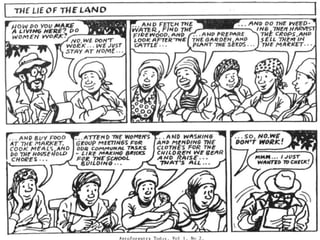
Women’s and men’s division of labour and
access and control over resources is different
There is a global gender inequality in favour
of men
Men’s work = paid = considered more important
Women’s work = unpaid= considered less important
Due to gender discrimination women do not
get their fair share of opportunities and
benefits
4
Can development initiatives fail because they
do not consider gender ?
5
6
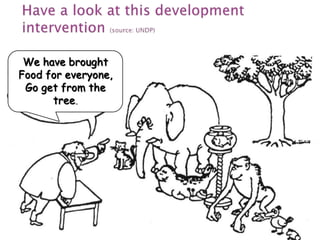
We have brought
Food for everyone,
Go get from the
tree.
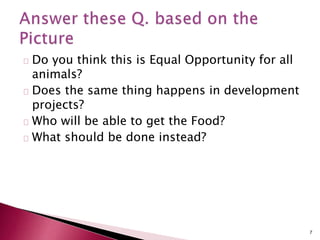
Do you think this is Equal Opportunity for all
animals?
Does the same thing happens in development
projects?
Who will be able to get the Food?
What should be done instead?
7
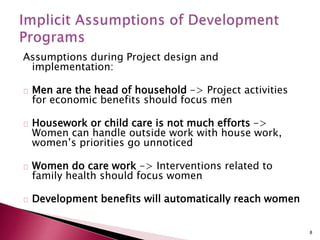
Assumptions during Project design and
implementation:
Men are the head of household -> Project activities
for economic benefits should focus men
Housework or child care is not much efforts ->
Women can handle outside work with house work,
women’s priorities go unnoticed
Women do care work -> Interventions related to
family health should focus women
Development benefits will automatically reach women
8
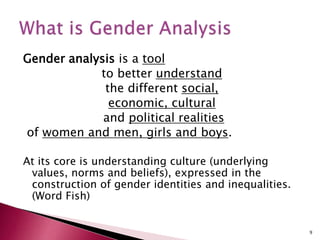
Gender analysis is a tool
to better understand
the different social,
economic, cultural
and political realities
of women and men, girls and boys.
At its core is understanding culture (underlying
values, norms and beliefs), expressed in the
construction of gender identities and inequalities.
(Word Fish)
9
Better understand our community (women,
men, girls and boys)
Get better results from development
programs
10
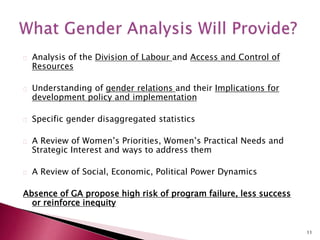
Analysis of the Division of Labour and Access and Control of
Resources
Understanding of gender relations and their Implications for
development policy and implementation
Specific gender disaggregated statistics
A Review of Women’s Priorities, Women’s Practical Needs and
Strategic Interest and ways to address them
A Review of Social, Economic, Political Power Dynamics
Absence of GA propose high risk of program failure, less success
or reinforce inequity
11
A gender analysis of health program will inform you how inequalities
disadvantage women’s health, the constraints women face, ways to
overcome constraints.
A gender analysis of women worker’s situations, their needs, work
places, wages, market trends will provide practical information to
advocate for all (women and men) worker’s rights
A gender analysis of product supply chain will tell you women’s
involvement at different stages in the supply chain so to increase
their visibility and gain economic benefits
A gender analysis of water project will inform you where women
collect water, what should be done to increase women’s access to
safe water
12
Gender Analysis should/can be undertaken at
any/all stages of a program/project cycle,
including:
Identification of the project;
Planning or design of the activity;
Implementation; and
Monitoring and evaluation of program
13
Government
Policy makers
Donors
Program Managers
Development Staff
Field workers, etc.
GA should be participatory involving key
stakeholders from the field where the intervention
is to take place
Gender Analysis can be conducted through a variety
of Tools and Frameworks
14
Collect Relevant Data: Sex–disaggregated information
for analysis (Who does what? Gender roles,
responsibilities, priorities of men and women both
within and outside the household? Who has what?
Who controls what?)
Identify Relevant Gender Issues (women’s and men’s
practical needs and strategic interests)
Understand the institutional, economic, social, and
political contexts (What are the differences,
constraints, influences, power dynamics between
women and men?)
Understand the priorities and needs of both men and
women affected by the project (what do they
need/want?)
15
Gender roles framework (Harvard)
Triple roles framework (Carolyn Moser)
Web of institutionalisation framework (Caren Levy)
Gender analysis matrix (GAM)
Equality and empowerment framework (Sara
Longwe)
Capacities and vulnerabilities framework (CVA)
People oriented planning framework (POP)
Social relations framework (SRF)
16
Harvard framework - 1
• Can help planners design efficient
projects
• Improves visibility of women in target
area
Three main tools:
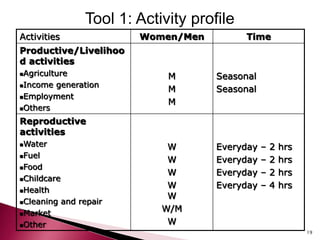
Tool 1: The socio-economic activity
profile –
who does what, when, where and for how
long? 17
18
Activities Women/Men Time
Productive/Livelihoo
d activities
Agriculture
Income generation
Employment
Others
M
M
M
Seasonal
Seasonal
Reproductive
activities
Water
Fuel
Food
Childcare
Health
Cleaning and repair
Market
Other
W
W
W
W
W
W/M
W
Everyday – 2 hrs
Everyday – 2 hrs
Everyday – 2 hrs
Everyday – 4 hrs
Tool 1: Activity profile
19
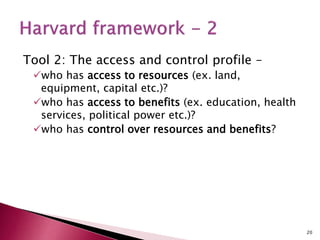
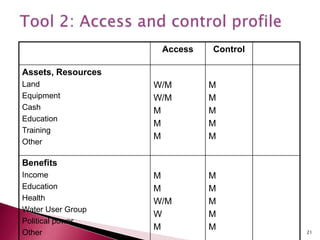
Tool 2: The access and control profile –
who has access to resources (ex. land,
equipment, capital etc.)?
who has access to benefits (ex. education, health
services, political power etc.)?
who has control over resources and benefits?
20
Access Control
Assets, Resources
Land
Equipment
Cash
Education
Training
Other
W/M
W/M
M
M
M
M
M
M
M
M
Benefits
Income
Education
Health
Water User Group
Political power
Other
M
M
W/M
W
M
M
M
M
M
M 21
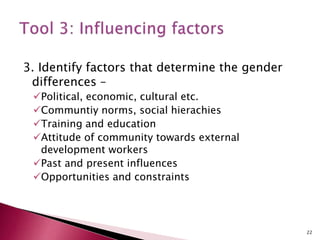
3. Identify factors that determine the gender
differences –
Political, economic, cultural etc.
Communtiy norms, social hierachies
Training and education
Attitude of community towards external
development workers
Past and present influences
Opportunities and constraints
22
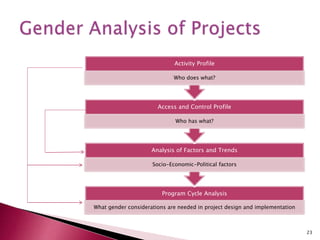
Program Cycle Analysis
What gender considerations are needed in project design and implementation
Analysis of Factors and Trends
Socio-Economic-Political factors
Access and Control Profile
Who has what?
Activity Profile
Who does what?
23
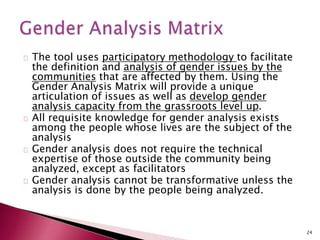
The tool uses participatory methodology to facilitate
the definition and analysis of gender issues by the
communities that are affected by them. Using the
Gender Analysis Matrix will provide a unique
articulation of issues as well as develop gender
analysis capacity from the grassroots level up.
All requisite knowledge for gender analysis exists
among the people whose lives are the subject of the
analysis
Gender analysis does not require the technical
expertise of those outside the community being
analyzed, except as facilitators
Gender analysis cannot be transformative unless the
analysis is done by the people being analyzed.
24
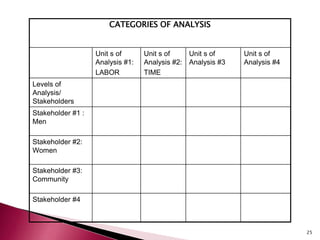
25
CATEGORIES OF ANALYSIS
Unit s of
Analysis #1:
LABOR
Unit s of
Analysis #2:
TIME
Unit s of
Analysis #3
Unit s of
Analysis #4
Levels of
Analysis/
Stakeholders
Stakeholder #1 :
Men
Stakeholder #2:
Women
Stakeholder #3:
Community
Stakeholder #4
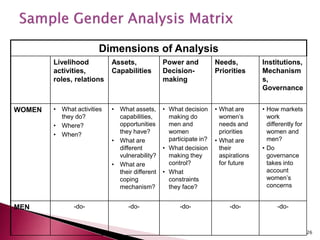
26
Dimensions of Analysis
Livelihood
activities,
roles, relations
Assets,
Capabilities
Power and
Decision-
making
Needs,
Priorities
Institutions,
Mechanism
s,
Governance
WOMEN • What activities
they do?
• Where?
• When?
• What assets,
capabilities,
opportunities
they have?
• What are
different
vulnerability?
• What are
their different
coping
mechanism?
• What decision
making do
men and
women
participate in?
• What decision
making they
control?
• What
constraints
they face?
• What are
women’s
needs and
priorities
• What are
their
aspirations
for future
• How markets
work
differently for
women and
men?
• Do
governance
takes into
account
women’s
concerns
MEN -do- -do- -do- -do- -do-
27

Gender Analysis

  • 1.
    Jagriti Shankar Asian Instituteof Technology Contact: jagriti@ait.asia Jagriti.shankar@gmail.com 1 Gender and Development – Practical approaches
  • 2.
    1. What andWhy of Gender Analysis 2. Gender Analysis Frameworks and Tools 2
  • 3.
    After this sessionyou should be able to:  recognise the importance of gender analysis for project planning, implementation and evaluation  use tools for gender analysis as part of development interventions 3
  • 4.
    Gender is asocial construction depending upon time and culture Women’s and men’s division of labour and access and control over resources is different There is a global gender inequality in favour of men Men’s work = paid = considered more important Women’s work = unpaid= considered less important Due to gender discrimination women do not get their fair share of opportunities and benefits 4
  • 5.
    Can development initiativesfail because they do not consider gender ? 5
  • 6.
    6 We have brought Foodfor everyone, Go get from the tree.
  • 7.
    Do you thinkthis is Equal Opportunity for all animals? Does the same thing happens in development projects? Who will be able to get the Food? What should be done instead? 7
  • 8.
    Assumptions during Projectdesign and implementation: Men are the head of household -> Project activities for economic benefits should focus men Housework or child care is not much efforts -> Women can handle outside work with house work, women’s priorities go unnoticed Women do care work -> Interventions related to family health should focus women Development benefits will automatically reach women 8
  • 9.
    Gender analysis isa tool to better understand the different social, economic, cultural and political realities of women and men, girls and boys. At its core is understanding culture (underlying values, norms and beliefs), expressed in the construction of gender identities and inequalities. (Word Fish) 9
  • 10.
    Better understand ourcommunity (women, men, girls and boys) Get better results from development programs 10
  • 11.
    Analysis of theDivision of Labour and Access and Control of Resources Understanding of gender relations and their Implications for development policy and implementation Specific gender disaggregated statistics A Review of Women’s Priorities, Women’s Practical Needs and Strategic Interest and ways to address them A Review of Social, Economic, Political Power Dynamics Absence of GA propose high risk of program failure, less success or reinforce inequity 11
  • 12.
    A gender analysisof health program will inform you how inequalities disadvantage women’s health, the constraints women face, ways to overcome constraints. A gender analysis of women worker’s situations, their needs, work places, wages, market trends will provide practical information to advocate for all (women and men) worker’s rights A gender analysis of product supply chain will tell you women’s involvement at different stages in the supply chain so to increase their visibility and gain economic benefits A gender analysis of water project will inform you where women collect water, what should be done to increase women’s access to safe water 12
  • 13.
    Gender Analysis should/canbe undertaken at any/all stages of a program/project cycle, including: Identification of the project; Planning or design of the activity; Implementation; and Monitoring and evaluation of program 13
  • 14.
    Government Policy makers Donors Program Managers DevelopmentStaff Field workers, etc. GA should be participatory involving key stakeholders from the field where the intervention is to take place Gender Analysis can be conducted through a variety of Tools and Frameworks 14
  • 15.
    Collect Relevant Data:Sex–disaggregated information for analysis (Who does what? Gender roles, responsibilities, priorities of men and women both within and outside the household? Who has what? Who controls what?) Identify Relevant Gender Issues (women’s and men’s practical needs and strategic interests) Understand the institutional, economic, social, and political contexts (What are the differences, constraints, influences, power dynamics between women and men?) Understand the priorities and needs of both men and women affected by the project (what do they need/want?) 15
  • 16.
    Gender roles framework(Harvard) Triple roles framework (Carolyn Moser) Web of institutionalisation framework (Caren Levy) Gender analysis matrix (GAM) Equality and empowerment framework (Sara Longwe) Capacities and vulnerabilities framework (CVA) People oriented planning framework (POP) Social relations framework (SRF) 16
  • 17.
    Harvard framework -1 • Can help planners design efficient projects • Improves visibility of women in target area Three main tools: Tool 1: The socio-economic activity profile – who does what, when, where and for how long? 17
  • 18.
  • 19.
    Activities Women/Men Time Productive/Livelihoo dactivities Agriculture Income generation Employment Others M M M Seasonal Seasonal Reproductive activities Water Fuel Food Childcare Health Cleaning and repair Market Other W W W W W W/M W Everyday – 2 hrs Everyday – 2 hrs Everyday – 2 hrs Everyday – 4 hrs Tool 1: Activity profile 19
  • 20.
    Tool 2: Theaccess and control profile – who has access to resources (ex. land, equipment, capital etc.)? who has access to benefits (ex. education, health services, political power etc.)? who has control over resources and benefits? 20
  • 21.
  • 22.
    3. Identify factorsthat determine the gender differences – Political, economic, cultural etc. Communtiy norms, social hierachies Training and education Attitude of community towards external development workers Past and present influences Opportunities and constraints 22
  • 23.
    Program Cycle Analysis Whatgender considerations are needed in project design and implementation Analysis of Factors and Trends Socio-Economic-Political factors Access and Control Profile Who has what? Activity Profile Who does what? 23
  • 24.
    The tool usesparticipatory methodology to facilitate the definition and analysis of gender issues by the communities that are affected by them. Using the Gender Analysis Matrix will provide a unique articulation of issues as well as develop gender analysis capacity from the grassroots level up. All requisite knowledge for gender analysis exists among the people whose lives are the subject of the analysis Gender analysis does not require the technical expertise of those outside the community being analyzed, except as facilitators Gender analysis cannot be transformative unless the analysis is done by the people being analyzed. 24
  • 25.
    25 CATEGORIES OF ANALYSIS Units of Analysis #1: LABOR Unit s of Analysis #2: TIME Unit s of Analysis #3 Unit s of Analysis #4 Levels of Analysis/ Stakeholders Stakeholder #1 : Men Stakeholder #2: Women Stakeholder #3: Community Stakeholder #4
  • 26.
    26 Dimensions of Analysis Livelihood activities, roles,relations Assets, Capabilities Power and Decision- making Needs, Priorities Institutions, Mechanism s, Governance WOMEN • What activities they do? • Where? • When? • What assets, capabilities, opportunities they have? • What are different vulnerability? • What are their different coping mechanism? • What decision making do men and women participate in? • What decision making they control? • What constraints they face? • What are women’s needs and priorities • What are their aspirations for future • How markets work differently for women and men? • Do governance takes into account women’s concerns MEN -do- -do- -do- -do- -do-
  • 27.

Editor's Notes

  • #17 A Standardized format that guide you to do GA Frameworks are only tools, you have to decide how to confront the situation Frameworks can be combined according to particular situations The frameworks address different aspects of gender equality and therefore are useful in different situations. Harvard and Moser are particularly useful when analysing the division of labour in agriculture and in urban settings; Levy is useful for gender mainstreaming in institutions; GAM is useful when assessing gender differential impacts of projects at community level; Longwe is useful for assessment of empowerment of women due to interventions in all sectors; CVA deals mainly with humanitarian and disaster preparedness issues; POP is an expanded version of Harvard, dealing mainly with refugee issues; SRF is useful when dealing with sustainable development and institutional change Harvard framework was developed at Harvard university. It is also called the Gender Roles Framework, was developed by the Harvard Institute for International Development in collaboration with the Women In Development office of USAID, and was first described in 1984 by Catherine Overholtand others. It was one of the earliest of such frameworks.[7] The starting point for the framework was the assumption that it makes economic sense for development aid projects to allocate resources to women as well as men, which will make development more efficient – a position named the “efficiency approach" Harvard framework informs planners about the situations, roles, resources, various social, economical and political influencing factors and on the basis of this overall information, planners can design better and efficient projects It improves the visibility because it generates the sex dissegrated data
  • #18 Harvard framework was developed at Harvard university. It is also called the Gender Roles Framework, was developed by the Harvard Institute for International Development in collaboration with the Women In Development office of USAID, and was first described in 1984 by Catherine Overholtand others. It was one of the earliest of such frameworks.[7] The starting point for the framework was the assumption that it makes economic sense for development aid projects to allocate resources to women as well as men, which will make development more efficient – a position named the “efficiency approach" Harvard framework informs planners about the situations, roles, resources, various social, economical and political influencing factors and on the basis of this overall information, planners can design better and efficient projects It improves the visibility because it generates the sex dissegrated data
  • #21 We analyze what resources people use to carry out the tasks identified in step 1 activity profile. Do we understand that Access and control are different. Though women can unrestrictedly use some resources but not always they can control or take decisions about changing, buying, selling of these resources. If women have access to resources that may serve women’s practical needs, but it doesn’t serve women’s strategic needs in longer term. For gender equity women and men should have equal control over resources like buying or selling of land, or other property.