NEPAL
DISASTER
REPORT

2013

Government of Nepal
Ministry of Home Affairs

Focus on Participation and Inclusion

Nepal
Disaster Preparedness Network -Nepal
Nepal Disaster Report, 2013

Published by

Ministry of Home Affairs (MoHA), Government of Nepal; and Disaster Preparedness NetworkNepal (DPNet-Nepal)
© All Rights reserved with the Ministry of Home Affairs of Nepal and Disaster Preparedness
Network-Nepal (DPNet-Nepal)
This publication is copyright. However, any part of this publication may be cited, copied,
translated into other languages or adapted without prior permission from the Ministry of Home
Affairs (MoHA) and DPNet-Nepal provided that the source is duly acknowledged.
The opinions expressed in this report do not necessarily represent the official position and
policy of the Ministry of Home Affairs and DPNet-Nepal.
ISBN: 9789937-2-7585-9
Contact details,
Nepal Disaster Report, 2013
Disaster Preparedness Network-Nepal (DPNet-Nepal)
C/O NRCS, Red Cross Road, Kalimati Kathmandu, Nepal
Phone: 977 01 6226613; 977 01 4672165; Fax no: 977 01 4672165
Email: dpnet@dpnet.org.np; web: www.dpnet.org.np
Designed & printed at Rolwaling Printing Press, Kathmandu, Nepal
Advisory Board

Janardan Nepal, Secretary, Ministry of Home Affairs
Pitambar Aryal, Chairperson, DPNet-Nepal

Editorial Board

Kedar Babu Dhungana
Krishna Raj Kaphle
Pradip Kumar Koirala
Shyam Sundar Jnavaly

Executive Editor

Ram Chandra Neupane

Editor-In-Chief

Lakshmi Prasad Dhakal

Contributors

Bamshi Acharya
Bhesh B. Parajuli
Bimal Gadal
Deepak Poudel
Deependra Joshi
Dul Raj Chimariya
Gautam Bhandari
Gehendra Gurung
Giovanni Congi
Govinda Basnet, PhD.
Hari Darshan Shrestha, PhD.
Jhanka Nath Dhakal
Khadga Sen Oli
Laxmi Raj Joshi
Man Bahadur Thapa
Manoj Thokar
Meen B. Poudyal Chhetri, PhD.
Moirra Reddick
Narayan Babu Shrestha
Ram Prasad Luitel
Rita Dhakal Jayaswal
Sunil Gurung
Surendra Dhakal
Foreword
Nepal is ranked as one of the most vulnerable countries in the world to natural disasters. Our
geographical difficulties have added further vulnerability to our national efforts. Nepal’s
approach to disaster management has changed since the initial challenges we have been
facing since a decade. The fact that our Disaster Management Division has come together
in a coordinated fashion to further strengthen our interventions is reflective of our improved
understanding of disaster management issues and challenges. In 2012, significant efforts
were made to identify disaster risk reduction activities in Nepal. The Government of Nepal,
international and National community interested and involved, as well as communities and
individuals, worked collectively through coordinated efforts to reduce risks and prevent
disasters.
In line with this, the Ministry of Home Affairs is highly pleased to bring out this edition of the
Nepal Disaster Report, 2013 – an important step in disaster management in Nepal. The report
is an attempt to document Nepal’s disaster management initiatives, hazards and disaster
events, socio-economic impacts and pertinent issues, as well as sharing good practices. The
report has been produced and published by Ministry and Disaster Preparedness
Network-Nepal collaboration with various partners.
This report attempts to examine and analyze data and events of disasters occurred during
2012, identifies exposures and vulnerabilities through trend analysis and highlights some of
the key areas. It is hoped that the publication of this report will stimulate improved data
collection and research that will help bridge the gaps identified in disaster management. This
should not be seen as a separate sector but as part of a holistic approach of development
strategies and programs including strengthening the local institutions. It is expected, through
the report, the fulfillment of the current desire of information collection, processing and
distribution in the area of disaster management of the country.

v
Finally, I take this opportunity to extend sincere thanks to all the Ministry’s staff members,
Editorial Board, HECT Consultancy, partner organizations, experts and professionals involved
in preparing this report. Our collective efforts can make a difference in building disaster
resilient communities in Nepal.
Thank you.

____________
Janardan Nepal
Secretary

vi
Disaster Preparedness Network-Nepal
Nepal

Nepal Redcross Building, P.O.Box No. 12294, Kalimati, Kathmandu
Phone : +977-01-4672165, 6226613,Fax :+977-01-4672165
Email : dpnet@dpnet.org.np,URL : www.dpnet.org.np

Jan 24, 2014
Date :.........................

Acknowledgement
It gives me an immense pleasure to present the Nepal Disaster Report (NDR) 2013 to the
national and international readers. The Disaster Preparedness Network Nepal (DPNetNepal), established in 1996, initiated the publication of the Nepal Disaster Report in 2009
with the leadership and guidance of the Ministry of Home Affairs. The NDR, which provides
comprehensive disaster data, information, analysis and reflection of losses and damages
that have occurred due to various disaster events across the country in the last two years,
is expected to serve as a key reference document for different stakeholders.
On behalf of the publishers, the Ministry of Home Affairs (MoHA) and DPNet-Nepal, I would
like to express my sincere appreciation to all the collaborating partners (Action Aid, Care
Nepal, Caritas Nepal, CECI, DCA, LWF, Mercy Corps, Mission East, Nepal Red Cross Society,
Oxfam, Plan Nepal, Save the Children, UNDP and World Vision International) for their
financial contribution and technical support. My special thanks go to Plan Nepal for providing
financial contribution for printing of the NDR 2013 and technical support while developing
this report.
I take this as a privilege to extend my special gratitude to Mr. Janardan Nepal, Secretary,
Ministry of Home Affairs (MOHA),Dr. Meen B. Poudyal Chhetri, former Chairperson of
DPNet-Nepal, Mr. Lakshmi Prasad Dhakal, Joint Secretary, MoHA, Mr. Pradip Kumar Koirala,
Under Secretary, MoHA, and Mr. Ram Chandra Neupane, Executive Editor for their advises,
commendable inputs, contributions and guidance which substantially contributed to enable
us to maintain the quality and publish this report. Similarly, my thanks go to all the intellectual
members of the Editorial Board for their constructive engagement and invaluable contribution
to bring the report into this form.
I would like to express our sincere thanks to Ms. Moira Reddick, Coordinator and Mr.
Giovanni Congi, Public Information Coordinator, Nepal Risk Reduction Consortium for
providing inputs particularly on language editing.
vii
I also take this opportunity to offer our sincere thanks to the consultants Mr. Deependra
Joshi, Dr. Govinda Basnet and Mr. Narayan Babu Shrestha of HECT Consultancy for their
hard work and professional output.
We are also thankful to all the national and international DRR partners, various agencies,
professionals and participants of review meeting who have contributed directly and indirectly.
At the same time, I would like to extend my appreciation to DPNet-Nepal Executive Board
and staff members Mr. Bhesh. B. Parajuli, Programme Coordinator, Mr. Safal Khatiwada,
Admin/Finance Officer, Mr. Bikash Shrestha for their dedication and coordination in this
endeavor.
At last but not least, on behalf of publishing partner, DPNet-Nepal, I would like to express
my sincere appreciation and gratitude to the Disaster Management Division, MoHA for
their guidance and cooperation to produce this report. We look forward to have continued
collaboration and guidance in the days ahead.

Mr. Pitambar Aryal
Chairperson

viii
Editorial
The Nepal Disaster Report 2013…Focus on Participation and Inclusion is a resource for
understanding and analyzing national disaster risk today and in the future. Large and small
disasters, ranging from the Seti flood of Kaski district in May 2012 to the cold waves in the Terai,
continued to demonstrate the intimate relationship between disasters and poverty. Drawing on
new and enhanced data, the 2012 report attempts to explore trends in disaster risk for each
region and with different socio-economic development.
The NDR 2013 is a compilation of facts of disaster occurrences and efforts made in Nepal in
reducing the impact of disasters and in getting prepared for future events. The document tries
to make a case on why and how Nepal should address the issues of disaster management in
order to preserve and enhance the well known resilience of the Nepalese people to adversaries
and vagaries of nature, safeguard peoples' life and property, and ensure incorporation of disaster
risk reduction measures into our developmental efforts.
The report has been structured in five major chapters. Chapter 1 presents an overview and lays
out the context by elaborating global and national contexts of disasters. It also provides a
chronology of the development of disaster management processes in the country, including the
government's initiatives in creating suitable policy and legal environments for effective management
and response planning. It presents national demographic characteristics along with the disaster
resilience and hazard profiles and reflects co-relationships amongst hazards, resiliency and
poverty in Nepal.
Chapter 2 analyzes the conceptual issues of disaster management and draws on the analytical
frameworks for examining the risk-poverty relationships along with institutional mechanisms.
It also caters to how do we ensure livelihoods, indigenous knowledge and community’s coping
strategy and how do we mainstream disaster management and climate change adaptation into
Nepal’s development planning process, implementation, monitoring and evaluation.
Chapter 3 analyzes the overall disaster trends occurred during 2012. It attempts to analyze
disaster trends from the perspective of why is it increasing or decreasing at particular region;
what is the gap and how it should be managed. The severity of disaster type varies in terms of
fatalities, injuries and property damage. In terms of fatalities, thunderbolt has caused the largest
number of deaths (119) and accounted for 29% of total deaths in 2012. Fire, landslide, floods,
and epidemics are other major disaster types. These hazard types together accounted for 82%
of deaths from disaster. However, in terms of affected families, fire has affected the largest
number of families.
Chapter 4 focuses on making disaster management work for all, mainstreaming disaster
management through participatory and inclusive management approaches; empowering at risk
ix
communities; role and participation of all the sections of the society in disaster management
and attempts to address rural-urban vulnerabilities. It points out the need to mainstream women
and excluded groups as they are disproportionately vulnerable to the impacts of disaster risks.
This chapter elucidates that in most cases, the needs and responsibilities of women and socially
excluded groups are not adequately considered in the design and planning of response and
recovery, making it critical to recognize the role of gender equality and social inclusion in crisis
situations.
Chapter 5 dwells on highlighting good practices on disaster management in Nepal. Altogether,
nine good practices have been described which illustrates successes of community-based
approaches to disaster mitigation in the country. These community-based good practices highlight
key success factors such as applying best practice methodologies of community development
to community based disaster mitigation, tapping traditional organizational structures and
mechanisms and capacity building activities with the community disaster committees and
volunteers.
Last chapter concludes with a set of concluding remarks. It stresses on the need to consolidate
gains by means of putting in place a concrete, effective, practical and proactive policy and ensure
increased inter-sectoral coordination, education and awareness coupled with adequate resources
through the effective implementation of agreed measures. Disaster mitigation, early warning
system, emergency rescue and relief operations, rehabilitation and recovery plans have been
identified with hands-on training, post-disaster evaluation, monitoring of relief works, review
and cooperation and coordination of central, district and local level preparedness and research
works.
Lakshmi Prasad Dhakal
Editor In-Chief
Joint Secretary and Chief, Disaster Management Division
Ministry of Home Affairs, Singha Durbar, Kathmandu

x
Abbreviation and Acronyms
AAN
ADB
ADPC
ADRA
AEPC
AINTDGM
AMCDRR
APF
APN
AUDMP
BDMT
CBDRMN
CBO
CBS
CCDRR
CDO
CDRF
CDS
CEAARRC
CNDRC
CRED
DAO
DDC
DDRC
DHM
DHS
DiMANN
DIMS
DMC
DPC
DPNet-Nepal
DPRP
DPSS
DRM
DRR
DRRSP
DSCWM
DUDBC
DWIDP

ActionAid Nepal
Asian Development Bank
Asian Disaster Preparedness Centre
Adventist Development and Relief Agency
Alternative Energy Promotion Centre
Association of INGOs in Nepal Task Group on Disaster Management
Asian Ministerial Conference on Disaster Risk Reduction
Armed Police Force
Asia-Pacific Network
Asian Urban Disaster Mitigation Program
Basic Disaster Management Training
Community Based Disaster Risk Management in Nepal
Community Based Organization
Central Bureau of Statistics
Child-Centred Disaster Risk Reduction
Chief District Officer
Central Disaster Relief Fund
Centre for Disaster Studies
Central Earthquake Affected Areas Reconstruction and Rehabilitation
Committee
Central Natural Disaster Relief Committee
Centre for Research on the Epidemiology of Disasters
District Administration Office
District Development Committee
District Disaster Relief Committee
Department of Hydrology and Meteorology
Department of Health Services
Disaster Management Network Nepal
Disaster Inventory/Information Management System
Disaster Management Committee
Disaster Preparedness Committee
Disaster Preparedness Network-Nepal
Disaster Preparedness and Response Plan
Disaster Preparedness for Safer Schools
Disaster Risk Management
Disaster Risk Reduction
Disaster Risk Reduction through Schools Project
Department of Soil Conservation and Watershed Management
Department of Urban Development and Building Construction
Department of Water Induced Disaster Prevention
xi
EAARRP
ECHO
EPC
ESD
EU
EWS
FAO
GAR
GDP
GHI
GIS
GLOFs
HFA
HVCA
IASC
ICIMOD
IATF/DR
IDNDR
IFRC
INGO
INSARAG
IPCC
IRA
ISDR
JICA
JYRC
KVERMP
LSAR
LSGA
LWF
MDG
MHPP
MMI
MoAC
MoFSC
MoHA
MoWR
NAPA
NAST
NBC
NCDM
NCDM
NCRA

Earthquake Affected Areas Reconstruction and Rehabilitation Project
European Commission’s Humanitarian Aid Department
Environment Protection Council
Earthquake Safety Day
European Union
Early Warning System
Food and Agriculture Organization
Global Assessment Report
Gross Domestic Product
Geo-Hazards International
Geographic Information System
Glacial Lake Outburst Floods
Hyogo Framework for Action
Hazard, Vulnerability and Capacity Assessment
Inter Agency Standing Committee
International Centre for Integrated Mountain Development
Inter-Agency Task Force on Disaster Reduction
International Decade for Natural Disaster Reduction
International Federation of Red Cross and Red Crescent Societies
International Non-Governmental Organization
International Search and Rescue Advisory Group
Inter-governmental Panel on Climate Change
Initial Rapid Assessment
International Strategy for Disaster Reduction
Japan International Cooperation Agency
Junior Youth Red Cross
Kathmandu Valley Earthquake Risk Management Project
Light Search and Rescue
Local Self-Governance Act
Lutheran World Federation
Millennium Development Goal
Ministry of Housing and Physical Planning
Modified Mercalli Intensity Scale
Ministry of Agriculture and Cooperatives
Ministry of Forest and Soil Conservation
Ministry of Home Affairs
Ministry of Water Resources
National Adaptation Plan of Action
Nepal Academy of Science and Technology
Nepal Building Code
Nepal Centre for Disaster Management
National Council for Disaster Management
Natural Calamity (Relief) Act 1982
xii
NDMA
NDMF
NDMP
NEOC
NEPAP
NGO
NGS
NPC
NPDRR
NNCDMC
NRCS
NRRC
NSDRM
NSET
PVA
SAR
SOP
UNCHS
UNDMT
UNDP
UNDRO
UNESCO
UNFCCC
UNISDR
UNOCHA
USAID
VDC
WCDR
WECS
WFP
WHO
WMO
WVI

National Disaster Management Authority
Natural Disaster Management Forum
National Disaster Management Policy
National Emergency Operations Centre
National Environmental Policy and Action Plan
Non-Governmental Organization
Nepal Geological Society
National Planning Commission
National Platform for Disaster Risk Reduction
National Network of Community Disaster Management Committee
Nepal Red Cross Society
Nepal Risk Reduction Consortium
National Strategy for Disaster Risk Management
National Society for Earthquake Technology Nepal
Participatory Vulnerability Assessment
Search and Rescue
Standard Operating Procedure
United Nations Centre for Human Settlements
United Nations Disaster Management Team
United Nations Development Programme
United Nations Disaster Relief Organization
United Nations Educational, Scientific and Cultural Organization
United Nations Framework Convention on Climate Change
United Nations International Strategy for Disaster Reduction
United Nations Office for the Coordination of Humanitarian Affairs
United States Agency for International Development
Village Development Committee
World Conference on Disaster Reduction
Water and Energy Commission Secretariat
World Food Program
World Health Organization
World Meteorological Organization
World Vision International

xiii
Table of Content
Foreword
Acknowledgement
Editorial
Abbreviation and Acronyms

v
vii
ix
xi

Chapter 1
Background Context: Disaster Risk Management in Nepal
Introduction
1.1
Nepal: Economic and social context
1.1.1
Economic Development Profile .
1.1.2
Social Context
1.2
Global Context
1.3
Regional Context
1.4
National Context
1.5
National Hazard Profile
1.6
Disaster Resilience Profile
1.7
Policy and Institutional Framework of Disaster Management in Nepal
1.8
Existing Legal Frameworks
1.9
Way forward

1
2
4
5
6
7
8
9
9
10
12
12
16

Chapter 2
Conceptual Issues on DRM
2.1
Risk and Vulnerability in Nepal
2.2
Disaster Risk Management in Nepal: A Paradigm Shift
2.3
Analytical Framework for Examining the Risk-Poverty Relationships
2.3.1 Political Economy of Disaster Risk Management
2.3.2 Co-relation amongst Hazard, Poverty and Resiliency
2.4
Current Practices and Coping Mechanism
2.4.1 Harnessing Synergies: Mainstreaming DRM and Climate Change
Adaptation into Development Planning and Process
2.4.2 Building Resilience
2.5
Way Forward
Chapter 3
Disaster Scenario, 2012
3.1
General Disaster Types
3.2
Disasters in 2012
3.3
Spatial Pattern of Human Casualties
3.3.1 Ecological/Development Regions
3.3.2 Human Injuries
3.3.3 Human Casualties by Major Disaster Types
3.3.4 Other Disaster Types
3.4
Economic Losses
xiv

17
18
19
20
21
21
23
23
24
25
27
28
29
31
31
34
35
41
42
3.5
3.6
3.7

Seasonality of the Disaster
Data Insufficiency
Key Features

44
46
46

Chapter 4
Participation and Inclusion: Making DRR Work for All
4.1
Axis of Socio-economic Differentials
Gender Equality and Social Inclusion
4.2
Role and Participation of Civil Society in DRM
4.2.1 Corporate Sector
4.2.2 Academic and Research Institutions
4.2.3 Media
4.2.4 Civil Society Organisations
4.2.5 Children, Youth, Old Age and Persons with Disabilities
4.2.6 Role of Nepal Army, Nepal Police and Armed Police Force
4.3
Addressing Rural and Urban Vulnerabilities
4.4
Way Forward

53
53
54
54
54
55
55
57
58
59

Chapter 5
Good Practices on DRM

61

GOOD PRACTICE 1
Early warning in action

62

GOOD PRACTICE 2
Warehousing and stockpiling

63

GOOD PRACTICE 3
Capacity building through training and simulation

64

GOOD PRACTICE 4
Little support, more resilience

65

GOOD PRACTICE 5
Indigenous knowledge and disaster mitigation

66

GOOD PRACTICE 6
Effective DRR mainstreaming into local development process

68

GOOD PRACTICE 7
Positive legal developments

69

GOOD PRACTICE 8
Community volunteers provide rapid response

71

xv

51
GOOD PRACTICE 9
Regional workshops pave way for preparedness and response planning

72

Chapter 6
Lessons Learned and Conclusion

73

Glossary: Basic Terms of Disaster Risk Reduction

76

References

82

Annex 1: Agencies Involved in Disaster Management in Nepal
ANNEX 2: Disaster Casualties in 2012

84
86

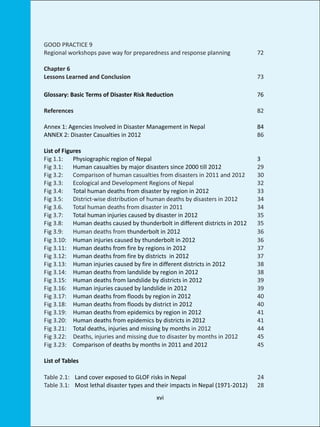
List of Figures
Fig 1.1:
Physiographic region of Nepal
Fig 3.1:
Human casualties by major disasters since 2000 till 2012
Fig 3.2:
Comparison of human casualties from disasters in 2011 and 2012
Fig 3.3:
Ecological and Development Regions of Nepal
Fig 3.4:
Total human deaths from disaster by region in 2012
Fig 3.5:
District-wise distribution of human deaths by disasters in 2012
Fig 3.6.
Total human deaths from disaster in 2011
Fig 3.7:
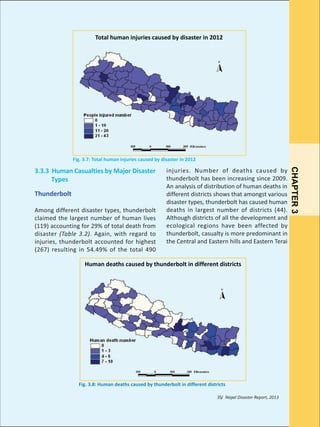
Total human injuries caused by disaster in 2012
Fig 3.8:
Human deaths caused by thunderbolt in different districts in 2012
Fig 3.9:
Human deaths from thunderbolt in 2012
Fig 3.10: Human injuries caused by thunderbolt in 2012
Fig 3.11: Human deaths from fire by regions in 2012
Fig 3.12: Human deaths from fire by districts in 2012
Fig 3.13: Human injuries caused by fire in different districts in 2012
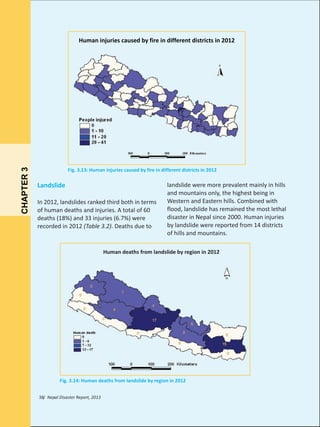
Fig 3.14: Human deaths from landslide by region in 2012
Fig 3.15: Human deaths from landslide by districts in 2012
Fig 3.16: Human injuries caused by landslide in 2012
Fig 3.17: Human deaths from floods by region in 2012
Fig 3.18: Human deaths from floods by district in 2012
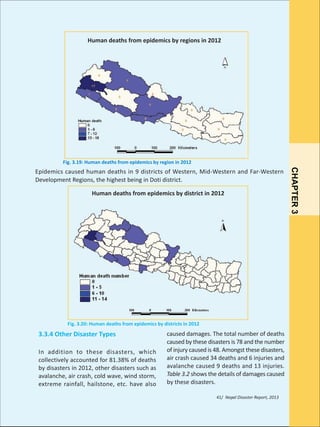
Fig 3.19: Human deaths from epidemics by region in 2012
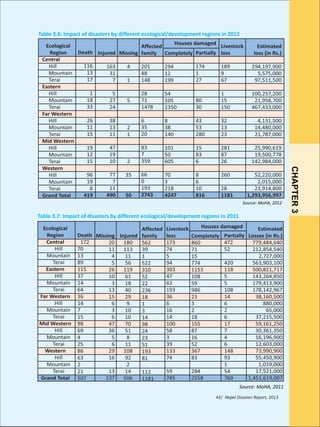
Fig 3.20: Human deaths from epidemics by districts in 2012
Fig 3.21: Total deaths, injuries and missing by months in 2012
Fig 3.22: Deaths, injuries and missing due to disaster by months in 2012
Fig 3.23: Comparison of deaths by months in 2011 and 2012

3
29
30
32
33
34
34
35
35
36
36
37
37
38
38
39
39
40
40
41
41
44
45
45

List of Tables
Table 2.1: Land cover exposed to GLOF risks in Nepal
Table 3.1: Most lethal disaster types and their impacts in Nepal (1971-2012)
xvi

24
28
Table 3.2:
Table 3.3:
Table 3.4:
Table 3.5:
Table 3.6:

Number of casualties and affected families in 2012
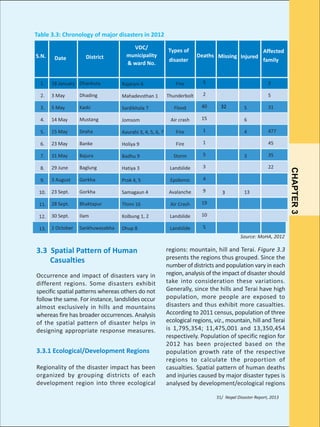
Chronology of major disasters in 2012
Human deaths distribution by ecological regions in 2012
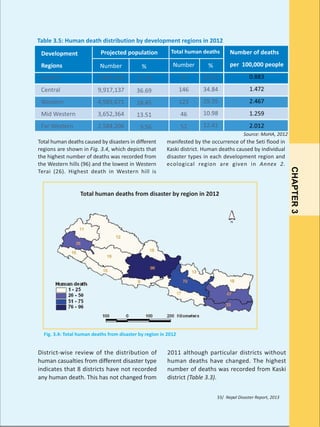
Human death distribution by development regions in 2012
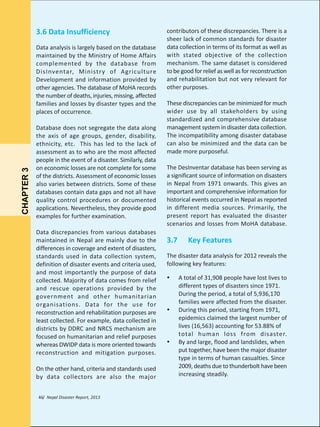
Impact of disasters by different ecological/development
regions in 2012
Table 3.7: Impact of disasters by different ecological/development
regions in 2011
Table 3.8: Major disaster impacts by month in 2012
Table 3.9: Human deaths caused by disaster in different geographical regions
Table 3.10: Human deaths caused by disaster in different development
regions, 2012
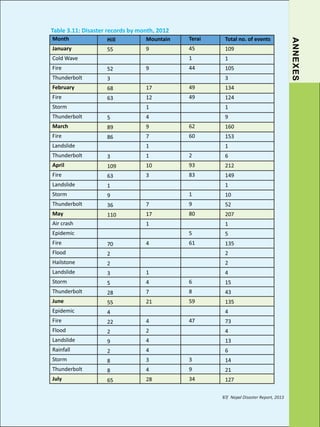
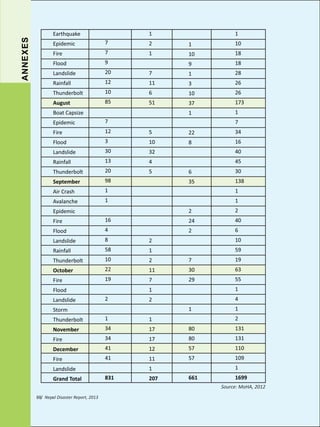
Table 3.11: Disaster records by month, 2012
Table 3.12: Major disasters in 2012 in chronological order
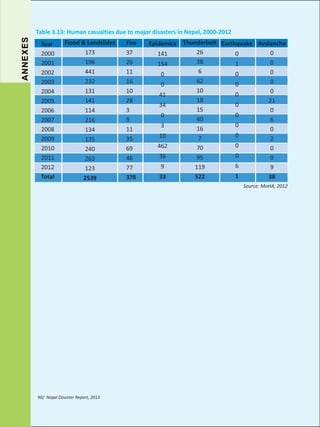
Table 3.13: Human casualties due to major disasters in Nepal, 2000-2012
List of Boxes
Box 1: Major natural disasters of the past
Box 2: Minimum characteristics of a disaster resilient community
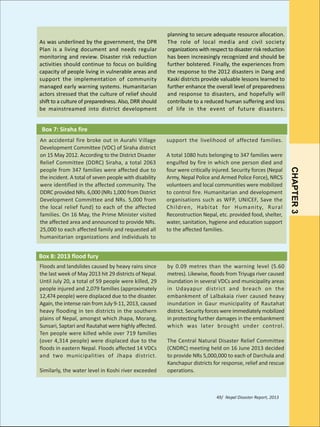
Box 3: Nepal Flagship Programmes
Box 4: Disaster preparedness and response planning initiatives
Box 5: Integrated watershed management: An option to CCA and DRM
Box 6: Seti flood: A missed opportunity
Box 7: Siraha fire
Box 8: 2013 flood fury
Box 9: Some relevant legal instruments of participation and social inclusion
related to DRM in Nepal
Box 10: National Network of Community Disaster Management Committees
Box 11: Children's Charter on DRR
Box 12: Nepal's participation in 5 th Asian Ministerial Conference on DRM
Box 13: INSARAG Meeting
Box 14: Championing ODF campaign

xvii

30
31
32
33
43
43
44
86
86
87
89
90
10
11
13
20
25
47
49
49
52
55
56
57
58
69
CHAPTER 1

© DPNet-Nepal

Background Context:
Disaster Risk Management in Nepal
CHAPTER 1

Introduction
Nepal is situated on the southern slopes of
the Central Himalaya and occupies a total
area of 147,181 km 2. The country is located
between latitudes 260 22' and 300 27' N
and longitudes 800 40' and 880 12' E. The
length of the country is 885 km from west
to east and its width varies from 145 km to
241 km with a mean of 193 km north-south.
About 86% of the total land area is covered
by hills and high mountains, and the
remaining 14% are the flat lands of the
Terai 1 region with less than 300m in
elevation. Altitude varies from some 67m
above the sea level at Kechana Kalan, Jhapa
district in the south-eastern Terai, to 8,848m
at the peak of the world’s highest mountain,
Mount Everest (Statistical Pocket Book Nepal
2010, CBS Nepal).

unsustainable development practices, etc.
As far as the geographic dimension of the
country is concerned, five ecological regions
of the country exhibit their own specific
problems. Due to geographical and other
climatological conditions, rugged and steep
topography, extreme weather events and
fragile geological conditions, the country is
regarded as a disaster hotspot because of
vulnerability of the population together
with regular and frequent occurrences of
different natural hazards (NDR, 2009). As
Nepal is extremely vulnerable to waterrelated hazards, its hydrology is highly
variable, with the monsoon bringing 80%
of Nepal’s rainfall in less than three months
during summer season (World Bank, 2012).

With its unique geo-physical settings and
socio-economic conditions, Nepal is highly
vulnerable to disasters. The country is prone
to disasters due to a number of factors,
both natural and human-induced, including
adverse geo-climatic conditions, topographic
features, environmental degradation,
population growth, urbanization,

Nepal is divided into five physiographic
regions which are almost parallel to each
other, running from west to east. They are:
high Himalayan region, high mountain,
middle mountain, Siwaliks2 and Terai. (Fig.
1.1). However, in common parlance, Terai,
hill and mountain is generally used.

1

The Terai is characterized by broad alluvial plains composed of alluvial deposits that have been derived from the
hinterlands, and are estimated to be a few kilometers thick at the foot of the range.
2

The Siwaliks, comprising the Churia Hills, is composed of a thick series of mudstones, shales, sandstones and
conglomerates of mid-Miocene to Pleistocene age.

2/ Nepal Disaster Report, 2013
CHAPTER 1

Fig. 1.1: Physiographic regions of Nepal

Climate
A wide range of climatic conditions exist in
Nepal within a short distance primarily due
to its variation in altitude. This is reflected in
the contrasting habitats, vegetation, flora and
fauna. The average annual rainfall is about
1,600 mm (mean annual precipitation varies
from more than 4,000 mm along the southern
slopes of the Annapurna Himalayan range to
less than 250 mm in the rain-shadow areas
near Tibetan plateau); about 80% of which
falls between June to September in the form
of summer monsoon (Nepal 4th National
Report to the Convention on Biological
Diversity/MoFSC, 2009).
The Terai and the Siwalik ranges experience
sub-tropical climate while the northern
mountainous regions have cold, dry

continental and alpine winter climate. Summer
and late spring temperatures range from about
280 C in the hilly region to more than 400 C in
the Terai. In winter, average maximum and
minimum temperatures in the Terai range
from a brisk 70 C to a mild 230 C respectively.
The central valleys experience a minimum
temperature often falling below the freezing
point. Much colder temperatures prevail at
h i g h er el evat i on s (I CI M OD, 2 0 07 ).

River Systems
Nepal has three major river systems from west
to east—Karnali, Gandaki and Koshi rivers
respectively. All the rivers ultimately become
major tributaries of the Ganga River in
northern India. After plunging through deep
gorges, these rivers deposit a large amount of
3/ Nepal Disaster Report, 2013
CHAPTER 1

sediments on the plains, thereby nurturing
them and renewing their alluvial soil fertility.
Once they reach the Terai region, they often
shift their course and overflow their banks
onto wide flood plains during summer
monsoon season (ICIMOD, 2007).

Land Use
Nepal is a land scarce country in terms of
availability of cultivable land. In 2008, per
household land availability was 0.6 ha. In 2001,
this was 0.8 ha. With the doubling of
population every 30 years, land availability per
capita is also declining more or less at the
same rate as there is less scope to move to
non-farm sector (CBS, 2009). Land and other
natural resources like forest are still important
for the livelihood of a large majority of rural
population (60% of the total population), even
though the contribution of primary sector
(especially agriculture) on the total Gross
Domestic Product (GDP) of the country is
declining and it is at present 32%.
From 1986 to 2000, there is a significant change
in land use pattern. The area under agricultural
use has increased significantly (by 20%) and
forest area by 9% (FAO, 2011). Despite increase
in area under agricultural land and forest land
between 1986 and 2000, the per capita
availability of agricultural land and forest land
has been declining in this period. This decline
is due to population growth and dependence
of a large majority of population for their
livelihoods. Depending upon the different
3

sources of data, the agricultural land in Nepal
varies from 23% to 28% of total land (Nepal
Land Use Policy and Planning, 2010).
Risk-sensitive land use planning is thus at the
centre for reducing exposure, the factor
causing most increase in disaster risk and for
which the least progress has been made in
achieving HFA3objectives (UNISDR, 2011).
1.1 Nepal: Economic and Social Contexts
Nepal occupies only 0.03% and 0.3% of total
land area of world and Asia respectively.
According to the National Population Census
2011, the annual population growth rate is
1.35% and the total population of the country
in 2011 has reached about 26.5 million. The
census estimates that some 379,000
households are in the mountains, 2.644 million
in hills, and 2.637 million in the Terai. The
percentage of the population living in the Terai
has increased about 2% (from 48 to 50%) and
decreased about 1% in the hills and mountains
(from 44 to 43% in hills and from 7 to 6.5% in
mountains respectively). The average
household size has decreased from 5.44 in
2001 to 4.7 in 2011. In mountains, the average
household size is 4.74; in hills, it is 4.34 and in
the Terai, it is 5.06 (CBS, 2011).
Agriculture sector contributes nearly 35% of
Nepal’s GDP and supports the livelihood of
more than 74% of Nepal’s population (CBS,
2012; NLSS, 2007). Only about 25% of Nepal’s
surface area is suitable for agricultural purpose.

HFA is a ten-year global strategy to make the world safer from natural hazards and provides the first systematic and
comprehensive approach to reducing disaster risks and losses.
4/ Nepal Disaster Report, 2013
The census report shows trends that need to
be taken into account in the context of policy
formulation for disaster risk reduction in Nepal.
One of the most important findings is the
reduction in the net population in 23 districts
in hills and mountains in Eastern, Central and
Western Development Regions. There has been
a rapid increase in the absentee population.
Of the total absentee population of 1.66
million, 52% are from hills, 42.3% from Terai
and the remainder from the mountains. Among
the absentee population, 86.7% is male. In
terms of regional origin of out-migration, 85.4%
of the absentee population is from rural areas.
Ten years ago, the absentee population was
only 0.76 million (CBS, 2011). The rapid increase
in the absentee population denotes an increase
in the pace of ‘feminization’ of society.
Moreover, as youths largely contribute to the
absentee population, it reflects an aging
society.
Jointly, these processes create additional
burden on women for managing local
resources. This implication is also reflected in
the change in sex ratio (number of males for
every 100 females). The national average sex

ratio has decreased from 99.8 in 2001 to 94.41
in 2011. Among the ecological regions, the sex
ratio in 2011 in the Terai, hills and mountains
has remained 97, 92 and 94 respectively. Sex
ratio has been recorded as low as 76 in Gulmi
district. The considerable decline of sex ratio
implies that more women have to undertake
the responsibility of disaster response,
management in the absence of male
population who has left Nepal for foreign
employment. Therefore, the trend of
demographic change needs consideration
while assessing the vulnerability of the
population and designing disaster risk
reduction measures (CBS, 2011).
1.1.1 Economic Development Profile
Nepal has undergone political and economic
transformations. The country’s economy was
adversely affected by the decade-long conflict.
In 1992, a major shift was made in making free
markets through liberalization as the chief
engines of economic development. Nepal’s
economy depends largely on natural resources
but the distribution of resources and use in
socio-economic development remains uneven.
Further, while Nepal has introduced policies
to ensure fairer distribution, implementation
has remained slow because of political
constraints.
In the past 20 years, Nepal has focused
primarily on economic development and
poverty reduction. For decades, Nepal’s GDP
growth rate has fluctuated between 3-5% per
year. The growth rate was 4.9%, 3.6%, 3.4%
and 4.5% during the Eighth, Ninth, Tenth and
the Three Year Interim Plan periods,
respectively (CBS, 2011).
Preliminary estimates of per capita GDP at
current price stands at NRs. 57,726 (US$ 735)
for 2011/12. The economic growth of the
5/ Nepal Disaster Report, 2013

CHAPTER 1

Suitable agricultural land is unevenly
distributed across ecological belts. Less than
10% of the cultivable land is in the mountains
with the remaining 90% nearly equally divided
between the hills and the Terai. About 21% of
the land is cultivable of which 54% has
irrigation facilities (MoAD, 2012) with per
household land holding being 0.7 ha. Most of
the Nepalese population depends on
agriculture for its livelihoods, which is based
on a rich diversity of useful species. The
diversity of livestock (both improved and
indigenous breed) plays a vital role in
contributing to the well-being of rural
communities .
CHAPTER 1

country measured by GDP is 4.63% per year in
2011/12. About one fourth of the population
(25.16%) lives below poverty line as per the
Nepal Living Standards Survey 2010/11 and
the Gini-Coefficient; which indicates inequality
in income distribution is 0.328 (CBS, 2011).
Nepal has made good progress in terms of
poverty reduction and towards achieving most
of the Millennium Development Goals (MDGs).
The Human Development Index (HDI) value for
Nepal is 0.463 (UNDP, 2013). The country still
has a long way to go in terms of sustainable
development as both the social and
environmental pi llars remain weak.

and investment rates. Consumption to GDP
ratio that was 88.3% in FY 2000/01 went up to
93.3% in FY 2010/11. As a result, the rate of
domestic savings has come down to 6.7% from
11.7% (GoN/MoF, 2011). A consumptionoriented economy leads to dependency
resulting in shortages of resources for
investment, particularly in environmental
sustainability. Hence, creating the foundation
for economic growth through enhanced savings
and investments by discouraging unnecessary
consumption remains an issue.

Traditional farming practices, dependence on
monsoon, growing shortages of farm labour
and poor access to markets are some major
factors leading to low development growth.
The structure of Nepali economy has been
changing. While the service sector has grown,
the share of industry and agriculture sectors
has declined. The share of agricultural GDP
decreased from 47.68% in 1990/91 to 35.66%
in 2010/11. Similarly, the share of industrial
sector decreased from 17.53% in 1990/91 to
14.58% in 2010/11 (NPC, 2011).

Despite developmental challenges, progress
on a number of social indicators has been
impressive. However, the gains which have
been hampered by conflict and political
instability have not been extensive enough to
make a significant impact on poverty and
inequality.

However, the share of services has increased
from 34.79% in 1990/91 to 49.76% in 2010/11.
Service sector growth was mainly brought
about by changes in the financial
intermediation and education sub-sectors. The
implication of slow growth in agriculture is
shrinking of employment and incomegenerating opportunities and the inability to
foster broad-based growth. Still the benefit
from the existing development and economic
policies is to reach to a larger section of
population (NPC, 2011).
Nepal’s economy is gradually becoming
consumption-oriented mainly pushed by
remittance thereby causing a decline in savings
6/ Nepal Disaster Report, 2013

1.1.2 Social Context

Nepal has made significant progress in
achieving its MDGs and has received
international praise for doing so. Considering
the difficult context—the decade-long armed
conflict, political instability, and preoccupation
with major national political agenda, including
peace-building, constitution writing, and staterestructuring—these achievements should be
considered remarkable. The majority of healthrelated MDGs have already been achieved, or
are on track to being achieved, except two
indicators in MDG 5, the contraceptive
prevalence rate and the unmet need for family
planning, and one in MDG 6, the proportion
of population with advanced HIV receiving antiretroviral combination therapy (ART). The
targets related to poverty and hunger, universal
primary education, gender equality and
women’s empowerment, are also likely to be
achieved by 2015, and though the targets
concerning environmental sustainability and
On the other hand, social sector (education
and health) has performed reasonably well.
While access to education and health services
has improved, significant challenges remain,
such as the vast disparity between boys and
girls and between different social communities
in access to primary school education, or the
lack of health workers in remote geographical
regions. Furthermore, the need for child
protection is on the rise as a large number of
children are exposed to violence, abuse and
exploitation (European Union’s Nepal Country
Strategy Paper, 2007-2013, Mid-Term Review
Document, April 2010).

1.2 Global Context
Disasters are harsh situations which
overwhelm local capacity, necessitating
national or international level for assistance.
Data gathered worldwide since 1980s suggest
that, while the number of people killed by
natural disasters has leveled out at around
80,000 per year, the number affected by
disasters and associated economic losses have
both soared. During 1990s, an annual average
of around 200 million people was affected by
natural disasters, which is nearly three times
higher than 1970s. Economic losses from such
disasters in 1990s averaged US$ 63 billion per
year which is nearly five times higher in real
terms than the figure for 1970s (Centre for
Research on the Epidemiology of DisastersCRED).
While the figures sound sobering, they disguise
the devastating effects that disasters can have
on poorer nations’ development as disasters

undermine development by contributing to
persistent poverty. The full scale of disaster
losses is still not fully understood. Today’s
globalised production systems and supply
chains have created new vulnerabilities. Global
trade, financial markets and supply chains
have become increasingly inter-connected.
When disasters occur in globally integrated
economies, the impacts ripple through regional
and global supply chains causing indirect losses
to businesses on the other side of the globe
(Global Assessment Report on Disaster Risk
Reduction, 2013).
Further to the declaration of the International
Decade for Disaster Reduction (1990-1999),
the UN General Assembly in 2000 founded
the UNISDR (United Nations International
Strategy for Disaster Reduction), a coalition
of governments, UN agencies, regional
organizations and civil society organizations.
In 2002, the UN published a document entitled
Living with Risk: A Global Review of Disaster
Reduction Initiatives. In 2005, a major reform
within the UN system resulted in some UN
agencies, in particular UNDP, becoming
increasingly concerned about disaster risk
issues by actively engaging in enhancing DRR
programmes at national level.
The road map towards the implementation of
the United Nations Millennium Declaration
(Secretary General’s report to the General
Assembly, 2005) touches on areas which are
closely linked to vulnerability to natural hazards
such as ensuring environmental stability,
eradication of extreme poverty and hunger
and promoting gender equality.
The United Nations Convention to Combat
Desertification (UNCCD) also provides the
international community with a framework
for sustainable development. The objective of
the Convention is to secure long-term
7/ Nepal Disaster Report, 2013

CHAPTER 1

global partnership are unlikely to be achieved.
In totality, lessons to facilitate their
achievements have been learnt (Nepal MDG,
Progress Report 2013).
CHAPTER 1

commitment of its parties through a legally
binding document. It provides an international
framework for States affected by desertification
to work jointly with industrialized countries to
implement National Action Programmes. The
Convention is a powerful instrument for
sustainable natural resource management in
affected regions and for ensuring long-term,
mandatory external support for these efforts.

temporary interruptions on the path of social
and economic progress, to be dealt with
reactive humanitarian relief, is no longer
credible. Disaster reduction should be treated
as an integral part of poverty reduction through
mainstreaming disaster management in
national planning process.

In furtherance of UN’s efforts, several
governments and NGOs championed the issue
of disaster reduction. During the second world
conference on disaster reduction held in Kobe,
Hyogo, Japan, world governments agreed on
the Hyogo Framework for Action (2005-2015)
which was formulated as a comprehensive
action-oriented response to international
concern about disaster impacts on
communities and national development. For
its part, the World Bank launched the Global
Environment Facility in the mid 1990s and
ProVention Consortium4 in 2000, which works
towards a more effective public-private
dialogue on disaster risk.

South Asia is exposed to a variety of hazards
due to the geo-climatic characteristics ranging
from avalanches and earthquakes to Glacial
Lake Outburst Floods (GLOFs) in the Himalayas
in the north, droughts and floods in the plains,
and cyclones that originate in Bay of Bengal
and Arabian Sea. South Asia’s geography is
very diverse, ranging from high elevations in
the Himalayas to long coastal lines formed by
Arabian Gulf, Indian Ocean and Bay of Bengal.
Importantly, many countries in the region share
common geological formations and river
basins, and natural hazards frequently
transcend national boundaries.

The Millennium Development Goals (MDGs)
declared by the international community to
halve extreme poverty and hunger, combat
infectious diseases, ensure universal primary
education and sustainable development are
critical to disaster management. Bearing in
mind the importance of disaster management,
the UN declared in 1990 the International
Decade for Natural Disaster Reduction (IDNDR)
following the adoption of Resolution 44/236
in December 1989. It has been realized that
environmental threats could result in serious
s o c i o - e co n o m i c a n d h u m a n co sts .
Clearly, disasters are a major threat to the
Nepalese society. The old view of disasters as
4

1.3 Regional Context

Cyclones, earthquakes, tsunamis, extreme
precipitation, especially during monsoon,
droughts, landslides and GLOFs, are all
common natural hazards in the region. The
variety and level of hazards is shaped by some
key geographic, climatic as well as geological
features.
Countries in the South Asia region have
regularly been experiencing a number of major
disasters in the last decades, which have taken
millions of lives and caused huge economic
losses and massive destruction in the economy.
Among others, major reasons in increasing
people's vulnerability in the region is largely
related to the demographic conditions, rapid
technological and socio-economic changes,

The ProVention Consortium was created in February 2000 to reduce the social, economic and environmental
impacts of natural disasters on vulnerable populations in developing countries.
8/ Nepal Disaster Report, 2013
for Action, 2006-2015).

Recurring disasters pose a great development
challenge for all SAARC countries. In this
context, a SAARC Comprehensive Framework
on Disaster Management and Disaster
Prevention was developed in 2006, which is
also aligned with the implementation of the
Hyogo Framework of Action 2005-2015.

1.4 National Context
Nepal lies in one of the most fragile eco-regions
of the world and is prone to natural and humaninduced disasters. The country is highly prone
to natural hazards such as floods, landslides,
fires, extreme weather events, including
thunderstorms, epidemics, cold waves, GLOF
and earthquakes. Disaster preparedness
activities are important as a precursor for a
more effective humanitarian response and for
reducing humanitarian caseloads during
disasters. Experience shows that an effective
humanitarian response at the onset of a crisis
is heavily influenced by the level of
preparedness planning of response agencies,
as well as the capacities and resources available
at all levels.
On account of its multi-layered vulnerability,
Nepal has witnessed an increase in the
frequency and intensity of disasters in the past.
This inference is drawn only on the basis of
disasters which have been reported. Losses
from low-intensity, but more extensive disaster
events such as landslides, soil erosion,
thunderstorm, continue to affect housing, local
infrastructure and large number of population.
These disasters at the local level are so frequent
that many communities accept them as an
integral part of their existence and, with varying
degrees of success, learn to live with them.

1.5 National Hazard Profile
Unstable steep slopes and fragile geological
formation of a young mountain range with
heavy monsoon rainfall leads to a wide range
of geological and hydro-meteorological
disasters across the country. The variation in
geological characteristics, together with
torrential rain during rainy season, result in
landslides, debris flows, floods, etc. Apart from
these, several other human-induced disasters
are reported in the country.
Nepal is affected by many natural hazards and
recent data shows that the frequency of natural
disasters such as floods, landslides and fire
have increased, especially during past three
decades and could be attributed to uncontrolled
development, environmental degradation or
human interventions. A profile of the most
important hazard-wise disaster events of 2012
has been presented in Chapter 3.
Evidence suggests that human interventions
can increase the frequency or severity of certain
types of hazards such as landslides, floods,
drought, etc. or cause hazards that were not
previously experienced. W ith the ever
increasing growth of population, safe land is
in scarce and there is a greater tendency for
people to occupy marginal lands thereby
increasing their susceptibility to hazards (World
Bank, 2012).
In this context, managing disasters in the 21st
century requires a concerted as well as an
integrated national effort which needs to be
coordinated at all levels. The Government of
Nepal has been working to reduce risks through
mainstreaming disaster management into
sectoral development for preventing the
occurrence of disasters, mitigating their impact
and ensuring that there is adequate
preparedness to ensure an effective response.

9/ Nepal Disaster Report, 2013

CHAPTER 1

fast expanding urbanization and development
within high-risk environment (SAARC Framework
CHAPTER 1

Box 1: Major natural disasters of the past
Historical records show that Nepal has been
suffering from various types of disaster. The
entire country is prone to earthquake. While
the hilly areas, with rough topography and
very young geology, are very prone to
landslides, the lowland Terai is prone to
floods. Avalanches, GLOFs and snowstorms
are common in high hills of Nepal.
The biggest recorded disasters in Nepal are
the earthquakes of 1934 and 1988 and the
floods of 1993, 2008 and 2012 in addition
to the Jajarkot diarrhea outbreak of 2009.
The earthquake of 1934 put the country’s
1.6 Disaster Resilience Profile
Disasters caused by natural hazards are
currently occurring more frequently and with
both increased human and fnancial costs (EMDAT 2012). International activities for DRR
received worldwide attention when the 1990s
was declared the International Decade for
Natural Disaster Reduction (IDNDR). In 1994,
the ‘Yokohama Strategy for a Safer World:
Guidelines for Disaster Prevention and
Mitigation’ was adopted which agreed that
disaster should be managed holistically from
prevention and mitigation to rehabilitation
and reconstruction (UNISDR, 2012).
Reducing disaster risk is about reducing the
underlying causes of risks which are closely
related to vulnerability. However, increasing
resilience also means looking at what is
available and accessible to individuals,
households and communities and building on
those existing capacities. For this reason, the
concept of resilience has been examined and

10/ Nepal Disaster Report, 2013

economy in shambles with 60% of the houses
damaged in Kathmandu Valley alone.
Similarly, the 1988 earthquake ruined the
vital infrastructures in the eastern parts of
Nepal. Again, the damage caused by floods
and landslides of 1993 was about NRs 4
billion (equivalent to US$ 55 million) in the
5 most affected districts amongst a total of
43 affected districts. This figure is equivalent
to about 3% of the government's annual
budget in that year. It was estimated that
the floods of 1993 retracted the country’s
development performance by at least two
decades (ICIMOD, 2007).
implemented extensively in advancing
understandings in the field of humanitarian
aid and livelihood improvement (Buckle et al.
2000; Paton and Johnston 2001; IFRC 2004).
The concept of resilience received worldwide
attention in the DRR field through the adoption
of the HFA in 2005.
In 2009, the Government of Nepal launched
the Nepal Risk Reduction Consortium (NRRC),
which is a unique arrangement that unites
humanitarian, financial and development
partners in line with the government priorities
aimed at reducing Nepal's vulnerability to
natural disasters, as stipulated in NSDRM 2009.
The consortium has identified short-to
medium-term DRR priorities that are both
urgent and viable within the current
institutional and policy arrangements in the
country, termed Flagship Programmes. Based
on the NSDRM and HFA, NRRC has identified
5 Flagship Priorities for sustainable disaster
risk management (see Box 3).
Empowering communities to increase their
resilience to disaster requires a sustained
There is also a great diversity within each
VDC/municipality and even within smaller
communities, with multiple languages,
ethnicities and religious groups represented.
Such diversity in composition and capacity
requires a customized strategy for DRR. With
the adoption of the HFA, the Government of
Nepal has committed to disaster risk reduction
at the national and local levels. Based on this
framework, the NSDRM 2009 acknowledges
the role of the community in disaster risk
management and focuses on local level
pa r t i c i pat i o n a n d i m p l e m e ntat i o n .

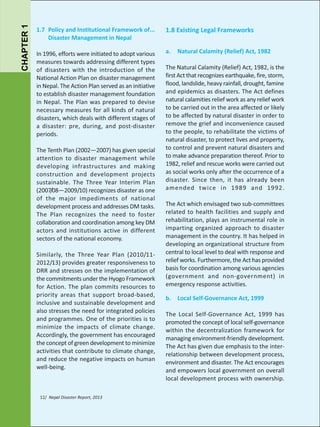
Box 2 : Minimum characteristics of a disaster resilient community
Organizational base at VDC/ward and community level;
Access to DRR information;
Multi-hazard risk and capacity assessments;
Community preparedness/response teams;
DRR/management plan at VDC/municipality level;
DRR funds;
Access to community managed DRR resources;
Local level risk/vulnerability reduction measures; and
Community based early warning systems

© Save the Children

http://www.flagship4.nrrc.org.np

© ECO-Nepal

1.
2.
3.
4.
5.
6.
7.
8.
9.

11/ Nepal Disaster Report, 2013

CHAPTER 1

In addition to the government mechanism, an
important contribution is being made by a
large number of Community Based
Organizations (CBOs), UN agencies,
development partners, I/NGOs, Nepal Red
Cross and other agencies in enhancing
community resilience. They work with the
community on hazard assessment and disaster
risk management planning. They apply
different approaches with different target
groups that make it difficult to track and to
evaluate overall progress towards creating
nationwide disaster-resilient communities,
and reinforce the need for NRRC Flagship IV
as a mechanism to build consensus and ensure
good coordination. The Flagship IV has
developed common tools for CBDRM projects
in Nepal, including minimum characteristics
(Box 2) of a disaster resilient community,
targeting implementation of CBDRR activities
in 1000 VDCs/municipalities within 5 years.

effort. Nepal has over 3,950 V illage
Development Committees (VDCs) and 58
municipalities, each facing a range of risks to
disasters, risks that are increasing due to
climate change, improper land use and
unplanned settlement and rapid population
growth.
CHAPTER 1

1.7 Policy and Institutional Framework of...
Disaster Management in Nepal

1.8 Existing Legal Frameworks

In 1996, efforts were initiated to adopt various
measures towards addressing different types
of disasters with the introduction of the
National Action Plan on disaster management
in Nepal. The Action Plan served as an initiative
to establish disaster management foundation
in Nepal. The Plan was prepared to devise
necessary measures for all kinds of natural
disasters, which deals with different stages of
a disaster: pre, during, and post-disaster
periods.

a.

The Tenth Plan (2002—2007) has given special
attention to disaster management while
developing infrastructures and making
construction and development projects
sustainable. The Three Year Interim Plan
(2007/08—2009/10) recognizes disaster as one
of the major impediments of national
development process and addresses DM tasks.
The Plan recognizes the need to foster
collaboration and coordination among key DM
actors and institutions active in different
sectors of the national economy.
Similarly, the Three Year Plan (2010/112012/13) provides greater responsiveness to
DRR and stresses on the implementation of
the commitments under the Hyogo Framework
for Action. The plan commits resources to
priority areas that support broad-based,
inclusive and sustainable development and
also stresses the need for integrated policies
and programmes. One of the priorities is to
minimize the impacts of climate change.
Accordingly, the government has encouraged
the concept of green development to minimize
activities that contribute to climate change,
and reduce the negative impacts on human
well-being.

12/ Nepal Disaster Report, 2013

Natural Calamity (Relief) Act, 1982

The Natural Calamity (Relief) Act, 1982, is the
first Act that recognizes earthquake, fire, storm,
flood, landslide, heavy rainfall, drought, famine
and epidemics as disasters. The Act defines
natural calamities relief work as any relief work
to be carried out in the area affected or likely
to be affected by natural disaster in order to
remove the grief and inconvenience caused
to the people, to rehabilitate the victims of
natural disaster, to protect lives and property,
to control and prevent natural disasters and
to make advance preparation thereof. Prior to
1982, relief and rescue works were carried out
as social works only after the occurrence of a
disaster. Since then, it has already been
amended twice in 1989 and 1992.
The Act which envisaged two sub-committees
related to health facilities and supply and
rehabilitation, plays an instrumental role in
imparting organized approach to disaster
management in the country. It has helped in
developing an organizational structure from
central to local level to deal with response and
relief works. Furthermore, the Act has provided
basis for coordination among various agencies
(government and non-government) in
emergency response activities.
b.

Local Self-Governance Act, 1999

The Local Self-Governance Act, 1999 has
promoted the concept of local self-governance
within the decentralization framework for
managing environment-friendly development.
The Act has given due emphasis to the interrelationship between development process,
environment and disaster. The Act encourages
and empowers local government on overall
local development process with ownership.
National Strategy for Disaster Risk
Management in Nepal, 2009

The National Strategy for Disaster Risk
Management (NSDRM), 2009, has provided a
roadmap for all the sectors to prepare sectorspecific programmes on disaster management
and formulate necessary policy decisions in
facilitating disaster mainstreaming into sectoral
development planning process. It is a
commitment of the Government of Nepal to

Out of 29 priority actions, the following key
five priorities have been taken forward under
the Nepal Flagship programme for immediate
action (Box 3):

Box 3: Nepal Flagship Programmes

2.
3.
4.
5.

School and Hospital Safety – Structural and Non-structural Aspects
of Making Schools and Hospitals Earthquake Resilient;
Emergency Preparedness and Response Capacity;
Flood Management in the Koshi River Basin;
Integrated Community Disaster Risk Management Programme; and
Policy/Institutional Support for Disaster Risk Management
http://www.un.org.np/coordinationmechanism/nrrc

© ECO-Nepal

1.

© ECO-Nepal

c.

reflect the paradigm shift towards protection
as part of the fulfillment of the basic rights of
the people. Based on the identified gaps and
issues for each of priorities for action that are
in line with HFA priorities, the NSDRM has
proposed and recommended strategies to be
taken for disaster management in Nepal. The
strategy has identified 29 cross-sectoral priority
strategic actions and several sectoral activities
for disaster management. The cross-sectoral
strategies are based on the gaps and issues
identified and are focused on addressing the
identified gaps in particular sectors,
incorporating all three stages of disaster
management cycle, namely- pre, during and
post disasters.

13/ Nepal Disaster Report, 2013

CHAPTER 1

Some DDCs, municipalities and VDCs have
started good initiatives such as the preparation
of DRM plan that also addresses climatic
hazards, training of professionals and staff and
implementation of community-based disaster
risk management programmes. However, due
to the absence of elected local bodies, local
government authorities have to perform their
responsibilities with limited resources and
capacities.
CHAPTER 1

The NSDRM has proposed the formation of
the National Commission for Disaster Risk
Management (NCDRM), which will be chaired
by the Prime Minister with high ranking
government officials from different ministries
and representatives from civil society
organizations as its members.
d.

Central Natural Disaster Relief Committee
(CNDRC)

An apex level Central Natural Disaster Relief
Committee (CNDRC) has been provisioned at
the Ministry of Home Affairs. Chaired by Hon.
Home Minister, the CNDRC, a 36-member
committee, is mandated to recommend the
Government of Nepal to declare emergency in
the disaster affected areas. CNDRC is mandated
to formulate and review national policy
regarding relief and rehabilitation works,
required programmes for preparedness,
response and recovery.
The CNDRC is comprised of the Minister of
Health and Population, Ministry of Physical
Infrastructures and Transport, secretaries of
relevant Ministries, Nepal Army, Nepal Police,
Armed Police Force, relevant government
departments, representatives of Social Welfare
Council, Nepal Red Cross Society and Nepal
Scout. The committee mobilizes the Central
Disaster Relief Fund.
The CNDRC coordinates all the central level
disaster relief and rehabilitation efforts and
directs the district and local committees on all
matters related to relief and rehabilitation
works, supplies, etc. The committee may
mobilize the Relief and Treatment SubCommittee chaired by the Minister of Health
and Population and Supplies, Shelter and
Rehabilitation Sub-Committee chaired by the
Minister of Physical Infrastructures and
Transport with specific terms of reference for
respective actions during disaster.
14/ Nepal Disaster Report, 2013

e.

Local Disaster Risk Management Planning
(LDRMP) Guideline, 2011

The Ministry of Federal Affairs and Local
Development (MoFALD) formulated the Local
Disaster Risk Management Planning Guideline
(LDRMP), 2011, under the Local SelfGovernance Act, 1998, in line with NSDRM,
2009. The main aim of the guideline is to
mainstream disaster management into local
level sectoral development areas by mobilizing
local resources and ensuring local community
participation following bottom-up approach.
LDRMP was put in place to make disaster
management participatory, transparent,
accountable, inclusive and responsible by
optimizing indigenous and local knowledge,
resources and capabilities.
f.

Disaster Preparedness and Response Plan
(DPRP) in Districts, 2010

The Ministry of Home Affairs (MoHA) has
formulated District Disaster Preparedness and
Response Planning Guideline (DPRP) under the
guidance of CNDRC aimed at formulating
emergency preparedness for response at all
districts. The DPRP piloting process was started
in 2007 as a contingency plan for effective
response under the chair of the Chief District
Officer.
Under the leadership of the District Disaster
Relief Committee, the DPRP process has been
scaled up with the technical support of District
Lead Support Agencies (DLSA), successfully
covering 73 districts by 2012. The result of this
initiative has tremendously contributed to
integrated disaster response with pre-identified
roles and responsibilities of state and non-state
stakeholders with accumulative inventories for
response.
National Disaster Response Framework
(NDRF)

The National Disaster Response Framework
(NDRF) has been prepared for effective
coordination and implementation of disaster
preparedness and response activities by
developing a National Disaster Response Action
Points that clarifies the roles and responsibilities
of the government and non-government
agencies. The main purpose of this framework
is to develop a clear, concise and
comprehensive national disaster response
framework for Nepal that can guide a more
effective and coordinated national response
focusing on large scale disaster. The framework
includes actions to be taken to save life and
property; maintain law and order; care for sick,
injured and vulnerable people; provide
essential services (lifeline utilities, food, shelter,
public information and media); and protect
public property immediately after the onset
of any disaster. The framework has also
identified required actions for needful
preparation from respective agencies.
h.

National Adaptation Programme of
Action (NAPA)

Nepal’s Climate Change Policy, 2011, sets out
the goal to improve people’s livelihoods
through climate change impact mitigation and
adaptation activities. The policy emphasizes a
climate resilient and low carbon development
path supported through international
commitments. The policy also calls for
strengthening national capacity to monitor
activities related to climate change. The
emphasis of the policy, inter alia, includes (i)
implementation of community-based local
adaptation actions as mentioned in the
National Adaptation Programme of Action
(NAPA); (ii) promotion of climate adaptation
and adoption of effective measures to address

the adverse impacts of climate change through
technology development and transfer, public
awareness, capacity building and access to
financial resources; and, (iii) development of
a reliable forecasting system to mitigate the
adverse impacts of climate change on
vulnerable areas, natural resources and
people's livelihoods.
i.

Local Adaptation Plans for Action (LAPA)

The National Framework on Local Adaptation
Plans for Action (LAPA) aims to promote the
preparation and implementation of LAPA and
integrate adaptation options into local and
national plans. LAPA Framework guides local
to national level planning to identify the most
climate vulnerable VDC, municipality, wards
and communities and their adaptation
challenges and opportunities, including possible
activities, and prioritize adaptation actions in
simple ways so that local communities decide
on and prioritize their own needs. The
integration of local level Climate and Energy
Plans with the LAPA could facilitate some triplewins and produce low carbon climate resilient
development (LCCRD).

j.

Nepal Risk Reduction Consortium (NRRC)

The Government of Nepal launched the NRRC
in 2009 under the chair of Home Secretary to
fulfill the institutional gap between obligation
from HFA, mandate from NSDRM and proposed
Disaster Management Act. The key role of
NRRC is to support the government in
identifying the programme areas on disaster
management, resource mobilization and its
implementation. The Ministry of Home Affairs
leads the NRRC, which is composed of 23
member organizations, including government,
donor communities, UN system, Red Cross

15/ Nepal Disaster Report, 2013

CHAPTER 1

g.
CHAPTER 1

Movement and civil societies. It is a unique
multi-stakeholder participatory arrangement
that unites humanitarian and development
partners in building a resilient Nepal.
k.

National Building Code (NBC)

The Government of Nepal has formulated the
Nepal National Building Code (NBC), 1993
targeting safer construction practices across
the nation. The Municipal and VDC authorities
are identified as key implementers of the code
with technical support from the Department
of Urban Development and Building
Construction. Though developed in 1993, NBC
went into force only in 2000 when the Building
Construction System Improvement Committee
(established by the Building Act, 1998)
authorized the ministry to implement the code
by gazetification. The Building Act and
Regulations and the Building Code provide the
legal framework for implementation by local
government. However, especially in urban
areas, it is essential that the full cycle of a legal
building regulation process is implemented
for new constructions.
1.9 Way Forward
Overall, there is a well developed policy and
regulatory frameworks for disaster
management in Nepal. Still the institutional
structure for implementation needs
strengthening at all levels. The challenge is to
implement these measures in a period of the
country's political transition and to move to a
new system of implementation with full
community participation to empower
communities and create a sustainable
approach to disaster management.

16/ Nepal Disaster Report, 2013

It calls for strengthening capacities of all actors:
government, non-government and
humanitarian agencies and civil society
organizations. Interventions in this area will
have to aim at developing and improving
effective early warning systems, development
of a comprehensive database, conduct
comprehensive surveys and develop
communication channels. The approval of
NSDRM is a major achievement. With the
approval of the strategy, various instruments
need to be upgraded, harmonized and
streamlined for consistency as they may have
been originally developed through separate
processes and mechanisms. This
mainstreaming needs to take place at all levels
with enhanced capacity and resourcing.
Though five priority areas envisaged by the
NSDRM are now in implementation, the
remaining priority areas equally need to be
implemented in achieving the goal of
developing a resilient Nepal.
NRRC has helped create and retain a focus on
disaster risk reduction and preparedness. As
it matures, cross-Flagship work has been
increasing. Flagship coordinating agencies need
to allocate appropriate, adequate and
dedicated capacity to proactively undertake
the increased functions for Flagship
coordination as originally envisaged
(coordination, information management,
technical support, resource mobilization,
monitoring reporting and evaluation). Since
Flagship V is related to institutional and policy
support, rest of the Flagship areas should be
coherent and directly linked with the area-V.
The endorsement of the disaster management
Act and formulation of designated agency are
crucial in further institutionalizing DM in Nepal.
© DPNet-Nepal

CHAPTER 2
Conceptual Issues on DRM
Introduction

CHAPTER 2

Disaster Risk Management (DRM) is the concept

and practice of reducing disaster risks through
systematic efforts to analyze and reduce the
causal factors of disasters. Reducing exposure
to hazards, lessening vulnerability of people
and property, wise management of land and
environment, and improving preparedness and
early warning for adverse events are all
examples of disaster risk management. Nepal
has felt the critical need to ensure that all
development plans, policies and
implementations mainstream disaster risk
management to save lives and secure
development gains.
Nepal is a country with high disaster risks, where
investments in risk reduction both save lives
and protects development goals. Thus, its
importance has been realized to proactively
integrate disaster management and climate risk
management into key development sectors to
lead to a self-sustained and long-term reduction
in disaster risks. In fact, DRM is a comprehensive
approach to reduce disaster risks which is set
out in the Hyogo Framework for Action. Its
expected outcome is the substantial reduction
of disaster losses, in lives and the social,
economic and environmental assets of
communities and countries (UNISDR, 2009).

2.1 Risk and Vulnerability in Nepal
With such a diverse landscape, ranging from
the massive Himalayan range to the fertile Terai
region, the people of Nepal face a variety of
life-threatening hazards. Classified as a global
‘hotspot’ (World Bank, 2005), Nepal is
vulnerable to multiple natural disasters,
suffering an average of 900 natural disasters
each year resulting in the loss of lives and fragile
livelihoods (MoHA, 2009). These disasters
include earthquake, flood, landslide, windstorm,
18/ Nepal Disaster Report, 2013

hailstorms, fire, GLOFs and avalanches. In terms
of relative vulnerability, Nepal has been ranked
as the 11th most at-risk country in the world to
earthquakes and 30th most at-risk to floods
and landslides (UNDP, BCPR, 2004). This
vulnerability to natural disasters result in
preventable deaths and injuries and puts
investments made in development at risk.
Disaster risk and vulnerability has increased
due to security issues and decreased livelihood
opportunities, migration, displacement, limited
access to and weak flow of information to the
population displaced internally due to more
than a decade-long conflict in the country
(NSDRM, 2009). However, the issue of
displacement is being addressed under the
ongoing government programme. Increasing
vulnerability in both urban and rural areas in
Nepal requires an integrated approach to
disaster risk management. In common with
many developing nations, Nepal is faced with
rapid urbanization, with a 3% increase in urban
population since 2001 (CBS, 2011), specifically
in the Kathmandu Valley. Urbanization is
occurring in a haphazard manner with little
regard to averting risk and placing more lives
in danger, specifically with regard to earthquake.
Kathmandu is the most at-risk city in the world
to a major earthquake (Geo Hazards
International, 2001). In the event of an
earthquake, major bridges and critical
infrastructures such as the only international
airport would be severely affected posing
significant challenges for an immediate and
effective response. This vulnerability is largely
due to poor building construction practices,
including infrastructure that is constructed
undermining seismic resilience. During the last
40 years, more than 300,000 buildings were
destroyed or damaged by floods, fire or
earthquakes (Des Inventar). These disasters
have imposed a devastating burden on people
and communities throughout Nepal. Disasters
occur consistently in a majority of the districts
in Nepal with more than 90% of the population
at high risk of casualties from two or more
types of hazards (MoHA, 2009).

development planning in Nepal in order to
protect lives and development gains.

The Government of Nepal has undertaken a
comprehensive study to assess urban growth
trends and scenarios of multi-hazard risks in
Kathmandu Valley to explore the scope of
future land use pattern. This assessment is
aimed at investigating and mapping the
projected future land use, probability of multihazard scenarios and current land use and
planning policies. Its purpose is to provide a
clear picture of the current and future trends
of urban expansion which could eventually
support for policy formulation and
implementation of effective land use and
disaster risk management plans (UNDP, 2012)

In recent years, the Government of Nepal has
taken steps to move from a relief and response
paradigm towards putting greater emphasis
on DRM by addressing all stages of disaster
management cycle. Although the current
institutional and financial frameworks remain
predominantly response-based, efforts are
being made to move towards a DRM approach
that is mainstreamed across all development
sectors and at all levels.

At a global level, there is now an emphasis that
sustainable development, poverty reduction
and good governance should require disaster
risk management to be integrated into plans,
policies and programmes (HFA, 2005-2015).
The Government of Nepal recognizes the need
to address and mainstream DRR through

The Natural Calamity (Relief) Act, 1982,
provides the main legal basis for DM in Nepal.
Amended twice since its adoption, it has
envisaged a response-focused approach to
DRM. In part, the government has addressed
this gap through the Local Self-Governance
Act, 1999, which authorizes a number of risk
reduction measures to be designed and
implemented by local government authorities:
D i s t r i c t D e v e l o p m e n t C o m m i tt e es ,
Municipalities and Village Development
Committees. However, inadequate institutional
structures, limited trained human resources,
lack of integrated planning for cumulative
financial resources, all remain limiting factors
to the implementation of these risk reduction
measures. Moreover, the absence of local
elected representatives has also remained a
stumbling block in its implementation.
The Government of Nepal, along with ongoing
relief and response practices, has recognized
the impact of disasters and the need to address
this issue through comprehensive risk
management approaches. As a result,
development plans have included DRM as
critical parts of sustainable development by
highlighting the need for policy formulation
and coordination with the creation of an
19/ Nepal Disaster Report, 2013

CHAPTER 2

In rural areas, the risk of floods and landslides
is particularly high in Nepal where there is
heavy reliance on weather dependent
agriculture. Agriculture sector is poorly
diversified and is largely dependent on
monsoon rains, which have become less
predictable due to climate change (Department
of Agriculture, 2010). Annually, floods and
landslides cause about 300 deaths also causing
severe economic damages exceeding US $10
million (MoHA, 2009). As a result, sustaining
development gains becomes a challenge as
disasters continue to impede them at both
national and local levels. Progress in
development that does not take disasters into
account is unsustainable and faces severe risk
of setback.

2.2 Disaster Risk Management in Nepal:
A Paradigm Shift
CHAPTER 2

appropriate and high-powered institutional
mechanism. The Three Year Interim Plan
(2007–2010) has emphasized the importance
of disaster risk management calling for changes
in existing national policies to give greater
attention to disaster preparedness and
reconstruction in addition to relief activities.
Similarly, the Three Year Plan (2010–2013) has
also places higher importance to resiliency and
minimize human and economic loss from
disaster by mainstreaming DRR into sectoral
development planning process.

of DRM and clearly outline the role of national,
regional and local authorities by provisioning
three sub-committees, namely, disaster risk
reduction, disaster response and disaster
recovery committees. In order to implement
the National Strategy for Disaster Risk
Management (NSDRM), the proposed Act has
envisioned a separate institutional mechanism
to coordinate overall disaster management
affairs.

2.3 Examining Risk-Poverty Relationships

Box 4: Disaster preparedness and
response planning initiatives

Quantitative and pragmatic evidence suggests
that there is a direct relationship between
disaster risk and poverty, which plays a key
In 2012, the Ministry of Home Affairs, through role in the accumulation of extensive risk over
Regional Administration Offices, organized disaster time and space. This role is intrinsically linked
preparedness and response planning workshops in as undermining disaster risk management limits
all five development regions. These workshops were government's efforts for poverty reduction.
aimed at orienting regional authorities on disaster
preparedness and planning process, quality
monitoring plans and reinforcing the roles and
responsibilities of District Lead Support Agencies
(DLSA). The Regional Disaster Relief Committee
(RDRC) members, security forces from the region,
district authorities from host districts, regional
representatives of line agencies, Red Cross and heads
of key I/NGOs and UN agencies are key stakeholders
at the regional level coordinating disaster
preparedness and planning initiatives. This initiative
is rolled out at the district level to ensure local level
preparedness.

The Government of Nepal became a signatory
to the Hyogo Framework for Action (HFA) in
2005. In line with this, the government is
currently in the process of approving the
Disaster Management Act, which aims at
including long-term planning, sustainable
approaches to DRM and strengthen links
between risk management and development.
The proposed Act will clarify the understanding

20/ Nepal Disaster Report, 2013

Recurrent and major disaster impacts seem to
perpetuate poverty outcomes. The extent of
vulnerability of communities to disaster risk
differs in urban and rural areas. Although
disasters impact social and economic landscape
of a country tremendously, there is little
evidence of systematic research to demonstrate
the long-term impacts of disaster on the
livelihoods of people in urban and rural areas.
Recent natural disasters in 2008 (Koshi floods)
and 2012 (Seti floods) demonstrate the interrelationships between poverty and vulnerability
by aggravating the livelihood options as the
poor people were highly affected by these
disasters. Furthermore, the national poverty
reduction agenda is facing numerous challenges
due to emerging climate change, environmental
degradation and the increasing number of
natural disasters across the country.
.3.1

Political Economy of Disaster Risk
Management

Taking into account these factors in mind, the
Government of Nepal has realized that effective
policies for disaster risk reduction can greatly
reduce the loss of lives and property caused
by disasters. In order to achieve this, the
government has adopted a multi-pronged
approach in reducing disaster vulnerabilities.
It has been realized that the implementation
of DRR policies and plans are constrained by
many factors such as differences in how various
line ministries, their departments at the
national and local levels, and local government
authorities act towards the existing DRM
policies, including financial constraints and
organizational challenges.
It has been realized that weak governance,
combined with political and economic factors,
are main shortcomings for t he poor
implementation of DRR plans and policies. The
government has felt the need to gain a better
understanding of the political economy of
disaster risk management. In the past, political
dynamics has not taken disaster management
into consideration, and in recent years, political
ownership has been considered as a critical
element in addressing disaster risk
management. Moving forward, more emphasis
is needed to work mainly on policy issues,
technical aspects, capacity building and

From previous initiatives, good results have
been achieved in many parts of the country
but it has also become clear that many
programmes have yet to deliver the expected
benefits to its citizens due to response-focused
political engagement, which is reflected in
fragmented priority and insufficient resource
allocation. The importance of these factors are
now widely recognized by the government, but
utmost attention needs to be given to respond
to a question of how political interest arises,
how to strengthen it and which will be the
government’s priority in the years to come.
The government has paid its attention in public
policy, collective action and address issues
related to political engagements by
emphasizing on the following key areas:
Ÿ
Ÿ
Ÿ
Ÿ
Ÿ
Ÿ
Ÿ
Ÿ

Implementation of disaster management
plans and polices;
Raising public awareness;
Creating enabling environment for disasterfriendly public services;
Ensuring residual risk transfer;
Improving disaster management
information system;
Strengthening networking and
coordination;
Enforcing national building code and land
use planning; and
Mainstreaming disaster and climate risk
management into development planning
process.

2.3.2 Co-relation amongst Hazard, Poverty
and Resiliency
Nepal is facing unprecedented disaster risks as
people are being exposed to more frequent
and severe hazards owing primarily to
21/ Nepal Disaster Report, 2013

CHAPTER 2

Political economy of disaster risk management
is relatively a new concept, which addresses
the central question of what are the critical
drivers that explain the uptake of disaster risk
management policies and how national and
international actors work to strengthen them.
It is analyzed by examining the incentives,
interests, institutions and power relations
facing key stakeholders while reducing disaster
vulnerability (Global Assessment Report, 2011).

strengthening institutions both at national and
local levels.
CHAPTER 2

unmanaged population growth, increasing
level of poverty and marginalization,
environmental degradation, poor planning and
preparedness and the impacts of climate
change.
Linking DRM to development can overcome
this dichotomy as disasters put development
at risk if development continues without
considering future disaster risks. Hazards turn
into disasters when there is a low level of
physical and social development. For example,
risks may happen because of the absence of
necessary flood management or counter
disaster infrastructure such as embankments
and drainage channels. In some cases, poorly
planned infrastructure development can itself
be the cause of disaster such as the outburst
of dams and collapse of mines.
Disasters, therefore, are inextricably linked to
the human context. Nepal has a population of
over 26.5 million (CBS, 2011). About 25% lives
below poverty level and majority of the
population are considered to be particularly
at-risk to hazards because of location and/or
socio-economic factors. Human activities are
also a major contributor to the likelihood and
extent of a disaster. Because of the rugged
topography, people have to engage with
natural environment on a daily basis which
can aggravate the natural conditions in ways
that lead to extreme events. Socio-economic
activities are linked closely to the natural
environment, disturbances in one region can
easily lead to consequent effects in other
areas—destructive practices like slash and burn
agriculture in the upstream areas increases
the risk of flood downstream. Understanding
the process involved in a disaster event requires
analyzing hazards at the locality, linking them
to wider driving factors and assessing the
human interaction.
Disasters are widely acknowledged to affect
disproportionately the poorest in a community
22/ Nepal Disaster Report, 2013

as they have relatively higher sensitivity to
disaster events compared with communities
of higher development status. Recurrent events
increase the vulnerability of the poor to
disasters, increasing poverty levels so that
many households are often unable to break
out of the poverty cycle. Medium to longer
term impacts of disasters at the national level
also challenge development progress towards
reducing poverty, possibly (re)creating
conditions that place marginal urban and rural
communities perpetually ‘at risk’ (UNISDR
2007). The exact relationship between disasters
and poverty is context-specific and often poorly
understood. The secretariat for the United
Nations International Strategy for Disaster
Reduction (UNISDR 2007a) noted there is little
empirical evidence of the long-term impact of
disasters on the lives and livelihoods of people
and on national development prospects.
Lessons from community participation in
disaster management reveal that it brings great
benefits in terms of ownership and direct
savings in losses from disasters. Although
problems vary from one specific context to
the other, top-down driven community-based
approach has yet to address local needs,
promote the potential of indigenous resources
and capacities, in the absence of which
people's vulnerabilities are likely to increase.
Recognizing these limitations, the Community
Based Disaster Management (CBDM) approach
has been promoted as a bottom-up planning
process. In order to create an enabling
environment, additional attention has been
given to assess community level hazards and
vulnerabilities.
In the case of disasters, people at the
community level have more to lose because
they are the ones directly hit by disasters,
whether major or minor. They are the first
ones to become vulnerable to the effects of
such hazardous events.
2.4 Current Practices and Coping
Mechanism

Environment conservation and disaster
management are important in the livelihoods
of indigenous people who often live in hazardprone areas and have built up, through
thousands of years of experience and intimate
contacts with environment, inherent
indigenous knowledge and local resources on
disastrous events. This knowledge is a precious
resource that continues to contribute to
environment conservation and disaster
management in Nepal. With the disruption of
traditional lifestyles and settlements in
permanent communities, it is a challenge to
maintain the continuity of traditional
knowledge through its transmission from one
generation to the other.
Disasters have affected poor countries and
poor people have been hit the most. According
to UNDP, 24 out of 49 least developed countries
face high levels of disaster risks. Nepal is no
exception to this. Not only are the people

2.4.1

Harnessing Synergies: Mainstreaming
DRM and Climate Change Adaptation
into Development Planning and
Process

The Ministry of Home Affairs and the Ministry
of Science, Technology and Environment, focal
ministries for disaster management and climate
change adaptation respectively, have initiated
effective linkages, coordination and synergy
in ensuring that the poorest and most
vulnerable communities in Nepal are able to
adapt to the negative effects of climate change.
According to the United Nations, although
Nepal’s per capita green house gas emissions
are negligible, it is affected by the negative
consequences of climate change such as rising
average maximum temperature which leads
to the subsequent retreat of glaciers (UNDP,
2010).
Climate models predict irregular precipitation
thus leading to an increased chance of flash
floods and intermittent rainfall resulting in
food insecurity and livelihoods setback.
Similarly, as glaciers begin retreating due to
climate change, there is also an increased
chance of GLOF. According to International
Centre for Integrated Mountain Development
(ICIMOD), warming in Nepal is an average of
0.6 degree per decade which is higher than
the global average of 0.4 degree (Country
Disaster Response Handbook, 2012).

23/ Nepal Disaster Report, 2013

CHAPTER 2

Disasters damage natural and physical
resources on which people’s livelihoods
depend. While different hazards have specific
effects, the ultimate impact of each hazard on
resource and poor people is mostly to disrupt
or destroy their livelihoods. Small farmers,
artisans and fishermen are affected both
through the loss of assets and the loss of
employment opportunities. Prevailing poverty,
characterized by low level of awareness, limited
resources, including access to skills and
knowledge, limit livelihood options. These
constraints limit opportunities to build
resilience.

affected by disasters, they also lack the capacity
to deal with the consequences of a disastrous
event. This exacerbates the situation which is
often characterized by food shortages, civil
unrest and furthermore creates dependency
(Practical Action, 2010).
CHAPTER 2

Climate change is raising the frequency and
scale of disasters in Nepal. This is having an
enormous impact made vulnerable by its
extreme climatic zones, geographical terrain
and river systems, which have led to large scale
temporary population migration, loss of major
infrastructures, exacerbated existing gaps in
educational and health services thus impacting
livelihood patterns.
Table 2.1: Land cover exposed to GLOF
risks in Nepal
Land cover type
Area (ha)
Agricultural land
Forest
Grass
Bush
River course
Cutting cliffs
Total

234.8
161.3
60.2
123.4
364.4
0.2
944.3

Source: ICIMOD GLOF Modelling, 2010)

is the case in the Siwaliks range, where
settlements and agricultural practices have
degraded the landscape and weakened the
natural defense system.
2.4.2

Building Resilience

Climate change has undermined the capacity
to deal with hazards. By putting pressure on
natural resources such as water, forests and
land, productivity, profitability and even viability
of subsistence livelihoods is challenged. With
less financial capital, people have little spare
funds to prepare for a disaster, protect their
property and other assets, and recover
afterwards.
In all, climate change has increased the
vulnerability of those that are already
susceptible to disasters and poverty by:
Ÿ

Increasing the disaster risk in places where
the poorest people live;
Adding strain on the natural protection
against hazards; and
Undermining livelihoods that provide
resilience against disaster

A growing body of evidence indicates that the
frequency and intensity of flash floods are
increasing in Nepal. On 5 May 2012, a flash
flood in Kaski district, claimed 72 lives. The
frequent occurrence of flash floods in the Hindu
Kush Himalayan region poses a severe threat
to lives, livelihoods and infrastructure, both in
the mountains and downstream. Vulnerable
groups such as the poor, women, children, the
elderly, and people with disabilities are often
hit hardest (ICIMOD, 2012).

Ÿ

Disaster risk is further increased because climate
change amplifies the effects of damaging human
practices. Where the natural environment is
already depleted through the use of
unsustainable practices, ecosystems will be less
able to withstand the variances in water level
or temperature rise. In turn, damaged
ecosystems provide weaker protection against
physical threats and, therefore, the likelihood
of an associated disaster event increases. This

That is why, for the majority of policy makers
and practitioners, the rationale behind calls for
greater mainstreaming of Climate Change
Adaptation (CCA) into DRM, and their
mainstreaming into development more broadly
is self-evident. Exploiting the overlap between
CCA and DRM is one way to ensure disaster
risk managers can continue to have a positive
impact on reducing vulnerability.

24/ Nepal Disaster Report, 2013

Ÿ

In light of these threats, disaster risk
management is central to meet development
objectives and to adapt to climate change. Even
gradual, mean changes in climate can increase
vulnerability of the poor and make the work of
disaster risk managers more difficult.
Box 5: Integrated watershed management: An option to CCA and DRM
conserving forests through community forestry. Although
rainfall is becoming more erratic and the potentiality of
hazards still exists, natural ecosystem has been improved
providing better defense and minimizing disaster risks.
Alternative options on growing crops and improved
irrigation facilities have enhanced production and
income.

Between 2004 and 2012, a range of activities in
improving livelihood capacities and improving watershed
condition were implemented. Communities have learned
to grow vegetables during winter as additional income
source, improved livestock rearing, conserved soil and
forests and utilized water resources to irrigate crops by
improving existing irrigation channels.

Stabilization of steep land through terracing and tree
planting, improving water management and construction
of flood barriers have helped prevent small scale
disasters; introduction of intensive vegetable gardening
and improved livestock breeds have strengthened
livelihoods, as increased agricultural biodiversity is a
key livelihood strategy to cope with changing and more
challenging environmental conditions. Sustainability of
livelihood initiatives are ensured by establishing an
institutional set up of community-based organizations
and linking them to service providers and markets to
carry out the activities in future.

Some farmers have chosen to cultivate bananas instead
of rice which would bring more income in limited water
availability situation. Soil erosion was managed by
controlling gulley in the micro catchments and applying
appropriate sloping agricultural land technology and by

2.5 Way Forward
In addressing disaster risks, a number of
emerging concerns warrant attention. These
include the integration of climate change issues
within the HFA and governance for DM at the
local level. DRM in Nepal has traditionally been
relief and response-oriented. There is significant
recognition that a strong, implementable,
results-based disaster risk management system
in Nepal will contribute to community and
national resiliency towards risks, sustainability
of development gains, poverty reduction, and
ultimately continued economic growth. Disaster
management is possible only through
integrated, participatory and collaborative
involvement of all partners. As such, due
importance needs to be given to more effective
integration of disaster risk considerations into
sustainable development policies, planning
and programming at all levels, with a special
emphasis on disaster prevention, mitigation,
preparedness and vulnerability reduction.
Overall, there is a well developed policy

framework for DRM, but the institutional
structure for implementation needs
strengthening at all levels. Legislation of the
proposed new Disaster Management Act with
a new dedicated institution is clearly the first
priority. For this, the national Disaster
Management Policy must be brought forward
ensuring integrated planning with community
level collective ownership. Again, development
and strengthening of institutions, mechanisms
and capacities at all levels, political ownership
and urban-focused earthquake preparedness
and mitigation measures with strong
stewardship from all the nodal ministries is a
pre-requisite to building resilience to hazards.
Furthermore, it is very important to consider
climate change issues within DRM.
Development plans and policies need to
integrate disaster management, climate change
adaptation and environment management
comprehensively in development strategies.
This holistic approach should also be reflected
at the grassroots level implementation to
address livelihoods of local communities.
25/ Nepal Disaster Report, 2013

CHAPTER 2

Landslide and flood is one of the major disaster risks in
Jugedi Khola watershed of Chitwan district, Nepal. Both
socio-economic practices (such as deforestation,
cultivating unsuitable hill slopes, uncontrolled grazing
and lack of skills for alternate livelihood options) and
erratic pattern of rainfall enhanced floods during summer
and drought and forest fire risks during winter.
© OXFAM
© Care Nepal

© MoHA
© ECO-Nepal/NPAF

Chapter 2
© DPNet-Nepal

CHAPTER 3
Disaster Scenario, 2012
Introduction
This chapter presents major disaster events
and their effects on human casualties and
economic losses in the country in 2012. In doing
so, it places the disaster events of 2012 in the
context of disaster trends in the country. The
disaster events are analyzed in terms of their
regional and district-wise distribution and
seasonality. These analyses are largely based
on the records of the Ministry of Home Affairs,
Ministry of Agriculture Development and
DesInventar.

CHAPTER 3

3.1 General Disaster Types
Common types of disasters in Nepal are
landslide, flood, thunderstorm, fire, epidemics,
earthquake and cold wave, among others. The

occurrence and impact of different types of
disasters varies over the years and seasons.
For example, landslides and flood occurs every
year in monsoon season whereas earthquake
does not have any pattern of season or year of
occurrence. A kaleidoscopic review of the
impact of various disasters since 1971 shows
that epidemics has caused the highest number
of fatalities, but in terms of impacted families,
flood has affected the largest number. Other
major disaster types, in terms of the number
of human deaths caused are landslide, flood,
fire and thunderstorm. The impact of different
types of disasters since 1971 is shown in Table
3.1. Category 'others' includes disasters such
as avalanche, drought, famine, forest fire, frost,
heat wave, pollution, snow storm,
sedimentation, etc.

Table 3.1: Most lethal disaster types and their impacts in Nepal (1971-2012)
SN Disaster Types

Number of Number of Number of
Deaths
events/records
injuries

Affected
family

Destroyed
houses

Damaged
houses

1.

Epidemic

3446

16,563

43,076

512,969

0

0

2.

Landslide

2942

4511

1566

555,705

18,414

13,773

3.

Flood

3685

4079

488

3,665,608

94,700

87,261

4.

Fire

6999

1416

1347

255,172

75,581

2282

5.

Thunderbolt

1403

1200

2257

6729

379

427

6.

Accident

1000

969

359

2137

5

415

7.

Earthquake

105

880

6840

4539

33,708

55,318

8.

Cold wave

390

515

83

2393

0

0

9.

Structural collapse

389

404

596

2016

1170

623

10. Boat capsize

140

279

140

410

0

0

11. Others

2892

1092

1458

928,492

5210

9998

23,391

31,908

58,210

5,936,170

229,167

170,097

Grand Total

Source: DesInventar 2011, MoHA 2011 and 2012
28/ Nepal Disaster Report, 2013
A trend analysis of human deaths caused by
different disaster types (Fig. 3.1) since 2000
shows that the number of deaths by particular
disaster type has been fluctuating over the
years. Since the casualty data caused by
landslide and flood has been recorded as one
category until 2010, the trend of casualties
has been analyzed by considering these two
disasters as one category. It indicates that with

an exception of 2009, flood and landslide has
caused highest number of human deaths since
2000. In 2009, epidemic was the major disaster
causing the highest number of deaths. In the
last three years, the number of deaths caused
by thunderbolt has been increasing. Similarly,
the number of deaths caused by fire has also
been increasing since 2009.

Human casualties by major disasters since 2000 till 2012
500

400

CHAPTER 3

Numbers of deaths

300

200

100

0

-100
Flood & Landslides

Fire

Epidemics

Thunderbolts

Earthquake

Avalanche

Fig. 3.1: Human casualties by major disasters since 2000 till 2012

3.2 Disasters in 2012
Major types of disasters recorded in 2012 are
thunderbolt, fire, landslide, flood, epidemic,
avalanche, extreme rainfall and windstorm.
Although air crash caused 34 fatalities, the
current norm of the Ministry of Home Affairs
does not consider it as disaster as the
government does not pay relief package to
victims. Casualties and the number of affected
families are shown in Table 3.2. Although cold

wave has largely affected people during winter
months, the data includes only deaths
medically certified as cold wave and not deaths
occurring during the events of cold wave. Table
3.2 shows that the total number of deaths and
people injured are 419 and 490 respectively
in 2012. The number of casualties is less than
2011 (Fig. 3.2). The impact of various disaster
types in terms of human and property losses
is given in Annex 2.

29/ Nepal Disaster Report, 2013
Table 3.2: Number of casualties and affected families in 2012
SN

Disaster

No. of deaths

No. of missing

No. of injuries

Affected family

Thunderbolt

119

0

267

35

2.

Fire

77

0

134

2436

3.

Landslide

60

8

33

66

4.

Flood

52

39

8

104

5.

Air crash

34

0

6

0

6.

Epidemic

33

0

0

0

7.

Windstorm

18

0

20

102

8.

Extreme rainfall

11

0

9

0

9.

Avalanche

9

3

13

0

10.

Boat capsize

4

0

0

0

11.

CHAPTER 3

1.

Cold wave

1

0

0

0

12.

Earthquake

1

0

0

0

419

50

490

2743

Total

Source: MoHA, 2012

Comparison of human casualties from disaster in 2011 and 2012

Fig. 3.2: Comparison of human casualties from disaster in 2011 and 2012

The severity of disaster type varies in terms of
fatalities, injuries and property damage. In
terms of fatalities, thunderbolt caused the
largest number of deaths (119) and accounted
for 29% of the total death (Table 3.2) in 2012.
Fire, landslide, floods and epidemics are other
major disaster types. These disaster types
together accounted for 82% deaths. However,
in terms of affected families, fire has affected
the largest number of families.
30/ Nepal Disaster Report, 2013

In 2012, a total of 1,699 disaster events were
recorded. Major disaster events, including
deaths, missing and affected families that
occurred in 2012 have been presented in
chronological order in Table 3.3. Among the
disaster types, major events recorded were
flood in the Seti river in Kaski district, fire in
Siraha district and avalanche in Gorkha district
in addition to two air crashes in terms of human
casualties and affected families.
Table 3.3: Chronology of major disasters in 2012
S.N.

Date

District

VDC/
municipality
& ward No.

Types of
disaster

Deaths Missing Injured

Affected
family

Fire

5

3

Thunderbolt

2

5

Flood

40

Air crash

15

6

Aaurahi 3, 4, 5, 6, 7

Fire

1

4

Banke

Holiya 9

Fire

1

31 May

Bajura

Badhu 9

Storm

5

8.

29 June

Baglung

Hatiya 3

Landslide

3

9.

3 August

Gorkha

Prok 4, 5

Epidemic

4

10.

23 Sept.

Gorkha

Samagaun 4

Avalanche

9

11.

28 Sept.

Bhaktapur

Thimi 16

Air Crash

19

12.

30 Sept.

Ilam

Kolbung 1, 2

Landslide

10

13.

2 October

Sankhuwasabha

Dhup 8

Landslide

5

1.

18 January Dhankuta

2.

3 May

Dhading

Mahadevsthan 1

3.

5 May

Kaski

Sardikhola 7

4.

14 May

Mustang

Jomsom

5.

15 May

Siraha

6.

23 May

7.

Rajarani 6

32

5

31

477
45

3

35

3

13

Source: MoHA, 2012

3.3 Spatial Pattern of Human
Casualties
Occurrence and impact of disasters vary in
different regions. Some disasters exhibit
specific spatial patterns whereas others do not
follow the same. For instance, landslides occur
almost exclusively in hills and mountains
whereas fire has broader occurrences. Analysis
of the spatial pattern of disaster helps in
designing appropriate response measures.

3.3.1 Ecological/Development Regions
Regionality of the disaster impact has been
organized by grouping districts of each
development region into three ecological

regions: mountain, hill and Terai. Figure 3.3
presents the regions thus grouped. Since the
number of districts and population vary in each
region, analysis of the impact of disaster should
take into consideration these variations.
Generally, since the hills and Terai have high
population, more people are exposed to
disasters and thus exhibit more casualties.
According to 2011 census, population of three
ecological regions, viz., mountain, hill and Terai
is 1,795,354; 11,475,001 and 13,350,454
respectively. Population of specific region for
2012 has been projected based on the
population growth rate of the respective
regions to calculate the proportion of
casualties. Spatial pattern of human deaths
and injuries caused by major disaster types is
analysed by development/ecological regions
31/ Nepal Disaster Report, 2013

CHAPTER 3

22
CHAPTER 3

Ecological and development regions of Nepal

Fig. 3.3: Ecological and Development Regions of Nepal

Tables 3.4 and 3.5 represent the proportion
of human deaths caused by disasters in
different ecological and development regions
respectively. Among the ecological regions,
hill accounted for 258 deaths (61.57%), Terai
accounted for 88 (21%) and mountain 73

(17.42%) deaths. In terms of population,
mountain has the highest casualties with 4.040
deaths per 100,000 people followed by hills
with 2.248 deaths and the Terai with 0.647
deaths per 100,000 people .

Table 3.4: Human deaths distribution by ecological regions in 2012
Projected population

Ecological Regions

Total human death

Number of death
per 100,000 people

Number

%

Number

1,806,788

6.68

73

17.42

4.040

Hill

11,612,002

42.97

258

61.57

2.248

Terai

13,605,022

50.34

88

21.01

Mountain

Among the development regions, Central
Development Region recorded the highest
number of human deaths of 146 (34.84%)
closely followed by Western Development
Region with 123 (29.35%) deaths (Table 3.5).
Simi larly, Eastern and Far Western
32/ Nepal Disaster Report, 2013

%

0.647
Source: MoHA, 2012

Development Regions each have accounted
for 12.41% human deaths. However, in terms
of the population size, Western Development
Region has recorded the highest death (2.467)
per 100,000 people with the lowest in Eastern
Development Region (0.883).
Table 3.5: Human death distribution by development regions in 2012
Total human deaths

Number of deaths

Development

Projected population

Regions

Number

%

Number

%

per 100,000 people

Eastern

5,887,640

21.78

52

12.41

0.883

Central

9,917,137

36.69

146

34.84

1.472

Western

4,985,671

18.45

123

29.35

2.467

Mid Western

3,652,364

13.51

46

10.98

1.259

Far Western

2,584,206

9.56

52

12.41

2.012
Source: MoHA, 2012

manifested by the occurrence of the Seti flood in
Kaski district. Human deaths caused by individual
disaster types in each development region and
ecological region are given in Annex 2.

Total human deaths from disaster by region in 2012

Fig. 3.4: Total human deaths from disaster by region in 2012

District-wise review of the distribution of
human casualties from different disaster type
indicates that 8 districts have not recorded
any human death. This has not changed from

2011 although particular districts without
human deaths have changed. The highest
number of deaths was recorded from Kaski
district (Table 3.3).
33/ Nepal Disaster Report, 2013

CHAPTER 3

Total human deaths caused by disasters in different
regions are shown in Fig. 3.4, which depicts that
the highest number of deaths was recorded from
the Western hills (96) and the lowest in Western
Terai (26). Highest death in Western hill is
CHAPTER 3

District-wise distribution of human deaths by disasters in 2012

Fig. 3.5: District-wise distribution of human deaths by disasters in 2012

Total human deaths from disaster in 2011

Fig. 3.6: Total human deaths from disaster in 2011

3.3.2 Human Injuries
A total of 490 human injuries were caused by
disasters in 2012 (Table 3.2). Out of all the
disaster types, largest number of injuries was
caused by thunderbolt (267), followed by fire
(134), landslide (33) and avalanche (13). These
four disasters accounted for 91% of total injuries
caused by disasters. A total of 9 districts did
not report human injuries from any type of
34/ Nepal Disaster Report, 2013

disasters. W ith regard to distribution,
thunderbolt caused human injuries in 45
districts of all the development and ecological
regions whereas fire injuries have been
reported from 37 districts. In terms of human
injury, thunderbolt, fire and landslide have
caused maximum number of injuries. Largest
number of injuries occurred in April (136)
largely contri buted by thunderbolt.
Figure 3.7: Total human injuries caused by hazards in 2012

Total human injuries caused by disaster in 2012

Fig. 3.7: Total human injuries caused by disaster in 2012

Thunderbolt
Among different disaster types, thunderbolt
claimed the largest number of human lives
(119) accounting for 29% of total death from
disaster (Table 3.2). Again, with regard to
injuries, thunderbolt accounted for highest
(267) resulting in 54.49% of the total 490

injuries. Number of deaths caused by
thunderbolt has been increasing since 2009.
An analysis of distribution of human deaths in
different districts shows that amongst various
disaster types, thunderbolt has caused human
deaths in largest number of districts (44).
Although districts of all the development and
ecological regions have been affected by
thunderbolt, casualty is more predominant in
the Central and Eastern hills and Eastern Terai

Human deaths caused by thunderbolt in different districts

Fig. 3.8: Human deaths caused by thunderbolt in different districts
35/ Nepal Disaster Report, 2013

CHAPTER 3

3.3.3 Human Casualties by Major Disaster
Types
Human deaths from thunderbolt in different regions

CHAPTER 3

Fig. 3.9: Human deaths from thunderbolt in 2012

Human injuries caused by thunderbolt in 2012

Fig. 3.10: Human injuries caused by thunderbolt in 2012

Fire

Next to thunderbolt, fire is the second largest
life claiming disaster in 2012 causing 77 deaths
(18%). A total of 134 people (27.35%) were
injured by fire (Table 3.2). Similarly, the number
of casualties by fire has been increasing since
2009. Figs. 3.9 and 3.10 indicate the distribution
36/ Nepal Disaster Report, 2013

of human deaths by fire in various districts and
regions. Interestingly, Far Western mountain
and Western mountain did not cause any
human deaths due to fire in 2012. Central hills
followed by Western and Eastern hills
accounted for the highest human deaths by
fire.
Human deaths from fire by region in 2012

Human death has been reported from 37 districts with highest number from Kathmandu district.
Generally, fire caused deaths more in Terai districts and Mid-western hills.
Human deaths from fire by districts in 2012

Fig. 3.12: Human deaths from fire by districts in 2012

37/ Nepal Disaster Report, 2013

CHAPTER 3

Fig. 3.11: Human deaths from fire by regions in 2012
CHAPTER 3

Human injuries caused by fire in different districts in 2012

Fig. 3.13: Human injuries caused by fire in different districts in 2012

Landslide
In 2012, landslides ranked third both in terms
of human deaths and injuries. A total of 60
deaths (18%) and 33 injuries (6.7%) were
recorded in 2012 (Table 3.2). Deaths due to

landslide were more prevalent mainly in hills
and mountains only, the highest being in
Western and Eastern hills. Combined with
flood, landslide has remained the most lethal
disaster in Nepal since 2000. Human injuries
by landslide were reported from 14 districts
of hills and mountains.

Human deaths from landslide by region in 2012

Fig. 3.14: Human deaths from landslide by region in 2012
38/ Nepal Disaster Report, 2013
Human deaths from landslide by districts in 2012

Human injuries caused by landslide in 2012

Fig. 3.16: Human injuries caused by landslide in 2012

Floods
Floods caused 52 deaths and 8 injuries in 2012.
The largest number of missing (52) was
attributed to flood in the same year. The Seti
river (Kaski district) flood in May 2012 alone
claimed 41 lives. Flood deaths were recorded

from Far Western Terai, Mid Western hill, Mid
Western Terai and Western hills (Fig. 3.17).
Human deaths due to flood were recorded
from only six districts (Fig. 3.18). Floods and
landslides together have been the major cause
of the largest number of deaths since 2000
except in 2009.
39/ Nepal Disaster Report, 2013

CHAPTER 3

Fig. 3.15: Human deaths from landslide by districts in 2012
Human deaths from floods by region in 2012

CHAPTER 3

Fig. 3.17: Human deaths from floods by region in 2012

Human deaths from floods by district in 2012

Fig. 3.18: Human deaths from floods by district in 2012

Epidemics
Although epidemics accounted for the largest
number of deaths among various disasters in
the past 40 years, it accounted for only 33 (8%)
deaths in 2012 (Table 3.2). No epidemics

40/ Nepal Disaster Report, 2013

related deaths were reported in the Central
and Eastern Development Regions (Fig. 3.19).
This also reflects poor public health scenario
in the affected regions. In comparison with
other regions, the highest number of deaths
was reported in Western hills.
Human deaths from epidemics by regions in 2012

Fig. 3.19: Human deaths from epidemics by region in 2012

Human deaths from epidemics by district in 2012

Fig. 3.20: Human deaths from epidemics by districts in 2012

3.3.4 Other Disaster Types
In addition to these disasters, which
collectively accounted for 81.38% of deaths
by disasters in 2012, other disasters such as
avalanche, air crash, cold wave, wind storm,
extreme rainfall, hailstone, etc. have also

caused damages. The total number of deaths
caused by these disasters is 78 and the number
of injury caused is 48. Amongst these disasters,
air crash caused 34 deaths and 6 injuries and
avalanche caused 9 deaths and 13 injuries.
Table 3.2 shows the details of damages caused
by these disasters.
41/ Nepal Disaster Report, 2013

CHAPTER 3

Epidemics caused human deaths in 9 districts of Western, Mid-Western and Far-Western
Development Regions, the highest being in Doti district.
Missing people
The number of missing people due to disaster in
2012 was recorded at 50. Out of the total missing,
flood accounted for 39, landslide caused 8 and 3
were reported missing due to avalanche. The Seti
flood in Kaski district claimed the highest number
of missing people.

CHAPTER 3

Affected families
The 'affected families' as recorded by the MoHA
are those families which have been temporarily
displaced in the midst of disaster events and which
have returned to their houses later. However, it
does not reflect, as generally assumed, the number
of families which were affected by the disaster.
In 2012, altogether 2,743 families were recorded
as 'affected families'. Fire affected the largest
number of families (2,436) followed by flood (104)
and windstorm (102). Among the
ecological/development regions, largest number
of affected families were recorded from Eastern
Terai (1,478) followed by Mid Western Terai (359).

3.4 Economic Losses
Disasters cause economic losses of various types
in addition to human deaths and injuries. These
economic damages include losses of houses,
livestock, crops, damage to public properties, etc.
MoHA coordinates with other agencies and
maintains the record of losses from disasters.
Problem in assessment of economic losses was
reported as there would be variation in different
districts in assessment and in many cases there
is a tendency to over-estimate economic losses.
Table 3.6 summarizes the damages caused by
various disasters in 2012 by ecological and
development regions. The summary of damage
by disasters in 2011 has also been presented for
comparison in Tables 3.6 and 3.7.

House damage
In 2012, a total of 2,743 houses were totally
damaged and 816 were partially damaged (Table
42/ Nepal Disaster Report, 2013

3.6). Basically, more houses were damaged in
Terai with the highest in Central Terai (2,350). In
2011, 2,558 houses were totally damaged and
769 were partially damaged (Table 3.7). Thus,
there is an increase of 66 % in totally damaged
houses and 6% in partially damaged houses in
2012.

Livestock loss
A total of 1,181 livestock were lost due to disaster
with the highest reported from Mid Western hill
(281) in 2012 (Table 3.6). In 2011, 745 livestock
were lost. Thus, there is an increase of 58% in
animal loss in 2012 (Table 3.7).

Crop damage
The Ministry of Agriculture Development (MoAD)
maintains the records of crop damages caused by
disasters. Major disaster type causing crop damage
in 2012 is drought. Less rainfall was received in
the main cropping season throughout the country
(MoAD 2012). Although drought condition
generally prevailed throughout the country, it was
more pronounced in some of the major paddy
producing districts like Saptari, Siraha, Dhanusa
and Mahottari. Since about 46% of the land is
rain-fed, drought situation affects agriculture
seriously. In 2011, which witnessed good rainfall,
paddy production reached a peak of about 5
million metric tons. On the other hand, in 2012,
the occurrence of drought resulted in leaving
about 140,000 hectare land barren thereby
reducing agriculture production by about 420,000
metric tons. There was 18% less production of
paddy compared to 2011 because of drought
(MOAD, 2012).

Economic losses
The total value of economic losses has been
reported to be NRs 1,293,956,997 in 2012 with
the highest economic losses reported from Eastern
Terai (Table 3.6). Similarly, in 2011, the total
economic loss was reported at NRs. 1,451,619,007
(Table 3.7).
Table 3.6: Impact of disasters by different ecological/development regions in 2012
Houses damaged

Livestock
Completely Partially loss

Estimated
loss (in Rs.)

294
12
199

174
1
27

189
9
67

294,197,900
5,575,000
97,511,500

54
105
2350

80
30

1
15
150

100,257,200
21,958,700
467,433,000

8
38
140

43
53
280

32
13
23

4,131,500
14,480,000
21,787,000

101
50
605

15
83
6

281
87
26

25,990,619
19,500,778
142,984,000

70
3
218
4247

8
6
10
816

260

52,220,000
2,015,000
23,914,800
1,293,956,997

28
1181

Source: MoHA, 2012

Table 3.7: Impact of disasters by different ecological/development regions in 2011
Ecological
Region
Central
Hill
Mountain
Terai
Eastern
Hill
Mountain
Terai
Far Western
Hill
Mountain
Terai
Mid Western
Hill
Mountain
Terai
Western
Hill
Mountain
Terai
Grand Total

Affected
Death Missing Injured family
172
180
20
562
70
11
113
39
13
4
11
1
89
5
56
522
115
26
119
310
37
10
61
52
14
3
18
22
64
13
40
236
36
15
29
18
14
6
9
1
7
3
10
3
15
6
10
14
98
47
70
98
69
36
51
24
5
4
8
23
6
25
11
51
29
86
108
193
16
92
63
81
2
2
13
14
21
112
137
506
507
1181

Houses damaged

Livestock
loss
173
74
5
94
303
47
63
193
36
6
16
14
100
58
3
39
133
74

Completely
860
71
15
774
1153
108
59
986
23
3
2
18
155
87
16
52
367
83

59
745

284
2558

Estimated
Partially Losses (in Rs.)
472
779,484,640
52
212,854,540
2,727,000
420
563,903,100
118
500,821,717
5
143,264,850
5
179,413,900
108
178,142,967
14
38,160,500
6
880,000
2
65,000
37,215,500
6
59,161,250
17
30,361,350
7
16,196,900
4
12,603,000
6
73,990,900
148
55,450,900
93
1,019,000
1
17,521,000
54
1,451,619,007
769
Source: MoHA, 2011

43/ Nepal Disaster Report, 2013

CHAPTER 3

Ecological
Affected
Death Injured Missing family
Region
Central
116
Hill
163
4
201
13
Mountain
31
48
17
Terai
7
148
1
Eastern
1
Hill
28
5
18
Mountain
71
27
5
33
1478
Terai
24
Far Western
26
6
38
Hill
11
35
13
Mountain
2
20
15
11
1
Terai
Mid Western
83
19
47
Hill
7
12
19
Mountain
359
10
15
2
Terai
Western
66
77
96
35
Hill
0
7
19
Mountain
193
11
8
Terai
2743
490
50
419
Grand Total
3.5 Seasonality of Disaster

human deaths in this month. Thunderbolt has
caused more deaths from April to September
with maximum number of deaths occurring in
May. Similarly, a distinct pattern can be seen
in the case of fire, landslides and floods. Human
death from fire was high from January to
March. Death from landslide was also recorded
high in the rainy season from May to October.
Epidemic caused deaths from May to
September, 2012. Total number of deaths,
injuries and missing by months is shown in
Table 3.8. Figure 3.21 shows the casualties
caused by different disaster types by months
in 2012.

Table 3.8: Major disaster impacts by month in 2012
Missing
Injuries
Month
Deaths
22
18
January
49
12
February
30
27
March
136
25
April
73
113
32
May
52
56
5
June
23
33
2
July
32
50
2
August
40
61
9
September

Source: MoHA, 2012

Distribution of total deaths, injuries and missing by months, 2012
160
140
120
100
80
60
40
20

Death

Injuries

Se
pt
em
be
r
Oc
to
be
r
No
ve
mb
er
De
ce
mb
er

Au
gu
st

Ju
ly

Ju
ne

M

ay

ril
Ap

y

ar
ch
M

ar
ru
Fe
b

nu

ar

y

0

Ja

CHAPTER 3

Generally, occurrence of disaster exhibits
seasonal pattern. For example, floods and
landslides occur in monsoon season, whereas
some disasters like earthquake and epidemics
may occur in different seasons. The number
of death occurring from various disaster types
in different months is given in Annex 2. With
regard to the total number of deaths, maximum
deaths (113) were recorded in May. But the
occurrence of flood in the Seti river (Kaski
district), an unusual season for the occurrence
of flood, contributed to the large number of

Missing

Fig. 3.21: Total deaths, injuries and missing by months in 2012
44/ Nepal Disaster Report, 2013
Deaths, injuries and missing due to disaster by months in 2012
45
40
Deaths in Numbers

35
30
25
20
25
10
5

mb
ce
De

No

ve
m

be

er

r

r
to
be

Au

Landslide

Flood

Oc

gu
st
Se
pt
em
be
r

ly

Ju

Fire

Thunderbolt

Fig. 3.22: Deaths, injuries and missing due to disaster by months in 2012

A comparison number of deaths caused by disaster in different months in 2011 and 2012 shows the
period lasting from April to October is most vulnerable in Nepal.

Comparison of deaths by months in 2011 and 2012
140
120
100
80
60
40
20

Au
gu
st

2012

Se
pt
em
be
r
Oc
to
be
r
No
ve
mb
er
De
ce
mb
er

2011

Ju
ly

Ju
ne

ay
M

Ap
ril

ar
ch
M

y
ar
ru

Fe
b

Ja

nu

ar

y

0

Fig. 3.23: Comparison of deaths by months in 2011 and 2012

45/ Nepal Disaster Report, 2013

CHAPTER 3

Epidemics

Ju

ne

ay
M

M

Ap

ar
ch

y
ru

ar

y

Fe
b

ar
nu
Ja

ril

0
3.6 Data Insufficiency

CHAPTER 3

Data analysis is largely based on the database
maintained by the Ministry of Home Affairs
complemented by the database from
DisInventar, Ministry of Agriculture
Development and information provided by
other agencies. The database of MoHA records
the number of deaths, injuries, missing, affected
families and losses by disaster types and the
places of occurrence.
Database does not segregate the data along
the axis of age groups, gender, disability,
ethnicity, etc. This has led to the lack of
assessment as to who are the most affected
people in the event of a disaster. Similarly, data
on economic losses are not complete for some
of the districts. Assessment of economic losses
also varies between districts. Some of these
databases contain data gaps and not all have
quality control procedures or documented
applications. Nevertheless, they provide good
examples for further examination.
Data discrepancies from various databases
maintained in Nepal are mainly due to the
differences in coverage and extent of disasters,
standards used in data collection system,
definition of disaster events and criteria used,
and most importantly the purpose of data
collected. Majority of data comes from relief
and rescue operations provided by the
government and other humanitarian
organisations. Data for the use for
reconstruction and rehabilitation purposes are
least collected. For example, data collected in
districts by DDRC and NRCS mechanism are
focused on humanitarian and relief purposes
whereas DWIDP data is more oriented towards
reconstruction and mitigation purposes.
On the other hand, criteria and standards used
by data collectors are also the major
46/ Nepal Disaster Report, 2013

contributors of these discrepancies. There is a
sheer lack of common standards for disaster
data collection in terms of its format as well as
with stated objective of the collection
mechanism. The same dataset is considered
to be good for relief as well as for reconstruction
and rehabilitation but not very relevant for
other purposes.
These discrepancies can be minimized for much
wider use by all stakeholders by using
standardized and comprehensive database
management system in disaster data collection.
The incompatibility among disaster database
can also be minimized and the data can be
made more purposeful.
The DesInventar database has been serving as
a significant source of information on disasters
in Nepal from 1971 onwards. This gives an
important and comprehensive information for
historical events occurred in Nepal as reported
in different media sources. Primarily, the
present report has evaluated the disaster
scenarios and losses from MoHA database.

3.7

Key Features

The disaster data analysis for 2012 reveals the
following key features:
Ÿ

Ÿ

Ÿ

A total of 31,908 people have lost lives to
different types of disasters since 1971.
During the period, a total of 5,936,170
families were affected from the disaster.
During this period, starting from 1971,
epidemics claimed the largest number of
lives (16,563) accounting for 53.88% of
total human loss from disaster.
By and large, flood and landslides, when
put together, have been the major disaster
type in terms of human casualties. Since
2009, deaths due to thunderbolt have been
increasing steadily.
Ÿ
Ÿ

Ÿ

Ÿ

Ÿ

Ÿ

Ÿ

Ÿ

Ÿ
Ÿ
Ÿ

Thunderbolt has caused more deaths from
April to September with maximum
number of deaths occurring in May.
Human deaths from fire was high from
January to March.
A review of deaths caused by disasters in
different months in 2011 and 2012 shows
the period lasting from April to October
is most vulnerable in Nepal.
Because of the drought situation in 2012,
about 140,000 hectares of land was left
barren reducing the paddy production by
about 420,000 metric tons.
Altogether, 4,247 houses were totally
damaged and 816 were partially damaged
in 2012.
A total of 1,181 livestock were lost due
to disaster with the highest reported from
Mid Western hill (281).
The total value of economic losses has
been reported to be NRs 1,293,956,997
in 2012 with highest economic losses
reported from the Eastern Terai.

Box 6: Seti flood: A missed opportunity
In May 2012, a massive flash flood just north of
Pokhara, the district headquarters of Kaski District
and the main tourist hub in the Western Region of
Nepal, caused immense destruction. A powerful
wall of water swept away several settlements along
the Seti river, breaching river banks downstream
and damaging the water supply of Pokhara, a city
with a quarter million inhabitants. Reportedly, 28
people lost their lives and many more were injured.
In July and August 2012, Dang district in the Mid
Western Terai region, was affected by the floods
of two separate rivers in a period of less than two
weeks. The floods, which in certain areas reached
up to one and half meters (five feet) above the
normal water level, damaged over 2000 houses
and shelters–completely destroying around
165–mostly those of poor families. It left the area
cut-off for several days and many households lost
cattle, stored grains or crops in the fields. Two

people reportedly lost their lives and many more
were affected.
The most recent flooding in Nepal during late June
2013, resulting from incessant monsoon rainfall,
has reportedly cost the lives of nearly 60 people
and affected hundreds of households in the Far
and Mid Western Development Regions and
continues to affect the daily lives of people in the
Eastern, Central and Far Western part of the country.
These natural disasters reflect some of the more
obvious lessons:
i. The need to conduct joint inter-agency damage
assessments is imperative in order to obtain a
comprehensive picture of the extent of damage.
Having valid and up-to-date information is vital
in the evidence based decision-making process
and contributes to be a more efficient use of
resources while responding to disasters. In
47/ Nepal Disaster Report, 2013

CHAPTER 3

Ÿ

In 2012, a total of 419 lost their lives, 490
were injured and 50 were missing
Among different disaster types,
thunderbolt caused the largest number
of human deaths (119) accounting for
29%. Other major disasters in terms of
human deaths are fire (18%), landslide
(14%), flood (13%) and epidemic (8%).
Thunderbolt has caused death in largest
number of districts (44), with more
damages done in Eastern and Central
Development Regions. Fire and landslides
are other commonly occurring disasters.
Among the ecological regions, largest
number of death was recorded in hills
(258) accounting for 61.57%. Among the
Development Region, Central
Development Region lost largest number
of people (146) followed by Western
Region (123).
In 2012, 8 districts did not record any
death from disasters.
Largest number of deaths (113) was
recorded in the month of May.
CHAPTER 3

Kaski district, the DDRC had formed a task force
comprising both government and nongovernment actors to carry out a joint
assessment in the affected areas. The task force
conducted observations and interviews in the
affected areas and carried out a multi-sectoral
analysis to respond in the most effective and
efficient manner to the needs of the affected
people.
ii. The presence of an adequate response capacity
at the local level is critical in order provide
immediate relief support to affected people
during small scale disasters. The government
introduced a provision for a disaster relief fund
of NRs. 300,000 for the DDRC and NRs. 700,000
for the RDRC, respectively. In addition, a team
of 25 police personnel was on standby for
search and rescue operations in each
district. In 2011, the Armed Police Force (APF)
established a disaster risk management centre
in Chitwan district.
iii. There is a need for active early warning systems
as the number of unusual floods and landslides
with greater damage and loss of property has
increased in recent years. Climate change and
infrastructure development have increased
vulnerability, particularly in the hills and
mountains. The Kaski CDO shared that “The
Seti flood was unexpected as it occurred during
the spring season. People were not prepared,
which perhaps contributed to a higher number
of casualties”. Based on this experience, the
Kaski DDRC established a communitybased early warning system in 2013, which
links the communities living up and
downstream of the Seti river.
The lessons thus drawn have brought about some
challenges too. There is a need for enhanced
coordination and collaboration, though both
government officials and humanitarian actors
commended improved coordination and
collaboration between government and nongovernment humanitarian organizations in the past
few years. However, more can be done in this
respect and all actors involved are encouraged to
48/ Nepal Disaster Report, 2013

continue their good efforts to bolster disaster
preparedness and response capacity at the district,
regional and national levels.
Furthermore, both private sector and civil society
are emerging actors in the humanitarian field.
Potentially one of the first responders during natural
disasters, the efforts of local private sector or civil
society members could contribute significantly to
life saving efforts. However, administrative and
bureaucratic hurdles remain. For instance, transfer
of private sector resources to the government is a
complex process, which calls for a coherent strategy
in terms of mobilizing funds from private sector,
local charities or other donors.
Again, timely and reliable dissemination of
information is imperative in saving lives during
disasters as it provides people living in areas at risk
the ability to find shelter on time. In addition,
responders and relief organizations need timely
and reliable information in order to effectively and
efficiently plan their response. However, during
the respective disasters, rumors and contradictory
information created confusion and consequently
delayed response activities.

Conclusion

Much has been achieved in the field of disaster risk
reduction in Nepal in recent years. Disaster
preparedness and response has been getting
increased attention at all levels which has
contributed to a reduction in human casualties and
loss of property during the onset and direct
aftermath of natural disasters. The government’s
capacity to respond to natural disasters has
improved considerably with the introduction of the
DPR Plan in 2011.
Government and non-government humanitarian
actors in both districts have acknowledged that the
implementation of the DPR Plan has added
significant value to the overall preparedness and
response initiatives. Coordination and collaboration
between government and non-governmental
humanitarian actors has also improved, particularly
in the areas of joint planning, response and the
strengthening of district level clusters.
As was underlined by the government, the DPR
Plan is a living document and needs regular
monitoring and review. Disaster risk reduction
activities should continue to focus on building
capacity of people living in vulnerable areas and
support the implementation of community
managed early warning systems. Humanitarian
actors stressed that the culture of relief should
shift to a culture of preparedness. Also, DRR should
be mainstreamed into district development

planning to secure adequate resource allocation.
The role of local media and civil society
organizations with respect to disaster risk reduction
has been increasingly recognized and should be
further bolstered. Finally, the experiences from
the response to the 2012 disasters in Dang and
Kaski districts provide valuable lessons learned to
further enhance the overall level of preparedness
and response to disasters, and hopefully will
contribute to a reduced human suffering and loss
of life in the event of future disasters.

Box 7: Siraha fire
support the livelihood of affected families.
A total 1080 huts belonging to 347 families were
engulfed by fire in which one person died and
four were critically injured. Security forces (Nepal
Army, Nepal Police and Armed Police Force), NRCS
volunteers and local communities were mobilized
to control fire. Humanitarian and development
organisations such as WFP, UNICEF, Save the
Children, Habitat for Humanity, Rural
Reconstruction Nepal, etc. provided food, shelter,
water, sanitation, hygiene and education support
to the affected families.

Box 8: 2013 flood fury
Floods and landslides caused by heavy rains since
the last week of May 2013 hit 29 districts of Nepal.
Until July 20, a total of 59 people were killed, 29
people injured and 2,079 families (approximately
12,474 people) were displaced due to the disaster.
Again, the intense rain from July 9-11, 2013, caused
heavy flooding in ten districts in the southern
plains of Nepal, amongst which Jhapa, Morang,
Sunsari, Saptari and Rautahat were highly affected.
Ten people were killed while over 719 families
(over 4,314 people) were displaced due to the
floods in eastern Nepal. Floods affected 14 VDCs
and two municipalities of Jhapa district.
Similarly, the water level in Koshi river exceeded

by 0.09 metres than the warning level (5.60
metres). Likewise, floods from Triyuga river caused
inundation in several VDCs and municipality areas
in Udayapur district and breach on the
embankment of Lalbakaia river caused heavy
inundation in Gaur municipality of Rautahat
district. Security forces were immediately mobilized
in protecting further damages in the embankment
which was later brought under control.
The Central Natural Disaster Relief Committee
(CNDRC) meeting held on 16 June 2013 decided
to provide NRs 5,000,000 to each of Darchula and
Kanchapur districts for response, relief and rescue
operations.

49/ Nepal Disaster Report, 2013

CHAPTER 3

An accidental fire broke out in Aurahi Village
Development Committee (VDC) of Siraha district
on 15 May 2012. According to the District Disaster
Relief Committee (DDRC) Siraha, a total 2063
people from 347 families were affected due to
the incident. A total of seven people with disability
were identified in the affected community. The
DDRC provided NRs. 6,000 (NRs 1,000 from District
Development Committee and NRs. 5,000 from
the local relief fund) to each of the affected
families. On 16 May, the Prime Minister visited
the affected area and announced to provide NRs.
25,000 to each affected family and requested all
humanitarian organizations and individuals to
© NPAF

© DPNet-Nepal

© OXFAM
© Plan Nepal
© UNDP Nepal

CHAPTER 4
Participation and Inclusion:
Making DRR Work for All
Introduction
Disaster loss and damage is increasing in Nepal
with grave consequences for the survival, dignity
and livelihood of the people, particularly poor
and marginalized communities. Addressing the
role disasters play in perpetuating the cycle of
poverty and in undermining development is
increasingly being recognized as a major
challenge that demands urgent attention. There
are many aspects of vulnerability arising from
various physical, social, economic and
environmental factors. Examples include poor
design and construction of buildings, inadequate
protection of assets, lack of public information
and awareness and disregard for wise
environmental management. Vulnerability can
also arise when people are isolated and insecure
in the face of risk, shock or stress. People differ
in their exposure to risk as a result of their social
group, gender, ethnic or other identity, age and
other factors.

CHAPTER 4

Mainstreaming people’s participation and social
inclusion into all stages of DRM, including
disaster preparedness, risk reduction and
mitigation, response and recovery, have gained

momentum in Nepal. The community-based
disaster risk management (CBDRM) approach
is valuable for many reasons, especially for
participation and social inclusion. Although
there has been limited study of communitybased mitigation and preparedness, there is a
growing body of case study evidence illustrating
successful initiatives of many kinds. Indeed, the
value of community-based initiatives has led
many disaster mitigation and preparedness
programmes to abandon technical, top-down
methods in favour of more participatory
approaches.
The Government of Nepal is a party to
numerous international conventions and has
adopted many progressive laws in response to
international commitments. A number of
national institutions have mandates that
promote gender equality and social inclusion
along with the Interim Constitution of Nepal
(2007). Inclusive development is one of the
government’s priorities, which have been laid
down in the Three Year Interim Plan and is
aimed at building a just society by ensuring
rightful sharing of power and resources for
active people’s participation.

Box 9: Some relevant legal instruments of participation and social inclusion related to
DRM in Nepal:
Ÿ

Ÿ

Ÿ

The Interim Constitution of Nepal, 2007,
has highly prioritized people’s
participation and social inclusion by
provisioning specific rights of freedom
and equality, rights against untouchability
and racial discrimination, right to
education, right of women, and right to
social justice.
The Natural Calamity (Relief) Act, 1982,
has the provision of formulating policies
and facilitating implementation of
disaster management.
The Local Self-Governance Act, 1999,
authorizes to undertake certain
functions with respect to DRM by local
bodies through legally prescribed
participatory bottom-up planning
process at all levels.

52/ Nepal Disaster Report, 2013

Ÿ

The NSDRM, 2009, provides strategic
guidance on cross-cutting issues such as
human rights and protection, gender and
social inclusion, decentralization and local
self-governance, humanitarian security,
and recommends implementation of
disaster management by mainstreaming
these in each sectoral plans and
programmes.

Ÿ

The LDRMP and DDMP guidelines, which
we re d eveloped and approved
considering the main sprit and thrust of
NSDRM, also ensure participation and
social inclusion which were approved
under the existing power granted by the
LSGA.
The Ministry of Home Affairs, in conjunction
with supporting agencies, has been regularly
conducting a series of simulation exercises,
mass casualty management training
programmes and search and rescue operations
for targeted beneficiaries and first responder
institutions in Kathmandu and other urban
areas of Nepal. These training programmes
include a full-scale mock drill simulating a major
earthquake or large road traffic accident to
improve the capacity of hospitals for emergency
preparedness and disaster response. The mock
drills are carried out in collaboration with
humanitarian and development partners that
have a major role to play in terms of disaster
management. These training programmes and
mock drill exercises have provided substantial
experience in testing the practical application
and proved to be the best way to put theory
into action and to test hospital emergency
preparedness.

4.1

Axis of Socio-economic
Differentials

Wo m e n a n d e xc l u d e d g r o u p s a r e
disproportionately vulnerable to the impacts
of disaster. In most cases, the needs and
responsibilities of women and socially excluded
groups are not adequately considered in the
design, planning, preparedness, recovery and
reconstruction, thus making it critical to
recognize the role of gender equality and social
inclusion in crisis situations.
Women and socially excluded groups are
supported to establish disaster management
linkages with livelihood activities through micro
level development interventions. This includes
piloting saving and credit cooperatives among
vulnerable communities in many parts of the

4.2

Role and Participation of
Civil Society in DRM

Several government and non-government
agencies have been focusing on DM in Nepal
since the 1988 earthquake in Eastern Nepal
and water-induced disasters in Central Nepal
in 1993. However, there exists inadequate
primary information at the central level that
elucidates which agencies are involved in
disaster management in Nepal, where are they
working, what are they doing, how much
resources have been spent, etc. Therefore, in
many instances, DM activities are isolated from
mainstream development initiatives with
duplication of project activities and lack of
cross learning.
In this context, under the aegis of the Ministry
of Home Affairs, a National Platform for Disaster
Risk Management (NPDRM) has been
envisaged to facilitate coordination process at
national and local levels. A committee
comprised of DM related agencies
(government, donors, UN agencies,
INGOs/NGOs, academia, media, private sector
and local government) has been established
under this platform. In addition, many multi/bilateral agencies are working on promoting
inclusive DM in Nepal .

53/ Nepal Disaster Report, 2013

CHAPTER 4

Gender Equality and Social Inclusion

country which will help in institutionalizing DM
initiatives in the long-run. This initiative has
encouraged local communities to support social
inclusion and women’s participation by
integrating livelihood improvement activities
into DM. However, the understanding of gender
in DM linkages at the policy and practice levels
needs to be strengthened and institutional
coordination and collaboration mechanism
consolidated.
4.2.1 Corporate Sector

CHAPTER 4

Business sector has always been a very
important stakeholder in DM as it has been
playing a critical role in reducing socioeconomic vulnerability and exposure to
disasters and in ensuring more resilient
economic growth at the national level. Building
their capacity and strengthening business
resilience further reduces dependency on
government for post-disaster recovery and
increases private sector capacity to pursue
corporate social responsibility, national and
sectoral development goals.
The Federation of Nepalese Chambers of
Commerce and Industry (FNCCI), an umbrella
organisation of the Nepalese private sector,
along with the Confederation of Nepalese
Industries (CNI) have played a major role in
providing relief materials to disaster-affected
communities. The private sector, on many
occasions, has made contributions by raising
funds for relief and rescue operations through
their associations. However, Nepalese business
houses are awakening to the call and have a
long way to go before they are more
responsive to their communities and society
at large (DFID, 2012).
As corporate social responsibility is emerging,
companies need to focus more on risk
reduction and mitigation. Of late, insurance
companies have teamed up with the DRR
community on earthquake preparedness,
livestock, land and crop compensation
primarily aimed at gaining credibility to market
its products and services.

4.2.2 Academic and Research
Institutions
Academia and research institutions of Nepal

54/ Nepal Disaster Report, 2013

have started promoting, prioritizing and
advancing research on natural, social,
engineering and technology aspects of disaster
risks in an integrated environment.
Additionally, these research institutions have
encouraged promoting the adoption of hazard,
vulnerability and risk profiles into disasterresilient development and sectoral planning.
Academic institutions such as Tribhuvan
University, Kathmandu University, Pokhara
University, Institute of Forestry, Institute of
Engineering, ICIMOD, etc. have long been
associated in undertaking research activities,
initiating and supporting higher education on
disaster management and promoting linkages
and collaboration with I/NGOs working on
disaster management.

4.2.3 Media
National and local media have played
fundamental roles in promoting DM policies,
holding the government and local bodies
accountable and in advancing DM agenda at
national and local levels. Increasing electronic
and print media have an active role to play in
the early warning chain and are essential
partners to help educate communities,
highlight particular needs of vulnerable groups
and channel DM messages to different
audiences in various local and ethnic
languages.
Mainstream media such as daily newspapers,
television, radio and community FM radio
stations have recognized the increasing
importance of DM issues in current affairs and
are providing clear and accurate information
to the public at times of pre, during and postdisaster periods. Similarly, Nepal’s media have
been emerging as a responsible humanitarian
and lifeline communicator as they are
informing and educating people with
customized messaging, including the most
vulnerable groups of society, about the disaster
risks they are facing and are willing to work
closer with national and local institutions.
In addition to emergency broadcasts, Nepalese
media has been relaying accounts of what
happened, where it happened, who or what

4.2.4 Civil Society Organizations

4.2.5 Children, Youth, Old Age and
Persons with Disabilities
Children are among the most vulnerable
groups in times of disaster. Factors such as
age, knowledge and physical strength affect
their ability to cope and survive in a disaster

Box 10: National Network of Community Disaster
Management Committee (NCDMC)
Founded in 2008, the National Network of
Community Based Disaster Management Committee
(NCDMC) is a national level network of disaster
affected communities, including representatives
from district level CBDRM committees that has been
expanded to 28 out of 75 districts, which is the first
of its kind in the country.
Representatives from poor, marginalized and socially
excluded groups and communities (such as women,
children, persons with disabilities, senior citizens,
etc. and/or disaster affected communities) have
joined this network for increased solidarity. The
committee discusses community level issues which
are consolidated from the experiences of people
living in disaster-prone areas and those issues are
linked from community to VDC, district and national
levels, aimed at creating mass awareness and
pursuing government, humanitarian and DRR actors
to take appropriate measures to stop underlying
causes of disaster vulnerabilities and minimize
disaster impacts in future.

context. Children have particular needs that
must be met for their healthy growth and
development, and these needs can be
compromised by acute disasters. Today’s
children and youth are the generation who
will inherit the legacy of our actions and so
their involvement is a first crucial step to
55/ Nepal Disaster Report, 2013

CHAPTER 4

Nepal’s Civil Society Organizations (CSOs) have
always raised concerns, expectations and
voices within the community, particularly in
the disaster-hit districts. Social cohesion and
solidarity are at the heart of community
resilience and CSOs play an important role in
strengthening it. They have continued to play
a critical role in upholding democratic values,
serving as custodians of people-based
development and building community
resilience. Successful partnerships with CSOs
have substantially contributed to innovations,
increased reach and investment and
promoted inclusion of marginalized
communities with regard to DM and CCA at
local level. Civil society and community-based
disaster risk management committees and
their networks have, therefore, proved to be
important stakeholders in promoting
accountability towards commitments made
by the government.

was affected, what is being done and where
it is safe to go. This is amply demonstrated by
the fact that media have disseminated accurate
information on natural hazards and DM and
dedicated more time and space to report on
the causes of disasters and what can be done
to prevent it.
ensure that actions to reduce risks are not
only effective but sustainable for years to
come.
Ongoing initiatives include enhancing
knowledge, capacity and awareness of DM
education for children, parents and teachers;
design and promote "safe school" 5
standards by training and mobilizing them to
champion school-based DRM; developing a
child-centred DRM model and advocating for
the integration of "safe school" standards and
DM curriculum into education policies. This
apart, various programmes are being
implemented to protect children by means of
ensuring health, education and other essential
services which are capable of addressing the
needs of children when disasters strike.

CHAPTER 4

School safety programmes have been
implemented aimed at (i) physical, seismic
retrofitting of school buildings; (ii) operational
strengthening through training and workshops
for students and teachers; and (iii) awareness
raising.
Persons with disabilities have remained
excluded from mainstream social activities
such as livelihoods and participation in
community level DM. Factors contributing to
exclusion include barriers relating to physical
accessibility, access to information and existing
social and cultural attitudes. Inclusive DM
considers the whole community, but pays
specific attention to persons with disabilities
and caregivers since their vulnerability reduces
the entire community’s resilience towards
disasters.

In recent years, various organizations working
on DM have been supporting children, youth,
old age and persons with disabilities into
mainstream development process. In order
to meet the specific needs of persons with
disabilities before, during and after disasters,
efforts to strengthen the implementation of
social safety net mechanisms are underway
to assist the poor, the elderly and the disabled,
and other population affected by disasters.
Similarly, enhancing recovery schemes,
including psycho-social training programmes
in order to mitigate the psychological damage
of vulnerable population, particularly children,
in the aftermath of disasters have also taken
roots into disaster management.
Box 11: Children's Charter on DRR
1.
2.
3.
4.

Child protection must be a priority
before, during and after a disaster;
Children have the right to participate and
to access the information they need;
Community infrastructure must be safe, and
relief and reconstruction must help reduce
future risks; and
DRR must reach the most vulnerable

Experiences also show that persons with
disabilities can effectively contribute to
CBDRM initiatives by identifying possible
solutions based on their needs and experience,
which in turn, increases the overall resilience
of the community. In order to foster maximum
effectiveness of collective efforts for risk
reduction, it is, therefore, important to work
inclusively across all communities.

5
Safe School standard not only focuses on mere preparedness, but also strives to develop knowledge to institutionalize
the culture of safety and resilience of all school communities to disaster. It focuses on inculcating a safe learning
environment and preparedness for a resilient school communities by training and mobilizing parents, students and
teachers to champion school-based disaster risk reduction.

56/ Nepal Disaster Report, 2013
In recent years, the Government of Nepal has
been promoting child-centred, gender-specific
and disability-sensitive interventions to be
mainstreamed into all CBDRM and into national
and local level development approaches.
However, the central question is how the poor
and the weak can benefit from institutional
processes in the first place and sustain those
benefits in the long run. Nepal needs to compile
and document good practices and lessons learnt
of disability-inclusive disaster management in
order to promote an achievable vision of
disability inclusive disaster management.
Building grassroots capacity, strengthening
community institutions, networking and
advocacy in response to and cope with future
disasters go a long way in addressing disaster
risks in Nepal.

4.2.6 Role of Nepal Army, Nepal Police
and Armed Police Force
At the time of disasters, Nepal Army, Nepal
Police and Armed Police Force play significant
roles, especially in carrying out rescue and relief
operations.

During pre-disaster, the Nepal Army sets up
institutions, governance and functioning
mechanisms. At the aftermath of disaster, it
works on rescue operations through land and
air, and logistics support for carrying out
humanitarian relief items, along with supporting

In the event of a large scale disaster, the Nepal
Police plays a crucial role in the established
command posts to facilitate rescue operations.
Since the police have a wider institutional
network, they are the primary responders and
first hand information providers to disasters.
Thus, Nepal Police is the primary source of
disaster data and information. The Nepal Police
has also established a Disaster Management
Division to coordinate the overall disaster
response.

Box 12: Nepal’s participation in 5th Asian
Ministerial Conference on DRR

Former Deputy Prime Minister and Minister for
Home Affairs Bijay Kumar Gachhadar participated
in the 5th Asian Ministerial Conference on Disaster
Risk Reduction from October 22-25, 2012, organized
by UNISDR in collaboration with the Government
of Indonesia.
Speaking at the conference, Hon. Gachhadar
apprised the Parties of the efforts being made by
Nepal at the local and national levels to reduce the
disaster risk, challenges and problems being faced
by the country to that end and raised issues related
to the development of organizational mechanism
to minimize problems related to landslides, floods
and global climate change. He pledged to make
maximum efforts for the allocation of 5% of total
national budget for reducing disaster risks in Nepal.
As part of the Declaration, Nepal expressed its
commitment to integrate local level DRR and climate
change adaptation into national development
planning process, strengthen local risk assessment
and fund mobilisation, governance, accountability,
build local community resilience, and identify
accountability measures for more effective
implementation of a post-2015 DRR.

57/ Nepal Disaster Report, 2013

CHAPTER 4

Nepal Army, through its Disaster Management
Directorate, has been playing instrumental roles
in providing emergency assistance for rescue
operations to needy people—a role that has
become even more important in the present
context. Primary roles of the Nepal Army include
search and rescue, medical assistance,
evacuation and air rescue, mass evacuation, etc.
Its first and foremost task is to carry out rescue
and relief operations by reacting quickly and
mobilizing capabilities due to its presence
throughout the country and along with aviation
service.

reconstruction of physical infrastructures like
schools, bridges, culverts, irrigation channels
and roads.
Similarly, the Armed Police Force (APF) has
established Disaster Management Division to
coordinate all DM activities. Likewise, a Disaster
Management Training Centre (DMTC) has been
established in 2011 at Kurintar, Chitwan district,
which is dedicated to enhance the capacity of
its personnel needed for prevention, mitigation
and response in line with APF’s 5-year Disaster
Management Plan.
Box 13: INSARAG Meeting
About 35 experts and participants from 17

countries in the Asia Pacific region shared
their crisis response strategies, progress and
the shortcomings to cope with disasters,
during the 2-day International Search and
Rescue Advisory Group (INSARAG) Asia
Pacific Regional Meeting held in Kathmandu
in 2012.
Hosted by the Government of Nepal in the

Again, the APF has deployed Regional Disaster
Management Team in every region with
available tools and equipment which is
mobilized in rescue and relief operations in
times of disaster situation that might occur in
respective regions. The APF's Immediate
Reaction Team (IRT) is involved in DM and
rescue operations.

capacity of Vice Chair of INSARAG, for the
second time in Kathmandu after April 2009,
the meeting emphasized on ways to build
national and international search and rescue
capacity to deal with any likely major
disasters in future. It also concentrated on
strengthening search and rescue capacity;
establish search and rescue operation team
within the security forces for disaster
response, and commitment of the
international agencies for managing disasters
in Nepal.

CHAPTER 4

4.3 Addressing Rural and Urban
Vulnerabilities

risk zones and increased the level of risks in
cities as a whole.

Agriculture sector and with it, the agri-business
industry, has particularly high level of disaster
risks. Disasters in this sector are not only
disasters for businesses, large or small, but also
significantly affect rural societies, urban
households, national and global commodity
markets and food security (UNISDR, 2013).

The level of risk has increased further in cities
due to high urban growth rates and consequent
high physical exposure and inadequate
preparedness. Urban vulnerability is largely a
consequence of improper urban management,
inadequate land use planning, unregulated
population density, poor construction practices,
ecological imbalance, infrastructure
dependency, and inadequate provision for open
spaces.

Nepal is passing through an unprecedented
phase of urbanization where the urban
population is projected to almost double during
the course of a few decades. This has put
enormous pressure on physical infrastructure,
socio-cultural fabric, natural environment and
institutional systems in towns and cities. While
planned urban development has not been able
to keep pace with the rising demands, ad-hoc
growth has resulted in people living in high58/ Nepal Disaster Report, 2013

Climate change has added a new dimension to
urban risks. It threatens towns and cities directly
through physical impacts of stresses and
catastrophic events, and indirectly through
distress migration. The concept of climate
resilience is very new to our developmental
and management paradigms, and requires
innovative approaches and interventions.
Resilience to climate related disasters in urban
areas tries to identify the capacity of urban
infrastructure and services to withstand
disasters on the one hand and how
communities and institutions are expected to
deal with such an event on the other. The
question is basically how resilient is our towns
and cities today? Or how is a community going
to absorb, maintain and recover from a
disaster? (SEEDS, 2010).

In line with the government’s flagship
programme on hospital safety, an independent
secure water supply system with emergency
water supply response plan was developed in
Tribhuwan University Teaching Hospital,
Kathmandu, which is equipped with a deep
tube well, earthquake resistant generator
house with generator, 1500 liters fuel stock
and other water supply materials to deliver
water supply in seven critical hospital units
through trained hospital maintenance and
housekeeping staff.
In recent years, the focus on urban Nepal has
grown steadily due to large population
migration from rural areas to urban centres
and more frequent and intense natural hazards
leading to disasters. The urbanization
pressure–in combination with more frequent
and severe natural hazards that have been
projected–are likely to significantly change
urban infrastructure and services of towns and
cities in the coming years. Especially, if natural
hazards turn into disasters, the potential loss
of lives and infrastructure in urban areas are
expected to increase.

Initially there used to be concerns mainly
around metropolitan cities such as Kathmandu
and Lalitpur districts, the emergence of second
and third tier towns such as Birgunj, Hetauda,
Narayangadh, Nepalgunj, Dhangadhi, etc. as
major engines of economic growth have
brought about a much wider landscape of
urban concerns that cuts across other emerging
towns in different geo-climatic settings within
the country.

4.4

Now, CBDRM approach has also been gradually
concentrated in urban areas through various
initiatives related to emergency preparedness
and response in community level as well as to

Disaster management, being an allencompassing and multi-disciplinary activity
spanning across all sectors of development, is
a sine qua non for overcoming vulnerabilities

Way Forward

59/ Nepal Disaster Report, 2013

CHAPTER 4

There is a definite link between urban disaster
and climate risks. In the context of urban risk
reduction, both of these need to be viewed
through a developmental lens, and
mainstreaming of disaster management has
to be one of the most prominent agendas of
action. Under the approach of integrating urban
risk reduction with climate change adaptation,
linkages with challenging processes of risk
assessment, risk communication, risk mitigation
and preparedness at the local level needs to
be re-examined. The Government of Nepal has
reiterated that building resilience can be
achieved only through multi-sectoral and multistakeholder approaches through appropriate
p o l i c y a n d p l a n n i n g i nte r ve nt i o n s .

enhance emergency response of key
institutions and stakeholders. Some of the
highlights are stockpiling of LSAR, hygiene kit
and WASH items as well as establishment of
emergency water supply at identified open
spaces such as Tribhuvan University, Kirtipur
and NARC-Khumaltar, action plan of the
Kathmandu Upatyaka Khanepani Limited
(KUKL) and private tanker association for
emergency water supply in emergencies.
and minimizing risks. It will not only help in
pooling resources but will also facilitate
information exchange and expertise across
sectors, learn from each other’s experience
and best practices.
The objective of DM is to consciously move
towards strengthening the national capability
and take care of the concerns vis-à-vis DM
across different sectors. In the aftermath of
the Seti flood (Kaski district) and Siraha fire in
2012, the response of the government, civil
society, media, voluntary organizations and
corporate sector has been exemplary and has
earned appreciation from many quarters. The
efforts of the governmentl have received
commendable support from individuals,
organizations, corporate sector and the civil
society .

This apart, ensuring adequate representation
of excluded community during assessment,
planning and implementation as well as benefit
sharing can play a vital role to protect and
promote right to participate and social
inclusion. Adequate financial investments and
tangible commitments are urgently required
to pursue gender-sensitive DRR at the
operational level. Supporting the development
of local technical know-how (such as
vulnerability tools and indicators), promoting
the use of new social networking media,
developing resilience strategies, mainstreaming
tools and strategies for predicting how slowonset disasters unfold and identifying
vulnerabilities, and above all facilitating
knowledge management and learning, are
among the actions which need to be stepped
up in future in managing disasters in Nepal.

© DPNet-Nepal

CHAPTER 4

International frameworks such as the Hyogo
Framework and MDGs are leading to changes
in policy, legislation, financing or programming
for DM and sustainable development.
However, mainstreaming of gender
perspectives in DM still requires greater efforts
and priority at all levels, from local to national.

U n d e r- re p res e ntat i o n a n d m u l t i p l e
discrimination are major identified challenges
of participation and social inclusion. Much still
needs to be done to secure concerted and
coordinated efforts by national actors to
address these challenges.

60/ Nepal Disaster Report, 2013
© ECO-Nepal/NPAF

CHAPTER 5
Good Practices on DRM
Introduction
The World Conference on Disaster Reduction
(WCDR), held in 2005 in Kobe, Japan, adopted
a global blueprint for DRM known as the Hyogo
Framework for Action (HFA). The HFA assists
national efforts to become more resilient to,
and cope better with the hazards that threaten
development gains. Its overarching goal is to
build resilience of nations and communities to
disasters by achieving substantive reduction of
disaster losses by 2015–in lives, and in the
social, economic, and environmental assets of
communities and countries.

The HFA outlines five priorities for action, and
offers guiding principles and practical means
for achieving disaster resilience. In Nepal, there
have been organized efforts on DRR under
specified HFA priorities both at the policy and
practice levels. Such efforts which can be more
accurately recognized as “Good Practices” are
scattered in many parts of the country. Amongst
such many efforts, nine good practices are
presented in this chapter with the view to share
and explore the possibilities of replication in
other parts of the country.

GOOD PRACTICE 1

communities with early warning system is
essential to ensure sustainability.

Early warning in action

On 3 August 2012 in Banke district,
communities were required to utilize early
warning to prevent a major disaster. With
incessant monsoon rains pushing water off the
West Rapti river to danger zone reaching 7.24m,
flood was imminent. Fortunately, for
downstream communities, early warning
system was activated as planned at the first
warning level. An electronic display board at
the District Administration Office (DAO)
sounded a siren when water reached the
danger level. At the community level, taskforces
at five VDCs affected by the West Rapti River
sprung into action, thanks to the CBDRR project
that has been implemented in those
communities.

CHAPTER 5

Priority Action 2: Identify, assess and monitor
disaster risks and enhance early warning

Every year, floods and landslides cause about
300 deaths in Nepal and economic damages
exceeding US$ 10 million. Lack of focus on
investing in DRR has put development efforts
at risk. Recognizing this gap, the Government
of Nepal launched the Nepal Reduction
Consortium (NRRC), which identified 5 flagship
priorities for DRR. Under NRRC, CBDRR is a
priority. Flagship 4 has created consensus with
CBDRR stakeholders regarding the minimum
characteristics of a disaster resilient community.
Among these characteristics is an inclusive
community based early warning system at
VDC/ward, district, regional and national levels.
Early warning system serves to provide
communities with advanced information on
flood risks in order to give people time to
respond effectively. Government’s initiatives
in Banke district has proved vital in protecting
communities from floods as engaging
62/ Nepal Disaster Report, 2013

Success of early warning system in Banke during
the West Rapti flood has saved lives of many
individuals. This highlights the importance of
preparing communities to natural disasters.
Under NRRC, CBDRR projects across the country
are ensuring that communities can protect
themselves and their livelihoods from the
impact of natural disasters.
GOOD PRACTICE 2
Warehousing and stockpiling
Priority Action 5: Strengthen disaster preparedness
for effective response at all levels

In 2012, gaps in disaster response in the case
of a high magnitude earthquake in Kathmandu
Valley (KV) were identified, as the storage
would become a major issue along with having
an adequate pre-positioning of food stockpiles.
For successful relief operations in a major
emergency, there is a need to protect and preposition supplies to cater for disruption to land
and air transport links. It is essential that
warehouses across the country are constructed,
upgraded or renovated, and the development
of vital infrastructures expanded.
However, large scale warehousing for
humanitarian community is difficult to locate
in Nepal. Except for the Nepal Red Cross Society
(NRCS), there are no significant warehousing
facilities maintained by other NGO partners.
Approximate usable floor area of NRCS is
253m2 and approximate usable volume is
725m3, which can store up to sufficient food
for 10,000 families. The Nepal Food Corporation
(NFC) is the largest provider of warehousing,
but the availability of storage space is linked
to harvest schedules.

Pre-positioning and stock-piling of medical
supplies and equipments, including vaccines,
inter-agency emergency health kits, diarrheal
disease and cholera kits, obstetric surgical and
midwifery kits, RH kits, post-exposure
prophylaxis (PEP) kits, anti-retroviral (ARV)
drugs, ORS, etc. have been completed in various
locations of Nepal, especially in five regional
medical stores. Transport and distribution
networks will need to be identified and
strengthened, and all regional hubs should
have cold-chain facilities for the storage of
medical supplies, where necessary. An
assessment of potential existing structures
(upgrades, renovation, etc.) and the erection
of new storage facilities have also been
conducted.
Key activities/targets
Ÿ

Seismic assessment and construction of
temporary warehouses (8 mobile storage
units which can store 2800 metric tons)
to be established in seven locations at the
Tribhuwan University Ground, Kathmandu
Airport, Tundikhel, Gokarna Gulf Club,
Balaju Industrial Estate, Pulchowk
Engineering Campus and National
Agriculture Centre.

Ÿ

Temporary warehouses (500 metric tons)
to be installed in five locations at
Gajuri/Dhading, Dhulikhel/Kavre,
Banepa/Kavre, Kulekhani/Makwanpur, and
Dakchhinkali/Kathmandu.
63/ Nepal Disaster Report, 2013

CHAPTER 5

Stockpiling enables the ability to utilize life
saving goods when a disaster occurs without
needing time to conduct consuming market
research and procurement. All goods are quality
controlled, appropriately packed and ready for
immediate dispatch to wherever they are
needed. Stockpiling and pre-positioning of
relief and rescue materials is essential in the
Kathmandu Valley and needs to be scaled up
across Nepal, particularly to hazard-prone and
densely populated areas.

In KV, the Pre-Positioning of Emergency Rescue
Stores (PPERS) have pre-positioned light Search
and Rescue (SAR) materials such as ladders,
picks, shovels, ropes and first aid kits in eight
strategic locations. For non-rescue materials,
supporting agencies have built temporary
warehouses to store food and non-food items
at the Tribhuwan International Airport, Birganj
and Nepalgunj.
Ÿ

Build five government regional
warehouses in Sunsari, Hetauda, Pokhara,
Surkhet and Dhangadhi.

Ÿ

Stockpiles are to be stored in sea
containers (20 feet long) located at the
NEOC, TIA Cargo Complex, Nepal Army
Headquarters and Armed Police Force
Headquarters for emergency response.

Ÿ

Stockpile bailey bridges at Nepal Army
camps at Tribhuvan International Airport
(TIA) for emergency response.

Ÿ

Seismic resistant water system
development targeting 100,000 internally
displaced persons (IDPs)with stockpiling
of emergency WASH items at the premises
of Tribhuwan University (TU), Kirtipur, and
Nepal Agriculture Research Council
(NARC), Khumaltar, which has been
declared as Open Spaces by the
Government of Nepal.

Major achievements

GOOD PRACTICE 3
Capacity building through training
and simulation

CHAPTER 5

Priority Action 5: Strengthen disaster preparedness
for effective response at all levels

In the last few years, disaster preparedness has
gained momentum in Nepal and the country
is increasingly recognized as a regional role
model in disaster preparedness. Since 2005,
the government has been bringing together all
relevant partners and created a joint
coordination mechanism, which has been
instrumental in disaster preparedness and
response planning.
64/ Nepal Disaster Report, 2013

F ive regional warehouses have been
constructed in Sunsari, Hetauda, Pokhara,
Surkhet and Dhangadhi and 15 logistic hubs
have been identified in Kathmandu Valley. In
addition to the availability of warehouses, it is
necessary they are earthquake-resilient.
Therefore, a seismic assessment programme
was organized at the Tribhuvan University
Teaching Hospital (TUTH), Nepal Food
Corporation's food storage warehouse building
structures at Thapathali, Kathmandu, and at
Nakkhu, Lalitpur district.
Furthermore, non-structural retrofitting of
buildings in TUTH as well as 250 meter deep
well has been dug in TUTH to make sure water
will be available in the operation theatres if
regular supply breaks down and most
importantly, Intensive training has been
conducted for the medical staff. Pre-positioning
and stockpiling of relief items such as 1,000
dead body kits, medical supplies and
equipments, including 3 Inter-agency
Emergency Health Kits (IEHK), 3 Diarrheal
disease kits, 1 tent and 3 surgical kits have
been completed in 2012.

The importance of national/local capacity and
the role of national/local organizations in
emergency response are becoming well
recognized. Most notably, the Ministry of Home
Affairs (MoHA) has led the process of
developing “The Guidance Note on Disaster
Preparedness and Response Planning 2011”
with the support of humanitarian partners to
plan and complete nationwide Disaster
Preparedness Response (DPR) planning
processes at national, regional and district
levels. These workshops have brought together
more than 8000 officials from 75 districts,
various government line agencies, security
forces and secured the commitment of
respective authorities and partners for response
preparedness activities at the district level.

Major Achievements

Building national capacity has made important
contributions to humanitarian response.
National partners are always the first
responders during emergency response.
Building effective partnerships is essential for
strengthening coordinated capacity to maintain
sustainable system by government, key
partners and communities. Given the
vulnerability to natural disasters in Nepal, the
government ensures that networks are
maintained and expanded, especially through
the continuation of disaster preparedness and
contingency planning workshops, training and
simulations at national, regional and district
levels.

In order to prepare the national/local partners
in emergency preparedness, numerous training,
workshops and meetings have been organised.
More than 87 workshops have been completed
in the last two years (2 national, 10 regional
and 75 district-based) on disaster preparedness
and response planning. All the 75 districts have
completed their Disaster Preparedness and
Response Plans. However, it has been noted
that there is room for the improvement of
quality as well as regular updates and
simulations. In addition, there have been 20
sessions on disaster preparedness and
humanitarian response mechanisms, 7 training
on DPR conducted by Nepal Army and Armed
Police Force along with the formation of one
monitoring team which, as of December 2012,
has monitored 15 districts on disaster
p re pa red n es s a n d res p o n s e p l a n s .

Key activities/targets
Ÿ
Ÿ

Ÿ

Develop national capacity (government)
on disaster preparedness and response
planning;
Strengthen capacity of humanitarian
partners (non-government) on DPR
planning for effective humanitarian
response; and
Ensure update, revise and coordinate
support for the implementation of district
Disaster Preparedness and Response (DPR)
plans and advocate for the mainstreaming
of DPR plans into the Disaster
Management Plan.

Little support, more resilience
Priority Action 1: Ensure that disaster risk
reduction is a national and a local priority with
a strong institutional basis for implementation

Floods and landslides are major natural hazards

in Nepal. Ill preparedness and lack of public
awareness of the community in disaster risk
area has further increased disaster vulnerability
in Nepal. The Government of Nepal has
declared 23 districts as vulnerable areas for
natural disasters. District Disaster Relief
Committee (DDRC) has to prepare annual plan
of district disaster preparedness. Chitwan is
the first district that has made a district disaster
management plan (ICIMOD, 2007a). During
65/ Nepal Disaster Report, 2013

CHAPTER 5

GOOD PRACTICE 4

Furthermore, regional emergency education
workshops were conducted in 31 districts that
have now completed their health sector
disaster contingency plan. Similarly, a host of
humanitarian organizations have conducted
series of simulation exercises on numerous
occasions at district levels jointly with the
government authorities.
the 1993 flood, which significantly affected five
Terai and hill districts, Chitwan was the hardest
hit district. Hazard and vulnerability assessment
indicates that flood is the most serious hazard
in Chitwan district followed by landslide and
river bank cutting.
The 1993 (2050 BS), flood of Budhi Rapti river
completely devastated ward no. 1, 2 and 7 in
which 3 people were killed and more than 143
households were swept away rendering all
agricultural lands unproductive and hitting
their livelihoods hardest. The entire community
of Kathar VDC was displaced after the flood in
which they lost their agricultural land, houses
and livestock. As most of the people in the area
are indigenous Tharu farmer community,
agriculture and livestock was their main source
of income. Other than this, vegetable farming
and other occupational services are their
alternative means of livelihoods. Being poor
and marginalized, these communities are more
vulnerable to climate change as they have less
knowledge and they live in vulnerable places.

CHAPTER 5

In 1994, the government had supported NRs.
540,000 and the local communities contributed
equal amount of voluntary labour. Soban
Chaudhary, former VDC chair and president of
Grameen Ekikrit Bikas Samaj cooperative, says
that after stone embankment and bio-fencing,
the communities have become self-reliant and
are now operating two cooperatives
–Brahmasthali Milk Producers’ Cooperative

GOOD PRACTICE 5
Indigenous knowledge and disaster
mitigation
Priority Action 3: Use knowledge, innovation
and education to build a culture of safety and
resilience at all levels

66/ Nepal Disaster Report, 2013

and fish farming cooperative–thanks to the
community awareness drive initiated by
development organizations.
The milk cooperative now sells 500 litres of
milk daily to private dairies and the dairy
cooperative, employs 7 staff members and
makes an average monthly profit of NRs.
50,000–60,000. A total of 168 share members
are directly benefitted from this venture.
Again, the Kathar communities have created
230 fish ponds through fish farming cooperative
and about 1 quintal of fish is harvested from
one kattha of land.

Indeed, the 1993 flood has opened our eyes and
we have now become self-sufficient as we have
significantly improved our livelihoods,” says Bishnu
Gurung, a member of women group from Kathar
VDC-1.
© Deependra Joshi

Nepal is prone to several natural disasters,
including landslides, floods, earthquakes, fire
and droughts, due to topography, unplanned
development and rapid population growth,
among other causes. As a result, many remote
and isolated communities have made use of
different indigenous mitigation and
preparedness practices to minimize the
negative impacts of disasters to life and
property.
Systematic and in-depth studies on indigenous
knowledge for disaster management have not
been carried out in Nepal. Nonetheless, Nepal’s
experiences on indigenous knowledge for
disaster management focuses on landslide
mitigating techniques that exist and are widely
practised in Bardiya, Chitwan, Syangja and
Tanahu districts. Local communities living in
disaster-risk areas possess a range of traditional
measures to mitigate landslides. In addition,
the local people observe signs in the
environment which allow them to take
precautions before the occurrence of any
disaster.

mountains. By putting stones and mud blocks
at the edge of the terrace, the water retained
in terrace is able to pass through the corner.
With this practice, land in steep slopes is
converted into terraced plain land. Additionally,
farmers also allow grasses to grow on the
terrace riser. Grasses grown on the terrace riser
keep the soil intact and reduce the rate of rain
and irrigated water run-off. Consequently,
growing grass helps control topsoil loss and
reduces the vulnerability of terrace riser from
landslides.

Agro-forestry

Bio fencing is practised by a large number of
farmers in Terai and other hill villages. It serves
as an alternative for dry wall fencing when
stones in the desired size and quantity are
unavailable. Commonly used fencing plants
include sajiwan (Jatrophacurcas L.), neem tree
(Azadirachtaindica), khirro (Sapium insigne),
and simali (Vitexnegundo L.). Some species of
fodder trees are also grown (single or mixed
with fencing trees) such as badahar
(Artocarpuslakoocha), dabdabe
(Garugapinnata), gindari (Premnaintegrifolia
L.), koiralo (Bauhinia variegate), kutmero
(Litseamonopetala),
phaledo
(Erythrinaarborescens), siris (Albizialebbeck),
and tanki (Bauhinia purpurea) for fencing. These
are deciduous and deep-rooted plants which
lose their leaves during winters, thus providing
sunlight for seasonal crops. The dead leaves
also serve as organic matter that enriches the
soil. Furthermore, these deep-rooted plants
do not compete with cereal crops for nutrient
and moisture.

Experiences of indigenous communities
indicate that shrubs and bushes prevent topsoil
loss and do not have the risk of falling down
during heavy rainfall. Farmers in the Terai plant
such species on marginal lands not suitable for
cultivation. In addition, farmers plant amriso
(Thysanolaena maxima) and babiyo
(Eulaliopsisbinata) to protect the terrace riser.
These plants have deep roots scattered around
the area, thus firming up top soil. Likewise,
bamboo is planted in gullies and shady areas
to control water run-off. Bamboos’ widely
spread roots intermingle in such a way that
they act as a natural interlocking system for
soil conservation.

Improving terrace riser

and steep lands. Most often such lands are
vulnerable to landslides. However, for

centuries farmers have been developing
terraces on steep slopes to reduce water runoff and topsoil losses and to make crop
cultivation easy. They are also able to build and
manage terraces that have a slight slope on
the corner rather than at the end in hills and

Mixed and inter-cropping
Farmers in the hills as well as in Terai increase
crop intensity through mixed and inter-

67/ Nepal Disaster Report, 2013

CHAPTER 5

In areas where arable land is scarce, people
have no option but to cultivate on marginal

Bio-fencing
cropping. In hills, they plant maize with
soybean or cow-pea; finger millet with black
gram (Vignaumballata); wheat with potato,
etc. One of the primary objectives of
intensifying crops is to increase and diversify
harvests. It is also an effective method of
reducing topsoil loss since it breaks the rate
of surface run-off. Keeping one crop at a time
means not leaving the farm fallow and
uncovered. Farmers’ years of experience have
shown that bare fields are prone to soil erosion
due to wind, water and landslides. In addition

to these various mitigation techniques,
communities also have the ability to recognize
warning signs for impending landslides, for
which they can prepare before the disaster
occurs. For instance, if new faults appear in
the earth’s surface, it can be an indication of
landslides in the immediate future. Water
sprouting in new places can be another
indication. Furthermore, a change in the
posture of the tree in any vertical or horizontal
angle may be an indication of landslides in or
around the area..

© Deependra Joshi

GOOD PRACTICE 6

CHAPTER 5

Effective DRR mainstreaming into
local development process
Priority Action 1: Ensure that disaster risk
reduction is a national and a local priority with
a strong institutional basis for implementation

Nawalparasi is one of the multiple hazard
districts due to its topographical variation.
During monsoons, major threat comes from
regular water-induced disasters. A number of
humanitarian and development organizations
have conducted interventions to reduce these
risks and damages from disasters.
68/ Nepal Disaster Report, 2013

© Deependra Joshi

Surrounded by two rivers (Jharahi and
Dhanewa), Rampurwa VDC is a highly floodprone area. VDC secretary Paras Nath Verma
is committed to reduce the risk of flooding
through risk reduction interventions. The VDC
has prioritized to stop open defecation and
supported latrine construction in the
communities for which the VDC has
contributed 80% of the total budget. DRRfriendly latrine construction has been
promoted by raising the plinth area of latrines
above the identified flood risk levels. These
flood levels were identified through
participatory risk assessment.
initiatives have resulted in safer fecal disposal
in the most flood prone communities, which
can save lives from secondary disasters such
as diarrhea and epidemics.

Box 14: Championing ODF campaign

the process of being declared as the Open
Defecation Free (ODF) VDC by 2015. The
success of this model is a result of empowered
women groups, minimum use of financial
resources, dynamic leadership, innovative
approach and wider application of locally
promoted tools. Therefore, this innovation
could be a viable model for scaling up
sanitation vis-à-vis mainstreaming DRR into
local development efforts.

As most of the people in the community did
not have latrine at their house, earlier Mrs.
Shreepati Devi Thakur, a resident of Fatuwa
Mahespur VDC-5, Rautahat district, had an
assumption that only elite groups can afford
to construct latrines at their houses. But now
she has become an example in her community
constructing economical and good model
permanent latrine. She had participated in
women empowerment centre class wherein
she developed an understanding about the
importance of latrine, sanitation and health
promotion. Strong determination led her to
construct permanent latrine utilizing locally
available resources such as bamboo, khar,
water shield pan (made from cement).

© Deependra Joshi

This example is a demonstration of the capacity
building initiative undertaken in the district
and the efforts to make local development
interventions disaster risk-sensitive. These

Newly constructed toilet at Fatuwa Maheshpur
VDC, Rautahat district

GOOD PRACTICE 7

access government resources for future
projects.

Positive legal developments

Overall, there is a well-developed policy
framework for DRR in Nepal and it appears
likely that the proposed Disaster Management
Act will establish new coordination
mechanisms at all levels. Some of the good
DRR practices enabled by the legal frameworks
include the current national disaster
management strategy and its implementation
process, innovative approaches to addressing
earthquake risk, improving building regulation
and safety, and planning for new urban
developments, as well as registration of C
CBDRR committees.

Priority Action 1: Ensure that disaster risk
reduction is a national and a local priority with
a strong institutional basis for implementation

Community-based DRR initiatives work closely
with local and/or district authorities, sharing
expertise, providing training and awareness
and building the capacity of committees to be
able to sustain the CBDRR processes in future.
Establishing DRR committees as CBOs aids
accountability for management of community
revolving relief funds and enables them to

69/ Nepal Disaster Report, 2013

CHAPTER 5

Communities of Fatuwa Mahespur VDC have
so far constructed 50 latrines and it is now in
National Strategy for Disaster Risk
Management (NSDRM)
Ÿ

Ÿ

The National Strategy for Disaster Risk
Management (NSDRM), approved in 2009,
is designed to dovetail with a new Disaster
Management Act and appears to be widely
accepted and supported at the national
level. District governments have already
established disaster management plans
under this strategy and the next stage will
be at local government level.
An innovative form of international
cooperation has been developed to
prioritize and implement key elements of
the NSDRM. This is the Nepal Risk
Reduction Consortium and its Flagship
Programmes developed in consultation
with the government and other
stakeholders.

Building regulation and earthquake risks
Ÿ

CHAPTER 5

Ÿ

Ÿ

There are many projects to retrofit public
schools, hospitals and other public
buildings for earthquake resilience,
overseen by the Department of Urban
Development and Building Construction
(DUDBC) with the assistance from multi/bilateral agencies.
The DUDBC has taken a positive approach
to the challenge of private building
construction regulation through public
education on earthquake risk from
buildings and through training within the
municipalities and building trades to
encourage and enable correct
implementation of the National Building
Codes, especially for larger urban
buildings.
The DUDBC, in partnership with many
supporting agencies, has developed
and provided training on the
Mandatory Rules of Thumb (MRT), a set

70/ Nepal Disaster Report, 2013

of voluntary guidelines in the National
Building Codes intended for builders to
construct earthquake and fire safety
smaller buildings. The MRTs pragmatically
recognize that most owners/builders do
not generally have the access to
engineering advice (as 93%
buildings are non-engineered), especially
in rural areas. This is a pragmatic approach
in the absence of more complete building
regulation, which could be replicated in
other areas with similar pattern of nonengineered construction where full
regulation does not exist.
Land use planning for safety
Ÿ The Ministry of Physical Planning and
Works (now known as the Ministry of Physical
Infrastructure and Transport) has implemented
a system of voluntary ‘land pooling’ in the
Kathmandu Valley, which compensates for a
lack of prior land use planning overlays or
reservation of public land for future urban
development. It reaches agreements with
landowners who wish to create new urban
developments, in which the owners sacrifice
a portion of their private land in order to
provide proper roads and other infrastructures,
including public open space.
The benefit to the landowners is that the value
of the remaining land increases greatly, while
the self-funding nature of these developments
means the government does not need to
purchase land or pay for the new infrastructure.
An important DRR element is that public safety
is improved with good access for emergency
vehicles (in fire, earthquake and other
emergencies) and the earthquake hazard from
falling buildings is reduced by having wider
streets and public open space for evacuation.
Community volunteers provide
rapid response
Priority Action 4: Reduce the underlying risk
factors

Community Disaster Management Committee
(CDMC) of Rampurwa VDC in Banke district
provided incredible rapid response to the flood
affected people on August 4, 2012. The trained
search and rescue first aid volunteers of
Rampurwa CDMC were mobilized for rescuing
49 persons (32 female and 17 male), who were
stranded in the middle of Rapti river due to
flood. The affected families were from
Sidhanawa ward no. 8 of Fattehapur VDC. They
had crossed the river to cultivate paddy on
their farmland. While returning, they were
trapped for 48 hours without any food and
shelter because of heavy downpour, and were
desperately waiting for rescue support from
outside.
At first, the DDRC deployed a rescue team by
helicopter to rescue them but they were unable

to do so because of unfavourable weather
condition. When Rampurwa CDMC received
the information, they instantly communicated
with the Nepal Red Cross Society Chapter of
Banke district about the situation based on
which the District Chapter mobilized trained
volunteers in the affected zone in coordination
with the Nepal Police.
Accordingly, the trained volunteers joined
hands with the police by carrying out basic
response kits such as life jackets, rubber tubes,
rope, etc. that is pre-positioned in the
community through NRCS. The joint team
rescued and evacuated all the trapped 49
persons from the flooded zone to safer place
at a local school (Madrasa) of Rampurwa. This
apart, the trained volunteers collected rice,
pulses, oil and vegetables and provided food
for them. Next day, water level receded and
the community volunteers again provided
service to bring them back to their own home.
This kind of rapid response has made the
community as a first responder in order to
make community resilience as well as
contributed to achieve Flagship IV of NRRC.

CHAPTER 5

© NRCS

GOOD PRACTICE 8

71/ Nepal Disaster Report, 2013
GOOD PRACTICE 9
Regional workshops pave way for
preparedness and response planning
Priority Action 5: Strengthen disaster
preparedness for effective response at all levels

A series of regional workshops were organized
in 2012 to review the recommendations and
map out actions to strengthen regional
response capacity for any future disaster
eventuality. Building on the action plan, the
workshops held in all the five development
regions agreed on the following action points:
A. Institutional strengthening and capacity
building
Ÿ

Ÿ

CHAPTER 5

Ÿ
Ÿ
Ÿ

Disaster Risk Reduction (DRR) Focal
Persons to be appointed at the Regional
Administration Office to follow-up on the
disaster preparedness and response
planning process in the district; Regional
Disaster Reduction Committee identifies
appropriate agencies to coordinate
cluster-specific activities (search and
rescue, education, WASH, health,
nutrition, protection, food, shelter, etc.)
in coordination with the regional
stakeholders;
Establishment and operationalization of
Regional Emergency Operation Centres;
Explore the possibility of Village Disaster
Reduction Committee and expand DRR
structure at the local level;
Provide targeted training on DRR to
security forces at regional and district
levels; and
Strengthen and implement policy and
procedures of land use policy and building

72/ Nepal Disaster Report, 2013

codes as risk mitigation measures at
regional levels.
B. Preparedness and response
Ÿ
Ÿ
Ÿ
Ÿ
Ÿ
Ÿ

Ÿ
Ÿ

Warehousing and pre-positioning of relief
materials at the regional level;
Facilitate and provide technical support
to conduct simulation exercises on DPRP
at the district level;
Coordinate with humanitarian agencies
both at the regional and central levels;
Mainstream DRR into development
planning cycles;
Prioritize protection cluster plans in all
districts with gender-sensitive DRR
initiatives;
Provision of basic response equipments
such as helicopter, rubber boat with
accessories (depending on the nature
and type of disaster);
Develop Nepal-specific standards for relief
materials (Nepal-specific SPHERE); and
Expedite the provision of District
Emergency Response Fund for effective
and timely response at the local level.

C. Follow-up, monitoring and reporting

mechanisms
Ÿ

Establish and institutionalize Regional
Monitoring Committees. A clear
monitoring and follow-up plan to be
developed and ensured for effective
implementation of DPR plan at the district
level; and

Ÿ

Establish disaster related information
centres at the regional level for better
coordination with concerned
stakeholders.
© ECO-Nepal/NPAF

CHAPTER 6
Lessons Learned and Conclusion
Lessons Learned
The year 2012 witnessed a few disasters. While
loss of life due to natural disaster was not high
(in comparison to other years) this should not
undermine the importance of mitigating the
effects of both natural and human-induced
disasters. It will be a huge price to pay if we do
not learn from past disasters and prevent future
hazards from becoming disasters. We need to
incorporate lessons learned from past disasters
in our present to break the vicious cycle of
hazards turning into disasters.
Four key lessons need a specific mention here.
First, there is a need to strengthen national
capacity for systematic disaster data collection,
interpretation and implementation. Up to date,
continuous, credible and accessible disaster
data information can play a key role in the
development of policy, plans and programmes
to adequately address vulnerabilities and
disaster risks.
Second, to ensure sustainable development, it
is vital to link livelihoods of marginalized
communities with DRR. This can be done
through awareness raising and training in
preparedness. By incorporating DRR into

CHAPTER 6

From Shared Risk to Shared Value
An overall impression is that despite loss of
lives and damage to infrastructure, the
Government of Nepal is better prepared to
handle disasters today than a decade ago. For
example, the 2012 Seti flood in Kaski district
and Siraha fire demonstrated stronger
institutional support and political will involving
a host of supporting agencies, civil society
organizations in relief activities and disaster
recovery. Again, although extensive headway
has been made in legislation and setting up of

livelihoods initiatives, communities can see the
value of risk reduction and promote long-term
community resilience.
Third, the Terai drought drew attention to the
fact that it was time to think about the
mainstreaming of drought risk management,
especially in the areas which are prone to
drought. The process of drought risk
management can also include policy decisions
in the feld of water and land resources, to
manage fresh water, excess of which results in
food scarcity in drought. It should be a holistic
approach of integrated water and land
management, which is a key to drought proofing
so that agriculture sustains even in the absence
of a normal monsoon.
Finally, disaster data reveals that the estimated
economic loss due to disaster is increasing in
Nepal. The socio-economic impacts of disasters
are far reaching and possess long-term
developmental implications to the country. An
integrated, multi-pronged approach for the
economic recovery of the affected area is
required to ensure the protection of the most
vulnerable members of the society. Therefore,
a scientifically sound comprehensive socioeconomic study from disaster lens needs to be
undertaken in immediate future.
a comprehensive structure for DM in Nepal,
much work is still needed before this system
can be deemed to be fully functional and
effective throughout the country.
An extensive capacity building programme is
still required for regional, district and local
level Disaster Management Committees
(DMCs). The existing gap between policy and
implementation calls for bridging the same
between planning at the national level and
implementation at the district level. Proper
communication systems need to be set up to
74/ Nepal Disaster Report, 2013
Disaster preparedness also needs to be
mainstreamed into development programmes
conducted at all levels. These programmes can
be in the area of community safety nets,
strengthening of infrastructure, raising
awareness on the need for better systems of
natural resource management and
encouraging the development of multiple
income sources to increase coping strategies
at the household level. Further activities need
to be designed to include disaster awareness
as part of the school curriculum with practical
activities and drills on this, in particular in
areas where there is a high risk/frequent
occurrence of disasters.
The disaster history of 2012 has set the tone
for accentuating that investments are made
in disaster management in the reconstruction
of housing, infrastructure and other
community assets. The 2012 disaster data
indicates that the estimated annual economic
loss is increasing with the increasing frequency
of disasters. The number of disasters as well
as the number of corresponding casualties
demonstrates that the country is likely to face

higher overall economic loss with the passage
of each year.
On a positive note, a new paradigm is indeed
emerging. The government ministries in close
collaboration with non-government agencies
have initiated national level risk assessment
exercises covering major hazards in the
country. Although Nepal is facing a series of
disaster related problems, it is gradually picking
up the momentum towards improving disaster
management programmes.
The NRRC has helped create and retain a focus
on disaster risk reduction and preparedness
nationwide. Mainstreaming disaster
management in sectoral development,
effective implementation of building code and
building act, implementation of land use and
settlement planning, changing mindset of the
people, development and strengthening of
effective institutions are some pressing issues
in disaster management of Nepal.
Therefore, the way forward for disaster
management is to view these aspects beyond
the scope of this report, and not as a separate
entity, but as part of a holistic programme to
strengthen development programmes, coping
strategies and local level institutions.

75/ Nepal Disaster Report, 2013

CHAPTER 6

© NRCS

ensure that future response is as integrated
as possible with the same message being
portrayed all across the country.
GLOSSARY

Glossary
Basic terms of disaster risk reduction
Acceptable risk:
The level of loss a society or community
considers acceptable given existing social,
economic, political, cultural, technical and
environmental conditions.
In engineering terms, acceptable risk is also
used to assess structural and non –structural
measures undertaken to reduce possible
damage at a level which does not harm people
and property, according to codes or "accepted
practice" based, among other issues, on a
known probability of hazard.
Biological hazard:
Processes of organic origin or those conveyed
by biological vectors, including exposure to
pathogenic micro-organisms, toxins and
bioactive substances, which may cause the loss
of life or injury, property damage, social and
economic disruption or environmental
degradation.
Examples of biological hazards: outbreaks of
epidemic diseases, plant or animal contagion,
insect plagues and extensive infestations.
Building codes:
Ordinances and regulations controlling the
design, construction, materials, alteration and
occupancy of any structure to insure human
safety and welfare. Building codes include both
technical and functional standards.
Capacity:
A combination of all the strengths and resources
available within a community, society or
organization that can reduce the level of risk,
or the effects of a disaster. Capacity may include
76/ Nepal Disaster Report, 2013

physical, institutional, social or economic means
as well as skilled personal or collective attributes
such as leadership and management. Capacity
may also be described as capability.
Capacity building:
Efforts aimed to develop human skills or societal
infrastructures within a community or
organization needed to reduce the level of risk.
In extended understanding, capacity building
also includes development of institutional,
financial, political and other resources, such as
technology at different levels and sectors of
the society.
Climate change:
The climate of a place or region is changed if
over an extended period (typically decades or
longer) there is a statistically significant change
in measurements of either the mean state or
variability of the climate for that place or region.
Changes in climate may be due to natural
processes or to persistent anthropogenic
changes in atmosphere or in land use. Note
that the definition of climate change used in
the United Nations Framework Convention on
Climate Change is more restricted, as it includes
only those changes which are attributable
directly or indirectly to human activity.
Coping capacity:
The means by which people or organizations
use available resources and abilities to face
adverse consequences that could lead to a
disaster. In general, this involves managing
resources, both in normal times as well as
during crises or adverse conditions. The
strengthening of coping capacities usually builds
resilience to withstand the effects of natural
and human-induced hazards.
A serious disruption of the functioning of a
community or a society causing widespread
human, material, economic or environmental
losses which exceed the ability of the affected
community or society to cope using its own
resources.
A disaster is a function of the risk process. It
results from the combination of hazards,
conditions of vulnerability and insufficient
capacity or measures to reduce the potential
negative consequences of risk.
Disaster risk management:
The systematic process of using administrative
decisions, organization, operational skills and
capacities to implement policies, strategies
and coping capacities of the society and
communities to lessen the impacts of natural
hazards and related environmental and
technological disasters. This comprises all
forms of activities, including structural and
non-structural measures to avoid (prevention)
or to limit (mitigation and preparedness)
adverse effects of hazards.
Disaster risk reduction (disaster reduction)
The conceptual framework of elements
considered with the possibilities to minimize
vulnerabilities and disaster risks throughout a
society, to avoid (prevention) or to limit
(mitigation and preparedness) the adverse
impacts of hazards, within the broad context
of sustainable development.
The disaster risk reduction framework is
composed of the following fields of action, as
described in ISDR's publication 2002 "Living
with Risk: a global review of disaster reduction
initiatives", page 23:
Ÿ Risk awareness and assessment including
hazard analysis and vulnerability/capacity

Ÿ

Knowledge development including
education, training, research and
information;

Ÿ

Public commitment and institutional
frameworks, including organisational,
policy, legislation and community action;
Ÿ Application of measures including
environmental management, land-use and
urban planning, protection of critical
facilities, application of science and
technology, partnership and networking,
and financial instruments;
Ÿ Early warning systems including
forecasting,
dissemination of warnings,
preparedness
measures and
reaction capacities.
Early warning:
The provision of timely and effective
information, through identified institutions,
that allows individuals exposed to a hazard to
take action to avoid or reduce their risk and
prepare for effective response.
Early warning systems include a chain of
concerns, namely: understanding and mapping
the hazard; monitoring and forecasting
i m p e n d i n g e ve nts ; p ro c es s i n g a n d
disseminating understandable warnings to
political authorities and the population, and
undertaking appropriate and timely actions in
response to the warnings.
El Niño-southern oscillation (ENSO):
A complex interaction of the tropical Pacific
Ocean and the global atmosphere that results
in irregularly occurring episodes of changed
ocean and weather patterns in many parts of
the world, often with significant impacts, such
as altered marine habitats, rainfall changes,
77/ Nepal Disaster Report, 2013

GLOSSARY

analysis;

Disaster:
GLOSSARY

The El Niño part of ENSO refers to the wellabove-average ocean temperatures along the
coasts of Ecuador, Peru and northern Chile and
across the eastern equatorial Pacific Ocean,
while the Southern Oscillation refers to the
associated global patterns of changed
atmospheric pressure and rainfall. La Niña is
approximately the opposite condition to El
Niño. Each El Niño or La Niña episode usually
lasts for several seasons.

may cause the loss of life or injury, property
damage, social and economic disruption or
environmental degradation. Geological hazard
includes internal earth processes or tectonic
origin, such as earthquakes, geological fault
activity, tsunamis, volcanic activity and
emissions as well as external processes such
as mass movements: landslides, rockslides,
rock falls or avalanches, surfaces collapses,
expansive soils and debris or mud flows.
Geological hazards can be single, sequential
or combined in their origin and effects.

Emergency management:

Geographic information systems (GIS):

The organization and management of resources
and responsibilities for dealing with all aspects
of emergencies, in particularly preparedness,
response and rehabilitation. Emergency
management involves plans, structures and
arrangements established to engage the normal
endeavors of government, voluntary and
private agencies in a comprehensive and
coordinated way to respond to the whole
spectrum of emergency needs. This is also
known as disaster management.

Analysis that combine relational databases
with spatial interpretation and outputs often
in form of maps. A more elaborate definition
is that of computer programmes for capturing,
storing, checking, integrating, analyzing and
displaying data about the earth that is spatially
referenced. Geographical information systems
are increasingly being utilized for hazard and
vulnerability mapping and analysis, as well as
for the application of disaster risk management
measures.

Environmental degradation

Greenhouse gas (GHG):

The reduction of the capacity of the
environment to meet social and ecological
objectives, and needs. Potential effects are
varied and may contribute to an increase in
vulnerability and the frequency and intensity
of natural hazards. Some examples: land
degradation, deforestation, desertification,
wild land fires, loss of biodiversity, land, water
and air pollution, climate change, sea level rise
and ozone depletion.Forecast definite
statement or statistical estimate of the
occurrence of a future event (UNESCO, WMO).
This term is used with different meanings in
different disciplines.

A gas, such as water vapor, carbon dioxide,
methane, chlorofluorocarbons (CFCs) and hydro
chlorofluorocarbons (HCFCs), that absorbs and
re-emits infrared radiation, warming the earth's
surface and contributing to climate change
(UNEP, 1998).

Geological hazard

Hazards can include latent conditions that may
represent future threats and can have different
origins: natural (geological, hydro-

floods, droughts, and changes in storm patterns.

Natural earth processes or phenomena that
78/ Nepal Disaster Report, 2013

Hazard:
A potentially damaging physical event,
phenomenon or human activity that may cause
the loss of life or injury, property damage,
social and economic disruption or
environmental degradation.
Hydro-meteorological hazard:
Natural processes or phenomena of
atmospheric, hydrological or oceanographic
nature, which may cause the loss of life or
injury, property damage, social and economic
disruption or environmental degradation.

Land-use planning can help to mitigate disasters
and reduce risks by discouraging high-density
settlements and construction of key
installations in hazard-prone areas, control of
population density and expansion, and in the
siting of service routes for transport, power,
water, sewage and other critical facilities.
Mitigation
Structural and non-structural measures
undertaken to limit the adverse impact of
natural hazards, environmental degradation
and technological hazards.

Hydrometeorological hazards include: floods,
debris and mud floods; tropical cyclones, storm
surges, thunder/hailstorms, rain and wind
storms, blizzards and other severe storms;
drought, desertification, wildland fires,
temperature extremes, sand or dust storms;
permafrost and snow or ice avalanches.
Hydrometeorological hazards can be single,
sequential or combined in their origin and
effects.

Natural hazards

La Niña

Preparedness

(see El Niño-Southern Oscillation).
Land-use planning
Branch of physical and socio-economic planning
that determines the means and assesses the
values or limitations of various options in which
land is to be utilized, with the corresponding
effects on different segments of the population
or interests of a community taken into account
in resulting decisions.
Land-use planning involves studies and
mapping, analysis of environmental and hazard
data, formulation of alternative land-use
decisions and design of a long-range plan for
different geographical and administrative
scales.

Natural processes or phenomena occurring in
the biosphere that may constitute a damaging
event. Natural hazards can be classified by
origin namely: geological, hydrometeorological
or biological. Hazardous events can vary in
magnitude or intensity, frequency, duration,
area of extent, speed of onset, spatial
dispersion and temporal spacing.

Activities and measures taken in advance to
ensure effective response to the impact of
hazards, including the issuance of timely and
effective early warnings and the temporary
evacuation of people and property from
threatened locations.
Prevention
Activities to provide outright avoidance of the
adverse impact of hazards and means to
minimize related environmental, technological
and biological disasters.
Depending on social and technical feasibility
and cost/benefit considerations, investing in
preventive measures is justified in areas
frequently affected by disasters. In the context
of public awareness and education, related to
79/ Nepal Disaster Report, 2013

GLOSSARY

meteorological and biological) or induced by
human processes (environmental degradation
and technological hazards). Hazards can be
single, sequential or combined in their origin
and effects. Each hazard is characterized by its
location, intensity, frequency and probability.
GLOSSARY

disaster risk reduction changing attitudes and
behaviour contribute to promoting a "culture
of prevention".
Public awareness
The processes of informing the general
population, increasing levels of consciousness
about risks and how people can act to reduce
their exposure to hazards. This is particularly
important for public officials in fulfilling their
responsibilities to save lives and property in
the event of a disaster.
Public awareness activities foster changes in
behaviour leading towards a culture of risk
reduction. This involves public information,
dissemination, education, radio or television
broadcasts, use of printed media, as well as,
the establishment of information centres and
networks and community and participation
actions.
Public information
Information, facts and knowledge provided or
learned as a result of research or study, available
to be disseminated to the public.

Resilience / resilient
The capacity of a system, community or society
potentially exposed to hazards to adapt, by
resisting or changing in order to reach and
maintain an acceptable level of functioning
and structure. This is determined by the degree
to which the social system is capable of
organizing itself to increase its capacity for
learning from past disasters for better future
protection and to improve risk reduction
measures.
Retrofitting (or upgrading)
Reinforcement of structures to become more
resistant and resilient to the forces of natural
hazards. Retrofitting involves consideration of
changes in the mass, stiffness, damping, load
path and ductility of materials, as well as radical
changes such as the introduction of energy
absorbing dampers and base isolation systems.
Examples of retrofitting includes the
consideration of wind loading to strengthen
and minimize the wind force, or in earthquake
prone areas, the strengthening of structures.

Recovery

Risk

Decisions and actions taken after a disaster
with a view to restoring or improving the predisaster living conditions of the stricken
community, while encouraging and facilitating
necessary adjustments to reduce disaster risk.

The probability of harmful consequences, or
expected losses (deaths, injuries, property,
livelihoods, economic activity disrupted or
environment damaged) resulting from
interactions between natural or human-induced
hazards and vulnerable conditions.

Recovery (rehabilitation and reconstruction)
affords an opportunity to develop and apply
disaster risk reduction measures.
Relief / response
The provision of assistance or intervention
during or immediately after a disaster to meet
the life preservation and basic subsistence
needs of those people affected. It can be of an
immediate, short-term, or protracted duration.
80/ Nepal Disaster Report, 2013

Conventionally risk is expressed by the notation:
Risk = Hazards x Vulnerability. Some disciplines
also include the concept of exposure to refer
particularly to the physical aspects of
vulnerability.
Beyond expressing a possibility of physical
harm, it is crucial to recognize that risks are
Risk assessment/analysis
A methodology to determine the nature and
extent of risk by analyzing potential hazards
and evaluating existing conditions of
vulnerability that could pose a potential threat
or harm to people, property, livelihoods and
the environment on which they depend.
The process of conducting a risk assessment
is based on a review of both the technical
features of hazards such as their location,
intensity, frequency and probability; and also
the analysis of the physical, social, economic
and environmental dimensions of vulnerability
and exposure, while taking particular account
of the coping capabilities pertinent to the risk
scenarios.
Structural / non-structural
Structural measures refer to any physical
construction to reduce or avoid possible
impacts of measures hazards, which include
engineering measures and construction of
hazard-resistant and protective structures and
infrastructure.
Non-structural measures refer to policies,
awareness, knowledge development, public
commitment, and methods and operating
practices, including participatory mechanisms
and the provision of information, which can
reduce risk and related impacts.

concept of "needs", in particular the essential
needs of the world's poor, to which overriding
priority should be given; and the idea of
limitations imposed by the state of technology
and social organization on the environment's
ability to meet present and the future needs.
(Brundtland Commission, 1987).
Sustainable development is based on sociocultural development, political stability and
decorum, economic growth and ecosystem
protection, which all relate to disaster risk
reduction.
Technological hazards
Danger originating from technological or
industrial accidents, dangerous procedures,
infrastructure failures or certain human
activities, which may cause the loss of life or
injury, property damage, social and economic
disruption or environmental degradation.
Some examples: industrial pollution, nuclear
activities and radioactivity, toxic wastes, dam
failures; transport, industrial or technological
accidents (explosions, fires, spi lls).
Vulnerability
The conditions determined by physical, social,
economic, and environmental factors or
processes, which increase the susceptibility of
a community to the impact of hazards. For
positive factors, which increase the ability of
people to cope with hazards, see definition of
capacity.
Source: UN/ISDR

Sustainable development
Development that meets the needs of the
present without compromising the ability of
future generations to meet their own needs.
It contains within it two key concepts: the
81/ Nepal Disaster Report, 2013

GLOSSARY

inherent or can be created or exist within social
systems. It is important to consider the social
contexts in which risks occur and that people
therefore do not necessarily share the same
perceptions of risk and their underlying causes.
REFERENCES

References
Basnet, S. S. et al (1998) "The Kathmandu
Valley Earthquake Risk Management, Disaster
Preparedness and Mitigation" a paper
presented in a International Seminar on Water
Induced Disaster held from 4 to 6 November,
1998 at Kathmandu, Nepal.
Bhattarai, D. & Poudyal Chhetri, M. B. (2001)
“Mitigation and Management of Floods in
Nepal,” Ministry of Home Affairs, Government
of Nepal.
Bordet, P., Colchen, M. and Le Fort, P., (1972),
"Some Features of the Geology of the
Annapurna Range, Nepal Himalaya",
Himalayan Geology V.2, pp. 537-563.
Children’s Action for Disaster Risk Reduction:
Voices from Children in Asia, UNISDR and
Plan, 2012
Country Disaster Response Handbook,
October 2012; Centre for Excellence in
Disaster Management and Humanitarian
Assistance,
DPNet, 2008, ‘Situation Report of the Koshi
Flood (Updated),’ Available online:
http://un.org.np
DWIDP (2011), Disaster Review 2010, DWIDP,
Ministry of Irrigation, Government of Nepal,
July 2011, series XVIII
Dhital, M.R. et. al (1998) "Application of
Geology, Geomorphology and Hydrology in
Landslide Hazard Mapping: Examples from
Western Nepal Himalaya" a paper presented
in a International Seminar on Water Induced
Disaster held from 4 to 6 November, 1998 at
Kathmandu, Nepal.
Disaster Management in Nepal: A Profile
(1994), Government of Nepal, Ministry of
H o m e A ffa i rs , Kat h m a n d u , N e pa l .
82/ Nepal Disaster Report, 2013

Disaster Review (1997), Water Induced
Department of Water Induced Disaster
Prevention (DWIDP) & JICA (Series VI), Lalitpur,
Nepal.
Joshi, A., Basnet, S., Dawadi, G.S., Duwal, S.,
Pandey, K.R. & Irwin, D. (2013). Urban Growth
Pattern in Kathmandu Valley, unpublished.
In. Kathmandu: Genesis Consultancy (P.) Ltd.
& Welink Consultants (P.) Ltd.
Khanal, N.R. (1998) "Water Induced Disaster
in Nepal" a paper presented in an International
Seminar on Water Induced Disaster held from
4 to 6 November, 1998, at Kathmandu, Nepal.
National Action Plan on Disaster Management
in Nepal (1996), Government of Nepal,
Ministry of Home Affairs, Kathmandu, Nepal.
Natural Disaster Relief Act, 1982, Government
of Nepal.
GoN/MoFSC (2009) Nepal Fourth National
Report to the Convention on Biological
Diversity (CBD), Kathmandu, Nepal:
Government of Nepal, Ministry of Forests and
Soil Conservation
Nepal Red Cross Society and the International
Federation of Red Cross and Red Crescent
Societies, Geneva, 2011; International Disaster
Response Law (IDRL) in Nepal; A study on
strengthening legal preparedness for
international disaster response
NSET, 2000; Seismic Vulnerability of The Public
School Buildings of Kathmandu Valley and
Methods for Reducing it: a report on the
School Earthquake Safety Program of the
Kathmandu Valley Earthquake Risk
Commission

Practical Action 2010. Understanding Disaster
Management in Practice with reference to
Nepal. Kathmandu, Nepal: Practical Action

The Risk to Resilience Study Team (2009):
Catalyzing Climate and Disaster Resilience:
Processes for Identifying Tangible and
Economically Robust Strategies: Final Report
of the Risk to Resilience Study, eds. Moench,
M., Fajber, E., Dixit, A., Caspari, E., & Anil
Pokhrel, ISET, ISET-Nepal, Kathmandu, Nepal,
328 pp.

Piya, B. and Sikrikar, S.M. (1998) "A Field
Report on Tatopani Landslide of 25 September,
1998, Tatopani Village, Myagdi District",
Department of Mines and Geology, Lainchaur,
Kathmandu, Nepal.
Poudyal Chhetri, M.B. (1998) "Country Report
on Disaster Governance in Nepal" a paper
presented at an International Seminar on
Disaster Governance held from 25 to 28
October, 2010, in the Republic of Korea.
Problems of Disaster Management in Nepal
and Measures to Solve them (1998), A Report
prepared by a Task Force, Government of
Nepal, Ministry of Home Affairs, Kathmandu,
Nepal.

UNISDR (2009), 'Global Assessment Report on
Disaster Risk Reduction: Risk and Poverty in a
changing climate', UNISDR, Geneva,
Switzerland
UNISDR (2011) Global Assessment Report on
Disaster Risk Reduction. Geneva, Switzerland:
United Nations International Strategy for
Disaster Reduction.

Statistical Year of Nepal 2009, Central Bureau
of Statistics, National Planning Commission,
Government of Nepal, Kathmandu, Nepal.

UNISDR (2013) From Shared Risk to Shared
Value –The Business Case for Disaster Risk
Reduction. Global Assessment Report on
Disaster Risk Reduction. Geneva, Switzerland:
United Nations Office for Disaster Risk
Reduction (UNISDR).

NPC (2011): Nepal Status Paper–United
Nations Conference on Sustainable
Development 2012 (Rio+20) Synopsis.
Kathmandu, Nepal: National Planning

UNOCHA (2010), 'Nepal Floods and Landslides
Situation Report', Issue No 02, 06 September
2010, Humanitarian Support Unit OCHA UN
RC/HC Office

83/ Nepal Disaster Report, 2013

REFERENCES

Management Project; NSET, Kathmandu, 2000
ANNEXES

Annexes
Annex 1: Agencies Involved in
Disaster Management in Nepal
Following national government agencies are
involved in disaster prevention and mitigation
works in Nepal:
1.
2.
3.
4.
5.
6.
7.
8.
9.
10.
11.
12.
13.
14.
15.
16.
17.
18.
19.
20.
21.
22.
23.
24.
25.
26.
27.

Ministry of Home Affairs
Ministry of Irrigation
Ministry of Energy
Ministry of Physical Planning and Works
Ministry of Health
Ministry of Finance
Ministry of Defense
Ministry of Foreign Affairs
Ministry of Information and
Communications
Ministry of Forest and Soil Conservation
Ministry of Agriculture and Co-operatives
Ministry of Education
Ministry of Sports
Ministry of Science, Technology and
Environment
Ministry of Women and Children
Ministry of Social Welfare
Ministry of Industry
Ministry of Commerce and Supplies
National Planning Commission Secretariat
Nepal Army
Nepal Police
Nepal Scout
Department of Water Induced Disaster
Prevention
Department of Mines and Geology
Department of Hydrology and
Meteorology
Department of Forest
Department of Watershed and Soil
Conservation

84/ Nepal Disaster Report, 2013

Beyond the above, the following international
agencies, national and international nongovernmental organizations are also working
on disaster management in Nepal:
DPNet-Nepal Members:
1.
2.
3.
4.
5.
6.
7.
8.
9.
10.
11.
12.
13.
14.
15.
16.
17.
18.
19.
20.
21.
22.
23.
24.
25.
26.
27.
28.
29.
30.
31.
32.

ActionAid Nepal
ADRA Nepal
Bagmati Lakhandehi Affected Society
Bikalpa, Nawalparasi
Care International Nepal
CARITAS Nepal
CDM-Nepal
Center for International Studies and
Cooperation
Centre for Disaster Management Studies
Centre for Disaster Studies (IOE)
Centre for Environment and Disaster
Management
Community Development Forum
CORD
Dan Church Aid
DEPROSC- Nepal
Disaster Management Federation Nepal
ECO-Nepal
FAYA Nepal
Focus Ed Nepal
Food for Health
FOPAD
FSCN Lalitpur
Handicap International
Help Age International
International Center for Integrated
Mountain Development (ICIMOD)
Jagaran Media Nepal
Janaki Mahila Jagaran
JYCN
Kirtipur Volunteer Society
Koshi victim Society
Mercy Corps
Mission East
Committee)
70. Women and children Development
Forum
71. Women, Children and Environmental
Center
72. World Health Organization, Emergency
and Humanitarian Action (WHO)
73. World Vision International Nepal
Other Agencies:
1.
2.

Asian Disaster Reduction Center (ADR)
Asian Disaster Preparedness Center
(ADPC)
3. European Union
4. GIZ
5. International Red Cross Society (IRCS)
6. Japan International Cooperation Agency
(JICA)
7. Plan Nepal
8. United Nations Office for the
Coordination of Humanitarian Affairs
(UNOCHA)
9. United States Agency for International
Development (USAID)
10. World Food Program (WFP)

85/ Nepal Disaster Report, 2013

ANNEXES

33. National Disaster Risk Reduction Center
34. National Institution for Disaster Survivors
35. Natural Disaster Management Forum
NDMF
36. Nepal Center for Disaster Management
37. Nepal Christian Relief Services
38. Nepal Environment and Education
Development Society (NEEDS Kanchanpur)
39. Nepal Geological Society
40. Nepal GIS Society
41. Nepal Landslide Society
42. Nepal National Social Welfare Association
43. Nepal Red Cross Society
44. Nepal Scouts National Headquarters
45. Nepal Society for Earthquake Technology
Nepal (NSET)
46. OCCED
47. Oxfam GB Nepal
48. Peacewin, Bajura
49. Practical Action Nepal
50. Ratauli Yuba Club
51. RCDSC
52. RRN
53. Rural Service Society
54. RWUA
55. Sahmati
56. Samajik Vikash Anusandhan Kendra,
Janakpur
57. Save the Children
58. School of Shelter and Environment
59. Social service center
60. SOCOD Nepal
61. South Asia Partnership Nepal (SAP Nepal)
62. Terre des Hommes
63. The Lutheran World Federation Nepal
(LWF Nepal)
64. Trust Nepal
65. UN/OCHA
66. UNICEF
67. United Mission to Nepal
68. United Nation Development Program
69. Ward DMC ( 17 Disaster management
ANNEXES

ANNEX 2: Disaster Casualties in 2012
Table 3.9: Human deaths caused by disaster in different geographical regions
Disaster type
Landslide
Air crash
Thunderbolt
Fire
Storm
Epidemic
Rainfall
Earthquake
Avalanche
Boat capsize
Cold wave
Flood
Total

Mountain
21
15
15
8
7
4
2
1
0
0
0
0
73

Terai
0
0
39
21
8
8
0
0
0
4
1
7
88

Hill
39
19
65
48
3
21
9
0
9
0
0
45
258

Total
60
34
119
77
18
33
11
1
9
4
1
52
419
Source: MoHA, 2012

Table 3.10: Human deaths caused by disasters in different development regions, 2012
SN
Eastern Central
Western Mid-Western Far Western
Disaster type
1.
30
64
11
Thunderbolt
10
4
2.

Fire

9

31

11

15

11

3.

Landslide

8

23

21

5

3

4.

Storm

4

2

0

1

11

5.

Rainfall

3

0

5

1

2

6.

Cold wave

1

0

0

0

0

7.

Air crash

0

19

15

0

0

8.

Avalanche

0

0

9

0

0

9.

Boat capsize

0

4

0

0

0

10.

Earthquake

0

0

0

0

1

11.

Epidemic

0

0

9

6

18

12.

Flood

0

0

42

8

2

Total

55

143

123

46

86/ Nepal Disaster Report, 2013

52
Source: MoHA, 2012
Table 3.11: Disaster records by month, 2012
Hill

Mountain

Terai

Total no. of events

January

55

9

45

109

1

1

44

105

Cold Wave
Fire

52

Thunderbolt

3

February

68

17

49

134

Fire

63

12

49

124

Storm
Thunderbolt

9

3

1
5

March

89

Fire

86

Landslide

1

4

9

9

62

160

7

60

153

1

1

Thunderbolt

3

1

2

6

April

109

10

93

212

Fire

63

3

83

149

Landslide

1

Storm

9

Thunderbolt

36

May

110

Air crash

1
1

10

7

9

52

17

80

207

1

Epidemic

1
5

5

61

135

Fire

70

Flood

2

2

Hailstone

2

2

Landslide

3

1

Storm

5

4

6

15

Thunderbolt

28

7

8

43

June

55

21

59

135

Epidemic

4
47

4

4

4

Fire

22

4

Flood

2

2

4

Landslide

9

4

13

Rainfall

2

4

6

Storm

8

3

3

14

Thunderbolt

8

4

9

21

July

65

28

34

127

73

87/ Nepal Disaster Report, 2013

ANNEXES

Month
ANNEXES

1

1

Earthquake
Epidemic

7

2

1

10

Fire

7

1

10

18

Flood

9

9

18

Landslide

20

7

1

28

Rainfall

12

11

3

26

Thunderbolt

10

6

10

26

August

85

51

37

173

1

1

Boat Capsize
Epidemic

7

Fire

12

5

22

34

Flood

3

10

8

16

Landslide

30

32

40

Rainfall

13

4

45

Thunderbolt

20

5

September

98

Air Crash

1

1

Avalanche

1

1

7

6

30

35

138

2

Epidemic

2

Fire

16

24

40

Flood

4

2

6

Landslide

8

2

10

Rainfall

58

1

59

Thunderbolt

10

2

7

19

October

22

11

30

63

Fire

19

7

29

55

1

Flood
Landslide

2

1

2

4
1

Storm

1

Thunderbolt

1

1

November

34

17

80

131

Fire

34

17

80

131

December

41

12

57

110

Fire

41

11

57

109
1

1

Landslide
Grand Total

2

831

207

661

1699
Source: MoHA, 2012

88/ Nepal Disaster Report, 2013
Table 3.12: Major disasters in 2012 in chronological order
Date

District

1.

9-Jan-12

2.

18-Jan-12 Dhankuta

3.

Municipality &
Ward No.

21-Jan-12 Kathmandu

Type of
Disaster

Death Missing Injured

Affected
family

Fire

1

2

Fire

5

3

Fire

1

1

Fire

1

1

5.

Kathmandu-34
24-Jan-12 Kavrepalanchowk Walting-5
24-Jan-12 Kailali
Apsariya

Fire

1

1

6.

28-Jan-12 Lalitpur

Sachal

Fire

1

1

7.

29-Jan-12 Dhankuta

Murtidhunga-6

Fire

1

1

8.

7-Feb-12

Achham

Budhakot-2

Fire

2

9.

8-Feb-12

4.

Kavrepalanchowk Kushadevi-8
Rajarani-6

1

1

Kavrepalanchowk Ganeshthan-7

Fire

1

1

10. 8-Mar-12

Jhapa

Satashidham

Fire

1

1

11. 8-Mar-12

Rautahat

Bhasaekuwa

Fire

1

3

12. 9-Mar-12

Kailali

Dhangadi-12

Fire

1

1

13. 14-Mar-12 Sunsari
14. 20-Mar-12 Taplejung

Chimdi-1

Fire

1

1

Dokhu-2

Fire

2

4

15. 30-Mar-12 Pyuthan
16. 2-Apr-12 Kalikot

Dangwang-6

Fire

1

Mehalmudi-2

Thunderbolt

1

17. 2-Apr-12

Nuwakot

Kakani-7

Thunderbolt

1

18. 4-Apr-12

Saptari

Sambhunath-6

Thunderbolt

1

1

1

19. 5-Apr-12

Myagdi

Darbang-5

Thunderbolt

1

6

1

20. 6-Apr-12

Jhapa

Beldangi-2

Thunderbolt

1

Deurali-3

Thunderbolt

1

Mahadevsthan-1 Thunderbolt

2

21. 1-May-12 Bhojpur
22. 3-May-12 Dhading

2
3

1
1

1
2

1
5

23. 3-May-12 Kailali
Joshipur-3
24. 5-May-12 Kaski
Sardikhola-7
25. 8-May-12 Sindhupalchowk Piskar-4
26. 8-May-12 Okhaldhunga
Bhusinga-8

Fire

1

Flood

40

Thunderbolt

1

Thunderbolt

1

27. 9-May-12 Makawanpur
28. 15-May-12 Siraha

Bhaisae-2

Fire

1

Aaurahi-3,4,5,6,7 Fire

1

29. 23-May-12 Banke
30. 28-May-12 Dailekh
31. 30-May-12 Khotang

Holiya-9

Fire

1

45

Paduka-4

Fire

1

1

Lamidanda-4

Thunderbolt

1

1

1

32. 31-May-12 Bajura
33. 29-Jun-12 Baglung

Badhu-9

Storm

5

3

35

Hatiya-3

Landslide

3

32

1
5

31

1

1
1
1

4

477

22
Source: MoHA, 2012
89/ Nepal Disaster Report, 2013

ANNEXES

S.N
ANNEXES

Table 3.13: Human casualties due to major disasters in Nepal, 2000-2012
Year
2000
2001
2002
2003
2004
2005
2006
2007
2008
2009
2010
2011
2012
Total

Flood & Landslides
173
196
441
232
131
141
114
216
134
135
240
263
123
2539

Fire
37
26
11
16
10
28
3
9
11
35
69
46
77
378

Epidemics
141
154
0
0
41
34
0
3
10
462
36
9
33

Thunderbolt Earthquake Avalanche
26
0
0
38
0
1
6
0
0
62
0
0
10
0
0
18
21
0
15
0
0
40
6
0
16
0
0
7
2
0
70
0
0
95
0
6
119
9
1
522
38
Source: MoHA, 2012

90/ Nepal Disaster Report, 2013

Nepal disaster report 2013

  • 1.
    NEPAL DISASTER REPORT 2013 Government of Nepal Ministryof Home Affairs Focus on Participation and Inclusion Nepal Disaster Preparedness Network -Nepal
  • 2.
    Nepal Disaster Report,2013 Published by Ministry of Home Affairs (MoHA), Government of Nepal; and Disaster Preparedness NetworkNepal (DPNet-Nepal) © All Rights reserved with the Ministry of Home Affairs of Nepal and Disaster Preparedness Network-Nepal (DPNet-Nepal) This publication is copyright. However, any part of this publication may be cited, copied, translated into other languages or adapted without prior permission from the Ministry of Home Affairs (MoHA) and DPNet-Nepal provided that the source is duly acknowledged. The opinions expressed in this report do not necessarily represent the official position and policy of the Ministry of Home Affairs and DPNet-Nepal. ISBN: 9789937-2-7585-9 Contact details, Nepal Disaster Report, 2013 Disaster Preparedness Network-Nepal (DPNet-Nepal) C/O NRCS, Red Cross Road, Kalimati Kathmandu, Nepal Phone: 977 01 6226613; 977 01 4672165; Fax no: 977 01 4672165 Email: dpnet@dpnet.org.np; web: www.dpnet.org.np Designed & printed at Rolwaling Printing Press, Kathmandu, Nepal
  • 3.
    Advisory Board Janardan Nepal,Secretary, Ministry of Home Affairs Pitambar Aryal, Chairperson, DPNet-Nepal Editorial Board Kedar Babu Dhungana Krishna Raj Kaphle Pradip Kumar Koirala Shyam Sundar Jnavaly Executive Editor Ram Chandra Neupane Editor-In-Chief Lakshmi Prasad Dhakal Contributors Bamshi Acharya Bhesh B. Parajuli Bimal Gadal Deepak Poudel Deependra Joshi Dul Raj Chimariya Gautam Bhandari Gehendra Gurung Giovanni Congi Govinda Basnet, PhD. Hari Darshan Shrestha, PhD. Jhanka Nath Dhakal Khadga Sen Oli Laxmi Raj Joshi Man Bahadur Thapa Manoj Thokar Meen B. Poudyal Chhetri, PhD. Moirra Reddick Narayan Babu Shrestha Ram Prasad Luitel Rita Dhakal Jayaswal Sunil Gurung Surendra Dhakal
  • 5.
    Foreword Nepal is rankedas one of the most vulnerable countries in the world to natural disasters. Our geographical difficulties have added further vulnerability to our national efforts. Nepal’s approach to disaster management has changed since the initial challenges we have been facing since a decade. The fact that our Disaster Management Division has come together in a coordinated fashion to further strengthen our interventions is reflective of our improved understanding of disaster management issues and challenges. In 2012, significant efforts were made to identify disaster risk reduction activities in Nepal. The Government of Nepal, international and National community interested and involved, as well as communities and individuals, worked collectively through coordinated efforts to reduce risks and prevent disasters. In line with this, the Ministry of Home Affairs is highly pleased to bring out this edition of the Nepal Disaster Report, 2013 – an important step in disaster management in Nepal. The report is an attempt to document Nepal’s disaster management initiatives, hazards and disaster events, socio-economic impacts and pertinent issues, as well as sharing good practices. The report has been produced and published by Ministry and Disaster Preparedness Network-Nepal collaboration with various partners. This report attempts to examine and analyze data and events of disasters occurred during 2012, identifies exposures and vulnerabilities through trend analysis and highlights some of the key areas. It is hoped that the publication of this report will stimulate improved data collection and research that will help bridge the gaps identified in disaster management. This should not be seen as a separate sector but as part of a holistic approach of development strategies and programs including strengthening the local institutions. It is expected, through the report, the fulfillment of the current desire of information collection, processing and distribution in the area of disaster management of the country. v
  • 6.
    Finally, I takethis opportunity to extend sincere thanks to all the Ministry’s staff members, Editorial Board, HECT Consultancy, partner organizations, experts and professionals involved in preparing this report. Our collective efforts can make a difference in building disaster resilient communities in Nepal. Thank you. ____________ Janardan Nepal Secretary vi
  • 7.
    Disaster Preparedness Network-Nepal Nepal NepalRedcross Building, P.O.Box No. 12294, Kalimati, Kathmandu Phone : +977-01-4672165, 6226613,Fax :+977-01-4672165 Email : dpnet@dpnet.org.np,URL : www.dpnet.org.np Jan 24, 2014 Date :......................... Acknowledgement It gives me an immense pleasure to present the Nepal Disaster Report (NDR) 2013 to the national and international readers. The Disaster Preparedness Network Nepal (DPNetNepal), established in 1996, initiated the publication of the Nepal Disaster Report in 2009 with the leadership and guidance of the Ministry of Home Affairs. The NDR, which provides comprehensive disaster data, information, analysis and reflection of losses and damages that have occurred due to various disaster events across the country in the last two years, is expected to serve as a key reference document for different stakeholders. On behalf of the publishers, the Ministry of Home Affairs (MoHA) and DPNet-Nepal, I would like to express my sincere appreciation to all the collaborating partners (Action Aid, Care Nepal, Caritas Nepal, CECI, DCA, LWF, Mercy Corps, Mission East, Nepal Red Cross Society, Oxfam, Plan Nepal, Save the Children, UNDP and World Vision International) for their financial contribution and technical support. My special thanks go to Plan Nepal for providing financial contribution for printing of the NDR 2013 and technical support while developing this report. I take this as a privilege to extend my special gratitude to Mr. Janardan Nepal, Secretary, Ministry of Home Affairs (MOHA),Dr. Meen B. Poudyal Chhetri, former Chairperson of DPNet-Nepal, Mr. Lakshmi Prasad Dhakal, Joint Secretary, MoHA, Mr. Pradip Kumar Koirala, Under Secretary, MoHA, and Mr. Ram Chandra Neupane, Executive Editor for their advises, commendable inputs, contributions and guidance which substantially contributed to enable us to maintain the quality and publish this report. Similarly, my thanks go to all the intellectual members of the Editorial Board for their constructive engagement and invaluable contribution to bring the report into this form. I would like to express our sincere thanks to Ms. Moira Reddick, Coordinator and Mr. Giovanni Congi, Public Information Coordinator, Nepal Risk Reduction Consortium for providing inputs particularly on language editing. vii
  • 8.
    I also takethis opportunity to offer our sincere thanks to the consultants Mr. Deependra Joshi, Dr. Govinda Basnet and Mr. Narayan Babu Shrestha of HECT Consultancy for their hard work and professional output. We are also thankful to all the national and international DRR partners, various agencies, professionals and participants of review meeting who have contributed directly and indirectly. At the same time, I would like to extend my appreciation to DPNet-Nepal Executive Board and staff members Mr. Bhesh. B. Parajuli, Programme Coordinator, Mr. Safal Khatiwada, Admin/Finance Officer, Mr. Bikash Shrestha for their dedication and coordination in this endeavor. At last but not least, on behalf of publishing partner, DPNet-Nepal, I would like to express my sincere appreciation and gratitude to the Disaster Management Division, MoHA for their guidance and cooperation to produce this report. We look forward to have continued collaboration and guidance in the days ahead. Mr. Pitambar Aryal Chairperson viii
  • 9.
    Editorial The Nepal DisasterReport 2013…Focus on Participation and Inclusion is a resource for understanding and analyzing national disaster risk today and in the future. Large and small disasters, ranging from the Seti flood of Kaski district in May 2012 to the cold waves in the Terai, continued to demonstrate the intimate relationship between disasters and poverty. Drawing on new and enhanced data, the 2012 report attempts to explore trends in disaster risk for each region and with different socio-economic development. The NDR 2013 is a compilation of facts of disaster occurrences and efforts made in Nepal in reducing the impact of disasters and in getting prepared for future events. The document tries to make a case on why and how Nepal should address the issues of disaster management in order to preserve and enhance the well known resilience of the Nepalese people to adversaries and vagaries of nature, safeguard peoples' life and property, and ensure incorporation of disaster risk reduction measures into our developmental efforts. The report has been structured in five major chapters. Chapter 1 presents an overview and lays out the context by elaborating global and national contexts of disasters. It also provides a chronology of the development of disaster management processes in the country, including the government's initiatives in creating suitable policy and legal environments for effective management and response planning. It presents national demographic characteristics along with the disaster resilience and hazard profiles and reflects co-relationships amongst hazards, resiliency and poverty in Nepal. Chapter 2 analyzes the conceptual issues of disaster management and draws on the analytical frameworks for examining the risk-poverty relationships along with institutional mechanisms. It also caters to how do we ensure livelihoods, indigenous knowledge and community’s coping strategy and how do we mainstream disaster management and climate change adaptation into Nepal’s development planning process, implementation, monitoring and evaluation. Chapter 3 analyzes the overall disaster trends occurred during 2012. It attempts to analyze disaster trends from the perspective of why is it increasing or decreasing at particular region; what is the gap and how it should be managed. The severity of disaster type varies in terms of fatalities, injuries and property damage. In terms of fatalities, thunderbolt has caused the largest number of deaths (119) and accounted for 29% of total deaths in 2012. Fire, landslide, floods, and epidemics are other major disaster types. These hazard types together accounted for 82% of deaths from disaster. However, in terms of affected families, fire has affected the largest number of families. Chapter 4 focuses on making disaster management work for all, mainstreaming disaster management through participatory and inclusive management approaches; empowering at risk ix
  • 10.
    communities; role andparticipation of all the sections of the society in disaster management and attempts to address rural-urban vulnerabilities. It points out the need to mainstream women and excluded groups as they are disproportionately vulnerable to the impacts of disaster risks. This chapter elucidates that in most cases, the needs and responsibilities of women and socially excluded groups are not adequately considered in the design and planning of response and recovery, making it critical to recognize the role of gender equality and social inclusion in crisis situations. Chapter 5 dwells on highlighting good practices on disaster management in Nepal. Altogether, nine good practices have been described which illustrates successes of community-based approaches to disaster mitigation in the country. These community-based good practices highlight key success factors such as applying best practice methodologies of community development to community based disaster mitigation, tapping traditional organizational structures and mechanisms and capacity building activities with the community disaster committees and volunteers. Last chapter concludes with a set of concluding remarks. It stresses on the need to consolidate gains by means of putting in place a concrete, effective, practical and proactive policy and ensure increased inter-sectoral coordination, education and awareness coupled with adequate resources through the effective implementation of agreed measures. Disaster mitigation, early warning system, emergency rescue and relief operations, rehabilitation and recovery plans have been identified with hands-on training, post-disaster evaluation, monitoring of relief works, review and cooperation and coordination of central, district and local level preparedness and research works. Lakshmi Prasad Dhakal Editor In-Chief Joint Secretary and Chief, Disaster Management Division Ministry of Home Affairs, Singha Durbar, Kathmandu x
  • 11.
    Abbreviation and Acronyms AAN ADB ADPC ADRA AEPC AINTDGM AMCDRR APF APN AUDMP BDMT CBDRMN CBO CBS CCDRR CDO CDRF CDS CEAARRC CNDRC CRED DAO DDC DDRC DHM DHS DiMANN DIMS DMC DPC DPNet-Nepal DPRP DPSS DRM DRR DRRSP DSCWM DUDBC DWIDP ActionAidNepal Asian Development Bank Asian Disaster Preparedness Centre Adventist Development and Relief Agency Alternative Energy Promotion Centre Association of INGOs in Nepal Task Group on Disaster Management Asian Ministerial Conference on Disaster Risk Reduction Armed Police Force Asia-Pacific Network Asian Urban Disaster Mitigation Program Basic Disaster Management Training Community Based Disaster Risk Management in Nepal Community Based Organization Central Bureau of Statistics Child-Centred Disaster Risk Reduction Chief District Officer Central Disaster Relief Fund Centre for Disaster Studies Central Earthquake Affected Areas Reconstruction and Rehabilitation Committee Central Natural Disaster Relief Committee Centre for Research on the Epidemiology of Disasters District Administration Office District Development Committee District Disaster Relief Committee Department of Hydrology and Meteorology Department of Health Services Disaster Management Network Nepal Disaster Inventory/Information Management System Disaster Management Committee Disaster Preparedness Committee Disaster Preparedness Network-Nepal Disaster Preparedness and Response Plan Disaster Preparedness for Safer Schools Disaster Risk Management Disaster Risk Reduction Disaster Risk Reduction through Schools Project Department of Soil Conservation and Watershed Management Department of Urban Development and Building Construction Department of Water Induced Disaster Prevention xi
  • 12.
    EAARRP ECHO EPC ESD EU EWS FAO GAR GDP GHI GIS GLOFs HFA HVCA IASC ICIMOD IATF/DR IDNDR IFRC INGO INSARAG IPCC IRA ISDR JICA JYRC KVERMP LSAR LSGA LWF MDG MHPP MMI MoAC MoFSC MoHA MoWR NAPA NAST NBC NCDM NCDM NCRA Earthquake Affected AreasReconstruction and Rehabilitation Project European Commission’s Humanitarian Aid Department Environment Protection Council Earthquake Safety Day European Union Early Warning System Food and Agriculture Organization Global Assessment Report Gross Domestic Product Geo-Hazards International Geographic Information System Glacial Lake Outburst Floods Hyogo Framework for Action Hazard, Vulnerability and Capacity Assessment Inter Agency Standing Committee International Centre for Integrated Mountain Development Inter-Agency Task Force on Disaster Reduction International Decade for Natural Disaster Reduction International Federation of Red Cross and Red Crescent Societies International Non-Governmental Organization International Search and Rescue Advisory Group Inter-governmental Panel on Climate Change Initial Rapid Assessment International Strategy for Disaster Reduction Japan International Cooperation Agency Junior Youth Red Cross Kathmandu Valley Earthquake Risk Management Project Light Search and Rescue Local Self-Governance Act Lutheran World Federation Millennium Development Goal Ministry of Housing and Physical Planning Modified Mercalli Intensity Scale Ministry of Agriculture and Cooperatives Ministry of Forest and Soil Conservation Ministry of Home Affairs Ministry of Water Resources National Adaptation Plan of Action Nepal Academy of Science and Technology Nepal Building Code Nepal Centre for Disaster Management National Council for Disaster Management Natural Calamity (Relief) Act 1982 xii
  • 13.
    NDMA NDMF NDMP NEOC NEPAP NGO NGS NPC NPDRR NNCDMC NRCS NRRC NSDRM NSET PVA SAR SOP UNCHS UNDMT UNDP UNDRO UNESCO UNFCCC UNISDR UNOCHA USAID VDC WCDR WECS WFP WHO WMO WVI National Disaster ManagementAuthority Natural Disaster Management Forum National Disaster Management Policy National Emergency Operations Centre National Environmental Policy and Action Plan Non-Governmental Organization Nepal Geological Society National Planning Commission National Platform for Disaster Risk Reduction National Network of Community Disaster Management Committee Nepal Red Cross Society Nepal Risk Reduction Consortium National Strategy for Disaster Risk Management National Society for Earthquake Technology Nepal Participatory Vulnerability Assessment Search and Rescue Standard Operating Procedure United Nations Centre for Human Settlements United Nations Disaster Management Team United Nations Development Programme United Nations Disaster Relief Organization United Nations Educational, Scientific and Cultural Organization United Nations Framework Convention on Climate Change United Nations International Strategy for Disaster Reduction United Nations Office for the Coordination of Humanitarian Affairs United States Agency for International Development Village Development Committee World Conference on Disaster Reduction Water and Energy Commission Secretariat World Food Program World Health Organization World Meteorological Organization World Vision International xiii
  • 14.
    Table of Content Foreword Acknowledgement Editorial Abbreviationand Acronyms v vii ix xi Chapter 1 Background Context: Disaster Risk Management in Nepal Introduction 1.1 Nepal: Economic and social context 1.1.1 Economic Development Profile . 1.1.2 Social Context 1.2 Global Context 1.3 Regional Context 1.4 National Context 1.5 National Hazard Profile 1.6 Disaster Resilience Profile 1.7 Policy and Institutional Framework of Disaster Management in Nepal 1.8 Existing Legal Frameworks 1.9 Way forward 1 2 4 5 6 7 8 9 9 10 12 12 16 Chapter 2 Conceptual Issues on DRM 2.1 Risk and Vulnerability in Nepal 2.2 Disaster Risk Management in Nepal: A Paradigm Shift 2.3 Analytical Framework for Examining the Risk-Poverty Relationships 2.3.1 Political Economy of Disaster Risk Management 2.3.2 Co-relation amongst Hazard, Poverty and Resiliency 2.4 Current Practices and Coping Mechanism 2.4.1 Harnessing Synergies: Mainstreaming DRM and Climate Change Adaptation into Development Planning and Process 2.4.2 Building Resilience 2.5 Way Forward Chapter 3 Disaster Scenario, 2012 3.1 General Disaster Types 3.2 Disasters in 2012 3.3 Spatial Pattern of Human Casualties 3.3.1 Ecological/Development Regions 3.3.2 Human Injuries 3.3.3 Human Casualties by Major Disaster Types 3.3.4 Other Disaster Types 3.4 Economic Losses xiv 17 18 19 20 21 21 23 23 24 25 27 28 29 31 31 34 35 41 42
  • 15.
    3.5 3.6 3.7 Seasonality of theDisaster Data Insufficiency Key Features 44 46 46 Chapter 4 Participation and Inclusion: Making DRR Work for All 4.1 Axis of Socio-economic Differentials Gender Equality and Social Inclusion 4.2 Role and Participation of Civil Society in DRM 4.2.1 Corporate Sector 4.2.2 Academic and Research Institutions 4.2.3 Media 4.2.4 Civil Society Organisations 4.2.5 Children, Youth, Old Age and Persons with Disabilities 4.2.6 Role of Nepal Army, Nepal Police and Armed Police Force 4.3 Addressing Rural and Urban Vulnerabilities 4.4 Way Forward 53 53 54 54 54 55 55 57 58 59 Chapter 5 Good Practices on DRM 61 GOOD PRACTICE 1 Early warning in action 62 GOOD PRACTICE 2 Warehousing and stockpiling 63 GOOD PRACTICE 3 Capacity building through training and simulation 64 GOOD PRACTICE 4 Little support, more resilience 65 GOOD PRACTICE 5 Indigenous knowledge and disaster mitigation 66 GOOD PRACTICE 6 Effective DRR mainstreaming into local development process 68 GOOD PRACTICE 7 Positive legal developments 69 GOOD PRACTICE 8 Community volunteers provide rapid response 71 xv 51
  • 16.
    GOOD PRACTICE 9 Regionalworkshops pave way for preparedness and response planning 72 Chapter 6 Lessons Learned and Conclusion 73 Glossary: Basic Terms of Disaster Risk Reduction 76 References 82 Annex 1: Agencies Involved in Disaster Management in Nepal ANNEX 2: Disaster Casualties in 2012 84 86 List of Figures Fig 1.1: Physiographic region of Nepal Fig 3.1: Human casualties by major disasters since 2000 till 2012 Fig 3.2: Comparison of human casualties from disasters in 2011 and 2012 Fig 3.3: Ecological and Development Regions of Nepal Fig 3.4: Total human deaths from disaster by region in 2012 Fig 3.5: District-wise distribution of human deaths by disasters in 2012 Fig 3.6. Total human deaths from disaster in 2011 Fig 3.7: Total human injuries caused by disaster in 2012 Fig 3.8: Human deaths caused by thunderbolt in different districts in 2012 Fig 3.9: Human deaths from thunderbolt in 2012 Fig 3.10: Human injuries caused by thunderbolt in 2012 Fig 3.11: Human deaths from fire by regions in 2012 Fig 3.12: Human deaths from fire by districts in 2012 Fig 3.13: Human injuries caused by fire in different districts in 2012 Fig 3.14: Human deaths from landslide by region in 2012 Fig 3.15: Human deaths from landslide by districts in 2012 Fig 3.16: Human injuries caused by landslide in 2012 Fig 3.17: Human deaths from floods by region in 2012 Fig 3.18: Human deaths from floods by district in 2012 Fig 3.19: Human deaths from epidemics by region in 2012 Fig 3.20: Human deaths from epidemics by districts in 2012 Fig 3.21: Total deaths, injuries and missing by months in 2012 Fig 3.22: Deaths, injuries and missing due to disaster by months in 2012 Fig 3.23: Comparison of deaths by months in 2011 and 2012 3 29 30 32 33 34 34 35 35 36 36 37 37 38 38 39 39 40 40 41 41 44 45 45 List of Tables Table 2.1: Land cover exposed to GLOF risks in Nepal Table 3.1: Most lethal disaster types and their impacts in Nepal (1971-2012) xvi 24 28
  • 17.
    Table 3.2: Table 3.3: Table3.4: Table 3.5: Table 3.6: Number of casualties and affected families in 2012 Chronology of major disasters in 2012 Human deaths distribution by ecological regions in 2012 Human death distribution by development regions in 2012 Impact of disasters by different ecological/development regions in 2012 Table 3.7: Impact of disasters by different ecological/development regions in 2011 Table 3.8: Major disaster impacts by month in 2012 Table 3.9: Human deaths caused by disaster in different geographical regions Table 3.10: Human deaths caused by disaster in different development regions, 2012 Table 3.11: Disaster records by month, 2012 Table 3.12: Major disasters in 2012 in chronological order Table 3.13: Human casualties due to major disasters in Nepal, 2000-2012 List of Boxes Box 1: Major natural disasters of the past Box 2: Minimum characteristics of a disaster resilient community Box 3: Nepal Flagship Programmes Box 4: Disaster preparedness and response planning initiatives Box 5: Integrated watershed management: An option to CCA and DRM Box 6: Seti flood: A missed opportunity Box 7: Siraha fire Box 8: 2013 flood fury Box 9: Some relevant legal instruments of participation and social inclusion related to DRM in Nepal Box 10: National Network of Community Disaster Management Committees Box 11: Children's Charter on DRR Box 12: Nepal's participation in 5 th Asian Ministerial Conference on DRM Box 13: INSARAG Meeting Box 14: Championing ODF campaign xvii 30 31 32 33 43 43 44 86 86 87 89 90 10 11 13 20 25 47 49 49 52 55 56 57 58 69
  • 19.
    CHAPTER 1 © DPNet-Nepal BackgroundContext: Disaster Risk Management in Nepal
  • 20.
    CHAPTER 1 Introduction Nepal issituated on the southern slopes of the Central Himalaya and occupies a total area of 147,181 km 2. The country is located between latitudes 260 22' and 300 27' N and longitudes 800 40' and 880 12' E. The length of the country is 885 km from west to east and its width varies from 145 km to 241 km with a mean of 193 km north-south. About 86% of the total land area is covered by hills and high mountains, and the remaining 14% are the flat lands of the Terai 1 region with less than 300m in elevation. Altitude varies from some 67m above the sea level at Kechana Kalan, Jhapa district in the south-eastern Terai, to 8,848m at the peak of the world’s highest mountain, Mount Everest (Statistical Pocket Book Nepal 2010, CBS Nepal). unsustainable development practices, etc. As far as the geographic dimension of the country is concerned, five ecological regions of the country exhibit their own specific problems. Due to geographical and other climatological conditions, rugged and steep topography, extreme weather events and fragile geological conditions, the country is regarded as a disaster hotspot because of vulnerability of the population together with regular and frequent occurrences of different natural hazards (NDR, 2009). As Nepal is extremely vulnerable to waterrelated hazards, its hydrology is highly variable, with the monsoon bringing 80% of Nepal’s rainfall in less than three months during summer season (World Bank, 2012). With its unique geo-physical settings and socio-economic conditions, Nepal is highly vulnerable to disasters. The country is prone to disasters due to a number of factors, both natural and human-induced, including adverse geo-climatic conditions, topographic features, environmental degradation, population growth, urbanization, Nepal is divided into five physiographic regions which are almost parallel to each other, running from west to east. They are: high Himalayan region, high mountain, middle mountain, Siwaliks2 and Terai. (Fig. 1.1). However, in common parlance, Terai, hill and mountain is generally used. 1 The Terai is characterized by broad alluvial plains composed of alluvial deposits that have been derived from the hinterlands, and are estimated to be a few kilometers thick at the foot of the range. 2 The Siwaliks, comprising the Churia Hills, is composed of a thick series of mudstones, shales, sandstones and conglomerates of mid-Miocene to Pleistocene age. 2/ Nepal Disaster Report, 2013
  • 21.
    CHAPTER 1 Fig. 1.1:Physiographic regions of Nepal Climate A wide range of climatic conditions exist in Nepal within a short distance primarily due to its variation in altitude. This is reflected in the contrasting habitats, vegetation, flora and fauna. The average annual rainfall is about 1,600 mm (mean annual precipitation varies from more than 4,000 mm along the southern slopes of the Annapurna Himalayan range to less than 250 mm in the rain-shadow areas near Tibetan plateau); about 80% of which falls between June to September in the form of summer monsoon (Nepal 4th National Report to the Convention on Biological Diversity/MoFSC, 2009). The Terai and the Siwalik ranges experience sub-tropical climate while the northern mountainous regions have cold, dry continental and alpine winter climate. Summer and late spring temperatures range from about 280 C in the hilly region to more than 400 C in the Terai. In winter, average maximum and minimum temperatures in the Terai range from a brisk 70 C to a mild 230 C respectively. The central valleys experience a minimum temperature often falling below the freezing point. Much colder temperatures prevail at h i g h er el evat i on s (I CI M OD, 2 0 07 ). River Systems Nepal has three major river systems from west to east—Karnali, Gandaki and Koshi rivers respectively. All the rivers ultimately become major tributaries of the Ganga River in northern India. After plunging through deep gorges, these rivers deposit a large amount of 3/ Nepal Disaster Report, 2013
  • 22.
    CHAPTER 1 sediments onthe plains, thereby nurturing them and renewing their alluvial soil fertility. Once they reach the Terai region, they often shift their course and overflow their banks onto wide flood plains during summer monsoon season (ICIMOD, 2007). Land Use Nepal is a land scarce country in terms of availability of cultivable land. In 2008, per household land availability was 0.6 ha. In 2001, this was 0.8 ha. With the doubling of population every 30 years, land availability per capita is also declining more or less at the same rate as there is less scope to move to non-farm sector (CBS, 2009). Land and other natural resources like forest are still important for the livelihood of a large majority of rural population (60% of the total population), even though the contribution of primary sector (especially agriculture) on the total Gross Domestic Product (GDP) of the country is declining and it is at present 32%. From 1986 to 2000, there is a significant change in land use pattern. The area under agricultural use has increased significantly (by 20%) and forest area by 9% (FAO, 2011). Despite increase in area under agricultural land and forest land between 1986 and 2000, the per capita availability of agricultural land and forest land has been declining in this period. This decline is due to population growth and dependence of a large majority of population for their livelihoods. Depending upon the different 3 sources of data, the agricultural land in Nepal varies from 23% to 28% of total land (Nepal Land Use Policy and Planning, 2010). Risk-sensitive land use planning is thus at the centre for reducing exposure, the factor causing most increase in disaster risk and for which the least progress has been made in achieving HFA3objectives (UNISDR, 2011). 1.1 Nepal: Economic and Social Contexts Nepal occupies only 0.03% and 0.3% of total land area of world and Asia respectively. According to the National Population Census 2011, the annual population growth rate is 1.35% and the total population of the country in 2011 has reached about 26.5 million. The census estimates that some 379,000 households are in the mountains, 2.644 million in hills, and 2.637 million in the Terai. The percentage of the population living in the Terai has increased about 2% (from 48 to 50%) and decreased about 1% in the hills and mountains (from 44 to 43% in hills and from 7 to 6.5% in mountains respectively). The average household size has decreased from 5.44 in 2001 to 4.7 in 2011. In mountains, the average household size is 4.74; in hills, it is 4.34 and in the Terai, it is 5.06 (CBS, 2011). Agriculture sector contributes nearly 35% of Nepal’s GDP and supports the livelihood of more than 74% of Nepal’s population (CBS, 2012; NLSS, 2007). Only about 25% of Nepal’s surface area is suitable for agricultural purpose. HFA is a ten-year global strategy to make the world safer from natural hazards and provides the first systematic and comprehensive approach to reducing disaster risks and losses. 4/ Nepal Disaster Report, 2013
  • 23.
    The census reportshows trends that need to be taken into account in the context of policy formulation for disaster risk reduction in Nepal. One of the most important findings is the reduction in the net population in 23 districts in hills and mountains in Eastern, Central and Western Development Regions. There has been a rapid increase in the absentee population. Of the total absentee population of 1.66 million, 52% are from hills, 42.3% from Terai and the remainder from the mountains. Among the absentee population, 86.7% is male. In terms of regional origin of out-migration, 85.4% of the absentee population is from rural areas. Ten years ago, the absentee population was only 0.76 million (CBS, 2011). The rapid increase in the absentee population denotes an increase in the pace of ‘feminization’ of society. Moreover, as youths largely contribute to the absentee population, it reflects an aging society. Jointly, these processes create additional burden on women for managing local resources. This implication is also reflected in the change in sex ratio (number of males for every 100 females). The national average sex ratio has decreased from 99.8 in 2001 to 94.41 in 2011. Among the ecological regions, the sex ratio in 2011 in the Terai, hills and mountains has remained 97, 92 and 94 respectively. Sex ratio has been recorded as low as 76 in Gulmi district. The considerable decline of sex ratio implies that more women have to undertake the responsibility of disaster response, management in the absence of male population who has left Nepal for foreign employment. Therefore, the trend of demographic change needs consideration while assessing the vulnerability of the population and designing disaster risk reduction measures (CBS, 2011). 1.1.1 Economic Development Profile Nepal has undergone political and economic transformations. The country’s economy was adversely affected by the decade-long conflict. In 1992, a major shift was made in making free markets through liberalization as the chief engines of economic development. Nepal’s economy depends largely on natural resources but the distribution of resources and use in socio-economic development remains uneven. Further, while Nepal has introduced policies to ensure fairer distribution, implementation has remained slow because of political constraints. In the past 20 years, Nepal has focused primarily on economic development and poverty reduction. For decades, Nepal’s GDP growth rate has fluctuated between 3-5% per year. The growth rate was 4.9%, 3.6%, 3.4% and 4.5% during the Eighth, Ninth, Tenth and the Three Year Interim Plan periods, respectively (CBS, 2011). Preliminary estimates of per capita GDP at current price stands at NRs. 57,726 (US$ 735) for 2011/12. The economic growth of the 5/ Nepal Disaster Report, 2013 CHAPTER 1 Suitable agricultural land is unevenly distributed across ecological belts. Less than 10% of the cultivable land is in the mountains with the remaining 90% nearly equally divided between the hills and the Terai. About 21% of the land is cultivable of which 54% has irrigation facilities (MoAD, 2012) with per household land holding being 0.7 ha. Most of the Nepalese population depends on agriculture for its livelihoods, which is based on a rich diversity of useful species. The diversity of livestock (both improved and indigenous breed) plays a vital role in contributing to the well-being of rural communities .
  • 24.
    CHAPTER 1 country measuredby GDP is 4.63% per year in 2011/12. About one fourth of the population (25.16%) lives below poverty line as per the Nepal Living Standards Survey 2010/11 and the Gini-Coefficient; which indicates inequality in income distribution is 0.328 (CBS, 2011). Nepal has made good progress in terms of poverty reduction and towards achieving most of the Millennium Development Goals (MDGs). The Human Development Index (HDI) value for Nepal is 0.463 (UNDP, 2013). The country still has a long way to go in terms of sustainable development as both the social and environmental pi llars remain weak. and investment rates. Consumption to GDP ratio that was 88.3% in FY 2000/01 went up to 93.3% in FY 2010/11. As a result, the rate of domestic savings has come down to 6.7% from 11.7% (GoN/MoF, 2011). A consumptionoriented economy leads to dependency resulting in shortages of resources for investment, particularly in environmental sustainability. Hence, creating the foundation for economic growth through enhanced savings and investments by discouraging unnecessary consumption remains an issue. Traditional farming practices, dependence on monsoon, growing shortages of farm labour and poor access to markets are some major factors leading to low development growth. The structure of Nepali economy has been changing. While the service sector has grown, the share of industry and agriculture sectors has declined. The share of agricultural GDP decreased from 47.68% in 1990/91 to 35.66% in 2010/11. Similarly, the share of industrial sector decreased from 17.53% in 1990/91 to 14.58% in 2010/11 (NPC, 2011). Despite developmental challenges, progress on a number of social indicators has been impressive. However, the gains which have been hampered by conflict and political instability have not been extensive enough to make a significant impact on poverty and inequality. However, the share of services has increased from 34.79% in 1990/91 to 49.76% in 2010/11. Service sector growth was mainly brought about by changes in the financial intermediation and education sub-sectors. The implication of slow growth in agriculture is shrinking of employment and incomegenerating opportunities and the inability to foster broad-based growth. Still the benefit from the existing development and economic policies is to reach to a larger section of population (NPC, 2011). Nepal’s economy is gradually becoming consumption-oriented mainly pushed by remittance thereby causing a decline in savings 6/ Nepal Disaster Report, 2013 1.1.2 Social Context Nepal has made significant progress in achieving its MDGs and has received international praise for doing so. Considering the difficult context—the decade-long armed conflict, political instability, and preoccupation with major national political agenda, including peace-building, constitution writing, and staterestructuring—these achievements should be considered remarkable. The majority of healthrelated MDGs have already been achieved, or are on track to being achieved, except two indicators in MDG 5, the contraceptive prevalence rate and the unmet need for family planning, and one in MDG 6, the proportion of population with advanced HIV receiving antiretroviral combination therapy (ART). The targets related to poverty and hunger, universal primary education, gender equality and women’s empowerment, are also likely to be achieved by 2015, and though the targets concerning environmental sustainability and
  • 25.
    On the otherhand, social sector (education and health) has performed reasonably well. While access to education and health services has improved, significant challenges remain, such as the vast disparity between boys and girls and between different social communities in access to primary school education, or the lack of health workers in remote geographical regions. Furthermore, the need for child protection is on the rise as a large number of children are exposed to violence, abuse and exploitation (European Union’s Nepal Country Strategy Paper, 2007-2013, Mid-Term Review Document, April 2010). 1.2 Global Context Disasters are harsh situations which overwhelm local capacity, necessitating national or international level for assistance. Data gathered worldwide since 1980s suggest that, while the number of people killed by natural disasters has leveled out at around 80,000 per year, the number affected by disasters and associated economic losses have both soared. During 1990s, an annual average of around 200 million people was affected by natural disasters, which is nearly three times higher than 1970s. Economic losses from such disasters in 1990s averaged US$ 63 billion per year which is nearly five times higher in real terms than the figure for 1970s (Centre for Research on the Epidemiology of DisastersCRED). While the figures sound sobering, they disguise the devastating effects that disasters can have on poorer nations’ development as disasters undermine development by contributing to persistent poverty. The full scale of disaster losses is still not fully understood. Today’s globalised production systems and supply chains have created new vulnerabilities. Global trade, financial markets and supply chains have become increasingly inter-connected. When disasters occur in globally integrated economies, the impacts ripple through regional and global supply chains causing indirect losses to businesses on the other side of the globe (Global Assessment Report on Disaster Risk Reduction, 2013). Further to the declaration of the International Decade for Disaster Reduction (1990-1999), the UN General Assembly in 2000 founded the UNISDR (United Nations International Strategy for Disaster Reduction), a coalition of governments, UN agencies, regional organizations and civil society organizations. In 2002, the UN published a document entitled Living with Risk: A Global Review of Disaster Reduction Initiatives. In 2005, a major reform within the UN system resulted in some UN agencies, in particular UNDP, becoming increasingly concerned about disaster risk issues by actively engaging in enhancing DRR programmes at national level. The road map towards the implementation of the United Nations Millennium Declaration (Secretary General’s report to the General Assembly, 2005) touches on areas which are closely linked to vulnerability to natural hazards such as ensuring environmental stability, eradication of extreme poverty and hunger and promoting gender equality. The United Nations Convention to Combat Desertification (UNCCD) also provides the international community with a framework for sustainable development. The objective of the Convention is to secure long-term 7/ Nepal Disaster Report, 2013 CHAPTER 1 global partnership are unlikely to be achieved. In totality, lessons to facilitate their achievements have been learnt (Nepal MDG, Progress Report 2013).
  • 26.
    CHAPTER 1 commitment ofits parties through a legally binding document. It provides an international framework for States affected by desertification to work jointly with industrialized countries to implement National Action Programmes. The Convention is a powerful instrument for sustainable natural resource management in affected regions and for ensuring long-term, mandatory external support for these efforts. temporary interruptions on the path of social and economic progress, to be dealt with reactive humanitarian relief, is no longer credible. Disaster reduction should be treated as an integral part of poverty reduction through mainstreaming disaster management in national planning process. In furtherance of UN’s efforts, several governments and NGOs championed the issue of disaster reduction. During the second world conference on disaster reduction held in Kobe, Hyogo, Japan, world governments agreed on the Hyogo Framework for Action (2005-2015) which was formulated as a comprehensive action-oriented response to international concern about disaster impacts on communities and national development. For its part, the World Bank launched the Global Environment Facility in the mid 1990s and ProVention Consortium4 in 2000, which works towards a more effective public-private dialogue on disaster risk. South Asia is exposed to a variety of hazards due to the geo-climatic characteristics ranging from avalanches and earthquakes to Glacial Lake Outburst Floods (GLOFs) in the Himalayas in the north, droughts and floods in the plains, and cyclones that originate in Bay of Bengal and Arabian Sea. South Asia’s geography is very diverse, ranging from high elevations in the Himalayas to long coastal lines formed by Arabian Gulf, Indian Ocean and Bay of Bengal. Importantly, many countries in the region share common geological formations and river basins, and natural hazards frequently transcend national boundaries. The Millennium Development Goals (MDGs) declared by the international community to halve extreme poverty and hunger, combat infectious diseases, ensure universal primary education and sustainable development are critical to disaster management. Bearing in mind the importance of disaster management, the UN declared in 1990 the International Decade for Natural Disaster Reduction (IDNDR) following the adoption of Resolution 44/236 in December 1989. It has been realized that environmental threats could result in serious s o c i o - e co n o m i c a n d h u m a n co sts . Clearly, disasters are a major threat to the Nepalese society. The old view of disasters as 4 1.3 Regional Context Cyclones, earthquakes, tsunamis, extreme precipitation, especially during monsoon, droughts, landslides and GLOFs, are all common natural hazards in the region. The variety and level of hazards is shaped by some key geographic, climatic as well as geological features. Countries in the South Asia region have regularly been experiencing a number of major disasters in the last decades, which have taken millions of lives and caused huge economic losses and massive destruction in the economy. Among others, major reasons in increasing people's vulnerability in the region is largely related to the demographic conditions, rapid technological and socio-economic changes, The ProVention Consortium was created in February 2000 to reduce the social, economic and environmental impacts of natural disasters on vulnerable populations in developing countries. 8/ Nepal Disaster Report, 2013
  • 27.
    for Action, 2006-2015). Recurringdisasters pose a great development challenge for all SAARC countries. In this context, a SAARC Comprehensive Framework on Disaster Management and Disaster Prevention was developed in 2006, which is also aligned with the implementation of the Hyogo Framework of Action 2005-2015. 1.4 National Context Nepal lies in one of the most fragile eco-regions of the world and is prone to natural and humaninduced disasters. The country is highly prone to natural hazards such as floods, landslides, fires, extreme weather events, including thunderstorms, epidemics, cold waves, GLOF and earthquakes. Disaster preparedness activities are important as a precursor for a more effective humanitarian response and for reducing humanitarian caseloads during disasters. Experience shows that an effective humanitarian response at the onset of a crisis is heavily influenced by the level of preparedness planning of response agencies, as well as the capacities and resources available at all levels. On account of its multi-layered vulnerability, Nepal has witnessed an increase in the frequency and intensity of disasters in the past. This inference is drawn only on the basis of disasters which have been reported. Losses from low-intensity, but more extensive disaster events such as landslides, soil erosion, thunderstorm, continue to affect housing, local infrastructure and large number of population. These disasters at the local level are so frequent that many communities accept them as an integral part of their existence and, with varying degrees of success, learn to live with them. 1.5 National Hazard Profile Unstable steep slopes and fragile geological formation of a young mountain range with heavy monsoon rainfall leads to a wide range of geological and hydro-meteorological disasters across the country. The variation in geological characteristics, together with torrential rain during rainy season, result in landslides, debris flows, floods, etc. Apart from these, several other human-induced disasters are reported in the country. Nepal is affected by many natural hazards and recent data shows that the frequency of natural disasters such as floods, landslides and fire have increased, especially during past three decades and could be attributed to uncontrolled development, environmental degradation or human interventions. A profile of the most important hazard-wise disaster events of 2012 has been presented in Chapter 3. Evidence suggests that human interventions can increase the frequency or severity of certain types of hazards such as landslides, floods, drought, etc. or cause hazards that were not previously experienced. W ith the ever increasing growth of population, safe land is in scarce and there is a greater tendency for people to occupy marginal lands thereby increasing their susceptibility to hazards (World Bank, 2012). In this context, managing disasters in the 21st century requires a concerted as well as an integrated national effort which needs to be coordinated at all levels. The Government of Nepal has been working to reduce risks through mainstreaming disaster management into sectoral development for preventing the occurrence of disasters, mitigating their impact and ensuring that there is adequate preparedness to ensure an effective response. 9/ Nepal Disaster Report, 2013 CHAPTER 1 fast expanding urbanization and development within high-risk environment (SAARC Framework
  • 28.
    CHAPTER 1 Box 1:Major natural disasters of the past Historical records show that Nepal has been suffering from various types of disaster. The entire country is prone to earthquake. While the hilly areas, with rough topography and very young geology, are very prone to landslides, the lowland Terai is prone to floods. Avalanches, GLOFs and snowstorms are common in high hills of Nepal. The biggest recorded disasters in Nepal are the earthquakes of 1934 and 1988 and the floods of 1993, 2008 and 2012 in addition to the Jajarkot diarrhea outbreak of 2009. The earthquake of 1934 put the country’s 1.6 Disaster Resilience Profile Disasters caused by natural hazards are currently occurring more frequently and with both increased human and fnancial costs (EMDAT 2012). International activities for DRR received worldwide attention when the 1990s was declared the International Decade for Natural Disaster Reduction (IDNDR). In 1994, the ‘Yokohama Strategy for a Safer World: Guidelines for Disaster Prevention and Mitigation’ was adopted which agreed that disaster should be managed holistically from prevention and mitigation to rehabilitation and reconstruction (UNISDR, 2012). Reducing disaster risk is about reducing the underlying causes of risks which are closely related to vulnerability. However, increasing resilience also means looking at what is available and accessible to individuals, households and communities and building on those existing capacities. For this reason, the concept of resilience has been examined and 10/ Nepal Disaster Report, 2013 economy in shambles with 60% of the houses damaged in Kathmandu Valley alone. Similarly, the 1988 earthquake ruined the vital infrastructures in the eastern parts of Nepal. Again, the damage caused by floods and landslides of 1993 was about NRs 4 billion (equivalent to US$ 55 million) in the 5 most affected districts amongst a total of 43 affected districts. This figure is equivalent to about 3% of the government's annual budget in that year. It was estimated that the floods of 1993 retracted the country’s development performance by at least two decades (ICIMOD, 2007). implemented extensively in advancing understandings in the field of humanitarian aid and livelihood improvement (Buckle et al. 2000; Paton and Johnston 2001; IFRC 2004). The concept of resilience received worldwide attention in the DRR field through the adoption of the HFA in 2005. In 2009, the Government of Nepal launched the Nepal Risk Reduction Consortium (NRRC), which is a unique arrangement that unites humanitarian, financial and development partners in line with the government priorities aimed at reducing Nepal's vulnerability to natural disasters, as stipulated in NSDRM 2009. The consortium has identified short-to medium-term DRR priorities that are both urgent and viable within the current institutional and policy arrangements in the country, termed Flagship Programmes. Based on the NSDRM and HFA, NRRC has identified 5 Flagship Priorities for sustainable disaster risk management (see Box 3). Empowering communities to increase their resilience to disaster requires a sustained
  • 29.
    There is alsoa great diversity within each VDC/municipality and even within smaller communities, with multiple languages, ethnicities and religious groups represented. Such diversity in composition and capacity requires a customized strategy for DRR. With the adoption of the HFA, the Government of Nepal has committed to disaster risk reduction at the national and local levels. Based on this framework, the NSDRM 2009 acknowledges the role of the community in disaster risk management and focuses on local level pa r t i c i pat i o n a n d i m p l e m e ntat i o n . Box 2 : Minimum characteristics of a disaster resilient community Organizational base at VDC/ward and community level; Access to DRR information; Multi-hazard risk and capacity assessments; Community preparedness/response teams; DRR/management plan at VDC/municipality level; DRR funds; Access to community managed DRR resources; Local level risk/vulnerability reduction measures; and Community based early warning systems © Save the Children http://www.flagship4.nrrc.org.np © ECO-Nepal 1. 2. 3. 4. 5. 6. 7. 8. 9. 11/ Nepal Disaster Report, 2013 CHAPTER 1 In addition to the government mechanism, an important contribution is being made by a large number of Community Based Organizations (CBOs), UN agencies, development partners, I/NGOs, Nepal Red Cross and other agencies in enhancing community resilience. They work with the community on hazard assessment and disaster risk management planning. They apply different approaches with different target groups that make it difficult to track and to evaluate overall progress towards creating nationwide disaster-resilient communities, and reinforce the need for NRRC Flagship IV as a mechanism to build consensus and ensure good coordination. The Flagship IV has developed common tools for CBDRM projects in Nepal, including minimum characteristics (Box 2) of a disaster resilient community, targeting implementation of CBDRR activities in 1000 VDCs/municipalities within 5 years. effort. Nepal has over 3,950 V illage Development Committees (VDCs) and 58 municipalities, each facing a range of risks to disasters, risks that are increasing due to climate change, improper land use and unplanned settlement and rapid population growth.
  • 30.
    CHAPTER 1 1.7 Policyand Institutional Framework of... Disaster Management in Nepal 1.8 Existing Legal Frameworks In 1996, efforts were initiated to adopt various measures towards addressing different types of disasters with the introduction of the National Action Plan on disaster management in Nepal. The Action Plan served as an initiative to establish disaster management foundation in Nepal. The Plan was prepared to devise necessary measures for all kinds of natural disasters, which deals with different stages of a disaster: pre, during, and post-disaster periods. a. The Tenth Plan (2002—2007) has given special attention to disaster management while developing infrastructures and making construction and development projects sustainable. The Three Year Interim Plan (2007/08—2009/10) recognizes disaster as one of the major impediments of national development process and addresses DM tasks. The Plan recognizes the need to foster collaboration and coordination among key DM actors and institutions active in different sectors of the national economy. Similarly, the Three Year Plan (2010/112012/13) provides greater responsiveness to DRR and stresses on the implementation of the commitments under the Hyogo Framework for Action. The plan commits resources to priority areas that support broad-based, inclusive and sustainable development and also stresses the need for integrated policies and programmes. One of the priorities is to minimize the impacts of climate change. Accordingly, the government has encouraged the concept of green development to minimize activities that contribute to climate change, and reduce the negative impacts on human well-being. 12/ Nepal Disaster Report, 2013 Natural Calamity (Relief) Act, 1982 The Natural Calamity (Relief) Act, 1982, is the first Act that recognizes earthquake, fire, storm, flood, landslide, heavy rainfall, drought, famine and epidemics as disasters. The Act defines natural calamities relief work as any relief work to be carried out in the area affected or likely to be affected by natural disaster in order to remove the grief and inconvenience caused to the people, to rehabilitate the victims of natural disaster, to protect lives and property, to control and prevent natural disasters and to make advance preparation thereof. Prior to 1982, relief and rescue works were carried out as social works only after the occurrence of a disaster. Since then, it has already been amended twice in 1989 and 1992. The Act which envisaged two sub-committees related to health facilities and supply and rehabilitation, plays an instrumental role in imparting organized approach to disaster management in the country. It has helped in developing an organizational structure from central to local level to deal with response and relief works. Furthermore, the Act has provided basis for coordination among various agencies (government and non-government) in emergency response activities. b. Local Self-Governance Act, 1999 The Local Self-Governance Act, 1999 has promoted the concept of local self-governance within the decentralization framework for managing environment-friendly development. The Act has given due emphasis to the interrelationship between development process, environment and disaster. The Act encourages and empowers local government on overall local development process with ownership.
  • 31.
    National Strategy forDisaster Risk Management in Nepal, 2009 The National Strategy for Disaster Risk Management (NSDRM), 2009, has provided a roadmap for all the sectors to prepare sectorspecific programmes on disaster management and formulate necessary policy decisions in facilitating disaster mainstreaming into sectoral development planning process. It is a commitment of the Government of Nepal to Out of 29 priority actions, the following key five priorities have been taken forward under the Nepal Flagship programme for immediate action (Box 3): Box 3: Nepal Flagship Programmes 2. 3. 4. 5. School and Hospital Safety – Structural and Non-structural Aspects of Making Schools and Hospitals Earthquake Resilient; Emergency Preparedness and Response Capacity; Flood Management in the Koshi River Basin; Integrated Community Disaster Risk Management Programme; and Policy/Institutional Support for Disaster Risk Management http://www.un.org.np/coordinationmechanism/nrrc © ECO-Nepal 1. © ECO-Nepal c. reflect the paradigm shift towards protection as part of the fulfillment of the basic rights of the people. Based on the identified gaps and issues for each of priorities for action that are in line with HFA priorities, the NSDRM has proposed and recommended strategies to be taken for disaster management in Nepal. The strategy has identified 29 cross-sectoral priority strategic actions and several sectoral activities for disaster management. The cross-sectoral strategies are based on the gaps and issues identified and are focused on addressing the identified gaps in particular sectors, incorporating all three stages of disaster management cycle, namely- pre, during and post disasters. 13/ Nepal Disaster Report, 2013 CHAPTER 1 Some DDCs, municipalities and VDCs have started good initiatives such as the preparation of DRM plan that also addresses climatic hazards, training of professionals and staff and implementation of community-based disaster risk management programmes. However, due to the absence of elected local bodies, local government authorities have to perform their responsibilities with limited resources and capacities.
  • 32.
    CHAPTER 1 The NSDRMhas proposed the formation of the National Commission for Disaster Risk Management (NCDRM), which will be chaired by the Prime Minister with high ranking government officials from different ministries and representatives from civil society organizations as its members. d. Central Natural Disaster Relief Committee (CNDRC) An apex level Central Natural Disaster Relief Committee (CNDRC) has been provisioned at the Ministry of Home Affairs. Chaired by Hon. Home Minister, the CNDRC, a 36-member committee, is mandated to recommend the Government of Nepal to declare emergency in the disaster affected areas. CNDRC is mandated to formulate and review national policy regarding relief and rehabilitation works, required programmes for preparedness, response and recovery. The CNDRC is comprised of the Minister of Health and Population, Ministry of Physical Infrastructures and Transport, secretaries of relevant Ministries, Nepal Army, Nepal Police, Armed Police Force, relevant government departments, representatives of Social Welfare Council, Nepal Red Cross Society and Nepal Scout. The committee mobilizes the Central Disaster Relief Fund. The CNDRC coordinates all the central level disaster relief and rehabilitation efforts and directs the district and local committees on all matters related to relief and rehabilitation works, supplies, etc. The committee may mobilize the Relief and Treatment SubCommittee chaired by the Minister of Health and Population and Supplies, Shelter and Rehabilitation Sub-Committee chaired by the Minister of Physical Infrastructures and Transport with specific terms of reference for respective actions during disaster. 14/ Nepal Disaster Report, 2013 e. Local Disaster Risk Management Planning (LDRMP) Guideline, 2011 The Ministry of Federal Affairs and Local Development (MoFALD) formulated the Local Disaster Risk Management Planning Guideline (LDRMP), 2011, under the Local SelfGovernance Act, 1998, in line with NSDRM, 2009. The main aim of the guideline is to mainstream disaster management into local level sectoral development areas by mobilizing local resources and ensuring local community participation following bottom-up approach. LDRMP was put in place to make disaster management participatory, transparent, accountable, inclusive and responsible by optimizing indigenous and local knowledge, resources and capabilities. f. Disaster Preparedness and Response Plan (DPRP) in Districts, 2010 The Ministry of Home Affairs (MoHA) has formulated District Disaster Preparedness and Response Planning Guideline (DPRP) under the guidance of CNDRC aimed at formulating emergency preparedness for response at all districts. The DPRP piloting process was started in 2007 as a contingency plan for effective response under the chair of the Chief District Officer. Under the leadership of the District Disaster Relief Committee, the DPRP process has been scaled up with the technical support of District Lead Support Agencies (DLSA), successfully covering 73 districts by 2012. The result of this initiative has tremendously contributed to integrated disaster response with pre-identified roles and responsibilities of state and non-state stakeholders with accumulative inventories for response.
  • 33.
    National Disaster ResponseFramework (NDRF) The National Disaster Response Framework (NDRF) has been prepared for effective coordination and implementation of disaster preparedness and response activities by developing a National Disaster Response Action Points that clarifies the roles and responsibilities of the government and non-government agencies. The main purpose of this framework is to develop a clear, concise and comprehensive national disaster response framework for Nepal that can guide a more effective and coordinated national response focusing on large scale disaster. The framework includes actions to be taken to save life and property; maintain law and order; care for sick, injured and vulnerable people; provide essential services (lifeline utilities, food, shelter, public information and media); and protect public property immediately after the onset of any disaster. The framework has also identified required actions for needful preparation from respective agencies. h. National Adaptation Programme of Action (NAPA) Nepal’s Climate Change Policy, 2011, sets out the goal to improve people’s livelihoods through climate change impact mitigation and adaptation activities. The policy emphasizes a climate resilient and low carbon development path supported through international commitments. The policy also calls for strengthening national capacity to monitor activities related to climate change. The emphasis of the policy, inter alia, includes (i) implementation of community-based local adaptation actions as mentioned in the National Adaptation Programme of Action (NAPA); (ii) promotion of climate adaptation and adoption of effective measures to address the adverse impacts of climate change through technology development and transfer, public awareness, capacity building and access to financial resources; and, (iii) development of a reliable forecasting system to mitigate the adverse impacts of climate change on vulnerable areas, natural resources and people's livelihoods. i. Local Adaptation Plans for Action (LAPA) The National Framework on Local Adaptation Plans for Action (LAPA) aims to promote the preparation and implementation of LAPA and integrate adaptation options into local and national plans. LAPA Framework guides local to national level planning to identify the most climate vulnerable VDC, municipality, wards and communities and their adaptation challenges and opportunities, including possible activities, and prioritize adaptation actions in simple ways so that local communities decide on and prioritize their own needs. The integration of local level Climate and Energy Plans with the LAPA could facilitate some triplewins and produce low carbon climate resilient development (LCCRD). j. Nepal Risk Reduction Consortium (NRRC) The Government of Nepal launched the NRRC in 2009 under the chair of Home Secretary to fulfill the institutional gap between obligation from HFA, mandate from NSDRM and proposed Disaster Management Act. The key role of NRRC is to support the government in identifying the programme areas on disaster management, resource mobilization and its implementation. The Ministry of Home Affairs leads the NRRC, which is composed of 23 member organizations, including government, donor communities, UN system, Red Cross 15/ Nepal Disaster Report, 2013 CHAPTER 1 g.
  • 34.
    CHAPTER 1 Movement andcivil societies. It is a unique multi-stakeholder participatory arrangement that unites humanitarian and development partners in building a resilient Nepal. k. National Building Code (NBC) The Government of Nepal has formulated the Nepal National Building Code (NBC), 1993 targeting safer construction practices across the nation. The Municipal and VDC authorities are identified as key implementers of the code with technical support from the Department of Urban Development and Building Construction. Though developed in 1993, NBC went into force only in 2000 when the Building Construction System Improvement Committee (established by the Building Act, 1998) authorized the ministry to implement the code by gazetification. The Building Act and Regulations and the Building Code provide the legal framework for implementation by local government. However, especially in urban areas, it is essential that the full cycle of a legal building regulation process is implemented for new constructions. 1.9 Way Forward Overall, there is a well developed policy and regulatory frameworks for disaster management in Nepal. Still the institutional structure for implementation needs strengthening at all levels. The challenge is to implement these measures in a period of the country's political transition and to move to a new system of implementation with full community participation to empower communities and create a sustainable approach to disaster management. 16/ Nepal Disaster Report, 2013 It calls for strengthening capacities of all actors: government, non-government and humanitarian agencies and civil society organizations. Interventions in this area will have to aim at developing and improving effective early warning systems, development of a comprehensive database, conduct comprehensive surveys and develop communication channels. The approval of NSDRM is a major achievement. With the approval of the strategy, various instruments need to be upgraded, harmonized and streamlined for consistency as they may have been originally developed through separate processes and mechanisms. This mainstreaming needs to take place at all levels with enhanced capacity and resourcing. Though five priority areas envisaged by the NSDRM are now in implementation, the remaining priority areas equally need to be implemented in achieving the goal of developing a resilient Nepal. NRRC has helped create and retain a focus on disaster risk reduction and preparedness. As it matures, cross-Flagship work has been increasing. Flagship coordinating agencies need to allocate appropriate, adequate and dedicated capacity to proactively undertake the increased functions for Flagship coordination as originally envisaged (coordination, information management, technical support, resource mobilization, monitoring reporting and evaluation). Since Flagship V is related to institutional and policy support, rest of the Flagship areas should be coherent and directly linked with the area-V. The endorsement of the disaster management Act and formulation of designated agency are crucial in further institutionalizing DM in Nepal.
  • 35.
  • 36.
    Introduction CHAPTER 2 Disaster RiskManagement (DRM) is the concept and practice of reducing disaster risks through systematic efforts to analyze and reduce the causal factors of disasters. Reducing exposure to hazards, lessening vulnerability of people and property, wise management of land and environment, and improving preparedness and early warning for adverse events are all examples of disaster risk management. Nepal has felt the critical need to ensure that all development plans, policies and implementations mainstream disaster risk management to save lives and secure development gains. Nepal is a country with high disaster risks, where investments in risk reduction both save lives and protects development goals. Thus, its importance has been realized to proactively integrate disaster management and climate risk management into key development sectors to lead to a self-sustained and long-term reduction in disaster risks. In fact, DRM is a comprehensive approach to reduce disaster risks which is set out in the Hyogo Framework for Action. Its expected outcome is the substantial reduction of disaster losses, in lives and the social, economic and environmental assets of communities and countries (UNISDR, 2009). 2.1 Risk and Vulnerability in Nepal With such a diverse landscape, ranging from the massive Himalayan range to the fertile Terai region, the people of Nepal face a variety of life-threatening hazards. Classified as a global ‘hotspot’ (World Bank, 2005), Nepal is vulnerable to multiple natural disasters, suffering an average of 900 natural disasters each year resulting in the loss of lives and fragile livelihoods (MoHA, 2009). These disasters include earthquake, flood, landslide, windstorm, 18/ Nepal Disaster Report, 2013 hailstorms, fire, GLOFs and avalanches. In terms of relative vulnerability, Nepal has been ranked as the 11th most at-risk country in the world to earthquakes and 30th most at-risk to floods and landslides (UNDP, BCPR, 2004). This vulnerability to natural disasters result in preventable deaths and injuries and puts investments made in development at risk. Disaster risk and vulnerability has increased due to security issues and decreased livelihood opportunities, migration, displacement, limited access to and weak flow of information to the population displaced internally due to more than a decade-long conflict in the country (NSDRM, 2009). However, the issue of displacement is being addressed under the ongoing government programme. Increasing vulnerability in both urban and rural areas in Nepal requires an integrated approach to disaster risk management. In common with many developing nations, Nepal is faced with rapid urbanization, with a 3% increase in urban population since 2001 (CBS, 2011), specifically in the Kathmandu Valley. Urbanization is occurring in a haphazard manner with little regard to averting risk and placing more lives in danger, specifically with regard to earthquake. Kathmandu is the most at-risk city in the world to a major earthquake (Geo Hazards International, 2001). In the event of an earthquake, major bridges and critical infrastructures such as the only international airport would be severely affected posing significant challenges for an immediate and effective response. This vulnerability is largely due to poor building construction practices, including infrastructure that is constructed undermining seismic resilience. During the last 40 years, more than 300,000 buildings were destroyed or damaged by floods, fire or earthquakes (Des Inventar). These disasters have imposed a devastating burden on people and communities throughout Nepal. Disasters
  • 37.
    occur consistently ina majority of the districts in Nepal with more than 90% of the population at high risk of casualties from two or more types of hazards (MoHA, 2009). development planning in Nepal in order to protect lives and development gains. The Government of Nepal has undertaken a comprehensive study to assess urban growth trends and scenarios of multi-hazard risks in Kathmandu Valley to explore the scope of future land use pattern. This assessment is aimed at investigating and mapping the projected future land use, probability of multihazard scenarios and current land use and planning policies. Its purpose is to provide a clear picture of the current and future trends of urban expansion which could eventually support for policy formulation and implementation of effective land use and disaster risk management plans (UNDP, 2012) In recent years, the Government of Nepal has taken steps to move from a relief and response paradigm towards putting greater emphasis on DRM by addressing all stages of disaster management cycle. Although the current institutional and financial frameworks remain predominantly response-based, efforts are being made to move towards a DRM approach that is mainstreamed across all development sectors and at all levels. At a global level, there is now an emphasis that sustainable development, poverty reduction and good governance should require disaster risk management to be integrated into plans, policies and programmes (HFA, 2005-2015). The Government of Nepal recognizes the need to address and mainstream DRR through The Natural Calamity (Relief) Act, 1982, provides the main legal basis for DM in Nepal. Amended twice since its adoption, it has envisaged a response-focused approach to DRM. In part, the government has addressed this gap through the Local Self-Governance Act, 1999, which authorizes a number of risk reduction measures to be designed and implemented by local government authorities: D i s t r i c t D e v e l o p m e n t C o m m i tt e es , Municipalities and Village Development Committees. However, inadequate institutional structures, limited trained human resources, lack of integrated planning for cumulative financial resources, all remain limiting factors to the implementation of these risk reduction measures. Moreover, the absence of local elected representatives has also remained a stumbling block in its implementation. The Government of Nepal, along with ongoing relief and response practices, has recognized the impact of disasters and the need to address this issue through comprehensive risk management approaches. As a result, development plans have included DRM as critical parts of sustainable development by highlighting the need for policy formulation and coordination with the creation of an 19/ Nepal Disaster Report, 2013 CHAPTER 2 In rural areas, the risk of floods and landslides is particularly high in Nepal where there is heavy reliance on weather dependent agriculture. Agriculture sector is poorly diversified and is largely dependent on monsoon rains, which have become less predictable due to climate change (Department of Agriculture, 2010). Annually, floods and landslides cause about 300 deaths also causing severe economic damages exceeding US $10 million (MoHA, 2009). As a result, sustaining development gains becomes a challenge as disasters continue to impede them at both national and local levels. Progress in development that does not take disasters into account is unsustainable and faces severe risk of setback. 2.2 Disaster Risk Management in Nepal: A Paradigm Shift
  • 38.
    CHAPTER 2 appropriate andhigh-powered institutional mechanism. The Three Year Interim Plan (2007–2010) has emphasized the importance of disaster risk management calling for changes in existing national policies to give greater attention to disaster preparedness and reconstruction in addition to relief activities. Similarly, the Three Year Plan (2010–2013) has also places higher importance to resiliency and minimize human and economic loss from disaster by mainstreaming DRR into sectoral development planning process. of DRM and clearly outline the role of national, regional and local authorities by provisioning three sub-committees, namely, disaster risk reduction, disaster response and disaster recovery committees. In order to implement the National Strategy for Disaster Risk Management (NSDRM), the proposed Act has envisioned a separate institutional mechanism to coordinate overall disaster management affairs. 2.3 Examining Risk-Poverty Relationships Box 4: Disaster preparedness and response planning initiatives Quantitative and pragmatic evidence suggests that there is a direct relationship between disaster risk and poverty, which plays a key In 2012, the Ministry of Home Affairs, through role in the accumulation of extensive risk over Regional Administration Offices, organized disaster time and space. This role is intrinsically linked preparedness and response planning workshops in as undermining disaster risk management limits all five development regions. These workshops were government's efforts for poverty reduction. aimed at orienting regional authorities on disaster preparedness and planning process, quality monitoring plans and reinforcing the roles and responsibilities of District Lead Support Agencies (DLSA). The Regional Disaster Relief Committee (RDRC) members, security forces from the region, district authorities from host districts, regional representatives of line agencies, Red Cross and heads of key I/NGOs and UN agencies are key stakeholders at the regional level coordinating disaster preparedness and planning initiatives. This initiative is rolled out at the district level to ensure local level preparedness. The Government of Nepal became a signatory to the Hyogo Framework for Action (HFA) in 2005. In line with this, the government is currently in the process of approving the Disaster Management Act, which aims at including long-term planning, sustainable approaches to DRM and strengthen links between risk management and development. The proposed Act will clarify the understanding 20/ Nepal Disaster Report, 2013 Recurrent and major disaster impacts seem to perpetuate poverty outcomes. The extent of vulnerability of communities to disaster risk differs in urban and rural areas. Although disasters impact social and economic landscape of a country tremendously, there is little evidence of systematic research to demonstrate the long-term impacts of disaster on the livelihoods of people in urban and rural areas. Recent natural disasters in 2008 (Koshi floods) and 2012 (Seti floods) demonstrate the interrelationships between poverty and vulnerability by aggravating the livelihood options as the poor people were highly affected by these disasters. Furthermore, the national poverty reduction agenda is facing numerous challenges due to emerging climate change, environmental degradation and the increasing number of natural disasters across the country.
  • 39.
    .3.1 Political Economy ofDisaster Risk Management Taking into account these factors in mind, the Government of Nepal has realized that effective policies for disaster risk reduction can greatly reduce the loss of lives and property caused by disasters. In order to achieve this, the government has adopted a multi-pronged approach in reducing disaster vulnerabilities. It has been realized that the implementation of DRR policies and plans are constrained by many factors such as differences in how various line ministries, their departments at the national and local levels, and local government authorities act towards the existing DRM policies, including financial constraints and organizational challenges. It has been realized that weak governance, combined with political and economic factors, are main shortcomings for t he poor implementation of DRR plans and policies. The government has felt the need to gain a better understanding of the political economy of disaster risk management. In the past, political dynamics has not taken disaster management into consideration, and in recent years, political ownership has been considered as a critical element in addressing disaster risk management. Moving forward, more emphasis is needed to work mainly on policy issues, technical aspects, capacity building and From previous initiatives, good results have been achieved in many parts of the country but it has also become clear that many programmes have yet to deliver the expected benefits to its citizens due to response-focused political engagement, which is reflected in fragmented priority and insufficient resource allocation. The importance of these factors are now widely recognized by the government, but utmost attention needs to be given to respond to a question of how political interest arises, how to strengthen it and which will be the government’s priority in the years to come. The government has paid its attention in public policy, collective action and address issues related to political engagements by emphasizing on the following key areas: Ÿ Ÿ Ÿ Ÿ Ÿ Ÿ Ÿ Ÿ Implementation of disaster management plans and polices; Raising public awareness; Creating enabling environment for disasterfriendly public services; Ensuring residual risk transfer; Improving disaster management information system; Strengthening networking and coordination; Enforcing national building code and land use planning; and Mainstreaming disaster and climate risk management into development planning process. 2.3.2 Co-relation amongst Hazard, Poverty and Resiliency Nepal is facing unprecedented disaster risks as people are being exposed to more frequent and severe hazards owing primarily to 21/ Nepal Disaster Report, 2013 CHAPTER 2 Political economy of disaster risk management is relatively a new concept, which addresses the central question of what are the critical drivers that explain the uptake of disaster risk management policies and how national and international actors work to strengthen them. It is analyzed by examining the incentives, interests, institutions and power relations facing key stakeholders while reducing disaster vulnerability (Global Assessment Report, 2011). strengthening institutions both at national and local levels.
  • 40.
    CHAPTER 2 unmanaged populationgrowth, increasing level of poverty and marginalization, environmental degradation, poor planning and preparedness and the impacts of climate change. Linking DRM to development can overcome this dichotomy as disasters put development at risk if development continues without considering future disaster risks. Hazards turn into disasters when there is a low level of physical and social development. For example, risks may happen because of the absence of necessary flood management or counter disaster infrastructure such as embankments and drainage channels. In some cases, poorly planned infrastructure development can itself be the cause of disaster such as the outburst of dams and collapse of mines. Disasters, therefore, are inextricably linked to the human context. Nepal has a population of over 26.5 million (CBS, 2011). About 25% lives below poverty level and majority of the population are considered to be particularly at-risk to hazards because of location and/or socio-economic factors. Human activities are also a major contributor to the likelihood and extent of a disaster. Because of the rugged topography, people have to engage with natural environment on a daily basis which can aggravate the natural conditions in ways that lead to extreme events. Socio-economic activities are linked closely to the natural environment, disturbances in one region can easily lead to consequent effects in other areas—destructive practices like slash and burn agriculture in the upstream areas increases the risk of flood downstream. Understanding the process involved in a disaster event requires analyzing hazards at the locality, linking them to wider driving factors and assessing the human interaction. Disasters are widely acknowledged to affect disproportionately the poorest in a community 22/ Nepal Disaster Report, 2013 as they have relatively higher sensitivity to disaster events compared with communities of higher development status. Recurrent events increase the vulnerability of the poor to disasters, increasing poverty levels so that many households are often unable to break out of the poverty cycle. Medium to longer term impacts of disasters at the national level also challenge development progress towards reducing poverty, possibly (re)creating conditions that place marginal urban and rural communities perpetually ‘at risk’ (UNISDR 2007). The exact relationship between disasters and poverty is context-specific and often poorly understood. The secretariat for the United Nations International Strategy for Disaster Reduction (UNISDR 2007a) noted there is little empirical evidence of the long-term impact of disasters on the lives and livelihoods of people and on national development prospects. Lessons from community participation in disaster management reveal that it brings great benefits in terms of ownership and direct savings in losses from disasters. Although problems vary from one specific context to the other, top-down driven community-based approach has yet to address local needs, promote the potential of indigenous resources and capacities, in the absence of which people's vulnerabilities are likely to increase. Recognizing these limitations, the Community Based Disaster Management (CBDM) approach has been promoted as a bottom-up planning process. In order to create an enabling environment, additional attention has been given to assess community level hazards and vulnerabilities. In the case of disasters, people at the community level have more to lose because they are the ones directly hit by disasters, whether major or minor. They are the first ones to become vulnerable to the effects of such hazardous events.
  • 41.
    2.4 Current Practicesand Coping Mechanism Environment conservation and disaster management are important in the livelihoods of indigenous people who often live in hazardprone areas and have built up, through thousands of years of experience and intimate contacts with environment, inherent indigenous knowledge and local resources on disastrous events. This knowledge is a precious resource that continues to contribute to environment conservation and disaster management in Nepal. With the disruption of traditional lifestyles and settlements in permanent communities, it is a challenge to maintain the continuity of traditional knowledge through its transmission from one generation to the other. Disasters have affected poor countries and poor people have been hit the most. According to UNDP, 24 out of 49 least developed countries face high levels of disaster risks. Nepal is no exception to this. Not only are the people 2.4.1 Harnessing Synergies: Mainstreaming DRM and Climate Change Adaptation into Development Planning and Process The Ministry of Home Affairs and the Ministry of Science, Technology and Environment, focal ministries for disaster management and climate change adaptation respectively, have initiated effective linkages, coordination and synergy in ensuring that the poorest and most vulnerable communities in Nepal are able to adapt to the negative effects of climate change. According to the United Nations, although Nepal’s per capita green house gas emissions are negligible, it is affected by the negative consequences of climate change such as rising average maximum temperature which leads to the subsequent retreat of glaciers (UNDP, 2010). Climate models predict irregular precipitation thus leading to an increased chance of flash floods and intermittent rainfall resulting in food insecurity and livelihoods setback. Similarly, as glaciers begin retreating due to climate change, there is also an increased chance of GLOF. According to International Centre for Integrated Mountain Development (ICIMOD), warming in Nepal is an average of 0.6 degree per decade which is higher than the global average of 0.4 degree (Country Disaster Response Handbook, 2012). 23/ Nepal Disaster Report, 2013 CHAPTER 2 Disasters damage natural and physical resources on which people’s livelihoods depend. While different hazards have specific effects, the ultimate impact of each hazard on resource and poor people is mostly to disrupt or destroy their livelihoods. Small farmers, artisans and fishermen are affected both through the loss of assets and the loss of employment opportunities. Prevailing poverty, characterized by low level of awareness, limited resources, including access to skills and knowledge, limit livelihood options. These constraints limit opportunities to build resilience. affected by disasters, they also lack the capacity to deal with the consequences of a disastrous event. This exacerbates the situation which is often characterized by food shortages, civil unrest and furthermore creates dependency (Practical Action, 2010).
  • 42.
    CHAPTER 2 Climate changeis raising the frequency and scale of disasters in Nepal. This is having an enormous impact made vulnerable by its extreme climatic zones, geographical terrain and river systems, which have led to large scale temporary population migration, loss of major infrastructures, exacerbated existing gaps in educational and health services thus impacting livelihood patterns. Table 2.1: Land cover exposed to GLOF risks in Nepal Land cover type Area (ha) Agricultural land Forest Grass Bush River course Cutting cliffs Total 234.8 161.3 60.2 123.4 364.4 0.2 944.3 Source: ICIMOD GLOF Modelling, 2010) is the case in the Siwaliks range, where settlements and agricultural practices have degraded the landscape and weakened the natural defense system. 2.4.2 Building Resilience Climate change has undermined the capacity to deal with hazards. By putting pressure on natural resources such as water, forests and land, productivity, profitability and even viability of subsistence livelihoods is challenged. With less financial capital, people have little spare funds to prepare for a disaster, protect their property and other assets, and recover afterwards. In all, climate change has increased the vulnerability of those that are already susceptible to disasters and poverty by: Ÿ Increasing the disaster risk in places where the poorest people live; Adding strain on the natural protection against hazards; and Undermining livelihoods that provide resilience against disaster A growing body of evidence indicates that the frequency and intensity of flash floods are increasing in Nepal. On 5 May 2012, a flash flood in Kaski district, claimed 72 lives. The frequent occurrence of flash floods in the Hindu Kush Himalayan region poses a severe threat to lives, livelihoods and infrastructure, both in the mountains and downstream. Vulnerable groups such as the poor, women, children, the elderly, and people with disabilities are often hit hardest (ICIMOD, 2012). Ÿ Disaster risk is further increased because climate change amplifies the effects of damaging human practices. Where the natural environment is already depleted through the use of unsustainable practices, ecosystems will be less able to withstand the variances in water level or temperature rise. In turn, damaged ecosystems provide weaker protection against physical threats and, therefore, the likelihood of an associated disaster event increases. This That is why, for the majority of policy makers and practitioners, the rationale behind calls for greater mainstreaming of Climate Change Adaptation (CCA) into DRM, and their mainstreaming into development more broadly is self-evident. Exploiting the overlap between CCA and DRM is one way to ensure disaster risk managers can continue to have a positive impact on reducing vulnerability. 24/ Nepal Disaster Report, 2013 Ÿ In light of these threats, disaster risk management is central to meet development objectives and to adapt to climate change. Even gradual, mean changes in climate can increase vulnerability of the poor and make the work of disaster risk managers more difficult.
  • 43.
    Box 5: Integratedwatershed management: An option to CCA and DRM conserving forests through community forestry. Although rainfall is becoming more erratic and the potentiality of hazards still exists, natural ecosystem has been improved providing better defense and minimizing disaster risks. Alternative options on growing crops and improved irrigation facilities have enhanced production and income. Between 2004 and 2012, a range of activities in improving livelihood capacities and improving watershed condition were implemented. Communities have learned to grow vegetables during winter as additional income source, improved livestock rearing, conserved soil and forests and utilized water resources to irrigate crops by improving existing irrigation channels. Stabilization of steep land through terracing and tree planting, improving water management and construction of flood barriers have helped prevent small scale disasters; introduction of intensive vegetable gardening and improved livestock breeds have strengthened livelihoods, as increased agricultural biodiversity is a key livelihood strategy to cope with changing and more challenging environmental conditions. Sustainability of livelihood initiatives are ensured by establishing an institutional set up of community-based organizations and linking them to service providers and markets to carry out the activities in future. Some farmers have chosen to cultivate bananas instead of rice which would bring more income in limited water availability situation. Soil erosion was managed by controlling gulley in the micro catchments and applying appropriate sloping agricultural land technology and by 2.5 Way Forward In addressing disaster risks, a number of emerging concerns warrant attention. These include the integration of climate change issues within the HFA and governance for DM at the local level. DRM in Nepal has traditionally been relief and response-oriented. There is significant recognition that a strong, implementable, results-based disaster risk management system in Nepal will contribute to community and national resiliency towards risks, sustainability of development gains, poverty reduction, and ultimately continued economic growth. Disaster management is possible only through integrated, participatory and collaborative involvement of all partners. As such, due importance needs to be given to more effective integration of disaster risk considerations into sustainable development policies, planning and programming at all levels, with a special emphasis on disaster prevention, mitigation, preparedness and vulnerability reduction. Overall, there is a well developed policy framework for DRM, but the institutional structure for implementation needs strengthening at all levels. Legislation of the proposed new Disaster Management Act with a new dedicated institution is clearly the first priority. For this, the national Disaster Management Policy must be brought forward ensuring integrated planning with community level collective ownership. Again, development and strengthening of institutions, mechanisms and capacities at all levels, political ownership and urban-focused earthquake preparedness and mitigation measures with strong stewardship from all the nodal ministries is a pre-requisite to building resilience to hazards. Furthermore, it is very important to consider climate change issues within DRM. Development plans and policies need to integrate disaster management, climate change adaptation and environment management comprehensively in development strategies. This holistic approach should also be reflected at the grassroots level implementation to address livelihoods of local communities. 25/ Nepal Disaster Report, 2013 CHAPTER 2 Landslide and flood is one of the major disaster risks in Jugedi Khola watershed of Chitwan district, Nepal. Both socio-economic practices (such as deforestation, cultivating unsuitable hill slopes, uncontrolled grazing and lack of skills for alternate livelihood options) and erratic pattern of rainfall enhanced floods during summer and drought and forest fire risks during winter.
  • 44.
    © OXFAM © CareNepal © MoHA © ECO-Nepal/NPAF Chapter 2
  • 45.
  • 46.
    Introduction This chapter presentsmajor disaster events and their effects on human casualties and economic losses in the country in 2012. In doing so, it places the disaster events of 2012 in the context of disaster trends in the country. The disaster events are analyzed in terms of their regional and district-wise distribution and seasonality. These analyses are largely based on the records of the Ministry of Home Affairs, Ministry of Agriculture Development and DesInventar. CHAPTER 3 3.1 General Disaster Types Common types of disasters in Nepal are landslide, flood, thunderstorm, fire, epidemics, earthquake and cold wave, among others. The occurrence and impact of different types of disasters varies over the years and seasons. For example, landslides and flood occurs every year in monsoon season whereas earthquake does not have any pattern of season or year of occurrence. A kaleidoscopic review of the impact of various disasters since 1971 shows that epidemics has caused the highest number of fatalities, but in terms of impacted families, flood has affected the largest number. Other major disaster types, in terms of the number of human deaths caused are landslide, flood, fire and thunderstorm. The impact of different types of disasters since 1971 is shown in Table 3.1. Category 'others' includes disasters such as avalanche, drought, famine, forest fire, frost, heat wave, pollution, snow storm, sedimentation, etc. Table 3.1: Most lethal disaster types and their impacts in Nepal (1971-2012) SN Disaster Types Number of Number of Number of Deaths events/records injuries Affected family Destroyed houses Damaged houses 1. Epidemic 3446 16,563 43,076 512,969 0 0 2. Landslide 2942 4511 1566 555,705 18,414 13,773 3. Flood 3685 4079 488 3,665,608 94,700 87,261 4. Fire 6999 1416 1347 255,172 75,581 2282 5. Thunderbolt 1403 1200 2257 6729 379 427 6. Accident 1000 969 359 2137 5 415 7. Earthquake 105 880 6840 4539 33,708 55,318 8. Cold wave 390 515 83 2393 0 0 9. Structural collapse 389 404 596 2016 1170 623 10. Boat capsize 140 279 140 410 0 0 11. Others 2892 1092 1458 928,492 5210 9998 23,391 31,908 58,210 5,936,170 229,167 170,097 Grand Total Source: DesInventar 2011, MoHA 2011 and 2012 28/ Nepal Disaster Report, 2013
  • 47.
    A trend analysisof human deaths caused by different disaster types (Fig. 3.1) since 2000 shows that the number of deaths by particular disaster type has been fluctuating over the years. Since the casualty data caused by landslide and flood has been recorded as one category until 2010, the trend of casualties has been analyzed by considering these two disasters as one category. It indicates that with an exception of 2009, flood and landslide has caused highest number of human deaths since 2000. In 2009, epidemic was the major disaster causing the highest number of deaths. In the last three years, the number of deaths caused by thunderbolt has been increasing. Similarly, the number of deaths caused by fire has also been increasing since 2009. Human casualties by major disasters since 2000 till 2012 500 400 CHAPTER 3 Numbers of deaths 300 200 100 0 -100 Flood & Landslides Fire Epidemics Thunderbolts Earthquake Avalanche Fig. 3.1: Human casualties by major disasters since 2000 till 2012 3.2 Disasters in 2012 Major types of disasters recorded in 2012 are thunderbolt, fire, landslide, flood, epidemic, avalanche, extreme rainfall and windstorm. Although air crash caused 34 fatalities, the current norm of the Ministry of Home Affairs does not consider it as disaster as the government does not pay relief package to victims. Casualties and the number of affected families are shown in Table 3.2. Although cold wave has largely affected people during winter months, the data includes only deaths medically certified as cold wave and not deaths occurring during the events of cold wave. Table 3.2 shows that the total number of deaths and people injured are 419 and 490 respectively in 2012. The number of casualties is less than 2011 (Fig. 3.2). The impact of various disaster types in terms of human and property losses is given in Annex 2. 29/ Nepal Disaster Report, 2013
  • 48.
    Table 3.2: Numberof casualties and affected families in 2012 SN Disaster No. of deaths No. of missing No. of injuries Affected family Thunderbolt 119 0 267 35 2. Fire 77 0 134 2436 3. Landslide 60 8 33 66 4. Flood 52 39 8 104 5. Air crash 34 0 6 0 6. Epidemic 33 0 0 0 7. Windstorm 18 0 20 102 8. Extreme rainfall 11 0 9 0 9. Avalanche 9 3 13 0 10. Boat capsize 4 0 0 0 11. CHAPTER 3 1. Cold wave 1 0 0 0 12. Earthquake 1 0 0 0 419 50 490 2743 Total Source: MoHA, 2012 Comparison of human casualties from disaster in 2011 and 2012 Fig. 3.2: Comparison of human casualties from disaster in 2011 and 2012 The severity of disaster type varies in terms of fatalities, injuries and property damage. In terms of fatalities, thunderbolt caused the largest number of deaths (119) and accounted for 29% of the total death (Table 3.2) in 2012. Fire, landslide, floods and epidemics are other major disaster types. These disaster types together accounted for 82% deaths. However, in terms of affected families, fire has affected the largest number of families. 30/ Nepal Disaster Report, 2013 In 2012, a total of 1,699 disaster events were recorded. Major disaster events, including deaths, missing and affected families that occurred in 2012 have been presented in chronological order in Table 3.3. Among the disaster types, major events recorded were flood in the Seti river in Kaski district, fire in Siraha district and avalanche in Gorkha district in addition to two air crashes in terms of human casualties and affected families.
  • 49.
    Table 3.3: Chronologyof major disasters in 2012 S.N. Date District VDC/ municipality & ward No. Types of disaster Deaths Missing Injured Affected family Fire 5 3 Thunderbolt 2 5 Flood 40 Air crash 15 6 Aaurahi 3, 4, 5, 6, 7 Fire 1 4 Banke Holiya 9 Fire 1 31 May Bajura Badhu 9 Storm 5 8. 29 June Baglung Hatiya 3 Landslide 3 9. 3 August Gorkha Prok 4, 5 Epidemic 4 10. 23 Sept. Gorkha Samagaun 4 Avalanche 9 11. 28 Sept. Bhaktapur Thimi 16 Air Crash 19 12. 30 Sept. Ilam Kolbung 1, 2 Landslide 10 13. 2 October Sankhuwasabha Dhup 8 Landslide 5 1. 18 January Dhankuta 2. 3 May Dhading Mahadevsthan 1 3. 5 May Kaski Sardikhola 7 4. 14 May Mustang Jomsom 5. 15 May Siraha 6. 23 May 7. Rajarani 6 32 5 31 477 45 3 35 3 13 Source: MoHA, 2012 3.3 Spatial Pattern of Human Casualties Occurrence and impact of disasters vary in different regions. Some disasters exhibit specific spatial patterns whereas others do not follow the same. For instance, landslides occur almost exclusively in hills and mountains whereas fire has broader occurrences. Analysis of the spatial pattern of disaster helps in designing appropriate response measures. 3.3.1 Ecological/Development Regions Regionality of the disaster impact has been organized by grouping districts of each development region into three ecological regions: mountain, hill and Terai. Figure 3.3 presents the regions thus grouped. Since the number of districts and population vary in each region, analysis of the impact of disaster should take into consideration these variations. Generally, since the hills and Terai have high population, more people are exposed to disasters and thus exhibit more casualties. According to 2011 census, population of three ecological regions, viz., mountain, hill and Terai is 1,795,354; 11,475,001 and 13,350,454 respectively. Population of specific region for 2012 has been projected based on the population growth rate of the respective regions to calculate the proportion of casualties. Spatial pattern of human deaths and injuries caused by major disaster types is analysed by development/ecological regions 31/ Nepal Disaster Report, 2013 CHAPTER 3 22
  • 50.
    CHAPTER 3 Ecological anddevelopment regions of Nepal Fig. 3.3: Ecological and Development Regions of Nepal Tables 3.4 and 3.5 represent the proportion of human deaths caused by disasters in different ecological and development regions respectively. Among the ecological regions, hill accounted for 258 deaths (61.57%), Terai accounted for 88 (21%) and mountain 73 (17.42%) deaths. In terms of population, mountain has the highest casualties with 4.040 deaths per 100,000 people followed by hills with 2.248 deaths and the Terai with 0.647 deaths per 100,000 people . Table 3.4: Human deaths distribution by ecological regions in 2012 Projected population Ecological Regions Total human death Number of death per 100,000 people Number % Number 1,806,788 6.68 73 17.42 4.040 Hill 11,612,002 42.97 258 61.57 2.248 Terai 13,605,022 50.34 88 21.01 Mountain Among the development regions, Central Development Region recorded the highest number of human deaths of 146 (34.84%) closely followed by Western Development Region with 123 (29.35%) deaths (Table 3.5). Simi larly, Eastern and Far Western 32/ Nepal Disaster Report, 2013 % 0.647 Source: MoHA, 2012 Development Regions each have accounted for 12.41% human deaths. However, in terms of the population size, Western Development Region has recorded the highest death (2.467) per 100,000 people with the lowest in Eastern Development Region (0.883).
  • 51.
    Table 3.5: Humandeath distribution by development regions in 2012 Total human deaths Number of deaths Development Projected population Regions Number % Number % per 100,000 people Eastern 5,887,640 21.78 52 12.41 0.883 Central 9,917,137 36.69 146 34.84 1.472 Western 4,985,671 18.45 123 29.35 2.467 Mid Western 3,652,364 13.51 46 10.98 1.259 Far Western 2,584,206 9.56 52 12.41 2.012 Source: MoHA, 2012 manifested by the occurrence of the Seti flood in Kaski district. Human deaths caused by individual disaster types in each development region and ecological region are given in Annex 2. Total human deaths from disaster by region in 2012 Fig. 3.4: Total human deaths from disaster by region in 2012 District-wise review of the distribution of human casualties from different disaster type indicates that 8 districts have not recorded any human death. This has not changed from 2011 although particular districts without human deaths have changed. The highest number of deaths was recorded from Kaski district (Table 3.3). 33/ Nepal Disaster Report, 2013 CHAPTER 3 Total human deaths caused by disasters in different regions are shown in Fig. 3.4, which depicts that the highest number of deaths was recorded from the Western hills (96) and the lowest in Western Terai (26). Highest death in Western hill is
  • 52.
    CHAPTER 3 District-wise distributionof human deaths by disasters in 2012 Fig. 3.5: District-wise distribution of human deaths by disasters in 2012 Total human deaths from disaster in 2011 Fig. 3.6: Total human deaths from disaster in 2011 3.3.2 Human Injuries A total of 490 human injuries were caused by disasters in 2012 (Table 3.2). Out of all the disaster types, largest number of injuries was caused by thunderbolt (267), followed by fire (134), landslide (33) and avalanche (13). These four disasters accounted for 91% of total injuries caused by disasters. A total of 9 districts did not report human injuries from any type of 34/ Nepal Disaster Report, 2013 disasters. W ith regard to distribution, thunderbolt caused human injuries in 45 districts of all the development and ecological regions whereas fire injuries have been reported from 37 districts. In terms of human injury, thunderbolt, fire and landslide have caused maximum number of injuries. Largest number of injuries occurred in April (136) largely contri buted by thunderbolt.
  • 53.
    Figure 3.7: Totalhuman injuries caused by hazards in 2012 Total human injuries caused by disaster in 2012 Fig. 3.7: Total human injuries caused by disaster in 2012 Thunderbolt Among different disaster types, thunderbolt claimed the largest number of human lives (119) accounting for 29% of total death from disaster (Table 3.2). Again, with regard to injuries, thunderbolt accounted for highest (267) resulting in 54.49% of the total 490 injuries. Number of deaths caused by thunderbolt has been increasing since 2009. An analysis of distribution of human deaths in different districts shows that amongst various disaster types, thunderbolt has caused human deaths in largest number of districts (44). Although districts of all the development and ecological regions have been affected by thunderbolt, casualty is more predominant in the Central and Eastern hills and Eastern Terai Human deaths caused by thunderbolt in different districts Fig. 3.8: Human deaths caused by thunderbolt in different districts 35/ Nepal Disaster Report, 2013 CHAPTER 3 3.3.3 Human Casualties by Major Disaster Types
  • 54.
    Human deaths fromthunderbolt in different regions CHAPTER 3 Fig. 3.9: Human deaths from thunderbolt in 2012 Human injuries caused by thunderbolt in 2012 Fig. 3.10: Human injuries caused by thunderbolt in 2012 Fire Next to thunderbolt, fire is the second largest life claiming disaster in 2012 causing 77 deaths (18%). A total of 134 people (27.35%) were injured by fire (Table 3.2). Similarly, the number of casualties by fire has been increasing since 2009. Figs. 3.9 and 3.10 indicate the distribution 36/ Nepal Disaster Report, 2013 of human deaths by fire in various districts and regions. Interestingly, Far Western mountain and Western mountain did not cause any human deaths due to fire in 2012. Central hills followed by Western and Eastern hills accounted for the highest human deaths by fire.
  • 55.
    Human deaths fromfire by region in 2012 Human death has been reported from 37 districts with highest number from Kathmandu district. Generally, fire caused deaths more in Terai districts and Mid-western hills. Human deaths from fire by districts in 2012 Fig. 3.12: Human deaths from fire by districts in 2012 37/ Nepal Disaster Report, 2013 CHAPTER 3 Fig. 3.11: Human deaths from fire by regions in 2012
  • 56.
    CHAPTER 3 Human injuriescaused by fire in different districts in 2012 Fig. 3.13: Human injuries caused by fire in different districts in 2012 Landslide In 2012, landslides ranked third both in terms of human deaths and injuries. A total of 60 deaths (18%) and 33 injuries (6.7%) were recorded in 2012 (Table 3.2). Deaths due to landslide were more prevalent mainly in hills and mountains only, the highest being in Western and Eastern hills. Combined with flood, landslide has remained the most lethal disaster in Nepal since 2000. Human injuries by landslide were reported from 14 districts of hills and mountains. Human deaths from landslide by region in 2012 Fig. 3.14: Human deaths from landslide by region in 2012 38/ Nepal Disaster Report, 2013
  • 57.
    Human deaths fromlandslide by districts in 2012 Human injuries caused by landslide in 2012 Fig. 3.16: Human injuries caused by landslide in 2012 Floods Floods caused 52 deaths and 8 injuries in 2012. The largest number of missing (52) was attributed to flood in the same year. The Seti river (Kaski district) flood in May 2012 alone claimed 41 lives. Flood deaths were recorded from Far Western Terai, Mid Western hill, Mid Western Terai and Western hills (Fig. 3.17). Human deaths due to flood were recorded from only six districts (Fig. 3.18). Floods and landslides together have been the major cause of the largest number of deaths since 2000 except in 2009. 39/ Nepal Disaster Report, 2013 CHAPTER 3 Fig. 3.15: Human deaths from landslide by districts in 2012
  • 58.
    Human deaths fromfloods by region in 2012 CHAPTER 3 Fig. 3.17: Human deaths from floods by region in 2012 Human deaths from floods by district in 2012 Fig. 3.18: Human deaths from floods by district in 2012 Epidemics Although epidemics accounted for the largest number of deaths among various disasters in the past 40 years, it accounted for only 33 (8%) deaths in 2012 (Table 3.2). No epidemics 40/ Nepal Disaster Report, 2013 related deaths were reported in the Central and Eastern Development Regions (Fig. 3.19). This also reflects poor public health scenario in the affected regions. In comparison with other regions, the highest number of deaths was reported in Western hills.
  • 59.
    Human deaths fromepidemics by regions in 2012 Fig. 3.19: Human deaths from epidemics by region in 2012 Human deaths from epidemics by district in 2012 Fig. 3.20: Human deaths from epidemics by districts in 2012 3.3.4 Other Disaster Types In addition to these disasters, which collectively accounted for 81.38% of deaths by disasters in 2012, other disasters such as avalanche, air crash, cold wave, wind storm, extreme rainfall, hailstone, etc. have also caused damages. The total number of deaths caused by these disasters is 78 and the number of injury caused is 48. Amongst these disasters, air crash caused 34 deaths and 6 injuries and avalanche caused 9 deaths and 13 injuries. Table 3.2 shows the details of damages caused by these disasters. 41/ Nepal Disaster Report, 2013 CHAPTER 3 Epidemics caused human deaths in 9 districts of Western, Mid-Western and Far-Western Development Regions, the highest being in Doti district.
  • 60.
    Missing people The numberof missing people due to disaster in 2012 was recorded at 50. Out of the total missing, flood accounted for 39, landslide caused 8 and 3 were reported missing due to avalanche. The Seti flood in Kaski district claimed the highest number of missing people. CHAPTER 3 Affected families The 'affected families' as recorded by the MoHA are those families which have been temporarily displaced in the midst of disaster events and which have returned to their houses later. However, it does not reflect, as generally assumed, the number of families which were affected by the disaster. In 2012, altogether 2,743 families were recorded as 'affected families'. Fire affected the largest number of families (2,436) followed by flood (104) and windstorm (102). Among the ecological/development regions, largest number of affected families were recorded from Eastern Terai (1,478) followed by Mid Western Terai (359). 3.4 Economic Losses Disasters cause economic losses of various types in addition to human deaths and injuries. These economic damages include losses of houses, livestock, crops, damage to public properties, etc. MoHA coordinates with other agencies and maintains the record of losses from disasters. Problem in assessment of economic losses was reported as there would be variation in different districts in assessment and in many cases there is a tendency to over-estimate economic losses. Table 3.6 summarizes the damages caused by various disasters in 2012 by ecological and development regions. The summary of damage by disasters in 2011 has also been presented for comparison in Tables 3.6 and 3.7. House damage In 2012, a total of 2,743 houses were totally damaged and 816 were partially damaged (Table 42/ Nepal Disaster Report, 2013 3.6). Basically, more houses were damaged in Terai with the highest in Central Terai (2,350). In 2011, 2,558 houses were totally damaged and 769 were partially damaged (Table 3.7). Thus, there is an increase of 66 % in totally damaged houses and 6% in partially damaged houses in 2012. Livestock loss A total of 1,181 livestock were lost due to disaster with the highest reported from Mid Western hill (281) in 2012 (Table 3.6). In 2011, 745 livestock were lost. Thus, there is an increase of 58% in animal loss in 2012 (Table 3.7). Crop damage The Ministry of Agriculture Development (MoAD) maintains the records of crop damages caused by disasters. Major disaster type causing crop damage in 2012 is drought. Less rainfall was received in the main cropping season throughout the country (MoAD 2012). Although drought condition generally prevailed throughout the country, it was more pronounced in some of the major paddy producing districts like Saptari, Siraha, Dhanusa and Mahottari. Since about 46% of the land is rain-fed, drought situation affects agriculture seriously. In 2011, which witnessed good rainfall, paddy production reached a peak of about 5 million metric tons. On the other hand, in 2012, the occurrence of drought resulted in leaving about 140,000 hectare land barren thereby reducing agriculture production by about 420,000 metric tons. There was 18% less production of paddy compared to 2011 because of drought (MOAD, 2012). Economic losses The total value of economic losses has been reported to be NRs 1,293,956,997 in 2012 with the highest economic losses reported from Eastern Terai (Table 3.6). Similarly, in 2011, the total economic loss was reported at NRs. 1,451,619,007 (Table 3.7).
  • 61.
    Table 3.6: Impactof disasters by different ecological/development regions in 2012 Houses damaged Livestock Completely Partially loss Estimated loss (in Rs.) 294 12 199 174 1 27 189 9 67 294,197,900 5,575,000 97,511,500 54 105 2350 80 30 1 15 150 100,257,200 21,958,700 467,433,000 8 38 140 43 53 280 32 13 23 4,131,500 14,480,000 21,787,000 101 50 605 15 83 6 281 87 26 25,990,619 19,500,778 142,984,000 70 3 218 4247 8 6 10 816 260 52,220,000 2,015,000 23,914,800 1,293,956,997 28 1181 Source: MoHA, 2012 Table 3.7: Impact of disasters by different ecological/development regions in 2011 Ecological Region Central Hill Mountain Terai Eastern Hill Mountain Terai Far Western Hill Mountain Terai Mid Western Hill Mountain Terai Western Hill Mountain Terai Grand Total Affected Death Missing Injured family 172 180 20 562 70 11 113 39 13 4 11 1 89 5 56 522 115 26 119 310 37 10 61 52 14 3 18 22 64 13 40 236 36 15 29 18 14 6 9 1 7 3 10 3 15 6 10 14 98 47 70 98 69 36 51 24 5 4 8 23 6 25 11 51 29 86 108 193 16 92 63 81 2 2 13 14 21 112 137 506 507 1181 Houses damaged Livestock loss 173 74 5 94 303 47 63 193 36 6 16 14 100 58 3 39 133 74 Completely 860 71 15 774 1153 108 59 986 23 3 2 18 155 87 16 52 367 83 59 745 284 2558 Estimated Partially Losses (in Rs.) 472 779,484,640 52 212,854,540 2,727,000 420 563,903,100 118 500,821,717 5 143,264,850 5 179,413,900 108 178,142,967 14 38,160,500 6 880,000 2 65,000 37,215,500 6 59,161,250 17 30,361,350 7 16,196,900 4 12,603,000 6 73,990,900 148 55,450,900 93 1,019,000 1 17,521,000 54 1,451,619,007 769 Source: MoHA, 2011 43/ Nepal Disaster Report, 2013 CHAPTER 3 Ecological Affected Death Injured Missing family Region Central 116 Hill 163 4 201 13 Mountain 31 48 17 Terai 7 148 1 Eastern 1 Hill 28 5 18 Mountain 71 27 5 33 1478 Terai 24 Far Western 26 6 38 Hill 11 35 13 Mountain 2 20 15 11 1 Terai Mid Western 83 19 47 Hill 7 12 19 Mountain 359 10 15 2 Terai Western 66 77 96 35 Hill 0 7 19 Mountain 193 11 8 Terai 2743 490 50 419 Grand Total
  • 62.
    3.5 Seasonality ofDisaster human deaths in this month. Thunderbolt has caused more deaths from April to September with maximum number of deaths occurring in May. Similarly, a distinct pattern can be seen in the case of fire, landslides and floods. Human death from fire was high from January to March. Death from landslide was also recorded high in the rainy season from May to October. Epidemic caused deaths from May to September, 2012. Total number of deaths, injuries and missing by months is shown in Table 3.8. Figure 3.21 shows the casualties caused by different disaster types by months in 2012. Table 3.8: Major disaster impacts by month in 2012 Missing Injuries Month Deaths 22 18 January 49 12 February 30 27 March 136 25 April 73 113 32 May 52 56 5 June 23 33 2 July 32 50 2 August 40 61 9 September Source: MoHA, 2012 Distribution of total deaths, injuries and missing by months, 2012 160 140 120 100 80 60 40 20 Death Injuries Se pt em be r Oc to be r No ve mb er De ce mb er Au gu st Ju ly Ju ne M ay ril Ap y ar ch M ar ru Fe b nu ar y 0 Ja CHAPTER 3 Generally, occurrence of disaster exhibits seasonal pattern. For example, floods and landslides occur in monsoon season, whereas some disasters like earthquake and epidemics may occur in different seasons. The number of death occurring from various disaster types in different months is given in Annex 2. With regard to the total number of deaths, maximum deaths (113) were recorded in May. But the occurrence of flood in the Seti river (Kaski district), an unusual season for the occurrence of flood, contributed to the large number of Missing Fig. 3.21: Total deaths, injuries and missing by months in 2012 44/ Nepal Disaster Report, 2013
  • 63.
    Deaths, injuries andmissing due to disaster by months in 2012 45 40 Deaths in Numbers 35 30 25 20 25 10 5 mb ce De No ve m be er r r to be Au Landslide Flood Oc gu st Se pt em be r ly Ju Fire Thunderbolt Fig. 3.22: Deaths, injuries and missing due to disaster by months in 2012 A comparison number of deaths caused by disaster in different months in 2011 and 2012 shows the period lasting from April to October is most vulnerable in Nepal. Comparison of deaths by months in 2011 and 2012 140 120 100 80 60 40 20 Au gu st 2012 Se pt em be r Oc to be r No ve mb er De ce mb er 2011 Ju ly Ju ne ay M Ap ril ar ch M y ar ru Fe b Ja nu ar y 0 Fig. 3.23: Comparison of deaths by months in 2011 and 2012 45/ Nepal Disaster Report, 2013 CHAPTER 3 Epidemics Ju ne ay M M Ap ar ch y ru ar y Fe b ar nu Ja ril 0
  • 64.
    3.6 Data Insufficiency CHAPTER3 Data analysis is largely based on the database maintained by the Ministry of Home Affairs complemented by the database from DisInventar, Ministry of Agriculture Development and information provided by other agencies. The database of MoHA records the number of deaths, injuries, missing, affected families and losses by disaster types and the places of occurrence. Database does not segregate the data along the axis of age groups, gender, disability, ethnicity, etc. This has led to the lack of assessment as to who are the most affected people in the event of a disaster. Similarly, data on economic losses are not complete for some of the districts. Assessment of economic losses also varies between districts. Some of these databases contain data gaps and not all have quality control procedures or documented applications. Nevertheless, they provide good examples for further examination. Data discrepancies from various databases maintained in Nepal are mainly due to the differences in coverage and extent of disasters, standards used in data collection system, definition of disaster events and criteria used, and most importantly the purpose of data collected. Majority of data comes from relief and rescue operations provided by the government and other humanitarian organisations. Data for the use for reconstruction and rehabilitation purposes are least collected. For example, data collected in districts by DDRC and NRCS mechanism are focused on humanitarian and relief purposes whereas DWIDP data is more oriented towards reconstruction and mitigation purposes. On the other hand, criteria and standards used by data collectors are also the major 46/ Nepal Disaster Report, 2013 contributors of these discrepancies. There is a sheer lack of common standards for disaster data collection in terms of its format as well as with stated objective of the collection mechanism. The same dataset is considered to be good for relief as well as for reconstruction and rehabilitation but not very relevant for other purposes. These discrepancies can be minimized for much wider use by all stakeholders by using standardized and comprehensive database management system in disaster data collection. The incompatibility among disaster database can also be minimized and the data can be made more purposeful. The DesInventar database has been serving as a significant source of information on disasters in Nepal from 1971 onwards. This gives an important and comprehensive information for historical events occurred in Nepal as reported in different media sources. Primarily, the present report has evaluated the disaster scenarios and losses from MoHA database. 3.7 Key Features The disaster data analysis for 2012 reveals the following key features: Ÿ Ÿ Ÿ A total of 31,908 people have lost lives to different types of disasters since 1971. During the period, a total of 5,936,170 families were affected from the disaster. During this period, starting from 1971, epidemics claimed the largest number of lives (16,563) accounting for 53.88% of total human loss from disaster. By and large, flood and landslides, when put together, have been the major disaster type in terms of human casualties. Since 2009, deaths due to thunderbolt have been increasing steadily.
  • 65.
    Ÿ Ÿ Ÿ Ÿ Ÿ Ÿ Ÿ Ÿ Ÿ Ÿ Ÿ Thunderbolt has causedmore deaths from April to September with maximum number of deaths occurring in May. Human deaths from fire was high from January to March. A review of deaths caused by disasters in different months in 2011 and 2012 shows the period lasting from April to October is most vulnerable in Nepal. Because of the drought situation in 2012, about 140,000 hectares of land was left barren reducing the paddy production by about 420,000 metric tons. Altogether, 4,247 houses were totally damaged and 816 were partially damaged in 2012. A total of 1,181 livestock were lost due to disaster with the highest reported from Mid Western hill (281). The total value of economic losses has been reported to be NRs 1,293,956,997 in 2012 with highest economic losses reported from the Eastern Terai. Box 6: Seti flood: A missed opportunity In May 2012, a massive flash flood just north of Pokhara, the district headquarters of Kaski District and the main tourist hub in the Western Region of Nepal, caused immense destruction. A powerful wall of water swept away several settlements along the Seti river, breaching river banks downstream and damaging the water supply of Pokhara, a city with a quarter million inhabitants. Reportedly, 28 people lost their lives and many more were injured. In July and August 2012, Dang district in the Mid Western Terai region, was affected by the floods of two separate rivers in a period of less than two weeks. The floods, which in certain areas reached up to one and half meters (five feet) above the normal water level, damaged over 2000 houses and shelters–completely destroying around 165–mostly those of poor families. It left the area cut-off for several days and many households lost cattle, stored grains or crops in the fields. Two people reportedly lost their lives and many more were affected. The most recent flooding in Nepal during late June 2013, resulting from incessant monsoon rainfall, has reportedly cost the lives of nearly 60 people and affected hundreds of households in the Far and Mid Western Development Regions and continues to affect the daily lives of people in the Eastern, Central and Far Western part of the country. These natural disasters reflect some of the more obvious lessons: i. The need to conduct joint inter-agency damage assessments is imperative in order to obtain a comprehensive picture of the extent of damage. Having valid and up-to-date information is vital in the evidence based decision-making process and contributes to be a more efficient use of resources while responding to disasters. In 47/ Nepal Disaster Report, 2013 CHAPTER 3 Ÿ In 2012, a total of 419 lost their lives, 490 were injured and 50 were missing Among different disaster types, thunderbolt caused the largest number of human deaths (119) accounting for 29%. Other major disasters in terms of human deaths are fire (18%), landslide (14%), flood (13%) and epidemic (8%). Thunderbolt has caused death in largest number of districts (44), with more damages done in Eastern and Central Development Regions. Fire and landslides are other commonly occurring disasters. Among the ecological regions, largest number of death was recorded in hills (258) accounting for 61.57%. Among the Development Region, Central Development Region lost largest number of people (146) followed by Western Region (123). In 2012, 8 districts did not record any death from disasters. Largest number of deaths (113) was recorded in the month of May.
  • 66.
    CHAPTER 3 Kaski district,the DDRC had formed a task force comprising both government and nongovernment actors to carry out a joint assessment in the affected areas. The task force conducted observations and interviews in the affected areas and carried out a multi-sectoral analysis to respond in the most effective and efficient manner to the needs of the affected people. ii. The presence of an adequate response capacity at the local level is critical in order provide immediate relief support to affected people during small scale disasters. The government introduced a provision for a disaster relief fund of NRs. 300,000 for the DDRC and NRs. 700,000 for the RDRC, respectively. In addition, a team of 25 police personnel was on standby for search and rescue operations in each district. In 2011, the Armed Police Force (APF) established a disaster risk management centre in Chitwan district. iii. There is a need for active early warning systems as the number of unusual floods and landslides with greater damage and loss of property has increased in recent years. Climate change and infrastructure development have increased vulnerability, particularly in the hills and mountains. The Kaski CDO shared that “The Seti flood was unexpected as it occurred during the spring season. People were not prepared, which perhaps contributed to a higher number of casualties”. Based on this experience, the Kaski DDRC established a communitybased early warning system in 2013, which links the communities living up and downstream of the Seti river. The lessons thus drawn have brought about some challenges too. There is a need for enhanced coordination and collaboration, though both government officials and humanitarian actors commended improved coordination and collaboration between government and nongovernment humanitarian organizations in the past few years. However, more can be done in this respect and all actors involved are encouraged to 48/ Nepal Disaster Report, 2013 continue their good efforts to bolster disaster preparedness and response capacity at the district, regional and national levels. Furthermore, both private sector and civil society are emerging actors in the humanitarian field. Potentially one of the first responders during natural disasters, the efforts of local private sector or civil society members could contribute significantly to life saving efforts. However, administrative and bureaucratic hurdles remain. For instance, transfer of private sector resources to the government is a complex process, which calls for a coherent strategy in terms of mobilizing funds from private sector, local charities or other donors. Again, timely and reliable dissemination of information is imperative in saving lives during disasters as it provides people living in areas at risk the ability to find shelter on time. In addition, responders and relief organizations need timely and reliable information in order to effectively and efficiently plan their response. However, during the respective disasters, rumors and contradictory information created confusion and consequently delayed response activities. Conclusion Much has been achieved in the field of disaster risk reduction in Nepal in recent years. Disaster preparedness and response has been getting increased attention at all levels which has contributed to a reduction in human casualties and loss of property during the onset and direct aftermath of natural disasters. The government’s capacity to respond to natural disasters has improved considerably with the introduction of the DPR Plan in 2011. Government and non-government humanitarian actors in both districts have acknowledged that the implementation of the DPR Plan has added significant value to the overall preparedness and response initiatives. Coordination and collaboration between government and non-governmental humanitarian actors has also improved, particularly in the areas of joint planning, response and the strengthening of district level clusters.
  • 67.
    As was underlinedby the government, the DPR Plan is a living document and needs regular monitoring and review. Disaster risk reduction activities should continue to focus on building capacity of people living in vulnerable areas and support the implementation of community managed early warning systems. Humanitarian actors stressed that the culture of relief should shift to a culture of preparedness. Also, DRR should be mainstreamed into district development planning to secure adequate resource allocation. The role of local media and civil society organizations with respect to disaster risk reduction has been increasingly recognized and should be further bolstered. Finally, the experiences from the response to the 2012 disasters in Dang and Kaski districts provide valuable lessons learned to further enhance the overall level of preparedness and response to disasters, and hopefully will contribute to a reduced human suffering and loss of life in the event of future disasters. Box 7: Siraha fire support the livelihood of affected families. A total 1080 huts belonging to 347 families were engulfed by fire in which one person died and four were critically injured. Security forces (Nepal Army, Nepal Police and Armed Police Force), NRCS volunteers and local communities were mobilized to control fire. Humanitarian and development organisations such as WFP, UNICEF, Save the Children, Habitat for Humanity, Rural Reconstruction Nepal, etc. provided food, shelter, water, sanitation, hygiene and education support to the affected families. Box 8: 2013 flood fury Floods and landslides caused by heavy rains since the last week of May 2013 hit 29 districts of Nepal. Until July 20, a total of 59 people were killed, 29 people injured and 2,079 families (approximately 12,474 people) were displaced due to the disaster. Again, the intense rain from July 9-11, 2013, caused heavy flooding in ten districts in the southern plains of Nepal, amongst which Jhapa, Morang, Sunsari, Saptari and Rautahat were highly affected. Ten people were killed while over 719 families (over 4,314 people) were displaced due to the floods in eastern Nepal. Floods affected 14 VDCs and two municipalities of Jhapa district. Similarly, the water level in Koshi river exceeded by 0.09 metres than the warning level (5.60 metres). Likewise, floods from Triyuga river caused inundation in several VDCs and municipality areas in Udayapur district and breach on the embankment of Lalbakaia river caused heavy inundation in Gaur municipality of Rautahat district. Security forces were immediately mobilized in protecting further damages in the embankment which was later brought under control. The Central Natural Disaster Relief Committee (CNDRC) meeting held on 16 June 2013 decided to provide NRs 5,000,000 to each of Darchula and Kanchapur districts for response, relief and rescue operations. 49/ Nepal Disaster Report, 2013 CHAPTER 3 An accidental fire broke out in Aurahi Village Development Committee (VDC) of Siraha district on 15 May 2012. According to the District Disaster Relief Committee (DDRC) Siraha, a total 2063 people from 347 families were affected due to the incident. A total of seven people with disability were identified in the affected community. The DDRC provided NRs. 6,000 (NRs 1,000 from District Development Committee and NRs. 5,000 from the local relief fund) to each of the affected families. On 16 May, the Prime Minister visited the affected area and announced to provide NRs. 25,000 to each affected family and requested all humanitarian organizations and individuals to
  • 68.
    © NPAF © DPNet-Nepal ©OXFAM © Plan Nepal
  • 69.
    © UNDP Nepal CHAPTER4 Participation and Inclusion: Making DRR Work for All
  • 70.
    Introduction Disaster loss anddamage is increasing in Nepal with grave consequences for the survival, dignity and livelihood of the people, particularly poor and marginalized communities. Addressing the role disasters play in perpetuating the cycle of poverty and in undermining development is increasingly being recognized as a major challenge that demands urgent attention. There are many aspects of vulnerability arising from various physical, social, economic and environmental factors. Examples include poor design and construction of buildings, inadequate protection of assets, lack of public information and awareness and disregard for wise environmental management. Vulnerability can also arise when people are isolated and insecure in the face of risk, shock or stress. People differ in their exposure to risk as a result of their social group, gender, ethnic or other identity, age and other factors. CHAPTER 4 Mainstreaming people’s participation and social inclusion into all stages of DRM, including disaster preparedness, risk reduction and mitigation, response and recovery, have gained momentum in Nepal. The community-based disaster risk management (CBDRM) approach is valuable for many reasons, especially for participation and social inclusion. Although there has been limited study of communitybased mitigation and preparedness, there is a growing body of case study evidence illustrating successful initiatives of many kinds. Indeed, the value of community-based initiatives has led many disaster mitigation and preparedness programmes to abandon technical, top-down methods in favour of more participatory approaches. The Government of Nepal is a party to numerous international conventions and has adopted many progressive laws in response to international commitments. A number of national institutions have mandates that promote gender equality and social inclusion along with the Interim Constitution of Nepal (2007). Inclusive development is one of the government’s priorities, which have been laid down in the Three Year Interim Plan and is aimed at building a just society by ensuring rightful sharing of power and resources for active people’s participation. Box 9: Some relevant legal instruments of participation and social inclusion related to DRM in Nepal: Ÿ Ÿ Ÿ The Interim Constitution of Nepal, 2007, has highly prioritized people’s participation and social inclusion by provisioning specific rights of freedom and equality, rights against untouchability and racial discrimination, right to education, right of women, and right to social justice. The Natural Calamity (Relief) Act, 1982, has the provision of formulating policies and facilitating implementation of disaster management. The Local Self-Governance Act, 1999, authorizes to undertake certain functions with respect to DRM by local bodies through legally prescribed participatory bottom-up planning process at all levels. 52/ Nepal Disaster Report, 2013 Ÿ The NSDRM, 2009, provides strategic guidance on cross-cutting issues such as human rights and protection, gender and social inclusion, decentralization and local self-governance, humanitarian security, and recommends implementation of disaster management by mainstreaming these in each sectoral plans and programmes. Ÿ The LDRMP and DDMP guidelines, which we re d eveloped and approved considering the main sprit and thrust of NSDRM, also ensure participation and social inclusion which were approved under the existing power granted by the LSGA.
  • 71.
    The Ministry ofHome Affairs, in conjunction with supporting agencies, has been regularly conducting a series of simulation exercises, mass casualty management training programmes and search and rescue operations for targeted beneficiaries and first responder institutions in Kathmandu and other urban areas of Nepal. These training programmes include a full-scale mock drill simulating a major earthquake or large road traffic accident to improve the capacity of hospitals for emergency preparedness and disaster response. The mock drills are carried out in collaboration with humanitarian and development partners that have a major role to play in terms of disaster management. These training programmes and mock drill exercises have provided substantial experience in testing the practical application and proved to be the best way to put theory into action and to test hospital emergency preparedness. 4.1 Axis of Socio-economic Differentials Wo m e n a n d e xc l u d e d g r o u p s a r e disproportionately vulnerable to the impacts of disaster. In most cases, the needs and responsibilities of women and socially excluded groups are not adequately considered in the design, planning, preparedness, recovery and reconstruction, thus making it critical to recognize the role of gender equality and social inclusion in crisis situations. Women and socially excluded groups are supported to establish disaster management linkages with livelihood activities through micro level development interventions. This includes piloting saving and credit cooperatives among vulnerable communities in many parts of the 4.2 Role and Participation of Civil Society in DRM Several government and non-government agencies have been focusing on DM in Nepal since the 1988 earthquake in Eastern Nepal and water-induced disasters in Central Nepal in 1993. However, there exists inadequate primary information at the central level that elucidates which agencies are involved in disaster management in Nepal, where are they working, what are they doing, how much resources have been spent, etc. Therefore, in many instances, DM activities are isolated from mainstream development initiatives with duplication of project activities and lack of cross learning. In this context, under the aegis of the Ministry of Home Affairs, a National Platform for Disaster Risk Management (NPDRM) has been envisaged to facilitate coordination process at national and local levels. A committee comprised of DM related agencies (government, donors, UN agencies, INGOs/NGOs, academia, media, private sector and local government) has been established under this platform. In addition, many multi/bilateral agencies are working on promoting inclusive DM in Nepal . 53/ Nepal Disaster Report, 2013 CHAPTER 4 Gender Equality and Social Inclusion country which will help in institutionalizing DM initiatives in the long-run. This initiative has encouraged local communities to support social inclusion and women’s participation by integrating livelihood improvement activities into DM. However, the understanding of gender in DM linkages at the policy and practice levels needs to be strengthened and institutional coordination and collaboration mechanism consolidated.
  • 72.
    4.2.1 Corporate Sector CHAPTER4 Business sector has always been a very important stakeholder in DM as it has been playing a critical role in reducing socioeconomic vulnerability and exposure to disasters and in ensuring more resilient economic growth at the national level. Building their capacity and strengthening business resilience further reduces dependency on government for post-disaster recovery and increases private sector capacity to pursue corporate social responsibility, national and sectoral development goals. The Federation of Nepalese Chambers of Commerce and Industry (FNCCI), an umbrella organisation of the Nepalese private sector, along with the Confederation of Nepalese Industries (CNI) have played a major role in providing relief materials to disaster-affected communities. The private sector, on many occasions, has made contributions by raising funds for relief and rescue operations through their associations. However, Nepalese business houses are awakening to the call and have a long way to go before they are more responsive to their communities and society at large (DFID, 2012). As corporate social responsibility is emerging, companies need to focus more on risk reduction and mitigation. Of late, insurance companies have teamed up with the DRR community on earthquake preparedness, livestock, land and crop compensation primarily aimed at gaining credibility to market its products and services. 4.2.2 Academic and Research Institutions Academia and research institutions of Nepal 54/ Nepal Disaster Report, 2013 have started promoting, prioritizing and advancing research on natural, social, engineering and technology aspects of disaster risks in an integrated environment. Additionally, these research institutions have encouraged promoting the adoption of hazard, vulnerability and risk profiles into disasterresilient development and sectoral planning. Academic institutions such as Tribhuvan University, Kathmandu University, Pokhara University, Institute of Forestry, Institute of Engineering, ICIMOD, etc. have long been associated in undertaking research activities, initiating and supporting higher education on disaster management and promoting linkages and collaboration with I/NGOs working on disaster management. 4.2.3 Media National and local media have played fundamental roles in promoting DM policies, holding the government and local bodies accountable and in advancing DM agenda at national and local levels. Increasing electronic and print media have an active role to play in the early warning chain and are essential partners to help educate communities, highlight particular needs of vulnerable groups and channel DM messages to different audiences in various local and ethnic languages. Mainstream media such as daily newspapers, television, radio and community FM radio stations have recognized the increasing importance of DM issues in current affairs and are providing clear and accurate information to the public at times of pre, during and postdisaster periods. Similarly, Nepal’s media have been emerging as a responsible humanitarian
  • 73.
    and lifeline communicatoras they are informing and educating people with customized messaging, including the most vulnerable groups of society, about the disaster risks they are facing and are willing to work closer with national and local institutions. In addition to emergency broadcasts, Nepalese media has been relaying accounts of what happened, where it happened, who or what 4.2.4 Civil Society Organizations 4.2.5 Children, Youth, Old Age and Persons with Disabilities Children are among the most vulnerable groups in times of disaster. Factors such as age, knowledge and physical strength affect their ability to cope and survive in a disaster Box 10: National Network of Community Disaster Management Committee (NCDMC) Founded in 2008, the National Network of Community Based Disaster Management Committee (NCDMC) is a national level network of disaster affected communities, including representatives from district level CBDRM committees that has been expanded to 28 out of 75 districts, which is the first of its kind in the country. Representatives from poor, marginalized and socially excluded groups and communities (such as women, children, persons with disabilities, senior citizens, etc. and/or disaster affected communities) have joined this network for increased solidarity. The committee discusses community level issues which are consolidated from the experiences of people living in disaster-prone areas and those issues are linked from community to VDC, district and national levels, aimed at creating mass awareness and pursuing government, humanitarian and DRR actors to take appropriate measures to stop underlying causes of disaster vulnerabilities and minimize disaster impacts in future. context. Children have particular needs that must be met for their healthy growth and development, and these needs can be compromised by acute disasters. Today’s children and youth are the generation who will inherit the legacy of our actions and so their involvement is a first crucial step to 55/ Nepal Disaster Report, 2013 CHAPTER 4 Nepal’s Civil Society Organizations (CSOs) have always raised concerns, expectations and voices within the community, particularly in the disaster-hit districts. Social cohesion and solidarity are at the heart of community resilience and CSOs play an important role in strengthening it. They have continued to play a critical role in upholding democratic values, serving as custodians of people-based development and building community resilience. Successful partnerships with CSOs have substantially contributed to innovations, increased reach and investment and promoted inclusion of marginalized communities with regard to DM and CCA at local level. Civil society and community-based disaster risk management committees and their networks have, therefore, proved to be important stakeholders in promoting accountability towards commitments made by the government. was affected, what is being done and where it is safe to go. This is amply demonstrated by the fact that media have disseminated accurate information on natural hazards and DM and dedicated more time and space to report on the causes of disasters and what can be done to prevent it.
  • 74.
    ensure that actionsto reduce risks are not only effective but sustainable for years to come. Ongoing initiatives include enhancing knowledge, capacity and awareness of DM education for children, parents and teachers; design and promote "safe school" 5 standards by training and mobilizing them to champion school-based DRM; developing a child-centred DRM model and advocating for the integration of "safe school" standards and DM curriculum into education policies. This apart, various programmes are being implemented to protect children by means of ensuring health, education and other essential services which are capable of addressing the needs of children when disasters strike. CHAPTER 4 School safety programmes have been implemented aimed at (i) physical, seismic retrofitting of school buildings; (ii) operational strengthening through training and workshops for students and teachers; and (iii) awareness raising. Persons with disabilities have remained excluded from mainstream social activities such as livelihoods and participation in community level DM. Factors contributing to exclusion include barriers relating to physical accessibility, access to information and existing social and cultural attitudes. Inclusive DM considers the whole community, but pays specific attention to persons with disabilities and caregivers since their vulnerability reduces the entire community’s resilience towards disasters. In recent years, various organizations working on DM have been supporting children, youth, old age and persons with disabilities into mainstream development process. In order to meet the specific needs of persons with disabilities before, during and after disasters, efforts to strengthen the implementation of social safety net mechanisms are underway to assist the poor, the elderly and the disabled, and other population affected by disasters. Similarly, enhancing recovery schemes, including psycho-social training programmes in order to mitigate the psychological damage of vulnerable population, particularly children, in the aftermath of disasters have also taken roots into disaster management. Box 11: Children's Charter on DRR 1. 2. 3. 4. Child protection must be a priority before, during and after a disaster; Children have the right to participate and to access the information they need; Community infrastructure must be safe, and relief and reconstruction must help reduce future risks; and DRR must reach the most vulnerable Experiences also show that persons with disabilities can effectively contribute to CBDRM initiatives by identifying possible solutions based on their needs and experience, which in turn, increases the overall resilience of the community. In order to foster maximum effectiveness of collective efforts for risk reduction, it is, therefore, important to work inclusively across all communities. 5 Safe School standard not only focuses on mere preparedness, but also strives to develop knowledge to institutionalize the culture of safety and resilience of all school communities to disaster. It focuses on inculcating a safe learning environment and preparedness for a resilient school communities by training and mobilizing parents, students and teachers to champion school-based disaster risk reduction. 56/ Nepal Disaster Report, 2013
  • 75.
    In recent years,the Government of Nepal has been promoting child-centred, gender-specific and disability-sensitive interventions to be mainstreamed into all CBDRM and into national and local level development approaches. However, the central question is how the poor and the weak can benefit from institutional processes in the first place and sustain those benefits in the long run. Nepal needs to compile and document good practices and lessons learnt of disability-inclusive disaster management in order to promote an achievable vision of disability inclusive disaster management. Building grassroots capacity, strengthening community institutions, networking and advocacy in response to and cope with future disasters go a long way in addressing disaster risks in Nepal. 4.2.6 Role of Nepal Army, Nepal Police and Armed Police Force At the time of disasters, Nepal Army, Nepal Police and Armed Police Force play significant roles, especially in carrying out rescue and relief operations. During pre-disaster, the Nepal Army sets up institutions, governance and functioning mechanisms. At the aftermath of disaster, it works on rescue operations through land and air, and logistics support for carrying out humanitarian relief items, along with supporting In the event of a large scale disaster, the Nepal Police plays a crucial role in the established command posts to facilitate rescue operations. Since the police have a wider institutional network, they are the primary responders and first hand information providers to disasters. Thus, Nepal Police is the primary source of disaster data and information. The Nepal Police has also established a Disaster Management Division to coordinate the overall disaster response. Box 12: Nepal’s participation in 5th Asian Ministerial Conference on DRR Former Deputy Prime Minister and Minister for Home Affairs Bijay Kumar Gachhadar participated in the 5th Asian Ministerial Conference on Disaster Risk Reduction from October 22-25, 2012, organized by UNISDR in collaboration with the Government of Indonesia. Speaking at the conference, Hon. Gachhadar apprised the Parties of the efforts being made by Nepal at the local and national levels to reduce the disaster risk, challenges and problems being faced by the country to that end and raised issues related to the development of organizational mechanism to minimize problems related to landslides, floods and global climate change. He pledged to make maximum efforts for the allocation of 5% of total national budget for reducing disaster risks in Nepal. As part of the Declaration, Nepal expressed its commitment to integrate local level DRR and climate change adaptation into national development planning process, strengthen local risk assessment and fund mobilisation, governance, accountability, build local community resilience, and identify accountability measures for more effective implementation of a post-2015 DRR. 57/ Nepal Disaster Report, 2013 CHAPTER 4 Nepal Army, through its Disaster Management Directorate, has been playing instrumental roles in providing emergency assistance for rescue operations to needy people—a role that has become even more important in the present context. Primary roles of the Nepal Army include search and rescue, medical assistance, evacuation and air rescue, mass evacuation, etc. Its first and foremost task is to carry out rescue and relief operations by reacting quickly and mobilizing capabilities due to its presence throughout the country and along with aviation service. reconstruction of physical infrastructures like schools, bridges, culverts, irrigation channels and roads.
  • 76.
    Similarly, the ArmedPolice Force (APF) has established Disaster Management Division to coordinate all DM activities. Likewise, a Disaster Management Training Centre (DMTC) has been established in 2011 at Kurintar, Chitwan district, which is dedicated to enhance the capacity of its personnel needed for prevention, mitigation and response in line with APF’s 5-year Disaster Management Plan. Box 13: INSARAG Meeting About 35 experts and participants from 17 countries in the Asia Pacific region shared their crisis response strategies, progress and the shortcomings to cope with disasters, during the 2-day International Search and Rescue Advisory Group (INSARAG) Asia Pacific Regional Meeting held in Kathmandu in 2012. Hosted by the Government of Nepal in the Again, the APF has deployed Regional Disaster Management Team in every region with available tools and equipment which is mobilized in rescue and relief operations in times of disaster situation that might occur in respective regions. The APF's Immediate Reaction Team (IRT) is involved in DM and rescue operations. capacity of Vice Chair of INSARAG, for the second time in Kathmandu after April 2009, the meeting emphasized on ways to build national and international search and rescue capacity to deal with any likely major disasters in future. It also concentrated on strengthening search and rescue capacity; establish search and rescue operation team within the security forces for disaster response, and commitment of the international agencies for managing disasters in Nepal. CHAPTER 4 4.3 Addressing Rural and Urban Vulnerabilities risk zones and increased the level of risks in cities as a whole. Agriculture sector and with it, the agri-business industry, has particularly high level of disaster risks. Disasters in this sector are not only disasters for businesses, large or small, but also significantly affect rural societies, urban households, national and global commodity markets and food security (UNISDR, 2013). The level of risk has increased further in cities due to high urban growth rates and consequent high physical exposure and inadequate preparedness. Urban vulnerability is largely a consequence of improper urban management, inadequate land use planning, unregulated population density, poor construction practices, ecological imbalance, infrastructure dependency, and inadequate provision for open spaces. Nepal is passing through an unprecedented phase of urbanization where the urban population is projected to almost double during the course of a few decades. This has put enormous pressure on physical infrastructure, socio-cultural fabric, natural environment and institutional systems in towns and cities. While planned urban development has not been able to keep pace with the rising demands, ad-hoc growth has resulted in people living in high58/ Nepal Disaster Report, 2013 Climate change has added a new dimension to urban risks. It threatens towns and cities directly through physical impacts of stresses and catastrophic events, and indirectly through distress migration. The concept of climate resilience is very new to our developmental and management paradigms, and requires
  • 77.
    innovative approaches andinterventions. Resilience to climate related disasters in urban areas tries to identify the capacity of urban infrastructure and services to withstand disasters on the one hand and how communities and institutions are expected to deal with such an event on the other. The question is basically how resilient is our towns and cities today? Or how is a community going to absorb, maintain and recover from a disaster? (SEEDS, 2010). In line with the government’s flagship programme on hospital safety, an independent secure water supply system with emergency water supply response plan was developed in Tribhuwan University Teaching Hospital, Kathmandu, which is equipped with a deep tube well, earthquake resistant generator house with generator, 1500 liters fuel stock and other water supply materials to deliver water supply in seven critical hospital units through trained hospital maintenance and housekeeping staff. In recent years, the focus on urban Nepal has grown steadily due to large population migration from rural areas to urban centres and more frequent and intense natural hazards leading to disasters. The urbanization pressure–in combination with more frequent and severe natural hazards that have been projected–are likely to significantly change urban infrastructure and services of towns and cities in the coming years. Especially, if natural hazards turn into disasters, the potential loss of lives and infrastructure in urban areas are expected to increase. Initially there used to be concerns mainly around metropolitan cities such as Kathmandu and Lalitpur districts, the emergence of second and third tier towns such as Birgunj, Hetauda, Narayangadh, Nepalgunj, Dhangadhi, etc. as major engines of economic growth have brought about a much wider landscape of urban concerns that cuts across other emerging towns in different geo-climatic settings within the country. 4.4 Now, CBDRM approach has also been gradually concentrated in urban areas through various initiatives related to emergency preparedness and response in community level as well as to Disaster management, being an allencompassing and multi-disciplinary activity spanning across all sectors of development, is a sine qua non for overcoming vulnerabilities Way Forward 59/ Nepal Disaster Report, 2013 CHAPTER 4 There is a definite link between urban disaster and climate risks. In the context of urban risk reduction, both of these need to be viewed through a developmental lens, and mainstreaming of disaster management has to be one of the most prominent agendas of action. Under the approach of integrating urban risk reduction with climate change adaptation, linkages with challenging processes of risk assessment, risk communication, risk mitigation and preparedness at the local level needs to be re-examined. The Government of Nepal has reiterated that building resilience can be achieved only through multi-sectoral and multistakeholder approaches through appropriate p o l i c y a n d p l a n n i n g i nte r ve nt i o n s . enhance emergency response of key institutions and stakeholders. Some of the highlights are stockpiling of LSAR, hygiene kit and WASH items as well as establishment of emergency water supply at identified open spaces such as Tribhuvan University, Kirtipur and NARC-Khumaltar, action plan of the Kathmandu Upatyaka Khanepani Limited (KUKL) and private tanker association for emergency water supply in emergencies.
  • 78.
    and minimizing risks.It will not only help in pooling resources but will also facilitate information exchange and expertise across sectors, learn from each other’s experience and best practices. The objective of DM is to consciously move towards strengthening the national capability and take care of the concerns vis-à-vis DM across different sectors. In the aftermath of the Seti flood (Kaski district) and Siraha fire in 2012, the response of the government, civil society, media, voluntary organizations and corporate sector has been exemplary and has earned appreciation from many quarters. The efforts of the governmentl have received commendable support from individuals, organizations, corporate sector and the civil society . This apart, ensuring adequate representation of excluded community during assessment, planning and implementation as well as benefit sharing can play a vital role to protect and promote right to participate and social inclusion. Adequate financial investments and tangible commitments are urgently required to pursue gender-sensitive DRR at the operational level. Supporting the development of local technical know-how (such as vulnerability tools and indicators), promoting the use of new social networking media, developing resilience strategies, mainstreaming tools and strategies for predicting how slowonset disasters unfold and identifying vulnerabilities, and above all facilitating knowledge management and learning, are among the actions which need to be stepped up in future in managing disasters in Nepal. © DPNet-Nepal CHAPTER 4 International frameworks such as the Hyogo Framework and MDGs are leading to changes in policy, legislation, financing or programming for DM and sustainable development. However, mainstreaming of gender perspectives in DM still requires greater efforts and priority at all levels, from local to national. U n d e r- re p res e ntat i o n a n d m u l t i p l e discrimination are major identified challenges of participation and social inclusion. Much still needs to be done to secure concerted and coordinated efforts by national actors to address these challenges. 60/ Nepal Disaster Report, 2013
  • 79.
  • 80.
    Introduction The World Conferenceon Disaster Reduction (WCDR), held in 2005 in Kobe, Japan, adopted a global blueprint for DRM known as the Hyogo Framework for Action (HFA). The HFA assists national efforts to become more resilient to, and cope better with the hazards that threaten development gains. Its overarching goal is to build resilience of nations and communities to disasters by achieving substantive reduction of disaster losses by 2015–in lives, and in the social, economic, and environmental assets of communities and countries. The HFA outlines five priorities for action, and offers guiding principles and practical means for achieving disaster resilience. In Nepal, there have been organized efforts on DRR under specified HFA priorities both at the policy and practice levels. Such efforts which can be more accurately recognized as “Good Practices” are scattered in many parts of the country. Amongst such many efforts, nine good practices are presented in this chapter with the view to share and explore the possibilities of replication in other parts of the country. GOOD PRACTICE 1 communities with early warning system is essential to ensure sustainability. Early warning in action On 3 August 2012 in Banke district, communities were required to utilize early warning to prevent a major disaster. With incessant monsoon rains pushing water off the West Rapti river to danger zone reaching 7.24m, flood was imminent. Fortunately, for downstream communities, early warning system was activated as planned at the first warning level. An electronic display board at the District Administration Office (DAO) sounded a siren when water reached the danger level. At the community level, taskforces at five VDCs affected by the West Rapti River sprung into action, thanks to the CBDRR project that has been implemented in those communities. CHAPTER 5 Priority Action 2: Identify, assess and monitor disaster risks and enhance early warning Every year, floods and landslides cause about 300 deaths in Nepal and economic damages exceeding US$ 10 million. Lack of focus on investing in DRR has put development efforts at risk. Recognizing this gap, the Government of Nepal launched the Nepal Reduction Consortium (NRRC), which identified 5 flagship priorities for DRR. Under NRRC, CBDRR is a priority. Flagship 4 has created consensus with CBDRR stakeholders regarding the minimum characteristics of a disaster resilient community. Among these characteristics is an inclusive community based early warning system at VDC/ward, district, regional and national levels. Early warning system serves to provide communities with advanced information on flood risks in order to give people time to respond effectively. Government’s initiatives in Banke district has proved vital in protecting communities from floods as engaging 62/ Nepal Disaster Report, 2013 Success of early warning system in Banke during the West Rapti flood has saved lives of many individuals. This highlights the importance of preparing communities to natural disasters. Under NRRC, CBDRR projects across the country are ensuring that communities can protect themselves and their livelihoods from the impact of natural disasters.
  • 81.
    GOOD PRACTICE 2 Warehousingand stockpiling Priority Action 5: Strengthen disaster preparedness for effective response at all levels In 2012, gaps in disaster response in the case of a high magnitude earthquake in Kathmandu Valley (KV) were identified, as the storage would become a major issue along with having an adequate pre-positioning of food stockpiles. For successful relief operations in a major emergency, there is a need to protect and preposition supplies to cater for disruption to land and air transport links. It is essential that warehouses across the country are constructed, upgraded or renovated, and the development of vital infrastructures expanded. However, large scale warehousing for humanitarian community is difficult to locate in Nepal. Except for the Nepal Red Cross Society (NRCS), there are no significant warehousing facilities maintained by other NGO partners. Approximate usable floor area of NRCS is 253m2 and approximate usable volume is 725m3, which can store up to sufficient food for 10,000 families. The Nepal Food Corporation (NFC) is the largest provider of warehousing, but the availability of storage space is linked to harvest schedules. Pre-positioning and stock-piling of medical supplies and equipments, including vaccines, inter-agency emergency health kits, diarrheal disease and cholera kits, obstetric surgical and midwifery kits, RH kits, post-exposure prophylaxis (PEP) kits, anti-retroviral (ARV) drugs, ORS, etc. have been completed in various locations of Nepal, especially in five regional medical stores. Transport and distribution networks will need to be identified and strengthened, and all regional hubs should have cold-chain facilities for the storage of medical supplies, where necessary. An assessment of potential existing structures (upgrades, renovation, etc.) and the erection of new storage facilities have also been conducted. Key activities/targets Ÿ Seismic assessment and construction of temporary warehouses (8 mobile storage units which can store 2800 metric tons) to be established in seven locations at the Tribhuwan University Ground, Kathmandu Airport, Tundikhel, Gokarna Gulf Club, Balaju Industrial Estate, Pulchowk Engineering Campus and National Agriculture Centre. Ÿ Temporary warehouses (500 metric tons) to be installed in five locations at Gajuri/Dhading, Dhulikhel/Kavre, Banepa/Kavre, Kulekhani/Makwanpur, and Dakchhinkali/Kathmandu. 63/ Nepal Disaster Report, 2013 CHAPTER 5 Stockpiling enables the ability to utilize life saving goods when a disaster occurs without needing time to conduct consuming market research and procurement. All goods are quality controlled, appropriately packed and ready for immediate dispatch to wherever they are needed. Stockpiling and pre-positioning of relief and rescue materials is essential in the Kathmandu Valley and needs to be scaled up across Nepal, particularly to hazard-prone and densely populated areas. In KV, the Pre-Positioning of Emergency Rescue Stores (PPERS) have pre-positioned light Search and Rescue (SAR) materials such as ladders, picks, shovels, ropes and first aid kits in eight strategic locations. For non-rescue materials, supporting agencies have built temporary warehouses to store food and non-food items at the Tribhuwan International Airport, Birganj and Nepalgunj.
  • 82.
    Ÿ Build five governmentregional warehouses in Sunsari, Hetauda, Pokhara, Surkhet and Dhangadhi. Ÿ Stockpiles are to be stored in sea containers (20 feet long) located at the NEOC, TIA Cargo Complex, Nepal Army Headquarters and Armed Police Force Headquarters for emergency response. Ÿ Stockpile bailey bridges at Nepal Army camps at Tribhuvan International Airport (TIA) for emergency response. Ÿ Seismic resistant water system development targeting 100,000 internally displaced persons (IDPs)with stockpiling of emergency WASH items at the premises of Tribhuwan University (TU), Kirtipur, and Nepal Agriculture Research Council (NARC), Khumaltar, which has been declared as Open Spaces by the Government of Nepal. Major achievements GOOD PRACTICE 3 Capacity building through training and simulation CHAPTER 5 Priority Action 5: Strengthen disaster preparedness for effective response at all levels In the last few years, disaster preparedness has gained momentum in Nepal and the country is increasingly recognized as a regional role model in disaster preparedness. Since 2005, the government has been bringing together all relevant partners and created a joint coordination mechanism, which has been instrumental in disaster preparedness and response planning. 64/ Nepal Disaster Report, 2013 F ive regional warehouses have been constructed in Sunsari, Hetauda, Pokhara, Surkhet and Dhangadhi and 15 logistic hubs have been identified in Kathmandu Valley. In addition to the availability of warehouses, it is necessary they are earthquake-resilient. Therefore, a seismic assessment programme was organized at the Tribhuvan University Teaching Hospital (TUTH), Nepal Food Corporation's food storage warehouse building structures at Thapathali, Kathmandu, and at Nakkhu, Lalitpur district. Furthermore, non-structural retrofitting of buildings in TUTH as well as 250 meter deep well has been dug in TUTH to make sure water will be available in the operation theatres if regular supply breaks down and most importantly, Intensive training has been conducted for the medical staff. Pre-positioning and stockpiling of relief items such as 1,000 dead body kits, medical supplies and equipments, including 3 Inter-agency Emergency Health Kits (IEHK), 3 Diarrheal disease kits, 1 tent and 3 surgical kits have been completed in 2012. The importance of national/local capacity and the role of national/local organizations in emergency response are becoming well recognized. Most notably, the Ministry of Home Affairs (MoHA) has led the process of developing “The Guidance Note on Disaster Preparedness and Response Planning 2011” with the support of humanitarian partners to plan and complete nationwide Disaster Preparedness Response (DPR) planning processes at national, regional and district levels. These workshops have brought together more than 8000 officials from 75 districts, various government line agencies, security forces and secured the commitment of respective authorities and partners for response
  • 83.
    preparedness activities atthe district level. Major Achievements Building national capacity has made important contributions to humanitarian response. National partners are always the first responders during emergency response. Building effective partnerships is essential for strengthening coordinated capacity to maintain sustainable system by government, key partners and communities. Given the vulnerability to natural disasters in Nepal, the government ensures that networks are maintained and expanded, especially through the continuation of disaster preparedness and contingency planning workshops, training and simulations at national, regional and district levels. In order to prepare the national/local partners in emergency preparedness, numerous training, workshops and meetings have been organised. More than 87 workshops have been completed in the last two years (2 national, 10 regional and 75 district-based) on disaster preparedness and response planning. All the 75 districts have completed their Disaster Preparedness and Response Plans. However, it has been noted that there is room for the improvement of quality as well as regular updates and simulations. In addition, there have been 20 sessions on disaster preparedness and humanitarian response mechanisms, 7 training on DPR conducted by Nepal Army and Armed Police Force along with the formation of one monitoring team which, as of December 2012, has monitored 15 districts on disaster p re pa red n es s a n d res p o n s e p l a n s . Key activities/targets Ÿ Ÿ Ÿ Develop national capacity (government) on disaster preparedness and response planning; Strengthen capacity of humanitarian partners (non-government) on DPR planning for effective humanitarian response; and Ensure update, revise and coordinate support for the implementation of district Disaster Preparedness and Response (DPR) plans and advocate for the mainstreaming of DPR plans into the Disaster Management Plan. Little support, more resilience Priority Action 1: Ensure that disaster risk reduction is a national and a local priority with a strong institutional basis for implementation Floods and landslides are major natural hazards in Nepal. Ill preparedness and lack of public awareness of the community in disaster risk area has further increased disaster vulnerability in Nepal. The Government of Nepal has declared 23 districts as vulnerable areas for natural disasters. District Disaster Relief Committee (DDRC) has to prepare annual plan of district disaster preparedness. Chitwan is the first district that has made a district disaster management plan (ICIMOD, 2007a). During 65/ Nepal Disaster Report, 2013 CHAPTER 5 GOOD PRACTICE 4 Furthermore, regional emergency education workshops were conducted in 31 districts that have now completed their health sector disaster contingency plan. Similarly, a host of humanitarian organizations have conducted series of simulation exercises on numerous occasions at district levels jointly with the government authorities.
  • 84.
    the 1993 flood,which significantly affected five Terai and hill districts, Chitwan was the hardest hit district. Hazard and vulnerability assessment indicates that flood is the most serious hazard in Chitwan district followed by landslide and river bank cutting. The 1993 (2050 BS), flood of Budhi Rapti river completely devastated ward no. 1, 2 and 7 in which 3 people were killed and more than 143 households were swept away rendering all agricultural lands unproductive and hitting their livelihoods hardest. The entire community of Kathar VDC was displaced after the flood in which they lost their agricultural land, houses and livestock. As most of the people in the area are indigenous Tharu farmer community, agriculture and livestock was their main source of income. Other than this, vegetable farming and other occupational services are their alternative means of livelihoods. Being poor and marginalized, these communities are more vulnerable to climate change as they have less knowledge and they live in vulnerable places. CHAPTER 5 In 1994, the government had supported NRs. 540,000 and the local communities contributed equal amount of voluntary labour. Soban Chaudhary, former VDC chair and president of Grameen Ekikrit Bikas Samaj cooperative, says that after stone embankment and bio-fencing, the communities have become self-reliant and are now operating two cooperatives –Brahmasthali Milk Producers’ Cooperative GOOD PRACTICE 5 Indigenous knowledge and disaster mitigation Priority Action 3: Use knowledge, innovation and education to build a culture of safety and resilience at all levels 66/ Nepal Disaster Report, 2013 and fish farming cooperative–thanks to the community awareness drive initiated by development organizations. The milk cooperative now sells 500 litres of milk daily to private dairies and the dairy cooperative, employs 7 staff members and makes an average monthly profit of NRs. 50,000–60,000. A total of 168 share members are directly benefitted from this venture. Again, the Kathar communities have created 230 fish ponds through fish farming cooperative and about 1 quintal of fish is harvested from one kattha of land. Indeed, the 1993 flood has opened our eyes and we have now become self-sufficient as we have significantly improved our livelihoods,” says Bishnu Gurung, a member of women group from Kathar VDC-1. © Deependra Joshi Nepal is prone to several natural disasters, including landslides, floods, earthquakes, fire and droughts, due to topography, unplanned development and rapid population growth, among other causes. As a result, many remote and isolated communities have made use of different indigenous mitigation and preparedness practices to minimize the negative impacts of disasters to life and property.
  • 85.
    Systematic and in-depthstudies on indigenous knowledge for disaster management have not been carried out in Nepal. Nonetheless, Nepal’s experiences on indigenous knowledge for disaster management focuses on landslide mitigating techniques that exist and are widely practised in Bardiya, Chitwan, Syangja and Tanahu districts. Local communities living in disaster-risk areas possess a range of traditional measures to mitigate landslides. In addition, the local people observe signs in the environment which allow them to take precautions before the occurrence of any disaster. mountains. By putting stones and mud blocks at the edge of the terrace, the water retained in terrace is able to pass through the corner. With this practice, land in steep slopes is converted into terraced plain land. Additionally, farmers also allow grasses to grow on the terrace riser. Grasses grown on the terrace riser keep the soil intact and reduce the rate of rain and irrigated water run-off. Consequently, growing grass helps control topsoil loss and reduces the vulnerability of terrace riser from landslides. Agro-forestry Bio fencing is practised by a large number of farmers in Terai and other hill villages. It serves as an alternative for dry wall fencing when stones in the desired size and quantity are unavailable. Commonly used fencing plants include sajiwan (Jatrophacurcas L.), neem tree (Azadirachtaindica), khirro (Sapium insigne), and simali (Vitexnegundo L.). Some species of fodder trees are also grown (single or mixed with fencing trees) such as badahar (Artocarpuslakoocha), dabdabe (Garugapinnata), gindari (Premnaintegrifolia L.), koiralo (Bauhinia variegate), kutmero (Litseamonopetala), phaledo (Erythrinaarborescens), siris (Albizialebbeck), and tanki (Bauhinia purpurea) for fencing. These are deciduous and deep-rooted plants which lose their leaves during winters, thus providing sunlight for seasonal crops. The dead leaves also serve as organic matter that enriches the soil. Furthermore, these deep-rooted plants do not compete with cereal crops for nutrient and moisture. Experiences of indigenous communities indicate that shrubs and bushes prevent topsoil loss and do not have the risk of falling down during heavy rainfall. Farmers in the Terai plant such species on marginal lands not suitable for cultivation. In addition, farmers plant amriso (Thysanolaena maxima) and babiyo (Eulaliopsisbinata) to protect the terrace riser. These plants have deep roots scattered around the area, thus firming up top soil. Likewise, bamboo is planted in gullies and shady areas to control water run-off. Bamboos’ widely spread roots intermingle in such a way that they act as a natural interlocking system for soil conservation. Improving terrace riser and steep lands. Most often such lands are vulnerable to landslides. However, for centuries farmers have been developing terraces on steep slopes to reduce water runoff and topsoil losses and to make crop cultivation easy. They are also able to build and manage terraces that have a slight slope on the corner rather than at the end in hills and Mixed and inter-cropping Farmers in the hills as well as in Terai increase crop intensity through mixed and inter- 67/ Nepal Disaster Report, 2013 CHAPTER 5 In areas where arable land is scarce, people have no option but to cultivate on marginal Bio-fencing
  • 86.
    cropping. In hills,they plant maize with soybean or cow-pea; finger millet with black gram (Vignaumballata); wheat with potato, etc. One of the primary objectives of intensifying crops is to increase and diversify harvests. It is also an effective method of reducing topsoil loss since it breaks the rate of surface run-off. Keeping one crop at a time means not leaving the farm fallow and uncovered. Farmers’ years of experience have shown that bare fields are prone to soil erosion due to wind, water and landslides. In addition to these various mitigation techniques, communities also have the ability to recognize warning signs for impending landslides, for which they can prepare before the disaster occurs. For instance, if new faults appear in the earth’s surface, it can be an indication of landslides in the immediate future. Water sprouting in new places can be another indication. Furthermore, a change in the posture of the tree in any vertical or horizontal angle may be an indication of landslides in or around the area.. © Deependra Joshi GOOD PRACTICE 6 CHAPTER 5 Effective DRR mainstreaming into local development process Priority Action 1: Ensure that disaster risk reduction is a national and a local priority with a strong institutional basis for implementation Nawalparasi is one of the multiple hazard districts due to its topographical variation. During monsoons, major threat comes from regular water-induced disasters. A number of humanitarian and development organizations have conducted interventions to reduce these risks and damages from disasters. 68/ Nepal Disaster Report, 2013 © Deependra Joshi Surrounded by two rivers (Jharahi and Dhanewa), Rampurwa VDC is a highly floodprone area. VDC secretary Paras Nath Verma is committed to reduce the risk of flooding through risk reduction interventions. The VDC has prioritized to stop open defecation and supported latrine construction in the communities for which the VDC has contributed 80% of the total budget. DRRfriendly latrine construction has been promoted by raising the plinth area of latrines above the identified flood risk levels. These flood levels were identified through participatory risk assessment.
  • 87.
    initiatives have resultedin safer fecal disposal in the most flood prone communities, which can save lives from secondary disasters such as diarrhea and epidemics. Box 14: Championing ODF campaign the process of being declared as the Open Defecation Free (ODF) VDC by 2015. The success of this model is a result of empowered women groups, minimum use of financial resources, dynamic leadership, innovative approach and wider application of locally promoted tools. Therefore, this innovation could be a viable model for scaling up sanitation vis-à-vis mainstreaming DRR into local development efforts. As most of the people in the community did not have latrine at their house, earlier Mrs. Shreepati Devi Thakur, a resident of Fatuwa Mahespur VDC-5, Rautahat district, had an assumption that only elite groups can afford to construct latrines at their houses. But now she has become an example in her community constructing economical and good model permanent latrine. She had participated in women empowerment centre class wherein she developed an understanding about the importance of latrine, sanitation and health promotion. Strong determination led her to construct permanent latrine utilizing locally available resources such as bamboo, khar, water shield pan (made from cement). © Deependra Joshi This example is a demonstration of the capacity building initiative undertaken in the district and the efforts to make local development interventions disaster risk-sensitive. These Newly constructed toilet at Fatuwa Maheshpur VDC, Rautahat district GOOD PRACTICE 7 access government resources for future projects. Positive legal developments Overall, there is a well-developed policy framework for DRR in Nepal and it appears likely that the proposed Disaster Management Act will establish new coordination mechanisms at all levels. Some of the good DRR practices enabled by the legal frameworks include the current national disaster management strategy and its implementation process, innovative approaches to addressing earthquake risk, improving building regulation and safety, and planning for new urban developments, as well as registration of C CBDRR committees. Priority Action 1: Ensure that disaster risk reduction is a national and a local priority with a strong institutional basis for implementation Community-based DRR initiatives work closely with local and/or district authorities, sharing expertise, providing training and awareness and building the capacity of committees to be able to sustain the CBDRR processes in future. Establishing DRR committees as CBOs aids accountability for management of community revolving relief funds and enables them to 69/ Nepal Disaster Report, 2013 CHAPTER 5 Communities of Fatuwa Mahespur VDC have so far constructed 50 latrines and it is now in
  • 88.
    National Strategy forDisaster Risk Management (NSDRM) Ÿ Ÿ The National Strategy for Disaster Risk Management (NSDRM), approved in 2009, is designed to dovetail with a new Disaster Management Act and appears to be widely accepted and supported at the national level. District governments have already established disaster management plans under this strategy and the next stage will be at local government level. An innovative form of international cooperation has been developed to prioritize and implement key elements of the NSDRM. This is the Nepal Risk Reduction Consortium and its Flagship Programmes developed in consultation with the government and other stakeholders. Building regulation and earthquake risks Ÿ CHAPTER 5 Ÿ Ÿ There are many projects to retrofit public schools, hospitals and other public buildings for earthquake resilience, overseen by the Department of Urban Development and Building Construction (DUDBC) with the assistance from multi/bilateral agencies. The DUDBC has taken a positive approach to the challenge of private building construction regulation through public education on earthquake risk from buildings and through training within the municipalities and building trades to encourage and enable correct implementation of the National Building Codes, especially for larger urban buildings. The DUDBC, in partnership with many supporting agencies, has developed and provided training on the Mandatory Rules of Thumb (MRT), a set 70/ Nepal Disaster Report, 2013 of voluntary guidelines in the National Building Codes intended for builders to construct earthquake and fire safety smaller buildings. The MRTs pragmatically recognize that most owners/builders do not generally have the access to engineering advice (as 93% buildings are non-engineered), especially in rural areas. This is a pragmatic approach in the absence of more complete building regulation, which could be replicated in other areas with similar pattern of nonengineered construction where full regulation does not exist. Land use planning for safety Ÿ The Ministry of Physical Planning and Works (now known as the Ministry of Physical Infrastructure and Transport) has implemented a system of voluntary ‘land pooling’ in the Kathmandu Valley, which compensates for a lack of prior land use planning overlays or reservation of public land for future urban development. It reaches agreements with landowners who wish to create new urban developments, in which the owners sacrifice a portion of their private land in order to provide proper roads and other infrastructures, including public open space. The benefit to the landowners is that the value of the remaining land increases greatly, while the self-funding nature of these developments means the government does not need to purchase land or pay for the new infrastructure. An important DRR element is that public safety is improved with good access for emergency vehicles (in fire, earthquake and other emergencies) and the earthquake hazard from falling buildings is reduced by having wider streets and public open space for evacuation.
  • 89.
    Community volunteers provide rapidresponse Priority Action 4: Reduce the underlying risk factors Community Disaster Management Committee (CDMC) of Rampurwa VDC in Banke district provided incredible rapid response to the flood affected people on August 4, 2012. The trained search and rescue first aid volunteers of Rampurwa CDMC were mobilized for rescuing 49 persons (32 female and 17 male), who were stranded in the middle of Rapti river due to flood. The affected families were from Sidhanawa ward no. 8 of Fattehapur VDC. They had crossed the river to cultivate paddy on their farmland. While returning, they were trapped for 48 hours without any food and shelter because of heavy downpour, and were desperately waiting for rescue support from outside. At first, the DDRC deployed a rescue team by helicopter to rescue them but they were unable to do so because of unfavourable weather condition. When Rampurwa CDMC received the information, they instantly communicated with the Nepal Red Cross Society Chapter of Banke district about the situation based on which the District Chapter mobilized trained volunteers in the affected zone in coordination with the Nepal Police. Accordingly, the trained volunteers joined hands with the police by carrying out basic response kits such as life jackets, rubber tubes, rope, etc. that is pre-positioned in the community through NRCS. The joint team rescued and evacuated all the trapped 49 persons from the flooded zone to safer place at a local school (Madrasa) of Rampurwa. This apart, the trained volunteers collected rice, pulses, oil and vegetables and provided food for them. Next day, water level receded and the community volunteers again provided service to bring them back to their own home. This kind of rapid response has made the community as a first responder in order to make community resilience as well as contributed to achieve Flagship IV of NRRC. CHAPTER 5 © NRCS GOOD PRACTICE 8 71/ Nepal Disaster Report, 2013
  • 90.
    GOOD PRACTICE 9 Regionalworkshops pave way for preparedness and response planning Priority Action 5: Strengthen disaster preparedness for effective response at all levels A series of regional workshops were organized in 2012 to review the recommendations and map out actions to strengthen regional response capacity for any future disaster eventuality. Building on the action plan, the workshops held in all the five development regions agreed on the following action points: A. Institutional strengthening and capacity building Ÿ Ÿ CHAPTER 5 Ÿ Ÿ Ÿ Disaster Risk Reduction (DRR) Focal Persons to be appointed at the Regional Administration Office to follow-up on the disaster preparedness and response planning process in the district; Regional Disaster Reduction Committee identifies appropriate agencies to coordinate cluster-specific activities (search and rescue, education, WASH, health, nutrition, protection, food, shelter, etc.) in coordination with the regional stakeholders; Establishment and operationalization of Regional Emergency Operation Centres; Explore the possibility of Village Disaster Reduction Committee and expand DRR structure at the local level; Provide targeted training on DRR to security forces at regional and district levels; and Strengthen and implement policy and procedures of land use policy and building 72/ Nepal Disaster Report, 2013 codes as risk mitigation measures at regional levels. B. Preparedness and response Ÿ Ÿ Ÿ Ÿ Ÿ Ÿ Ÿ Ÿ Warehousing and pre-positioning of relief materials at the regional level; Facilitate and provide technical support to conduct simulation exercises on DPRP at the district level; Coordinate with humanitarian agencies both at the regional and central levels; Mainstream DRR into development planning cycles; Prioritize protection cluster plans in all districts with gender-sensitive DRR initiatives; Provision of basic response equipments such as helicopter, rubber boat with accessories (depending on the nature and type of disaster); Develop Nepal-specific standards for relief materials (Nepal-specific SPHERE); and Expedite the provision of District Emergency Response Fund for effective and timely response at the local level. C. Follow-up, monitoring and reporting mechanisms Ÿ Establish and institutionalize Regional Monitoring Committees. A clear monitoring and follow-up plan to be developed and ensured for effective implementation of DPR plan at the district level; and Ÿ Establish disaster related information centres at the regional level for better coordination with concerned stakeholders.
  • 91.
  • 92.
    Lessons Learned The year2012 witnessed a few disasters. While loss of life due to natural disaster was not high (in comparison to other years) this should not undermine the importance of mitigating the effects of both natural and human-induced disasters. It will be a huge price to pay if we do not learn from past disasters and prevent future hazards from becoming disasters. We need to incorporate lessons learned from past disasters in our present to break the vicious cycle of hazards turning into disasters. Four key lessons need a specific mention here. First, there is a need to strengthen national capacity for systematic disaster data collection, interpretation and implementation. Up to date, continuous, credible and accessible disaster data information can play a key role in the development of policy, plans and programmes to adequately address vulnerabilities and disaster risks. Second, to ensure sustainable development, it is vital to link livelihoods of marginalized communities with DRR. This can be done through awareness raising and training in preparedness. By incorporating DRR into CHAPTER 6 From Shared Risk to Shared Value An overall impression is that despite loss of lives and damage to infrastructure, the Government of Nepal is better prepared to handle disasters today than a decade ago. For example, the 2012 Seti flood in Kaski district and Siraha fire demonstrated stronger institutional support and political will involving a host of supporting agencies, civil society organizations in relief activities and disaster recovery. Again, although extensive headway has been made in legislation and setting up of livelihoods initiatives, communities can see the value of risk reduction and promote long-term community resilience. Third, the Terai drought drew attention to the fact that it was time to think about the mainstreaming of drought risk management, especially in the areas which are prone to drought. The process of drought risk management can also include policy decisions in the feld of water and land resources, to manage fresh water, excess of which results in food scarcity in drought. It should be a holistic approach of integrated water and land management, which is a key to drought proofing so that agriculture sustains even in the absence of a normal monsoon. Finally, disaster data reveals that the estimated economic loss due to disaster is increasing in Nepal. The socio-economic impacts of disasters are far reaching and possess long-term developmental implications to the country. An integrated, multi-pronged approach for the economic recovery of the affected area is required to ensure the protection of the most vulnerable members of the society. Therefore, a scientifically sound comprehensive socioeconomic study from disaster lens needs to be undertaken in immediate future. a comprehensive structure for DM in Nepal, much work is still needed before this system can be deemed to be fully functional and effective throughout the country. An extensive capacity building programme is still required for regional, district and local level Disaster Management Committees (DMCs). The existing gap between policy and implementation calls for bridging the same between planning at the national level and implementation at the district level. Proper communication systems need to be set up to 74/ Nepal Disaster Report, 2013
  • 93.
    Disaster preparedness alsoneeds to be mainstreamed into development programmes conducted at all levels. These programmes can be in the area of community safety nets, strengthening of infrastructure, raising awareness on the need for better systems of natural resource management and encouraging the development of multiple income sources to increase coping strategies at the household level. Further activities need to be designed to include disaster awareness as part of the school curriculum with practical activities and drills on this, in particular in areas where there is a high risk/frequent occurrence of disasters. The disaster history of 2012 has set the tone for accentuating that investments are made in disaster management in the reconstruction of housing, infrastructure and other community assets. The 2012 disaster data indicates that the estimated annual economic loss is increasing with the increasing frequency of disasters. The number of disasters as well as the number of corresponding casualties demonstrates that the country is likely to face higher overall economic loss with the passage of each year. On a positive note, a new paradigm is indeed emerging. The government ministries in close collaboration with non-government agencies have initiated national level risk assessment exercises covering major hazards in the country. Although Nepal is facing a series of disaster related problems, it is gradually picking up the momentum towards improving disaster management programmes. The NRRC has helped create and retain a focus on disaster risk reduction and preparedness nationwide. Mainstreaming disaster management in sectoral development, effective implementation of building code and building act, implementation of land use and settlement planning, changing mindset of the people, development and strengthening of effective institutions are some pressing issues in disaster management of Nepal. Therefore, the way forward for disaster management is to view these aspects beyond the scope of this report, and not as a separate entity, but as part of a holistic programme to strengthen development programmes, coping strategies and local level institutions. 75/ Nepal Disaster Report, 2013 CHAPTER 6 © NRCS ensure that future response is as integrated as possible with the same message being portrayed all across the country.
  • 94.
    GLOSSARY Glossary Basic terms ofdisaster risk reduction Acceptable risk: The level of loss a society or community considers acceptable given existing social, economic, political, cultural, technical and environmental conditions. In engineering terms, acceptable risk is also used to assess structural and non –structural measures undertaken to reduce possible damage at a level which does not harm people and property, according to codes or "accepted practice" based, among other issues, on a known probability of hazard. Biological hazard: Processes of organic origin or those conveyed by biological vectors, including exposure to pathogenic micro-organisms, toxins and bioactive substances, which may cause the loss of life or injury, property damage, social and economic disruption or environmental degradation. Examples of biological hazards: outbreaks of epidemic diseases, plant or animal contagion, insect plagues and extensive infestations. Building codes: Ordinances and regulations controlling the design, construction, materials, alteration and occupancy of any structure to insure human safety and welfare. Building codes include both technical and functional standards. Capacity: A combination of all the strengths and resources available within a community, society or organization that can reduce the level of risk, or the effects of a disaster. Capacity may include 76/ Nepal Disaster Report, 2013 physical, institutional, social or economic means as well as skilled personal or collective attributes such as leadership and management. Capacity may also be described as capability. Capacity building: Efforts aimed to develop human skills or societal infrastructures within a community or organization needed to reduce the level of risk. In extended understanding, capacity building also includes development of institutional, financial, political and other resources, such as technology at different levels and sectors of the society. Climate change: The climate of a place or region is changed if over an extended period (typically decades or longer) there is a statistically significant change in measurements of either the mean state or variability of the climate for that place or region. Changes in climate may be due to natural processes or to persistent anthropogenic changes in atmosphere or in land use. Note that the definition of climate change used in the United Nations Framework Convention on Climate Change is more restricted, as it includes only those changes which are attributable directly or indirectly to human activity. Coping capacity: The means by which people or organizations use available resources and abilities to face adverse consequences that could lead to a disaster. In general, this involves managing resources, both in normal times as well as during crises or adverse conditions. The strengthening of coping capacities usually builds resilience to withstand the effects of natural and human-induced hazards.
  • 95.
    A serious disruptionof the functioning of a community or a society causing widespread human, material, economic or environmental losses which exceed the ability of the affected community or society to cope using its own resources. A disaster is a function of the risk process. It results from the combination of hazards, conditions of vulnerability and insufficient capacity or measures to reduce the potential negative consequences of risk. Disaster risk management: The systematic process of using administrative decisions, organization, operational skills and capacities to implement policies, strategies and coping capacities of the society and communities to lessen the impacts of natural hazards and related environmental and technological disasters. This comprises all forms of activities, including structural and non-structural measures to avoid (prevention) or to limit (mitigation and preparedness) adverse effects of hazards. Disaster risk reduction (disaster reduction) The conceptual framework of elements considered with the possibilities to minimize vulnerabilities and disaster risks throughout a society, to avoid (prevention) or to limit (mitigation and preparedness) the adverse impacts of hazards, within the broad context of sustainable development. The disaster risk reduction framework is composed of the following fields of action, as described in ISDR's publication 2002 "Living with Risk: a global review of disaster reduction initiatives", page 23: Ÿ Risk awareness and assessment including hazard analysis and vulnerability/capacity Ÿ Knowledge development including education, training, research and information; Ÿ Public commitment and institutional frameworks, including organisational, policy, legislation and community action; Ÿ Application of measures including environmental management, land-use and urban planning, protection of critical facilities, application of science and technology, partnership and networking, and financial instruments; Ÿ Early warning systems including forecasting, dissemination of warnings, preparedness measures and reaction capacities. Early warning: The provision of timely and effective information, through identified institutions, that allows individuals exposed to a hazard to take action to avoid or reduce their risk and prepare for effective response. Early warning systems include a chain of concerns, namely: understanding and mapping the hazard; monitoring and forecasting i m p e n d i n g e ve nts ; p ro c es s i n g a n d disseminating understandable warnings to political authorities and the population, and undertaking appropriate and timely actions in response to the warnings. El Niño-southern oscillation (ENSO): A complex interaction of the tropical Pacific Ocean and the global atmosphere that results in irregularly occurring episodes of changed ocean and weather patterns in many parts of the world, often with significant impacts, such as altered marine habitats, rainfall changes, 77/ Nepal Disaster Report, 2013 GLOSSARY analysis; Disaster:
  • 96.
    GLOSSARY The El Niñopart of ENSO refers to the wellabove-average ocean temperatures along the coasts of Ecuador, Peru and northern Chile and across the eastern equatorial Pacific Ocean, while the Southern Oscillation refers to the associated global patterns of changed atmospheric pressure and rainfall. La Niña is approximately the opposite condition to El Niño. Each El Niño or La Niña episode usually lasts for several seasons. may cause the loss of life or injury, property damage, social and economic disruption or environmental degradation. Geological hazard includes internal earth processes or tectonic origin, such as earthquakes, geological fault activity, tsunamis, volcanic activity and emissions as well as external processes such as mass movements: landslides, rockslides, rock falls or avalanches, surfaces collapses, expansive soils and debris or mud flows. Geological hazards can be single, sequential or combined in their origin and effects. Emergency management: Geographic information systems (GIS): The organization and management of resources and responsibilities for dealing with all aspects of emergencies, in particularly preparedness, response and rehabilitation. Emergency management involves plans, structures and arrangements established to engage the normal endeavors of government, voluntary and private agencies in a comprehensive and coordinated way to respond to the whole spectrum of emergency needs. This is also known as disaster management. Analysis that combine relational databases with spatial interpretation and outputs often in form of maps. A more elaborate definition is that of computer programmes for capturing, storing, checking, integrating, analyzing and displaying data about the earth that is spatially referenced. Geographical information systems are increasingly being utilized for hazard and vulnerability mapping and analysis, as well as for the application of disaster risk management measures. Environmental degradation Greenhouse gas (GHG): The reduction of the capacity of the environment to meet social and ecological objectives, and needs. Potential effects are varied and may contribute to an increase in vulnerability and the frequency and intensity of natural hazards. Some examples: land degradation, deforestation, desertification, wild land fires, loss of biodiversity, land, water and air pollution, climate change, sea level rise and ozone depletion.Forecast definite statement or statistical estimate of the occurrence of a future event (UNESCO, WMO). This term is used with different meanings in different disciplines. A gas, such as water vapor, carbon dioxide, methane, chlorofluorocarbons (CFCs) and hydro chlorofluorocarbons (HCFCs), that absorbs and re-emits infrared radiation, warming the earth's surface and contributing to climate change (UNEP, 1998). Geological hazard Hazards can include latent conditions that may represent future threats and can have different origins: natural (geological, hydro- floods, droughts, and changes in storm patterns. Natural earth processes or phenomena that 78/ Nepal Disaster Report, 2013 Hazard: A potentially damaging physical event, phenomenon or human activity that may cause the loss of life or injury, property damage, social and economic disruption or environmental degradation.
  • 97.
    Hydro-meteorological hazard: Natural processesor phenomena of atmospheric, hydrological or oceanographic nature, which may cause the loss of life or injury, property damage, social and economic disruption or environmental degradation. Land-use planning can help to mitigate disasters and reduce risks by discouraging high-density settlements and construction of key installations in hazard-prone areas, control of population density and expansion, and in the siting of service routes for transport, power, water, sewage and other critical facilities. Mitigation Structural and non-structural measures undertaken to limit the adverse impact of natural hazards, environmental degradation and technological hazards. Hydrometeorological hazards include: floods, debris and mud floods; tropical cyclones, storm surges, thunder/hailstorms, rain and wind storms, blizzards and other severe storms; drought, desertification, wildland fires, temperature extremes, sand or dust storms; permafrost and snow or ice avalanches. Hydrometeorological hazards can be single, sequential or combined in their origin and effects. Natural hazards La Niña Preparedness (see El Niño-Southern Oscillation). Land-use planning Branch of physical and socio-economic planning that determines the means and assesses the values or limitations of various options in which land is to be utilized, with the corresponding effects on different segments of the population or interests of a community taken into account in resulting decisions. Land-use planning involves studies and mapping, analysis of environmental and hazard data, formulation of alternative land-use decisions and design of a long-range plan for different geographical and administrative scales. Natural processes or phenomena occurring in the biosphere that may constitute a damaging event. Natural hazards can be classified by origin namely: geological, hydrometeorological or biological. Hazardous events can vary in magnitude or intensity, frequency, duration, area of extent, speed of onset, spatial dispersion and temporal spacing. Activities and measures taken in advance to ensure effective response to the impact of hazards, including the issuance of timely and effective early warnings and the temporary evacuation of people and property from threatened locations. Prevention Activities to provide outright avoidance of the adverse impact of hazards and means to minimize related environmental, technological and biological disasters. Depending on social and technical feasibility and cost/benefit considerations, investing in preventive measures is justified in areas frequently affected by disasters. In the context of public awareness and education, related to 79/ Nepal Disaster Report, 2013 GLOSSARY meteorological and biological) or induced by human processes (environmental degradation and technological hazards). Hazards can be single, sequential or combined in their origin and effects. Each hazard is characterized by its location, intensity, frequency and probability.
  • 98.
    GLOSSARY disaster risk reductionchanging attitudes and behaviour contribute to promoting a "culture of prevention". Public awareness The processes of informing the general population, increasing levels of consciousness about risks and how people can act to reduce their exposure to hazards. This is particularly important for public officials in fulfilling their responsibilities to save lives and property in the event of a disaster. Public awareness activities foster changes in behaviour leading towards a culture of risk reduction. This involves public information, dissemination, education, radio or television broadcasts, use of printed media, as well as, the establishment of information centres and networks and community and participation actions. Public information Information, facts and knowledge provided or learned as a result of research or study, available to be disseminated to the public. Resilience / resilient The capacity of a system, community or society potentially exposed to hazards to adapt, by resisting or changing in order to reach and maintain an acceptable level of functioning and structure. This is determined by the degree to which the social system is capable of organizing itself to increase its capacity for learning from past disasters for better future protection and to improve risk reduction measures. Retrofitting (or upgrading) Reinforcement of structures to become more resistant and resilient to the forces of natural hazards. Retrofitting involves consideration of changes in the mass, stiffness, damping, load path and ductility of materials, as well as radical changes such as the introduction of energy absorbing dampers and base isolation systems. Examples of retrofitting includes the consideration of wind loading to strengthen and minimize the wind force, or in earthquake prone areas, the strengthening of structures. Recovery Risk Decisions and actions taken after a disaster with a view to restoring or improving the predisaster living conditions of the stricken community, while encouraging and facilitating necessary adjustments to reduce disaster risk. The probability of harmful consequences, or expected losses (deaths, injuries, property, livelihoods, economic activity disrupted or environment damaged) resulting from interactions between natural or human-induced hazards and vulnerable conditions. Recovery (rehabilitation and reconstruction) affords an opportunity to develop and apply disaster risk reduction measures. Relief / response The provision of assistance or intervention during or immediately after a disaster to meet the life preservation and basic subsistence needs of those people affected. It can be of an immediate, short-term, or protracted duration. 80/ Nepal Disaster Report, 2013 Conventionally risk is expressed by the notation: Risk = Hazards x Vulnerability. Some disciplines also include the concept of exposure to refer particularly to the physical aspects of vulnerability. Beyond expressing a possibility of physical harm, it is crucial to recognize that risks are
  • 99.
    Risk assessment/analysis A methodologyto determine the nature and extent of risk by analyzing potential hazards and evaluating existing conditions of vulnerability that could pose a potential threat or harm to people, property, livelihoods and the environment on which they depend. The process of conducting a risk assessment is based on a review of both the technical features of hazards such as their location, intensity, frequency and probability; and also the analysis of the physical, social, economic and environmental dimensions of vulnerability and exposure, while taking particular account of the coping capabilities pertinent to the risk scenarios. Structural / non-structural Structural measures refer to any physical construction to reduce or avoid possible impacts of measures hazards, which include engineering measures and construction of hazard-resistant and protective structures and infrastructure. Non-structural measures refer to policies, awareness, knowledge development, public commitment, and methods and operating practices, including participatory mechanisms and the provision of information, which can reduce risk and related impacts. concept of "needs", in particular the essential needs of the world's poor, to which overriding priority should be given; and the idea of limitations imposed by the state of technology and social organization on the environment's ability to meet present and the future needs. (Brundtland Commission, 1987). Sustainable development is based on sociocultural development, political stability and decorum, economic growth and ecosystem protection, which all relate to disaster risk reduction. Technological hazards Danger originating from technological or industrial accidents, dangerous procedures, infrastructure failures or certain human activities, which may cause the loss of life or injury, property damage, social and economic disruption or environmental degradation. Some examples: industrial pollution, nuclear activities and radioactivity, toxic wastes, dam failures; transport, industrial or technological accidents (explosions, fires, spi lls). Vulnerability The conditions determined by physical, social, economic, and environmental factors or processes, which increase the susceptibility of a community to the impact of hazards. For positive factors, which increase the ability of people to cope with hazards, see definition of capacity. Source: UN/ISDR Sustainable development Development that meets the needs of the present without compromising the ability of future generations to meet their own needs. It contains within it two key concepts: the 81/ Nepal Disaster Report, 2013 GLOSSARY inherent or can be created or exist within social systems. It is important to consider the social contexts in which risks occur and that people therefore do not necessarily share the same perceptions of risk and their underlying causes.
  • 100.
    REFERENCES References Basnet, S. S.et al (1998) "The Kathmandu Valley Earthquake Risk Management, Disaster Preparedness and Mitigation" a paper presented in a International Seminar on Water Induced Disaster held from 4 to 6 November, 1998 at Kathmandu, Nepal. Bhattarai, D. & Poudyal Chhetri, M. B. (2001) “Mitigation and Management of Floods in Nepal,” Ministry of Home Affairs, Government of Nepal. Bordet, P., Colchen, M. and Le Fort, P., (1972), "Some Features of the Geology of the Annapurna Range, Nepal Himalaya", Himalayan Geology V.2, pp. 537-563. Children’s Action for Disaster Risk Reduction: Voices from Children in Asia, UNISDR and Plan, 2012 Country Disaster Response Handbook, October 2012; Centre for Excellence in Disaster Management and Humanitarian Assistance, DPNet, 2008, ‘Situation Report of the Koshi Flood (Updated),’ Available online: http://un.org.np DWIDP (2011), Disaster Review 2010, DWIDP, Ministry of Irrigation, Government of Nepal, July 2011, series XVIII Dhital, M.R. et. al (1998) "Application of Geology, Geomorphology and Hydrology in Landslide Hazard Mapping: Examples from Western Nepal Himalaya" a paper presented in a International Seminar on Water Induced Disaster held from 4 to 6 November, 1998 at Kathmandu, Nepal. Disaster Management in Nepal: A Profile (1994), Government of Nepal, Ministry of H o m e A ffa i rs , Kat h m a n d u , N e pa l . 82/ Nepal Disaster Report, 2013 Disaster Review (1997), Water Induced Department of Water Induced Disaster Prevention (DWIDP) & JICA (Series VI), Lalitpur, Nepal. Joshi, A., Basnet, S., Dawadi, G.S., Duwal, S., Pandey, K.R. & Irwin, D. (2013). Urban Growth Pattern in Kathmandu Valley, unpublished. In. Kathmandu: Genesis Consultancy (P.) Ltd. & Welink Consultants (P.) Ltd. Khanal, N.R. (1998) "Water Induced Disaster in Nepal" a paper presented in an International Seminar on Water Induced Disaster held from 4 to 6 November, 1998, at Kathmandu, Nepal. National Action Plan on Disaster Management in Nepal (1996), Government of Nepal, Ministry of Home Affairs, Kathmandu, Nepal. Natural Disaster Relief Act, 1982, Government of Nepal. GoN/MoFSC (2009) Nepal Fourth National Report to the Convention on Biological Diversity (CBD), Kathmandu, Nepal: Government of Nepal, Ministry of Forests and Soil Conservation Nepal Red Cross Society and the International Federation of Red Cross and Red Crescent Societies, Geneva, 2011; International Disaster Response Law (IDRL) in Nepal; A study on strengthening legal preparedness for international disaster response NSET, 2000; Seismic Vulnerability of The Public School Buildings of Kathmandu Valley and Methods for Reducing it: a report on the School Earthquake Safety Program of the Kathmandu Valley Earthquake Risk
  • 101.
    Commission Practical Action 2010.Understanding Disaster Management in Practice with reference to Nepal. Kathmandu, Nepal: Practical Action The Risk to Resilience Study Team (2009): Catalyzing Climate and Disaster Resilience: Processes for Identifying Tangible and Economically Robust Strategies: Final Report of the Risk to Resilience Study, eds. Moench, M., Fajber, E., Dixit, A., Caspari, E., & Anil Pokhrel, ISET, ISET-Nepal, Kathmandu, Nepal, 328 pp. Piya, B. and Sikrikar, S.M. (1998) "A Field Report on Tatopani Landslide of 25 September, 1998, Tatopani Village, Myagdi District", Department of Mines and Geology, Lainchaur, Kathmandu, Nepal. Poudyal Chhetri, M.B. (1998) "Country Report on Disaster Governance in Nepal" a paper presented at an International Seminar on Disaster Governance held from 25 to 28 October, 2010, in the Republic of Korea. Problems of Disaster Management in Nepal and Measures to Solve them (1998), A Report prepared by a Task Force, Government of Nepal, Ministry of Home Affairs, Kathmandu, Nepal. UNISDR (2009), 'Global Assessment Report on Disaster Risk Reduction: Risk and Poverty in a changing climate', UNISDR, Geneva, Switzerland UNISDR (2011) Global Assessment Report on Disaster Risk Reduction. Geneva, Switzerland: United Nations International Strategy for Disaster Reduction. Statistical Year of Nepal 2009, Central Bureau of Statistics, National Planning Commission, Government of Nepal, Kathmandu, Nepal. UNISDR (2013) From Shared Risk to Shared Value –The Business Case for Disaster Risk Reduction. Global Assessment Report on Disaster Risk Reduction. Geneva, Switzerland: United Nations Office for Disaster Risk Reduction (UNISDR). NPC (2011): Nepal Status Paper–United Nations Conference on Sustainable Development 2012 (Rio+20) Synopsis. Kathmandu, Nepal: National Planning UNOCHA (2010), 'Nepal Floods and Landslides Situation Report', Issue No 02, 06 September 2010, Humanitarian Support Unit OCHA UN RC/HC Office 83/ Nepal Disaster Report, 2013 REFERENCES Management Project; NSET, Kathmandu, 2000
  • 102.
    ANNEXES Annexes Annex 1: AgenciesInvolved in Disaster Management in Nepal Following national government agencies are involved in disaster prevention and mitigation works in Nepal: 1. 2. 3. 4. 5. 6. 7. 8. 9. 10. 11. 12. 13. 14. 15. 16. 17. 18. 19. 20. 21. 22. 23. 24. 25. 26. 27. Ministry of Home Affairs Ministry of Irrigation Ministry of Energy Ministry of Physical Planning and Works Ministry of Health Ministry of Finance Ministry of Defense Ministry of Foreign Affairs Ministry of Information and Communications Ministry of Forest and Soil Conservation Ministry of Agriculture and Co-operatives Ministry of Education Ministry of Sports Ministry of Science, Technology and Environment Ministry of Women and Children Ministry of Social Welfare Ministry of Industry Ministry of Commerce and Supplies National Planning Commission Secretariat Nepal Army Nepal Police Nepal Scout Department of Water Induced Disaster Prevention Department of Mines and Geology Department of Hydrology and Meteorology Department of Forest Department of Watershed and Soil Conservation 84/ Nepal Disaster Report, 2013 Beyond the above, the following international agencies, national and international nongovernmental organizations are also working on disaster management in Nepal: DPNet-Nepal Members: 1. 2. 3. 4. 5. 6. 7. 8. 9. 10. 11. 12. 13. 14. 15. 16. 17. 18. 19. 20. 21. 22. 23. 24. 25. 26. 27. 28. 29. 30. 31. 32. ActionAid Nepal ADRA Nepal Bagmati Lakhandehi Affected Society Bikalpa, Nawalparasi Care International Nepal CARITAS Nepal CDM-Nepal Center for International Studies and Cooperation Centre for Disaster Management Studies Centre for Disaster Studies (IOE) Centre for Environment and Disaster Management Community Development Forum CORD Dan Church Aid DEPROSC- Nepal Disaster Management Federation Nepal ECO-Nepal FAYA Nepal Focus Ed Nepal Food for Health FOPAD FSCN Lalitpur Handicap International Help Age International International Center for Integrated Mountain Development (ICIMOD) Jagaran Media Nepal Janaki Mahila Jagaran JYCN Kirtipur Volunteer Society Koshi victim Society Mercy Corps Mission East
  • 103.
    Committee) 70. Women andchildren Development Forum 71. Women, Children and Environmental Center 72. World Health Organization, Emergency and Humanitarian Action (WHO) 73. World Vision International Nepal Other Agencies: 1. 2. Asian Disaster Reduction Center (ADR) Asian Disaster Preparedness Center (ADPC) 3. European Union 4. GIZ 5. International Red Cross Society (IRCS) 6. Japan International Cooperation Agency (JICA) 7. Plan Nepal 8. United Nations Office for the Coordination of Humanitarian Affairs (UNOCHA) 9. United States Agency for International Development (USAID) 10. World Food Program (WFP) 85/ Nepal Disaster Report, 2013 ANNEXES 33. National Disaster Risk Reduction Center 34. National Institution for Disaster Survivors 35. Natural Disaster Management Forum NDMF 36. Nepal Center for Disaster Management 37. Nepal Christian Relief Services 38. Nepal Environment and Education Development Society (NEEDS Kanchanpur) 39. Nepal Geological Society 40. Nepal GIS Society 41. Nepal Landslide Society 42. Nepal National Social Welfare Association 43. Nepal Red Cross Society 44. Nepal Scouts National Headquarters 45. Nepal Society for Earthquake Technology Nepal (NSET) 46. OCCED 47. Oxfam GB Nepal 48. Peacewin, Bajura 49. Practical Action Nepal 50. Ratauli Yuba Club 51. RCDSC 52. RRN 53. Rural Service Society 54. RWUA 55. Sahmati 56. Samajik Vikash Anusandhan Kendra, Janakpur 57. Save the Children 58. School of Shelter and Environment 59. Social service center 60. SOCOD Nepal 61. South Asia Partnership Nepal (SAP Nepal) 62. Terre des Hommes 63. The Lutheran World Federation Nepal (LWF Nepal) 64. Trust Nepal 65. UN/OCHA 66. UNICEF 67. United Mission to Nepal 68. United Nation Development Program 69. Ward DMC ( 17 Disaster management
  • 104.
    ANNEXES ANNEX 2: DisasterCasualties in 2012 Table 3.9: Human deaths caused by disaster in different geographical regions Disaster type Landslide Air crash Thunderbolt Fire Storm Epidemic Rainfall Earthquake Avalanche Boat capsize Cold wave Flood Total Mountain 21 15 15 8 7 4 2 1 0 0 0 0 73 Terai 0 0 39 21 8 8 0 0 0 4 1 7 88 Hill 39 19 65 48 3 21 9 0 9 0 0 45 258 Total 60 34 119 77 18 33 11 1 9 4 1 52 419 Source: MoHA, 2012 Table 3.10: Human deaths caused by disasters in different development regions, 2012 SN Eastern Central Western Mid-Western Far Western Disaster type 1. 30 64 11 Thunderbolt 10 4 2. Fire 9 31 11 15 11 3. Landslide 8 23 21 5 3 4. Storm 4 2 0 1 11 5. Rainfall 3 0 5 1 2 6. Cold wave 1 0 0 0 0 7. Air crash 0 19 15 0 0 8. Avalanche 0 0 9 0 0 9. Boat capsize 0 4 0 0 0 10. Earthquake 0 0 0 0 1 11. Epidemic 0 0 9 6 18 12. Flood 0 0 42 8 2 Total 55 143 123 46 86/ Nepal Disaster Report, 2013 52 Source: MoHA, 2012
  • 105.
    Table 3.11: Disasterrecords by month, 2012 Hill Mountain Terai Total no. of events January 55 9 45 109 1 1 44 105 Cold Wave Fire 52 Thunderbolt 3 February 68 17 49 134 Fire 63 12 49 124 Storm Thunderbolt 9 3 1 5 March 89 Fire 86 Landslide 1 4 9 9 62 160 7 60 153 1 1 Thunderbolt 3 1 2 6 April 109 10 93 212 Fire 63 3 83 149 Landslide 1 Storm 9 Thunderbolt 36 May 110 Air crash 1 1 10 7 9 52 17 80 207 1 Epidemic 1 5 5 61 135 Fire 70 Flood 2 2 Hailstone 2 2 Landslide 3 1 Storm 5 4 6 15 Thunderbolt 28 7 8 43 June 55 21 59 135 Epidemic 4 47 4 4 4 Fire 22 4 Flood 2 2 4 Landslide 9 4 13 Rainfall 2 4 6 Storm 8 3 3 14 Thunderbolt 8 4 9 21 July 65 28 34 127 73 87/ Nepal Disaster Report, 2013 ANNEXES Month
  • 106.
  • 107.
    Table 3.12: Majordisasters in 2012 in chronological order Date District 1. 9-Jan-12 2. 18-Jan-12 Dhankuta 3. Municipality & Ward No. 21-Jan-12 Kathmandu Type of Disaster Death Missing Injured Affected family Fire 1 2 Fire 5 3 Fire 1 1 Fire 1 1 5. Kathmandu-34 24-Jan-12 Kavrepalanchowk Walting-5 24-Jan-12 Kailali Apsariya Fire 1 1 6. 28-Jan-12 Lalitpur Sachal Fire 1 1 7. 29-Jan-12 Dhankuta Murtidhunga-6 Fire 1 1 8. 7-Feb-12 Achham Budhakot-2 Fire 2 9. 8-Feb-12 4. Kavrepalanchowk Kushadevi-8 Rajarani-6 1 1 Kavrepalanchowk Ganeshthan-7 Fire 1 1 10. 8-Mar-12 Jhapa Satashidham Fire 1 1 11. 8-Mar-12 Rautahat Bhasaekuwa Fire 1 3 12. 9-Mar-12 Kailali Dhangadi-12 Fire 1 1 13. 14-Mar-12 Sunsari 14. 20-Mar-12 Taplejung Chimdi-1 Fire 1 1 Dokhu-2 Fire 2 4 15. 30-Mar-12 Pyuthan 16. 2-Apr-12 Kalikot Dangwang-6 Fire 1 Mehalmudi-2 Thunderbolt 1 17. 2-Apr-12 Nuwakot Kakani-7 Thunderbolt 1 18. 4-Apr-12 Saptari Sambhunath-6 Thunderbolt 1 1 1 19. 5-Apr-12 Myagdi Darbang-5 Thunderbolt 1 6 1 20. 6-Apr-12 Jhapa Beldangi-2 Thunderbolt 1 Deurali-3 Thunderbolt 1 Mahadevsthan-1 Thunderbolt 2 21. 1-May-12 Bhojpur 22. 3-May-12 Dhading 2 3 1 1 1 2 1 5 23. 3-May-12 Kailali Joshipur-3 24. 5-May-12 Kaski Sardikhola-7 25. 8-May-12 Sindhupalchowk Piskar-4 26. 8-May-12 Okhaldhunga Bhusinga-8 Fire 1 Flood 40 Thunderbolt 1 Thunderbolt 1 27. 9-May-12 Makawanpur 28. 15-May-12 Siraha Bhaisae-2 Fire 1 Aaurahi-3,4,5,6,7 Fire 1 29. 23-May-12 Banke 30. 28-May-12 Dailekh 31. 30-May-12 Khotang Holiya-9 Fire 1 45 Paduka-4 Fire 1 1 Lamidanda-4 Thunderbolt 1 1 1 32. 31-May-12 Bajura 33. 29-Jun-12 Baglung Badhu-9 Storm 5 3 35 Hatiya-3 Landslide 3 32 1 5 31 1 1 1 1 4 477 22 Source: MoHA, 2012 89/ Nepal Disaster Report, 2013 ANNEXES S.N
  • 108.
    ANNEXES Table 3.13: Humancasualties due to major disasters in Nepal, 2000-2012 Year 2000 2001 2002 2003 2004 2005 2006 2007 2008 2009 2010 2011 2012 Total Flood & Landslides 173 196 441 232 131 141 114 216 134 135 240 263 123 2539 Fire 37 26 11 16 10 28 3 9 11 35 69 46 77 378 Epidemics 141 154 0 0 41 34 0 3 10 462 36 9 33 Thunderbolt Earthquake Avalanche 26 0 0 38 0 1 6 0 0 62 0 0 10 0 0 18 21 0 15 0 0 40 6 0 16 0 0 7 2 0 70 0 0 95 0 6 119 9 1 522 38 Source: MoHA, 2012 90/ Nepal Disaster Report, 2013