Cover Photo: Training on search and
rescue techniques using local resources,
Kailali district

Photo Courtesy: Mercy Corps
Government of Nepal
                          Ministry of Home Affairs


                                                     2011
                         NEPAL
DISASTER
  REPORT
 Policies, Practices and Lessons


    Empowered lives.
    Resilient nations.
Editorial Board
Amod Mani Dixit
Bishal Nath Upreti, Ph.D.
Deepak Paudel
Pitambar Aryal
Pradip Kumar Koirala
Shyam Sundar Jnavaly
Surya Narayan Shrestha

Contributors
Bhubaneswari Parajuli
Bijay Krishna Upadhyay
Gopi Krishna Basyal
Khadga Sen Oli
Nisha Shrestha
Niva Upreti
Suraj Shrestha
Suresh Chaudhary


Reviewers
Meen B. Poudyal Chhetri, Ph.D.
Ramesh Guragain


Design and Layout
Chandan Dhoj Rana Magar

Published by
Ministry of Home Affairs (MoHA), Government of Nepal; and Disaster Preparedness Network-Nepal (DPNet-Nepal)
with support from United Nations Development Programme Nepal (UNDP), ActionAid Nepal and
National Society for Earthquake Technology-Nepal (NSET)

This publication is copyright. But any part of this publication may be cited, copied, translated into other languages
or adapted to meet local needs without prior permission from Ministry of Home Affairs (MoHA) and Disaster
Preparedness Network-Nepal (DPNet-Nepal) provided that the source is clearly stated.

The opinions and recommendations expressed or mentioned in this report do not necessarily represent the official
position and policy of the Ministry of Home Affairs and DPNet-Nepal.


ISBN: 978-99933-710-1-4


To order Nepal Disaster Report 2011, Contact
Disaster Preparedness Network-Nepal (DPNet-Nepal)
C/O NRCS, Red Cross Road, Kalimati
Phone: 977 01 6226613, 977 01 4672165; Fax no: 977 01 4672165
Email: dpnet@dpnet.org.np; Website: http://www.dpnet.org.np
Foreword


           | iii
Acknowledgement


                  |v
Editorial

                   NEPAL DISASTER REPORT 2011 Policies, Practices and Lessons tries to become
Editorial


                   a compendium of understanding, concepts, experiences and lessons of disaster risk
                   management (DRM) and emergency response planning and capacity building in Nepal. It
                   tries to reflect the current status of DRM in Nepal including peoples' aspiration and portrays
                   the efforts made by people and agencies - the government at the central and local levels,
                   the international development partners, the civil society and national private businesses,
                   and the people at the ward, tole (neighborhood) and community levels, to get out of the
                   vicious cycle of poverty and disaster vulnerabilities. Thus, this document is a compilation
                   of facts of disaster occurrence and the efforts made in Nepal in reducing the impact of
                   the disasters and in getting prepared for future events. The document looks into the level
                   of natural hazards the country is exposed to, tries to explore the social, economic, and
                   political meanings of disasters for the country, and tries to make a case on why and how
                   Nepal should address the issues of disaster risk management in order to preserve and
                   enhance the well-known resilience of the Nepalese to adversaries and vagaries of nature,
                   safeguard peoples' life and property, and ensure incorporation of disaster risk reduction
                   (DRR) into our developmental efforts.
                   The message of this document is organized into five chapters.
                   Chapter 1: Disaster Management in Nepal – An Overview lays out the context by
                   providing facts on natural hazards in Nepal and their causative factors. It also provides a
                   chronology of the development of DRM processes in the country including the government's
                   initiatives in creating suitable policy and legal environments for effective DRR and response
                   planning starting from the promulgation of the Natural Calamity (Relief) Act, 1982. These
                   are given in the background of large disasters the country faced due to the 1988 Udaypur
                   Earthquake, 1993 Floods in South-Central Nepal, lessons learned from managing these
                   devastating events and the consequent milestone initiatives of the government such as the
                   formulation of the National Building Code and the establishment of sector-specific Working
                   Groups on Health, Logistics, Food and Agriculture etc. The establishment of the Disaster
                   Prevention Technical Centre (DPTC), which subsequently metamorphosed into the
                   Department of Water-induced Disaster Prevention (DWIDP), institutionalization of the
                   annual Earthquake Safety Day, formulation and promulgation of the Local Self-Governance
                   Act 1999, the Study on Earthquake Disaster Mitigation in Kathmandu Valley (SEDM) by
                   MoHA and JICA in 2000-2002, efforts on Climate Change Impact Adaptation, constitution
                   of the National Platform on DRR, formulation of the National Strategy for Disaster Risk
                   Management (NSDRM), 2009 and drafting of the Disaster Risk Management Bill, preparation
                   of Disaster Preparedness and Response Plans for a majority of districts, establishment and
                   commissioning of the National Emergency Operations Centre (NEOC), creation of Disaster
                   Cluster Groups, participation of Nepal in Global initiatives in DRR including the International
                   Decade for Natural Disaster Reduction (IDNDR) and the International Strategy for Disaster
                   Reduction (ISDR), participation in the formulation of Hyogo Framework of Action (HFA)
                   and translation of its meaning to Nepalese context, formulation of National Action Plan
                   for Disaster Management, participation in Global Platform for Disaster Risk Reduction.


            vi |   Nepal Disaster Report 2011
Experiences gained and lessons learned from such rich engagement of the government
have also been described.
Further, this Chapter 1 also reports on the milestone initiatives undertaken by the civil
society organizations and NGOs and the lessons learned: e.g. establishment of Disaster


                                                                                                   Editorial
Management section in the Nepal Red Cross Society (NRCS), establishment of National
Society for Earthquake Technology-Nepal (NSET) and implementation of the Kathmandu
Valley Earthquake Risk Management Program (KVERMP), establishment and landmark
contributions of Disaster Preparedness Network-Nepal (DPNet-Nepal), Disaster Management
Network Nepal (DiMaNN), National Network of Community Disaster Management
Committee (N-NCDMC), Nepal Geological Society (NGS), Nepal Landslide Society
(NELS), The Society of Hydrologists and Meteorologists – Nepal (SOHAM-Nepal), Nepal
GIS Society (NEGISS), Association of International NGOs (AIN), and the Centre for
Disaster Studies of the Institute of Engineering (IOE). Collective efforts of networks and
agencies under such milestone programs as DIPECHO projects, Developing DRR
Terminologies in Nepali language, efforts on sensitizing CA Members on DRR, Mainstreaming
DRR in Nepal's Education System, Study on Strengthening Legal Preparedness for
International Disaster Response are also described in terms of their contribution, impacts,
challenges and lessons learned.
Chapter 2: Disaster Data Analysis for 2010 provides disaster statistics for Nepal during
1971-2010, with detailed description and analysis of disaster data for the year 2010. It
reports that epidemic presents itself as the most lethal hazard with a total toll of 16,521
deaths from 3,413 events during the period of past four decades. The second and third
hazards with huge toll of life are landslide and flood respectively. There were 95 episodes
of damaging earthquake in Nepal or its surroundings, with a total toll of 873 lives dead.
One has to remember that the medium sized Udaypur Earthquake of 1988 alone was
responsible for a death toll of 721 persons and collapse / damage to several thousand
houses. Epidemics (130 deaths), and Landslide (67 deaths), Fire (61 deaths), Flood (27
deaths) were the most lethal hazards in the year 2010. There were a total of 1,551 disaster
events in the year (almost three events per day) and more than two disaster-related deaths
per day. Total monetary losses due to disaster in 2010 amounted almost to 11 billion Nepali
Rupees or about 1 % of GDP. The year 2010 is witnessed less disaster impact in comparison
to the years 2008, and 2009.
Chapter 3: Impacts and Lessons of Major Past Disasters reports the event details,
casualty and other societal impacts, damage to the different sector of economy including
building, infrastructure, and provides an account of emergency response made. The events
considered are the Udaypur Earthquake of 1988, the 1993 Flood of South-Central Nepal,
Koshi Flood of 2008, and the 2009 Jajarkot Diarrhea Outbreak. While the events as well
as the impacts have been described in details, the report has tried to distill out the major
lessons and the needs for intervention in national mechanism of response in a strategic
way.
Chapter 4: Good Practices of Disaster Risk Management (DRM) provides details
accounts of about 13 DRM programs and concepts implemented in Nepal and rightly
considered as the "Good Practices". These are: 1) Disaster Preparedness and Response


                                                                                           | vii
Planning for all administrative districts of Nepal, 2) Early Warning System - Forewarned
                     is forearmed – a flood early warning system in Kailali district, 3) Establishing Community
                     Based Early Warning Systems in Nepal – a flood early warning system implemented in
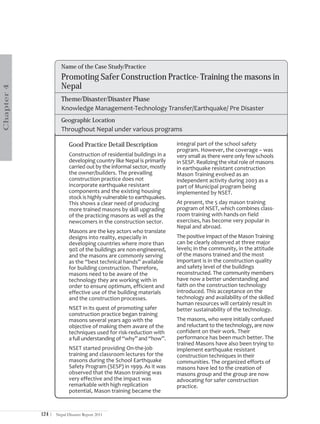
                     Chitwan and Nawalparasi districts of Nepal, 4) Promoting Safer Construction Practice-
Editorial


                     Training the masons in Nepal, 5) Building Code Implementation in Dharan Municipality,
                     6) Child Centered Disaster Risk Reduction in Sunsari District, 7) DRR Income Generation
                     Program (IGP)/Community Based Disaster Risk Reduction Program implemented in Ilam,
                     Jhapa and Panchthar districts, 8) Developing and Implementing Emergency Response Plan
                     of Bheri Zonal Hospital, 9) School Earthquake Safety Program (SESP), 10) Disaster
                     Preparedness for Safer Schools (DPSS), 11) Community Based Disaster Risk Management
                     in Nepal (CBDRM-N) implemented as pilot program in Kathmandu, Lalitpur and in Alapot
                     VDC, 12) Local level Disaster Management Committees – Effective Vehiclesfor reducing
                     disaster risk (Community Based Disaster Risk Management) in Banke, Makwanpur, Rasuwa
                     and Kathmandu districts, and 13) Pre-Monsoon Workshops: Effective Tool to enhance
                     National as well as Local Preparedness Planning for Flood Response. These good practices
                     are described in terms of their contents, objectives, methodology, beneficiary, achievements,
                     challenges, lessons learned and opportunities for further improvement, and their replication
                     potentials. There were many more candidates of good practices, and not all could be
                     accommodated, and the ones chosen were those that represented different locations,
                     approaches, or contents. It is heartening to note that these are excellent examples that serve
                     as evidence of the feasibilities of DRM in Nepal despite the very adverse economic and
                     political situation.
                     Chapter 5: Thematic Discussion on Economics of Disasters provides a discourse on
                     the direct and indirect losses due to disaster events. The losses are presented separately for
                     casualty, and damage to infrastructure (roads, dams, bridges, and buildings). An analysis
                     of the impact on macroeconomics and on national GDP is also presented together with
                     an analysis of the trend of investments on disasters against losses.
                     It is to be emphasized here that the works represented in this compendium is the overall
                     achievement made by Nepal with contribution of all agencies, public or private, academic
                     or community-based. The successes as well as the failures are to be shared by all and further
                     efforts to meet the identified challenges are to be made by all.
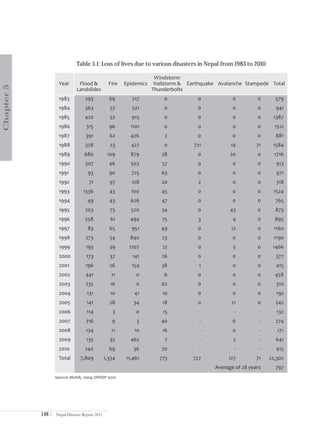
                     Nepal suffers a loss of several million rupees every year due to damage of infrastructures
                     by natural hazards. The official data for 1983-2010 shows that over 30 billion rupees were
                     lost due to disasters; this is an average of about a billion Nepali Rupees every year. And
                     the report makes a case that the situation should not continue this way because Nepal has
                     learned and has developed capacity for disaster risk management as demonstrated by the
                     good practices. The real need is to scale up the successes and to institutionalize the
                     methodologies. That is the real Challenge!


            viii |   Nepal Disaster Report 2011
Table of Content


                                                                                                Table of Content
CHAPTER 1 : DISASTER RISK MANAGEMENT IN NEPAL – AN OVERVIEW                          1
    The Context                                                                     3
    The development of Disaster Risk Management in Nepal                            8
         Government Initiatives and Policy Intervention                             8
         Global Initiatives and Nepal's Participation                              25
         Initiatives by Civil Society Organizations                                34
    Summary                                                                        45
    Timeline: Disaster Risk Management in Nepal                                    47
CHAPTER 2: DISASTER DATA ANALYSIS FOR 2010                                          51
    Disasters in Year 2010                                                         53
    Economic Loss due to Disasters in year 2010                                    59
    Comparison of 2010 with disaster data of past 5 year’s                         64
    Disaster Information for Nepal                                                 65
    Conclusions                                                                    68
CHAPTER 3 : IMPACTS AND LESSONS OF MAJOR PAST DISASTERS                             71
    The 1988 Udaypur Earthquake                                                     73
    The 1993 Flood of South-Central Nepal                                           81
    The Koshi Flood 2008                                                            92
    The 2009 Jajarkot Diarrhea Outbreak                                            106
CHAPTER 4: GOOD PRACTICES ON DISASTER RISK MANAGEMENT                              115
    Disaster Preparedness and Response Planning                                    118
    Early Warning System - Forewarned is forearmed                                 120
    Establishing Community Based Early Warning Systems in Nepal                    122
    Promoting Safer Construction Practice- Training the masons in Nepal            124
    Building Code Implementation in Dharan Municipality                            126
    Child Centered Disaster Risk Reduction                                         128
    DRR Income Generation Program (IGP)/Community Based Disaster Risk Reduction
    Program                                                                        130
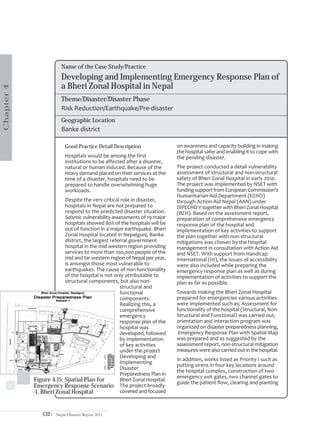
    Developing and Implementing Emergency Response Plan of Bheri Zonal Hospital    132
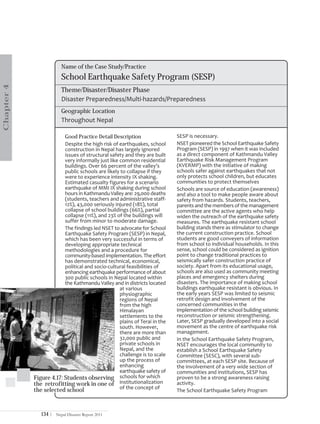
    School Earthquake Safety Program (SESP)                                        134
    Disaster Preparedness for Safer Schools (DPSS)                                 136
    Community Based Disaster Risk Management in Nepal (CBDRM-N)                    138
    Local level Disaster Management Committees – Effective Vehicles for reducing
    disaster risk (Community Based Disaster Risk Management)                       140
    Pre-Monsoon Workshops: Effective Tool to Enhance National as well as
    Local Preparedness Planning for Flood Response                                 142
CHAPTER 5: THEMATIC DISCUSSION ON ECONOMICS OF DISASTERS                           145
    Background                                                                     147
    Damage and Losses                                                              147
    Economic values of damage and losses                                           155
    Damage and loss Vs. Investments                                                159
    Past studies                                                                   161
    Summary and Conclusions                                                        163
REFERENCES                                                                         165
                                                                                         | ix
List of Tables
List of Tables


                      Table 1.1:      Top 10 hazards types and their impact in Nepal 1971-2010                   3
                      Table 1.2:      Regional Mean Temperature Trends for the period 1977-94 (°C per year)      16
                      Table 1.3:      IDNDR Day celebration (1991-1999)                                         27
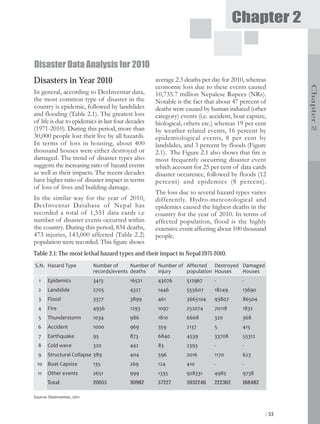
                      Table 2.1:      Top 10 hazards types and their impact in Nepal 1971-2010                  53
                      Table 2.2:      Loss of human lives and property due to disasters in 2010, Nepal          54
                      Table 2.3:      Disaster effects on Human Population, 2010                                56
                      Table 2.4:      No. of building damaged and destroyed by different type of disasters in
                                      Nepal, 2010                                                               58
                      Table 2.5:      Loss due to all types of disasters compared to gross domestic products     61
                      Table 2.6:      Events catagories as per the Hazard Type                                  67
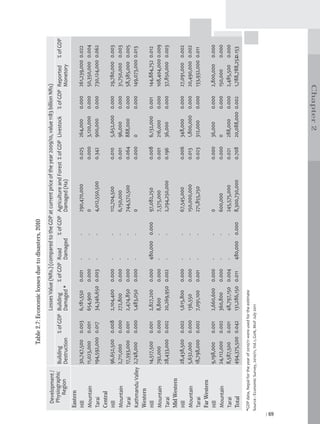
                      Table 2.7:      Economic losses due to disasters, 2010                                    69
                      Table 3.1:      Losses due to infrastructure damage/failure                               82
                      Table 3.2:      Infrastructure Damage in July 1993 in Nepal                               83
                      Table 3.3:      Estimated loss of lives and property from landslides and floods of
                                      19-22 July 1993                                                           84
                      Table 3.4:      Damage due to Flood and Landslide in July 1993                            85
                      Table 3.5 :     Families affected and the number of housing constructed by Tzu Chi
                                      Foundation                                                                 91
                      Table 3.6:      Number of households and population figures for the affected VDCs         92
                      Table 3.7:      Number of deaths and injuries                                             92
                      Table 3.8:      Damage to properties                                                      93
                      Table 3.9:      Extent of damage to cultivated land                                       93
                      Table 3.10: Loss of household goods in number                                             93
                      Table 3.11:     Damage of roads and trails                                                93
                      Table 3.12:     Loss of crops in 2008 Koshi flood                                         94
                      Table 3.13:     Loss of fruits in 2008 Koshi flood                                        94
                      Table 3.14: Losses of vegetables in 2008 Koshi flood                                      94
                      Table 3.15:     Number of livestock lost in 2008 Koshi flood                              94
                      Table 3.16: Estimated monetary loss in 2008 Koshi flood                                   95
                      Table 3.17:     Number of days when the flow of goods and services were closed            96
                      Table 3.18: Details of Compensation after 2008 Koshi flood                                101
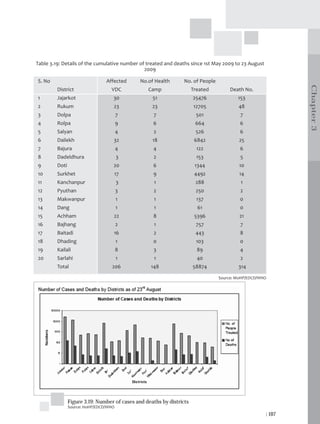
                      Table 3.19: Details of the cumulative number of treated and deaths since 1st May
                                  2009 to 23, August 2009                                                       107


                 x|   Nepal Disaster Report 2011
Table 5.1:    Loss of lives due to various disasters in Nepal from 1983 to 2010           148
Table 5.2:    Human death due to disasters during 1971-2010                               149


                                                                                                       List of Tables
Table 5.3:    Summary of effects on human lives due to disasters during 1971-2010         150
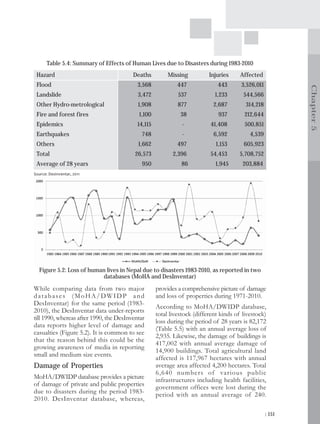
Table 5.4:    Summary of Effects of Human Lives due to Disasters during 1983-2010         151
Table 5.5:    Damage of properties and Estimated Economic Loss (Value in 2010) due to
              Disasters during 1983 – 2010                                                152
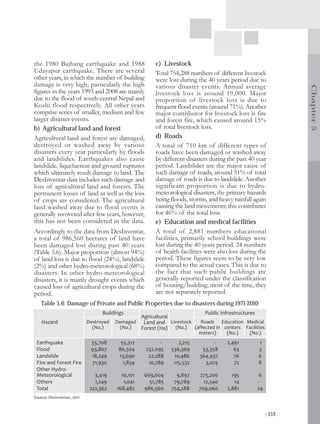
Table 5.6:    Damage of Private and Public Properties due to disasters during 1971-2010   153
Table 5.7:    Year-wise Damage of Private and Public Properties due to disasters
              during 1971-2010                                                            154
Table 5.8:    Year-wise economic value of damages (in Million NRs.)                       156
Table 5.9:    Major Hazard-wise Economic Value of Damages (in Million NRs.)               158
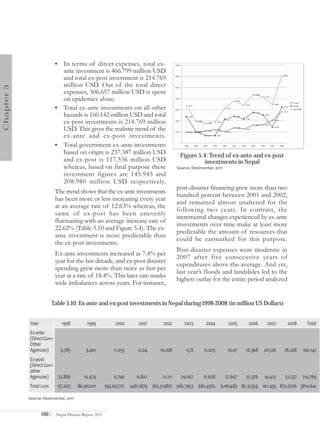
Table 5.10: Ex-ante and ex-post investments in Nepal during 1998-2008
            (in million US Dollars)                                                       160
Table 5.11:   Total disaster losses and ex-ante and ex-post investments in
              disasters during (1998-2008) in Million USD                                 161
Table 5.12:   Infrastructure damage in July 1993 in Nepal                                 162


                                       List of Boxes
Box 1.1:  Measuring earthquakes                                                            5
Box 1.2 : Main Recommendations of SEDM                                                    13
Box 1.3:  Tokyo Declaration for International Decade for Natural Disaster Reduction       25
Box 1.4:  Excerpts from remarks during first IDNDR day celebration in Nepal               26


                                                                                                       List of Boxes
Box 1.5:  Resolution of 1995 IDNDR Day                                                    28
Box 1.6:  Excerpts from remarks during first IDNDR day celebration in Nepal               28
Box 1.7:  Components of National Action Plan 1996                                         29
Box 1.8:  Earthquake scenario of Kathmandu Valley                                         36
Box 1.9:  List of DPNet Nepal Member Organizations                                        38
Box 1.10: Disaster related Keywords interpreted, developed and adapted by
          Dhulikhel Workshop 2008                                                          42
Box 1.11: Addressing Disaster in Periodic Plans                                            44
Box 1.12: Findings and Recommendations of IDRL Study                                       46
Box 2.1: Major Disasters in the Year 2010                                                  54
Box 2.2: Extensive and Intensive Risk                                                      63
Box 3.1: Post 1988 Diary                                                                   80
Box 3.2: July 1993 Floods and Landslides of South Central Nepal                            84
Box 3.3: Secondary Effects of Koshi Flood                                                  96
Box 3.4: Prompt activation of DDRC & CNDRC                                                 97
Box 3.5: Quick Initial Rescue and Relief                                                   98
Box 3.6: Reconstruction and Rehabilitation after 2008 Koshi flood                         103
                                                                                                | xi
List of Figures
List of Figures


                          Figure 1.1 : News coverage on Building Code Implementation from
                                       “The Rising Nepal”                                                            10
                          Figure 1.2: Then Prime Minister, Home Minister and distinguished guests observing
                                       models on earthquake resistant building construction at
                                       Earthquake Safety Day 2010, Lalitpur                                          11
                          Figure 1.3: Comparison between temperatures in Kathmandu and global and
                                       all-Nepal temperature                                                         16
                          Figure 1.4: All Nepal temperature trend (1975-2006)                                        16
                          Figure 1.5: Effect of global warming is more acutely manifested in higher altitude
                                       (Chhuksang, Mustang)                                                         16
                          Figure 1.6: Constituent Assembly Members at the sensitization workshop                    43
                          Figure 2.1: Trend of hazard occurrence in past decades in Nepal, 1971-2010                55
                          Figure 2.2: Seasonality of occurrences of selected hazard types by month                  57
                          Figure 2.3: Effect of natural disasters in building damage by hazard types 2010           59
                          Figure 2.4: Trend of reported loss value in DesInventar Database for Nepal 1971-2010,
                                       by decades                                                                   62
                          Figure 2.5: Major peaks of impact in terms of deaths due to intensive disasters in 2010   62
                          Figure 2.6: Loss of human lives by districts during 2009 (left) and 2010 (right)          64
                          Figure 2.7: Loss of human lives due to major disaster events in Nepal in
                                       year 2009 and 2010                                                           64
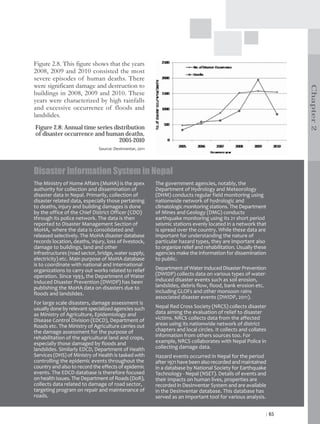
                          Figure 2.8: Annual time series distribution of disaster occurrence and human deaths,
                                       2005-2010                                                                    65
                          Figure 3.1: Earthquake intensity map                                                      73
                          Figure 3.2: Sectorwise loss                                                               73
                          Figure 3.3: Building damage in Naya Bazar of Dharan                                       74
                          Figure 3.4: The damage of road in Koshi Highway                                           74
                          Figure 3.5: During the relief distribution                                                76
                          Figure 3.6: Area affected by landslides and flood disasters during high intensity
                                       rainfall of July 19 & 20, 1993                                                81
                          Figure 3.7: Floor plan of a typical duplex unit providing basic housing for two
                                       families in Mangalpur                                                         88
                          Figure 3.8: Stone Masonry in Foundation                                                    88
                          Figure 3.9: Weakness in building construction                                              88
                          Figure 3.10: Brick building under construction                                             88
                          Figure 3.11: Pre Cast RCC lintel above the opening                                         89
                          Figure 3.12: Improper bonding of masonry units                                             89
                          Figure 3.13: Detached toilet blocks for the houses                                         89
                          Figure 3.14: Koshi Flood Map                                                               92
                          Figure 3.15: People seeking for temporary shelter after 2008 Koshi flood                   97
                          Figure 3.16: Shelter, storm and struggle for life after Koshi flood 2008                   99
                          Figure 3.17: Distribution of compensation after 2008 Koshi flood                          100


                  xii |   Nepal Disaster Report 2011
Figure 3.18: Diarrhorea outbreak in mid west and far west region                        106
Figure 3.19: Number of cases and deaths by districts                                    107


                                                                                                        List of Figures
Figure 3.20: Trends of diarrheal cases in mid and far western region of Nepal           108
Figure 3.21: Treatment of diarrhea patient Khagenkot Health Post, Jajarkot              109
Figure 3.22: IEC materials to raise awareness in WASH/UNICEF                             110
Figure 4.1:  Street Drama on Disaster Awareness performed in Kathmandu October 2012 117
Figure 4.2:  Guidance note on DPRP                                                       119
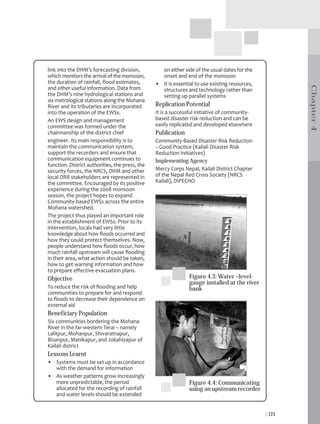
Figure 4.3:  Water –level-gauge installed at the river bank                              121
Figure 4.4:  Communicating using an upstream recorder                                    121
Figure 4.5:  One of the Installed tower, Local resident informing on the gauge reading  123
Figure 4.6:  Local resident practicing on the siren                                     123
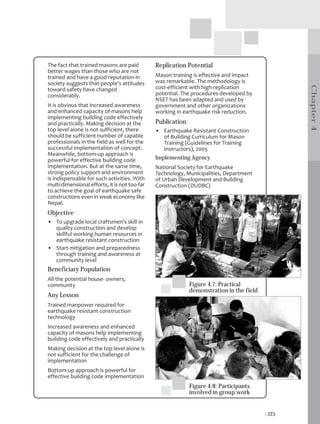
Figure 4.7:  Practical demonstration in the field                                       125
Figure 4.8:  Participants involved in group work                                        125
Figure 4.9:  Concerned Stakeholders jointly announcing the building code implementation 127
Figure 4.10: Constructing Sill and Lintel bands has become popular in Dharan            127
Figure: 4.11:Practice on the flood response technique                                   129
Figure 4.12: Students permforming duck, cover & hold on                                 129
Figure 4.13: Kitchen Gardening in Panchthar in DRR implemented communities               131
Figure 4.14: Murdirmaya Tumbapo and her husband with their buffalos, which they were
             able to buy with a helping hand from the DRR program                        131
Figure 4.15: Spatial Plan for Emergency Response Scenario -1                            132
Figure 4.16: Nonstructural Mitigation work at the hospital                              133
Figure 4.17: Students observing the retrofitting work in one of the selected school     134
Figure 4.18: Students participating in the earthquake drill program                     135
Figure 4.19: School Emergency Evacuation Plan Painted on walls of school building       137
Figure 4.20: Students demonstrating and practicing Duck Cover And hold during School
             Earthquake Drill                                                           137
Figure 4.21: Communities attending orientation lecture on Earthquake safety             139
Figure 4.22: Participants performing practical exercise during the LSAR training        139
Figure 4.23: DMC Meeting                                                                 141
Figure 4.24: DMC member orienting the community                                          141
Figure 4.25: Distiguished guests at the dias during the workshop                        143
Figure 4.26: Participant of the workshop                                                143
Figure 5.1: Percentage of loss of life due to various types of disasters in Nepal
             during 1983-2010                                                           149
Figure 5.2: Loss of human lives in Nepal due to disasters 1983-2010, as reported in two
             databases (MoHA and DesInventar)                                            151
Figure 5.3: Proportion of economic losses due to different hazards in the total
             economic losses during 1971-2010                                           155
Figure 5.4: Trend of ex-ante and ex-post investments in Nepal                           160
Figure 5.5: Total Disaster Losses and Ex ante and ExPost Investments in disasters
             during (1998-2008) in millionUSD                                            161


                                                                                               | xiii
Acronym
                  AAN     Action-Aid Nepal                           DERMP    Dharan Earthquake Risk
                  ADB     Asian Development Bank                              Management Program
Acronym


                  ADPC    Asian Disaster Preparedness Center         DHM      Department of Hydrology and
                                                                              Meteorology
                  ADRA    Adventist Development and Relief
                          Agency                                     DHS      Department of Health Services
                  AEPC    Alternative Energy Promotion Centre        DHWG     Disaster Health Working Group
                  AINTDGM Association of INGOs in Nepal Task         DiMANN Disaster Management Network
                          Group on Disaster Management                        Nepal
                  AMCDRR Asian Ministerial Conference on             DIMS     Disaster Inventory/Information
                          Disaster Risk Reduction                             Management System
                  APF     Armed Police Force                         DIS      Digital Information System
                  APN     Asia-Pacific Network                       DLSA     District Lead Support Agency
                                                                     DMC      Disaster Management Committee
                  ARC           American Red Cross                   DMG      Department of Mines and Geology
                  AUDMP         Asian Urban Disaster Mitigation      DMSP     Disaster Mitigation Support Program
                                Program                              DOI      Department of Irrigation
                  AWD           Acute Watery Diarrhea                DOR      Department of Roads
                  BDMT          Basic Disaster Management Training   DPC      Disaster Preparedness Committee
                  BZH           Bheri Zonal Hospital                 DPNet-Nepal Disaster Preparedness Network-
                  CA            Constituent Assembly                             Nepal
                  CBDRMN        Community Based Disaster Risk        DPRP     Disaster Preparedness and Response
                                Management in Nepal                           Plan
                  CBO           Community Based Organization         DPSS     Disaster Preparedness for Safer
                                                                              Schools
                  CBS           Central Bureau of Statistics
                                                                     DPTC     Disaster Prevention Technical Center
                  CCDRR         Child-Centered Disaster Risk
                                Reduction                            DPHO     District Public Health Office
                                                                     DRM      Disaster Risk Management
                  CDO      Chief District Officer
                                                                     DRR      Disaster Risk Reduction
                  CDRF     Central Disaster Relief Fund
                                                                     DRRSP    Disaster Risk Reduction through
                  CDS      Center for Disaster Studies                        Schools Project
                  CEAARRC  Central Earthquake Affected Areas         DSCWM Department of Soil Conservation and
                           Reconstruction and Rehabilitation                  Watershed Management
                           Committee
                                                                     DUDBC    Department of Urban Development
                  CECOD    Center for Community Development                   and Building Construction
                  CNDRC    Central Natural Disaster Relief           DWIDP    Department of Water Induced
                           Committee                                          Disaster Prevention
                  CRED     Centre for Research on the                EAARRP Earthquake Affected Areas
                           Epidemiology of Disasters                          Reconstruction and Rehabilitation
                  DAO      District Administration Office                     Project
                  DCWB     District Child Welfare Board              ECHO     European Commission’s
                  DDC      District Development Committee                     Humanitarian Aid Department
                  DDRC     District Disaster Relief Committee        EDCD     Epidemiology and Disease Control
                                                                              Division
                  DEO      District Education Office
                                                                     EPC      Environment Protection Council
                  DEPROSC-Nepal Development Project Service
                           Center- Nepal                             ESD      Earthquake Safety Day
                                                                     EU       European Union


          xiv |   Nepal Disaster Report 2011
EWS     Early Warning System                     KDRRI    Kailali Disaster Risk Reduction
FAO     Food and Agriculture Organization                 Initiatives
FCHV    Female Community Health Volunteer        KMC      Kathmandu Metropolitan City
FMIS    Farmer Managed Irrigation System         KVERMP   Kathmandu Valley Earthquake Risk
                                                          Management Project


                                                                                                  Acronym
GAR     Global Assessment Report
                                                 LARED    Latin American Research Education
GDP     Gross Domestic Production                         and Development
GHI     Geo-Hazards International                LSAR     Light Search and Rescue
GIS     Geographic Information System            LSGA     Local Self Governance Act
GLOFs   Glacial Lake Outburst Floods             LSMC     Lalitpur Sub Metropolitan City
GPS     Global Positioning System                LWF      Lutheran World Federation
HFA     Hyogo Framework for Action               LWR      Lutheran World Relief
HI      Handicap International                   MCH      Maternal Child Health
HICS    Hospital Incident Command System         MCPM     Minimum Conditions and
HKH     Hindu Kush Himalaya                               Performance Measurements
HRDC    Hospital and Rehabilitation Center for   MDGs     Millennium Development Goals
        the Disabled Children                    MEDEP    Micro-Enterprise Development
HVCA    Hazard, Vulnerability and Capacity                Program
        Assessment                               MHPP     Ministry of Housing and Physical
IASC    Inter Agency Standing Committee                   Planning
ICAO    International Civil Aviation             MMI      Modified Mercalli Intensity Scale
        Organization                             MoAC     Ministry of Agriculture and
ICIMOD  International Centre for Integrated               Cooperatives
        Mountain Development                     MoFSC    Ministry of Forest and Soil
IATF/DR Inter-Agency Task Force on Disaster               Conservation
        Reduction                                MoHA     Ministry of Home Affairs
IDA     International Development                MoLD     Ministry of Local Development
        Association
                                                 MoST     Ministry of Science and Technology
IDNDR   International Decade for Natural
        Disaster Reduction                       MoWR     Ministry of Water Resources
IDP     Internally Displaced Person              MRT      Mandatory Rule of Thumb
IFRC    International Federation of Red Cross    NA       Nepalese Army
        and Red Crescent Societies               NAPA     National Adaptation Program of
INF     International Nepal Fellowship                    Action
INGO    International Non-Governmental           NAST     Nepal Academy of Science and
        Organization                                      Technology
INSARAG International Search and Rescue          NBC      Nepal Building Code
        Advisory Group                           NCDM     Nepal Center for Disaster
IOE     Institute of Engineering                          Management
IPCC    Intergovernmental Panel on Climate       NCDM     National Council for Disaster
        Change                                            Management
IRA     Initial Rapid Assessment                 NCRA     Natural Calamity (Relief) Act-1982
ISDR    International Strategy for Disaster      NDC      National Development Council
        Reduction                                NDMA     National Disaster Management
ITDG    Intermediate Technology                           Authority
        Development Group                        NDMF     Natural Disaster Management Forum
JICA    Japan International Cooperation                   Nepal
        Agency                                   NDMF     Natural Disaster Management Form
JYRC    Junior Youth Red Cross                            Nepal


                                                                                           | xv
NDMP    National Disaster Management Policy    SOHAM    Society of Hydrologists and
                  NEA     Nepal Electricity Authority                     Meteorologists
                  NEA     Nepal Engineers’ Association           SOP      Standard Operating Procedure
                  NEGIS   Nepal GIS Society                      SMC      School Management Committee
Acronym


                  NELS    Nepal Landslide Society                TU       Tribhuvan University
                  NEOC    National Emergency Operations          UN       United Nations
                          Center                                 UNCHS    United Nations Center for Human
                  NEPAP   National Environmental Policy and               Settlements
                          Action Plan                            UNCRD    United Nations Center for Regional
                  NEWAH   Nepal Water for Health                          Development
                  NFHP    Nepal Family Health Programme          UNDMS    United Nations Disaster Management
                                                                          Secretariat
                  NFI     Non Food Item
                                                                 UNDMT    United Nations Disaster Management
                  NGO     Non-Governmental Organization                   Team
                  NGS     Nepal Geological Society               UNDP     United Nations Development
                  NHEICC  National Health Education                       Programme
                          Information and Communication          UNDRO    United Nations Disaster Relief
                          Center                                          Organization
                  NP      Nepal Police                           UNESCO United Nations Educational Scientific
                  NPC     National Planning Commission                    and Cultural Organization
                  NPDRR   National Platform for Disaster Risk    UNFCCC United Nations Framework
                          Reduction                                       Convention on Climate Change
                  NNCDMC National Network of Community           UNICEF   United Nations Children’s Fund
                          Disaster Management Committee          UNISDR   United Nations International Strategy
                  NRCS    Nepal Red Cross Society                         for Disaster Reduction
                  NRRC    Nepal Risk Reduction Consortium        UNOCHA United Nations Office for the
                  NSDRM   National Strategy for Disaster Risk             Coordination of Humanitarian Affairs
                          Management                             USAID    United States Agency for
                  NSET    National Society for Earthquake                 International Development
                          Technology - Nepal                     USAID-NFRP USAID- Nepal Flood Recovery
                  OECD    Organization for Economic Co-                   Program
                          operation and Development              VDC      Village Development Committee
                  OFDA    Office of the U.S. Foreign Disaster    VFL      Views from the Frontline
                          Assistance                             WCDR     World Conference on Disaster
                  ORS     Oral Rehydration Solution                       Reduction
                  PVA     Participatory Vulnerability            WECS     Water and Energy Commission
                          Assessment                                      Secretariat
                  PVCA    Participatory Vulnerability Capacity   WFP      World Food Program
                          Assessment                             WHO      World Health Organization
                  SAR     Search and Rescue                      WMO      World Meteorological Organization
                  SBDPTOT School Based Disaster Preparedness     WOREC    Womens Rehabilitation Center
                          Training of Trainers
                                                                 WSSI     World Seismic Safety Initiative
                  SDC     Swiss Development Coopertion
                                                                 WSSDO    Water Supply and Sanitation Division
                  SEDM    Study on Earthquake Disaster                    Office
                          Mitigation for Kathmandu Valley
                                                                 WVI      World Vision International
                  SESC    School Earthquake Safety Committee
                                                                 WWF      World Wildlife Fund
                  SESP    School Earthquake Safety Program
                                                                 YARCN    Youth Awareness Raising Center
                  SFRALSO Saptakoshi Flood Rehabilitation                 Nepal
                          Agriculture and Livestock Service
                          Office

          xvi |   Nepal Disaster Report 2011
CHAPTER 1 : DISASTER RISK
MANAGEMENT IN NEPAL
    – AN OVERVIEW


                       |1
Boat ferrying food and goods across what used to be normal dry land but then flooded, Koshi Flood
                                                         Photo Courtesy: www.everestunsencored.org
2|
Chapter 1


Disaster Risk Management in Nepal – An Overview
The Context


                                                                                                          Chapter 1
Nepal is exposed to several types of natural        during the monsoon periods (June-August).
as well as human-induced hazards. A wide            Most of the flood disasters take place along
variety of physiographical, geological,             the banks of the larger rivers such as Mechi,
ecological and hydro-meteorological factors         Kankai, Koshi, Kamala, Bagmati, East Rapti,
contribute to the high levels of hazards            Narayani (Gandak), West Rapti, Babai,
                 Table 1.1: Top 10 hazards types and their impact in Nepal 1971-2010
S.N. Hazard Type             Number of            Number of        Number of           Affected
                             records/events       deaths           injury              population
  1    Epidemics             3413                 16521            43076               512967
  2    Landslide             2705                 4327             1446                555607
  3    Flood                 3377                 3899             461                 3665104
  4    Fire                  4936                 1293             1097                252074
  5    Thunderstorm          1034                 986              1810                6668
  6    Accident              1000                 969              359                 2137
  7    Earthquake            95                   873              6840                4539
  8    Cold wave             320                  442              83                  2393
  9    Structural Collapse 389                    404              596                 2016
 10 Boat Capsize             135                  269              124                 410
  11   Other events          2651                 999              1335                928331
       Total                 20055                30982            57227               5932246

Source : DesInventar, 2011


faced; while demographic factors such as            Karnali and Mahakali rivers. Rivers
rapid population growth, slow economic              originating from the Siwaliks are mostly of
development and the resulting rampant               ephemeral nature, being wild during the
poverty, widespread unawareness on the              monsoon season, and they also pose high
possibilities and means of mitigation, limited      flood hazards to the Tarai. Extensive
firm political and social commitment etc.           inundation in the Tarai plain is due to
also make the country extremely prone to            frequent change in the river courses, bank
disasters. The major types of natural hazards       erosion and erosion in the river meanders.
of concern and their impact are listed in
                                                    In the mountainous regions, rivers are in
Table 1.1 and major hazards are described
                                                    spates during the monsoon season. Bank
briefly.
                                                    undercutting, inundation of the flood plains
Flood                                               are the results. But more disastrous are the
                                                    floods in the high gradient tributary streams
Flood is a recurrent problem in the Tarai as        due to cloud bursts or high intensity rainfall
well as in the mountain regions.                    concentrated usually in a small catchment.
Most part of Tarai faces problem of floods          Such flash floods cause triggering of

                                                                                                     |3
landslide, deep scouring of the stream bed          High intensity rainfalls, which occur
                 and the side slopes and they rapidly develop        frequently during the monsoon season are
                 into debris flows capable of transporting           found to have triggered many highly
                 several cubic meter sized boulders.                 destructive debris slides and debris flow
Chapter 1


                 The problem of flooding in the Tarai is also        along the high gradient hill slope channels.
                 high due to the high bed load, in addition          Majority of the landslides in Nepal occur
                 to the suspended load, carried by the rivers.       in the late monsoon periods. Incessant
                 In the plains, almost all the rivers are            rainfall during the period, when the
                 widening and cutting their banks each year.         antecedent moisture content of the land
                 Landslide and Debris Flow                           surface reaches a certain critical stage, is
                                                                     found to be accompanied by landslides.
                 The causes of landslides in Nepal can be
                 assigned to a complex interaction of several        Earthquake is another important landslide
                 factors which are natural as well as human          triggerer. Apart from developing fissures
                 activity related. High relief, concentrated         both along and parallel to the hill slopes,
                 monsoon rainfall, withdraw of underlying            and thus generating the potentials for debris
                 as well as lateral supports by toe cutting and      slides, the earthquakes are found to trigger
                 bank erosion, presence of weaker rocks,             a variety of landslide types including huge
                 active neotectonic movements and a complex          rock slide, rock fall and slumps. Some of
                 geological history, which has resulted in           the very big landslides have been reported
                 very intense faulting, folding and fracturation     to have been initiated by the Nepal-Bihar
                 of the rocks, are the natural factors causing       earthquake of 1934 AD.
                 landslides in Nepal. But human activities           Debris flows are frequent in the mountainous
                 are also responsible for the very high extent,      parts of the country. They are caused by
                 and they add to the density of landslides in        deep scouring of the stream bed and side
                 the country. Overgrazing of protective              slope by a high gradient stream. Materials
                 grassy cover, mass felling of trees leading         are the deeply weathered rock and colluvium
                 to an unprecedented deforestation,                  in the middle mountains and the thick glacial
                 disturbance of the hill slopes by road/canal
                                                                     deposits in the high mountains. Damming
                 construction, non consideration of the
                                                                     of rivers and tributaries due to landslides
                 geologic conditions in the corresponding
                                                                     and debris and subsequent sudden breaching
                 location, planning or designs of
                 infrastructures etc. are some of the important      of the dam is another important phenomena
                 anthropogenic factors leading to landslides.        for the generation of debris flows. In the
                                                                     higher mountains, debris flows are frequently
                 There are other social causes for the greater       generated by Glacial Lakes Outburst Floods
                 extent of damage. Unawareness on the part           (GLOFs) due to the breaching of the
                 of the population and the decision makers           moraines or glacier ice damming the lakes.
                 may be cited as the most important of all
                 the anthropogenic activity related indirect         The debris flow travels usually to greater
                 causes of landslides.                               distances along the river valley and destroy
                                                                     terraces, infrastructures and settlements
                 All these factors set the stage for the landslide   along its course. Destruction of bridges,
                 to take place. But the stability balance is         hyd r o p owe r f a c i l i t i e s a n d o t h e r
                 usually tipped by one of the two triggers,          infrastructures along the Sunkoshi and Bhote
                 namely; a) rainfall/cloud burst, and b)             Koshi rivers in 1967 and 1996 were due to
                 earthquake, excavation and transitory               debris flows.
                 stresses.

            4|   Nepal Disaster Report 2011
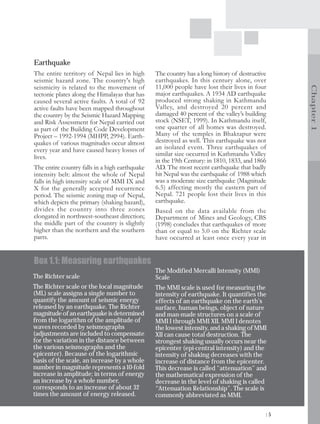
Earthquake
The entire territory of Nepal lies in high      The country has a long history of destructive
seismic hazard zone. The country's high         earthquakes. In this century alone, over
seismicity is related to the movement of        11,000 people have lost their lives in four


                                                                                                 Chapter 1
tectonic plates along the Himalayas that has    major earthquakes. A 1934 AD earthquake
caused several active faults. A total of 92     produced strong shaking in Kathmandu
active faults have been mapped throughout       Valley, and destroyed 20 percent and
the country by the Seismic Hazard Mapping       damaged 40 percent of the valley’s building
and Risk Assessment for Nepal carried out       stock (NSET, 1999). In Kathmandu itself,
as part of the Building Code Development        one quarter of all homes was destroyed.
Project – 1992-1994 (MHPP, 2994). Earth-        Many of the temples in Bhaktapur were
quakes of various magnitudes occur almost       destroyed as well. This earthquake was not
every year and have caused heavy losses of      an isolated event. Three earthquakes of
lives.                                          similar size occurred in Kathmandu Valley
                                                in the 19th Century: in 1810, 1833, and 1866
The entire country falls in a high earthquake   AD. The most recent earthquake that badly
intensity belt: almost the whole of Nepal       hit Nepal was the earthquake of 1988 which
falls in high intensity scale of MMI IX and     was a moderate size earthquake (Magnitude
X for the generally accepted recurrence         6.5) affecting mostly the eastern part of
period. The seismic zoning map of Nepal,        Nepal. 721 people lost their lives in this
which depicts the primary (shaking hazard),     earthquake.
divides the country into three zones            Based on the data available from the
elongated in northwest-southeast direction;     Department of Mines and Geology, CBS
the middle part of the country is slightly      (1998) concludes that earthquakes of more
higher than the northern and the southern       than or equal to 5.0 on the Richter scale
parts.                                          have occurred at least once every year in


Box 1.1: Measuring earthquakes
                                                The Modified Mercalli Intensity (MMI)
The Richter scale                               Scale
The Richter scale or the local magnitude        The MMI scale is used for measuring the
(ML) scale assigns a single number to           intensity of earthquake. It quantifies the
quantify the amount of seismic energy           effects of an earthquake on the earth's
released by an earthquake. The Richter          surface, human beings, object of nature
magnitude of an earthquake is determined        and man-made structures on a scale of
from the logarithm of the amplitude of          MMI I through MMI XII. MMI I denotes
waves recorded by seismographs                  the lowest intensity, and a shaking of MMI
(adjustments are included to compensate         XII can cause total destruction. The
for the variation in the distance between       strongest shaking usually occurs near the
the various seismographs and the                epicenter (epi-central intensity) and the
epicenter). Because of the logarithmic          intensity of shaking decreases with the
basis of the scale, an increase by a whole      increase of distance from the epicenter.
number in magnitude represents a 10-fold        This decrease is called "attenuation” and
increase in amplitude; in terms of energy       the mathematical expression of the
an increase by a whole number,                  decrease in the level of shaking is called
corresponds to an increase of about 32          “Attenuation Relationship”. The scale is
times the amount of energy released.            commonly abbreviated as MMI.

                                                                                            |5
Nepal since 1987, with the exception of          unplanned urban settlements are the cause
                 1989 and 1992 when no such events were           for the potentially high risk from epidemic.
                 recorded. The current disaster database of       gastro-enteritis, cholera, encephalitis,
                 Nepal shows that there were 22 earthquakes       meningitis, dysentery and diarrhea account
Chapter 1


                 with magnitudes ranging from 4.5 to 6.5 on       for more than 50% of the total deaths due
                 the Richter scale throughout the country         to epidemics. Break out of epidemics after
                 for last 37 years period (1971-2007). About      a major disaster such as flood and earthquake
                 34,000 buildings were destroyed and 55,000       etc. is quite frequent.
                 were damaged (DesInventar, 2007) during
                 this period due to earthquakes.                  Epidemics of contagious diseases have two
                 Many studies have been carried out in the        peaks: during the months of May and June,
                 past to evaluate the earthquake risk of          before the rainy season begins and in August,
                 Kathmandu Valley. The most significant           the height of the monsoon. Unsafe drinking
                 among such studies are: the Study on             water and poor sanitation are the main causes
                 Earthquake Disaster Mitigation for               of water-borne diseases in Nepal. Water-
                 Kathmandu Valley conducted in 2002 by            borne diseases continue to take lives in
                 Ministry of Home Affairs (MoHA) with             Nepal. In fact, over 80 per cent of all illness
                 suppor t from Japan Inter national               is attributed to inadequate access to clean
                 Coopertation Agency (JICA); and the              water supplies, poor sanitation and poor
                 earthquake risk assessment and scenario          hygiene practices.
                 development in 1997 by Kathmandu Valley
                 Earthquake Risk Management Project
                                                                  Fire
                 (KVERMP) implemented by the National             Forest fires are prevalent in the Tarai forests
                 Society for Earthquake Technology – Nepal        as well as in the forests belonging to the
                 (NSET). A simple loss estimation carried         Siwaliks and middle mountains. Although
                 out during the KVERMP suggested that in          damages by such fires have been severe in
                 case of a reoccurrence of similar shaking        terms of environmental degradation, these
                 to that of 1934 in Kathmandu Valley would        have not been followed as disasters to
                 result in the following consequences: death:     communities.
                 40,000, injury: 95,000, homeless population:
                                                                  On the other hand, disasters due to fires in
                 600,000 – 900,000 , and building damage:
                                                                  settlements are common in the Tarai where
                 60% (NSET, 1999). Recent studies have
                                                                  most of the houses are thatched roof and
                 shown that the situation is not much different
                                                                  clustered and there is little fire safety
                 in other cities also.
                                                                  measures implemented. Fires are sporadic
                 Epidemic                                         also in the mountain settlements. Most fire
                 Epidemics are in fact the number one killer      disasters occur during summer (April - July)
                 in Nepal, with an average of 410 deaths per      when temperatures are high and strong
                 year. During 1983-2010, 22,306 people lost       winds occur. The large number of small fire
                 their lives (MoHA,2004;DWIDP, 2010).             incidences has a cumulative effect throughout
                 Fifty-two per cent of those deaths were          the country
                 caused by epidemics. The pattern is not          Drought
                 much changed during later time as well.
                                                                  A severe drought hit Nepal during 1981-
                 Lack of treated drinking water supply and        1982 causing heavy damage to crops leading
                 poor hygiene conditions, not only in the         to a decline in Gross Domestic Product
                 rural areas but also in the crowded,             (GDP) by about 1.4%. Failure of monsoon


            6|   Nepal Disaster Report 2011
rains or its late arrival causes partial drought    starvation. Such cold waves can cause
affecting major crops in different parts of         famines and result in numerous fatalities.
the country. Uneven distribution of the             November to February are the months for
monsoon rains, with several parts of the            the cold waves.


                                                                                                           Chapter 1
country not receiving the required rains in
the required time for the major crop is a           Heat waves with rise in atmospheric average
recurrent phenomenon. Since a large part            temperature well above the average of a
of the country still depends on rainfall for        region have been reported to induce adverse
cultivation, such phenomena affect the              effects on human populations, crops,
agriculture production of the country very          properties and services. This is common in
adversely.                                          Tarai region in southern Nepal.
Storm                                               The flat plains of Tarai in the south of the
Storms (line-squalls) with heavy rainfall and       country also show the highest level of
hail are common during the summer months            susceptibility to liquefaction.
in the tropical and sub-tropical parts of the       Cyclonic wind is a hazard that destroys
country. Major damage from storms has               horticultural crops in spring, while hailstorm
been recorded in eastern Nepal (1980) and           causes significant harm to the summer as
mid-western Nepal (1983). Storm winds of            well as winter crops, especially in the
even moderate velocities have major effects         mountainous areas of the country.
in the Tarai, where most of the houses and
structures are lightly roofed.                      Historically, famines have occurred because
The most occurring disaster in March/April          of drought, crop failure, pestilence, and
and October are hailstorms that have a              because of human-induced causes such as
disastrous effect especially on agriculture.        war or misguided economic policies. Famines
While most of the hail that precipitates from       are not frequently reported as other natural
the clouds is fairly small and virtually            disaster events in Nepal but every year they
harmless, there have been cases of golf ball        have serious effect on people in the country.
sized hail that causes much damage especially       Rarely lives are lost by famine but the effect
to the standing crops and inflict injuries.         on people is high.
Thunderstorms dominate the weather during           Glacial Lakes Outburst Floods (GLOFs)
May to September. A thunderstorm is                 and Avalanches are typical of high Himalayan
n o r m a l l y a c c o m p a n i e d by h e av y   regions. The problem of GLOFs is being
precipitation. During wintertime, especially        intensified due to the climate change resulting
in December and January, the northern areas         in accelerated melting of the glacier tongues
of Nepal suffer harsh snow storms.                  and rapid enlargement of the glacial lakes
Other Hazards                                       contained by natural moraine dams. Several
                                                    glacial lakes have been mapped in Nepal.
In Nepal, cold waves –related casualties have       Snow avalanches are prevalent in the
taken place not much in the very cold places        Himalayan region – they pose risk to the
in the high Himalayas, but in the sub-tropical      high mountain tourism industry.
Tarai. They have also caused death and injury
to livestock and wildlife. If a cold wave is        Other hazards including boat capsize, frost,
accompanied by heavy and persistent snow,           accidents (caused by natural phenomenon),
grazing animals may be unable to reach              leaks, panic, pollution, sedimentation,
needed food and die of hypothermia or               structural collapse are also recorded in Nepal.


                                                                                                      |7
The development of Disaster                        lives in one night. Several expert missions
                                                                    fielded by Office of Foreign Disaster
                 Risk Management in Nepal                           Assistance (OFDA), United Nations Disaster
                 As stated, Nepal is prone to various kinds         Relief Organization (UNDRO) and United
Chapter 1


                 of frequently occurring disasters. Flood,          Nations Educational, Scientific and Cultural
                 landslide, fire, epidemics, drought are some       Organization (UNESCO) also recomme-
                 regular events which cause huge loss of life       nded for comprehensive approach for
                 and property every year; whereas, large            disaster management in the country.
                 earthquakes on the other hand, are less
                 frequent but when they occur, cause severe         Government Initiatives and
                 damage and destruction. Developmental              Policy Intervention
                 achievements gained in decades are lost            Natural Calamity (Relief) Act, 1982
                 within few seconds and minutes during such
                 large disasters. Economics of such disaster        Prior to 1982, rescue, relief as well as
                 losses are also great: a significant proportion    resettlement of disaster victims were carried
                 of Gross Domestic Product (GDP) is lost            out in Nepal on an ad-hoc basis, primarily
                 every year due to large, medium and small          as a social work. The Government of Nepal
                 disasters. Therefore, fighting with disaster       promulgated the Natural Calamity (Relief)
                 events through effective search, rescue and        Act in 1982 to carry out rescue, relief works
                 relief to disaster victims; timely and equitable   in a systematic manner. The Act has since
                 reconstruction and rehabilitation; and             then been amended thrice (first in 1986,
                 mitigation in the long run always required         second in 1989 and third in 1992) enunciating
                 significant amount of time, efforts and            the significance of the pre-disaster and post
                 budget from the government and local               disaster activities.
                 communities. Management of disasters and           The Act was instrumental in imparting an
                 disaster risks have been a key area of work.       organized approach to disaster management
                                                                    in the country. It helped develop an
                 There was a time when occurrence of natural
                                                                    organizational structure from central to local
                 hazard events were regarded as the acts of
                                                                    level, to deal with response and relief works.
                 god or divine power and each disaster event        Furthermore, the Act provided the basis for
                 was treated on a case to case basis. The           coordination among various agencies,
                 management consisted in providing relief           government and non-government in
                 in the form of cash grants, cloths and food        emergency response activities.
                 grains on ad-hoc basis from the available
                 resources.                                         However, it has been widely felt that the
                                                                    present Act, just can not address the whole
                 More systematic work related to disaster risk      spectrum of hazard mitigation and disaster
                 management began in Nepal only after 1982          risk reduction issues. The Act does not
                 when the Natural Calamity (Relief) Act was         discriminate between the different types of
                 first promulgated. Starting from 1970s, the        disaster for management purposes. It needs
                 necessity for a more organised treatment of        incorporation of the whole philosophy of
                 natural disaster started being felt in the         the possibility of disaster reduction and
                 country due mainly to the experience gained        should still further emphasise the pre-event
                 while administrating relief works and surveys      activities for risk reduction. There has been
                 of several disasters, such as the landslide at     a general consensus that the country requires
                 Deurali (Pokhara) in 1974 which claimed 62         a new act to incorporate the whole spectrum

            8|   Nepal Disaster Report 2011
of disaster risk management starting from       management and co-ordination; Mapping
risk reduction, mitigation to preparedness,     earthquake hazard patterns and analyse risks
response and reconstr uction and                to various types of buildings and
rehabilitation.                                 development patterns; Formulate a national


                                                                                                   Chapter 1
                                                building code, incorporating earthquake-
Lessons of 1988 Earthquake and                  resistant standards and guidelines; Develop
Development of National Building                new and improved building materials and
Code                                            earthquake-resistant standards and guidelines;
The magnitude 6.5 Udayapur earthquake of        and Provide staff training in the shelter
eastern Nepal that occurred in the morning      sector.
of 21 August 1988 was a major turning point     In addition to the Shelter Policy
for Nepal in terms of starting the concepts     Development, the project consisted of a
for risk reduction and mitigation. One of       component for the development of National
the key lessons realized during this            Building Code. The Building Code
earthquake was the need for formulation         component of the project comprised of
and enforcement of building codes that          three distinct sub-components:
ensure the earthquake safety of residential
and all other buildings. Significant number     1) Seismic Hazard Mapping and Risk
of private houses and public buildings were        Assessment of Nepal: to establish an
                                                   appropriate level of design against
damaged and destroyed due to the lack of
                                                   earthquake-induced damage in Nepal
seismic features. This realization led to the
formulation of a project concept for            2) Preparation and Implementation of
development of building code and long-             National Building Code
term shelter policy and plans.                  3) Development of Alternative Building
                                                   Materials and Technologies
In 1988, the then newly formed Ministry of
Housing and Physical Planning (MHPP),           The project, in 1994, finally completed the
requested technical assistance from United      formulation of Nepal National Building
Nations Development Forum (UNDP) and            Code and two other studies.
UNCHS for institutional development and         The Building Code developed was unique
capability strengthening of MHPP and            in itself; it incorporated provisions for
formulation of a long term shelter policy       making buildings earthquake-resistant, it
for Nepal. Subsequently in 1990, a three-       addressed the problems not only of the
year program of Policy and Technical            engineered buildings but also those houses
Support to Urban Sector (PTSUS - UNDP/          in rural, semi-urban and urban areas which
UNCHS PROJECT NEP/88/054) was                   are mostly constructed without the input
initiated within the MHPP. Originally           from qualified building/structural engineers.
scheduled to be completed in 1992, the          It has four levels of code documents:
project was extended until December 1993.       i. Buildings designed with International
The project consisted of seven components:           State-of-the-art provisions
Formulation of a National Shelter Policy        ii. Provisions for Professionally Engineered
and Implementation Strategy based on a               Buildings
comprehensive shelter needs assessment;         iii. Mandatory Rules of Thumb for mostly
Preparation of a national shelter sector             available urban and semi-urban residential
Training Needs Assessment and Strategy;              buildings
Strengthening of MHPP capabilities in           iv. Guidelines for rural construction

                                                                                              |9
Although the building code was unique in                      all government buildings and encouraged
                   its nature to address the problems of Nepal                   to implement it in all municipal areas.
                   it was not enforced immediately. It took                      1993 Flood of South Central Nepal
                   several years to be formally enforced by the
Chapter 1


                                                                                 and Sectoral Working Groups
                   Government of Nepal. In 2003 only, the
                   Government of Nepal decided to make the                       Three sectoral working groups, namely
                   building code compliance mandatory in                         Health, Logistics, and Food and Agriculture
                                                                                 were established during the flood response
                                                                                 of 1993 in order to achieve better
                                                                                 coordination and effective response. In 1994,
                                                                                 the government requested the international
                                                                                 community to help continue the three
                                                                                 sectoral working groups in order to prepare
                                                                                 sectoral contingency plans for future
                                                                                 disasters. The UN system agreed to continue
                                                                                 and coordinate the three sectoral working
                                                                                 groups. The responsibility of the sectoral
                                                                                 working g roups, which included
                                                                                 representatives from the government, the
                                                                                 UN, donors and NGOs, was to provide
                                                                                 support to the government’s on-going relief
                                                                                 efforts in the sectors of food and agriculture,
                                                                                 health, and logistics.
                                                                                 In 1995, the sectoral working groups
                                                                                 produced three manuals that were revised
                                                                                 in 1999. These manuals were intended to
                                                                                 serve as the rolling plans. The meetings and
                                                                                 activities of the Working Groups gradually
                                                                                 decreased over the years, and virtually
                                                                                 became non-existing. However, at the end
                                                                                 of 2000, the Epidemiology and Disease
                                                                                 Control Division (EDCD) of Department
                                                                                 of Health Services, Ministry of Health, and
                                                                                 World Health Organization (WHO) decided
                                                                                 to revitalise the Disaster Health Working
                                                                                 Group (DHWG). Later, the DHWG
                                                                                 prepared a health sector emergency
                                                                                 preparedness and disaster response plan.
                                                                                 Establishment of Disaster Prevention
                                                                                 Technical Center (DPTC)
                                                                                 Nepal suffers from various types of water-
                                                                                 induced disasters such as soil erosion,
                                                                                 landslides, debris flow, flood, bank erosion
                                   Figure 1.1 : News coverage on Building Code
                                   Implementation from “The Rising Nepal”        etc. due to its rugged topographically weak
                                                                                   geological formations, active seismic

            10 |   Nepal Disaster Report 2011
conditions, occasional glacier lake outburst                   The objective of DPTC was to strengthen
floods, concentrated monsoon rains                             capability of the government to cope with
associated with unscientific land utilizations.                disasters such as landslides, debris flows,
These phenomena induce severe impacts                          soil erosion and flooding through


                                                                                                                                    Chapter 1
on the vital infrastructures of the nation                     development of technology suitable to Nepal
such as roads, houses, hydropower, irrigation                  and training of personnel working in these
and drinking water facilities, cause loss of                   fields.
agricultural lands, properties and human                       To institutionalize the objectives and
lives posing a severe threat to the sustainable                achievements of the DPTC, the Department
development of the country. In order to                        of Water Induced Disaster Prevention
promote prevention and mitigation of these                     (DWIDP) was established on 7 February
disasters in Nepal, an agreement was signed                    2000 under the Ministry of Water Resources.
between Government of Nepal and the                            The then River Training Division of the
Government of Japan on 7 October 1991                          Department of Irrigation was merged in
for the establishment of Water Induced                         the organizational structure of the DWIDP
Disaster Prevention Technical Centre                           to strengthen its institutional capability. Seven
(DPTC) as a joint undertaking of concerned                     Division and five Sub-Division offices were
agencies of GoN with the Ministry of Water                     established so as to mitigate the water-
Resources (MoWR) as leading agency, and                        induced disasters throughout the country.
the cooperation of the Government of Japan
                                                               Since then, DWIDP has been working
through Japan International Cooperation
                                                               towards prevention and mitigation of water
Agency (JICA) for the initial five years and
                                                               induced disasters as well as towards post-
later extended for two and half years until
                                                               disaster rehabilitation and reconstruction.
March 1999.


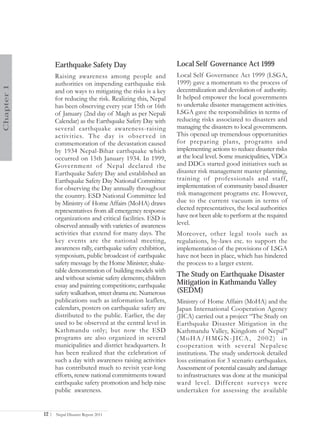
        Figure 1.2: Then Prime Minister, Home Minister and distinguished guests observing models on earthquake resistant building
        construction at Earthquake Safety Day 2010, Lalitpur
        Photo Courtesy: NSET
                                                                                                                           | 11
Earthquake Safety Day                            Local Self Governance Act 1999
                   Raising awareness among people and               Local Self Governance Act 1999 (LSGA,
                   authorities on impending earthquake risk         1999) gave a momentum to the process of
Chapter 1


                   and on ways to mitigating the risks is a key     decentralization and devolution of authority.
                   for reducing the risk. Realizing this, Nepal     It helped empower the local governments
                   has been observing every year 15th or 16th       to undertake disaster management activities.
                   of January (2nd day of Magh as per Nepali        LSGA gave the responsibilities in terms of
                   Calendar) as the Earthquake Safety Day with      reducing risks associated to disasters and
                   several earthquake awareness-raising             managing the disasters to local governments.
                   activities. The day is obser ved in              This opened up tremendous opportunities
                   commemoration of the devastation caused          for preparing plans, programs and
                   by 1934 Nepal-Bihar earthquake which             implementing actions to reduce disaster risks
                   occurred on 15th January 1934. In 1999,          at the local level. Some municipalities, VDCs
                   Government of Nepal declared the                 and DDCs started good initiatives such as
                   Earthquake Safety Day and established an         disaster risk management master planning,
                   Earthquake Safety Day National Committee         training of professionals and staff,
                   for observing the Day annually throughout        implementation of community based disaster
                   the country. ESD National Committee led          risk management programs etc. However,
                   by Ministry of Home Affairs (MoHA) draws         due to the current vacuum in terms of
                   representatives from all emergency response      elected representatives, the local authorities
                   organizations and critical facilities. ESD is    have not been able to perform at the required
                   observed annually with varieties of awareness    level.
                   activities that extend for many days. The        Moreover, other legal tools such as
                   key events are the national meeting,             regulations, by-laws etc. to support the
                   awareness rally, earthquake safety exhibition,   implementation of the provisions of LSGA
                   symposium, public broadcast of earthquake        have not been in place, which has hindered
                   safety message by the Home Minister; shake-      the process to a larger extent.
                   table demonstration of building models with
                   and without seismic safety elements; children
                                                                    The Study on Earthquake Disaster
                   essay and painting competitions; earthquake      Mitigation in Kathmandu Valley
                   safety walkathon, street drama etc. Numerous     (SEDM)
                   publications such as information leaflets,       Ministry of Home Affairs (MoHA) and the
                   calendars, posters on earthquake safety are      Japan International Cooperation Agency
                   distributed to the public. Earlier, the day      (JICA) carried out a project “The Study on
                   used to be observed at the central level in      Earthquake Disaster Mitigation in the
                   Kathmandu only; but now the ESD                  Kathmandu Valley, Kingdom of Nepal”
                   programs are also organized in several           (MoHA/HMGN-JICA, 2002) in
                   municipalities and district headquarters. It     cooperation with several Nepalese
                   has been realized that the celebration of        institutions. The study undertook detailed
                   such a day with awareness raising activities     loss estimation for 3 scenario earthquakes.
                   has contributed much to revisit year-long        Assessment of potential casualty and damage
                   efforts, renew national commitments toward       to infrastructures was done at the municipal
                   earthquake safety promotion and help raise       ward level. Different sur veys were
                   public awareness.                                undertaken for assessing the available


            12 |   Nepal Disaster Report 2011
resources and constraints. A building                        • Put higher priority on the disaster
inventory comprising 1100 typical buildings                    mitigation and preparedness policies and
representing the valley was prepared.                          confirm it in the 5 year national plan
Damage analysis of existing building stock,                  • Empower local autonomous bodies for


                                                                                                                             Chapter 1
public facilities and lifeline networks was                    risk management
based on the building inventory. This study
also undertook a social structure survey that                • Promote public awareness to earthquake
explored existing social norms that                            disaster and give support to target groups
contributed to disaster resiliency of the                      for resilient capacity on self-help basis
society. The existing policy and legal                       The SEDM proposed generation and
environment was also researched .                            implementation of earthquake disaster
It ended up with proposing several schemes                   reduction plans at different levels of the
for making seismic risk coping mechanism                     government. It was suggested that the
operational and sustainable. The following                   individual disaster management plans should
are some key recommendations of the study:                   be prepared at each level of government
                                                             and institutions by the method of full
• Build a coordination mechanism by
    establishing a permanent structure such                  participatory planning by all stakeholders.
    as National Disaster Council


Box 1.2 : Main Recommendations of SEDM
Mechanisms for Sustainable Development of                    Operations Centre; and advising employees of their
Disaster Management                                          responsibilities in case of disaster.
Currently Nepal lacks the necessary mechanisms for           Key elements of emergency plans and manuals include
sustainable disaster management. It is clear that the        the assignment of responsibilities/authority, the
following steps must be taken to improve the capacity        establishment of systems for command/control/
for disaster management in Nepal:                            communications/coordination, and the
                                                             collection/dissemination of information.
1) Establish a strong legal base for a comprehensive
   risk management system.                                   Emergency response/recovery planning should be
2) Create sustainable mechanisms for inter-                  prepared for prompt/proper decision-making and
   governmental and inter-institutional coordination.        smooth execution of the decided measures before,
3) Ensure that the Tenth Five-Year Plan, currently in        during, and after a disaster. The importance of
   preparation, includes plans and funding for firm          communication for the initial response should be
   disaster mitigation measures.                             recognised, as well as the importance of the role of
                                                             the media in communication.
4) Promote and strengthen self-governance of local
   bodies for risk management.                               Protection of Life and Property
5) Promote public awareness on self-protection               Many difficulties are anticipated in the initial stages of
   against earthquake disasters and outreach to              the disaster, including search and rescue operations,
   targeted groups.                                          medical services, cremation, drinking water and food,
Need to Maintain Governance                                  public health care, security, fire-fighting, management
The government, at all levels, is responsible for            of volunteers, safety inspections of structures and
providing continuity of effective leadership, direction      infrastructure, debris removal and disposal, shelter and
of emergency operations, and management of recovery          temporary housing, etc. Due to inadequate response
operations. For this reason, it is essential that            planning and systems for inter-institutional
governmental entities continue to function during and        coordination, public onsite services in an emergency
following a disaster. This requires that they take actions   are likely to be deficient for the time being. Community
on preparedness such as: preparing plans/manuals to          involvement and the sense of self-protection by the
guide initial response; establishing systems for             people are accordingly indispensable.
communications/coordination, including an Emergency


                                                                                                                      | 13
The logistics to support on-site activities after the      (including for the Melamchi project), securing a water
                   occurrence of a disaster is a critical issue. The          supply distribution system by water tankers, and
                   transportation system must continue to function during     preservation of existing wells and spouts at the local
Chapter 1


                   and after the occurrence of the earthquake disaster so     level.
                   that the on-site activities of search and rescue and       (5) Telecommunications Facilities
                   other socio-economic activities can continue to
                   function. Similarly, prompt restoration of electrical      The current vulnerability of telecommunications
                   service and water supplies to affected areas would         facilities is carefully examined. To create a reliable
                   play an important role during the initial stages of a      network against disaster, it is recommended to
                   disaster. The existing conditions of these and other       complete the multiple diversity routing composition
                   critical elements of the infrastructure are discussed,     as well as to establish emergency communication and
                   identifying the underlying problems. Priority projects     broadcasting systems.
                   to improve the current situation are also presented.       (6) Urban Structure
                   The Need to Strengthen the Socio-Economic System           Several separate areas within the city centre of
                   Working towards sustainable development is a natural       Kathmandu should be designated as intensive
                   and necessary companion to working towards effective       development areas for disaster prevention by
                   earthquake disaster management itself, because the         maximising the disaster mitigation characteristics of
                   ability to deal with earthquake disasters is highly        the urban structure. Securing emergency evacuation
                   dependent upon the fundamentals of society, economic       routes and preserving evacuation areas in some areas
                   growth and social stability, all of which are the fruits   of the city are effective measures that can be applied
                   of sustainable development. Urban society is highly        to Kathmandu. Each of these measures should be
                   dependent on the socio-economic infrastructure, and        implemented to reinforce the city against disasters.
                   any weakness makes it vulnerable to disaster. The vast     Disaster mitigation measures in central Kathmandu will
                   direct and indirect economic and societal losses caused    be proposed on a geographic area basis by classifying
                   by disasters can be reduced by reinforcing the             the central city areas into eight strategic zones based
                   infrastructure through sustainable development             on the characteristics of the urban structure.
                   practices. The fundamental elements of the                 Recommendations and Proposals
                   infrastructure are discussed.
                                                                              As a result of the study, about one hundred potential
                   (1) Transportation Facilities                              programmes were identified for the improvement of
                   The existing master plan studies were reviewed.            earthquake disaster management in Kathmandu Valley.
                   Proposals for roads, bridges and the airport to improve    The study team evaluated the programmes from the
                   the access to and mobility inside the Valley are           viewpoints of term, priority and reality.
                   presented.                                                 Fulfilment of all the programmes would require a
                   (2) Building Structures                                    tremendous amount of time and money. The team
                                                                              consequently selected four projects, which each include
                   Most of the existing buildings have severe deficiencies    several programmes, for urgent implementation. The
                   regarding earthquake resistance. The report presents,      implementation of the projects will hopefully bring
                   discusses and makes recommendations on the current         visible results and thus further promote endeavours
                   building construction system, the Draft National           to achieve the three goals for earthquake disaster
                   Building Code of Nepal, and the defects of individual      reduction.
                   types of buildings: hospitals, schools and public
                   buildings, and historical buildings.                       The four projects are:
                   (3) Electric Power Supply Facilities                       a) Establishment of an Early Earthquake Information
                                                                                 System,
                   An evaluation of the master plan studies on the
                   transmission and distribution network in the Valley was    b) Establishment of a Municipality Disaster
                   performed. Provision of a stable transmission system          Management Institution and Exercise,
                   is proposed in the city core areas of Kathmandu            c) Building Improvement, and
                   Metropolis. Other recommendations, including
                   preparation and implementation of design manuals for       d) Establishment of a Comprehensive Database for
                   earthquake resistance and training of personnel for an        Earthquake Disaster Mitigation.
                   effective technical support system, are presented.         Besides the selected projects, it should be noted that
                   (4) Water Supply and Sewerage Facilities                   there are important and long-term projects with high
                                                                              priority/reality, i.e., the Sindhuli road project aiming at
                   The ongoing Melamchi Project is expected to                improving access to the Valley, road widening projects
                   significantly improve the extremely poor water supply      for smoother mobility in the Valley, and the Melamchi
                   and sewerage conditions. Urgent tasks include              water supply projects.
                   preparing design manuals for earthquake resistance


            14 |   Nepal Disaster Report 2011
Climate Change Impacts and                        change impacting Nepal rather dispropor-
Adaptation in Nepal                               tionately compared to its size and its own
                                                  meagre contribution of the green house
Nepal is a hotspot for geophysical and            gases. However, given its location between


                                                                                                       Chapter 1
climatic hazards. The country is highly
                                                  two rapidly growing economies of India and
vulnerable to the potential negative impacts
                                                  China, Nepal cannot escape the rapidly
of climate change. Consistent rises in annual
                                                  increasing influence of climate and global
mean temperature, less frequent but more
intensive rainfall events, increasing frequency   changes. The rapidly retreating glaciers
and intensity of floods, changes in monsoon       (average retreat of more than 30 m/year),
on- and offset, increased outbreak of water-      rapid rise in average maximum temperature
borne and vector-borne diseases, growing          (>0.06°C), erratic rainfalls and increase in
threat from Glacial Lake Outburst Floods          frequency of extreme events such as floods
(GLOFs), longer dry spells and drought            and drought like situation are some of the
events, and increasingly stronger storms          effects Nepal is facing during the last few
have already been experienced in Nepal in         years. Most of the big rivers of Nepal are
the past decade. These climate-induced            glacier-fed and its main resources of water
hazards are not only causing damage and           and hydroelectricity will be seriously affected
loss of human lives and property; they also       due to the ongoing changes in glacier
undermine development progress in Nepal           reserves, snowfall and natural hazards.
and put the achievement of Millennium             An analysis of about 30 years of observed
Development Goals (MDGs) at risk,                 temperature of Nepal has shown that
including the oblig ations of and                 maximum temperatures in Nepal are
commitments to the climate change regime.         increasing at an alarming rate (Shrestha et
The world is already experiencing the             al., 1999). Study carried out by the
destructive effects of rising global              Department of Hydrology and Meteorology
temperatures, altered rainfall patterns and       (DHM) shows that the all-Nepal maximum
extreme weather. In the short term, such          temperature increased by 1.8°C in 32 years
impacts create pressing needs for disaster        between 1975-2006, which is equal to about
relief and reactive climate adaptation            0.06°C per year. Such warming is found to
measures. But medium and long term effects        be more pronounced in the northern high
will almost certainly be much more                altitude regions of Nepal. Further, warming
disruptive. Wide-ranging impacts, including       in the winter is more pronounced compared
on agriculture, ecosystems and human              to other seasons. The increasing trend of
habitation, will continue for decades and         maxium temperature is a dominant feature
many will grow in frequency and intensity         of the country except for the western middle
(World Resource Report 2010-11).                  mountainous region. For minimum
Faced with this reality, governments,             temperature, the decreasing trend is observed
multilateral institutions, civil society and      over the western and west of central
communities must seek to build the resilience     mountainous regions and the eastern parts
of both current and future generations to         of the country. However, increasing trend
climate impacts. In doing so they must tailor     is dominant over most of the regions.
their responses to the specific characteristics   Another analysis of daily temperature data
and unpredictable nature of climate change.       for 36 years from 1971 to 2006 using
There is a general agreement that climate         RClimDex software also shows that both


                                                                                                | 15
significant and consistent increase in
                                                                                     temperature in Nepal for the years 2030,
                                                                                     2050, and 2100 across the various models.
                                                                                     This analysis also shows somewhat larger
Chapter 1


                                                                                     warming in winter months than the summer
                                                                                     months. The projected change above the
                                                                                     baseline average is 1.2° C for 2030, 1.7°C
                                                                                     for 2050 and 3.0°C for 2100.
                                                                                     Analysis of precipitation data from station
                                                                                     records all over Nepal does not reveal any
                                                                                     significant trends. However, an analysis of
                                                                                     daily precipitation data for 46 years from
                    Figure 1.3: Comparison between temperatures in Kathmandu
                    and global and all-Nepal temperature
                                                                                     1961-2006 shows an increasing trend in
            Annual (Jan-Dec)            (Temperature deviation from normal in °C)
                                                                                     precipitation extremes. About 73% stations
                                                     Source: Shrestha et al., 1999   (out of 26 total station selected for the study)
                                                                                     exhibited an increase in the annual count of
            Table 1.2: Regional Mean Temperature
            Trends for the period 1977-94 (°C per year)                              days when precipitation is greater or equal
                                                                                     to 50 mm.
                                                                                     A recent study projected that doubling of
                                                                                     atmospheric carbondioxide concentration
                                                                                     will reduce Nepal’s forest types from 15 to
                                                                                     12, and habitats and ecosystems will be
                                                                                     destroyed. Climate change will also affect
                                                                                     productivity of natural ecosystems,
                                                                                     particularly provision of environmental
                    Source: Update after Shrestha et al., 1999                       services.
                                                                                     Nepal has to prepare itself to try and mitigate
                                                                                     these effects if possible and if not adapt to


                    Figure 1.4: All Nepal temperature trend (1975-2006)
                    Source: DHM

                        days and nights are becoming warmer and
                        cool days and cool nights are becoming less
                        frequent (Baidya et al., 2008).
                        The projection of temperature by
                        Organization for Economic Co-operation
                        and Development (OECD) shows a
                                                                                                  Figure 1.5: Effect of global warming is more
                                                                                                  acutely manifested in higher altitude
                                                                                                  (Chhuksang, Mustang)
                 16 |   Nepal Disaster Report 2011
them to reduce their impacts on our lives          Environment Protection Council (EPC)
      and livelihoods. Nepal is largely a                under the chairmanship of the Rt. Hon'ble
      mountainous country and current indications        Prime Minister with the objective of
      are that the mountain regions are more


                                                                                                                          Chapter 1
                                                         integrating environmental concerns into the
      vulnerable due to increased warming trends         development process. The EPC initiated the
      as well as extreme changes in altitude over        process of formulating the national policy
      small distances. These alarming trends not         on environment and approved the "National
      only make Nepal's major sectors of economy         Environmental Policy and Action Plan
      such as agriculture, tourism and energy more       (NEPAP)" in 1994. In November 1996,
      vulnerable but also endanger the health,           GON also established Alternative Energy
      safety and wellbeing of Nepali people.             Promotion Centre (AEPC) under the
      For a least developed country such as Nepal,       Ministry of Science and Technology
      adaptation should be the priority.                 (MoEST). Realizing the importance of
      Government of Nepal has prepared National          impacts of climate change on environment
      Adaptation Program of Action (NAPA) to             and pertinent issues, the government of
      Climate Change. It comprises nine priority         Nepal established a separate Ministry of
      projects. Well coordinated, quick and serious      Environment in 2009.
      implementation of NAPA will be extremely           In the policy and legislative front also, Nepal
      important to mitigate and adapt to the             initiated several measures. It brought
      growing impacts of climate change in Nepal.        Sustainable Development Agenda for Nepal
      On June 12, 1992, during the Earth Summit          in 2003 to guide the sustainable development
      at Rio, Nepal signed the United Nations            path till 2017. Other several policies,
      Framework Convention on Climate Change             strategies, and laws which are relevant to
      (UNFCCC) treaty. Nepal ratified the treaty         the issues of environmental problems and
      on May 2, 1994 which came into effect from         climate change have been put into force.
      July 31, 1994 and Nepal responded                  The major national environmental policies
      immediately with the establishment of              include the National Conservation Strategy,


Nepal holds Cabinet Meeting at                        In the picture, there seem Nepal's Prime Minister Madhav Kumar
Mount Everest                                         Nepal, center, and members of the cabinet raise hands in favor
                                                      of a document to highlight the negative impacts of global
                                                      warming on Mount Everest during a special cabinet meeting at
                                                      Kalapatthar in Nepal, on 4 Dec 2009. Nepal's top politicians
                                                      strapped on oxygen tanks and held a Cabinet meeting amid the
                                                      frigid, thin air of Mount Everest to highlight the danger global
                                                      warming poses to glaciers, ahead of international climate change
                                                      talks in COP15.
                                                      The government billed the activity as the world's highest Cabinet
                                                      meeting. The ministers posed for pictures, signed a commitment
                                                      to tighten environmental regulations and expand the nation's
                                                      protected areas, and then quickly flew back to capital city.

                                                      "The Everest declaration was a message to the world to minimize
                                                      the negative impact of climate change on Mount Everest and
                                                      other Himalayan mountains," Prime Minister Madhav Kumar
                                                      Nepal later said.
                                                                                                  Source: www.msnbc.com


                                                                                                          | 17
1988, the Nepal Environment Policy and                            legislations. The other legislations include
                   Action Plan,1993, the Sustainable                                 Soil and Water Conservation Act, 1982;
                   Development Agenda 2003. The National                             Water Resources Act, 1992; Industrial
                   Climate Change Policy has been prepared                           Enterprises Act, 1992; Vehicle and Transport
Chapter 1


                   and is in the process of finalization. The                        Management Act, 1992 and Regulations,
                   Interim Constitution of Nepal, 2006, has                          1997 (with first amendment in 2004); Forest
                   for the first time, recognized “right to clean                    Act, 1992 and Regulations, 1995; Local Self-
                   environment”, as a fundamental right of the                       governance Act, 1999 and Local Self-
                   citizens of Nepal. Environment Protection                         Governance Regulations, 1999 and Ozone
                   Act, 1996 and Environment Protection                              Depleting Substance Consumption
                   Regulations, 1997 are the key environmental                       Regulations, 2001.


                     “Vulnerability to disaster is growing faster than resilience. [...] Disaster risk reduction
                   should be an everyday concern for everybody. Let us all invest today for a safer tomorrow."
                                         Ban Ki-moon, Secretary-General, United Nations
                                                Message for the International Day for Disaster Reduction


                                                 Most of the rural Nepali women has to spend up to half their day collecting water, an impact of climate change
            18 |   Nepal Disaster Report 2011                                                                                    Photo Courtesy: Tear Australia
National Platform on Disaster Risk               impact to the environment from natural
Reduction                                        hazards thereby contributing to the
                                                 aspirations of alleviating poverty and
The Hyogo Framework for Action (HFA)             improving the quality of life of all Nepali


                                                                                                    Chapter 1
and the subsequent first Global Platform         people.
on Disaster Risk Reduction (GPDRR)
organized during 5-7 June 2007 have              The formulation of policy and legislative
envisioned establishment of National             procedures on disaster issue in Nepal dates
Platform for Disaster Risk Reduction             back in early 1980s when Natural Calamity
(NPDRR) in each country to provide policy        (Relief) Act, 1982 was enacted. With this
and technical support to the government          backdrop, Nepal is considered to be one of
and also to complement the efforts. In line      the first countries in South Asia to have
with the recommendations, National               created a policy and legal environment for
Platform on Disaster Risk Reduction              disaster risk management. The Natural
(NPDRR) was established in Nepal in 2008         Calamity (Relief) Act, 1982 did perform a
under the National Directives Act 2018 of        mission to formalize disaster response as a
Nepal. The platform is headed by the             responsibility of the government to provide
Ministry of Home Affairs (MoHA) and              relief to the victims of the disaster-events,
several relevant government agencies, UN         and it designated authorities at the centre
organizations and NGOs/INGOs sit as the          and district levels to coordinate the rescue
members. The platform is believed mainly         and relief efforts of various response
to develop consensus concepts and actions        agencies. However, the experience of the
for mainstreaming disaster risk reduction        past three decades evidenced that this
into policy, plans, and programs through         structure is capable to coordinate only small
advocacy, coordination and analysis; to          to medium level disasters. The stipulations
ensure political commitments; and to provide     of the Act and the institutional mechanism
directions and guidance on disaster risk         it has created were not adequate to manage
reduction activities.                            emergency response during medium disasters
National Strategy for Disaster Risk              such as the Udayapur earthquake of 1988
Management in Nepal 2009                         or the flood disaster in south-central Nepal
                                                 in 1993.
With the broader national vision of making
“Disaster-resilient Nepal”, Government of        National Strategy for Disaster Risk
Nepal approved the National Strategy for         Management (NSDRM) has been developed
Disaster Risk Management in Nepal                based on the HFA in consultation with the
(NSDRM) on October 11, 2009. The                 relevant stakeholders across all levels. The
National Strategy for Disaster Risk              Hyogo Framework for Action 2005-2015
Management is a commitment of the                (HFA) was hence the beacon throughout
Government of Nepal to reflect the               the strategy formulation process. Reference
paradigm shift towards enhancing disaster        to HFA was made not only because it
resiliency as part of the fulfilment of the      recommends what every country should do
basic right of the people. It also expresses     for disaster reduction, but also because
the desire of the people and government of       Government of Nepal had taken part in
Nepal to reduce disaster risks to an             developing this framework and has made
acceptable level for safeguarding their lives,   commitments to implement it. Hence,
properties, development investments, cultural    streamlining the National Strategy in line
heritage as well as to mitigate the adverse      with the HFA is regarded as the most

                                                                                             | 19
important approach to be adopted. The               • Approving the national-level & sector-
                   strategy is based on the ground realities and          wise DRM plans,
                   identified needs of Nepal. It has tried to          • Guide and oversee management of fund
                   capture the opportunities of Disaster Risk             generation and mobilization on Risk
Chapter 1


                   Management (DRM) in Nepal in line with                 Reduction/Mitigation, Preparedness,
                   the current international understanding,               Response, Recovery, Rehabilitation and
                   scientific progress and regional initiatives.          Reconstruction; and
                   The strategy is expected to provide the road        • Provide policy guidance for bilateral,
                   map for all sectors to prepare sector specific         sub-regional, regional and international
                   programs for DRM and formulate the                     cooperation in the area of DRM.
                   necessary policy decisions for facilitating         To work as the Secretariat of NCDM,
                   mainstreaming DRM into the development              National Disaster Management Authority
                   process.                                            (NDMA) has been envisaged. The NDMA
                                                                       is the National focal point for the
                   The strategy has identified 29 cross-sectoral
                                                                       implementation, facilitation, coordination
                   priority strategic actions and several sectoral
                                                                       and monitoring of the strategies of Disaster
                   activities for DRM. The cross-sectoral
                                                                       Risk Management. During and after a
                   strategies are based on gaps and issues
                                                                       national level disaster, the NDMA has
                   identified and are focused on addressing the
                                                                       responsibility to work on emergency
                   identified gaps in particular sectors. They         response, recovery, reconstruction and
                   are divided into the five Priorities for Action.    rehabilitation. To be able to discharge this
                   The following sectors have been considered:         responsibility, the NDMA is to develop
                   • Agriculture and Food security                     necessary strategies, standards and guidelines,
                   • Health                                            and design plans and programmes for
                   • Education                                         capacity building and emergency response.
                   • Shelter, Infrastructure and Physical              Also three high level committees are
                       Planning                                        envisaged to constitute at the central level
                   • Livelihood Protection                             on Preparedness, Search & Rescue and
                   • Water and Sanitation                              Rehabilitation & Reconstruction with the
                   • Information, Communication,                       view to sector-wise activities. The
                       Coordination and Logistics                      institutional structure also envisages the
                   • Search and Rescue and Damage and                  constitution of a Regional, District and local
                       Needs Assessment                                level Disaster Management Committees
                   In regard to establishing effective institutional   (DMC).
                   structures, National Council for Disaster           Proposed Disaster Management Bill,
                   Risk Management (NCDM) has been
                                                                       2009
                   envisioned as the highest level institution to
                   be constituted under chairmanship of Prime          The proposed Disaster Management Bill,
                   Minister. Home Minister is the Deputy Chair         2009 is towards enhancing effective
                   and Council Members include ministers,              management of risk reduction throughout
                   Chief of the Army Staff, Chief of the police        the disaster management cycle-preparedness,
                   departments and representatives of the civil        mitigation, rescue and relief, rehabilitation
                   society. The NCDM is responsible for:               and recovery.
                   • Endorsement of national policies on               The proposed Bill emphasizes on protecting
                       DRM,

            20 |   Nepal Disaster Report 2011
and securing lives and property with                   national/international organizations, civil
emphasis on critical facilities that impact            societies, DPNet-Nepal etc. As a result of
general public and facilitates management              this initiative, National workshop in 2010
of disasters effectively. The proposed                 recommended 21 points and approved by


                                                                                                           Chapter 1
Disaster Management Bill, 2009 calls for               Central Natural Disaster Relief Committee
replacement of the existing Natural Calamity           (CNDRC) for an effective disaster
(Relief) Act, 1982. The salient features of            preparedness initiative at district, regional
the proposed DM Bill are:                              and national levels. One of the
• Disasters are defined distinctly as natural          recommendations was to make “District
    and human induced                                  Lead Support Agencies (DLSA)” in 67
• Provision for National Council for                   districts among the national and international
    Disaster Management (NCDM) to be                   agencies with an objective to support DDRC
    chaired by Prime Minister of Nepal with            for preparing “District Disaster Preparedness
    clear mandate and functions, duties,               and Response Plan’. It has resulted in very
    responsibilities and authority of the              positive feedbacks from all the actors. As a
    council.                                           result, more than 60 districts completed the
• Proposal to set up National Disaster                 preparation of DPRP including five regional
    Management Authority (NDMA) under                  authorities drafted the Standard Operating
    the NCDM, to act as the focal point for            Procedures (SOP) in 2010. It was realized
    disaster management functions in Nepal             that these preparedness initiatives have
    from formulation of appropriate                    achieved major success in responding the
    strategies and plans to implementation             floods and landslides in 2010.
    and supervision of disaster management
    activities                                         The lessons learned from a series of joint
• Clarifies the role, responsibility and               meetings suggested for amending the
    functions of security forces including             Guidance Note 2008 to include the multi-
    Nepal Army, Nepal Police and Armed                 hazard scenarios for planning including
    Police Force; institutions, industrial sector      earthquake as a mandatory to all 75 districts.
    and private organizations
                                                       Nepal Risk Reduction Consortium
It is very urgent to pass out the Disaster
Manag ement Bill to suppor t the                       An innovative form of international
implementation of National Strategy for                cooperation has been developed to prioritize
Disaster Risk Management, which                        and implement key elements of the
supplements the development of the country             NSDRM. It is the Nepal Risk Reduction
and ensures the rights of each individual to           Consortium (NRRC) and its Flagship
safe life.                                             Programs developed in consultation with
                                                       the government and other stakeholders.
(Extracted from Disaster Risk Reduction: An
information pack for Constituent Assembly members of   In May 2009, comprehensive Nepal Disaster
Nepal)                                                 Risk Reduction Consortium (NRRC) was
Preparation of Disaster Preparedness                   launched to support the Government of
                                                       Nepal in developing a long term disaster
and Response Plan (DPRP) in
                                                       risk reduction action plan building upon the
Districts                                              new National Strategy for Disaster Risk
Ministry of Home Affairs (MoHA) is leading             Management (NSDRM). The NRRC
the preparedness initiatives jointly with other        initiated a multi-stakeholder participatory
Government agencies, UN agencies,

                                                                                                    | 21
process with the government and civil society   1. School and hospital safety-structural and
                   organizations to identify short to medium           non-structural aspects of making schools
                   term disaster risk reduction priorities that        and hospitals earthquake resilient
                   are both urgent and viable within the current       coordinator (ADB)
Chapter 1


                   institutional and policy arrangements in the    2. Emergency preparedness and response
                   country.                                            capacity (UNOCHA)
                   The NRRC is a unique institutional              3. Flood management in the Koshi river
                   arrangement, bringing together financial            basin (World Bank)
                   institutions, development partners, the Red     4. Integrated community based disaster risk
                   Cross / Red Crescent Movement, and the              reduction/management (IFRC)
                   UN in partnership with the Government of        5. Policy/Institutional support for disaster
                   Nepal. It bridges the spectrum of                   risk management (UNDP)
                   development and humanitarian partners,          The objectives of NRRC are:
                   uniting to support the Government of Nepal
                   in developing a long term Disaster Risk         • Support the Government of Nepal in
                   Reduction Action Plan building on the               developing a long term DRR Action Plan
                   National Strategy for Disaster Risk                 building on the new National Strategy
                   Management (NSDRM). The founding                    for Disaster Risk Management
                   members of the Consortium are the Asian         • Initiate a multi-stakeholder participatory
                   Development Bank (ADB), the International           process with the Government of Nepal
                   Federation of the Red Cross and Red                 and civil society organizations
                   Crescent Societies (IFRC), United Nations       • Identify short to medium term disaster
                   Development Programme (UNDP), UN                    risk reduction priorities that are both
                   Office for the Coordination of Humanitarian         urgent and viable within the current
                   Affairs (OCHA), UN International Strategy           institutional and policy arrangements in
                   for Disaster Reduction (ISDR) and the               the country
                   World Bank. The US Government and the           The NRRC represents an important
                   Humanitarian Aid Department of the              development in the disaster risk management
                   European Commission (ECHO) also                 of the country. It has enabled the
                   formally joined the NRRC in 2010. The           establishment of a coordinated approach
                   government has formally established the         to areas of DRR that have been prioritized
                   NRRC Steering Committee, coordinated by         based on risk assessments, and brings
                   the Secretary of Home Affairs including a       together humanitarian and development
                   number of ministries and the consortium         actors, essential for a long-term approach.
                   partners. A Secretariat was also created to     The engagement of the government is
                   support the work of the Steering Committee      another essential factor that allows for
                   and is comprised of the Joint-Secretary and     national ownership and sustainability. Yet it
                   Under-Secretary of MoHA and an NRRC             is too early to state whether it has been a
                   Coordinator.                                    success or not as a model to secure increased
                   Based on government priorities and              funding to preparedness. The flagship areas
                   discussions with multi stakeholder groups,      are progressing at different stages and those
                   the NRRC and government identified five         with a clear work plan and set of targets
                   flagship areas for immediate intervention       have been able to progress faster than others,
                   for disaster risk management in Nepal,          with the help of financial support from
                   coordinated by one of the partner               donors and commitment from partners.
                   organizations:


            22 |   Nepal Disaster Report 2011
National Emergency Operation                     mechanism that can help to address identified
Center (NEOC)                                    gaps in response and enhance the quality of
                                                 humanitarian action by ensuring greater
The National Emergency Operations Centre         predictability and accountability, while at the


                                                                                                      Chapter 1
(NEOC) was opened on 17 December 2010,           same time strengthening partnerships
by the Minister of Home Affairs and is           between NGOs, international organizations,
operated under the Planning and Special          the International Red Cross and Red
Services Division of MoHA. The objective         Crescent Movement and UN agencies.
of the NEOC is to work as a coordination
and communication point for disaster             On 18th August 2008, the Koshi River
information across the country, including        breached an embankment through an eastern
government agencies and other response           retaining wall damaging two dam spurs
and recovery stakeholders.                       affecting 8 Village Development Committees
                                                 (VDCs) of Sunsari and Saptari districts. The
The NEOC is a standalone pre fabricated          impact was obviously massive and hugely
building situated at the Ministry of Home        aggravated (please refer Chapter 3). The
Affairs premises in Singha Durbar. The           delayed registration process, slow
building has been built to earthquake            identification of alternative resettlement
standards and is completely self contained,      sites and movement of flood-affected
including multiple back up power supplies.       population from India to Nepal led to
The NEOC's working time is round the             multiple challenges for the ensuing
clock during the disaster period and never       emergency operation. Distribution of food
sleeps to get information. It has been running   and non-food items (NFIs) were delayed
by a nine-member personnel team under            due to the slowness of the registration
the leadership of Under-Secretary.               process and the capacity of host families to
As part of MoHA’s strategy to further            support displaced persons became major
                                                 concerns considering the endemic poverty
develop Nepal’s emergency preparedness
                                                 and vulnerability of the communities
and response capacity, it is planning to
                                                 themselves. Because of the complex
establish District Emergency Operation
                                                 situation, the humanitarian community faced
Centres (DEOCs) in all 75 districts. In the
                                                 a challenge in responding to the wider
first phase, 11 districts have been selected
                                                 emergency needs with limited financial
to setup DEOCs.                                  resources. The government’s response was
Creation of National Cluster Groups              initially good and its approach a serious one.
                                                 A district early-warning system was
Following the devastating 1993 floods in         apparently activated immediately and Army
south-central part of the country, Nepal         and Armed Police Forces (APF) were soon
established three “Working Groups” for           involved in search and rescue - there was
disaster management, this concept of             little loss of life. There was a first meeting
“Working Group” is similar, to a certain         of the Regional Disaster Response
extent, to the “Cluster Approach”                Committee (RDRC) on the same evening
promulgated by the UN Inter-Agency               as the embankment breached and the first
Standing Committee (IASC) in 2005. It is         meeting at district level occurred in Sunsari
now globally accepted as an effective UN         the next day.


                                                                                               | 23
While the Humanitarian Country Team            counterparts in the affected districts where
                   (HCT) had already largely been organized       the cluster approach was also adopted to
                   and functioning in line with the cluster       manage humanitarian assistance. At district
                   approach, the UN Humanitarian Coordinator
Chapter 1


                                                                  level, cluster meetings were often chaired
                   requested formalization of the cluster         by government line ministries. Local
                   approach. The Inter- Agency Standing
                                                                  implementing partners also attended cluster
                   Committee (IASC) endorsed the cluster
                   approach in Nepal focused on the flood-        meetings. The cluster approach effectively
                   affected areas in September 2008 to provide    enabled infor mation sharing and
                   ‘predictable leadership and accountability’.   management, monitoring of projects, and
                   At the national level, Cluster Leads met on    assisted in the identification of gaps and/or
                   a regular basis and coordinated with their     duplication.


                                                                                  Celebrating ISDR Day 2010, Kathmandu
                                                                                           Photo Courtesy: DPNet-Nepal


            24 |   Nepal Disaster Report 2011
Global Initiatives and Nepal's                       In response to the call by UN, Nepal
                                                      constituted the IDNDR National Committee
 Participation                                        in 1990 under the chairmanship of the
 IDNDR Initiatives in Nepal and its                   Hon’ble Home Minister. The committee


                                                                                                                   Chapter 1
 Contribution in Advancing DRM                        was further expanded in February 1994. The
                                                      IDNDR National Committee provided
 History                                              leadership to various initiatives that were
 In 1987, the General Assembly of the United          geared towards better disaster management
 Nations (Res. 42/169) recognized the                 and policy and plan formulation. One of
 importance of reducing the impact of natural         key initiatives that was led by IDNDR
                                                      National Committee was the formulation of
 disasters and decided to designate the decade
                                                      National Action Plan for Disaster
 of 1990 as the International Decade for
                                                      Management in Nepal in 1994. The
 Natural Disaster Reduction (IDNDR). The              preliminary plan was presented during the
 aim of the decade was to foster international        World Conference on Disaster Management
 co-operation in the field of natural disaster        in Yokohama, Japan, 23-27 May 1994.
 reduction. Subsequently, the UN decided to
 designate the second Wednesday of October            Beside the IDNDR initiative led by
 as the International Day for Natural Disaster        government, Nepal Geological Society, a
 Reduction (Res. 44/236, 1989). It urged all          professional society of geologists,
 the countries for implementing the                   seismologists, geophysicists etc., separately
 International Framework of Action of the             formed NGS-IDNDR Council among the
 IDNDR (Res.45/185, 1990) and to establish            scientists to compliment IDNDR National
 National Committees.                                 Committee. Later, in February 1994, as a
                                                      result of continuous advocacy and joint work

Box 1.3: Tokyo Declaration for International Decade for Natural
Disaster Reduction                The Secretary-General of the United Nations, who
"We, the Ad Hoc International Group of Experts        was asked to develop a framework to attain the
for the International Decade for Natural Disaster     objective and goals of the Decade, appointed our
Reduction, hereby declare the following:              committee, the Ad Hoc International Group of
                                                      Experts. We are 25 scientists and technical experts
Throughout history, mankind has lived under the       drawn from throughout the world and
threat of natural disasters. Millions of lives have   representing the spectrum of disciplines engaged
been lost in recent decades, with untold human        in disaster reduction. We will soon submit out
suffering and property damage as well as setbacks     report to the Secretary-General, but today we
to development efforts. Indeed, the situation is      wish to call to the world's attention our common
growing worse. Vulnerability to natural disasters     conviction that millions of lives can be saved,
is rising due to population growth, urbanisation      hundreds of millions protected from tragedy, and
of industry and infrastructure in disaster-prone      hundreds of billions of dollars saved as a result
areas. But we now have improved capacity to           of the International Decade.
confront the problem. Fatalism is no longer
acceptable; it is time to bring the full force of     Since our first meeting in Geneva in July 1988,
scientific and technological advancement to           there have been floods in the Sudan and
reduce the human tragedy and economic loss of         Bangladesh, hurricanes Gilbert and Juana in the
natural disasters.                                    Caribbean and Central America, destructive
                                                      earthquakes in China, India, Nepal and the USSR,
This concept is the United Nations General            and severe drought and locust infestations in
Assembly decision, in its Resolution 42/169 of 11     Africa. The post-disaster response of the
December 1987, to designate the 1990s as an           international community has been generous. But
International Decade in which the world               observing these and other tragedic events has
community joins to cooperate on natural disaster      convinced us of the need for increased efforts in
reduction.                                            disaster planning, preparedness, and prevention.

                                                                                                            | 25
by NGS-IDNDR Council, the government                           providing adequate support to IDNDR
                    decided to include four members Nepal                          National Committee in formulating and
                    Geological Society (NGS), Nepal Engineers’                     executing various hazard reduction national
                    Association (NEA), Department of Mines                         programs as well as increasing the awareness
Chapter 1


                    & Geology (DMG), and Tribhuban                                 among the people regarding the possibilities
                    University (TU) from the scientific                            of mitigating hazards.
                    community to the National Committee. The                       Major Activities under IDNDR
                    role of NGS-IDNDR Council was visible
                    mainly during the preparation of National                      The NGS-IDNDR Council organized first
                    Report and National Action Plan to be                          one day seminar cum workshop on
                    presented in the Yokohama Conference.                          “Geologic Hazards, Environment and Man-
                                                                                   made structures” on October 7, 1991 to
                    The NGS-IDNDR Council aimed at                                 commemorate the IDNDR Day. Since then,
               We believe that the Decade is a moral imperative.                  the private sector to support international and
               It is the first coordinated effort to prevent the                  regional cooperation on disaster-related activities
               unnecessary loss of life from natural hazards. It                  and to contribute to the transfer of disaster-
               also makes practical sense. The Decade is an                       reduction technology, particularly in disaster
               opportunity for the world community, in a spirit                   prone developing countries.
               of global cooperation, to use the considerable
               existing scientific and technical knowledge to                     The Decade is an opportunity for action, both
               alleviate human suffering and enhance economic                     immediate and long-term. Specific projects can
               security. In implementing the Decade, the                          be implemented immediately to help achieve a
               vulnerability of developing counties must be of                    safer world. Implementation of the Decade
               special concern.                                                   requires commitment of the international
                                                                                  community to enhance the level of technical
               Thus we, the Ad Hoc International Group of                         cooperation, particularly with regard to the
               Experts, call on;                                                  developing countries. The group calls for all
                                                                                  countries to form national committees to plan
               The People of the world, as well as their                          for and coordinate national efforts. Is suggests
               governments, to work toward greater security                       that the United Nations General Assembly
               against natural disaster;                                          consider the establishment of a unique
               The governments of all countries to participate                    cooperative mechanism, supported by
               actively in the Decade by educating and training                   extrabudgetary resources, that brings together
               their citizens to increase awareness, by enhancing                 the diverse groups that can contribute to the
               social preparedness, by integrating disaster                       Decade. It seeks the commitment of the
               consciousness into their development                               international community to assure the availability
               programmes, and by making available the power                      of resources to implement this important activity.
               of sciences and technology to reduce disaster                      The Group is confident that through these actions
               loss;                                                              mankind will capture the promise of enhanced
               The United Nations, scientific and technological                   security and prosperity".
               institutions, nongovernmental organizations, and


                   Box 1.4: Excerpts from remarks during first IDNDR day celebration
                   in Nepal
                   === xfdL ef}uf]lns / 6f]kf]u|flkmsn b[li6sf]0fn] h'g l:yltdf 5f}+ Tof] vfln j}1flgs / k|ljlwsx?sf] dfq ;/f]sf/sf] ljifo
                   xf]Og . === === === xfdLnfO{ yfxf 5 ls k|s[lt Tolt l56f] ablnb}g t/ o;nfO{ dflg;sf nflu pkof]uL agfpg ;lsG5 h;sf]
                   nflu dg'ios} ;[hgzLntf cfjZos x'G5 . o;/L x]bf{ dnfO{ nfU5 xfdLn] xfd|f] lsl;dn] 1fg xfl;n gu/L ;'v} 5}g h;sf
                   nflu g]kfnsf k|ljlwsx? ;dy{ x'g'x'G5 / xfdLn] kfO{ cfPsf] cGt/f{li6«o ;xof]u klg lng' k5{ . === === === clxn] g]kfn k'gM
                   lgdf{0fsf] r/0faf6 u'hb} u/]sf] a]nfdf k|fljlws k|zf;s / gLlt lgdf{tfx? / vf;u/L /fhgLlts txdf lgb]zgsf] cfjZos
                                             |                                                                               {
                   x'G5, ;dGjo x'g'k5{, ljrf/sf] cfbfg–k|bfg x'g}k5{ . ===
                                                                         Mr. D.N. Dhungana, Speaker, House of Representatives
                                                         Remarks as the Chief Guest during IDNDR National Workshop, October 7, 1991

            26 |    Nepal Disaster Report 2011
NGS-IDNDR Council organized such                           hazards such as landslides, floods, erosion,
seminar and workshop every year to                         earthquakes was achieved. The activities
commemorate the IDNDR Day (2nd                             helped educate and change the psyche of
Wednesday of October). Table 1.3 provides                  Nepalese engineers, scientists, and


                                                                                                                 Chapter 1
the list of IDNDR Day programs organized                   professionals on disaster risk reduction and
every year (1991-1999).                                    helped to highlight the importance and need
In addition, several other interaction,                    of scientific and academic researches on
professional discussions, training and                     disaster risk reduction in Nepal.
awareness programs were organized as part                  The important achievements and lessons
of the IDNDR. Celebration of IDNDR                         are captured in the National Report of Nepal
Day was the culmination of all activities                  prepared for the IDNDR Regional
conducted throughout the year. Such                        Conference, 22-26 February 1999, Bangkok,
interaction, awareness and training programs               Thailand. Although Nepal was somehow
were geared towards enhancing knowledge                    late in picking up the momentum, the
and understanding on the hazards, disasters                country made great strides towards building
and risk and help frame a comprehensive                    national capabilities in disaster management
concept of disaster reduction in the country.              during the concluding Decade. There have
Contributions and Impacts                                  been several efforts in the national scale
                                                           towards meeting the goal of disaster
Several awareness and training programs in                 reduction. A national outlook regarding the
the form of meetings, seminars, workshops                  necessities and ways of disaster reduction
and conferences were organized during the                  was crystallized during the period. This was
period, which were instrumental in                         a big achievement.
enhancing general understanding on the
feasibility of disaster risk reduction. The                Therefore, although the International
discourses conducted were capable of                       Decade for Natural Disaster Reduction
improving the understanding on hazards,                    (IDNDR) came to a close, it was realized
vulnerabilities, risk and disasters. Coherence             that the concept, vision and the types of
in understanding on technicalities of various              efforts made by IDNDR should be
                                                           continued.
Table 1.3: IDNDR Day celebration (1991-1999)
Year         Date                   Theme
1991         October 7              One day seminar cum workshop on “Geologic Hazards, Environment and
                                    Man-made Structures”
1992         October 14             One day seminar on “Geological Hazards and Environmental Problems in
                                    Nepal”
1993         October 13             One day seminar on “Geo-scientific Inputs in Natural Disaster Management
1994         October 5              One-day National Meeting cum Seminar on “Geo-scientific Inputs in
                                    Preparedness and Mitigation of Natural Disaster”
1995         October 11             One-day National Meeting cum Seminar on “Prevention of Natural Disasters:
                                    Challenges to Scientific Communities in Nepal
1996         October 9              One-day National Meeting cum Seminar on “Understanding Our Physical
                                    Environment: Key to Natural Disaster Reduction”
1997         October 6              One-day National Meeting cum Seminar on “Natural Disaster Reduction in
                                    Nepal: Experience and Challenges”
1998         October 14             One-day National Meeting cum Seminar on “ Natural Disaster Prevention
                                    and the Media: Prevention Begins with Information”
1999         October 13             One-day National Meeting cum Seminar on “Prevention Pays”

Source: Bulletin of Nepal Geological Society
                                                                                                          | 27
Formulation of National Action Plan                           to prepare a National Action Plan for
                   on Disaster Management in Nepal                               Disaster Management. The four core groups
                                                                                 were related to Disaster Preparedness,
                   The IDNDR National Committee felt the                         Disaster Response, Rehabilitation and
                   need of preparing a practical and effective                   Reconstruction, and Disaster Mitigation.
Chapter 1


                   action plan on disaster management as
                   previous efforts were concentrated mainly                     The core groups through a series of meetings
                   on the rescue and relief operations. The                      and mini-workshops during a period of
                   meeting of IDNDR National Committee                           approximately 4 months prepared a
                   held on February 10, 1994 formed four core                    preliminary National Action Plan. The
                   groups, comprising of experts, adminis-                       preliminary action plan was prepared based
                   trators, security personnel, & academicians,                  mainly on the recommendations made by

                   Box 1.5: Resolution of 1995 IDNDR Day
                   of] ;ef IDNDR Day '95 sf lbg lgDg k|:tfjx? Kfl/t                  ug{sf nflu pgLx?sf] Jofks ;xeflutf u/fOg'
                   ub{5 M                                                            k5{ .
                   != IDNDR Day '94 sf] ;efn] kfl/t u/]sf ;Dk"0f{                %= k|fs[lts k|sf]kn] afnaflnsfx?df ctL tLj| c;/
                      k|:tfjx?nfO{ sfof{Gjog ug{ ;DalGwt lgsfox?                    kfb{5 . pgLx?nfO{ k|fs[lts k|sf]kaf6 arfO{ ;'vdo
                      ;dIf k'gM cg'/f]w ub{5 .                                      afNosfn k|bfg ug'{ ;dfhsf] bfoLTj xf] . afnaflnsfx?
                                                                                    d'nssf nflu clt dxTjk"0f{ ;DklQ x'g . pgLx?nfO{
                                                                                        '
                   @= g]kfn ;/sf/ åf/f k|fs[lts k|sf]k Go"lgs/0f ;DalGw             k|fs[lts k|sf]k c;/ Go"lgs/0f ;DalGw hfgsf/L
                      ckgfOPsf /fli6«o sfo{qmdx? k|lt pT;flxt x'b} k|fs[lts
                                                                F                   ljBfno dfkm{t lbP/ ;dfhn] bL3{sflng pknlAw k|fKt
                      k|sf]k Go"lgs/0fsf nflu IDNDR NATIONAL                        ug{ ;Sb5 . k|fs[lts k|sf]k Go"lgs/0f tkm{ ul/g]
                      COMMITTEE åf/f th'df ul/Psf] NATIONAL ACTION
                                          {                                         /fli6«o r]i6fdf o; k|sf/sf sfo{qmddf oyflrg hf]8
                      PLAN nfO{ oyfzL3| nfu' ug{ g]kfn ;/sf/ ;dIf
                                                                                    lbg' cfjZos 5 .
                      cg'/f]w ub{5 .
                                                                                 ^= g]kfndf k|sl[ ts k|sf]k Go"gLs/0fsf nflu ctL cfjZos
                   #= d'n'ssf] nflu th'{df ul/Psf] /fli6«o lgdf{0f ;+lxtf           HAZARD MAPPING tyf RISK ASSESSMENT ;DalGw
                      nfu' ug]{ tkm{ cfjzos sf/jfxLsf nflu g]kfn ;/sf/              sfdx? ug{ ;Sg] tyf pTkfb Go"lgs/0fsf pkfox?
                      ;dIf cg'/f]w ub{5 .                                           kQf] nufO{ ltgsf] sfo{Gjog ug{ ;Sg] Ifdtf cfwf/e"t
                   $= k|fs[lts k|sf]ksf] ;+be{df dlxnf If]q clt kLl8t x'g]          ?kdf ljsl;t e} ;s]sf] 5 . t/ 1fg, ;Lksf][ ;d'lrt
                      dfq xf]Og, oyfy{df dlxnfx?n] cfˆgf] s[ofsnfkåf/f              pkof]u tyf pknAw hgzlQmsf] pko'Qm k/Lrfngsf]
                      k|ToIf jf k/f]IftM kof{j/0f ;+/If0f tyf k|fs[lts k|sf]k       If]qdf lgs} w]/} ;wf/sf] cfjZostf b]lvG5 . o; tkm{
                      lgjf/0fsf ;fy} k|sf]k kl5sf] ;fdfGoLs/0f k|s[ofdf             cfjZos Wofg lbO{ d'n'sd} pknAw j}1flgs tyf
                      ctL dxTjk"0f{ of]ubfg ub}{ cfPsf 5g . t;y{ k|fs[lts          k|ljlw1x?sf] plrt pkof]u ug{sf nflu ;DalGwt ;Dk"0f{
                      k|sf]k Go"lgs/0fsf ;Dk"0f{ /fli6«o k|of;x?df                  lgsfox?df cg'/f]w ul/G5 .
                      dlxnfj[Gbsf] uxgtd of]ubfgsf] ;d'lrt pkof]u

                   Box 1.6: Excerpts from remarks during first IDNDR day
                   celebration in Nepal
                   ... There is another hindrance also. The official national term for Natural Disaster is "b}jL k|sf]k" which
                   is largely a misnomer. I think that it has been wrongly taken up. Literally it means "Godly very great
                   anger". At the present level of knowledge of various natural phenomena I don’t think we still should
                   continue calling it "Anger of God". The case here is not this. The question may not be only the wording,
                   but the effect of the wording. Etymology itself, I feel, is hindering against our efforts. So I call upon
                   all of you to refrain from using this word "b}jL k|sf]k" for describing Natural Disasters or Natural Hazards.
                   It should no longer be tolerated because this is what IDNDR calls to fight against. ... ... ... The management
                   of natural disaster should include four steps prediction, assessment of risks, preparedness plan and
                   management of disaster itself. Till now the focus is only on the post disaster relief operation and
                   clearing up only. This is wrong and against IDNDR concept. The focus should be shifted from post-
                   disaster to pre-disaster activity ...”
                                                                      Mr. Amod Mani Dixit, Co-ordinator NGS-IDNDR Council
                                                                            Remarks during IDNDR National Workshop, October 7, 1991
            28   | Nepal Disaster Report 2011
the Country Workshop (October 31-3                     "National Action Plan on Disaster
November 1993) and National Conference                 Management in Nepal".
(4 November 1993) on Disaster
Management. The plan also referred to the              While implementing the plan, with a view


                                                                                                                   Chapter 1
existing Comprehensive Plan for Disaster               to make it easier and more effective, some
                                                       amendments were made by IDNDR,
Management in Nepal. This preliminary plan
                                                       National Committee on 29 Sept. 1996 which
was presented to the World Conference on               included:
Disaster Management, Yokohama, Japan,
1994.                                                  • The executing agency for Flood Hazard
                                                           Mapping and establishment of Flood
Later, the IDNDR National Committee felt                   Forecasting & Warning System is to be
the need of incorporating Yokohama                         the Department of Hydrology &
Strategy in National Action Plan and                       Meteorology instead of Department of
simplifying the preliminary draft in order to              Irrigation.
adopt a more practicable and implementable             • As a part of Disaster Mitigation Action
Action Plan on Disaster Management.                        Plan, policies on – (i) prevention &
Hence, IDNDR National Committee finally                    preparedness, (ii) participation of NGOs,
prepared an Action Plan on Disaster                        private sector and local communities and
Management on July 13, 1995 and submitted                  (iii) incorporating environmental impact
it to Nepal Government for its approval.                   study in development plan, has to be
Later, the Government of Nepal on                          carried out by Ministry of Population
February 18, 1996 endorsed this plan as the                and Environment instead of CDRC;

Box 1.7: Components of National Action Plan 1996
A. National Action Plan on Disaster                    in the context of capacity building at local level
Preparedness                                           such as Public Awareness Programmes, Rehearsal,
                                                       Drills, and Stockpiling of emergency relief
The national action plan on disaster preparedness      materials. The environmental & geological studies
presented in the form of a matrix indicated            had been prioritized.
priority item group, activities, the time schedule
and the executing agencies with specific               B. National Action Plan on Disaster Response
cooperating agencies.
                                                       As the activities of disaster response start only
The recommended activities involved the                after a disaster has struck in certain area, the
formation of appropriate institutional                 Action Plan was prepared as a part of
arrangements in terms of National Disaster             preparedness for actual response operations.
Management Council at policy level, a National         This action plan was prepared with the
Disaster Management Centre at the central              assumption that about 15000 families (with an
executive level and various disaster management        average of 6 members in a family) would be
committees at regional, district and village level     affected by disaster every year. Considering this
for effective implementation. The plan also            size, the items and activities included in this action
included the enactment of appropriate legislation      plan should be carried out so as to build the
with specified responsibilities to concerned           capability of disaster management by the end of
agencies. The action plan also proposed the            2000 A.D. In this context equipment necessary
incorporation of disaster management as multi-         for disaster response activities had been
sectoral activities in the five year development       recommended.
plan. The emphasis had been given to the
                                                       The Disaster Response Action Plan included
preparation of hazard assessment and mapping
                                                       following activities:
of the recurring disasters in Nepal like earthquake,
flood, landslides, GLOFs etc. The activities further   • Evacuation, Search and Rescue
specified the selected areas in this concern so as     • Communication and Transportation
to attain the objectives in the remaining part of      • Temporary Settlement
the decade.
                                                       • Health, Nutrition, and Sanitation:
Several arrangements had been recommended
                                                                                                            | 29
while Ministry of Land Reform &                      entation, monitoring, updating and co-
                      Management has to be the co-operating                ordination. However, the sheer fact that
                      agency for (i) the preparation of land               such a document prepared and accepted for
                      use plan, (ii) rehabilitation plan and (iii)         implementation was itself a great step. The
Chapter 1


                      reduction programmes.                                country came out of the traditional fatalistic
                   • To monitor the execution of the action                approach towards natural disaster and aspired
                      plan, a Monitoring and Evaluation                    to interact with the disasters by being
                      Committee comprised of representatives               prepared towards it, by adapting mitigation
                      from Ministry of Home Affairs, National              measures.
                      Planning Commission, Ministry of
                      Finance, Ministry of Water Resources,                It should be noted that several of the items
                      Ministry of Industry (Department of                  listed were already being implemented by
                      Mines and Geology), Nepal Red Cross                  the line agencies and departments of the
                      Society and Nepal Army has been                      Government. The efforts made jointly by
                      constituted.                                         the UN-DMT and the international
                   The action plan was an ambitious document.              community in co-operation with the
                   Even though, the Government accepted the                Government in creating Working Groups
                   plan as a planning document and committed               to prepare working plans and guidelines for
                   towards its fulfilment, it still was in the form        disaster-response could serve as the model
                   of a wishful "shopping list" rather than an             for the future course to be taken for other
                   actual action plan since it did not spell out           aspects for disaster management such as
                   the required mechanism for its implem-                  mitigation and rehabilitation/reconstruction.

                   C. National Action Plan on Disaster                     D. National Action Plan on Disaster Mitigation
                   Reconstruction and Rehabilitation Action
                                                                           The Action Plan recommended the identification
                   The action plan called for the development of           and recognition of the major natural hazards by
                   standard damage assessment format for all types         the government for proper management and
                   of natural disasters with formation of a                also for the direction of effective mitigation
                   permanent damage assessment team at central             measures. The need of allocating funds in national
                   as well as local level. There is also                   budget for disaster management and mitigation
                   recommendation on compiling and disseminating           programme was emphasized. Also, it was
                   the information on extent of damages. The action        conceptualized to form special disaster cell in the
                   plan also included rehabilitation and                   organization of every key disaster related agency.
                   reconstruction planning with emphasis on                From the strategies of IDNDR World Conference
                   creating permanent committees for such activities       1994, following activities had been included in
                   centrally and locally. Concept of sectorwise expert     the Action Plan.
                   group to review the information of damage
                   assessment and to prepare guidelines for                • Risk assessment for development planning
                   rehabilitation and reconstruction works was             • Policies on the role of NGOs, local community,
                   introduced.                                               private sector and also policies on peoples'
                   It was also envisioned to implement income                participation especially women and socially
                                                                             disadvantaged groups.
                   generating programmes for sustainable
                   rehabilitation. For that, feasibility study was         • Incorporation of Environment Impact
                   thought to be conducted to find out the local             Assessment for disaster reduction in
                   trends and availability of local resources. A special     development planning.
                   directive for loans to the disaster victims with
                   subsidized interest rates was also recommended.         • Promotion of regional and sub-regional co-
                                                                             operation between countries exposed to
                   The action plan also emphasized the need of
                                                                             same types of hazards.
                   carrying out regular capability assessment and
                   inventory preparation at various levels including       • Establishment of documentation centre on
                   the resources of local community and NGOs.                disaster reduction activities.

            30 |   Nepal Disaster Report 2011
2005 Kobe World Conference and its              Out of the four documents the Hyogo
relevance to Nepal                              Framework of Action (HFA) is a global
                                                blueprint for disaster risk reduction efforts
World Conference on Disaster Reduction          during the next decade. Its goal is to


                                                                                                     Chapter 1
(WCDR) was organized in Kobe, Hyogo,            substantially reduce disaster losses by 2015
Japan, from 18 to 22 January 2005. The          – in lives, and in the social, economic, and
Conference was to take stock of progress        environmental assets of communities and
in disaster risk reduction accomplished since   countries. Therefore, the priorities of HFA
the Yokohama Conference of 1994 and to          are as follows:
make plans for the next ten years. The
conference was attended by delegates from       • Ensure that disaster risk reduction is a
g over nment and non-g over nment                   national and local priority with a strong
organizations from 168 countries including          institutional basis for implementation.
Nepal. The conference adopted a 10-year         • Identify, assess and monitor disaster risks
plan to make the world safer from natural           and enhance early warning.
hazards.                                        • Use knowledge, innovation and education
The WCDR was composed of three main                 to build a culture of safety and resilience
processes, Intergovernmental segment;               at all levels.
Thematic segment; and Public Forum. The         • Reduce the underlying risk factors.
Intergovernmental segment, with delegations     • Strengthen disaster preparedness for
from more than 160 Member States,                   effective response at all levels
provided the venue for delegates to make
general statements on the issues of disaster    These five priority areas of HFA have been
reduction. The Thematic Segment was             guiding the disaster risk management efforts
formatted to complement the discussions         in Nepal.
on the programme outcome at the                 A total of 19 professionals from different
intergovernmental level. The public forum,      government (MoHA, MoHP, KMC) and
open to the general public and Conference       non-government (NRCS, NSET, ICIMOD,
participants, consisted of Workshops,           ITDG) organizations attended the WCDR
Exhibition booths, and Poster Sessions.         from Nepal. The professionals from Nepal
The following four documents are the main       made presentations and key note addresses
outcome of the World Conference on              in several sessions during the conference.
Disaster Reduction. The four documents          Nepal's exposure to this conference was
representing a strong commitment of the         highly beneficial in terms of aligning the
international community to address disaster     country to the global understanding on
reduction and to engage in a determined,        DRM express Nepal's committment towards
results-oriented plan of action for the next    effective DRR and also to bring the
decade are the outcomes of the conference.      experiences and lessons from other countries
                                                around the world. The HFA documents
1. Review of the Yokohama Strategy and          have been effective tools in getting policy
    Plan of Action for a Safer World            guidance for subsequent policy discusions
2. Hyogo Declaration                            in Nepal.
3. Hyogo Framework of Action 2005-2015:
    Building the Resilience of Nations and      Asian Ministerial Conferences
    Communities to Disasters                    The Asian Ministerial Conferences on
4. Common Statement of the Special              Disaster Risk Reduction organized every
    Session on the Indian Ocean Disaster:       two years since 2005 at Asian Governments’
    risk reduction for a safer future           initiative, represent unique opportunities for

                                                                                              | 31
Ministers in charge of disaster risk               and the overarching theme of the conference
                   management from the Asia and Pacific               was "Disaster Risk Reduction for Climate
                   region to reaffirm their commitment to             Change Adaptation", with a particular focus
                   Hyogo Framework for Action (HFA)                   on 1) the convergence of DRR and climate
Chapter 1


                   implementation and to exchange valuable            change adaptation and 2) available
                   experiences on successful practices and            infor mation technolog y and green
                   innovative approaches in implementing              technology. Government of Nepal has been
                   HFA’s five priorities for action at the national   participating in all ministerial conference.
                   and local levels.                                  The participation helped much to gain from
                                                                      the dialogue at regional level and also to
                   The First Asian Ministerial Conference on          contribute.
                   Disaster Risk Reduction, organized by the
                   Government of China (Beijing, September            Global Platform for Disaster Risk
                   2005), adopted the Beijing Action for              Reduction
                   Disaster Risk Reduction to promote the
                   newly-adopted HFA and to seek Asian                The Global Platform for Disaster Risk
                   Governments' commitment and actions to             Reduction is a biennial forum for
                   implement disaster risk reduction, including       information exchange, discussion of latest
                   through the strengthening of existing key          development and knowledge and partnership
                   regional cooperation mechanisms.                   building across sectors, with the goal to
                                                                      improve implementation of disaster risk
                   The Second Conference (New Delhi, India,           reduction through better communication
                   November 2007) reaffirmed Governments’             and coordination amongst stakeholders. It
                   commitment to HFA and agreed to expand             is for government representatives, NGOs,
                   further the biennial Asian Ministerial             scientists, practitioners, and UN
                   Conference on Disaster Risk Reduction as           organizations to share experiences and
                   the Regional Platform with participation of        formulate strategic guidance and advice for
                   the National Governments, regional and             the implementation of the HFA.
                   sub-regional organizations, UN Agencies,
                   and other stakeholders including the civil         The Global Platform is managed by the UN
                   society, scientific and technical organizations,   International Strategy for Disaster Reduction.
                   the private sector and the media.                  It is the world's foremost gathering of
                                                                      stakeholders committed to reducing disaster
                   Adopting the Kuala Lumpur Declaration,             risk and building the resilience of
                   the Third Ministerial Conference was               communities and nations. A core function
                   successfully convened by the Government            of the Global Platform is to support the
                   of Malaysia (Kuala Lumpur, December                implementation of the Hyogo Framework
                   2008) and the overarching theme of the             of Action. The Global Platform for Disaster
                   Conference was “Multi-stakeholder                  Reduction was established in 2007 and takes
                   Partnership for Disaster Risk Reduction in         place every two years.
                   the Asia and Pacific region,” with a particular
                                                                      This first session of the Global Platform
                   focus on Public Private Partnership for
                                                                      for Disaster Risk Reduction held in Geneva,
                   Disaster Risk Reduction and community-
                                                                      Switzerland, 5-7 June 2007 was convened
                   based disaster risk reduction activities.
                                                                      on the basis of guidance contained in the
                   The Fourth Asian Ministerial Conference            resolution of the General Assembly on the
                   on Disaster Risk Reduction (AMCDRR)                ISDR that calls for the adoption by
                   was successfully convened in Incheon,              governments of the Hyogo Framework and
                   Republic of Korea, on 25-28 October 2010           that recognizes the Global Platform as a

            32 |   Nepal Disaster Report 2011
successor mechanism to the Inter-Agency           across developing countries and regions.
Task Force for Disaster Reduction.                The main goal of ‘Views from the Frontline’
                                                  is to support the effective implementation
National practitioners and other stakeholders
                                                  of the HFA to build the resilience of


                                                                                                       Chapter 1
have repeatedly expressed the desire to have
                                                  vulnerable people and communities at-risk
a mechanism through which they can                to disasters. This independent review is being
exchange their experiences in disaster risk       coordinated by the Global Network for
reduction and access information on how           Disaster Reduction (GN) and implemented
other countries addressed particular              by civil society actors. It seeks to complement
challenges in the implementation of the           the biennial national level HFA Monitoring
Hyogo Framework. The Global Platform              and Progress Review being facilitated and
has been set up to serve this need, and it is     coordinated by the UN-ISDR.
expected to become the main global forum
for all parties involved in disaster risk         The first edition of VFL in 2009 showed
reduction, namely governments, UN                 that Disaster Risk Reduction and the
agencies, international financial institutions,   progress of implementation of HFA at local
regional bodies, civil society, the private       level in Nepal are in the preliminary phase
sector, and the scientific and academic           and are not up to the mark. 2009,
communities. It will provide advocacy for         presentation of views from over 7000
effective action to reduce disaster risks, will   respondents from 48 countries made a major
expand the political space devoted to the         impact at the UN 'Global Platform for
issue, and will contribute to the achievement     Disaster Risk Reduction', and at the local
of the Millennium Development Goals               level, where dialogue, collaboration and
particularly in respect to poverty reduction      action have been promoted. VFL 2009
and environmental sustainability.                 showed that progress in establishing national
                                                  policies and legislation had not generated
Nepal has been participating in the Global        widespread changes in local practices. Based
Platform and benefitting much for the             on this, VFL2011 was focused on local
international practices in policies, plans and    governance, which is critical to effective
programs for disaster risk reduction.             implementation of policy facilitation and
                                                  provision of necessary resources; leading to
Views from the Frontline
                                                  the HFA achieving real impact on the
Views from the Frontline (VFL) is an action-      ground, where people at risk live, eat and
research project undertaken by civil society      work. VFL 2011 was initiated in November
stakeholders in conjunction with government       2010 in Nepal. The findings and conclusions
bodies. It aims at measuring progress towards     of the current study, of which Nepal is a
implementation of the Hyogo Framework             part, is prepared with the aim of presenting
for Action (HFA) at the local level through       the local stakeholders perspective at global
the participation of different stakeholders       level.

" …Building a culture of prevention is not easy. While the costs of prevention have to be
  paid in the present, its benefits lie in a distant future. Moreover, the benefits are not
                  tangible; they are the disasters that did NOT happen.


                        “Kofi Annan, «Facing the Humantarian Challenge »
                         Towards a Culture of Prevention”, UNGA, A/54/1


                                                                                                | 33
nationwide networks in partnership with
                   Initiatives by Civil Society                     communities and other stakeholders. The
                   Organizations                                    Disaster Management Strategic Framework
                                                                    (2010-2015) of NRCS covers four main
                   Establishment of Disaster                        strategic directions such as i) Disaster
Chapter 1


                   Management Section in NRCS                       Management Planning, ii) Disaster Risk
                   The Nepal Red Cross Society (NRCS) has           Reduction, iii) Response for natural Disasters
                   been involved in disaster response since its     and Population Movement and iv) Recovery
                   inception in 1963. It represents as an ex-       for Natural Disasters and Population
                   officio member in Central, Regional and          Movements and additional three enabling
                   District level Natural Disaster Relief           directions such as i) Organizational
                   Committees headed by Minister of Home            Preparedness, ii) Coordination and
                   Affairs, Regional Administrator and Chief        Partnership and iii) Advocacy.
                   District Officer respectively. The NRCS          The NRCS is the only organization that has
                   plays auxiliary role to the government of        its' own institutional set up such as National
                   Nepal and it has been actively involved in       Headquarter at central level, Regional
                   formulating and implementing national level      Coordination Committees in each of all five
                   disaster management policies, strategies,        regions, District Chapters in each of all 75
                   plans and programs. In addition, it has been     districts and 1,339 Sub-chapters at
                   intensively involved in strengthening and        Municipal/VDC levels. Besides, it has been
                   institutionalizing Disaster Risk Reduction       managing 12 warehouses in different strategic
                   (DRR) activities in Nepal.                       locations in the country. It has trained human
                   Besides its continued engagement in              resources at the headquarters and district
                   rendering response services, NRCS started        level in national, regional and global DM
                   disaster preparedness activities through         competencies such as Field Assessment and
                   strengthening and expanding network of           Coordination Team (FACT), Emergency
                   warehouses in 1975. NRCS started                 Relief Unit (ERU), Regional Disaster
                   Community Based Disaster Preparedness            Response Team (RDRT), National Disaster
                   initiatives in 1997 and since then it has been   Response Team (NDRT), District Disaster
                   implementing Community Based Disaster            Response Team (DDRT), First Aid, First
                   Risk Reduction programs aiming to                Aid trainers, Search and Rescue
                   contribute towards building resilient            (CADRE/LSAR), Dead Body Management,
                   communities to be prepared for, cope with        WASH, Shelter, PSP and RFL. The National
                   and respond to disasters.                        Disaster Response Framework has given
                                                                    specific mandate to NRCS for responding
                   Taken global, regional and national plans        to emergencies
                   and priorities into consideration, the NRCS
                   has developed its' five year development         The NRCS has been implementing Disaster
                   plan, DM policy, Disaster Management             Risk Reduction Programmes targeting to
                   Strategic Framework for scaling-up its'          vulnerable communities. NRCS has also
                   Disaster Management initiatives throughout       been actively engaged in the Nepal Risk
                   the country. The prevailing DM policy has        Reduction Consortium as the member of
                   clearly given mandate for NRCS in all            steering committee and participating in
                   components of the DM cycle particularly          different flagships as the member of advisory
                   in i) Disaster Risk Reduction, ii) Disaster      committees. In an average, NRCS provides
                   Response and iii) Post Disaster Recovery         relief services to 7,000 to 10,000 families
                   activities. The DM strategic mission of          affected by floods, landslides, fires, epidemics
                   NRCS is to deliver quality services targeting    and earthquake in an annual basis. As and
                   to most vulnerable population and scale up       when needed, the NRCS provides sector
                   its' interventions for building safer and more   specific relief services such as emergency
                   resilient communities by mobilizing its'         health, WASH, Shelter etc in time of disaster.
                                                                    (For detail, www.nrcs.org).
            34 |   Nepal Disaster Report 2011
Establishment of NSET and                         (GHI), as the Nepal national project of the
Implementation of KVERMP                          Asian Urban Disaster Mitigation Program
                                                  (AUDMP) implemented by the Asian
Few key professionals who worked during           Disaster Preparedness Centre (ADPC).


                                                                                                         Chapter 1
the response after 1988 earthquake realized
that there is tremendous lack of awareness        KVERMP included a wide variety of
among the common people and policy/               activities aimed at beginning a self-sustaining
decision makers about the earthquake risks        earthquake risk management program for
of Nepal and the possible ways to mitigate        Kathmandu Valley. Project components
it.                                               included:
Also, there is significant gap in terms of        1) development of an earthquake scenario
preparation of knowledge about safer                 and an action plan for earthquake risk
construction practices. They also realized           management in the Kathmandu Valley,
that the huge tasks of awareness raising and      2) a school earthquake safety program, and
technology promotion can not be done by
government institutions only. Hence, the          3) awareness raising and institutional
need of a civil society organization to              strengthening.
support government in this direction was          The project was implemented with strong
felt. With this realization, the group of         participation by national government
professionals which included seismologists,       ag encies, municipal g over nments,
university professors, civil engineers and        professional societies, academic institutions,
journalists through a meeting held on June        schools, and international agencies present
18, 1993 founded National Society for             in Kathmandu Valley in advisory committees,
Earthquake Technology-Nepal (NSET). The           various workshops, seminars, interviews and
main purpose of establishing the                  joint programs.
organization was “to foster the advancement       The major accomplishment of the project
of science and practice of earthquake             was development of an earthquake damage
engineering and technology for mitigating         scenario and an action plan for reducing the
the earthquake risk and increasing the seismic    seismic risk of the valley. The action plan
safety, to enhance professionalism,               was a consensus document depicting roles
professional engineering and scientific ethics,   and responsibilities of all concerned
and to further the objectives of the              institutions in managing the seismic risk of
International Association for Earthquake          Kathmandu. School Earthquake Safety
Engineering as applicable to Nepal”.              Program (SESP) was another major
Later in 1998, NSET formulated its vision,        accomplishment. It established technical
mission and strategic objectives to further       and social feasibility and also the affordability
act more effectively towards achieving the        of seismic improvement of school buildings.
goal of the organization. NSET has vision         SESP is now established as a widely accepted
to achieve “Earthquake Safe Communities           concept which not only helps build the
in Nepal by 2020”.                                school buildings stronger, but also serves as
                                                  an awareness raising tool that ultimately
NSET implemented its first and remarkable         makes the entire community safer against
project Kathmandu Valley Earthquake Risk          earthquake. Training of masons in
Management Project (KVERMP) during                earthquake safe construction and dissemi-
September 1997 - December 1999 in                 nating the earthquake safety information to
association with GeoHazards International         children, teachers, parents and community

                                                                                                  | 35
Box 1.8: Earthquake scenario of Kathmandu Valley
                   A simple loss estimation study for Kathmandu           are also at risk of liquefaction induced damage.
                   Valley was conducted as part of the Kathmandu          Tribhuvan International Airport is surrounded by
Chapter 1


                   Valley Earthquake Risk Management Project              liquefaction prone areas. This means that the
                   (KVERMP). This loss estimation study examined          airport may be isolated from the rest of
                   what the consequences would be if the 1934             Kathmandu Valley, limiting emergency aid from
                   earthquake shaking were to occur in modern day         outside of the valley.
                   Kathmandu Valley. The next earthquake to
                   severely damage Kathmandu Valley will not have         Damage to Utilities
                   the same magnitude and location as the 1934            Approximately 95 percent of water pipes and 50
                   event. However, it is quite reasonable to assume       percent of other water system components
                   that the next large earthquake to affect               (pumping stations, treatment plants, etc.) could
                   Kathmandu Valley will have approximately the           be damaged seriously. Almost all telephone
                   same shaking pattern within the valley due to          exchange buildings and 60 percent of telephone
                   soft soil beneath the valley’s surface.                lines are likely to be damaged, requiring significant
                   Some results of KVERMP’s loss estimation study         to moderate repair to be operational.
                   are presented below to help clarify the extent of      Approximately 40 percent of electric lines and
                   the problem that Kathmandu Valley faces. This           all electric substations are likely to be damaged.
                   loss estimation is not a forecast of what will         It could take one month after an earthquake
                   happen in the future, and should be viewed only         for electricity and telephone utilities to be
                   as a tool to help make decisions about reducing        operational. Water systems will require much
                   Kathmandu Valley’s earthquake risk.                    more time to repair. It is estimated that most
                                                                          parts of the valley will be without piped water
                   The Loss Estimation                                    supply for several months and several areas could
                                                                          remain without service for over one year.
                   The loss estimation study indicates that massive
                   damage can be expected to Kathmandu Valley’s           Deaths, Injuries, and Homelessness
                   buildings, structures and population if the shaking
                   of 1934 were to repeat.                                Death and injury expectations are similarly
                                                                          shocking. Simply applying the percentage of the
                   Damage to Buildings                                    population killed or injured in the 1934 earthquake
                                                                          to the population of the valley today results in an
                   A rough estimation of damage to buildings was          estimate of 22,000 deaths and 25,000 injuries
                   conducted by KVERMP using information about            requiring hospitalization. Applying more recent
                   typical construction types found in Kathmandu          earthquake casualty figures from cities
                   Valley which was collected and analyzed while          comparable to Kathmandu Valley results in an
                   developing the Nepalese building code. As many         estimate of 40,000 deaths and 95,000 injuries in
                   as 60 percent of all buildings in Kathmandu Valley     Kathmandu Valley’s next major earthquake.
                   are likely to be damaged heavily, many beyond
                    repair. Bhaktapur, which suffered the worst           An additional 600,000 to 900,000 residents of
                    damage in 1934, has historically suffered more        Kathmandu Valley are expected to be left
                   than the rest of the valley in earthquakes, possibly   homeless by the earthquake due to damaged
                   because of its soil conditions. As many as 75          buildings or fear of being in their homes. The
                   percent of all buildings in Bhaktapur are likely to    existing government medical facilities in
                   be heavily damaged.                                    Kathmandu have a total of about 2,200 beds,
                                                                          most of which are full under non-emergency
                   Damage to Transportation Network                       conditions. An additional 3,500 patients could
                   In addition to building damage, it is estimated         be accommodated on floors or outside space
                   that almost half of the bridges in the valley could     around hospitals. In California and Japan,
                   be impassable, and that 10 percent of paved roads      earthquake shaking on MMI IX are generally
                   will have moderate damage, such as deep cracks         believed to make at least 50 percent of hospital
                   or subsidence. In addition, many of the narrowest      beds unusable, due to structural problems
                   streets in the valley will be blocked by debris from   (building collapse) or non-structural problems
                   damaged buildings. The city of Bhaktapur may           (e.g. fallen bookshelves or loss of electrical
                   not be accessible from Kathmandu or Lalitpur           power). There will be a major shortage of space
                   because of road and bridge damage. The bridges         for medical treatment in Kathmandu Valley.
                   connecting Kathmandu and Lalitpur to each other
                                                                          Source: Earthquake Scenario of Kathmandu Valley, NSET 1999


            36 |   Nepal Disaster Report 2011
at large are the strongest parts of SESP         Council of the Government of Nepal as
which is found as the start of a self            per the Organization Registration Act. There
replicating process. The KVERMP also             were 30 members of the network when it
helped institutionalise the seismic safety       was formally registered with the SWC.


                                                                                                     Chapter 1
consideration with several policy shifts - at
                                                 The network aims to assist individuals and
NSET’s request, the government designated
                                                 organizations to prepare for, and respond
January 15 as the Earthquake Safety Day, in
                                                 to and manage disaster should it strike.
recognition of the occurrence of the last
                                                 DPNet-Nepal works closely with Govern-
earthquake to strike the valley on January
15, 1934.                                        ment of Nepal through its agencies, which
                                                 are concerned with disaster preparedness
The KVERMP achievements provided                 and management. It complements the effort
enough motivation for the municipalities of      of these agencies to inform and prepare
Vyas, Dharan and Banepa to develop their         organizations and communities to deal
worst case earthquake damage scenario            effectively with disasters. DPNet-Nepal is
which served as the basis for developing         concerned with natural disasters such as
action plans for ERM and subsequent              earthquake, floods, droughts and landslide.
implementation.                                  It will also cover disasters such as epidemic,
Establishment of Disaster                        flood and fire that occur often in towns and
                                                 villages.
Preparedness Network-Nepal
                                                 DPNet-Nepal aims to assist and works
The need for establishing a network of
                                                 closely with the Government institutions
organizations those working in aspects of
                                                 but as facilitator to Disaster Preparedness
disaster risk management was realized in
                                                 activities in Nepal. Thus, DPNet-Nepal
1996; and hence the organization was
informally established in 1996 by a group        allows and encourages promoting effective
of 13 non-government organization. Later,        coordination and communication as well as
in March 1998, a charter for the establi-        developing knowledge management with its
shment of Disaster Preparedness Network-         all stakeholders in Nepal.
Nepal (DPNet-Nepal) was prepared and in          Thus DPNet-Nepal has been instrumental
October 1998, 14 NGOs signed the charter         in establishing strong linkages among the
formally establishing the organization.          disaster related organization through
Disaster Preparedness Network-Nepal              networking approaches. It also has been
(DPNet-Nepal) was envisioned as a loose          contributing towards building of capacities
association of individual organizations within   of member organization through mutual
the development sector in Nepal, which are       assistance and learning organization of
concerned with disaster management.              networking and sharing meetings,
                                                 workshops, awareness-raising events,
Since, the formal establishment in 1998, it      advocacy meetings and some key works that
organized several networking, awareness          DPNet-Nepal has been doing.
and training events. During the course of
time, sometimes it was very active and           Disaster Management Network
sometimes not very much.                         Nepal (DiMaNN)
Until 2007, DPNet-Nepal worked as a loose        The National Disaster Management
network of organizations. In 2007, it was        Network Nepal (DiMaNN) is a network
formally registered with the Social Welfare      that consists of the organizations working


                                                                                              | 37
Box 1.9: List of DPNet-Nepal Member Organizations
                   Government                                           3    Centre for Disaster Studies (IOE)
                   1    Armed Police Force Disaster Management          4    Centre for Environment and Disaster
Chapter 1


                        Cell                                                 Management
                   2    Department of Hydrology and Meteorology         5    Community Development forum
                   3    Department of Mines and Geology                 6    Department of Water Induced Disaster
                   4    Department of Soil Conservation and Water            Prevention
                        shade Management                                7    DEPROSC- Nepal
                   5    Department of Water Induced Disaster            8    ECO-Nepal
                        Prevention                                      9    FOPAD
                   6    Ministry of Agriculture and Cooperatives        10   Kirtipur Volunteer Society
                   7    Ministry of Education/ Curriculum Dev. center   11   National Disaster Risk Reduction Center,
                   8    Ministry of Environment                              Baneshwor
                   9    Ministry of Science and Technology              12   National Institution for Disaster Survivors
                   10   Ministry of Health & population                 13   Natural Disaster Management Forum (NDMF)
                   11   Ministry of Home Affairs                        14   Nepal Christian Relief Services
                   12   Ministry of Local development                   15   Nepal Geological Society
                   13   Ministry of Physical planning and works         16   Nepal GIS Society
                   14   Ministry of Water resources                     17   Nepal Landslide Society
                   15   Nepal Army Disaster Cell                        18   Nepal Red Cross Society
                   16   Nepal Police(Operation section)                 19   Nepal Scouts National Headquarters
                   17   Department of Urban Development and             20   National Society for Earthquake Technology
                        Building Construction                                - Nepal (NSET)
                   18   Kathmandu Metropolitan City office              21   School For Shelter and Environment
                   19   National Planning commission                    22   Friends Service Council Nepal (FSCN)
                   INGOs                                                23   Trust Nepal
                   1     Action Aid Nepal                               24   Food For Health
                   2    ADRA Nepal                                      25   Focus Aid Nepal
                   3    Care International Nepal                        26   Jagaran Media Nepal
                   4    CARITAS Nepal                                   27   RRN
                   5    Mercy Corps                                     NGOs (outside Kathmandu Valley)
                   6    Oxfam GB Nepal                                  1    Disaster Management Federation Nepal
                   7    Practical Action Nepal                               Damak-10, jhapa
                   8    International Center for Integrated Mountain    2    CDM-Nepal, Butwal-11
                        Development (ICIMOD)                            3    FAYA Nepal, Dhangadhi, FAYA Marg, kailali
                   9    Save the Children Alliance                      4    Koshi victim Society, Rajbiraj, Saptari, Nepal
                   10   South Asia Partnership Nepal (SAP Nepal)        5    Ratauli Yuba Club, Janakpur-7, Zeromile
                   11   Terre des Hommes                                6    Rural Service Society, VDC Kabilasi-9 Gaira
                   12   The Lutheran World Federation Nepal (LWF             Bazar, Sarlahi
                        Nepal)                                          7    RWUA, Haripur, Sarlahi
                   13   UN/OCHA                                         8    Women and Children Development Forum
                   14   UNICEF                                               (WCDF), Hetauda-4
                   15   United Mission To Nepal                         9    Women, Children and Environmental Center,
                   16   United Nation Development Programme                  Hetauda-2
                   17   World Health Organization, Emergency and        10   Sahmati, Nawalparasi
                        Humanitarian Action (WHO)                       11   Social Service Center
                   18   World Vision International Nepal                12   OCCED
                   19   Handicap International                          13   SOCOD Nepal, Lamjung
                   20   Center for International Studies and            14   Nepal National Social Welfare Association
                        Cooperation                                     15   Nepal Environment and Education
                   NGOs (within Kathmandu Valley)                            Development Society (NEEDS Kanchanpur)
                   1    17 Ward DMC (Disaster management                16   Peacewin, Bajura
                        Committee)                                      17   Janaki Mahila Jagaran
                   2    Centre for Disaster Management Studies          18   Bikalpa, Nawalparasi


            38 |   Nepal Disaster Report 2011
in disaster management sector stationed in        research and application of geological
various geographical areas to mobilize local,     sciences to the national development, foster
natural and human resources working as an         high professional standard among its
agent of social change.                           members, and promote and protect the


                                                                                                        Chapter 1
DiMaNN has network members in twenty              professional interests of earth scientists of
two districts of Nepal. The Network works         the country and also to be active in
in a grass root level and this has given a        protection and conservation of environment
chance of deeper understanding of the             and in reduction of natural disaster.
people's concern of disaster issues and its       Presently, the Society has over 440 members
interconnections with cross cutting issues        encompassing almost all the geoscientists
with different developing activities like         of Nepal as well as many geoscientists of
education, health and sanitation, drinking        other countries who are actively engaged or
water, etc. An effective organization of          interested in the geological research of
program with good impact is possible              Himalaya-Tibet region. In this regard the
through this network for the community            Nepal Geological Society is more than just
people. Therefore, it is very much necessary      a national society. It has over one third of
to sensitize & aware concerned stakeholders,      its members from this region and overseas.
people in disaster issues, & the capacity         The society is also gradually fulfilling a role
building of NGOs, CBOs, advocacy,                 of a regional geoscientific organization. It
lobbying, for influencing policies at national    is hoped that the Society may be able to
level. DiMaNN has been envisioned to              help develop a better networking of the
contribute on that cause.                         scientists of this region and overseas and
National Network of Community                     foster an atmosphere for a more effective
                                                  regional and international scientific
Disaster Management Committee
                                                  cooperation in the field of researches in the
(N-NCDMC)                                         Himalayan earth sciences.
National Network of Community Disaster
Management Committee (N-NCDMC) is a               Nepal Landslide Society (NELS)
community led loose network organized to          Nepal Landslide Society (NELS) is a national
establish the right of disaster affected people   non-g over nmental and non-profit
and to build the risk resilient communities       professional scientific organization. Nepal
through awareness, capacity building and          Landslide Society (NELS) aims at
policy advocacy ensuring participation in         contributing to the reduction of loss of life
both government and private agency's              and property due to landslides, glacial lake
planning and implementation. People from          outburst flood (GLOFs), erosion, floods
highly vulnerable and/or affected                 and so on through study and research on
communities to different natural hazards          related science and technology to mitigate
have organized themselves in Committees           and prevent such disasters. NELS intends
that work together to reduce the risk in their    to undertake measures to raise awareness
communities.                                      through related institutions, enhance
Nepal Geological Society (NGS)                    professional and scientific qualities of experts
                                                  and organizations working in this field, and
Nepal Geological Society (NGS) was                to help landslide-affected communities with
formally established in 1980 with the             rescue and relief work. Nepal Landslide
objectives to develop and promote the             Society provides access to elements that are


                                                                                                 | 39
essential to the professional growth of           and meteorolog y towards overall
                   scientists at all levels of expertise and from    development of the country; promote
                   all sectors: academic, government, business,      contacts, solidarity and professional ethics
                   and industry. It has a common purpose to          among hydrologists and meteorologists; and
Chapter 1


                   study the mysteries of our planet and share       conduct research independently or in
                   scientific findings related with natural          collaboration with national and international
                   disaster. Its main activities include fostering   institutions, publish materials related to this,
                   the human quest for understanding                 as well as conduct consultancy services.
                   landslides and related phenomena through
                   research and study, catalyzing new scientific     SOHAM-Nepal has been serving the nation
                   ways of thinking about natural disasters,         since its establishment through its member’s
                   and also applying knowledge and insight to        expertise, ideas and efforts in various relevant
                   human needs and aspirations and                   issues like climate change, global warming,
                   stewardship of the countermeasures against        snow/glacier, water resources etc. At present,
                   such disasters.                                   more than 145 professionals have been
                                                                     associated with SOHAM-Nepal. The general
                   The Society of Hydrologists and                   assembly is the highest body of the society
                   Meteorologists - Nepal (SOHAM-                    for preparing its rules and regulation. Apart
                   Nepal)                                            from this, an executive committee is also
                                                                     formed to run the society through general
                   T he Society of Hydrologist and
                                                                     election. Initially, the period of executive
                   Meteorologist-Nepal (SOHAM-Nepal) is
                                                                     committee was for two years but it was
                   solely an autonomous professional
                   org anization of Hydrologist and                  changed to three years since fourth executive
                   Meteorologist in Nepal. SOHAM-Nepal               committee. The society publishes Journal
                   came into existence on 23rd March 2001            of Hydrology and Meteorology SOHAM
                   on the auspicious occasion of the World           (For detail: www.soham.org.np).
                   Meteorological Day under the name of              Nepal GIS Society
                   “Nepal Association of Hydrologist and
                   Meteorologist” (NAHAM). An ad-hoc                 Nepal GIS Society (NEGISS) is a non-profit
                   committee under the chairmanship of Prof          forum of GIS professionals and users in
                   Suresh Raj Chalise was formed. On 13th            Nepal registered under the Government of
                   December, 2001, NAHAM was renamed as              Nepal on July 22, 1995. The inception of
                   SOHAM-Nepal by a meeting including                the Society is attributed to the felt need of
                   several distinguished Hydrologists and            GIS professionals for a common forum for
                   Meteorologists from various organizations         advancing the use and application of GIS
                   of the country.                                   technologies in Nepal and for sharing
                                                                     professional experiences in addition to
                   Main objectives of SOHAM are to Promote           dedicating to larger mandate of engaging
                   studies and researches in the field of            on advocacy for optimized management of
                   hydrology and meteorology in Nepal; help          spatial data resources among others.
                   academic and professional upliftment of
                   Nepalese hydrologists and meteorologists          Nepal GIS Society is formed with a clear
                   and protect their rights; establish contacts      objective of furthering the use and
                   with concerned national and international         application of GIS and spatial data analysis
                   organizations towards development of              technologies in the country as an aid to
                   mutual benefit; develop involvement of            ensuring sustainable human development
                   national professionals related to hydrology       and mobilization of our resource bases.

            40 |   Nepal Disaster Report 2011
GIS technologies offers great functionalities      resources on behalf of all disadvantaged
for processing spatial information and             people in Nepal, especially those vulnerable
derieving knowledge that is more holistic.         to Natural Disaster and continues to engage
The fact remains however that Nepal is still       with the Government, donors, various


                                                                                                         Chapter 1
at formative stage in terms of using GIS           sectors of the civil society, NGOs and poor
technologies to solve developmental                and excluded people on these issues.
challenges and linking the resourcefulness         AIN Task Group on Disaster Management
obtainable through judicious application of        (AIN-TGDM) is a working group focusing
GIS to strategies implemented to solve socio-      on Emergency and Disaster Management.
economic problems faced by the country.            Formed in 2002, as an integral part of AIN
A mechanism facilitation networking among          Knowledge Management matrix AIN-
GIS user and professional seemed to hold           TGDM has been continuously updating and
a lot of potential to create synergies in GIS      sharing the issues and updates within its
arena in the country.                              member organizations and has been taking
In addition to this, Nepal GIS Society also        responsibility to develop understanding on
assume advocacy roles putting forth the            conceptual and operational aspects of
need to avoid duplication of effort,               emergency and disaster issues in Nepal.
developing standards and ensuring                  DIPECHO Projects in Nepal
commitment for data sharing and tailoring
GIS applications to meet local level               In recognition of Nepal’s need to tackle the
development challenges.                            problem of disaster risks and mitigate their
                                                   impacts on people's lives and livelihoods,
Center for Disaster Studies                        the European Commission began to provide
The Centre for Disaster Studies was                financial assistance to Nepal when it released
established in 2003 AD in the Institute of         its First DRR Action Plan in 2003. On 15
Engineering (IoE). The centre has an               June 2009, DIPECHO launched its Fifth
objective of working for management of             Action Plan, which emphasizes the need for
disaster in the country. It is trying to do this   initiating a wide array of community-
by offering short term courses, carrying out       based disaster preparedness and DRR
research and consultancy works in the              interventions, including developing a disaster
beginning. This center is now supporting           management and risk reduction legal
and assisting Master’s degree course in            framework, implementing disaster education,
Disaster Risk Management in the IoE.               constr ucting small-scale mitigative
                                                   infrastructures, coordinating among agencies,
Association of International NGOs                  conducting research, developing early
The Association of International NGOs              warning systems, and building capacity. The
(AIN), formed by INGOs working in Nepal            projects under DIPECHO’s Fifth Action
in September 1996, is an important actor in        Plan involve eight partners, cover 18 districts,
the development sector of Nepal as it has          and ran to December 2010.
been implementing various people-centered          Key Interventions were Awareness Raising;
development programmes throughout the              Capacity building & Preparedness (Trainings
hills, mountains and Tarai areas. Recognizing      – Search & Rescue, Basic First Aid, PVA,
the growing need to work in a country prone        CBDM, etc, Assistive Devices provision/
to Natural Disaster and several emergency          preposition, Community based Early
situation, AIN is committed to expand its          Warning Systems, Disaster preparedness


                                                                                                  | 41
plan/Community & VDC action plans,                          Assessment (PVCA), Participator y
                   Simulation/mock drills, LSAR Equipments,                    Vulnerability Assessment (PVA) etc. in all
                   First Aid kits, Exchange visits); Institutional             project locations. Contingency plans and
                   linkages and advocacy; Small Scale Mitiga-                  DRR plans developed in many districts.
Chapter 1


                   tion; and Coordination, joint collaboration,                Such positive initiatives validate increasing
                   sharing lessons. The main focus was on                      demands for institutionalization of DRR
                   promoting replicable community centric                      within development plans. The National
                   initiatives to enhance risk resilience that                 Strategy for Disaster Risk Management was
                   include establishing community based early                  supported under DIPECHO IV. The School
                   warning systems, awareness generation,                      curriculum to include DRR into national
                   capacity building, skill development,                       curricula was initiated under DIPECHO
                   leadership, institutional strengthening, people             III. DIPECHO also provided strategic
                   led advocacy, life skill training, small scale              support to DPNet-Nepal under DIPECHO
                   mitigation and localized material support to                III and IV and also to initiatives that have
                   help people help themselves.                                national relevance and impact.
                   DIPECHO has built awareness, trained                        Developing DRR Terminologies in
                   volunteer base as well as improved structural               Nepali
                   safety through retrofitting. These schools                  The process of defining and redefining
                   are now acting as models for efficient safety               accurate and pervasive meaning of disaster
                   measures. Numerous schools have been                        related Ne pali words & phrases
                   covered across various districts. Thousands                 etymologically as well as based on contextual
                   of students are oriented on earthquake safety.              & transformational dynamics and also
                   Mock drills were conducted, a practice still                adopting newer concepts and terminologies
                   being continued in many of the schools.                     from Global arena helps enrich disaster
                                                                               vocabulary and consequently enhances the
                   Risk profiling exercises were conducted                     level of awareness and understanding as
                   through participatory methods like Hazard                   well. National Society for Earthquake
                   Vulnerability Capacity Assessment (HVCA),                   Technology – Nepal (NSET) has been
                   Participatory Vulnerability Capacity                        engaged in developing and adapting Disaster

                   Box 1.10: Disaster related Keywords interpreted, developed and
                   adapted by Dhulikhel Workshop 2008
                   qm=;+ c+u|]hL zAb       k|fljlws zAb÷lgSof}{n   qm=;+ c+u|]hL zAb              k|fljlws zAb lgSof}{n
                                           ul/Psf g]kfnL zAb                                      ul/Psf g]kfnL zAb
                   !     Hazard            k|sf]k                  !!    Relief                   /fxt
                   @     Disaster          ljkb                   !@    Fore Shocks/Pre-shocks   k"j{sDk
                   #     Risk              hf]lvd                  !#    After shocks             k/sDk
                   $     Vulnerability     ;+s6f;Ggtf              !$    Retrofitting             k|anLs/0f
                   %     Exposure          ;Dd'vtf                 !%    Reinforcing              ;anLs/0f
                   ^     Capacity          Ifdtf                   !^    Mitigation               cNkLs/0f
                   &     Resilience        pTyfgzLntf              !&    Reduction                Go"gLs/0f
                   *     Resistant         k|lt/f]wL               !*    Earthquake "Go Bag"      e'O{+rfnf] æem6k6 emf]nfÆ
                   (     Recovery          k'gnf{e                 !(    Shaking Table            sDkg d~r
                   !)    Response          k|ltsfo{                @)    Duck, Cover and Hold     38f 6sL u8NsL, cft nfuL ;dft
                                                                                                    F' ]       F' '    ]


            42 |   Nepal Disaster Report 2011
related concepts and terminologies in Nepali     the concepts and build consensus on the
language with the view to standardize &          Etymology of Nepali words pertaining to
enrich Nepali vocabulary and also enhance        Disaster Risk Reduction. The uniformity &
common understanding on those amongst            standardization in use of disaster


                                                                                                                Chapter 1
Nepali communities.                              terminologies in Nepali language has been
Initially, during 2002-2004, NSET carried        enhanced referring the outcomes of the
out extensive work on gathering and              workshop. National Strategy for Disaster
compiling Disaster Vocabulary comprising         Risk Management in Nepal which has been
numerous Nepali words in use in the areas        endorsed by Government of Nepal in 2009
of Hazards, Disasters and Risk Reduction         stresses in use of common DRR
and also acquiring certain words from            terminologies including those evolved or
different languages with an idea to assimilate   adapted by Dhulikhel Workshop.
those with Nepali linguistics. The conceptual    Sensitizing Constituent Assembly
construct was initiated and raised with the      Members on DRR
NSET in-house efforts and continued with
the WSSI fellowship. Well known consultants      Nepal is one of the acknowledged ‘global
from Nepali linguistic fields Mr. Madan          hotspots’ for disasters. The increasing
Mani Dixit and Dr. Devi Prasad Subedi            frequency and intensity of disasters have
worked in this endeavor and come up with         been adversely affecting this Himalayan
almost finalised form. The draft has been        country. Whereas there has been increasing
reviewed several times by senior experts         efforts to address disasters through
and professionals from different layers of       appropriate mechanisms, including adoption
core as well as peripheral linkages. It has      of National Strategy for Disaster Risk
been developed only in soft copy and final       Management (Oct, 2009), there is also a
prints could be made possible with couple        growing concern that there is a need to
of consultative meetings/ workshops and          further strengthen the DRR framework in
peer review processes.                           Nepal, so as to insure the development
                                                 investments and arrest erosion of social,
As there was felt an acute need of transfor-     economic and environmental assets due to
ming contemporary global concepts &              a variety of disasters that pose danger to the
terminologies in DRR to integrate and fit        lives and livelihood of the people.
into Nepali wisdom and practices, NSET
in association with Ministry of Home Affairs
and with the support from ActionAid Nepal
organized a two-day residential workshop
of well known Linguists, Litterateurs, Media-
persons and government & non-government
professionals in DRR fields in Dhulikhel,
Kavre during January 18-20, 2008. The
workshop was organized as an additional
event within Earthquake Safety Day
celebration with the view to "Developing
Consensus on Selection/Etymology of
Nepali Words Pertaining to Disaster Risk
Management". It was the first multi-
stakeholders’ activity of this kind held in
Nepal that worked out intensively to clarify                  Figure 1.6: Constituent Assembly Members
                                                              at the sensitization workshop
                                                                                                         | 43
One of the key measures identified by DRR             attention and framework to address disaster
                   stakeholders in the country is to inform the          risks. Through a consultative process, the
                   policy makers of the country. Thus, through           Disaster Risk Reduction Tool Kit was
                   a path breaking initiative, key DRR                   developed which is a professionally designed
Chapter 1


                   stakeholders including Ministry of Home               information pack on disaster risk reduction,
                   Affairs, partners of the DIPECHO program              specially designed to inform constituent
                   under European Commission Humanitarian                assembly members on DRR, sensitize the
                   Aid de par tment, United Nations                      policy makers on disaster issues and solicit
                   Development Program in Nepal, Oxfam                   their informed involvement and leadership
                   GB, Association of International NGOs,                to strengthen DRR framework in Nepal.
                   DPNet-Nepal, Nepal Red Cross and NSET                 The Tool Kit comprises of overview of
                   decided to join hands together to design,             disasters in Nepal, NSDRM, existing
                   develop and distribute ‘Disaster Risk                 legislation on disaster management, HFA,
                   Reduction Tool Kit’ to inform and sensitize           need for strengthening DRR framework
                   the constituent assembly members on                   through an inclusive approach addressing
                   disasters, risks and need for increasing              special needs of differentially vulnerable


                   Box 1.11: Addressing Disaster in Periodic Plans
                   Disaster Management Programs was first included       practices efficient, competent, strengthened and
                   in the 10th national plan (2002-2007) of the          effective.
                   government of Nepal. Chapter 17 emphasized on
                   the irrigation and water induced disaster control,    Develop and apply environment-friendly systems
                   whereas chapter 22 deals on population,               in development and construction works,
                   environment and natural and human induced             appropriate information flow and pre- disaster
                   disaster management. Both chapters reiterate          preparedness for the mitigation of risks of natural
                   the priority on policy formulation, strengthening     disaster, strengthen collaborative works between
                   institutional mechanism, risk assessment,             the government, non government and private
                   information collection and dissemination              sector for rapid response and recovery are the
                   regarding the disaster management. Both               major strategies of the plan. The plan has listed
                   chapters also emphasized on the low costs             the programs of formulation of national strategy,
                   disaster resilience construction practices.           awareness raising, preparedness for effective
                   Similarly, the Three Year Interim Plan (2007/08-      response and recovery, study and research, risk
                   2009/10) devoted separate chapter (chapter 26)        and hazard zone mapping, stockpiling of relief
                   on natural disaster management. The interim plan      and rescue materials, and enhancement of
                   emphasizes on policy formulation, strengthening       involvement of local bodies.
                   institutional mechanism, EWS, coordinated             Current 12th three year development plan (2010/11-
                   approach for DRR and linking disaster                 2012/13) has also devoted separate chapter for
                   management with climate change. It is hoped           disaster management issues. This plan addressed
                   that this attempt would be a landmark in the          disaster management issues more
                   history of Disaster Management.                       comprehensively.12th three year development
                   The plan has set up its vision to minimize social     plan set its disaster management goal to achieve
                   and economic loss and damage caused by                goal of Hyogo Framework for Action by 2015.
                   disasters. The main objective of plan is to promote   Long term goal of the plan is to develop disaster
                   the security of life and property from the impact     resilient Nepal. Moreover, mainstreaming disaster
                   of natural disasters through sustainable,             risk reduction, institutional and legal reform and
                   environment-friendly and result oriented              preparedness for better response are the
                   development by making disaster management             strategies of this plan.


            44 |   Nepal Disaster Report 2011
people, disaster map of Nepal, disaster fact     students learning about causes and effects
sheet and proposed flood early warning           of disasters, disseminating the knowledge
strategy as a key DRR measure for Nepal.         among their community, and exploring local
                                                 solutions to disasters. (Jnavaly S., 2010)


                                                                                                       Chapter 1
DRR Partners in Nepal conducted series of
Workshops to sensitize Constituent               Study on Strengthening Legal
Assembly (CA) Members on DRR in 2010.            Preparedness for International
The program was organized jointly by             Disaster Response
Humanitarian Aid Department of European
Commission, Australian Government-               It is a common practice nowadays that
AusAID, ActionAid and Co-Action Nepal            countries suffering from large-scale disasters
in association with Oxfam, DPNet-Nepal           receive international support for disaster
and Eco-Nepal. Such an initiative has been       response. Nepal has also been getting
believed to produce and propagate                supports from neighbouring contries and
substantial dynamism in accelerating national    other international organizations during
level policy formulation processes and           major disaster events. However, receiving
developing effective plans and programs at       and managing the international assistances
various levels. Participating CA Members         are complex and challenging.
were found highly concerned over issues of       There are numbers of relevant provisions
disaster risks and their management.             contained in different national laws, however,
Mainstreaming DRR in Nepal's                     they are not specifically targeted towards
Education System                                 receiving international assistance in care of
                                                 a large disaster. Instead, ad-hoc decision are
Disasters can be reduced substantially if        made during the need to provide legal ground
people are well informed about measures          for receiving such international assistance.
they can take to reduce vulnerability - and      Therefore, a need was felt to dense required
if they are motivated to act. ActionAid Nepal    legal basis for receiving and managing
paid efforts to mainstream DRR education         international assistance during large disasters.
in school curriculum as part of project which    In this view, Nepal Red Cross Society
ran from October 2006 to February 2010.          (NRCS) conducted a study on strengthening
The Disaster Risk Reduction through School       legal preparedness within the scope of
(DRRS) project aimed to provide relevant         International Disaster Response Law (IDRL)
information on disaster risks and means of       in Nepal. The study reviewed existing legal
protection in formal, non-formal and             provisions and made recommendations on
informal education and training activities.      improving/ strengthening it. In 2007, the
There was no holistic book that could be         International Federation of Red Cross and
used to teach students about DRR in the          Red Crescent Societies (IFRC) developed
classroom. There were very limited resources     the IDRL guidelines (Guidelines for the
available. After this intervention, Curriculum   Domestic Facilation and Regulation of
Development Center of Nepal Government           International Disaster Relief and Initial
revised three compulsory subjects - social       Recovery Assistances). The IDRL guidelines
studies, science and health, population and      are a set of recommentations to governm-
environment - for grade nine and ten,            ents on how to prepare their disaster
rewriting the textbooks to integrate DRR         response laws and plans for the common
education. Also process of developing            regulating problems in international disaster
teacher's guide and training teachers have       relief operations. The study was primarily
been initiated. Positive results have seen       based on the IDRL guidelines.

                                                                                                | 45
Box 1.12: Findings and Recommendations of IDRL Study
                   Key Findings                                         • Contain provisions on early warning as an
                                                                          important component of disaster risk
                   • There are currently strong legal mechanisms
Chapter 1


                                                                          reduction. Reference may also be made to
                     for controlling corruption, fraud and unlawful       bilateral sharing of information with
                     diversion of international relief and initial        neighboring countries and regional
                     recovery assistance.                                 arrangements through the SAARC;
                   • Information sharing mechanisms for early           • Describe conditions and procedures for
                     warning within the country and between               terminating international assistance.
                     neighboring countries are yet to be properly
                     established.                                       • Clearly describe the roles and responsibilities
                                                                          of domestic actors in disaster response,
                   • Improving the access to the sea and ensuring         ensuring that such duties are commensurate
                     cooperation with transit states is essential for     with their authority and resources;
                     Nepal, a country which is landlocked and
                     disaster prone.                                    • Establish mechanisms for cooperation
                                                                          between assisting actors and government
                   • The roles of domestic actors need further            authorities (to be developed in consultation
                     clarification, and attention needs to be paid        with humanitarian actors);
                     to increase their capacity and resources in
                     order to meet their mandates.                      • Establish a fast track system for the
                                                                          registration of humanitarian organizations
                   • The existing legal provisions for obtaining          that addresses visa arrangements,
                     temporary legal status, obtaining working            recognition of professional qualifications,
                     visas, recognizing professional qualifications,      provision of temporary legal status and the
                     importing telecommunication equipment and            importation of relief and early recovery goods
                     medicines are too time-consuming for the             (the provision of such facilities should be
                     disaster context.                                    conditional upon organizations meeting
                   • While the Government of Nepal is seen as             certain eligibility requirements based on
                     being liberal in the implementation of current       paragraph 4 of the IDRL Guidelines and,
                     laws in the disaster context, no mechanism           where possible, the registration of these
                     has been established so far to ensure the            organizations should be made in advance of
                     speedy registration of assisting humanitarian        a disaster);
                     organizations and the coordinated provision        • Provide for permission to be granted quickly
                     of legal facilities.                                 for transportation, exemption of taxes,
                   Core Recommendations                                   authorization of the use of
                                                                          telecommunication equipment and radio
                   • Define conditions and procedures for                 frequencies, and the lifting of restrictions on
                     appealing for and accepting international            the importation of relief and recovery related
                     assistance;                                          goods and equipment;
                   • Include minimum standards for the delivery         • Establish minimum standards for relief goods
                     of relief and recovery assistance based on           and their packaging, as well as methods for
                     international codes of conduct and standards;        the disposal of unused or unwanted goods.


                   Summary                                              to plan and implement mitigation and
                                                                        preparedness actions have been improved.
                   The past three decades have witnessed                In summary, the environment has become
                   tremendous amount of policy level                    more conducive for taking the concepts of
                   interventions, inclusion of DRR in national          disaster risk reduction to a new height with
                   level plans, programs and several cases and          more focused and widened scope of works.
                   examples of disaster risk reduction and              The current need is to make the legal
                   preparednes efforts. The general awareness           environment better by promulgating the
                   of people of the communities, and                    new act as envisioned in the NSDRM which
                   professionals at policy and decision making          will pave a new national highway for
                   level has significantly increased. Capacities        mainstreaming DRM in Nepal.
            46 |   Nepal Disaster Report 2011
Timeline: Disaster Risk Management in Nepal
1970s and     Realization of need for systematic disaster management during the disaster


                                                                                                                            Chapter 1
early 1980s   events such as Landslides and several other disasters of 1970s, Bajhang Earthquake,
              1980
1982          Promulgation of Natural Calamity (Relief) Act 1982 (NCRA)
1984          UNDP study about threats of disaster and the need for foreign assistance
              conducted
1987          Establishment of Special Disaster Unit (SDU) in Ministry of Home Affairs
1988          Udayapur Earthquake of magnitude 6.5
1989-1992     Institutional Support to Disaster Preparedness and Relief begun
              NCRA 1982 amended
1990-1993     Policy and Technical Support to Urban Sector (PTSUS- UNDP/UNCHS Project
              NEP/88/054) initiated
1990          Formation of IDNDR National Committee
              Formation of NGS-IDNDR Council
              Strategy for Training on Disaster Management prepared
1991          Beginning of IDNDR Day Celebration in Nepal
              Comprehensive Disaster Management Plan Prepared
              Establishment of Disaster Prevention Technical Center (DPTC) in Nepal
1992          Second amendment of NCRA (1982) ratified
              Nepal signed the UNFCCC treaty during the Earth Summit at Rio
1993          Training of government officers by the government in collaboration with
              UNDP/DHA held
              First World Seismic Safety Initiative (WSSI) Workshop held in Bangkok
              Flood of South Central Nepal
              Three sectoral working groups (Health, Logistics, and Food & Agriculture)
              established for the response of 1993 flood
1993/94       Training on disaster management conducted by USAID and ADPC, Bangkok
              organized at the request of MoHA
1994          Formulation of Nepal National Building Code
              Formulation on National Action Plan on Disaster Management
              Establishment of NSET l for supporting government in reducing earthquake risk
              in Nepal.
1996          National Action Plan on Disaster Management endorsed by government
              Disaster Management section was setup at Nepal Red Cross Society (NRCS)
              Establishment of Disaster Preparedness Network-Nepal (DPNet-Nepal) for
              supporting coordination between government and non-government setors
              Disaster Management Capacity Building Program of UNDP initiated
                              Government Initiative   Initiative by Civil Society   Global Initiative   Disaster Event


                                                                                                                     | 47
1997                Kathmandu Valley Earthquake Risk Management Project (KVERMP) launched as
                                           national project under the Asian Urban Disaster Mitigation Program of Asian
                                           Disaster Preparedness Center
Chapter 1


                       1998                Government of Nepal declared Magh 2 (15 or 16 January) as National Earthquake
                                           Safety Day (ESD)
                                           Building Act adopted by the Parliament
                                           Kathmandu Valley Earthquake Risk Management Action Plan was finalized
                                           Disaster Management Section in Kathmandu Metropolitan Office was set up
                       1999                First Earthquake Safety Day (ESD) celebrated
                                           Prime Minister released the Kathmandu Valley Earthquake Scenario and Risk
                                           Management Action Plan
                                           Local Self Governance Act promulgated
                       2000                Department of Water Induced Disaster Prevention (DWIDP) established
                                           Kathmandu Valley Earthquake Risk Management Action Plan Implementation
                                           Project started
                       2001                First DIPECHO project launched in Nepal
                                           Department of Narcotics Control and Disaster Management established
                                           Emergency Preparedness and Disaster Response Plan for the Health Sector
                                           drafted
                       2002                Study on Earthquake Disaster Mitigation in the Kathmandu Valley (SEDM), carried
                                           out in cooperation with the Japan International Cooperation Agency (JICA)
                                           First ever mass casualty drill was organized involving the emergency rescue
                                           responders and hospitals
                                           Seismic vulnerability assessment of 14 hospitals undertaken with Ministry of
                                           Health and WHO
                                           Asian Seismological Commission 2002 held in Kathmandu
                       2003                Disaster Impact Assessment (DIA) of development projects made mandatory in
                                           the Tenth National Plan
                                           GON decides mandatory implementation of Building Code
                                           Lalitpur Sub Metropolitan City started mandatory implementation of Nepal
                                           National Building Code (first municipality to initiate the process)
                                           Pre-Positioned Emergency Rescue Stores (PPERS) established in eight communities
                                           in Kathmandu Valley and the local volunteers were trained
                                           DesInventar system introduced in Nepal with assistance of UNDP/BCPR, inventory
                                           of natural disasters of the country for the last 33 years (1971-2003) prepared and
                                           analyzed
                                           RADIUS established in Kathmandu Metropolitan City as a planning tool in
                                           cooperation with UNESCO

                                                          Government Initiative   Initiative by Civil Society   Global Initiative   Disaster Event


            48 |   Nepal Disaster Report 2011
2004          NSET received Tech Museum Award in Microsoft Education category for the
                 innovative Shake Table Technology
                 Kathmandu Valley Earthquake Preparedness Initiative (KVEPI) started jointly by
                 American Red Cross, Nepal Red Cross Society and NSET as a preparedness and


                                                                                                                              Chapter 1
                 capacity building program in 10 locations of Kathmandu Valley under OFDA support
   2005          Nepal Participated in the World Conference on DR (WCDR-Hyogo Conference)
                 held in Kobe, Japan
                 Second Core Member Meeting (CMM II) on “International Framework for
                 Development of Disaster Reduction Technology List on Implementation Strategies
                 - Disaster Reduction Hyperbase" for Asia-Pacific Region was organized in Nepal
                 First Asian Ministerial Conference on Disaster Risk Reduction, organized by
                 Government of China in Beijing, China
   2006          Community Based Disaster Management Program (CBDMP) initiated
                 Curriculum Development Center (CDC) started integrating disaster issues in school
                 curricula
   2007          Drafts of acts, policies and strategies on disaster management in Nepal prepared
                 MoHA promulgated Relief Standard for disaster affected people
                 Global Platform for Disaster Risk Reduction established in Geneva, Switzerland
                 Disaster Risk Reduction at the National Level in Nepal (DRRNLN-II) implemented
                 by UNDP
   2008          National Platform for Disaster Risk Reduction (NPDRR) established
                 Cluster Approach first endorsed and adopted by IASC in Nepal
                 Koshi Flood Disaster
   2009          National Strategy for Disaster Risk Management endorsed by GON
                 Nepal Risk Reduction Consortium Launched
                 Jajarkot Diarrhea Outbreak
   2010          National Emergency Operation Center (NEOC) established at the national level
                 The Making Cities Resilient: 'My City is getting ready!' campaign, launched in May
                 2010 by UNISDR – Nepal is one of the signatory country
                                Government Initiative   Initiative by Civil Society   Global Initiative   Disaster Event


“One of the lessons learnt from the tsunami is that thousands of lives and billions of dollars
  could have been saved had adequate disaster reduction strategies been in place….
      I urge all stakeholders to implement the Hyogo Framework for Action, and
                                    to do it now now”
                      Bill Clinton, Special Envoy for Tsunami recovery, 2005


                                                                                                                       | 49
Celebrating ISDR day 2010, Kathmandu
                                             Photo Courtesy: DPNet-Nepal

50 |   Nepal Disaster Report 2011
CHAPTER 2: DISASTER DATA
   ANALYSIS FOR 2010


                     | 51
Landslide on the only road to several districts of Far Western Nepal
                                                         Photo Courtesy: nyayahealth.wordpress.coms

52 |   Nepal Disaster Report 2011
Chapter 2


Disaster Data Analysis for 2010
Disasters in Year 2010                             average 2.3 deaths per day for 2010, whereas
                                                   economic loss due to these events caused


                                                                                                       Chapter 2
In general, according to DesInventar data,         10,735.7 million Nepalese Rupees (NRs).
the most common type of disaster in the            Notable is the fact that about 47 percent of
country is epidemic, followed by landslides        deaths were caused by human induced (other
and flooding (Table 2.1). The greatest loss        category) events (i.e. accident, boat capsize,
of life is due to epidemics in last four decades   biological, others etc.) whereas 19 per cent
(1971-2010). During this period, more than         by weather related events, 16 percent by
30,000 people lost their live by all hazards.      epidemiological events, 8 per cent by
In terms of loss in housing, about 400             landslides, and 3 percent by floods (Figure
thousand houses were either destroyed or           2.1). The Figure 2.1 also shows that fire is
damaged. The trend of disaster types also          most frequently occurring disaster event
suggests the increasing ratio of hazard events     which account for 25 per cent of data cards
as well as their impacts. The recent decades       disaster occurence, followed by floods (12
have higher ratio of disaster impact in terms      percent) and epidemics (8 percent).
of loss of lives and building damage.
                                                   The loss due to several hazard types varies
In the similar way for the year of 2010,           differently. Hydro-meteorological and
DesInventar Database of Nepal has                  epidemics caused the highest deaths in the
recorded a total of 1,551 data cards i.e           country for the year of 2010. In terms of
number of disaster events occurred within          affected population, flood is the highly
the country. During this period, 834 deaths,       extensive event affecting about 100 thousand
473 injuries, 143,000 affected (Table 2.2)         people.
population were recorded. This figure shows
Table 2.1: The most lethal hazard types and their impact in Nepal 1971-2010.
S.N. Hazard Type            Number of      Number of Number of Affected Destroyed Damaged
                            records/events deaths    injury    population Houses  Houses
  1    Epidemics            3413         16521      43076       512967     -           -
  2    Landslide            2705         4327       1446        555607     18249       13690
  3    Flood                3377         3899       461         3665104    93807       86504
  4    Fire                 4936         1293       1097        252074     70118       1832
  5    Thunderstorm         1034         986        1810        6668       320         368
  6    Accident             1000         969        359         2137       5           415
  7    Earthquake           95           873        6840        4539       33708       55312
  8    Cold wave            320          442        83          2393       -           -
  9    Structural Collapse 389           404        596         2016       1170        623
 10 Boat Capsize            135          269        124         410        -           -
  11   Other events         2651         999        1335        928331     4985        9738
       Total                20055        30982      57227       5932246    222362      168482

Source: DesInventar, 2011


                                                                                                | 53
Table 2.2: Loss of human lives and property due to disasters in 2010, Nepal.
                    Hazard Types           No. of records/              Impact on Human Lives                     Loss of Building
                                               events        Deaths   Injuries     Missing Affected Destroyed Damaged
Chapter 2


                    Flood                        191           27        1             23        99,526          1,611         6,093
                    Landslide                   148           67        52             21        17,832          396             255
                    Fire/ forest fires          378            61       65             -         10,773          2,131           90
                    Epidemics                   128           130        3             -          2,202            -              -
                    Other Hydro-
                    meteorological              267           161      200             5         10,675           89            1,657
                    Other                       439           391       152            97         2,017           32            358
                    Total                       1,551         837       473           146       143,025         4,259          8,453

                   Source: DesInventar, 2011


                   Disaster Occurences in 2010                                extensiveness (covering larger areas) of the
                                                                              hazard type throughout the country. This
                   Table 2.1 shows that fire, landslide, flood
                                                                              extensiveness of the hazard types can also
                   and epidemics are the most frequently
                                                                              be associated with the impact on agriculture,
                   occurring hazard types in Nepal for the last
                                                                              health, livelihoods etc.
                   four decades. For year 2010, fire is the most
                   extensively occurring hazard followed by                   During the past decades, in general the
                   hydro-meteorological events. Still floods and              trend of disaster events has a significant
                   landslides are highly occurring hazards. These             increase, especially in recent decades, the
                   number of records of hazards represent the                 number of disaster events has significantly

                   Box 2.1: Major Disasters in the                            West Region, Bajura, Achham, Kailali,
                                                                              Kanchanpur, Dadeldhura were most affected
                   Year 2010                                                  by floods and landslides.
                                                                               (Nepal Floods and Landslides Situation Report, Issue No. 02,
                   Flood/Landslides                                                                                   06 September 2010)

                   As in the previous year flood and landslides               Floods
                   triggered by heavy rainfall wrought havoc in               More than 70 families had been displaced due
                   various parts of the country as well displaced             to floods in several parts of the Jhapa district
                   hundreds of families.                                      in June 2010. Areas including Duwagadhi,
                   Incessant monsoon rains have resulted in flash             Mechinagar, Dhaijan, Jyamirgadi, Goldhap and
                   floods, inundation and landslides in 43 districts          Chandragadi in the eastern part of the district
                   across the country. All five regions of Nepal              have been the hardest hit. Floods had also
                   were affected by the floods and landslides,                affected Baigundhura and Topgachhi in the
                   according to the Ministry of Home Affairs                  west. Thirty eight families have been displaced
                   (MoHA). In the Eastern Region,                             and another 243 affected ward number 1,2,34
                   Sankhuwasabha, Udayapur, Taplegunj, Ilam,                  and 5 of Duwagadi VDC alone due to floods in
                   Jhapa, Morang, Sunsari, Saptari districts were             Hadiya and Fulbasa rivers. The displaced
                   affected, whereas in the Central Terai Sindhuli,           families were sheltered at Shanti Primary
                   Dolakha, Dhading, Dhanusa, Sarlahi, Chitwan,               School and Puhantu Janajyoti Secondary
                   Makawanpur, Rautahat, Parsa were most                      School. They had been provided with food and
                   affected. Likewise, in Western Region, Syangja,            clothes by neighbours. Most of the displaced
                   Kaski, Tanahu, Baglung, Myagdi, Parbat, Gulmi,             families are either Santhal or Rajbanshi.
                   Nawalparasi were affected and in Mid-West                  Likewise, 33 families had been displaced from
                   region, Rukum, Dang, Pyuthan, Bardiya, Banke,              Chandragadi-3 and 4 after the swollen Hadiya
                   Jajarkot, Dailekh, Kalikot, Dolpa and in the Far-          river enterned human settlements. The
            54 |   Nepal Disaster Report 2011
of natural disasters. During the year 2010,
                                                 disaster events caused 837 deaths, 473 injuries
                                                 and 143 thousand population affected
                                                 throughout the country. These were caused


                                                                                                               Chapter 2
                                                 due to floods, landslides, fires, epidemics
                                                 and other weather related events.
                                                 Loss according to physiographic
                                                 region
                                                 Table 2.3 shows the effects of disaster on
                                                 people according to physiographic and
                                                 development regions. The highest proportion
Figure 2.1: Trend of hazard occurrence in        of disaster occurrence and death is in
past decades in Nepal, 1971-2010.
Source: DesInventar, 2011
                                                 Eastern Development Region; followed by
                                                 Central Development Region.
increased and the impact on people and
                                                 Flood events are frequent and have largest
property as well. The reason behind this can
                                                 effect in the populated areas of hills and
be associated with the improved mechanism
                                                 Tarai. Landslides are also very frequent and
of reporting of disasters and the increased
                                                 common in hill areas.
awareness in disaster reporting of media.
                                                 Epidemiological events are common in all
Loss of Life Due to Disasters                    regions. Lack of good health facilities in
Deaths, injuries and affected population are     remote areas is one of the most prominent
the commonly accepted and highly                 causes of epidemiological events and high
important indicators of the direct impact        impacts to the people.

displaced had been kept at Pashupati             houses in Mahabharta had been inundated by
Secondary School. Similarly, 55 huts inside      Kamal River.
Goldhap Regugee Camp had been inundated                                 (Data source: Various news papers)
by water from Deunia river. Armed police force   In Udayapur, a total of 420 families had been
and Nepal Police had been mobilsed for rescue    affected by flooding from Triyuga river and
in the camp. A few families in Mechinagar and    Badrwa khola. 250 families from Tapeswari; 100
Jyamirgadi had also been displaced by the        families from Triyuga municipality and 70 families
swollen Ninda river while most of the schools    from Tribeni have been affected by the floods.
in Mechinagar remained closed. Several bighas    One person has been found dead and one is still
of land in Topgachhi-7, 8 and 9 and a few                    missing and 13 families of Triyuga
                                                             municipality were displaced.
                                                            According to NRCS-Rautahat, a total
                                                            of 560 families were affected in the
                                                            district (Harsaha - 80 families;
                                                            Bahardurpur - 30 families and
                                                            Banjaraha- about 450 families) by the
                                                            swollen Bagmati and Lal Bakaiya
                                                            rivers. In Sarlahi, about 120
                                                            householdsof Nayabasti located in
                                                            Karmaiya (Bagmati river barrage
                                                            side) were affected by water logging
                                                            and two houses have been
                                                            completely damaged.
                                                            Inundated area of Duwagadhi by Ninda Khola
                                                            Photo Courtesy: Raju, Nagarik Daily Newspaper

                                                                                                        | 55
Table 2.3: Disaster effects on Human Population, 2010
                                                                                                        Human Population
                    Development / Physiographic                No. of records /
                             Region                                events             Deaths       Injuries       Missing        Affected
                     Eastern Development Region
Chapter 2


                     Hill                                        137                  52          57             19              17,942
                     Mountain                                    73                   14          21             6               7,652
                     Tarai                                       248                  105         19             7               26,489
                     Central Development Region
                     Hill                                        179                  94          81             19              8,572
                     Mountain                                    47                   44          35             10              595
                     Tarai                                       136                  85          51             10              11,569
                     Western Development Region
                     Hill                                        219                  96          93             31              4,732
                     Mountain                                    13                   5           0              1               1,452
                     Tarai                                       70                   56          18             4               35,747
                     Mid-western Development Region
                     Hill                                        142                  84          38             10              2,685
                     Mountain                                    25                   25          8              8               598
                     Tarai                                       94                   82          6              3               6,210
                     Far-western Development Region
                     Hill                                        39                   29          11             5               1,005
                     Mountain                                    47                   31          16             4               2,259
                     Tarai                                       82                   35          19             9               15,518
                     Total                                       1,551                837         473            146             143,025
                   Source: DesInventar, 2011


                   Hundreds of houses of Mandi area (4 VDCs) in
                   western Chitwan district were inundated by the
                   floods. The area has been totally cut off from
                   the district headquarters and other places.
                   Rescue workers had not been able to reach the
                   area by land. According to local sources, on 24
                   August, at least two people were washed away
                   by the river and another two were missing.
                   More than 200 families were completely
                   displaced and required the camp facilities.
                                  (Nepal Floods and Landslides Situation Report,
                                                   Issue No. 01, 25 August 2010)
                   In Morang, over 500 families were displaced
                   due to floods in various rivers. At least 50
                   families in Itahara VDC were driven out due to
                   the flooded Bakraha River. Some 300 families
                   had been affected by the flood. A 15 year old
                   girl from Itahara-5 died after being swept away.
                   The Bakraha river also displaced 60 families at                 Local people crossing the road cut by Ratu Khola
                   Khame Jhoa in Madhumalla. Urlabari-7 and                        Photo Courtesy: Rabindra, Kantipur National Daily
                   Belbari-3 were also hit by floods. A large area
                   of farmland at Kamalakhoch region of Sindhuli                   Heavy rain in Chure range provoked flood in
                   district has been flooded by the Kamala and                     Ratu river in Mahottari that inundated few
                   Tawa rivers. The swelling Narayani river in                     houses and intruded nearly 50 meters road in
                   Nawalparasi district posed a risk to 12 VDCs of                 Nepal-India boarder side of Bhitthabazar. 4
                   the Gandak region.                                              people swept were rescued from 200 meters.
            56 |   Nepal Disaster Report 2011
The impact on human mortality is caused
by major four types of hazard events
(epidemics, fire, landslides and floods) in all
regions. Epidemics and fire events, mainly


                                                                                                                                  Chapter 2
of anthropogenic in origin, are most frequent
in the Terai region, and are concentrated in
particular months (seasons); whereas
landslides occur in hill region in monsoon
season. The seasonal calendar for the floods
and landslides clearly depicts that these are
rainfall triggered events.
Seasonality of Disasters and its
                                                               Figure 2.2: Seasonality of occurrences of
Impacts                                                        selected hazard types by month
Disaster related human deaths and other                        Source: DesInventar, 2011
losses show similar seasonality as that for                    June and also July to October as two main
disaster occurrence with concentrations                        period for epidemics. The figure clearly
during the months of April to August (Figure                   depicts two peaks for major hazards
2.2). July and August stand out as the two                     concentrating in April for epidemics and
month in which the death toll appears to be                    fire events whereas July and August for flood
about 3 times higher than the average for                      and landslides. Similar can also be seen for
the year. The concentration of death patterns                  impact on building damage (refer
during these months also correlates with                       DesInventar database for the pattern of this
the affected population.                                       seasonality for previous years in more detail,
Figure 2.2 confirms it by showing March-                       www.desinventar.net).

                                                               embankment and entered the human
                                                               settlements.
                                                                                           (Data source: Various news papers)

                                                               Landslide
                                                               There were several cases of landslides across
                                                               the country claiming 67 casualties and affecting
                                                               more than 17, 00 people (DesInventar, 2010).
                                                               The most affected districts were Taplejung -
                                                               Sadewa VDC displacing 18 families, 3 casualties,
                                                               Khamlung VDC, Bajura, Jajarkot, Dolakha,
                                                               Dhading, Syangja, Kaski and Illam districts. The
                                                               Shankhuwasabha landslide displaced 280
Inundated Boarder Security Post of Armed Police Force (APF),   people of 56 families as the rain triggered
Mahendranagar                                                  landslide at Shikhuwakhola VDC’s ward no. 4,
Photo Courtesy: Chitrang Thapa, Kantipur National Daily
                                                               5 and 6 swept away 12 houses in the district on
There was one human life lost reported from                    June 2010. The landslide had also demolished
Kailali due to flood. Nearly 200 families got                  the suspension bridge over Newa River
displaced in the district. Building and land of                connecting ward no. 4 and 5 of the VDC. It had
Saraswati School had been damaged. Around                      also caused harm to the VDC building, Kalika
80 houses got flooded in Mahendranagar Ward                    Secondary school and Balkanya Primary School.
No 8. Also boarder security post of Armed                      As the people fled the scene early, there was
Police Force got inundated.                                    no human casualty.
The raising Mahakali River also breached its                   The highest numbers of casualties has been
                                                                                                                           | 57
Table 2.4: No. of buildings damaged and destroyed by different type
                                                          of disasters in Nepal, 2010
                     Hazard Types                            No. of records/       Building           Building         Total (Destroyed
                                                             events                Destroyed          Damaged          & Damaged)
Chapter 2


                     Flood                                   191                   1,611              6,093            7,704
                     Landslide                               148                   396                255              651
                     Fire/forest fire                        378                   2,131              90               2,221
                     Epidemics                               128                   -                  -                -
                     Hydro-meteorological                    267                   89                 1,657            1,746
                     Other                                   439                   32                 358              390
                     Total                                   1,551                 4,259              8,453            12,712
                   Source: DesInventar, 2011
                                                                                       necessary to analyze the building damage
                   Building Destruction and Damage                                     and destruction in more details.
                   by Disasters
                                                                                       Table 2.4 shows the occurrence of natural
                   More than 12,000 buildings were either                              disasters events with the impact on buildings.
                   destroyed or damaged by natural disasters                           Floods, landslides, fire and forest fire stand
                   during the year 2010 (Table 2.4). This is a                         out as the main contributors of disaster
                   huge loss for any country, especially for a                         related losses of buildings. Weather related
                   weak economic country like Nepal. Damage                            events also cause building damage at a
                   and destruction of buildings could be used                          significant level.
                   as an important proxy for the estimation of
                   direct disaster losses. Therefore, it is                            According to the data for 2010, out of the


                                               Landslide in Kaski                      Displaced family in Bhirkot, Dolakha
                                               Photo Courtesy: Kantipur National       Photo Courtesy: Ramesh, Nagarik Daily Newspaper
                                               Daily

                                                                                       was halted along the Mechi Highway's Ilam-
                   reported from Dolakha with nine deaths, seven                       Phidim section on August after landslides at
                   from Dhading, and five each from Syangja, Kaski                     Gumbadanda of Pauwasartap VDC-7 of
                   and Jajarkot districts due to landslides.                           Panchthar district blocked the road. The
                                                                                       landslide of Mugling- Narayanghat Section
                   Landslides in various parts of the hilly areas have                 obstructed Prithvi Highway. Similarly the
                   further obstructed roads and affected                               vehicular movement was also obstructed in
                   transportation. For eg; The vehicular movement                      some parts of Dhankuta and Sankhuwasabha

            58 |    Nepal Disaster Report 2011
total buildings damaged and destroyed, about
33 percent were destroyed completely.
Among this some 61 percent building loss
were caused by flood, followed by fire (17%),


                                                                                                                  Chapter 2
hydro-meteorological events (14 %) and
landslides (5%) (Figure 2.3). The ratios of
buildings destroyed and damaged could be
used for shelter response planning. The ratio
varies for different disasters. Further, average
ratio of building damage per event is 1: 8.2;
in other words each event causes damage
of more than 8 building.

Economic Loss due to Disasters
in year 2010                                       Figure 2.3: Effect of natural disasters in
An estimation made by Consortium                   building damage by hazard types 2010
Evaluación de Riesgos Naturales - América          Source: DesInventar, 2011
Latina (ERN-AL, 2011) for the economic
loss due to disasters in Nepal using the           Whereas for all hazards, the losses account
DesInventar database show losses caused            equal to or greater than US$ 1 million at
by hydro-meteorological events have been           least 6 times per year, US$ 10 million at least
equal or greater than US$ 1 million at least       twice every three years and US$ 100 million
5 times per year, more than US$ 10 million         at least once every 13 years (GAR Country
at least once every 2 years and more than          Report, 2011).
US$ 100 million at least once every 39 years.      Economic losses due to small, medium and

districts for one day due to the landslides.
The incessant rain triggered landslides and
obstructed several rural hill roads in Gulmi
district. Landslide in Ghamir VDC engulfed 47
years old Chhote Darji. He was rescued alive
and sent to Mission Hospital Palpa for the
treatment. Floods in Hugdikhola, Letekhola
and Lumdikhola has obstructed road along
Ridi-Rudrabeni-Wamitaksar section. Also the
reports of landslides disturbed passage from
Tamghas to Simaltari, Purkot Daha, Shantipur,
Ridi Balkot and also Sandhikharka.
Landslide at Koralkhola section of Dr. KI Singh
Highway has affected passengers travelling
from Dadeldhura to Doti. Karnali Highway also
got badly affected.                                Landslide affected Dr. KI Singh Highway in Dadeldhura
                                                   Photo Courtesy: Mohan Shahi, Kantipur National Daily
Epidemic
In the year 2010 the greatest loss of life was     districts. Eight diarrhoea-related deaths have
due to epidemic claiming 130 deaths                been reported in Banke, five in Dang and four
throughout the country.                            in Gorkha districts. In Nepalgunj, Banke district,
                                                   Vibrio Cholerae has been detected in 14 out of
Following the monsoon rains (June-July) and        21 stool samples from patients suffering from
a contamination of drinking water sources,         diarrhoea. Over 1200 cases were reported and
diarrhea cases were on the rise in several         treated at the three major hospitals in the city.
                                                                                                           | 59
large disasters are very significant. In terms
                   of direct economic loss (reported and
                   estimated), a total of NRs 10,735 million                           Methodology for
                   for the period of 2010 was estimated (in
                                                                                       Calculation of
Chapter 2


                   year 2010 price index). Of this 3, percent
                   corresponds to destruction of buildings                             Economic loss
                   while 53 per cent corresponds to hectares
                   of damaged agricultural land and forest.                             The calculation of direct
                   This is equivalent to about 1 percent of the                         economic losses due to disasters
                                                                                        has been estimated with the
                   country's annual development budget (Fiscal                          procedure followed by DIMS
                   year 2067/68)- 2009/2010.                                            Nepal (DesInventar, 2005). The
                                                                                        major attributes considered for
                   Table 2.5 shows calculated and reported                              the calculation were: 1) reported
                   values of disaster loss. The table compares                          direct loss in monetary form
                   the economic loss due to disaster events                             (Nepalese Rupees - NRs), 2) the
                                                                                        loss of buildings (building
                   with total GDP of the country. About 1                               destruction and building
                   percent of GDP can be seen as the direct                             damage), 3) road damage, 4) loss
                   loss due to disasters during the year 2010.                          of agricultural land, and 5) loss of
                   This figure does not include the indirect                            livestock. The calculations are
                                                                                        based on average market price of
                   economic impacts of disasters in sectors                             the assets in year 2010.
                   like agriculture, health, education etc.
                   Apart from this (calculation based on
                   DesInventar database), the Ministry of
                   Home Affairs (MoHA/GoN) and


                                                                                     system and the lack of personal and
                                                                                     environmental sanitation awareness in the
                                                                                     society.
                                                                                     Fire
                                                                                     In the year 2010 Fire (fire/forest fire) was one
                                                                                     of the most frequently occurring disaster
                                                                                     events claiming 61 deaths in the year and
                                                                                     affecting more than 10,000 people across the
                                                                                     country. Fire has wreaked havoc in several
                                                                                     districts, destroying hundreds of houses and
                                                                                     properties worth millions of rupees.
                                                                                     Some of the major fire incidents were that of
                                                                                     Aurahi-6, Siraha, where four persons were
                                                                                     injured and 75 houses were gutted in a fire.
                                                                                     According to the police, property worth Rs 1
                   Treatment to patients of diarrhoea laying on the floor in Bheri
                   Zonal Hospital, beds were over occupied
                                                                                     crore was destroyed in the fire. The fire was
                   Photo Courtesy: Janak, Kantipur National Daily                    brought under control this evening with efforts
                                                                                     from locals, police and army personnel and a
                   According to DPHO Banke, the main reason                          fire tender from Lahan municipality. In yet
                   behind the increased number of diarrhoea cases                    another incident in Hakpada-6, Siraha, twenty-
                   were polluted water sources and water supply                      six houses were destroyed in a blaze on
                   lines, the contamination of water as a result of                  Saturday along with one casualty in the
                   the recent floods, the lack of a proper drainage                  incident.

            60 |   Nepal Disaster Report 2011
Department of Water Induced Disaster                                 attracting international concern. Although,
Prevention (DWIDP) database has also                                 year 2010 has not recorded intensive disaster
produced estimated value of disaster loss                            event (see Box 2.1 for extensive and intensive
in the year 2010 as NRs. 1,398.19 million.                           disaster risks) like Koshi Flood (of 2008),


                                                                                                                          Chapter 2
The estimated loss due to floods landslides,                         or any earthquake events; however, the total
and avalanches has been presented as NRs.                            loss scenario shows equivalent to 1 percent
3,829.35 million. (DWIDP, 2011: 20).                                 of GDP is lost by small and medium sized
                                                                     disasters (of extensive in nature), which is
Comparing with other database such as EM-                            very significant for country like Nepal. The
DAT compiled by CRED, Nepal does not                                 indirect loss has not been considered in
record any significant disaster event in 2010                        calculation of economic loss. The majority
Table 2.5: Loss due to all types of disasters compared to gross domestic products
  Sector of Loss                                    Total Loss in Million NRs.            % of GDP of year 2010*
  Building Destruction                              494.38                                0.042
  Building Damage                                   131.29                                0.011
  Road                                              0.48                                  0.000
  Agriculture Land                                  8300.73                               0.708
  Livestock                                         20.09                                 0.002
  Total Sectoral                                    8946.96                               0.763
  Reported Monetary Loss                            1788.79                               0.153
  Total Loss                                        10735.75                              0.916
*Total GDP for year 2010 is NRs. 1171.9 billion, Source: Economic Survey of Nepal, 2011
Source: DesInventar, 2011


Fire in Hakpada-6 of Siraha district
Photo Courtesy: Dev Narayan Shah, Kantipur National Daily            down 40 houses of 15 families. Police said that
                                                                     property worth Rs. 10 million was destroyed in
In Kapilvastu, three persons were killed and 30                      the fire. The fire had damaged Rs. 400,000
injured in a fire that also gutted 150 houses and                    property and six houses were gutted down on
sheds of 70 families in Ganeshpur-7, Gedawajod,                      Wednesday.
of Kapilvastu.
                                                                     During the dry season, many incidents of
The Duhabi, Sunsari fire that broke out in the                       outbreak of fire had taken place at the eastern
morning destroyed 40 houses at Duhabi Village                        Banke causing a loss of huge amount of property
development Committee (VDC) of Sunsari. The                          and houses. Around two weeks ago, one person
fire started from 4 am suddenly and gutted                           died and one hundred houses were gutted in
                                                                                                                   | 61
of events in this year are small and medium
                   sized.
                   In terms of reported direct loss, the trend
Chapter 2


                   has been found increasing every decade
                   (Figure 2.4). The reason behind this could
                   be better reporting as well as increased
                   vulnerability of the properties, especially       Figure 2.4: Trend of reported loss value in
                   increasing fire events.                           DesInventar Database for Nepal 1971-2010,
                                                                     by decades
                   Loss in terms of Intensive and                    Source: DesInventar, 2011
                   Extensive Disaster
                   Extensive disaster is mainly characterized
                   by frequently occurring, low and medium
                   intensity disasters, whereas intensive disaster
                   are those infrequent, high intensity and very
                   concentrated spatially. Extensive disasters
                   are main caused for damage to property
                   whereas, the intensive disasters are main
                   contributor for higher mortality. Not only
                   in developing countries, extensive disasters
                   are major contributor to mortality in
                   developed countries (GAR, 2010). However,
                   small disasters are local in its extent and       Figure 2.5: Major peaks of impact in terms
                   frequent with notable accumulated social          of deaths due to intensive disasters in 2010
                                                                     Source: DesInventar, 2011


                   the worst case of fire in Narinapur               even claimed two lives. Similarly five houses were
                                                                     gutted in a fire in Kandbari municipality-5, Sekaha
                   In Udayapur, fire broke out at Galfadiya of       in Sankhuwasabha destroying property worth
                   Tapeshwori VDC-1 on Sunday, killing Kamala        NRs. 7 million.
                   Khatri, 26, and razing 15 houses and sheds.
                                                                     In Rautahat, 16 houses in a Muslim village of
                   In Sindhuli, 17 huts and cowsheds were            Malhiniya Tole in Rajpur Tulsi VDC were destroyed
                   destroyed when a blaze engulfed Bekhataadi        in a fire. Four houses were also destroyed in a
                   of Tinkanya VDC-1 Police said property worth      fire in Bharouliya of Swathi VDC in Nawalparasi.
                   seven million rupees was destroyed there.
                                                                     In Rolpa, one person was killed and 12 injured in
                   Fifty houses were gutted in a fire in Lohajara    a fire at Gaurigaun in Rolpa. Fire that started
                   VDC of Saptari destroying property worth Rs 5     from Bachchapaile community forest was out of
                   million and rendering 18 families homeless.       control and around 54 houses were destroyed
                   In Dang/Banke, three persons were killed in the   and more than 600 villagers were affected.
                   fire while more than 50 houses were burnt to      In Gaighat, the wildfire that broke out in the
                   ashes. Similarly sixty-seven huts of landless     Khanbu Community Forest in Khanbu VDC of
                   people were gutted in fire in Bandarjhula of      Udaypur destroyed four houses and cowsheds.
                   Ayodhyapuri-9, Chitwan. The fire that had
                   started in the houses from 4 pm on Friday was     There were various other cases of spreading of
                   brought under control only on Saturday noon.      wildfire that have destroyed hundreds of
                                                                     hectares of forestland in Parbat, Bhojpur districts,
                   In Dhankuta, the forest fire, which had spread    , Bandevi and Dharampani forests in Palpa.,
                   in Thapchuwa, destroyed seven houses causing      Sankhuwasabha, Sindhuli and Tehrathum
                   the loss of property worth NRs. 1 million and     districts.


            62 |   Nepal Disaster Report 2011
Chapter 2
The number of people reported affected
                                                                   (143,000 per year) remained stable in 2010,
                                                                   compared to the previous years in average.
                                                                   However, the number of affected people
Chapter 2


                                                                   for year 2009 is about 377 thousand. This
                                                                   depicts that the year 2010 has significant
                                                                   low reports and thereby low level of human
                                                                   lives loss as compared to the year 2009.
                                                                   The year 2009 has significant level of reports
                                                                   on human casualties due to epidemics mostly
                                                                   from Tarai region of the country.

                                                                   Comparison of 2010 with
                                                                   disaster data of past 5 year’s
                                                                   Along with the increase in occurrence of
                                                                   disaster events, there is also a high increase
                                                                   in the average annual losses in the year. From
                                                                   2005 up to 2007, there was moderate growth
                                                                   trend of disaster occurrence and associated
                   Figure 2.6: Loss of human lives by districts    human death. After 2007, the trend has
                   during 2009 (above) and 2010 (below)            shown excessive increase in both occurrences
                   Source: DesInventar, 2011                       of disaster events as well as casualties. During
                                                                   this period, the drastic change in the pattern
                   damanged in the year 2010. In both years        of disaster deaths is caused due to floods
                   fire and flood events are the major cause of    and landslides. Notable is the fact that the
                   loss. In terms of reported loss value due to    overall scenario of deaths and building
                   these particular events about NRs. 36 million   destruction is dominated by small and
                   has been reported for the year 2009, and        medium sized events which also have high
                   about NRs. 30 million has been reported         impact on losses in aggregate.
                   for 2010. The year 2009 has more reports        Annual time-series distribution of the effect
                   and higher loss records for landslides.         of disasters on human deaths is shown in


                   Figure 2.7: Loss of human lives due to major disaster events in Nepal in year 2009 and 2010.
                   Source: DesInventar, 2011

            64 |   Nepal Disaster Report 2011
Figure 2.8. This figure shows that the years
2008, 2009 and 2010 consisted the most
severe episodes of human deaths. There
were significant damage and destruction to


                                                                                                                    Chapter 2
buildings in 2008, 2009 and 2010. These
years were characterized by high rainfalls
and excessive occurrence of floods and
landslides.
Figure 2.8: Annual time series distribution
of disaster occurrence and human deaths,
                                 2005-2010
                              Source: DesInventar, 2011


Disaster Information System in Nepal
The Ministry of Home Affairs (MoHA) is the apex           The government agencies, notably, the
authority for collection and dissemination of             Department of Hydrology and Meteorology
disaster data in Nepal. Primarily, collection of          (DHM) conducts regular field monitoring using
disaster related data, especially those pertaining        nationwide network of hydrologic and
to deaths, injury and building damages is done            climatologic monitoring stations. The Department
by the office of the Chief District Officer (CDO)         of Mines and Geology (DMG) conducts
through its police network. The data is then              earthquake monitoring using its 21 short period
reported to Disaster Management Section of                seismic stations evenly located in a network that
MoHA, where the data is consolidated and                  is spread over the country. While these data are
released selectively. The MoHA disaster database          important for understanding the nature of
records location, deaths, injury, loss of livestock,      particular hazard types, they are important also
damage to buildings, land and other                       to organize relief and rehabilitation. Usually these
infrastructures (road sector, bridge, water supply,       agencies make the information for dissemination
electricity) etc. Main purpose of MoHA database           to public.
is to coordinate with national and international
organizations to carry out works related to relief        Department of Water Induced Disaster Prevention
operation. Since 1993, the Department of Water            (DWIDP) collects data on various types of water-
Induced Disaster Prevention (DWIDP) has been              induced disaster events such as soil erosion,
publishing the MoHA data on disasters due to              landslides, debris flow, flood, bank erosion etc.
floods and landslides.                                    including GLOFs and other monsoon rains
                                                          associated disaster events (DWIDP, 2011).
For large scale disasters, damage assessment is
usually done by relevant specialized agencies such        Nepal Red Cross Society (NRCS) collects disaster
as Ministry of Agriculture, Epidemiology and              data aiming the evaluation of relief to disaster
Disease Control Division (EDCD), Department of            victims. NRCS collects data from the affected
Roads etc. The Ministry of Agriculture carries out        areas using its nationwide network of district
the damage assessment for the purpose of                  chapters and local circles. It collects and collates
rehabilitation of the agricultural land and crops,        information from others sources too. For
especially those damaged by floods and                    example, NRCS collaborates with Nepal Police in
landslides. Similarly EDCD, Department of Health          collecting damage data.
Services (DHS) of Ministry of Health is tasked with       Hazard events occurred in Nepal for the period
controlling the epidemic events throughout the            after 1971 have been also recorded and maintained
country and also to record the effects of epidemic        in a database by National Society for Earthquake
events. The EDCD database is therefore focused            Technology - Nepal (NSET). Details of events and
on health issues. The Department of Roads (DoR),          their impacts on human lives, properties are
collects data related to damage of road sector,           recorded in DesInventar System and are available
targeting program on repair and maintenance of            in the DesInventar database. This database has
roads.                                                    served as an important tool for various analysis.


                                                                                                             | 65
NSET with financial and technical support from                 etc. including queries with tables, graphics and
                   United Nations Development Programme (UNDP)                    thematic maps. This was developed and
                   in the year 2003 endeavored to establish a                     successfully implemented by The Social Studies
Chapter 2


                   systematic data inventory of natural disaster                  Network for Disasters Prevention in Latin America
                   events in Nepal. A standard data collection format             (LARED).
                   was developed and used to capture the data from
                   different sources and entered into the                         The DesInventar Database of Nepal collects the
                   "DesInventar System". The effort concluded                     information from published print media (i.e. daily
                   preparing comprehensive database of all disasters              newspapers) on daily basis. The information is
                   occurred during 33 years (1971-2003). Later, NSET              refined with different level of verification. The
                   continued to update the data on regular basis                  attributes of such of the date includes - (hazard)
                   with its own resources for subsequent years. Up                type, cause, occurrence date, administrative
                   to date data is available in the DesInventar                   location of the event. In addition to this, the
                   database.                                                      system collects information on the impact of
                                                                                  hazard event with information on number of
                   DesInventar1 is an inventory system, to register               deaths and injury (casualties), number of housing
                   data about characteristics and effects of diverse              destroyed and damaged, number of affected
                   types of natural disasters, from global or national            population. The impact of event is also recorded.
                   scales and/or local level. This includes a software
                   system with two main components a) DesInventar                 Nepal DesInventar database includes attributes
                   module - which is a relational and structural                  on the identified 27 types of hazard. As per their
                   database through which the data is fed by filling              source of origin, these hazard types as they
                   in predefined fields and b) DesConsultar module                appear in the system are further categorized
                   that allows access to the database by queries that             broadly into six categories of the events for the
                   may include relations among the diverse variables              present purpose of categorization (Table 2.6).
                   of effects, types of events, causes, sites, dates,             In the database, different types of losses are
                                                                                  recorded, as a) reported loss due to particular
                   1   For details on the conception, methodology and use of      event, which is directly mentioned in the source
                       DesInventar see: www.desinventar.org, especially the       of information, and b) calculated loss which is an
                       methodological and user manuals presented there. Consult
                       also the work of LA RED-OSSO for UNDP-ISDR. Comparative    estimate of the total value of
                       Analysis of Databases de disasters EmDat-DesInventar for   property/infrastructure losses associated with
                       more detail January 2003, at www.desenredando.org. For
                       DesInventar Database of Nepal, see: www.desinventar.net    each event.
                       or www.nset.org.np


                   Global Database
                   The emergency events database known as                         This database collects any disaster
                   EM-DAT maintained by Centre for Research                       information using the criteria at least one
                   on the Epidemiology of Disasters (CRED)                        of the following fulfilled: a) 10 or more
                   has been the only comprehensive global                         people reported killed, b) 100 or more people
                   database on disaster events. It contains                       reported affected, c) declaration of a state
                   essential core data on the occurrence and                      of emergency, d) call for international
                   impacts of disasters worldwide dating from                     assistance. Large-scale disasters always
                   1900 to the present. Main objectives of this                   dramatically and immediately attract attention
                   database are to assist humanitarian action                     of people and institutions including
                   at both national and international levels; to                  humanitarian agencies and media. An
                   rationalize decision making for disaster                       example of such event is Koshi Flood of
                   preparedness; and to provide objective basis                   2008 in Nepal which fall within the criteria
                   for vulnerability assessment and priority                      by CRED and is included into the database.
                   setting.


            66 |   Nepal Disaster Report 2011
Table 2.6: Events catagories as per the Hazard Type
 Hazard Type                 Events (as appeared in DesInventar Database of Nepal)
 Earthquake                  Earthquake


                                                                                                         Chapter 2
 Epidemics                   Epidemics, Plague
 Landslides                  Landslide, Avalanche
 Hydro-meteorological        Cold wave, Drought, Famine, Hailstorm, Heat wave, Heavy rains,
                             Rains, Snow storm, Storm, Strong wind, Thunderstorm
 Floods                      Floods, GLOFs and flash floods
 Fire                        Fire and Forest fires
 Others                      Boat capsize, Explosion, Panic, Pollution, Structure collapse,
                             Biological, and Others
Source: DesInventar, 2011


On the other side, numerous medium and               purposes. The data for the use for
smaller-scale disasters occuring in every            reconstruction and rehabilitation purposes
country which do not meet such (as                   are least collected. For example, the data
mentioned by CRED) criteria are always               collected in the districts by DDRC and
missing from such database in many cases             NRCS mechanism are focused on
and also do not attract so much of attention         humanitarian and relief purposes whereas
of governments. This can be seen in Nepal's          DWIDP data is more oriented towards
case too. For example, EM-DAT has no                 reconstruction and mitigation purposes.
record of disaster event in Nepal for 2010,
                                                     On the other hand, criteria and standards
but Nepal DesInventar Database collects a
                                                     used by data collector are also the major
significant amount of data related to small
and medium scale disasters at local level.           contribution of these discrepancies. There
The cumulative impact of such small and              is lack of common standards for disaster
medium sized disasters could be quite                data collection in terms of its format as well
significant for any country or region which          as with stated objective of the collection
remain unnoticed in the global database.             mechanism. The same dataset is considered
The DesInventar database captures all types          to be good for relief as well as for
of disaster events of all sizes.                     reconstruction and rehabilitation but not
                                                     very meaningful for other purposes. Due to
Discrepancies in Disaster Data                       these variation, the data induce problem for
The discrepancies in the data from different         wider use.
databases maintained in Nepal are mainly             DesInventar System also has some crucial
due to the differences in coverage and extent        limitations. Gorkhapatra National Daily is
of disasters, standards used in data collection      taken as the conclusive source for the early
system, definition of disaster events and            period and specific government records
criteria used and most importantly the               (MoHA and DWIDP reports)for recent
purpose of data collected. Majority of data          years. Therefore, the accuracy of the findings
comes from relief and rescue provided by             largely depends on the accuracy of data
government and other humanitarian                    source. Number of data-cards does not


                                                                                                  | 67
reflect the number of events. Natural events      events has not been evaluated. The
                   with same nature are generalized. For             calculations for economic loss has been
                   example: debris flow is included into             made based on the direct physical losses and
                   landslide and all types of transferable disease   compared to the GDP of the country for
Chapter 2


                   affecting community are included into             2010.
                   epidemic. The qualitative losses are calculated   During the year 2010, though the database
                   with the current general valuation of the         has not recorded large disaster events as
                   losses to find out the overall losses. Hence,     previously occurred like Koshi Flood of
                   the loss values may not be absolutely true        2008 in eastern Nepal and diarrhoeal
                   in terms of monetary value.                       outbreak Mid-Western and Far-Western
                   By using standardized and comprehensive           districts however, this year still records large
                   database management system in disaster            number of deaths and significant impact on
                   data collection, this discrepancies can be        economy. About 1 percent of GDP is recor-
                   minimized for much wider use by all               ded lost by disasters of varied intensities.
                   stakeholders. The incompatibility among           The disasters recorded during this year were
                   disaster databases can also be minimized          flash floods, inundation and landslides
                   and the data can be made more meaningful.         throughout the country as a result of
                                                                     incessent rains after 21 August 2010, fire
                   Conclusions                                       events in April destroying about 500 houses
                                                                     in different part of the country, and
                   The DesInventar database has been serving         epidemics and cold waves were very frequent
                   as a significant source of information on         in months of January, April and August.
                   disasters in Nepal for the period of 1971
                   onwards. This gives an important and              The data has given significant oversight for
                   comprehensive information for historical          the dominance of small and medium size
                   events occurred in Nepal as reported in           events as well as associated economic loss.
                   different media sources. Primarily, the present   Estimation and comparison shows one of
                   report has evaluate d the disaster scenarios      the good application of such data for various
                   and losses from the DesInventar of database.      sector of disaster risk reduction with
                   The impact of disasters were evaluated in         improved understanding in DRR. The data
                   terms of tangible losses including human          has also been used for pioneering
                   casualties (deaths and injury), affected          applications in risk assessment (for example
                   population, impact on housing (building           applying the methodology used in the GAR
                   destroyed and damaged), loss of livestock,        2009) and also it has helped to prioritize
                   loss of agriculture land/crop and reported        disaster risk reduction planning at different
                   direct loss. The secondary losses due to          levels in the country.


            68 |   Nepal Disaster Report 2011
Table 2.7: Economic losses due to disasters, 2010

           Development /                                       Losses Value (NRs.) (compared to the GDP at current price of the year 2009/10, value 1183 billion NRs)
           Physiographic         Building    % of GDP Building  % of GDP Road    % of GDP Agriculture and Forest % of GDP Livestock                      % of GDP Reported       % of GDP
              Region             Destruction          Damaged *          Damaged          Damaged (Ha)                                                            Monetory
        Eastern
        Hill                     30,747,500 0.003              6,181,550 0.001       -          -          290,470,000            0.025     264,000      0.000     261,239,000 0.022
        Mountain                 11,023,000 0.001              654,900    0.000      -          -          0                      0.000     3,120,000    0.000     50,350,000 0.004
        Tarai                    194,592,000 0.017             34,346,650 0.003      -          -          4,012,550,500          0.342     900,000      0.000     730,124,000 0.062
        Central
        Hill                     96,652,500       0.008        2,104,400     0.000   -          -          112,704,500            0.010     5,652,000    0.000     29,780,000    0.003
        Mountain                 2,711,000        0.000        272,800       0.000   -          -          6,150,000              0.001     96,000       0.000     31,750,000    0.003
        Tarai                    17,393,000       0.001        2,474,850     0.000   -          -          744,572,500            0.064     888,000      0.000     58,385,000    0.005
        Kathmandu Valley         2,748,000        0.000        1,483,050     0.000   -          -          0                      0.000     0            0.000     149,073,000   0.013
        Western
        Hill                     14,517,500       0.001        2,827,200 0.000       480,000    0.000      97,082,250             0.008     6,132,000    0.001     144,884,752 0.012
        Mountain                 792,000          0.000        8,800      0.000      -          -          7,375,000              0.001     216,000      0.000     108,404,000 0.009
        Tarai                    28,433,000       0.002        20,269,950 0.002      -          -          2,294,250,000          0.196     36,000       0.000     37,850,000 0.003
        Mid Western
        Hill                     28,438,500       0.002        1,615,800     0.000   -          -          67,545,000             0.006     348,000      0.000     27,091,000 0.002
        Mountain                 5,632,000        0.000        136,550       0.000   -          -          150,000,000            0.013     1,800,000    0.000     20,490,000 0.002
        Tarai                    18,798,000       0.002        7,091,100     0.001   -          -          271,855,250            0.023     312,000      0.000     133,932,000 0.011
        Far Western
        Hill                     9,198,000        0.001        2,660,600     0.000   -          -          0                      0.000     36,000       0.000     2,800,000 0.000
        Mountain                 24,112,000       0.002        360,800       0.000   -          -          600,000                0.000     0            0.000     150,000      0.000
        Tarai                    8,587,500        0.001        48,797,150    0.004   -          -          245,575,000            0.021     288,000      0.000     2,485,500 0.000
        Total                    494,375,500      0.042        131,286,150   0.011   480,000    0.000      8,300,730,000          0.708     20,088,000   0.002     1,788,788,2520.153
       *GDP data, Nepal for the year of 2010/11 were used for the estimate
       Source : Economic Survey, 2010/11, Vol.1, GoN, MoF July 2011


| 69
                                                                                                                                               Chapter 2
Floods and landslides caused by torrential monsoon rains in the Southern districts of Banke,
                                                                                         Bardiya, Dhanusa, Siraha and Saptari
                                                                      Photo Courtesy: www.wfp.org / WFP/James Giambrone


70 |   Nepal Disaster Report 2011
CHAPTER 3 : IMPACTS AND
 LESSONS OF MAJOR PAST
      DISASTERS


                    | 71
People stranded as the road washed away by the Koshi Flood, 2008
                      Photo Courtesy: http://bordernepal.wordpress.com
72 |
Chapter 3


Impacts and Lessons of Major Past Disasters
The 1988 Udaypur Earthquake
                                                   people injured (1657 seriously injured and


                                                                                                          Chapter 3
Event Scenario                                     4896 minor injured). The earthquake claimed
In August 20, 1988 after 54 years of the           668 lives in Eastern Development Region
occurrence of the great Bihar-Nepal                and 53 in Central Development Region.
earthquake, Nepal was hit by another               Highest death toll was seen in Sunsari district
earthquake of medium size (Magnitude: 6.5          with 138 followed by Panchthar and
Richter scale) at 04 Hrs. 55 Min. local time.      Udayapur district. (Thapa, N., 1988)
It rocked the entire Eastern and part of the       Sector wise Loss (Direct)
Central Development Regions. Its epicentre
was at Udaypur, about 160 km southeast of          The estimated total direct economic loss
Kathmandu. It lasted about 40 seconds              was 5 billion NRs (JICA 2002). The damage
affecting 22 districts. The epicentral intensity   in dollar value was to housing ($78.5 million),
was found to be VIII MMI in Katari, Dharan         followed by roads and bridges ($62.4 million)
and Dhankuta which suffered a higher order         and schools ($32 million). The total direct
of damage. Structural damage and other             estimate of damage was $ 172 million
effects were seen in intensity zone VII and        (Kreimer, A. & Preece, M., 2002).
VI also. There were 6 major aftershocks
with magnitude greater than 4 Richter scale.       Damage to Housing and other
The common ground effects that were                buildings
observed are surface faulting and ground           The earthquake left more than 460,000
fissuring, landslides, liquefaction, lateral       persons homeless. A total of 64,174 private
spreads, ground oscillation and sand boils.        houses were damaged among which 21,976
(Dixit, A. M. & Koirala, A, 1989).                 were completely damaged and 42,198 were
                                                   seriously damaged which could not be used
Human Casualty                                     further. 468 public buildings, 790
The quake left 721 people dead and 6,553           Government buildings, 158 Village


       Figure 3.1: Earthquake intensity map                          Figure 3.2: Sectorwise loss
       Source: Department of Mines and Geology                       Source: Thapa, N., 1988


                                                                                                   | 73
Roads Damage
                                                                   Damages to roads were mainly due to
                                                                   liquefaction, ground fissuring, landslides and
Chapter 3


                                                                   embankment failures. About 1.5 Km road
                                                                   segment of Dharan-Dhankuta Road section
                                                                   of Koshi Highway was breached near
                                                                   Bhedetar, Dhankuta district due to debris
                                                                   slide and rockfall. Traffic was closed for
                                                                   several months. Similarly road embankment
                                                                   failure and ground fissuring due to
                                                                   liquefaction was seen in Biratnagar-Dharan
                                                                   road section of Koshi Highway. A 100 m.
                                                                   long stretch of the gravel road of Mahendra
                                                                   Highway-Dhanusha road near Sarsa village,
                   Figure 3.3: Building damage in Naya Bazar of    Dhanusha district was seen damaged with
                   Dharan
                                                                   a subsidence of 30 cm due to the causative
                   Panchayat buildings and 150 religious sites     phenomenon of liquefaction, ground
                   were damaged. Similarly, 346 schools were       fissuring, embankment failure. The road was
                   completely damaged while 604 schools were       repaired by filling and compaction. Similarly,
                   seriously damaged which could not be used       a 300 m. long stretch of Mahendra highway-
                   further. (Thapa, N., 1988)                      Katari road near Phulbaria Village, Siraha
                   Regarding damage to buildings, the following
                   facts were observed
                   • Adobe type of buildings collapsed
                      extensively in the middle belt of Eastern
                      Terai.
                   • Mud mortared stone masonry buildings
                      in the hilly region sustained heavy damage
                      structurally.
                   • Old 2-3 storey brick masonry buildings
                      sustained serious cracks in the walls.
                   • Cement mortared brick construction and
                      RC frame structures performed rather
                      fairly well.
                   • Landslide and ground fissuring were                        Figure 3.4: The damage of road
                      partly the causes of damage of buildings                  in Koshi Highway
                      in Lower intensity zones.
                   Livestock loss                                  district and a 250 m. long stretch of road
                   It was reported that the earthquake took the    embankment of Mahendra Highway-Gaighat
                   life of about 1566 cattles throughout the       road near Kadamaha, Siraha district showed
                   country with 1341 in Eastern Development        slumping and fissuring. Subsidence in several
                   Region and 225 in Central Development           segments in 10-30 Km of Phidim-Taplejung
                   Region. (Thapa, N., 1988)                       road was seen near Bharepa, Panchthar
                                                                   district due to debris slide. The road was

            74 |   Nepal Disaster Report 2011
closed for several months. (Dixit, A. M. &         Dug and Tube Wells
Koirala, A, 1989)
                                                   Almost all of the dug wells within the
Bridges and Culverts                               liquefaction zones in the Terai region


                                                                                                       Chapter 3
                                                   experienced the phenomena of sand
Displacement of individual spans of the
                                                   intrusion which filled them up partially or
multispanned bridges was noticed in many
                                                   wholly with sand resulting into water spilling
rivers. A shortening of the bridge by 17 cm.
                                                   over the brim. The water was muddy for
was monitored at Gehri Bridge which had
                                                   many subsequent days which led to a
a span of 20.7 m. A majority of the culverts
                                                   shortage of clean drinking water in the
in Kamala-Biring Khola stretch of the
                                                   villages. A good majority of the hand tube
Mahendra Highway showed conspicuous
                                                   wells within the area started flowing without
displacement of approach slabs on either
                                                   being pumped. It lasted for several days in
abutment by the earthquake which was
                                                   many cases. In the eastern part of Siraha
accompanied by a settlement of 10-25 cm.
                                                   district many of the bamboo borings of
Development of cracks (3-5 cm wide) with
                                                   depth 6-12 m. driven to tap artesian water
relative displacement and undulation of the
                                                   for irrigation got plugged for the whole
individual blocks of causeways were noticed
                                                   depth by the intruded sand. Deep tube wells
at the crossings of Bagaha river in Dauri
                                                   (Depth 100 m.) bored for tapping ground
village, Gaighat road and at the Mauli river
                                                   water for irrigation in Bhagwanpur village
c r o s s i n g o f M a h e n d r a H i g h way.
                                                   of Siraha district was ejected but by several
Development of tension cracks were
                                                   cm. damaging the foundation and connecting
observed in the abutments of the bridges
                                                   shaft to the driving engine. (Dixit, A. M. &
across Urikhola, Ratuwa and Mawa rivers.
                                                   Koirala, A, 1989)
Reinforced Concrete (RC) resting pad on
each of the three piers of a four-span bridge      Indirect Impact
in Duhabi River showed shear failure. The
                                                   According to CBS Statistical Yearbook 1995
bridge was pushed into the left abutment
                                                   and Economic Survey, the Ministry of
by some mm. In some bridges, displacement
                                                   Finance, 1995, the total hazard loss due to
was seen along construction joints. (Dixit,
                                                   disaster was NRs. 6,099 million which is
A. M. & Koirala, A, 1989)
                                                   23.69 % of GDP (The GDP was NRs.
Irrigation Canals                                  25,749 million) and 64.69% of Development
                                                   expenditure (The Development expenditure
Many hill irrigation canals in intensity zones
                                                   was NRs. 9,428 million) in the year 1988
VIII-VII were breached or covered by the
                                                   when the country was struck by eastern
induced landslide and others started leaking
                                                   Nepal earthquake. The effect was seen in
along the ground fissures developed by the
                                                   subsequent year as well. In 1989, it was
seismic loading. Of the irrigation canals in
                                                   15.34% of GDP and 33.84% of
Tarai, only the Kamala west main canal
                                                   Development expenditure. Three percent
showed horizontal longitudinal crack along
                                                   (about $14 million) of the 1989 fiscal year’s
the side wall and longitudinal fissures in the
                                                   development budget was allocated for
bed while the minor canal from tube well
                                                   reconstr uction and rehabilitation.
No. 4 of Bhagwanpur village of Siraha
district was damaged due to shearing and           Relief Effort
tensioning at several places. Similar effects
                                                   The government of Nepal mounted an initial
were seen in other lined canals in Tarai.
                                                   relief operation for the affected areas,
(Dixit, A. M. & Koirala, A, 1989)
                                                   coordinated by the Ministry of Housing and

                                                                                                | 75
Physical Planning (MHPP). Constitution of       family for the affected families. In Sunsari
                   a Central Earthquake Affected Areas             district, it was increased to 80 kg per family
                   Reconstr uction and Rehabilitation              having more than 5 members in the family
                   Committee (CEAARRC) under the                   whereas it was reduced to 20 kg per family
Chapter 3


                   chairmanship of the Minister of Housing         in those districts which were less affected.
                   and Physical Planning, responsible for          25,842.64 kg of rice amounting to NRs.
                   coordinating the programme was done.            24,850,000.00 was distributed in total.
                   Government undertook needs assessment           (Thapa, N., 1988)
                   and mobilized Army, Police, Nepal Red
                   Cross and Local Government and Rastriya
                   Panchayat (parliament) representatives to
                   provide relief. This relief included care for
                   the injured, financial compensation to
                   individuals and communities, and some
                   materials for emergency shelter. Government
                   formally decided on 24 August to request
                   international relief assistance. Donors were
                   advised to contribute cash grants to procure
                   emergency items. Medicine and food was
                   the first priority and second priority items
                   comprise: heavy duty plastic sheeting
                   blankets, cloth (not used clothing),
                   tents/temporary shelter, gabion wire,                         Figure 3.5: Relief materials
                                                                                 distribution
                   corrugated iron sheets, polyethylene pipes,
                   mobile hospitals and ambulances. As a result,   Medicines
                   donation of NRs. 47,202,861.16 from foreign
                   countries and of NRs. 42,848,410.71 from        About 103 medical doctors were sent from
                   internal organizations and individuals were     Kathmandu to affected areas of Eastern
                   received. According to UNDRO Situation          Development Region. 5542.60 kg medicines
                   Report, the contributions made from UN          were distributed in Eastern Development
                   system to GoN was US$ 76,000 and that           Region and Sindhuli district of Central
                   from NGOs was US$ 465,800 while that            Development Region. Medicines amounting
                   from different governments was US$              to NRs. 2,192,646.18 were received from
                   2,242,992 (UN Department of Humanitarian        Home Ministry, Health Ministry, World
                   Affairs)                                        Health Organizations, foreign countries,
                                                                   different organizations and individuals.
                   Relief Money                                    5305.50 kg medicines amounting to NRs.
                   Government provided relief money of NRs         11,820,780.73 were distributed to earthquake
                   2,000 for a death, NRs 1,000 for loss of a      affected people. (Thapa, N., 1988)
                   house to the earthquake affected people. A      Shelter
                   total of NRs. 62,152,900 (NRs. 1,442,000
                   for death and NRs. 60,710,900 for loss of       Plastic sheets for emergency shelter were
                   a house) was distributed to those people.       provided immediately by GoN. 271,448
                   (Thapa, N., 1988)                               Plastic sheets amounting to NRs.
                                                                   10,109,796.71 were distributed for the
                   Food Distribution                               affected people. Apart from plastic sheets,
                   Government provided 40 kg of rice per           481 Shade traps, 22,155 blankets, 427 ground

            76 |   Nepal Disaster Report 2011
sheets, 20,073 utensils, 27,130 clothes, 80          of them to execute a credit and technical
trousers, 48 rolls of tarpaulin along with           assistance program for reconstruction of
nylon ropes, folding beds, and corrugated            earthquake damaged houses. Projects
iron sheets were also distributed to support         included the Housing Loan Program and


                                                                                                          Chapter 3
the shelter response. (Thapa, N., 1988)              the smokeless stove ('chulo') and improved
Recovery and Reconstruction Efforts                  latrine ('charpi') construction. MHPP was
                                                     assigned overall responsibility for
GoN requested support from the donor                 coordination of the national reconstruction
community including International                    rehabilitation effort. House reconstruction
Development Association (IDA) for housing            loans were implemented by the three major
and the Asian Development Bank for road              Nepalese Banks-RBB, NBL and ADB. Under
reconstruction. Government together with             the EAARRP Project Office, there were two
United Nations system and interested                 regional offices and 27 district offices each
donors, worked on identification of post-            headed by a district engineer, some 254
disaster needs. Preliminary requirements             overseers and sub overseers for the housing
were pre-fabricated housing construction             reconstruction program in the affected
components, cement, iron rods, bailey                districts. They were all given initial training
bridges. UNDP/UNDRO provided                         in basic earthquake resistance technology
technical assistance. The government                 for housing. Based on the location of the
approached various donor agencies for grant          house, there were three types of loans: Rural
and loan assistance to carry out the recovery        loans maximum of NRs. 10,000, District
and rehabilitation works. The ADB provided           Center loans maximum of NRs. 20,000, and
emergency assistance in reconstructing roads,        Nagar Panchayat or urban loans maximum
bridges and public buildings damaged in the          of NRs. 50,000. The repayment terms were
earthquake. The World Bank through IDA               a) First Rs. 5,000: 1% interest for 8 years
provided a loan of NRs. 1,062,400,000                with a 2 year grace period on principal and
equivalent to US$ 41.5 million to GoN for            interest, b) Second NRs. 5,000: 10% interest
Nepal Municipal Development and                      for 8 years with a 2 year grace period on
E a r t h q u a ke E m e r g e n c y H o u s i n g   principal only and c) Above NRs. 10,000:
Reconstruction Project in which a housing            15% interest for 8 years with a 2 year grace
reconstruction component was appended                period on principal only (Robert Merrill
to the already appraised Municipal                   Padco, Inc., 1990). To give loan recipients
Development Project. (The World Bank,                the opportunity to make adequate choices
1997)                                                about disaster-resistant construction, they
The Recovery and Reconstruction phase                were required to walk through demonstration
started from September 20, 1988. The policy          houses built near the lending banks. The
adopted by the government was the                    models emphasized simple, cost-effective,
preference for loan rather than grant                earthquake-resistant features such as bonding
assistance to the affected households, even          at the corners, securing gable walls, and
though World Bank guidelines permit                  providing lintels over openings and secure
emergency relief to be in the form of grants.        roof structures. In district headquarters and
GoN launched a comprehensive program                 urban areas, it was mandatory to incorporate
of reconstruction and rehabilitation on              such features (Kreimer, A. & Preece, M.,
September 22, 1988. The Nepal Earthquake             2002). Disbursement of loans was being
Affected Areas Reconstruction and                    done in two instalments, which in the
Rehabilitation Project (EAARRP) was one              majority of cases were equal. First instalment

                                                                                                   | 77
was based on field verification by the            homes. 84% built entirely new houses
                   Panchayat Chairman and Ward Chairman              because of the extent of damage to their
                   or member. To ensure proper use of the            original homes. Only a small minority were
                   loan and to motivate builders to adopt            reported having received adequate
Chapter 3


                   earthquake resistance measures, technical         guidance/training from the Project Unit in
                   verification by the Project’s District Engineer   construction techniques, although the
                   or Overseer was a requirement for the             majority incorporated some strengthening
                   second instalment. (Robert Merrill Padco,         features to increase earthquake resistance.
                   Inc., 1990)                                       (The World Bank, 1997)
                   The housing loan programme was completed          In 1992, GoN decided to convert housing
                   within two years, i.e., on the end of Fiscal      reconstruction loans of NRs. 5,000 into
                   Year 2047/048 (1991). As only those who           grants, and waive repayment of the first
                   were listed in the Relief booklet were eligible   NRs. 5,000 of those with loans up to NRs.
                   for the loan, all the affected families could     10,000. Low income borrowers accounted
                   not be covered by the relief operation.           for 23551 loans with a total waived value of
                   Concerns were raised by various district          NRs. 15,368,848. Those whose loans
                   committees on this shortcoming. In order          exceeded NRs. 10,000 did not get any such
                   to accommodate those who were in                  concession. In the budget of Fiscal Year
                   advertently left out by the relief team, the      2052/53 (1995/96) NRs 10,000,000 was set
                   central committee decided to grant authority      aside for the purpose of waiving the loan
                   to each district committee to select additional   amount of NRs 5,000 for the loanees who
                   families to the limit of 7% of the original       have received the loans not more than NRs
                   number of listed families in the district.        1 0,000 (The World Bank, 1997). Due to
                   Thus, in total about 70,000 families were         this waiver, loanee of more than NRs 10,000
                   expected to benefit from the loan                 also expected the same. Those who were
                   programme based on the information, about         not granted any relief felt that they have
                   78% of the total families obtained either         been unfairly treated and should have at
                   the first or both installments. About 54%         least benefited from the waiver on their first
                   of these receiving first installments had         NRs. 5,000 of borrowings. The commercial
                   obtained second installments as well. 51,778      banks continued to hold these non-
                   households were served out of this amount.        performing assets while being theoretically
                   5,369 homes were built under the supervision      liable for the corresponding repayments to
                   of the project technician and which have          GoN, the borrowers were unable to sell the
                   some measures of earthquake resistant             assets they used as collateral at the time of
                   features (The World Bank, 1997). The              borrowing. Therefore, only few loanees
                   number of grants allocated for latrine            repaid the loan and hence the repayment of
                   construction and smokeless stoves was less        the outstanding loans was extremely poor.
                   than one-quarter of the appraisal estimate
                   of 55,000 households mainly because of the        EAARRP also established a separate School
                   insufficient effort to raise public awareness     Rehabilitation Unit (SRU) and recruited
                   of the value of such facilities. (The World       about 500 skilled masons/carpenters to
                   Bank, 1997)                                       supplement EAARRP field staff of
                                                                     engineers and overseers. Designs for typical
                   A survey of 1% of loan beneficiaries (500         school buildings were being prepared by the
                   households) carried out in 1993 showed that       architectural section of the EAARRP
                   97% of them used the loan to rebuild their        implementation unit. The community

            78 |   Nepal Disaster Report 2011
participation tradition was maintained in the   right from the start, with top-up loans
proposed project. Construction was              available for those requiring larger sums for
undertaken on the basis of agreements with      house reconstruction (The World Bank,
the respective Village Panchayats or School     1997). Drawing on the foregoing, some of


                                                                                                    Chapter 3
Reconstruction Committees. It completed         the significant lessons learned from the
the construction of 15578 classrooms by         housing loan programme which could be
1996.                                           used in a nationwide housing loan
                                                programme are as follows:
The project was completed on schedule on
June 30, 1996. In total US$ 23.4 million were   a. Affordability - Due to the emergency
disbursed by IDA to GoN. Despite some              nature of the project, no affordability
drawbacks, the outcome of the Earthquake           criteria were taken into account for loan
Emergency Housing Reconstruction                   eligibility. The recipients had to be on
Component was judged to be satisfactory            the original relief list and had to be
from the government side because about             citizens of and live in Nepal. Because of
                                                   this, the affordability criterion was not
300,000 people benefited from loans to
                                                   taken into consideration while issuing
reconstruct their homes. The funds were            the loan. Any future housing loan
disbursed rapidly and there were few cases         programs would have to be based strictly
of misuse of loans. The efforts, dedication        on the ability and willingness of
and achievements of the project staff in           borrowers to repay the loan.
assisting the affected families in rebuilding
                                                b. Subsidy - The programme was
their homes by providing financial and             substantially subsidized in order to reach
technical support and make them adopt              the rural poor. If an expanded program
improved or ear thquake restraint                  was to be financially viable, any subsidies
construction technique to safeguard building       would have to be applied judiciously,
against future earthquakes was recognized          quantified and placed on the budget.
by UNCHS/Habitat which awarded the              c. Repayment Schedule – Banks did not
Project its Scroll of Honor in 1993.               treat the housing loan as commercial
Lessons learned                                    loans. There were no repayment
                                                   schedules calculated. All the banks and
Every disaster is an opportunity to learn          the people knew that the loan had to be
something. This earthquake showed that the         repaid within eight years. None of the
current building construction practice was         banks calculated the effective interest
not strong enough to resist even moderate          rates for each type of loan. Moreover,
earthquakes. Consequently, it drew the             records were not summarized by type
attention of the government for the need           and size of loan. Therefore, knowledge
of changes and improvement in current              of amounts and dates for the repayment
building construction practices in Nepal           of the loan as well as the grace period
which led to the formation of National             of principal and the due date of interest
Building Code.                                     are mandatory to the bank branches and
                                                   loanee for any loan programme to be
Regarding housing loan, experts think that         self sustaining. Corrective action must
it was a mistake to only partly convert            also be taken in the loan programme to
emergency relief from loans into grants            encourage the habit of repayment,
because of the precedent that it had set. It       especially of interest during the grace
would have been simpler and better to have         period on district centers and urban loans.
offered modest grants to all genuine victims

                                                                                             | 79
d. Loan Recovery – There was political                        not to pay the loan. So, it can be said
                      pressure from local Panchayat politicians                  that loan recovery was not enforced or
                      to certify second installments and/or                      was highly politicized. If loan recovery
                      ‘chulo/ latrine’ grants which did not                      would be not enforced or would
Chapter 3


                      allow the technicians to work on their                     politicize, it will set precedence for any
                      own. Moreover, they encouraged people                      future loan programme.


                   Box 3.1: Post 1988 Diary
                   Important Dates              Event
                   August 20, 1988              Earthquake of 6.5 Richter scale hit Nepal, the epicenter being Udaypur
                   August 24, 1988              GoN requested for international relief assistance
                   September 22, 1988           Comprehensive program of Recovery and Reconstruction launched-EAARRP
                                                started
                   April 7, 1989                Agreement between GoN and IDA for Municipal Development and Housing
                                                Reconstruction Project
                   1989                         Credit granted for Earthquake School Rehabilitation Program
                   1990-92                      Political change, dissolution of Nagar Panchayats and the appointment of
                                                interim municipality boards prior to elections in mid- 1992
                   July 1991                    Housing Loan Program completed
                   1992                         GoN decided to convert housing reconstruction loans of NRs. 5,000 into grants,
                                                and waive repayment of the first NRs. 5,000 of those with loans up to NRs.
                                                10,000
                   March 1995                   A large part of the credit SDR 5.51 million was cancelled by IDA in March 1995
                                                due to
                   1996                         NRs 10,000,000 was set aside by GoN for the purpose of waiving the loan
                                                amount of NRs 5,000 for the loanees who have received the loans not more
                                                than NRs 1 0,000
                   February 27, 1996            Schools Rehabilitated Unit of EAARRP completed the construction of 15578
                                                classrooms
                   June 30, 1996                Earthquake School Rehabilitation Program completed Earthquake Affected
                                                Areas Reconstruction and Rehabilitation Project (EAARRP) completed


            80 |   Nepal Disaster Report 2011
The 1993 Flood of South-Central Nepal
Event Scenario                                       floods triggered by this torrential rain. Nearly
                                                     8,000 families of 17 VDCs, namely, Tistung,


                                                                                                           Chapter 3
Unprecedented high intensity precipitation
                                                     Bajrabarahi, Palung, Daman, Agra, Gogane,
(cloud burst) occurred in the upper part of
                                                     Namtar, Raksirang, Khairang, Kankad,
the Mahabharat Range of Makawanpur and
                                                     Bharta, Surikhet, Kalikatar, Bhimphedi,
Dhading districts, covering three major
                                                     Markhu, and Chitlang in Makawanpur
waters sheds- Bagmati in the east, Trishuli
                                                     district, and 3,000 families from Naubise,
in the north, and Rapti in the south - on
                                                     Thakre, Tasarpu, Pida, Baireni, and Gajuri
July 19, 1993.
                                                     VDCs in Dhading district, were affected by
The volume of precipitation within 24 hours,         this rainfall.
recorded within the area, ranged from 362
                                                     Another very high intensity precipitation
mm at Nibuwatar in the southern part of
                                                     event occurred in the Churia and in the
the Mahabharat Range to 320 mm at the
                                                     lower part of the Mahabharat Range on July
Kulekhani dam site, 337 mm at Markhu
                                                     20, 1993, one day after the heavy
(1530 m), 373 mm at Daman (2,364 m), and
                                                     precipitation in the Daman-Palung area. This
a maximum of 539.5 mm at Tistung (1,940
                                                     area of high precipitation fell in the eastern
m). Such high intensity rainfall occurred
                                                     part of Makawanpur District (Phaperbari-
over about 530 sq. km. with a maximum
                                                     Raigaun), in the southern part of Kavre
east-west length of 40 km and maximum
                                                     district (Milche-Saldhara), and in the western
north-south width of 20 km (Figure 3.6).
                                                     part of Sindhuli district (Hariharpur-Marin
Almost all the VDCs located in the                   Khola). The total precipitation recorded in
Mahabharat Range and its adjoining areas             the Hariharpur area within 24 hours was
of Makawanpur and Dhading districts were             more than 500 mm. High intensity
affected by landslides, debris flows and             precipitations was concentrated in about
                                                                    500-800 sq. km with a
                                                                    maximum east-west length of
                                                                    60 km and a north south width
                                                                    of 25 km.
                                                                    Flooding/landslide disaster of
                                                                    1993 is a periodic extreme
                                                                    event, and it is not so unlikely
                                                                    or uncommon. Such events
                                                                    have occurred in the past. It
                                                                    is estimated that such huge
                                                                    destruction was caused by a
                                                                    78-year precipitation event
                                                                    (Dhital et al. 1993).
                                                                   Direct Loss and Damage
                                                                   Human Lives
                                                                   Nearly 160 persons from these
  Figure 3.6: Area affected by landslides and flood disasters      areas died. VDCs’ located far
  during high intensity rainfall of July 19 -20, 1993
  Source: Dhital et al. 1993                                       down in the Rapti Valley were

                                                                                                    | 81
Table 3.1: Losses due to infrastructure damage/failure
                     Sn.     Infrastructure           Location            Description
Chapter 3


                     1       Koshi barrage            Saptari, Sunsari    Nearly every year, thousands are affected
                     2       River embankment         Dhanusa             1998: 200 houses, 4,500 families affected
                     3       Ring dam                 Rautahat            1978: 4 casualties, 850 houses damaged, 4,500
                     4       Irrigation dam                               families affected
                     5       Check dam                Rautahat, Sarlahi   1993: 793 casualties, 9500 houses, 14,500
                                                                          livestock,
                     6       Hydropower dam
                                                      Rapti, Chitwan      31,500 families affected
                                                                          1990: 26 casualties, 880 houses damaged;
                                                                          1993: 24 casualties, 2,206 houses damaged, 5,880
                                                                          livestock, 5293 affected
                                                      Syangja             1990: 5 casualties; opening gate at Andhikhola
                                                                          dam
                                                                                     Source: Khanal 1996, Chhetri and Bhattarai 2001

                   also affected by the flood generated by the             Roads
                   rain. Five thousand families in seven VDCs,             • Mass movements on Highways and
                   namely, Bhandara, Piple, Kathar, Kumroj,                  Adjacent Regions
                   Bachhauli, Padampur, and Khaireni of
                                                                             The floods and heavy rain caused severe
                   Chitwan district (about 40-60 km                          damage to the roads (Dhital et al. 1993).
                   downstream from the area of high intensity                The damage was confined to the gullies,
                   rain) were also affected, and 22 persons were             steep soil slopes, and slopes with highly
                   swept away. Similarly, 1,600 families from                weathered rock. Gully erosion and alluvial
                   five VDCs, namely, Manohara, Handikhola,                  fans either destroyed or blocked the road
                   Basamadi, Bhaise, and Nibuwatar in                        in several places. The road very close to
                   Makawanpur district, were affected, and 33                the river channel also suffered from bank
                   persons were swept away by the floods on                  scouring, whereas, in several places, small
                   the Rapti River.                                          debris fan debouched on the road.
                   By the second rain further 1,600 families in            • Damage to the Tribhuvan Highway and
                   Kavre District, 11,000 families in Sindhuli               Adjacent Area
                   District, and 4,000 families in Makawanpur                There were more than 2,000 landslides
                   District were affected. Similarly, about 35,000           (with major landslides in more than 200
                   families in Rautahat and Sarlahi districts in             places) ranging in size from tens of
                   the downstream areas (20-60 km south) were                square metres to thousands of square
                   affected and a total of 760 persons were                  metres.
                   swept away by the flood.                                  There were about 20 places with severe
                                                                             washouts. Areas where heavy damages
                   The July 1993 flood/landslide disaster was                occurred were Naubise (Km 26), Around
                   the second very big natural disasters that                Jhapre (Km 49- Km 53), between
                   Nepal faced after only five years of the 1988             Sikharkot and Daman (Km 71 – Km
                   eastern Nepal earthquake. During this flood               76), between Aghor and Mahabhir (Km
                   disaster five hundred thousand people were                89-98), around Bhainse Dobhan, and at
                   affected and about 1500 people died.                      Bulbule (Km 122-123). More than 100


            82 |   Nepal Disaster Report 2011
metres of retaining walls and 23 culverts        the Blue Heaven Restaurant, situated on the
  were damaged. The bridge at Mahabhir,               left bank of the Trisuli River, about 500
  Bhaninse, and Trikhandi were completely             m west of Malekhu, was washed away
  washed out and the bridge over the                  completely.


                                                                                                          Chapter 3
  Sopyang Khola and the Sankhamul khola
  were partially damaged (Dhital et al.            Damage to the Kulekhani Reservoir Area
  1993).                                           Huge amount of sediment was brought into
• Damage to the Prithvi Highway and its            the Kulekhani Reservoir by this event. The
  Surroundings                                     survey carried out by the Department of
                                                   Soil Conservation (DSC 1994), in March
   Considerable damage to the Prithivi             1993 and 31 December 1993, in the
   Highway was incurred by floods, debris          Kulekhani Reservoir indicated that the
   flows, and landslides. According to the         sediment deposited during the 1993
   data provided by the Department of              monsoon was about 771 hectare-metres.
   Roads, the cost of the damage along the         During the period, the gross capacity of the
   Prithivi Highway is estimated to be about       reservoir was reduced by 10.19 million cubic
   572 million NRs. The Malekhu Khola              metres of its capacity at construction, of
   Bridge with a span of 44 m was washed           which 7.71 million cubic metres of sediment
   away. Similarly, the Belkhu Khola Bridge,       were due to the 1993 floods. The Kunchal-
   with a span of 66 m, and the Agra Khola         Kulekhani Road, the Kulekhani Penstock
   Bridge, with a span of 88 m were                pipe, the portal of the Kulekhani I tailrace
   destroyed (Dhital et al. 1993). The Prithvi     tunnel, and the intake of the Kulekhnai II
   Highway was either damaged severely by          were also severely damaged. The damage to
                                                   Kulekhani Penstock pipe alone amounted
   the Trisuli River or damaged by landslides
                                                   to about 200 million NRs (Dhital et al. 1993).
   in more than 50 places. In those areas,
   the retaining walls were also damaged           Damage to Bagmati Barrage
   considerably.                                   The Bagmati Barrage at Karmaiya in Sarlahi
   In several areas, the highway is very close     District was severely damaged by the flood
   to the river. In such areas, the river          and losses were estimated at more than 150
   scoured the road and deposited from             million NRs (Upreti and Dhital 1996).
   one to three metres of sand and gravel.         The Debris Flow at Phedigaun
   Several suspension bridges were also
   either washed away or severely damaged          Phedigaun located in the Palung Khola in
                                                   Central Nepal was most severely affected
   during the same event. On the other
                                                   by the July 1993 disaster in which 62 people
   hand, the flood, and rock-and soil slides       were killed and 52 houses were destroyed
   damaged the road and adjacent slope at          (Dhital et al. 1993). About 2 square
   Naubise, Galchi, around Mahadev Besi,           kilometres of the cultivated land and the
   Belkhu, Gajuri, Malekhu, Benighat, Bisal        village were washed away during the night
   Tar, and Jogimara. During the same event,       of 19th July, 1993.
                   Table 3.2: Infrastructure Damage in July 1993 in Nepal

 Roads (km)       Bridges (num)       Dams (num)        FMIS (num)        Public Buildings (num)
    367               213                 64               620                     452
 FMIS: Farmer-managed Irrigation System
                                                                                 Source: Khanal 1996


                                                                                                   | 83
Table 3.3: Estimated loss of lives and property from landslides and floods of 19-22 July 1993
                    Sn.       Loss of Lives & Property                              Quantity/Unit
                    1         Dead                                                  1,336 persons
Chapter 3


                    2         Missing                                               201 persons
                    3         Injured                                               110 persons
                    4         Families affected                                     85,451 families
                    5         Houses destroyed                                      18,322 no
                    6         Houses damaged                                        20,721 no
                    7         Public buildings lost                                 452 no
                    8         Land loss                                             57,013 ha
                    9         Livestock loss                                        25,628 no
                    10        Roads destroyed                                       366 km
                    11        Number of bridges destroyed                           213 no
                    12        Dam destroyed                                         34 no
                    13        Number of Irrigation Channels destroyed               620 no
                    14        Total Estimated Loss of Property                      NRs 4,901 million
                                                                                                Source: Chhetri and Bhattarai 2001

                   Other Infrastructures
                   Almost all the bridges located over the rivers         precipitation was badly damaged and
                   originating from the Mahabharat Range (area            numerous irrigation, transportation systems,
                   of high intensity rainfall) were swept away            and other infrastructure were also destroyed.
                   by the floods.                                         Agriculture
                   Bagmati barrage, located about 20 km                   About 60,000 ha of land got damaged (Table
                   downstream from the area of high intensity             3.3).


                   Box 3.2: July 1993 Floods and Landslides of South Central Nepal
                   The south-central part of Nepal experienced            national highways, 38 large to small irrigation
                   unprecedented floods, landslides and debris flows      schemes, 452 school blocks hospital and
                   following an incessant rainfall lasting 19-21 July     government offices etc. were destroyed within
                   1993. Maximum rainfall recorded was 540 mm in          the couple of days. Vital supplies to the capital
                   a day with the night time rainfall of 65 mm/hour.      city, Kathmandu was virtually cut off for more
                   The disaster was followed by another event of          than a month because of the road breaches and
                   floods and landslides on the 8-9 August 1993. The      damage to the bridges. Damage to the Kulekhani
                   total effect of the two events was 1,460 people        hydropower system, consisting of two power
                   dead or missing, 73,606 families seriously affected,   plants and providing 40% of the national power
                   39,043 houses destroyed fully or partially, about      production resulted in heavy load shedding which
                   43,330 ha of cultivated land washed away or            affected not only the normal life of the population
                   covered with debris, 367 km of roads damaged,          but also adversely affected the whole of the
                   213 bridges, including six concrete bridges on         national economy (UNDP, 1997)


            84 |   Nepal Disaster Report 2011
Table 3.4: Damage due to Flood and Landslide in July 1993
 District       Family   People No. of House       Land   Land     Livestock Infrastructure
                Affected Affected Deaths Collapsed Washed Affected lost      damage/collap
                                                   (ha)   (ha)               sed


                                                                                                              Chapter 3
 Makwanpur      14748    84196    247    3010       4112     NA         1872        Kulekhani
                                                                                    Hydro power
                                                                                    plant/ roads,
                                                                                    Schools/ houses
 Sarlahi        16812    91110    687    16708      379      16681      11310       Bagmati
                                                                                    Barrage/ roads
                                                                                    Schools/ houses
 Rautahat       14644    89146    111    6411       1366     6748       3211        Schools and
                                                                                    houses, roads
 Sindhuli       16163    83441    53 2   718        5918     1418       2045        Same as above
                                                                                    plus bridges
                                                                                    and roads
 Kavrepalanchok 3318     18915    24     885        1244     NA         114         Same as above
 Dhading        1113     6358     24     827        1066     NA         353         Same as above
 Chitwan        5293     34943    24     2206       741      2321       5880        Same as above
                                                                                    and road
 Total          72091    408109   1170   32765      14826    27168      24785 -
                                                             Source: Annual Disaster review, 1993, DPTC.


Economic Loss                                    Statistical Yearbook 2006 and Economic
                                                 Survey, the Ministry of Finance, 1995, 2006).
Estimates place the losses from this single
event at about 5 billion NRs. (Chhetri and       Lessons learned
Bhattarai 2001).
                                                 The main lessons lerned as compiled by
According to the data available from the         A. Dixit (1996) are:
Department of Roads, the damage to Prithvi       • Preparedness and Early Warning
Highway due to landslides and debris flows
                                                    The extreme weather event was sudden
of 1993 disaster amounted to a total of NRs.
                                                    and any effective warning could not be
572 million (Dhital et. al. 1993).                  issued. Moreover, there was no
Indirect Impact                                     preparedness at any level. The lack of
                                                    communication was very severely felt as
Due to the 1993 flood/landslide,                    different rumors added to the confusion.
Kathmandu, the capital city, was cut off
from rest of the country for 28 days due to         The necessity of installing floodwarning
                                                    system along the main rivers, especially
the disruption of Prithvi Highway and
                                                    at such large infrastructure as the
Narayanghat- Mugling road section.                  Kulekhani dam; as well as establishment
Secondary Effects                                   of proper communication system
                                                    between two infrastructures e.g.
The next largest loss due to disaster was           Kulekhani Dam and the Barrage of the
16.17% in 1993 which again was the 1993             Bagmati Irrigation Project located
landslide and flood disaster year (CBS              downstream in the same catchment, was


                                                                                                       | 85
felt acutely, notably because the initial     institutional capacity of the Special
                     rumour suggested the sudden release of        Disaster Unit, the experience gained from
                     water from the Kulekhani Dam for its          the 1988 Udaypur Earthquake, and a
                     safety was the main cause of the flood        very effective role played by the UN-
Chapter 3


                     which reached the Terai during the night      DMT in providing co-ordination as well
                     time. The government has initiated some       as technical support, the continual
                     action in this line.                          institutional capacity building of the
                   • Rescue and Relief                             Nepal Red Cross and its limited but very
                                                                   effective preparedness in terms of
                     Response was again immediate from all
                                                                   construction of ware houses and storage
                     quarters. The Central Natural Disaster
                                                                   of food /relief materials etc. were the
                     Relief Committee became active and the
                                                                   contributing factors. Similarly, the Army
                     government launched a massive relief
                                                                   and the Police could play increasingly
                     and rescue operation, mobilizing the
                                                                   better role. The Government was able
                     army, the police and the non-government
                                                                   to develop strategies for an effective
                     organizations such as the Nepal Red
                                                                   management of the disaster-relief
                     Cross for rescue and relief. Local
                                                                   operations which consisted in monitoring
                     communities were also involved for
                                                                   of the disaster-relief operations by teams
                     providing assistance to the government
                                                                   including re presentatives from
                     efforts. The Natural Calamity (Relief)
                                                                   international communities, in inviting
                     Act was activated for the declaration of
                                                                   the international personnel to the
                     disaster area. A Regional Disaster Relief
                                                                   Government team managing the Disaster
                     Centre was established in Hetauda for
                                                                   Relief Unit in the Ministry of Home;
                     providing the necessary co-ordination in
                                                                   and sending a special team from the
                     relief activities. The Royal Nepal Army
                                                                   centre to verify damage statistics and to
                     flew surveillance missions over the
                                                                   take necessary actions to improve the
                     affected areas for initial damage
                                                                   disaster response efforts. Representatives
                     assessment. This helped verification of
                                                                   of different political parties were involved
                     the conflicting information on the
                                                                   in the disaster-relief operations. Local
                     damages. Subsequently, the government
                                                                   activists were also involved in a greater
                     fielded various technical teams as for
                                                                   way.
                     health, shelter, water and sanitation to
                     provide a more detailed assessment of         Transparency in disaster-relief operations
                     damage.                                       was thus maintained than any time
                                                                   previously. However, the need to
                     The government made an international
                                                                   strengthen the national capability in terms
                     appeal for support and the UN Resident
                                                                   of preparedness and co-ordination was
                     Coordinator was requested to assist in
                                                                   very acutely realized. This aspect still
                     the co-ordination of the international
                                                                   demands greater attention given the fact
                     community's disaster-relief efforts. Relief
                                                                   that the government is much constrained
                     materials poured in from various
                                                                   financially and foreign assistance will
                     countries and international organizations.
                                                                   continue to play much role in future
                     Available institutional resources were
                                                                   disaster response. For instance, it became
                     mobilized to manage the distribution of
                                                                   quite evident that the limited logistical
                     the relief materials to the affected.
                                                                   capability of the Government needed to
                     The response to the flood disaster was        be strengthened and an effective co-
                     much better managed than during any           ordination mechanism should be
                     of the previous disasters in Nepal.           developed for ensuring a smooth
                     Continuous building up of the                 management of the relief supplies

            86 |   Nepal Disaster Report 2011
coming to the country from international         of the damaged infrastructures including
  donors. Similarly, a system of disaster          the hydropower system and the bridges
  assessment needs to be developed and             etc. were carried out with the involvement
  strongly implemented not only for                of the line agencies of the Government


                                                                                                   Chapter 3
  developing a correct damage scenario,            and with support from international
  but also or an effective implementation          donor/funding agencies.
  of the disaster response works.                  One of the examples of rehabilitating
  Given the Government's request for help          the flood affected people was the
  to co-ordinate the international                 construction of 1800 dwelling units in
  community's disaster-relief efforts, the         Sukhiya Pokhari of Sarlahi, Mangalpur
  UN Disaster Management Team (UN-                 and Santapur of Rautahat District and
  DMT) has been actively involved in               Madanpokhara of Makwanpur District.
  working with the Government to develop           These 1800 housing units were
  plans for reacting to future disaster            constructed with the financial assistance
  situations including providing assistance        from Tzu Chi Foundation a Buddhist
  in the co-ordination of the disaster relief      Charity organization based in Taiwan
  efforts. A co-ordination mechanism               and were provided free of cost to the
  concerning logistical management has             beneficiaries along with a conditional
  been developed jointly by the UN-DMT             ownership title restricting them to sell
  and the Government which would be                the property before 25 years of
  initiated should a disaster take place.          occupation. A brief description of the
  Working Groups on Health and Food                project is presented in the following
  have been formed which include                   pages.
  representatives from the Government
  and the international community based         Rehabilitation of flood victims of 1993
  in Nepal. Manuals have been prepared          in Sarlahi, Rautahat and Makwanpur
  for Logistics, Health and Food aspect in      Districts
  order to ensure greater effectiveness of      Introduction
  disaster response works. All these were
  achieved and the manuals are prepared         National and international institutions
  based on the experiences gained during        working in the affected areas offered various
  the 1993 Floods.                              options to rehabilitating the flood victims.
• Rehabilitation and Reconstruction             One such program was executed by Tzu Chi
  The Government constituted a Central          Foundation, a Buddhist charity organization
  Disaster Rehabilitation and                   based in Taiwan. One basic housing unit
  Reconstruction Coordinating Committee         with two rooms a small kitchen and a
  which was assigned with the task of           detached toilet was provided to 1800 families
  preparing a damage assessment report          in four different locations. 60 Housing units
  upon which a rehabilitation and               accommodating 10 household families in
  reconstruction program was drawn. The         each unit was constructed in Sukhiya Pokhari
  National Planning Commission (NPC)            of Sarlahi district. 150 duplex blocks for
  was given responsibility for managing         300 families in Mangalpur and 250 duplex
  the reconstruction and rehabilitation         units for another 500 families in Santapur
  phase.                                        were constructed in Rautahat District.
  Provision of financial assistance to the      Similarly anther 200 duplex units for 400
  affected population for reconstruction,       families were constructed in Madanpokhara
  initiation of low-cost housing, restoration   of Makwanpur District.

                                                                                            | 87
Building Plan
                   The basic plan of the housing unit had a
                   small verandah, two moderately sized rooms
Chapter 3


                   and a small kitchen. There was a small toilet
                   for each housing unit detached to the main
                   building. Each housing unit also had a small
                   kitchen garden. The housing units were
                   provided with wide access roads and
                   approach to the main road. The Figure 3.7
                   drawing shows the dimensions of a typical
                   duplex unit used to house the flood victims.
                   Nepal government provided the land for
                   the housing program, Tzu Chi foundation
                   provided the construction cost. The housing
                   project was completed within 18 months by
                   employing two A Class contractors. Thus                         Figure 3.7: Floor plan of a typical
                   this rehabilitation program for the victims                     duplex unit providing basic housing
                                                                                   for two families in Mangalpur
                   also became the largest housing program
                   ever executed in Nepal in a very short time.
                                                                       and windows. Molded steel frames were
                   Construction Technology                             used for the doors and windows. The doors
                                                                       had paneled shutters and the window glass
                   The buildings were constructed with boulder         shutters. The colored CGI roofs were
                   stone masonry in mud mortar in the                  supported on steel tubular rafters and
                   foundation. Brick masonry in cement sand            battens. The (figure 3.8 - 3.13) photographs
                   mortar was used in the superstructure.              were taken in Mangapur of Rautahat District
                   Precast RCC lintels were used over the doors        while they were under construction.


                                  Figure 3.8: Stone                Figure 3.9: Weakness             Figure 3.10: Brick
                                  Masonry in                       in building                      building under
                                  Foundation                       construction                     construction

            88 |   Nepal Disaster Report 2011
Chapter 3
            Figure 3.11: Pre Cast            Figure 3.12: Improper           Figure 3.13: Detached
            RCC lintel above                 bonding of masonry              toilet blocks for the
            the opening                      units                           houses


Construction Quality                              19 housing units after the flood victims
                                                  occupied the buildings were blown in Sukhiya
The quality of construction of the buildings      Pokhari of Sarlahi District by a moderate
as observed during construction in                intensity of wind. Sukhiya Pokhari had blocks
Mangalpur of Rautahat District was not to         of row housing with 10 units in a block.
the standards. The reason behind may be           The improper breath to length ratio might
that the construction had to be completed         have been a major reason for this damage
in a short time. The other obvious reason         apart from the proper anchorage of the
may be lack of proper supervision and             roofing system to the wall. The colonies
monitoring. The quality might have been           seemed to be safe from flood as all the four
better if the potential beneficiaries were        settlements are located in areas less prone
employed in the construction work.                to frequent flooding. Very limited use of
                                                  timber and use of other non combustible
Vulnerability to disasters other than             construction materials makes them safe from
flood                                             fire, also.
Despite the low quality of construction due       Three settlements in Sukhiya Pokhari,
to many reasons the buildings may be strong       Mangalpur and Santapur observe very high
enough to bear the vertical load. In a way        temperature in summer and extremely cold
this has been proved because they are erect       temperature in the winter. Instances of few
since the completion in 1995 and have stood       deaths every year by hot wave in the summer
for the last 17 years. But they are highly        and cold wave in the winter are very common
vulnerable to horizontal loads like high speed    in these areas. The use of CGI roofing sheet
wind and earthquakes. The housing units           without any provision for the insulation
clearly lack basic seismic resistant features     made the dwelling unit uncomfortable.
like vertical reinforcement and horizontal        Almost all the household have constructed
bands. The CGI sheet roofing of three of          additional shades with the materials that
the housing units during construction and         they can afford. The shades were mostly


                                                                                               | 89
constructed with wattle and daub wall and        the toilets were used either as a fire wood
                   thatch roof. These shades are cool in summer     store or a goat shed.
                   and warm in winter. The addition had come
                   up not only because of the comfort but also      Employment
Chapter 3


                   because of the space requirement. Whatever       The affected population who finally settled
                   may be the reason behind this but the            in the newly constructed buildings spread
                   settlements are now vulnerable in case of        across the bank of river Bagmati from
                   fire.                                            Nunthar to the border of India which
                                                                    stretches across more than 40 kilometers.
                   Housing delivery system
                                                                    This created the problem of employment
                   This project basically had two major             for daily hand to mouth maintenance. It was
                   objectives. One of them was to construct         not possible for the bread earners to travel
                   1800 housing units in the given time and         to and from the original employment location
                   the other was to select and settle the flood     nor there were any opportunity of alternative
                   victims in the new settlement. There were        employment within the walking distance
                   no major problems reported in fulfilling the     from the new settlement. This forced the
                   first one but meeting the second objective       family members to break into two living
                   faced major challenges.                          areas. The bread earners of the family started
                   The affected population raised a question        living in temporary huts in their original
                   on the selection of the beneficiaries. It was    location and the new house was only for
                   known that the affected population was not       old people and children s who could not
                   satisfied with the selection process. They       work. Even the elderly and the children
                   opined that there was larger mass left who       could have gone to their original location
                   were more severely affected than those who       but this was stopped by the compulsion of
                   were allotted the housing units. They wanted     the government which did not allow them
                   the selection criterion to be more specific      to sell the new property within 15 years
                   and transparent. There were heavy protest        from the date the ownership was transferred.
                   during the allocation and it was delayed         All the 1800 housing units were occupied
                   months keeping the victims in temporary          in the initial months but as time passed many
                   shelters even after the buildings were ready     of them left their houses locked and started
                   to occupy.                                       settling in the place where they could get
                                                                    work to earn their bread. It was said that
                   Water supply and sanitation                      they started selling their property unofficially.
                                                                    It is very much likely that almost 50% of
                   The other issue was of drinking water. The
                                                                    those allotted the buildings might not be
                   settlement in Mangalpur neither had an
                   existing drinking water supply scheme nor        living in the house any more.
                   the implementers made a new scheme. The          Conclusions
                   water required for construction was also         • The project implemented with the
                   transported from Bagmati river around 2            financial assistance of Tzu Chi
                   kilometers from the site. The inhabitants          Foundation has been the first largest
                   were compelled to bring the water they             housing project ever included in Nepal
                   required from either the Bagmati river 2           till 1995 providing permanent shelter to
                   kilometers away or the irrigation canal nearby     the people affected from disaster, though
                   for years after they were settled. This made       the number of families rehabilitated is
                   them very difficult to use the toilet blocks.      very small in comparison to the affected
                   Even after a year of occupying the houses          mass.

            90 |   Nepal Disaster Report 2011
• Providing the housing units free of cost          • It is much better to rehabilitate the
  and without any participation in the                victims in the vicinity of their original
  construction and housing delivery system            living areas as far as possible. This process
  lead to decreased sense of ownership by             may take more time but it will be


                                                                                                            Chapter 3
  the occupants.                                      sustainable and the beneficiaries will not
• Addition of shades constructed with                 feel as stranger in her / his own residence.
  wattle and daub walls and thatch roof             • The beneficiaries must be considered as
  has considerably decreased the outlook              one of the major stakeholders instead
  of the settlement and highly increased              of treating them as “poor helpless
  the vulnerability to fire disasters.                victims” and try to spoon feed them.
                                                      These people can very well participate
• Some of the beneficiaries have settled              in the selection process of the
  elsewhere either leaving the houses locked          beneficiaries with an agreed selection
  or informally sold the property as they             criterion. Further they can work in the
  were not allowed to formally sell it to             construction of the buildings being built
  others within 25 years of the date of               for them at least as unskilled laborers.
  awarding the owner title.                           Training them on the building
• Lack of employment opportunity within               construction process would facilitate
  the nearby location exce pt in                      them to construct their own buildings
  Madanpokhara of Makwanpur district                  and at the same time acquire additional
  became the main reason for the victims              skill for livelihood. In this case such
  to settle elsewhere.                                rehabilitation endeavor should be
                                                      considered as a process and not an
Lessons for the future                                objective oriented project.
The lesson from this project is to establish        • Such project could have contributed to
community based disaster risk management              income generation activity in a great deal
                                                      if local materials like “khapda” the
committees and capacitate them to                     traditional clay tiles instead of CGI sheets
implement disaster preparedness and                   were used for roofing. Various income
response at the local level. Apart from that          generating programs could have been
the following lessons can be drawn from               coupled with the rehabilitation program
the experience of this rehabilitation for the         in association with the NGOs/ INGOs
disaster affected people;                             working in the area.


Table 3.5 : Families affected and the number of housing constructed by Tzu Chi Foundation
 District      Family affected   Houses Collapsed     Families rehabilitated by Tzu Chi Foundation
 Makwanpur     14748             3010                 400
 Sarlahi       16812             16708                600
 Rautahat      14644             6411                 800
 Total         46,204            26,129               1,800


                                                                                                     | 91
The Koshi Flood 2008
                   Event Scenario
Chapter 3


                   Nepal had a devastating flood in 2008 in
                   eastern region due to heavy monsoon rains
                   in Koshi River Basin, one of the largest river
                   basin among the major three river systems
                   in the country. On 18 August, the Koshi
                   River breached an embankment through an
                   eastern retaining wall damaging two dam
                   spurs, roughly 10 Km north of the East
                   West Highway, affecting 8 VDCs - Kusaha,
                   Laukahi, Ghuski, Sreepur, Haripur,
                   Narshimha, Madhuban and Basantapur of
                   Sunsari and Saptari Districts. Additional
                   flooding on 29 August affected further 4
                   VDCs.
                   Direct Loss and Damage
                   Human Casualties
                                                                          Figure 3.14: Koshi Flood Map
                   The data on loss and damage differ with                Source: UNOCHA, 2008
                   different sources. According to UNESCO
                   field survey a total of 6183 households, 40%           Table 3.6 presents the total number of
                   of the households in these 12 VDCs were                population and households.
                   affected. Another estimate shows a total               There was only one fatality reported from
                   number of 7306 households affected in the              the flooding. However, the number of deaths
                   VDCs of Shreepur, Haripur and Paschim                  reached 55, mostly in the shelter camps
                   Kusaha. Source of CDO Office, Sunsari,                 (CDO Office, Sunsari). UNESCO field
                   shows a total of 7584 displaced families.              survey reported total of 40 deaths, of which
                   Almost all the households in Haripur and               18 were female and 6 were children. Many
                   Shreepur were affected. The percentage of              of them had died due to diarrhea. The total
                   affected households decreases with the                 number of injured people was 2350 of which
                   increase in the distance from the breach site.         898 were female and 816 were children.

                           Table 3.6: Number of households and population figures for the affected VDCs

                     Number of households and Total number of      Total number of    Number of             % of affected
                     population figures for the households           population    household affected        household
                          affected VDCs          18238                   109817                  6183            33.9


                                                  Table 3.7: Number of deaths and injuries
                                                             Death                                     Injury
                     Number of deaths           Male   Female Children    Total       Male       Female Children     Total
                       and injuries
                                                 16      18        6       40         636         898        816     2350
                                                                                                         Source: UNESCO, 2009

            92   | Nepal Disaster Report 2011
Housing and Building                                     completely washed away at three different
                                                         points and about 4 km submerged in flood
Many property including houses, sheds,
public buildings and temples were swept                  water (ADB, 2008c; IASC, 2008; Pathak,
                                                         2008). The Koshi flood destroyed 12 km of


                                                                                                                              Chapter 3
away and destroyed. In addition to these, 8
rice mills and 23 seller mills were damaged.             Mahendra Highway in different parts of
Table 3.8 shows the damage to building                   Sunsari district. 13 km of culverts, irrigation
property from the flooding.                              channels got flooded. Nepal Army Barrack
                                                         and office of Koshi Tappu Wild Life Reserve
Table 3.10 shows the estimated loss of                   had been inundated. (Kantipur Daily, 2065
household goods. Those losses were                       Bhadra)
confined to three VDCs.
                                                         Also, damage to underground optical fibre,
Infrastructures                                          phone lines and installations resulted in
The estimated loss of infrastructure such as             telecommunication problems in landline and
road, bridges and culverts is shown in Table             mobile phone for two days (ADB. 2008;
3.11 . About 7 km of metalled road, 126 km               IASC, 2008; Pathak, 2008).
of graveled road, 131 km of earth road and               In regards to electricity supply, five towers
82 km of trails were damaged. Similarly 6                of 132 KV and about 117 Km of transm-
bridges and 67 culverts were also damaged                ission lines were damaged by the flood.
by the flood.                                            Similarly 60 KV transmission lines was also
The East West Highway which is the                       damaged. Transmission lines even in the
country’s main transport corridor remained               downstream area in the far south and eastern
impassable for three months hampering                    parts were damaged.
movement of agricultural product from the                Agriculture
Eastern Tarai to other parts of the country;
as 17 km was damaged including 1 km                      Land: Over 5985 Bighas of rice paddy, sugar

                                 Table 3.8: Damage to properties
                          House (no)                       Public                                            Seller
 Loss of /damage to                            Sheds (no) Building            Temples Rice Mills
                       Pakki    Kachchi                                                                      Mills
     properties
                        230         3167          323              19             26             8               23

                        Table 3.9: Extent of damage to cultivated land
                       Total land area in      Totally damaged          Partially damaged
 Extent of damage             Bigha           land area in Bigha        land area in Bigha       Ponds       Canal
 to cultivated land
                             8207                   3764                         4443                89          73

                       Table 3.10: Loss of household goods in number

 Loss of household      Khat          Daraj             Radio              TV              Cycle          Motor bike
  goods in number       3288          1075              1490               225             3150              11

                               Table 3.11: Damage of roads and trails
                           Road (km)
  Loss/damage of                                                        Trail (km)      Bridge (no) Culvert (no)
                      Metalled Graveled         Earth     Total
  roads and trails
                       7.4          126          131      264.4             82               6              67
                                                                                                 Source: UNESCO, 2009
                                                                                                                       | 93
cane, corn and jute land got destroyed by                     VDCs, namely Haripur, Shreepur Jabadi and
                   the flood along with 89 ponds and 73 canal.                   Paschim Kusaha.
                   Almost all the cultivated lands in the three
                                                                                 Table 3.14 shows the estimates of vegetables
                   VDCs namely Haripur, Shreepur Japadi and
Chapter 3


                                                                                 damaged by the flood. The estimated loss
                   Paschim Kusaha were damaged by the flood.
                                                                                 is substantial. Again, Haripur, Shreepur
                   Large parts of cultivated land were covered
                   by a thick layer of sand and gravel.                          Jabadi, Paschim Kusaha and Ghuski were
                                                                                 affected most.
                   Another estimate of damage to land shows
                   a much higher area of nearly 8200 Bighas                      Livestock loss: The flood also damaged and
                   damaged by the flood, in only four VDCs.                      destroyed livestock and productive assets,
                   Nearly 46% of the area was totally damaged                    such as agricultural tools and machinery.
                   and the remaining 54% was partially                           Table 3.15 shows the number of livestock
                   damaged.                                                      lost due to the flood. The loss of fish was
                                                                                 considerable even in the downstream areas
                   Crops: A huge quantity of standing crops                      such as Kaptangunj and Sahebgunj. A total
                   got damaged and there was loss of grain                       of 55000 domestic animals were affected
                   stored in the houses because of the floods                    and 20000 displaced.
                   (Table 3.12). The standing crops were paddy,
                   sugarcane and jute. The quantity lost reported                Direct Economic Loss
                   from 39800 quintal of sugarcane to 79214                      UNESCO estimated the loss incurred in
                   quintal of rice and 2170 quintal of jute.                     monetary value and it shows that there was
                   Similarly, the loss of stored grains reported                 a loss of about 3773.6 million rupees (Table
                   as 4940 quintal of wheat to 5427 quintal of                   3.16). Land value comprised nearly 64% of
                   maize and 635 quintal of potato.                              the total loss, followed by livestock, food,
                   Fruits and Vegetables: The loss of fruits                     crops and houses. This estimate was based
                   from the flood is shown in the Table 3.13                     on the losses in only four VDCs and did
                   The loss of fruits was also confined to three                 not incorporate the loss of other household

                                                    Table 3.12: Loss of crops in 2008 Koshi flood

                      Loss of crops in            Paddy       Wheat             Maize           Potato     Sugarcane          Jute
                          quintal                 79214       4940              5427             635        398100            2170

                                                    Table 3.13: Loss of fruits in 2008 Koshi flood

                       Loss of fruits in           Mango           Jack fruit       Banana               Guava              Litchi
                           quintal                  4620             2370            300                  100                500

                                                Table 3.14: Losses of vegetables in 2008 Koshi flood
                                                 Bottle
                   Losses of vegetables Pumpkin gourd               Cucumber Pointed   Chilli Aborigine            Okra        Arum
                                                                              gourd
                        in quintal
                                          1601.5 40219                 102   31015   10000      1200                   10        30

                                            Table 3.15: Number of livestock lost in 2008 Koshi flood
                          Number of               Cow      Buffalo       Goat           Chicken     Duck         Pig         Fish
                        livestock lost            1000      1180         7306           22047       2000         300        303500
                                                                                                                   Source: UNESCO, 2009


            94 |   Nepal Disaster Report 2011
goods, infrastructure and services. So the             The flood was associated with an increased
total loss seemed to exceed this estimate.             incidence of pestilence and crop disease as
                                                       well with further adverse implications for
Indirect Impact                                        crop yields.


                                                                                                               Chapter 3
Electricity supply: Damage of 60 KV and                Food insecurity: Koshi flood contributed
132 KV transmission line with 5 towers                 to food insecurity by massively destroying
caused disruption of electricity supply for            the crops and agricultural land.
2 to 4 weeks.
                                                       Schools: Koshi flood disrupted the
Water supply: The water supply system                  education of some 23,000 school students
was also affected up to 4 weeks. Disasters             including both displaced students and
e x a c e r b a t e d p r o b l e m s o f wa t e r     students of the host schools where the
contamination, leading to an increase in               displaced were sheltered (Acharya & Aryal
water-borne diseases such as cholera and               2008). There were 61 schools and 9950
diarrhea.                                              students affected by this flood. Out of 61
Telecom: The communication networks                    schools 17 Community schools (6885
were disturbed by flood for two days. Nepal            students), 13 Boarding schools (1000
Telecom Mobile network was working but                 students), 6 Madarasa (1585 students), 25
it got disturbed time and often. Mero mobile           Child Development Centers (480 students)
services, a private telecom facility worked            were affected. 21 schools and 1 campus of
fairly good. Internet connection worked                district headquarter were closed for setting
sporadically.                                          of the camp. Total 20000 students were
                                                       affected due to setting up of the camp.
Market: The 2008 Koshi flood was reported
to have a significant upward impact on                 Flow of Goods and Services: The flow
commodity prices, particularly of onions,              of people and goods ceased completely for
potatoes and fire-woods (IASC, 2008). At               a period of 30 to 220 days. Previously more
the same time, the price of some goods                 than 3600 vehicles used to shuttle every day
declined due to supplier side problems. The            on the East-West Highway. Similarly the
price of perishable food items such as                 supply of drinking water and electricity was
bananas and vegetables dropped sharply in              completely disrupted for up to 220 days in
areas east of Koshi while it increased in              many places. Industries were closed for up
western and north eastern feeder markets               to 220 days (Table 3.17).
because of the closure of the East-West                Hale of the Industries of Sunsari Morang
Highway (IASC, 2008; WFP, 2008).                       corridor were closed by the flood resulting

                    Table 3.16: Estimated monetary loss in 2008 Koshi flood
 S. No         Properties                            Loss in Rs               %
 1             House and shed                        60454080                 1.6
 2             Land                                  2422400375               64.2
 3             Livestock                             319247508                8.5
 4             Crops                                 176641475                4.7
 5             Food                                  190844448                5.1
 Total                                               3773603836               100
                                                                                     Source: UNESCO, 2009


                                                                                                        | 95
in the daily loss of NRs. 10 crore. It also       Box 3.3: Secondary Effects of
                   disturbed the goods supply to other parts         Koshi Flood
                   of country like Kathmandu, Butwal, Pokhara
                   and Narayanghat.                                  The macroeconomic consequences of the 2008
Chapter 3


                                                                     Koshi and far-western floods
                   Early Warning and Preparedness
                                                                     The Koshi and far-western floods resulted in an
                   A sort of partial Early Warning System was        estimated NRS 2.3 billion (US$29.2 m) direct
                                                                     damage to assets and a further NRS 3.6m
                   established in Koshi Flood of 2008. Rising        (US$44.8m) indirect damage, together equivalent
                   of water level in the river due to continuous     to 0.6% of projected GDP for FY 2008-2009.
                   rain was quite noticeable prior one week.         However, the impact of the floods was fairly
                   The information was being aired regularly         localized and, assuming relatively rapid restoration
                                                                     of infrastructure and reclamation of agricultural
                   by local radio Saptakoshi FM. When spur           land, it was expected that the floods would have
                   cutting started, people were alerted and          a very limited impact on macroeconomic
                   advised to leave the place. This was one day      performance. In consequence, the GDP growth
                   before the event and when the event               forecast for the year was only revised down from
                                                                     7.0 to 6.7%, and the agricultural GDP growth
                   occurred people were able to evacuate             forecast from 4.5 to 4.1%, following the floods.
                   though with limited belongings. DDRC              Growth in the nonagricultural sector was also
                   immediately got activated in communicating        expected to be 0.2 percentage points lower than
                   and coordinating with GOs, I/NGOs, UN             previously forecast, due to the impact of damage
                                                                     to transport and communications infrastructure
                   agencies for rescue and relief. No fatality       on manufacturing activities and trade.
                   occurred due to flooding.
                                                                     The floods were expected to have a minimal
                                                                     impact on prices, given their relatively limited
                   Rescue and Relief                                 effect on overall agricultural production coupled
                                                                     with supply alternatives from India. Meanwhile,
                   The Government took the lead role in              adverse impacts on the balance of trade, relating
                   response operations through DDRCs and             to higher inflows of imports for reconstruction
                   CDOs by coordinating between local                purposes and to resolve supply disruptions
                   authorities and the line ministries.              resulting as a consequence of damage to the East-
                                                                     West Highway, were expected to be offset by
                   On 4 September 2008, the Government               sustained growth in inflows of remittances and
                                                                     tourism earnings (Source: ADB, 2008).

                            Table 3.17: Number of days when the flow of goods and services were closed
                       S. No Name of the VDCs      Traffic flow Water supply      Electricity   Trade       Industry
                       1        Haripur            180         200                220           150         150
                       2        Shreepur Jabadi    180         200                220           150         220
                       3        Paschim Kusaha     200         200                200           200         200
                       4        Ghuski             200         0                  20            30          20
                       5        Basantapur         30          0                  15            30          15
                       6        Laukahi            220         7                  30            30          30
                       7        Narsimha           30          15                 15            30          15
                       8        Ramgunj Sinuwari   45          15                 15            30          15
                       9        Devangunnj         45          15                 15            30          15
                       10       Sahevgunj          40          15                 15            30          15
                       11       Madyaharsahi       40          15                 15            30          15
                       12       Kaptangunj         40          15                 15            30          15
                                                                                                      Source: UNESCO, 2009
            96   | Nepal Disaster Report 2011
declared a State of Emergency in 10 VDCs            Box 3.4: Prompt activation of
in Sunsari and 1 VDC in Saptari, making it          DDRC & CNDRC
easier for CDOs to take prompt actions as
                                                    The DDRC of Sunsari met on 18 August after
needed. At the regional level, the Saptakoshi


                                                                                                             Chapter 3
                                                    getting the information of flood. The CDO and
Disaster Management Coordination Cell was           LDO also met with political parties though they
established to monitor and direct the               were not the member of DDRC. The DDRC sent
DDRCs. At the central level, CNDRC,                 an assessment team to assess the nature and
                                                    extent of the event and informed MoHA/CNDRC
chaired by the Ministry of Home Affairs,            requiring assistance from the center.
oversaw the response effort and prepared
                                                    The Central Natural Disaster Relief Committee
the return strategy plan for the Koshi flood-       (CNDRC) meeting headed by the PM Pushpa
displaced people in December 2008.                  Kamal Dahal held on 19 August, declared National
                                                    emergency and directed to mobilize the entire
The work of the international humanitarian          state machinery for the relief effort.
community in both regions was being
                                                    The Government further appealed to all people,
coordinated through a cluster system                organizations and international community to
formalized on 9 September 2008. Clusters            generously extend financial and material help for
were established for health - WHO; nutrition        carrying out the relief and rehabilitation operation
- UNICEF; water, sanitation, and hygiene -          on 21 August.
 UNICEF; food assistance - WFP; education
- UNICEF and Save the Children; protection
- OCHA with a subgroup on child protection
(UNICEF); camp coordination and camp                NGOs and NRCS played a critical role in
management - IOM; and emergency shelter             the immediate response in Sunsari and
- IFRC. The clusters coordinated by the             Saptari districts, working closely with UN
UNOCHA responded to the needs of flood-             agencies. The role of NRCS had largely
affected people. The World Bank funded              been to facilitate the distribution of relief
two barges to provide temporary transport           materials obtained from government
to cross the Koshi River. National and local        agencies and development partners. (ADB,
                                                    2009)
                                                    Almost all the Humanitarian agencies sent
                                                    their staff in the affected areas to provide
                                                    direct assistance like Action Aid in
                                                    vulnerable groups, DPNet in coordination
                                                    and information sharing with civil society,
                                                    UNDP on transportation of rapid
                                                    assessment teams, medical teams, medicines,
                                                    search and rescue kits, emergency response
                                                    items both food and NFI.
                                                    The Government of India, which is
                                                    responsible for maintenance of the Koshi
                                                    barrage and embankment under the Koshi
                                                    Project Agreement, responded by providing
                                                    NRs 320 million as immediate reliefs to
                                                    flood-affected people in Saptari and Sunsari
                                                    districts.
Figure 3.15: People seeking for temporary shelter
after 2008 Koshi flood
                                                                                                      | 97
Need Assessment                                      Box 3.5: Quick Initial Rescue
                   The DDRC constituted and deployed teams
                                                                        and Relief
                   to assess the loss of property and other             The response of the Government in terms of
                                                                        rescue operation was quick and efficient. Security
Chapter 3


                   resources. NRCS carried out Damage and               forces were deployed for rescue and to control
                   Need Assessment. Oxfam, Caritas and                  the side cutting using the sand filled sack. Similarly
                   DEPROSC Nepal completed initial rapid                Koshi Victim Society (KVS) in Saptari were
                   assessments using IASC-IRA tool. WFP                 mobilized for rescue and distribution of relief
                   assessed initial food needs and damages to           materials. People have been rescued from roof
                                                                        and tree tops. More than 5,500 people were
                   food crops. MoHP, WHO and UNFPA                      rescued using 3 Army Helicopters, 10 rafting boats,
                   carried out rapid health assessment. UN              3 ordinary boats, 4 elephants from the adjacent
                   OCHA carried out initial assessment of the           Koshi Tappu Wild Life Reserve and nylon rope 18
                   situation in Saptari and other areas. Child          pieces of air filled Tube within three days.
                                                                        According to the Nepal Army, 2,500 people were
                   protection and education assessment was              rescued by ground on 19 August. 417 people were
                   done by child related agencies.                      airlifted from roof and tree tops by 9:30 am on
                                                                        20 August.
                   Supply of Food and Non-food Items
                                                                        The Sunsari chapter of NRCS mobilized its local
                   Initially immediate food needs were being            volunteers for distribution of relief materials for
                   met with donations of ready to eat foods             humanitarian response. The NRCS handed over
                   from the Government, INGOs, NGOs, UN                 the management of its relief materials warehouse
                                                                        to LDO in Inaruwa for distribution on 21 August.
                   and local civic organizations. Later on WFP          The small local stakeholders were fast in the
                   made resources available for feeding up to           response (Baral, M., 2009).
                   30,000 people for two weeks. All the people
                   staying in the camps received some of the
                                                                        Shelter
                   other kind of food. But the need to provide
                   the necessary level of calorie received not          Locations of those displaced slowly
                   much attention. Some displaced people living         coalesced into four distinct categories over
                   outside the camp did not receive the food            the first month: those living with host
                   especially those who had not left their house        families, camps established in higher areas
                   with the fear of losing their property. Though       east of the new Koshi flow, camps
                   there was no shortage of food, the                   established in Saptari district and finally
                   distribution especially outside the camp was         camps extending south of the embankment
                   problematic. There was looting of the food           breach along a narrow strip of land between
                   intended for distribution on 19th August in          the embankment and the usual flow of the
                   Lauki. Some relief suppliers wanted to               Koshi (Kellett, J, 2009). A total of 328
                   distribute the relief but were not able to do        shelters were built in the Jhumka camp,
                   so due to the absence of a suitable                  followed by 245 shelters in the Lauki camp.
                   mechanism of identifying the genuine                 Additional shelters were subsequently built
                   disaster victims. Later identity cards were          in other places (ADB, 2009). All the
                   issued to solve the problem (DPNet, 2008).           displaced persons received some or the other
                   ACT International and LWF Nepal provided             kind of emergency shelter even though not
                   ready-to-eat food such as beaten rice, puffed        confirming to the Sphere requirements.
                   rice and noodles to 3,583 people from 552            Most of the shelters were created in the
                   h o u s e h o l d s ( LW F N e p a l , 2 0 0 8 ) .   existing Schools and it hampered the
                                                                        education of the students. (DPNet, 2008).
                   Similarly, non food items (NFI) such as              Oxfam completed 4,199 shelters and
                   blankets, tarpaulin, plastic buckets/ jugs           supported 890 Bamboo frames, Oxfam and
                   were also distributed to the affected people.        NRCS further distributed heavy-duty

            98 |   Nepal Disaster Report 2011
Tarpaulin for winterization. 29 temporary          Committees were formed in order to take
shelters were set up surrounding or in the         responsibility for care of WASH facilities,
Inaruwa Municipality and campus, schools,          camp cleanliness and encouraging safe
Madarasa in different parts of laukahi.            hygiene behaviors. A total of 12 Oral


                                                                                                        Chapter 3
                                                   Rehydration Treatment (ORT) corners and
Medicine
                                                   Health Information Centers were established
Children in particular suffered from               where Community Health Volunteers
pneumonia due to the supply of a rather            (CHVs) distributed Oral Rehydration
thin mat. There were also few incidences of        Solution (ORS) and disseminated
diarrhea and cholera along with eye disorder       information related to public health and
such as Conjunctivitis. Nepal Red Cross            hygiene promotion. Altogether 2,328 people
Society initiated setting up of the health         got benefited from the information provided
camp for flood victims. Similarly District         and 321 diarrhea patients were treated with
Health Office Sunsari, BP Koirala Institute        ORS. Likewise 1,540 education sessions
of health Science Dharan, Birat Nursing            were organized by the PHP volunteers and
Home, Novel Medical Collage, Nepal Army,           supervisors on different areas of hygiene
Rotary Club provided health services. Some


               Figure 3.16: Shelter, storm and struggle for life after 2008 Koshi flood

camps were opened for the distribution of          promotion. With the view to raise public
medicines. One of them was the Pragatisheel        awareness, 48 street dramas were performed.
Samuha which was seen to be distributing           World Vision International (WVI) installed
the necessary drugs for the flood victims in       hand pumps for safe drinking water at the
collaboration with the District Health Office      temporary shelters and conducted arsenic
in Lauki (DPNet, 2008).                            testing. It also installed 24 temporary toilets
                                                   at the shelters and some emergency toilets.
Water, Sanitation and Hygiene (WASH)
                                                   UNICEF gave trainings on the use of
A total of 584 Public Health Promotion             aquatab and provided it for 600 families.

                                                                                                 | 99
Recovery                                         Government Compensation Package
                    The majority of Koshi flood-affected             Ministry of Home Affairs approved a total
                    displaced households returned to their area      of NRs. 1 billion 60 Crore 82 Lakhs 96
Chapter 3


                    of pre-flood origin. However, the flood          Thousand 5 Hundred to compensate flood
                    displaced households from the heavily            damaged buildings, land and crops, as well
                    sanded areas were with limited shelter, access   as funds for two Kattha of land for the
                    to basic facilities including drinking water,    landless households and compensation for
                    sanitation facilities, adequate shelter or       deaths that occurred in camps. (UNOCHA,
                    livelihood support. Therefore various            2009), see Table 3.18 for more details.
                    packages were brought for the affected
                                                                     Health Service in Return Areas
                    people in recovery phase.
                                                                     Under the inadequate provision of health
                    Food Security
                                                                     services, children, pregnant women and
                    Cash-for-Food: The DDRC Sunsari provided         elderly were particularly vulnerable to the
                    Cash-for-Food for the Koshi flood affected       harsh weather conditions; Flood-affected
                    families from Shreepur 1-9 and Paschim           families commonly suffered from sand in
                    Kusaha 3, 4. Total of 5,139 households           the air (from winds), cough and fever, eye
                    received the Cash-for-Food, conducted            infections, diarrhea, skin infections
                    during 27 April - 10 May, 2009. DDRC             (UNOCHA, 2009). Therefore health services
                    provided the Cash-for-Food with the norms        were provided in returns areas as well.
                    of NPR 1,000 per family member to
                                                                     Livelihoods and Income Generation
                    households with less than five members,
                                                                     (LIG)
                    families with more than five members
                    received a lump sum of NPR 5075.00.              In Sunsari District, USAID/Nepal Flood
                    (UNOCHA, 2009)                                   Recovery Program (NFRP) conducted 16-
                    Food for work - Development Project
                    Service Cener (DEPROSC-Nepal/WFP
                    partner NGO) implemented schemes on
                    Food-for-Work (FfW) in the areas of 4
                    VDCs – Paschim Kusaha, Shreepur, Haripur
                    and Lauki. The total benefited households
                    were 3,612 HHs. Most of the running
                    schemes included Rural Road Rehabilitation
                    and some new road constructions,
                    community fish ponds, Hume Pipe                  Figure 3.17: Distribution of compensation after
                    maintenances, culvert maintenances, check        2008 Koshi flood
                                                                     Source; MoHA, 2065 BS
                    dam construction and deep land filling.
                    (UNOCHA, 2009)                                   month training program starting from
                                                                     November 2009 and spanning in three crop
                    Return Package                                   cycles. A total of 1,067 participants were
                    A total of 7,343 families applied for the        divided into 192 producer groups and by
                    Government Return Package and a total of         late January the programs distributed all
                    2,438 families (Green zone: 1,680, Yellow        seeds, nursery sets and integrated pest
                    zone: 758 families) from the flood affected      management kits. Demonstration plots
                    area received the sum, as of 13 May 2009.        totaling 270 hectares were planted for the
                    (UNOCHA, 2009)                                   first crop cycle with a variety of high value

            100 |   Nepal Disaster Report 2011
Table 3.18: Details of Compensation after 2008 Koshi flood
 S. No   Title                      Details                            Amount
 1       House Types                Thatch roof                        NRs. 50,000


                                                                                                             Chapter 3
                                    Zink                               NRs. 100000
                                    2 story                            NRs. 200000
                                    Pakki                              NRs. 1 lakh per room
 2       Land                       Red area                           5 lakhs per bigaha
                                    Damaged land by main stream        6 lakhs per bigaha
 3       Crops                      Paddy                              Per man (40kg) NRs. 600
                                    Wheat                              Per man 850
                                    sugarcane                          Per man 230
                                    Jute                               Per man 1000
 4       Squatters (1422)           1 squatters                        2 kattha
 5       Dead family compensation   1 person                           25000 (dead in camp)
                                                                       1000000 (dead by flood)
 6       Others                     Return to origin places program 50,000 per person
                                    Land treatment                     75000 per bigaha
 7       Livestock                  livestock loan                     50,000 (interest less)
                                                                                  Source: UNOCHA, 2009

crops such as onion, chili, cucumber, squash,        projects directly benefitted an estimated
pumpkin, okra, long bean and hybrid maize.           7,364 households and improved the quality,
It installed 10 irrigation sets for producer         accessibility and resilience of over five
groups with an agreement to pay for 25%              kilometers of local roads – equating to a
of the installation cost. (USAID Nepal,              complete rehabilitation of 20 percent of all
2010)                                                roads affected by the flood (approx. 25 km).
Face Board (A partner NGO of MEDEP/                  (USAID Nepal, 2010)
UNDP) formed a total of 35 entrepreneur              Water, Sanitation and Hygiene (WASH)
groups comprising vegetable farming,
shuttering, rickshaw, saloon, cream                  UNICEF supported for decommissioning
separation, brass band etc in return areas           of WASH facilities from the vacated camps.
and provided skill-based trainings. Micro-           Save the Children through its implementing
Enter prise Development Prog ram                     partner, UPCA Nepal, established WASH
(MEDEP) provided pump set/boring pump                facilities in schools in the returned area
at 2 per group and installation support in           (water points, toilets etc) and mobilized 22
Haripur VDC. Plan Nepal conducted                    Female Community Health Volunteers
boutique training for 20 participants.               (FCHVs) in 3 VDCs for intensifying
(UNOCHA, 2009)                                       awareness in sanitation and health. As the
                                                     flood affected area is the arsenic zone,
Infrastructure                                       agencies willing to implement WASH
USAID-NFRP constructed 8 bridges and                 projects (tube wells) in return area needed
culverts in Sunsari and rehabilitated 3              to coordinate with Water Supply and
important sections of local roads. These             Sanitation Division Office (WSSDO) for

                                                                                                     | 101
arsenic tests. WSSDO distributed hand             BP Madan Primary School-Shreepur 9 and
                    pumps in the Internally Displaced Person          Janata Primary School-Shreepur 5) which
                    (IDP) returned area of Haripur, Shreepur          were completely damaged during flooding
                    and Paschim Kusaha VDC to meet the                were reconstructed. (UNOCHA, 2009)
Chapter 3


                    immediate need of drinking water.
                                                                      Agriculture and Livestock
                    (UNOCHA, 2009)
                                                                      The Saptakoshi Flood Rehabilitation
                    Health and Nutrition
                                                                      Agriculture and Livestock Service Office
                    Women’s Rehabilitation Center (WOREC)             (SFRALSO) distributed 4500 packets of
                    with support from Plan Nepal provided             vegetable and 4200 packets of Mung seed.
                    fresh milk for infants under-two year from        It conducted the Soil fertility status test after
                    various camps. District Health Office (DHO)       flood testing 1,000 sample soil. It also
                    and Biratnagar Eye Hospital worked to             conducted Livestock Health Camps and
                    address the eye infection situation in returned   provided the required medicines for the
                    areas. DHO mobilized a health workers             treatment of livestock. Cattle feed
                    team as mobile team in the flood affected         distribution work was done from 12 May
                    area for health check up, general treatment       by District Livestock office, Sunsari/FAO
                    and follow up. Counseling in health and           in return areas. 60 farmers groups were
                    hygiene in affected areas was carried out         formed to establish a Goat Procurement
                    regularly through a number of methods             Fund. (UNOCHA, 2009)
                    which included
                                                                      Shelter/housing
                    • Regular household visits by community
                        health volunteer (CHV)                        The resettlement project funded by
                    • Poster distribution                             UNDP/UN-HABITAT, for landless families
                                                                      affected by Koshi Flooding provided
                    • Street drama                                    permanent housing. Additionally, it helped
                    • Rally using play cards and banners              to remove the psychological burden of being
                    • Demonstrations (hand washing and ORT            squatters. The government provided 2 kattha
                        preparation/treatment)                        (676 sq m) of land to each family. The
                    • WASH Information Centre and ORT                 houses in the planned settlement were
                        Corner (operational 6 hours per day)          constructed at low cost basis and more
                    • Weekly education sessions targeted to           resistant to natural hazards. Focus was more
                        children in the protection “safe space”       in use of locally available materials and
                                                                      technology. The treated bamboo and adobe
                    Education
                                                                      was promoted, with emphasis on disaster
                    The District Education Office (DEO), with         risk reduction through appropriate settlement
                    support from District Child Welfare Board         planning and housing design.
                    (DCWB), UNICEF, Save the Children/
                                                                      Livelihood trainings
                    UPCA, WVI, and Center for Community
                    Development (CECOD) conducted                     UN-HABITAT trained to construct houses
                    ‘Admission Campaign’ in Sunsari with special      at low cost basis and more resistant to natural
                    attention to four flood affected VDCs of          hazards with focus in use of locally available
                    Haripur, Shreepur, Paschim Kusaha and             such treated bamboo and adobe. Different
                    Lauki during 26 April - 8 May. 3schools (BP       agencies provided training on clean water
                    Kishan Primary School-Paschim Kusaha 4,           and sanitation as well.


            102 |   Nepal Disaster Report 2011
Reconstruction and Rehabilitation
Nepal Government Budget
                                               Box 3.6: Reconstruction
On the budgetary front, the Government


                                                                                                        Chapter 3
earmarked NRs2 billion for rehabilitation      and Rehabilitation after
of the Koshi flood victims. Donations from     2008 Koshi flood
individuals and private organizations were     ADB provided $ 25,600,000 grant for
collected through the Prime Minister’s Flood   Emergency Flood Damage Rehabilitation
Relief Fund. (ADB, 2009)                       Program to be conducted on 3 districts-
                                               Sunsari, Kanchanpur and Kailali. The Closing
Embankment and Spur                            Date of the project is 31 December 2012 and
The Government of India rehabilitated the      is still an ongoing project. The objective of
                                               the Project is to restore economic activity in
damaged embankment Indian government           the Project Districts and improve the
diverted the Koshi River as usual way by       livelihood of the people affected by the 2008
built up three coffer dam in 26th January.     monsoon floods in the eastern and far
Spur no. 11 and 12 has built up by Nepal       western regions of Nepal. (ADB, 2009) The
and India (ADB, 2009).                         Project in Sunsari District includes the
                                               following parts:
Road                                           Part A: Agriculture
The Government of India rebuilt 12 km of       (i) Distribution of seeds, fingerlings,
roads damaged segment of the East–West         compost, and basic farm equipment;
Highway                                        (ii) Provision of extension services, training
Health                                         for farming on sandy soil, and social
                                               mobilization activities;
Relief-Government of Nepal established         (iii) Rehabilitation of fishponds, agriculture
temporary 10 bed hospital in Rastriya Nimavi   collection centers, and market places.
School in Laukahi.                             Part B: Irrigation
Drinking water and Sanitation                  (i) Reconstruction and rehabilitation of
Similarly, the World Vision, constructed       surface irrigation systems including the
                                               improvement of head works, canals, drains,
toilet, tube well in the shelter camp.         aqueducts, gates, outlets, and inlets, canal
Department of Irrigation (DOI) built up        service roads, culverts and small bridges;
1000 shallow tube well in shelter camp.        and (ii) Rehabilitation of shallow tube wells.
Agriculture                                    Part C: Water Supply and Sanitation

With ADB grant, DOI reconstructed              (i) Construction of 4 small overhead water
                                               supply systems and installation of about
irrigation project in the damaged area of      3,500 shallow tube wells in Sunsari District;
Pashim Kushaha and Haripur. Similarly,         (ii) Design and implementation of a health
DOI also reconstructed the damaged             and hygiene education and awareness
irrigation canal in Sunsari through Sunsari    program; (iii) Construction of household
- Morang irrigation project. Ministry of       level latrines; and (iv) Implementation of a
                                               community mobilization program.
Agriculture removed the sand from the
agrarian land.                                 Part D: Roads

Shelter                                        Construction of the Koshi Bridge at Chatara.

UN-HABITAT built 235 houses including
the squatter families.

                                                                                                | 103
Lessons learned                                  • Absence of appropriate registration
                                                                         system caused delay in executing relief
                    Strengths                                            efforts
                    Preparedness                                     • No orientation training in cluster
Chapter 3


                    • Availability of Contingency Planning               planning particularly in emergency shelter
                      (CP) in some clusters particularly in              in DUDBC/division office
                      shelter
                                                                     • No provision of emergency budget to
                    • Endorsement of cluster approach by the             procure relief materials for emergency
                      government and humanitarian agencies
                                                                         shelter
                    • Partial establishment of Early warning
                      system. No human fatality from the flood       • Inadequate partnership development
                                                                         between government agencies and the
                    • Coordination mechanism through
                                                                         humanitarian agencies in pre-disaster
                      OCHA among the humanitarian agencies
                                                                         phase
                    Response
                                                                     Response
                    • Prompt activation of DDRC and
                      CNDRC                                          Trigger of information by media and official
                    • Quick initial rescue and relief                channel, in both top down and bottom up
                                                                     approach and informal international inquiry
                    • Presence of Humanitarian actors right          mainly from India.
                      from the beginning
                                                                     • Gaps in information flow
                    • Congruency among the cluster partners
                    • Sharing of responsibilities and                • Inadequate initial rescue facilities
                      accountabilities                               • Shortage of Human Resources in earlier
                    Recovery                                             phase
                    • Good coordination than in the previous         • Use of schools for emergency shelter
                      disasters                                          problematic
                    • Mutually agreed Nepal Standard set             • Varied standards
                    • Risk and vulnerability assessment carried      • The relief items in shelters and NFI,
                      out                                                food provided were of varied standards
                    • Frequent cluster interaction with                  ranging from highest to lowest quality.
                      delineation of responsibility                  • Disposal of dead animals
                    • Linked with comprehensive                      • Damage and needs assessment
                      reconstruction and rehabilitation activities   Distribution mechanism
                    Issues and Challenges                            Long time taken in developing the
                    Preparedness                                     distribution mechanisms. The selected site
                    • No pre-designated evacuation sites             was too far from the displaced location
                    • No pre-identified land for camp                raising property security problem mainly
                       settlement                                    the cattle and making drainage and access
                    • Absence of pre-positioning of shelter          road was costly.
                       kits                                          • Poor Shelter materials
                    • Partial application of Contingency             • Camp management was a great issue in
                       Planning                                          Koshi flood in terms of SPHERE and
                    • Unclear role and responsibility of                 other standards and cluster approach
                       technical line agencies                       • Absence of single operating centre like
                    • No vulnerability assessment of public               EOC at district
                       buildings which could be used for             • Persuading DUDBC to provide financial
                       evacuations                                       assistance for winterization of shelter

            104 |   Nepal Disaster Report 2011
Areas for improvement                              • Coordination among various stakeholders-
• Identification of evacuation sites for              government, humanitarian actors, locals,
  emergency shelter such as host families,           line agencies, national and district levels,
  open spaces/land, public buildings               • Clear cut roles and responsibilities of all


                                                                                                                      Chapter 3
  including schools                                  shelter stakeholders
• Supporting mechanism to host families            • Information sharing mechanisms among
  needs to be established. People taking             agencies
  shelter in the host families in Koshi flood      • Capacity assessment of various
  was 15 -20%                                        organizations at various levels, national
• Vulnerability assessment of public                 as well as local
  buildings is to be done to accommodate           • Strong data base of disaggregated data
  large no of people during emergency                to respond the various needs of the
• Using schools for emergency shelter more           people effectively during emergency
  than a week is to be avoided                     • Standardization of shelter kits
• People taking spontaneous emergency              • Pre-positioning of shelter materials at
  shelter in open spaces like road sides,            strategic places
  river banks needs to be relocated into           • Collaboration of all (government, civil
  temporary camps at the earliest                    society, NGOs, external partners, and
• Emergency shelter camp location needs              clusters (NFI) for planning and
  to be identified                                   preparedness
• Standardization of assessment tools              • EOC center needs to be established at
  (formats etc) for shelter and clear                central level as well as the district level
  assessment process to be defined                 • Damage assessment format needs to be
• Integration of shelter materials and NFI,          developed and endorsed by all agencies
  livestock, livelihood and other thematic         • Information management mechanism
  cluster                                            needs to be developed


                                          Flood victims wade through flood water to a safe zone in Sunsari
                                                               district after the Koshi river dam collapsed
                                                                                      Photo Courtesy: EPA


                                                                                                              | 105
The 2009 Jajarkot Diarrhea Outbreak
                    Event Scenario                                     Direct Loss and Damage
Chapter 3


                    An outbreak of Acute Watery Diarrhea               Human Casualties
                    (AWD) that began in early May 2009 affected
                                                                       According to the Ministry of Health and
                    more than 58 thousands of population in
                                                                       Population (MoHP), the cumulative death
                    the Districts of the Mid Western Region
                                                                       toll from diarrhea related causes was 314
                    and Far Western Region of Nepal. Diarrhea
                                                                       deaths in all VDCs of diarrhea affected
                    related deaths continue to be reported
                                                                       districts, till 23 August 2009. The most
                    though the trend in death numbers was
                                                                       affected was Jajarkot district (153 deaths).
                    decreasing. According to the Ministry of
                                                                       Rukum also suffered with 48 deaths. The
                    Health and Population (MoHP), about 206
                                                                       number of people treated was 58874.
                    VDCs of 20 districts were affected by the
                    diarrhea. The most affected was Jajarkot           The details of the cumulative number of
                    district followed by Rukum. A significant          treated and deaths since 1st May 2009 to 23
                    number of people also got treated during           August 2009 are given in the Table 3.19.
                    the outbreak.


                    Figure 3.18: Diarrhorea outbreak in mid west and far west region
                    Source: MoHP, 2009


            106 |   Nepal Disaster Report 2011
Table 3.19: Details of the cumulative number of treated and deaths since 1st May 2009 to 23 August
                                               2009

S. No                            Affected      No.of Health       No. of People


                                                                                                              Chapter 3
         District                  VDC            Camp                 Treated         Death No.
1        Jajarkot                   30              51                 25476              153
2        Rukum                      23              23                  12705             48
3        Dolpa                          7           7                    501               7
4        Rolpa                          9           6                   664                6
5        Salyan                         4           2                   526                6
6        Dailekh                    32              18                  6842               25
7        Bajura                         4           4                    122               6
8        Dadeldhura                     3           2                    153               5
9        Doti                       20              6                   1344               10
10       Surkhet                    17              9                   4492               14
11       Kanchanpur                     3            1                  288                1
12       Pyuthan                        3           2                   250                2
13       Makwanpur                      1            1                   137               0
14       Dang                           1            1                   61                0
15       Achham                     22              8                   5396               21
16       Bajhang                        2            1                  757                7
17       Baitadi                    16              2                   443                8
18       Dhading                        1           0                    103               0
19       Kailali                        8           3                    89                4
20       Sarlahi                        1            1                   40                2
         Total                     206             148                 58874              314
                                                                                  Source: MoHP/EDCD/WHO


                Figure 3.19: Number of cases and deaths by districts
                Source: HoHP/EDCD/WHO
                                                                                                      | 107
Chapter 3


                                      Figure 3.20: Trends of diarrheal cases in mid and far western region of Nepal
                                      Source: MoHP/EDCD/WHO

                    Response                                                Health
                    The MoHP/Epidemiology and Disease                       Respective DPHO mobilized Health Posts
                    Control Division (EDCD) took lead in the                and Sub-Health Posts-medical staff,
                    response at the central level. The District             including Female Community Health
                    Public Health Offices (DPHOs) in the                    Volunteers (FCHVs) and Maternal Child
                    various Districts were leading the response             Health (MCH) workers to provide medical
                    to the diarrhea outbreak at the district level.         support. Political Party members also
                                                                            provided support to the affected
                    GoN announced a Short Term Plan and
                                                                            communities including health camps. Besides
                    Long Term Plan for the diarrhea affected
                                                                            distributing medicines and mobilizing health
                    areas in Mid and Far Western Regions. Short-
                                                                            workers, health awareness campaigns were
                    Ter m Plan included approaches to
                                                                            also launched in those districts.
                    surveillance, case management, outbreak
                    confirmation, prevention and control, and               As part of surveillance, EDCD/MoHP
                    immediate response.                                     alerted DPHOs and Regional Health
                                                                            Directorate to enhance the surveillance
                    Epidemiology and Disease Control Division
                                                                            activities. WHO distributed surveillance
                    (EDCD), World Health Organization
                                                                            forms to the 15 Surveillance Medical
                    (WHO), International Nepal Fellowship
                                                                            Officers (SMO) located in the affected areas,
                    (INF), Nepal Family Health Program
                                                                            as well as to the case management protocols.
                    (NFHP), Helvetas and CARE Nepal
                                                                            Weekly reports were submitted based on
                    supported with health workers. MoHP,
                                                                            information collected on a daily basis in the
                    EDCD, WHO, Nepal Red Cross Society
                                                                            affected VDCs. International Federation of
                    (NRCS), UNICEF, Development Project
                                                                            Red Cross and Red Crescent Societies
                    Service Center (DEPROSC), Nepal Water
                                                                            (IFRC) activated its internal global system
                    for Health (NEWAH), Save the Children,
                                                                            to provide alerts to donor and relief partners.
                    MERLIN, and Adventist Development and
                    Relief Agency (ADRA) Nepal provided                     At the central level, NRCS formed working
                    medical supplies.                                       team for the AWD issues comprised of

            108 |   Nepal Disaster Report 2011
Logistics and Supplies
                                                 • WHO provided 4 additional diarrheal
                                                   disease kits, 3 to go to the Mid Western
                                                   Development Region and 1 for the Far


                                                                                                       Chapter 3
                                                   Wester n Development Region.
                                                 • Save the Children handed over 1,512
                                                   bottles of Ringer Lactate, drugs for
                                                   treating 200 persons and 2000 packets
                                                   of ORS to the DHO of Jajarkot district.
                                                   The agency also supported an additional
                                                   10,000 packets of ORS to Rukum district
                                                   and 2,000 ORS packets to Dailekh
                                                   district.
                                                 • LWF provided 12,000 ORS, 400 health
                                                   kits, 12,000 aquatabs, and 8,800 soaps
Figure 3.21: Treatment of diarrhea patient         each to Dailekh, Surkhet and Dadeldhura.
Khagenkot Health Post, Jajarkot
Photo Courtesy: Dr. R. Kafle
                                                 Water, Sanitation and Hygiene
health coordinator as technical leader           (WASH)
supported by the communication and health
practitioner of the different departments        The WASH Cluster response in Jajarkot was
such as DM Department and Procurement            coordinated by Water Supply and Sanitation
Section while Disaster Management                Sub Divisional Offices (WSSSDO). It aimed
Department took lead of the entire               to reach 100% of the households through
operation.                                       multiple mobilized volunteers. The WASH
                                                 Cluster agreed on common messaging for
The Lutheran World Federation (LWF)
supported health workers in Dailekh,             hygiene campaigns. Partners and multiple
Dadeldhura and Surkhet.                          community volunteers were mobilized with
                                                 hygiene promotion materials and how to
WHO sent a surveillance officer to Surkhet       use ORS and water treatment agents.
to assist with the surveillance in the region.
                                                 WSSDO, DHO, NRCS, UNICEF, DFID,
Surveillance                                     GTZ, USAID, DEPROSC, Hospital and
• EDCD/MoHP, alerted all District Health         Rehabilitation Centre for the Disabled
   Offices and Regional Health Directorates      Children (HRDC), Youth Awareness Raising
   to enhance the surveillance activities in     Center Nepal (YARCN), NEWAH
   order to recognize any unusual events         supported by Concern Worldwide, ADRA
   related to diarrheal diseases.                Nepal, Paschim Pailla, and the National
• WHO assisted EDCD and districts on             Health Education Infor mation and
   setting up the surveillance system with       Communication Centre (NHEICC)
   the support of partners on the ground.        supported hygiene promotion in Jajarkot
• Outbreak Medical Officer in Rukum              and Rukum Districts. Similarly there were
   assisted DHO on surveillance and              responses in Surkhet, Dailekh, Rolpa, Doti
   outbreak management.                          and Dadeldhura by various agencies;
• NPHL sent laboratory technician to             including Oxfam, LWF, youth groups were
   Jajarkot for further collection of            mobilised for distribution of chlorine tablets,
   samples/specimens.                            hygiene promotion, cleaning of water

                                                                                               | 109
sources and villages, chlorination of water         volunteers educated households on
                    system.                                                maintaining personal hygiene, use of
                                                                           water treatment agents, ORS preparation
                    UNICEF along with DHO, NRCS, WSSDO,                    and promotion of safe human excreta
Chapter 3


                    DEPROSC and National Health Education                  disposal.
                    Information and Communication Centre
                    (NHEICC) designed and developed                     Nutrition
                    additional standard messages and                    Nutrition related information materials were
                    disseminated the information throughout             incorporated into the WASH information
                    Jajarkot district through flex chart and general    campaign, including the message on the
                    information booklets                                importance to continue to provide nutritious
                    • In Surkhet district, the NRCS chapter             food to sick children with nutrition
                        distributed water purification liquid           surveillance in various districts.
                        in1000HH together with DFID/CSP.                Protection
                    • In Rukum district, the NRCS chapter
                        distributed 5,500 bottles of water              The Protection Cluster developed a child
                        purification liquid and 8000 satchels of        protection and nutrition checklist to assess
                        ORS. NRCS HQ dispatched 20, 000                 the impact of the diarrhea outbreak on
                        poster on health and hygiene. NRCS HQ           children as marginalized and low socio-
                        technical team in the field oriented 100        economic status people were the most
                        volunteers particularly on WATSAN and           affected by diarrhea, according to DPHO
                        mobilized in the rural areas for the            data. Similarly, psychosocial care were
                        awareness, evacuation of the patients           required for children and surviving family
                        and demonstrating water treatment. The          members from diarrhea affected families
                        chapter further mobilized volunteers for        and there was also need for specialized care
                        the 16 VDC for the awareness raising
                        purpose.
                    • In Salyan district, the
                        NRCS chapter mobilized
                        94 volunteers for the
                        awareness raising (IEC
                        distribution, message
                        flow and how to use
                        PYUSH), two people in
                        e a ch V D C. N RC S
                        chapter also assisted
                        VDC to establish the
                        working committee in
                        the four most affected
                        VDC, lead by the VDC
                        secretary.
                    • In Dadeldhura, LWF
                        mobilized volunteers to
                        create awareness related
                        to personal hygiene and
                        public health. T he
                                                                  Figure 3.22: IEC materials to raise awareness in WASH/UNICEF
                                                                  Source: GON/UNICEF


            110 |   Nepal Disaster Report 2011
to pregnant and lactating women affected          gaps and find out possible ways forward
by diarrhea.                                      to response.
Coordination                                    • Prevention Coordination: On 2 August,
                                                  the Ministry of Home Affairs (MoHA)


                                                                                                   Chapter 3
The Ministry of Home Affairs, Ministry of         issued letters to CDOs in the western
Health and Population, and the Ministry of        regions to emphasise the importance of
Physical Planning and Works and                   conducting DDRC meetings in response
humanitarian UN agencies had a series of          to disasters, as well to coordinate DDRC
joint meetings to streamline the coordination     meetings to discuss prevention
among the different groups.                       approaches to the diarrhea outbreak.
• District Level Coordination: There were       Response per District
    regular coordination meetings under the     • In Jajarkot district, Save the Children
    District Disaster Relief Committee            trained and mobilized 567 volunteers for
    (DDRC), chaired by the Chief District         distribution and training on the use of
    Officer (CDO) in DHQ where the head           ORS at the household level.
    of the government line agencies
    discussed the ongoing response, identify    • In Jajarkot district, NRCS chapter
    the gaps and plan the future response         mobilized 18 volunteers for the
    accordingly. On 1 August, the Minister        household level awareness through IEC
    for Health and Population chaired the         materials and distributing on-spot ORS
    all-party meeting in Jajarkot DHQ. The        and water treatment tablets. The team
    meeting reviewed the diarrhea outbreak        also helped the affected families by
    response activities and requested all         providing evacuation service for the
    sections of the society for additional        medical treatment. NRCS district chapter
    support.                                      distributed 100,000 water treatment
                                                  tablets and 1000 ORS. Similarly, 100
• Central Health Coordination Meeting:            tarpaulins and 100 blankets were
    Health Cluster had a central level            distributed to the health care centers. 50
    coordination meetings to continue to set      stretchers were kept standby in regional
    up the surveillance system and monitor        warehouse Nepaljung. NRCS assigned
    data and identify the communication           two volunteer each for 9 VDC.
    channel for relaying surveillance data
                                                • In Sindhuli district, NRCS Kalpabrikshya
    o Health cluster members were to              sub chapter assisted Kalpbrishya PHC
        identify stocks that can be mobilized     to operate emergency health facilities in
        immediately and inform WHO                the affected area. DP unit (Sahan and
    o WHO was to collaborate with the             Dhamile) functioning under the NRCS
        MoHP in prioritizing the stocks to        supported CBMHRR program also sent
        be mobilized by army helicopter           their 9 member team (volunteers) to the
    o UN OCHA facilitated weekly                  affected site to assist the health camp
        Operational IASC meetings in              and evacuating people to the health
        Kathmandu to provide a multicluster       centers for the further treatment.
        forum discussion on the approach        • In Rukum district, NRCS chapter helped
        and response to the diarrhea outbreak     the operational unit (hospitals) to set-up
• Regional Health Coordination meetings:          emergency treatment units by providing
    Regional Health Coordination Team             blankets and tarpaulins.
    meeting chaired by MoHP outbreak focal      • In Rukum district, Save the Children
    point to review the situation, discuss on     trained and mobilized 819 volunteers for

                                                                                           | 111
distribution and training on the use of       Red Cross Societies supported the amount
                      ORS at the household level.                   of NRs. 19,655,212 to fund its operation in
                    • In Rukum district, the Human                  response to the diarrhea outbreak. The
                      Development and Community Services            budget was based on a preliminary proposal,
Chapter 3


                      (HDCS) agency provided medical                and the operation funded through
                      services in remote villages of Rukum.         contributions from the Finnish Embassy,
                      The medical personnel of the outreach         Swiss Development Corporation (SDC),
                      program were deployed from the HDCS-          U N I C E F, t h e Au s t r i a n , B e l g i a n ,
                      run hospital based in Chaurjhari.             Luxembourg and Swiss Red Cross Societies.
                    • In Dailekh district, Save the Children        Save the Children Nepal supported
                      trained and mobilized 441 volunteers for
                                                                    US$100,000 to cover the funding gap for
                      distribution and training on the use of
                      ORS at the household level.                   the Save the Children planned activities to
                                                                    the diarrhea outbreak. Save the Children
                    • In Surkhet district, the NRCS chapter         channeled US$10,000 from regular programs
                      mobilized 80 volunteers for the
                                                                    for the diarrhea outbreak response. Save the
                      assessment and awareness actions. The
                      peoples in the affected village fled to the   Children received US$ 3,000 from Save the
                      city centers and took shelter in schools.     Children Headquarters and US$ 15,000 from
                      The chapter distributed 20 blankets and       the Halady Murchy Fund, Save the Children
                      5 tarps to the 35 families taking shelter     US, for the diarrhea response, to support
                      in school.                                    activities in line with the GoN Short-Term
                    • In Kailali district, the NRCS chapter         and Long-Term Plans.
                      conducted awareness campaigns in the          Challenges & Gaps
                      affected VDC and broadcasted radio
                      messages for one and half months against      Access to diarrhea affected areas and
                      diarrhea through the FM Radio in local        communication due to the difficult terrain
                      language.                                     and bad weather conditions remained a
                    • In Pyuthan district, the NRCS chapter         constraint for the delivery of emergency
                      conducted orientation program to its          medical services as well as monitoring the
                      volunteers to be deployed to the affected     supplies to the population in need.
                      areas for the awareness campaign. NRCS        Enhancing the need for better surveillance
                      chapter mobilized 98 volunteers in that       was also a great challenge due to the
                      area.                                         continuing monsoon season which expedited
                                                                    the spread of the disease to other districts.
                    Funding
                                                                    • Transportation: Transportation of
                    The Ministry of Health and Population              supplies from the centre/district
                    mobilized NRs. 27,000,000 worth of                 headquarters and from District
                    medicine to the diarrhea affected areas.           Headquarter to the VDCs remained a
                    UNICEF mobilized US$ 93,330 from                   challenge. The diarrhea affected villages
                    internal funds to respond for the diarrhea         were remote, in some areas it took five
                    outbreak response. US$ 82,560 for WASH             days to reach from District Headquarters
                    activities and US$ 10,770 for Health related       (DHQ). Weather conditions also
                    activities.                                        hampered air services
                                                                    • Logistics coordination: In Jajarkot, the
                    The Nepal Red Cross Society (NRCS) from            logistics base was located at Chourjahari
                    its in-country partners and partner National       airstrip in Rukum District, four hours


            112 |   Nepal Disaster Report 2011
walk from DHQ. And there was a lack             Medicines were delivered by helicopter
  of coordination between the logistic            into the District and transported to
  centre in Chourjahari and DHQ due to            affected areas by porters and mules
  communication constraints


                                                                                                   Chapter 3
                                               Key WASH gaps
• Access: The majority of affected areas       • Lack of water purification tablets in the
  were difficult to access, requiring days        affected areas. Chlorine solution remained
  of walking, and therefore it was difficult      a gap, with 30,000 households requiring
  to transport required medicines and relay       chlorine solution, particularly in Rukum
  timely information
                                               • Logistics of WASH supplies to remote
• Telecommunications: Nepal Telecom               affected areas. Some areas are only
  GSM mobile was only available from              accessible by foot, which prolongs the
  1000hrs to 1600hrs. The CDMA                    time to get the supplies to the household
  telephone was static during the evening.        level
  There was limited communication with
  areas located outside District               • Dried Water Source-As the majority of
  Headquarters, which had negatively              springs and the water sources dried up
  impacted on timely information sharing.         due to lack of rainfall during and the
  It was difficult to track supply and            winter drought people were compelled
  demand                                          to drink and fetch the contaminated
                                                  water available elsewhere
• Electricity: There was no electricity in
  District Headquarters. Solar power was       • Coordination of the response at the local
  required for the telephone battery, laptop      level remained a challenge
  and other electrical equipment, including    Issues
  CDMA mobile phones
                                               • Informal Sector Service Centre (INSEC)
• Staff Supplies: The deployed health teams       and Consumer's Rights Protection Forum
  needed to carry sufficient supplies,            (CRPF) raised concern over the quality
  including water and food – as the majority      of food distributed by WFP since mid
  of the areas were food insecure                 April to mid July in the Mid and Far West
Key Health Gaps                                   areas affected by the diarrhea outbreak
                                                  claiming that the food was inedible.
• Access to health facilities for affected        They also raised concern over the report
  population in remote areas                      made public by the government stating
• Access to affected areas for the health         the quality of food distributed by WFP
  staff. Some areas were only accessible by       was good.
  foot, which prolonged the time to get        • The activities of various organizations
  the supplies to the household level             were not harmonized. There was a need
• Health information management system            to harmonise and come up with a
  needs to be strengthened                        coordinated approach to control the
• Gathering of medical supplies at road           epidemics
  drop-points/plane drop-points needs to       • The care of the orphan children including
  be managed                                      other vulnerable was also an issue in the
• Logistics constraints for the delivery of       changing context.
  medical items to remote affected areas


                                                                                           | 113
Chapter 3


                                                 A doctor from AMDA- headquarter treating the Diarrhea affecetd child, Jajarkot, 2009
                                                                                            Photo Courtesy: amdainternational.com


            114 |   Nepal Disaster Report 2011
CHAPTER 4: GOOD PRACTICES
    ON DISASTER RISK
     MANAGEMENT


                      | 115
Community people engaged in vulnerability capacity assessment & mapping, Humla
                                                                                           Photo Courtesy: NSET 2009
116 |   Nepal Disaster Report 2011
Chapter 4


Good Practices on Disaster Risk Management


                                                                                           Chapter 4
World Conference on Disaster             practical means for achieving disaster
Reduction (WCDR) held in Kobe,           resilience for vulnerable communities
Japan in 2005 adopted a global           in the context of sustainable
blueprint for disaster risk              development.
reduction known as Hyogo
Framework for Action (HFA). The          Since then, there have been more
Hyogo Framework assists the              organized efforts on DRR under
efforts of nations and                   specified HFA priorities in Nepal both
communities to become more               at national as well as community level.
resilient to, and cope better with       Such efforts which we can more
the hazards that threaten their          accurately recognize as “Good
development gains. Its                   Practices” are scattered all over the
overarching goal is to build             country. Amongst such many efforts,
resilience of nations and                some are gathered in this chapter with
communities to disasters, by             the view to share and explore the
achieving substantive reduction          possibilities of replication in many
of disaster losses by 2015 – in lives,   other parts of the country. These are
and in the social, economic, and         few good examples and we can see
environmental assets of                  number of similar but distinct concepts
communities and countries. The           and experiences from different parts.
HFA offers five areas of priorities      But the need is how we can replicate
for action, guiding principles and       & scale up such efforts?


               Figure 4.1: Street Drama on Disaster Awareness performed in
               Kathmandu, ISDR 2010
               Photo Courtesy: NSET
                                                                                   | 117
Name of the Case Study/Practice
                      Disaster Preparedness and Response Planning
Chapter 4


                      Theme/Disaster/Disaster Phase
                      Governance/Mutlihazard/Preparedness
                      Geographic Location
                      75 districts throughout Nepal


                           Good Practice Detail Description              levels in the past few years. MOHA is
                                                                         leading the preparedness initiatives
                           Nepal faces a myriad of hazards. Different    jointly with other Government Agencies,
                           hazards such as flood, landslides, fire,      UN Agencies, National/International
                           storm, cold wave and epidemics are            Organizations, Civil Societies, DPNet etc.
                           causing enormous loss of lives and
                           properties in Nepal every year. The entire    As a result of this initiative, National
                           country from East to West is highly prone     workshop in 2010 recommended 21
                           to earthquake disaster and already faced      points and approved by Central Level
                           several small to mega earthquake              Natural Disaster Response Committee
                           disasters in the past.                        (CNDRC) for an effective disaster
                                                                         preparedness initiative at district, regional
                           Disaster preparedness activities are          and national levels. One of the
                           therefore important as a precursor for a      recommendations was to make “District
                           more effective humanitarian response          Lead Support Agencies (DLSA)” in 67
                           and for reducing humanitarian caseloads       districts among the national and
                           during disasters. Experience confirms         international agencies with an objective
                           that an effective humanitarian response       to support District Disaster Relief
                           at the onset of a crisis is heavily           Committe (DDRC) for preparing “District
                           influenced by the level of preparedness       Disaster Preparedness Plan’. It has
                           planning of responding agencies, as well      resulted in very positive feedbacks from
                           as the capacities and resources available     all the actors. As a result, more than 60
                           at all levels.                                districts completed the preparation of
                           Nepal should therefore be prepared in         Disaster Preparedness Plan including five
                           case of emergencies and disasters to          regional authorities that drafted the
                           protect it’s people from personal injury      Standard Operating Procedures (SOP) in
                           and loss of lives and protect property        2010. It was realized that these
                           from damage. Emergency and Disaster           preparedness initiatives have achieved
                           Preparedness is one important                 major success in responding the flood
                           component of Disaster Risk Reduction.         and landslide affected people in 2010.
                           It consists of actions intended to increase   DPR Plan is to be developed further in all
                           the coping capacity of districts and make     75 districts and humanitarian agencies
                           them more resilient to disasters.             supposed to play important roles of
                           Considering the facts, Ministry of Home       District Lead Support Agency (DLSA) as
                           Affairs (MOHA) has started the                usual. Further to this DDRC would take
                           preparation of Disaster Preparedness          the lead role jointly with District
                           Plans at national, regional and district      Development Committee for all
                                                                         necessary supports required for


            118 |   Nepal Disaster Report 2011
preparing DRR Plan in the districts.


                                                                                                  Chapter 4
The Disaster Preparedness and Response
Plan (DPRP) aims to minimize human
casualties and loss of properties due to
disasters. The plan specifies the actions
needed to address each of the disaster
preparedness issues and to achieve the
goals, who/which organization will
complete each action and under what
timeline. The plan hence includes who is
going to do what and by when and in
what order for the disaster response &
preparedness.
A Guidance Note 2011 has been
formulated for preparing the Disaster
Preparedness and Response Plan. This
note was prepared from the feedback of
all the humanitarian partners. The
taskforce was formed under the
leadership of Under Secretary/Disaster
Management Section/MOHA with the
representative from UN Agencies, Nepal
Red Cross Society, Association of INGOs                 Figure 4.2: Guidance note
in Nepal Task Group on Disaster                         on DPRP
Management (AINTDGM) and DPNet-
Nepal.
                                            • Central level coordination needs to
Objective                                      be more effectively trickled down or
                                               replicated at district level.
To develop Disaster Preparedness and
Response Plan (DPRP) for all the 75         Replication Potential
districts of Nepal in order to minimize
                                            Disaster Preparedness and Response Plan
loss of human lives and properties caused
                                            (DPRP) has been envisioned to be
by disasters
                                            prepared for all the 75 districts of Nepal.
Beneficiary Population                      Also, this is not just one-point activity.
                                            Timely updates on the DPRP is very much
All the Nepali People                       required.
Lesson Learnt                               Publication
• Inter-Agency coordination is              Guidance Note: Disaster Preparedness
   inevitable but demands high level of     and Response Planning 2011
   commitment.
                                            Implementing Agency
• Major Stakeholders can play less
   effective role in the absence of         Ministry of Home Affairs/Government of
   defined provision/mandate to work        Nepal
   on disaster preparedness.


                                                                                          | 119
Name of the Case Study/Practice
                      Early Warning System - Forewarned is forearmed
Chapter 4


                      Theme/Disaster/Disaster Phase
                      Enhance Early Warning/Flood/Pre-disaster
                      Geographic Location
                      Kailali District

                        Good Practice Detail Description                      and passing information and when flood and
                        During the flood of September 2008, the               rainfalls levels make it necessary, warnings to
                        water came so fast that it was chest-high             downstream communities. The project formed
                        only four minutes after it first entered the          EWS sub-committees in each community to
                        Mohana riverside communities. But the                 provide accurate information. It worked on
                        communities followed the warning and                  building the capacity of the committee
                        evacuation plans which they had developed             members to understand the significance of
                        and practiced beforehand. When the water              river and rainfall levels.
                        of the Mohana River started to rise on 20             The project put in place the communication
                        September, the sirens were sounded at 3               equipment, used gauges to measure river and
                        A.M. The Disaster Preparedness Committee              rainfall levels and record their trend. Wooden
                        (DPC), the Early Warning System (EWS)                 posts with yellow (warning-get ready) and red
                        committee and the Search and Rescue (S&R)             (danger-need to evacuate) bands were
                        team together managed to evacuate the                 installed along riverbanks.
                        people on time. The communities lost fewer            Local FM radio were used for broadcasts to
                        lives (in fact, none at all) and significantly less   disseminate warnings, the project also
                        property than surrounding communities, but            provided CDMA telephones to link the
                        surrounding communities also benefited from           upstream recorder stations with downstream
                        the EWSs as the project communities spread            communities as well as with the Department
                        the word.                                             of Hydrology and Meteorology (DHM) field
                        Prior to the project intervention, there was          office in six communities bordering the
                        no systematized EWS, and people relied on             Mohana River in the far-western Terai – namely
                        their “instinct,” visible flooding upstream           Lalitpur, Mohanpur, Shivaratnapur, Bisanpur,
                        and flood-related smells and sounds which             Manikapur, and Jokahiyapur.
                        resulted in heavy loss of lives and property          The project communities further prepared
                        every year. Early warning systems (EWSs)              evacuation plans incorporating early warning
                        thus reduced vulnerability by providing               and performed simulations.
                        individuals and communities with the
                        information they need to act in a timely and          During the monsoon season, data collection
                        appropriate manner to avoid flood-related             has been devised to record at hourly intervals,
                        risks. The project Kailali Disaster Risk              24 hours seven days a week. Historical data
                        Reduction Initiatives (KDRRI) implemented             from previous monsoon seasons has formed
                        by Mercy Corps Nepal, in partnership with             the basis for identifying critical water levels
                        the Kailali District Chapter of the Nepal Red         and rainfall thresholds. When these levels are
                        Cross Society (NRCS Kailali) with support             exceeded, a warning is disseminated through
                        from DIPECHO built effective, integrated              various channels, including local FM radio
                        systems that included not just the physical           stations, telephones, megaphones and
                        infrastructure but also provisions for technical      handoperated sirens. DHM’s cooperation
                        monitoring and warning, and steps to                  ensures the effectiveness and sustainability
                        increase public awareness.                            of the EWS and enables communities to
                        EWSs involved monitoring upstream points


            120 |   Nepal Disaster Report 2011
link into the DHM’s forecasting division,          on either side of the usual dates for the
which monitors the arrival of the monsoon,         onset and end of the monsoon
the duration of rainfall, flood estimates,       • It is essential to use existing resources,


                                                                                                        Chapter 4
and other useful information. Data from            structures and technology rather than
the DHM’s nine hydrological stations and           setting up parallel systems
six metrological stations along the Mohana
River and its tributaries are incorporated       Replication Potential
into the operation of the EWSs.                  It is a successful initiative of community-
An EWS design and management                     based disaster risk reduction and can be
committee was formed under the                   easily replicated and developed elsewhere
chairmanship of the district chief               Publication
engineer. Its main responsibility is to          Community-Based Disaster Risk Reduction
maintain the communication system,               – Good Practice (Kailali Disaster Risk
support the recorders and ensure that            Reduction Initiatives)
communication equipment continues to             Implementing Agency
function. District authorities, the press, the
security forces, the NRCS, DHM and other         Mercy Corps Nepal, Kailali District Chapter
local DRR stakeholders are represented in        of the Nepal Red Cross Society (NRCS
the committee. Encouraged by its positive        Kailali), DIPECHO
experience during the 2008 monsoon
season, the project hopes to expand
Community-based EWSs across the entire
Mohana watershed.
The project thus played an important role
in the establishment of EWSs. Prior to its
intervention, locals had very little
knowledge about how floods occurred and
how they could protect themselves. Now,
people understand how floods occur, how
much rainfall upstream will cause flooding
in their area, what action should be taken,
how to get warning information and how
to prepare effective evacuation plans.
Objective                                                       Figure 4.3: Water –level-
                                                                gauge installed at the river
To reduce the risk of flooding and help                         bank
communities to prepare for and respond
to floods to decrease their dependence on
external aid
Beneficiary Population
Six communities bordering the Mohana
River in the far-western Terai – namely
Lalitpur, Mohanpur, Shivaratnapur,
Bisanpur, Manikapur, and Jokahiyapur of
Kailali district
Lessons Learnt
• Systems must be set up in accordance
  with the demand for information
• As weather patterns grow increasingly
  more unpredictable, the period                                Figure 4.4: Communicating
  allocated for the recording of rainfall                       using an upstream recorder
  and water levels should be extended


                                                                                                | 121
Name of the Case Study/Practice
                        Establishing Community Based Early Warning Systems in
                        Nepal
Chapter 4


                        Theme/Disaster/Disaster Phase
                        Enhance Early Warning/Flood/Pre-disaster
                        Geographic Location
                        Chitwan and Nawalparasi

                          Good Practice Detail Description                     managed and independent of outside
                          There was no formal system of watching the           support. Construction of the tower and
                          river during periods of high water. Water            provision of siren systems were managed by
                          ingress was not observable in many places,           Practical Action while site identification, land
                          due to the lie of the land and dense                 purchase, community mobilization,
                          vegetation during the monsoon period. Flood          awareness raising and establishing a user
                          waters often entered houses before people            committee were the responsibility of the
                          were even aware that there was a threat,             community.
                          making it impossible to save anything. In            In expanding its program, Practical Action
                          addition, as due to the prevalent rainfall           chose to remain in the same geographical
                          patterns, floods tended to come at night,            area extending downstream, west, to the
                          many people lost sleep during the high water         communities of Piple, Jagatpur and Meghauli
                          periods, due to stress and worry.                    on the Rapti river in Chitwan, and then to
                          This made the communities very much keen             Pithauli, Kolhuwa and Parsauni on the
                          on the project being carried out by Practical        Narayani river, in Nawalparasi. Within these
                          Action towards strengthening the capacity            communities approximately 34,500
                          of communities to manage early warning               individuals now benefit from the setting up
                          systems to reduce the impacts of floods. The         of the EWS and other project activities, with
                          project components such as; Setting up of            the latter including the distribution of 70 life
                          Formal “watch and warn” rotas, or full time          jackets and other life saving equipment,
                          watchmen paid during the critical flood              construction of 15 boats, 6 bridges, 9 spurs
                          periods to watch on behalf of everyone;              and dykes, and 6 shelters, as well as a broad
                          Identifying the Sites giving the best view of        range of public awareness and education
                          both the river and the community and                 activities including poster and leaflet
                          establishing the form of warning which               distributions, FM broadcasts, street theatre,
                          everyone could understand were highly                song and dance competitions and schools
                          convincing and agreeable for the community.          activities.
                          In 2002 as a part of its pilot project, Practical    Chitwan and Nawalparasi are among the
                          Action erected an observation tower and              most flood prone districts in Nepal, appearing
                          siren system in Bhandara, Chitwan. The               high on the lists of loss and damage each
                          project was implemented to assess the                year. Towers were erected in 5 out of the 6
                          potential and opportunity for purely local           communities targeted, incorporating design
                          level observation and warning of flood with          improvements influenced both by previous
                          its objectives set very much within the              learning and ideas generated within the new
                          operational and security environment                 project area. Experience suggested reliance
                          prevalent in 2002. Specifically as government        on mains electricity was unwise, so alternative
                          institution were finding it increasingly difficult   sources of warning were discussed. Study
                          to operate in many rural locations, the              revealed no existing ‘indigenous’ warning
                          deteriorating security environment further           systems - which was not unexpected given
                          made it imperative that whatever systems             that most communities were made up of
                          were established they be community                   migrants and flood was a recent phenomena


            122   | Nepal Disaster Report 2011
- nor that any locally manufactured hand              which put users first and at their centre
sirens or warning systems were available. As        • Systems should be based on the principal
such it was agreed to opt for ‘stand alone’           of “demand for”, not “supply of”
electrical siren systems.


                                                                                                              Chapter 4
                                                      information
By the monsoon of 2007, systems were                • Successful EWS are the product of
completed in all five locations. The “watch”          effective person to person
component was managed differently in each             communication and efficient social
community, but a common warning system                networks. Communication technologies
was agreed throughout the area, as a result           merely complement these
of an inter-community exchange program.
The first sounding of a siren indicated that        • Systems should dictate the technology
communities should prepare, while the                 and not technology the system
second one meant that they should evacuate.         Replication Potential
So far sirens were only transmitted so the          Practical Action and its partners believe that
communities established relay systems reliant       their activities in piloting EWS in Nepal have
on volunteers going door to door to pass on         highlighted the applicability, cost
warnings received. Evacuation in all locations      effectiveness, utility and its high replication
was further assisted by other components            potential in other areas.
of the program such as the improvement of
bridges and provision of boats.                     Publication
Genuine intra-community warning systems             Early Warning Saving Lives
were established to which the siren was only        Implementing Agency
a trigger. There is now additional time for         Practical Action
people to gather members, valuable assets,
live stock and stored food. The system has
proved robust when external sources and
information has failed. Communities have
felt empowered and increasingly there is
now less fatalism about floods and
inevitability of the destruction that they bring.
Objective
To strengthen the capacity of communities
to manage early warning systems to reduce
the impacts of floods
Beneficiary Population
Residents of Chitwan and Nawalparasi district
Lessons Learnt                                                     Figure 4.5: One of the
• Investment in EWS is a cost effective use                        Installed tower, Local resident
  of limited resources where risk can be                           informing on the gauge
  anticipated and measured                                         reading
• High tech/high cost systems are not only
  inappropriate but unsustainable. Use of
  local resources both cuts costs and
  ensures greater ownership
• Systems should provide information, not
  warnings per se. Making information
  intelligible and user friendly are
  fundamental to any system
• Users of information should be active
  participants in systems, not beneficiaries
  of them. Systems must be established

                                                                   Figure 4.6: Local resident
                                                                   practicing on the siren            | 123
Name of the Case Study/Practice
                      Promoting Safer Construction Practice- Training the masons in
                      Nepal
Chapter 4


                      Theme/Disaster/Disaster Phase
                      Knowledge Management-Technology Transfer/Earthquake/ Pre Disaster
                      Geographic Location
                      Throughout Nepal under various programs

                           Good Practice Detail Description             integral part of the school safety
                                                                        program. However, the coverage – was
                           Construction of residential buildings in a   very small as there were only few schools
                           developing country like Nepal is primarily   in SESP. Realizing the vital role of masons
                           carried out by the informal sector, mostly   in earthquake resistant construction
                           the owner/builders. The prevailing           Mason Training evolved as an
                           construction practice does not               independent activity during 2003 as a
                           incorporate earthquake resistant             part of Municipal program being
                           components and the existing housing          implemented by NSET.
                           stock is highly vulnerable to earthquakes.
                           This shows a clear need of producing         At present, the 5 day mason training
                           more trained masons by skill upgrading       program of NSET, which combines class-
                           of the practicing masons as well as the      room training with hands-on field
                           newcomers in the construction sector.        exercises, has become very popular in
                                                                        Nepal and abroad.
                           Masons are the key actors who translate
                           designs into reality, especially in          The positive impact of the Mason Training
                           developing countries where more than         can be clearly observed at three major
                           90% of the buildings are non-engineered,     levels; in the community, in the attitude
                           and the masons are commonly serving          of the masons trained and the most
                           as the “best technical hands” available      important is in the construction quality
                           for building construction. Therefore,        and safety level of the buildings
                           masons need to be aware of the               reconstructed. The community members
                           technology they are working with in          have now a better understanding and
                           order to ensure optimum, efficient and       faith on the construction technology
                           effective use of the building materials      introduced. This acceptance on the
                           and the construction processes.              technology and availability of the skilled
                                                                        human resources will certainly result in
                           NSET in its quest of promoting safer         better sustainability of the technology.
                           construction practice began training
                           masons several years ago with the            The masons, who were initially confused
                           objective of making them aware of the        and reluctant to the technology, are now
                           techniques used for risk-reduction with      confident on their work. Their
                           a full understanding of “why” and “how”.     performance has been much better. The
                                                                        trained Masons have also been trying to
                           NSET started providing On-the-job            implement earthquake resistant
                           training and classroom lectures for the      construction techniques in their
                           masons during the School Earthquake          communities. The organized efforts of
                           Safety Program (SESP) in 1999. As it was     masons have led to the creation of
                           observed that the Mason training was         masons group and the group are now
                           very effective and the impact was            advocating for safer construction
                           remarkable with high replication             practice.
                           potential, Mason training became the


            124 |   Nepal Disaster Report 2011
The fact that trained masons are paid          Replication Potential
better wages than those who are not
trained and have a good reputation in          Mason training is effective and impact
society suggests that people’s attitudes       was remarkable. The methodology is


                                                                                                  Chapter 4
toward safety have changed                     cost-efficient with high replication
considerably.                                  potential. The procedures developed by
                                               NSET has been adapted and used by
It is obvious that increased awareness         government and other organizations
and enhanced capacity of masons help           working in earthquake risk reduction.
implementing building code effectively
and practically. Making decision at the        Publication
top level alone is not sufficient, there       • Earthquake Resistant Construction
should be sufficient number of capable           of Building Curriculum for Mason
professionals in the field as well for the       Training (Guidelines for Training
successful implementation of concept.            Instructors), 2005
Meanwhile, bottom-up approach is
powerful for effective building code           Implementing Agency
implementation. But at the same time,          National Society for Earthquake
strong policy support and environment          Technology, Municipalities, Department
is indispensable for such activities. With     of Urban Development and Building
multi dimensional efforts, it is not too far   Construction (DUDBC)
to achieve the goal of earthquake safe
constructions even in weak economy like
Nepal.
Objective
• To upgrade local craftsmen’s skill in
  quality construction and develop
  skillful working human resources in
  earthquake resistant construction
• Start mitigation and preparedness
  through training and awareness at
  community level
Beneficiary Population
All the potential house- owners,
community                                                    Figure 4.7: Practical
                                                             demonstration in the field
Any Lesson
Trained manpower required for
earthquake resistant construction
technology
Increased awareness and enhanced
capacity of masons help implementing
building code effectively and practically
Making decision at the top level alone is
not sufficient for the challenge of
implementation
Bottom-up approach is powerful for
effective building code implementation
                                                             Figure 4.8: Participants
                                                             involved in group work


                                                                                          | 125
Name of the Case Study/Practice
                      Building Code Implementation in Dharan Municipality
Chapter 4


                      Theme/Disaster/Disaster Phase
                      Risk Reduction/ Earthquake/Pre-disaster
                      Geographic Location
                      Dharan, Sunsari

                         Good Practice Detail Description                  on submission of detailing rather than
                                                                           calculations and main emphasis was given on
                         Dharan is one of the municipalities which         the implementation of Category C (MRT) of
                         have effectively implemented the building         the Code. The second year of implementation
                         code in recent years.                             of building code was focused on field
                         It took almost a decade for Dharan to recover     implementation. The municipalities made
                         from the effect of the devastation caused by      several requests and appeals to the people
                         the 1988 earthquake of 6.5 Magnitude. The         for constructing safer buildings. Several mobile
                         quake left behind questions like: what are        clinics were also conducted.
                         the major problems in the current                 To speed up the process, municipality brought
                         construction practice? How can this poor          about the Licensing system to the local builders
                         construction practice be changed into a good      and masons in the third year of implementation
                         construction practice?                            of building code. Receiving a 4 days earthquake
                         Further the study carried out under the           resistant construction training conducted by
                         Dharan Earthquake Risk Management Project         the municipality was a pre-requisite for the
                         (DERMP) implemented by NSET outlined the          local builders and masons to be qualified for
                         aftermath of the probable earthquake and          the professional license issued by the
                         the vulnerability scenario of the municipality.   municipality.
                         It showed that almost 60% of the municipal        In order to make a check on the system the
                         area is expected to bear a damage of MMI          municipality enforced punishment system to
                         IX scale and almost 40% of the area is            those local builders and masons who tend to
                         expected to bear a damage of MMI VIII scale.      ignore the provisions of building code. The
                         It also showed that 40% of the total building     punishment system was divided into 4 levels.
                         stock could be damaged and severe effect
                         in critical lifeline facilities.                  1. Warning if found ignoring the provisions
                                                                               of building code deliberately for the first
                         This made Dharan Municipality to come up              time.
                         with the strategies towards minimizing the        2. Suspending for a period of 2 months if the
                         existing risk in the municipality such as;            same person is found ignoring the
                         conduct series of trainings and awareness             provisions of building code deliberately
                         programs and Implement building code as               for the second time
                         soon as possible.
                                                                           3. Blacklisting and making it public if the same
                         On the occasion of Earthquake Awareness               person is found guilty of ignoring the
                         Day on August 22, 2007 (Bhadra 5, 2064 B.S.),         provisions of building code deliberately
                         Dharan municipality in the presence of                for the third time
                         government officials and all the stakeholders     4. Delisting from the municipal list and
                         announced its plan to implement NBC in all            cancelling the license if the same person
                         of its building permit process.                       is found guilty of ignoring the provisions
                         The first year of implementation of building          of building code deliberately for the fourth
                         code was mainly focused on the                        and final time.
                         improvement of municipal drawings                 Further to motivate those local builders and
                         submitted by the client for building permit       masons who are doing well and following the
                         purpose. The municipality was mainly focused      building code a provision of reward was made.


            126 |   Nepal Disaster Report 2011
Annually on the occasion of the Earthquake        computer aided designing trainings like SAP
Awareness Day they were rewarded with a           • Due attention to Retrofitting should be
cash prize, certificate and their names are          given along with the new constructions
made public.                                         for old cities like Dharan


                                                                                                        Chapter 4
These efforts led to the establishment of         Replication Potential
Separate unit for Building code and               • High Replication Potential
Earthquake Safety within the organizational
framework of the municipality. Drastic positive   • Building Code Implementation in Nepal is
change in building drawings has been seen            not so easy due to various factors.
which has been replicated in one or the other        However, it could be accomplished and as
way in the field as well. Almost all the new         well replicated if there is a good
houses (nearly 75%) have been constructed            coordination between the implementing
following most of the criteria of NBC.               agencies and the stakeholders as in the
Involvement of masons and technicians in             case of Dharan Municipality.
building construction has increased due to        Implementing Agency
their involvement in building permit system       Dharan Municipality
and licensing system. Follow-up even after
the issuing the permit has made the house-
owners stick to the drawings to the drawings.
Professional Associations of masons,
contractors and consultant technicians have
been formed.
Objective/Methodology
• To effectively implement the building code
    in Dharan municipality
• To reduce the earthquake risk in Dharan
    Municipality
Beneficiary Population
Residents of Dharan Municipality and the
surrounding area
Lessons Learnt
• MRT should be more elaborated and                             Figure 4.9: Concerned
    extended to other cases                                     Stakeholders jointly
• Implementation of Mandatory Rule of                           announcing the building code
    Thumb (MRT) in the least should be                          implementation
    confirmed by Ministry of Local
    Development (MoLD) by introducing it in
    Minimum Conditions Performance
    Measures (MCPM)
• Support from government and other
    bodies is necessary to sustain the program
• Screening and selection should be done
    prior giving trainings to local masons
• Promotional scheme to local masons and
    contractors should be introduced
• Submission of Design Calculations should
    be made compulsory for Category BB
    Buildings
• Submission of Stress and Eccentricity
    calculation should be made compulsory
    for Category CC Buildings                                   Figure 4.10: Constructing
• Competency in structural designing for                        Sill and Lintel bands has
    the consultants should be increased giving                  become popular in Dharan


                                                                                                | 127
Name of the Case Study/Practice
                      Child Centered Disaster Risk Reduction
Chapter 4


                      Theme/Disaster/Disaster Phase
                      Risk Reduction/ Multihazard/Predisaster
                      Geographic Location
                      Sunsari District / July 2010 – October 2011

                         Good Practice Detail Description                potential risks, including damage to school
                                                                         infrastructure, furniture, and learning
                         The flooding of the Koshi River in 2008         material and time lost due to closure. Each
                         devastated Sunsari District in Nepal            plan adhered to the principle of 'DRR through
                         displacing 7000 families and creating a great   schools' not 'DRR in schools' so that they
                         humanitarian crisis. The fact that so many      could accommodate a wide variety of issues,
                         children saw their rights to survival,          all of which put children at their centre.
                         education and protection compromised            Schools have started to implement these
                         underscored an important point: to secure       contingency plans, renovating toilets and
                         the wellbeing of children before, during,       clearing, leveling, and fencing school grounds
                         and after a disaster, more needs to be done     to reduce the risk of snake bites, accidents,
                         than simply provide humanitarian aid after      and incursions by domestic and wild animals.
                         a natural hazard wreaks havoc on a
                         community ill-prepared to cope. Plan Nepal      At the community level, the project
                         assumed the role of one of the lead             conducted initiatives to make sure that the
                         agencies in the response effort.                knowledge and skills people acquired during
                                                                         trainings could be translated into action and
                         Embracing the principles of the Hyogo           to increase people’s confidence in their
                         Framework of Action and the Nepal               capacity to manage disasters; in addition to
                         Government’s Disaster Management                the six street drama performances, there
                         Strategy, Plan launched its Child-Centred       were three showings of the project’s DRR
                         Disaster Risk Reduction (CCDRR) Project in      documentary, and six drills in earthquake,
                         2010 supported by Irish Aid in                  fire and flood procedures.
                         Mahendranagar, Harinagara and
                         Barahachhetra village development               The drills and simulations helped to fill gaps
                         committees (VDCs) in Sunsari District in        in people’s knowledge about DRR and to
                         partnership with Human Development and          translate skills and knowledge into practice
                         Environment Protection Forum (HUDEP).           at the individual, family and community
                         The wards and VDCs were selected with           levels.
                         input from the district’s development and       Even though this project was of short nature
                         disaster relief committees and with due         and a pilot initiative, it has generated many
                         consideration to their exposure and             interesting findings and learning.
                         vulnerability to hazards.
                         With the participation of both child and
                                                                         Objective/Methodology
                         adult stakeholders, each of the three           The objectives of the project were; to
                         schools in the project area—Harinagara          increase the capacity of local governments
                         Higher Secondary School in Harinagara,          and the Sunsari District Disaster Relief
                         Basanta Ritu Secondary School in                Committee (DDRC) to prepare for and
                         Mahendranagar, and Kausika Lower                respond to disasters using a CCDRR
                         Secondary School in Barachhetra—                approach, and to increase the capacity of
                         developed a contingency plan after              children, youth and local communities to
                         conducting a Hazard-Vulnerability-and-          prepare for, respond to, and militate against
                         Capacity Analysis (HVCA) which assessed         potential disasters.


            128 |   Nepal Disaster Report 2011
Beneficiary Population                            Replication Potential
The project directly benefited 30,892 people      Plan Nepal and its partner believe that
of 6121 households                                CCDRR approach can be replicated with any


                                                                                                        Chapter 4
Lessons Learnt                                    CBDRM initiative. More specially, the CCDRR
                                                  approach can be applied under Flagship 1
• Local participation is vital to the success
  of the project. This project’s DRR activities
                                                  School Safety Program
  were conducted in partnership with local        Publication
  people, and local ownership was actively
  encouraged. Local community members             A project evaluation and Learning document
  were given significant roles such as DRM        - available from Plan Nepal
  ambassadors, and in general were
  involved in the entire DRM cycle. Often,        Implementing Agency
  they bore full responsibility for the success   Plan Nepal Kathmandu
  or failure of activities.
• An important aspect of this project was
  to contribute efforts towards better
  governance systems, both locally and
  nationally. Local disaster management
  committees (LDMCs) have been
  established to institutionalize government
  systems at local village level. Furthermore
  LDMC involvement also increased during
  the implementation phase of the project.
• Investing in building local school capacity
  should be prioritised in future projects as
  schools are excellent conduits for
  knowledge sharing and dissemination.
• The programme has highlighted a ground-
  level willingness to address school safety,
  and it could be effective to implement a
  'right-to-safe-schools’ campaign,
  advocating in coordination with local                         Figure: 4.11: Practice on the
  health posts and parents teachers                             flood response technique
  associations for first aid boxes and fire
  extinguishers in each school, as well as
  repairing of unsafe structures and
  prioritise earthquake resistant
  construction.
• The provision of life-saving equipment
  increases the value of trainings. Providing
  essential equipment not only increased
  participants’ interest but also enhanced
  their confidence and self-esteem. For
  example conducting real life search and
  rescue simulations using life jackets and
  ropes caught the imagination of
  participants, and encouraged more
  people to get involved in training.
• For scaling-up local capacity on child
  centered disaster risk management, the
  inclusion of vulnerable groups should be
  prioritized.
                                                                Figure 4.12: Students
                                                                permforming Duck, Cover
                                                                & Hold on


                                                                                                | 129
Name of the Case Study/Practice
                      DRR Income Generation Program (IGP)/Community Based
                      Disaster Risk Reduction Program
Chapter 4


                      Theme/Disaster/Disaster Phase
                      Underlying Risk Factors/Multihazard/Pre-Post Disaster
                      Geographic Location
                      Illam, Jhapa and Panchtar districts


                         Good Practice Detail Description                 to addressing disaster. The DRR unit
                                                                          encouraged the community to come to
                         Nepal Red Cross has been working with 25         gatherings and through these meetings,
                         communities in Illam, Jhapa and Panchtar         they became aware that if they worked
                         districts in eastern region of Nepal to          together, they could do a lot to solve their
                         reduce the risk of disasters since 2006. The     problems.
                         program, which is supported by the British
                         Red Cross, trains community members in           As part of the DRR program, the Red Cross
                         disaster management. This involves setting       also provided the committees with
                         up teams to prepare communities for              NRs.15,000 each for increasing the economic
                         disasters, such as floods and landslides. It     capacity within the community. The
                         also includes training people in first aid, as   emergency funds were used to provide
                         well as establishing emergency funds for         income generation loans for people affected
                         responding when a disaster strikes. As a         by disasters who lost their means of making
                         result, all 25 participating communities         a living.
                         have received relevant training and set up       The loan was very helpful for the needy
                         DRR units, implemented mitigation                people as the bank didn’t lend loan without
                         projects, established emergency funds and        a guarantor and others overcharge on
                         trained DM groups.                               interest. The loan under DRR Income
                         The communities the Red Cross is working         Generation Program was affordable for
                         with in eastern Nepal are poor and               repayment and thus was beneficial for the
                         therefore particularly vulnerable to a           people.
                         number of disasters including river floods,      The Red Cross further equipped the
                         fires and snakebites. They have faced these      community with essential skills as they were
                         disasters for many years as they did not         provided with various trainings such as First
                         have any knowledge or skills on disaster         Aid and Disaster Management. From these
                         preparedness or disaster mitigation,             trainings, the communities have received
                         rescue, relief or even basic pre warning         knowledge and skills on Disaster
                         systems. There was no social cohesion in         Preparedness and Mitigation, Basic First Aid,
                         their community, which made coordination         Emergency Coordination and
                         very difficult. The situation changed when       Communication. The DRR program has thus
                         the community was selected by NRCS for           increased awareness of the community
                         the Community Based Disaster Risk                about disasters and social harmony in their
                         Reduction program. Before the program            community.
                         started in the community, the community
                         preferred to wait for others to try and solve    Objective
                         their problems. The arrival of the DRR           • To increase the awareness level of the
                         program introduced a different approach             community towards DRR


            130 |   Nepal Disaster Report 2011
• To equip the community with essential      Replication Potential
   skills on DRR
                                             The program has a very high replication


                                                                                                   Chapter 4
• To support the community to uplift their   potential and is being replicated to other
   livelihood through various income         communities in order to increase the
   generation program                        disaster resilience of the communities
Beneficiary Population                       Implementing Agency
More than 15,000 Communities of the three    Nepal Red Cross Society (NRCS), British Red
districts                                    Cross


              Figure 4.13: Kitchen Gardening in one of the
              DRR implemented communities, Panchthar


                                 Figure 4.14: Murdirmaya Tumbapo and her husband
                                 with their buffalos, which they were able to buy
                                 with a helping hand from the DRR program


                                                                                           | 131
Name of the Case Study/Practice
                         Developing and Implementing Emergency Response Plan of
                         a Bheri Zonal Hospital in Nepal
Chapter 4


                         Theme/Disaster/Disaster Phase
                         Risk Reduction/Earthquake/Pre-disaster
                         Geographic Location
                         Banke district

                            Good Practice Detail Description                on awareness and capacity building in making
                                                                            the hospital safer and enabling it to cope with
                            Hospitals would be among the first              the pending disaster.
                            institutions to be affected after a disaster,
                            natural or human induced. Because of the        The project conducted a detail vulnerability
                            heavy demand placed on their services at the    assessment of structural and non-structural
                            time of a disaster, hospitals need to be        safety of Bheri Zonal Hospital in early 2010.
                            prepared to handle overwhelming huge            The project was implemented by NSET with
                            workloads.                                      funding support from European Commission’s
                                                                            Humanitarian Aid Department (ECHO)
                         Despite the very critical role in disaster,        through Action-Aid Nepal (AAN) under
                         hospitals in Nepal are not prepared to             DIPECHO V together with Bheri Zonal Hospital
                         respond to the predicted disaster situation.       (BZH). Based on the assessment report,
                         Seismic vulnerability assessments of 19 major      preparation of comprehensive emergency
                         hospitals showed 80% of the hospitals will be      response plan of the hospital and
                         out of function in a major earthquake. Bheri       implementation of key activities to support
                         Zonal Hospital located in Nepalgunj, Banke         the plan together with non-structural
                         district, the largest referral government          mitigations was chosen by the hospital
                         hospital in the mid western region providing       management in consultation with Action Aid
                         services to more than 100,000 people of the        and NSET. With support from Handicap
                         mid and far western region of Nepal per year,      International (HI), the issues of accessibility
                         is amongst those most vulnerable to                were also included while preparing the
                         earthquakes. The cause of non-functionality        emergency response plan as well as during
                         of the hospital is not only attributable to        implementation of activities to support the
                         structural components, but also non-               plan as far as possible.
                                                   structural and
                                                   functional               Towards making the Bheri Zonal Hospital
                                                   components.              prepared for emergencies various activities
                                                   Realizing this, a        were implemented such as; Assessment for
                                                   comprehensive            functionality of the hospital (Structural, Non-
                                                   emergency                Structural and Functional) was carried out,
                                                   response plan of the     orientation and interaction program was
                                                   hospital was             organized on disaster preparedness planning,
                                                   developed, followed       Emergency Response Plan with Spatial Map
                                                   by implementation        was prepared and as suggested by the
                                                   of key activities        assessment report, non-structural mitigation
                                                   under the project        measures were also carried out in the hospital.
                                                   Developing and
                                                                            In addition, works listed as Priority I such as
                                                   Implementing
                                                                            putting sirens in four key locations around
                                                   Disaster
                                                                            the hospital complex, construction of two
                                                   Preparedness Plan in
                                                                            emergency exit gates, two channel gates to
            Figure 4.15: Spatial Plan for          Bheri Zonal Hospital.
                                                                            guide the patient flow, clearing and planting
            Emergency Response Scenario The project broadly
            -1, Bheri Zonal Hospital               covered and focused


                132|   Nepal Disaster Report 2011
of grass in the garden area to maintain as a          Integration with other programs was Cost
lawn for allocating an overflow of patients,          effective
making and fixing of sign boards for quarters         Regular practice of Triage is important
and the main entrance gates of the hospital,          Continuous training for the staff needed


                                                                                                                  Chapter 4
were carried out.                                     Linkage of Disaster Store with Emergency Store
For Strengthening of critical life line facilities,   is necessary
as suggested by the vulnerability assessment,         Mass Casualty Management is not all technical
lifeline facilities including the generator and       Drill was a learning experience for nursing
pump house, were strengthened by                      students
demolishing the existing one and                      Drill should to be conducted on regular basis
reconstructing the housing and providing
                                                      Replication Potential
shelter for the generator. They were
constructed incorporating earthquake                  This was a pilot project primarily developed to
resistant elements, to ensure they remain             design and build a replicable model that can
functional during post-disaster.                      be used in future hospital safety-related
                                                      programs, whilst also demonstrating and
Development of hospital disaster response
                                                      advocating for a higher level of hospital safety
plan is not an end in itself and it is imperative
                                                      in the country as per the first Flagship Program
to test the plan, therefore orientation training
                                                      (a consortium developed by the donors and
and Hospital Disaster Preparedness Drill
                                                      endorsed by GON for Disaster Risk
program was developed as a continuing effort
                                                      Management in Nepal).
to help Bheri Zonal Hospital undertake
effective and efficient drills specifically for       As gleaned from the works of BZH and the
emergency preparedness and response.                  lessons learnt, all approaches and
                                                      methodologies were found to be highly
Objective/Methodology
                                                      effective and can be replicated with project-
The overall goal of the project was to                specific alterations in other health institutions
strengthen the mass casualty management               in Nepal in future
system in BZH to ensure the prompt and
                                                      Implementing Agency
sufficient performance of the hospital after a
disaster building an effective, efficient and         Action-Aid Nepal (AAN) and Bheri Zonal
inclusive response mechanism                          Hospital (BZH), under the DIPECHO V, National
                                                      Society for Earthquake Technology-Nepal
Methodology
                                                      (NSET), Handicap International (HI).
The various methodologies carried out in BZH
to improve its functionality during a disaster,
are as follows;
Coordination and Interactions with Various
Stakeholders
Reference of Relevant Documents
Application of Hospital Incident Command
System (HICS)
Beneficiary Population
More than 100,000 people of the Mid and Far
Western Region of Nepal
Lessons Learnt
Planning is possible, even in busy operating
hospital
Involvement of Hospital Staff in Planning and
Implementation was effective
Application of new concept is challenging and                        Figure 4.16: Nonstructural
requires patience                                                    Mitigation work at the
                                                                     hospital


                                                                                                          | 133
Name of the Case Study/Practice
                         School Earthquake Safety Program (SESP)
Chapter 4


                         Theme/Disaster/Disaster Phase
                         Disaster Preparedness/Multi-hazards/Preparedness
                         Geographic Location
                         Throughout Nepal

                         Good Practice Detail Description                   SESP is necessary.
                         Despite the high risk of earthquakes, school       NSET pioneered the School Earthquake Safety
                         construction in Nepal has largely ignored          Program (SESP) in 1997 when it was included
                         issues of structural safety and they are built     as a direct component of Kathmandu Valley
                         very informally just like common residential       Earthquake Risk Management Program
                         buildings. Over 66 percent of the valley’s         (KVERMP) with the initiative of making
                         public schools are likely to collapse if they      schools safer against earthquakes that not
                         were to experience intensity IX shaking.           only protects school children, but educates
                         Estimated casualty figures for a scenario          communities to protect themselves
                         earthquake of MMI IX shaking during school         Schools are source of education (awareness)
                         hours in Kathmandu Valley are: 29,000 deaths       and also a tool to make people aware about
                         (students, teachers and administrative staff-      safety from hazards. Students, teachers,
                         12%), 43,000 seriously injured (18%), total        parents and the members of the management
                         collapse of school buildings (66%), partial        committee are the active agents who help
                         collapse (11%), and 23% of the buildings will      widen the outreach of the earthquake safety
                         suffer from minor to moderate damage.              measures. The earthquake resistant school
                         The findings led NSET to advocate for School       building stands there as stimulator to change
                         Earthquake Safety Program (SESP) in Nepal,         the current construction practice. School
                         which has been very successful in terms of         students are good conveyers of information
                         developing appropriate technical                   from school to individual households. In this
                         methodologies and a procedure for                  sense, school could be considered as ignition
                         community-based implementation. The effort         point to change traditional practices to
                         has demonstrated technical, economical,            seismically safer construction practice of
                         political and socio-cultural feasibilities of      society. Apart from its educational usage,
                         enhancing earthquake performance of about          schools are also used as community meeting
                         300 public schools in Nepal located within         places and emergency shelters during
                         the Kathmandu Valley and in districts located      disasters. The importance of making school
                                                   at various               buildings earthquake resistant is obvious. In
                                                   physiographic            the early years SESP was limited to seismic
                                                   regions of Nepal         retrofit design and involvement of the
                                                   from the high            concerned communities in the
                                                   Himalayan                implementation of the school building seismic
                                                   settlements to the       reconstruction or seismic strengthening.
                                                   plains of Terai in the   Later, SESP gradually developed into a social
                                                   south. However,          movement as the centre of earthquake risk
                                                   there are more than      management.
                                                   32,000 public and        In the School Earthquake Safety Program,
                                                   private schools in       NSET encourages the local community to
                                                   Nepal, and the           establish a School Earthquake Safety
                                                   challenge is to scale    Committee (SESC), with several sub-
                                                   up the process of        committees, at each SESP site. Because of
                                                   enhancing                the involvement of a very wide section of
                                                   earthquake safety of     communities and institutions, SESP has
            Figure 4.17: Students observing schools for which               proven to be a strong awareness raising
            the retrofitting work in one of institutionalization            activity.
            the selected school                    of the concept of
                                                                            The School Earthquake Safety Program


               134 |   Nepal Disaster Report 2011
consists of three closely inter-knit sub-           • Transparency plays vital role in community
components, namely, (1) Training of masons,           -based programs
(2) Training of teachers, parents and students      • Best indicator of success of technology
on earthquake preparedness and preparedness           transfer is replication of the process.
planning, and (3) seismic retrofit or earthquake-


                                                                                                               Chapter 4
resistant reconstruction of public school           • Training program for mason is an essential
buildings. NSET carries out survey, design and        part for a successful School Earthquake
assists the construction committee to                 Safety Program
implement the construction. Usually, the local      • Retrofitting is an affordable solution for
masons are engaged in the construction;               Nepalese Schools
contractors are avoided.                            Replication Potential
NSET also provides construction supervision.
During construction, the masons and                 School Earthquake Safety Program is a
technicians are provided with the Hands-on          complete program to make schools safer and
training on earthquake resistant construction.      also reach communities with the message of
Further the school teachers, students and the       earthquake safety promotion. SESP
surrounding community are oriented on               approaches are well established and
earthquake safety. Emergency Response Plan          approved. Despite concept being widely
of the school is developed including training of    accepted and even replicated at various levels,
teachers, parents, children and the community       there is a huge potential to scale up the effort
for the drill to be performed based on the plan.    with extensive replication so as to cover
                                                    thousands of schools in Nepal and the region.
Thus the program has been very successful in
promoting community participation in all            Additionally, the masons trained during the
components of program activities and to raise       program are now spreading the technology
earthquake awareness significantly.                 of earthquake-resistant construction in their
                                                    communities and replicating the technology
Objective/Methodology                               while constructing new buildings. They are
The main goal of the project is to gradually        also training other masons. Thus the process
ensure that school children in seismic regions      of replication (replicating the construction
go to earthquake-safe schools and that local        methods employed in school building to
communities build their capacities to cope with     construct their private houses) would multiply
earthquake disasters. To achieve the goal, the      in future to set a new technological culture in
SESP program has the following principal            construction.
objectives:
                                                    Publication
• To assess the structural and non structural
    vulnerability of public school buildings        Hand-Book for Seismic Resistant Construction
                                                    and Retrofitting of School Buildings in Nepal
• To identify and implement measures to
    reduce the identified vulnerabilities           Training Manual for School Based Earthquake
                                                    Preparedness Program
• To raise awareness of earthquake risks and
    preparedness                                    Implementing Agency
• Help schools develop and implement                National Society for Earthquake Technology-
    School Earthquake Preparedness Plan              Nepal (NSET) in partnership with many
                                                    Agencies/ Organizations
Beneficiary Population
Students, teachers and the surrounding
community of the selected schools
Lessons Learnt
• Schools are the best point of entry for
   propagating disaster risk reduction at
   community level
• School Earthquake Safety Program is a
   complete program
• SESP is a platform to produce/develop
   appropriate technology
• Management model in SESP can be used in
   any community development work as a
   model for community- based initiatives
                                                                   Figure 4.18: Students
                                                                   participating in the earthquake
                                                                   drill program
                                                                                                       | 135
Name of the Case Study/Practice
                     Disaster Preparedness for Safer Schools (DPSS)
Chapter 4


                     Theme/Disaster/Disaster Phase
                     Preparedness/Earthquake-Multi-hazard / Pre-disaster
                     Geographic Location
                     Nuwakot, Bhaktapur

                      Good Practice Detail Description                  Formation of Student Disaster Safety Clubs,
                                                                        Strengthening of Junior/Youth Red Cross
                      Schools in Nepal and the region are highly        (J/YRC), Preparation and implemention of
                      vulnerable to different kinds of disasters.       School Disaster Preparedness and Response
                      Disaster awareness and preparedness at the        Plan, Support for Students’ Summits in
                      schools is very low. There is urgent need of      districts, School Disaster Preparedness Drill,
                      disaster preparedness in vulnerable schools in    in 20 Schools, Developing Handbook on School
                      Nepal. Realizing this need, Nepal Red Cross       Disaster Preparedness, and etc.
                      Society (NRCS) and NSET with the funding
                      support from American Red Cross (ARC)             Secondly, with the objective to increase
                      implemented the program “Disaster                 disaster awareness of communities, various
                      Preparedness for Safer Schools in Nepal           Awareness Campaigns were carried on, like
                      (DPSS)” to increase disaster awareness and        the orientation sessions to parents,
                      improve the disaster safety of schools and        community people and the leaders on
                      communities through awareness, training and       concepts of hazards, disasters, preparedness
                      capacity building activities. The program was     and mitigation; Disaster Safety Rallies and also
                      implemented in 50 schools from two districts      production and dissemination of relevant
                      ( Bhaktapur and Nuwakot) of Nepal during the      publications.
                      period of Nov 2009 to Oct 2010. DPSS is further   Third area of activities under this program
                      envisioned as a regional program to be            focused on assisting institutionalization of
                      implemented in few disaster prone countries       disaster safety concepts through Involvement
                      of Asia on the basis of experiences & lessons     of key government and non-government
                      learnt during first phase.                        institutions of education sector in the
                      The program included development and              program; Program Advisory Committee at
                      adaptation of training curricula on school        Central Level; District and local level
                      based disaster preparedness, delivery of          stakeholder meetings; Preparation of draft
                      training courses, preparation and                 National Strategy for institutionalization of
                      implementation of school earthquake               Disaster Preparedness in Schools as well as
                      preparedness plans, disaster preparedness         Dissemination and Advocacy.
                      drills, community awareness and                   A total of 8,402 people got benefitted through
                      establishment of links between city/community     numbers of disaster preparedness and risk
                      preparedness plan and school preparedness         reduction activities implemented in the DPSS
                      plan. Various activities such as 5-day course     program. 93 trainings on Disaster
                      on School Based Disaster Preparedness             Preparedness and Disaster Risk Reduction
                      Training of Trainers (SBDPTOT), 3-day course      were conducted and 20 communities and 50
                      on Basic Disaster Management Training             schools of the program district were benefited
                      (BDMT), 4-day course on Basic First Aid           through risk reduction and preparedness
                      Training (FA), 4-day course on -Light Search      activities. As an outcome of the training
                      and Rescue Training (LSAR) and 3-day course       activities five different training curricula on
                      on Disaster Preparedness                          disaster preparedness was developed.
                      Planning/Vulnerability & Capacity Assessment      Now the program partners are implementing
                      Training (DPP/VCA) were conducted. Also,          second phase of the program “DPSS2” in both
                      various activities were implemented on            the districts Nuwakot & Bhaktapur and also
                      Disaster Risk Reduction and Preparedness such     expanding to Rasuwa district.
                      as Vulnerability and Risk Assessment,


            136|   Nepal Disaster Report 2011
Objective                                        of its continuation and replicability.
• Improve disaster safety of public schools      Publication
  through increased hazard awareness;            Curricula for - School Based Disaster
  improved disaster management skills


                                                                                                        Chapter 4
                                                 Preparedness ToT (SBDToT, 5 Days),
  among school children, teachers and
  parents; and by establishing proper            Basic Disaster Management training (BDMT,
  disaster preparedness and response             3 Days)
  systems                                        Light Search and Rescue Training (LSAR, 4
• Increase disaster awareness of                 Days),
  communities through disaster awareness         Vulnerability Capacity Assessment/ Disaster
  and training programs and campaigns            Preparedness Plan training (VCA/DP, 3 Days),
  using schools as entry point
                                                 Program Operation Guidelines for DPSS
• Assist to institutionalize disaster safety
  concepts into regular education system         Implementing Agency
  by developing and assisting in                 Nepal Red Cross Society (NRCS), National
  implementation of national strategies for      Society for Earthquake Technology (NSET),
  wide-spread application of concepts,           American Red Cross (ARC)
  approaches and methodologies to
  enhance disaster safety of entire
  education system throughout the country.
Beneficiary Population
The communities, students, teachers and Red
Cross volunteers of the program area
Lessons Leant
• Mobilization of JYRC, Red Cross Volunteer
  seems very effective to aware community
• JYRC, School teacher and Management
  committee of Schools can take lead role
  to implement the preparedness activity
• Involvement of security forces help to
  make smooth coordination with
  community
• Some more intervention required to                         Figure 4.19: School Emergency
  involve community for preparedness                         Evacuation Plan painted on
  activity                                                   walls of school building
• Capacity building activities required for
  local government staff for sustainability
  of program
• Involvement of NSET reinforced the
  smooth implementation procedure and
  built up the technical capacity of NRCS
Replication Potential
Wide incorporation of local stakeholder,
government partners during implementation
of the initiation demonstrated the model as
a sustainable and replicable one to other
schools and community. Further high level of
community acceptance of the conducted
activities has showed that it has a high
replication potential.
                                                             Figure 4.20: Students
Second phase of the program “DPSS2” now                      demonstrating and practicing
being implemented in 3 districts is an example               Duck Cover and Hold during
                                                             school earthquake drill
                                                                                                | 137
Name of the Case Study/Practice
                     Community Based Disaster Risk Management in Nepal
                     (CBDRM-N)
Chapter 4


                     Theme/Disaster/Disaster Phase
                     Disaster Preparedness/Multi-hazards/Preparedness
                     Geographic Location
                     Kathmandu, Lalitpur, Alapot VDC

                     Good Practice Detail Description                   The three DMCs with technical assistance from
                     Realizing that neighborhoods and communities       NSET, organized a 3 day training program on
                     are the first ones to help each other during any   Participatory Hazard, Risk, Vulnerability and
                     major disaster situation, NSET has implemented     Capacity Assessment (PHRVCA) for 30 local
                     community based earthquake/disaster risk           volunteers in each of the program
                     management programs in different                   communities. The trained volunteers along
                     communities of Nepal. Community Based              with other members of the community carried
                     Disaster Risk Management in Nepal (CBDRM-          out the participatory Hazard, Risk, Vulnerability
                     N) is one of those interventions. With the         and Capacity Assessment of their locality. On
                     funding support from Lutheran World Relief         that basis, the Disaster Risk Management
                     (LWR), NSET implemented program in Alapot          Master Plan has been developed for each Ward
                     Village Development Committee, Ward No.12          or VDC. The prepared master plan was shared
                     of Lalitpur Sub-Metropolitan City (LSMC12) and     and endorsed by the community stakeholders
                     Ward No.18 of Kathmandu Metropolitan City          in presence of the local government officials.
                     (KMC18) during 2010-2011.                          Pilot activities were implemented in schools
                     The program implementation begun with the          and health centers. An orientation program
                     number of multi-stakeholders meetings in           on DRR was conducted in each selected school
                     program communities separately to formulate        and the School Based Community Disaster
                     Ward/VDC level Disaster Risk Management            Preparedness Plan was prepared. In addition,
                     Committees (DMC). The concept was to pilot         Disaster Response Plan was developed in each
                     institutionalization of DRM efforts at the         program community. Non structural
                     lowermost administrative units in line with        vulnerability reduction works were carried out
                     Local Self-Governance Act (LSGA) 1999 and as       in the selected schools and primary health
                     envisioned in National Strategy for Disaster       centers.
                     Risk Management (NSDRM)-2009. With the             Further, to upgrade the skill of the practicing
                     participation of multiple sectors, DMC was         masons of their community a five day training
                     formed in each of the three program                program for masons on Earthquake Resistant
                     communities to be led by Head of Ward or VDC.      Construction Technology was organized by
                     The program was initiated with a 5-day training    each DMCs.
                     program on Community Based Disaster Risk           In this program concept, all the activities have
                     Management conducted for the                       been designed so as to enhance disaster
                     representatives of the three Disaster              resiliency through local initiatives on right
                     Management Committees (DMC) and the                based approach. Also, stress is on networking
                     concerned authorities. The idea was to impart      among CBOs and other civil society
                     knowledge and skills in community frontiers        organizations on policy development and
                     and also enhance quality of DRM activities in      sharing best practices in disaster risk
                     the community to carry on. The trained persons     management framework.
                     are now capable of planning and implementing       The concerned authority has endorsed the
                     Community Based Disaster Risk Management           DMCs as an entity within formal structure of
                     initiatives.                                       the Metropolitan City and Village Development
                     Disaster Risk Management Committees (DMCs)         Committees.
                     planned for series of community level
                     orientation programs to raise the public
                     awareness on DRR/DRM.


            138|   Nepal Disaster Report 2011
Objectives                                          The procedures developed by NSET has been
• Enhance community capacities in                   adapted and used by other organizations
   mainstreaming community based disaster           working in disaster risk reduction. It is very
                                                    much clear that all the 4000 Village
   risk management


                                                                                                             Chapter 4
                                                    Development Committees should be facilitated
• Build and facilitate school based disaster        to form Village level Disaster Risk Management
   management plan in targeted schools which        Committees and implement the Disaster Risk
   interconnect with nearby community/CBOs          Reduction Activities in each village to make
   and health institutions                          the Nepali community resilient to disasters.
• Establish 3 local health institution based        Source / Publication
   disaster management plan as hubs for             Reports by NSET
   emergency response and emergency health          Implementing Agency
   preparedness at the local level
                                                    National Society for Earthquake Technology-
• Enhance the disaster safety of the                Nepal (NSET), Lutheran World Relief (LWR)
   community by implementing structural and
   non-structural vulnerability reduction
   activities in all 3 communities
• Enhance skill on right based approach and
   the networking among CBOs, and other civil
   society organizations on policy
   development and best practices sharing in
   disaster risk management framework
• Institutionalize the Disaster Risk
   Management (DRM) initiative at 3 local
   government and social institutions by
   prepositioning of emergency rescue
   supplies
Beneficiary Population
Communities of KMC Ward No 18, LSMC Ward
No 12 and Alapot VDC
More than 3,500 persons actively participated
in the CBDRM-N project activities and gained                      Figure 4.21: Communities
direct benefit with enhanced access to                            attending orientation lecture
knowledge, skill and hands on experience.                         on earthquake safety
Lessons learnt
• Continuous mass awareness campaign is
   very much essential
• Explaining complex concepts of disaster
   risk reduction in a simple language pays
• Combination of Local wisdom and modern
   knowledge in Disaster Risk Management is
   a must for Effective Risk Assessment and
   Reduction
• Transparency brings interest, involvement
   and ownership
• Community Based Disaster Risk Reduction
   Initiatives should be “Community Paced”
• Developing and improving risk assessment
   tools are very important
Replication Potential
The methodology is cost-efficient and replicable.
                                                                  Figure 4.22: Participants
                                                                  performing practical exercise
                                                                  during the LSAR training
                                                                                                     | 139
Name of the Case Study/Practice
                      Local level Disaster Management Committees – Effective Vehicles
                      for reducing disaster risk (Community Based Disaster Risk
Chapter 4


                      Management)
                      Theme/Disaster/Disaster Phase
                      Preparedness/Multihazard/Pre-disaster
                      Geographic Location
                      Banke, Makwanpur,Rasuwa and Kathmandu

                       Good Practice Detail Description                    and responsibilities. The fact that DMCs were
                       In the previous years, DRR efforts did not          socially inclusive helped to ensure the equal
                       occur at the local level; decisions were made       participation of men, women and marginalized
                       higher up and were imposed on local                 groups in reducing the risks of hazards,
                       communities, ignoring the fact that these           eliminating social vulnerability and building
                       decisions might be inappropriate for the local      disaster-resilient communities. Women, who
                       context. The misconception that dealing with        were once largely absent from development
                       disaster is the duty of the government and          endeavors, are now in the forefront and are
                       that locals can do nothing on their own to          well represented in decision-making process.
                       manage disaster prevailed, because there            The establishment of DMCs has made it easier
                       were no organized DMCs, discussions about           to provide services to those groups of affected
                       disaster risks and ways to cope with them           people who were previously left unaided
                       were limited.                                       during disasters. DMCs also make communities
                       The Project Disaster Risk Reduction through         more responsive because with the
                       Schools (DRRSP) implemented by Action Aid           transparency of their actions they establish
                       Nepal facilitated PVAs (Participatory               upstream and downstream linkages and,
                       Vulnerability Assessment) and interactions at       increase the willingness of every family to
                       the school and community level revealed that        participate in DRR. Because DMCs have made
                       there were many gaps in the DRR knowledge           local-level resource mobilization possible,
                       and practices of local people. One of those         communities can now respond to disaster risks
                       gaps was the lack of an institution responsible     immediately. DMCs mobilize local resources
                       for disaster-related activities. To address this    and create awareness about people’s ability
                       gap, socially inclusive Disaster Management         to act on their own, thereby empowering
                       Committees (DMCs) were formed at the                them. Since it is almost impossible to respond
                       school and community levels in the project          effectively without funds, all the DMCs have
                       implemented districts of Banke, Makwanpur,          established emergency funds which can be
                       Rasuwa and Kathmandu. DMC members                   drawn on in times of need to provide
                       learned many life-saving skills through             immediate relief before external support
                       trainings in first aid, search and rescue, fire     arrives. Not only have DMCs promoted local-
                       fighting and other issues in an effort to build     level DRR, but they have also empowered
                       their capacities to respond to disaster.            communities. Getting involved with a DMC
                       Emphasis was given to the institutional             helps people overcome their shyness and lack
                       development of these DMCs, grooming them            of confidence. Communities with DMCs have
                       to assume the role of ‘risk minimisers’. Under      a positive self-image and are able to project
                       the leadership of DMCs, communities drafted         that image publicly. For example, under the
                       community-based disaster preparedness and           leadership of its DMC, Bageshwori VDC, Banke,
                       contingency plans in order to promote for           constructed a safe shelter which it rents out
                       sustainable DRR at the local level.                 to others to conduct meetings and other
                                                                           programmes. The income is deposited in the
                       Once local-level DMCs had been established          community’s emergency fund.
                       and strengthened, it was easy for various
                       disaster actors to realize their respective roles   DMCs provide good coordination, whether of
                                                                           resources or ideas and therefore maximize a


            140 |   Nepal Disaster Report 2011
community’s ability to respond to disasters        • DMCs also ensure that decision-making is
and to reduce disaster risks. They coordinate        based on the will of all stakeholders and
among governmental agencies, NGOs, School            promote a culture of harmony and unity
Management Committees (SMCs), Community              which fosters the collective and


                                                                                                              Chapter 4
leaders and Parent Teacher Association (PTAs)        comprehensive handling of disaster risks
to insure that DRR activities are collective       Replication Potential
efforts. They are also able to secure and
mobilize external support easily. For example,     Different hazards require different
the DMC in Matehiya, Banke, working in             interventions, but an integrated, multi-
coordination with the Red Cross, Matehiya          stakeholder approach is the basis of this
VDC, Banke DDC, the District Disaster Relief       initiative, and this can be successfully applied
Committee, and BEE Group, was able to raise        in different communities and contexts. As such,
NRs. 260,000 for 25 fire-affected families. This   it can be replicated in other hazard prone areas
DMC is also linked with the district level         and at national level. This requires raised
Network for Disaster Affected People. DMCs         awareness and understanding of disaster risk
have also served as a platform to promote          reduction among political parties and
interactions and discussions among students,       government, and government officials working
teachers and guardians about new DRR issues        in different line offices.
as they arise and to share the good practices      Implementing Agency
adopted by communities other than the six          Action Aid Nepal/ DIPECHO
project communities with a view towards
replicating them. DMCs also prepare
contingency plans for disaster preparedness,
and their knowledge about resource
generation is strong.
Objective/Methodology
• To promote disaster resilient communities
• Enhancing community capacities in
  mainstreaming community based disaster
  risk management
Beneficiary Population
Communities of Banke, Makwanpur,Rasuwa
and Kathmandu
Lessons Learnt
• DMCs ensure that all local-level
  stakeholders will be represented in all DRR                     Figure 4.23: DMC Meeting
  endeavors as they are socially inclusive
• As DMCs promote accountability among
  stakeholders, they increase the
  effectiveness of DRR efforts
• Since the plans and programs of DMCs are
  transparent, they find it easy to generate
  resources both internally and externally,
  even small contributions can help
  communities respond to disasters
  immediately after they occur
• DMCs should be further equipped with the
  skills and knowledge they need to mobilize
  resources for DRR
• DMCs advocate and lobby in favor of the
  disaster affected, particularly the most                        Figure 4.24: DMC member
  vulnerable among them                                           orienting the community


                                                                                                      | 141
Name of the Case Study/Practice
                     Pre-Monsoon Workshops: Effective Tool to Enhance National as well
                     as Local Preparedness Planning for Flood Response
Chapter 4


                     Theme/Disaster/Disaster Phase
                     Disaster Preparedness/Flood/Pre-disaster
                     Geographic Location
                     Throughout Nepal


                      Good Practice Detail Description                    responsibilities and make a coordinated
                                                                          plan in case of disaster.
                      Nepal is prone to a number of disasters, but
                      the most frequent and certain to occur is           The Pre-Monsoon Workshops at Central and
                      flood and landslides during the monsoon             District Level in 2008 had positive impacts
                      causing heavy loss every year. Such disasters       during response in major floods-Koshi Flood
                      results not only in loss of life but also retards   and Western Nepal Flood in 2008. The
                      the national development process. Both the          preparedness planning enhanced the
                      government and non government sectors               coordination, communication and
                      in Nepal are working jointly and in                 collaboration among government institutes,
                      collaboration to reduce the risk of disasters       local bodies and agencies. The Pre-Monsoon
                      and provide effective response.                     Workshops were organized at Central Level
                                                                          and at District Level in 46 districts by Co-
                      Pre-Monsoon Workshops, organized each               coordinating with District Disaster Relief
                      year in Nepal to measure the level of               Committee (DDRC). The workshop also
                      preparedness and also make organizations            adopted Initial Rapid Assessment (IRA)
                      prepared for response, is one good example          tools, endorsed draft National Standard
                      of DRR in Nepal which has a national impact.        Response Kits (food, Hygiene, shelter and
                      Nepal Center for Disaster Management                education), formed Community Disaster
                      (NCDM) with the support from I/NGOs and             Tesponse Team and Cluster wise Pre
                      UN Agencies initiated to organize Pre-              Disaster Task Force in some districts and
                      Monsoon Workshop in 2002 and continued              communities along with mapping of
                      till 2006. From 2007, DPNet-Nepal and               resources and capacity of institutions.
                      NCDM are jointly organizing the workshop.
                      Following the workshop at national level,           The wide appreciated coordinated response
                      preparedness workshops are also being               during the Koshi Flood in 2008, August can
                      organized in districts and also in some             be attributed as an outcome of regular pre
                      communities.                                        monsoon workshop at national level and
                                                                          likewise preparation in district level. Though
                      These workshops have been instrumental              the national as well as local preparation was
                      for effective and coordinated response              for regular types of flood and there was no
                      during the disaster. Some part of plain land        contingency scenarios set in a scale flood
                      area in tarai is inundated every year during        occurred in Koshi areas, the response
                      the rainy season in Nepal putting the life          remained quite effective. DDRC took the
                      and livelihoods of poor and vulnerable              lead for response coordination and UN
                      communities living near the river banks at          OCHA facilitated response and other relief
                      stake. This kind of workshops has been able         agencies supported the government in
                      to map the resources and also prepare               response. Cluster approach, spontaneously
                      informal contingencies for the probable             started to work in place, which made IASC
                      response. It is equally helpful to share the        to approve cluster approach at national


            142|   Nepal Disaster Report 2011
level. The district level preparedness           coordination and collaboration among the
planning in leadership of DDRC ensured the       various DRR stakeholders. Further the
lead role of local government during the         Government of Nepal has already endorsed


                                                                                                         Chapter 4
response also. Integrated Initial Rapid          the ‘Guidance Note for District Disaster
Assessment Tools were used within first 48       Preparedness Planning Workshops.
hrs and later on Cluster specific                Publication
survey/assessment has been conducted to
design the Cluster response plan. Very           Guidance Note for District Disaster
enthusiastically, government took the lead       Preparedness Planning Workshops
role for each cluster. Even some of the          Implementing Agency
departments who are not the member of
DDRC, like department of education lead          Ministry of Home Affairs/GON, NCDM,
the education cluster. The response, not         DPNet-Nepal
only from the eye of outsiders, also in a view
of the affected communities was very good.
These increased coordination and
predictable response in such crisis in Nepal,
in general is a result of continuous effort of
stakeholders for better cooperation and
collaboration for DRR in Nepal and the
workshops especially organized for this
purpose like pre monsoon workshops are
playing a vital role to boost the coordination
and collaboration.
Objective/Methodology
To share lessons learned from last year’s
disaster response activities and
preparedness and make an effective district
level plans for the better response and
preparedness activities for the coming
year’s monsoon disaster                                        Figure 4.25: Distiguished
                                                               guests at the dias during the
Beneficiary Population                                         workshop
Communities of the flood prone area
Any Lesson
The preparation of common tools like Multi
Cluster Initial Assessment Tools and
Guidelines and acceptance of the tools
through this kind of workshops among the
stakeholders will help for better information
and data management for effective and
efficient response in future disasters.
Replication Potential
These workshops have been instrumental
for effective and coordinated response
during the disaster. Such practice needs to
be replicated in order to boost the
                                                               Figure 4.26: Participant of the
                                                               workshop


                                                                                                 | 143
A drill simulation done in city core-area of Kathmandu
                                                              Photo Courtesy: DPNet-Nepal
144   | Nepal Disaster Report 2011
CHAPTER 5: THEMATIC
DISCUSSION ON ECONOMICS
      OF DISASTERS


                    | 145
Flood Risk Reduction Activity in Nawalparasi
                                                 Photo Courtesy: Practical Action

146 |   Nepal Disaster Report 2011
Chapter 5

Thematic Discussion on Economics of Disasters
Background


                                                                                                        Chapter 5
Frequently occurring small, medium and            import requirements, with potential
large disaster events in Nepal cause casualty     implications for the balance of payments
of thousands of human lives and destruction       and levels of official foreign reserves. Prices
of physical assets worth hundreds of millions     may be forced up, particularly where food
of rupees every year. In addition, indirect       staple shortages are exacerbated by
socio-economic impacts due to human               disruptions to the transport network, in turn
casualties and damages of infrastructures         fuelling inflation and affecting poor
are also enormous. This has eventually            households disproportionately.
caused direct negative impact on
development and economy of the country.           The following sections of this chapter
A significant proportion of GDP is also           discuss on economic impacts of disasters
lost every year due to natural disasters.         which had gone through over the years in
                                                  general.
The several socio-economic impacts of
disasters can be categorized as direct losses,    Damage and Losses
indirect losses and secondary effects.
                                                  Human Lives
• Direct losses are the physical damage to
    capital assets, including buildings,          The impact of disasters on human lives
    infrastructure, industrial plants, standing   varies year-by-year. Based on the disaster
    crops, grain stores, livestock and social     data compiled by MoHA and DWIDP, an
    infrastructure, as well as loss of human      average of 797 people killed annually due
    life and injury and estimated economic        to disasters during 1983-2010 (MoHA 2004,
    loss.                                         DWIDP, 2010) (Table 5.1 and Figure 5.1).
• Indirect effects relate to disruptions to       A total of 22,302 people were killed by all
    the flow of goods and services stemming       types of disasters. Significant proportion of
    from these direct losses, including, for      human casualty (around 52%) is due to
    instance, reduced output, loss of earnings    epidemics. Landslides and floods are other
    and job losses.                               major contributors in the total human loss.
• Secondary effects concern both the              The loss of lives due to landslides and floods
    short- and long-term broader socio-           alone was 279 per year for the same period.
    economic impacts of a disaster, such as       Another disaster database, the DesInventar
    those on GDP growth, fiscal and               Database compiled by NSET which captured
    monetary performance, the balance of          the data related to disasters since 1971 shows
    payments, foreign reserves, indebtedness
                                                  even more number of deaths during the
    and the scale and incidence of poverty.
                                                  period (Table 5.2). The human death during
The direct loss caused by the disasters is        the period of 40 years (1971-2010) is 30,982
obvious and easy to determine. However,           which make an annual average death of 775.
the direct losses can lead to a wide array of     From this data also, it can be seen that the
indirect and secondary effects which are          significant proportion of death (more than
often intermingled and dare difficult to          52%) is caused by epidemics. Other major
determine. For instance, crop losses can          causes of human casualty are floods and
result in higher commercial and/or food aid       landslides (combined 27%). The low


                                                                                                | 147
Table 5.1: Loss of lives due to various disasters in Nepal from 1983 to 2010

                                                                       Windstorm
                     Year       Flood &            Fire   Epidemics    Hailstorm & Earthquake Avalanche Stampede Total
Chapter 5


                               Landslides                             Thunderbolts
                     1983           293            69        217          0           0            0         0      579
                     1984           363            57        521          0           0            0         0      941
                     1985           420            52       915           0           0            0         0     1387
                     1986           315            96       1101          0           0            0         0      1512
                     1987           391            62       426           2           0            0         0      881
                     1988           328            23       427           0          721          14         71    1584
                     1989          680            109       879          28           0           20         0      1716
                     1990           307            46       503          57           0            0         0      913
                     1991            93            90       725          63           0            0         0      971
                     1992             71           97        128         20            2           0         0      318
                     1993          1336            43       100          45           0            0         0     1524
                     1994            49            43       626          47           0            0         0      765
                     1995           203            73       520          34           0           43         0      873
                     1996           258            61       494          75           3            4         0      895
                     1997            83            65       951          49           0           12         0     1160
                     1998           273            54       840          23           0            0         0     1190
                     1999           193            39       1207         22           0            5         0     1466
                     2000           173            37        141         26           0            0         0      377
                     2001           196            26        154         38            1           0         0      415
                     2002           441             11        0           6           0            0         0      458
                     2003           232            16         0          62           0            0         0      310
                     2004            131           10         41         10           0            0         0      192
                     2005            141           28        34          18           0           21         0      242
                     2006            114            3         0           15           -            -         -      132
                     2007           216             9         3          40            -           6          -     274
                     2008           134             11        10         16            -           0          -      171
                     2009           135            35       462           7            -           2          -     641
                     2010           240            69        36          70            -            -         -     415
                     Total       7,809           1,334    11,461        773          727         127         71   22,302
                                                                                            Average of 28 years     797
                    Source: MoHA, 2004; DWIDP 2010


            148 |   Nepal Disaster Report 2011
proportion of human casualty by earthquake
(around 3%) is due to the fact that during
this period, no large earthquake occurred;
only one major event of 1988 occurred. The


                                                                                                                 Chapter 5
segregated data for period 1983-2010 from
DesInventar database shows more average
annual casualty rate of 950 deaths per year
(Table 5.3).
In terms of affected population, flood events
are the major contributor (Table 5.2). Around
62% of the total disaster affected population
is due to floods. Floods affect annually
around 125 thousand people. Annually,
around 150,000 - 200,000 people are affected
due to different disasters (Table 5.2 and 5.3).      Figure 5.1: Percentage of loss of life due to
                                                     various types of disasters in Nepal during
                                                     1983-2010
                                                     Source: MoHA 2004, DWIDP 2010


                       Table 5.2: Human death due to disasters during 1971-2010
                                      Other        Fire and
 Year         Flood     Landslide     Hydro-     forest fires Epidemics Earthquakes          Others   Total
                                    metrological
 1971            34        68           37            4           151                          17          311
 1972              5       94           21            6           42                             5        173
 1973            23        23           22           16           92                          38          214
 1974            71        24           14           13          383                 -           2        507
 1975            15        19           32            11         158                          28         263
 1976             -       149           15           93            41                            6       304
 1977            17        57           13           13           47                           15         162
 1978            10        39           37            11         349                           25         471
 1979            15        29           10           52          522                           12        640
 1980              8       85           21           13          144             125           27        423
 1981           130        62            7            11          34                           14        258
 1982              3      206            8           12          454                            -        683
 1983            72       106           15             7         282                           10        492
 1984           167        89           15           23          775                           22      1,091
 1985            35        25            4           14          104                          47         229
 1986              8       86           12           17          160                             6       289
 1987            38        30            5             7           25                          17         122
 1988            20       165           10           10          266            744           112      1,327
 1989            31       130           33           26          104                          28          352
 1990            52        35           22            9          388                             6        512
 1991            45        27           46           23          948                             8     1,097
 1992              2       31           23           51          891                            -        998
 1993         1,169       256           70           25          253                     1    38        1,812

                                                                                                      | 149
Other        Fire and
              Year                Flood      Landslide     Hydro-     forest fires Epidemics Earthquakes Others                Total
                                                         metrological
              1994                  7       57                58             52              985           -            16      1,175
Chapter 5


              1995                24      190                  72           101              766           -              5     1,158
              1996                 73      215                58            117              665                        19      1,147
              1997                54       40               100              78            1,058           -              1     1,331
              1998                131     197                  51            20              748                          7     1,154
              1999               139       131                47             39           1,044                          9     1,409
              2000                79       118                50            40               403                        18       708
              2001                49      270                 90             57           1,400               2         34     1,902
              2002               158      455                 38             14              223                         11      899
              2003                64      223                173             37              462               1         11       971
              2004                 77       47                171            27              744                        39      1,105
              2005                 14        17               83             16              134                        69        333
              2006                 52     104                 94            40               267                        39       596
              2007                45       88                129             20              227                       127       636
              2008               128      162                124             72               217                     242        945
              2009              808         111              155             97              446                      329      1,946
              2010                 27       67              160              61              130                      392        837
              Total            3,899     4,327             2,559          1,355           1,6532         873         1,437    30,982
              Average for
              40 years             97      108                64            34               413          22           36        775
              Total for 28 years (1983-2010)                                                                       26,573
              Average for 28 years (1983-2010)                                                                                  949
            Source: DesInventar, 2011


                            Table 5.3: Summary of effects on human lives due to disasters during 1971-2010

              Hazard                                        Deaths           Missing                Injuries       Affected
              Flood                                          3,899                 663                 461         3,665,104
              Landslide                                       4,327                605               1,446          555,607
              Other Hydro-metrological                        2,559                887                3,514         910,073
              Fire and forest fires                           1,355                596                1,135         268,342
              Epidemics                                      16,532                  -              43,076           513,017
              Earthquakes                                       873                  -               6,840             4,539
              Others                                          1,437                659                 755            15,564
              Total                                         30,982                3,410             57,227         5,932,246
              Average of 40 years                                   775              85                1430         148,300
            Source: DesInventar, 2011


            150 |    Nepal Disaster Report 2011
Table 5.4: Summary of Effects of Human Lives due to Disasters during 1983-2010
 Hazard                                  Deaths          Missing          Injuries     Affected
 Flood                                     3,568             447             443       3,526,011


                                                                                                           Chapter 5
 Landslide                                 3,472             537            1,233       544,566
 Other Hydro-metrological                  1,908             877            2,687        314,218
 Fire and forest fires                     1,100              38              937       212,644
 Epidemics                                 14,115              -          41,408         500,851
 Earthquakes                                748                -            6,592          4,539
 Others                                    1,662             497             1,153      605,923
 Total                                    26,573           2,396          54,453       5,708,752
 Average of 28 years                         950              86            1,945       203,884
Source: DesInventar, 2011


  Figure 5.2: Loss of human lives in Nepal due to disasters 1983-2010, as reported in two
                          databases (MoHA and DesInventar)
While comparing data from two major                 provides a comprehensive picture of damage
databases (MoHA/DWIDP and                           and loss of properties during 1971-2010.
DesInventar) for the same period (1983-
                                                    According to MoHA/DWIDP database,
2010), the DesInventar data under-reports
                                                    total livestock (different kinds of livestock)
till 1990, whereas after 1990, the DesInventar
                                                    loss during the period of 28 years is 82,172
data reports higher level of damage and
                                                    (Table 5.5) with an annual average loss of
casualties (Figure 5.2). It is common to see
                                                    2,935. Likewise, the damage of buildings is
that the reason behind this could be the
                                                    417,002 with annual average damage of
growing awareness of media in reporting
                                                    14,900 buildings. Total agricultural land
small and medium size events.
                                                    affected is 117,967 hectares with annual
Damage of Properties                                average area affected 4,200 hectares. Total
                                                    6,640 numbers of various public
MoHA/DWIDP database provides a picture              infrastructures including health facilities,
of damage of private and public properties          government offices were lost during the
due to disasters during the period 1983-            period with an annual average of 240.
2010. DesInventar database, whereas,

                                                                                                   | 151
Table 5.5: Damage of properties and Estimated Economic Loss (Value in 2010) due to
                                                  Disasters during 1983 – 2010
                                                                     (Million NRs.)
Chapter 5


                                  Loss of         Houses       Land       Damage in Public    Estimated loss Value of losses
                       Year      Livestock       Destroyed   affected      Infrastructures     (Million NRs.)    in 2010
                                    (No.)          (No.)       (Ha.)            (No.)
                       1983            248              12                                         240.00            1,974.38
                       1984         3,547         10,597         1,242           869                49.00              378.84
                       1985         3,399           7,166        1,355           436                 23.00              167.49
                       1986         6,566           3,370        1,315           436                 23.00              147.35
                       1987          1,852        36,220       18,858             421           2,005.00            11,363.18
                       1988         2,788        108,801                       4,365            6,099.00          30,833.49
                       1989         4,240           7,648                                        4,172.00         19,353.44
                       1990            867          6,352         1,132                            139.00               619.56
                       1991            642          5,510          283             39               43.00               174.86
                       1992         1,586         13,997            135           66                 52.00              175.20
                       1993                         21,911                                      5,189.00           16,197.44
                       1994         1,329           3,234          392                             184.00              542.90
                       1995         2,053          10,275      41,867                            1,933.00           5,303.58
                       1996        2,480          30,014        6,063                            1,579.00           3,955.40
                       1997          1,191          4,825       6,063                              410.00              947.46
                       1998          1,179        15,082            327                          1,230.00           2,620.03
                       1999           650           4,304           182                            509.00              964.48
                       2000          1,017         6,886           889                            1,141.50           2,092.54
                       2001           665           6,103                                          526.55               936.13
                       2002         2,126         19,856       10,078                              525.56               907.32
                       2003          1,125          6,819       2,360                              989.93             1,631.43
                       2004           888           4,818                                          341.09              545.09
                       2005           955           3,169                                           387.21              592.70
                       2006       10,098            3,765       3,397                               392.31              553.03
                       2007        21,861         37,984            514                          1,928.55          2,555.42
                       2008        7,066          13,864        21,315                           1,633.28           2,008.53
                       2009            228          1,050                           5              420.25              458.40
                       2010         1,526         23,370           200              3            1,398.19            1,398.19
                       Total       82,172        417,002      117,967          6,640           33,563.42         109,397.87
                                                       Average Annual Loss during the period (2010 Value)                3,907
                    Source: DesInventar, 2011

                    A more comprehensive data is provided by                  different disasters during 1971-2010 (Table
                    DesInventar data for the evaluation of                    5.6). Around 46% of the total damage of
                    damage of properties (Table 5.6 and 5.7).                 buildings is due to floods, around 23% due
                    Discussion on the damages are presented                   to earthquakes, 19% due to fires, and 8%
                    in the following paragraphs:                              due to landslides.
                    a) Housing/buildings                                      Annual distribution of building damage is
                    A total of 222,362 houses were completely                 presented in Table 5.7. Years 1980 and 1988
                    destroyed and 168,482 were damaged by                     show very high damage figures which are
                                                                              mainly due to two episodes of earthquakes:

            152 |   Nepal Disaster Report 2011
the 1980 Bajhang earthquake and 1988                   c) Livestock
Udayapur earthquake. There are several                 Total 754,288 numbers of different livestock
other years, in which the number of building           were lost during the 40 years period due to
damage is very high; particularly the high             various disaster events. Annual average


                                                                                                              Chapter 5
figures in the years 1993 and 2008 are mainly          livestock loss is around 19,000. Major
due to the flood of south-central Nepal and            proportion of livestock loss is due to
Koshi flood respectively. All other years              frequent flood events (around 71%). Another
comprise series of smaller, medium and few             major contributor for livestock loss is fire
larger disaster events.                                and forest fire, which caused around 15%
b) Agricultural land and forest                        of total livestock loss.
Agricultural land and forest are damaged,              d) Roads
destroyed or washed away by various                    A total of 710 km of different types of
disasters every year particularly by floods            roads have been damaged or washed away
and landslides. Earthquakes also cause                 by different disasters during the past 40 year
landslide, liquefaction and ground ruptures            period. Landslides are the major cause of
which ultimately result damage to land. The            such damage of roads, around 51% of total
DesInventar data includes such damage and              damage of roads is due to landslide. Another
loss of agricultural land and forests. The             significant proportion is due to hydro-
permanent losses of land as well as the loss           meteorological disasters, the primary hazards
of crops are considered. The agricultural              being floods, storms, and heavy rainfall again
land washed away due to flood events is                causing the land movements; this contributes
generally recovered after few years, however,          for 46% of the total loss.
this has not been considered in the data.              e) Education and medical facilities
Accordingly to the data from DesInventar,              A total of 2,881 numbers educational
a total of 986,560 hectares of land have               facilities, primarily school buildings were
been damaged lost during past 40 years                 lost during the 40 years period. 24 numbers
(Table 5.6). Major proportion (almost 94%)             of health facilities were also lost during the
of land loss is due to flood (24%), landslide          period. These figures seem to be very low
(2%) and other hydro-meteorological (68%)              compared to the actual cases. This is due to
disasters. In other hydro-meteorological               the fact that such public buildings are
disasters, it is mainly drought events which           generally reported under the classification
caused loss of agricultural crops during the           of housing/building; most of the time, they
period.                                                are not separately reported.
    Table 5.6: Damage of Private and Public Properties due to disasters during 1971-2010
                                  Buildings                            Public Infrastructures
                                                Agricultural
    Hazard                  Destroyed   Damaged Land and Livestock   Roads Education Medical
                              (No.)       (No.) Forest (Ha) (No.) (affected in centers Facilities
                                                                         meters)    (No.)     (No.)
 Earthquake                  33,708       55,312         -       2,215         -    2,461        1
 Flood                       93,807      86,504    232,095    536,369     53,358       63        3
 Landslide                   18,249      13,690     22,288     10,486    364,937       76        6
 Fire and Forest Fire        71,930        1,834    10,789     115,532     3,025       72        8
 Other Hydro-
 Meteorological                3,419      10,101   669,604      9,897    275,200      195         6
 Others                        1,249       1,041     51,785    79,789      12,540      14        -
 Total                       222,362    168,482    986,560    754,288    709,060    2,881        24
Source: DesInventar, 2011


                                                                                                      | 153
Table 5.7: Year-wise Damage of Private and Public Properties due to disasters
                                                          during 1971-2010
                                                        Buildings                            Public Infrastructures
                                                                      Agricultural
Chapter 5


                        Hazard                   Destroyed    Damaged Land and Livestock   Roads Education Medical
                                                   (No.)        (No.) Forest (Ha) (No.) (affected in centers Facilities
                                                                                                     meters)    (No.)     (No.)
                     1971                               131         142          500        1,335           -        2       -
                     1972                               771          86           397         340           -         1      -
                     1973                            1,957          160        1,404          709         500       -        -
                     1974                            2,615         859        17,347         1,431      1,045         1      -
                     1975                            2,051           36         1,292          723          -        4       -
                     1976                           4,957          448       30,404          1,714      2,050         1      -
                     1977                            1,347          462       12,877          299           -       -        -
                     1978                            3,132           75           345         959       3,960       -        -
                     1979                           2,061            68           778         695           -       -        -
                     1980                          14,348      13,650         16,818      10,881            -      68            1
                     1981                            1,246       1,004         9,537          687           -         1      -
                     1982                           1,039            37         1,614      6,894            -         1      -
                     1983                           1,384        1,207         1,448          399         598      20        -
                     1984                           2,568          485         5,429       2,892       16,040        6       -
                     1985                            1,475           63             -      1,067            -        5       -
                     1986                            1,160            21          223          392          -         1      -
                     1987                            1,041        6,115        2,365          804           -        6       -
                     1988                          23,202       41,182         1,003       1,446        2,000   2,388        -
                     1989                           4,813         1,377        7,898          669           -        4       -
                     1990                           1,209        1,366          1,791           91          -        2       -
                     1991                            1,392          202           243          100        350        4       -
                     1992                           6,225            79      77,993           442         450         1      -
                     1993                          21,249       21,673       90,485       25,165       25,224        2         1
                     1994                            3,175          517     157,688           766    160,000       15        -
                     1995                           9,685      15,898         23,622       2,409            -       -        -
                     1996                          19,638       13,923         6,849       2,995            -        6       -
                     1997                           4,549        1,046       80,668       26,414           50       -        -
                     1998                          15,978           477        3,975        1,035         495        6       -
                     1999                           4,046           697        3,022         1,101          -        4       -
                     2000                           3,038         1,810      36,580          1,125      3,072        9        3
                     2001                           6,308        2,350        51,920      28,672          200       12       -
                     2002                          14,059        5,479        12,561       4,593        2,780        3       -
                     2003                           1,974           761      72,634        2,395      271,062      27          2
                     2004                            1,641       3,339       37,480      101,993      141,025      26         2
                     2005                           1,449           539            15      1,484       44,320      20
                     2006                            1,927       8,512       72,746         1,297          15
                     2007                           9,456        1,466         5,696    499,566            80      31        1
                     2008                          16,029        3,293       89,568        8,853       33,420      67        9
                     2009                            3,761       9,125       38,902        7,782           24     104        4
                     2010                           4,276        8,453       10,444         1,674         300      33        1
                     Total                        222,362     168,482      986,560      754,288      709,060    2,881       24
                    Source: DesInventar, 2011


            154 |   Nepal Disaster Report 2011
Economic values of damage                        highest economic loss occurred in the year
                                                 1988; the loss during the year was around 6
and losses                                       billion Nepali Rupees and the value of the
Economic values of all damage and losses         loss in year 2010 is 30.83 billion. This huge


                                                                                                      Chapter 5
have been calculated (DesInventar, 2011).        economic loss was mainly due to the
Year-wise economic loss values due to            devastation caused by the 6.5 magnitude
damage of different properties are presented     earthquake of eastern Nepal, as well as due
in Table 5.8. The loss values are calculated     to a series of flooding events in the same
first for the 2004 prices of the properties      year. The year 1993 also shows a huge
and then they are converted to current prices    economic loss, this loss was mainly due to
(2010 prices) using the Price Index for          the severe flooding of the South-Central
different years.                                 Nepal. The loss value during this year is
                                                 around 5.2 billion Nepali Rupees and the
Based on the calculations, the current value
                                                 value of this loss in year 2010 is around 16.2
of damages to all types of properties is
                                                 billion. The impact of loss during 1988
around 937,252.682 million Nepali Rupees.
                                                 earthquake was also very large, the economic
In other words, around 937 billion Nepali
                                                 loss was around 6.83% of the GDP of the
Rupees worth of properties were lost during
                                                 year; the GDP of the year was 89.27 billion
the period of past 40 years. This makes an
                                                 Nepali Rupees. Likewise, other years with
average property loss of 23,431.317 million
                                                 significant GDP losses were 1987, 1989 and
NRs. every year. The Gross Domestic
                                                 1993; in these years the losses were 2.61%,
Product (GDP) for the year 2010 is 1,183
                                                 4.03% and 2.61% respectively.
billion NRs. (Economic Survey, 2011). If
we compare this loss with the GDP, we find
around 2% of GDP is lost every year due
to disasters.
The years 1988, 1993 and 2008 again show
a greater value of economic losses due to
the major intensive disasters during these
years.
Losses due to floods have major contribution
to the total economic loss. Floods cause
around 70% of the total economic losses
(Table 5.9 and Figure 5.3). The second largest
contributing hazard is drought, which cause
9% of the total loss. Likewise, other hydro-
meteorological disasters cause 8%, landslide
5%, fires 4% and earthquakes 2% to the
total loss.
                                                 Figure 5.3: Proportion of economic losses
According to the MoHA/DWIDP database,               due to different hazards in the total
Table 5.5, the economic loss values during           economic losses during 1971-2010
the period of 1983-2010 shows that the           Source: DesInventar, 2011


                                                                                              | 155
Chapter 5


156 |
                                                                Table 5.8: Year-wise economic value of damages (in Million NRs.)

                                    Economic      Economic Economic Value     Economic Economic Sum of Total                   Sum of                         Current value      Current value
                                     Value of      Value of   of Loss on        Value of value of    Damages                  Current value      Reported            (2010) of        (2010) of Total
                             Year   Destroyed     Damaged Agricultural          loss of   Road        (Value of                 (2010) of        loss (NRs)        Reported loss          losses
                                     houses        houses      Land and        Livestock damage damage in the                    losses                           (NRs)          (Million NRs.)
                                                              Forests                             year 2004)


Nepal Disaster Report 2011
                             1971       17.558          1.317      250.000       16.020       -               284.895            455.286           0.862                20.657              475.943
                             1972      138.031          3.102     808.630         4.080               -           953.842            1,524.322          4.710                111.403           1,635.725
                             1973      355.964         6.684      1,191.420       8.508      2.000              1,564.576          2,500.327           3.709                76.785             2,577.112
                             1974     653.058         22.383 22,763.800           17.172     4.180            23,460.592         37,492.047           11.581              202.866          37,694.913
                             1975      437.601         0.803     3,590.020        8.676               -        4,037.099            6,451.631           6.147               93.036           6,544.667
                             1976     807.899         18.582 18,228.950         20.568      10.500            19,086.498         30,501.867          43.056               661.690          31,163.558
                             1977      202.956         10.313    3,365.605        3.588               -         3,582.462           5,725.083          2.807                 41.489           5,766.572
                             1978      830.041         2.084      655.500         11.508     21.916             1,521.049          2,430.767          13.380               178.277           2,609.044
                             1979      501.126         1.369     1,420.060        8.340               -         1,930.894          3,085.736           17.632              226.507            3,312.242
                             1980    3,458.884      347.954      7,520.220      130.572           -            11,457.630         18,310.279         10.495               124.006          18,434.285
                             1981      231.756        27.763    6,097.095         8.244               -         6,364.857          10,171.590          6.552                68.524           10,240.114
                             1982      217.392         0.376      1,418.214      82.728               -          1,718.710          2,746.647         52.640               497.594            3,244.241
                             1983      162.830        29.298     2,454.320        4.788      2.301             2,653.536           4,240.579         30.644               252.094            4,492.673
                             1984      457.469         5.055     2,579.585       34.704     96.170              3,172.983          5,070.700          41.812               323.272           5,393.971
                             1985      216.063         2.246              -       12.804                  -         231.113           369.338           39.501              287.643              656.981
                             1986      189.348         0.352       368.433        4.704               -           562.837            899.462         257.369              1,648.873           2,548.335
                             1987      200.651        57.598    4,493.500        9.648            -             4,761.396           7,609.121         42.703               242.013            7,851.134
                             1988    5,375.194       955.821     1,723.324       17.352     11.000             8,082.690          12,916.835         28.452               143.840          13,060.675
                             1989      561.732        29.755    12,979.515        8.028           -            13,579.030         21,700.459         128.460               595.911          22,296.370
                             1990       150.110       34.298     1,888.870        1.092               -         2,074.370           3,315.022         22.616               100.808            3,415.830
Economic        Economic Economic Value     Economic Economic Sum of Total             Sum of                        Current value      Current value
                     Value of        Value of   of Loss on        Value of value of    Damages            Current value     Reported            (2010) of        (2010) of Total
          Year      Destroyed       Damaged Agricultural          loss of   Road        (Value of           (2010) of       loss (NRs)        Reported loss          losses
                     houses          houses      Land and        Livestock damage damage in the              losses                          (NRs)          (Million NRs.)
                                                Forests                             year 2004)
          1991            218.139         6.116      381.260         1.200      1.750          608.464            972.379         88.142              358.436             1,330.815
          1992          688.500          1.784    14,607.915        5.304      2.400        15,305.903         24,460.151       191.259              644.389           25,104.540
          1993         2,326.517      283.903 72,296.601         301.980     125.520       75,334.520        120,391.052     1,134.301            3,540.715          123,931.767
          1994          654.935          8.285 24,754.493            9.192   800.000       26,226.904         41,912.852        97.608               287.995          42,200.847
          1995         2,251.743      406.010 42,318.832          28.908           -       45,005.492         71,922.653     2,130.795            5,846.266           77,768.919
          1996        4,926.054       354.945     6,690.365       35.940           -        12,007.304        19,188.707       395.301               990.230           20,178.937
          1997         1,046.025        24.514 14,896.797         316.968      0.195       16,284.499        26,024.032       489.260              1,130.625          27,154.657
          1998         3,731.467         4.583    4,768.060        12.420      1.560        8,518.089         13,612.640       383.163                816.175          14,428.815
          1999            743.141       14.576     4,131.095        13.212             -     4,902.023          7,833.855       565.016             1,070.624           8,904.479
          2000           502.179        42.494 27,578.042          13.500      6.502        28,142.717       44,974.485        742.962              1,361.961         46,336.446
          2001          856.437         46.023    31,990.417     344.064       0.320       33,237.260         53,116.005     1,509.258            2,683.244           55,799.249
          2002         1,584.922        78.265 22,280.897           55.116    12.090        24,011.290        38,372.109     2,842.002            4,906.420           43,278.529
          2003           247.245        12.777 40,666.537          28.740    944.237       41,899.535        66,959.066        512.863               845.211          67,804.277
          2004           195.496        37.222 46,371.464        1,223.916   519.002       48,347.099        77,262.828     1,406.425             2,247.588           79,510.417
          2005            187.812        11.795         7.125       17.808    231.160          455.700            697.543       142.590                218.263             915.806
          2006          364.546        207.767    4,832.387        15.564      0.024        5,420.288          7,640.867       487.352               687.010            8,327.877
          2007        2,300.098         33.018      718.240     5,994.792      0.128        9,046.276         11,986.734       633.128               838.924           12,825.657
          2008         1,748.567       59.664 63,705.381          106.236     12.523       65,632.371         80,711.385     2,039.139             2,507.631          83,219.015
          2009          549.053        132.878    2,019.385        93.384      0.038         2,794.738         3,048.474       947.044             1,033.027            4,081.500
          2010          494.376        131.286    8,300.730        20.088      0.480        8,946.960         8,946.960      1,788.788             1,788.788          10,735.748
          Grand
          Total                                                                                          897,551.871                         39,700.811          937,252.682
                                                                                              Average value of damage in each year (at 2010 price)                23,431.317
        Source: DesInventar, 2011


| 157
                                                                                                                                     Chapter 5
Chapter 5


158 |
                                                                   Table 5.9: Major Hazard-wise Economic Value of Damages (in Million NRs.)


Nepal Disaster Report 2011
                                                   Economic        Economic Economic Value Economic Economic Sum of Total      Sum of               Current value Current value
                                                    Value of        Value of   of Loss on    Value of value of    Damages    Present value Reported     of Reported of Total losses
                               Year                Destroyed       Damaged    Agricultural   loss of   Road       (Value of (2004 to 2010)    loss        loss 2010        in 2010
                                                    houses          houses      Land and    Livestock damage damage in the     of losses (Million NRs) (Million NRs) (Million NRs.)
                                                                               Forests                         year 2004)
                               Flood               16,255.821      1,618.081    393,518.190    6,436.428       278.642       418,107.163     640,681.023     6,109.827      11,788.544     652,469.567
                               Landslide             3,581.910        272.512     23,156.202      125.832      1,501.850      28,638.305        45,523.184      931.823        2,162.573      47,685.757
                               Drought                        -            -     58,811.085                -             -      58,811.085      89,322.240         11.700          18.280      89,340.521
                               Other Hydro-
                               Meteorological            758.315      185.118    42,383.762       118.764       971.800       44,417.758       69,779.367     2,833.148       4,739.511      74,518.878
                               Earthquake            8,201.349      1,312.018           -        26.580              -        9,539.947       15,245.490        22.834           72.771       15,318.261
                               Fire and
                               Forest Fire          11,797.375        43.525        660.866     1,386.384         4.840        13,892.990       21,425.977    9,329.426      20,826.785       42,252.762
                               Others                    188.135     23.800       8,582.977      957.468        48.864         9,801.244       15,574.590        52.765          92.346      15,666.936
                               Total               40,782.904       3,455.055    527,113.081    9,051.456 2,805.996          583,208.492      897,551.871    19,291.522     39,700.811      937,252.682
                             Source: DesInventar, 2011
Damage and loss Vs.                                   Out of the total direct and indirect
                                                      investments, almost 50% of the total has
Investments                                           been spent on mitigation, preparedness and
Assessment of Economics of Disaster Risk              response to the epidemics (health sector)


                                                                                                                    Chapter 5
Reduction, famously known as the Ex-ante              amounting to 566.200 million USD. Rest
and Ex-post Investment Estimates in DRR,              50% covers other remaining disasters. This
was carried out in Nepal by the National              is an obvious result in Nepal since significant
Society for Earthquake Technology - Nepal             proportion of the government budget is
(NSET) in 2009 with the support from                  spent in health sector for providing basic
Global Facility for Disaster Reduction and            health services to the people and preventing
Recovery (GFDRR) of the World Bank.                   various e pidemiological diseases.
The study analysed the data on investments            After epidemics, another major proportion
by different organizations during the period          is spent on landslides and floods: 158.200
1998-2008 (NSET, 2011). The study                     million (total of flood alone is 34.453 and
considered investments from mainly four               landslides, flood combined is 123.747).
types of organizations, namely the
government organizations, donor agencies,             A significant amount 332.717 million has
UN system and few INGOs.                              been spent on mitigation, preparedness to
                                                      general response, relief covering the entire
The analysis revealed that a total of                 hazards; not clearly identified as focused to
approximately 1.1 Billion USD has been                any specific hazard. This mainly includes
spent in different stages of different hazards        the post-event relief, (mostly cash for relief
in Nepal during last 11 years (1998 – 2008);          and reconstruction), to the people through
of which around 60% (681.568 million USD)             District Administration Offices under the
is direct investments and 40% (402.875                Ministry of Home Affairs (MoHA), and
million USD) is indirect investments. Out             programs linked with preparedness and
of the total 681.568 million USD direct               mitigation under different ministries.
investments, 603.204 million has been spent
on different planned activities for response,         Ex-ante and Ex-post investments:
recovery, rehabilitation, reconstruction and          •   If we consider both direct and indirect
pre-disaster mitigation and preparedness;                 expenses, the ex-ante investments seem
and 78.364 million for ad-hoc response                    to be extremely higher than the ex-post
activities.                                               investments: ex-ante 841.806 million
                                                          USD and ex-post 242.637 million USD.


Ex-ante and ex-post investments                       resources executed by agencies and programs
                                                      ahead of disasters considered as ex-ante and
The resources executed by agencies and                those expenditures that happen after the
programs ahead of disasters considered as ex-         disasters considered as ex-post) is a bit different
ante and those expenditures that happen after         than the investment data based on their final
the disasters considered as ex-post.                  purpose (i.e. prevention, mitigation, preparedness
Ex-ante and ex-post investments by origin and         considered as ex-ante and rescue, relief,
by final purpose                                      reconstruction, rehabilitation considered as ex-
                                                      post).
The total ex-ante and ex-post investment data
on the basis of the origin of investments (i.e. the


                                                                                                            | 159
•   In terms of direct expenses, total ex-
                                ante investment is 466.799 million USD
                                and total ex-post investment is 214.769
                                million USD. Out of the total direct
Chapter 5


                                expenses, 306.657 million USD is spent
                                on epidemics alone.
                            • Total ex-ante investments on all other
                                hazards is 160.142 million USD and total
                                ex-post investments is 214.769 million
                                USD. This gives the realistic trend of the
                                ex-ante and ex-post investments.
                            • Total government ex-ante investments
                                based on origin is 237.387 million USD                        Figure 5.4: Trend of ex-ante and ex-post
                                and ex-post is 117.536 million USD                                      investments in Nepal
                                whereas, based on final purpose these                        Source: DesInventar, 2011
                                investment figures are 145.943 and
                                208.980 million USD respectively.
                                                                                             post-disaster financing grew more than two
                            The trend shows that the ex-ante investments
                                                                                             hundred percent between 2001 and 2002,
                            has been more or less increasing every year
                                                                                             and remained almost unaltered for the
                            at an average rate of 12.63% whereas, the
                                                                                             following two years. In contrast, the
                            same of ex-post has been unevenly
                                                                                             incremental changes experienced by ex-ante
                            fluctuating with an average increase rate of
                                                                                             investments over time make at least more
                            22.62% (Table 5.10 and Figure 5.4). The ex-
                                                                                             predictable the amount of resources that
                            ante investment is more predictable than
                                                                                             could be earmarked for this purpose.
                            the ex-post investments.
                                                                                             Post-disaster expenses were moderate in
                            Ex-ante investments increased at 7.4% per
                                                                                             2007 after five consecutive years of
                            year for the last decade, and ex-post disaster
                                                                                             expenditures above-the-average. And yet,
                            spending grew more than twice as fast per
                                                                                             last year’s floods and landslides led to the
                            year at a rate of 18.4%. This later rate masks
                                                                                             highest outlay for the entire period analyzed
                            wide imbalances across years. For instance,


                          Table 5.10: Ex-ante and ex-post investments in Nepal during 1998-2008 (in million US Dollars)


             Year                1998          1999            2000            2001           2002          2003          2004       2005         2006      2007 otal
             Ex-ante
             (Direct Gov+
             Other
             Agencies)            9.783         9.401           11.053         12.04         10.208          13.8         12.625     16.07       16.368   20.526        28
             Ex-post
             (Direct Gov+
             other
             Agencies)          23.886        10.474            6.746         6.802           21.211     24.067          21.638    27.607       25.376    14.425    32.
             Total Loss         137.027   86.902011      395.657721      448.2879     365.519851 566.7953     682.4565      9.165483 85.32359     161.435 872.0706 38

            Source: DesInventar, 2011


                    160 |   Nepal Disaster Report 2011
Table 5.11: Total disaster losses and ex-ante and ex-post investments in disasters during
                                                    (1998-2008) in Million USD

Hazard                                                                                                                                                                    Grand


                                                                                                                                                                                                       Chapter 5
/Disaster               1998       1999        2000            2001             2002              2003            2004             2005           2006             2007     otal 2008            T
I. Water
Induced Disaster        9966       10109        11337          14749             11117            11283           15234          22539            19108         23491             26881     175814
L .Water
Induced               132699.5 79320.91       388838       431567.6         318237.1       558017.2       632421.6 4006.148               71692.8         139117          856129
I .Earthquake              122         128         802                225               163               553             287             1157            390             1387            3072       8286
L.Earthquake               0           0              0     20.65975                   0                  0               0                 0               0         9.8112       1.334784
I.Epidemics              20100       27212      30518          32788             35322            32895          49690           53038           64093          76098            144446 566200
L.Epidemic            11.09808   54.9408     1910.373 4087.506          78.41856         303.7611 812.0969              16.24248       161.9557      407.872         253.9717
I. Fire                  112         125          122            130               134                 132              135                               171             190              175       1426
L.Fire               3441.03 6783.253 4225.262            7866.113 45804.24            3852.713       42537.33 4766.448 9953.958                    10303.4        14898.53
I. General - All        41644       15981       12566           11553           25569            32728            24721         29996            36407          41541             60011     332717
L. General            875.3872   742.9121 684.0779 4745.989             1400.079 4621.664 6685.526                      143.7036       3514.88      10050.58         787.8016
Total                  71944      53555       55345          59445            72305            77591            90067         106730        120169          142707          234585 1084443

               Source: DesInventar, 2011

               (See Figure 3). These drastic shifts are more
               formally captured in the average deviation
               of ex post expenditures: 8.78 million dollars,
               which is equivalent to 2.23 more times the
               average deviation from mean ex ante
               expenditures.
               The trend of investments on disasters has
               been compared with the occurrence of
               different natural disasters and the impacts
               during the same period. Table 11 and Figure
               5 provide summary of the disasters occurred                                    Figure 5.5: Total Disaster Losses and Ex ante
               during the period 1998-2008. The obvious                                       and ExPost Investments in disasters during
               observation is that the investments in                                                  (1998-2008) in millionUSD
               different phases of disaster risk management                                   (I- Investment, L- Losses)
               are very low as compared to the losses caused                                  Source: DesInventar, 2011
               by various disasters during the period.
                                                                                              • Some particular events, which are
               Past studies                                                                     intensive in nature have caused very large
               There have been a number of studies carried                                      amount of damage and losses. One
               out in the past to understand the economic                                       example for such type of large extent of
               impacts of disasters in Nepal. Following                                         disaster can be seen in flood of 1993.
               paragraphs capture some of the key findings                                      The data on number of infrastructure
                                                                                                damages due to the July 1993 disaster is
               of such studies.
                                                                                                shown in Table 5.13.


                                                                                                                                                                           | 161
Table 5.12: Infrastructure damage in July 1993 in Nepal

                      Roads (km)             Bridges (No.)     Dams (No.)        FMIS (No.)      Public Buildings (No.)
Chapter 5


                           367                   213               64               620                   452
                    FMIS: Farmer-managed Irrigation System
                    Source: Khanal, 1996


                    • Sedimentation - Nepal also suffers from                 5 to 30 million rupees per kilometer that
                      a different type of infrastructure damage               is about 0.01 to 0.04 per cent of the
                      often caused by landslides and debris                   annual budget of the nation for every
                      flows in filling up of reservoirs from                  kilometer of road.
                      excessive sedimentation, thus rendering               • Based on the data compiled by the
                      the reservoirs less effective or reducing               Ministry of Home Affairs, in the twenty
                      the reservoir's life. The rivers of Nepal               three years between 1983 and 2005, over
                      are notorious for very high sediment                    28 billion rupees were lost due to
                      discharge particularly during the                       disasters; this is an average of nearly
                      monsoon season. In fact, sediment                       1,208 million rupees per year. In 2000
                      production in Nepalese watersheds has                   alone, the economic losses were
                      been acknowledged to be the highest in                  estimated at 1.2 billion rupees; this is a
                      the world (Carson 1985; Laban 1978).                    normal year, when no exceptional
                      For example, the storage of Kulekhani                   disastrous events were reported (Chhetri,
                      Reservoir was reduced from 12 million                   2002). The estimated loss of property
                      cubic meters to 7.6 million cubic meters                by all types of disaster in the year 2005
                      as a result of sedimentation and siltation              is about Rs. 388.21 million. Among them
                      during landslide and flood disasters of                 the loss of property due to flood and
                      1993 alone (Galay et. al. 1995).                        landslides only is 131.56 million. Hence,
                      In the absence of a systematic and                      the water-induced disasters have played
                      detailed data on infrastructure damage                  a vital role in the loss of lives and
                      in consolidated form, it is difficult to get            property of the country in 2005.
                      their rehabilitation/ reconstruction.                 • JICA (1993) has estimated the total
                    • Roads - It has been estimated that the                  disaster loss from floods and landslides
                      cost of reconstruction and rehabilitation               in the year 1993 is nearly 5 billion
                      of roads damaged by landslides and                      Nepalese rupees. In the same way, Khanal
                      floods in Nepal between the periods                     (1996) has estimated the average annual
                      1979 to 1993 was NRs 2,250 million (i.e.,               infrastructure damage due to landslides
                      equivalent to US$ 50 million). An                       and floods in terms of financial loss is
                      estimated 10-25 per cent of the hill roads              approximately US$ 20 million.
                      passing through river valleys are                     • A study on hydro-climatic disaster and
                      completely washed out every four to five                its risk reduction in Nepal (Paudel, 2006)
                      years by a combination of landslides and                indicated that out of total financial
                      floods. Road failures and washouts as a                 assistance of 8.8 million USD provided
                      result of heavy monsoon rains during                    by different agencies during the period
                      fifteen years (1979- 1993) resulted in the              of 2000-2005, 9% (0.8 million USD) was
                      rehabilitation works amounting to nearly                spent of emergency management, 3.3%
                      2.5 billion NRs. The implication of the                 (0.29 million USD) on recovery, 68% (6
                      cost of roads requires investment of


            162 |   Nepal Disaster Report 2011
million USD) on prevention, 17% (1.5            If this trend holds, the country is likely
   million USD) on mitigation and 2.4%             to face higher overall economic loss with
   (0.21 million USD) on preparedness.             the passage of each year.
                                                 • The direct losses have potential further


                                                                                                     Chapter 5
Summary and Conclusions                            indirect and secondary impacts. Not all
Disasters have tremendous impact on the            the impacts are measurable. The
life of the people in many aspects. It has         secondary impact which is measurable
caused widespread devastation, costing             is also quite significant as evident in the
thousands of lives and billions of rupees.         loss of GDP. A significant proportion
                                                   of GDP is lost every year due to natural
• The data reveals that Nepal suffers              disasters. An enormous amount is spent
    human casualties and damages of                for rehabilitation and reconstruction of
    infrastructures every year due to various      damaged and destroyed infrastructures.
    disasters, though there are some               However, the indirect effects of disasters
    variations in data. The economic loss          such as the reduction in agricultural
    due to major disasters, such 1988              productivity due to erosion of top soil,
    earthquakes and the floods of 1993 in          loss in efficiency of hydropower plants
    Nepal is phenomenal. The total direct          and damage to irrigation facilities and
    losses due to property and infrastructure      siltation in canals and reservoirs, cost of
    damages and destruction alone reach            resettlement of people affected, loss of
    billions of rupees on an annual basis.         work-hours in industry and service
    Average annual losses to disaster are          sectors, environmental damages,
    quite high by any standard in a poor           economic losses due to disruption in
    country like Nepal. This is a substantial      traffic movement, and disruption in
    amount of loss on annual basis to              agricultural activities due to loss of
    warrant serious attention.                     animals used for tilling farms, human
• The data of impacts caused by the                sufferings, psychological impacts/ trauma
    disasters also reveal that the estimated       etc. that the people have to undergo after
    annual economic loss is increasing with        the disaster are not available as they are
    the increasing frequency of disasters.         difficult to determine empirically. This
    The number of natural disasters as well        suggests that the socio-economic impacts
    as the number of corresponding                 of disasters are far reaching, and hence
    casualties, injured and affected people,       a more rigorous study on these aspects
    and economic loss is steadily on the rise.     is required.


                                                                                             | 163
Koshi Flood affected girl taking care of little sister while her parents queue up
                                                                            Photo Courtesy: everestuncensored.org
164 |   Nepal Disaster Report 2011
References

ADB1, 2009, ‘Grant Agreement (Special Operations)        Health Cluster, ‘Outbreak Situation Report, 23 July
    (Emergency Flood Damage Rehabilitation Project)           2009’, Available online: www.searo.who.int
    between Nepal and ADB’, Available online:            Health Cluster, ‘Outbreak Situation Report, 28 July
    http://www2.adb.org                                       2009’, Available online: www.nep.searo.who.int


                                                                                                                        References
ADB2, 2009, ‘Report and Recommendation of the            Health Cluster, ‘Outbreak Situation Report, 3 August
    President to the Board of Directors on Proposed           2009’, Available online: www.searo.who.int
    Asian Development Fund Grant Nepal:                  Jajarkot, Nepal Cholera Outbreak, Available online:
    Emergency Flood Damage Rehabilitation Project,            www.bvsde.paho.org
    Project Number: 43001’, Available online:            JICA, 1993; Report of Japan Disaster Relief Team
    http://www2.adb.org                                       (Expert Team) on heavy rainfall and floods in
Baral, M., 2009, ‘Water Induced Disasters, Flood              Nepal, Japan International Cooperation Agency
    Hazard Mapping & Koshi flood disaster of Nepal’           (JICA), JR1JDC/93-03, unpublished, 125 pp
    Available online: http://www.icharm.pwri. go.jp      JICA, 2002, ‘Earthquake Disaster Assessment and
Carson, B. 1985; ICIMOD Occasional Paper No. 1,               Database System’ in ‘The Study on Earthquake
    Kathmandu, Nepal "Erosion and Sedimentation               Disaster Mitigation in the Kathmandu valley,
    Processes in the Nepalese Himalaya”                       Kingdom of Nepal’.
Chhetri, M. P., 2002; Disaster Management in Nepal:      Jnavaly S.S., 'Stories from Frontline', Action Aid Nepal
    Issues and Solution. A paper presented at the             2010
    Seminar on Mountain Hazard and Risk                  Karki M., Mool P., Shrestha A., Climate Change and
    Minimization, 9-13 April 2001, Kathmandu, Nepal           its Increasing Impacts in Nepal.
Dangal R.; 2011, Disaster Risk Management: Policies      Kellett, J, 2009, ‘A Review of the Emergency Shelter
    and Practices in Nepal                                    Cluster Koshi Floods Emergency Response Nepal,
Deoja, B. B., 2000; Mountain roads development in             from August 2008’, Available online: www.ifrc.org
    Nepal: engineering geological concerns, Jour. of     Khanal, N.R., 1996, "Assessment of Natural Hazards
    Nepal Geol. Soc., The proceedings of                      in Nepal" Report submitted to Research Division,
    International Symposium on Engineering Geology,           Tribhuvan University, Kirtipur, Kathmandu, Nepal
    Hydrogeology, and Natural Disasters with                  (unpublished)
    Emphasis on Asia, v 22 Sp Issue, pp. 167-178.
                                                         Kreimer, A. & Preece, M., 2002, ‘Case study: Nepal
Diarrhea Outbreak: Chronology, Available online:              Municipal Development and Earthquake
    www.inseconline.org/pics/1257598337.pd,                   Reconstruction Project’, Available online:
    http://www.inseconline.org/index.php                      http://desastres.unanleon-edu.ni/pdf
Disease outbreaks and status of response mechanism       Laban, P. 1978; "Field Measurement on Erosion and
    for this year, Available online:                          Sedimentation in Nepal", Dept. of Soil
    www.nepal.watsan.net/page/892                             Conservation and Watershed Management, Paper
Dixit, A. M. & Koirala, A, 1989, ‘Report on the               No. 5, Kathmandu, Nepal
    Intensity Mapping of Udaypur Earthquake of 20        LWF Nepal, 2008, ‘Rapid Response: Koshi Flood
    August, 1988’ Department of Mines and Geology,            Survivors’ from the Journal ‘LWF Nepal’, vol. 2,
    Kathmandu, 1989.                                          no. 3, pp. 1
DPNet, 2008, ‘Situation Report of the Koshi Flood        MoF/GoN, (2010) 'Nepal Economic Survey 2009/10',
    (Updated),’ Available online: http://www.un.org.np        Ministry of Finance, Government of Nepal,
DWIDP (2011), Disaster Review 2010, DWIDP,                    Available online: http://www.mof.gov.np
    Ministry of Irrigation, Government of Nepal,         MoHA, 2004; Disaster Scenario of Nepal 2000-200,
    July 2011, series XVIII                                   Government of Nepal, Ministry of Home Affairs,
EM-DAT: The OFDA/CRED International Disaster                  2004
    Database –www.emdat.be – Université catholique       NDMF,2005; Final Report on An overview of the
    de Louvain – Brussels – Belgium                           priority of the disaster risk reduction in Nepal,
ERN-AL (2011) Probabilistic Modelling of Natural              submitted to Action Aid Nepal and submitted by
    Risks at the Global Level: the Hybrid Loss                Natural Disaster Management Forum Nepal
    Exceedance Curve (Development of Methodology              (NDMF Nepal), Kathmandu
    and Implementation of Case Studies, Phase 1A:        Nepal Red Cross Society and the International
    Colombia, Mexico and Nepal) Evaluacion de                 Federation of Red Cross and Red Crescent
    Riesgos Naturales - America Latina (ERN-AL)               Societies, Geneva, 2011; International Disaster
    February 2011, Report submitted to UN ISDR                Response Law (IDRL) in Nepal; A study on
    Global Assessment Report on Disaster Risk                 strengthening legal preparedness for international
    Reduction                                                 disaster response
Gyawali D. & Dixit A. “Community Response to             NGS, News Bulletin, Volume 8-15, February 1996-
    Disaster” 1993 flood in Central Nepal and its             1998, Nepal Geological Society
    aftermath.

                                                                                                                | 165
NGS, News Bulletin, Volume 16, April 1999, Nepal        The World Bank, 1997, ‘Implementation Completion
                         Geological Society                                     Report-Nepal Municipal Development and
                     NGS, News Bulletin, Volume 17, April 2000, Nepal           Earthquake Emergency Housing Reconstruction
                         Geological Society                                     Project’, Available online: http://www-
References


                     NSET/UNDP (2005), 'Disaster                                wds.worldbank.org
                         Inventory/Information Management System             UN Department of Humanitarian Affairs, ‘Nepal
                         (DIMS) in Nepal', 2005, Final Report submitted         Earthquake Aug 1988 UNDRO Situation Reports
                         to UNDP Nepal.                                         1-8’, Available online: http://reliefweb.int
                     NSET, 2007; DesInventar, 2007; A Report on              UNESCO, 2009; Rapid Hazard and Risk Assessment:
                         DesInventar Data Analysis, National Society for        Post-Flood Return Analysis, p. 46, June 2009
                         Earthquake Technology- Nepal (NSET), 2007              Available Online; http://www.un.org.np
                     NSET, 2011; DesInventar, 2011; A Report on              United Nations Environment Programme (UNEP),
                         DesInventar Data Analysis, National Society for        the United Nations Development Programme
                         Earthquake Technology- Nepal (NSET), 2011              (UNDP), the World Bank and the World Resources
                     NSET, 2011; Report on Analysis of Ex-ante and Ex-          Institute, 'World Resources Report 2010-2011'.
                         post Investments on Disaster Risk Management        UNOCHA, ‘Situation Update, Mid Western Region
                         in Nepal, National Society for Earthquake              Diarrhoea Outbreak, 12 July 2009’, Available
                         Technology- Nepal (NSET), Kathmandu,2011               online: www.searo.who.int
                         (In-house Report)                                   UNOCHA Situation Update: Mid and Far Western
                     NSET, 1999; Kathmandu Valley’s Earthquake Scenario,        Regions Diarrhoea Outbreak, Available online:
                         NSET; Kathmandu; 1999                                  http://un.org.np
                     NSET, 1999; The Kathmandu Valley Earthquake Risk        UNOCHA, 2009, ‘Koshi Flood Response Update, 13
                         Management Action Plan. NSET; Kathmandu,               May 2009, Sunsari District’, Available online:
                         1999                                                   http://reliefweb.int
                     NSET,2000; Seismic Vulnerability of The Public          UNOCHA (2010), 'Nepal Floods and Landslides
                         School Buildings of Kathmandu Valley and               Situation Report', Issue No 02, 06 September
                         Methods for Reducing it: a report on the School        2010, Humanitarian Support Unit OCHA UN
                         Earthquake Safety Program of the Kathmandu             RC/HC Office, Available online:
                         Valley Earthquake Risk Management Project;             www.desinventar.net, http://www.emdat.be
                         NSET, Kathmandu, 2000                               Upadhyay B. 'Rehabilitation of flood victims a case
                     NSET, 2000; A Vocabulary of Disaster Terms (English        study', A paper presented at the Workshop on
                         – Nepali); Prepared under the WSSI Fellowship          Sustainable Housing, 29-30 Nov 1995.
                         Program (Draft), NSET, Kathmandu; 2000              Upreti, B. N. 2006, The nexus between Natural
                     Outbreak Situation Report 28 July 2009, Available          Disasters and Development: Key Policy issues in
                         online: www.nep.searo.who.int                          meeting the Millennium Development Goals and
                     Paudel, D.2006; An Overview of Hydro-climatic              Poverty Alleviation, Economic Policy Network,
                         Disaster Risks and its Reduction in Nepal.             Policy Paper 27
                         Proceedings of the International Workshop on        UNISDR (2009), 'Global Assessment Report on
                         Flood Forecasting Management in Mountainous            Disaster Risk Reduction: Risk and Poverty in a
                         Areas held on 12-14 June 2006, Kathmandu;              changing climate', UNISDR, Geneva, Switzerland
                         Department of Hydrology and Meteorology,            USAID Nepal, 2010, ‘Update: Progress in Koshi
                         Government of Nepal, Kathmandu , 209-218               Flood Recovery’ from ‘Monthly Update-March
                     Robert Merrill Padco, Inc., 1990, ‘Documentation of        2010, Issue # 13, USAID/ Nepal Flood Recovery
                         Nepal Housing Reconstruction Loan Program              Program, Build Back Better’, Available online:
                         for Earthquake Damaged Housing’, Available             http://www.fintrac.com
                         online: http://pdf.usaid.gov                        World Bank and The United Nations (2011);Natural
                     Social Welfare Council, Year 6/ No 18 Vol 62,“Samajik      Hazards, Unnatural disasters; The Economics of
                         Sewa Samachara” Poush 2050.                            Effective Prevention/ World Bank and The United
                     Thapa, N., 1988, 'Bhadau Panch Ko Bhukampa (in             Nations, 2011
                         Nepali)', Second Edition, Central Disaster Relief
                         Committee, Kathmandu, 1989.


             166 |   Nepal Disaster Report 2011
Nepal Disaster Report 2011

Nepal Disaster Report 2011

  • 2.
    Cover Photo: Trainingon search and rescue techniques using local resources, Kailali district Photo Courtesy: Mercy Corps
  • 3.
    Government of Nepal Ministry of Home Affairs 2011 NEPAL DISASTER REPORT Policies, Practices and Lessons Empowered lives. Resilient nations.
  • 4.
    Editorial Board Amod ManiDixit Bishal Nath Upreti, Ph.D. Deepak Paudel Pitambar Aryal Pradip Kumar Koirala Shyam Sundar Jnavaly Surya Narayan Shrestha Contributors Bhubaneswari Parajuli Bijay Krishna Upadhyay Gopi Krishna Basyal Khadga Sen Oli Nisha Shrestha Niva Upreti Suraj Shrestha Suresh Chaudhary Reviewers Meen B. Poudyal Chhetri, Ph.D. Ramesh Guragain Design and Layout Chandan Dhoj Rana Magar Published by Ministry of Home Affairs (MoHA), Government of Nepal; and Disaster Preparedness Network-Nepal (DPNet-Nepal) with support from United Nations Development Programme Nepal (UNDP), ActionAid Nepal and National Society for Earthquake Technology-Nepal (NSET) This publication is copyright. But any part of this publication may be cited, copied, translated into other languages or adapted to meet local needs without prior permission from Ministry of Home Affairs (MoHA) and Disaster Preparedness Network-Nepal (DPNet-Nepal) provided that the source is clearly stated. The opinions and recommendations expressed or mentioned in this report do not necessarily represent the official position and policy of the Ministry of Home Affairs and DPNet-Nepal. ISBN: 978-99933-710-1-4 To order Nepal Disaster Report 2011, Contact Disaster Preparedness Network-Nepal (DPNet-Nepal) C/O NRCS, Red Cross Road, Kalimati Phone: 977 01 6226613, 977 01 4672165; Fax no: 977 01 4672165 Email: dpnet@dpnet.org.np; Website: http://www.dpnet.org.np
  • 5.
    Foreword | iii
  • 7.
  • 8.
    Editorial NEPAL DISASTER REPORT 2011 Policies, Practices and Lessons tries to become Editorial a compendium of understanding, concepts, experiences and lessons of disaster risk management (DRM) and emergency response planning and capacity building in Nepal. It tries to reflect the current status of DRM in Nepal including peoples' aspiration and portrays the efforts made by people and agencies - the government at the central and local levels, the international development partners, the civil society and national private businesses, and the people at the ward, tole (neighborhood) and community levels, to get out of the vicious cycle of poverty and disaster vulnerabilities. Thus, this document is a compilation of facts of disaster occurrence and the efforts made in Nepal in reducing the impact of the disasters and in getting prepared for future events. The document looks into the level of natural hazards the country is exposed to, tries to explore the social, economic, and political meanings of disasters for the country, and tries to make a case on why and how Nepal should address the issues of disaster risk management in order to preserve and enhance the well-known resilience of the Nepalese to adversaries and vagaries of nature, safeguard peoples' life and property, and ensure incorporation of disaster risk reduction (DRR) into our developmental efforts. The message of this document is organized into five chapters. Chapter 1: Disaster Management in Nepal – An Overview lays out the context by providing facts on natural hazards in Nepal and their causative factors. It also provides a chronology of the development of DRM processes in the country including the government's initiatives in creating suitable policy and legal environments for effective DRR and response planning starting from the promulgation of the Natural Calamity (Relief) Act, 1982. These are given in the background of large disasters the country faced due to the 1988 Udaypur Earthquake, 1993 Floods in South-Central Nepal, lessons learned from managing these devastating events and the consequent milestone initiatives of the government such as the formulation of the National Building Code and the establishment of sector-specific Working Groups on Health, Logistics, Food and Agriculture etc. The establishment of the Disaster Prevention Technical Centre (DPTC), which subsequently metamorphosed into the Department of Water-induced Disaster Prevention (DWIDP), institutionalization of the annual Earthquake Safety Day, formulation and promulgation of the Local Self-Governance Act 1999, the Study on Earthquake Disaster Mitigation in Kathmandu Valley (SEDM) by MoHA and JICA in 2000-2002, efforts on Climate Change Impact Adaptation, constitution of the National Platform on DRR, formulation of the National Strategy for Disaster Risk Management (NSDRM), 2009 and drafting of the Disaster Risk Management Bill, preparation of Disaster Preparedness and Response Plans for a majority of districts, establishment and commissioning of the National Emergency Operations Centre (NEOC), creation of Disaster Cluster Groups, participation of Nepal in Global initiatives in DRR including the International Decade for Natural Disaster Reduction (IDNDR) and the International Strategy for Disaster Reduction (ISDR), participation in the formulation of Hyogo Framework of Action (HFA) and translation of its meaning to Nepalese context, formulation of National Action Plan for Disaster Management, participation in Global Platform for Disaster Risk Reduction. vi | Nepal Disaster Report 2011
  • 9.
    Experiences gained andlessons learned from such rich engagement of the government have also been described. Further, this Chapter 1 also reports on the milestone initiatives undertaken by the civil society organizations and NGOs and the lessons learned: e.g. establishment of Disaster Editorial Management section in the Nepal Red Cross Society (NRCS), establishment of National Society for Earthquake Technology-Nepal (NSET) and implementation of the Kathmandu Valley Earthquake Risk Management Program (KVERMP), establishment and landmark contributions of Disaster Preparedness Network-Nepal (DPNet-Nepal), Disaster Management Network Nepal (DiMaNN), National Network of Community Disaster Management Committee (N-NCDMC), Nepal Geological Society (NGS), Nepal Landslide Society (NELS), The Society of Hydrologists and Meteorologists – Nepal (SOHAM-Nepal), Nepal GIS Society (NEGISS), Association of International NGOs (AIN), and the Centre for Disaster Studies of the Institute of Engineering (IOE). Collective efforts of networks and agencies under such milestone programs as DIPECHO projects, Developing DRR Terminologies in Nepali language, efforts on sensitizing CA Members on DRR, Mainstreaming DRR in Nepal's Education System, Study on Strengthening Legal Preparedness for International Disaster Response are also described in terms of their contribution, impacts, challenges and lessons learned. Chapter 2: Disaster Data Analysis for 2010 provides disaster statistics for Nepal during 1971-2010, with detailed description and analysis of disaster data for the year 2010. It reports that epidemic presents itself as the most lethal hazard with a total toll of 16,521 deaths from 3,413 events during the period of past four decades. The second and third hazards with huge toll of life are landslide and flood respectively. There were 95 episodes of damaging earthquake in Nepal or its surroundings, with a total toll of 873 lives dead. One has to remember that the medium sized Udaypur Earthquake of 1988 alone was responsible for a death toll of 721 persons and collapse / damage to several thousand houses. Epidemics (130 deaths), and Landslide (67 deaths), Fire (61 deaths), Flood (27 deaths) were the most lethal hazards in the year 2010. There were a total of 1,551 disaster events in the year (almost three events per day) and more than two disaster-related deaths per day. Total monetary losses due to disaster in 2010 amounted almost to 11 billion Nepali Rupees or about 1 % of GDP. The year 2010 is witnessed less disaster impact in comparison to the years 2008, and 2009. Chapter 3: Impacts and Lessons of Major Past Disasters reports the event details, casualty and other societal impacts, damage to the different sector of economy including building, infrastructure, and provides an account of emergency response made. The events considered are the Udaypur Earthquake of 1988, the 1993 Flood of South-Central Nepal, Koshi Flood of 2008, and the 2009 Jajarkot Diarrhea Outbreak. While the events as well as the impacts have been described in details, the report has tried to distill out the major lessons and the needs for intervention in national mechanism of response in a strategic way. Chapter 4: Good Practices of Disaster Risk Management (DRM) provides details accounts of about 13 DRM programs and concepts implemented in Nepal and rightly considered as the "Good Practices". These are: 1) Disaster Preparedness and Response | vii
  • 10.
    Planning for alladministrative districts of Nepal, 2) Early Warning System - Forewarned is forearmed – a flood early warning system in Kailali district, 3) Establishing Community Based Early Warning Systems in Nepal – a flood early warning system implemented in Chitwan and Nawalparasi districts of Nepal, 4) Promoting Safer Construction Practice- Editorial Training the masons in Nepal, 5) Building Code Implementation in Dharan Municipality, 6) Child Centered Disaster Risk Reduction in Sunsari District, 7) DRR Income Generation Program (IGP)/Community Based Disaster Risk Reduction Program implemented in Ilam, Jhapa and Panchthar districts, 8) Developing and Implementing Emergency Response Plan of Bheri Zonal Hospital, 9) School Earthquake Safety Program (SESP), 10) Disaster Preparedness for Safer Schools (DPSS), 11) Community Based Disaster Risk Management in Nepal (CBDRM-N) implemented as pilot program in Kathmandu, Lalitpur and in Alapot VDC, 12) Local level Disaster Management Committees – Effective Vehiclesfor reducing disaster risk (Community Based Disaster Risk Management) in Banke, Makwanpur, Rasuwa and Kathmandu districts, and 13) Pre-Monsoon Workshops: Effective Tool to enhance National as well as Local Preparedness Planning for Flood Response. These good practices are described in terms of their contents, objectives, methodology, beneficiary, achievements, challenges, lessons learned and opportunities for further improvement, and their replication potentials. There were many more candidates of good practices, and not all could be accommodated, and the ones chosen were those that represented different locations, approaches, or contents. It is heartening to note that these are excellent examples that serve as evidence of the feasibilities of DRM in Nepal despite the very adverse economic and political situation. Chapter 5: Thematic Discussion on Economics of Disasters provides a discourse on the direct and indirect losses due to disaster events. The losses are presented separately for casualty, and damage to infrastructure (roads, dams, bridges, and buildings). An analysis of the impact on macroeconomics and on national GDP is also presented together with an analysis of the trend of investments on disasters against losses. It is to be emphasized here that the works represented in this compendium is the overall achievement made by Nepal with contribution of all agencies, public or private, academic or community-based. The successes as well as the failures are to be shared by all and further efforts to meet the identified challenges are to be made by all. Nepal suffers a loss of several million rupees every year due to damage of infrastructures by natural hazards. The official data for 1983-2010 shows that over 30 billion rupees were lost due to disasters; this is an average of about a billion Nepali Rupees every year. And the report makes a case that the situation should not continue this way because Nepal has learned and has developed capacity for disaster risk management as demonstrated by the good practices. The real need is to scale up the successes and to institutionalize the methodologies. That is the real Challenge! viii | Nepal Disaster Report 2011
  • 11.
    Table of Content Table of Content CHAPTER 1 : DISASTER RISK MANAGEMENT IN NEPAL – AN OVERVIEW 1 The Context 3 The development of Disaster Risk Management in Nepal 8 Government Initiatives and Policy Intervention 8 Global Initiatives and Nepal's Participation 25 Initiatives by Civil Society Organizations 34 Summary 45 Timeline: Disaster Risk Management in Nepal 47 CHAPTER 2: DISASTER DATA ANALYSIS FOR 2010 51 Disasters in Year 2010 53 Economic Loss due to Disasters in year 2010 59 Comparison of 2010 with disaster data of past 5 year’s 64 Disaster Information for Nepal 65 Conclusions 68 CHAPTER 3 : IMPACTS AND LESSONS OF MAJOR PAST DISASTERS 71 The 1988 Udaypur Earthquake 73 The 1993 Flood of South-Central Nepal 81 The Koshi Flood 2008 92 The 2009 Jajarkot Diarrhea Outbreak 106 CHAPTER 4: GOOD PRACTICES ON DISASTER RISK MANAGEMENT 115 Disaster Preparedness and Response Planning 118 Early Warning System - Forewarned is forearmed 120 Establishing Community Based Early Warning Systems in Nepal 122 Promoting Safer Construction Practice- Training the masons in Nepal 124 Building Code Implementation in Dharan Municipality 126 Child Centered Disaster Risk Reduction 128 DRR Income Generation Program (IGP)/Community Based Disaster Risk Reduction Program 130 Developing and Implementing Emergency Response Plan of Bheri Zonal Hospital 132 School Earthquake Safety Program (SESP) 134 Disaster Preparedness for Safer Schools (DPSS) 136 Community Based Disaster Risk Management in Nepal (CBDRM-N) 138 Local level Disaster Management Committees – Effective Vehicles for reducing disaster risk (Community Based Disaster Risk Management) 140 Pre-Monsoon Workshops: Effective Tool to Enhance National as well as Local Preparedness Planning for Flood Response 142 CHAPTER 5: THEMATIC DISCUSSION ON ECONOMICS OF DISASTERS 145 Background 147 Damage and Losses 147 Economic values of damage and losses 155 Damage and loss Vs. Investments 159 Past studies 161 Summary and Conclusions 163 REFERENCES 165 | ix
  • 12.
    List of Tables Listof Tables Table 1.1: Top 10 hazards types and their impact in Nepal 1971-2010 3 Table 1.2: Regional Mean Temperature Trends for the period 1977-94 (°C per year) 16 Table 1.3: IDNDR Day celebration (1991-1999) 27 Table 2.1: Top 10 hazards types and their impact in Nepal 1971-2010 53 Table 2.2: Loss of human lives and property due to disasters in 2010, Nepal 54 Table 2.3: Disaster effects on Human Population, 2010 56 Table 2.4: No. of building damaged and destroyed by different type of disasters in Nepal, 2010 58 Table 2.5: Loss due to all types of disasters compared to gross domestic products 61 Table 2.6: Events catagories as per the Hazard Type 67 Table 2.7: Economic losses due to disasters, 2010 69 Table 3.1: Losses due to infrastructure damage/failure 82 Table 3.2: Infrastructure Damage in July 1993 in Nepal 83 Table 3.3: Estimated loss of lives and property from landslides and floods of 19-22 July 1993 84 Table 3.4: Damage due to Flood and Landslide in July 1993 85 Table 3.5 : Families affected and the number of housing constructed by Tzu Chi Foundation 91 Table 3.6: Number of households and population figures for the affected VDCs 92 Table 3.7: Number of deaths and injuries 92 Table 3.8: Damage to properties 93 Table 3.9: Extent of damage to cultivated land 93 Table 3.10: Loss of household goods in number 93 Table 3.11: Damage of roads and trails 93 Table 3.12: Loss of crops in 2008 Koshi flood 94 Table 3.13: Loss of fruits in 2008 Koshi flood 94 Table 3.14: Losses of vegetables in 2008 Koshi flood 94 Table 3.15: Number of livestock lost in 2008 Koshi flood 94 Table 3.16: Estimated monetary loss in 2008 Koshi flood 95 Table 3.17: Number of days when the flow of goods and services were closed 96 Table 3.18: Details of Compensation after 2008 Koshi flood 101 Table 3.19: Details of the cumulative number of treated and deaths since 1st May 2009 to 23, August 2009 107 x| Nepal Disaster Report 2011
  • 13.
    Table 5.1: Loss of lives due to various disasters in Nepal from 1983 to 2010 148 Table 5.2: Human death due to disasters during 1971-2010 149 List of Tables Table 5.3: Summary of effects on human lives due to disasters during 1971-2010 150 Table 5.4: Summary of Effects of Human Lives due to Disasters during 1983-2010 151 Table 5.5: Damage of properties and Estimated Economic Loss (Value in 2010) due to Disasters during 1983 – 2010 152 Table 5.6: Damage of Private and Public Properties due to disasters during 1971-2010 153 Table 5.7: Year-wise Damage of Private and Public Properties due to disasters during 1971-2010 154 Table 5.8: Year-wise economic value of damages (in Million NRs.) 156 Table 5.9: Major Hazard-wise Economic Value of Damages (in Million NRs.) 158 Table 5.10: Ex-ante and ex-post investments in Nepal during 1998-2008 (in million US Dollars) 160 Table 5.11: Total disaster losses and ex-ante and ex-post investments in disasters during (1998-2008) in Million USD 161 Table 5.12: Infrastructure damage in July 1993 in Nepal 162 List of Boxes Box 1.1: Measuring earthquakes 5 Box 1.2 : Main Recommendations of SEDM 13 Box 1.3: Tokyo Declaration for International Decade for Natural Disaster Reduction 25 Box 1.4: Excerpts from remarks during first IDNDR day celebration in Nepal 26 List of Boxes Box 1.5: Resolution of 1995 IDNDR Day 28 Box 1.6: Excerpts from remarks during first IDNDR day celebration in Nepal 28 Box 1.7: Components of National Action Plan 1996 29 Box 1.8: Earthquake scenario of Kathmandu Valley 36 Box 1.9: List of DPNet Nepal Member Organizations 38 Box 1.10: Disaster related Keywords interpreted, developed and adapted by Dhulikhel Workshop 2008 42 Box 1.11: Addressing Disaster in Periodic Plans 44 Box 1.12: Findings and Recommendations of IDRL Study 46 Box 2.1: Major Disasters in the Year 2010 54 Box 2.2: Extensive and Intensive Risk 63 Box 3.1: Post 1988 Diary 80 Box 3.2: July 1993 Floods and Landslides of South Central Nepal 84 Box 3.3: Secondary Effects of Koshi Flood 96 Box 3.4: Prompt activation of DDRC & CNDRC 97 Box 3.5: Quick Initial Rescue and Relief 98 Box 3.6: Reconstruction and Rehabilitation after 2008 Koshi flood 103 | xi
  • 14.
    List of Figures Listof Figures Figure 1.1 : News coverage on Building Code Implementation from “The Rising Nepal” 10 Figure 1.2: Then Prime Minister, Home Minister and distinguished guests observing models on earthquake resistant building construction at Earthquake Safety Day 2010, Lalitpur 11 Figure 1.3: Comparison between temperatures in Kathmandu and global and all-Nepal temperature 16 Figure 1.4: All Nepal temperature trend (1975-2006) 16 Figure 1.5: Effect of global warming is more acutely manifested in higher altitude (Chhuksang, Mustang) 16 Figure 1.6: Constituent Assembly Members at the sensitization workshop 43 Figure 2.1: Trend of hazard occurrence in past decades in Nepal, 1971-2010 55 Figure 2.2: Seasonality of occurrences of selected hazard types by month 57 Figure 2.3: Effect of natural disasters in building damage by hazard types 2010 59 Figure 2.4: Trend of reported loss value in DesInventar Database for Nepal 1971-2010, by decades 62 Figure 2.5: Major peaks of impact in terms of deaths due to intensive disasters in 2010 62 Figure 2.6: Loss of human lives by districts during 2009 (left) and 2010 (right) 64 Figure 2.7: Loss of human lives due to major disaster events in Nepal in year 2009 and 2010 64 Figure 2.8: Annual time series distribution of disaster occurrence and human deaths, 2005-2010 65 Figure 3.1: Earthquake intensity map 73 Figure 3.2: Sectorwise loss 73 Figure 3.3: Building damage in Naya Bazar of Dharan 74 Figure 3.4: The damage of road in Koshi Highway 74 Figure 3.5: During the relief distribution 76 Figure 3.6: Area affected by landslides and flood disasters during high intensity rainfall of July 19 & 20, 1993 81 Figure 3.7: Floor plan of a typical duplex unit providing basic housing for two families in Mangalpur 88 Figure 3.8: Stone Masonry in Foundation 88 Figure 3.9: Weakness in building construction 88 Figure 3.10: Brick building under construction 88 Figure 3.11: Pre Cast RCC lintel above the opening 89 Figure 3.12: Improper bonding of masonry units 89 Figure 3.13: Detached toilet blocks for the houses 89 Figure 3.14: Koshi Flood Map 92 Figure 3.15: People seeking for temporary shelter after 2008 Koshi flood 97 Figure 3.16: Shelter, storm and struggle for life after Koshi flood 2008 99 Figure 3.17: Distribution of compensation after 2008 Koshi flood 100 xii | Nepal Disaster Report 2011
  • 15.
    Figure 3.18: Diarrhoreaoutbreak in mid west and far west region 106 Figure 3.19: Number of cases and deaths by districts 107 List of Figures Figure 3.20: Trends of diarrheal cases in mid and far western region of Nepal 108 Figure 3.21: Treatment of diarrhea patient Khagenkot Health Post, Jajarkot 109 Figure 3.22: IEC materials to raise awareness in WASH/UNICEF 110 Figure 4.1: Street Drama on Disaster Awareness performed in Kathmandu October 2012 117 Figure 4.2: Guidance note on DPRP 119 Figure 4.3: Water –level-gauge installed at the river bank 121 Figure 4.4: Communicating using an upstream recorder 121 Figure 4.5: One of the Installed tower, Local resident informing on the gauge reading 123 Figure 4.6: Local resident practicing on the siren 123 Figure 4.7: Practical demonstration in the field 125 Figure 4.8: Participants involved in group work 125 Figure 4.9: Concerned Stakeholders jointly announcing the building code implementation 127 Figure 4.10: Constructing Sill and Lintel bands has become popular in Dharan 127 Figure: 4.11:Practice on the flood response technique 129 Figure 4.12: Students permforming duck, cover & hold on 129 Figure 4.13: Kitchen Gardening in Panchthar in DRR implemented communities 131 Figure 4.14: Murdirmaya Tumbapo and her husband with their buffalos, which they were able to buy with a helping hand from the DRR program 131 Figure 4.15: Spatial Plan for Emergency Response Scenario -1 132 Figure 4.16: Nonstructural Mitigation work at the hospital 133 Figure 4.17: Students observing the retrofitting work in one of the selected school 134 Figure 4.18: Students participating in the earthquake drill program 135 Figure 4.19: School Emergency Evacuation Plan Painted on walls of school building 137 Figure 4.20: Students demonstrating and practicing Duck Cover And hold during School Earthquake Drill 137 Figure 4.21: Communities attending orientation lecture on Earthquake safety 139 Figure 4.22: Participants performing practical exercise during the LSAR training 139 Figure 4.23: DMC Meeting 141 Figure 4.24: DMC member orienting the community 141 Figure 4.25: Distiguished guests at the dias during the workshop 143 Figure 4.26: Participant of the workshop 143 Figure 5.1: Percentage of loss of life due to various types of disasters in Nepal during 1983-2010 149 Figure 5.2: Loss of human lives in Nepal due to disasters 1983-2010, as reported in two databases (MoHA and DesInventar) 151 Figure 5.3: Proportion of economic losses due to different hazards in the total economic losses during 1971-2010 155 Figure 5.4: Trend of ex-ante and ex-post investments in Nepal 160 Figure 5.5: Total Disaster Losses and Ex ante and ExPost Investments in disasters during (1998-2008) in millionUSD 161 | xiii
  • 16.
    Acronym AAN Action-Aid Nepal DERMP Dharan Earthquake Risk ADB Asian Development Bank Management Program Acronym ADPC Asian Disaster Preparedness Center DHM Department of Hydrology and Meteorology ADRA Adventist Development and Relief Agency DHS Department of Health Services AEPC Alternative Energy Promotion Centre DHWG Disaster Health Working Group AINTDGM Association of INGOs in Nepal Task DiMANN Disaster Management Network Group on Disaster Management Nepal AMCDRR Asian Ministerial Conference on DIMS Disaster Inventory/Information Disaster Risk Reduction Management System APF Armed Police Force DIS Digital Information System APN Asia-Pacific Network DLSA District Lead Support Agency DMC Disaster Management Committee ARC American Red Cross DMG Department of Mines and Geology AUDMP Asian Urban Disaster Mitigation DMSP Disaster Mitigation Support Program Program DOI Department of Irrigation AWD Acute Watery Diarrhea DOR Department of Roads BDMT Basic Disaster Management Training DPC Disaster Preparedness Committee BZH Bheri Zonal Hospital DPNet-Nepal Disaster Preparedness Network- CA Constituent Assembly Nepal CBDRMN Community Based Disaster Risk DPRP Disaster Preparedness and Response Management in Nepal Plan CBO Community Based Organization DPSS Disaster Preparedness for Safer Schools CBS Central Bureau of Statistics DPTC Disaster Prevention Technical Center CCDRR Child-Centered Disaster Risk Reduction DPHO District Public Health Office DRM Disaster Risk Management CDO Chief District Officer DRR Disaster Risk Reduction CDRF Central Disaster Relief Fund DRRSP Disaster Risk Reduction through CDS Center for Disaster Studies Schools Project CEAARRC Central Earthquake Affected Areas DSCWM Department of Soil Conservation and Reconstruction and Rehabilitation Watershed Management Committee DUDBC Department of Urban Development CECOD Center for Community Development and Building Construction CNDRC Central Natural Disaster Relief DWIDP Department of Water Induced Committee Disaster Prevention CRED Centre for Research on the EAARRP Earthquake Affected Areas Epidemiology of Disasters Reconstruction and Rehabilitation DAO District Administration Office Project DCWB District Child Welfare Board ECHO European Commission’s DDC District Development Committee Humanitarian Aid Department DDRC District Disaster Relief Committee EDCD Epidemiology and Disease Control Division DEO District Education Office EPC Environment Protection Council DEPROSC-Nepal Development Project Service Center- Nepal ESD Earthquake Safety Day EU European Union xiv | Nepal Disaster Report 2011
  • 17.
    EWS Early Warning System KDRRI Kailali Disaster Risk Reduction FAO Food and Agriculture Organization Initiatives FCHV Female Community Health Volunteer KMC Kathmandu Metropolitan City FMIS Farmer Managed Irrigation System KVERMP Kathmandu Valley Earthquake Risk Management Project Acronym GAR Global Assessment Report LARED Latin American Research Education GDP Gross Domestic Production and Development GHI Geo-Hazards International LSAR Light Search and Rescue GIS Geographic Information System LSGA Local Self Governance Act GLOFs Glacial Lake Outburst Floods LSMC Lalitpur Sub Metropolitan City GPS Global Positioning System LWF Lutheran World Federation HFA Hyogo Framework for Action LWR Lutheran World Relief HI Handicap International MCH Maternal Child Health HICS Hospital Incident Command System MCPM Minimum Conditions and HKH Hindu Kush Himalaya Performance Measurements HRDC Hospital and Rehabilitation Center for MDGs Millennium Development Goals the Disabled Children MEDEP Micro-Enterprise Development HVCA Hazard, Vulnerability and Capacity Program Assessment MHPP Ministry of Housing and Physical IASC Inter Agency Standing Committee Planning ICAO International Civil Aviation MMI Modified Mercalli Intensity Scale Organization MoAC Ministry of Agriculture and ICIMOD International Centre for Integrated Cooperatives Mountain Development MoFSC Ministry of Forest and Soil IATF/DR Inter-Agency Task Force on Disaster Conservation Reduction MoHA Ministry of Home Affairs IDA International Development MoLD Ministry of Local Development Association MoST Ministry of Science and Technology IDNDR International Decade for Natural Disaster Reduction MoWR Ministry of Water Resources IDP Internally Displaced Person MRT Mandatory Rule of Thumb IFRC International Federation of Red Cross NA Nepalese Army and Red Crescent Societies NAPA National Adaptation Program of INF International Nepal Fellowship Action INGO International Non-Governmental NAST Nepal Academy of Science and Organization Technology INSARAG International Search and Rescue NBC Nepal Building Code Advisory Group NCDM Nepal Center for Disaster IOE Institute of Engineering Management IPCC Intergovernmental Panel on Climate NCDM National Council for Disaster Change Management IRA Initial Rapid Assessment NCRA Natural Calamity (Relief) Act-1982 ISDR International Strategy for Disaster NDC National Development Council Reduction NDMA National Disaster Management ITDG Intermediate Technology Authority Development Group NDMF Natural Disaster Management Forum JICA Japan International Cooperation Nepal Agency NDMF Natural Disaster Management Form JYRC Junior Youth Red Cross Nepal | xv
  • 18.
    NDMP National Disaster Management Policy SOHAM Society of Hydrologists and NEA Nepal Electricity Authority Meteorologists NEA Nepal Engineers’ Association SOP Standard Operating Procedure NEGIS Nepal GIS Society SMC School Management Committee Acronym NELS Nepal Landslide Society TU Tribhuvan University NEOC National Emergency Operations UN United Nations Center UNCHS United Nations Center for Human NEPAP National Environmental Policy and Settlements Action Plan UNCRD United Nations Center for Regional NEWAH Nepal Water for Health Development NFHP Nepal Family Health Programme UNDMS United Nations Disaster Management Secretariat NFI Non Food Item UNDMT United Nations Disaster Management NGO Non-Governmental Organization Team NGS Nepal Geological Society UNDP United Nations Development NHEICC National Health Education Programme Information and Communication UNDRO United Nations Disaster Relief Center Organization NP Nepal Police UNESCO United Nations Educational Scientific NPC National Planning Commission and Cultural Organization NPDRR National Platform for Disaster Risk UNFCCC United Nations Framework Reduction Convention on Climate Change NNCDMC National Network of Community UNICEF United Nations Children’s Fund Disaster Management Committee UNISDR United Nations International Strategy NRCS Nepal Red Cross Society for Disaster Reduction NRRC Nepal Risk Reduction Consortium UNOCHA United Nations Office for the NSDRM National Strategy for Disaster Risk Coordination of Humanitarian Affairs Management USAID United States Agency for NSET National Society for Earthquake International Development Technology - Nepal USAID-NFRP USAID- Nepal Flood Recovery OECD Organization for Economic Co- Program operation and Development VDC Village Development Committee OFDA Office of the U.S. Foreign Disaster VFL Views from the Frontline Assistance WCDR World Conference on Disaster ORS Oral Rehydration Solution Reduction PVA Participatory Vulnerability WECS Water and Energy Commission Assessment Secretariat PVCA Participatory Vulnerability Capacity WFP World Food Program Assessment WHO World Health Organization SAR Search and Rescue WMO World Meteorological Organization SBDPTOT School Based Disaster Preparedness WOREC Womens Rehabilitation Center Training of Trainers WSSI World Seismic Safety Initiative SDC Swiss Development Coopertion WSSDO Water Supply and Sanitation Division SEDM Study on Earthquake Disaster Office Mitigation for Kathmandu Valley WVI World Vision International SESC School Earthquake Safety Committee WWF World Wildlife Fund SESP School Earthquake Safety Program YARCN Youth Awareness Raising Center SFRALSO Saptakoshi Flood Rehabilitation Nepal Agriculture and Livestock Service Office xvi | Nepal Disaster Report 2011
  • 19.
    CHAPTER 1 :DISASTER RISK MANAGEMENT IN NEPAL – AN OVERVIEW |1
  • 20.
    Boat ferrying foodand goods across what used to be normal dry land but then flooded, Koshi Flood Photo Courtesy: www.everestunsencored.org 2|
  • 21.
    Chapter 1 Disaster RiskManagement in Nepal – An Overview The Context Chapter 1 Nepal is exposed to several types of natural during the monsoon periods (June-August). as well as human-induced hazards. A wide Most of the flood disasters take place along variety of physiographical, geological, the banks of the larger rivers such as Mechi, ecological and hydro-meteorological factors Kankai, Koshi, Kamala, Bagmati, East Rapti, contribute to the high levels of hazards Narayani (Gandak), West Rapti, Babai, Table 1.1: Top 10 hazards types and their impact in Nepal 1971-2010 S.N. Hazard Type Number of Number of Number of Affected records/events deaths injury population 1 Epidemics 3413 16521 43076 512967 2 Landslide 2705 4327 1446 555607 3 Flood 3377 3899 461 3665104 4 Fire 4936 1293 1097 252074 5 Thunderstorm 1034 986 1810 6668 6 Accident 1000 969 359 2137 7 Earthquake 95 873 6840 4539 8 Cold wave 320 442 83 2393 9 Structural Collapse 389 404 596 2016 10 Boat Capsize 135 269 124 410 11 Other events 2651 999 1335 928331 Total 20055 30982 57227 5932246 Source : DesInventar, 2011 faced; while demographic factors such as Karnali and Mahakali rivers. Rivers rapid population growth, slow economic originating from the Siwaliks are mostly of development and the resulting rampant ephemeral nature, being wild during the poverty, widespread unawareness on the monsoon season, and they also pose high possibilities and means of mitigation, limited flood hazards to the Tarai. Extensive firm political and social commitment etc. inundation in the Tarai plain is due to also make the country extremely prone to frequent change in the river courses, bank disasters. The major types of natural hazards erosion and erosion in the river meanders. of concern and their impact are listed in In the mountainous regions, rivers are in Table 1.1 and major hazards are described spates during the monsoon season. Bank briefly. undercutting, inundation of the flood plains Flood are the results. But more disastrous are the floods in the high gradient tributary streams Flood is a recurrent problem in the Tarai as due to cloud bursts or high intensity rainfall well as in the mountain regions. concentrated usually in a small catchment. Most part of Tarai faces problem of floods Such flash floods cause triggering of |3
  • 22.
    landslide, deep scouringof the stream bed High intensity rainfalls, which occur and the side slopes and they rapidly develop frequently during the monsoon season are into debris flows capable of transporting found to have triggered many highly several cubic meter sized boulders. destructive debris slides and debris flow Chapter 1 The problem of flooding in the Tarai is also along the high gradient hill slope channels. high due to the high bed load, in addition Majority of the landslides in Nepal occur to the suspended load, carried by the rivers. in the late monsoon periods. Incessant In the plains, almost all the rivers are rainfall during the period, when the widening and cutting their banks each year. antecedent moisture content of the land Landslide and Debris Flow surface reaches a certain critical stage, is found to be accompanied by landslides. The causes of landslides in Nepal can be assigned to a complex interaction of several Earthquake is another important landslide factors which are natural as well as human triggerer. Apart from developing fissures activity related. High relief, concentrated both along and parallel to the hill slopes, monsoon rainfall, withdraw of underlying and thus generating the potentials for debris as well as lateral supports by toe cutting and slides, the earthquakes are found to trigger bank erosion, presence of weaker rocks, a variety of landslide types including huge active neotectonic movements and a complex rock slide, rock fall and slumps. Some of geological history, which has resulted in the very big landslides have been reported very intense faulting, folding and fracturation to have been initiated by the Nepal-Bihar of the rocks, are the natural factors causing earthquake of 1934 AD. landslides in Nepal. But human activities Debris flows are frequent in the mountainous are also responsible for the very high extent, parts of the country. They are caused by and they add to the density of landslides in deep scouring of the stream bed and side the country. Overgrazing of protective slope by a high gradient stream. Materials grassy cover, mass felling of trees leading are the deeply weathered rock and colluvium to an unprecedented deforestation, in the middle mountains and the thick glacial disturbance of the hill slopes by road/canal deposits in the high mountains. Damming construction, non consideration of the of rivers and tributaries due to landslides geologic conditions in the corresponding and debris and subsequent sudden breaching location, planning or designs of infrastructures etc. are some of the important of the dam is another important phenomena anthropogenic factors leading to landslides. for the generation of debris flows. In the higher mountains, debris flows are frequently There are other social causes for the greater generated by Glacial Lakes Outburst Floods extent of damage. Unawareness on the part (GLOFs) due to the breaching of the of the population and the decision makers moraines or glacier ice damming the lakes. may be cited as the most important of all the anthropogenic activity related indirect The debris flow travels usually to greater causes of landslides. distances along the river valley and destroy terraces, infrastructures and settlements All these factors set the stage for the landslide along its course. Destruction of bridges, to take place. But the stability balance is hyd r o p owe r f a c i l i t i e s a n d o t h e r usually tipped by one of the two triggers, infrastructures along the Sunkoshi and Bhote namely; a) rainfall/cloud burst, and b) Koshi rivers in 1967 and 1996 were due to earthquake, excavation and transitory debris flows. stresses. 4| Nepal Disaster Report 2011
  • 23.
    Earthquake The entire territoryof Nepal lies in high The country has a long history of destructive seismic hazard zone. The country's high earthquakes. In this century alone, over seismicity is related to the movement of 11,000 people have lost their lives in four Chapter 1 tectonic plates along the Himalayas that has major earthquakes. A 1934 AD earthquake caused several active faults. A total of 92 produced strong shaking in Kathmandu active faults have been mapped throughout Valley, and destroyed 20 percent and the country by the Seismic Hazard Mapping damaged 40 percent of the valley’s building and Risk Assessment for Nepal carried out stock (NSET, 1999). In Kathmandu itself, as part of the Building Code Development one quarter of all homes was destroyed. Project – 1992-1994 (MHPP, 2994). Earth- Many of the temples in Bhaktapur were quakes of various magnitudes occur almost destroyed as well. This earthquake was not every year and have caused heavy losses of an isolated event. Three earthquakes of lives. similar size occurred in Kathmandu Valley in the 19th Century: in 1810, 1833, and 1866 The entire country falls in a high earthquake AD. The most recent earthquake that badly intensity belt: almost the whole of Nepal hit Nepal was the earthquake of 1988 which falls in high intensity scale of MMI IX and was a moderate size earthquake (Magnitude X for the generally accepted recurrence 6.5) affecting mostly the eastern part of period. The seismic zoning map of Nepal, Nepal. 721 people lost their lives in this which depicts the primary (shaking hazard), earthquake. divides the country into three zones Based on the data available from the elongated in northwest-southeast direction; Department of Mines and Geology, CBS the middle part of the country is slightly (1998) concludes that earthquakes of more higher than the northern and the southern than or equal to 5.0 on the Richter scale parts. have occurred at least once every year in Box 1.1: Measuring earthquakes The Modified Mercalli Intensity (MMI) The Richter scale Scale The Richter scale or the local magnitude The MMI scale is used for measuring the (ML) scale assigns a single number to intensity of earthquake. It quantifies the quantify the amount of seismic energy effects of an earthquake on the earth's released by an earthquake. The Richter surface, human beings, object of nature magnitude of an earthquake is determined and man-made structures on a scale of from the logarithm of the amplitude of MMI I through MMI XII. MMI I denotes waves recorded by seismographs the lowest intensity, and a shaking of MMI (adjustments are included to compensate XII can cause total destruction. The for the variation in the distance between strongest shaking usually occurs near the the various seismographs and the epicenter (epi-central intensity) and the epicenter). Because of the logarithmic intensity of shaking decreases with the basis of the scale, an increase by a whole increase of distance from the epicenter. number in magnitude represents a 10-fold This decrease is called "attenuation” and increase in amplitude; in terms of energy the mathematical expression of the an increase by a whole number, decrease in the level of shaking is called corresponds to an increase of about 32 “Attenuation Relationship”. The scale is times the amount of energy released. commonly abbreviated as MMI. |5
  • 24.
    Nepal since 1987,with the exception of unplanned urban settlements are the cause 1989 and 1992 when no such events were for the potentially high risk from epidemic. recorded. The current disaster database of gastro-enteritis, cholera, encephalitis, Nepal shows that there were 22 earthquakes meningitis, dysentery and diarrhea account Chapter 1 with magnitudes ranging from 4.5 to 6.5 on for more than 50% of the total deaths due the Richter scale throughout the country to epidemics. Break out of epidemics after for last 37 years period (1971-2007). About a major disaster such as flood and earthquake 34,000 buildings were destroyed and 55,000 etc. is quite frequent. were damaged (DesInventar, 2007) during this period due to earthquakes. Epidemics of contagious diseases have two Many studies have been carried out in the peaks: during the months of May and June, past to evaluate the earthquake risk of before the rainy season begins and in August, Kathmandu Valley. The most significant the height of the monsoon. Unsafe drinking among such studies are: the Study on water and poor sanitation are the main causes Earthquake Disaster Mitigation for of water-borne diseases in Nepal. Water- Kathmandu Valley conducted in 2002 by borne diseases continue to take lives in Ministry of Home Affairs (MoHA) with Nepal. In fact, over 80 per cent of all illness suppor t from Japan Inter national is attributed to inadequate access to clean Coopertation Agency (JICA); and the water supplies, poor sanitation and poor earthquake risk assessment and scenario hygiene practices. development in 1997 by Kathmandu Valley Earthquake Risk Management Project Fire (KVERMP) implemented by the National Forest fires are prevalent in the Tarai forests Society for Earthquake Technology – Nepal as well as in the forests belonging to the (NSET). A simple loss estimation carried Siwaliks and middle mountains. Although out during the KVERMP suggested that in damages by such fires have been severe in case of a reoccurrence of similar shaking terms of environmental degradation, these to that of 1934 in Kathmandu Valley would have not been followed as disasters to result in the following consequences: death: communities. 40,000, injury: 95,000, homeless population: On the other hand, disasters due to fires in 600,000 – 900,000 , and building damage: settlements are common in the Tarai where 60% (NSET, 1999). Recent studies have most of the houses are thatched roof and shown that the situation is not much different clustered and there is little fire safety in other cities also. measures implemented. Fires are sporadic Epidemic also in the mountain settlements. Most fire Epidemics are in fact the number one killer disasters occur during summer (April - July) in Nepal, with an average of 410 deaths per when temperatures are high and strong year. During 1983-2010, 22,306 people lost winds occur. The large number of small fire their lives (MoHA,2004;DWIDP, 2010). incidences has a cumulative effect throughout Fifty-two per cent of those deaths were the country caused by epidemics. The pattern is not Drought much changed during later time as well. A severe drought hit Nepal during 1981- Lack of treated drinking water supply and 1982 causing heavy damage to crops leading poor hygiene conditions, not only in the to a decline in Gross Domestic Product rural areas but also in the crowded, (GDP) by about 1.4%. Failure of monsoon 6| Nepal Disaster Report 2011
  • 25.
    rains or itslate arrival causes partial drought starvation. Such cold waves can cause affecting major crops in different parts of famines and result in numerous fatalities. the country. Uneven distribution of the November to February are the months for monsoon rains, with several parts of the the cold waves. Chapter 1 country not receiving the required rains in the required time for the major crop is a Heat waves with rise in atmospheric average recurrent phenomenon. Since a large part temperature well above the average of a of the country still depends on rainfall for region have been reported to induce adverse cultivation, such phenomena affect the effects on human populations, crops, agriculture production of the country very properties and services. This is common in adversely. Tarai region in southern Nepal. Storm The flat plains of Tarai in the south of the Storms (line-squalls) with heavy rainfall and country also show the highest level of hail are common during the summer months susceptibility to liquefaction. in the tropical and sub-tropical parts of the Cyclonic wind is a hazard that destroys country. Major damage from storms has horticultural crops in spring, while hailstorm been recorded in eastern Nepal (1980) and causes significant harm to the summer as mid-western Nepal (1983). Storm winds of well as winter crops, especially in the even moderate velocities have major effects mountainous areas of the country. in the Tarai, where most of the houses and structures are lightly roofed. Historically, famines have occurred because The most occurring disaster in March/April of drought, crop failure, pestilence, and and October are hailstorms that have a because of human-induced causes such as disastrous effect especially on agriculture. war or misguided economic policies. Famines While most of the hail that precipitates from are not frequently reported as other natural the clouds is fairly small and virtually disaster events in Nepal but every year they harmless, there have been cases of golf ball have serious effect on people in the country. sized hail that causes much damage especially Rarely lives are lost by famine but the effect to the standing crops and inflict injuries. on people is high. Thunderstorms dominate the weather during Glacial Lakes Outburst Floods (GLOFs) May to September. A thunderstorm is and Avalanches are typical of high Himalayan n o r m a l l y a c c o m p a n i e d by h e av y regions. The problem of GLOFs is being precipitation. During wintertime, especially intensified due to the climate change resulting in December and January, the northern areas in accelerated melting of the glacier tongues of Nepal suffer harsh snow storms. and rapid enlargement of the glacial lakes Other Hazards contained by natural moraine dams. Several glacial lakes have been mapped in Nepal. In Nepal, cold waves –related casualties have Snow avalanches are prevalent in the taken place not much in the very cold places Himalayan region – they pose risk to the in the high Himalayas, but in the sub-tropical high mountain tourism industry. Tarai. They have also caused death and injury to livestock and wildlife. If a cold wave is Other hazards including boat capsize, frost, accompanied by heavy and persistent snow, accidents (caused by natural phenomenon), grazing animals may be unable to reach leaks, panic, pollution, sedimentation, needed food and die of hypothermia or structural collapse are also recorded in Nepal. |7
  • 26.
    The development ofDisaster lives in one night. Several expert missions fielded by Office of Foreign Disaster Risk Management in Nepal Assistance (OFDA), United Nations Disaster As stated, Nepal is prone to various kinds Relief Organization (UNDRO) and United Chapter 1 of frequently occurring disasters. Flood, Nations Educational, Scientific and Cultural landslide, fire, epidemics, drought are some Organization (UNESCO) also recomme- regular events which cause huge loss of life nded for comprehensive approach for and property every year; whereas, large disaster management in the country. earthquakes on the other hand, are less frequent but when they occur, cause severe Government Initiatives and damage and destruction. Developmental Policy Intervention achievements gained in decades are lost Natural Calamity (Relief) Act, 1982 within few seconds and minutes during such large disasters. Economics of such disaster Prior to 1982, rescue, relief as well as losses are also great: a significant proportion resettlement of disaster victims were carried of Gross Domestic Product (GDP) is lost out in Nepal on an ad-hoc basis, primarily every year due to large, medium and small as a social work. The Government of Nepal disasters. Therefore, fighting with disaster promulgated the Natural Calamity (Relief) events through effective search, rescue and Act in 1982 to carry out rescue, relief works relief to disaster victims; timely and equitable in a systematic manner. The Act has since reconstruction and rehabilitation; and then been amended thrice (first in 1986, mitigation in the long run always required second in 1989 and third in 1992) enunciating significant amount of time, efforts and the significance of the pre-disaster and post budget from the government and local disaster activities. communities. Management of disasters and The Act was instrumental in imparting an disaster risks have been a key area of work. organized approach to disaster management in the country. It helped develop an There was a time when occurrence of natural organizational structure from central to local hazard events were regarded as the acts of level, to deal with response and relief works. god or divine power and each disaster event Furthermore, the Act provided the basis for was treated on a case to case basis. The coordination among various agencies, management consisted in providing relief government and non-government in in the form of cash grants, cloths and food emergency response activities. grains on ad-hoc basis from the available resources. However, it has been widely felt that the present Act, just can not address the whole More systematic work related to disaster risk spectrum of hazard mitigation and disaster management began in Nepal only after 1982 risk reduction issues. The Act does not when the Natural Calamity (Relief) Act was discriminate between the different types of first promulgated. Starting from 1970s, the disaster for management purposes. It needs necessity for a more organised treatment of incorporation of the whole philosophy of natural disaster started being felt in the the possibility of disaster reduction and country due mainly to the experience gained should still further emphasise the pre-event while administrating relief works and surveys activities for risk reduction. There has been of several disasters, such as the landslide at a general consensus that the country requires Deurali (Pokhara) in 1974 which claimed 62 a new act to incorporate the whole spectrum 8| Nepal Disaster Report 2011
  • 27.
    of disaster riskmanagement starting from management and co-ordination; Mapping risk reduction, mitigation to preparedness, earthquake hazard patterns and analyse risks response and reconstr uction and to various types of buildings and rehabilitation. development patterns; Formulate a national Chapter 1 building code, incorporating earthquake- Lessons of 1988 Earthquake and resistant standards and guidelines; Develop Development of National Building new and improved building materials and Code earthquake-resistant standards and guidelines; The magnitude 6.5 Udayapur earthquake of and Provide staff training in the shelter eastern Nepal that occurred in the morning sector. of 21 August 1988 was a major turning point In addition to the Shelter Policy for Nepal in terms of starting the concepts Development, the project consisted of a for risk reduction and mitigation. One of component for the development of National the key lessons realized during this Building Code. The Building Code earthquake was the need for formulation component of the project comprised of and enforcement of building codes that three distinct sub-components: ensure the earthquake safety of residential and all other buildings. Significant number 1) Seismic Hazard Mapping and Risk of private houses and public buildings were Assessment of Nepal: to establish an appropriate level of design against damaged and destroyed due to the lack of earthquake-induced damage in Nepal seismic features. This realization led to the formulation of a project concept for 2) Preparation and Implementation of development of building code and long- National Building Code term shelter policy and plans. 3) Development of Alternative Building Materials and Technologies In 1988, the then newly formed Ministry of Housing and Physical Planning (MHPP), The project, in 1994, finally completed the requested technical assistance from United formulation of Nepal National Building Nations Development Forum (UNDP) and Code and two other studies. UNCHS for institutional development and The Building Code developed was unique capability strengthening of MHPP and in itself; it incorporated provisions for formulation of a long term shelter policy making buildings earthquake-resistant, it for Nepal. Subsequently in 1990, a three- addressed the problems not only of the year program of Policy and Technical engineered buildings but also those houses Support to Urban Sector (PTSUS - UNDP/ in rural, semi-urban and urban areas which UNCHS PROJECT NEP/88/054) was are mostly constructed without the input initiated within the MHPP. Originally from qualified building/structural engineers. scheduled to be completed in 1992, the It has four levels of code documents: project was extended until December 1993. i. Buildings designed with International The project consisted of seven components: State-of-the-art provisions Formulation of a National Shelter Policy ii. Provisions for Professionally Engineered and Implementation Strategy based on a Buildings comprehensive shelter needs assessment; iii. Mandatory Rules of Thumb for mostly Preparation of a national shelter sector available urban and semi-urban residential Training Needs Assessment and Strategy; buildings Strengthening of MHPP capabilities in iv. Guidelines for rural construction |9
  • 28.
    Although the buildingcode was unique in all government buildings and encouraged its nature to address the problems of Nepal to implement it in all municipal areas. it was not enforced immediately. It took 1993 Flood of South Central Nepal several years to be formally enforced by the Chapter 1 and Sectoral Working Groups Government of Nepal. In 2003 only, the Government of Nepal decided to make the Three sectoral working groups, namely building code compliance mandatory in Health, Logistics, and Food and Agriculture were established during the flood response of 1993 in order to achieve better coordination and effective response. In 1994, the government requested the international community to help continue the three sectoral working groups in order to prepare sectoral contingency plans for future disasters. The UN system agreed to continue and coordinate the three sectoral working groups. The responsibility of the sectoral working g roups, which included representatives from the government, the UN, donors and NGOs, was to provide support to the government’s on-going relief efforts in the sectors of food and agriculture, health, and logistics. In 1995, the sectoral working groups produced three manuals that were revised in 1999. These manuals were intended to serve as the rolling plans. The meetings and activities of the Working Groups gradually decreased over the years, and virtually became non-existing. However, at the end of 2000, the Epidemiology and Disease Control Division (EDCD) of Department of Health Services, Ministry of Health, and World Health Organization (WHO) decided to revitalise the Disaster Health Working Group (DHWG). Later, the DHWG prepared a health sector emergency preparedness and disaster response plan. Establishment of Disaster Prevention Technical Center (DPTC) Nepal suffers from various types of water- induced disasters such as soil erosion, landslides, debris flow, flood, bank erosion Figure 1.1 : News coverage on Building Code Implementation from “The Rising Nepal” etc. due to its rugged topographically weak geological formations, active seismic 10 | Nepal Disaster Report 2011
  • 29.
    conditions, occasional glacierlake outburst The objective of DPTC was to strengthen floods, concentrated monsoon rains capability of the government to cope with associated with unscientific land utilizations. disasters such as landslides, debris flows, These phenomena induce severe impacts soil erosion and flooding through Chapter 1 on the vital infrastructures of the nation development of technology suitable to Nepal such as roads, houses, hydropower, irrigation and training of personnel working in these and drinking water facilities, cause loss of fields. agricultural lands, properties and human To institutionalize the objectives and lives posing a severe threat to the sustainable achievements of the DPTC, the Department development of the country. In order to of Water Induced Disaster Prevention promote prevention and mitigation of these (DWIDP) was established on 7 February disasters in Nepal, an agreement was signed 2000 under the Ministry of Water Resources. between Government of Nepal and the The then River Training Division of the Government of Japan on 7 October 1991 Department of Irrigation was merged in for the establishment of Water Induced the organizational structure of the DWIDP Disaster Prevention Technical Centre to strengthen its institutional capability. Seven (DPTC) as a joint undertaking of concerned Division and five Sub-Division offices were agencies of GoN with the Ministry of Water established so as to mitigate the water- Resources (MoWR) as leading agency, and induced disasters throughout the country. the cooperation of the Government of Japan Since then, DWIDP has been working through Japan International Cooperation towards prevention and mitigation of water Agency (JICA) for the initial five years and induced disasters as well as towards post- later extended for two and half years until disaster rehabilitation and reconstruction. March 1999. Figure 1.2: Then Prime Minister, Home Minister and distinguished guests observing models on earthquake resistant building construction at Earthquake Safety Day 2010, Lalitpur Photo Courtesy: NSET | 11
  • 30.
    Earthquake Safety Day Local Self Governance Act 1999 Raising awareness among people and Local Self Governance Act 1999 (LSGA, authorities on impending earthquake risk 1999) gave a momentum to the process of Chapter 1 and on ways to mitigating the risks is a key decentralization and devolution of authority. for reducing the risk. Realizing this, Nepal It helped empower the local governments has been observing every year 15th or 16th to undertake disaster management activities. of January (2nd day of Magh as per Nepali LSGA gave the responsibilities in terms of Calendar) as the Earthquake Safety Day with reducing risks associated to disasters and several earthquake awareness-raising managing the disasters to local governments. activities. The day is obser ved in This opened up tremendous opportunities commemoration of the devastation caused for preparing plans, programs and by 1934 Nepal-Bihar earthquake which implementing actions to reduce disaster risks occurred on 15th January 1934. In 1999, at the local level. Some municipalities, VDCs Government of Nepal declared the and DDCs started good initiatives such as Earthquake Safety Day and established an disaster risk management master planning, Earthquake Safety Day National Committee training of professionals and staff, for observing the Day annually throughout implementation of community based disaster the country. ESD National Committee led risk management programs etc. However, by Ministry of Home Affairs (MoHA) draws due to the current vacuum in terms of representatives from all emergency response elected representatives, the local authorities organizations and critical facilities. ESD is have not been able to perform at the required observed annually with varieties of awareness level. activities that extend for many days. The Moreover, other legal tools such as key events are the national meeting, regulations, by-laws etc. to support the awareness rally, earthquake safety exhibition, implementation of the provisions of LSGA symposium, public broadcast of earthquake have not been in place, which has hindered safety message by the Home Minister; shake- the process to a larger extent. table demonstration of building models with and without seismic safety elements; children The Study on Earthquake Disaster essay and painting competitions; earthquake Mitigation in Kathmandu Valley safety walkathon, street drama etc. Numerous (SEDM) publications such as information leaflets, Ministry of Home Affairs (MoHA) and the calendars, posters on earthquake safety are Japan International Cooperation Agency distributed to the public. Earlier, the day (JICA) carried out a project “The Study on used to be observed at the central level in Earthquake Disaster Mitigation in the Kathmandu only; but now the ESD Kathmandu Valley, Kingdom of Nepal” programs are also organized in several (MoHA/HMGN-JICA, 2002) in municipalities and district headquarters. It cooperation with several Nepalese has been realized that the celebration of institutions. The study undertook detailed such a day with awareness raising activities loss estimation for 3 scenario earthquakes. has contributed much to revisit year-long Assessment of potential casualty and damage efforts, renew national commitments toward to infrastructures was done at the municipal earthquake safety promotion and help raise ward level. Different sur veys were public awareness. undertaken for assessing the available 12 | Nepal Disaster Report 2011
  • 31.
    resources and constraints.A building • Put higher priority on the disaster inventory comprising 1100 typical buildings mitigation and preparedness policies and representing the valley was prepared. confirm it in the 5 year national plan Damage analysis of existing building stock, • Empower local autonomous bodies for Chapter 1 public facilities and lifeline networks was risk management based on the building inventory. This study also undertook a social structure survey that • Promote public awareness to earthquake explored existing social norms that disaster and give support to target groups contributed to disaster resiliency of the for resilient capacity on self-help basis society. The existing policy and legal The SEDM proposed generation and environment was also researched . implementation of earthquake disaster It ended up with proposing several schemes reduction plans at different levels of the for making seismic risk coping mechanism government. It was suggested that the operational and sustainable. The following individual disaster management plans should are some key recommendations of the study: be prepared at each level of government and institutions by the method of full • Build a coordination mechanism by establishing a permanent structure such participatory planning by all stakeholders. as National Disaster Council Box 1.2 : Main Recommendations of SEDM Mechanisms for Sustainable Development of Operations Centre; and advising employees of their Disaster Management responsibilities in case of disaster. Currently Nepal lacks the necessary mechanisms for Key elements of emergency plans and manuals include sustainable disaster management. It is clear that the the assignment of responsibilities/authority, the following steps must be taken to improve the capacity establishment of systems for command/control/ for disaster management in Nepal: communications/coordination, and the collection/dissemination of information. 1) Establish a strong legal base for a comprehensive risk management system. Emergency response/recovery planning should be 2) Create sustainable mechanisms for inter- prepared for prompt/proper decision-making and governmental and inter-institutional coordination. smooth execution of the decided measures before, 3) Ensure that the Tenth Five-Year Plan, currently in during, and after a disaster. The importance of preparation, includes plans and funding for firm communication for the initial response should be disaster mitigation measures. recognised, as well as the importance of the role of the media in communication. 4) Promote and strengthen self-governance of local bodies for risk management. Protection of Life and Property 5) Promote public awareness on self-protection Many difficulties are anticipated in the initial stages of against earthquake disasters and outreach to the disaster, including search and rescue operations, targeted groups. medical services, cremation, drinking water and food, Need to Maintain Governance public health care, security, fire-fighting, management The government, at all levels, is responsible for of volunteers, safety inspections of structures and providing continuity of effective leadership, direction infrastructure, debris removal and disposal, shelter and of emergency operations, and management of recovery temporary housing, etc. Due to inadequate response operations. For this reason, it is essential that planning and systems for inter-institutional governmental entities continue to function during and coordination, public onsite services in an emergency following a disaster. This requires that they take actions are likely to be deficient for the time being. Community on preparedness such as: preparing plans/manuals to involvement and the sense of self-protection by the guide initial response; establishing systems for people are accordingly indispensable. communications/coordination, including an Emergency | 13
  • 32.
    The logistics tosupport on-site activities after the (including for the Melamchi project), securing a water occurrence of a disaster is a critical issue. The supply distribution system by water tankers, and transportation system must continue to function during preservation of existing wells and spouts at the local Chapter 1 and after the occurrence of the earthquake disaster so level. that the on-site activities of search and rescue and (5) Telecommunications Facilities other socio-economic activities can continue to function. Similarly, prompt restoration of electrical The current vulnerability of telecommunications service and water supplies to affected areas would facilities is carefully examined. To create a reliable play an important role during the initial stages of a network against disaster, it is recommended to disaster. The existing conditions of these and other complete the multiple diversity routing composition critical elements of the infrastructure are discussed, as well as to establish emergency communication and identifying the underlying problems. Priority projects broadcasting systems. to improve the current situation are also presented. (6) Urban Structure The Need to Strengthen the Socio-Economic System Several separate areas within the city centre of Working towards sustainable development is a natural Kathmandu should be designated as intensive and necessary companion to working towards effective development areas for disaster prevention by earthquake disaster management itself, because the maximising the disaster mitigation characteristics of ability to deal with earthquake disasters is highly the urban structure. Securing emergency evacuation dependent upon the fundamentals of society, economic routes and preserving evacuation areas in some areas growth and social stability, all of which are the fruits of the city are effective measures that can be applied of sustainable development. Urban society is highly to Kathmandu. Each of these measures should be dependent on the socio-economic infrastructure, and implemented to reinforce the city against disasters. any weakness makes it vulnerable to disaster. The vast Disaster mitigation measures in central Kathmandu will direct and indirect economic and societal losses caused be proposed on a geographic area basis by classifying by disasters can be reduced by reinforcing the the central city areas into eight strategic zones based infrastructure through sustainable development on the characteristics of the urban structure. practices. The fundamental elements of the Recommendations and Proposals infrastructure are discussed. As a result of the study, about one hundred potential (1) Transportation Facilities programmes were identified for the improvement of The existing master plan studies were reviewed. earthquake disaster management in Kathmandu Valley. Proposals for roads, bridges and the airport to improve The study team evaluated the programmes from the the access to and mobility inside the Valley are viewpoints of term, priority and reality. presented. Fulfilment of all the programmes would require a (2) Building Structures tremendous amount of time and money. The team consequently selected four projects, which each include Most of the existing buildings have severe deficiencies several programmes, for urgent implementation. The regarding earthquake resistance. The report presents, implementation of the projects will hopefully bring discusses and makes recommendations on the current visible results and thus further promote endeavours building construction system, the Draft National to achieve the three goals for earthquake disaster Building Code of Nepal, and the defects of individual reduction. types of buildings: hospitals, schools and public buildings, and historical buildings. The four projects are: (3) Electric Power Supply Facilities a) Establishment of an Early Earthquake Information System, An evaluation of the master plan studies on the transmission and distribution network in the Valley was b) Establishment of a Municipality Disaster performed. Provision of a stable transmission system Management Institution and Exercise, is proposed in the city core areas of Kathmandu c) Building Improvement, and Metropolis. Other recommendations, including preparation and implementation of design manuals for d) Establishment of a Comprehensive Database for earthquake resistance and training of personnel for an Earthquake Disaster Mitigation. effective technical support system, are presented. Besides the selected projects, it should be noted that (4) Water Supply and Sewerage Facilities there are important and long-term projects with high priority/reality, i.e., the Sindhuli road project aiming at The ongoing Melamchi Project is expected to improving access to the Valley, road widening projects significantly improve the extremely poor water supply for smoother mobility in the Valley, and the Melamchi and sewerage conditions. Urgent tasks include water supply projects. preparing design manuals for earthquake resistance 14 | Nepal Disaster Report 2011
  • 33.
    Climate Change Impactsand change impacting Nepal rather dispropor- Adaptation in Nepal tionately compared to its size and its own meagre contribution of the green house Nepal is a hotspot for geophysical and gases. However, given its location between Chapter 1 climatic hazards. The country is highly two rapidly growing economies of India and vulnerable to the potential negative impacts China, Nepal cannot escape the rapidly of climate change. Consistent rises in annual increasing influence of climate and global mean temperature, less frequent but more intensive rainfall events, increasing frequency changes. The rapidly retreating glaciers and intensity of floods, changes in monsoon (average retreat of more than 30 m/year), on- and offset, increased outbreak of water- rapid rise in average maximum temperature borne and vector-borne diseases, growing (>0.06°C), erratic rainfalls and increase in threat from Glacial Lake Outburst Floods frequency of extreme events such as floods (GLOFs), longer dry spells and drought and drought like situation are some of the events, and increasingly stronger storms effects Nepal is facing during the last few have already been experienced in Nepal in years. Most of the big rivers of Nepal are the past decade. These climate-induced glacier-fed and its main resources of water hazards are not only causing damage and and hydroelectricity will be seriously affected loss of human lives and property; they also due to the ongoing changes in glacier undermine development progress in Nepal reserves, snowfall and natural hazards. and put the achievement of Millennium An analysis of about 30 years of observed Development Goals (MDGs) at risk, temperature of Nepal has shown that including the oblig ations of and maximum temperatures in Nepal are commitments to the climate change regime. increasing at an alarming rate (Shrestha et The world is already experiencing the al., 1999). Study carried out by the destructive effects of rising global Department of Hydrology and Meteorology temperatures, altered rainfall patterns and (DHM) shows that the all-Nepal maximum extreme weather. In the short term, such temperature increased by 1.8°C in 32 years impacts create pressing needs for disaster between 1975-2006, which is equal to about relief and reactive climate adaptation 0.06°C per year. Such warming is found to measures. But medium and long term effects be more pronounced in the northern high will almost certainly be much more altitude regions of Nepal. Further, warming disruptive. Wide-ranging impacts, including in the winter is more pronounced compared on agriculture, ecosystems and human to other seasons. The increasing trend of habitation, will continue for decades and maxium temperature is a dominant feature many will grow in frequency and intensity of the country except for the western middle (World Resource Report 2010-11). mountainous region. For minimum Faced with this reality, governments, temperature, the decreasing trend is observed multilateral institutions, civil society and over the western and west of central communities must seek to build the resilience mountainous regions and the eastern parts of both current and future generations to of the country. However, increasing trend climate impacts. In doing so they must tailor is dominant over most of the regions. their responses to the specific characteristics Another analysis of daily temperature data and unpredictable nature of climate change. for 36 years from 1971 to 2006 using There is a general agreement that climate RClimDex software also shows that both | 15
  • 34.
    significant and consistentincrease in temperature in Nepal for the years 2030, 2050, and 2100 across the various models. This analysis also shows somewhat larger Chapter 1 warming in winter months than the summer months. The projected change above the baseline average is 1.2° C for 2030, 1.7°C for 2050 and 3.0°C for 2100. Analysis of precipitation data from station records all over Nepal does not reveal any significant trends. However, an analysis of daily precipitation data for 46 years from Figure 1.3: Comparison between temperatures in Kathmandu and global and all-Nepal temperature 1961-2006 shows an increasing trend in Annual (Jan-Dec) (Temperature deviation from normal in °C) precipitation extremes. About 73% stations Source: Shrestha et al., 1999 (out of 26 total station selected for the study) exhibited an increase in the annual count of Table 1.2: Regional Mean Temperature Trends for the period 1977-94 (°C per year) days when precipitation is greater or equal to 50 mm. A recent study projected that doubling of atmospheric carbondioxide concentration will reduce Nepal’s forest types from 15 to 12, and habitats and ecosystems will be destroyed. Climate change will also affect productivity of natural ecosystems, particularly provision of environmental Source: Update after Shrestha et al., 1999 services. Nepal has to prepare itself to try and mitigate these effects if possible and if not adapt to Figure 1.4: All Nepal temperature trend (1975-2006) Source: DHM days and nights are becoming warmer and cool days and cool nights are becoming less frequent (Baidya et al., 2008). The projection of temperature by Organization for Economic Co-operation and Development (OECD) shows a Figure 1.5: Effect of global warming is more acutely manifested in higher altitude (Chhuksang, Mustang) 16 | Nepal Disaster Report 2011
  • 35.
    them to reducetheir impacts on our lives Environment Protection Council (EPC) and livelihoods. Nepal is largely a under the chairmanship of the Rt. Hon'ble mountainous country and current indications Prime Minister with the objective of are that the mountain regions are more Chapter 1 integrating environmental concerns into the vulnerable due to increased warming trends development process. The EPC initiated the as well as extreme changes in altitude over process of formulating the national policy small distances. These alarming trends not on environment and approved the "National only make Nepal's major sectors of economy Environmental Policy and Action Plan such as agriculture, tourism and energy more (NEPAP)" in 1994. In November 1996, vulnerable but also endanger the health, GON also established Alternative Energy safety and wellbeing of Nepali people. Promotion Centre (AEPC) under the For a least developed country such as Nepal, Ministry of Science and Technology adaptation should be the priority. (MoEST). Realizing the importance of Government of Nepal has prepared National impacts of climate change on environment Adaptation Program of Action (NAPA) to and pertinent issues, the government of Climate Change. It comprises nine priority Nepal established a separate Ministry of projects. Well coordinated, quick and serious Environment in 2009. implementation of NAPA will be extremely In the policy and legislative front also, Nepal important to mitigate and adapt to the initiated several measures. It brought growing impacts of climate change in Nepal. Sustainable Development Agenda for Nepal On June 12, 1992, during the Earth Summit in 2003 to guide the sustainable development at Rio, Nepal signed the United Nations path till 2017. Other several policies, Framework Convention on Climate Change strategies, and laws which are relevant to (UNFCCC) treaty. Nepal ratified the treaty the issues of environmental problems and on May 2, 1994 which came into effect from climate change have been put into force. July 31, 1994 and Nepal responded The major national environmental policies immediately with the establishment of include the National Conservation Strategy, Nepal holds Cabinet Meeting at In the picture, there seem Nepal's Prime Minister Madhav Kumar Mount Everest Nepal, center, and members of the cabinet raise hands in favor of a document to highlight the negative impacts of global warming on Mount Everest during a special cabinet meeting at Kalapatthar in Nepal, on 4 Dec 2009. Nepal's top politicians strapped on oxygen tanks and held a Cabinet meeting amid the frigid, thin air of Mount Everest to highlight the danger global warming poses to glaciers, ahead of international climate change talks in COP15. The government billed the activity as the world's highest Cabinet meeting. The ministers posed for pictures, signed a commitment to tighten environmental regulations and expand the nation's protected areas, and then quickly flew back to capital city. "The Everest declaration was a message to the world to minimize the negative impact of climate change on Mount Everest and other Himalayan mountains," Prime Minister Madhav Kumar Nepal later said. Source: www.msnbc.com | 17
  • 36.
    1988, the NepalEnvironment Policy and legislations. The other legislations include Action Plan,1993, the Sustainable Soil and Water Conservation Act, 1982; Development Agenda 2003. The National Water Resources Act, 1992; Industrial Climate Change Policy has been prepared Enterprises Act, 1992; Vehicle and Transport Chapter 1 and is in the process of finalization. The Management Act, 1992 and Regulations, Interim Constitution of Nepal, 2006, has 1997 (with first amendment in 2004); Forest for the first time, recognized “right to clean Act, 1992 and Regulations, 1995; Local Self- environment”, as a fundamental right of the governance Act, 1999 and Local Self- citizens of Nepal. Environment Protection Governance Regulations, 1999 and Ozone Act, 1996 and Environment Protection Depleting Substance Consumption Regulations, 1997 are the key environmental Regulations, 2001. “Vulnerability to disaster is growing faster than resilience. [...] Disaster risk reduction should be an everyday concern for everybody. Let us all invest today for a safer tomorrow." Ban Ki-moon, Secretary-General, United Nations Message for the International Day for Disaster Reduction Most of the rural Nepali women has to spend up to half their day collecting water, an impact of climate change 18 | Nepal Disaster Report 2011 Photo Courtesy: Tear Australia
  • 37.
    National Platform onDisaster Risk impact to the environment from natural Reduction hazards thereby contributing to the aspirations of alleviating poverty and The Hyogo Framework for Action (HFA) improving the quality of life of all Nepali Chapter 1 and the subsequent first Global Platform people. on Disaster Risk Reduction (GPDRR) organized during 5-7 June 2007 have The formulation of policy and legislative envisioned establishment of National procedures on disaster issue in Nepal dates Platform for Disaster Risk Reduction back in early 1980s when Natural Calamity (NPDRR) in each country to provide policy (Relief) Act, 1982 was enacted. With this and technical support to the government backdrop, Nepal is considered to be one of and also to complement the efforts. In line the first countries in South Asia to have with the recommendations, National created a policy and legal environment for Platform on Disaster Risk Reduction disaster risk management. The Natural (NPDRR) was established in Nepal in 2008 Calamity (Relief) Act, 1982 did perform a under the National Directives Act 2018 of mission to formalize disaster response as a Nepal. The platform is headed by the responsibility of the government to provide Ministry of Home Affairs (MoHA) and relief to the victims of the disaster-events, several relevant government agencies, UN and it designated authorities at the centre organizations and NGOs/INGOs sit as the and district levels to coordinate the rescue members. The platform is believed mainly and relief efforts of various response to develop consensus concepts and actions agencies. However, the experience of the for mainstreaming disaster risk reduction past three decades evidenced that this into policy, plans, and programs through structure is capable to coordinate only small advocacy, coordination and analysis; to to medium level disasters. The stipulations ensure political commitments; and to provide of the Act and the institutional mechanism directions and guidance on disaster risk it has created were not adequate to manage reduction activities. emergency response during medium disasters National Strategy for Disaster Risk such as the Udayapur earthquake of 1988 Management in Nepal 2009 or the flood disaster in south-central Nepal in 1993. With the broader national vision of making “Disaster-resilient Nepal”, Government of National Strategy for Disaster Risk Nepal approved the National Strategy for Management (NSDRM) has been developed Disaster Risk Management in Nepal based on the HFA in consultation with the (NSDRM) on October 11, 2009. The relevant stakeholders across all levels. The National Strategy for Disaster Risk Hyogo Framework for Action 2005-2015 Management is a commitment of the (HFA) was hence the beacon throughout Government of Nepal to reflect the the strategy formulation process. Reference paradigm shift towards enhancing disaster to HFA was made not only because it resiliency as part of the fulfilment of the recommends what every country should do basic right of the people. It also expresses for disaster reduction, but also because the desire of the people and government of Government of Nepal had taken part in Nepal to reduce disaster risks to an developing this framework and has made acceptable level for safeguarding their lives, commitments to implement it. Hence, properties, development investments, cultural streamlining the National Strategy in line heritage as well as to mitigate the adverse with the HFA is regarded as the most | 19
  • 38.
    important approach tobe adopted. The • Approving the national-level & sector- strategy is based on the ground realities and wise DRM plans, identified needs of Nepal. It has tried to • Guide and oversee management of fund capture the opportunities of Disaster Risk generation and mobilization on Risk Chapter 1 Management (DRM) in Nepal in line with Reduction/Mitigation, Preparedness, the current international understanding, Response, Recovery, Rehabilitation and scientific progress and regional initiatives. Reconstruction; and The strategy is expected to provide the road • Provide policy guidance for bilateral, map for all sectors to prepare sector specific sub-regional, regional and international programs for DRM and formulate the cooperation in the area of DRM. necessary policy decisions for facilitating To work as the Secretariat of NCDM, mainstreaming DRM into the development National Disaster Management Authority process. (NDMA) has been envisaged. The NDMA is the National focal point for the The strategy has identified 29 cross-sectoral implementation, facilitation, coordination priority strategic actions and several sectoral and monitoring of the strategies of Disaster activities for DRM. The cross-sectoral Risk Management. During and after a strategies are based on gaps and issues national level disaster, the NDMA has identified and are focused on addressing the responsibility to work on emergency identified gaps in particular sectors. They response, recovery, reconstruction and are divided into the five Priorities for Action. rehabilitation. To be able to discharge this The following sectors have been considered: responsibility, the NDMA is to develop • Agriculture and Food security necessary strategies, standards and guidelines, • Health and design plans and programmes for • Education capacity building and emergency response. • Shelter, Infrastructure and Physical Also three high level committees are Planning envisaged to constitute at the central level • Livelihood Protection on Preparedness, Search & Rescue and • Water and Sanitation Rehabilitation & Reconstruction with the • Information, Communication, view to sector-wise activities. The Coordination and Logistics institutional structure also envisages the • Search and Rescue and Damage and constitution of a Regional, District and local Needs Assessment level Disaster Management Committees In regard to establishing effective institutional (DMC). structures, National Council for Disaster Proposed Disaster Management Bill, Risk Management (NCDM) has been 2009 envisioned as the highest level institution to be constituted under chairmanship of Prime The proposed Disaster Management Bill, Minister. Home Minister is the Deputy Chair 2009 is towards enhancing effective and Council Members include ministers, management of risk reduction throughout Chief of the Army Staff, Chief of the police the disaster management cycle-preparedness, departments and representatives of the civil mitigation, rescue and relief, rehabilitation society. The NCDM is responsible for: and recovery. • Endorsement of national policies on The proposed Bill emphasizes on protecting DRM, 20 | Nepal Disaster Report 2011
  • 39.
    and securing livesand property with national/international organizations, civil emphasis on critical facilities that impact societies, DPNet-Nepal etc. As a result of general public and facilitates management this initiative, National workshop in 2010 of disasters effectively. The proposed recommended 21 points and approved by Chapter 1 Disaster Management Bill, 2009 calls for Central Natural Disaster Relief Committee replacement of the existing Natural Calamity (CNDRC) for an effective disaster (Relief) Act, 1982. The salient features of preparedness initiative at district, regional the proposed DM Bill are: and national levels. One of the • Disasters are defined distinctly as natural recommendations was to make “District and human induced Lead Support Agencies (DLSA)” in 67 • Provision for National Council for districts among the national and international Disaster Management (NCDM) to be agencies with an objective to support DDRC chaired by Prime Minister of Nepal with for preparing “District Disaster Preparedness clear mandate and functions, duties, and Response Plan’. It has resulted in very responsibilities and authority of the positive feedbacks from all the actors. As a council. result, more than 60 districts completed the • Proposal to set up National Disaster preparation of DPRP including five regional Management Authority (NDMA) under authorities drafted the Standard Operating the NCDM, to act as the focal point for Procedures (SOP) in 2010. It was realized disaster management functions in Nepal that these preparedness initiatives have from formulation of appropriate achieved major success in responding the strategies and plans to implementation floods and landslides in 2010. and supervision of disaster management activities The lessons learned from a series of joint • Clarifies the role, responsibility and meetings suggested for amending the functions of security forces including Guidance Note 2008 to include the multi- Nepal Army, Nepal Police and Armed hazard scenarios for planning including Police Force; institutions, industrial sector earthquake as a mandatory to all 75 districts. and private organizations Nepal Risk Reduction Consortium It is very urgent to pass out the Disaster Manag ement Bill to suppor t the An innovative form of international implementation of National Strategy for cooperation has been developed to prioritize Disaster Risk Management, which and implement key elements of the supplements the development of the country NSDRM. It is the Nepal Risk Reduction and ensures the rights of each individual to Consortium (NRRC) and its Flagship safe life. Programs developed in consultation with the government and other stakeholders. (Extracted from Disaster Risk Reduction: An information pack for Constituent Assembly members of In May 2009, comprehensive Nepal Disaster Nepal) Risk Reduction Consortium (NRRC) was Preparation of Disaster Preparedness launched to support the Government of Nepal in developing a long term disaster and Response Plan (DPRP) in risk reduction action plan building upon the Districts new National Strategy for Disaster Risk Ministry of Home Affairs (MoHA) is leading Management (NSDRM). The NRRC the preparedness initiatives jointly with other initiated a multi-stakeholder participatory Government agencies, UN agencies, | 21
  • 40.
    process with thegovernment and civil society 1. School and hospital safety-structural and organizations to identify short to medium non-structural aspects of making schools term disaster risk reduction priorities that and hospitals earthquake resilient are both urgent and viable within the current coordinator (ADB) Chapter 1 institutional and policy arrangements in the 2. Emergency preparedness and response country. capacity (UNOCHA) The NRRC is a unique institutional 3. Flood management in the Koshi river arrangement, bringing together financial basin (World Bank) institutions, development partners, the Red 4. Integrated community based disaster risk Cross / Red Crescent Movement, and the reduction/management (IFRC) UN in partnership with the Government of 5. Policy/Institutional support for disaster Nepal. It bridges the spectrum of risk management (UNDP) development and humanitarian partners, The objectives of NRRC are: uniting to support the Government of Nepal in developing a long term Disaster Risk • Support the Government of Nepal in Reduction Action Plan building on the developing a long term DRR Action Plan National Strategy for Disaster Risk building on the new National Strategy Management (NSDRM). The founding for Disaster Risk Management members of the Consortium are the Asian • Initiate a multi-stakeholder participatory Development Bank (ADB), the International process with the Government of Nepal Federation of the Red Cross and Red and civil society organizations Crescent Societies (IFRC), United Nations • Identify short to medium term disaster Development Programme (UNDP), UN risk reduction priorities that are both Office for the Coordination of Humanitarian urgent and viable within the current Affairs (OCHA), UN International Strategy institutional and policy arrangements in for Disaster Reduction (ISDR) and the the country World Bank. The US Government and the The NRRC represents an important Humanitarian Aid Department of the development in the disaster risk management European Commission (ECHO) also of the country. It has enabled the formally joined the NRRC in 2010. The establishment of a coordinated approach government has formally established the to areas of DRR that have been prioritized NRRC Steering Committee, coordinated by based on risk assessments, and brings the Secretary of Home Affairs including a together humanitarian and development number of ministries and the consortium actors, essential for a long-term approach. partners. A Secretariat was also created to The engagement of the government is support the work of the Steering Committee another essential factor that allows for and is comprised of the Joint-Secretary and national ownership and sustainability. Yet it Under-Secretary of MoHA and an NRRC is too early to state whether it has been a Coordinator. success or not as a model to secure increased Based on government priorities and funding to preparedness. The flagship areas discussions with multi stakeholder groups, are progressing at different stages and those the NRRC and government identified five with a clear work plan and set of targets flagship areas for immediate intervention have been able to progress faster than others, for disaster risk management in Nepal, with the help of financial support from coordinated by one of the partner donors and commitment from partners. organizations: 22 | Nepal Disaster Report 2011
  • 41.
    National Emergency Operation mechanism that can help to address identified Center (NEOC) gaps in response and enhance the quality of humanitarian action by ensuring greater The National Emergency Operations Centre predictability and accountability, while at the Chapter 1 (NEOC) was opened on 17 December 2010, same time strengthening partnerships by the Minister of Home Affairs and is between NGOs, international organizations, operated under the Planning and Special the International Red Cross and Red Services Division of MoHA. The objective Crescent Movement and UN agencies. of the NEOC is to work as a coordination and communication point for disaster On 18th August 2008, the Koshi River information across the country, including breached an embankment through an eastern government agencies and other response retaining wall damaging two dam spurs and recovery stakeholders. affecting 8 Village Development Committees (VDCs) of Sunsari and Saptari districts. The The NEOC is a standalone pre fabricated impact was obviously massive and hugely building situated at the Ministry of Home aggravated (please refer Chapter 3). The Affairs premises in Singha Durbar. The delayed registration process, slow building has been built to earthquake identification of alternative resettlement standards and is completely self contained, sites and movement of flood-affected including multiple back up power supplies. population from India to Nepal led to The NEOC's working time is round the multiple challenges for the ensuing clock during the disaster period and never emergency operation. Distribution of food sleeps to get information. It has been running and non-food items (NFIs) were delayed by a nine-member personnel team under due to the slowness of the registration the leadership of Under-Secretary. process and the capacity of host families to As part of MoHA’s strategy to further support displaced persons became major concerns considering the endemic poverty develop Nepal’s emergency preparedness and vulnerability of the communities and response capacity, it is planning to themselves. Because of the complex establish District Emergency Operation situation, the humanitarian community faced Centres (DEOCs) in all 75 districts. In the a challenge in responding to the wider first phase, 11 districts have been selected emergency needs with limited financial to setup DEOCs. resources. The government’s response was Creation of National Cluster Groups initially good and its approach a serious one. A district early-warning system was Following the devastating 1993 floods in apparently activated immediately and Army south-central part of the country, Nepal and Armed Police Forces (APF) were soon established three “Working Groups” for involved in search and rescue - there was disaster management, this concept of little loss of life. There was a first meeting “Working Group” is similar, to a certain of the Regional Disaster Response extent, to the “Cluster Approach” Committee (RDRC) on the same evening promulgated by the UN Inter-Agency as the embankment breached and the first Standing Committee (IASC) in 2005. It is meeting at district level occurred in Sunsari now globally accepted as an effective UN the next day. | 23
  • 42.
    While the HumanitarianCountry Team counterparts in the affected districts where (HCT) had already largely been organized the cluster approach was also adopted to and functioning in line with the cluster manage humanitarian assistance. At district approach, the UN Humanitarian Coordinator Chapter 1 level, cluster meetings were often chaired requested formalization of the cluster by government line ministries. Local approach. The Inter- Agency Standing implementing partners also attended cluster Committee (IASC) endorsed the cluster approach in Nepal focused on the flood- meetings. The cluster approach effectively affected areas in September 2008 to provide enabled infor mation sharing and ‘predictable leadership and accountability’. management, monitoring of projects, and At the national level, Cluster Leads met on assisted in the identification of gaps and/or a regular basis and coordinated with their duplication. Celebrating ISDR Day 2010, Kathmandu Photo Courtesy: DPNet-Nepal 24 | Nepal Disaster Report 2011
  • 43.
    Global Initiatives andNepal's In response to the call by UN, Nepal constituted the IDNDR National Committee Participation in 1990 under the chairmanship of the IDNDR Initiatives in Nepal and its Hon’ble Home Minister. The committee Chapter 1 Contribution in Advancing DRM was further expanded in February 1994. The IDNDR National Committee provided History leadership to various initiatives that were In 1987, the General Assembly of the United geared towards better disaster management Nations (Res. 42/169) recognized the and policy and plan formulation. One of importance of reducing the impact of natural key initiatives that was led by IDNDR National Committee was the formulation of disasters and decided to designate the decade National Action Plan for Disaster of 1990 as the International Decade for Management in Nepal in 1994. The Natural Disaster Reduction (IDNDR). The preliminary plan was presented during the aim of the decade was to foster international World Conference on Disaster Management co-operation in the field of natural disaster in Yokohama, Japan, 23-27 May 1994. reduction. Subsequently, the UN decided to designate the second Wednesday of October Beside the IDNDR initiative led by as the International Day for Natural Disaster government, Nepal Geological Society, a Reduction (Res. 44/236, 1989). It urged all professional society of geologists, the countries for implementing the seismologists, geophysicists etc., separately International Framework of Action of the formed NGS-IDNDR Council among the IDNDR (Res.45/185, 1990) and to establish scientists to compliment IDNDR National National Committees. Committee. Later, in February 1994, as a result of continuous advocacy and joint work Box 1.3: Tokyo Declaration for International Decade for Natural Disaster Reduction The Secretary-General of the United Nations, who "We, the Ad Hoc International Group of Experts was asked to develop a framework to attain the for the International Decade for Natural Disaster objective and goals of the Decade, appointed our Reduction, hereby declare the following: committee, the Ad Hoc International Group of Experts. We are 25 scientists and technical experts Throughout history, mankind has lived under the drawn from throughout the world and threat of natural disasters. Millions of lives have representing the spectrum of disciplines engaged been lost in recent decades, with untold human in disaster reduction. We will soon submit out suffering and property damage as well as setbacks report to the Secretary-General, but today we to development efforts. Indeed, the situation is wish to call to the world's attention our common growing worse. Vulnerability to natural disasters conviction that millions of lives can be saved, is rising due to population growth, urbanisation hundreds of millions protected from tragedy, and of industry and infrastructure in disaster-prone hundreds of billions of dollars saved as a result areas. But we now have improved capacity to of the International Decade. confront the problem. Fatalism is no longer acceptable; it is time to bring the full force of Since our first meeting in Geneva in July 1988, scientific and technological advancement to there have been floods in the Sudan and reduce the human tragedy and economic loss of Bangladesh, hurricanes Gilbert and Juana in the natural disasters. Caribbean and Central America, destructive earthquakes in China, India, Nepal and the USSR, This concept is the United Nations General and severe drought and locust infestations in Assembly decision, in its Resolution 42/169 of 11 Africa. The post-disaster response of the December 1987, to designate the 1990s as an international community has been generous. But International Decade in which the world observing these and other tragedic events has community joins to cooperate on natural disaster convinced us of the need for increased efforts in reduction. disaster planning, preparedness, and prevention. | 25
  • 44.
    by NGS-IDNDR Council,the government providing adequate support to IDNDR decided to include four members Nepal National Committee in formulating and Geological Society (NGS), Nepal Engineers’ executing various hazard reduction national Association (NEA), Department of Mines programs as well as increasing the awareness Chapter 1 & Geology (DMG), and Tribhuban among the people regarding the possibilities University (TU) from the scientific of mitigating hazards. community to the National Committee. The Major Activities under IDNDR role of NGS-IDNDR Council was visible mainly during the preparation of National The NGS-IDNDR Council organized first Report and National Action Plan to be one day seminar cum workshop on presented in the Yokohama Conference. “Geologic Hazards, Environment and Man- made structures” on October 7, 1991 to The NGS-IDNDR Council aimed at commemorate the IDNDR Day. Since then, We believe that the Decade is a moral imperative. the private sector to support international and It is the first coordinated effort to prevent the regional cooperation on disaster-related activities unnecessary loss of life from natural hazards. It and to contribute to the transfer of disaster- also makes practical sense. The Decade is an reduction technology, particularly in disaster opportunity for the world community, in a spirit prone developing countries. of global cooperation, to use the considerable existing scientific and technical knowledge to The Decade is an opportunity for action, both alleviate human suffering and enhance economic immediate and long-term. Specific projects can security. In implementing the Decade, the be implemented immediately to help achieve a vulnerability of developing counties must be of safer world. Implementation of the Decade special concern. requires commitment of the international community to enhance the level of technical Thus we, the Ad Hoc International Group of cooperation, particularly with regard to the Experts, call on; developing countries. The group calls for all countries to form national committees to plan The People of the world, as well as their for and coordinate national efforts. Is suggests governments, to work toward greater security that the United Nations General Assembly against natural disaster; consider the establishment of a unique The governments of all countries to participate cooperative mechanism, supported by actively in the Decade by educating and training extrabudgetary resources, that brings together their citizens to increase awareness, by enhancing the diverse groups that can contribute to the social preparedness, by integrating disaster Decade. It seeks the commitment of the consciousness into their development international community to assure the availability programmes, and by making available the power of resources to implement this important activity. of sciences and technology to reduce disaster The Group is confident that through these actions loss; mankind will capture the promise of enhanced The United Nations, scientific and technological security and prosperity". institutions, nongovernmental organizations, and Box 1.4: Excerpts from remarks during first IDNDR day celebration in Nepal === xfdL ef}uf]lns / 6f]kf]u|flkmsn b[li6sf]0fn] h'g l:yltdf 5f}+ Tof] vfln j}1flgs / k|ljlwsx?sf] dfq ;/f]sf/sf] ljifo xf]Og . === === === xfdLnfO{ yfxf 5 ls k|s[lt Tolt l56f] ablnb}g t/ o;nfO{ dflg;sf nflu pkof]uL agfpg ;lsG5 h;sf] nflu dg'ios} ;[hgzLntf cfjZos x'G5 . o;/L x]bf{ dnfO{ nfU5 xfdLn] xfd|f] lsl;dn] 1fg xfl;n gu/L ;'v} 5}g h;sf nflu g]kfnsf k|ljlwsx? ;dy{ x'g'x'G5 / xfdLn] kfO{ cfPsf] cGt/f{li6«o ;xof]u klg lng' k5{ . === === === clxn] g]kfn k'gM lgdf{0fsf] r/0faf6 u'hb} u/]sf] a]nfdf k|fljlws k|zf;s / gLlt lgdf{tfx? / vf;u/L /fhgLlts txdf lgb]zgsf] cfjZos | { x'G5, ;dGjo x'g'k5{, ljrf/sf] cfbfg–k|bfg x'g}k5{ . === Mr. D.N. Dhungana, Speaker, House of Representatives Remarks as the Chief Guest during IDNDR National Workshop, October 7, 1991 26 | Nepal Disaster Report 2011
  • 45.
    NGS-IDNDR Council organizedsuch hazards such as landslides, floods, erosion, seminar and workshop every year to earthquakes was achieved. The activities commemorate the IDNDR Day (2nd helped educate and change the psyche of Wednesday of October). Table 1.3 provides Nepalese engineers, scientists, and Chapter 1 the list of IDNDR Day programs organized professionals on disaster risk reduction and every year (1991-1999). helped to highlight the importance and need In addition, several other interaction, of scientific and academic researches on professional discussions, training and disaster risk reduction in Nepal. awareness programs were organized as part The important achievements and lessons of the IDNDR. Celebration of IDNDR are captured in the National Report of Nepal Day was the culmination of all activities prepared for the IDNDR Regional conducted throughout the year. Such Conference, 22-26 February 1999, Bangkok, interaction, awareness and training programs Thailand. Although Nepal was somehow were geared towards enhancing knowledge late in picking up the momentum, the and understanding on the hazards, disasters country made great strides towards building and risk and help frame a comprehensive national capabilities in disaster management concept of disaster reduction in the country. during the concluding Decade. There have Contributions and Impacts been several efforts in the national scale towards meeting the goal of disaster Several awareness and training programs in reduction. A national outlook regarding the the form of meetings, seminars, workshops necessities and ways of disaster reduction and conferences were organized during the was crystallized during the period. This was period, which were instrumental in a big achievement. enhancing general understanding on the feasibility of disaster risk reduction. The Therefore, although the International discourses conducted were capable of Decade for Natural Disaster Reduction improving the understanding on hazards, (IDNDR) came to a close, it was realized vulnerabilities, risk and disasters. Coherence that the concept, vision and the types of in understanding on technicalities of various efforts made by IDNDR should be continued. Table 1.3: IDNDR Day celebration (1991-1999) Year Date Theme 1991 October 7 One day seminar cum workshop on “Geologic Hazards, Environment and Man-made Structures” 1992 October 14 One day seminar on “Geological Hazards and Environmental Problems in Nepal” 1993 October 13 One day seminar on “Geo-scientific Inputs in Natural Disaster Management 1994 October 5 One-day National Meeting cum Seminar on “Geo-scientific Inputs in Preparedness and Mitigation of Natural Disaster” 1995 October 11 One-day National Meeting cum Seminar on “Prevention of Natural Disasters: Challenges to Scientific Communities in Nepal 1996 October 9 One-day National Meeting cum Seminar on “Understanding Our Physical Environment: Key to Natural Disaster Reduction” 1997 October 6 One-day National Meeting cum Seminar on “Natural Disaster Reduction in Nepal: Experience and Challenges” 1998 October 14 One-day National Meeting cum Seminar on “ Natural Disaster Prevention and the Media: Prevention Begins with Information” 1999 October 13 One-day National Meeting cum Seminar on “Prevention Pays” Source: Bulletin of Nepal Geological Society | 27
  • 46.
    Formulation of NationalAction Plan to prepare a National Action Plan for on Disaster Management in Nepal Disaster Management. The four core groups were related to Disaster Preparedness, The IDNDR National Committee felt the Disaster Response, Rehabilitation and need of preparing a practical and effective Reconstruction, and Disaster Mitigation. Chapter 1 action plan on disaster management as previous efforts were concentrated mainly The core groups through a series of meetings on the rescue and relief operations. The and mini-workshops during a period of meeting of IDNDR National Committee approximately 4 months prepared a held on February 10, 1994 formed four core preliminary National Action Plan. The groups, comprising of experts, adminis- preliminary action plan was prepared based trators, security personnel, & academicians, mainly on the recommendations made by Box 1.5: Resolution of 1995 IDNDR Day of] ;ef IDNDR Day '95 sf lbg lgDg k|:tfjx? Kfl/t ug{sf nflu pgLx?sf] Jofks ;xeflutf u/fOg' ub{5 M k5{ . != IDNDR Day '94 sf] ;efn] kfl/t u/]sf ;Dk"0f{ %= k|fs[lts k|sf]kn] afnaflnsfx?df ctL tLj| c;/ k|:tfjx?nfO{ sfof{Gjog ug{ ;DalGwt lgsfox? kfb{5 . pgLx?nfO{ k|fs[lts k|sf]kaf6 arfO{ ;'vdo ;dIf k'gM cg'/f]w ub{5 . afNosfn k|bfg ug'{ ;dfhsf] bfoLTj xf] . afnaflnsfx? d'nssf nflu clt dxTjk"0f{ ;DklQ x'g . pgLx?nfO{ ' @= g]kfn ;/sf/ åf/f k|fs[lts k|sf]k Go"lgs/0f ;DalGw k|fs[lts k|sf]k c;/ Go"lgs/0f ;DalGw hfgsf/L ckgfOPsf /fli6«o sfo{qmdx? k|lt pT;flxt x'b} k|fs[lts F ljBfno dfkm{t lbP/ ;dfhn] bL3{sflng pknlAw k|fKt k|sf]k Go"lgs/0fsf nflu IDNDR NATIONAL ug{ ;Sb5 . k|fs[lts k|sf]k Go"lgs/0f tkm{ ul/g] COMMITTEE åf/f th'df ul/Psf] NATIONAL ACTION { /fli6«o r]i6fdf o; k|sf/sf sfo{qmddf oyflrg hf]8 PLAN nfO{ oyfzL3| nfu' ug{ g]kfn ;/sf/ ;dIf lbg' cfjZos 5 . cg'/f]w ub{5 . ^= g]kfndf k|sl[ ts k|sf]k Go"gLs/0fsf nflu ctL cfjZos #= d'n'ssf] nflu th'{df ul/Psf] /fli6«o lgdf{0f ;+lxtf HAZARD MAPPING tyf RISK ASSESSMENT ;DalGw nfu' ug]{ tkm{ cfjzos sf/jfxLsf nflu g]kfn ;/sf/ sfdx? ug{ ;Sg] tyf pTkfb Go"lgs/0fsf pkfox? ;dIf cg'/f]w ub{5 . kQf] nufO{ ltgsf] sfo{Gjog ug{ ;Sg] Ifdtf cfwf/e"t $= k|fs[lts k|sf]ksf] ;+be{df dlxnf If]q clt kLl8t x'g] ?kdf ljsl;t e} ;s]sf] 5 . t/ 1fg, ;Lksf][ ;d'lrt dfq xf]Og, oyfy{df dlxnfx?n] cfˆgf] s[ofsnfkåf/f pkof]u tyf pknAw hgzlQmsf] pko'Qm k/Lrfngsf] k|ToIf jf k/f]IftM kof{j/0f ;+/If0f tyf k|fs[lts k|sf]k If]qdf lgs} w]/} ;wf/sf] cfjZostf b]lvG5 . o; tkm{ lgjf/0fsf ;fy} k|sf]k kl5sf] ;fdfGoLs/0f k|s[ofdf cfjZos Wofg lbO{ d'n'sd} pknAw j}1flgs tyf ctL dxTjk"0f{ of]ubfg ub}{ cfPsf 5g . t;y{ k|fs[lts k|ljlw1x?sf] plrt pkof]u ug{sf nflu ;DalGwt ;Dk"0f{ k|sf]k Go"lgs/0fsf ;Dk"0f{ /fli6«o k|of;x?df lgsfox?df cg'/f]w ul/G5 . dlxnfj[Gbsf] uxgtd of]ubfgsf] ;d'lrt pkof]u Box 1.6: Excerpts from remarks during first IDNDR day celebration in Nepal ... There is another hindrance also. The official national term for Natural Disaster is "b}jL k|sf]k" which is largely a misnomer. I think that it has been wrongly taken up. Literally it means "Godly very great anger". At the present level of knowledge of various natural phenomena I don’t think we still should continue calling it "Anger of God". The case here is not this. The question may not be only the wording, but the effect of the wording. Etymology itself, I feel, is hindering against our efforts. So I call upon all of you to refrain from using this word "b}jL k|sf]k" for describing Natural Disasters or Natural Hazards. It should no longer be tolerated because this is what IDNDR calls to fight against. ... ... ... The management of natural disaster should include four steps prediction, assessment of risks, preparedness plan and management of disaster itself. Till now the focus is only on the post disaster relief operation and clearing up only. This is wrong and against IDNDR concept. The focus should be shifted from post- disaster to pre-disaster activity ...” Mr. Amod Mani Dixit, Co-ordinator NGS-IDNDR Council Remarks during IDNDR National Workshop, October 7, 1991 28 | Nepal Disaster Report 2011
  • 47.
    the Country Workshop(October 31-3 "National Action Plan on Disaster November 1993) and National Conference Management in Nepal". (4 November 1993) on Disaster Management. The plan also referred to the While implementing the plan, with a view Chapter 1 existing Comprehensive Plan for Disaster to make it easier and more effective, some amendments were made by IDNDR, Management in Nepal. This preliminary plan National Committee on 29 Sept. 1996 which was presented to the World Conference on included: Disaster Management, Yokohama, Japan, 1994. • The executing agency for Flood Hazard Mapping and establishment of Flood Later, the IDNDR National Committee felt Forecasting & Warning System is to be the need of incorporating Yokohama the Department of Hydrology & Strategy in National Action Plan and Meteorology instead of Department of simplifying the preliminary draft in order to Irrigation. adopt a more practicable and implementable • As a part of Disaster Mitigation Action Action Plan on Disaster Management. Plan, policies on – (i) prevention & Hence, IDNDR National Committee finally preparedness, (ii) participation of NGOs, prepared an Action Plan on Disaster private sector and local communities and Management on July 13, 1995 and submitted (iii) incorporating environmental impact it to Nepal Government for its approval. study in development plan, has to be Later, the Government of Nepal on carried out by Ministry of Population February 18, 1996 endorsed this plan as the and Environment instead of CDRC; Box 1.7: Components of National Action Plan 1996 A. National Action Plan on Disaster in the context of capacity building at local level Preparedness such as Public Awareness Programmes, Rehearsal, Drills, and Stockpiling of emergency relief The national action plan on disaster preparedness materials. The environmental & geological studies presented in the form of a matrix indicated had been prioritized. priority item group, activities, the time schedule and the executing agencies with specific B. National Action Plan on Disaster Response cooperating agencies. As the activities of disaster response start only The recommended activities involved the after a disaster has struck in certain area, the formation of appropriate institutional Action Plan was prepared as a part of arrangements in terms of National Disaster preparedness for actual response operations. Management Council at policy level, a National This action plan was prepared with the Disaster Management Centre at the central assumption that about 15000 families (with an executive level and various disaster management average of 6 members in a family) would be committees at regional, district and village level affected by disaster every year. Considering this for effective implementation. The plan also size, the items and activities included in this action included the enactment of appropriate legislation plan should be carried out so as to build the with specified responsibilities to concerned capability of disaster management by the end of agencies. The action plan also proposed the 2000 A.D. In this context equipment necessary incorporation of disaster management as multi- for disaster response activities had been sectoral activities in the five year development recommended. plan. The emphasis had been given to the The Disaster Response Action Plan included preparation of hazard assessment and mapping following activities: of the recurring disasters in Nepal like earthquake, flood, landslides, GLOFs etc. The activities further • Evacuation, Search and Rescue specified the selected areas in this concern so as • Communication and Transportation to attain the objectives in the remaining part of • Temporary Settlement the decade. • Health, Nutrition, and Sanitation: Several arrangements had been recommended | 29
  • 48.
    while Ministry ofLand Reform & entation, monitoring, updating and co- Management has to be the co-operating ordination. However, the sheer fact that agency for (i) the preparation of land such a document prepared and accepted for use plan, (ii) rehabilitation plan and (iii) implementation was itself a great step. The Chapter 1 reduction programmes. country came out of the traditional fatalistic • To monitor the execution of the action approach towards natural disaster and aspired plan, a Monitoring and Evaluation to interact with the disasters by being Committee comprised of representatives prepared towards it, by adapting mitigation from Ministry of Home Affairs, National measures. Planning Commission, Ministry of Finance, Ministry of Water Resources, It should be noted that several of the items Ministry of Industry (Department of listed were already being implemented by Mines and Geology), Nepal Red Cross the line agencies and departments of the Society and Nepal Army has been Government. The efforts made jointly by constituted. the UN-DMT and the international The action plan was an ambitious document. community in co-operation with the Even though, the Government accepted the Government in creating Working Groups plan as a planning document and committed to prepare working plans and guidelines for towards its fulfilment, it still was in the form disaster-response could serve as the model of a wishful "shopping list" rather than an for the future course to be taken for other actual action plan since it did not spell out aspects for disaster management such as the required mechanism for its implem- mitigation and rehabilitation/reconstruction. C. National Action Plan on Disaster D. National Action Plan on Disaster Mitigation Reconstruction and Rehabilitation Action The Action Plan recommended the identification The action plan called for the development of and recognition of the major natural hazards by standard damage assessment format for all types the government for proper management and of natural disasters with formation of a also for the direction of effective mitigation permanent damage assessment team at central measures. The need of allocating funds in national as well as local level. There is also budget for disaster management and mitigation recommendation on compiling and disseminating programme was emphasized. Also, it was the information on extent of damages. The action conceptualized to form special disaster cell in the plan also included rehabilitation and organization of every key disaster related agency. reconstruction planning with emphasis on From the strategies of IDNDR World Conference creating permanent committees for such activities 1994, following activities had been included in centrally and locally. Concept of sectorwise expert the Action Plan. group to review the information of damage assessment and to prepare guidelines for • Risk assessment for development planning rehabilitation and reconstruction works was • Policies on the role of NGOs, local community, introduced. private sector and also policies on peoples' It was also envisioned to implement income participation especially women and socially disadvantaged groups. generating programmes for sustainable rehabilitation. For that, feasibility study was • Incorporation of Environment Impact thought to be conducted to find out the local Assessment for disaster reduction in trends and availability of local resources. A special development planning. directive for loans to the disaster victims with subsidized interest rates was also recommended. • Promotion of regional and sub-regional co- operation between countries exposed to The action plan also emphasized the need of same types of hazards. carrying out regular capability assessment and inventory preparation at various levels including • Establishment of documentation centre on the resources of local community and NGOs. disaster reduction activities. 30 | Nepal Disaster Report 2011
  • 49.
    2005 Kobe WorldConference and its Out of the four documents the Hyogo relevance to Nepal Framework of Action (HFA) is a global blueprint for disaster risk reduction efforts World Conference on Disaster Reduction during the next decade. Its goal is to Chapter 1 (WCDR) was organized in Kobe, Hyogo, substantially reduce disaster losses by 2015 Japan, from 18 to 22 January 2005. The – in lives, and in the social, economic, and Conference was to take stock of progress environmental assets of communities and in disaster risk reduction accomplished since countries. Therefore, the priorities of HFA the Yokohama Conference of 1994 and to are as follows: make plans for the next ten years. The conference was attended by delegates from • Ensure that disaster risk reduction is a g over nment and non-g over nment national and local priority with a strong organizations from 168 countries including institutional basis for implementation. Nepal. The conference adopted a 10-year • Identify, assess and monitor disaster risks plan to make the world safer from natural and enhance early warning. hazards. • Use knowledge, innovation and education The WCDR was composed of three main to build a culture of safety and resilience processes, Intergovernmental segment; at all levels. Thematic segment; and Public Forum. The • Reduce the underlying risk factors. Intergovernmental segment, with delegations • Strengthen disaster preparedness for from more than 160 Member States, effective response at all levels provided the venue for delegates to make general statements on the issues of disaster These five priority areas of HFA have been reduction. The Thematic Segment was guiding the disaster risk management efforts formatted to complement the discussions in Nepal. on the programme outcome at the A total of 19 professionals from different intergovernmental level. The public forum, government (MoHA, MoHP, KMC) and open to the general public and Conference non-government (NRCS, NSET, ICIMOD, participants, consisted of Workshops, ITDG) organizations attended the WCDR Exhibition booths, and Poster Sessions. from Nepal. The professionals from Nepal The following four documents are the main made presentations and key note addresses outcome of the World Conference on in several sessions during the conference. Disaster Reduction. The four documents Nepal's exposure to this conference was representing a strong commitment of the highly beneficial in terms of aligning the international community to address disaster country to the global understanding on reduction and to engage in a determined, DRM express Nepal's committment towards results-oriented plan of action for the next effective DRR and also to bring the decade are the outcomes of the conference. experiences and lessons from other countries around the world. The HFA documents 1. Review of the Yokohama Strategy and have been effective tools in getting policy Plan of Action for a Safer World guidance for subsequent policy discusions 2. Hyogo Declaration in Nepal. 3. Hyogo Framework of Action 2005-2015: Building the Resilience of Nations and Asian Ministerial Conferences Communities to Disasters The Asian Ministerial Conferences on 4. Common Statement of the Special Disaster Risk Reduction organized every Session on the Indian Ocean Disaster: two years since 2005 at Asian Governments’ risk reduction for a safer future initiative, represent unique opportunities for | 31
  • 50.
    Ministers in chargeof disaster risk and the overarching theme of the conference management from the Asia and Pacific was "Disaster Risk Reduction for Climate region to reaffirm their commitment to Change Adaptation", with a particular focus Hyogo Framework for Action (HFA) on 1) the convergence of DRR and climate Chapter 1 implementation and to exchange valuable change adaptation and 2) available experiences on successful practices and infor mation technolog y and green innovative approaches in implementing technology. Government of Nepal has been HFA’s five priorities for action at the national participating in all ministerial conference. and local levels. The participation helped much to gain from the dialogue at regional level and also to The First Asian Ministerial Conference on contribute. Disaster Risk Reduction, organized by the Government of China (Beijing, September Global Platform for Disaster Risk 2005), adopted the Beijing Action for Reduction Disaster Risk Reduction to promote the newly-adopted HFA and to seek Asian The Global Platform for Disaster Risk Governments' commitment and actions to Reduction is a biennial forum for implement disaster risk reduction, including information exchange, discussion of latest through the strengthening of existing key development and knowledge and partnership regional cooperation mechanisms. building across sectors, with the goal to improve implementation of disaster risk The Second Conference (New Delhi, India, reduction through better communication November 2007) reaffirmed Governments’ and coordination amongst stakeholders. It commitment to HFA and agreed to expand is for government representatives, NGOs, further the biennial Asian Ministerial scientists, practitioners, and UN Conference on Disaster Risk Reduction as organizations to share experiences and the Regional Platform with participation of formulate strategic guidance and advice for the National Governments, regional and the implementation of the HFA. sub-regional organizations, UN Agencies, and other stakeholders including the civil The Global Platform is managed by the UN society, scientific and technical organizations, International Strategy for Disaster Reduction. the private sector and the media. It is the world's foremost gathering of stakeholders committed to reducing disaster Adopting the Kuala Lumpur Declaration, risk and building the resilience of the Third Ministerial Conference was communities and nations. A core function successfully convened by the Government of the Global Platform is to support the of Malaysia (Kuala Lumpur, December implementation of the Hyogo Framework 2008) and the overarching theme of the of Action. The Global Platform for Disaster Conference was “Multi-stakeholder Reduction was established in 2007 and takes Partnership for Disaster Risk Reduction in place every two years. the Asia and Pacific region,” with a particular This first session of the Global Platform focus on Public Private Partnership for for Disaster Risk Reduction held in Geneva, Disaster Risk Reduction and community- Switzerland, 5-7 June 2007 was convened based disaster risk reduction activities. on the basis of guidance contained in the The Fourth Asian Ministerial Conference resolution of the General Assembly on the on Disaster Risk Reduction (AMCDRR) ISDR that calls for the adoption by was successfully convened in Incheon, governments of the Hyogo Framework and Republic of Korea, on 25-28 October 2010 that recognizes the Global Platform as a 32 | Nepal Disaster Report 2011
  • 51.
    successor mechanism tothe Inter-Agency across developing countries and regions. Task Force for Disaster Reduction. The main goal of ‘Views from the Frontline’ is to support the effective implementation National practitioners and other stakeholders of the HFA to build the resilience of Chapter 1 have repeatedly expressed the desire to have vulnerable people and communities at-risk a mechanism through which they can to disasters. This independent review is being exchange their experiences in disaster risk coordinated by the Global Network for reduction and access information on how Disaster Reduction (GN) and implemented other countries addressed particular by civil society actors. It seeks to complement challenges in the implementation of the the biennial national level HFA Monitoring Hyogo Framework. The Global Platform and Progress Review being facilitated and has been set up to serve this need, and it is coordinated by the UN-ISDR. expected to become the main global forum for all parties involved in disaster risk The first edition of VFL in 2009 showed reduction, namely governments, UN that Disaster Risk Reduction and the agencies, international financial institutions, progress of implementation of HFA at local regional bodies, civil society, the private level in Nepal are in the preliminary phase sector, and the scientific and academic and are not up to the mark. 2009, communities. It will provide advocacy for presentation of views from over 7000 effective action to reduce disaster risks, will respondents from 48 countries made a major expand the political space devoted to the impact at the UN 'Global Platform for issue, and will contribute to the achievement Disaster Risk Reduction', and at the local of the Millennium Development Goals level, where dialogue, collaboration and particularly in respect to poverty reduction action have been promoted. VFL 2009 and environmental sustainability. showed that progress in establishing national policies and legislation had not generated Nepal has been participating in the Global widespread changes in local practices. Based Platform and benefitting much for the on this, VFL2011 was focused on local international practices in policies, plans and governance, which is critical to effective programs for disaster risk reduction. implementation of policy facilitation and provision of necessary resources; leading to Views from the Frontline the HFA achieving real impact on the Views from the Frontline (VFL) is an action- ground, where people at risk live, eat and research project undertaken by civil society work. VFL 2011 was initiated in November stakeholders in conjunction with government 2010 in Nepal. The findings and conclusions bodies. It aims at measuring progress towards of the current study, of which Nepal is a implementation of the Hyogo Framework part, is prepared with the aim of presenting for Action (HFA) at the local level through the local stakeholders perspective at global the participation of different stakeholders level. " …Building a culture of prevention is not easy. While the costs of prevention have to be paid in the present, its benefits lie in a distant future. Moreover, the benefits are not tangible; they are the disasters that did NOT happen. “Kofi Annan, «Facing the Humantarian Challenge » Towards a Culture of Prevention”, UNGA, A/54/1 | 33
  • 52.
    nationwide networks inpartnership with Initiatives by Civil Society communities and other stakeholders. The Organizations Disaster Management Strategic Framework (2010-2015) of NRCS covers four main Establishment of Disaster strategic directions such as i) Disaster Chapter 1 Management Section in NRCS Management Planning, ii) Disaster Risk The Nepal Red Cross Society (NRCS) has Reduction, iii) Response for natural Disasters been involved in disaster response since its and Population Movement and iv) Recovery inception in 1963. It represents as an ex- for Natural Disasters and Population officio member in Central, Regional and Movements and additional three enabling District level Natural Disaster Relief directions such as i) Organizational Committees headed by Minister of Home Preparedness, ii) Coordination and Affairs, Regional Administrator and Chief Partnership and iii) Advocacy. District Officer respectively. The NRCS The NRCS is the only organization that has plays auxiliary role to the government of its' own institutional set up such as National Nepal and it has been actively involved in Headquarter at central level, Regional formulating and implementing national level Coordination Committees in each of all five disaster management policies, strategies, regions, District Chapters in each of all 75 plans and programs. In addition, it has been districts and 1,339 Sub-chapters at intensively involved in strengthening and Municipal/VDC levels. Besides, it has been institutionalizing Disaster Risk Reduction managing 12 warehouses in different strategic (DRR) activities in Nepal. locations in the country. It has trained human Besides its continued engagement in resources at the headquarters and district rendering response services, NRCS started level in national, regional and global DM disaster preparedness activities through competencies such as Field Assessment and strengthening and expanding network of Coordination Team (FACT), Emergency warehouses in 1975. NRCS started Relief Unit (ERU), Regional Disaster Community Based Disaster Preparedness Response Team (RDRT), National Disaster initiatives in 1997 and since then it has been Response Team (NDRT), District Disaster implementing Community Based Disaster Response Team (DDRT), First Aid, First Risk Reduction programs aiming to Aid trainers, Search and Rescue contribute towards building resilient (CADRE/LSAR), Dead Body Management, communities to be prepared for, cope with WASH, Shelter, PSP and RFL. The National and respond to disasters. Disaster Response Framework has given specific mandate to NRCS for responding Taken global, regional and national plans to emergencies and priorities into consideration, the NRCS has developed its' five year development The NRCS has been implementing Disaster plan, DM policy, Disaster Management Risk Reduction Programmes targeting to Strategic Framework for scaling-up its' vulnerable communities. NRCS has also Disaster Management initiatives throughout been actively engaged in the Nepal Risk the country. The prevailing DM policy has Reduction Consortium as the member of clearly given mandate for NRCS in all steering committee and participating in components of the DM cycle particularly different flagships as the member of advisory in i) Disaster Risk Reduction, ii) Disaster committees. In an average, NRCS provides Response and iii) Post Disaster Recovery relief services to 7,000 to 10,000 families activities. The DM strategic mission of affected by floods, landslides, fires, epidemics NRCS is to deliver quality services targeting and earthquake in an annual basis. As and to most vulnerable population and scale up when needed, the NRCS provides sector its' interventions for building safer and more specific relief services such as emergency resilient communities by mobilizing its' health, WASH, Shelter etc in time of disaster. (For detail, www.nrcs.org). 34 | Nepal Disaster Report 2011
  • 53.
    Establishment of NSETand (GHI), as the Nepal national project of the Implementation of KVERMP Asian Urban Disaster Mitigation Program (AUDMP) implemented by the Asian Few key professionals who worked during Disaster Preparedness Centre (ADPC). Chapter 1 the response after 1988 earthquake realized that there is tremendous lack of awareness KVERMP included a wide variety of among the common people and policy/ activities aimed at beginning a self-sustaining decision makers about the earthquake risks earthquake risk management program for of Nepal and the possible ways to mitigate Kathmandu Valley. Project components it. included: Also, there is significant gap in terms of 1) development of an earthquake scenario preparation of knowledge about safer and an action plan for earthquake risk construction practices. They also realized management in the Kathmandu Valley, that the huge tasks of awareness raising and 2) a school earthquake safety program, and technology promotion can not be done by government institutions only. Hence, the 3) awareness raising and institutional need of a civil society organization to strengthening. support government in this direction was The project was implemented with strong felt. With this realization, the group of participation by national government professionals which included seismologists, ag encies, municipal g over nments, university professors, civil engineers and professional societies, academic institutions, journalists through a meeting held on June schools, and international agencies present 18, 1993 founded National Society for in Kathmandu Valley in advisory committees, Earthquake Technology-Nepal (NSET). The various workshops, seminars, interviews and main purpose of establishing the joint programs. organization was “to foster the advancement The major accomplishment of the project of science and practice of earthquake was development of an earthquake damage engineering and technology for mitigating scenario and an action plan for reducing the the earthquake risk and increasing the seismic seismic risk of the valley. The action plan safety, to enhance professionalism, was a consensus document depicting roles professional engineering and scientific ethics, and responsibilities of all concerned and to further the objectives of the institutions in managing the seismic risk of International Association for Earthquake Kathmandu. School Earthquake Safety Engineering as applicable to Nepal”. Program (SESP) was another major Later in 1998, NSET formulated its vision, accomplishment. It established technical mission and strategic objectives to further and social feasibility and also the affordability act more effectively towards achieving the of seismic improvement of school buildings. goal of the organization. NSET has vision SESP is now established as a widely accepted to achieve “Earthquake Safe Communities concept which not only helps build the in Nepal by 2020”. school buildings stronger, but also serves as an awareness raising tool that ultimately NSET implemented its first and remarkable makes the entire community safer against project Kathmandu Valley Earthquake Risk earthquake. Training of masons in Management Project (KVERMP) during earthquake safe construction and dissemi- September 1997 - December 1999 in nating the earthquake safety information to association with GeoHazards International children, teachers, parents and community | 35
  • 54.
    Box 1.8: Earthquakescenario of Kathmandu Valley A simple loss estimation study for Kathmandu are also at risk of liquefaction induced damage. Valley was conducted as part of the Kathmandu Tribhuvan International Airport is surrounded by Chapter 1 Valley Earthquake Risk Management Project liquefaction prone areas. This means that the (KVERMP). This loss estimation study examined airport may be isolated from the rest of what the consequences would be if the 1934 Kathmandu Valley, limiting emergency aid from earthquake shaking were to occur in modern day outside of the valley. Kathmandu Valley. The next earthquake to severely damage Kathmandu Valley will not have Damage to Utilities the same magnitude and location as the 1934 Approximately 95 percent of water pipes and 50 event. However, it is quite reasonable to assume percent of other water system components that the next large earthquake to affect (pumping stations, treatment plants, etc.) could Kathmandu Valley will have approximately the be damaged seriously. Almost all telephone same shaking pattern within the valley due to exchange buildings and 60 percent of telephone soft soil beneath the valley’s surface. lines are likely to be damaged, requiring significant Some results of KVERMP’s loss estimation study to moderate repair to be operational. are presented below to help clarify the extent of Approximately 40 percent of electric lines and the problem that Kathmandu Valley faces. This all electric substations are likely to be damaged. loss estimation is not a forecast of what will It could take one month after an earthquake happen in the future, and should be viewed only for electricity and telephone utilities to be as a tool to help make decisions about reducing operational. Water systems will require much Kathmandu Valley’s earthquake risk. more time to repair. It is estimated that most parts of the valley will be without piped water The Loss Estimation supply for several months and several areas could remain without service for over one year. The loss estimation study indicates that massive damage can be expected to Kathmandu Valley’s Deaths, Injuries, and Homelessness buildings, structures and population if the shaking of 1934 were to repeat. Death and injury expectations are similarly shocking. Simply applying the percentage of the Damage to Buildings population killed or injured in the 1934 earthquake to the population of the valley today results in an A rough estimation of damage to buildings was estimate of 22,000 deaths and 25,000 injuries conducted by KVERMP using information about requiring hospitalization. Applying more recent typical construction types found in Kathmandu earthquake casualty figures from cities Valley which was collected and analyzed while comparable to Kathmandu Valley results in an developing the Nepalese building code. As many estimate of 40,000 deaths and 95,000 injuries in as 60 percent of all buildings in Kathmandu Valley Kathmandu Valley’s next major earthquake. are likely to be damaged heavily, many beyond repair. Bhaktapur, which suffered the worst An additional 600,000 to 900,000 residents of damage in 1934, has historically suffered more Kathmandu Valley are expected to be left than the rest of the valley in earthquakes, possibly homeless by the earthquake due to damaged because of its soil conditions. As many as 75 buildings or fear of being in their homes. The percent of all buildings in Bhaktapur are likely to existing government medical facilities in be heavily damaged. Kathmandu have a total of about 2,200 beds, most of which are full under non-emergency Damage to Transportation Network conditions. An additional 3,500 patients could In addition to building damage, it is estimated be accommodated on floors or outside space that almost half of the bridges in the valley could around hospitals. In California and Japan, be impassable, and that 10 percent of paved roads earthquake shaking on MMI IX are generally will have moderate damage, such as deep cracks believed to make at least 50 percent of hospital or subsidence. In addition, many of the narrowest beds unusable, due to structural problems streets in the valley will be blocked by debris from (building collapse) or non-structural problems damaged buildings. The city of Bhaktapur may (e.g. fallen bookshelves or loss of electrical not be accessible from Kathmandu or Lalitpur power). There will be a major shortage of space because of road and bridge damage. The bridges for medical treatment in Kathmandu Valley. connecting Kathmandu and Lalitpur to each other Source: Earthquake Scenario of Kathmandu Valley, NSET 1999 36 | Nepal Disaster Report 2011
  • 55.
    at large arethe strongest parts of SESP Council of the Government of Nepal as which is found as the start of a self per the Organization Registration Act. There replicating process. The KVERMP also were 30 members of the network when it helped institutionalise the seismic safety was formally registered with the SWC. Chapter 1 consideration with several policy shifts - at The network aims to assist individuals and NSET’s request, the government designated organizations to prepare for, and respond January 15 as the Earthquake Safety Day, in to and manage disaster should it strike. recognition of the occurrence of the last DPNet-Nepal works closely with Govern- earthquake to strike the valley on January 15, 1934. ment of Nepal through its agencies, which are concerned with disaster preparedness The KVERMP achievements provided and management. It complements the effort enough motivation for the municipalities of of these agencies to inform and prepare Vyas, Dharan and Banepa to develop their organizations and communities to deal worst case earthquake damage scenario effectively with disasters. DPNet-Nepal is which served as the basis for developing concerned with natural disasters such as action plans for ERM and subsequent earthquake, floods, droughts and landslide. implementation. It will also cover disasters such as epidemic, Establishment of Disaster flood and fire that occur often in towns and villages. Preparedness Network-Nepal DPNet-Nepal aims to assist and works The need for establishing a network of closely with the Government institutions organizations those working in aspects of but as facilitator to Disaster Preparedness disaster risk management was realized in activities in Nepal. Thus, DPNet-Nepal 1996; and hence the organization was informally established in 1996 by a group allows and encourages promoting effective of 13 non-government organization. Later, coordination and communication as well as in March 1998, a charter for the establi- developing knowledge management with its shment of Disaster Preparedness Network- all stakeholders in Nepal. Nepal (DPNet-Nepal) was prepared and in Thus DPNet-Nepal has been instrumental October 1998, 14 NGOs signed the charter in establishing strong linkages among the formally establishing the organization. disaster related organization through Disaster Preparedness Network-Nepal networking approaches. It also has been (DPNet-Nepal) was envisioned as a loose contributing towards building of capacities association of individual organizations within of member organization through mutual the development sector in Nepal, which are assistance and learning organization of concerned with disaster management. networking and sharing meetings, workshops, awareness-raising events, Since, the formal establishment in 1998, it advocacy meetings and some key works that organized several networking, awareness DPNet-Nepal has been doing. and training events. During the course of time, sometimes it was very active and Disaster Management Network sometimes not very much. Nepal (DiMaNN) Until 2007, DPNet-Nepal worked as a loose The National Disaster Management network of organizations. In 2007, it was Network Nepal (DiMaNN) is a network formally registered with the Social Welfare that consists of the organizations working | 37
  • 56.
    Box 1.9: Listof DPNet-Nepal Member Organizations Government 3 Centre for Disaster Studies (IOE) 1 Armed Police Force Disaster Management 4 Centre for Environment and Disaster Chapter 1 Cell Management 2 Department of Hydrology and Meteorology 5 Community Development forum 3 Department of Mines and Geology 6 Department of Water Induced Disaster 4 Department of Soil Conservation and Water Prevention shade Management 7 DEPROSC- Nepal 5 Department of Water Induced Disaster 8 ECO-Nepal Prevention 9 FOPAD 6 Ministry of Agriculture and Cooperatives 10 Kirtipur Volunteer Society 7 Ministry of Education/ Curriculum Dev. center 11 National Disaster Risk Reduction Center, 8 Ministry of Environment Baneshwor 9 Ministry of Science and Technology 12 National Institution for Disaster Survivors 10 Ministry of Health & population 13 Natural Disaster Management Forum (NDMF) 11 Ministry of Home Affairs 14 Nepal Christian Relief Services 12 Ministry of Local development 15 Nepal Geological Society 13 Ministry of Physical planning and works 16 Nepal GIS Society 14 Ministry of Water resources 17 Nepal Landslide Society 15 Nepal Army Disaster Cell 18 Nepal Red Cross Society 16 Nepal Police(Operation section) 19 Nepal Scouts National Headquarters 17 Department of Urban Development and 20 National Society for Earthquake Technology Building Construction - Nepal (NSET) 18 Kathmandu Metropolitan City office 21 School For Shelter and Environment 19 National Planning commission 22 Friends Service Council Nepal (FSCN) INGOs 23 Trust Nepal 1 Action Aid Nepal 24 Food For Health 2 ADRA Nepal 25 Focus Aid Nepal 3 Care International Nepal 26 Jagaran Media Nepal 4 CARITAS Nepal 27 RRN 5 Mercy Corps NGOs (outside Kathmandu Valley) 6 Oxfam GB Nepal 1 Disaster Management Federation Nepal 7 Practical Action Nepal Damak-10, jhapa 8 International Center for Integrated Mountain 2 CDM-Nepal, Butwal-11 Development (ICIMOD) 3 FAYA Nepal, Dhangadhi, FAYA Marg, kailali 9 Save the Children Alliance 4 Koshi victim Society, Rajbiraj, Saptari, Nepal 10 South Asia Partnership Nepal (SAP Nepal) 5 Ratauli Yuba Club, Janakpur-7, Zeromile 11 Terre des Hommes 6 Rural Service Society, VDC Kabilasi-9 Gaira 12 The Lutheran World Federation Nepal (LWF Bazar, Sarlahi Nepal) 7 RWUA, Haripur, Sarlahi 13 UN/OCHA 8 Women and Children Development Forum 14 UNICEF (WCDF), Hetauda-4 15 United Mission To Nepal 9 Women, Children and Environmental Center, 16 United Nation Development Programme Hetauda-2 17 World Health Organization, Emergency and 10 Sahmati, Nawalparasi Humanitarian Action (WHO) 11 Social Service Center 18 World Vision International Nepal 12 OCCED 19 Handicap International 13 SOCOD Nepal, Lamjung 20 Center for International Studies and 14 Nepal National Social Welfare Association Cooperation 15 Nepal Environment and Education NGOs (within Kathmandu Valley) Development Society (NEEDS Kanchanpur) 1 17 Ward DMC (Disaster management 16 Peacewin, Bajura Committee) 17 Janaki Mahila Jagaran 2 Centre for Disaster Management Studies 18 Bikalpa, Nawalparasi 38 | Nepal Disaster Report 2011
  • 57.
    in disaster managementsector stationed in research and application of geological various geographical areas to mobilize local, sciences to the national development, foster natural and human resources working as an high professional standard among its agent of social change. members, and promote and protect the Chapter 1 DiMaNN has network members in twenty professional interests of earth scientists of two districts of Nepal. The Network works the country and also to be active in in a grass root level and this has given a protection and conservation of environment chance of deeper understanding of the and in reduction of natural disaster. people's concern of disaster issues and its Presently, the Society has over 440 members interconnections with cross cutting issues encompassing almost all the geoscientists with different developing activities like of Nepal as well as many geoscientists of education, health and sanitation, drinking other countries who are actively engaged or water, etc. An effective organization of interested in the geological research of program with good impact is possible Himalaya-Tibet region. In this regard the through this network for the community Nepal Geological Society is more than just people. Therefore, it is very much necessary a national society. It has over one third of to sensitize & aware concerned stakeholders, its members from this region and overseas. people in disaster issues, & the capacity The society is also gradually fulfilling a role building of NGOs, CBOs, advocacy, of a regional geoscientific organization. It lobbying, for influencing policies at national is hoped that the Society may be able to level. DiMaNN has been envisioned to help develop a better networking of the contribute on that cause. scientists of this region and overseas and National Network of Community foster an atmosphere for a more effective regional and international scientific Disaster Management Committee cooperation in the field of researches in the (N-NCDMC) Himalayan earth sciences. National Network of Community Disaster Management Committee (N-NCDMC) is a Nepal Landslide Society (NELS) community led loose network organized to Nepal Landslide Society (NELS) is a national establish the right of disaster affected people non-g over nmental and non-profit and to build the risk resilient communities professional scientific organization. Nepal through awareness, capacity building and Landslide Society (NELS) aims at policy advocacy ensuring participation in contributing to the reduction of loss of life both government and private agency's and property due to landslides, glacial lake planning and implementation. People from outburst flood (GLOFs), erosion, floods highly vulnerable and/or affected and so on through study and research on communities to different natural hazards related science and technology to mitigate have organized themselves in Committees and prevent such disasters. NELS intends that work together to reduce the risk in their to undertake measures to raise awareness communities. through related institutions, enhance Nepal Geological Society (NGS) professional and scientific qualities of experts and organizations working in this field, and Nepal Geological Society (NGS) was to help landslide-affected communities with formally established in 1980 with the rescue and relief work. Nepal Landslide objectives to develop and promote the Society provides access to elements that are | 39
  • 58.
    essential to theprofessional growth of and meteorolog y towards overall scientists at all levels of expertise and from development of the country; promote all sectors: academic, government, business, contacts, solidarity and professional ethics and industry. It has a common purpose to among hydrologists and meteorologists; and Chapter 1 study the mysteries of our planet and share conduct research independently or in scientific findings related with natural collaboration with national and international disaster. Its main activities include fostering institutions, publish materials related to this, the human quest for understanding as well as conduct consultancy services. landslides and related phenomena through research and study, catalyzing new scientific SOHAM-Nepal has been serving the nation ways of thinking about natural disasters, since its establishment through its member’s and also applying knowledge and insight to expertise, ideas and efforts in various relevant human needs and aspirations and issues like climate change, global warming, stewardship of the countermeasures against snow/glacier, water resources etc. At present, such disasters. more than 145 professionals have been associated with SOHAM-Nepal. The general The Society of Hydrologists and assembly is the highest body of the society Meteorologists - Nepal (SOHAM- for preparing its rules and regulation. Apart Nepal) from this, an executive committee is also formed to run the society through general T he Society of Hydrologist and election. Initially, the period of executive Meteorologist-Nepal (SOHAM-Nepal) is committee was for two years but it was solely an autonomous professional org anization of Hydrologist and changed to three years since fourth executive Meteorologist in Nepal. SOHAM-Nepal committee. The society publishes Journal came into existence on 23rd March 2001 of Hydrology and Meteorology SOHAM on the auspicious occasion of the World (For detail: www.soham.org.np). Meteorological Day under the name of Nepal GIS Society “Nepal Association of Hydrologist and Meteorologist” (NAHAM). An ad-hoc Nepal GIS Society (NEGISS) is a non-profit committee under the chairmanship of Prof forum of GIS professionals and users in Suresh Raj Chalise was formed. On 13th Nepal registered under the Government of December, 2001, NAHAM was renamed as Nepal on July 22, 1995. The inception of SOHAM-Nepal by a meeting including the Society is attributed to the felt need of several distinguished Hydrologists and GIS professionals for a common forum for Meteorologists from various organizations advancing the use and application of GIS of the country. technologies in Nepal and for sharing professional experiences in addition to Main objectives of SOHAM are to Promote dedicating to larger mandate of engaging studies and researches in the field of on advocacy for optimized management of hydrology and meteorology in Nepal; help spatial data resources among others. academic and professional upliftment of Nepalese hydrologists and meteorologists Nepal GIS Society is formed with a clear and protect their rights; establish contacts objective of furthering the use and with concerned national and international application of GIS and spatial data analysis organizations towards development of technologies in the country as an aid to mutual benefit; develop involvement of ensuring sustainable human development national professionals related to hydrology and mobilization of our resource bases. 40 | Nepal Disaster Report 2011
  • 59.
    GIS technologies offersgreat functionalities resources on behalf of all disadvantaged for processing spatial information and people in Nepal, especially those vulnerable derieving knowledge that is more holistic. to Natural Disaster and continues to engage The fact remains however that Nepal is still with the Government, donors, various Chapter 1 at formative stage in terms of using GIS sectors of the civil society, NGOs and poor technologies to solve developmental and excluded people on these issues. challenges and linking the resourcefulness AIN Task Group on Disaster Management obtainable through judicious application of (AIN-TGDM) is a working group focusing GIS to strategies implemented to solve socio- on Emergency and Disaster Management. economic problems faced by the country. Formed in 2002, as an integral part of AIN A mechanism facilitation networking among Knowledge Management matrix AIN- GIS user and professional seemed to hold TGDM has been continuously updating and a lot of potential to create synergies in GIS sharing the issues and updates within its arena in the country. member organizations and has been taking In addition to this, Nepal GIS Society also responsibility to develop understanding on assume advocacy roles putting forth the conceptual and operational aspects of need to avoid duplication of effort, emergency and disaster issues in Nepal. developing standards and ensuring DIPECHO Projects in Nepal commitment for data sharing and tailoring GIS applications to meet local level In recognition of Nepal’s need to tackle the development challenges. problem of disaster risks and mitigate their impacts on people's lives and livelihoods, Center for Disaster Studies the European Commission began to provide The Centre for Disaster Studies was financial assistance to Nepal when it released established in 2003 AD in the Institute of its First DRR Action Plan in 2003. On 15 Engineering (IoE). The centre has an June 2009, DIPECHO launched its Fifth objective of working for management of Action Plan, which emphasizes the need for disaster in the country. It is trying to do this initiating a wide array of community- by offering short term courses, carrying out based disaster preparedness and DRR research and consultancy works in the interventions, including developing a disaster beginning. This center is now supporting management and risk reduction legal and assisting Master’s degree course in framework, implementing disaster education, Disaster Risk Management in the IoE. constr ucting small-scale mitigative infrastructures, coordinating among agencies, Association of International NGOs conducting research, developing early The Association of International NGOs warning systems, and building capacity. The (AIN), formed by INGOs working in Nepal projects under DIPECHO’s Fifth Action in September 1996, is an important actor in Plan involve eight partners, cover 18 districts, the development sector of Nepal as it has and ran to December 2010. been implementing various people-centered Key Interventions were Awareness Raising; development programmes throughout the Capacity building & Preparedness (Trainings hills, mountains and Tarai areas. Recognizing – Search & Rescue, Basic First Aid, PVA, the growing need to work in a country prone CBDM, etc, Assistive Devices provision/ to Natural Disaster and several emergency preposition, Community based Early situation, AIN is committed to expand its Warning Systems, Disaster preparedness | 41
  • 60.
    plan/Community & VDCaction plans, Assessment (PVCA), Participator y Simulation/mock drills, LSAR Equipments, Vulnerability Assessment (PVA) etc. in all First Aid kits, Exchange visits); Institutional project locations. Contingency plans and linkages and advocacy; Small Scale Mitiga- DRR plans developed in many districts. Chapter 1 tion; and Coordination, joint collaboration, Such positive initiatives validate increasing sharing lessons. The main focus was on demands for institutionalization of DRR promoting replicable community centric within development plans. The National initiatives to enhance risk resilience that Strategy for Disaster Risk Management was include establishing community based early supported under DIPECHO IV. The School warning systems, awareness generation, curriculum to include DRR into national capacity building, skill development, curricula was initiated under DIPECHO leadership, institutional strengthening, people III. DIPECHO also provided strategic led advocacy, life skill training, small scale support to DPNet-Nepal under DIPECHO mitigation and localized material support to III and IV and also to initiatives that have help people help themselves. national relevance and impact. DIPECHO has built awareness, trained Developing DRR Terminologies in volunteer base as well as improved structural Nepali safety through retrofitting. These schools The process of defining and redefining are now acting as models for efficient safety accurate and pervasive meaning of disaster measures. Numerous schools have been related Ne pali words & phrases covered across various districts. Thousands etymologically as well as based on contextual of students are oriented on earthquake safety. & transformational dynamics and also Mock drills were conducted, a practice still adopting newer concepts and terminologies being continued in many of the schools. from Global arena helps enrich disaster vocabulary and consequently enhances the Risk profiling exercises were conducted level of awareness and understanding as through participatory methods like Hazard well. National Society for Earthquake Vulnerability Capacity Assessment (HVCA), Technology – Nepal (NSET) has been Participatory Vulnerability Capacity engaged in developing and adapting Disaster Box 1.10: Disaster related Keywords interpreted, developed and adapted by Dhulikhel Workshop 2008 qm=;+ c+u|]hL zAb k|fljlws zAb÷lgSof}{n qm=;+ c+u|]hL zAb k|fljlws zAb lgSof}{n ul/Psf g]kfnL zAb ul/Psf g]kfnL zAb ! Hazard k|sf]k !! Relief /fxt @ Disaster ljkb !@ Fore Shocks/Pre-shocks k"j{sDk # Risk hf]lvd !# After shocks k/sDk $ Vulnerability ;+s6f;Ggtf !$ Retrofitting k|anLs/0f % Exposure ;Dd'vtf !% Reinforcing ;anLs/0f ^ Capacity Ifdtf !^ Mitigation cNkLs/0f & Resilience pTyfgzLntf !& Reduction Go"gLs/0f * Resistant k|lt/f]wL !* Earthquake "Go Bag" e'O{+rfnf] æem6k6 emf]nfÆ ( Recovery k'gnf{e !( Shaking Table sDkg d~r !) Response k|ltsfo{ @) Duck, Cover and Hold 38f 6sL u8NsL, cft nfuL ;dft F' ] F' ' ] 42 | Nepal Disaster Report 2011
  • 61.
    related concepts andterminologies in Nepali the concepts and build consensus on the language with the view to standardize & Etymology of Nepali words pertaining to enrich Nepali vocabulary and also enhance Disaster Risk Reduction. The uniformity & common understanding on those amongst standardization in use of disaster Chapter 1 Nepali communities. terminologies in Nepali language has been Initially, during 2002-2004, NSET carried enhanced referring the outcomes of the out extensive work on gathering and workshop. National Strategy for Disaster compiling Disaster Vocabulary comprising Risk Management in Nepal which has been numerous Nepali words in use in the areas endorsed by Government of Nepal in 2009 of Hazards, Disasters and Risk Reduction stresses in use of common DRR and also acquiring certain words from terminologies including those evolved or different languages with an idea to assimilate adapted by Dhulikhel Workshop. those with Nepali linguistics. The conceptual Sensitizing Constituent Assembly construct was initiated and raised with the Members on DRR NSET in-house efforts and continued with the WSSI fellowship. Well known consultants Nepal is one of the acknowledged ‘global from Nepali linguistic fields Mr. Madan hotspots’ for disasters. The increasing Mani Dixit and Dr. Devi Prasad Subedi frequency and intensity of disasters have worked in this endeavor and come up with been adversely affecting this Himalayan almost finalised form. The draft has been country. Whereas there has been increasing reviewed several times by senior experts efforts to address disasters through and professionals from different layers of appropriate mechanisms, including adoption core as well as peripheral linkages. It has of National Strategy for Disaster Risk been developed only in soft copy and final Management (Oct, 2009), there is also a prints could be made possible with couple growing concern that there is a need to of consultative meetings/ workshops and further strengthen the DRR framework in peer review processes. Nepal, so as to insure the development investments and arrest erosion of social, As there was felt an acute need of transfor- economic and environmental assets due to ming contemporary global concepts & a variety of disasters that pose danger to the terminologies in DRR to integrate and fit lives and livelihood of the people. into Nepali wisdom and practices, NSET in association with Ministry of Home Affairs and with the support from ActionAid Nepal organized a two-day residential workshop of well known Linguists, Litterateurs, Media- persons and government & non-government professionals in DRR fields in Dhulikhel, Kavre during January 18-20, 2008. The workshop was organized as an additional event within Earthquake Safety Day celebration with the view to "Developing Consensus on Selection/Etymology of Nepali Words Pertaining to Disaster Risk Management". It was the first multi- stakeholders’ activity of this kind held in Nepal that worked out intensively to clarify Figure 1.6: Constituent Assembly Members at the sensitization workshop | 43
  • 62.
    One of thekey measures identified by DRR attention and framework to address disaster stakeholders in the country is to inform the risks. Through a consultative process, the policy makers of the country. Thus, through Disaster Risk Reduction Tool Kit was a path breaking initiative, key DRR developed which is a professionally designed Chapter 1 stakeholders including Ministry of Home information pack on disaster risk reduction, Affairs, partners of the DIPECHO program specially designed to inform constituent under European Commission Humanitarian assembly members on DRR, sensitize the Aid de par tment, United Nations policy makers on disaster issues and solicit Development Program in Nepal, Oxfam their informed involvement and leadership GB, Association of International NGOs, to strengthen DRR framework in Nepal. DPNet-Nepal, Nepal Red Cross and NSET The Tool Kit comprises of overview of decided to join hands together to design, disasters in Nepal, NSDRM, existing develop and distribute ‘Disaster Risk legislation on disaster management, HFA, Reduction Tool Kit’ to inform and sensitize need for strengthening DRR framework the constituent assembly members on through an inclusive approach addressing disasters, risks and need for increasing special needs of differentially vulnerable Box 1.11: Addressing Disaster in Periodic Plans Disaster Management Programs was first included practices efficient, competent, strengthened and in the 10th national plan (2002-2007) of the effective. government of Nepal. Chapter 17 emphasized on the irrigation and water induced disaster control, Develop and apply environment-friendly systems whereas chapter 22 deals on population, in development and construction works, environment and natural and human induced appropriate information flow and pre- disaster disaster management. Both chapters reiterate preparedness for the mitigation of risks of natural the priority on policy formulation, strengthening disaster, strengthen collaborative works between institutional mechanism, risk assessment, the government, non government and private information collection and dissemination sector for rapid response and recovery are the regarding the disaster management. Both major strategies of the plan. The plan has listed chapters also emphasized on the low costs the programs of formulation of national strategy, disaster resilience construction practices. awareness raising, preparedness for effective Similarly, the Three Year Interim Plan (2007/08- response and recovery, study and research, risk 2009/10) devoted separate chapter (chapter 26) and hazard zone mapping, stockpiling of relief on natural disaster management. The interim plan and rescue materials, and enhancement of emphasizes on policy formulation, strengthening involvement of local bodies. institutional mechanism, EWS, coordinated Current 12th three year development plan (2010/11- approach for DRR and linking disaster 2012/13) has also devoted separate chapter for management with climate change. It is hoped disaster management issues. This plan addressed that this attempt would be a landmark in the disaster management issues more history of Disaster Management. comprehensively.12th three year development The plan has set up its vision to minimize social plan set its disaster management goal to achieve and economic loss and damage caused by goal of Hyogo Framework for Action by 2015. disasters. The main objective of plan is to promote Long term goal of the plan is to develop disaster the security of life and property from the impact resilient Nepal. Moreover, mainstreaming disaster of natural disasters through sustainable, risk reduction, institutional and legal reform and environment-friendly and result oriented preparedness for better response are the development by making disaster management strategies of this plan. 44 | Nepal Disaster Report 2011
  • 63.
    people, disaster mapof Nepal, disaster fact students learning about causes and effects sheet and proposed flood early warning of disasters, disseminating the knowledge strategy as a key DRR measure for Nepal. among their community, and exploring local solutions to disasters. (Jnavaly S., 2010) Chapter 1 DRR Partners in Nepal conducted series of Workshops to sensitize Constituent Study on Strengthening Legal Assembly (CA) Members on DRR in 2010. Preparedness for International The program was organized jointly by Disaster Response Humanitarian Aid Department of European Commission, Australian Government- It is a common practice nowadays that AusAID, ActionAid and Co-Action Nepal countries suffering from large-scale disasters in association with Oxfam, DPNet-Nepal receive international support for disaster and Eco-Nepal. Such an initiative has been response. Nepal has also been getting believed to produce and propagate supports from neighbouring contries and substantial dynamism in accelerating national other international organizations during level policy formulation processes and major disaster events. However, receiving developing effective plans and programs at and managing the international assistances various levels. Participating CA Members are complex and challenging. were found highly concerned over issues of There are numbers of relevant provisions disaster risks and their management. contained in different national laws, however, Mainstreaming DRR in Nepal's they are not specifically targeted towards Education System receiving international assistance in care of a large disaster. Instead, ad-hoc decision are Disasters can be reduced substantially if made during the need to provide legal ground people are well informed about measures for receiving such international assistance. they can take to reduce vulnerability - and Therefore, a need was felt to dense required if they are motivated to act. ActionAid Nepal legal basis for receiving and managing paid efforts to mainstream DRR education international assistance during large disasters. in school curriculum as part of project which In this view, Nepal Red Cross Society ran from October 2006 to February 2010. (NRCS) conducted a study on strengthening The Disaster Risk Reduction through School legal preparedness within the scope of (DRRS) project aimed to provide relevant International Disaster Response Law (IDRL) information on disaster risks and means of in Nepal. The study reviewed existing legal protection in formal, non-formal and provisions and made recommendations on informal education and training activities. improving/ strengthening it. In 2007, the There was no holistic book that could be International Federation of Red Cross and used to teach students about DRR in the Red Crescent Societies (IFRC) developed classroom. There were very limited resources the IDRL guidelines (Guidelines for the available. After this intervention, Curriculum Domestic Facilation and Regulation of Development Center of Nepal Government International Disaster Relief and Initial revised three compulsory subjects - social Recovery Assistances). The IDRL guidelines studies, science and health, population and are a set of recommentations to governm- environment - for grade nine and ten, ents on how to prepare their disaster rewriting the textbooks to integrate DRR response laws and plans for the common education. Also process of developing regulating problems in international disaster teacher's guide and training teachers have relief operations. The study was primarily been initiated. Positive results have seen based on the IDRL guidelines. | 45
  • 64.
    Box 1.12: Findingsand Recommendations of IDRL Study Key Findings • Contain provisions on early warning as an important component of disaster risk • There are currently strong legal mechanisms Chapter 1 reduction. Reference may also be made to for controlling corruption, fraud and unlawful bilateral sharing of information with diversion of international relief and initial neighboring countries and regional recovery assistance. arrangements through the SAARC; • Information sharing mechanisms for early • Describe conditions and procedures for warning within the country and between terminating international assistance. neighboring countries are yet to be properly established. • Clearly describe the roles and responsibilities of domestic actors in disaster response, • Improving the access to the sea and ensuring ensuring that such duties are commensurate cooperation with transit states is essential for with their authority and resources; Nepal, a country which is landlocked and disaster prone. • Establish mechanisms for cooperation between assisting actors and government • The roles of domestic actors need further authorities (to be developed in consultation clarification, and attention needs to be paid with humanitarian actors); to increase their capacity and resources in order to meet their mandates. • Establish a fast track system for the registration of humanitarian organizations • The existing legal provisions for obtaining that addresses visa arrangements, temporary legal status, obtaining working recognition of professional qualifications, visas, recognizing professional qualifications, provision of temporary legal status and the importing telecommunication equipment and importation of relief and early recovery goods medicines are too time-consuming for the (the provision of such facilities should be disaster context. conditional upon organizations meeting • While the Government of Nepal is seen as certain eligibility requirements based on being liberal in the implementation of current paragraph 4 of the IDRL Guidelines and, laws in the disaster context, no mechanism where possible, the registration of these has been established so far to ensure the organizations should be made in advance of speedy registration of assisting humanitarian a disaster); organizations and the coordinated provision • Provide for permission to be granted quickly of legal facilities. for transportation, exemption of taxes, Core Recommendations authorization of the use of telecommunication equipment and radio • Define conditions and procedures for frequencies, and the lifting of restrictions on appealing for and accepting international the importation of relief and recovery related assistance; goods and equipment; • Include minimum standards for the delivery • Establish minimum standards for relief goods of relief and recovery assistance based on and their packaging, as well as methods for international codes of conduct and standards; the disposal of unused or unwanted goods. Summary to plan and implement mitigation and preparedness actions have been improved. The past three decades have witnessed In summary, the environment has become tremendous amount of policy level more conducive for taking the concepts of interventions, inclusion of DRR in national disaster risk reduction to a new height with level plans, programs and several cases and more focused and widened scope of works. examples of disaster risk reduction and The current need is to make the legal preparednes efforts. The general awareness environment better by promulgating the of people of the communities, and new act as envisioned in the NSDRM which professionals at policy and decision making will pave a new national highway for level has significantly increased. Capacities mainstreaming DRM in Nepal. 46 | Nepal Disaster Report 2011
  • 65.
    Timeline: Disaster RiskManagement in Nepal 1970s and Realization of need for systematic disaster management during the disaster Chapter 1 early 1980s events such as Landslides and several other disasters of 1970s, Bajhang Earthquake, 1980 1982 Promulgation of Natural Calamity (Relief) Act 1982 (NCRA) 1984 UNDP study about threats of disaster and the need for foreign assistance conducted 1987 Establishment of Special Disaster Unit (SDU) in Ministry of Home Affairs 1988 Udayapur Earthquake of magnitude 6.5 1989-1992 Institutional Support to Disaster Preparedness and Relief begun NCRA 1982 amended 1990-1993 Policy and Technical Support to Urban Sector (PTSUS- UNDP/UNCHS Project NEP/88/054) initiated 1990 Formation of IDNDR National Committee Formation of NGS-IDNDR Council Strategy for Training on Disaster Management prepared 1991 Beginning of IDNDR Day Celebration in Nepal Comprehensive Disaster Management Plan Prepared Establishment of Disaster Prevention Technical Center (DPTC) in Nepal 1992 Second amendment of NCRA (1982) ratified Nepal signed the UNFCCC treaty during the Earth Summit at Rio 1993 Training of government officers by the government in collaboration with UNDP/DHA held First World Seismic Safety Initiative (WSSI) Workshop held in Bangkok Flood of South Central Nepal Three sectoral working groups (Health, Logistics, and Food & Agriculture) established for the response of 1993 flood 1993/94 Training on disaster management conducted by USAID and ADPC, Bangkok organized at the request of MoHA 1994 Formulation of Nepal National Building Code Formulation on National Action Plan on Disaster Management Establishment of NSET l for supporting government in reducing earthquake risk in Nepal. 1996 National Action Plan on Disaster Management endorsed by government Disaster Management section was setup at Nepal Red Cross Society (NRCS) Establishment of Disaster Preparedness Network-Nepal (DPNet-Nepal) for supporting coordination between government and non-government setors Disaster Management Capacity Building Program of UNDP initiated Government Initiative Initiative by Civil Society Global Initiative Disaster Event | 47
  • 66.
    1997 Kathmandu Valley Earthquake Risk Management Project (KVERMP) launched as national project under the Asian Urban Disaster Mitigation Program of Asian Disaster Preparedness Center Chapter 1 1998 Government of Nepal declared Magh 2 (15 or 16 January) as National Earthquake Safety Day (ESD) Building Act adopted by the Parliament Kathmandu Valley Earthquake Risk Management Action Plan was finalized Disaster Management Section in Kathmandu Metropolitan Office was set up 1999 First Earthquake Safety Day (ESD) celebrated Prime Minister released the Kathmandu Valley Earthquake Scenario and Risk Management Action Plan Local Self Governance Act promulgated 2000 Department of Water Induced Disaster Prevention (DWIDP) established Kathmandu Valley Earthquake Risk Management Action Plan Implementation Project started 2001 First DIPECHO project launched in Nepal Department of Narcotics Control and Disaster Management established Emergency Preparedness and Disaster Response Plan for the Health Sector drafted 2002 Study on Earthquake Disaster Mitigation in the Kathmandu Valley (SEDM), carried out in cooperation with the Japan International Cooperation Agency (JICA) First ever mass casualty drill was organized involving the emergency rescue responders and hospitals Seismic vulnerability assessment of 14 hospitals undertaken with Ministry of Health and WHO Asian Seismological Commission 2002 held in Kathmandu 2003 Disaster Impact Assessment (DIA) of development projects made mandatory in the Tenth National Plan GON decides mandatory implementation of Building Code Lalitpur Sub Metropolitan City started mandatory implementation of Nepal National Building Code (first municipality to initiate the process) Pre-Positioned Emergency Rescue Stores (PPERS) established in eight communities in Kathmandu Valley and the local volunteers were trained DesInventar system introduced in Nepal with assistance of UNDP/BCPR, inventory of natural disasters of the country for the last 33 years (1971-2003) prepared and analyzed RADIUS established in Kathmandu Metropolitan City as a planning tool in cooperation with UNESCO Government Initiative Initiative by Civil Society Global Initiative Disaster Event 48 | Nepal Disaster Report 2011
  • 67.
    2004 NSET received Tech Museum Award in Microsoft Education category for the innovative Shake Table Technology Kathmandu Valley Earthquake Preparedness Initiative (KVEPI) started jointly by American Red Cross, Nepal Red Cross Society and NSET as a preparedness and Chapter 1 capacity building program in 10 locations of Kathmandu Valley under OFDA support 2005 Nepal Participated in the World Conference on DR (WCDR-Hyogo Conference) held in Kobe, Japan Second Core Member Meeting (CMM II) on “International Framework for Development of Disaster Reduction Technology List on Implementation Strategies - Disaster Reduction Hyperbase" for Asia-Pacific Region was organized in Nepal First Asian Ministerial Conference on Disaster Risk Reduction, organized by Government of China in Beijing, China 2006 Community Based Disaster Management Program (CBDMP) initiated Curriculum Development Center (CDC) started integrating disaster issues in school curricula 2007 Drafts of acts, policies and strategies on disaster management in Nepal prepared MoHA promulgated Relief Standard for disaster affected people Global Platform for Disaster Risk Reduction established in Geneva, Switzerland Disaster Risk Reduction at the National Level in Nepal (DRRNLN-II) implemented by UNDP 2008 National Platform for Disaster Risk Reduction (NPDRR) established Cluster Approach first endorsed and adopted by IASC in Nepal Koshi Flood Disaster 2009 National Strategy for Disaster Risk Management endorsed by GON Nepal Risk Reduction Consortium Launched Jajarkot Diarrhea Outbreak 2010 National Emergency Operation Center (NEOC) established at the national level The Making Cities Resilient: 'My City is getting ready!' campaign, launched in May 2010 by UNISDR – Nepal is one of the signatory country Government Initiative Initiative by Civil Society Global Initiative Disaster Event “One of the lessons learnt from the tsunami is that thousands of lives and billions of dollars could have been saved had adequate disaster reduction strategies been in place…. I urge all stakeholders to implement the Hyogo Framework for Action, and to do it now now” Bill Clinton, Special Envoy for Tsunami recovery, 2005 | 49
  • 68.
    Celebrating ISDR day2010, Kathmandu Photo Courtesy: DPNet-Nepal 50 | Nepal Disaster Report 2011
  • 69.
    CHAPTER 2: DISASTERDATA ANALYSIS FOR 2010 | 51
  • 70.
    Landslide on theonly road to several districts of Far Western Nepal Photo Courtesy: nyayahealth.wordpress.coms 52 | Nepal Disaster Report 2011
  • 71.
    Chapter 2 Disaster DataAnalysis for 2010 Disasters in Year 2010 average 2.3 deaths per day for 2010, whereas economic loss due to these events caused Chapter 2 In general, according to DesInventar data, 10,735.7 million Nepalese Rupees (NRs). the most common type of disaster in the Notable is the fact that about 47 percent of country is epidemic, followed by landslides deaths were caused by human induced (other and flooding (Table 2.1). The greatest loss category) events (i.e. accident, boat capsize, of life is due to epidemics in last four decades biological, others etc.) whereas 19 per cent (1971-2010). During this period, more than by weather related events, 16 percent by 30,000 people lost their live by all hazards. epidemiological events, 8 per cent by In terms of loss in housing, about 400 landslides, and 3 percent by floods (Figure thousand houses were either destroyed or 2.1). The Figure 2.1 also shows that fire is damaged. The trend of disaster types also most frequently occurring disaster event suggests the increasing ratio of hazard events which account for 25 per cent of data cards as well as their impacts. The recent decades disaster occurence, followed by floods (12 have higher ratio of disaster impact in terms percent) and epidemics (8 percent). of loss of lives and building damage. The loss due to several hazard types varies In the similar way for the year of 2010, differently. Hydro-meteorological and DesInventar Database of Nepal has epidemics caused the highest deaths in the recorded a total of 1,551 data cards i.e country for the year of 2010. In terms of number of disaster events occurred within affected population, flood is the highly the country. During this period, 834 deaths, extensive event affecting about 100 thousand 473 injuries, 143,000 affected (Table 2.2) people. population were recorded. This figure shows Table 2.1: The most lethal hazard types and their impact in Nepal 1971-2010. S.N. Hazard Type Number of Number of Number of Affected Destroyed Damaged records/events deaths injury population Houses Houses 1 Epidemics 3413 16521 43076 512967 - - 2 Landslide 2705 4327 1446 555607 18249 13690 3 Flood 3377 3899 461 3665104 93807 86504 4 Fire 4936 1293 1097 252074 70118 1832 5 Thunderstorm 1034 986 1810 6668 320 368 6 Accident 1000 969 359 2137 5 415 7 Earthquake 95 873 6840 4539 33708 55312 8 Cold wave 320 442 83 2393 - - 9 Structural Collapse 389 404 596 2016 1170 623 10 Boat Capsize 135 269 124 410 - - 11 Other events 2651 999 1335 928331 4985 9738 Total 20055 30982 57227 5932246 222362 168482 Source: DesInventar, 2011 | 53
  • 72.
    Table 2.2: Lossof human lives and property due to disasters in 2010, Nepal. Hazard Types No. of records/ Impact on Human Lives Loss of Building events Deaths Injuries Missing Affected Destroyed Damaged Chapter 2 Flood 191 27 1 23 99,526 1,611 6,093 Landslide 148 67 52 21 17,832 396 255 Fire/ forest fires 378 61 65 - 10,773 2,131 90 Epidemics 128 130 3 - 2,202 - - Other Hydro- meteorological 267 161 200 5 10,675 89 1,657 Other 439 391 152 97 2,017 32 358 Total 1,551 837 473 146 143,025 4,259 8,453 Source: DesInventar, 2011 Disaster Occurences in 2010 extensiveness (covering larger areas) of the hazard type throughout the country. This Table 2.1 shows that fire, landslide, flood extensiveness of the hazard types can also and epidemics are the most frequently be associated with the impact on agriculture, occurring hazard types in Nepal for the last health, livelihoods etc. four decades. For year 2010, fire is the most extensively occurring hazard followed by During the past decades, in general the hydro-meteorological events. Still floods and trend of disaster events has a significant landslides are highly occurring hazards. These increase, especially in recent decades, the number of records of hazards represent the number of disaster events has significantly Box 2.1: Major Disasters in the West Region, Bajura, Achham, Kailali, Kanchanpur, Dadeldhura were most affected Year 2010 by floods and landslides. (Nepal Floods and Landslides Situation Report, Issue No. 02, Flood/Landslides 06 September 2010) As in the previous year flood and landslides Floods triggered by heavy rainfall wrought havoc in More than 70 families had been displaced due various parts of the country as well displaced to floods in several parts of the Jhapa district hundreds of families. in June 2010. Areas including Duwagadhi, Incessant monsoon rains have resulted in flash Mechinagar, Dhaijan, Jyamirgadi, Goldhap and floods, inundation and landslides in 43 districts Chandragadi in the eastern part of the district across the country. All five regions of Nepal have been the hardest hit. Floods had also were affected by the floods and landslides, affected Baigundhura and Topgachhi in the according to the Ministry of Home Affairs west. Thirty eight families have been displaced (MoHA). In the Eastern Region, and another 243 affected ward number 1,2,34 Sankhuwasabha, Udayapur, Taplegunj, Ilam, and 5 of Duwagadi VDC alone due to floods in Jhapa, Morang, Sunsari, Saptari districts were Hadiya and Fulbasa rivers. The displaced affected, whereas in the Central Terai Sindhuli, families were sheltered at Shanti Primary Dolakha, Dhading, Dhanusa, Sarlahi, Chitwan, School and Puhantu Janajyoti Secondary Makawanpur, Rautahat, Parsa were most School. They had been provided with food and affected. Likewise, in Western Region, Syangja, clothes by neighbours. Most of the displaced Kaski, Tanahu, Baglung, Myagdi, Parbat, Gulmi, families are either Santhal or Rajbanshi. Nawalparasi were affected and in Mid-West Likewise, 33 families had been displaced from region, Rukum, Dang, Pyuthan, Bardiya, Banke, Chandragadi-3 and 4 after the swollen Hadiya Jajarkot, Dailekh, Kalikot, Dolpa and in the Far- river enterned human settlements. The 54 | Nepal Disaster Report 2011
  • 73.
    of natural disasters.During the year 2010, disaster events caused 837 deaths, 473 injuries and 143 thousand population affected throughout the country. These were caused Chapter 2 due to floods, landslides, fires, epidemics and other weather related events. Loss according to physiographic region Table 2.3 shows the effects of disaster on people according to physiographic and development regions. The highest proportion Figure 2.1: Trend of hazard occurrence in of disaster occurrence and death is in past decades in Nepal, 1971-2010. Source: DesInventar, 2011 Eastern Development Region; followed by Central Development Region. increased and the impact on people and Flood events are frequent and have largest property as well. The reason behind this can effect in the populated areas of hills and be associated with the improved mechanism Tarai. Landslides are also very frequent and of reporting of disasters and the increased common in hill areas. awareness in disaster reporting of media. Epidemiological events are common in all Loss of Life Due to Disasters regions. Lack of good health facilities in Deaths, injuries and affected population are remote areas is one of the most prominent the commonly accepted and highly causes of epidemiological events and high important indicators of the direct impact impacts to the people. displaced had been kept at Pashupati houses in Mahabharta had been inundated by Secondary School. Similarly, 55 huts inside Kamal River. Goldhap Regugee Camp had been inundated (Data source: Various news papers) by water from Deunia river. Armed police force In Udayapur, a total of 420 families had been and Nepal Police had been mobilsed for rescue affected by flooding from Triyuga river and in the camp. A few families in Mechinagar and Badrwa khola. 250 families from Tapeswari; 100 Jyamirgadi had also been displaced by the families from Triyuga municipality and 70 families swollen Ninda river while most of the schools from Tribeni have been affected by the floods. in Mechinagar remained closed. Several bighas One person has been found dead and one is still of land in Topgachhi-7, 8 and 9 and a few missing and 13 families of Triyuga municipality were displaced. According to NRCS-Rautahat, a total of 560 families were affected in the district (Harsaha - 80 families; Bahardurpur - 30 families and Banjaraha- about 450 families) by the swollen Bagmati and Lal Bakaiya rivers. In Sarlahi, about 120 householdsof Nayabasti located in Karmaiya (Bagmati river barrage side) were affected by water logging and two houses have been completely damaged. Inundated area of Duwagadhi by Ninda Khola Photo Courtesy: Raju, Nagarik Daily Newspaper | 55
  • 74.
    Table 2.3: Disastereffects on Human Population, 2010 Human Population Development / Physiographic No. of records / Region events Deaths Injuries Missing Affected Eastern Development Region Chapter 2 Hill 137 52 57 19 17,942 Mountain 73 14 21 6 7,652 Tarai 248 105 19 7 26,489 Central Development Region Hill 179 94 81 19 8,572 Mountain 47 44 35 10 595 Tarai 136 85 51 10 11,569 Western Development Region Hill 219 96 93 31 4,732 Mountain 13 5 0 1 1,452 Tarai 70 56 18 4 35,747 Mid-western Development Region Hill 142 84 38 10 2,685 Mountain 25 25 8 8 598 Tarai 94 82 6 3 6,210 Far-western Development Region Hill 39 29 11 5 1,005 Mountain 47 31 16 4 2,259 Tarai 82 35 19 9 15,518 Total 1,551 837 473 146 143,025 Source: DesInventar, 2011 Hundreds of houses of Mandi area (4 VDCs) in western Chitwan district were inundated by the floods. The area has been totally cut off from the district headquarters and other places. Rescue workers had not been able to reach the area by land. According to local sources, on 24 August, at least two people were washed away by the river and another two were missing. More than 200 families were completely displaced and required the camp facilities. (Nepal Floods and Landslides Situation Report, Issue No. 01, 25 August 2010) In Morang, over 500 families were displaced due to floods in various rivers. At least 50 families in Itahara VDC were driven out due to the flooded Bakraha River. Some 300 families had been affected by the flood. A 15 year old girl from Itahara-5 died after being swept away. The Bakraha river also displaced 60 families at Local people crossing the road cut by Ratu Khola Khame Jhoa in Madhumalla. Urlabari-7 and Photo Courtesy: Rabindra, Kantipur National Daily Belbari-3 were also hit by floods. A large area of farmland at Kamalakhoch region of Sindhuli Heavy rain in Chure range provoked flood in district has been flooded by the Kamala and Ratu river in Mahottari that inundated few Tawa rivers. The swelling Narayani river in houses and intruded nearly 50 meters road in Nawalparasi district posed a risk to 12 VDCs of Nepal-India boarder side of Bhitthabazar. 4 the Gandak region. people swept were rescued from 200 meters. 56 | Nepal Disaster Report 2011
  • 75.
    The impact onhuman mortality is caused by major four types of hazard events (epidemics, fire, landslides and floods) in all regions. Epidemics and fire events, mainly Chapter 2 of anthropogenic in origin, are most frequent in the Terai region, and are concentrated in particular months (seasons); whereas landslides occur in hill region in monsoon season. The seasonal calendar for the floods and landslides clearly depicts that these are rainfall triggered events. Seasonality of Disasters and its Figure 2.2: Seasonality of occurrences of Impacts selected hazard types by month Disaster related human deaths and other Source: DesInventar, 2011 losses show similar seasonality as that for June and also July to October as two main disaster occurrence with concentrations period for epidemics. The figure clearly during the months of April to August (Figure depicts two peaks for major hazards 2.2). July and August stand out as the two concentrating in April for epidemics and month in which the death toll appears to be fire events whereas July and August for flood about 3 times higher than the average for and landslides. Similar can also be seen for the year. The concentration of death patterns impact on building damage (refer during these months also correlates with DesInventar database for the pattern of this the affected population. seasonality for previous years in more detail, Figure 2.2 confirms it by showing March- www.desinventar.net). embankment and entered the human settlements. (Data source: Various news papers) Landslide There were several cases of landslides across the country claiming 67 casualties and affecting more than 17, 00 people (DesInventar, 2010). The most affected districts were Taplejung - Sadewa VDC displacing 18 families, 3 casualties, Khamlung VDC, Bajura, Jajarkot, Dolakha, Dhading, Syangja, Kaski and Illam districts. The Shankhuwasabha landslide displaced 280 Inundated Boarder Security Post of Armed Police Force (APF), people of 56 families as the rain triggered Mahendranagar landslide at Shikhuwakhola VDC’s ward no. 4, Photo Courtesy: Chitrang Thapa, Kantipur National Daily 5 and 6 swept away 12 houses in the district on There was one human life lost reported from June 2010. The landslide had also demolished Kailali due to flood. Nearly 200 families got the suspension bridge over Newa River displaced in the district. Building and land of connecting ward no. 4 and 5 of the VDC. It had Saraswati School had been damaged. Around also caused harm to the VDC building, Kalika 80 houses got flooded in Mahendranagar Ward Secondary school and Balkanya Primary School. No 8. Also boarder security post of Armed As the people fled the scene early, there was Police Force got inundated. no human casualty. The raising Mahakali River also breached its The highest numbers of casualties has been | 57
  • 76.
    Table 2.4: No.of buildings damaged and destroyed by different type of disasters in Nepal, 2010 Hazard Types No. of records/ Building Building Total (Destroyed events Destroyed Damaged & Damaged) Chapter 2 Flood 191 1,611 6,093 7,704 Landslide 148 396 255 651 Fire/forest fire 378 2,131 90 2,221 Epidemics 128 - - - Hydro-meteorological 267 89 1,657 1,746 Other 439 32 358 390 Total 1,551 4,259 8,453 12,712 Source: DesInventar, 2011 necessary to analyze the building damage Building Destruction and Damage and destruction in more details. by Disasters Table 2.4 shows the occurrence of natural More than 12,000 buildings were either disasters events with the impact on buildings. destroyed or damaged by natural disasters Floods, landslides, fire and forest fire stand during the year 2010 (Table 2.4). This is a out as the main contributors of disaster huge loss for any country, especially for a related losses of buildings. Weather related weak economic country like Nepal. Damage events also cause building damage at a and destruction of buildings could be used significant level. as an important proxy for the estimation of direct disaster losses. Therefore, it is According to the data for 2010, out of the Landslide in Kaski Displaced family in Bhirkot, Dolakha Photo Courtesy: Kantipur National Photo Courtesy: Ramesh, Nagarik Daily Newspaper Daily was halted along the Mechi Highway's Ilam- reported from Dolakha with nine deaths, seven Phidim section on August after landslides at from Dhading, and five each from Syangja, Kaski Gumbadanda of Pauwasartap VDC-7 of and Jajarkot districts due to landslides. Panchthar district blocked the road. The landslide of Mugling- Narayanghat Section Landslides in various parts of the hilly areas have obstructed Prithvi Highway. Similarly the further obstructed roads and affected vehicular movement was also obstructed in transportation. For eg; The vehicular movement some parts of Dhankuta and Sankhuwasabha 58 | Nepal Disaster Report 2011
  • 77.
    total buildings damagedand destroyed, about 33 percent were destroyed completely. Among this some 61 percent building loss were caused by flood, followed by fire (17%), Chapter 2 hydro-meteorological events (14 %) and landslides (5%) (Figure 2.3). The ratios of buildings destroyed and damaged could be used for shelter response planning. The ratio varies for different disasters. Further, average ratio of building damage per event is 1: 8.2; in other words each event causes damage of more than 8 building. Economic Loss due to Disasters in year 2010 Figure 2.3: Effect of natural disasters in An estimation made by Consortium building damage by hazard types 2010 Evaluación de Riesgos Naturales - América Source: DesInventar, 2011 Latina (ERN-AL, 2011) for the economic loss due to disasters in Nepal using the Whereas for all hazards, the losses account DesInventar database show losses caused equal to or greater than US$ 1 million at by hydro-meteorological events have been least 6 times per year, US$ 10 million at least equal or greater than US$ 1 million at least twice every three years and US$ 100 million 5 times per year, more than US$ 10 million at least once every 13 years (GAR Country at least once every 2 years and more than Report, 2011). US$ 100 million at least once every 39 years. Economic losses due to small, medium and districts for one day due to the landslides. The incessant rain triggered landslides and obstructed several rural hill roads in Gulmi district. Landslide in Ghamir VDC engulfed 47 years old Chhote Darji. He was rescued alive and sent to Mission Hospital Palpa for the treatment. Floods in Hugdikhola, Letekhola and Lumdikhola has obstructed road along Ridi-Rudrabeni-Wamitaksar section. Also the reports of landslides disturbed passage from Tamghas to Simaltari, Purkot Daha, Shantipur, Ridi Balkot and also Sandhikharka. Landslide at Koralkhola section of Dr. KI Singh Highway has affected passengers travelling from Dadeldhura to Doti. Karnali Highway also got badly affected. Landslide affected Dr. KI Singh Highway in Dadeldhura Photo Courtesy: Mohan Shahi, Kantipur National Daily Epidemic In the year 2010 the greatest loss of life was districts. Eight diarrhoea-related deaths have due to epidemic claiming 130 deaths been reported in Banke, five in Dang and four throughout the country. in Gorkha districts. In Nepalgunj, Banke district, Vibrio Cholerae has been detected in 14 out of Following the monsoon rains (June-July) and 21 stool samples from patients suffering from a contamination of drinking water sources, diarrhoea. Over 1200 cases were reported and diarrhea cases were on the rise in several treated at the three major hospitals in the city. | 59
  • 78.
    large disasters arevery significant. In terms of direct economic loss (reported and estimated), a total of NRs 10,735 million Methodology for for the period of 2010 was estimated (in Calculation of Chapter 2 year 2010 price index). Of this 3, percent corresponds to destruction of buildings Economic loss while 53 per cent corresponds to hectares of damaged agricultural land and forest. The calculation of direct This is equivalent to about 1 percent of the economic losses due to disasters has been estimated with the country's annual development budget (Fiscal procedure followed by DIMS year 2067/68)- 2009/2010. Nepal (DesInventar, 2005). The major attributes considered for Table 2.5 shows calculated and reported the calculation were: 1) reported values of disaster loss. The table compares direct loss in monetary form the economic loss due to disaster events (Nepalese Rupees - NRs), 2) the loss of buildings (building with total GDP of the country. About 1 destruction and building percent of GDP can be seen as the direct damage), 3) road damage, 4) loss loss due to disasters during the year 2010. of agricultural land, and 5) loss of This figure does not include the indirect livestock. The calculations are based on average market price of economic impacts of disasters in sectors the assets in year 2010. like agriculture, health, education etc. Apart from this (calculation based on DesInventar database), the Ministry of Home Affairs (MoHA/GoN) and system and the lack of personal and environmental sanitation awareness in the society. Fire In the year 2010 Fire (fire/forest fire) was one of the most frequently occurring disaster events claiming 61 deaths in the year and affecting more than 10,000 people across the country. Fire has wreaked havoc in several districts, destroying hundreds of houses and properties worth millions of rupees. Some of the major fire incidents were that of Aurahi-6, Siraha, where four persons were injured and 75 houses were gutted in a fire. According to the police, property worth Rs 1 Treatment to patients of diarrhoea laying on the floor in Bheri Zonal Hospital, beds were over occupied crore was destroyed in the fire. The fire was Photo Courtesy: Janak, Kantipur National Daily brought under control this evening with efforts from locals, police and army personnel and a According to DPHO Banke, the main reason fire tender from Lahan municipality. In yet behind the increased number of diarrhoea cases another incident in Hakpada-6, Siraha, twenty- were polluted water sources and water supply six houses were destroyed in a blaze on lines, the contamination of water as a result of Saturday along with one casualty in the the recent floods, the lack of a proper drainage incident. 60 | Nepal Disaster Report 2011
  • 79.
    Department of WaterInduced Disaster attracting international concern. Although, Prevention (DWIDP) database has also year 2010 has not recorded intensive disaster produced estimated value of disaster loss event (see Box 2.1 for extensive and intensive in the year 2010 as NRs. 1,398.19 million. disaster risks) like Koshi Flood (of 2008), Chapter 2 The estimated loss due to floods landslides, or any earthquake events; however, the total and avalanches has been presented as NRs. loss scenario shows equivalent to 1 percent 3,829.35 million. (DWIDP, 2011: 20). of GDP is lost by small and medium sized disasters (of extensive in nature), which is Comparing with other database such as EM- very significant for country like Nepal. The DAT compiled by CRED, Nepal does not indirect loss has not been considered in record any significant disaster event in 2010 calculation of economic loss. The majority Table 2.5: Loss due to all types of disasters compared to gross domestic products Sector of Loss Total Loss in Million NRs. % of GDP of year 2010* Building Destruction 494.38 0.042 Building Damage 131.29 0.011 Road 0.48 0.000 Agriculture Land 8300.73 0.708 Livestock 20.09 0.002 Total Sectoral 8946.96 0.763 Reported Monetary Loss 1788.79 0.153 Total Loss 10735.75 0.916 *Total GDP for year 2010 is NRs. 1171.9 billion, Source: Economic Survey of Nepal, 2011 Source: DesInventar, 2011 Fire in Hakpada-6 of Siraha district Photo Courtesy: Dev Narayan Shah, Kantipur National Daily down 40 houses of 15 families. Police said that property worth Rs. 10 million was destroyed in In Kapilvastu, three persons were killed and 30 the fire. The fire had damaged Rs. 400,000 injured in a fire that also gutted 150 houses and property and six houses were gutted down on sheds of 70 families in Ganeshpur-7, Gedawajod, Wednesday. of Kapilvastu. During the dry season, many incidents of The Duhabi, Sunsari fire that broke out in the outbreak of fire had taken place at the eastern morning destroyed 40 houses at Duhabi Village Banke causing a loss of huge amount of property development Committee (VDC) of Sunsari. The and houses. Around two weeks ago, one person fire started from 4 am suddenly and gutted died and one hundred houses were gutted in | 61
  • 80.
    of events inthis year are small and medium sized. In terms of reported direct loss, the trend Chapter 2 has been found increasing every decade (Figure 2.4). The reason behind this could be better reporting as well as increased vulnerability of the properties, especially Figure 2.4: Trend of reported loss value in increasing fire events. DesInventar Database for Nepal 1971-2010, by decades Loss in terms of Intensive and Source: DesInventar, 2011 Extensive Disaster Extensive disaster is mainly characterized by frequently occurring, low and medium intensity disasters, whereas intensive disaster are those infrequent, high intensity and very concentrated spatially. Extensive disasters are main caused for damage to property whereas, the intensive disasters are main contributor for higher mortality. Not only in developing countries, extensive disasters are major contributor to mortality in developed countries (GAR, 2010). However, small disasters are local in its extent and Figure 2.5: Major peaks of impact in terms frequent with notable accumulated social of deaths due to intensive disasters in 2010 Source: DesInventar, 2011 the worst case of fire in Narinapur even claimed two lives. Similarly five houses were gutted in a fire in Kandbari municipality-5, Sekaha In Udayapur, fire broke out at Galfadiya of in Sankhuwasabha destroying property worth Tapeshwori VDC-1 on Sunday, killing Kamala NRs. 7 million. Khatri, 26, and razing 15 houses and sheds. In Rautahat, 16 houses in a Muslim village of In Sindhuli, 17 huts and cowsheds were Malhiniya Tole in Rajpur Tulsi VDC were destroyed destroyed when a blaze engulfed Bekhataadi in a fire. Four houses were also destroyed in a of Tinkanya VDC-1 Police said property worth fire in Bharouliya of Swathi VDC in Nawalparasi. seven million rupees was destroyed there. In Rolpa, one person was killed and 12 injured in Fifty houses were gutted in a fire in Lohajara a fire at Gaurigaun in Rolpa. Fire that started VDC of Saptari destroying property worth Rs 5 from Bachchapaile community forest was out of million and rendering 18 families homeless. control and around 54 houses were destroyed In Dang/Banke, three persons were killed in the and more than 600 villagers were affected. fire while more than 50 houses were burnt to In Gaighat, the wildfire that broke out in the ashes. Similarly sixty-seven huts of landless Khanbu Community Forest in Khanbu VDC of people were gutted in fire in Bandarjhula of Udaypur destroyed four houses and cowsheds. Ayodhyapuri-9, Chitwan. The fire that had started in the houses from 4 pm on Friday was There were various other cases of spreading of brought under control only on Saturday noon. wildfire that have destroyed hundreds of hectares of forestland in Parbat, Bhojpur districts, In Dhankuta, the forest fire, which had spread , Bandevi and Dharampani forests in Palpa., in Thapchuwa, destroyed seven houses causing Sankhuwasabha, Sindhuli and Tehrathum the loss of property worth NRs. 1 million and districts. 62 | Nepal Disaster Report 2011
  • 81.
  • 82.
    The number ofpeople reported affected (143,000 per year) remained stable in 2010, compared to the previous years in average. However, the number of affected people Chapter 2 for year 2009 is about 377 thousand. This depicts that the year 2010 has significant low reports and thereby low level of human lives loss as compared to the year 2009. The year 2009 has significant level of reports on human casualties due to epidemics mostly from Tarai region of the country. Comparison of 2010 with disaster data of past 5 year’s Along with the increase in occurrence of disaster events, there is also a high increase in the average annual losses in the year. From 2005 up to 2007, there was moderate growth trend of disaster occurrence and associated Figure 2.6: Loss of human lives by districts human death. After 2007, the trend has during 2009 (above) and 2010 (below) shown excessive increase in both occurrences Source: DesInventar, 2011 of disaster events as well as casualties. During this period, the drastic change in the pattern damanged in the year 2010. In both years of disaster deaths is caused due to floods fire and flood events are the major cause of and landslides. Notable is the fact that the loss. In terms of reported loss value due to overall scenario of deaths and building these particular events about NRs. 36 million destruction is dominated by small and has been reported for the year 2009, and medium sized events which also have high about NRs. 30 million has been reported impact on losses in aggregate. for 2010. The year 2009 has more reports Annual time-series distribution of the effect and higher loss records for landslides. of disasters on human deaths is shown in Figure 2.7: Loss of human lives due to major disaster events in Nepal in year 2009 and 2010. Source: DesInventar, 2011 64 | Nepal Disaster Report 2011
  • 83.
    Figure 2.8. Thisfigure shows that the years 2008, 2009 and 2010 consisted the most severe episodes of human deaths. There were significant damage and destruction to Chapter 2 buildings in 2008, 2009 and 2010. These years were characterized by high rainfalls and excessive occurrence of floods and landslides. Figure 2.8: Annual time series distribution of disaster occurrence and human deaths, 2005-2010 Source: DesInventar, 2011 Disaster Information System in Nepal The Ministry of Home Affairs (MoHA) is the apex The government agencies, notably, the authority for collection and dissemination of Department of Hydrology and Meteorology disaster data in Nepal. Primarily, collection of (DHM) conducts regular field monitoring using disaster related data, especially those pertaining nationwide network of hydrologic and to deaths, injury and building damages is done climatologic monitoring stations. The Department by the office of the Chief District Officer (CDO) of Mines and Geology (DMG) conducts through its police network. The data is then earthquake monitoring using its 21 short period reported to Disaster Management Section of seismic stations evenly located in a network that MoHA, where the data is consolidated and is spread over the country. While these data are released selectively. The MoHA disaster database important for understanding the nature of records location, deaths, injury, loss of livestock, particular hazard types, they are important also damage to buildings, land and other to organize relief and rehabilitation. Usually these infrastructures (road sector, bridge, water supply, agencies make the information for dissemination electricity) etc. Main purpose of MoHA database to public. is to coordinate with national and international organizations to carry out works related to relief Department of Water Induced Disaster Prevention operation. Since 1993, the Department of Water (DWIDP) collects data on various types of water- Induced Disaster Prevention (DWIDP) has been induced disaster events such as soil erosion, publishing the MoHA data on disasters due to landslides, debris flow, flood, bank erosion etc. floods and landslides. including GLOFs and other monsoon rains associated disaster events (DWIDP, 2011). For large scale disasters, damage assessment is usually done by relevant specialized agencies such Nepal Red Cross Society (NRCS) collects disaster as Ministry of Agriculture, Epidemiology and data aiming the evaluation of relief to disaster Disease Control Division (EDCD), Department of victims. NRCS collects data from the affected Roads etc. The Ministry of Agriculture carries out areas using its nationwide network of district the damage assessment for the purpose of chapters and local circles. It collects and collates rehabilitation of the agricultural land and crops, information from others sources too. For especially those damaged by floods and example, NRCS collaborates with Nepal Police in landslides. Similarly EDCD, Department of Health collecting damage data. Services (DHS) of Ministry of Health is tasked with Hazard events occurred in Nepal for the period controlling the epidemic events throughout the after 1971 have been also recorded and maintained country and also to record the effects of epidemic in a database by National Society for Earthquake events. The EDCD database is therefore focused Technology - Nepal (NSET). Details of events and on health issues. The Department of Roads (DoR), their impacts on human lives, properties are collects data related to damage of road sector, recorded in DesInventar System and are available targeting program on repair and maintenance of in the DesInventar database. This database has roads. served as an important tool for various analysis. | 65
  • 84.
    NSET with financialand technical support from etc. including queries with tables, graphics and United Nations Development Programme (UNDP) thematic maps. This was developed and in the year 2003 endeavored to establish a successfully implemented by The Social Studies Chapter 2 systematic data inventory of natural disaster Network for Disasters Prevention in Latin America events in Nepal. A standard data collection format (LARED). was developed and used to capture the data from different sources and entered into the The DesInventar Database of Nepal collects the "DesInventar System". The effort concluded information from published print media (i.e. daily preparing comprehensive database of all disasters newspapers) on daily basis. The information is occurred during 33 years (1971-2003). Later, NSET refined with different level of verification. The continued to update the data on regular basis attributes of such of the date includes - (hazard) with its own resources for subsequent years. Up type, cause, occurrence date, administrative to date data is available in the DesInventar location of the event. In addition to this, the database. system collects information on the impact of hazard event with information on number of DesInventar1 is an inventory system, to register deaths and injury (casualties), number of housing data about characteristics and effects of diverse destroyed and damaged, number of affected types of natural disasters, from global or national population. The impact of event is also recorded. scales and/or local level. This includes a software system with two main components a) DesInventar Nepal DesInventar database includes attributes module - which is a relational and structural on the identified 27 types of hazard. As per their database through which the data is fed by filling source of origin, these hazard types as they in predefined fields and b) DesConsultar module appear in the system are further categorized that allows access to the database by queries that broadly into six categories of the events for the may include relations among the diverse variables present purpose of categorization (Table 2.6). of effects, types of events, causes, sites, dates, In the database, different types of losses are recorded, as a) reported loss due to particular 1 For details on the conception, methodology and use of event, which is directly mentioned in the source DesInventar see: www.desinventar.org, especially the of information, and b) calculated loss which is an methodological and user manuals presented there. Consult also the work of LA RED-OSSO for UNDP-ISDR. Comparative estimate of the total value of Analysis of Databases de disasters EmDat-DesInventar for property/infrastructure losses associated with more detail January 2003, at www.desenredando.org. For DesInventar Database of Nepal, see: www.desinventar.net each event. or www.nset.org.np Global Database The emergency events database known as This database collects any disaster EM-DAT maintained by Centre for Research information using the criteria at least one on the Epidemiology of Disasters (CRED) of the following fulfilled: a) 10 or more has been the only comprehensive global people reported killed, b) 100 or more people database on disaster events. It contains reported affected, c) declaration of a state essential core data on the occurrence and of emergency, d) call for international impacts of disasters worldwide dating from assistance. Large-scale disasters always 1900 to the present. Main objectives of this dramatically and immediately attract attention database are to assist humanitarian action of people and institutions including at both national and international levels; to humanitarian agencies and media. An rationalize decision making for disaster example of such event is Koshi Flood of preparedness; and to provide objective basis 2008 in Nepal which fall within the criteria for vulnerability assessment and priority by CRED and is included into the database. setting. 66 | Nepal Disaster Report 2011
  • 85.
    Table 2.6: Eventscatagories as per the Hazard Type Hazard Type Events (as appeared in DesInventar Database of Nepal) Earthquake Earthquake Chapter 2 Epidemics Epidemics, Plague Landslides Landslide, Avalanche Hydro-meteorological Cold wave, Drought, Famine, Hailstorm, Heat wave, Heavy rains, Rains, Snow storm, Storm, Strong wind, Thunderstorm Floods Floods, GLOFs and flash floods Fire Fire and Forest fires Others Boat capsize, Explosion, Panic, Pollution, Structure collapse, Biological, and Others Source: DesInventar, 2011 On the other side, numerous medium and purposes. The data for the use for smaller-scale disasters occuring in every reconstruction and rehabilitation purposes country which do not meet such (as are least collected. For example, the data mentioned by CRED) criteria are always collected in the districts by DDRC and missing from such database in many cases NRCS mechanism are focused on and also do not attract so much of attention humanitarian and relief purposes whereas of governments. This can be seen in Nepal's DWIDP data is more oriented towards case too. For example, EM-DAT has no reconstruction and mitigation purposes. record of disaster event in Nepal for 2010, On the other hand, criteria and standards but Nepal DesInventar Database collects a used by data collector are also the major significant amount of data related to small and medium scale disasters at local level. contribution of these discrepancies. There The cumulative impact of such small and is lack of common standards for disaster medium sized disasters could be quite data collection in terms of its format as well significant for any country or region which as with stated objective of the collection remain unnoticed in the global database. mechanism. The same dataset is considered The DesInventar database captures all types to be good for relief as well as for of disaster events of all sizes. reconstruction and rehabilitation but not very meaningful for other purposes. Due to Discrepancies in Disaster Data these variation, the data induce problem for The discrepancies in the data from different wider use. databases maintained in Nepal are mainly DesInventar System also has some crucial due to the differences in coverage and extent limitations. Gorkhapatra National Daily is of disasters, standards used in data collection taken as the conclusive source for the early system, definition of disaster events and period and specific government records criteria used and most importantly the (MoHA and DWIDP reports)for recent purpose of data collected. Majority of data years. Therefore, the accuracy of the findings comes from relief and rescue provided by largely depends on the accuracy of data government and other humanitarian source. Number of data-cards does not | 67
  • 86.
    reflect the numberof events. Natural events events has not been evaluated. The with same nature are generalized. For calculations for economic loss has been example: debris flow is included into made based on the direct physical losses and landslide and all types of transferable disease compared to the GDP of the country for Chapter 2 affecting community are included into 2010. epidemic. The qualitative losses are calculated During the year 2010, though the database with the current general valuation of the has not recorded large disaster events as losses to find out the overall losses. Hence, previously occurred like Koshi Flood of the loss values may not be absolutely true 2008 in eastern Nepal and diarrhoeal in terms of monetary value. outbreak Mid-Western and Far-Western By using standardized and comprehensive districts however, this year still records large database management system in disaster number of deaths and significant impact on data collection, this discrepancies can be economy. About 1 percent of GDP is recor- minimized for much wider use by all ded lost by disasters of varied intensities. stakeholders. The incompatibility among The disasters recorded during this year were disaster databases can also be minimized flash floods, inundation and landslides and the data can be made more meaningful. throughout the country as a result of incessent rains after 21 August 2010, fire Conclusions events in April destroying about 500 houses in different part of the country, and The DesInventar database has been serving epidemics and cold waves were very frequent as a significant source of information on in months of January, April and August. disasters in Nepal for the period of 1971 onwards. This gives an important and The data has given significant oversight for comprehensive information for historical the dominance of small and medium size events occurred in Nepal as reported in events as well as associated economic loss. different media sources. Primarily, the present Estimation and comparison shows one of report has evaluate d the disaster scenarios the good application of such data for various and losses from the DesInventar of database. sector of disaster risk reduction with The impact of disasters were evaluated in improved understanding in DRR. The data terms of tangible losses including human has also been used for pioneering casualties (deaths and injury), affected applications in risk assessment (for example population, impact on housing (building applying the methodology used in the GAR destroyed and damaged), loss of livestock, 2009) and also it has helped to prioritize loss of agriculture land/crop and reported disaster risk reduction planning at different direct loss. The secondary losses due to levels in the country. 68 | Nepal Disaster Report 2011
  • 87.
    Table 2.7: Economiclosses due to disasters, 2010 Development / Losses Value (NRs.) (compared to the GDP at current price of the year 2009/10, value 1183 billion NRs) Physiographic Building % of GDP Building % of GDP Road % of GDP Agriculture and Forest % of GDP Livestock % of GDP Reported % of GDP Region Destruction Damaged * Damaged Damaged (Ha) Monetory Eastern Hill 30,747,500 0.003 6,181,550 0.001 - - 290,470,000 0.025 264,000 0.000 261,239,000 0.022 Mountain 11,023,000 0.001 654,900 0.000 - - 0 0.000 3,120,000 0.000 50,350,000 0.004 Tarai 194,592,000 0.017 34,346,650 0.003 - - 4,012,550,500 0.342 900,000 0.000 730,124,000 0.062 Central Hill 96,652,500 0.008 2,104,400 0.000 - - 112,704,500 0.010 5,652,000 0.000 29,780,000 0.003 Mountain 2,711,000 0.000 272,800 0.000 - - 6,150,000 0.001 96,000 0.000 31,750,000 0.003 Tarai 17,393,000 0.001 2,474,850 0.000 - - 744,572,500 0.064 888,000 0.000 58,385,000 0.005 Kathmandu Valley 2,748,000 0.000 1,483,050 0.000 - - 0 0.000 0 0.000 149,073,000 0.013 Western Hill 14,517,500 0.001 2,827,200 0.000 480,000 0.000 97,082,250 0.008 6,132,000 0.001 144,884,752 0.012 Mountain 792,000 0.000 8,800 0.000 - - 7,375,000 0.001 216,000 0.000 108,404,000 0.009 Tarai 28,433,000 0.002 20,269,950 0.002 - - 2,294,250,000 0.196 36,000 0.000 37,850,000 0.003 Mid Western Hill 28,438,500 0.002 1,615,800 0.000 - - 67,545,000 0.006 348,000 0.000 27,091,000 0.002 Mountain 5,632,000 0.000 136,550 0.000 - - 150,000,000 0.013 1,800,000 0.000 20,490,000 0.002 Tarai 18,798,000 0.002 7,091,100 0.001 - - 271,855,250 0.023 312,000 0.000 133,932,000 0.011 Far Western Hill 9,198,000 0.001 2,660,600 0.000 - - 0 0.000 36,000 0.000 2,800,000 0.000 Mountain 24,112,000 0.002 360,800 0.000 - - 600,000 0.000 0 0.000 150,000 0.000 Tarai 8,587,500 0.001 48,797,150 0.004 - - 245,575,000 0.021 288,000 0.000 2,485,500 0.000 Total 494,375,500 0.042 131,286,150 0.011 480,000 0.000 8,300,730,000 0.708 20,088,000 0.002 1,788,788,2520.153 *GDP data, Nepal for the year of 2010/11 were used for the estimate Source : Economic Survey, 2010/11, Vol.1, GoN, MoF July 2011 | 69 Chapter 2
  • 88.
    Floods and landslidescaused by torrential monsoon rains in the Southern districts of Banke, Bardiya, Dhanusa, Siraha and Saptari Photo Courtesy: www.wfp.org / WFP/James Giambrone 70 | Nepal Disaster Report 2011
  • 89.
    CHAPTER 3 :IMPACTS AND LESSONS OF MAJOR PAST DISASTERS | 71
  • 90.
    People stranded asthe road washed away by the Koshi Flood, 2008 Photo Courtesy: http://bordernepal.wordpress.com 72 |
  • 91.
    Chapter 3 Impacts andLessons of Major Past Disasters The 1988 Udaypur Earthquake people injured (1657 seriously injured and Chapter 3 Event Scenario 4896 minor injured). The earthquake claimed In August 20, 1988 after 54 years of the 668 lives in Eastern Development Region occurrence of the great Bihar-Nepal and 53 in Central Development Region. earthquake, Nepal was hit by another Highest death toll was seen in Sunsari district earthquake of medium size (Magnitude: 6.5 with 138 followed by Panchthar and Richter scale) at 04 Hrs. 55 Min. local time. Udayapur district. (Thapa, N., 1988) It rocked the entire Eastern and part of the Sector wise Loss (Direct) Central Development Regions. Its epicentre was at Udaypur, about 160 km southeast of The estimated total direct economic loss Kathmandu. It lasted about 40 seconds was 5 billion NRs (JICA 2002). The damage affecting 22 districts. The epicentral intensity in dollar value was to housing ($78.5 million), was found to be VIII MMI in Katari, Dharan followed by roads and bridges ($62.4 million) and Dhankuta which suffered a higher order and schools ($32 million). The total direct of damage. Structural damage and other estimate of damage was $ 172 million effects were seen in intensity zone VII and (Kreimer, A. & Preece, M., 2002). VI also. There were 6 major aftershocks with magnitude greater than 4 Richter scale. Damage to Housing and other The common ground effects that were buildings observed are surface faulting and ground The earthquake left more than 460,000 fissuring, landslides, liquefaction, lateral persons homeless. A total of 64,174 private spreads, ground oscillation and sand boils. houses were damaged among which 21,976 (Dixit, A. M. & Koirala, A, 1989). were completely damaged and 42,198 were seriously damaged which could not be used Human Casualty further. 468 public buildings, 790 The quake left 721 people dead and 6,553 Government buildings, 158 Village Figure 3.1: Earthquake intensity map Figure 3.2: Sectorwise loss Source: Department of Mines and Geology Source: Thapa, N., 1988 | 73
  • 92.
    Roads Damage Damages to roads were mainly due to liquefaction, ground fissuring, landslides and Chapter 3 embankment failures. About 1.5 Km road segment of Dharan-Dhankuta Road section of Koshi Highway was breached near Bhedetar, Dhankuta district due to debris slide and rockfall. Traffic was closed for several months. Similarly road embankment failure and ground fissuring due to liquefaction was seen in Biratnagar-Dharan road section of Koshi Highway. A 100 m. long stretch of the gravel road of Mahendra Highway-Dhanusha road near Sarsa village, Figure 3.3: Building damage in Naya Bazar of Dhanusha district was seen damaged with Dharan a subsidence of 30 cm due to the causative Panchayat buildings and 150 religious sites phenomenon of liquefaction, ground were damaged. Similarly, 346 schools were fissuring, embankment failure. The road was completely damaged while 604 schools were repaired by filling and compaction. Similarly, seriously damaged which could not be used a 300 m. long stretch of Mahendra highway- further. (Thapa, N., 1988) Katari road near Phulbaria Village, Siraha Regarding damage to buildings, the following facts were observed • Adobe type of buildings collapsed extensively in the middle belt of Eastern Terai. • Mud mortared stone masonry buildings in the hilly region sustained heavy damage structurally. • Old 2-3 storey brick masonry buildings sustained serious cracks in the walls. • Cement mortared brick construction and RC frame structures performed rather fairly well. • Landslide and ground fissuring were Figure 3.4: The damage of road partly the causes of damage of buildings in Koshi Highway in Lower intensity zones. Livestock loss district and a 250 m. long stretch of road It was reported that the earthquake took the embankment of Mahendra Highway-Gaighat life of about 1566 cattles throughout the road near Kadamaha, Siraha district showed country with 1341 in Eastern Development slumping and fissuring. Subsidence in several Region and 225 in Central Development segments in 10-30 Km of Phidim-Taplejung Region. (Thapa, N., 1988) road was seen near Bharepa, Panchthar district due to debris slide. The road was 74 | Nepal Disaster Report 2011
  • 93.
    closed for severalmonths. (Dixit, A. M. & Dug and Tube Wells Koirala, A, 1989) Almost all of the dug wells within the Bridges and Culverts liquefaction zones in the Terai region Chapter 3 experienced the phenomena of sand Displacement of individual spans of the intrusion which filled them up partially or multispanned bridges was noticed in many wholly with sand resulting into water spilling rivers. A shortening of the bridge by 17 cm. over the brim. The water was muddy for was monitored at Gehri Bridge which had many subsequent days which led to a a span of 20.7 m. A majority of the culverts shortage of clean drinking water in the in Kamala-Biring Khola stretch of the villages. A good majority of the hand tube Mahendra Highway showed conspicuous wells within the area started flowing without displacement of approach slabs on either being pumped. It lasted for several days in abutment by the earthquake which was many cases. In the eastern part of Siraha accompanied by a settlement of 10-25 cm. district many of the bamboo borings of Development of cracks (3-5 cm wide) with depth 6-12 m. driven to tap artesian water relative displacement and undulation of the for irrigation got plugged for the whole individual blocks of causeways were noticed depth by the intruded sand. Deep tube wells at the crossings of Bagaha river in Dauri (Depth 100 m.) bored for tapping ground village, Gaighat road and at the Mauli river water for irrigation in Bhagwanpur village c r o s s i n g o f M a h e n d r a H i g h way. of Siraha district was ejected but by several Development of tension cracks were cm. damaging the foundation and connecting observed in the abutments of the bridges shaft to the driving engine. (Dixit, A. M. & across Urikhola, Ratuwa and Mawa rivers. Koirala, A, 1989) Reinforced Concrete (RC) resting pad on each of the three piers of a four-span bridge Indirect Impact in Duhabi River showed shear failure. The According to CBS Statistical Yearbook 1995 bridge was pushed into the left abutment and Economic Survey, the Ministry of by some mm. In some bridges, displacement Finance, 1995, the total hazard loss due to was seen along construction joints. (Dixit, disaster was NRs. 6,099 million which is A. M. & Koirala, A, 1989) 23.69 % of GDP (The GDP was NRs. Irrigation Canals 25,749 million) and 64.69% of Development expenditure (The Development expenditure Many hill irrigation canals in intensity zones was NRs. 9,428 million) in the year 1988 VIII-VII were breached or covered by the when the country was struck by eastern induced landslide and others started leaking Nepal earthquake. The effect was seen in along the ground fissures developed by the subsequent year as well. In 1989, it was seismic loading. Of the irrigation canals in 15.34% of GDP and 33.84% of Tarai, only the Kamala west main canal Development expenditure. Three percent showed horizontal longitudinal crack along (about $14 million) of the 1989 fiscal year’s the side wall and longitudinal fissures in the development budget was allocated for bed while the minor canal from tube well reconstr uction and rehabilitation. No. 4 of Bhagwanpur village of Siraha district was damaged due to shearing and Relief Effort tensioning at several places. Similar effects The government of Nepal mounted an initial were seen in other lined canals in Tarai. relief operation for the affected areas, (Dixit, A. M. & Koirala, A, 1989) coordinated by the Ministry of Housing and | 75
  • 94.
    Physical Planning (MHPP).Constitution of family for the affected families. In Sunsari a Central Earthquake Affected Areas district, it was increased to 80 kg per family Reconstr uction and Rehabilitation having more than 5 members in the family Committee (CEAARRC) under the whereas it was reduced to 20 kg per family Chapter 3 chairmanship of the Minister of Housing in those districts which were less affected. and Physical Planning, responsible for 25,842.64 kg of rice amounting to NRs. coordinating the programme was done. 24,850,000.00 was distributed in total. Government undertook needs assessment (Thapa, N., 1988) and mobilized Army, Police, Nepal Red Cross and Local Government and Rastriya Panchayat (parliament) representatives to provide relief. This relief included care for the injured, financial compensation to individuals and communities, and some materials for emergency shelter. Government formally decided on 24 August to request international relief assistance. Donors were advised to contribute cash grants to procure emergency items. Medicine and food was the first priority and second priority items comprise: heavy duty plastic sheeting blankets, cloth (not used clothing), tents/temporary shelter, gabion wire, Figure 3.5: Relief materials distribution corrugated iron sheets, polyethylene pipes, mobile hospitals and ambulances. As a result, Medicines donation of NRs. 47,202,861.16 from foreign countries and of NRs. 42,848,410.71 from About 103 medical doctors were sent from internal organizations and individuals were Kathmandu to affected areas of Eastern received. According to UNDRO Situation Development Region. 5542.60 kg medicines Report, the contributions made from UN were distributed in Eastern Development system to GoN was US$ 76,000 and that Region and Sindhuli district of Central from NGOs was US$ 465,800 while that Development Region. Medicines amounting from different governments was US$ to NRs. 2,192,646.18 were received from 2,242,992 (UN Department of Humanitarian Home Ministry, Health Ministry, World Affairs) Health Organizations, foreign countries, different organizations and individuals. Relief Money 5305.50 kg medicines amounting to NRs. Government provided relief money of NRs 11,820,780.73 were distributed to earthquake 2,000 for a death, NRs 1,000 for loss of a affected people. (Thapa, N., 1988) house to the earthquake affected people. A Shelter total of NRs. 62,152,900 (NRs. 1,442,000 for death and NRs. 60,710,900 for loss of Plastic sheets for emergency shelter were a house) was distributed to those people. provided immediately by GoN. 271,448 (Thapa, N., 1988) Plastic sheets amounting to NRs. 10,109,796.71 were distributed for the Food Distribution affected people. Apart from plastic sheets, Government provided 40 kg of rice per 481 Shade traps, 22,155 blankets, 427 ground 76 | Nepal Disaster Report 2011
  • 95.
    sheets, 20,073 utensils,27,130 clothes, 80 of them to execute a credit and technical trousers, 48 rolls of tarpaulin along with assistance program for reconstruction of nylon ropes, folding beds, and corrugated earthquake damaged houses. Projects iron sheets were also distributed to support included the Housing Loan Program and Chapter 3 the shelter response. (Thapa, N., 1988) the smokeless stove ('chulo') and improved Recovery and Reconstruction Efforts latrine ('charpi') construction. MHPP was assigned overall responsibility for GoN requested support from the donor coordination of the national reconstruction community including International rehabilitation effort. House reconstruction Development Association (IDA) for housing loans were implemented by the three major and the Asian Development Bank for road Nepalese Banks-RBB, NBL and ADB. Under reconstruction. Government together with the EAARRP Project Office, there were two United Nations system and interested regional offices and 27 district offices each donors, worked on identification of post- headed by a district engineer, some 254 disaster needs. Preliminary requirements overseers and sub overseers for the housing were pre-fabricated housing construction reconstruction program in the affected components, cement, iron rods, bailey districts. They were all given initial training bridges. UNDP/UNDRO provided in basic earthquake resistance technology technical assistance. The government for housing. Based on the location of the approached various donor agencies for grant house, there were three types of loans: Rural and loan assistance to carry out the recovery loans maximum of NRs. 10,000, District and rehabilitation works. The ADB provided Center loans maximum of NRs. 20,000, and emergency assistance in reconstructing roads, Nagar Panchayat or urban loans maximum bridges and public buildings damaged in the of NRs. 50,000. The repayment terms were earthquake. The World Bank through IDA a) First Rs. 5,000: 1% interest for 8 years provided a loan of NRs. 1,062,400,000 with a 2 year grace period on principal and equivalent to US$ 41.5 million to GoN for interest, b) Second NRs. 5,000: 10% interest Nepal Municipal Development and for 8 years with a 2 year grace period on E a r t h q u a ke E m e r g e n c y H o u s i n g principal only and c) Above NRs. 10,000: Reconstruction Project in which a housing 15% interest for 8 years with a 2 year grace reconstruction component was appended period on principal only (Robert Merrill to the already appraised Municipal Padco, Inc., 1990). To give loan recipients Development Project. (The World Bank, the opportunity to make adequate choices 1997) about disaster-resistant construction, they The Recovery and Reconstruction phase were required to walk through demonstration started from September 20, 1988. The policy houses built near the lending banks. The adopted by the government was the models emphasized simple, cost-effective, preference for loan rather than grant earthquake-resistant features such as bonding assistance to the affected households, even at the corners, securing gable walls, and though World Bank guidelines permit providing lintels over openings and secure emergency relief to be in the form of grants. roof structures. In district headquarters and GoN launched a comprehensive program urban areas, it was mandatory to incorporate of reconstruction and rehabilitation on such features (Kreimer, A. & Preece, M., September 22, 1988. The Nepal Earthquake 2002). Disbursement of loans was being Affected Areas Reconstruction and done in two instalments, which in the Rehabilitation Project (EAARRP) was one majority of cases were equal. First instalment | 77
  • 96.
    was based onfield verification by the homes. 84% built entirely new houses Panchayat Chairman and Ward Chairman because of the extent of damage to their or member. To ensure proper use of the original homes. Only a small minority were loan and to motivate builders to adopt reported having received adequate Chapter 3 earthquake resistance measures, technical guidance/training from the Project Unit in verification by the Project’s District Engineer construction techniques, although the or Overseer was a requirement for the majority incorporated some strengthening second instalment. (Robert Merrill Padco, features to increase earthquake resistance. Inc., 1990) (The World Bank, 1997) The housing loan programme was completed In 1992, GoN decided to convert housing within two years, i.e., on the end of Fiscal reconstruction loans of NRs. 5,000 into Year 2047/048 (1991). As only those who grants, and waive repayment of the first were listed in the Relief booklet were eligible NRs. 5,000 of those with loans up to NRs. for the loan, all the affected families could 10,000. Low income borrowers accounted not be covered by the relief operation. for 23551 loans with a total waived value of Concerns were raised by various district NRs. 15,368,848. Those whose loans committees on this shortcoming. In order exceeded NRs. 10,000 did not get any such to accommodate those who were in concession. In the budget of Fiscal Year advertently left out by the relief team, the 2052/53 (1995/96) NRs 10,000,000 was set central committee decided to grant authority aside for the purpose of waiving the loan to each district committee to select additional amount of NRs 5,000 for the loanees who families to the limit of 7% of the original have received the loans not more than NRs number of listed families in the district. 1 0,000 (The World Bank, 1997). Due to Thus, in total about 70,000 families were this waiver, loanee of more than NRs 10,000 expected to benefit from the loan also expected the same. Those who were programme based on the information, about not granted any relief felt that they have 78% of the total families obtained either been unfairly treated and should have at the first or both installments. About 54% least benefited from the waiver on their first of these receiving first installments had NRs. 5,000 of borrowings. The commercial obtained second installments as well. 51,778 banks continued to hold these non- households were served out of this amount. performing assets while being theoretically 5,369 homes were built under the supervision liable for the corresponding repayments to of the project technician and which have GoN, the borrowers were unable to sell the some measures of earthquake resistant assets they used as collateral at the time of features (The World Bank, 1997). The borrowing. Therefore, only few loanees number of grants allocated for latrine repaid the loan and hence the repayment of construction and smokeless stoves was less the outstanding loans was extremely poor. than one-quarter of the appraisal estimate of 55,000 households mainly because of the EAARRP also established a separate School insufficient effort to raise public awareness Rehabilitation Unit (SRU) and recruited of the value of such facilities. (The World about 500 skilled masons/carpenters to Bank, 1997) supplement EAARRP field staff of engineers and overseers. Designs for typical A survey of 1% of loan beneficiaries (500 school buildings were being prepared by the households) carried out in 1993 showed that architectural section of the EAARRP 97% of them used the loan to rebuild their implementation unit. The community 78 | Nepal Disaster Report 2011
  • 97.
    participation tradition wasmaintained in the right from the start, with top-up loans proposed project. Construction was available for those requiring larger sums for undertaken on the basis of agreements with house reconstruction (The World Bank, the respective Village Panchayats or School 1997). Drawing on the foregoing, some of Chapter 3 Reconstruction Committees. It completed the significant lessons learned from the the construction of 15578 classrooms by housing loan programme which could be 1996. used in a nationwide housing loan programme are as follows: The project was completed on schedule on June 30, 1996. In total US$ 23.4 million were a. Affordability - Due to the emergency disbursed by IDA to GoN. Despite some nature of the project, no affordability drawbacks, the outcome of the Earthquake criteria were taken into account for loan Emergency Housing Reconstruction eligibility. The recipients had to be on Component was judged to be satisfactory the original relief list and had to be from the government side because about citizens of and live in Nepal. Because of this, the affordability criterion was not 300,000 people benefited from loans to taken into consideration while issuing reconstruct their homes. The funds were the loan. Any future housing loan disbursed rapidly and there were few cases programs would have to be based strictly of misuse of loans. The efforts, dedication on the ability and willingness of and achievements of the project staff in borrowers to repay the loan. assisting the affected families in rebuilding b. Subsidy - The programme was their homes by providing financial and substantially subsidized in order to reach technical support and make them adopt the rural poor. If an expanded program improved or ear thquake restraint was to be financially viable, any subsidies construction technique to safeguard building would have to be applied judiciously, against future earthquakes was recognized quantified and placed on the budget. by UNCHS/Habitat which awarded the c. Repayment Schedule – Banks did not Project its Scroll of Honor in 1993. treat the housing loan as commercial Lessons learned loans. There were no repayment schedules calculated. All the banks and Every disaster is an opportunity to learn the people knew that the loan had to be something. This earthquake showed that the repaid within eight years. None of the current building construction practice was banks calculated the effective interest not strong enough to resist even moderate rates for each type of loan. Moreover, earthquakes. Consequently, it drew the records were not summarized by type attention of the government for the need and size of loan. Therefore, knowledge of changes and improvement in current of amounts and dates for the repayment building construction practices in Nepal of the loan as well as the grace period which led to the formation of National of principal and the due date of interest Building Code. are mandatory to the bank branches and loanee for any loan programme to be Regarding housing loan, experts think that self sustaining. Corrective action must it was a mistake to only partly convert also be taken in the loan programme to emergency relief from loans into grants encourage the habit of repayment, because of the precedent that it had set. It especially of interest during the grace would have been simpler and better to have period on district centers and urban loans. offered modest grants to all genuine victims | 79
  • 98.
    d. Loan Recovery– There was political not to pay the loan. So, it can be said pressure from local Panchayat politicians that loan recovery was not enforced or to certify second installments and/or was highly politicized. If loan recovery ‘chulo/ latrine’ grants which did not would be not enforced or would Chapter 3 allow the technicians to work on their politicize, it will set precedence for any own. Moreover, they encouraged people future loan programme. Box 3.1: Post 1988 Diary Important Dates Event August 20, 1988 Earthquake of 6.5 Richter scale hit Nepal, the epicenter being Udaypur August 24, 1988 GoN requested for international relief assistance September 22, 1988 Comprehensive program of Recovery and Reconstruction launched-EAARRP started April 7, 1989 Agreement between GoN and IDA for Municipal Development and Housing Reconstruction Project 1989 Credit granted for Earthquake School Rehabilitation Program 1990-92 Political change, dissolution of Nagar Panchayats and the appointment of interim municipality boards prior to elections in mid- 1992 July 1991 Housing Loan Program completed 1992 GoN decided to convert housing reconstruction loans of NRs. 5,000 into grants, and waive repayment of the first NRs. 5,000 of those with loans up to NRs. 10,000 March 1995 A large part of the credit SDR 5.51 million was cancelled by IDA in March 1995 due to 1996 NRs 10,000,000 was set aside by GoN for the purpose of waiving the loan amount of NRs 5,000 for the loanees who have received the loans not more than NRs 1 0,000 February 27, 1996 Schools Rehabilitated Unit of EAARRP completed the construction of 15578 classrooms June 30, 1996 Earthquake School Rehabilitation Program completed Earthquake Affected Areas Reconstruction and Rehabilitation Project (EAARRP) completed 80 | Nepal Disaster Report 2011
  • 99.
    The 1993 Floodof South-Central Nepal Event Scenario floods triggered by this torrential rain. Nearly 8,000 families of 17 VDCs, namely, Tistung, Chapter 3 Unprecedented high intensity precipitation Bajrabarahi, Palung, Daman, Agra, Gogane, (cloud burst) occurred in the upper part of Namtar, Raksirang, Khairang, Kankad, the Mahabharat Range of Makawanpur and Bharta, Surikhet, Kalikatar, Bhimphedi, Dhading districts, covering three major Markhu, and Chitlang in Makawanpur waters sheds- Bagmati in the east, Trishuli district, and 3,000 families from Naubise, in the north, and Rapti in the south - on Thakre, Tasarpu, Pida, Baireni, and Gajuri July 19, 1993. VDCs in Dhading district, were affected by The volume of precipitation within 24 hours, this rainfall. recorded within the area, ranged from 362 Another very high intensity precipitation mm at Nibuwatar in the southern part of event occurred in the Churia and in the the Mahabharat Range to 320 mm at the lower part of the Mahabharat Range on July Kulekhani dam site, 337 mm at Markhu 20, 1993, one day after the heavy (1530 m), 373 mm at Daman (2,364 m), and precipitation in the Daman-Palung area. This a maximum of 539.5 mm at Tistung (1,940 area of high precipitation fell in the eastern m). Such high intensity rainfall occurred part of Makawanpur District (Phaperbari- over about 530 sq. km. with a maximum Raigaun), in the southern part of Kavre east-west length of 40 km and maximum district (Milche-Saldhara), and in the western north-south width of 20 km (Figure 3.6). part of Sindhuli district (Hariharpur-Marin Almost all the VDCs located in the Khola). The total precipitation recorded in Mahabharat Range and its adjoining areas the Hariharpur area within 24 hours was of Makawanpur and Dhading districts were more than 500 mm. High intensity affected by landslides, debris flows and precipitations was concentrated in about 500-800 sq. km with a maximum east-west length of 60 km and a north south width of 25 km. Flooding/landslide disaster of 1993 is a periodic extreme event, and it is not so unlikely or uncommon. Such events have occurred in the past. It is estimated that such huge destruction was caused by a 78-year precipitation event (Dhital et al. 1993). Direct Loss and Damage Human Lives Nearly 160 persons from these Figure 3.6: Area affected by landslides and flood disasters areas died. VDCs’ located far during high intensity rainfall of July 19 -20, 1993 Source: Dhital et al. 1993 down in the Rapti Valley were | 81
  • 100.
    Table 3.1: Lossesdue to infrastructure damage/failure Sn. Infrastructure Location Description Chapter 3 1 Koshi barrage Saptari, Sunsari Nearly every year, thousands are affected 2 River embankment Dhanusa 1998: 200 houses, 4,500 families affected 3 Ring dam Rautahat 1978: 4 casualties, 850 houses damaged, 4,500 4 Irrigation dam families affected 5 Check dam Rautahat, Sarlahi 1993: 793 casualties, 9500 houses, 14,500 livestock, 6 Hydropower dam Rapti, Chitwan 31,500 families affected 1990: 26 casualties, 880 houses damaged; 1993: 24 casualties, 2,206 houses damaged, 5,880 livestock, 5293 affected Syangja 1990: 5 casualties; opening gate at Andhikhola dam Source: Khanal 1996, Chhetri and Bhattarai 2001 also affected by the flood generated by the Roads rain. Five thousand families in seven VDCs, • Mass movements on Highways and namely, Bhandara, Piple, Kathar, Kumroj, Adjacent Regions Bachhauli, Padampur, and Khaireni of The floods and heavy rain caused severe Chitwan district (about 40-60 km damage to the roads (Dhital et al. 1993). downstream from the area of high intensity The damage was confined to the gullies, rain) were also affected, and 22 persons were steep soil slopes, and slopes with highly swept away. Similarly, 1,600 families from weathered rock. Gully erosion and alluvial five VDCs, namely, Manohara, Handikhola, fans either destroyed or blocked the road Basamadi, Bhaise, and Nibuwatar in in several places. The road very close to Makawanpur district, were affected, and 33 the river channel also suffered from bank persons were swept away by the floods on scouring, whereas, in several places, small the Rapti River. debris fan debouched on the road. By the second rain further 1,600 families in • Damage to the Tribhuvan Highway and Kavre District, 11,000 families in Sindhuli Adjacent Area District, and 4,000 families in Makawanpur There were more than 2,000 landslides District were affected. Similarly, about 35,000 (with major landslides in more than 200 families in Rautahat and Sarlahi districts in places) ranging in size from tens of the downstream areas (20-60 km south) were square metres to thousands of square affected and a total of 760 persons were metres. swept away by the flood. There were about 20 places with severe washouts. Areas where heavy damages The July 1993 flood/landslide disaster was occurred were Naubise (Km 26), Around the second very big natural disasters that Jhapre (Km 49- Km 53), between Nepal faced after only five years of the 1988 Sikharkot and Daman (Km 71 – Km eastern Nepal earthquake. During this flood 76), between Aghor and Mahabhir (Km disaster five hundred thousand people were 89-98), around Bhainse Dobhan, and at affected and about 1500 people died. Bulbule (Km 122-123). More than 100 82 | Nepal Disaster Report 2011
  • 101.
    metres of retainingwalls and 23 culverts the Blue Heaven Restaurant, situated on the were damaged. The bridge at Mahabhir, left bank of the Trisuli River, about 500 Bhaninse, and Trikhandi were completely m west of Malekhu, was washed away washed out and the bridge over the completely. Chapter 3 Sopyang Khola and the Sankhamul khola were partially damaged (Dhital et al. Damage to the Kulekhani Reservoir Area 1993). Huge amount of sediment was brought into • Damage to the Prithvi Highway and its the Kulekhani Reservoir by this event. The Surroundings survey carried out by the Department of Soil Conservation (DSC 1994), in March Considerable damage to the Prithivi 1993 and 31 December 1993, in the Highway was incurred by floods, debris Kulekhani Reservoir indicated that the flows, and landslides. According to the sediment deposited during the 1993 data provided by the Department of monsoon was about 771 hectare-metres. Roads, the cost of the damage along the During the period, the gross capacity of the Prithivi Highway is estimated to be about reservoir was reduced by 10.19 million cubic 572 million NRs. The Malekhu Khola metres of its capacity at construction, of Bridge with a span of 44 m was washed which 7.71 million cubic metres of sediment away. Similarly, the Belkhu Khola Bridge, were due to the 1993 floods. The Kunchal- with a span of 66 m, and the Agra Khola Kulekhani Road, the Kulekhani Penstock Bridge, with a span of 88 m were pipe, the portal of the Kulekhani I tailrace destroyed (Dhital et al. 1993). The Prithvi tunnel, and the intake of the Kulekhnai II Highway was either damaged severely by were also severely damaged. The damage to Kulekhani Penstock pipe alone amounted the Trisuli River or damaged by landslides to about 200 million NRs (Dhital et al. 1993). in more than 50 places. In those areas, the retaining walls were also damaged Damage to Bagmati Barrage considerably. The Bagmati Barrage at Karmaiya in Sarlahi In several areas, the highway is very close District was severely damaged by the flood to the river. In such areas, the river and losses were estimated at more than 150 scoured the road and deposited from million NRs (Upreti and Dhital 1996). one to three metres of sand and gravel. The Debris Flow at Phedigaun Several suspension bridges were also either washed away or severely damaged Phedigaun located in the Palung Khola in Central Nepal was most severely affected during the same event. On the other by the July 1993 disaster in which 62 people hand, the flood, and rock-and soil slides were killed and 52 houses were destroyed damaged the road and adjacent slope at (Dhital et al. 1993). About 2 square Naubise, Galchi, around Mahadev Besi, kilometres of the cultivated land and the Belkhu, Gajuri, Malekhu, Benighat, Bisal village were washed away during the night Tar, and Jogimara. During the same event, of 19th July, 1993. Table 3.2: Infrastructure Damage in July 1993 in Nepal Roads (km) Bridges (num) Dams (num) FMIS (num) Public Buildings (num) 367 213 64 620 452 FMIS: Farmer-managed Irrigation System Source: Khanal 1996 | 83
  • 102.
    Table 3.3: Estimatedloss of lives and property from landslides and floods of 19-22 July 1993 Sn. Loss of Lives & Property Quantity/Unit 1 Dead 1,336 persons Chapter 3 2 Missing 201 persons 3 Injured 110 persons 4 Families affected 85,451 families 5 Houses destroyed 18,322 no 6 Houses damaged 20,721 no 7 Public buildings lost 452 no 8 Land loss 57,013 ha 9 Livestock loss 25,628 no 10 Roads destroyed 366 km 11 Number of bridges destroyed 213 no 12 Dam destroyed 34 no 13 Number of Irrigation Channels destroyed 620 no 14 Total Estimated Loss of Property NRs 4,901 million Source: Chhetri and Bhattarai 2001 Other Infrastructures Almost all the bridges located over the rivers precipitation was badly damaged and originating from the Mahabharat Range (area numerous irrigation, transportation systems, of high intensity rainfall) were swept away and other infrastructure were also destroyed. by the floods. Agriculture Bagmati barrage, located about 20 km About 60,000 ha of land got damaged (Table downstream from the area of high intensity 3.3). Box 3.2: July 1993 Floods and Landslides of South Central Nepal The south-central part of Nepal experienced national highways, 38 large to small irrigation unprecedented floods, landslides and debris flows schemes, 452 school blocks hospital and following an incessant rainfall lasting 19-21 July government offices etc. were destroyed within 1993. Maximum rainfall recorded was 540 mm in the couple of days. Vital supplies to the capital a day with the night time rainfall of 65 mm/hour. city, Kathmandu was virtually cut off for more The disaster was followed by another event of than a month because of the road breaches and floods and landslides on the 8-9 August 1993. The damage to the bridges. Damage to the Kulekhani total effect of the two events was 1,460 people hydropower system, consisting of two power dead or missing, 73,606 families seriously affected, plants and providing 40% of the national power 39,043 houses destroyed fully or partially, about production resulted in heavy load shedding which 43,330 ha of cultivated land washed away or affected not only the normal life of the population covered with debris, 367 km of roads damaged, but also adversely affected the whole of the 213 bridges, including six concrete bridges on national economy (UNDP, 1997) 84 | Nepal Disaster Report 2011
  • 103.
    Table 3.4: Damagedue to Flood and Landslide in July 1993 District Family People No. of House Land Land Livestock Infrastructure Affected Affected Deaths Collapsed Washed Affected lost damage/collap (ha) (ha) sed Chapter 3 Makwanpur 14748 84196 247 3010 4112 NA 1872 Kulekhani Hydro power plant/ roads, Schools/ houses Sarlahi 16812 91110 687 16708 379 16681 11310 Bagmati Barrage/ roads Schools/ houses Rautahat 14644 89146 111 6411 1366 6748 3211 Schools and houses, roads Sindhuli 16163 83441 53 2 718 5918 1418 2045 Same as above plus bridges and roads Kavrepalanchok 3318 18915 24 885 1244 NA 114 Same as above Dhading 1113 6358 24 827 1066 NA 353 Same as above Chitwan 5293 34943 24 2206 741 2321 5880 Same as above and road Total 72091 408109 1170 32765 14826 27168 24785 - Source: Annual Disaster review, 1993, DPTC. Economic Loss Statistical Yearbook 2006 and Economic Survey, the Ministry of Finance, 1995, 2006). Estimates place the losses from this single event at about 5 billion NRs. (Chhetri and Lessons learned Bhattarai 2001). The main lessons lerned as compiled by According to the data available from the A. Dixit (1996) are: Department of Roads, the damage to Prithvi • Preparedness and Early Warning Highway due to landslides and debris flows The extreme weather event was sudden of 1993 disaster amounted to a total of NRs. and any effective warning could not be 572 million (Dhital et. al. 1993). issued. Moreover, there was no Indirect Impact preparedness at any level. The lack of communication was very severely felt as Due to the 1993 flood/landslide, different rumors added to the confusion. Kathmandu, the capital city, was cut off from rest of the country for 28 days due to The necessity of installing floodwarning system along the main rivers, especially the disruption of Prithvi Highway and at such large infrastructure as the Narayanghat- Mugling road section. Kulekhani dam; as well as establishment Secondary Effects of proper communication system between two infrastructures e.g. The next largest loss due to disaster was Kulekhani Dam and the Barrage of the 16.17% in 1993 which again was the 1993 Bagmati Irrigation Project located landslide and flood disaster year (CBS downstream in the same catchment, was | 85
  • 104.
    felt acutely, notablybecause the initial institutional capacity of the Special rumour suggested the sudden release of Disaster Unit, the experience gained from water from the Kulekhani Dam for its the 1988 Udaypur Earthquake, and a safety was the main cause of the flood very effective role played by the UN- Chapter 3 which reached the Terai during the night DMT in providing co-ordination as well time. The government has initiated some as technical support, the continual action in this line. institutional capacity building of the • Rescue and Relief Nepal Red Cross and its limited but very effective preparedness in terms of Response was again immediate from all construction of ware houses and storage quarters. The Central Natural Disaster of food /relief materials etc. were the Relief Committee became active and the contributing factors. Similarly, the Army government launched a massive relief and the Police could play increasingly and rescue operation, mobilizing the better role. The Government was able army, the police and the non-government to develop strategies for an effective organizations such as the Nepal Red management of the disaster-relief Cross for rescue and relief. Local operations which consisted in monitoring communities were also involved for of the disaster-relief operations by teams providing assistance to the government including re presentatives from efforts. The Natural Calamity (Relief) international communities, in inviting Act was activated for the declaration of the international personnel to the disaster area. A Regional Disaster Relief Government team managing the Disaster Centre was established in Hetauda for Relief Unit in the Ministry of Home; providing the necessary co-ordination in and sending a special team from the relief activities. The Royal Nepal Army centre to verify damage statistics and to flew surveillance missions over the take necessary actions to improve the affected areas for initial damage disaster response efforts. Representatives assessment. This helped verification of of different political parties were involved the conflicting information on the in the disaster-relief operations. Local damages. Subsequently, the government activists were also involved in a greater fielded various technical teams as for way. health, shelter, water and sanitation to provide a more detailed assessment of Transparency in disaster-relief operations damage. was thus maintained than any time previously. However, the need to The government made an international strengthen the national capability in terms appeal for support and the UN Resident of preparedness and co-ordination was Coordinator was requested to assist in very acutely realized. This aspect still the co-ordination of the international demands greater attention given the fact community's disaster-relief efforts. Relief that the government is much constrained materials poured in from various financially and foreign assistance will countries and international organizations. continue to play much role in future Available institutional resources were disaster response. For instance, it became mobilized to manage the distribution of quite evident that the limited logistical the relief materials to the affected. capability of the Government needed to The response to the flood disaster was be strengthened and an effective co- much better managed than during any ordination mechanism should be of the previous disasters in Nepal. developed for ensuring a smooth Continuous building up of the management of the relief supplies 86 | Nepal Disaster Report 2011
  • 105.
    coming to thecountry from international of the damaged infrastructures including donors. Similarly, a system of disaster the hydropower system and the bridges assessment needs to be developed and etc. were carried out with the involvement strongly implemented not only for of the line agencies of the Government Chapter 3 developing a correct damage scenario, and with support from international but also or an effective implementation donor/funding agencies. of the disaster response works. One of the examples of rehabilitating Given the Government's request for help the flood affected people was the to co-ordinate the international construction of 1800 dwelling units in community's disaster-relief efforts, the Sukhiya Pokhari of Sarlahi, Mangalpur UN Disaster Management Team (UN- and Santapur of Rautahat District and DMT) has been actively involved in Madanpokhara of Makwanpur District. working with the Government to develop These 1800 housing units were plans for reacting to future disaster constructed with the financial assistance situations including providing assistance from Tzu Chi Foundation a Buddhist in the co-ordination of the disaster relief Charity organization based in Taiwan efforts. A co-ordination mechanism and were provided free of cost to the concerning logistical management has beneficiaries along with a conditional been developed jointly by the UN-DMT ownership title restricting them to sell and the Government which would be the property before 25 years of initiated should a disaster take place. occupation. A brief description of the Working Groups on Health and Food project is presented in the following have been formed which include pages. representatives from the Government and the international community based Rehabilitation of flood victims of 1993 in Nepal. Manuals have been prepared in Sarlahi, Rautahat and Makwanpur for Logistics, Health and Food aspect in Districts order to ensure greater effectiveness of Introduction disaster response works. All these were achieved and the manuals are prepared National and international institutions based on the experiences gained during working in the affected areas offered various the 1993 Floods. options to rehabilitating the flood victims. • Rehabilitation and Reconstruction One such program was executed by Tzu Chi The Government constituted a Central Foundation, a Buddhist charity organization Disaster Rehabilitation and based in Taiwan. One basic housing unit Reconstruction Coordinating Committee with two rooms a small kitchen and a which was assigned with the task of detached toilet was provided to 1800 families preparing a damage assessment report in four different locations. 60 Housing units upon which a rehabilitation and accommodating 10 household families in reconstruction program was drawn. The each unit was constructed in Sukhiya Pokhari National Planning Commission (NPC) of Sarlahi district. 150 duplex blocks for was given responsibility for managing 300 families in Mangalpur and 250 duplex the reconstruction and rehabilitation units for another 500 families in Santapur phase. were constructed in Rautahat District. Provision of financial assistance to the Similarly anther 200 duplex units for 400 affected population for reconstruction, families were constructed in Madanpokhara initiation of low-cost housing, restoration of Makwanpur District. | 87
  • 106.
    Building Plan The basic plan of the housing unit had a small verandah, two moderately sized rooms Chapter 3 and a small kitchen. There was a small toilet for each housing unit detached to the main building. Each housing unit also had a small kitchen garden. The housing units were provided with wide access roads and approach to the main road. The Figure 3.7 drawing shows the dimensions of a typical duplex unit used to house the flood victims. Nepal government provided the land for the housing program, Tzu Chi foundation provided the construction cost. The housing project was completed within 18 months by employing two A Class contractors. Thus Figure 3.7: Floor plan of a typical this rehabilitation program for the victims duplex unit providing basic housing for two families in Mangalpur also became the largest housing program ever executed in Nepal in a very short time. and windows. Molded steel frames were Construction Technology used for the doors and windows. The doors had paneled shutters and the window glass The buildings were constructed with boulder shutters. The colored CGI roofs were stone masonry in mud mortar in the supported on steel tubular rafters and foundation. Brick masonry in cement sand battens. The (figure 3.8 - 3.13) photographs mortar was used in the superstructure. were taken in Mangapur of Rautahat District Precast RCC lintels were used over the doors while they were under construction. Figure 3.8: Stone Figure 3.9: Weakness Figure 3.10: Brick Masonry in in building building under Foundation construction construction 88 | Nepal Disaster Report 2011
  • 107.
    Chapter 3 Figure 3.11: Pre Cast Figure 3.12: Improper Figure 3.13: Detached RCC lintel above bonding of masonry toilet blocks for the the opening units houses Construction Quality 19 housing units after the flood victims occupied the buildings were blown in Sukhiya The quality of construction of the buildings Pokhari of Sarlahi District by a moderate as observed during construction in intensity of wind. Sukhiya Pokhari had blocks Mangalpur of Rautahat District was not to of row housing with 10 units in a block. the standards. The reason behind may be The improper breath to length ratio might that the construction had to be completed have been a major reason for this damage in a short time. The other obvious reason apart from the proper anchorage of the may be lack of proper supervision and roofing system to the wall. The colonies monitoring. The quality might have been seemed to be safe from flood as all the four better if the potential beneficiaries were settlements are located in areas less prone employed in the construction work. to frequent flooding. Very limited use of timber and use of other non combustible Vulnerability to disasters other than construction materials makes them safe from flood fire, also. Despite the low quality of construction due Three settlements in Sukhiya Pokhari, to many reasons the buildings may be strong Mangalpur and Santapur observe very high enough to bear the vertical load. In a way temperature in summer and extremely cold this has been proved because they are erect temperature in the winter. Instances of few since the completion in 1995 and have stood deaths every year by hot wave in the summer for the last 17 years. But they are highly and cold wave in the winter are very common vulnerable to horizontal loads like high speed in these areas. The use of CGI roofing sheet wind and earthquakes. The housing units without any provision for the insulation clearly lack basic seismic resistant features made the dwelling unit uncomfortable. like vertical reinforcement and horizontal Almost all the household have constructed bands. The CGI sheet roofing of three of additional shades with the materials that the housing units during construction and they can afford. The shades were mostly | 89
  • 108.
    constructed with wattleand daub wall and the toilets were used either as a fire wood thatch roof. These shades are cool in summer store or a goat shed. and warm in winter. The addition had come up not only because of the comfort but also Employment Chapter 3 because of the space requirement. Whatever The affected population who finally settled may be the reason behind this but the in the newly constructed buildings spread settlements are now vulnerable in case of across the bank of river Bagmati from fire. Nunthar to the border of India which stretches across more than 40 kilometers. Housing delivery system This created the problem of employment This project basically had two major for daily hand to mouth maintenance. It was objectives. One of them was to construct not possible for the bread earners to travel 1800 housing units in the given time and to and from the original employment location the other was to select and settle the flood nor there were any opportunity of alternative victims in the new settlement. There were employment within the walking distance no major problems reported in fulfilling the from the new settlement. This forced the first one but meeting the second objective family members to break into two living faced major challenges. areas. The bread earners of the family started The affected population raised a question living in temporary huts in their original on the selection of the beneficiaries. It was location and the new house was only for known that the affected population was not old people and children s who could not satisfied with the selection process. They work. Even the elderly and the children opined that there was larger mass left who could have gone to their original location were more severely affected than those who but this was stopped by the compulsion of were allotted the housing units. They wanted the government which did not allow them the selection criterion to be more specific to sell the new property within 15 years and transparent. There were heavy protest from the date the ownership was transferred. during the allocation and it was delayed All the 1800 housing units were occupied months keeping the victims in temporary in the initial months but as time passed many shelters even after the buildings were ready of them left their houses locked and started to occupy. settling in the place where they could get work to earn their bread. It was said that Water supply and sanitation they started selling their property unofficially. It is very much likely that almost 50% of The other issue was of drinking water. The those allotted the buildings might not be settlement in Mangalpur neither had an existing drinking water supply scheme nor living in the house any more. the implementers made a new scheme. The Conclusions water required for construction was also • The project implemented with the transported from Bagmati river around 2 financial assistance of Tzu Chi kilometers from the site. The inhabitants Foundation has been the first largest were compelled to bring the water they housing project ever included in Nepal required from either the Bagmati river 2 till 1995 providing permanent shelter to kilometers away or the irrigation canal nearby the people affected from disaster, though for years after they were settled. This made the number of families rehabilitated is them very difficult to use the toilet blocks. very small in comparison to the affected Even after a year of occupying the houses mass. 90 | Nepal Disaster Report 2011
  • 109.
    • Providing thehousing units free of cost • It is much better to rehabilitate the and without any participation in the victims in the vicinity of their original construction and housing delivery system living areas as far as possible. This process lead to decreased sense of ownership by may take more time but it will be Chapter 3 the occupants. sustainable and the beneficiaries will not • Addition of shades constructed with feel as stranger in her / his own residence. wattle and daub walls and thatch roof • The beneficiaries must be considered as has considerably decreased the outlook one of the major stakeholders instead of the settlement and highly increased of treating them as “poor helpless the vulnerability to fire disasters. victims” and try to spoon feed them. These people can very well participate • Some of the beneficiaries have settled in the selection process of the elsewhere either leaving the houses locked beneficiaries with an agreed selection or informally sold the property as they criterion. Further they can work in the were not allowed to formally sell it to construction of the buildings being built others within 25 years of the date of for them at least as unskilled laborers. awarding the owner title. Training them on the building • Lack of employment opportunity within construction process would facilitate the nearby location exce pt in them to construct their own buildings Madanpokhara of Makwanpur district and at the same time acquire additional became the main reason for the victims skill for livelihood. In this case such to settle elsewhere. rehabilitation endeavor should be considered as a process and not an Lessons for the future objective oriented project. The lesson from this project is to establish • Such project could have contributed to community based disaster risk management income generation activity in a great deal if local materials like “khapda” the committees and capacitate them to traditional clay tiles instead of CGI sheets implement disaster preparedness and were used for roofing. Various income response at the local level. Apart from that generating programs could have been the following lessons can be drawn from coupled with the rehabilitation program the experience of this rehabilitation for the in association with the NGOs/ INGOs disaster affected people; working in the area. Table 3.5 : Families affected and the number of housing constructed by Tzu Chi Foundation District Family affected Houses Collapsed Families rehabilitated by Tzu Chi Foundation Makwanpur 14748 3010 400 Sarlahi 16812 16708 600 Rautahat 14644 6411 800 Total 46,204 26,129 1,800 | 91
  • 110.
    The Koshi Flood2008 Event Scenario Chapter 3 Nepal had a devastating flood in 2008 in eastern region due to heavy monsoon rains in Koshi River Basin, one of the largest river basin among the major three river systems in the country. On 18 August, the Koshi River breached an embankment through an eastern retaining wall damaging two dam spurs, roughly 10 Km north of the East West Highway, affecting 8 VDCs - Kusaha, Laukahi, Ghuski, Sreepur, Haripur, Narshimha, Madhuban and Basantapur of Sunsari and Saptari Districts. Additional flooding on 29 August affected further 4 VDCs. Direct Loss and Damage Human Casualties Figure 3.14: Koshi Flood Map The data on loss and damage differ with Source: UNOCHA, 2008 different sources. According to UNESCO field survey a total of 6183 households, 40% Table 3.6 presents the total number of of the households in these 12 VDCs were population and households. affected. Another estimate shows a total There was only one fatality reported from number of 7306 households affected in the the flooding. However, the number of deaths VDCs of Shreepur, Haripur and Paschim reached 55, mostly in the shelter camps Kusaha. Source of CDO Office, Sunsari, (CDO Office, Sunsari). UNESCO field shows a total of 7584 displaced families. survey reported total of 40 deaths, of which Almost all the households in Haripur and 18 were female and 6 were children. Many Shreepur were affected. The percentage of of them had died due to diarrhea. The total affected households decreases with the number of injured people was 2350 of which increase in the distance from the breach site. 898 were female and 816 were children. Table 3.6: Number of households and population figures for the affected VDCs Number of households and Total number of Total number of Number of % of affected population figures for the households population household affected household affected VDCs 18238 109817 6183 33.9 Table 3.7: Number of deaths and injuries Death Injury Number of deaths Male Female Children Total Male Female Children Total and injuries 16 18 6 40 636 898 816 2350 Source: UNESCO, 2009 92 | Nepal Disaster Report 2011
  • 111.
    Housing and Building completely washed away at three different points and about 4 km submerged in flood Many property including houses, sheds, public buildings and temples were swept water (ADB, 2008c; IASC, 2008; Pathak, 2008). The Koshi flood destroyed 12 km of Chapter 3 away and destroyed. In addition to these, 8 rice mills and 23 seller mills were damaged. Mahendra Highway in different parts of Table 3.8 shows the damage to building Sunsari district. 13 km of culverts, irrigation property from the flooding. channels got flooded. Nepal Army Barrack and office of Koshi Tappu Wild Life Reserve Table 3.10 shows the estimated loss of had been inundated. (Kantipur Daily, 2065 household goods. Those losses were Bhadra) confined to three VDCs. Also, damage to underground optical fibre, Infrastructures phone lines and installations resulted in The estimated loss of infrastructure such as telecommunication problems in landline and road, bridges and culverts is shown in Table mobile phone for two days (ADB. 2008; 3.11 . About 7 km of metalled road, 126 km IASC, 2008; Pathak, 2008). of graveled road, 131 km of earth road and In regards to electricity supply, five towers 82 km of trails were damaged. Similarly 6 of 132 KV and about 117 Km of transm- bridges and 67 culverts were also damaged ission lines were damaged by the flood. by the flood. Similarly 60 KV transmission lines was also The East West Highway which is the damaged. Transmission lines even in the country’s main transport corridor remained downstream area in the far south and eastern impassable for three months hampering parts were damaged. movement of agricultural product from the Agriculture Eastern Tarai to other parts of the country; as 17 km was damaged including 1 km Land: Over 5985 Bighas of rice paddy, sugar Table 3.8: Damage to properties House (no) Public Seller Loss of /damage to Sheds (no) Building Temples Rice Mills Pakki Kachchi Mills properties 230 3167 323 19 26 8 23 Table 3.9: Extent of damage to cultivated land Total land area in Totally damaged Partially damaged Extent of damage Bigha land area in Bigha land area in Bigha Ponds Canal to cultivated land 8207 3764 4443 89 73 Table 3.10: Loss of household goods in number Loss of household Khat Daraj Radio TV Cycle Motor bike goods in number 3288 1075 1490 225 3150 11 Table 3.11: Damage of roads and trails Road (km) Loss/damage of Trail (km) Bridge (no) Culvert (no) Metalled Graveled Earth Total roads and trails 7.4 126 131 264.4 82 6 67 Source: UNESCO, 2009 | 93
  • 112.
    cane, corn andjute land got destroyed by VDCs, namely Haripur, Shreepur Jabadi and the flood along with 89 ponds and 73 canal. Paschim Kusaha. Almost all the cultivated lands in the three Table 3.14 shows the estimates of vegetables VDCs namely Haripur, Shreepur Japadi and Chapter 3 damaged by the flood. The estimated loss Paschim Kusaha were damaged by the flood. is substantial. Again, Haripur, Shreepur Large parts of cultivated land were covered by a thick layer of sand and gravel. Jabadi, Paschim Kusaha and Ghuski were affected most. Another estimate of damage to land shows a much higher area of nearly 8200 Bighas Livestock loss: The flood also damaged and damaged by the flood, in only four VDCs. destroyed livestock and productive assets, Nearly 46% of the area was totally damaged such as agricultural tools and machinery. and the remaining 54% was partially Table 3.15 shows the number of livestock damaged. lost due to the flood. The loss of fish was considerable even in the downstream areas Crops: A huge quantity of standing crops such as Kaptangunj and Sahebgunj. A total got damaged and there was loss of grain of 55000 domestic animals were affected stored in the houses because of the floods and 20000 displaced. (Table 3.12). The standing crops were paddy, sugarcane and jute. The quantity lost reported Direct Economic Loss from 39800 quintal of sugarcane to 79214 UNESCO estimated the loss incurred in quintal of rice and 2170 quintal of jute. monetary value and it shows that there was Similarly, the loss of stored grains reported a loss of about 3773.6 million rupees (Table as 4940 quintal of wheat to 5427 quintal of 3.16). Land value comprised nearly 64% of maize and 635 quintal of potato. the total loss, followed by livestock, food, Fruits and Vegetables: The loss of fruits crops and houses. This estimate was based from the flood is shown in the Table 3.13 on the losses in only four VDCs and did The loss of fruits was also confined to three not incorporate the loss of other household Table 3.12: Loss of crops in 2008 Koshi flood Loss of crops in Paddy Wheat Maize Potato Sugarcane Jute quintal 79214 4940 5427 635 398100 2170 Table 3.13: Loss of fruits in 2008 Koshi flood Loss of fruits in Mango Jack fruit Banana Guava Litchi quintal 4620 2370 300 100 500 Table 3.14: Losses of vegetables in 2008 Koshi flood Bottle Losses of vegetables Pumpkin gourd Cucumber Pointed Chilli Aborigine Okra Arum gourd in quintal 1601.5 40219 102 31015 10000 1200 10 30 Table 3.15: Number of livestock lost in 2008 Koshi flood Number of Cow Buffalo Goat Chicken Duck Pig Fish livestock lost 1000 1180 7306 22047 2000 300 303500 Source: UNESCO, 2009 94 | Nepal Disaster Report 2011
  • 113.
    goods, infrastructure andservices. So the The flood was associated with an increased total loss seemed to exceed this estimate. incidence of pestilence and crop disease as well with further adverse implications for Indirect Impact crop yields. Chapter 3 Electricity supply: Damage of 60 KV and Food insecurity: Koshi flood contributed 132 KV transmission line with 5 towers to food insecurity by massively destroying caused disruption of electricity supply for the crops and agricultural land. 2 to 4 weeks. Schools: Koshi flood disrupted the Water supply: The water supply system education of some 23,000 school students was also affected up to 4 weeks. Disasters including both displaced students and e x a c e r b a t e d p r o b l e m s o f wa t e r students of the host schools where the contamination, leading to an increase in displaced were sheltered (Acharya & Aryal water-borne diseases such as cholera and 2008). There were 61 schools and 9950 diarrhea. students affected by this flood. Out of 61 Telecom: The communication networks schools 17 Community schools (6885 were disturbed by flood for two days. Nepal students), 13 Boarding schools (1000 Telecom Mobile network was working but students), 6 Madarasa (1585 students), 25 it got disturbed time and often. Mero mobile Child Development Centers (480 students) services, a private telecom facility worked were affected. 21 schools and 1 campus of fairly good. Internet connection worked district headquarter were closed for setting sporadically. of the camp. Total 20000 students were affected due to setting up of the camp. Market: The 2008 Koshi flood was reported to have a significant upward impact on Flow of Goods and Services: The flow commodity prices, particularly of onions, of people and goods ceased completely for potatoes and fire-woods (IASC, 2008). At a period of 30 to 220 days. Previously more the same time, the price of some goods than 3600 vehicles used to shuttle every day declined due to supplier side problems. The on the East-West Highway. Similarly the price of perishable food items such as supply of drinking water and electricity was bananas and vegetables dropped sharply in completely disrupted for up to 220 days in areas east of Koshi while it increased in many places. Industries were closed for up western and north eastern feeder markets to 220 days (Table 3.17). because of the closure of the East-West Hale of the Industries of Sunsari Morang Highway (IASC, 2008; WFP, 2008). corridor were closed by the flood resulting Table 3.16: Estimated monetary loss in 2008 Koshi flood S. No Properties Loss in Rs % 1 House and shed 60454080 1.6 2 Land 2422400375 64.2 3 Livestock 319247508 8.5 4 Crops 176641475 4.7 5 Food 190844448 5.1 Total 3773603836 100 Source: UNESCO, 2009 | 95
  • 114.
    in the dailyloss of NRs. 10 crore. It also Box 3.3: Secondary Effects of disturbed the goods supply to other parts Koshi Flood of country like Kathmandu, Butwal, Pokhara and Narayanghat. The macroeconomic consequences of the 2008 Chapter 3 Koshi and far-western floods Early Warning and Preparedness The Koshi and far-western floods resulted in an A sort of partial Early Warning System was estimated NRS 2.3 billion (US$29.2 m) direct damage to assets and a further NRS 3.6m established in Koshi Flood of 2008. Rising (US$44.8m) indirect damage, together equivalent of water level in the river due to continuous to 0.6% of projected GDP for FY 2008-2009. rain was quite noticeable prior one week. However, the impact of the floods was fairly The information was being aired regularly localized and, assuming relatively rapid restoration of infrastructure and reclamation of agricultural by local radio Saptakoshi FM. When spur land, it was expected that the floods would have cutting started, people were alerted and a very limited impact on macroeconomic advised to leave the place. This was one day performance. In consequence, the GDP growth before the event and when the event forecast for the year was only revised down from 7.0 to 6.7%, and the agricultural GDP growth occurred people were able to evacuate forecast from 4.5 to 4.1%, following the floods. though with limited belongings. DDRC Growth in the nonagricultural sector was also immediately got activated in communicating expected to be 0.2 percentage points lower than and coordinating with GOs, I/NGOs, UN previously forecast, due to the impact of damage to transport and communications infrastructure agencies for rescue and relief. No fatality on manufacturing activities and trade. occurred due to flooding. The floods were expected to have a minimal impact on prices, given their relatively limited Rescue and Relief effect on overall agricultural production coupled with supply alternatives from India. Meanwhile, The Government took the lead role in adverse impacts on the balance of trade, relating response operations through DDRCs and to higher inflows of imports for reconstruction CDOs by coordinating between local purposes and to resolve supply disruptions authorities and the line ministries. resulting as a consequence of damage to the East- West Highway, were expected to be offset by On 4 September 2008, the Government sustained growth in inflows of remittances and tourism earnings (Source: ADB, 2008). Table 3.17: Number of days when the flow of goods and services were closed S. No Name of the VDCs Traffic flow Water supply Electricity Trade Industry 1 Haripur 180 200 220 150 150 2 Shreepur Jabadi 180 200 220 150 220 3 Paschim Kusaha 200 200 200 200 200 4 Ghuski 200 0 20 30 20 5 Basantapur 30 0 15 30 15 6 Laukahi 220 7 30 30 30 7 Narsimha 30 15 15 30 15 8 Ramgunj Sinuwari 45 15 15 30 15 9 Devangunnj 45 15 15 30 15 10 Sahevgunj 40 15 15 30 15 11 Madyaharsahi 40 15 15 30 15 12 Kaptangunj 40 15 15 30 15 Source: UNESCO, 2009 96 | Nepal Disaster Report 2011
  • 115.
    declared a Stateof Emergency in 10 VDCs Box 3.4: Prompt activation of in Sunsari and 1 VDC in Saptari, making it DDRC & CNDRC easier for CDOs to take prompt actions as The DDRC of Sunsari met on 18 August after needed. At the regional level, the Saptakoshi Chapter 3 getting the information of flood. The CDO and Disaster Management Coordination Cell was LDO also met with political parties though they established to monitor and direct the were not the member of DDRC. The DDRC sent DDRCs. At the central level, CNDRC, an assessment team to assess the nature and extent of the event and informed MoHA/CNDRC chaired by the Ministry of Home Affairs, requiring assistance from the center. oversaw the response effort and prepared The Central Natural Disaster Relief Committee the return strategy plan for the Koshi flood- (CNDRC) meeting headed by the PM Pushpa displaced people in December 2008. Kamal Dahal held on 19 August, declared National emergency and directed to mobilize the entire The work of the international humanitarian state machinery for the relief effort. community in both regions was being The Government further appealed to all people, coordinated through a cluster system organizations and international community to formalized on 9 September 2008. Clusters generously extend financial and material help for were established for health - WHO; nutrition carrying out the relief and rehabilitation operation - UNICEF; water, sanitation, and hygiene - on 21 August. UNICEF; food assistance - WFP; education - UNICEF and Save the Children; protection - OCHA with a subgroup on child protection (UNICEF); camp coordination and camp NGOs and NRCS played a critical role in management - IOM; and emergency shelter the immediate response in Sunsari and - IFRC. The clusters coordinated by the Saptari districts, working closely with UN UNOCHA responded to the needs of flood- agencies. The role of NRCS had largely affected people. The World Bank funded been to facilitate the distribution of relief two barges to provide temporary transport materials obtained from government to cross the Koshi River. National and local agencies and development partners. (ADB, 2009) Almost all the Humanitarian agencies sent their staff in the affected areas to provide direct assistance like Action Aid in vulnerable groups, DPNet in coordination and information sharing with civil society, UNDP on transportation of rapid assessment teams, medical teams, medicines, search and rescue kits, emergency response items both food and NFI. The Government of India, which is responsible for maintenance of the Koshi barrage and embankment under the Koshi Project Agreement, responded by providing NRs 320 million as immediate reliefs to flood-affected people in Saptari and Sunsari districts. Figure 3.15: People seeking for temporary shelter after 2008 Koshi flood | 97
  • 116.
    Need Assessment Box 3.5: Quick Initial Rescue The DDRC constituted and deployed teams and Relief to assess the loss of property and other The response of the Government in terms of rescue operation was quick and efficient. Security Chapter 3 resources. NRCS carried out Damage and forces were deployed for rescue and to control Need Assessment. Oxfam, Caritas and the side cutting using the sand filled sack. Similarly DEPROSC Nepal completed initial rapid Koshi Victim Society (KVS) in Saptari were assessments using IASC-IRA tool. WFP mobilized for rescue and distribution of relief assessed initial food needs and damages to materials. People have been rescued from roof and tree tops. More than 5,500 people were food crops. MoHP, WHO and UNFPA rescued using 3 Army Helicopters, 10 rafting boats, carried out rapid health assessment. UN 3 ordinary boats, 4 elephants from the adjacent OCHA carried out initial assessment of the Koshi Tappu Wild Life Reserve and nylon rope 18 situation in Saptari and other areas. Child pieces of air filled Tube within three days. According to the Nepal Army, 2,500 people were protection and education assessment was rescued by ground on 19 August. 417 people were done by child related agencies. airlifted from roof and tree tops by 9:30 am on 20 August. Supply of Food and Non-food Items The Sunsari chapter of NRCS mobilized its local Initially immediate food needs were being volunteers for distribution of relief materials for met with donations of ready to eat foods humanitarian response. The NRCS handed over from the Government, INGOs, NGOs, UN the management of its relief materials warehouse to LDO in Inaruwa for distribution on 21 August. and local civic organizations. Later on WFP The small local stakeholders were fast in the made resources available for feeding up to response (Baral, M., 2009). 30,000 people for two weeks. All the people staying in the camps received some of the Shelter other kind of food. But the need to provide the necessary level of calorie received not Locations of those displaced slowly much attention. Some displaced people living coalesced into four distinct categories over outside the camp did not receive the food the first month: those living with host especially those who had not left their house families, camps established in higher areas with the fear of losing their property. Though east of the new Koshi flow, camps there was no shortage of food, the established in Saptari district and finally distribution especially outside the camp was camps extending south of the embankment problematic. There was looting of the food breach along a narrow strip of land between intended for distribution on 19th August in the embankment and the usual flow of the Lauki. Some relief suppliers wanted to Koshi (Kellett, J, 2009). A total of 328 distribute the relief but were not able to do shelters were built in the Jhumka camp, so due to the absence of a suitable followed by 245 shelters in the Lauki camp. mechanism of identifying the genuine Additional shelters were subsequently built disaster victims. Later identity cards were in other places (ADB, 2009). All the issued to solve the problem (DPNet, 2008). displaced persons received some or the other ACT International and LWF Nepal provided kind of emergency shelter even though not ready-to-eat food such as beaten rice, puffed confirming to the Sphere requirements. rice and noodles to 3,583 people from 552 Most of the shelters were created in the h o u s e h o l d s ( LW F N e p a l , 2 0 0 8 ) . existing Schools and it hampered the education of the students. (DPNet, 2008). Similarly, non food items (NFI) such as Oxfam completed 4,199 shelters and blankets, tarpaulin, plastic buckets/ jugs supported 890 Bamboo frames, Oxfam and were also distributed to the affected people. NRCS further distributed heavy-duty 98 | Nepal Disaster Report 2011
  • 117.
    Tarpaulin for winterization.29 temporary Committees were formed in order to take shelters were set up surrounding or in the responsibility for care of WASH facilities, Inaruwa Municipality and campus, schools, camp cleanliness and encouraging safe Madarasa in different parts of laukahi. hygiene behaviors. A total of 12 Oral Chapter 3 Rehydration Treatment (ORT) corners and Medicine Health Information Centers were established Children in particular suffered from where Community Health Volunteers pneumonia due to the supply of a rather (CHVs) distributed Oral Rehydration thin mat. There were also few incidences of Solution (ORS) and disseminated diarrhea and cholera along with eye disorder information related to public health and such as Conjunctivitis. Nepal Red Cross hygiene promotion. Altogether 2,328 people Society initiated setting up of the health got benefited from the information provided camp for flood victims. Similarly District and 321 diarrhea patients were treated with Health Office Sunsari, BP Koirala Institute ORS. Likewise 1,540 education sessions of health Science Dharan, Birat Nursing were organized by the PHP volunteers and Home, Novel Medical Collage, Nepal Army, supervisors on different areas of hygiene Rotary Club provided health services. Some Figure 3.16: Shelter, storm and struggle for life after 2008 Koshi flood camps were opened for the distribution of promotion. With the view to raise public medicines. One of them was the Pragatisheel awareness, 48 street dramas were performed. Samuha which was seen to be distributing World Vision International (WVI) installed the necessary drugs for the flood victims in hand pumps for safe drinking water at the collaboration with the District Health Office temporary shelters and conducted arsenic in Lauki (DPNet, 2008). testing. It also installed 24 temporary toilets at the shelters and some emergency toilets. Water, Sanitation and Hygiene (WASH) UNICEF gave trainings on the use of A total of 584 Public Health Promotion aquatab and provided it for 600 families. | 99
  • 118.
    Recovery Government Compensation Package The majority of Koshi flood-affected Ministry of Home Affairs approved a total displaced households returned to their area of NRs. 1 billion 60 Crore 82 Lakhs 96 Chapter 3 of pre-flood origin. However, the flood Thousand 5 Hundred to compensate flood displaced households from the heavily damaged buildings, land and crops, as well sanded areas were with limited shelter, access as funds for two Kattha of land for the to basic facilities including drinking water, landless households and compensation for sanitation facilities, adequate shelter or deaths that occurred in camps. (UNOCHA, livelihood support. Therefore various 2009), see Table 3.18 for more details. packages were brought for the affected Health Service in Return Areas people in recovery phase. Under the inadequate provision of health Food Security services, children, pregnant women and Cash-for-Food: The DDRC Sunsari provided elderly were particularly vulnerable to the Cash-for-Food for the Koshi flood affected harsh weather conditions; Flood-affected families from Shreepur 1-9 and Paschim families commonly suffered from sand in Kusaha 3, 4. Total of 5,139 households the air (from winds), cough and fever, eye received the Cash-for-Food, conducted infections, diarrhea, skin infections during 27 April - 10 May, 2009. DDRC (UNOCHA, 2009). Therefore health services provided the Cash-for-Food with the norms were provided in returns areas as well. of NPR 1,000 per family member to Livelihoods and Income Generation households with less than five members, (LIG) families with more than five members received a lump sum of NPR 5075.00. In Sunsari District, USAID/Nepal Flood (UNOCHA, 2009) Recovery Program (NFRP) conducted 16- Food for work - Development Project Service Cener (DEPROSC-Nepal/WFP partner NGO) implemented schemes on Food-for-Work (FfW) in the areas of 4 VDCs – Paschim Kusaha, Shreepur, Haripur and Lauki. The total benefited households were 3,612 HHs. Most of the running schemes included Rural Road Rehabilitation and some new road constructions, community fish ponds, Hume Pipe Figure 3.17: Distribution of compensation after maintenances, culvert maintenances, check 2008 Koshi flood Source; MoHA, 2065 BS dam construction and deep land filling. (UNOCHA, 2009) month training program starting from November 2009 and spanning in three crop Return Package cycles. A total of 1,067 participants were A total of 7,343 families applied for the divided into 192 producer groups and by Government Return Package and a total of late January the programs distributed all 2,438 families (Green zone: 1,680, Yellow seeds, nursery sets and integrated pest zone: 758 families) from the flood affected management kits. Demonstration plots area received the sum, as of 13 May 2009. totaling 270 hectares were planted for the (UNOCHA, 2009) first crop cycle with a variety of high value 100 | Nepal Disaster Report 2011
  • 119.
    Table 3.18: Detailsof Compensation after 2008 Koshi flood S. No Title Details Amount 1 House Types Thatch roof NRs. 50,000 Chapter 3 Zink NRs. 100000 2 story NRs. 200000 Pakki NRs. 1 lakh per room 2 Land Red area 5 lakhs per bigaha Damaged land by main stream 6 lakhs per bigaha 3 Crops Paddy Per man (40kg) NRs. 600 Wheat Per man 850 sugarcane Per man 230 Jute Per man 1000 4 Squatters (1422) 1 squatters 2 kattha 5 Dead family compensation 1 person 25000 (dead in camp) 1000000 (dead by flood) 6 Others Return to origin places program 50,000 per person Land treatment 75000 per bigaha 7 Livestock livestock loan 50,000 (interest less) Source: UNOCHA, 2009 crops such as onion, chili, cucumber, squash, projects directly benefitted an estimated pumpkin, okra, long bean and hybrid maize. 7,364 households and improved the quality, It installed 10 irrigation sets for producer accessibility and resilience of over five groups with an agreement to pay for 25% kilometers of local roads – equating to a of the installation cost. (USAID Nepal, complete rehabilitation of 20 percent of all 2010) roads affected by the flood (approx. 25 km). Face Board (A partner NGO of MEDEP/ (USAID Nepal, 2010) UNDP) formed a total of 35 entrepreneur Water, Sanitation and Hygiene (WASH) groups comprising vegetable farming, shuttering, rickshaw, saloon, cream UNICEF supported for decommissioning separation, brass band etc in return areas of WASH facilities from the vacated camps. and provided skill-based trainings. Micro- Save the Children through its implementing Enter prise Development Prog ram partner, UPCA Nepal, established WASH (MEDEP) provided pump set/boring pump facilities in schools in the returned area at 2 per group and installation support in (water points, toilets etc) and mobilized 22 Haripur VDC. Plan Nepal conducted Female Community Health Volunteers boutique training for 20 participants. (FCHVs) in 3 VDCs for intensifying (UNOCHA, 2009) awareness in sanitation and health. As the flood affected area is the arsenic zone, Infrastructure agencies willing to implement WASH USAID-NFRP constructed 8 bridges and projects (tube wells) in return area needed culverts in Sunsari and rehabilitated 3 to coordinate with Water Supply and important sections of local roads. These Sanitation Division Office (WSSDO) for | 101
  • 120.
    arsenic tests. WSSDOdistributed hand BP Madan Primary School-Shreepur 9 and pumps in the Internally Displaced Person Janata Primary School-Shreepur 5) which (IDP) returned area of Haripur, Shreepur were completely damaged during flooding and Paschim Kusaha VDC to meet the were reconstructed. (UNOCHA, 2009) Chapter 3 immediate need of drinking water. Agriculture and Livestock (UNOCHA, 2009) The Saptakoshi Flood Rehabilitation Health and Nutrition Agriculture and Livestock Service Office Women’s Rehabilitation Center (WOREC) (SFRALSO) distributed 4500 packets of with support from Plan Nepal provided vegetable and 4200 packets of Mung seed. fresh milk for infants under-two year from It conducted the Soil fertility status test after various camps. District Health Office (DHO) flood testing 1,000 sample soil. It also and Biratnagar Eye Hospital worked to conducted Livestock Health Camps and address the eye infection situation in returned provided the required medicines for the areas. DHO mobilized a health workers treatment of livestock. Cattle feed team as mobile team in the flood affected distribution work was done from 12 May area for health check up, general treatment by District Livestock office, Sunsari/FAO and follow up. Counseling in health and in return areas. 60 farmers groups were hygiene in affected areas was carried out formed to establish a Goat Procurement regularly through a number of methods Fund. (UNOCHA, 2009) which included Shelter/housing • Regular household visits by community health volunteer (CHV) The resettlement project funded by • Poster distribution UNDP/UN-HABITAT, for landless families affected by Koshi Flooding provided • Street drama permanent housing. Additionally, it helped • Rally using play cards and banners to remove the psychological burden of being • Demonstrations (hand washing and ORT squatters. The government provided 2 kattha preparation/treatment) (676 sq m) of land to each family. The • WASH Information Centre and ORT houses in the planned settlement were Corner (operational 6 hours per day) constructed at low cost basis and more • Weekly education sessions targeted to resistant to natural hazards. Focus was more children in the protection “safe space” in use of locally available materials and technology. The treated bamboo and adobe Education was promoted, with emphasis on disaster The District Education Office (DEO), with risk reduction through appropriate settlement support from District Child Welfare Board planning and housing design. (DCWB), UNICEF, Save the Children/ Livelihood trainings UPCA, WVI, and Center for Community Development (CECOD) conducted UN-HABITAT trained to construct houses ‘Admission Campaign’ in Sunsari with special at low cost basis and more resistant to natural attention to four flood affected VDCs of hazards with focus in use of locally available Haripur, Shreepur, Paschim Kusaha and such treated bamboo and adobe. Different Lauki during 26 April - 8 May. 3schools (BP agencies provided training on clean water Kishan Primary School-Paschim Kusaha 4, and sanitation as well. 102 | Nepal Disaster Report 2011
  • 121.
    Reconstruction and Rehabilitation NepalGovernment Budget Box 3.6: Reconstruction On the budgetary front, the Government Chapter 3 earmarked NRs2 billion for rehabilitation and Rehabilitation after of the Koshi flood victims. Donations from 2008 Koshi flood individuals and private organizations were ADB provided $ 25,600,000 grant for collected through the Prime Minister’s Flood Emergency Flood Damage Rehabilitation Relief Fund. (ADB, 2009) Program to be conducted on 3 districts- Sunsari, Kanchanpur and Kailali. The Closing Embankment and Spur Date of the project is 31 December 2012 and The Government of India rehabilitated the is still an ongoing project. The objective of the Project is to restore economic activity in damaged embankment Indian government the Project Districts and improve the diverted the Koshi River as usual way by livelihood of the people affected by the 2008 built up three coffer dam in 26th January. monsoon floods in the eastern and far Spur no. 11 and 12 has built up by Nepal western regions of Nepal. (ADB, 2009) The and India (ADB, 2009). Project in Sunsari District includes the following parts: Road Part A: Agriculture The Government of India rebuilt 12 km of (i) Distribution of seeds, fingerlings, roads damaged segment of the East–West compost, and basic farm equipment; Highway (ii) Provision of extension services, training Health for farming on sandy soil, and social mobilization activities; Relief-Government of Nepal established (iii) Rehabilitation of fishponds, agriculture temporary 10 bed hospital in Rastriya Nimavi collection centers, and market places. School in Laukahi. Part B: Irrigation Drinking water and Sanitation (i) Reconstruction and rehabilitation of Similarly, the World Vision, constructed surface irrigation systems including the improvement of head works, canals, drains, toilet, tube well in the shelter camp. aqueducts, gates, outlets, and inlets, canal Department of Irrigation (DOI) built up service roads, culverts and small bridges; 1000 shallow tube well in shelter camp. and (ii) Rehabilitation of shallow tube wells. Agriculture Part C: Water Supply and Sanitation With ADB grant, DOI reconstructed (i) Construction of 4 small overhead water supply systems and installation of about irrigation project in the damaged area of 3,500 shallow tube wells in Sunsari District; Pashim Kushaha and Haripur. Similarly, (ii) Design and implementation of a health DOI also reconstructed the damaged and hygiene education and awareness irrigation canal in Sunsari through Sunsari program; (iii) Construction of household - Morang irrigation project. Ministry of level latrines; and (iv) Implementation of a community mobilization program. Agriculture removed the sand from the agrarian land. Part D: Roads Shelter Construction of the Koshi Bridge at Chatara. UN-HABITAT built 235 houses including the squatter families. | 103
  • 122.
    Lessons learned • Absence of appropriate registration system caused delay in executing relief Strengths efforts Preparedness • No orientation training in cluster Chapter 3 • Availability of Contingency Planning planning particularly in emergency shelter (CP) in some clusters particularly in in DUDBC/division office shelter • No provision of emergency budget to • Endorsement of cluster approach by the procure relief materials for emergency government and humanitarian agencies shelter • Partial establishment of Early warning system. No human fatality from the flood • Inadequate partnership development between government agencies and the • Coordination mechanism through humanitarian agencies in pre-disaster OCHA among the humanitarian agencies phase Response Response • Prompt activation of DDRC and CNDRC Trigger of information by media and official • Quick initial rescue and relief channel, in both top down and bottom up approach and informal international inquiry • Presence of Humanitarian actors right mainly from India. from the beginning • Gaps in information flow • Congruency among the cluster partners • Sharing of responsibilities and • Inadequate initial rescue facilities accountabilities • Shortage of Human Resources in earlier Recovery phase • Good coordination than in the previous • Use of schools for emergency shelter disasters problematic • Mutually agreed Nepal Standard set • Varied standards • Risk and vulnerability assessment carried • The relief items in shelters and NFI, out food provided were of varied standards • Frequent cluster interaction with ranging from highest to lowest quality. delineation of responsibility • Disposal of dead animals • Linked with comprehensive • Damage and needs assessment reconstruction and rehabilitation activities Distribution mechanism Issues and Challenges Long time taken in developing the Preparedness distribution mechanisms. The selected site • No pre-designated evacuation sites was too far from the displaced location • No pre-identified land for camp raising property security problem mainly settlement the cattle and making drainage and access • Absence of pre-positioning of shelter road was costly. kits • Poor Shelter materials • Partial application of Contingency • Camp management was a great issue in Planning Koshi flood in terms of SPHERE and • Unclear role and responsibility of other standards and cluster approach technical line agencies • Absence of single operating centre like • No vulnerability assessment of public EOC at district buildings which could be used for • Persuading DUDBC to provide financial evacuations assistance for winterization of shelter 104 | Nepal Disaster Report 2011
  • 123.
    Areas for improvement • Coordination among various stakeholders- • Identification of evacuation sites for government, humanitarian actors, locals, emergency shelter such as host families, line agencies, national and district levels, open spaces/land, public buildings • Clear cut roles and responsibilities of all Chapter 3 including schools shelter stakeholders • Supporting mechanism to host families • Information sharing mechanisms among needs to be established. People taking agencies shelter in the host families in Koshi flood • Capacity assessment of various was 15 -20% organizations at various levels, national • Vulnerability assessment of public as well as local buildings is to be done to accommodate • Strong data base of disaggregated data large no of people during emergency to respond the various needs of the • Using schools for emergency shelter more people effectively during emergency than a week is to be avoided • Standardization of shelter kits • People taking spontaneous emergency • Pre-positioning of shelter materials at shelter in open spaces like road sides, strategic places river banks needs to be relocated into • Collaboration of all (government, civil temporary camps at the earliest society, NGOs, external partners, and • Emergency shelter camp location needs clusters (NFI) for planning and to be identified preparedness • Standardization of assessment tools • EOC center needs to be established at (formats etc) for shelter and clear central level as well as the district level assessment process to be defined • Damage assessment format needs to be • Integration of shelter materials and NFI, developed and endorsed by all agencies livestock, livelihood and other thematic • Information management mechanism cluster needs to be developed Flood victims wade through flood water to a safe zone in Sunsari district after the Koshi river dam collapsed Photo Courtesy: EPA | 105
  • 124.
    The 2009 JajarkotDiarrhea Outbreak Event Scenario Direct Loss and Damage Chapter 3 An outbreak of Acute Watery Diarrhea Human Casualties (AWD) that began in early May 2009 affected According to the Ministry of Health and more than 58 thousands of population in Population (MoHP), the cumulative death the Districts of the Mid Western Region toll from diarrhea related causes was 314 and Far Western Region of Nepal. Diarrhea deaths in all VDCs of diarrhea affected related deaths continue to be reported districts, till 23 August 2009. The most though the trend in death numbers was affected was Jajarkot district (153 deaths). decreasing. According to the Ministry of Rukum also suffered with 48 deaths. The Health and Population (MoHP), about 206 number of people treated was 58874. VDCs of 20 districts were affected by the diarrhea. The most affected was Jajarkot The details of the cumulative number of district followed by Rukum. A significant treated and deaths since 1st May 2009 to 23 number of people also got treated during August 2009 are given in the Table 3.19. the outbreak. Figure 3.18: Diarrhorea outbreak in mid west and far west region Source: MoHP, 2009 106 | Nepal Disaster Report 2011
  • 125.
    Table 3.19: Detailsof the cumulative number of treated and deaths since 1st May 2009 to 23 August 2009 S. No Affected No.of Health No. of People Chapter 3 District VDC Camp Treated Death No. 1 Jajarkot 30 51 25476 153 2 Rukum 23 23 12705 48 3 Dolpa 7 7 501 7 4 Rolpa 9 6 664 6 5 Salyan 4 2 526 6 6 Dailekh 32 18 6842 25 7 Bajura 4 4 122 6 8 Dadeldhura 3 2 153 5 9 Doti 20 6 1344 10 10 Surkhet 17 9 4492 14 11 Kanchanpur 3 1 288 1 12 Pyuthan 3 2 250 2 13 Makwanpur 1 1 137 0 14 Dang 1 1 61 0 15 Achham 22 8 5396 21 16 Bajhang 2 1 757 7 17 Baitadi 16 2 443 8 18 Dhading 1 0 103 0 19 Kailali 8 3 89 4 20 Sarlahi 1 1 40 2 Total 206 148 58874 314 Source: MoHP/EDCD/WHO Figure 3.19: Number of cases and deaths by districts Source: HoHP/EDCD/WHO | 107
  • 126.
    Chapter 3 Figure 3.20: Trends of diarrheal cases in mid and far western region of Nepal Source: MoHP/EDCD/WHO Response Health The MoHP/Epidemiology and Disease Respective DPHO mobilized Health Posts Control Division (EDCD) took lead in the and Sub-Health Posts-medical staff, response at the central level. The District including Female Community Health Public Health Offices (DPHOs) in the Volunteers (FCHVs) and Maternal Child various Districts were leading the response Health (MCH) workers to provide medical to the diarrhea outbreak at the district level. support. Political Party members also provided support to the affected GoN announced a Short Term Plan and communities including health camps. Besides Long Term Plan for the diarrhea affected distributing medicines and mobilizing health areas in Mid and Far Western Regions. Short- workers, health awareness campaigns were Ter m Plan included approaches to also launched in those districts. surveillance, case management, outbreak confirmation, prevention and control, and As part of surveillance, EDCD/MoHP immediate response. alerted DPHOs and Regional Health Directorate to enhance the surveillance Epidemiology and Disease Control Division activities. WHO distributed surveillance (EDCD), World Health Organization forms to the 15 Surveillance Medical (WHO), International Nepal Fellowship Officers (SMO) located in the affected areas, (INF), Nepal Family Health Program as well as to the case management protocols. (NFHP), Helvetas and CARE Nepal Weekly reports were submitted based on supported with health workers. MoHP, information collected on a daily basis in the EDCD, WHO, Nepal Red Cross Society affected VDCs. International Federation of (NRCS), UNICEF, Development Project Red Cross and Red Crescent Societies Service Center (DEPROSC), Nepal Water (IFRC) activated its internal global system for Health (NEWAH), Save the Children, to provide alerts to donor and relief partners. MERLIN, and Adventist Development and Relief Agency (ADRA) Nepal provided At the central level, NRCS formed working medical supplies. team for the AWD issues comprised of 108 | Nepal Disaster Report 2011
  • 127.
    Logistics and Supplies • WHO provided 4 additional diarrheal disease kits, 3 to go to the Mid Western Development Region and 1 for the Far Chapter 3 Wester n Development Region. • Save the Children handed over 1,512 bottles of Ringer Lactate, drugs for treating 200 persons and 2000 packets of ORS to the DHO of Jajarkot district. The agency also supported an additional 10,000 packets of ORS to Rukum district and 2,000 ORS packets to Dailekh district. • LWF provided 12,000 ORS, 400 health kits, 12,000 aquatabs, and 8,800 soaps Figure 3.21: Treatment of diarrhea patient each to Dailekh, Surkhet and Dadeldhura. Khagenkot Health Post, Jajarkot Photo Courtesy: Dr. R. Kafle Water, Sanitation and Hygiene health coordinator as technical leader (WASH) supported by the communication and health practitioner of the different departments The WASH Cluster response in Jajarkot was such as DM Department and Procurement coordinated by Water Supply and Sanitation Section while Disaster Management Sub Divisional Offices (WSSSDO). It aimed Department took lead of the entire to reach 100% of the households through operation. multiple mobilized volunteers. The WASH Cluster agreed on common messaging for The Lutheran World Federation (LWF) supported health workers in Dailekh, hygiene campaigns. Partners and multiple Dadeldhura and Surkhet. community volunteers were mobilized with hygiene promotion materials and how to WHO sent a surveillance officer to Surkhet use ORS and water treatment agents. to assist with the surveillance in the region. WSSDO, DHO, NRCS, UNICEF, DFID, Surveillance GTZ, USAID, DEPROSC, Hospital and • EDCD/MoHP, alerted all District Health Rehabilitation Centre for the Disabled Offices and Regional Health Directorates Children (HRDC), Youth Awareness Raising to enhance the surveillance activities in Center Nepal (YARCN), NEWAH order to recognize any unusual events supported by Concern Worldwide, ADRA related to diarrheal diseases. Nepal, Paschim Pailla, and the National • WHO assisted EDCD and districts on Health Education Infor mation and setting up the surveillance system with Communication Centre (NHEICC) the support of partners on the ground. supported hygiene promotion in Jajarkot • Outbreak Medical Officer in Rukum and Rukum Districts. Similarly there were assisted DHO on surveillance and responses in Surkhet, Dailekh, Rolpa, Doti outbreak management. and Dadeldhura by various agencies; • NPHL sent laboratory technician to including Oxfam, LWF, youth groups were Jajarkot for further collection of mobilised for distribution of chlorine tablets, samples/specimens. hygiene promotion, cleaning of water | 109
  • 128.
    sources and villages,chlorination of water volunteers educated households on system. maintaining personal hygiene, use of water treatment agents, ORS preparation UNICEF along with DHO, NRCS, WSSDO, and promotion of safe human excreta Chapter 3 DEPROSC and National Health Education disposal. Information and Communication Centre (NHEICC) designed and developed Nutrition additional standard messages and Nutrition related information materials were disseminated the information throughout incorporated into the WASH information Jajarkot district through flex chart and general campaign, including the message on the information booklets importance to continue to provide nutritious • In Surkhet district, the NRCS chapter food to sick children with nutrition distributed water purification liquid surveillance in various districts. in1000HH together with DFID/CSP. Protection • In Rukum district, the NRCS chapter distributed 5,500 bottles of water The Protection Cluster developed a child purification liquid and 8000 satchels of protection and nutrition checklist to assess ORS. NRCS HQ dispatched 20, 000 the impact of the diarrhea outbreak on poster on health and hygiene. NRCS HQ children as marginalized and low socio- technical team in the field oriented 100 economic status people were the most volunteers particularly on WATSAN and affected by diarrhea, according to DPHO mobilized in the rural areas for the data. Similarly, psychosocial care were awareness, evacuation of the patients required for children and surviving family and demonstrating water treatment. The members from diarrhea affected families chapter further mobilized volunteers for and there was also need for specialized care the 16 VDC for the awareness raising purpose. • In Salyan district, the NRCS chapter mobilized 94 volunteers for the awareness raising (IEC distribution, message flow and how to use PYUSH), two people in e a ch V D C. N RC S chapter also assisted VDC to establish the working committee in the four most affected VDC, lead by the VDC secretary. • In Dadeldhura, LWF mobilized volunteers to create awareness related to personal hygiene and public health. T he Figure 3.22: IEC materials to raise awareness in WASH/UNICEF Source: GON/UNICEF 110 | Nepal Disaster Report 2011
  • 129.
    to pregnant andlactating women affected gaps and find out possible ways forward by diarrhea. to response. Coordination • Prevention Coordination: On 2 August, the Ministry of Home Affairs (MoHA) Chapter 3 The Ministry of Home Affairs, Ministry of issued letters to CDOs in the western Health and Population, and the Ministry of regions to emphasise the importance of Physical Planning and Works and conducting DDRC meetings in response humanitarian UN agencies had a series of to disasters, as well to coordinate DDRC joint meetings to streamline the coordination meetings to discuss prevention among the different groups. approaches to the diarrhea outbreak. • District Level Coordination: There were Response per District regular coordination meetings under the • In Jajarkot district, Save the Children District Disaster Relief Committee trained and mobilized 567 volunteers for (DDRC), chaired by the Chief District distribution and training on the use of Officer (CDO) in DHQ where the head ORS at the household level. of the government line agencies discussed the ongoing response, identify • In Jajarkot district, NRCS chapter the gaps and plan the future response mobilized 18 volunteers for the accordingly. On 1 August, the Minister household level awareness through IEC for Health and Population chaired the materials and distributing on-spot ORS all-party meeting in Jajarkot DHQ. The and water treatment tablets. The team meeting reviewed the diarrhea outbreak also helped the affected families by response activities and requested all providing evacuation service for the sections of the society for additional medical treatment. NRCS district chapter support. distributed 100,000 water treatment tablets and 1000 ORS. Similarly, 100 • Central Health Coordination Meeting: tarpaulins and 100 blankets were Health Cluster had a central level distributed to the health care centers. 50 coordination meetings to continue to set stretchers were kept standby in regional up the surveillance system and monitor warehouse Nepaljung. NRCS assigned data and identify the communication two volunteer each for 9 VDC. channel for relaying surveillance data • In Sindhuli district, NRCS Kalpabrikshya o Health cluster members were to sub chapter assisted Kalpbrishya PHC identify stocks that can be mobilized to operate emergency health facilities in immediately and inform WHO the affected area. DP unit (Sahan and o WHO was to collaborate with the Dhamile) functioning under the NRCS MoHP in prioritizing the stocks to supported CBMHRR program also sent be mobilized by army helicopter their 9 member team (volunteers) to the o UN OCHA facilitated weekly affected site to assist the health camp Operational IASC meetings in and evacuating people to the health Kathmandu to provide a multicluster centers for the further treatment. forum discussion on the approach • In Rukum district, NRCS chapter helped and response to the diarrhea outbreak the operational unit (hospitals) to set-up • Regional Health Coordination meetings: emergency treatment units by providing Regional Health Coordination Team blankets and tarpaulins. meeting chaired by MoHP outbreak focal • In Rukum district, Save the Children point to review the situation, discuss on trained and mobilized 819 volunteers for | 111
  • 130.
    distribution and trainingon the use of Red Cross Societies supported the amount ORS at the household level. of NRs. 19,655,212 to fund its operation in • In Rukum district, the Human response to the diarrhea outbreak. The Development and Community Services budget was based on a preliminary proposal, Chapter 3 (HDCS) agency provided medical and the operation funded through services in remote villages of Rukum. contributions from the Finnish Embassy, The medical personnel of the outreach Swiss Development Corporation (SDC), program were deployed from the HDCS- U N I C E F, t h e Au s t r i a n , B e l g i a n , run hospital based in Chaurjhari. Luxembourg and Swiss Red Cross Societies. • In Dailekh district, Save the Children Save the Children Nepal supported trained and mobilized 441 volunteers for US$100,000 to cover the funding gap for distribution and training on the use of ORS at the household level. the Save the Children planned activities to the diarrhea outbreak. Save the Children • In Surkhet district, the NRCS chapter channeled US$10,000 from regular programs mobilized 80 volunteers for the for the diarrhea outbreak response. Save the assessment and awareness actions. The peoples in the affected village fled to the Children received US$ 3,000 from Save the city centers and took shelter in schools. Children Headquarters and US$ 15,000 from The chapter distributed 20 blankets and the Halady Murchy Fund, Save the Children 5 tarps to the 35 families taking shelter US, for the diarrhea response, to support in school. activities in line with the GoN Short-Term • In Kailali district, the NRCS chapter and Long-Term Plans. conducted awareness campaigns in the Challenges & Gaps affected VDC and broadcasted radio messages for one and half months against Access to diarrhea affected areas and diarrhea through the FM Radio in local communication due to the difficult terrain language. and bad weather conditions remained a • In Pyuthan district, the NRCS chapter constraint for the delivery of emergency conducted orientation program to its medical services as well as monitoring the volunteers to be deployed to the affected supplies to the population in need. areas for the awareness campaign. NRCS Enhancing the need for better surveillance chapter mobilized 98 volunteers in that was also a great challenge due to the area. continuing monsoon season which expedited the spread of the disease to other districts. Funding • Transportation: Transportation of The Ministry of Health and Population supplies from the centre/district mobilized NRs. 27,000,000 worth of headquarters and from District medicine to the diarrhea affected areas. Headquarter to the VDCs remained a UNICEF mobilized US$ 93,330 from challenge. The diarrhea affected villages internal funds to respond for the diarrhea were remote, in some areas it took five outbreak response. US$ 82,560 for WASH days to reach from District Headquarters activities and US$ 10,770 for Health related (DHQ). Weather conditions also activities. hampered air services • Logistics coordination: In Jajarkot, the The Nepal Red Cross Society (NRCS) from logistics base was located at Chourjahari its in-country partners and partner National airstrip in Rukum District, four hours 112 | Nepal Disaster Report 2011
  • 131.
    walk from DHQ.And there was a lack Medicines were delivered by helicopter of coordination between the logistic into the District and transported to centre in Chourjahari and DHQ due to affected areas by porters and mules communication constraints Chapter 3 Key WASH gaps • Access: The majority of affected areas • Lack of water purification tablets in the were difficult to access, requiring days affected areas. Chlorine solution remained of walking, and therefore it was difficult a gap, with 30,000 households requiring to transport required medicines and relay chlorine solution, particularly in Rukum timely information • Logistics of WASH supplies to remote • Telecommunications: Nepal Telecom affected areas. Some areas are only GSM mobile was only available from accessible by foot, which prolongs the 1000hrs to 1600hrs. The CDMA time to get the supplies to the household telephone was static during the evening. level There was limited communication with areas located outside District • Dried Water Source-As the majority of Headquarters, which had negatively springs and the water sources dried up impacted on timely information sharing. due to lack of rainfall during and the It was difficult to track supply and winter drought people were compelled demand to drink and fetch the contaminated water available elsewhere • Electricity: There was no electricity in District Headquarters. Solar power was • Coordination of the response at the local required for the telephone battery, laptop level remained a challenge and other electrical equipment, including Issues CDMA mobile phones • Informal Sector Service Centre (INSEC) • Staff Supplies: The deployed health teams and Consumer's Rights Protection Forum needed to carry sufficient supplies, (CRPF) raised concern over the quality including water and food – as the majority of food distributed by WFP since mid of the areas were food insecure April to mid July in the Mid and Far West Key Health Gaps areas affected by the diarrhea outbreak claiming that the food was inedible. • Access to health facilities for affected They also raised concern over the report population in remote areas made public by the government stating • Access to affected areas for the health the quality of food distributed by WFP staff. Some areas were only accessible by was good. foot, which prolonged the time to get • The activities of various organizations the supplies to the household level were not harmonized. There was a need • Health information management system to harmonise and come up with a needs to be strengthened coordinated approach to control the • Gathering of medical supplies at road epidemics drop-points/plane drop-points needs to • The care of the orphan children including be managed other vulnerable was also an issue in the • Logistics constraints for the delivery of changing context. medical items to remote affected areas | 113
  • 132.
    Chapter 3 A doctor from AMDA- headquarter treating the Diarrhea affecetd child, Jajarkot, 2009 Photo Courtesy: amdainternational.com 114 | Nepal Disaster Report 2011
  • 133.
    CHAPTER 4: GOODPRACTICES ON DISASTER RISK MANAGEMENT | 115
  • 134.
    Community people engagedin vulnerability capacity assessment & mapping, Humla Photo Courtesy: NSET 2009 116 | Nepal Disaster Report 2011
  • 135.
    Chapter 4 Good Practiceson Disaster Risk Management Chapter 4 World Conference on Disaster practical means for achieving disaster Reduction (WCDR) held in Kobe, resilience for vulnerable communities Japan in 2005 adopted a global in the context of sustainable blueprint for disaster risk development. reduction known as Hyogo Framework for Action (HFA). The Since then, there have been more Hyogo Framework assists the organized efforts on DRR under efforts of nations and specified HFA priorities in Nepal both communities to become more at national as well as community level. resilient to, and cope better with Such efforts which we can more the hazards that threaten their accurately recognize as “Good development gains. Its Practices” are scattered all over the overarching goal is to build country. Amongst such many efforts, resilience of nations and some are gathered in this chapter with communities to disasters, by the view to share and explore the achieving substantive reduction possibilities of replication in many of disaster losses by 2015 – in lives, other parts of the country. These are and in the social, economic, and few good examples and we can see environmental assets of number of similar but distinct concepts communities and countries. The and experiences from different parts. HFA offers five areas of priorities But the need is how we can replicate for action, guiding principles and & scale up such efforts? Figure 4.1: Street Drama on Disaster Awareness performed in Kathmandu, ISDR 2010 Photo Courtesy: NSET | 117
  • 136.
    Name of theCase Study/Practice Disaster Preparedness and Response Planning Chapter 4 Theme/Disaster/Disaster Phase Governance/Mutlihazard/Preparedness Geographic Location 75 districts throughout Nepal Good Practice Detail Description levels in the past few years. MOHA is leading the preparedness initiatives Nepal faces a myriad of hazards. Different jointly with other Government Agencies, hazards such as flood, landslides, fire, UN Agencies, National/International storm, cold wave and epidemics are Organizations, Civil Societies, DPNet etc. causing enormous loss of lives and properties in Nepal every year. The entire As a result of this initiative, National country from East to West is highly prone workshop in 2010 recommended 21 to earthquake disaster and already faced points and approved by Central Level several small to mega earthquake Natural Disaster Response Committee disasters in the past. (CNDRC) for an effective disaster preparedness initiative at district, regional Disaster preparedness activities are and national levels. One of the therefore important as a precursor for a recommendations was to make “District more effective humanitarian response Lead Support Agencies (DLSA)” in 67 and for reducing humanitarian caseloads districts among the national and during disasters. Experience confirms international agencies with an objective that an effective humanitarian response to support District Disaster Relief at the onset of a crisis is heavily Committe (DDRC) for preparing “District influenced by the level of preparedness Disaster Preparedness Plan’. It has planning of responding agencies, as well resulted in very positive feedbacks from as the capacities and resources available all the actors. As a result, more than 60 at all levels. districts completed the preparation of Nepal should therefore be prepared in Disaster Preparedness Plan including five case of emergencies and disasters to regional authorities that drafted the protect it’s people from personal injury Standard Operating Procedures (SOP) in and loss of lives and protect property 2010. It was realized that these from damage. Emergency and Disaster preparedness initiatives have achieved Preparedness is one important major success in responding the flood component of Disaster Risk Reduction. and landslide affected people in 2010. It consists of actions intended to increase DPR Plan is to be developed further in all the coping capacity of districts and make 75 districts and humanitarian agencies them more resilient to disasters. supposed to play important roles of Considering the facts, Ministry of Home District Lead Support Agency (DLSA) as Affairs (MOHA) has started the usual. Further to this DDRC would take preparation of Disaster Preparedness the lead role jointly with District Plans at national, regional and district Development Committee for all necessary supports required for 118 | Nepal Disaster Report 2011
  • 137.
    preparing DRR Planin the districts. Chapter 4 The Disaster Preparedness and Response Plan (DPRP) aims to minimize human casualties and loss of properties due to disasters. The plan specifies the actions needed to address each of the disaster preparedness issues and to achieve the goals, who/which organization will complete each action and under what timeline. The plan hence includes who is going to do what and by when and in what order for the disaster response & preparedness. A Guidance Note 2011 has been formulated for preparing the Disaster Preparedness and Response Plan. This note was prepared from the feedback of all the humanitarian partners. The taskforce was formed under the leadership of Under Secretary/Disaster Management Section/MOHA with the representative from UN Agencies, Nepal Red Cross Society, Association of INGOs Figure 4.2: Guidance note in Nepal Task Group on Disaster on DPRP Management (AINTDGM) and DPNet- Nepal. • Central level coordination needs to Objective be more effectively trickled down or replicated at district level. To develop Disaster Preparedness and Response Plan (DPRP) for all the 75 Replication Potential districts of Nepal in order to minimize Disaster Preparedness and Response Plan loss of human lives and properties caused (DPRP) has been envisioned to be by disasters prepared for all the 75 districts of Nepal. Beneficiary Population Also, this is not just one-point activity. Timely updates on the DPRP is very much All the Nepali People required. Lesson Learnt Publication • Inter-Agency coordination is Guidance Note: Disaster Preparedness inevitable but demands high level of and Response Planning 2011 commitment. Implementing Agency • Major Stakeholders can play less effective role in the absence of Ministry of Home Affairs/Government of defined provision/mandate to work Nepal on disaster preparedness. | 119
  • 138.
    Name of theCase Study/Practice Early Warning System - Forewarned is forearmed Chapter 4 Theme/Disaster/Disaster Phase Enhance Early Warning/Flood/Pre-disaster Geographic Location Kailali District Good Practice Detail Description and passing information and when flood and During the flood of September 2008, the rainfalls levels make it necessary, warnings to water came so fast that it was chest-high downstream communities. The project formed only four minutes after it first entered the EWS sub-committees in each community to Mohana riverside communities. But the provide accurate information. It worked on communities followed the warning and building the capacity of the committee evacuation plans which they had developed members to understand the significance of and practiced beforehand. When the water river and rainfall levels. of the Mohana River started to rise on 20 The project put in place the communication September, the sirens were sounded at 3 equipment, used gauges to measure river and A.M. The Disaster Preparedness Committee rainfall levels and record their trend. Wooden (DPC), the Early Warning System (EWS) posts with yellow (warning-get ready) and red committee and the Search and Rescue (S&R) (danger-need to evacuate) bands were team together managed to evacuate the installed along riverbanks. people on time. The communities lost fewer Local FM radio were used for broadcasts to lives (in fact, none at all) and significantly less disseminate warnings, the project also property than surrounding communities, but provided CDMA telephones to link the surrounding communities also benefited from upstream recorder stations with downstream the EWSs as the project communities spread communities as well as with the Department the word. of Hydrology and Meteorology (DHM) field Prior to the project intervention, there was office in six communities bordering the no systematized EWS, and people relied on Mohana River in the far-western Terai – namely their “instinct,” visible flooding upstream Lalitpur, Mohanpur, Shivaratnapur, Bisanpur, and flood-related smells and sounds which Manikapur, and Jokahiyapur. resulted in heavy loss of lives and property The project communities further prepared every year. Early warning systems (EWSs) evacuation plans incorporating early warning thus reduced vulnerability by providing and performed simulations. individuals and communities with the information they need to act in a timely and During the monsoon season, data collection appropriate manner to avoid flood-related has been devised to record at hourly intervals, risks. The project Kailali Disaster Risk 24 hours seven days a week. Historical data Reduction Initiatives (KDRRI) implemented from previous monsoon seasons has formed by Mercy Corps Nepal, in partnership with the basis for identifying critical water levels the Kailali District Chapter of the Nepal Red and rainfall thresholds. When these levels are Cross Society (NRCS Kailali) with support exceeded, a warning is disseminated through from DIPECHO built effective, integrated various channels, including local FM radio systems that included not just the physical stations, telephones, megaphones and infrastructure but also provisions for technical handoperated sirens. DHM’s cooperation monitoring and warning, and steps to ensures the effectiveness and sustainability increase public awareness. of the EWS and enables communities to EWSs involved monitoring upstream points 120 | Nepal Disaster Report 2011
  • 139.
    link into theDHM’s forecasting division, on either side of the usual dates for the which monitors the arrival of the monsoon, onset and end of the monsoon the duration of rainfall, flood estimates, • It is essential to use existing resources, Chapter 4 and other useful information. Data from structures and technology rather than the DHM’s nine hydrological stations and setting up parallel systems six metrological stations along the Mohana River and its tributaries are incorporated Replication Potential into the operation of the EWSs. It is a successful initiative of community- An EWS design and management based disaster risk reduction and can be committee was formed under the easily replicated and developed elsewhere chairmanship of the district chief Publication engineer. Its main responsibility is to Community-Based Disaster Risk Reduction maintain the communication system, – Good Practice (Kailali Disaster Risk support the recorders and ensure that Reduction Initiatives) communication equipment continues to Implementing Agency function. District authorities, the press, the security forces, the NRCS, DHM and other Mercy Corps Nepal, Kailali District Chapter local DRR stakeholders are represented in of the Nepal Red Cross Society (NRCS the committee. Encouraged by its positive Kailali), DIPECHO experience during the 2008 monsoon season, the project hopes to expand Community-based EWSs across the entire Mohana watershed. The project thus played an important role in the establishment of EWSs. Prior to its intervention, locals had very little knowledge about how floods occurred and how they could protect themselves. Now, people understand how floods occur, how much rainfall upstream will cause flooding in their area, what action should be taken, how to get warning information and how to prepare effective evacuation plans. Objective Figure 4.3: Water –level- gauge installed at the river To reduce the risk of flooding and help bank communities to prepare for and respond to floods to decrease their dependence on external aid Beneficiary Population Six communities bordering the Mohana River in the far-western Terai – namely Lalitpur, Mohanpur, Shivaratnapur, Bisanpur, Manikapur, and Jokahiyapur of Kailali district Lessons Learnt • Systems must be set up in accordance with the demand for information • As weather patterns grow increasingly more unpredictable, the period Figure 4.4: Communicating allocated for the recording of rainfall using an upstream recorder and water levels should be extended | 121
  • 140.
    Name of theCase Study/Practice Establishing Community Based Early Warning Systems in Nepal Chapter 4 Theme/Disaster/Disaster Phase Enhance Early Warning/Flood/Pre-disaster Geographic Location Chitwan and Nawalparasi Good Practice Detail Description managed and independent of outside There was no formal system of watching the support. Construction of the tower and river during periods of high water. Water provision of siren systems were managed by ingress was not observable in many places, Practical Action while site identification, land due to the lie of the land and dense purchase, community mobilization, vegetation during the monsoon period. Flood awareness raising and establishing a user waters often entered houses before people committee were the responsibility of the were even aware that there was a threat, community. making it impossible to save anything. In In expanding its program, Practical Action addition, as due to the prevalent rainfall chose to remain in the same geographical patterns, floods tended to come at night, area extending downstream, west, to the many people lost sleep during the high water communities of Piple, Jagatpur and Meghauli periods, due to stress and worry. on the Rapti river in Chitwan, and then to This made the communities very much keen Pithauli, Kolhuwa and Parsauni on the on the project being carried out by Practical Narayani river, in Nawalparasi. Within these Action towards strengthening the capacity communities approximately 34,500 of communities to manage early warning individuals now benefit from the setting up systems to reduce the impacts of floods. The of the EWS and other project activities, with project components such as; Setting up of the latter including the distribution of 70 life Formal “watch and warn” rotas, or full time jackets and other life saving equipment, watchmen paid during the critical flood construction of 15 boats, 6 bridges, 9 spurs periods to watch on behalf of everyone; and dykes, and 6 shelters, as well as a broad Identifying the Sites giving the best view of range of public awareness and education both the river and the community and activities including poster and leaflet establishing the form of warning which distributions, FM broadcasts, street theatre, everyone could understand were highly song and dance competitions and schools convincing and agreeable for the community. activities. In 2002 as a part of its pilot project, Practical Chitwan and Nawalparasi are among the Action erected an observation tower and most flood prone districts in Nepal, appearing siren system in Bhandara, Chitwan. The high on the lists of loss and damage each project was implemented to assess the year. Towers were erected in 5 out of the 6 potential and opportunity for purely local communities targeted, incorporating design level observation and warning of flood with improvements influenced both by previous its objectives set very much within the learning and ideas generated within the new operational and security environment project area. Experience suggested reliance prevalent in 2002. Specifically as government on mains electricity was unwise, so alternative institution were finding it increasingly difficult sources of warning were discussed. Study to operate in many rural locations, the revealed no existing ‘indigenous’ warning deteriorating security environment further systems - which was not unexpected given made it imperative that whatever systems that most communities were made up of were established they be community migrants and flood was a recent phenomena 122 | Nepal Disaster Report 2011
  • 141.
    - nor thatany locally manufactured hand which put users first and at their centre sirens or warning systems were available. As • Systems should be based on the principal such it was agreed to opt for ‘stand alone’ of “demand for”, not “supply of” electrical siren systems. Chapter 4 information By the monsoon of 2007, systems were • Successful EWS are the product of completed in all five locations. The “watch” effective person to person component was managed differently in each communication and efficient social community, but a common warning system networks. Communication technologies was agreed throughout the area, as a result merely complement these of an inter-community exchange program. The first sounding of a siren indicated that • Systems should dictate the technology communities should prepare, while the and not technology the system second one meant that they should evacuate. Replication Potential So far sirens were only transmitted so the Practical Action and its partners believe that communities established relay systems reliant their activities in piloting EWS in Nepal have on volunteers going door to door to pass on highlighted the applicability, cost warnings received. Evacuation in all locations effectiveness, utility and its high replication was further assisted by other components potential in other areas. of the program such as the improvement of bridges and provision of boats. Publication Genuine intra-community warning systems Early Warning Saving Lives were established to which the siren was only Implementing Agency a trigger. There is now additional time for Practical Action people to gather members, valuable assets, live stock and stored food. The system has proved robust when external sources and information has failed. Communities have felt empowered and increasingly there is now less fatalism about floods and inevitability of the destruction that they bring. Objective To strengthen the capacity of communities to manage early warning systems to reduce the impacts of floods Beneficiary Population Residents of Chitwan and Nawalparasi district Lessons Learnt Figure 4.5: One of the • Investment in EWS is a cost effective use Installed tower, Local resident of limited resources where risk can be informing on the gauge anticipated and measured reading • High tech/high cost systems are not only inappropriate but unsustainable. Use of local resources both cuts costs and ensures greater ownership • Systems should provide information, not warnings per se. Making information intelligible and user friendly are fundamental to any system • Users of information should be active participants in systems, not beneficiaries of them. Systems must be established Figure 4.6: Local resident practicing on the siren | 123
  • 142.
    Name of theCase Study/Practice Promoting Safer Construction Practice- Training the masons in Nepal Chapter 4 Theme/Disaster/Disaster Phase Knowledge Management-Technology Transfer/Earthquake/ Pre Disaster Geographic Location Throughout Nepal under various programs Good Practice Detail Description integral part of the school safety program. However, the coverage – was Construction of residential buildings in a very small as there were only few schools developing country like Nepal is primarily in SESP. Realizing the vital role of masons carried out by the informal sector, mostly in earthquake resistant construction the owner/builders. The prevailing Mason Training evolved as an construction practice does not independent activity during 2003 as a incorporate earthquake resistant part of Municipal program being components and the existing housing implemented by NSET. stock is highly vulnerable to earthquakes. This shows a clear need of producing At present, the 5 day mason training more trained masons by skill upgrading program of NSET, which combines class- of the practicing masons as well as the room training with hands-on field newcomers in the construction sector. exercises, has become very popular in Nepal and abroad. Masons are the key actors who translate designs into reality, especially in The positive impact of the Mason Training developing countries where more than can be clearly observed at three major 90% of the buildings are non-engineered, levels; in the community, in the attitude and the masons are commonly serving of the masons trained and the most as the “best technical hands” available important is in the construction quality for building construction. Therefore, and safety level of the buildings masons need to be aware of the reconstructed. The community members technology they are working with in have now a better understanding and order to ensure optimum, efficient and faith on the construction technology effective use of the building materials introduced. This acceptance on the and the construction processes. technology and availability of the skilled human resources will certainly result in NSET in its quest of promoting safer better sustainability of the technology. construction practice began training masons several years ago with the The masons, who were initially confused objective of making them aware of the and reluctant to the technology, are now techniques used for risk-reduction with confident on their work. Their a full understanding of “why” and “how”. performance has been much better. The trained Masons have also been trying to NSET started providing On-the-job implement earthquake resistant training and classroom lectures for the construction techniques in their masons during the School Earthquake communities. The organized efforts of Safety Program (SESP) in 1999. As it was masons have led to the creation of observed that the Mason training was masons group and the group are now very effective and the impact was advocating for safer construction remarkable with high replication practice. potential, Mason training became the 124 | Nepal Disaster Report 2011
  • 143.
    The fact thattrained masons are paid Replication Potential better wages than those who are not trained and have a good reputation in Mason training is effective and impact society suggests that people’s attitudes was remarkable. The methodology is Chapter 4 toward safety have changed cost-efficient with high replication considerably. potential. The procedures developed by NSET has been adapted and used by It is obvious that increased awareness government and other organizations and enhanced capacity of masons help working in earthquake risk reduction. implementing building code effectively and practically. Making decision at the Publication top level alone is not sufficient, there • Earthquake Resistant Construction should be sufficient number of capable of Building Curriculum for Mason professionals in the field as well for the Training (Guidelines for Training successful implementation of concept. Instructors), 2005 Meanwhile, bottom-up approach is powerful for effective building code Implementing Agency implementation. But at the same time, National Society for Earthquake strong policy support and environment Technology, Municipalities, Department is indispensable for such activities. With of Urban Development and Building multi dimensional efforts, it is not too far Construction (DUDBC) to achieve the goal of earthquake safe constructions even in weak economy like Nepal. Objective • To upgrade local craftsmen’s skill in quality construction and develop skillful working human resources in earthquake resistant construction • Start mitigation and preparedness through training and awareness at community level Beneficiary Population All the potential house- owners, community Figure 4.7: Practical demonstration in the field Any Lesson Trained manpower required for earthquake resistant construction technology Increased awareness and enhanced capacity of masons help implementing building code effectively and practically Making decision at the top level alone is not sufficient for the challenge of implementation Bottom-up approach is powerful for effective building code implementation Figure 4.8: Participants involved in group work | 125
  • 144.
    Name of theCase Study/Practice Building Code Implementation in Dharan Municipality Chapter 4 Theme/Disaster/Disaster Phase Risk Reduction/ Earthquake/Pre-disaster Geographic Location Dharan, Sunsari Good Practice Detail Description on submission of detailing rather than calculations and main emphasis was given on Dharan is one of the municipalities which the implementation of Category C (MRT) of have effectively implemented the building the Code. The second year of implementation code in recent years. of building code was focused on field It took almost a decade for Dharan to recover implementation. The municipalities made from the effect of the devastation caused by several requests and appeals to the people the 1988 earthquake of 6.5 Magnitude. The for constructing safer buildings. Several mobile quake left behind questions like: what are clinics were also conducted. the major problems in the current To speed up the process, municipality brought construction practice? How can this poor about the Licensing system to the local builders construction practice be changed into a good and masons in the third year of implementation construction practice? of building code. Receiving a 4 days earthquake Further the study carried out under the resistant construction training conducted by Dharan Earthquake Risk Management Project the municipality was a pre-requisite for the (DERMP) implemented by NSET outlined the local builders and masons to be qualified for aftermath of the probable earthquake and the professional license issued by the the vulnerability scenario of the municipality. municipality. It showed that almost 60% of the municipal In order to make a check on the system the area is expected to bear a damage of MMI municipality enforced punishment system to IX scale and almost 40% of the area is those local builders and masons who tend to expected to bear a damage of MMI VIII scale. ignore the provisions of building code. The It also showed that 40% of the total building punishment system was divided into 4 levels. stock could be damaged and severe effect in critical lifeline facilities. 1. Warning if found ignoring the provisions of building code deliberately for the first This made Dharan Municipality to come up time. with the strategies towards minimizing the 2. Suspending for a period of 2 months if the existing risk in the municipality such as; same person is found ignoring the conduct series of trainings and awareness provisions of building code deliberately programs and Implement building code as for the second time soon as possible. 3. Blacklisting and making it public if the same On the occasion of Earthquake Awareness person is found guilty of ignoring the Day on August 22, 2007 (Bhadra 5, 2064 B.S.), provisions of building code deliberately Dharan municipality in the presence of for the third time government officials and all the stakeholders 4. Delisting from the municipal list and announced its plan to implement NBC in all cancelling the license if the same person of its building permit process. is found guilty of ignoring the provisions The first year of implementation of building of building code deliberately for the fourth code was mainly focused on the and final time. improvement of municipal drawings Further to motivate those local builders and submitted by the client for building permit masons who are doing well and following the purpose. The municipality was mainly focused building code a provision of reward was made. 126 | Nepal Disaster Report 2011
  • 145.
    Annually on theoccasion of the Earthquake computer aided designing trainings like SAP Awareness Day they were rewarded with a • Due attention to Retrofitting should be cash prize, certificate and their names are given along with the new constructions made public. for old cities like Dharan Chapter 4 These efforts led to the establishment of Replication Potential Separate unit for Building code and • High Replication Potential Earthquake Safety within the organizational framework of the municipality. Drastic positive • Building Code Implementation in Nepal is change in building drawings has been seen not so easy due to various factors. which has been replicated in one or the other However, it could be accomplished and as way in the field as well. Almost all the new well replicated if there is a good houses (nearly 75%) have been constructed coordination between the implementing following most of the criteria of NBC. agencies and the stakeholders as in the Involvement of masons and technicians in case of Dharan Municipality. building construction has increased due to Implementing Agency their involvement in building permit system Dharan Municipality and licensing system. Follow-up even after the issuing the permit has made the house- owners stick to the drawings to the drawings. Professional Associations of masons, contractors and consultant technicians have been formed. Objective/Methodology • To effectively implement the building code in Dharan municipality • To reduce the earthquake risk in Dharan Municipality Beneficiary Population Residents of Dharan Municipality and the surrounding area Lessons Learnt • MRT should be more elaborated and Figure 4.9: Concerned extended to other cases Stakeholders jointly • Implementation of Mandatory Rule of announcing the building code Thumb (MRT) in the least should be implementation confirmed by Ministry of Local Development (MoLD) by introducing it in Minimum Conditions Performance Measures (MCPM) • Support from government and other bodies is necessary to sustain the program • Screening and selection should be done prior giving trainings to local masons • Promotional scheme to local masons and contractors should be introduced • Submission of Design Calculations should be made compulsory for Category BB Buildings • Submission of Stress and Eccentricity calculation should be made compulsory for Category CC Buildings Figure 4.10: Constructing • Competency in structural designing for Sill and Lintel bands has the consultants should be increased giving become popular in Dharan | 127
  • 146.
    Name of theCase Study/Practice Child Centered Disaster Risk Reduction Chapter 4 Theme/Disaster/Disaster Phase Risk Reduction/ Multihazard/Predisaster Geographic Location Sunsari District / July 2010 – October 2011 Good Practice Detail Description potential risks, including damage to school infrastructure, furniture, and learning The flooding of the Koshi River in 2008 material and time lost due to closure. Each devastated Sunsari District in Nepal plan adhered to the principle of 'DRR through displacing 7000 families and creating a great schools' not 'DRR in schools' so that they humanitarian crisis. The fact that so many could accommodate a wide variety of issues, children saw their rights to survival, all of which put children at their centre. education and protection compromised Schools have started to implement these underscored an important point: to secure contingency plans, renovating toilets and the wellbeing of children before, during, clearing, leveling, and fencing school grounds and after a disaster, more needs to be done to reduce the risk of snake bites, accidents, than simply provide humanitarian aid after and incursions by domestic and wild animals. a natural hazard wreaks havoc on a community ill-prepared to cope. Plan Nepal At the community level, the project assumed the role of one of the lead conducted initiatives to make sure that the agencies in the response effort. knowledge and skills people acquired during trainings could be translated into action and Embracing the principles of the Hyogo to increase people’s confidence in their Framework of Action and the Nepal capacity to manage disasters; in addition to Government’s Disaster Management the six street drama performances, there Strategy, Plan launched its Child-Centred were three showings of the project’s DRR Disaster Risk Reduction (CCDRR) Project in documentary, and six drills in earthquake, 2010 supported by Irish Aid in fire and flood procedures. Mahendranagar, Harinagara and Barahachhetra village development The drills and simulations helped to fill gaps committees (VDCs) in Sunsari District in in people’s knowledge about DRR and to partnership with Human Development and translate skills and knowledge into practice Environment Protection Forum (HUDEP). at the individual, family and community The wards and VDCs were selected with levels. input from the district’s development and Even though this project was of short nature disaster relief committees and with due and a pilot initiative, it has generated many consideration to their exposure and interesting findings and learning. vulnerability to hazards. With the participation of both child and Objective/Methodology adult stakeholders, each of the three The objectives of the project were; to schools in the project area—Harinagara increase the capacity of local governments Higher Secondary School in Harinagara, and the Sunsari District Disaster Relief Basanta Ritu Secondary School in Committee (DDRC) to prepare for and Mahendranagar, and Kausika Lower respond to disasters using a CCDRR Secondary School in Barachhetra— approach, and to increase the capacity of developed a contingency plan after children, youth and local communities to conducting a Hazard-Vulnerability-and- prepare for, respond to, and militate against Capacity Analysis (HVCA) which assessed potential disasters. 128 | Nepal Disaster Report 2011
  • 147.
    Beneficiary Population Replication Potential The project directly benefited 30,892 people Plan Nepal and its partner believe that of 6121 households CCDRR approach can be replicated with any Chapter 4 Lessons Learnt CBDRM initiative. More specially, the CCDRR approach can be applied under Flagship 1 • Local participation is vital to the success of the project. This project’s DRR activities School Safety Program were conducted in partnership with local Publication people, and local ownership was actively encouraged. Local community members A project evaluation and Learning document were given significant roles such as DRM - available from Plan Nepal ambassadors, and in general were involved in the entire DRM cycle. Often, Implementing Agency they bore full responsibility for the success Plan Nepal Kathmandu or failure of activities. • An important aspect of this project was to contribute efforts towards better governance systems, both locally and nationally. Local disaster management committees (LDMCs) have been established to institutionalize government systems at local village level. Furthermore LDMC involvement also increased during the implementation phase of the project. • Investing in building local school capacity should be prioritised in future projects as schools are excellent conduits for knowledge sharing and dissemination. • The programme has highlighted a ground- level willingness to address school safety, and it could be effective to implement a 'right-to-safe-schools’ campaign, advocating in coordination with local Figure: 4.11: Practice on the health posts and parents teachers flood response technique associations for first aid boxes and fire extinguishers in each school, as well as repairing of unsafe structures and prioritise earthquake resistant construction. • The provision of life-saving equipment increases the value of trainings. Providing essential equipment not only increased participants’ interest but also enhanced their confidence and self-esteem. For example conducting real life search and rescue simulations using life jackets and ropes caught the imagination of participants, and encouraged more people to get involved in training. • For scaling-up local capacity on child centered disaster risk management, the inclusion of vulnerable groups should be prioritized. Figure 4.12: Students permforming Duck, Cover & Hold on | 129
  • 148.
    Name of theCase Study/Practice DRR Income Generation Program (IGP)/Community Based Disaster Risk Reduction Program Chapter 4 Theme/Disaster/Disaster Phase Underlying Risk Factors/Multihazard/Pre-Post Disaster Geographic Location Illam, Jhapa and Panchtar districts Good Practice Detail Description to addressing disaster. The DRR unit encouraged the community to come to Nepal Red Cross has been working with 25 gatherings and through these meetings, communities in Illam, Jhapa and Panchtar they became aware that if they worked districts in eastern region of Nepal to together, they could do a lot to solve their reduce the risk of disasters since 2006. The problems. program, which is supported by the British Red Cross, trains community members in As part of the DRR program, the Red Cross disaster management. This involves setting also provided the committees with up teams to prepare communities for NRs.15,000 each for increasing the economic disasters, such as floods and landslides. It capacity within the community. The also includes training people in first aid, as emergency funds were used to provide well as establishing emergency funds for income generation loans for people affected responding when a disaster strikes. As a by disasters who lost their means of making result, all 25 participating communities a living. have received relevant training and set up The loan was very helpful for the needy DRR units, implemented mitigation people as the bank didn’t lend loan without projects, established emergency funds and a guarantor and others overcharge on trained DM groups. interest. The loan under DRR Income The communities the Red Cross is working Generation Program was affordable for with in eastern Nepal are poor and repayment and thus was beneficial for the therefore particularly vulnerable to a people. number of disasters including river floods, The Red Cross further equipped the fires and snakebites. They have faced these community with essential skills as they were disasters for many years as they did not provided with various trainings such as First have any knowledge or skills on disaster Aid and Disaster Management. From these preparedness or disaster mitigation, trainings, the communities have received rescue, relief or even basic pre warning knowledge and skills on Disaster systems. There was no social cohesion in Preparedness and Mitigation, Basic First Aid, their community, which made coordination Emergency Coordination and very difficult. The situation changed when Communication. The DRR program has thus the community was selected by NRCS for increased awareness of the community the Community Based Disaster Risk about disasters and social harmony in their Reduction program. Before the program community. started in the community, the community preferred to wait for others to try and solve Objective their problems. The arrival of the DRR • To increase the awareness level of the program introduced a different approach community towards DRR 130 | Nepal Disaster Report 2011
  • 149.
    • To equipthe community with essential Replication Potential skills on DRR The program has a very high replication Chapter 4 • To support the community to uplift their potential and is being replicated to other livelihood through various income communities in order to increase the generation program disaster resilience of the communities Beneficiary Population Implementing Agency More than 15,000 Communities of the three Nepal Red Cross Society (NRCS), British Red districts Cross Figure 4.13: Kitchen Gardening in one of the DRR implemented communities, Panchthar Figure 4.14: Murdirmaya Tumbapo and her husband with their buffalos, which they were able to buy with a helping hand from the DRR program | 131
  • 150.
    Name of theCase Study/Practice Developing and Implementing Emergency Response Plan of a Bheri Zonal Hospital in Nepal Chapter 4 Theme/Disaster/Disaster Phase Risk Reduction/Earthquake/Pre-disaster Geographic Location Banke district Good Practice Detail Description on awareness and capacity building in making the hospital safer and enabling it to cope with Hospitals would be among the first the pending disaster. institutions to be affected after a disaster, natural or human induced. Because of the The project conducted a detail vulnerability heavy demand placed on their services at the assessment of structural and non-structural time of a disaster, hospitals need to be safety of Bheri Zonal Hospital in early 2010. prepared to handle overwhelming huge The project was implemented by NSET with workloads. funding support from European Commission’s Humanitarian Aid Department (ECHO) Despite the very critical role in disaster, through Action-Aid Nepal (AAN) under hospitals in Nepal are not prepared to DIPECHO V together with Bheri Zonal Hospital respond to the predicted disaster situation. (BZH). Based on the assessment report, Seismic vulnerability assessments of 19 major preparation of comprehensive emergency hospitals showed 80% of the hospitals will be response plan of the hospital and out of function in a major earthquake. Bheri implementation of key activities to support Zonal Hospital located in Nepalgunj, Banke the plan together with non-structural district, the largest referral government mitigations was chosen by the hospital hospital in the mid western region providing management in consultation with Action Aid services to more than 100,000 people of the and NSET. With support from Handicap mid and far western region of Nepal per year, International (HI), the issues of accessibility is amongst those most vulnerable to were also included while preparing the earthquakes. The cause of non-functionality emergency response plan as well as during of the hospital is not only attributable to implementation of activities to support the structural components, but also non- plan as far as possible. structural and functional Towards making the Bheri Zonal Hospital components. prepared for emergencies various activities Realizing this, a were implemented such as; Assessment for comprehensive functionality of the hospital (Structural, Non- emergency Structural and Functional) was carried out, response plan of the orientation and interaction program was hospital was organized on disaster preparedness planning, developed, followed Emergency Response Plan with Spatial Map by implementation was prepared and as suggested by the of key activities assessment report, non-structural mitigation under the project measures were also carried out in the hospital. Developing and In addition, works listed as Priority I such as Implementing putting sirens in four key locations around Disaster the hospital complex, construction of two Preparedness Plan in emergency exit gates, two channel gates to Figure 4.15: Spatial Plan for Bheri Zonal Hospital. guide the patient flow, clearing and planting Emergency Response Scenario The project broadly -1, Bheri Zonal Hospital covered and focused 132| Nepal Disaster Report 2011
  • 151.
    of grass inthe garden area to maintain as a Integration with other programs was Cost lawn for allocating an overflow of patients, effective making and fixing of sign boards for quarters Regular practice of Triage is important and the main entrance gates of the hospital, Continuous training for the staff needed Chapter 4 were carried out. Linkage of Disaster Store with Emergency Store For Strengthening of critical life line facilities, is necessary as suggested by the vulnerability assessment, Mass Casualty Management is not all technical lifeline facilities including the generator and Drill was a learning experience for nursing pump house, were strengthened by students demolishing the existing one and Drill should to be conducted on regular basis reconstructing the housing and providing Replication Potential shelter for the generator. They were constructed incorporating earthquake This was a pilot project primarily developed to resistant elements, to ensure they remain design and build a replicable model that can functional during post-disaster. be used in future hospital safety-related programs, whilst also demonstrating and Development of hospital disaster response advocating for a higher level of hospital safety plan is not an end in itself and it is imperative in the country as per the first Flagship Program to test the plan, therefore orientation training (a consortium developed by the donors and and Hospital Disaster Preparedness Drill endorsed by GON for Disaster Risk program was developed as a continuing effort Management in Nepal). to help Bheri Zonal Hospital undertake effective and efficient drills specifically for As gleaned from the works of BZH and the emergency preparedness and response. lessons learnt, all approaches and methodologies were found to be highly Objective/Methodology effective and can be replicated with project- The overall goal of the project was to specific alterations in other health institutions strengthen the mass casualty management in Nepal in future system in BZH to ensure the prompt and Implementing Agency sufficient performance of the hospital after a disaster building an effective, efficient and Action-Aid Nepal (AAN) and Bheri Zonal inclusive response mechanism Hospital (BZH), under the DIPECHO V, National Society for Earthquake Technology-Nepal Methodology (NSET), Handicap International (HI). The various methodologies carried out in BZH to improve its functionality during a disaster, are as follows; Coordination and Interactions with Various Stakeholders Reference of Relevant Documents Application of Hospital Incident Command System (HICS) Beneficiary Population More than 100,000 people of the Mid and Far Western Region of Nepal Lessons Learnt Planning is possible, even in busy operating hospital Involvement of Hospital Staff in Planning and Implementation was effective Application of new concept is challenging and Figure 4.16: Nonstructural requires patience Mitigation work at the hospital | 133
  • 152.
    Name of theCase Study/Practice School Earthquake Safety Program (SESP) Chapter 4 Theme/Disaster/Disaster Phase Disaster Preparedness/Multi-hazards/Preparedness Geographic Location Throughout Nepal Good Practice Detail Description SESP is necessary. Despite the high risk of earthquakes, school NSET pioneered the School Earthquake Safety construction in Nepal has largely ignored Program (SESP) in 1997 when it was included issues of structural safety and they are built as a direct component of Kathmandu Valley very informally just like common residential Earthquake Risk Management Program buildings. Over 66 percent of the valley’s (KVERMP) with the initiative of making public schools are likely to collapse if they schools safer against earthquakes that not were to experience intensity IX shaking. only protects school children, but educates Estimated casualty figures for a scenario communities to protect themselves earthquake of MMI IX shaking during school Schools are source of education (awareness) hours in Kathmandu Valley are: 29,000 deaths and also a tool to make people aware about (students, teachers and administrative staff- safety from hazards. Students, teachers, 12%), 43,000 seriously injured (18%), total parents and the members of the management collapse of school buildings (66%), partial committee are the active agents who help collapse (11%), and 23% of the buildings will widen the outreach of the earthquake safety suffer from minor to moderate damage. measures. The earthquake resistant school The findings led NSET to advocate for School building stands there as stimulator to change Earthquake Safety Program (SESP) in Nepal, the current construction practice. School which has been very successful in terms of students are good conveyers of information developing appropriate technical from school to individual households. In this methodologies and a procedure for sense, school could be considered as ignition community-based implementation. The effort point to change traditional practices to has demonstrated technical, economical, seismically safer construction practice of political and socio-cultural feasibilities of society. Apart from its educational usage, enhancing earthquake performance of about schools are also used as community meeting 300 public schools in Nepal located within places and emergency shelters during the Kathmandu Valley and in districts located disasters. The importance of making school at various buildings earthquake resistant is obvious. In physiographic the early years SESP was limited to seismic regions of Nepal retrofit design and involvement of the from the high concerned communities in the Himalayan implementation of the school building seismic settlements to the reconstruction or seismic strengthening. plains of Terai in the Later, SESP gradually developed into a social south. However, movement as the centre of earthquake risk there are more than management. 32,000 public and In the School Earthquake Safety Program, private schools in NSET encourages the local community to Nepal, and the establish a School Earthquake Safety challenge is to scale Committee (SESC), with several sub- up the process of committees, at each SESP site. Because of enhancing the involvement of a very wide section of earthquake safety of communities and institutions, SESP has Figure 4.17: Students observing schools for which proven to be a strong awareness raising the retrofitting work in one of institutionalization activity. the selected school of the concept of The School Earthquake Safety Program 134 | Nepal Disaster Report 2011
  • 153.
    consists of threeclosely inter-knit sub- • Transparency plays vital role in community components, namely, (1) Training of masons, -based programs (2) Training of teachers, parents and students • Best indicator of success of technology on earthquake preparedness and preparedness transfer is replication of the process. planning, and (3) seismic retrofit or earthquake- Chapter 4 resistant reconstruction of public school • Training program for mason is an essential buildings. NSET carries out survey, design and part for a successful School Earthquake assists the construction committee to Safety Program implement the construction. Usually, the local • Retrofitting is an affordable solution for masons are engaged in the construction; Nepalese Schools contractors are avoided. Replication Potential NSET also provides construction supervision. During construction, the masons and School Earthquake Safety Program is a technicians are provided with the Hands-on complete program to make schools safer and training on earthquake resistant construction. also reach communities with the message of Further the school teachers, students and the earthquake safety promotion. SESP surrounding community are oriented on approaches are well established and earthquake safety. Emergency Response Plan approved. Despite concept being widely of the school is developed including training of accepted and even replicated at various levels, teachers, parents, children and the community there is a huge potential to scale up the effort for the drill to be performed based on the plan. with extensive replication so as to cover thousands of schools in Nepal and the region. Thus the program has been very successful in promoting community participation in all Additionally, the masons trained during the components of program activities and to raise program are now spreading the technology earthquake awareness significantly. of earthquake-resistant construction in their communities and replicating the technology Objective/Methodology while constructing new buildings. They are The main goal of the project is to gradually also training other masons. Thus the process ensure that school children in seismic regions of replication (replicating the construction go to earthquake-safe schools and that local methods employed in school building to communities build their capacities to cope with construct their private houses) would multiply earthquake disasters. To achieve the goal, the in future to set a new technological culture in SESP program has the following principal construction. objectives: Publication • To assess the structural and non structural vulnerability of public school buildings Hand-Book for Seismic Resistant Construction and Retrofitting of School Buildings in Nepal • To identify and implement measures to reduce the identified vulnerabilities Training Manual for School Based Earthquake Preparedness Program • To raise awareness of earthquake risks and preparedness Implementing Agency • Help schools develop and implement National Society for Earthquake Technology- School Earthquake Preparedness Plan Nepal (NSET) in partnership with many Agencies/ Organizations Beneficiary Population Students, teachers and the surrounding community of the selected schools Lessons Learnt • Schools are the best point of entry for propagating disaster risk reduction at community level • School Earthquake Safety Program is a complete program • SESP is a platform to produce/develop appropriate technology • Management model in SESP can be used in any community development work as a model for community- based initiatives Figure 4.18: Students participating in the earthquake drill program | 135
  • 154.
    Name of theCase Study/Practice Disaster Preparedness for Safer Schools (DPSS) Chapter 4 Theme/Disaster/Disaster Phase Preparedness/Earthquake-Multi-hazard / Pre-disaster Geographic Location Nuwakot, Bhaktapur Good Practice Detail Description Formation of Student Disaster Safety Clubs, Strengthening of Junior/Youth Red Cross Schools in Nepal and the region are highly (J/YRC), Preparation and implemention of vulnerable to different kinds of disasters. School Disaster Preparedness and Response Disaster awareness and preparedness at the Plan, Support for Students’ Summits in schools is very low. There is urgent need of districts, School Disaster Preparedness Drill, disaster preparedness in vulnerable schools in in 20 Schools, Developing Handbook on School Nepal. Realizing this need, Nepal Red Cross Disaster Preparedness, and etc. Society (NRCS) and NSET with the funding support from American Red Cross (ARC) Secondly, with the objective to increase implemented the program “Disaster disaster awareness of communities, various Preparedness for Safer Schools in Nepal Awareness Campaigns were carried on, like (DPSS)” to increase disaster awareness and the orientation sessions to parents, improve the disaster safety of schools and community people and the leaders on communities through awareness, training and concepts of hazards, disasters, preparedness capacity building activities. The program was and mitigation; Disaster Safety Rallies and also implemented in 50 schools from two districts production and dissemination of relevant ( Bhaktapur and Nuwakot) of Nepal during the publications. period of Nov 2009 to Oct 2010. DPSS is further Third area of activities under this program envisioned as a regional program to be focused on assisting institutionalization of implemented in few disaster prone countries disaster safety concepts through Involvement of Asia on the basis of experiences & lessons of key government and non-government learnt during first phase. institutions of education sector in the The program included development and program; Program Advisory Committee at adaptation of training curricula on school Central Level; District and local level based disaster preparedness, delivery of stakeholder meetings; Preparation of draft training courses, preparation and National Strategy for institutionalization of implementation of school earthquake Disaster Preparedness in Schools as well as preparedness plans, disaster preparedness Dissemination and Advocacy. drills, community awareness and A total of 8,402 people got benefitted through establishment of links between city/community numbers of disaster preparedness and risk preparedness plan and school preparedness reduction activities implemented in the DPSS plan. Various activities such as 5-day course program. 93 trainings on Disaster on School Based Disaster Preparedness Preparedness and Disaster Risk Reduction Training of Trainers (SBDPTOT), 3-day course were conducted and 20 communities and 50 on Basic Disaster Management Training schools of the program district were benefited (BDMT), 4-day course on Basic First Aid through risk reduction and preparedness Training (FA), 4-day course on -Light Search activities. As an outcome of the training and Rescue Training (LSAR) and 3-day course activities five different training curricula on on Disaster Preparedness disaster preparedness was developed. Planning/Vulnerability & Capacity Assessment Now the program partners are implementing Training (DPP/VCA) were conducted. Also, second phase of the program “DPSS2” in both various activities were implemented on the districts Nuwakot & Bhaktapur and also Disaster Risk Reduction and Preparedness such expanding to Rasuwa district. as Vulnerability and Risk Assessment, 136| Nepal Disaster Report 2011
  • 155.
    Objective of its continuation and replicability. • Improve disaster safety of public schools Publication through increased hazard awareness; Curricula for - School Based Disaster improved disaster management skills Chapter 4 Preparedness ToT (SBDToT, 5 Days), among school children, teachers and parents; and by establishing proper Basic Disaster Management training (BDMT, disaster preparedness and response 3 Days) systems Light Search and Rescue Training (LSAR, 4 • Increase disaster awareness of Days), communities through disaster awareness Vulnerability Capacity Assessment/ Disaster and training programs and campaigns Preparedness Plan training (VCA/DP, 3 Days), using schools as entry point Program Operation Guidelines for DPSS • Assist to institutionalize disaster safety concepts into regular education system Implementing Agency by developing and assisting in Nepal Red Cross Society (NRCS), National implementation of national strategies for Society for Earthquake Technology (NSET), wide-spread application of concepts, American Red Cross (ARC) approaches and methodologies to enhance disaster safety of entire education system throughout the country. Beneficiary Population The communities, students, teachers and Red Cross volunteers of the program area Lessons Leant • Mobilization of JYRC, Red Cross Volunteer seems very effective to aware community • JYRC, School teacher and Management committee of Schools can take lead role to implement the preparedness activity • Involvement of security forces help to make smooth coordination with community • Some more intervention required to Figure 4.19: School Emergency involve community for preparedness Evacuation Plan painted on activity walls of school building • Capacity building activities required for local government staff for sustainability of program • Involvement of NSET reinforced the smooth implementation procedure and built up the technical capacity of NRCS Replication Potential Wide incorporation of local stakeholder, government partners during implementation of the initiation demonstrated the model as a sustainable and replicable one to other schools and community. Further high level of community acceptance of the conducted activities has showed that it has a high replication potential. Figure 4.20: Students Second phase of the program “DPSS2” now demonstrating and practicing being implemented in 3 districts is an example Duck Cover and Hold during school earthquake drill | 137
  • 156.
    Name of theCase Study/Practice Community Based Disaster Risk Management in Nepal (CBDRM-N) Chapter 4 Theme/Disaster/Disaster Phase Disaster Preparedness/Multi-hazards/Preparedness Geographic Location Kathmandu, Lalitpur, Alapot VDC Good Practice Detail Description The three DMCs with technical assistance from Realizing that neighborhoods and communities NSET, organized a 3 day training program on are the first ones to help each other during any Participatory Hazard, Risk, Vulnerability and major disaster situation, NSET has implemented Capacity Assessment (PHRVCA) for 30 local community based earthquake/disaster risk volunteers in each of the program management programs in different communities. The trained volunteers along communities of Nepal. Community Based with other members of the community carried Disaster Risk Management in Nepal (CBDRM- out the participatory Hazard, Risk, Vulnerability N) is one of those interventions. With the and Capacity Assessment of their locality. On funding support from Lutheran World Relief that basis, the Disaster Risk Management (LWR), NSET implemented program in Alapot Master Plan has been developed for each Ward Village Development Committee, Ward No.12 or VDC. The prepared master plan was shared of Lalitpur Sub-Metropolitan City (LSMC12) and and endorsed by the community stakeholders Ward No.18 of Kathmandu Metropolitan City in presence of the local government officials. (KMC18) during 2010-2011. Pilot activities were implemented in schools The program implementation begun with the and health centers. An orientation program number of multi-stakeholders meetings in on DRR was conducted in each selected school program communities separately to formulate and the School Based Community Disaster Ward/VDC level Disaster Risk Management Preparedness Plan was prepared. In addition, Committees (DMC). The concept was to pilot Disaster Response Plan was developed in each institutionalization of DRM efforts at the program community. Non structural lowermost administrative units in line with vulnerability reduction works were carried out Local Self-Governance Act (LSGA) 1999 and as in the selected schools and primary health envisioned in National Strategy for Disaster centers. Risk Management (NSDRM)-2009. With the Further, to upgrade the skill of the practicing participation of multiple sectors, DMC was masons of their community a five day training formed in each of the three program program for masons on Earthquake Resistant communities to be led by Head of Ward or VDC. Construction Technology was organized by The program was initiated with a 5-day training each DMCs. program on Community Based Disaster Risk In this program concept, all the activities have Management conducted for the been designed so as to enhance disaster representatives of the three Disaster resiliency through local initiatives on right Management Committees (DMC) and the based approach. Also, stress is on networking concerned authorities. The idea was to impart among CBOs and other civil society knowledge and skills in community frontiers organizations on policy development and and also enhance quality of DRM activities in sharing best practices in disaster risk the community to carry on. The trained persons management framework. are now capable of planning and implementing The concerned authority has endorsed the Community Based Disaster Risk Management DMCs as an entity within formal structure of initiatives. the Metropolitan City and Village Development Disaster Risk Management Committees (DMCs) Committees. planned for series of community level orientation programs to raise the public awareness on DRR/DRM. 138| Nepal Disaster Report 2011
  • 157.
    Objectives The procedures developed by NSET has been • Enhance community capacities in adapted and used by other organizations mainstreaming community based disaster working in disaster risk reduction. It is very much clear that all the 4000 Village risk management Chapter 4 Development Committees should be facilitated • Build and facilitate school based disaster to form Village level Disaster Risk Management management plan in targeted schools which Committees and implement the Disaster Risk interconnect with nearby community/CBOs Reduction Activities in each village to make and health institutions the Nepali community resilient to disasters. • Establish 3 local health institution based Source / Publication disaster management plan as hubs for Reports by NSET emergency response and emergency health Implementing Agency preparedness at the local level National Society for Earthquake Technology- • Enhance the disaster safety of the Nepal (NSET), Lutheran World Relief (LWR) community by implementing structural and non-structural vulnerability reduction activities in all 3 communities • Enhance skill on right based approach and the networking among CBOs, and other civil society organizations on policy development and best practices sharing in disaster risk management framework • Institutionalize the Disaster Risk Management (DRM) initiative at 3 local government and social institutions by prepositioning of emergency rescue supplies Beneficiary Population Communities of KMC Ward No 18, LSMC Ward No 12 and Alapot VDC More than 3,500 persons actively participated in the CBDRM-N project activities and gained Figure 4.21: Communities direct benefit with enhanced access to attending orientation lecture knowledge, skill and hands on experience. on earthquake safety Lessons learnt • Continuous mass awareness campaign is very much essential • Explaining complex concepts of disaster risk reduction in a simple language pays • Combination of Local wisdom and modern knowledge in Disaster Risk Management is a must for Effective Risk Assessment and Reduction • Transparency brings interest, involvement and ownership • Community Based Disaster Risk Reduction Initiatives should be “Community Paced” • Developing and improving risk assessment tools are very important Replication Potential The methodology is cost-efficient and replicable. Figure 4.22: Participants performing practical exercise during the LSAR training | 139
  • 158.
    Name of theCase Study/Practice Local level Disaster Management Committees – Effective Vehicles for reducing disaster risk (Community Based Disaster Risk Chapter 4 Management) Theme/Disaster/Disaster Phase Preparedness/Multihazard/Pre-disaster Geographic Location Banke, Makwanpur,Rasuwa and Kathmandu Good Practice Detail Description and responsibilities. The fact that DMCs were In the previous years, DRR efforts did not socially inclusive helped to ensure the equal occur at the local level; decisions were made participation of men, women and marginalized higher up and were imposed on local groups in reducing the risks of hazards, communities, ignoring the fact that these eliminating social vulnerability and building decisions might be inappropriate for the local disaster-resilient communities. Women, who context. The misconception that dealing with were once largely absent from development disaster is the duty of the government and endeavors, are now in the forefront and are that locals can do nothing on their own to well represented in decision-making process. manage disaster prevailed, because there The establishment of DMCs has made it easier were no organized DMCs, discussions about to provide services to those groups of affected disaster risks and ways to cope with them people who were previously left unaided were limited. during disasters. DMCs also make communities The Project Disaster Risk Reduction through more responsive because with the Schools (DRRSP) implemented by Action Aid transparency of their actions they establish Nepal facilitated PVAs (Participatory upstream and downstream linkages and, Vulnerability Assessment) and interactions at increase the willingness of every family to the school and community level revealed that participate in DRR. Because DMCs have made there were many gaps in the DRR knowledge local-level resource mobilization possible, and practices of local people. One of those communities can now respond to disaster risks gaps was the lack of an institution responsible immediately. DMCs mobilize local resources for disaster-related activities. To address this and create awareness about people’s ability gap, socially inclusive Disaster Management to act on their own, thereby empowering Committees (DMCs) were formed at the them. Since it is almost impossible to respond school and community levels in the project effectively without funds, all the DMCs have implemented districts of Banke, Makwanpur, established emergency funds which can be Rasuwa and Kathmandu. DMC members drawn on in times of need to provide learned many life-saving skills through immediate relief before external support trainings in first aid, search and rescue, fire arrives. Not only have DMCs promoted local- fighting and other issues in an effort to build level DRR, but they have also empowered their capacities to respond to disaster. communities. Getting involved with a DMC Emphasis was given to the institutional helps people overcome their shyness and lack development of these DMCs, grooming them of confidence. Communities with DMCs have to assume the role of ‘risk minimisers’. Under a positive self-image and are able to project the leadership of DMCs, communities drafted that image publicly. For example, under the community-based disaster preparedness and leadership of its DMC, Bageshwori VDC, Banke, contingency plans in order to promote for constructed a safe shelter which it rents out sustainable DRR at the local level. to others to conduct meetings and other programmes. The income is deposited in the Once local-level DMCs had been established community’s emergency fund. and strengthened, it was easy for various disaster actors to realize their respective roles DMCs provide good coordination, whether of resources or ideas and therefore maximize a 140 | Nepal Disaster Report 2011
  • 159.
    community’s ability torespond to disasters • DMCs also ensure that decision-making is and to reduce disaster risks. They coordinate based on the will of all stakeholders and among governmental agencies, NGOs, School promote a culture of harmony and unity Management Committees (SMCs), Community which fosters the collective and Chapter 4 leaders and Parent Teacher Association (PTAs) comprehensive handling of disaster risks to insure that DRR activities are collective Replication Potential efforts. They are also able to secure and mobilize external support easily. For example, Different hazards require different the DMC in Matehiya, Banke, working in interventions, but an integrated, multi- coordination with the Red Cross, Matehiya stakeholder approach is the basis of this VDC, Banke DDC, the District Disaster Relief initiative, and this can be successfully applied Committee, and BEE Group, was able to raise in different communities and contexts. As such, NRs. 260,000 for 25 fire-affected families. This it can be replicated in other hazard prone areas DMC is also linked with the district level and at national level. This requires raised Network for Disaster Affected People. DMCs awareness and understanding of disaster risk have also served as a platform to promote reduction among political parties and interactions and discussions among students, government, and government officials working teachers and guardians about new DRR issues in different line offices. as they arise and to share the good practices Implementing Agency adopted by communities other than the six Action Aid Nepal/ DIPECHO project communities with a view towards replicating them. DMCs also prepare contingency plans for disaster preparedness, and their knowledge about resource generation is strong. Objective/Methodology • To promote disaster resilient communities • Enhancing community capacities in mainstreaming community based disaster risk management Beneficiary Population Communities of Banke, Makwanpur,Rasuwa and Kathmandu Lessons Learnt • DMCs ensure that all local-level stakeholders will be represented in all DRR Figure 4.23: DMC Meeting endeavors as they are socially inclusive • As DMCs promote accountability among stakeholders, they increase the effectiveness of DRR efforts • Since the plans and programs of DMCs are transparent, they find it easy to generate resources both internally and externally, even small contributions can help communities respond to disasters immediately after they occur • DMCs should be further equipped with the skills and knowledge they need to mobilize resources for DRR • DMCs advocate and lobby in favor of the disaster affected, particularly the most Figure 4.24: DMC member vulnerable among them orienting the community | 141
  • 160.
    Name of theCase Study/Practice Pre-Monsoon Workshops: Effective Tool to Enhance National as well as Local Preparedness Planning for Flood Response Chapter 4 Theme/Disaster/Disaster Phase Disaster Preparedness/Flood/Pre-disaster Geographic Location Throughout Nepal Good Practice Detail Description responsibilities and make a coordinated plan in case of disaster. Nepal is prone to a number of disasters, but the most frequent and certain to occur is The Pre-Monsoon Workshops at Central and flood and landslides during the monsoon District Level in 2008 had positive impacts causing heavy loss every year. Such disasters during response in major floods-Koshi Flood results not only in loss of life but also retards and Western Nepal Flood in 2008. The the national development process. Both the preparedness planning enhanced the government and non government sectors coordination, communication and in Nepal are working jointly and in collaboration among government institutes, collaboration to reduce the risk of disasters local bodies and agencies. The Pre-Monsoon and provide effective response. Workshops were organized at Central Level and at District Level in 46 districts by Co- Pre-Monsoon Workshops, organized each coordinating with District Disaster Relief year in Nepal to measure the level of Committee (DDRC). The workshop also preparedness and also make organizations adopted Initial Rapid Assessment (IRA) prepared for response, is one good example tools, endorsed draft National Standard of DRR in Nepal which has a national impact. Response Kits (food, Hygiene, shelter and Nepal Center for Disaster Management education), formed Community Disaster (NCDM) with the support from I/NGOs and Tesponse Team and Cluster wise Pre UN Agencies initiated to organize Pre- Disaster Task Force in some districts and Monsoon Workshop in 2002 and continued communities along with mapping of till 2006. From 2007, DPNet-Nepal and resources and capacity of institutions. NCDM are jointly organizing the workshop. Following the workshop at national level, The wide appreciated coordinated response preparedness workshops are also being during the Koshi Flood in 2008, August can organized in districts and also in some be attributed as an outcome of regular pre communities. monsoon workshop at national level and likewise preparation in district level. Though These workshops have been instrumental the national as well as local preparation was for effective and coordinated response for regular types of flood and there was no during the disaster. Some part of plain land contingency scenarios set in a scale flood area in tarai is inundated every year during occurred in Koshi areas, the response the rainy season in Nepal putting the life remained quite effective. DDRC took the and livelihoods of poor and vulnerable lead for response coordination and UN communities living near the river banks at OCHA facilitated response and other relief stake. This kind of workshops has been able agencies supported the government in to map the resources and also prepare response. Cluster approach, spontaneously informal contingencies for the probable started to work in place, which made IASC response. It is equally helpful to share the to approve cluster approach at national 142| Nepal Disaster Report 2011
  • 161.
    level. The districtlevel preparedness coordination and collaboration among the planning in leadership of DDRC ensured the various DRR stakeholders. Further the lead role of local government during the Government of Nepal has already endorsed Chapter 4 response also. Integrated Initial Rapid the ‘Guidance Note for District Disaster Assessment Tools were used within first 48 Preparedness Planning Workshops. hrs and later on Cluster specific Publication survey/assessment has been conducted to design the Cluster response plan. Very Guidance Note for District Disaster enthusiastically, government took the lead Preparedness Planning Workshops role for each cluster. Even some of the Implementing Agency departments who are not the member of DDRC, like department of education lead Ministry of Home Affairs/GON, NCDM, the education cluster. The response, not DPNet-Nepal only from the eye of outsiders, also in a view of the affected communities was very good. These increased coordination and predictable response in such crisis in Nepal, in general is a result of continuous effort of stakeholders for better cooperation and collaboration for DRR in Nepal and the workshops especially organized for this purpose like pre monsoon workshops are playing a vital role to boost the coordination and collaboration. Objective/Methodology To share lessons learned from last year’s disaster response activities and preparedness and make an effective district level plans for the better response and preparedness activities for the coming year’s monsoon disaster Figure 4.25: Distiguished guests at the dias during the Beneficiary Population workshop Communities of the flood prone area Any Lesson The preparation of common tools like Multi Cluster Initial Assessment Tools and Guidelines and acceptance of the tools through this kind of workshops among the stakeholders will help for better information and data management for effective and efficient response in future disasters. Replication Potential These workshops have been instrumental for effective and coordinated response during the disaster. Such practice needs to be replicated in order to boost the Figure 4.26: Participant of the workshop | 143
  • 162.
    A drill simulationdone in city core-area of Kathmandu Photo Courtesy: DPNet-Nepal 144 | Nepal Disaster Report 2011
  • 163.
    CHAPTER 5: THEMATIC DISCUSSIONON ECONOMICS OF DISASTERS | 145
  • 164.
    Flood Risk ReductionActivity in Nawalparasi Photo Courtesy: Practical Action 146 | Nepal Disaster Report 2011
  • 165.
    Chapter 5 Thematic Discussionon Economics of Disasters Background Chapter 5 Frequently occurring small, medium and import requirements, with potential large disaster events in Nepal cause casualty implications for the balance of payments of thousands of human lives and destruction and levels of official foreign reserves. Prices of physical assets worth hundreds of millions may be forced up, particularly where food of rupees every year. In addition, indirect staple shortages are exacerbated by socio-economic impacts due to human disruptions to the transport network, in turn casualties and damages of infrastructures fuelling inflation and affecting poor are also enormous. This has eventually households disproportionately. caused direct negative impact on development and economy of the country. The following sections of this chapter A significant proportion of GDP is also discuss on economic impacts of disasters lost every year due to natural disasters. which had gone through over the years in general. The several socio-economic impacts of disasters can be categorized as direct losses, Damage and Losses indirect losses and secondary effects. Human Lives • Direct losses are the physical damage to capital assets, including buildings, The impact of disasters on human lives infrastructure, industrial plants, standing varies year-by-year. Based on the disaster crops, grain stores, livestock and social data compiled by MoHA and DWIDP, an infrastructure, as well as loss of human average of 797 people killed annually due life and injury and estimated economic to disasters during 1983-2010 (MoHA 2004, loss. DWIDP, 2010) (Table 5.1 and Figure 5.1). • Indirect effects relate to disruptions to A total of 22,302 people were killed by all the flow of goods and services stemming types of disasters. Significant proportion of from these direct losses, including, for human casualty (around 52%) is due to instance, reduced output, loss of earnings epidemics. Landslides and floods are other and job losses. major contributors in the total human loss. • Secondary effects concern both the The loss of lives due to landslides and floods short- and long-term broader socio- alone was 279 per year for the same period. economic impacts of a disaster, such as Another disaster database, the DesInventar those on GDP growth, fiscal and Database compiled by NSET which captured monetary performance, the balance of the data related to disasters since 1971 shows payments, foreign reserves, indebtedness even more number of deaths during the and the scale and incidence of poverty. period (Table 5.2). The human death during The direct loss caused by the disasters is the period of 40 years (1971-2010) is 30,982 obvious and easy to determine. However, which make an annual average death of 775. the direct losses can lead to a wide array of From this data also, it can be seen that the indirect and secondary effects which are significant proportion of death (more than often intermingled and dare difficult to 52%) is caused by epidemics. Other major determine. For instance, crop losses can causes of human casualty are floods and result in higher commercial and/or food aid landslides (combined 27%). The low | 147
  • 166.
    Table 5.1: Lossof lives due to various disasters in Nepal from 1983 to 2010 Windstorm Year Flood & Fire Epidemics Hailstorm & Earthquake Avalanche Stampede Total Chapter 5 Landslides Thunderbolts 1983 293 69 217 0 0 0 0 579 1984 363 57 521 0 0 0 0 941 1985 420 52 915 0 0 0 0 1387 1986 315 96 1101 0 0 0 0 1512 1987 391 62 426 2 0 0 0 881 1988 328 23 427 0 721 14 71 1584 1989 680 109 879 28 0 20 0 1716 1990 307 46 503 57 0 0 0 913 1991 93 90 725 63 0 0 0 971 1992 71 97 128 20 2 0 0 318 1993 1336 43 100 45 0 0 0 1524 1994 49 43 626 47 0 0 0 765 1995 203 73 520 34 0 43 0 873 1996 258 61 494 75 3 4 0 895 1997 83 65 951 49 0 12 0 1160 1998 273 54 840 23 0 0 0 1190 1999 193 39 1207 22 0 5 0 1466 2000 173 37 141 26 0 0 0 377 2001 196 26 154 38 1 0 0 415 2002 441 11 0 6 0 0 0 458 2003 232 16 0 62 0 0 0 310 2004 131 10 41 10 0 0 0 192 2005 141 28 34 18 0 21 0 242 2006 114 3 0 15 - - - 132 2007 216 9 3 40 - 6 - 274 2008 134 11 10 16 - 0 - 171 2009 135 35 462 7 - 2 - 641 2010 240 69 36 70 - - - 415 Total 7,809 1,334 11,461 773 727 127 71 22,302 Average of 28 years 797 Source: MoHA, 2004; DWIDP 2010 148 | Nepal Disaster Report 2011
  • 167.
    proportion of humancasualty by earthquake (around 3%) is due to the fact that during this period, no large earthquake occurred; only one major event of 1988 occurred. The Chapter 5 segregated data for period 1983-2010 from DesInventar database shows more average annual casualty rate of 950 deaths per year (Table 5.3). In terms of affected population, flood events are the major contributor (Table 5.2). Around 62% of the total disaster affected population is due to floods. Floods affect annually around 125 thousand people. Annually, around 150,000 - 200,000 people are affected due to different disasters (Table 5.2 and 5.3). Figure 5.1: Percentage of loss of life due to various types of disasters in Nepal during 1983-2010 Source: MoHA 2004, DWIDP 2010 Table 5.2: Human death due to disasters during 1971-2010 Other Fire and Year Flood Landslide Hydro- forest fires Epidemics Earthquakes Others Total metrological 1971 34 68 37 4 151 17 311 1972 5 94 21 6 42 5 173 1973 23 23 22 16 92 38 214 1974 71 24 14 13 383 - 2 507 1975 15 19 32 11 158 28 263 1976 - 149 15 93 41 6 304 1977 17 57 13 13 47 15 162 1978 10 39 37 11 349 25 471 1979 15 29 10 52 522 12 640 1980 8 85 21 13 144 125 27 423 1981 130 62 7 11 34 14 258 1982 3 206 8 12 454 - 683 1983 72 106 15 7 282 10 492 1984 167 89 15 23 775 22 1,091 1985 35 25 4 14 104 47 229 1986 8 86 12 17 160 6 289 1987 38 30 5 7 25 17 122 1988 20 165 10 10 266 744 112 1,327 1989 31 130 33 26 104 28 352 1990 52 35 22 9 388 6 512 1991 45 27 46 23 948 8 1,097 1992 2 31 23 51 891 - 998 1993 1,169 256 70 25 253 1 38 1,812 | 149
  • 168.
    Other Fire and Year Flood Landslide Hydro- forest fires Epidemics Earthquakes Others Total metrological 1994 7 57 58 52 985 - 16 1,175 Chapter 5 1995 24 190 72 101 766 - 5 1,158 1996 73 215 58 117 665 19 1,147 1997 54 40 100 78 1,058 - 1 1,331 1998 131 197 51 20 748 7 1,154 1999 139 131 47 39 1,044 9 1,409 2000 79 118 50 40 403 18 708 2001 49 270 90 57 1,400 2 34 1,902 2002 158 455 38 14 223 11 899 2003 64 223 173 37 462 1 11 971 2004 77 47 171 27 744 39 1,105 2005 14 17 83 16 134 69 333 2006 52 104 94 40 267 39 596 2007 45 88 129 20 227 127 636 2008 128 162 124 72 217 242 945 2009 808 111 155 97 446 329 1,946 2010 27 67 160 61 130 392 837 Total 3,899 4,327 2,559 1,355 1,6532 873 1,437 30,982 Average for 40 years 97 108 64 34 413 22 36 775 Total for 28 years (1983-2010) 26,573 Average for 28 years (1983-2010) 949 Source: DesInventar, 2011 Table 5.3: Summary of effects on human lives due to disasters during 1971-2010 Hazard Deaths Missing Injuries Affected Flood 3,899 663 461 3,665,104 Landslide 4,327 605 1,446 555,607 Other Hydro-metrological 2,559 887 3,514 910,073 Fire and forest fires 1,355 596 1,135 268,342 Epidemics 16,532 - 43,076 513,017 Earthquakes 873 - 6,840 4,539 Others 1,437 659 755 15,564 Total 30,982 3,410 57,227 5,932,246 Average of 40 years 775 85 1430 148,300 Source: DesInventar, 2011 150 | Nepal Disaster Report 2011
  • 169.
    Table 5.4: Summaryof Effects of Human Lives due to Disasters during 1983-2010 Hazard Deaths Missing Injuries Affected Flood 3,568 447 443 3,526,011 Chapter 5 Landslide 3,472 537 1,233 544,566 Other Hydro-metrological 1,908 877 2,687 314,218 Fire and forest fires 1,100 38 937 212,644 Epidemics 14,115 - 41,408 500,851 Earthquakes 748 - 6,592 4,539 Others 1,662 497 1,153 605,923 Total 26,573 2,396 54,453 5,708,752 Average of 28 years 950 86 1,945 203,884 Source: DesInventar, 2011 Figure 5.2: Loss of human lives in Nepal due to disasters 1983-2010, as reported in two databases (MoHA and DesInventar) While comparing data from two major provides a comprehensive picture of damage databases (MoHA/DWIDP and and loss of properties during 1971-2010. DesInventar) for the same period (1983- According to MoHA/DWIDP database, 2010), the DesInventar data under-reports total livestock (different kinds of livestock) till 1990, whereas after 1990, the DesInventar loss during the period of 28 years is 82,172 data reports higher level of damage and (Table 5.5) with an annual average loss of casualties (Figure 5.2). It is common to see 2,935. Likewise, the damage of buildings is that the reason behind this could be the 417,002 with annual average damage of growing awareness of media in reporting 14,900 buildings. Total agricultural land small and medium size events. affected is 117,967 hectares with annual Damage of Properties average area affected 4,200 hectares. Total 6,640 numbers of various public MoHA/DWIDP database provides a picture infrastructures including health facilities, of damage of private and public properties government offices were lost during the due to disasters during the period 1983- period with an annual average of 240. 2010. DesInventar database, whereas, | 151
  • 170.
    Table 5.5: Damageof properties and Estimated Economic Loss (Value in 2010) due to Disasters during 1983 – 2010 (Million NRs.) Chapter 5 Loss of Houses Land Damage in Public Estimated loss Value of losses Year Livestock Destroyed affected Infrastructures (Million NRs.) in 2010 (No.) (No.) (Ha.) (No.) 1983 248 12 240.00 1,974.38 1984 3,547 10,597 1,242 869 49.00 378.84 1985 3,399 7,166 1,355 436 23.00 167.49 1986 6,566 3,370 1,315 436 23.00 147.35 1987 1,852 36,220 18,858 421 2,005.00 11,363.18 1988 2,788 108,801 4,365 6,099.00 30,833.49 1989 4,240 7,648 4,172.00 19,353.44 1990 867 6,352 1,132 139.00 619.56 1991 642 5,510 283 39 43.00 174.86 1992 1,586 13,997 135 66 52.00 175.20 1993 21,911 5,189.00 16,197.44 1994 1,329 3,234 392 184.00 542.90 1995 2,053 10,275 41,867 1,933.00 5,303.58 1996 2,480 30,014 6,063 1,579.00 3,955.40 1997 1,191 4,825 6,063 410.00 947.46 1998 1,179 15,082 327 1,230.00 2,620.03 1999 650 4,304 182 509.00 964.48 2000 1,017 6,886 889 1,141.50 2,092.54 2001 665 6,103 526.55 936.13 2002 2,126 19,856 10,078 525.56 907.32 2003 1,125 6,819 2,360 989.93 1,631.43 2004 888 4,818 341.09 545.09 2005 955 3,169 387.21 592.70 2006 10,098 3,765 3,397 392.31 553.03 2007 21,861 37,984 514 1,928.55 2,555.42 2008 7,066 13,864 21,315 1,633.28 2,008.53 2009 228 1,050 5 420.25 458.40 2010 1,526 23,370 200 3 1,398.19 1,398.19 Total 82,172 417,002 117,967 6,640 33,563.42 109,397.87 Average Annual Loss during the period (2010 Value) 3,907 Source: DesInventar, 2011 A more comprehensive data is provided by different disasters during 1971-2010 (Table DesInventar data for the evaluation of 5.6). Around 46% of the total damage of damage of properties (Table 5.6 and 5.7). buildings is due to floods, around 23% due Discussion on the damages are presented to earthquakes, 19% due to fires, and 8% in the following paragraphs: due to landslides. a) Housing/buildings Annual distribution of building damage is A total of 222,362 houses were completely presented in Table 5.7. Years 1980 and 1988 destroyed and 168,482 were damaged by show very high damage figures which are mainly due to two episodes of earthquakes: 152 | Nepal Disaster Report 2011
  • 171.
    the 1980 Bajhangearthquake and 1988 c) Livestock Udayapur earthquake. There are several Total 754,288 numbers of different livestock other years, in which the number of building were lost during the 40 years period due to damage is very high; particularly the high various disaster events. Annual average Chapter 5 figures in the years 1993 and 2008 are mainly livestock loss is around 19,000. Major due to the flood of south-central Nepal and proportion of livestock loss is due to Koshi flood respectively. All other years frequent flood events (around 71%). Another comprise series of smaller, medium and few major contributor for livestock loss is fire larger disaster events. and forest fire, which caused around 15% b) Agricultural land and forest of total livestock loss. Agricultural land and forest are damaged, d) Roads destroyed or washed away by various A total of 710 km of different types of disasters every year particularly by floods roads have been damaged or washed away and landslides. Earthquakes also cause by different disasters during the past 40 year landslide, liquefaction and ground ruptures period. Landslides are the major cause of which ultimately result damage to land. The such damage of roads, around 51% of total DesInventar data includes such damage and damage of roads is due to landslide. Another loss of agricultural land and forests. The significant proportion is due to hydro- permanent losses of land as well as the loss meteorological disasters, the primary hazards of crops are considered. The agricultural being floods, storms, and heavy rainfall again land washed away due to flood events is causing the land movements; this contributes generally recovered after few years, however, for 46% of the total loss. this has not been considered in the data. e) Education and medical facilities Accordingly to the data from DesInventar, A total of 2,881 numbers educational a total of 986,560 hectares of land have facilities, primarily school buildings were been damaged lost during past 40 years lost during the 40 years period. 24 numbers (Table 5.6). Major proportion (almost 94%) of health facilities were also lost during the of land loss is due to flood (24%), landslide period. These figures seem to be very low (2%) and other hydro-meteorological (68%) compared to the actual cases. This is due to disasters. In other hydro-meteorological the fact that such public buildings are disasters, it is mainly drought events which generally reported under the classification caused loss of agricultural crops during the of housing/building; most of the time, they period. are not separately reported. Table 5.6: Damage of Private and Public Properties due to disasters during 1971-2010 Buildings Public Infrastructures Agricultural Hazard Destroyed Damaged Land and Livestock Roads Education Medical (No.) (No.) Forest (Ha) (No.) (affected in centers Facilities meters) (No.) (No.) Earthquake 33,708 55,312 - 2,215 - 2,461 1 Flood 93,807 86,504 232,095 536,369 53,358 63 3 Landslide 18,249 13,690 22,288 10,486 364,937 76 6 Fire and Forest Fire 71,930 1,834 10,789 115,532 3,025 72 8 Other Hydro- Meteorological 3,419 10,101 669,604 9,897 275,200 195 6 Others 1,249 1,041 51,785 79,789 12,540 14 - Total 222,362 168,482 986,560 754,288 709,060 2,881 24 Source: DesInventar, 2011 | 153
  • 172.
    Table 5.7: Year-wiseDamage of Private and Public Properties due to disasters during 1971-2010 Buildings Public Infrastructures Agricultural Chapter 5 Hazard Destroyed Damaged Land and Livestock Roads Education Medical (No.) (No.) Forest (Ha) (No.) (affected in centers Facilities meters) (No.) (No.) 1971 131 142 500 1,335 - 2 - 1972 771 86 397 340 - 1 - 1973 1,957 160 1,404 709 500 - - 1974 2,615 859 17,347 1,431 1,045 1 - 1975 2,051 36 1,292 723 - 4 - 1976 4,957 448 30,404 1,714 2,050 1 - 1977 1,347 462 12,877 299 - - - 1978 3,132 75 345 959 3,960 - - 1979 2,061 68 778 695 - - - 1980 14,348 13,650 16,818 10,881 - 68 1 1981 1,246 1,004 9,537 687 - 1 - 1982 1,039 37 1,614 6,894 - 1 - 1983 1,384 1,207 1,448 399 598 20 - 1984 2,568 485 5,429 2,892 16,040 6 - 1985 1,475 63 - 1,067 - 5 - 1986 1,160 21 223 392 - 1 - 1987 1,041 6,115 2,365 804 - 6 - 1988 23,202 41,182 1,003 1,446 2,000 2,388 - 1989 4,813 1,377 7,898 669 - 4 - 1990 1,209 1,366 1,791 91 - 2 - 1991 1,392 202 243 100 350 4 - 1992 6,225 79 77,993 442 450 1 - 1993 21,249 21,673 90,485 25,165 25,224 2 1 1994 3,175 517 157,688 766 160,000 15 - 1995 9,685 15,898 23,622 2,409 - - - 1996 19,638 13,923 6,849 2,995 - 6 - 1997 4,549 1,046 80,668 26,414 50 - - 1998 15,978 477 3,975 1,035 495 6 - 1999 4,046 697 3,022 1,101 - 4 - 2000 3,038 1,810 36,580 1,125 3,072 9 3 2001 6,308 2,350 51,920 28,672 200 12 - 2002 14,059 5,479 12,561 4,593 2,780 3 - 2003 1,974 761 72,634 2,395 271,062 27 2 2004 1,641 3,339 37,480 101,993 141,025 26 2 2005 1,449 539 15 1,484 44,320 20 2006 1,927 8,512 72,746 1,297 15 2007 9,456 1,466 5,696 499,566 80 31 1 2008 16,029 3,293 89,568 8,853 33,420 67 9 2009 3,761 9,125 38,902 7,782 24 104 4 2010 4,276 8,453 10,444 1,674 300 33 1 Total 222,362 168,482 986,560 754,288 709,060 2,881 24 Source: DesInventar, 2011 154 | Nepal Disaster Report 2011
  • 173.
    Economic values ofdamage highest economic loss occurred in the year 1988; the loss during the year was around 6 and losses billion Nepali Rupees and the value of the Economic values of all damage and losses loss in year 2010 is 30.83 billion. This huge Chapter 5 have been calculated (DesInventar, 2011). economic loss was mainly due to the Year-wise economic loss values due to devastation caused by the 6.5 magnitude damage of different properties are presented earthquake of eastern Nepal, as well as due in Table 5.8. The loss values are calculated to a series of flooding events in the same first for the 2004 prices of the properties year. The year 1993 also shows a huge and then they are converted to current prices economic loss, this loss was mainly due to (2010 prices) using the Price Index for the severe flooding of the South-Central different years. Nepal. The loss value during this year is around 5.2 billion Nepali Rupees and the Based on the calculations, the current value value of this loss in year 2010 is around 16.2 of damages to all types of properties is billion. The impact of loss during 1988 around 937,252.682 million Nepali Rupees. earthquake was also very large, the economic In other words, around 937 billion Nepali loss was around 6.83% of the GDP of the Rupees worth of properties were lost during year; the GDP of the year was 89.27 billion the period of past 40 years. This makes an Nepali Rupees. Likewise, other years with average property loss of 23,431.317 million significant GDP losses were 1987, 1989 and NRs. every year. The Gross Domestic 1993; in these years the losses were 2.61%, Product (GDP) for the year 2010 is 1,183 4.03% and 2.61% respectively. billion NRs. (Economic Survey, 2011). If we compare this loss with the GDP, we find around 2% of GDP is lost every year due to disasters. The years 1988, 1993 and 2008 again show a greater value of economic losses due to the major intensive disasters during these years. Losses due to floods have major contribution to the total economic loss. Floods cause around 70% of the total economic losses (Table 5.9 and Figure 5.3). The second largest contributing hazard is drought, which cause 9% of the total loss. Likewise, other hydro- meteorological disasters cause 8%, landslide 5%, fires 4% and earthquakes 2% to the total loss. Figure 5.3: Proportion of economic losses According to the MoHA/DWIDP database, due to different hazards in the total Table 5.5, the economic loss values during economic losses during 1971-2010 the period of 1983-2010 shows that the Source: DesInventar, 2011 | 155
  • 174.
    Chapter 5 156 | Table 5.8: Year-wise economic value of damages (in Million NRs.) Economic Economic Economic Value Economic Economic Sum of Total Sum of Current value Current value Value of Value of of Loss on Value of value of Damages Current value Reported (2010) of (2010) of Total Year Destroyed Damaged Agricultural loss of Road (Value of (2010) of loss (NRs) Reported loss losses houses houses Land and Livestock damage damage in the losses (NRs) (Million NRs.) Forests year 2004) Nepal Disaster Report 2011 1971 17.558 1.317 250.000 16.020 - 284.895 455.286 0.862 20.657 475.943 1972 138.031 3.102 808.630 4.080 - 953.842 1,524.322 4.710 111.403 1,635.725 1973 355.964 6.684 1,191.420 8.508 2.000 1,564.576 2,500.327 3.709 76.785 2,577.112 1974 653.058 22.383 22,763.800 17.172 4.180 23,460.592 37,492.047 11.581 202.866 37,694.913 1975 437.601 0.803 3,590.020 8.676 - 4,037.099 6,451.631 6.147 93.036 6,544.667 1976 807.899 18.582 18,228.950 20.568 10.500 19,086.498 30,501.867 43.056 661.690 31,163.558 1977 202.956 10.313 3,365.605 3.588 - 3,582.462 5,725.083 2.807 41.489 5,766.572 1978 830.041 2.084 655.500 11.508 21.916 1,521.049 2,430.767 13.380 178.277 2,609.044 1979 501.126 1.369 1,420.060 8.340 - 1,930.894 3,085.736 17.632 226.507 3,312.242 1980 3,458.884 347.954 7,520.220 130.572 - 11,457.630 18,310.279 10.495 124.006 18,434.285 1981 231.756 27.763 6,097.095 8.244 - 6,364.857 10,171.590 6.552 68.524 10,240.114 1982 217.392 0.376 1,418.214 82.728 - 1,718.710 2,746.647 52.640 497.594 3,244.241 1983 162.830 29.298 2,454.320 4.788 2.301 2,653.536 4,240.579 30.644 252.094 4,492.673 1984 457.469 5.055 2,579.585 34.704 96.170 3,172.983 5,070.700 41.812 323.272 5,393.971 1985 216.063 2.246 - 12.804 - 231.113 369.338 39.501 287.643 656.981 1986 189.348 0.352 368.433 4.704 - 562.837 899.462 257.369 1,648.873 2,548.335 1987 200.651 57.598 4,493.500 9.648 - 4,761.396 7,609.121 42.703 242.013 7,851.134 1988 5,375.194 955.821 1,723.324 17.352 11.000 8,082.690 12,916.835 28.452 143.840 13,060.675 1989 561.732 29.755 12,979.515 8.028 - 13,579.030 21,700.459 128.460 595.911 22,296.370 1990 150.110 34.298 1,888.870 1.092 - 2,074.370 3,315.022 22.616 100.808 3,415.830
  • 175.
    Economic Economic Economic Value Economic Economic Sum of Total Sum of Current value Current value Value of Value of of Loss on Value of value of Damages Current value Reported (2010) of (2010) of Total Year Destroyed Damaged Agricultural loss of Road (Value of (2010) of loss (NRs) Reported loss losses houses houses Land and Livestock damage damage in the losses (NRs) (Million NRs.) Forests year 2004) 1991 218.139 6.116 381.260 1.200 1.750 608.464 972.379 88.142 358.436 1,330.815 1992 688.500 1.784 14,607.915 5.304 2.400 15,305.903 24,460.151 191.259 644.389 25,104.540 1993 2,326.517 283.903 72,296.601 301.980 125.520 75,334.520 120,391.052 1,134.301 3,540.715 123,931.767 1994 654.935 8.285 24,754.493 9.192 800.000 26,226.904 41,912.852 97.608 287.995 42,200.847 1995 2,251.743 406.010 42,318.832 28.908 - 45,005.492 71,922.653 2,130.795 5,846.266 77,768.919 1996 4,926.054 354.945 6,690.365 35.940 - 12,007.304 19,188.707 395.301 990.230 20,178.937 1997 1,046.025 24.514 14,896.797 316.968 0.195 16,284.499 26,024.032 489.260 1,130.625 27,154.657 1998 3,731.467 4.583 4,768.060 12.420 1.560 8,518.089 13,612.640 383.163 816.175 14,428.815 1999 743.141 14.576 4,131.095 13.212 - 4,902.023 7,833.855 565.016 1,070.624 8,904.479 2000 502.179 42.494 27,578.042 13.500 6.502 28,142.717 44,974.485 742.962 1,361.961 46,336.446 2001 856.437 46.023 31,990.417 344.064 0.320 33,237.260 53,116.005 1,509.258 2,683.244 55,799.249 2002 1,584.922 78.265 22,280.897 55.116 12.090 24,011.290 38,372.109 2,842.002 4,906.420 43,278.529 2003 247.245 12.777 40,666.537 28.740 944.237 41,899.535 66,959.066 512.863 845.211 67,804.277 2004 195.496 37.222 46,371.464 1,223.916 519.002 48,347.099 77,262.828 1,406.425 2,247.588 79,510.417 2005 187.812 11.795 7.125 17.808 231.160 455.700 697.543 142.590 218.263 915.806 2006 364.546 207.767 4,832.387 15.564 0.024 5,420.288 7,640.867 487.352 687.010 8,327.877 2007 2,300.098 33.018 718.240 5,994.792 0.128 9,046.276 11,986.734 633.128 838.924 12,825.657 2008 1,748.567 59.664 63,705.381 106.236 12.523 65,632.371 80,711.385 2,039.139 2,507.631 83,219.015 2009 549.053 132.878 2,019.385 93.384 0.038 2,794.738 3,048.474 947.044 1,033.027 4,081.500 2010 494.376 131.286 8,300.730 20.088 0.480 8,946.960 8,946.960 1,788.788 1,788.788 10,735.748 Grand Total 897,551.871 39,700.811 937,252.682 Average value of damage in each year (at 2010 price) 23,431.317 Source: DesInventar, 2011 | 157 Chapter 5
  • 176.
    Chapter 5 158 | Table 5.9: Major Hazard-wise Economic Value of Damages (in Million NRs.) Nepal Disaster Report 2011 Economic Economic Economic Value Economic Economic Sum of Total Sum of Current value Current value Value of Value of of Loss on Value of value of Damages Present value Reported of Reported of Total losses Year Destroyed Damaged Agricultural loss of Road (Value of (2004 to 2010) loss loss 2010 in 2010 houses houses Land and Livestock damage damage in the of losses (Million NRs) (Million NRs) (Million NRs.) Forests year 2004) Flood 16,255.821 1,618.081 393,518.190 6,436.428 278.642 418,107.163 640,681.023 6,109.827 11,788.544 652,469.567 Landslide 3,581.910 272.512 23,156.202 125.832 1,501.850 28,638.305 45,523.184 931.823 2,162.573 47,685.757 Drought - - 58,811.085 - - 58,811.085 89,322.240 11.700 18.280 89,340.521 Other Hydro- Meteorological 758.315 185.118 42,383.762 118.764 971.800 44,417.758 69,779.367 2,833.148 4,739.511 74,518.878 Earthquake 8,201.349 1,312.018 - 26.580 - 9,539.947 15,245.490 22.834 72.771 15,318.261 Fire and Forest Fire 11,797.375 43.525 660.866 1,386.384 4.840 13,892.990 21,425.977 9,329.426 20,826.785 42,252.762 Others 188.135 23.800 8,582.977 957.468 48.864 9,801.244 15,574.590 52.765 92.346 15,666.936 Total 40,782.904 3,455.055 527,113.081 9,051.456 2,805.996 583,208.492 897,551.871 19,291.522 39,700.811 937,252.682 Source: DesInventar, 2011
  • 177.
    Damage and lossVs. Out of the total direct and indirect investments, almost 50% of the total has Investments been spent on mitigation, preparedness and Assessment of Economics of Disaster Risk response to the epidemics (health sector) Chapter 5 Reduction, famously known as the Ex-ante amounting to 566.200 million USD. Rest and Ex-post Investment Estimates in DRR, 50% covers other remaining disasters. This was carried out in Nepal by the National is an obvious result in Nepal since significant Society for Earthquake Technology - Nepal proportion of the government budget is (NSET) in 2009 with the support from spent in health sector for providing basic Global Facility for Disaster Reduction and health services to the people and preventing Recovery (GFDRR) of the World Bank. various e pidemiological diseases. The study analysed the data on investments After epidemics, another major proportion by different organizations during the period is spent on landslides and floods: 158.200 1998-2008 (NSET, 2011). The study million (total of flood alone is 34.453 and considered investments from mainly four landslides, flood combined is 123.747). types of organizations, namely the government organizations, donor agencies, A significant amount 332.717 million has UN system and few INGOs. been spent on mitigation, preparedness to general response, relief covering the entire The analysis revealed that a total of hazards; not clearly identified as focused to approximately 1.1 Billion USD has been any specific hazard. This mainly includes spent in different stages of different hazards the post-event relief, (mostly cash for relief in Nepal during last 11 years (1998 – 2008); and reconstruction), to the people through of which around 60% (681.568 million USD) District Administration Offices under the is direct investments and 40% (402.875 Ministry of Home Affairs (MoHA), and million USD) is indirect investments. Out programs linked with preparedness and of the total 681.568 million USD direct mitigation under different ministries. investments, 603.204 million has been spent on different planned activities for response, Ex-ante and Ex-post investments: recovery, rehabilitation, reconstruction and • If we consider both direct and indirect pre-disaster mitigation and preparedness; expenses, the ex-ante investments seem and 78.364 million for ad-hoc response to be extremely higher than the ex-post activities. investments: ex-ante 841.806 million USD and ex-post 242.637 million USD. Ex-ante and ex-post investments resources executed by agencies and programs ahead of disasters considered as ex-ante and The resources executed by agencies and those expenditures that happen after the programs ahead of disasters considered as ex- disasters considered as ex-post) is a bit different ante and those expenditures that happen after than the investment data based on their final the disasters considered as ex-post. purpose (i.e. prevention, mitigation, preparedness Ex-ante and ex-post investments by origin and considered as ex-ante and rescue, relief, by final purpose reconstruction, rehabilitation considered as ex- post). The total ex-ante and ex-post investment data on the basis of the origin of investments (i.e. the | 159
  • 178.
    In terms of direct expenses, total ex- ante investment is 466.799 million USD and total ex-post investment is 214.769 million USD. Out of the total direct Chapter 5 expenses, 306.657 million USD is spent on epidemics alone. • Total ex-ante investments on all other hazards is 160.142 million USD and total ex-post investments is 214.769 million USD. This gives the realistic trend of the ex-ante and ex-post investments. • Total government ex-ante investments based on origin is 237.387 million USD Figure 5.4: Trend of ex-ante and ex-post and ex-post is 117.536 million USD investments in Nepal whereas, based on final purpose these Source: DesInventar, 2011 investment figures are 145.943 and 208.980 million USD respectively. post-disaster financing grew more than two The trend shows that the ex-ante investments hundred percent between 2001 and 2002, has been more or less increasing every year and remained almost unaltered for the at an average rate of 12.63% whereas, the following two years. In contrast, the same of ex-post has been unevenly incremental changes experienced by ex-ante fluctuating with an average increase rate of investments over time make at least more 22.62% (Table 5.10 and Figure 5.4). The ex- predictable the amount of resources that ante investment is more predictable than could be earmarked for this purpose. the ex-post investments. Post-disaster expenses were moderate in Ex-ante investments increased at 7.4% per 2007 after five consecutive years of year for the last decade, and ex-post disaster expenditures above-the-average. And yet, spending grew more than twice as fast per last year’s floods and landslides led to the year at a rate of 18.4%. This later rate masks highest outlay for the entire period analyzed wide imbalances across years. For instance, Table 5.10: Ex-ante and ex-post investments in Nepal during 1998-2008 (in million US Dollars) Year 1998 1999 2000 2001 2002 2003 2004 2005 2006 2007 otal Ex-ante (Direct Gov+ Other Agencies) 9.783 9.401 11.053 12.04 10.208 13.8 12.625 16.07 16.368 20.526 28 Ex-post (Direct Gov+ other Agencies) 23.886 10.474 6.746 6.802 21.211 24.067 21.638 27.607 25.376 14.425 32. Total Loss 137.027 86.902011 395.657721 448.2879 365.519851 566.7953 682.4565 9.165483 85.32359 161.435 872.0706 38 Source: DesInventar, 2011 160 | Nepal Disaster Report 2011
  • 179.
    Table 5.11: Totaldisaster losses and ex-ante and ex-post investments in disasters during (1998-2008) in Million USD Hazard Grand Chapter 5 /Disaster 1998 1999 2000 2001 2002 2003 2004 2005 2006 2007 otal 2008 T I. Water Induced Disaster 9966 10109 11337 14749 11117 11283 15234 22539 19108 23491 26881 175814 L .Water Induced 132699.5 79320.91 388838 431567.6 318237.1 558017.2 632421.6 4006.148 71692.8 139117 856129 I .Earthquake 122 128 802 225 163 553 287 1157 390 1387 3072 8286 L.Earthquake 0 0 0 20.65975 0 0 0 0 0 9.8112 1.334784 I.Epidemics 20100 27212 30518 32788 35322 32895 49690 53038 64093 76098 144446 566200 L.Epidemic 11.09808 54.9408 1910.373 4087.506 78.41856 303.7611 812.0969 16.24248 161.9557 407.872 253.9717 I. Fire 112 125 122 130 134 132 135 171 190 175 1426 L.Fire 3441.03 6783.253 4225.262 7866.113 45804.24 3852.713 42537.33 4766.448 9953.958 10303.4 14898.53 I. General - All 41644 15981 12566 11553 25569 32728 24721 29996 36407 41541 60011 332717 L. General 875.3872 742.9121 684.0779 4745.989 1400.079 4621.664 6685.526 143.7036 3514.88 10050.58 787.8016 Total 71944 53555 55345 59445 72305 77591 90067 106730 120169 142707 234585 1084443 Source: DesInventar, 2011 (See Figure 3). These drastic shifts are more formally captured in the average deviation of ex post expenditures: 8.78 million dollars, which is equivalent to 2.23 more times the average deviation from mean ex ante expenditures. The trend of investments on disasters has been compared with the occurrence of different natural disasters and the impacts during the same period. Table 11 and Figure 5 provide summary of the disasters occurred Figure 5.5: Total Disaster Losses and Ex ante during the period 1998-2008. The obvious and ExPost Investments in disasters during observation is that the investments in (1998-2008) in millionUSD different phases of disaster risk management (I- Investment, L- Losses) are very low as compared to the losses caused Source: DesInventar, 2011 by various disasters during the period. • Some particular events, which are Past studies intensive in nature have caused very large There have been a number of studies carried amount of damage and losses. One out in the past to understand the economic example for such type of large extent of impacts of disasters in Nepal. Following disaster can be seen in flood of 1993. paragraphs capture some of the key findings The data on number of infrastructure damages due to the July 1993 disaster is of such studies. shown in Table 5.13. | 161
  • 180.
    Table 5.12: Infrastructuredamage in July 1993 in Nepal Roads (km) Bridges (No.) Dams (No.) FMIS (No.) Public Buildings (No.) Chapter 5 367 213 64 620 452 FMIS: Farmer-managed Irrigation System Source: Khanal, 1996 • Sedimentation - Nepal also suffers from 5 to 30 million rupees per kilometer that a different type of infrastructure damage is about 0.01 to 0.04 per cent of the often caused by landslides and debris annual budget of the nation for every flows in filling up of reservoirs from kilometer of road. excessive sedimentation, thus rendering • Based on the data compiled by the the reservoirs less effective or reducing Ministry of Home Affairs, in the twenty the reservoir's life. The rivers of Nepal three years between 1983 and 2005, over are notorious for very high sediment 28 billion rupees were lost due to discharge particularly during the disasters; this is an average of nearly monsoon season. In fact, sediment 1,208 million rupees per year. In 2000 production in Nepalese watersheds has alone, the economic losses were been acknowledged to be the highest in estimated at 1.2 billion rupees; this is a the world (Carson 1985; Laban 1978). normal year, when no exceptional For example, the storage of Kulekhani disastrous events were reported (Chhetri, Reservoir was reduced from 12 million 2002). The estimated loss of property cubic meters to 7.6 million cubic meters by all types of disaster in the year 2005 as a result of sedimentation and siltation is about Rs. 388.21 million. Among them during landslide and flood disasters of the loss of property due to flood and 1993 alone (Galay et. al. 1995). landslides only is 131.56 million. Hence, In the absence of a systematic and the water-induced disasters have played detailed data on infrastructure damage a vital role in the loss of lives and in consolidated form, it is difficult to get property of the country in 2005. their rehabilitation/ reconstruction. • JICA (1993) has estimated the total • Roads - It has been estimated that the disaster loss from floods and landslides cost of reconstruction and rehabilitation in the year 1993 is nearly 5 billion of roads damaged by landslides and Nepalese rupees. In the same way, Khanal floods in Nepal between the periods (1996) has estimated the average annual 1979 to 1993 was NRs 2,250 million (i.e., infrastructure damage due to landslides equivalent to US$ 50 million). An and floods in terms of financial loss is estimated 10-25 per cent of the hill roads approximately US$ 20 million. passing through river valleys are • A study on hydro-climatic disaster and completely washed out every four to five its risk reduction in Nepal (Paudel, 2006) years by a combination of landslides and indicated that out of total financial floods. Road failures and washouts as a assistance of 8.8 million USD provided result of heavy monsoon rains during by different agencies during the period fifteen years (1979- 1993) resulted in the of 2000-2005, 9% (0.8 million USD) was rehabilitation works amounting to nearly spent of emergency management, 3.3% 2.5 billion NRs. The implication of the (0.29 million USD) on recovery, 68% (6 cost of roads requires investment of 162 | Nepal Disaster Report 2011
  • 181.
    million USD) onprevention, 17% (1.5 If this trend holds, the country is likely million USD) on mitigation and 2.4% to face higher overall economic loss with (0.21 million USD) on preparedness. the passage of each year. • The direct losses have potential further Chapter 5 Summary and Conclusions indirect and secondary impacts. Not all Disasters have tremendous impact on the the impacts are measurable. The life of the people in many aspects. It has secondary impact which is measurable caused widespread devastation, costing is also quite significant as evident in the thousands of lives and billions of rupees. loss of GDP. A significant proportion of GDP is lost every year due to natural • The data reveals that Nepal suffers disasters. An enormous amount is spent human casualties and damages of for rehabilitation and reconstruction of infrastructures every year due to various damaged and destroyed infrastructures. disasters, though there are some However, the indirect effects of disasters variations in data. The economic loss such as the reduction in agricultural due to major disasters, such 1988 productivity due to erosion of top soil, earthquakes and the floods of 1993 in loss in efficiency of hydropower plants Nepal is phenomenal. The total direct and damage to irrigation facilities and losses due to property and infrastructure siltation in canals and reservoirs, cost of damages and destruction alone reach resettlement of people affected, loss of billions of rupees on an annual basis. work-hours in industry and service Average annual losses to disaster are sectors, environmental damages, quite high by any standard in a poor economic losses due to disruption in country like Nepal. This is a substantial traffic movement, and disruption in amount of loss on annual basis to agricultural activities due to loss of warrant serious attention. animals used for tilling farms, human • The data of impacts caused by the sufferings, psychological impacts/ trauma disasters also reveal that the estimated etc. that the people have to undergo after annual economic loss is increasing with the disaster are not available as they are the increasing frequency of disasters. difficult to determine empirically. This The number of natural disasters as well suggests that the socio-economic impacts as the number of corresponding of disasters are far reaching, and hence casualties, injured and affected people, a more rigorous study on these aspects and economic loss is steadily on the rise. is required. | 163
  • 182.
    Koshi Flood affectedgirl taking care of little sister while her parents queue up Photo Courtesy: everestuncensored.org 164 | Nepal Disaster Report 2011
  • 183.
    References ADB1, 2009, ‘GrantAgreement (Special Operations) Health Cluster, ‘Outbreak Situation Report, 23 July (Emergency Flood Damage Rehabilitation Project) 2009’, Available online: www.searo.who.int between Nepal and ADB’, Available online: Health Cluster, ‘Outbreak Situation Report, 28 July http://www2.adb.org 2009’, Available online: www.nep.searo.who.int References ADB2, 2009, ‘Report and Recommendation of the Health Cluster, ‘Outbreak Situation Report, 3 August President to the Board of Directors on Proposed 2009’, Available online: www.searo.who.int Asian Development Fund Grant Nepal: Jajarkot, Nepal Cholera Outbreak, Available online: Emergency Flood Damage Rehabilitation Project, www.bvsde.paho.org Project Number: 43001’, Available online: JICA, 1993; Report of Japan Disaster Relief Team http://www2.adb.org (Expert Team) on heavy rainfall and floods in Baral, M., 2009, ‘Water Induced Disasters, Flood Nepal, Japan International Cooperation Agency Hazard Mapping & Koshi flood disaster of Nepal’ (JICA), JR1JDC/93-03, unpublished, 125 pp Available online: http://www.icharm.pwri. go.jp JICA, 2002, ‘Earthquake Disaster Assessment and Carson, B. 1985; ICIMOD Occasional Paper No. 1, Database System’ in ‘The Study on Earthquake Kathmandu, Nepal "Erosion and Sedimentation Disaster Mitigation in the Kathmandu valley, Processes in the Nepalese Himalaya” Kingdom of Nepal’. Chhetri, M. P., 2002; Disaster Management in Nepal: Jnavaly S.S., 'Stories from Frontline', Action Aid Nepal Issues and Solution. A paper presented at the 2010 Seminar on Mountain Hazard and Risk Karki M., Mool P., Shrestha A., Climate Change and Minimization, 9-13 April 2001, Kathmandu, Nepal its Increasing Impacts in Nepal. Dangal R.; 2011, Disaster Risk Management: Policies Kellett, J, 2009, ‘A Review of the Emergency Shelter and Practices in Nepal Cluster Koshi Floods Emergency Response Nepal, Deoja, B. B., 2000; Mountain roads development in from August 2008’, Available online: www.ifrc.org Nepal: engineering geological concerns, Jour. of Khanal, N.R., 1996, "Assessment of Natural Hazards Nepal Geol. Soc., The proceedings of in Nepal" Report submitted to Research Division, International Symposium on Engineering Geology, Tribhuvan University, Kirtipur, Kathmandu, Nepal Hydrogeology, and Natural Disasters with (unpublished) Emphasis on Asia, v 22 Sp Issue, pp. 167-178. Kreimer, A. & Preece, M., 2002, ‘Case study: Nepal Diarrhea Outbreak: Chronology, Available online: Municipal Development and Earthquake www.inseconline.org/pics/1257598337.pd, Reconstruction Project’, Available online: http://www.inseconline.org/index.php http://desastres.unanleon-edu.ni/pdf Disease outbreaks and status of response mechanism Laban, P. 1978; "Field Measurement on Erosion and for this year, Available online: Sedimentation in Nepal", Dept. of Soil www.nepal.watsan.net/page/892 Conservation and Watershed Management, Paper Dixit, A. M. & Koirala, A, 1989, ‘Report on the No. 5, Kathmandu, Nepal Intensity Mapping of Udaypur Earthquake of 20 LWF Nepal, 2008, ‘Rapid Response: Koshi Flood August, 1988’ Department of Mines and Geology, Survivors’ from the Journal ‘LWF Nepal’, vol. 2, Kathmandu, 1989. no. 3, pp. 1 DPNet, 2008, ‘Situation Report of the Koshi Flood MoF/GoN, (2010) 'Nepal Economic Survey 2009/10', (Updated),’ Available online: http://www.un.org.np Ministry of Finance, Government of Nepal, DWIDP (2011), Disaster Review 2010, DWIDP, Available online: http://www.mof.gov.np Ministry of Irrigation, Government of Nepal, MoHA, 2004; Disaster Scenario of Nepal 2000-200, July 2011, series XVIII Government of Nepal, Ministry of Home Affairs, EM-DAT: The OFDA/CRED International Disaster 2004 Database –www.emdat.be – Université catholique NDMF,2005; Final Report on An overview of the de Louvain – Brussels – Belgium priority of the disaster risk reduction in Nepal, ERN-AL (2011) Probabilistic Modelling of Natural submitted to Action Aid Nepal and submitted by Risks at the Global Level: the Hybrid Loss Natural Disaster Management Forum Nepal Exceedance Curve (Development of Methodology (NDMF Nepal), Kathmandu and Implementation of Case Studies, Phase 1A: Nepal Red Cross Society and the International Colombia, Mexico and Nepal) Evaluacion de Federation of Red Cross and Red Crescent Riesgos Naturales - America Latina (ERN-AL) Societies, Geneva, 2011; International Disaster February 2011, Report submitted to UN ISDR Response Law (IDRL) in Nepal; A study on Global Assessment Report on Disaster Risk strengthening legal preparedness for international Reduction disaster response Gyawali D. & Dixit A. “Community Response to NGS, News Bulletin, Volume 8-15, February 1996- Disaster” 1993 flood in Central Nepal and its 1998, Nepal Geological Society aftermath. | 165
  • 184.
    NGS, News Bulletin,Volume 16, April 1999, Nepal The World Bank, 1997, ‘Implementation Completion Geological Society Report-Nepal Municipal Development and NGS, News Bulletin, Volume 17, April 2000, Nepal Earthquake Emergency Housing Reconstruction Geological Society Project’, Available online: http://www- References NSET/UNDP (2005), 'Disaster wds.worldbank.org Inventory/Information Management System UN Department of Humanitarian Affairs, ‘Nepal (DIMS) in Nepal', 2005, Final Report submitted Earthquake Aug 1988 UNDRO Situation Reports to UNDP Nepal. 1-8’, Available online: http://reliefweb.int NSET, 2007; DesInventar, 2007; A Report on UNESCO, 2009; Rapid Hazard and Risk Assessment: DesInventar Data Analysis, National Society for Post-Flood Return Analysis, p. 46, June 2009 Earthquake Technology- Nepal (NSET), 2007 Available Online; http://www.un.org.np NSET, 2011; DesInventar, 2011; A Report on United Nations Environment Programme (UNEP), DesInventar Data Analysis, National Society for the United Nations Development Programme Earthquake Technology- Nepal (NSET), 2011 (UNDP), the World Bank and the World Resources NSET, 2011; Report on Analysis of Ex-ante and Ex- Institute, 'World Resources Report 2010-2011'. post Investments on Disaster Risk Management UNOCHA, ‘Situation Update, Mid Western Region in Nepal, National Society for Earthquake Diarrhoea Outbreak, 12 July 2009’, Available Technology- Nepal (NSET), Kathmandu,2011 online: www.searo.who.int (In-house Report) UNOCHA Situation Update: Mid and Far Western NSET, 1999; Kathmandu Valley’s Earthquake Scenario, Regions Diarrhoea Outbreak, Available online: NSET; Kathmandu; 1999 http://un.org.np NSET, 1999; The Kathmandu Valley Earthquake Risk UNOCHA, 2009, ‘Koshi Flood Response Update, 13 Management Action Plan. NSET; Kathmandu, May 2009, Sunsari District’, Available online: 1999 http://reliefweb.int NSET,2000; Seismic Vulnerability of The Public UNOCHA (2010), 'Nepal Floods and Landslides School Buildings of Kathmandu Valley and Situation Report', Issue No 02, 06 September Methods for Reducing it: a report on the School 2010, Humanitarian Support Unit OCHA UN Earthquake Safety Program of the Kathmandu RC/HC Office, Available online: Valley Earthquake Risk Management Project; www.desinventar.net, http://www.emdat.be NSET, Kathmandu, 2000 Upadhyay B. 'Rehabilitation of flood victims a case NSET, 2000; A Vocabulary of Disaster Terms (English study', A paper presented at the Workshop on – Nepali); Prepared under the WSSI Fellowship Sustainable Housing, 29-30 Nov 1995. Program (Draft), NSET, Kathmandu; 2000 Upreti, B. N. 2006, The nexus between Natural Outbreak Situation Report 28 July 2009, Available Disasters and Development: Key Policy issues in online: www.nep.searo.who.int meeting the Millennium Development Goals and Paudel, D.2006; An Overview of Hydro-climatic Poverty Alleviation, Economic Policy Network, Disaster Risks and its Reduction in Nepal. Policy Paper 27 Proceedings of the International Workshop on UNISDR (2009), 'Global Assessment Report on Flood Forecasting Management in Mountainous Disaster Risk Reduction: Risk and Poverty in a Areas held on 12-14 June 2006, Kathmandu; changing climate', UNISDR, Geneva, Switzerland Department of Hydrology and Meteorology, USAID Nepal, 2010, ‘Update: Progress in Koshi Government of Nepal, Kathmandu , 209-218 Flood Recovery’ from ‘Monthly Update-March Robert Merrill Padco, Inc., 1990, ‘Documentation of 2010, Issue # 13, USAID/ Nepal Flood Recovery Nepal Housing Reconstruction Loan Program Program, Build Back Better’, Available online: for Earthquake Damaged Housing’, Available http://www.fintrac.com online: http://pdf.usaid.gov World Bank and The United Nations (2011);Natural Social Welfare Council, Year 6/ No 18 Vol 62,“Samajik Hazards, Unnatural disasters; The Economics of Sewa Samachara” Poush 2050. Effective Prevention/ World Bank and The United Thapa, N., 1988, 'Bhadau Panch Ko Bhukampa (in Nations, 2011 Nepali)', Second Edition, Central Disaster Relief Committee, Kathmandu, 1989. 166 | Nepal Disaster Report 2011