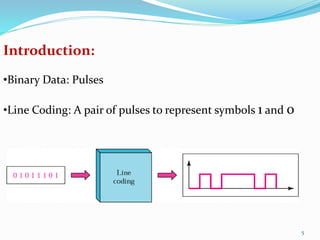
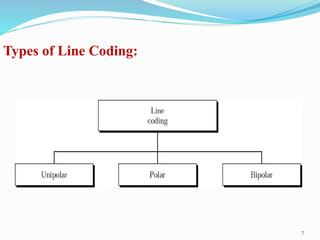
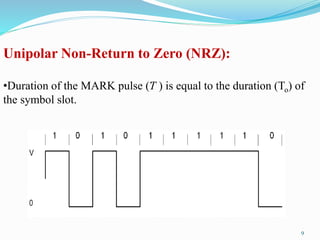
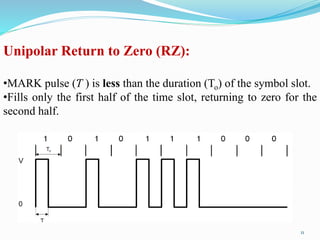
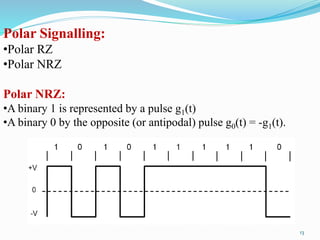
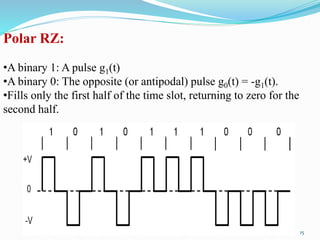
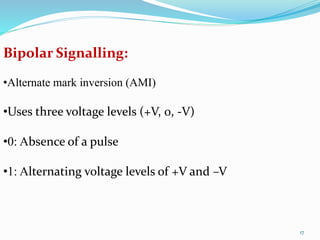
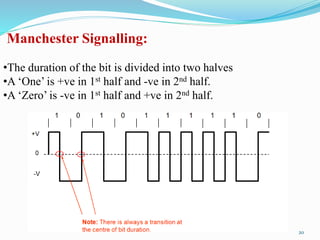
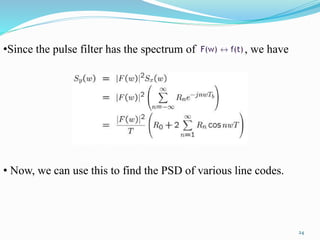
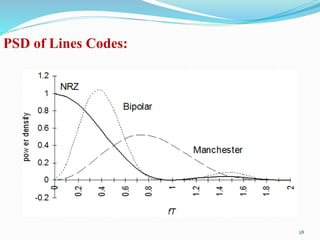
The document discusses different types of line coding used to transmit digital data over communication channels. It describes the need for line coding to avoid signal dispersion and intersymbol interference when transmitting discrete digital information over band-limited channels. The key types of line coding covered are unipolar (NRZ and RZ), polar, bipolar (AMI), and Manchester coding. Their properties like transmission bandwidth, power efficiency, error detection capabilities, and power spectral densities are compared. Polar RZ, Polar NRZ, AMI, and Manchester coding are analyzed in depth and their advantages and disadvantages discussed.