1
INTRODUCTION TO
TELEVISION
Chap. - 1
Prepared by
Mr. K. S. Raviya
Electronics & Communication Department
C. U. Shah College of Engg. And Tech.
Ref. Modern television practice by R. R. Gulati
1. INTRODUCTION
2
Television – to see from a distance Or
T.V. is the Transmission of Picture information over an
electric channel.
Real breakthrough – invention of CRT
First Camera tube – iconoscope
1935 – TV broadcasting started
1959 – in India
3
TV Global standards – PAL, NTSC, Secam
Global TV Standards - NTSC
4
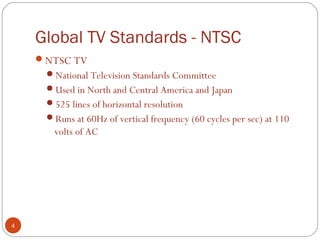
NTSC TV
National Television Standards Committee
Used in North and Central America and Japan
525 lines of horizontal resolution
Runs at 60Hz of vertical frequency (60 cycles per sec) at 110
volts of AC
Global TV Standards - SECAM
5
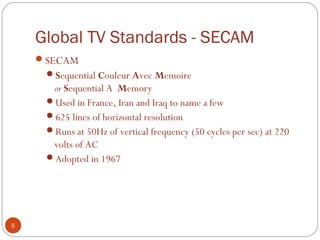
SECAM
Sequential Couleur Avec Memoire
or Sequential A Memory
Used in France, Iran and Iraq to name a few
625 lines of horizontal resolution
Runs at 50Hz of vertical frequency (50 cycles per sec) at 220
volts of AC
Adopted in 1967
Global TV Standards - PAL
6
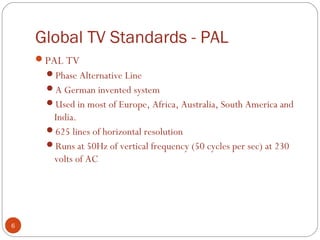
PAL TV
Phase Alternative Line
A German invented system
Used in most of Europe, Africa, Australia, South America and
India.
625 lines of horizontal resolution
Runs at 50Hz of vertical frequency (50 cycles per sec) at 230
volts of AC
Global Electricity Standards
7
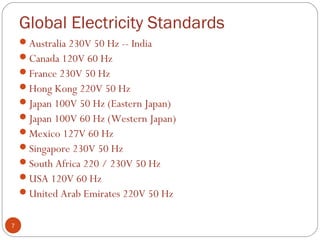
Australia 230V 50 Hz -- India
Canada 120V 60 Hz
France 230V 50 Hz
Hong Kong 220V 50 Hz
Japan 100V 50 Hz (Eastern Japan)
Japan 100V 60 Hz (Western Japan)
Mexico 127V 60 Hz
Singapore 230V 50 Hz
South Africa 220 / 230V 50 Hz
USA 120V 60 Hz
United Arab Emirates 220V 50 Hz
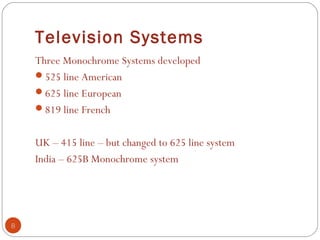
Television Systems
8
Three Monochrome Systems developed
525 line American
625 line European
819 line French
UK – 415 line – but changed to 625 line system
India – 625B Monochrome system
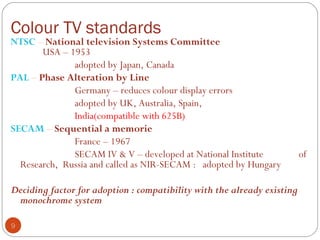
Colour TV standards
9
NTSC – National television Systems Committee
USA – 1953
adopted by Japan, Canada
PAL – Phase Alteration by Line
Germany – reduces colour display errors
adopted by UK, Australia, Spain,
India(compatible with 625B)
SECAM – Sequential a memorie
France – 1967
SECAM IV & V – developed at National Institute of
Research, Russia and called as NIR-SECAM : adopted by Hungary
Deciding factor for adoption : compatibility with the already existing
monochrome system
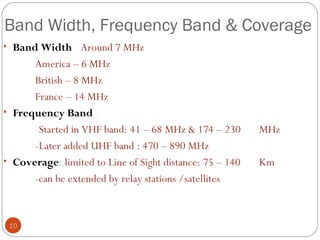
Band Width, Frequency Band & Coverage
10
• Band Width : Around 7 MHz
America – 6 MHz
British – 8 MHz
France – 14 MHz
• Frequency Band :
-Started in VHF band: 41 – 68 MHz & 174 – 230 MHz
-Later added UHF band : 470 – 890 MHz
• Coverage: limited to Line of Sight distance: 75 – 140 Km
-can be extended by relay stations /satellites
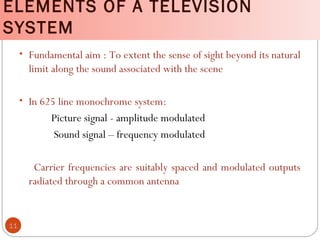
ELEMENTS OF A TELEVISION
SYSTEM
11
• Fundamental aim : To extent the sense of sight beyond its natural
limit along the sound associated with the scene
• In 625 line monochrome system:
Picture signal - amplitude modulated
Sound signal – frequency modulated
Carrier frequencies are suitably spaced and modulated outputs
radiated through a common antenna
Picture Transmission
12
• Picture information – optical in character – assembly of a large
number of bright and dark areas, each representing a picture element
– infinite number of pieces – existing simultaneously
• Information is a function of two variables: Time and Space
• Instead of using infinite number of channels simultaneously, we use
Scanning
• Scanning: Optical information is converted into electrical form and
transmitted element by element, one at a time in a sequential manner to cover
the entire scene to be televised
• - done at very fast rate
- repeated a number of times per second to create an illusion of simultaneous
pick-up
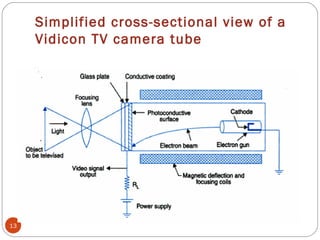
Simplified cross-sectional view of a
Vidicon TV camera tube
13
TV Camera
14
• Heart of a TV camera is a Camera tube
• Camera tube – converts optical information into corresponding
electrical signal
• Amplitude proportional to brightness
• Optical image is focused by a lens assembly to a rectangular glass
face-plate
• Transparent conductive coating at the inner side of the glass face-
plate
• On which is laid a thin layer of photoconductive material –
having a very high resistance when no light falls on it.
• Resistance decreases when the intensity increases
• Electron beam – used to pick up the picture information
available on the target plate in terms of varying resistance
• Beam is formed by an electron gun – deflected by a pair of
deflection coils kept mutually perpendicular on the glass plate -
to achieve scanning of the entire target area
15
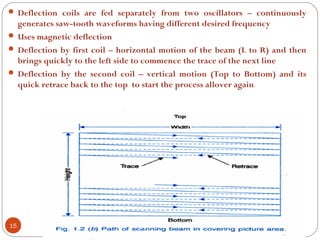
 Deflection coils are fed separately from two oscillators – continuously
generates saw-tooth waveforms having different desired frequency
 Uses magnetic deflection
 Deflection by first coil – horizontal motion of the beam (L to R) and then
brings quickly to the left side to commence the trace of the next line
 Deflection by the second coil – vertical motion (Top to Bottom) and its
quick retrace back to the top to start the process allover again
16
• Encounters different resistance across the target plate
• Results in a flow of current which varies in magnitude during scanning
• Current pass through a load resistance RL - varying voltage appears
across RL corresponding to the optical information of the picture
• Very high scanning rate – so that the scene content do not have
enough time to move perceptibly in the time required for one
complete scan of the image
• We get the true information of the scene
• Scanning converts the information existing in space and time
coordinates into time variations only – called a video signal
• Video signal is amplified – amplitude modulated with channel picture
carrier frequency – fed to the transmitter antenna for radiation along
with the sound signal
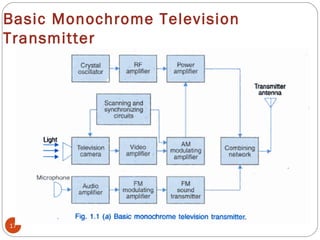
Basic Monochrome Television
Transmitter
17
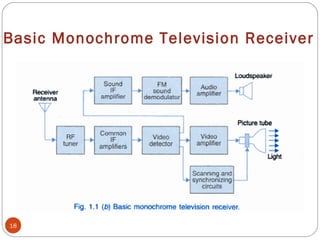
Basic Monochrome Television Receiver
18
Sound Transmission
19
• Microphone converts the sound associated with the picture into
proportional voltage
• Single valued function of time – so needs a single channel
• Amplified – frequency modulated using assigned carrier
frequency – combined with the AM picture transmitter output –
fed to common antenna – radiated in the form of
electromagnetic waves
Picture reception
20
• Receiving antenna intercepts the radiated picture and sound
carrier signal – feeds to RF tuner
• Receiver – heterodyne type
• Employs 2 or 3 stages of IF amplification
• Demodulated to recover video signal
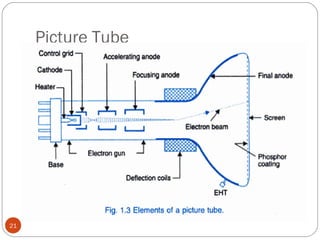
• Amplified and coupled to picture tube (same as CRT) – which
converts the electrical signal back into picture elements – with
same degree of black and white
Picture Tube
21
Sound reception
22
• Beam is deflected by a pair of deflecting coils in the same way
and rate as the beam scans the target area in the camera tube
• Video signal is fed to the grid or cathode of the picture tube
• When the varying signal voltage makes the control grid less
negative, the beam current is increased , making the spot on the
screen brighter
• More negative grid voltage reduces brightness
• Sound signals are separated from the picture signals in
the video detector section
• Amplified – demodulated (FM detector)
• Fed to audio amplifier and loud speaker
Synchronization
23
• To ensure perfect synchronization between scene being
televised and the picture produced on the raster
• Synchronizing pulses are transmitted during retrace ie
flyback intervals
• Distinct for horizontal and vertical motion control
• Radiated along with the picture details
• Processed at the receiver and fed to the picture tube sweep
circuitry
Receiver controls
24
• Channel selector - for selecting desired channel
• Fine tuning control – for obtaining best picture details in the
selected channel
• Hold control – to get steady picture in case it rolls up or
down
• Brightness control – varies the beam intensity of the picture
tube
• Contrast control – gain control of the video amplifier
• Volume and tone control – part of audio amplifier
Colour Television
25
• Based on the theory of additive colour mixing : all colours
including white can be created by mixing red, green and blue
lights
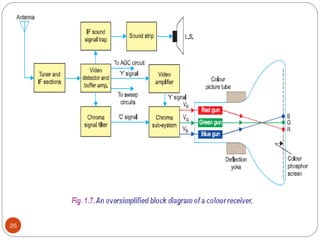
• Video signal for red, green and blue information are combined
and transmitted along with the brightness(monochrome) signal
• At the receiver, the three colour signals are separated and fed to
the three electron guns of the colour picture tube
• Screen of the picture tube has red, green and blue phosphors
arranged in alternate dots
• Each gun produces an electron beam to illuminate the three
colour phosphors separately on the fluorescent screen
• Our eye then integrates the red, green and blue colour
information and their luminance to perceive the actual colour
and brightness of the picture being televised
26
27

Ch 6 introduction to television

  • 1.
    1 INTRODUCTION TO TELEVISION Chap. -1 Prepared by Mr. K. S. Raviya Electronics & Communication Department C. U. Shah College of Engg. And Tech. Ref. Modern television practice by R. R. Gulati
  • 2.
    1. INTRODUCTION 2 Television –to see from a distance Or T.V. is the Transmission of Picture information over an electric channel. Real breakthrough – invention of CRT First Camera tube – iconoscope 1935 – TV broadcasting started 1959 – in India
  • 3.
    3 TV Global standards– PAL, NTSC, Secam
  • 4.
    Global TV Standards- NTSC 4 NTSC TV National Television Standards Committee Used in North and Central America and Japan 525 lines of horizontal resolution Runs at 60Hz of vertical frequency (60 cycles per sec) at 110 volts of AC
  • 5.
    Global TV Standards- SECAM 5 SECAM Sequential Couleur Avec Memoire or Sequential A Memory Used in France, Iran and Iraq to name a few 625 lines of horizontal resolution Runs at 50Hz of vertical frequency (50 cycles per sec) at 220 volts of AC Adopted in 1967
  • 6.
    Global TV Standards- PAL 6 PAL TV Phase Alternative Line A German invented system Used in most of Europe, Africa, Australia, South America and India. 625 lines of horizontal resolution Runs at 50Hz of vertical frequency (50 cycles per sec) at 230 volts of AC
  • 7.
    Global Electricity Standards 7 Australia230V 50 Hz -- India Canada 120V 60 Hz France 230V 50 Hz Hong Kong 220V 50 Hz Japan 100V 50 Hz (Eastern Japan) Japan 100V 60 Hz (Western Japan) Mexico 127V 60 Hz Singapore 230V 50 Hz South Africa 220 / 230V 50 Hz USA 120V 60 Hz United Arab Emirates 220V 50 Hz
  • 8.
    Television Systems 8 Three MonochromeSystems developed 525 line American 625 line European 819 line French UK – 415 line – but changed to 625 line system India – 625B Monochrome system
  • 9.
    Colour TV standards 9 NTSC– National television Systems Committee USA – 1953 adopted by Japan, Canada PAL – Phase Alteration by Line Germany – reduces colour display errors adopted by UK, Australia, Spain, India(compatible with 625B) SECAM – Sequential a memorie France – 1967 SECAM IV & V – developed at National Institute of Research, Russia and called as NIR-SECAM : adopted by Hungary Deciding factor for adoption : compatibility with the already existing monochrome system
  • 10.
    Band Width, FrequencyBand & Coverage 10 • Band Width : Around 7 MHz America – 6 MHz British – 8 MHz France – 14 MHz • Frequency Band : -Started in VHF band: 41 – 68 MHz & 174 – 230 MHz -Later added UHF band : 470 – 890 MHz • Coverage: limited to Line of Sight distance: 75 – 140 Km -can be extended by relay stations /satellites
  • 11.
    ELEMENTS OF ATELEVISION SYSTEM 11 • Fundamental aim : To extent the sense of sight beyond its natural limit along the sound associated with the scene • In 625 line monochrome system: Picture signal - amplitude modulated Sound signal – frequency modulated Carrier frequencies are suitably spaced and modulated outputs radiated through a common antenna
  • 12.
    Picture Transmission 12 • Pictureinformation – optical in character – assembly of a large number of bright and dark areas, each representing a picture element – infinite number of pieces – existing simultaneously • Information is a function of two variables: Time and Space • Instead of using infinite number of channels simultaneously, we use Scanning • Scanning: Optical information is converted into electrical form and transmitted element by element, one at a time in a sequential manner to cover the entire scene to be televised • - done at very fast rate - repeated a number of times per second to create an illusion of simultaneous pick-up
  • 13.
    Simplified cross-sectional viewof a Vidicon TV camera tube 13
  • 14.
    TV Camera 14 • Heartof a TV camera is a Camera tube • Camera tube – converts optical information into corresponding electrical signal • Amplitude proportional to brightness • Optical image is focused by a lens assembly to a rectangular glass face-plate • Transparent conductive coating at the inner side of the glass face- plate • On which is laid a thin layer of photoconductive material – having a very high resistance when no light falls on it. • Resistance decreases when the intensity increases • Electron beam – used to pick up the picture information available on the target plate in terms of varying resistance • Beam is formed by an electron gun – deflected by a pair of deflection coils kept mutually perpendicular on the glass plate - to achieve scanning of the entire target area
  • 15.
    15  Deflection coilsare fed separately from two oscillators – continuously generates saw-tooth waveforms having different desired frequency  Uses magnetic deflection  Deflection by first coil – horizontal motion of the beam (L to R) and then brings quickly to the left side to commence the trace of the next line  Deflection by the second coil – vertical motion (Top to Bottom) and its quick retrace back to the top to start the process allover again
  • 16.
    16 • Encounters differentresistance across the target plate • Results in a flow of current which varies in magnitude during scanning • Current pass through a load resistance RL - varying voltage appears across RL corresponding to the optical information of the picture • Very high scanning rate – so that the scene content do not have enough time to move perceptibly in the time required for one complete scan of the image • We get the true information of the scene • Scanning converts the information existing in space and time coordinates into time variations only – called a video signal • Video signal is amplified – amplitude modulated with channel picture carrier frequency – fed to the transmitter antenna for radiation along with the sound signal
  • 17.
  • 18.
  • 19.
    Sound Transmission 19 • Microphoneconverts the sound associated with the picture into proportional voltage • Single valued function of time – so needs a single channel • Amplified – frequency modulated using assigned carrier frequency – combined with the AM picture transmitter output – fed to common antenna – radiated in the form of electromagnetic waves
  • 20.
    Picture reception 20 • Receivingantenna intercepts the radiated picture and sound carrier signal – feeds to RF tuner • Receiver – heterodyne type • Employs 2 or 3 stages of IF amplification • Demodulated to recover video signal • Amplified and coupled to picture tube (same as CRT) – which converts the electrical signal back into picture elements – with same degree of black and white
  • 21.
  • 22.
    Sound reception 22 • Beamis deflected by a pair of deflecting coils in the same way and rate as the beam scans the target area in the camera tube • Video signal is fed to the grid or cathode of the picture tube • When the varying signal voltage makes the control grid less negative, the beam current is increased , making the spot on the screen brighter • More negative grid voltage reduces brightness • Sound signals are separated from the picture signals in the video detector section • Amplified – demodulated (FM detector) • Fed to audio amplifier and loud speaker
  • 23.
    Synchronization 23 • To ensureperfect synchronization between scene being televised and the picture produced on the raster • Synchronizing pulses are transmitted during retrace ie flyback intervals • Distinct for horizontal and vertical motion control • Radiated along with the picture details • Processed at the receiver and fed to the picture tube sweep circuitry
  • 24.
    Receiver controls 24 • Channelselector - for selecting desired channel • Fine tuning control – for obtaining best picture details in the selected channel • Hold control – to get steady picture in case it rolls up or down • Brightness control – varies the beam intensity of the picture tube • Contrast control – gain control of the video amplifier • Volume and tone control – part of audio amplifier
  • 25.
    Colour Television 25 • Basedon the theory of additive colour mixing : all colours including white can be created by mixing red, green and blue lights • Video signal for red, green and blue information are combined and transmitted along with the brightness(monochrome) signal • At the receiver, the three colour signals are separated and fed to the three electron guns of the colour picture tube • Screen of the picture tube has red, green and blue phosphors arranged in alternate dots • Each gun produces an electron beam to illuminate the three colour phosphors separately on the fluorescent screen • Our eye then integrates the red, green and blue colour information and their luminance to perceive the actual colour and brightness of the picture being televised
  • 26.
  • 27.