Television Receiver
Contents
 RF Tuner
 IF Subsystem
 Video amplifier
 Sound section
 Sync separation and processing
 Deflection circuits
 Scanning Currents in the yoke
 DC power supplies
 Electronic tuners
 IF Subsystem
Contents
 Y Signal channel
 Chroma decoder
 Separation of U and V colour phasors
 Synchronous demodulators
 Sub carrier generation and control
 Matrixing for drive circuits
 Receiver Servicing
 Video pattern generator
 Sweep & Marker generator
 Colour TV Pattern Generator
 Vectroscope
RF tuner
RF tuner
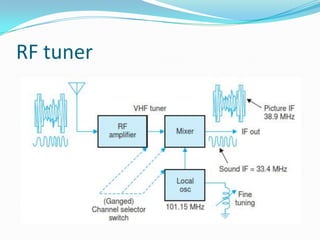
 This section consists of RF amplifier, mixer and local
oscillator
 The purpose of the tuner unit is to amplify both sound
and picture signals picked up by the antenna and to
convert the carrier frequencies and their associated
bands into the intermediate frequencies and their
sidebands
 The receiver uses superhetrodyne principle as used in
radio receivers
 The setting of the local oscillator frequency enables
selection of desired station
RF tuner
 The standard intermediate frequencies for the 625-B
system are-Picture IF = 38.9 MHz, Sound IF = 33.4
MHz
RF tuner
Choice of selecting IF
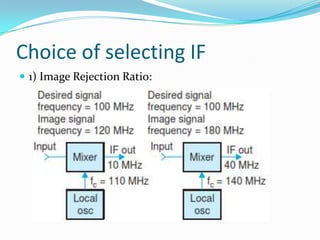
 1) Image Rejection Ratio:
Choice of selecting IF
 The undesired signal which gets received is spaced at a
gap of twice the IF frequency, and is known as ‘Image
Signal’
 The image rejection ratio is defined as the output due
to desired station divided by output due to image
signal
 With RF amplifier the output due to image signal can
be very much reduced or completely eliminated
 Here as IF will be greater, the image frequency will be
greater and there are more chances to eliminate it
through well designed filter
Choice of selecting IF
 2) Pick-up Due to Local Oscillator Radiation from TV
Receivers
 If the output from the local oscillator of a TV receiver
gets coupled to the antenna, it will get radiated and
may cause interference in another receiver
 Here again advantage lies with higher IF frequency,
because with higher IF there is a greater separation
between the resonant circuits of local oscillator and RF
amplifier circuits
Choice of selecting IF
 3) Ease of Separation of Modulating Signal from IF
Carrier at the Demodulator
 For ease of filtering out the IF carrier freuency, it is
desirable to have a much higher IF frequency as
compared to the highest modulating frequency
 In radio receivers the IF frequency is 455 KHz and the
highest audio frequency is only 5 KHz
 In TV receivers, with the highest modulating frequency
of 5 MHz, an IF frequency of atleast 40 MHz is desirable
Choice of selecting IF
 4) Image Frequencies Should Not Lie in the FM Band
 The FM band is from 88 MHz to 110 MHz
 With IF frequency chosen close to 40 MHz, the image
frequencies of the lower VHF band fall between 121 to
148 MHz and thus cannot cause any interference in the
FM band
 Higher TV channels are much above the FM band
Choice of selecting IF
 5) Interference or Direct Pick-Up from Bands Assigned
for other Service
 Amateur and industrial applications frequency band
lies between 21 to 27 MHz
 If the IF frequency is chosen above 40 MHz, even the
second harmonics of this band will not cause any
serious direct pick-up problems
Choice of selecting IF
 6) Gain
 The television receiver should produce enough gain at
high IF frequencies
 This is achievable through today’s highly accurate
transistors
Video Detector
Video Amplifier
 The video amplifier is dc coupled from the video detector
to the picture tube, in order to preserve the dc component
for correct brightness
 However, in some video amplifier designs, on account of
complexities of a direct coupled amplifier, ac coupling is
instead used
 The dc component of the video signal is restored by a diode
clamper before feeding it to cathode or grid of the picture
tube
 In transistor amplifier designs, a suitable configuration of
two transistors and a driver often becomes necessary to
obtain the same gain
Video Amplifier
 Besides gain, response of the amplifier should ideally
be flat from dc (zero) to 5 MHz to include all essential
video components
 This needs rigorous design considerations because the
band of frequencies to be covered extends from dc
through audio range to radio frequencies
 A loss in gain of high frequency components in the
video signal would reduce sharpness of the picture
whereas a poor low frequency response will result in
loss of boundary details of letters etc
 It is also essential that phase distortion in the amplifer
is kept to a minimum
Sound section
 The relatively weak FM sound
signal is given at least one
stage of amplification before
feeding it to the FM detector
 The FM detector is normally a
ratio detector or a
discriminator preceded by a
limiter
 The characteristics of a typical
FM detector are shown in Fig
Sound section
 A tuned amplifier, with enough bandwidth to pass the FM
sound signal is used to boost the FM signal
 The volume and tone controls form part of the audio
amplifiers
 The power amplifier is either a single ended or push-pull
configuration employing transistors
 Special ICs have been developed which contain FM
demodulator and most parts of the audio amplifier
Sync separation and processing
 The horizontal and vertical sync pulses that form part
of the composite video signal are separated in the sync
separator
 A sync separator is a clipper that is suitably biased to
produce output, only during sync pulse amplitude of
the video signal
 The pulse train as obtained from the sync separator is
fed simultaneously to a differentiating and an
integrating circuit
Sync separation and processing
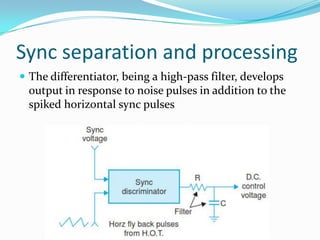
 The differentiator, being a high-pass filter, develops
output in response to noise pulses in addition to the
spiked horizontal sync pulses
Sync separation and processing
 This results in occasional wrong triggering of the
horizontal oscillator which results in diagonal tearing
of the reproduced picture
 To overcome this difficulty, a special circuit known as
automatic frequency control (AFC) circuit is employed
 The AFC circuit employs a discriminator arrangement
which compares the incoming horizontal sync pulses
and the voltage that develops across the output of the
horizontal deflection amplifier
Deflection circuits
 The necessary sawtooth voltage for vertical and
horizontal is developed by charging and discharging a
capacitor with different time constants
 For vertical deflection, the frequency of the oscillator
is controlled by varying the resistance of the RC
coupling network and is locked in synchronism by the
vertical sync pulses
 A part of the coupling network resistance is a
potentiometer that is located on the front panel of the
receiver
 This is known as ‘Vertical Hold Control’
Deflection circuits
 The frequency of horizontal oscillator is controlled by
dc control voltage developed by the AFC circuit
 Since the noise pulses in the control voltage are
completely suppressed, most receivers do not provide
any horizontal frequency (hold) control
 Since the deflection coils need about one amp of
current to sweep the entire raster, the output of the
oscillator is given one stage of power amplification (as
for vertical deflection) and then fed to the horizontal
deflection coils
Scanning Currents in the yoke
 Vertical scanning current: The vertical oscillator uses
an RC network to develop a sawtooth waveform
 With this as an input to the vertical amplifier, a
sawtooth current flows through the vertical deflection
coil to cause vertical scanning
 The vertical output stage is a power amplifier which
acts as a current source to produce a linear rise of
magnetic field in the deflection coil
 The stage is cut off for brief period of retrace only
Scanning Currents in the yoke
 Horizontal scanning current: The horizontal coil is
given a current changes of several amperes in 52us
 Due this large change a self induced voltage is
generated across the coil which creates the horizontal
trace
 The horizontal amplifier is continuously switched ON
and switched OFF
 The horizontal output stage consumes more than 75
percent of the total power used by the receiver
DC power supplies
 Various DC sources needed in a typical television
receiver are as under
 Low voltage: about 12 to 35 volts for IC and small signal
amplifiers
 Medium voltages: about 150 v for horizontal output
stage, 300 to 400v for the screen and focus grid of
picture tube and about 175 v for the video amplifier
 High voltage: 15 to 18KV for final anode of picture tube
PAL-D Colour Decoder
Electronic tuners for colour
television
 Varactor is a special silicon diode, the junction
capacitance of which is used for tuning
 This capacitance varies inversely with the amount of
reverse bias applied across the diode
 The resonant frequency of the tuned circuits in which
they are connected, is controlled merely by changing
the reverse bias across the varactor
 Figure shows a basic circuit for varactor diode tuning
Electronic tuners for colour
television
IF Subsystem for colour television
 IF system for colour television consists of
 band shaping filter circuit
 IF amplifiers(AGC controlled)
 AGC(Automatic gain control)
 AFT(Automatic frequency tuning)
 Intercarrier sound IF detector
 Video detector
 Buffer video amplifier
Block diagram of AFT
IF Subsystem
 After passing through IF subsystem the colour signal is
given in to 4 blocks
 Luminance or Y channel
 Chroma decoder
 AGC circuit
 Sync-separator and Raster circuit
Y signal Channel
Y signal Channel
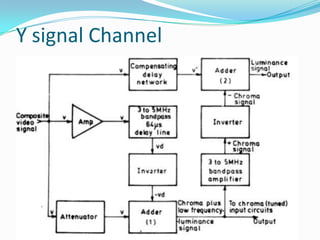
 Y signal represents the brightness of the picture signal
 The colour signals get added on Y signal to reproduce
coloured scene on raster
 To recover colour information from Y signal, we need
to use comb filter
 It selects frequencies that need to be passed and
rejects the other frequencies in Y signal band
 To achieve this video signal v is applied to a delay line
of 64 us and inverter
 Output of delay line and inverter are added and
chroma signal frequencies are recovered
Y signal Channel
Y signal Channel
Chroma decoder
Chroma decoder
 The main function of chroma decoder is to recover U
and V colour difference signals which are combined
with Y to obtain R,G and B video signal
 For this the decoder has to perform following
functions
 Chroma signal seperation and amplification
 Separation of U and V
 Demodulation of U and V
 Generation of subcarriers for two demodulators
 To develop ‘ident’ signal
Separation of U and V colour
phasors
Synchronous demodulators
Sub carrier generation and control
 To extract the colour burst signal from composite
video signal, a burst phase discriminator is used
 It determines the phase difference of input colour
burst and sets the reference oscillator accordingly to
use it as a reference subcarrier for U and V
demodulators
 Also a colour killer block and burst phase
identification block is used to turn ON the second
stage amplifier only when a colour signal is received
 In absence of colour burst, the amplifier will be OFF
and the signal is considered as monochrome signal
Matrixing for drive circuits
 The value of R1, R2 and R3 are so chosen that the G-Y
amplifier block receives input as per following
equation
 (G-Y) = -0.51(R-Y) – 0.186(B-Y)
 Once all colour difference signals are extracted, they
are applied to RGB matrix for cathode drive
 Luminance signal Y is added to these difference signals
to obtain the Vr, Vb and Vg colour voltages
Television Receiver

Television Receiver

  • 1.
  • 2.
    Contents  RF Tuner IF Subsystem  Video amplifier  Sound section  Sync separation and processing  Deflection circuits  Scanning Currents in the yoke  DC power supplies  Electronic tuners  IF Subsystem
  • 3.
    Contents  Y Signalchannel  Chroma decoder  Separation of U and V colour phasors  Synchronous demodulators  Sub carrier generation and control  Matrixing for drive circuits  Receiver Servicing  Video pattern generator  Sweep & Marker generator  Colour TV Pattern Generator  Vectroscope
  • 4.
  • 5.
    RF tuner  Thissection consists of RF amplifier, mixer and local oscillator  The purpose of the tuner unit is to amplify both sound and picture signals picked up by the antenna and to convert the carrier frequencies and their associated bands into the intermediate frequencies and their sidebands  The receiver uses superhetrodyne principle as used in radio receivers  The setting of the local oscillator frequency enables selection of desired station
  • 6.
    RF tuner  Thestandard intermediate frequencies for the 625-B system are-Picture IF = 38.9 MHz, Sound IF = 33.4 MHz
  • 7.
  • 9.
    Choice of selectingIF  1) Image Rejection Ratio:
  • 10.
    Choice of selectingIF  The undesired signal which gets received is spaced at a gap of twice the IF frequency, and is known as ‘Image Signal’  The image rejection ratio is defined as the output due to desired station divided by output due to image signal  With RF amplifier the output due to image signal can be very much reduced or completely eliminated  Here as IF will be greater, the image frequency will be greater and there are more chances to eliminate it through well designed filter
  • 11.
    Choice of selectingIF  2) Pick-up Due to Local Oscillator Radiation from TV Receivers  If the output from the local oscillator of a TV receiver gets coupled to the antenna, it will get radiated and may cause interference in another receiver  Here again advantage lies with higher IF frequency, because with higher IF there is a greater separation between the resonant circuits of local oscillator and RF amplifier circuits
  • 12.
  • 13.
    Choice of selectingIF  3) Ease of Separation of Modulating Signal from IF Carrier at the Demodulator  For ease of filtering out the IF carrier freuency, it is desirable to have a much higher IF frequency as compared to the highest modulating frequency  In radio receivers the IF frequency is 455 KHz and the highest audio frequency is only 5 KHz  In TV receivers, with the highest modulating frequency of 5 MHz, an IF frequency of atleast 40 MHz is desirable
  • 14.
    Choice of selectingIF  4) Image Frequencies Should Not Lie in the FM Band  The FM band is from 88 MHz to 110 MHz  With IF frequency chosen close to 40 MHz, the image frequencies of the lower VHF band fall between 121 to 148 MHz and thus cannot cause any interference in the FM band  Higher TV channels are much above the FM band
  • 15.
    Choice of selectingIF  5) Interference or Direct Pick-Up from Bands Assigned for other Service  Amateur and industrial applications frequency band lies between 21 to 27 MHz  If the IF frequency is chosen above 40 MHz, even the second harmonics of this band will not cause any serious direct pick-up problems
  • 16.
    Choice of selectingIF  6) Gain  The television receiver should produce enough gain at high IF frequencies  This is achievable through today’s highly accurate transistors
  • 17.
  • 18.
    Video Amplifier  Thevideo amplifier is dc coupled from the video detector to the picture tube, in order to preserve the dc component for correct brightness  However, in some video amplifier designs, on account of complexities of a direct coupled amplifier, ac coupling is instead used  The dc component of the video signal is restored by a diode clamper before feeding it to cathode or grid of the picture tube  In transistor amplifier designs, a suitable configuration of two transistors and a driver often becomes necessary to obtain the same gain
  • 19.
    Video Amplifier  Besidesgain, response of the amplifier should ideally be flat from dc (zero) to 5 MHz to include all essential video components  This needs rigorous design considerations because the band of frequencies to be covered extends from dc through audio range to radio frequencies  A loss in gain of high frequency components in the video signal would reduce sharpness of the picture whereas a poor low frequency response will result in loss of boundary details of letters etc  It is also essential that phase distortion in the amplifer is kept to a minimum
  • 20.
    Sound section  Therelatively weak FM sound signal is given at least one stage of amplification before feeding it to the FM detector  The FM detector is normally a ratio detector or a discriminator preceded by a limiter  The characteristics of a typical FM detector are shown in Fig
  • 21.
    Sound section  Atuned amplifier, with enough bandwidth to pass the FM sound signal is used to boost the FM signal  The volume and tone controls form part of the audio amplifiers  The power amplifier is either a single ended or push-pull configuration employing transistors  Special ICs have been developed which contain FM demodulator and most parts of the audio amplifier
  • 22.
    Sync separation andprocessing  The horizontal and vertical sync pulses that form part of the composite video signal are separated in the sync separator  A sync separator is a clipper that is suitably biased to produce output, only during sync pulse amplitude of the video signal  The pulse train as obtained from the sync separator is fed simultaneously to a differentiating and an integrating circuit
  • 23.
    Sync separation andprocessing  The differentiator, being a high-pass filter, develops output in response to noise pulses in addition to the spiked horizontal sync pulses
  • 24.
    Sync separation andprocessing  This results in occasional wrong triggering of the horizontal oscillator which results in diagonal tearing of the reproduced picture  To overcome this difficulty, a special circuit known as automatic frequency control (AFC) circuit is employed  The AFC circuit employs a discriminator arrangement which compares the incoming horizontal sync pulses and the voltage that develops across the output of the horizontal deflection amplifier
  • 25.
    Deflection circuits  Thenecessary sawtooth voltage for vertical and horizontal is developed by charging and discharging a capacitor with different time constants  For vertical deflection, the frequency of the oscillator is controlled by varying the resistance of the RC coupling network and is locked in synchronism by the vertical sync pulses  A part of the coupling network resistance is a potentiometer that is located on the front panel of the receiver  This is known as ‘Vertical Hold Control’
  • 26.
    Deflection circuits  Thefrequency of horizontal oscillator is controlled by dc control voltage developed by the AFC circuit  Since the noise pulses in the control voltage are completely suppressed, most receivers do not provide any horizontal frequency (hold) control  Since the deflection coils need about one amp of current to sweep the entire raster, the output of the oscillator is given one stage of power amplification (as for vertical deflection) and then fed to the horizontal deflection coils
  • 27.
    Scanning Currents inthe yoke  Vertical scanning current: The vertical oscillator uses an RC network to develop a sawtooth waveform  With this as an input to the vertical amplifier, a sawtooth current flows through the vertical deflection coil to cause vertical scanning  The vertical output stage is a power amplifier which acts as a current source to produce a linear rise of magnetic field in the deflection coil  The stage is cut off for brief period of retrace only
  • 28.
    Scanning Currents inthe yoke  Horizontal scanning current: The horizontal coil is given a current changes of several amperes in 52us  Due this large change a self induced voltage is generated across the coil which creates the horizontal trace  The horizontal amplifier is continuously switched ON and switched OFF  The horizontal output stage consumes more than 75 percent of the total power used by the receiver
  • 29.
    DC power supplies Various DC sources needed in a typical television receiver are as under  Low voltage: about 12 to 35 volts for IC and small signal amplifiers  Medium voltages: about 150 v for horizontal output stage, 300 to 400v for the screen and focus grid of picture tube and about 175 v for the video amplifier  High voltage: 15 to 18KV for final anode of picture tube
  • 30.
  • 31.
    Electronic tuners forcolour television  Varactor is a special silicon diode, the junction capacitance of which is used for tuning  This capacitance varies inversely with the amount of reverse bias applied across the diode  The resonant frequency of the tuned circuits in which they are connected, is controlled merely by changing the reverse bias across the varactor  Figure shows a basic circuit for varactor diode tuning
  • 32.
    Electronic tuners forcolour television
  • 33.
    IF Subsystem forcolour television  IF system for colour television consists of  band shaping filter circuit  IF amplifiers(AGC controlled)  AGC(Automatic gain control)  AFT(Automatic frequency tuning)  Intercarrier sound IF detector  Video detector  Buffer video amplifier
  • 34.
  • 35.
    IF Subsystem  Afterpassing through IF subsystem the colour signal is given in to 4 blocks  Luminance or Y channel  Chroma decoder  AGC circuit  Sync-separator and Raster circuit
  • 36.
  • 37.
    Y signal Channel Y signal represents the brightness of the picture signal  The colour signals get added on Y signal to reproduce coloured scene on raster  To recover colour information from Y signal, we need to use comb filter  It selects frequencies that need to be passed and rejects the other frequencies in Y signal band  To achieve this video signal v is applied to a delay line of 64 us and inverter  Output of delay line and inverter are added and chroma signal frequencies are recovered
  • 38.
  • 39.
  • 40.
  • 41.
    Chroma decoder  Themain function of chroma decoder is to recover U and V colour difference signals which are combined with Y to obtain R,G and B video signal  For this the decoder has to perform following functions  Chroma signal seperation and amplification  Separation of U and V  Demodulation of U and V  Generation of subcarriers for two demodulators  To develop ‘ident’ signal
  • 42.
    Separation of Uand V colour phasors
  • 43.
  • 44.
  • 45.
  • 46.
  • 47.
    Sub carrier generationand control  To extract the colour burst signal from composite video signal, a burst phase discriminator is used  It determines the phase difference of input colour burst and sets the reference oscillator accordingly to use it as a reference subcarrier for U and V demodulators  Also a colour killer block and burst phase identification block is used to turn ON the second stage amplifier only when a colour signal is received  In absence of colour burst, the amplifier will be OFF and the signal is considered as monochrome signal
  • 48.
  • 49.
    Matrixing for drivecircuits  The value of R1, R2 and R3 are so chosen that the G-Y amplifier block receives input as per following equation  (G-Y) = -0.51(R-Y) – 0.186(B-Y)  Once all colour difference signals are extracted, they are applied to RGB matrix for cathode drive  Luminance signal Y is added to these difference signals to obtain the Vr, Vb and Vg colour voltages