Components of road
CARRAIGE WAY
SHOULDER
CAMBER
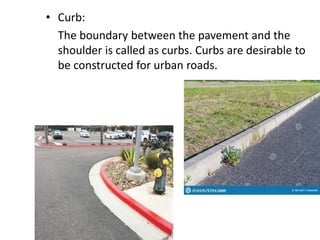
CURBS
GRADIENT
• Carriage way:
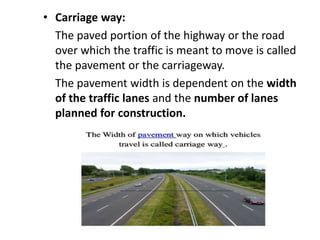
The paved portion of the highway or the road
over which the traffic is meant to move is called
the pavement or the carriageway.
The pavement width is dependent on the width
of the traffic lanes and the number of lanes
planned for construction.
• Shoulders:
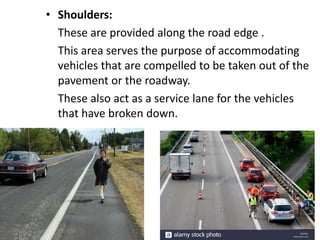
These are provided along the road edge .
This area serves the purpose of accommodating
vehicles that are compelled to be taken out of the
pavement or the roadway.
These also act as a service lane for the vehicles
that have broken down.
• Camber:
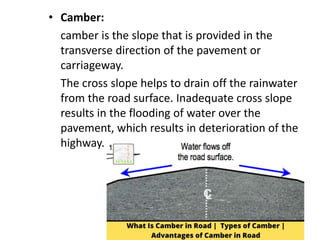
camber is the slope that is provided in the
transverse direction of the pavement or
carriageway.
The cross slope helps to drain off the rainwater
from the road surface. Inadequate cross slope
results in the flooding of water over the
pavement, which results in deterioration of the
highway.
• Curb:
The boundary between the pavement and the
shoulder is called as curbs. Curbs are desirable to
be constructed for urban roads.
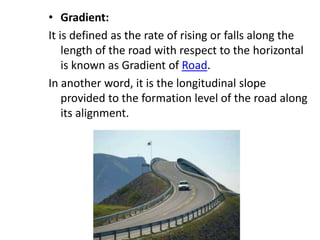
• Gradient:
It is defined as the rate of rising or falls along the
length of the road with respect to the horizontal
is known as Gradient of Road.
In another word, it is the longitudinal slope
provided to the formation level of the road along
its alignment.
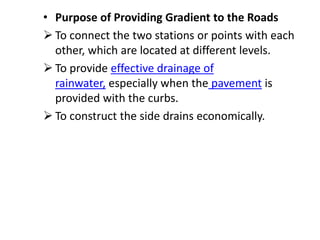
• Purpose of Providing Gradient to the Roads
 To connect the two stations or points with each
other, which are located at different levels.
 To provide effective drainage of
rainwater, especially when the pavement is
provided with the curbs.
 To construct the side drains economically.
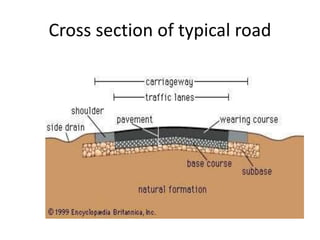
Cross section of typical road

Components of road.pptx

  • 1.
    Components of road CARRAIGEWAY SHOULDER CAMBER CURBS GRADIENT
  • 2.
    • Carriage way: Thepaved portion of the highway or the road over which the traffic is meant to move is called the pavement or the carriageway. The pavement width is dependent on the width of the traffic lanes and the number of lanes planned for construction.
  • 3.
    • Shoulders: These areprovided along the road edge . This area serves the purpose of accommodating vehicles that are compelled to be taken out of the pavement or the roadway. These also act as a service lane for the vehicles that have broken down.
  • 4.
    • Camber: camber isthe slope that is provided in the transverse direction of the pavement or carriageway. The cross slope helps to drain off the rainwater from the road surface. Inadequate cross slope results in the flooding of water over the pavement, which results in deterioration of the highway.
  • 5.
    • Curb: The boundarybetween the pavement and the shoulder is called as curbs. Curbs are desirable to be constructed for urban roads.
  • 6.
    • Gradient: It isdefined as the rate of rising or falls along the length of the road with respect to the horizontal is known as Gradient of Road. In another word, it is the longitudinal slope provided to the formation level of the road along its alignment.
  • 7.
    • Purpose ofProviding Gradient to the Roads  To connect the two stations or points with each other, which are located at different levels.  To provide effective drainage of rainwater, especially when the pavement is provided with the curbs.  To construct the side drains economically.
  • 8.
    Cross section oftypical road