PRINCIPAL OF
ORGANISATION
By Mrs.S.M.Patil
Sharad Institute of Technology College
of Engineering Yadrav Ichalkaranji
PRINCIPAL OF ORGANISATION
1) Consideration of objectives
2) Relationship of basic components of the organization
3) Responsibility and authority
4) Span of control
5) Dividing and grouping work(including coordination)
6) Effective delegation
7) Communication
8) Line and staff relationships
9) Balance, stability and flexibility
1. Consideration of objectives
What's mean by this?
 Only those objectives should be taken up and accomplished for
which there is real need in the organization.
 It is to be ensured that the objectives of different departments in the
organization are unified and aligned to the corporate goals.
 e.g. Measures may be taken to increase productivity, improve
product quality.
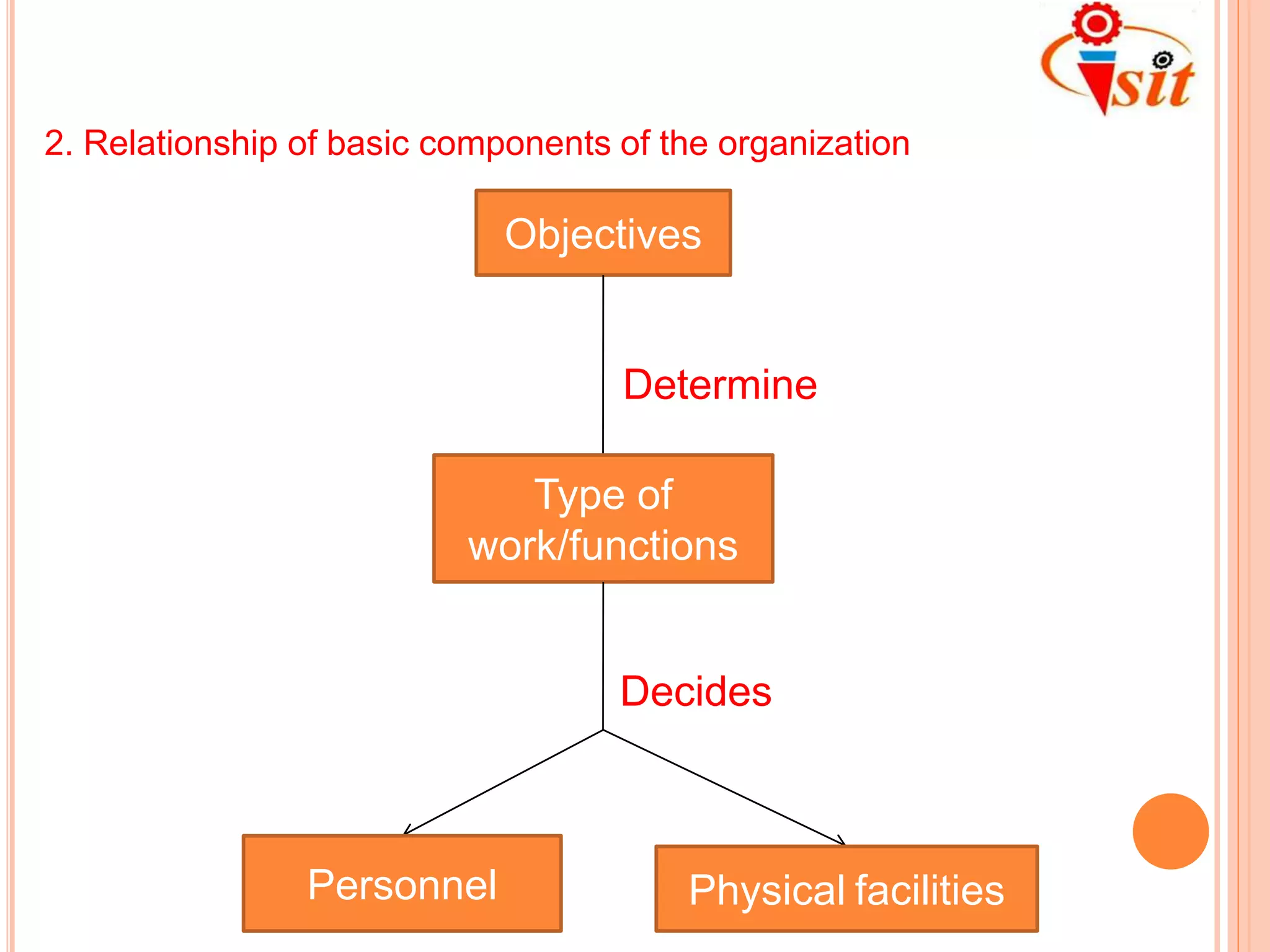
2. Relationship of basic components of the organization
Determine
Decides
Objectives
Type of
work/functions
Personnel Physical facilities
3.1 Responsibility
 A superior is always responsible for the success or failure of his
subordinates.
 It means the responsibility can never be delegated, though authority
can percolate from upwards to downwards.
 In any organization, the superior is held responsible for the actions of
his subordinates and the subordinates are accountable for the work to
their superiors.
3.2 Authority
 The line of authority, must be well defined so that every subordinate
knows who is his superior.
What’s mean by that?
 Who shall take a decision, issue instructions, recruit staff, control
work, must be fixed in advance.
Why it’s needed?
 The work to be carried out by the subordinates as planned.
 There should never be confusion as to whom to report or refer to for
decisions.
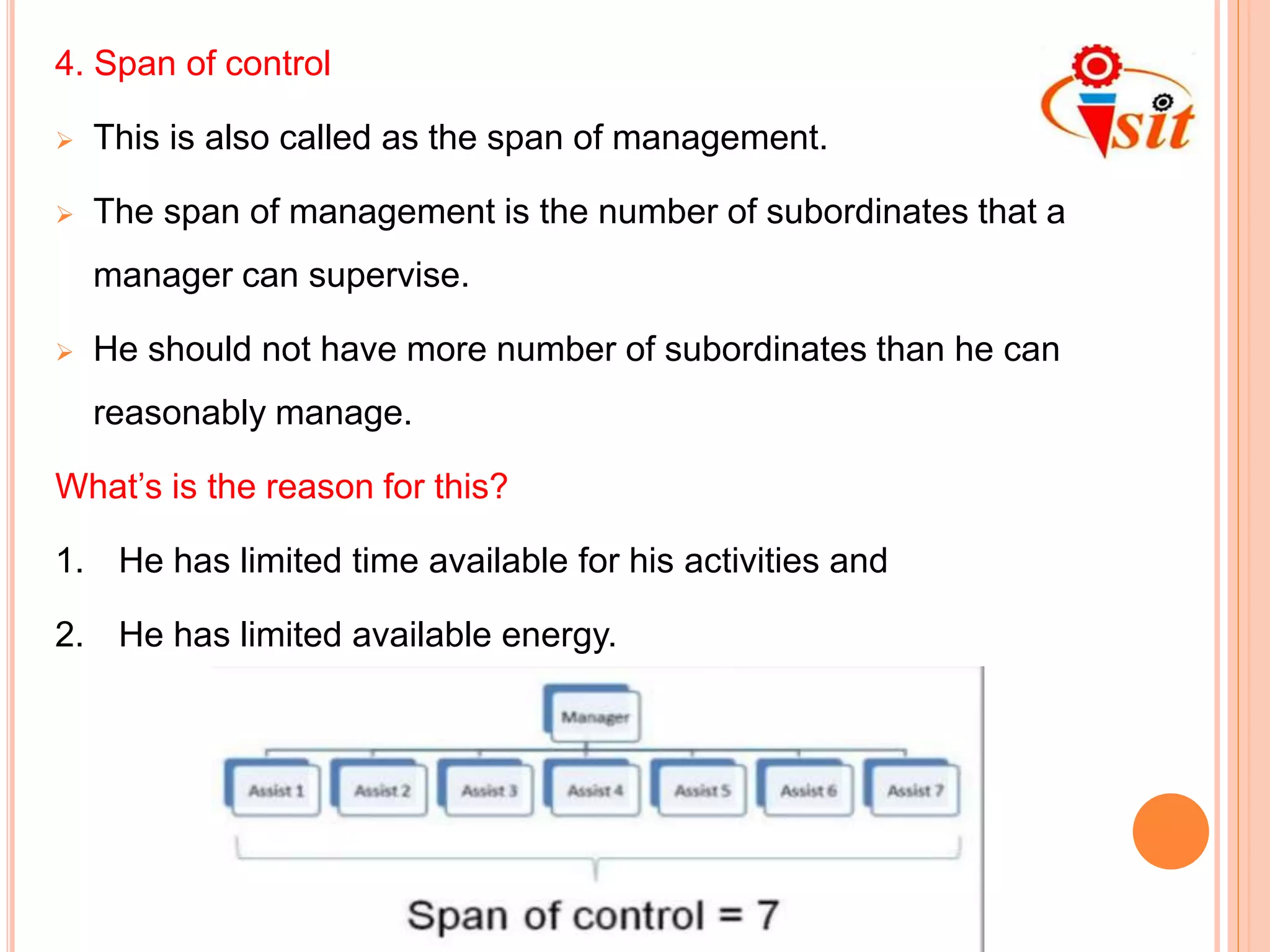
4. Span of control
 This is also called as the span of management.
 The span of management is the number of subordinates that a
manager can supervise.
 He should not have more number of subordinates than he can
reasonably manage.
What’s is the reason for this?
1. He has limited time available for his activities and
2. He has limited available energy.
 Generally, depending upon the conditions of the business enterprise,
the span of control may be any number varying from 2 to 20.
Span of control depends upon the following considerations.
1. Trained and experience coordinates.
2. Same work at one table or very close to each other large span of
control is possible.
3. Working in isolated area small span of control is ideal.
4. Complex nature of work demands a small span of work.
5. For same nature of work executive to executive to span of control may
vary.
5. Dividing and grouping work
 Divisional provides a greater sense of responsibility on the part of
the personnel and more clear cut control over profits.
 Head of each division has a considerable freedom to act and adopt
to local needs.
 Grouping is needed for specialization and coordination.
 E.g. At the Hero Honda Motors Ltd factories bike comes off the
assembly line in every 18 seconds. Naturally, it would not be
feasible for any single person to assemble a bike in just 18
seconds. This signifies the power of the division of labor (also
called division of work).
6. Effective delegation
 When an executive instead of doing all thinking for the unit himself,
passes down to his subordinates any task on which they can take
decisions themselves and perform it efficiently and effectively.
7. Communication
 Communication serves as a linking process by which parts of an
organization are tied together.
 There are three types of communications.
1. Downward communication
2. Upward communication
3. Horizontal communication
4. Unofficial communication
8. Line and staff functions
 All activities of an organization can be classified into two categories.
1. Primary activities
2. Supporting activities
 Primary activities or line functions: Which contributes directly and
vitally to objectives of an organization.
E.g. Sales, production etc.
 Supporting activities: Supporting activities are those that aid/help the
line or auxiliary to line functions.
E.g. accounting, maintenance, administration etc.
9. Balance, Stability and Flexibility
9.1 Balance:
 All units of an organization should be balanced.
 In the absence of such balance the goals of the organization cannot
be cannot be achieved economically and effectively.
 E.g. If the purchase department is underdevelopment as compared
to other department it will seriously handicap the firm that may
otherwise be very strong and modern production and sales.
9.2 Stability
 It reference to the capacity to withstand the losses of key
personnel without serious loss to the effectiveness of the
organization in performing work.
9.3 Flexibility
 Flexibility is ability to bend and blend without experiencing any
serious setback.

PRINCIPAL OF ORGANISATION.pptx

  • 1.
    PRINCIPAL OF ORGANISATION By Mrs.S.M.Patil SharadInstitute of Technology College of Engineering Yadrav Ichalkaranji
  • 2.
    PRINCIPAL OF ORGANISATION 1)Consideration of objectives 2) Relationship of basic components of the organization 3) Responsibility and authority 4) Span of control 5) Dividing and grouping work(including coordination) 6) Effective delegation 7) Communication 8) Line and staff relationships 9) Balance, stability and flexibility
  • 3.
    1. Consideration ofobjectives What's mean by this?  Only those objectives should be taken up and accomplished for which there is real need in the organization.  It is to be ensured that the objectives of different departments in the organization are unified and aligned to the corporate goals.  e.g. Measures may be taken to increase productivity, improve product quality.
  • 4.
    2. Relationship ofbasic components of the organization Determine Decides Objectives Type of work/functions Personnel Physical facilities
  • 5.
    3.1 Responsibility  Asuperior is always responsible for the success or failure of his subordinates.  It means the responsibility can never be delegated, though authority can percolate from upwards to downwards.  In any organization, the superior is held responsible for the actions of his subordinates and the subordinates are accountable for the work to their superiors.
  • 6.
    3.2 Authority  Theline of authority, must be well defined so that every subordinate knows who is his superior. What’s mean by that?  Who shall take a decision, issue instructions, recruit staff, control work, must be fixed in advance. Why it’s needed?  The work to be carried out by the subordinates as planned.  There should never be confusion as to whom to report or refer to for decisions.
  • 7.
    4. Span ofcontrol  This is also called as the span of management.  The span of management is the number of subordinates that a manager can supervise.  He should not have more number of subordinates than he can reasonably manage. What’s is the reason for this? 1. He has limited time available for his activities and 2. He has limited available energy.
  • 8.
     Generally, dependingupon the conditions of the business enterprise, the span of control may be any number varying from 2 to 20. Span of control depends upon the following considerations. 1. Trained and experience coordinates. 2. Same work at one table or very close to each other large span of control is possible. 3. Working in isolated area small span of control is ideal. 4. Complex nature of work demands a small span of work. 5. For same nature of work executive to executive to span of control may vary.
  • 9.
    5. Dividing andgrouping work  Divisional provides a greater sense of responsibility on the part of the personnel and more clear cut control over profits.  Head of each division has a considerable freedom to act and adopt to local needs.  Grouping is needed for specialization and coordination.  E.g. At the Hero Honda Motors Ltd factories bike comes off the assembly line in every 18 seconds. Naturally, it would not be feasible for any single person to assemble a bike in just 18 seconds. This signifies the power of the division of labor (also called division of work).
  • 10.
    6. Effective delegation When an executive instead of doing all thinking for the unit himself, passes down to his subordinates any task on which they can take decisions themselves and perform it efficiently and effectively.
  • 11.
    7. Communication  Communicationserves as a linking process by which parts of an organization are tied together.  There are three types of communications. 1. Downward communication 2. Upward communication 3. Horizontal communication 4. Unofficial communication
  • 12.
    8. Line andstaff functions  All activities of an organization can be classified into two categories. 1. Primary activities 2. Supporting activities  Primary activities or line functions: Which contributes directly and vitally to objectives of an organization. E.g. Sales, production etc.
  • 13.
     Supporting activities:Supporting activities are those that aid/help the line or auxiliary to line functions. E.g. accounting, maintenance, administration etc.
  • 14.
    9. Balance, Stabilityand Flexibility 9.1 Balance:  All units of an organization should be balanced.  In the absence of such balance the goals of the organization cannot be cannot be achieved economically and effectively.  E.g. If the purchase department is underdevelopment as compared to other department it will seriously handicap the firm that may otherwise be very strong and modern production and sales.
  • 15.
    9.2 Stability  Itreference to the capacity to withstand the losses of key personnel without serious loss to the effectiveness of the organization in performing work. 9.3 Flexibility  Flexibility is ability to bend and blend without experiencing any serious setback.