Mandibular impacted 3rd
molar removal
Dr. Anushan Madhushanka..BDS, MD/OMFS, MFDRCSI
Senior registrar in OMF surgery
North ColomboTeaching hospital, Sri Lanka
What is an impaction?
• A tooth that failed to erupt during its
development
• Eruption time 18-20 yrs
• Maximum time 24 yrs
• After 25yrs no eruption, remain same site
• Eruption unlikely if mesioangulated
No space distal to 2nd molar
Relevant anatomy
Indication for removal
(NICE guidelines)
Episodes of pericoronitis > 2times
Gross caries
Untreatable pulpitis
Associated pathology- cyst , tumour, CA
Jaw surgeries – Osteotomies
Orthodontist requirement
*** No prophylactic removal if asymptomatic
Difficulty assessment
Why difficulty assessment ?
• To determine GA/LA
• For Preparation of pt
• To minimise the complication
What is the difficulty here?
Physical & mental stress to surgeon & Pt
Time
Preservation of vital structures
General assessment
• PMH/allergies
• Past dental treatment
• Age
• Body frame
• Male / female
• Occupation
Local assessment
• Mouth opening
• Tongue size
• Thickness of alveolar bone
• Condition of the 2nd molar – large restorations
Caries
• Pre OP sensation of lower lip & tongue****
3rd molar assessment
*****Clinical & Radiographic
Clinical Assessment
• Depth of impaction
• Angulation
• Space available distal to 2nd molar
3rd molar assessment cont..
Radiographic assessment
• Use - IOPA, Lateral Oblique, OPG, CBCT
• Standard – IOPA / OPG
Radiographic assessment
• IOPA/OPG assessment
1. Depth of impaction
2. Angulations
3. Ramus relation
4. Winters Lines
5. ID Nerve relationship
6. Crown & root configuration
7. Bone quality
8. Any pariapical pathology
Depth of impaction
Angulation
1. Mesialy - Easy
2. Distaly – Very difficult
3. Vertical – Moderately difficult
4. Horizontal - Moderately difficult
5. Buccoversion
6. Linguoversion
7. Inverted
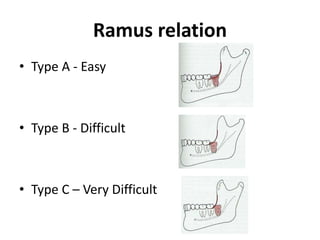
Ramus relation
• Type A - Easy
• Type B - Difficult
• Type C – Very Difficult
Winters Lines
• Red line < 5mm – Easy, can do under LA
• Red line > 5mm – Difficult, need GA
• Increasing 1mm make difficulty 3 folds
Proximity to ID nerve
Look for – Tramp line course
Radio density changes in root
Root disfiguration
These increase risk of ID nerve damage
Crown & Root configuration
• Large bulbous crown – diificult
• Divergent root – difficult
• Multiple roots - difficult
Associated pathology
Large pericoronal space - Easy
Associated cystic cavity - Easy
Surgical Procedure
Preparations
• Pt preparation – mental preparation
INFORMED WRITTEN CONSENT
Antiseptic mouth wash
• Sterility – through out the procedure
• Chair, Light, Suction & Instruments
• Assistants – Need two
Local anaesthesia
• Topical anaesthesia – lidocain spray/ gel
• ID nerve & Lingual nerve block
• Buccal infiltration
• Intraligamentary ?
• Intrapulpal ?
• Pre emptive analgesia ????
Incision
Envelop flap/One sided flap
Two sided flap
three sided flap - prefered
Flap elevation
• Use periosteal elevator
• Work under the periosteum
• Raise mucoperiosteal flap ( No mucosal flaps)
• Raise little lingual flap & protect lingual Nv
Bone removal
• Remove buccal & distal bone
• Expose crown & uppur 1/3 of root
• Need straight/ contra angle micromotor
• Use 1mm TC bur. Steel bur often breaks.
• Need good irrigation with N.S
Tooth sectioning
Tooth removal
• Use dental elevators
• Minimum force
• No forcep delivery – might damage ID nerve
• Can make drill hole to get point of application
Wound conditioning
• Irrigation – Use 20cc syringe with 16/18G
cannula + 0.9% N.S
• Removal of sharp edges & debris
• Insert surgicel / gelfoam – optional
• Close the wound
Suturing & Dressing
• Can use absorbable/non absorbable material
• Size- 3/0 with round bodied needle
• 2-3 sutures – 1st – mesial end
2nd – distal end
3rd – inbetween - optional
• No vertical incision suturing – used as drain
port
• Keep antibiotc gauze pack with pressure
Post OP instructions
• Strict resting - 24 hrs
• Keep pack – 10 min
• No hot drinks or hot meals for 24hrs
• No gargling of mouth for 24hrs
• No smoking/alcohol for 3 days
• No insertion of foreign objects
• Take soft diet
• Keep ice pack in jaw
• Use 0.2% chlorhexidine MW/bd
Post op drugs
*** Studies show No need of antibiotcs.
• Augmentin - 625mg/bd – 5 days
• Celecoxib - 200- 400mg/bd – 3days
• Panadine - 1000mg/qds – 3days
• Dexamethazone - 2mg/bd – 24 hours
• Ranitidine – 150mg/bd – 3 days
• Diazepam - 5mg/noct on that day
Potential Complications & Their
Management
Intra OP
• Bleeding – pack for 10 min
DO NOT FEAR. IT WILL ARREST
• Loss of tooth piece/tooth – look into socket,
suction apparatus, tissue spaces
Aspirated ? – Need CXR & referal
• Bone fracture
• Nerve injury Refer to OMF unit
Immediate Post op (24rs to 48hrs)
• Pain****- Main problem, give good anlgesia
• Bleeding – mild oozing will settle
• Swelling – will settle
• Haematoma – if large, refer to OMF unit
• Self inficted trauma – warn the pt
Intermediate post op (after 2-3 days)
• Swelling
• Mild pain
• Trismus – facilitate jaw opening
• Infection – give antibiotics & do I & D
• Dry socket – frequent irrigation & ZOE pack
• Lower lip/Tongue – Anaesthesia, Paraesthesia
Do sensory mapping
Observe improvement
What to do if there is a,
• Persistent swelling
• Persistent bleeding
• Massive haematoma
• Nerve injuries Refer to OMFU
• Bone/tooth fracture
• Persistant trismus
• Anaesthesia/Paraesthesia
• TMJ pain
Thank You
Any Questions ?

Mandibular impacted third molar removal

  • 1.
    Mandibular impacted 3rd molarremoval Dr. Anushan Madhushanka..BDS, MD/OMFS, MFDRCSI Senior registrar in OMF surgery North ColomboTeaching hospital, Sri Lanka
  • 2.
    What is animpaction? • A tooth that failed to erupt during its development • Eruption time 18-20 yrs • Maximum time 24 yrs • After 25yrs no eruption, remain same site • Eruption unlikely if mesioangulated No space distal to 2nd molar
  • 3.
  • 4.
    Indication for removal (NICEguidelines) Episodes of pericoronitis > 2times Gross caries Untreatable pulpitis Associated pathology- cyst , tumour, CA Jaw surgeries – Osteotomies Orthodontist requirement *** No prophylactic removal if asymptomatic
  • 5.
    Difficulty assessment Why difficultyassessment ? • To determine GA/LA • For Preparation of pt • To minimise the complication What is the difficulty here? Physical & mental stress to surgeon & Pt Time Preservation of vital structures
  • 6.
    General assessment • PMH/allergies •Past dental treatment • Age • Body frame • Male / female • Occupation
  • 7.
    Local assessment • Mouthopening • Tongue size • Thickness of alveolar bone • Condition of the 2nd molar – large restorations Caries • Pre OP sensation of lower lip & tongue****
  • 8.
    3rd molar assessment *****Clinical& Radiographic Clinical Assessment • Depth of impaction • Angulation • Space available distal to 2nd molar
  • 9.
    3rd molar assessmentcont.. Radiographic assessment • Use - IOPA, Lateral Oblique, OPG, CBCT • Standard – IOPA / OPG
  • 10.
    Radiographic assessment • IOPA/OPGassessment 1. Depth of impaction 2. Angulations 3. Ramus relation 4. Winters Lines 5. ID Nerve relationship 6. Crown & root configuration 7. Bone quality 8. Any pariapical pathology
  • 11.
  • 12.
    Angulation 1. Mesialy -Easy 2. Distaly – Very difficult 3. Vertical – Moderately difficult 4. Horizontal - Moderately difficult 5. Buccoversion 6. Linguoversion 7. Inverted
  • 13.
    Ramus relation • TypeA - Easy • Type B - Difficult • Type C – Very Difficult
  • 14.
    Winters Lines • Redline < 5mm – Easy, can do under LA • Red line > 5mm – Difficult, need GA • Increasing 1mm make difficulty 3 folds
  • 15.
    Proximity to IDnerve Look for – Tramp line course Radio density changes in root Root disfiguration These increase risk of ID nerve damage
  • 16.
    Crown & Rootconfiguration • Large bulbous crown – diificult • Divergent root – difficult • Multiple roots - difficult
  • 17.
    Associated pathology Large pericoronalspace - Easy Associated cystic cavity - Easy
  • 18.
    Surgical Procedure Preparations • Ptpreparation – mental preparation INFORMED WRITTEN CONSENT Antiseptic mouth wash • Sterility – through out the procedure • Chair, Light, Suction & Instruments • Assistants – Need two
  • 19.
    Local anaesthesia • Topicalanaesthesia – lidocain spray/ gel • ID nerve & Lingual nerve block • Buccal infiltration • Intraligamentary ? • Intrapulpal ? • Pre emptive analgesia ????
  • 20.
    Incision Envelop flap/One sidedflap Two sided flap three sided flap - prefered
  • 21.
    Flap elevation • Useperiosteal elevator • Work under the periosteum • Raise mucoperiosteal flap ( No mucosal flaps) • Raise little lingual flap & protect lingual Nv
  • 22.
    Bone removal • Removebuccal & distal bone • Expose crown & uppur 1/3 of root • Need straight/ contra angle micromotor • Use 1mm TC bur. Steel bur often breaks. • Need good irrigation with N.S
  • 23.
  • 24.
    Tooth removal • Usedental elevators • Minimum force • No forcep delivery – might damage ID nerve • Can make drill hole to get point of application
  • 25.
    Wound conditioning • Irrigation– Use 20cc syringe with 16/18G cannula + 0.9% N.S • Removal of sharp edges & debris • Insert surgicel / gelfoam – optional • Close the wound
  • 26.
    Suturing & Dressing •Can use absorbable/non absorbable material • Size- 3/0 with round bodied needle • 2-3 sutures – 1st – mesial end 2nd – distal end 3rd – inbetween - optional • No vertical incision suturing – used as drain port • Keep antibiotc gauze pack with pressure
  • 27.
    Post OP instructions •Strict resting - 24 hrs • Keep pack – 10 min • No hot drinks or hot meals for 24hrs • No gargling of mouth for 24hrs • No smoking/alcohol for 3 days • No insertion of foreign objects • Take soft diet • Keep ice pack in jaw • Use 0.2% chlorhexidine MW/bd
  • 28.
    Post op drugs ***Studies show No need of antibiotcs. • Augmentin - 625mg/bd – 5 days • Celecoxib - 200- 400mg/bd – 3days • Panadine - 1000mg/qds – 3days • Dexamethazone - 2mg/bd – 24 hours • Ranitidine – 150mg/bd – 3 days • Diazepam - 5mg/noct on that day
  • 29.
    Potential Complications &Their Management Intra OP • Bleeding – pack for 10 min DO NOT FEAR. IT WILL ARREST • Loss of tooth piece/tooth – look into socket, suction apparatus, tissue spaces Aspirated ? – Need CXR & referal • Bone fracture • Nerve injury Refer to OMF unit
  • 30.
    Immediate Post op(24rs to 48hrs) • Pain****- Main problem, give good anlgesia • Bleeding – mild oozing will settle • Swelling – will settle • Haematoma – if large, refer to OMF unit • Self inficted trauma – warn the pt
  • 31.
    Intermediate post op(after 2-3 days) • Swelling • Mild pain • Trismus – facilitate jaw opening • Infection – give antibiotics & do I & D • Dry socket – frequent irrigation & ZOE pack • Lower lip/Tongue – Anaesthesia, Paraesthesia Do sensory mapping Observe improvement
  • 32.
    What to doif there is a, • Persistent swelling • Persistent bleeding • Massive haematoma • Nerve injuries Refer to OMFU • Bone/tooth fracture • Persistant trismus • Anaesthesia/Paraesthesia • TMJ pain
  • 33.