6- Major Connectors
a. Maxillary Major Connectors
Major Connectors
Dr. Amal Fathy Kaddah
Professor of Prosthodontic,
Faculty of Dentistry,
Cairo University
Believe
in
your
Dreams
Definition
Types
Location and form
Requirements
Indication and contraindication
Advantages
Disadvantages
Support
Retention
Bracing and Stability
Indirect Retention
Function
Major connector (or any component)
+ Special function
?
?
?
?
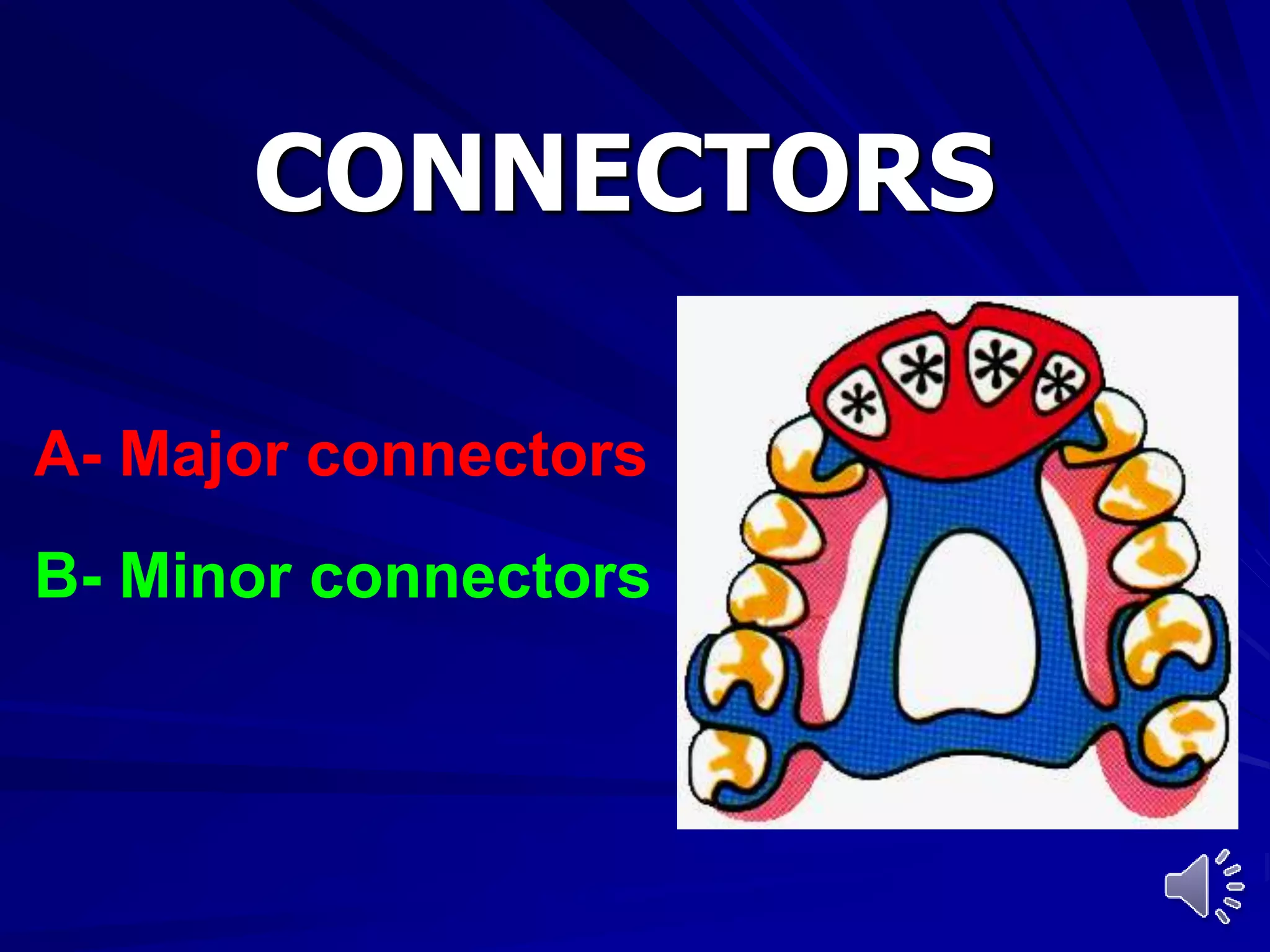
CONNECTORS
A- Major connectors
B- Minor connectors
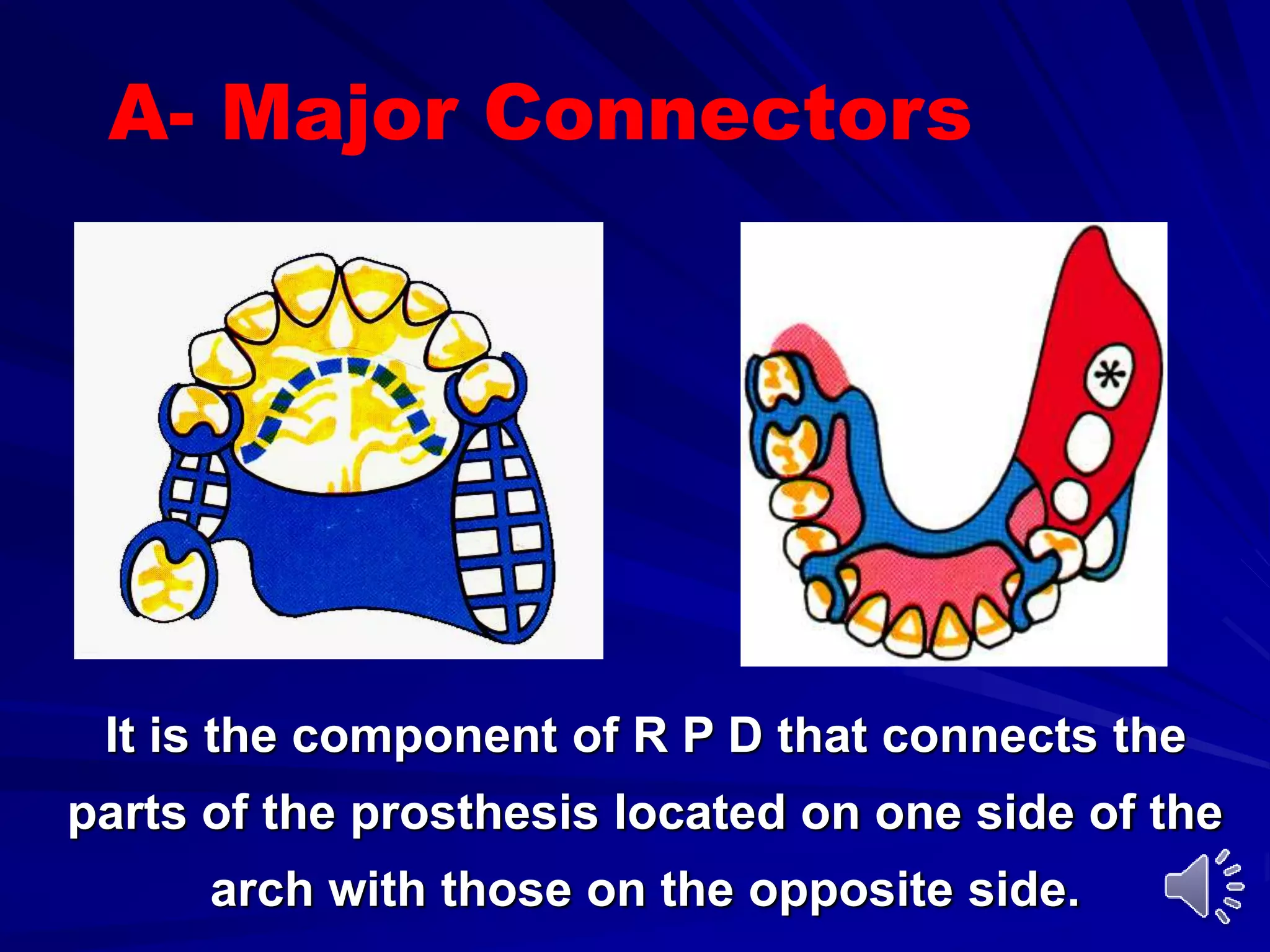
A- Major Connectors
It is the component of R P D that connects the
parts of the prosthesis located on one side of the
arch with those on the opposite side.
2. Contribute to the support of
the prosthesis.
3. They may contribute to the
functions of bracing and
reciprocation.
Functions of connectors
4. Contribute to retention of the prosthesis: Palatal
plates provide direct retention.
5. Connectors resting on prepared dental or firm oral
tissues provide indirect retention.
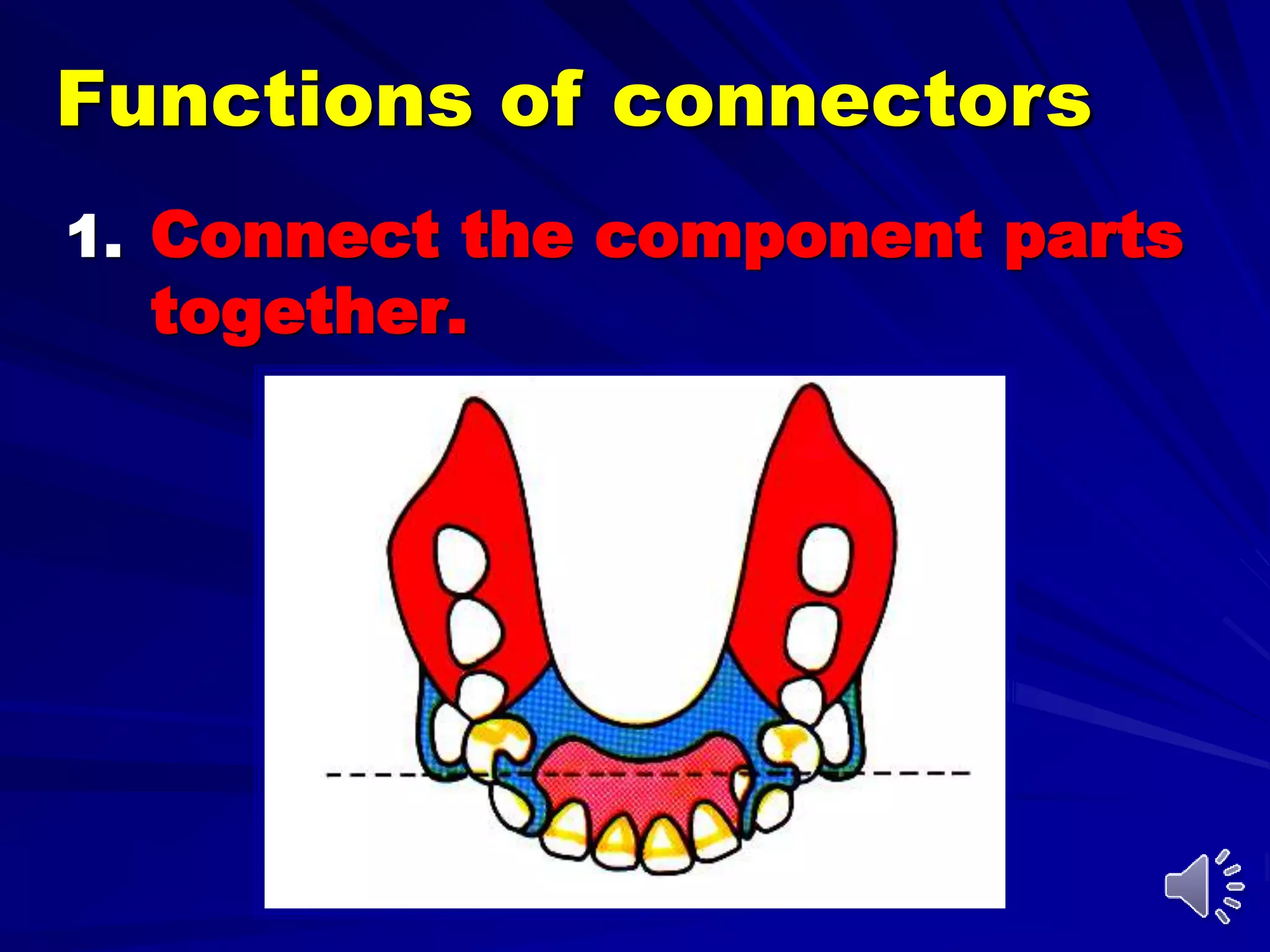
1. Join the component parts of RPD together.
1. Connect the component parts
together.
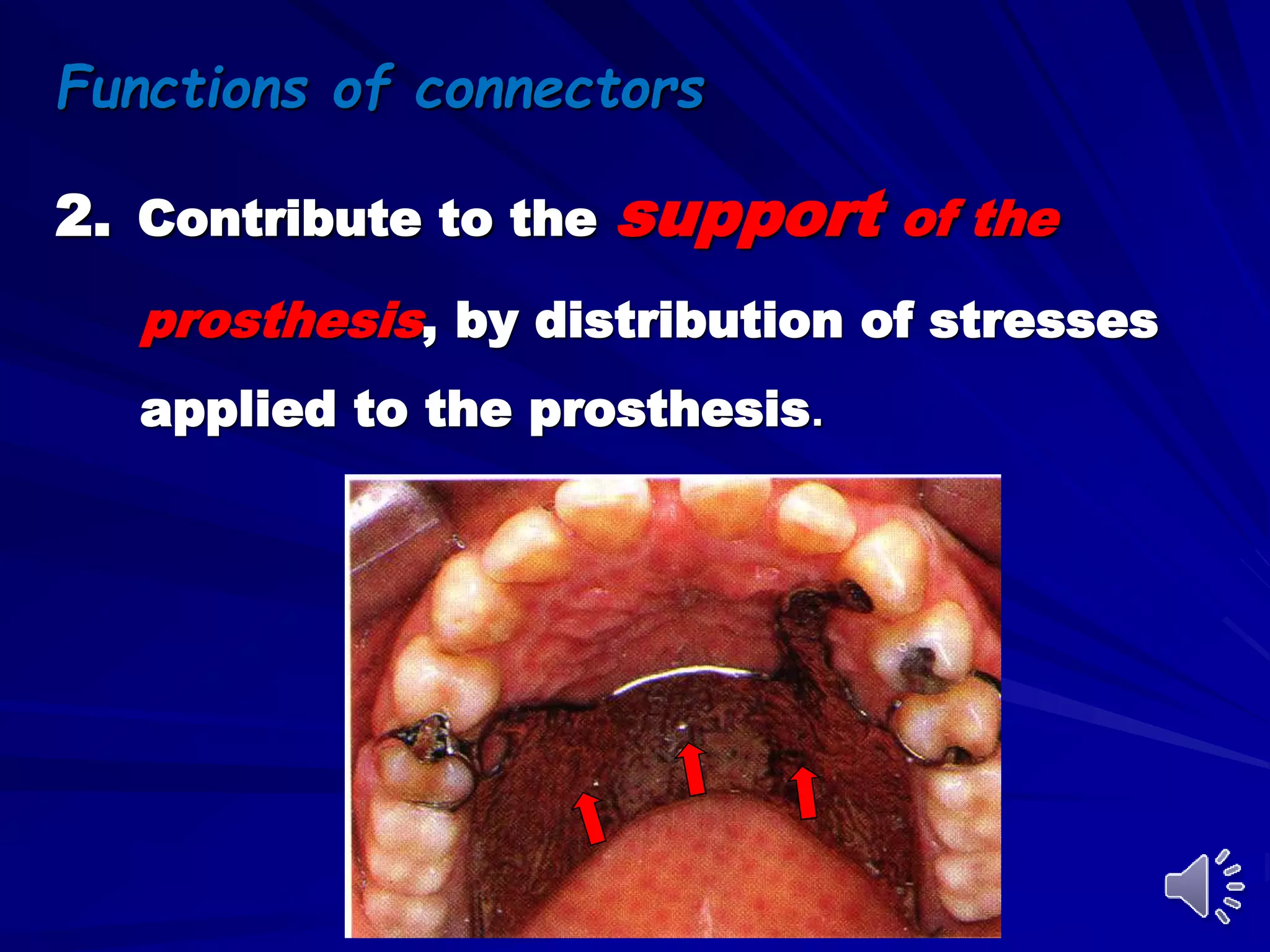
Functions of connectors
2. Contribute to the support of the
prosthesis, by distribution of stresses
applied to the prosthesis.
Functions of connectors
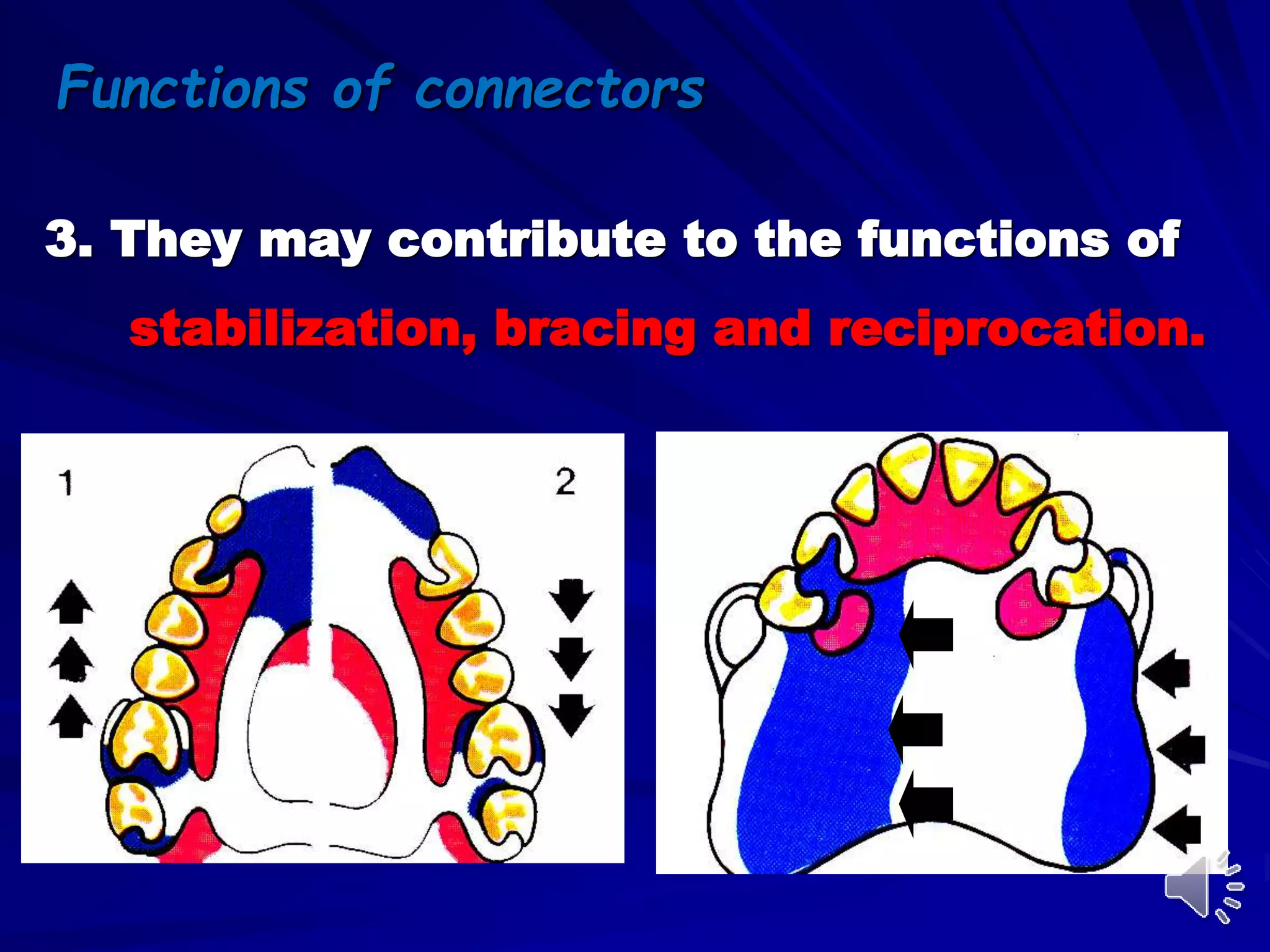
3. They may contribute to the functions of
stabilization, bracing and reciprocation.
Functions of connectors
Contribute to the functions of bracing and
reciprocation
This Component Provides Cross-arch
Stabilization.
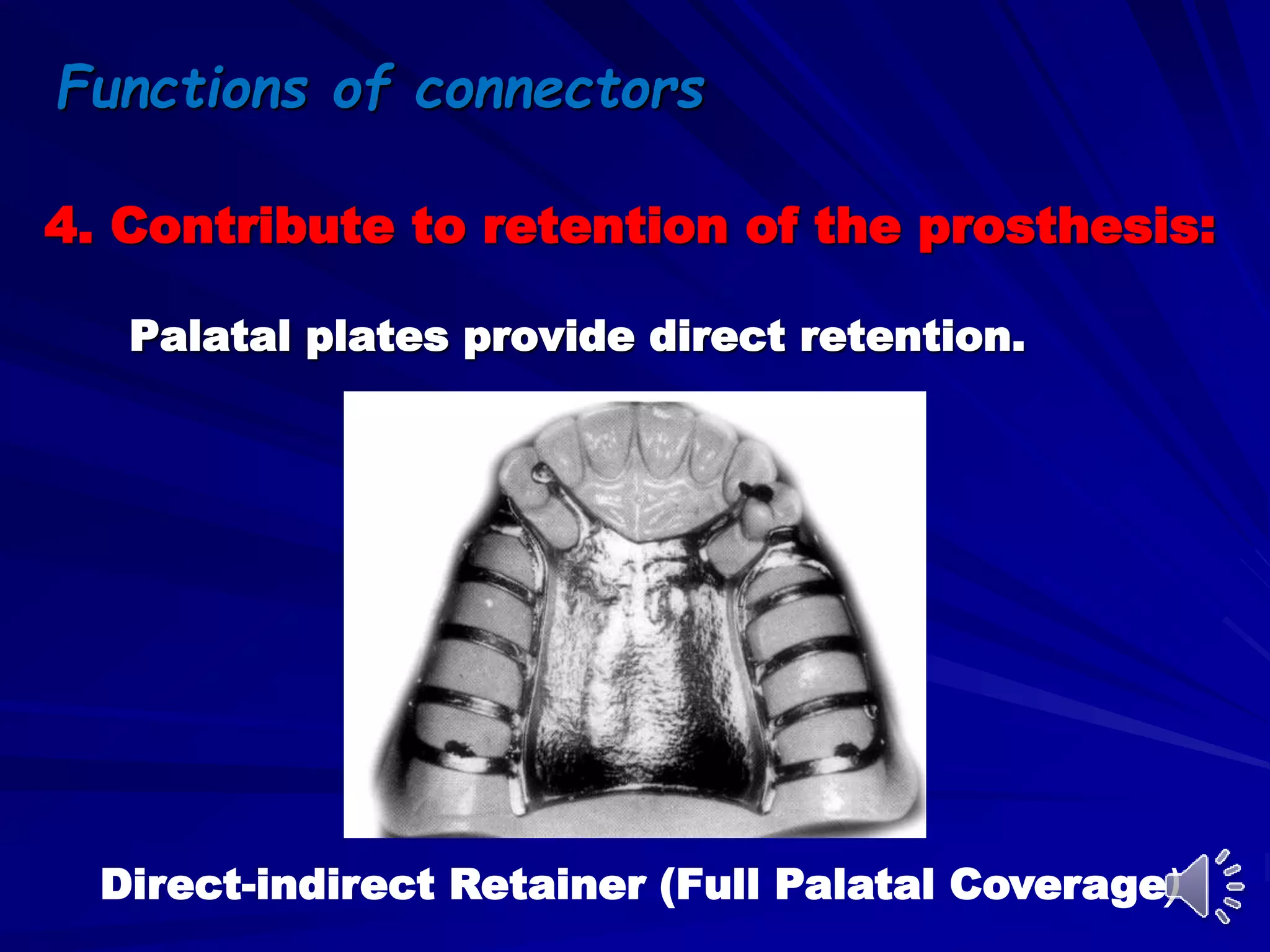
4. Contribute to retention of the prosthesis:
Palatal plates provide direct retention.
Direct-indirect Retainer (Full Palatal Coverage)
Functions of connectors
May Provide Indirect Retention.
Anterior Palatal Bar
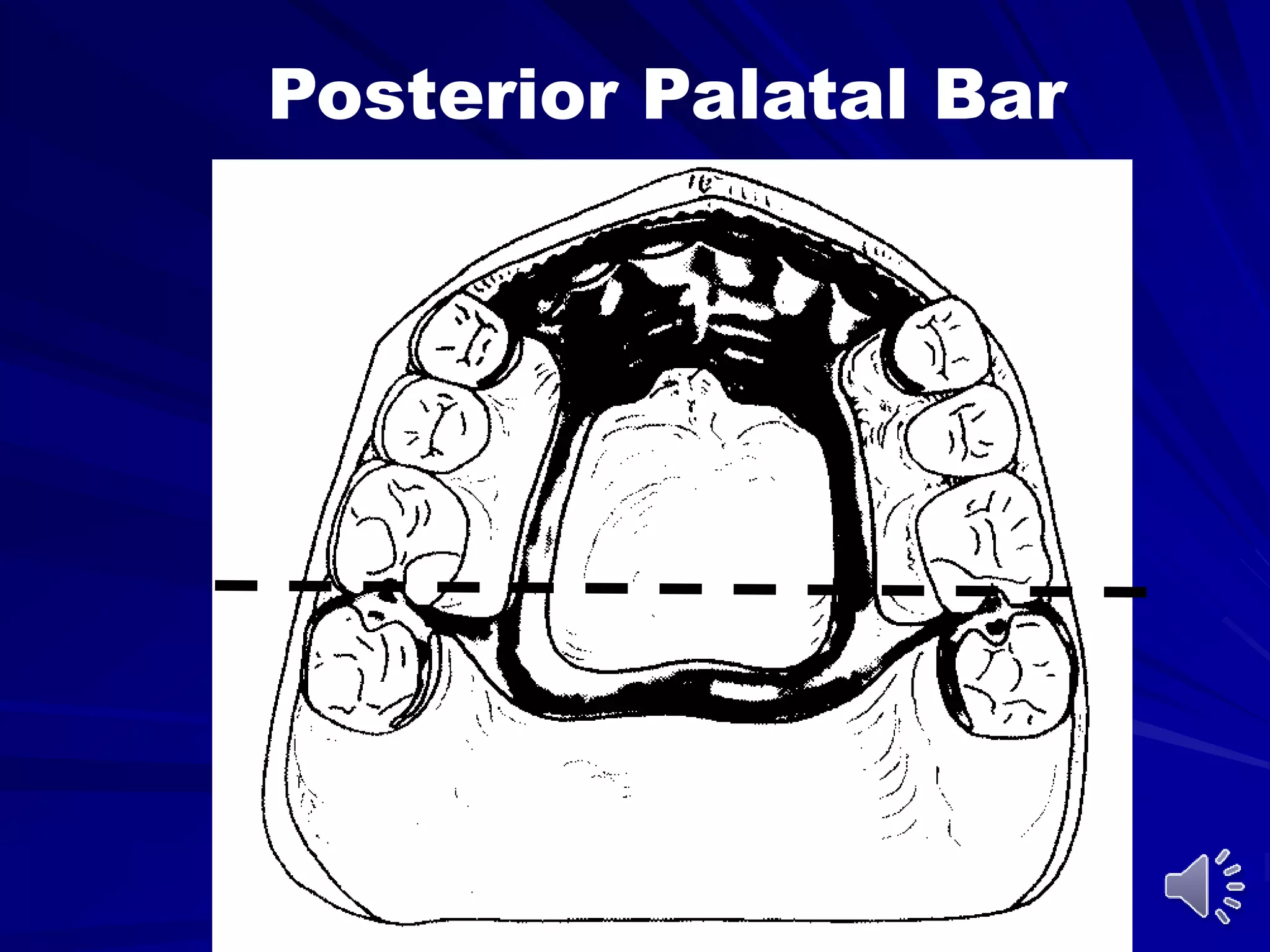
Posterior Palatal Bar
Smile when
picking up the
phone. The caller
will hear it in
your voice
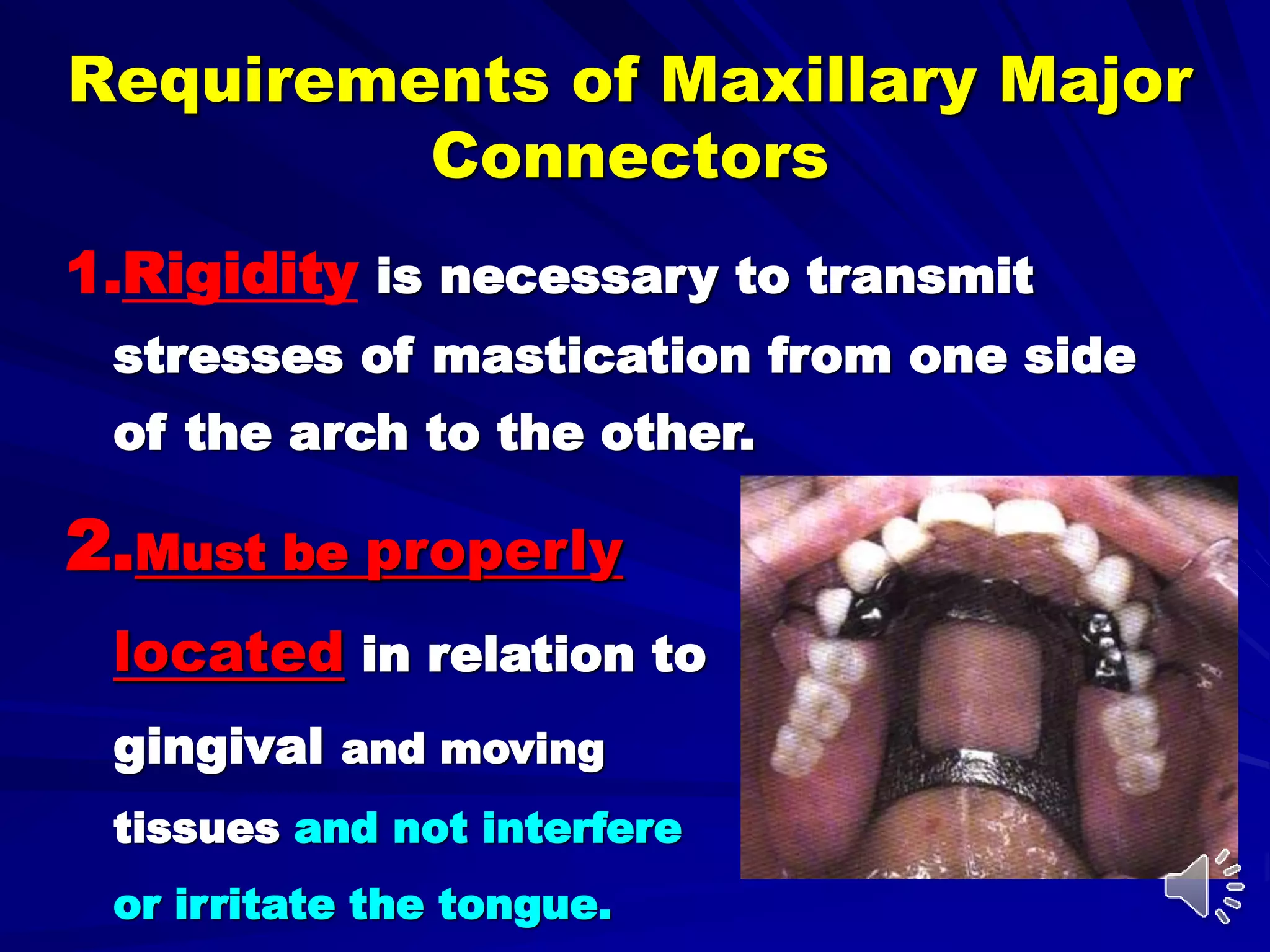
1.Rigidity is necessary to transmit
stresses of mastication from one side
of the arch to the other.
2.Must be properly
located in relation to
gingival and moving
tissues and not interfere
or irritate the tongue.
Requirements of Maxillary Major
Connectors
3. Should be self-cleansing
4. Not allow trapping of food particles.
5. Should be made from an alloy
compatible with oral tissues.
6. Relief is avoided under maxillary major
connector except in the presence of
palatal tori or prominent median palatine
raphe.
7. Should not alter the
natural contour of the
palatal surfaces of the
arch.
8. The lateral palatal borders
should be placed at the
junction of the vertical
and horizontal surfaces of
the palate.
9. It should cross the midline
of the palate
perpendicular to it.
10. Bony or soft
tissue
prominences
should be avoided.
11.Cover no more
tissues than
necessary.
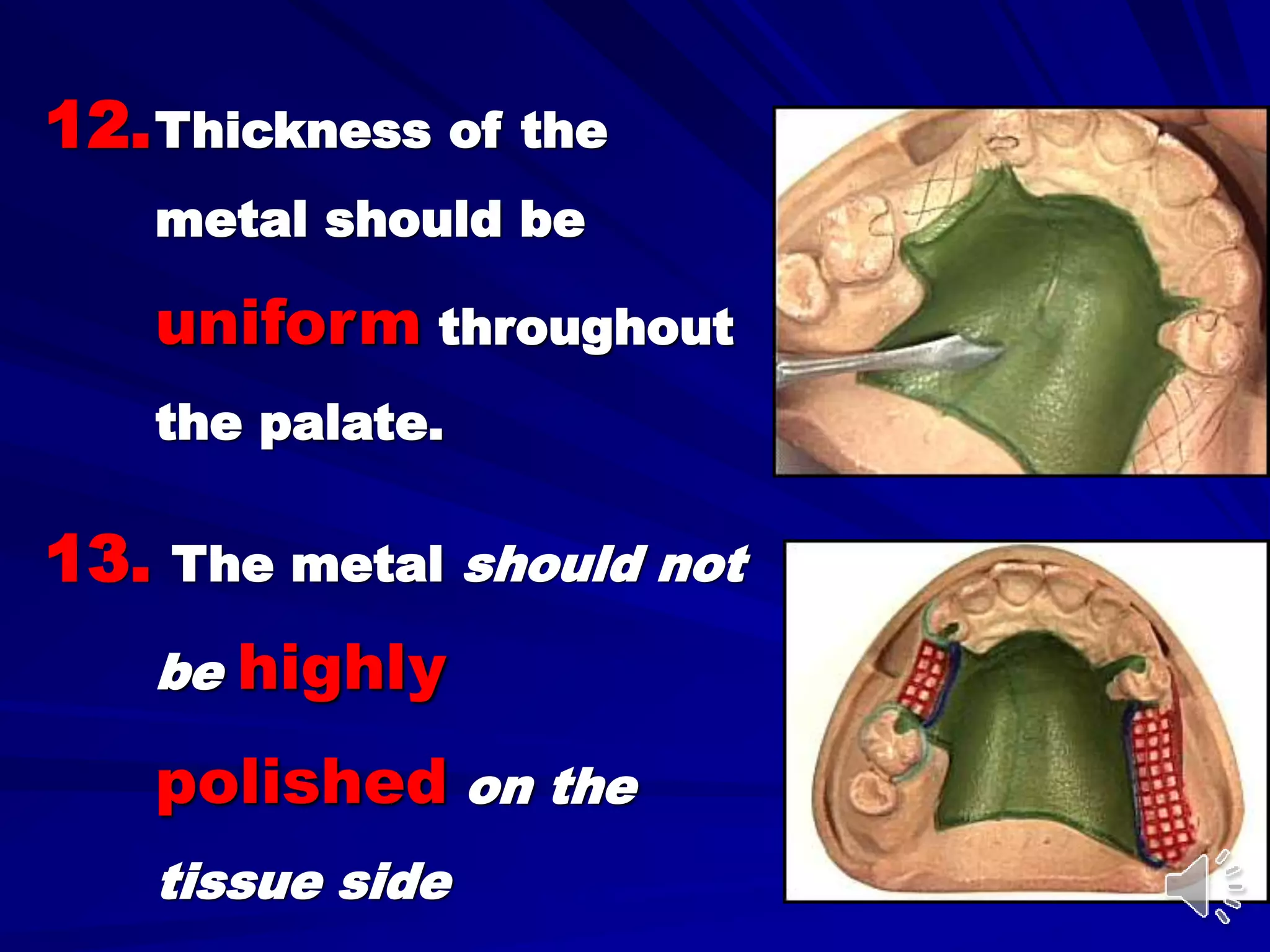
12.Thickness of the
metal should be
uniform throughout
the palate.
13. The metal should not
be highly
polished on the
tissue side
a- Placed at least 6 mm away from
the gingival margin.
14. The borders should be
Rather than diagonal
to the gingival margin
and should be
crossed abruptly
and at right angle to
the margin
b. The borders should run parallel
in order to produce the least possible
soft tissue coverage.
slightly towards the tissues, and
Hence they are less
detectable by the
tongue and not
interfere with speech,
and to minimizing
patient discomfort.
c. All borders should be tapered
d. should be smoothly curved.
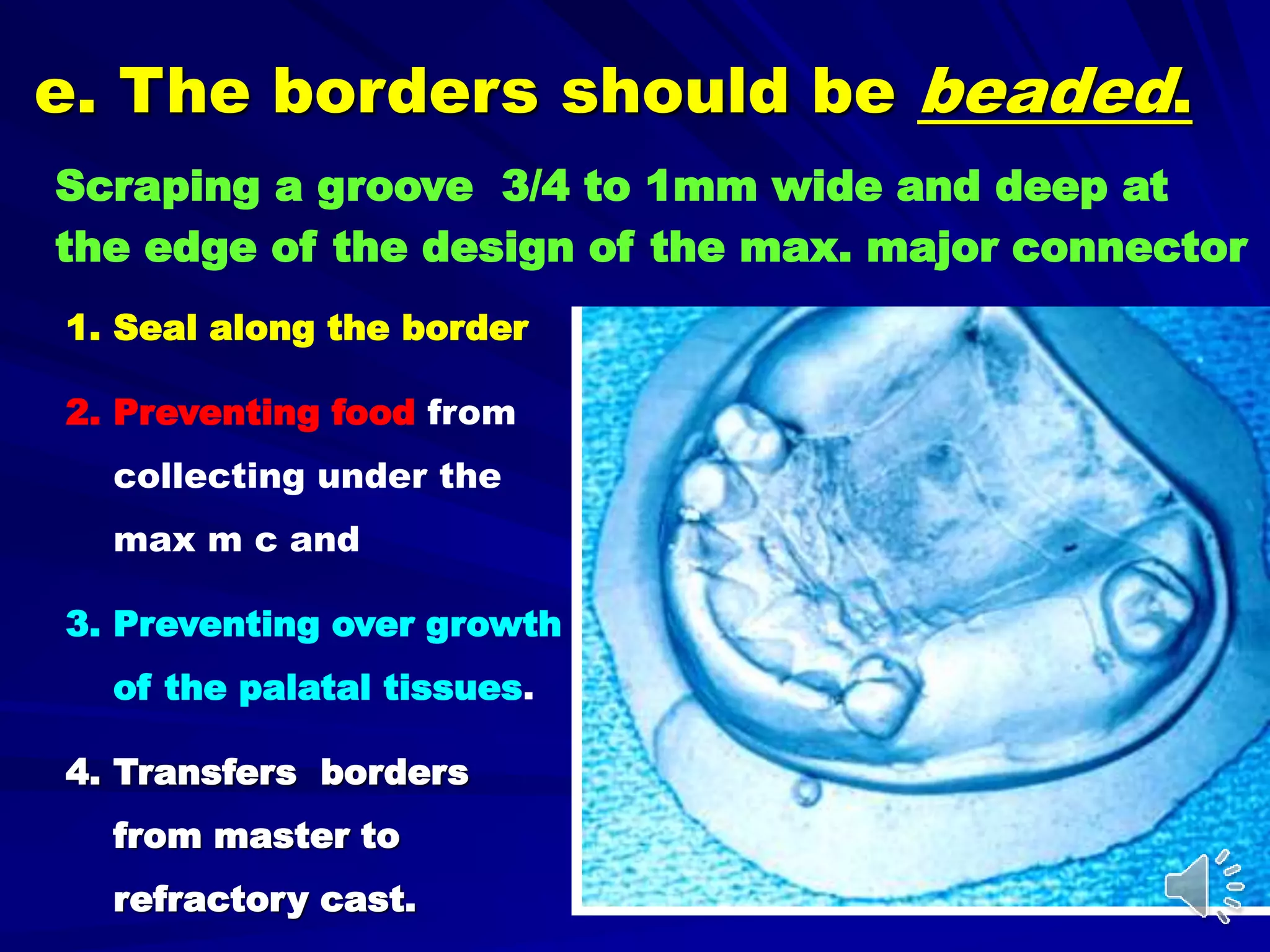
e. The borders should be beaded.
1. Seal along the border
2. Preventing food from
collecting under the
max m c and
3. Preventing over growth
of the palatal tissues.
4. Transfers borders
from master to
refractory cast.
Scraping a groove 3/4 to 1mm wide and deep at
the edge of the design of the max. major connector
STRAPS
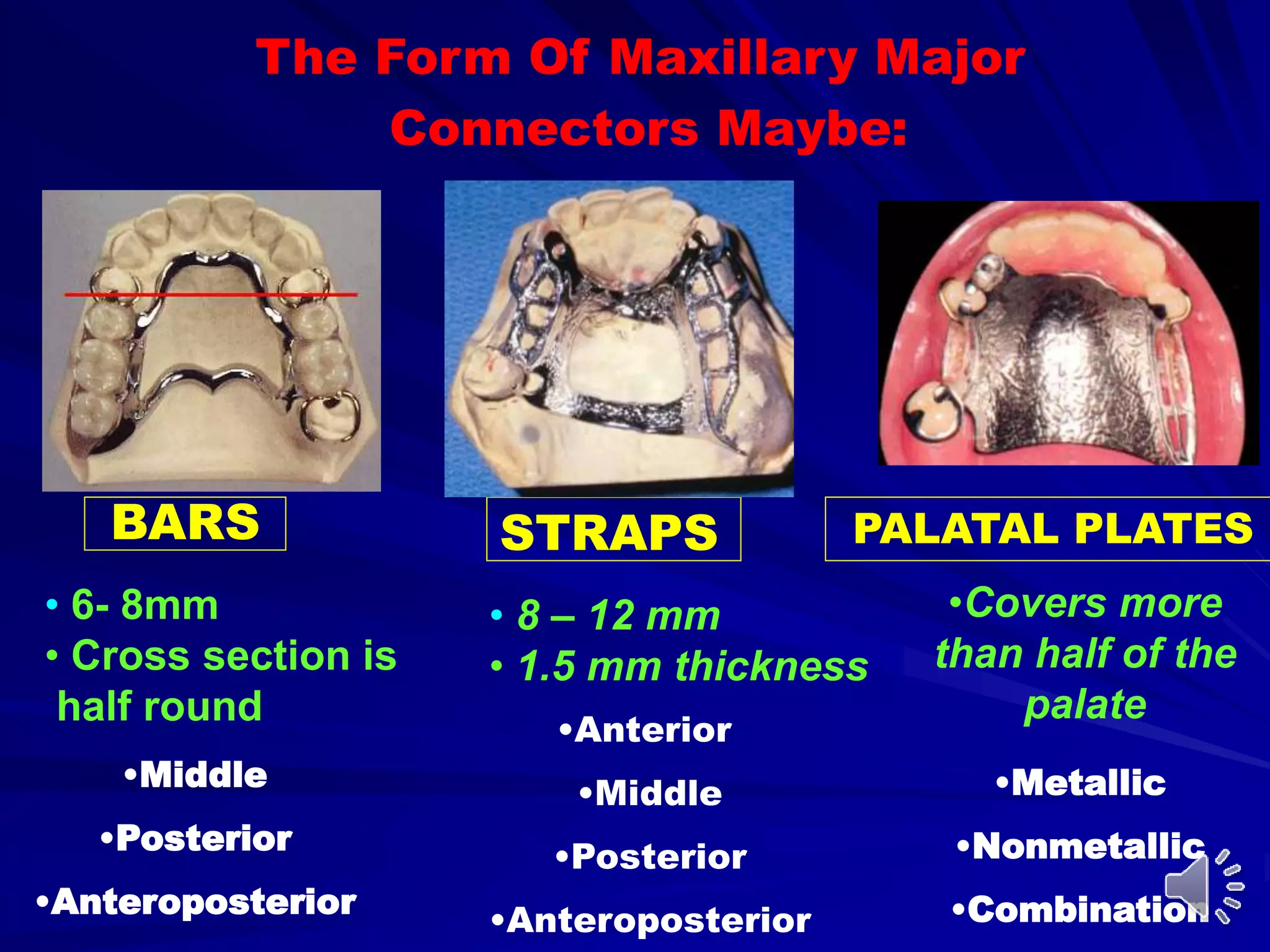
The Form Of Maxillary Major
Connectors Maybe:
BARS PALATAL PLATES
• 6- 8mm
• Cross section is
half round
• 8 – 12 mm
• 1.5 mm thickness
•Covers more
than half of the
palate
•Anterior
•Middle
•Posterior
•Anteroposterior
•Middle
•Posterior
•Anteroposterior
•Metallic
•Nonmetallic
•Combination
•Narrow, (6-8 Mm)
• Half Oval In Cross
Section (Thick).
• Their Margins Are
Beveled And Gently
Curved
• Cover lesser amounts
of tissues.
• Require more bulk of to gain the required
rigidity, may interfere with proper speech and
may be untolerated by patients
BARS
STRAPS
• Wide and thin,
• More than 8 mm in width
to gain the necessary
rigidity
• Having a uniform
thickness,
• Well tolerated
• Helps in distribution of stresses over a wider
area thus provides support
PALATAL PLATES
• Cover half or more of
the palate
• The maximum area
coverage contribute to
Wide distribution of the
stresses falling on
denture.
• Support and retention
of the prosthesis.
• Horizontal stabilization
of the prosthesis
ANTERIOR PALATAL BAR
Indication: It is rarely used alone
Location and form
Anterior palatal region, located 6-8 mm
behind the gingival margin of
anterior teeth.
Disadvantages
intolerable by patients as it crosses
the palatal rugae where tongue
activity is marked.
Speech difficulties may be
encountered.
Support
Retention
Bracing and Stability
Indirect Retention
MIDDLE PALATAL BAR
comfortable, away from the rugae area, well tolerated
Bracing are achieved
lacks rigidity unless made bulky.
Indications: In short bounded saddle
It cannot be used in cases having large torus palatinus
or prominent median palatine raphe.
POSTERIOR PALATAL BAR
• limited indications
for use as single bar.
• Location and form
in close relation to the
junction of the hard and soft
palate, or placed in level with
the second molar.
• Advantages: exhibits
limited coverage and well
tolerated by the tongue It is
not likely to affect taste.
•Bracing, indirect retention for Kennedy class IV cases.
Disadvantages: lacks of rigidity.
It cannot be used in with large torus palatinus.
ANTERO-POSTERIOR PALATAL BAR
(Ring Design, A-P bar)
Location and form: Anterior, Posterior bars and Longitudinal bars:
, the metal forming the connector lies in two different directions giving the
connector strength and rigidity
Indication: in any design especially in the presence of torus palatinus
Advantages: the most rigid bar major connector, minimal soft tissue
coverage
Disadvantages: Poor support, annoy the tongue and are intolerable
Contraindications: high, narrow palatal vault
large tori extending to the junction of the hard and soft palate.
ANTERIOR PALATAL STRAP
Location and form: in the valleys rather than the crests of the
rugae area.
Indications: a large torus or a hard prominent median palatine
raphe exists.
Advantages: some vertical support. Indirect retention may be
provided.
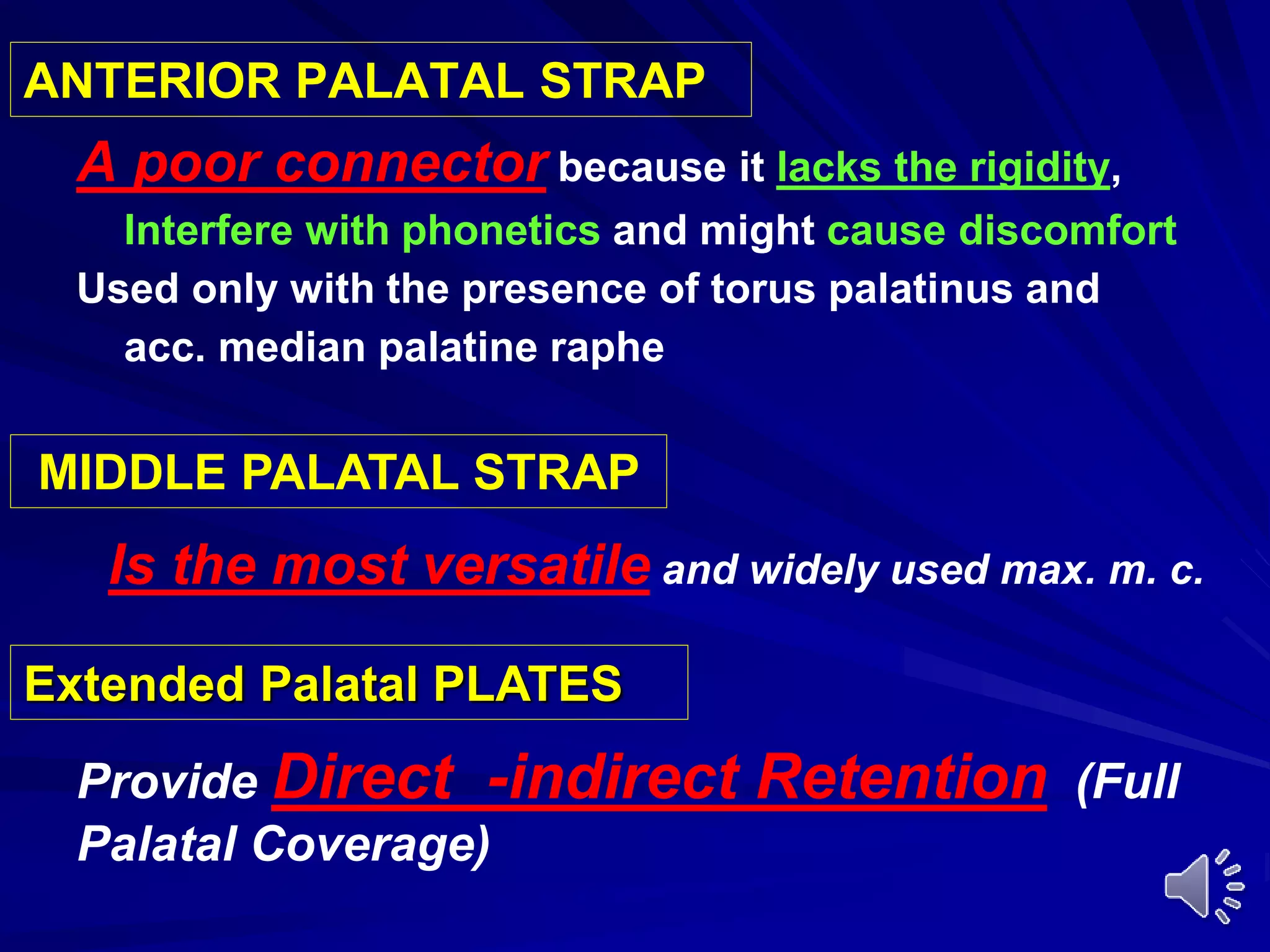
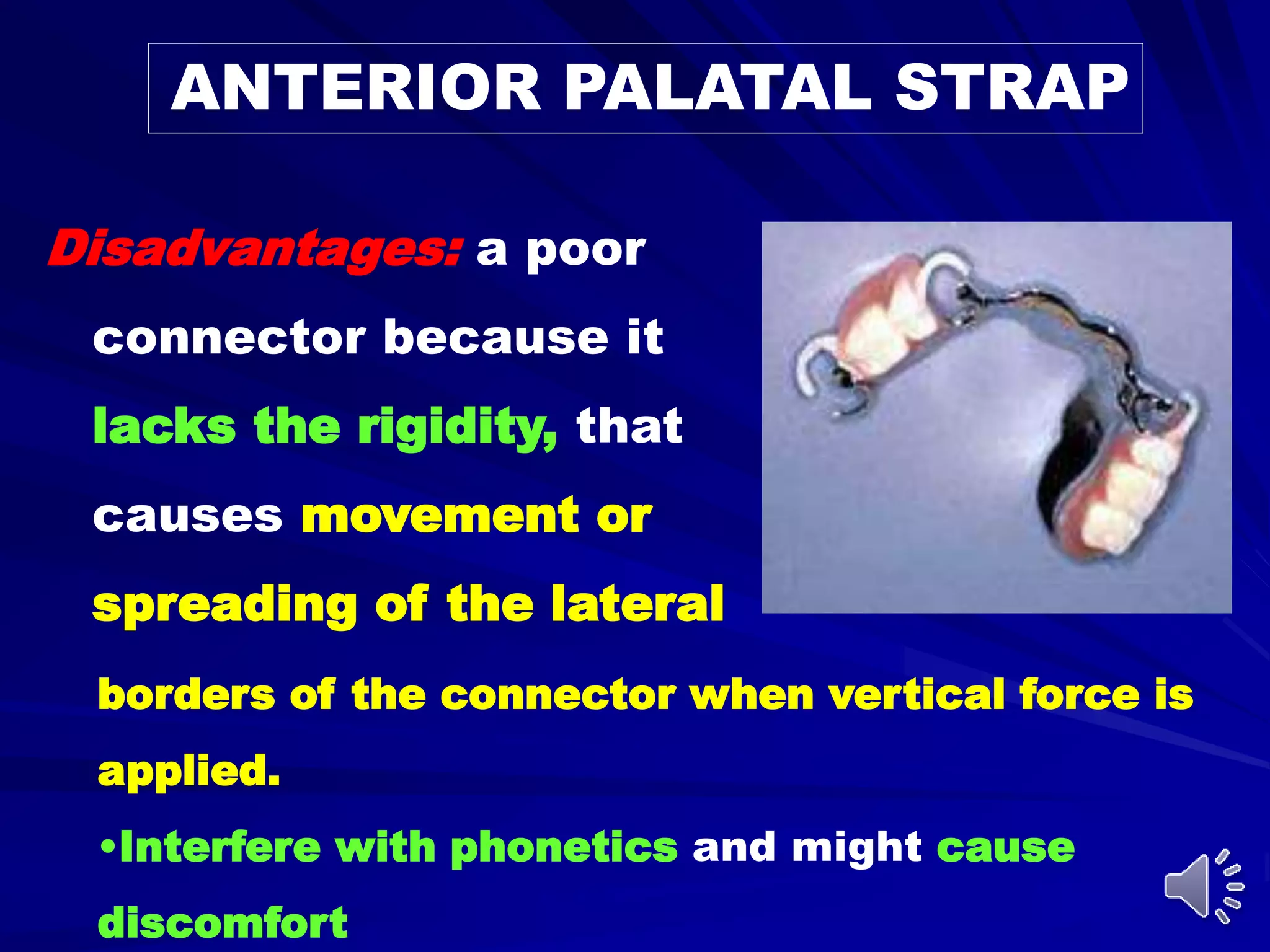
Disadvantages: a poor connector because it lacks the rigidity,
ANTERIOR PALATAL STRAP
Disadvantages: a poor
connector because it
lacks the rigidity, that
causes movement or
spreading of the lateral
borders of the connector when vertical force is
applied.
•Interfere with phonetics and might cause
discomfort
MIDDLE PALATAL STRAP
Advantages
• Rigid.
• Reduces gingival margin coverage
to a minimum
• Well tolerated
• Away from the tactile receptors
• Rarely annoying to the patient.
• Relatively narrow
• Minimal interference with
phonetics.
The most versatile and
widely used maxillary
major connector
The strap
lies on the
central
portion of
the hard
palate
MIDDLE PALATAL STRAP
POSTERIOR PALATAL STRAP
A minimum of 8
mm. in width, and
1.5mm thickness
Has a thicker
central area for
increased rigidity.
Cross section of posterior
palatal strap showing a
thicker central area for
increased rigidity
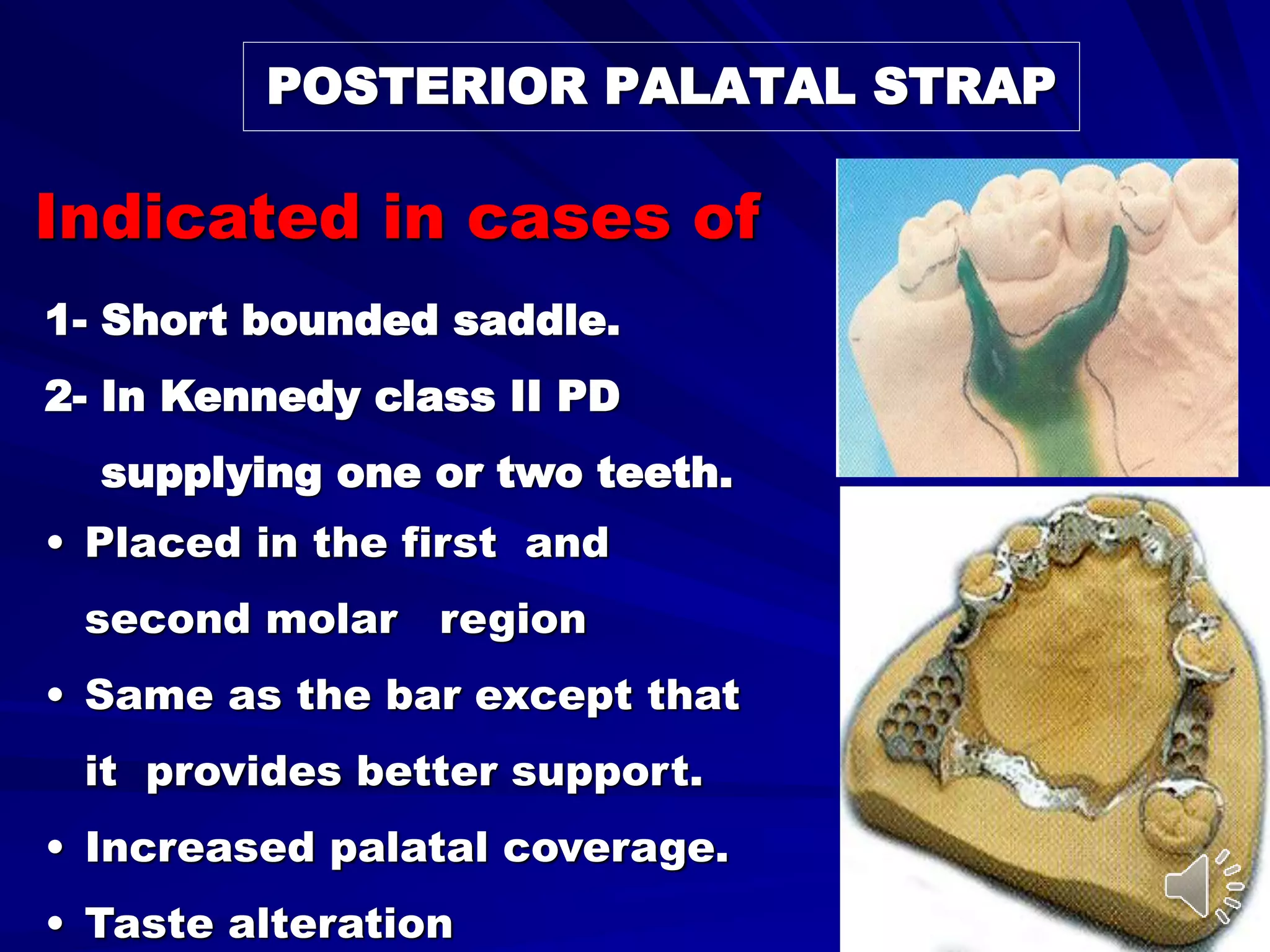
Indicated in cases of
1- Short bounded saddle.
2- In Kennedy class II PD
supplying one or two teeth.
POSTERIOR PALATAL STRAP
• Placed in the first and
second molar region
• Same as the bar except that
it provides better support.
• Increased palatal coverage.
• Taste alteration
ANTRO-POSTERIOR STRAP
Location and form: a rigid connector; similar location and
structure to that of the a p bar
Indicated in Kennedy class I or II partial denture bases, when a
large torus exists.
Advantages: Rigidity and strength of the connector allow the
metal to be used in thinner sections. Support due to wide palatal
coverage. Good retention and stability.
? ? ?
? ? ?
? ? ?
Contraindications
Anterior : speaking area??
Posterior : too far posterior for
comfort
Middle : food impaction??
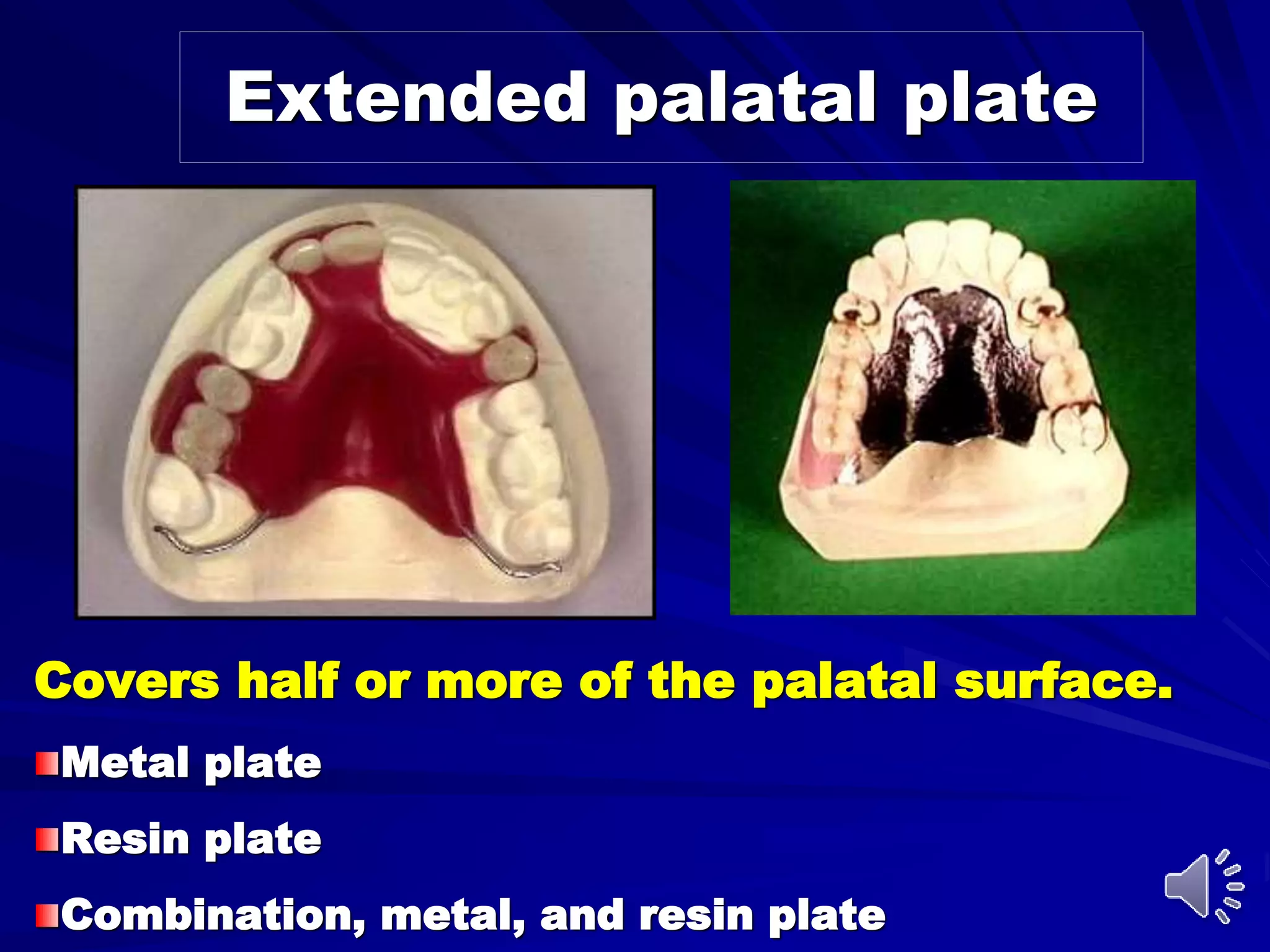
Extended palatal plate
Covers half or more of the palatal surface.
Metal plate
Resin plate
Combination, metal, and resin plate
Anterior metallic
part having
provisions for
mechanical
retention to attach
an acrylic posterior
portion.
Combination,
metal, and resin
plate
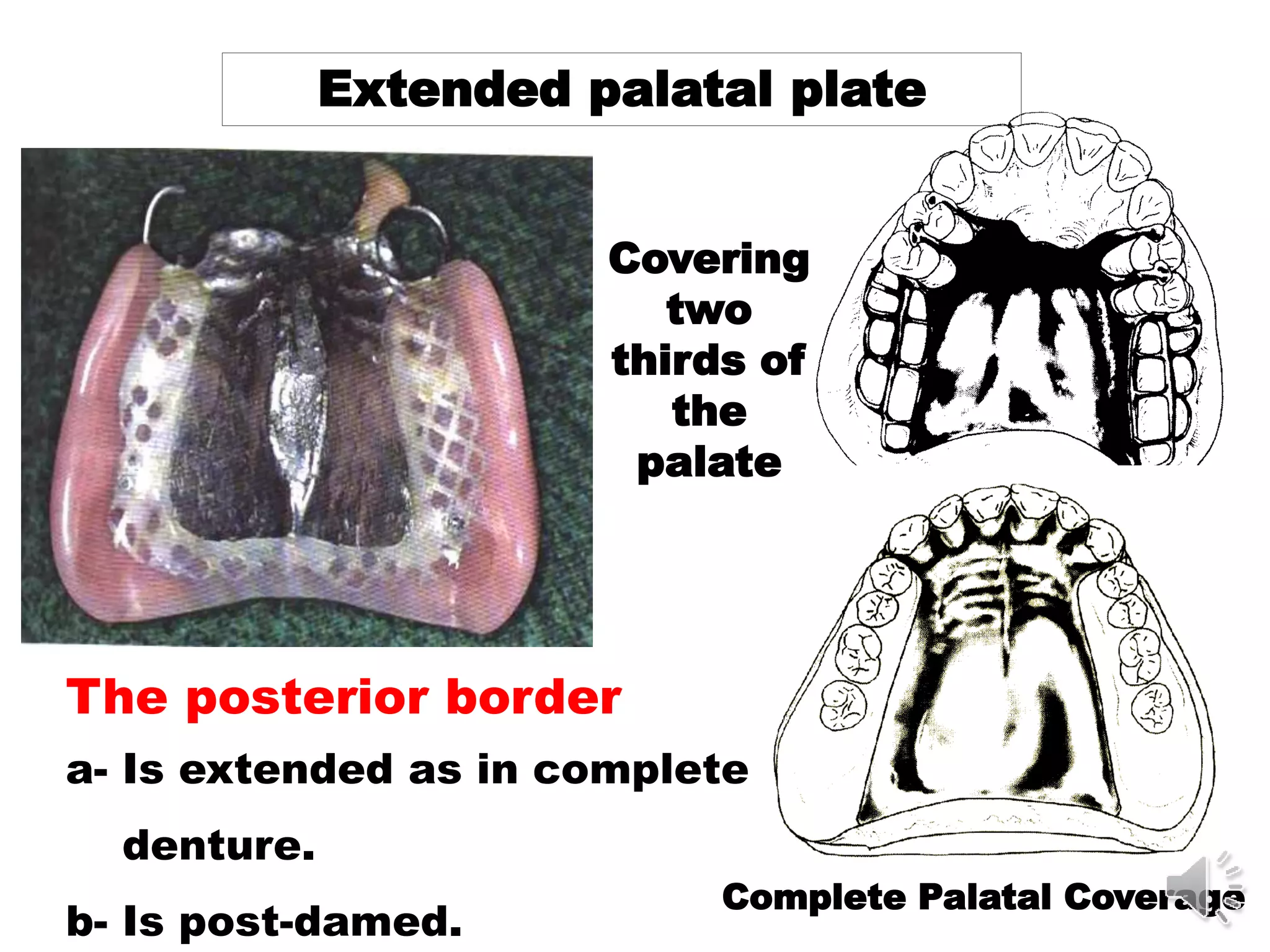
Extended palatal plate
Complete Palatal Coverage
Covering
two
thirds of
the
palate
The posterior border
a- Is extended as in complete
denture.
b- Is post-damed.
Complete palatal plate
Resin plate Cast metal plates
A palatal plate connector covers
half or more of the palatal surface
Complete palatal plate
1. Long free end saddle cases.
2. Free end saddles with anterior
modification spaces.
3. In cleft palate patients.
4. Resin plates in temporary
prosthesis.
5. Heavy occlusion.
6. Poor flat ridges.
Indications:
Long free end saddle cases.
Class I
Class IV
Cast metal
plates
Factors affecting selection of the
maxillary major connector design
1- The need for rigidity and support.
2- Sites of the edentulous areas.
3- Patient’s comfort :
a- Taste sensation.
b- Gagging sensation.
c- Torus palatinus.
d- Presence of palatal defects.
e- Amount of palatal coverage.
4- The need for indirect retention.
All anterior Max. M. C.
Disadvantages
intolerable by patients as it crosses the palatal rugae where
tongue activity is marked.
Speech difficulties may be encountered.
All Max. M. C.
Bracing is achieved by the vertical parts of the connector
All Max. M. C. except single bar and ant pal. strap
Provide Rigidity, Support.
All Max. M. C. except middle palatal MC
Provide indirect Retention
Give
reasons
???
All Max. M. C. except Bar major connectors
Provide Retention
ANTERIOR PALATAL STRAP
A poor connector because it lacks the rigidity,
Interfere with phonetics and might cause discomfort
Used only with the presence of torus palatinus and
acc. median palatine raphe
MIDDLE PALATAL STRAP
Extended Palatal PLATES
Is the most versatile and widely used max. m. c.
Provide Direct -indirect Retention (Full
Palatal Coverage)
‫رمانى‬ ‫ساعده‬ ‫اشتد‬‫لما‬‫ف‬ ‫يوم‬ ‫كل‬ ‫الرماية‬‫اعلمه‬
‫هجانى‬ ‫افية‬‫ق‬ ‫ال‬‫ق‬ ‫لما‬‫ف‬ ‫القوافى‬‫نظم‬ ‫علمته‬ ‫وكم‬
‫المازنى‬‫أوس‬‫ابن‬‫معن‬
Maxillary major connectors

Maxillary major connectors

  • 1.
    6- Major Connectors a.Maxillary Major Connectors
  • 3.
    Major Connectors Dr. AmalFathy Kaddah Professor of Prosthodontic, Faculty of Dentistry, Cairo University
  • 4.
  • 5.
    Definition Types Location and form Requirements Indicationand contraindication Advantages Disadvantages Support Retention Bracing and Stability Indirect Retention Function Major connector (or any component) + Special function ? ? ? ?
  • 6.
  • 7.
    A- Major Connectors Itis the component of R P D that connects the parts of the prosthesis located on one side of the arch with those on the opposite side.
  • 8.
    2. Contribute tothe support of the prosthesis. 3. They may contribute to the functions of bracing and reciprocation. Functions of connectors 4. Contribute to retention of the prosthesis: Palatal plates provide direct retention. 5. Connectors resting on prepared dental or firm oral tissues provide indirect retention. 1. Join the component parts of RPD together.
  • 9.
    1. Connect thecomponent parts together. Functions of connectors
  • 10.
    2. Contribute tothe support of the prosthesis, by distribution of stresses applied to the prosthesis. Functions of connectors
  • 11.
    3. They maycontribute to the functions of stabilization, bracing and reciprocation. Functions of connectors
  • 12.
    Contribute to thefunctions of bracing and reciprocation
  • 13.
    This Component ProvidesCross-arch Stabilization.
  • 14.
    4. Contribute toretention of the prosthesis: Palatal plates provide direct retention. Direct-indirect Retainer (Full Palatal Coverage) Functions of connectors
  • 15.
  • 16.
  • 17.
  • 18.
    Smile when picking upthe phone. The caller will hear it in your voice
  • 20.
    1.Rigidity is necessaryto transmit stresses of mastication from one side of the arch to the other. 2.Must be properly located in relation to gingival and moving tissues and not interfere or irritate the tongue. Requirements of Maxillary Major Connectors
  • 21.
    3. Should beself-cleansing 4. Not allow trapping of food particles. 5. Should be made from an alloy compatible with oral tissues. 6. Relief is avoided under maxillary major connector except in the presence of palatal tori or prominent median palatine raphe.
  • 22.
    7. Should notalter the natural contour of the palatal surfaces of the arch. 8. The lateral palatal borders should be placed at the junction of the vertical and horizontal surfaces of the palate. 9. It should cross the midline of the palate perpendicular to it.
  • 23.
    10. Bony orsoft tissue prominences should be avoided. 11.Cover no more tissues than necessary.
  • 24.
    12.Thickness of the metalshould be uniform throughout the palate. 13. The metal should not be highly polished on the tissue side
  • 25.
    a- Placed atleast 6 mm away from the gingival margin. 14. The borders should be
  • 26.
    Rather than diagonal tothe gingival margin and should be crossed abruptly and at right angle to the margin b. The borders should run parallel in order to produce the least possible soft tissue coverage.
  • 27.
    slightly towards thetissues, and Hence they are less detectable by the tongue and not interfere with speech, and to minimizing patient discomfort. c. All borders should be tapered d. should be smoothly curved.
  • 28.
    e. The bordersshould be beaded. 1. Seal along the border 2. Preventing food from collecting under the max m c and 3. Preventing over growth of the palatal tissues. 4. Transfers borders from master to refractory cast. Scraping a groove 3/4 to 1mm wide and deep at the edge of the design of the max. major connector
  • 30.
    STRAPS The Form OfMaxillary Major Connectors Maybe: BARS PALATAL PLATES • 6- 8mm • Cross section is half round • 8 – 12 mm • 1.5 mm thickness •Covers more than half of the palate •Anterior •Middle •Posterior •Anteroposterior •Middle •Posterior •Anteroposterior •Metallic •Nonmetallic •Combination
  • 31.
    •Narrow, (6-8 Mm) •Half Oval In Cross Section (Thick). • Their Margins Are Beveled And Gently Curved • Cover lesser amounts of tissues. • Require more bulk of to gain the required rigidity, may interfere with proper speech and may be untolerated by patients BARS
  • 32.
    STRAPS • Wide andthin, • More than 8 mm in width to gain the necessary rigidity • Having a uniform thickness, • Well tolerated • Helps in distribution of stresses over a wider area thus provides support
  • 33.
    PALATAL PLATES • Coverhalf or more of the palate • The maximum area coverage contribute to Wide distribution of the stresses falling on denture. • Support and retention of the prosthesis. • Horizontal stabilization of the prosthesis
  • 34.
    ANTERIOR PALATAL BAR Indication:It is rarely used alone Location and form Anterior palatal region, located 6-8 mm behind the gingival margin of anterior teeth. Disadvantages intolerable by patients as it crosses the palatal rugae where tongue activity is marked. Speech difficulties may be encountered. Support Retention Bracing and Stability Indirect Retention
  • 35.
    MIDDLE PALATAL BAR comfortable,away from the rugae area, well tolerated Bracing are achieved lacks rigidity unless made bulky. Indications: In short bounded saddle It cannot be used in cases having large torus palatinus or prominent median palatine raphe.
  • 36.
    POSTERIOR PALATAL BAR •limited indications for use as single bar. • Location and form in close relation to the junction of the hard and soft palate, or placed in level with the second molar. • Advantages: exhibits limited coverage and well tolerated by the tongue It is not likely to affect taste. •Bracing, indirect retention for Kennedy class IV cases. Disadvantages: lacks of rigidity. It cannot be used in with large torus palatinus.
  • 37.
    ANTERO-POSTERIOR PALATAL BAR (RingDesign, A-P bar) (Ring Design, A-P bar) Location and form: Anterior, Posterior bars and Longitudinal bars: , the metal forming the connector lies in two different directions giving the connector strength and rigidity Indication: in any design especially in the presence of torus palatinus Advantages: the most rigid bar major connector, minimal soft tissue coverage Disadvantages: Poor support, annoy the tongue and are intolerable Contraindications: high, narrow palatal vault large tori extending to the junction of the hard and soft palate.
  • 38.
    ANTERIOR PALATAL STRAP Locationand form: in the valleys rather than the crests of the rugae area. Indications: a large torus or a hard prominent median palatine raphe exists. Advantages: some vertical support. Indirect retention may be provided. Disadvantages: a poor connector because it lacks the rigidity,
  • 39.
    ANTERIOR PALATAL STRAP Disadvantages:a poor connector because it lacks the rigidity, that causes movement or spreading of the lateral borders of the connector when vertical force is applied. •Interfere with phonetics and might cause discomfort
  • 40.
    MIDDLE PALATAL STRAP Advantages •Rigid. • Reduces gingival margin coverage to a minimum • Well tolerated • Away from the tactile receptors • Rarely annoying to the patient. • Relatively narrow • Minimal interference with phonetics. The most versatile and widely used maxillary major connector
  • 41.
    The strap lies onthe central portion of the hard palate MIDDLE PALATAL STRAP
  • 42.
    POSTERIOR PALATAL STRAP Aminimum of 8 mm. in width, and 1.5mm thickness Has a thicker central area for increased rigidity. Cross section of posterior palatal strap showing a thicker central area for increased rigidity
  • 43.
    Indicated in casesof 1- Short bounded saddle. 2- In Kennedy class II PD supplying one or two teeth. POSTERIOR PALATAL STRAP • Placed in the first and second molar region • Same as the bar except that it provides better support. • Increased palatal coverage. • Taste alteration
  • 44.
    ANTRO-POSTERIOR STRAP Location andform: a rigid connector; similar location and structure to that of the a p bar Indicated in Kennedy class I or II partial denture bases, when a large torus exists. Advantages: Rigidity and strength of the connector allow the metal to be used in thinner sections. Support due to wide palatal coverage. Good retention and stability.
  • 45.
    ? ? ? ?? ? ? ? ? Contraindications Anterior : speaking area?? Posterior : too far posterior for comfort Middle : food impaction??
  • 46.
    Extended palatal plate Covershalf or more of the palatal surface. Metal plate Resin plate Combination, metal, and resin plate
  • 47.
    Anterior metallic part having provisionsfor mechanical retention to attach an acrylic posterior portion. Combination, metal, and resin plate
  • 48.
    Extended palatal plate CompletePalatal Coverage Covering two thirds of the palate The posterior border a- Is extended as in complete denture. b- Is post-damed.
  • 49.
    Complete palatal plate Resinplate Cast metal plates A palatal plate connector covers half or more of the palatal surface
  • 50.
    Complete palatal plate 1.Long free end saddle cases. 2. Free end saddles with anterior modification spaces. 3. In cleft palate patients. 4. Resin plates in temporary prosthesis. 5. Heavy occlusion. 6. Poor flat ridges. Indications:
  • 51.
    Long free endsaddle cases. Class I Class IV Cast metal plates
  • 52.
    Factors affecting selectionof the maxillary major connector design 1- The need for rigidity and support. 2- Sites of the edentulous areas. 3- Patient’s comfort : a- Taste sensation. b- Gagging sensation. c- Torus palatinus. d- Presence of palatal defects. e- Amount of palatal coverage. 4- The need for indirect retention.
  • 53.
    All anterior Max.M. C. Disadvantages intolerable by patients as it crosses the palatal rugae where tongue activity is marked. Speech difficulties may be encountered. All Max. M. C. Bracing is achieved by the vertical parts of the connector All Max. M. C. except single bar and ant pal. strap Provide Rigidity, Support. All Max. M. C. except middle palatal MC Provide indirect Retention Give reasons ??? All Max. M. C. except Bar major connectors Provide Retention
  • 54.
    ANTERIOR PALATAL STRAP Apoor connector because it lacks the rigidity, Interfere with phonetics and might cause discomfort Used only with the presence of torus palatinus and acc. median palatine raphe MIDDLE PALATAL STRAP Extended Palatal PLATES Is the most versatile and widely used max. m. c. Provide Direct -indirect Retention (Full Palatal Coverage)
  • 55.
    ‫رمانى‬ ‫ساعده‬ ‫اشتد‬‫لما‬‫ف‬‫يوم‬ ‫كل‬ ‫الرماية‬‫اعلمه‬ ‫هجانى‬ ‫افية‬‫ق‬ ‫ال‬‫ق‬ ‫لما‬‫ف‬ ‫القوافى‬‫نظم‬ ‫علمته‬ ‫وكم‬ ‫المازنى‬‫أوس‬‫ابن‬‫معن‬