Complexity in
projects
Definitions, impact and determining factors of
complexity


November 2011
Complexity in projects (1)


 • Complexity affects project
   result/value/performance (negatively)
   is a widely accepted opinion confirmed
   by studies and research


   Source:
   Managing Project Complexity: PhD dissertation, Marian Bosch-Rekveldt (15 November 2011)


© Logica 2011. All rights reserved                                                           No. 2
Complexity in projects (2)


 • This presentation contains two
   studies:
         1. Is a study of 46 projects determining the
            relation between assessing complexity in IT
            related projects and the achieved result
            (value)
         2. Is a study of 8 projects defining and
            determining complexity and elements of
            complexity, and how complexity can be
            handled


© Logica 2011. All rights reserved                        No. 3
Complexity in projects (3)


 • Definitions of complexity are
   ambiguous and can be related to
   amongst others:
         −        Competencies (of involved people)
         −        Technology
         −        Organisation
         −        Environment
         −        Available time
         −        (Local) circumstances
         −        .....

© Logica 2011. All rights reserved                    No. 4
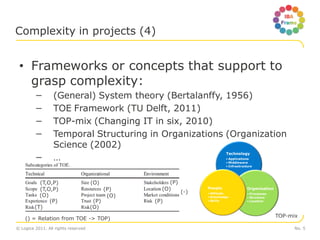
Complexity in projects (4)


 • Frameworks or concepts that support to
   grasp complexity:
         −        (General) System theory (Bertalanffy, 1956)
         −        TOE Framework (TU Delft, 2011)
         −        TOP-mix (Changing IT in six, 2010)
         −        Temporal Structuring in Organizations (Organization
                  Science (2002)
                                                        Technology
         −        …                                                          • Applications
                                                                             • Middleware
                                                                             • Infrastructure


           (T,O,P)                   (O)                (P)
           (T,O,P)                          (P)      (O)            People                Organisation
                                                              (-)   • Attitude
           (O)                               (O)                    • Knowledge
                                                                                          • Processes
                                                                                          • Structure
               (P)                    (P)          (P)              • Skills              • Location

         (T)                         (O)
                                                                                                         TOP-mix
    () = Relation from TOE -> TOP)
© Logica 2011. All rights reserved                                                                             No. 5
Content


 • Study 1
 • Study 2
 • Key references and contact


© Logica 2011. All rights reserved   No. 6
Content


 • Study 1
 • Study 2
 • Key references and contact


© Logica 2011. All rights reserved   No. 7
Study 1: Background (1)


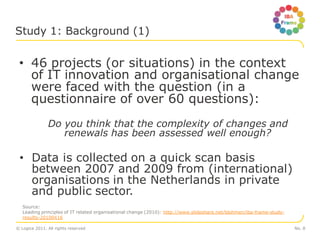
 • 46 projects (or situations) in the context
   of IT innovation and organisational change
   were faced with the question (in a
   questionnaire of over 60 questions):
               Do you think that the complexity of changes and
                  renewals has been assessed well enough?

 • Data is collected on a quick scan basis
   between 2007 and 2009 from (international)
   organisations in the Netherlands in private
   and public sector.
   Source:
   Leading principles of IT related organisational change (2010): http://www.slideshare.net/ldohmen/iba-frame-study-
   results-20100416

© Logica 2011. All rights reserved                                                                                     No. 8
Study 1: Results and findings (1)


 • In the collection of 46 projects
   complexity was:
         −     Not assessed for 14 projects
         −     Sometimes assessed for 25 projects
         −     Mostly assessed for 7 projects
         −     Always assessed for 0 projects

                                             Complexity of
                                              projects has
                                          little/no attention


© Logica 2011. All rights reserved                              No. 9
Study 1: Results and findings (2)
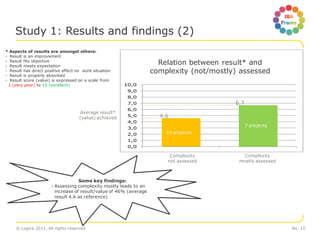
* Aspects of results are amongst others:
- Result is an improvement                                            Relation between result*
- Result fits objective
                                                                      Relation between result* and
- Result meets expectation                                            achieved and complexity
- Result has direct positive effect on work situation               complexity (not/mostly) assessed
- Result is properly absorbed                                          (not/mostly) assessed
- Result score (value) is expressed on a scale from
 1 (very poor) to 10 (excellent)                        10,0
                                                         9,0
                                                         8,0
                                                         7,0                              6.7
                                                         6,0
                                     Average result*
                                     (value) achieved    5,0          4.6
                                                         4,0
                                                                                                7 projects
                                                         3,0
                                                         2,0            14 projects
                                                         1,0
                                                         0,0

                                                                         Complexity          Complexity
                                                                        not assessed       mostly assessed


                                    Some key findings:
                       - Assessing complexity mostly leads to an
                         increase of result/value of 46% (average
                         result 4.6 as reference)


     © Logica 2011. All rights reserved                                                                      No. 10
Study 1: Results and findings (3)
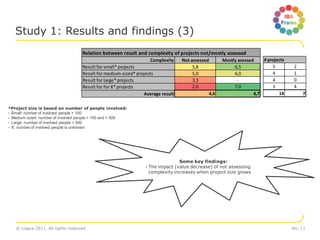
                                   Relation between result and complexity of projects not/mostly assessed
                                                                  Complexity    Not assessed         Mostly asessed    # projects
                                   Result for small* projects                        5,8                  6,5              5        2
                                   Result for medium-sized* projects                 5,0                  6,0              4        1
                                   Result for large* projects                        3,3                    -              4        0
                                   Result for for X* projects                        2,0                  7,0              1        4
                                                               Average result                  4,6                 6,7        14        7

*Project size is based on number of people involved:
- Small: number of involved people < 100
- Medium sized: number of involved people > 100 and < 500
- Large: number of involved people > 500
- X: number of involved people is unknown


                                                                              Some key findings:
                                                               - The impact (value decrease) of not assessing
                                                                 complexity increases when project size grows


   © Logica 2011. All rights reserved                                                                                               No. 11
Study 1: Data on project level

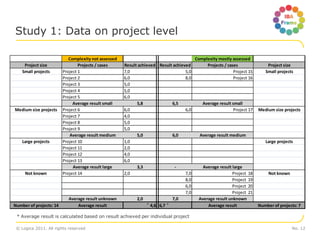
                            Complexity not assessed                                    Complexity mostly assessed
     Project size                Projects / cases     Result achieved Result achieved        Projects / cases               Project size
    Small projects       Project 1                    7,0                          5,0                     Project 15      Small projects
                         Project 2                    6,0                          8,0                     Project 16
                         Project 3                    5,0
                         Project 4                    5,0
                         Project 5                    6,0
                              Average result small          5,8              6,5          Average result small
Medium size projects     Project 6                    6,0                          6,0                     Project 17   Medium size projects
                         Project 7                    4,0
                         Project 8                    5,0
                         Project 9                    5,0
                             Average result medium          5,0              6,0         Average result medium
    Large projects       Project 10                   1,0                                                                  Large projects
                         Project 11                   2,0
                         Project 12                   4,0
                         Project 13                   6,0
                              Average result large          3,3               -            Average result large
     Not known           Project 14                   2,0                          7,0                    Project 18         Not known
                                                                                   8,0                    Project 19
                                                                                   6,0                    Project 20
                                                                                   7,0                    Project 21
                           Average result unknown           2,0              7,0         Average result unknown
Number of projects: 14         Average result                    * 4,6 6,7 *                 Average result             Number of projects: 7

 * Average result is calculated based on result achieved per individual project

 © Logica 2011. All rights reserved                                                                                                      No. 12
Content


 • Study 1
 • Study 2
 • Key references and contact


© Logica 2011. All rights reserved   No. 13
Study 2: Background


    Within many organisations changes are made by means of
    projects. IT projects are notorious for their low success rate. In
    recent years a link was made between project complexity and
    project failure. Logica is interested in this connection and offered
    a position to research complexity in IT projects. This research
    focuses on analyzing which literature about project complexity is
    available and which frameworks for measuring project complexity
    already exist. Eight cases have been analyzed, each of which
    focused on a project in the financial services sector. The case
    studies were performed by keeping interviews with project
    managers and analyzing project documentation. The main
    research question is:
    Which (combination of) factors determine the complexity of IT
    projects and how can these successfully be managed?


   Source:
   Complexity in IT-projects (Master thesis Jorden van Helvoort – TU Delft (November 2011)


© Logica 2011. All rights reserved                                                           No. 14
Study 2: Findings and conclusions

 • Findings and conclusions are based on the TOE Framework of the TU Delft (slide #5)
 • To successfully manage these dominant complexity elements in IT projects, a project
   manager has three main management measures at his disposal:

 1.Manage communication: This is achieved through face‐to‐face communication, formal
   information exchange, stakeholder management, interface management, or
   committing information to paper or digital format, like repositories and knowledge
   bases.

 2.Manage realism: This is achieved through strict agreements on changes to the project
   scope or quality, making smart choices in selecting technology, standardizing software
   tools, limiting conversions of data, limiting the amount of different systems and always
   testing solutions extensively to ensure added‐value to the client.

 3.Manage engagement: This is achieved through reducing the team size wherever
   possible, building relationships based on trust, always use monitoring and control,
   replacing project members or stakeholders with the wrong attitude, creating a sense of
   a common goal, knowing the organization, finding multiple project sponsors, being
   aware of early warning signs of project failure, timing stakeholders participation and
   looking for intrinsic motivation among the project team and stakeholders.
    Source:
    Complexity in IT-projects (Master thesis Jorden van Helvoort – TU Delft (November 2011)

© Logica 2011. All rights reserved                                                            No. 15
Content


 • Study 1
 • Study 2
 • Key references and contact


© Logica 2011. All rights reserved   No. 16
Key references

 •     Managing project complexity
       http://repository.tudelft.nl/view/ir/uuid%3Aa783e581-bc7a-4efa-adcb-7e9201840367/


 •     Kampioen organisatieverandering
       http://www.unibook.com/nl/Leon-Dohmen/Kampioen-organisatieverandering


 •     Leading principles of IT related organisational change
       http://www.slideshare.net/ldohmen/iba-frame-study-results-20100416


 •     Master thesis Jorden van Helvoort: Complexity in IT projects

 •     Regie voeren over organisatieverandering met ICT
       http://www.sdu.nl/catalogus/9789012125895


 •     Changing IT in six
       http://www.vangorcum.nl/EN_toonBoek.asp?PublID=4552


 •     It’s About Time: Temporal Structuring in Organizations
       http://orgsci.journal.informs.org/content/13/6/684.abstract


© Logica 2011. All rights reserved                                                         No. 17
For questions and special requests – Contact


                                     Management of (Information) Technology
                                        Leon Dohmen | Principal Management Consultant –
                                                  IT Management Consultancy
                                           T: +31 40 2957 777 | M: +31 6 1737 6636
                                                   leon.dohmen@logica.com

© Logica 2011. All rights reserved                                                        No. 18
Logica Nederlands B.V.:
                 Consultancy and
                 Professional Services -
                 Practice IT management


Logica is a leading IT and business services company, employing 39,000 people across 36 countries. It provides business consulting, systems integration,
and IT and business process outsourcing services. Logica works closely with its customers to release their potential – enabling change that increases their
efficiency, accelerates growth and manages risk. It applies its deep industry knowledge, technical excellence and global delivery expertise to help its
customers build leadership positions in their markets. Logica is listed on both the London Stock Exchange and Euronext (Amsterdam) (LSE: LOG; Euronext:
LOG). More information is available at www.logica.com

Complexity in projects

  • 1.
    Complexity in projects Definitions, impactand determining factors of complexity November 2011
  • 2.
    Complexity in projects(1) • Complexity affects project result/value/performance (negatively) is a widely accepted opinion confirmed by studies and research Source: Managing Project Complexity: PhD dissertation, Marian Bosch-Rekveldt (15 November 2011) © Logica 2011. All rights reserved No. 2
  • 3.
    Complexity in projects(2) • This presentation contains two studies: 1. Is a study of 46 projects determining the relation between assessing complexity in IT related projects and the achieved result (value) 2. Is a study of 8 projects defining and determining complexity and elements of complexity, and how complexity can be handled © Logica 2011. All rights reserved No. 3
  • 4.
    Complexity in projects(3) • Definitions of complexity are ambiguous and can be related to amongst others: − Competencies (of involved people) − Technology − Organisation − Environment − Available time − (Local) circumstances − ..... © Logica 2011. All rights reserved No. 4
  • 5.
    Complexity in projects(4) • Frameworks or concepts that support to grasp complexity: − (General) System theory (Bertalanffy, 1956) − TOE Framework (TU Delft, 2011) − TOP-mix (Changing IT in six, 2010) − Temporal Structuring in Organizations (Organization Science (2002) Technology − … • Applications • Middleware • Infrastructure (T,O,P) (O) (P) (T,O,P) (P) (O) People Organisation (-) • Attitude (O) (O) • Knowledge • Processes • Structure (P) (P) (P) • Skills • Location (T) (O) TOP-mix () = Relation from TOE -> TOP) © Logica 2011. All rights reserved No. 5
  • 6.
    Content • Study1 • Study 2 • Key references and contact © Logica 2011. All rights reserved No. 6
  • 7.
    Content • Study1 • Study 2 • Key references and contact © Logica 2011. All rights reserved No. 7
  • 8.
    Study 1: Background(1) • 46 projects (or situations) in the context of IT innovation and organisational change were faced with the question (in a questionnaire of over 60 questions): Do you think that the complexity of changes and renewals has been assessed well enough? • Data is collected on a quick scan basis between 2007 and 2009 from (international) organisations in the Netherlands in private and public sector. Source: Leading principles of IT related organisational change (2010): http://www.slideshare.net/ldohmen/iba-frame-study- results-20100416 © Logica 2011. All rights reserved No. 8
  • 9.
    Study 1: Resultsand findings (1) • In the collection of 46 projects complexity was: − Not assessed for 14 projects − Sometimes assessed for 25 projects − Mostly assessed for 7 projects − Always assessed for 0 projects Complexity of projects has little/no attention © Logica 2011. All rights reserved No. 9
  • 10.
    Study 1: Resultsand findings (2) * Aspects of results are amongst others: - Result is an improvement Relation between result* - Result fits objective Relation between result* and - Result meets expectation achieved and complexity - Result has direct positive effect on work situation complexity (not/mostly) assessed - Result is properly absorbed (not/mostly) assessed - Result score (value) is expressed on a scale from 1 (very poor) to 10 (excellent) 10,0 9,0 8,0 7,0 6.7 6,0 Average result* (value) achieved 5,0 4.6 4,0 7 projects 3,0 2,0 14 projects 1,0 0,0 Complexity Complexity not assessed mostly assessed Some key findings: - Assessing complexity mostly leads to an increase of result/value of 46% (average result 4.6 as reference) © Logica 2011. All rights reserved No. 10
  • 11.
    Study 1: Resultsand findings (3) Relation between result and complexity of projects not/mostly assessed Complexity Not assessed Mostly asessed # projects Result for small* projects 5,8 6,5 5 2 Result for medium-sized* projects 5,0 6,0 4 1 Result for large* projects 3,3 - 4 0 Result for for X* projects 2,0 7,0 1 4 Average result 4,6 6,7 14 7 *Project size is based on number of people involved: - Small: number of involved people < 100 - Medium sized: number of involved people > 100 and < 500 - Large: number of involved people > 500 - X: number of involved people is unknown Some key findings: - The impact (value decrease) of not assessing complexity increases when project size grows © Logica 2011. All rights reserved No. 11
  • 12.
    Study 1: Dataon project level Complexity not assessed Complexity mostly assessed Project size Projects / cases Result achieved Result achieved Projects / cases Project size Small projects Project 1 7,0 5,0 Project 15 Small projects Project 2 6,0 8,0 Project 16 Project 3 5,0 Project 4 5,0 Project 5 6,0 Average result small 5,8 6,5 Average result small Medium size projects Project 6 6,0 6,0 Project 17 Medium size projects Project 7 4,0 Project 8 5,0 Project 9 5,0 Average result medium 5,0 6,0 Average result medium Large projects Project 10 1,0 Large projects Project 11 2,0 Project 12 4,0 Project 13 6,0 Average result large 3,3 - Average result large Not known Project 14 2,0 7,0 Project 18 Not known 8,0 Project 19 6,0 Project 20 7,0 Project 21 Average result unknown 2,0 7,0 Average result unknown Number of projects: 14 Average result * 4,6 6,7 * Average result Number of projects: 7 * Average result is calculated based on result achieved per individual project © Logica 2011. All rights reserved No. 12
  • 13.
    Content • Study1 • Study 2 • Key references and contact © Logica 2011. All rights reserved No. 13
  • 14.
    Study 2: Background Within many organisations changes are made by means of projects. IT projects are notorious for their low success rate. In recent years a link was made between project complexity and project failure. Logica is interested in this connection and offered a position to research complexity in IT projects. This research focuses on analyzing which literature about project complexity is available and which frameworks for measuring project complexity already exist. Eight cases have been analyzed, each of which focused on a project in the financial services sector. The case studies were performed by keeping interviews with project managers and analyzing project documentation. The main research question is: Which (combination of) factors determine the complexity of IT projects and how can these successfully be managed? Source: Complexity in IT-projects (Master thesis Jorden van Helvoort – TU Delft (November 2011) © Logica 2011. All rights reserved No. 14
  • 15.
    Study 2: Findingsand conclusions • Findings and conclusions are based on the TOE Framework of the TU Delft (slide #5) • To successfully manage these dominant complexity elements in IT projects, a project manager has three main management measures at his disposal: 1.Manage communication: This is achieved through face‐to‐face communication, formal information exchange, stakeholder management, interface management, or committing information to paper or digital format, like repositories and knowledge bases. 2.Manage realism: This is achieved through strict agreements on changes to the project scope or quality, making smart choices in selecting technology, standardizing software tools, limiting conversions of data, limiting the amount of different systems and always testing solutions extensively to ensure added‐value to the client. 3.Manage engagement: This is achieved through reducing the team size wherever possible, building relationships based on trust, always use monitoring and control, replacing project members or stakeholders with the wrong attitude, creating a sense of a common goal, knowing the organization, finding multiple project sponsors, being aware of early warning signs of project failure, timing stakeholders participation and looking for intrinsic motivation among the project team and stakeholders. Source: Complexity in IT-projects (Master thesis Jorden van Helvoort – TU Delft (November 2011) © Logica 2011. All rights reserved No. 15
  • 16.
    Content • Study1 • Study 2 • Key references and contact © Logica 2011. All rights reserved No. 16
  • 17.
    Key references • Managing project complexity http://repository.tudelft.nl/view/ir/uuid%3Aa783e581-bc7a-4efa-adcb-7e9201840367/ • Kampioen organisatieverandering http://www.unibook.com/nl/Leon-Dohmen/Kampioen-organisatieverandering • Leading principles of IT related organisational change http://www.slideshare.net/ldohmen/iba-frame-study-results-20100416 • Master thesis Jorden van Helvoort: Complexity in IT projects • Regie voeren over organisatieverandering met ICT http://www.sdu.nl/catalogus/9789012125895 • Changing IT in six http://www.vangorcum.nl/EN_toonBoek.asp?PublID=4552 • It’s About Time: Temporal Structuring in Organizations http://orgsci.journal.informs.org/content/13/6/684.abstract © Logica 2011. All rights reserved No. 17
  • 18.
    For questions andspecial requests – Contact Management of (Information) Technology Leon Dohmen | Principal Management Consultant – IT Management Consultancy T: +31 40 2957 777 | M: +31 6 1737 6636 leon.dohmen@logica.com © Logica 2011. All rights reserved No. 18
  • 19.
    Logica Nederlands B.V.: Consultancy and Professional Services - Practice IT management Logica is a leading IT and business services company, employing 39,000 people across 36 countries. It provides business consulting, systems integration, and IT and business process outsourcing services. Logica works closely with its customers to release their potential – enabling change that increases their efficiency, accelerates growth and manages risk. It applies its deep industry knowledge, technical excellence and global delivery expertise to help its customers build leadership positions in their markets. Logica is listed on both the London Stock Exchange and Euronext (Amsterdam) (LSE: LOG; Euronext: LOG). More information is available at www.logica.com