Planning a Complex Project - An
    Under Appreciated Effort
Planning A Complex Project – An
      Under Appreciated Effort
Presented By:

Glen R. Palmer, PSP, CFCC
Owner
GR Palmer Consulting Services, LLC

Chris W. Carson, PSP, CCM, PMP
Corporate Director of Project Controls
Alpha Corporation
Planning A Complex Project


 A Good Plan

   A Good Plan Does Not Guarantee a
   Successfully Executed Project, But a Bad Plan
   Virtually Always Means Project Failure
Planning A Complex Project


 Introduction

   The Effort Required To make a Good Plan Is
   Under Appreciated in the Industry
   Many Organizations Have Forgotten How to
   Plan
   A Plan Created By the PM And the Scheduler
   Only Is Not a True Plan
Planning A Complex Project

 The Biggest Mistakes Made In
 Planning
   If a Person Knows How to Run Scheduling
   Software, He or She Must Know How to Plan
   The Project Cannot Afford the Hours Required
   to Plan the Project
   The Size of the Planning Group Will Make it
   Impossible to Get Agreement
   Waiting Too Long to Plan the Job
   Attempting to Plan a Project Before the Team
   Has Plans and Specifications
Planning A Complex Project


 Assuming that if a Person Knows How to Run
 Scheduling Software, He or She Must Know How
 to Plan

   Planning a Complex Project Requires Project Field
   Experience
   Anyone Can Learn to Operate Software
   Running a Planning Session Requires Public Speaking
   Skills
   In the Old Days Planning and Scheduling Were Two
   Different Jobs
Planning A Complex Project


 Thinking the Project Cannot Afford the Hours
 Required to Plan the Project

   The Project Cannot Afford Not to Plan the Project
   A Good Plan Will Make the Project Substantially More
   Efficient
   The Cost For A Good Plan Will Not Impact total Cost
   Companies Always Find Money to Work On Claims, But
   there Is Never Enough For Planning
Planning A Complex Project


 Assuming that if the Entire Team Is Involved In the
 Planning Process, the Size Of the Group will
 Make It Impossible to Get Agreement

   All Major Stakeholders Need to Be Involved In Planning
   the Project
   The Team Experience/Lessons Learned Needs to be
   Incorporated Into the Plan
   Risk Management should be Included in Planning
   This Is A Great Team Building Exercise
Planning A Complex Project


 Waiting Too Long to Plan the Job

   Waiting Until A Job Is Won Is Way Too Late to Plan
   How to Execute the Work On A Fixed Price Project
   The Plan Impacts the Cost Estimate
   Need to Have a Pre-Bid Planning Session, Which Can
   Be Performed at a Higher Level
   Some Projects Do Not Get a Good Plan Until the Job
   Gets Into Financial Trouble
Planning A Complex Project


 Attempting to Plan a Project Before the Team Has
 Plans and Specifications

   Planning a Complex Project Requires Information
   Enough to Understand the Scope Of Work
   The Project Management Team MUST Know the Plans
   and Be Able to Work Out Sequencing
   The Team Must Know the Interrelationships Between
   Trades, Locations, Processes
Planning A Complex Project


 Who Needs to Be Involved?

    Project Manager          Lead Instrumentation
    Superintendent           Construction Manager
    Engineering Manager      Project Controls Mgr
    Procurement/Contracts    Lead Scheduler
    Lead Civil/Structural    Lead Start-up
    Lead Mechanical          Facilitator
    Lead Piping              Major subcontractors
    Lead Electrical
Planning A Complex Project


 Prior to Planning or Schedule Development
 Session, Give Team the Following:

   Contract
   Plans & Specs or Program Information
   Cost Estimate and Basis Of Estimate
   Schedule Submitted With Bid
   Project Execution Write-up
Planning A Complex Project


 At the Planning Session, the Team Member
 Expectations Are:

   Completely Understand His/Her Portion of Estimate
   Have Already Performed a Constructability Review
   Know Construction Sequence and Durations
   Lead Engineers Will Provide Sequence and Durations
   Know Material Lead Times and Major Delivery Dates
   Determine Start-up Sequence
   Understand Commissioning & Close-out Sequences
   Know Constraints on Project – Funding, Down Time,
   Owner Input/Furnished Equipment
Planning A Complex Project


 The Planning Session Location

   The Session Should Be Held In a Large Conference
   Room
   Engineers and Contractors Need to Be Away From
   Their Offices to Become Engaged
   Catered Lunch to Ensure Team Stays
   Work Surfaces to Spread out Plans & Sketches
   Team Members That are Truly Engaged In the Process
   Often Have Break-out Sessions to Discuss Alternatives
   – Occasionally Finding a Better Approach
Planning A Complex Project


 The Planning Session – Opening Remarks

   Project Manager Introductions & Goals
   Facilitator Explains “Card Trick” Process
   Project Scheduler Explains WBS, Scope Exclusions,
   Weather, Constraints, etc.
   Leads Discuss their Scope, Engineering Hours,
   Drawings Required, Estimated Quantities, and their
   Contractual Requirements
   Team Members Discuss List of Lessons Learned
   Risk Register (combined with lessons learned)
Planning A Complex Project


 The Planning Session – Opening Remarks
 (Continued)

   Facilitator Discusses Construction Support
   Facilitator Explains the Need For Producing a
   Meaningful and Achievable Plan & Desired Format
   Facilitator Explains Team “Buy-In”
   Facilitator Homework – Unprepared Team
   Facilitator Explains the Need to Fight For What You
   Believe In
   Explain Risk Management Process
Planning A Complex Project


 The Gilbane “Card Trick”

   Developed by Gilbane, A General Contractor With
   Great Planning And Organizational Skills
   Uses Colored “Post-it Notes” to Represent Different
   Disciplines or Subcontractors
   Uses a Large Paper Calendar on Conference Room
   Wall – Some Use a Large White Board or Pincushion
   Wall Covering
   Other Names – Storyboard Planning, Bar Chart
   Development
Planning A Complex Project


  The Start Of the Planning Session

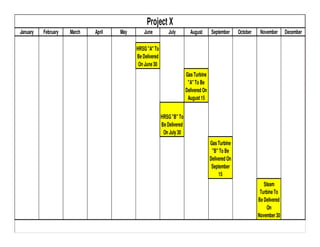
    On a Large Complex Project the Starting Point Is
    Usually the Delivery of Long Lead Equipment
Project X
January   February   March   April   May       June           July         August       September      October    November      December

                                           HRSG "A" To
                                           Be Delivered
                                            On June 30
                                                                         Gas Turbine
                                                                          "A" To Be
                                                                         Delivered On
                                                                          August 15


                                                          HRSG "B" To
                                                          Be Delivered
                                                           On July 30
                                                                                        Gas Turbine
                                                                                         "B" To Be
                                                                                        Delivered On
                                                                                         September
                                                                                             15
                                                                                                                    Steam
                                                                                                                  Turbine To
                                                                                                                 Be Delivered
                                                                                                                      On
                                                                                                                 November 30
Planning A Complex Project


 The Next Step of the Planning Session

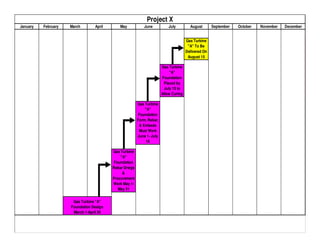
   Perform a Backward Pass Through the Foundation
   Engineering for Each Piece of Equipment
   This Should Include Cure Time, Winter Concrete
   Placing, Rainy Season Allowance, Etc.
   If the Equipment Is Inside a Building, then the Building
   Foundation and Slab May Need to Be Placed Prior to
   the Equipment Foundation
   Building Close-in at Equipment Locations May Drive
   Another Path of Activities or Sequencing
   Access Paths may Drive Sequencing – Elevator Shaft
   Drilling, Modular Construction Installation
Project X
January   February   March       April      May            June           July         August       September   October   November   December


                                                                                     Gas Turbine
                                                                                      "A" To Be
                                                                                     Delivered On
                                                                                      August 15

                                                                      Gas Turbine
                                                                           "A"
                                                                      Foundation
                                                                       Placed by
                                                                        July 15 to
                                                                      Allow Curing

                                                       Gas Turbine
                                                           "A"
                                                        Foundation
                                                       Form, Rebar,
                                                        & Embeds
                                                        Must Work
                                                       June 1- July
                                                            15

                                         Gas Turbine
                                             "A"
                                         Foundation
                                         Rebar Drwgs
                                              &
                                         Procurement
                                         Work May 1-
                                            May 31


                      Gas Turbine "A"
                     Foundation Design
                      March 1-April 30
Planning A Complex Project


 The Next Part Of the Planning Session
 (Continued)

   Next ,Set the Equipment on Its Foundation and Go
   Forward through Construction
   This Same Process Is then Continued through All Major
   Equipment, Structures and Commodities through
   System Turnover
   If the Project Is Not Driven By Equipment Deliveries,
   then Pick the Important Milestones and Use the Same
   Planning Approach
Planning A Complex Project


  Typical Milestones

    Building – Structure Weather Tight
    Building – Foundation Complete
    Port – First Run Dredging Complete, Wharf Complete
    Pipe Line – Frost Out of the Ground
    Bridge – Steel, Girders, Bascule Equipment Delivered
    Access to Parts of Site
    Limitations on Construction – Pile Driving Restricted
    Times, Habitat Nesting Times, Wetlands Impact on Site
Planning A Complex Project


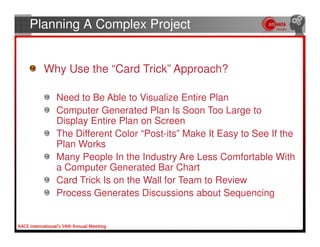
  Why Use the “Card Trick” Approach?

    Need to Be Able to Visualize Entire Plan
    Computer Generated Plan Is Soon Too Large to
    Display Entire Plan on Screen
    The Different Color “Post-its” Make It Easy to See If the
    Plan Works
    Many People In the Industry Are Less Comfortable With
    a Computer Generated Bar Chart
    Card Trick Is on the Wall for Team to Review
    Process Generates Discussions about Sequencing
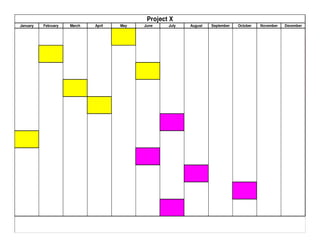
Project X
January   February   March   April   May   June    July   August   September   October   November   December
Planning A Complex Project


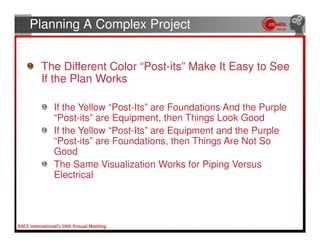
 The Different Color “Post-its” Make It Easy to See
 If the Plan Works

   If the Yellow “Post-Its” are Foundations And the Purple
   “Post-its” are Equipment, then Things Look Good
   If the Yellow “Post-Its” are Equipment and the Purple
   “Post-its” are Foundations, then Things Are Not So
   Good
   The Same Visualization Works for Piping Versus
   Electrical
Planning A Complex Project

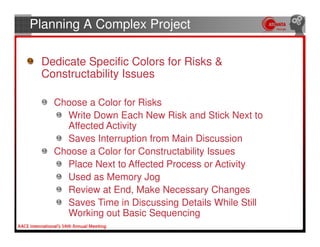
 Dedicate Specific Colors for Risks &
 Constructability Issues

   Choose a Color for Risks
     Write Down Each New Risk and Stick Next to
     Affected Activity
     Saves Interruption from Main Discussion
   Choose a Color for Constructability Issues
     Place Next to Affected Process or Activity
     Used as Memory Jog
     Review at End, Make Necessary Changes
     Saves Time in Discussing Details While Still
     Working out Basic Sequencing
Planning A Complex Project

 If Desired, Can Display Logic

   Some Schedulers Use Yarn or String to Model
   Relationships between Activities
   May Help to Clarify Logic Between Activities
   Particularly Good for Special Relationships
Planning A Complex Project

 Document the Plan

   Use a Camera to Record the Plan
   Have the Scheduler Input all Activities and
   Relationships as the Plan is Developed
   Print a Copy of the Overview Plan
Planning A Complex Project

 The Planning Session

   These Session Typically Take 1-3 Days Depending on
   Complexity Of Project
   At the End of the Session Each Team Member Is Asked
   to Sign-Off on the Plan Signifying “Buy-in”
   The Output of the Planning or Schedule Development
   Session is an Overview or High Level Schedule –
   Sometimes Called an Outline Schedule
   Overview Schedule Captures Main Sequences,
   Constraints, Milestones, Full Scope of Work
Planning A Complex Project

 After the Planning Session

   Project Scheduler Inputs Plan Into Scheduling Software
       During Session or Immediately Afterwards
   Clear Up any Unforeseen Issues that Impact Plan Such
   as Project Calendars
   Subdivides Higher Level Plan into Detailed Schedule
   All Elaborated Details Must Roll Up into Overview
   Schedule to Ensure Continuing Team Buy-in
   The Output Of this Effort Becomes the Project Baseline
   Plan Unless - the Planning Effort was for Schedule
   Recovery, then It Becomes the Revised Baseline
Planning A Complex Project

 Facilitator Requirements

   An Off-Team Facilitator Works Best Due to the Need to
   Control the Group, Ask Difficult Questions, Give
   Homework, Etc.
   Facilitator Needs:
     Great Communication Skills
     Credibility
     Great Project Experience
     Keep All Team Members Engaged
     Does Not Allow Team to Get Bogged Down with
     Distractions – Use Risks and Constructability Issue
     Post-it Notes to Allow Team to Move on
Planning A Complex Project


           Thank You
          For Attending!
Contact Information


Name:            Chris W. Carson, PSP, CCM, PMP
Title:           Corporate Director Of Project Controls
Company:         Alpha Corporation
Email Address:   chris.carson@alphacorporation.com
Phone Number:    +1 (757) 342-5524

Name:            Glen R. Palmer, PSP, CFCC
Title:           Owner
Company:         GR Palmer Consulting Services, LLC
Email Address:   gpalmer@gpalmer.com
Phone Number:    +1 (603) 591-6754

Planning A Complex Project

  • 1.
    Planning a ComplexProject - An Under Appreciated Effort
  • 2.
    Planning A ComplexProject – An Under Appreciated Effort Presented By: Glen R. Palmer, PSP, CFCC Owner GR Palmer Consulting Services, LLC Chris W. Carson, PSP, CCM, PMP Corporate Director of Project Controls Alpha Corporation
  • 3.
    Planning A ComplexProject A Good Plan A Good Plan Does Not Guarantee a Successfully Executed Project, But a Bad Plan Virtually Always Means Project Failure
  • 4.
    Planning A ComplexProject Introduction The Effort Required To make a Good Plan Is Under Appreciated in the Industry Many Organizations Have Forgotten How to Plan A Plan Created By the PM And the Scheduler Only Is Not a True Plan
  • 5.
    Planning A ComplexProject The Biggest Mistakes Made In Planning If a Person Knows How to Run Scheduling Software, He or She Must Know How to Plan The Project Cannot Afford the Hours Required to Plan the Project The Size of the Planning Group Will Make it Impossible to Get Agreement Waiting Too Long to Plan the Job Attempting to Plan a Project Before the Team Has Plans and Specifications
  • 6.
    Planning A ComplexProject Assuming that if a Person Knows How to Run Scheduling Software, He or She Must Know How to Plan Planning a Complex Project Requires Project Field Experience Anyone Can Learn to Operate Software Running a Planning Session Requires Public Speaking Skills In the Old Days Planning and Scheduling Were Two Different Jobs
  • 7.
    Planning A ComplexProject Thinking the Project Cannot Afford the Hours Required to Plan the Project The Project Cannot Afford Not to Plan the Project A Good Plan Will Make the Project Substantially More Efficient The Cost For A Good Plan Will Not Impact total Cost Companies Always Find Money to Work On Claims, But there Is Never Enough For Planning
  • 8.
    Planning A ComplexProject Assuming that if the Entire Team Is Involved In the Planning Process, the Size Of the Group will Make It Impossible to Get Agreement All Major Stakeholders Need to Be Involved In Planning the Project The Team Experience/Lessons Learned Needs to be Incorporated Into the Plan Risk Management should be Included in Planning This Is A Great Team Building Exercise
  • 9.
    Planning A ComplexProject Waiting Too Long to Plan the Job Waiting Until A Job Is Won Is Way Too Late to Plan How to Execute the Work On A Fixed Price Project The Plan Impacts the Cost Estimate Need to Have a Pre-Bid Planning Session, Which Can Be Performed at a Higher Level Some Projects Do Not Get a Good Plan Until the Job Gets Into Financial Trouble
  • 10.
    Planning A ComplexProject Attempting to Plan a Project Before the Team Has Plans and Specifications Planning a Complex Project Requires Information Enough to Understand the Scope Of Work The Project Management Team MUST Know the Plans and Be Able to Work Out Sequencing The Team Must Know the Interrelationships Between Trades, Locations, Processes
  • 11.
    Planning A ComplexProject Who Needs to Be Involved? Project Manager Lead Instrumentation Superintendent Construction Manager Engineering Manager Project Controls Mgr Procurement/Contracts Lead Scheduler Lead Civil/Structural Lead Start-up Lead Mechanical Facilitator Lead Piping Major subcontractors Lead Electrical
  • 12.
    Planning A ComplexProject Prior to Planning or Schedule Development Session, Give Team the Following: Contract Plans & Specs or Program Information Cost Estimate and Basis Of Estimate Schedule Submitted With Bid Project Execution Write-up
  • 13.
    Planning A ComplexProject At the Planning Session, the Team Member Expectations Are: Completely Understand His/Her Portion of Estimate Have Already Performed a Constructability Review Know Construction Sequence and Durations Lead Engineers Will Provide Sequence and Durations Know Material Lead Times and Major Delivery Dates Determine Start-up Sequence Understand Commissioning & Close-out Sequences Know Constraints on Project – Funding, Down Time, Owner Input/Furnished Equipment
  • 14.
    Planning A ComplexProject The Planning Session Location The Session Should Be Held In a Large Conference Room Engineers and Contractors Need to Be Away From Their Offices to Become Engaged Catered Lunch to Ensure Team Stays Work Surfaces to Spread out Plans & Sketches Team Members That are Truly Engaged In the Process Often Have Break-out Sessions to Discuss Alternatives – Occasionally Finding a Better Approach
  • 15.
    Planning A ComplexProject The Planning Session – Opening Remarks Project Manager Introductions & Goals Facilitator Explains “Card Trick” Process Project Scheduler Explains WBS, Scope Exclusions, Weather, Constraints, etc. Leads Discuss their Scope, Engineering Hours, Drawings Required, Estimated Quantities, and their Contractual Requirements Team Members Discuss List of Lessons Learned Risk Register (combined with lessons learned)
  • 16.
    Planning A ComplexProject The Planning Session – Opening Remarks (Continued) Facilitator Discusses Construction Support Facilitator Explains the Need For Producing a Meaningful and Achievable Plan & Desired Format Facilitator Explains Team “Buy-In” Facilitator Homework – Unprepared Team Facilitator Explains the Need to Fight For What You Believe In Explain Risk Management Process
  • 17.
    Planning A ComplexProject The Gilbane “Card Trick” Developed by Gilbane, A General Contractor With Great Planning And Organizational Skills Uses Colored “Post-it Notes” to Represent Different Disciplines or Subcontractors Uses a Large Paper Calendar on Conference Room Wall – Some Use a Large White Board or Pincushion Wall Covering Other Names – Storyboard Planning, Bar Chart Development
  • 18.
    Planning A ComplexProject The Start Of the Planning Session On a Large Complex Project the Starting Point Is Usually the Delivery of Long Lead Equipment
  • 19.
    Project X January February March April May June July August September October November December HRSG "A" To Be Delivered On June 30 Gas Turbine "A" To Be Delivered On August 15 HRSG "B" To Be Delivered On July 30 Gas Turbine "B" To Be Delivered On September 15 Steam Turbine To Be Delivered On November 30
  • 20.
    Planning A ComplexProject The Next Step of the Planning Session Perform a Backward Pass Through the Foundation Engineering for Each Piece of Equipment This Should Include Cure Time, Winter Concrete Placing, Rainy Season Allowance, Etc. If the Equipment Is Inside a Building, then the Building Foundation and Slab May Need to Be Placed Prior to the Equipment Foundation Building Close-in at Equipment Locations May Drive Another Path of Activities or Sequencing Access Paths may Drive Sequencing – Elevator Shaft Drilling, Modular Construction Installation
  • 21.
    Project X January February March April May June July August September October November December Gas Turbine "A" To Be Delivered On August 15 Gas Turbine "A" Foundation Placed by July 15 to Allow Curing Gas Turbine "A" Foundation Form, Rebar, & Embeds Must Work June 1- July 15 Gas Turbine "A" Foundation Rebar Drwgs & Procurement Work May 1- May 31 Gas Turbine "A" Foundation Design March 1-April 30
  • 22.
    Planning A ComplexProject The Next Part Of the Planning Session (Continued) Next ,Set the Equipment on Its Foundation and Go Forward through Construction This Same Process Is then Continued through All Major Equipment, Structures and Commodities through System Turnover If the Project Is Not Driven By Equipment Deliveries, then Pick the Important Milestones and Use the Same Planning Approach
  • 23.
    Planning A ComplexProject Typical Milestones Building – Structure Weather Tight Building – Foundation Complete Port – First Run Dredging Complete, Wharf Complete Pipe Line – Frost Out of the Ground Bridge – Steel, Girders, Bascule Equipment Delivered Access to Parts of Site Limitations on Construction – Pile Driving Restricted Times, Habitat Nesting Times, Wetlands Impact on Site
  • 24.
    Planning A ComplexProject Why Use the “Card Trick” Approach? Need to Be Able to Visualize Entire Plan Computer Generated Plan Is Soon Too Large to Display Entire Plan on Screen The Different Color “Post-its” Make It Easy to See If the Plan Works Many People In the Industry Are Less Comfortable With a Computer Generated Bar Chart Card Trick Is on the Wall for Team to Review Process Generates Discussions about Sequencing
  • 25.
    Project X January February March April May June July August September October November December
  • 26.
    Planning A ComplexProject The Different Color “Post-its” Make It Easy to See If the Plan Works If the Yellow “Post-Its” are Foundations And the Purple “Post-its” are Equipment, then Things Look Good If the Yellow “Post-Its” are Equipment and the Purple “Post-its” are Foundations, then Things Are Not So Good The Same Visualization Works for Piping Versus Electrical
  • 27.
    Planning A ComplexProject Dedicate Specific Colors for Risks & Constructability Issues Choose a Color for Risks Write Down Each New Risk and Stick Next to Affected Activity Saves Interruption from Main Discussion Choose a Color for Constructability Issues Place Next to Affected Process or Activity Used as Memory Jog Review at End, Make Necessary Changes Saves Time in Discussing Details While Still Working out Basic Sequencing
  • 28.
    Planning A ComplexProject If Desired, Can Display Logic Some Schedulers Use Yarn or String to Model Relationships between Activities May Help to Clarify Logic Between Activities Particularly Good for Special Relationships
  • 29.
    Planning A ComplexProject Document the Plan Use a Camera to Record the Plan Have the Scheduler Input all Activities and Relationships as the Plan is Developed Print a Copy of the Overview Plan
  • 30.
    Planning A ComplexProject The Planning Session These Session Typically Take 1-3 Days Depending on Complexity Of Project At the End of the Session Each Team Member Is Asked to Sign-Off on the Plan Signifying “Buy-in” The Output of the Planning or Schedule Development Session is an Overview or High Level Schedule – Sometimes Called an Outline Schedule Overview Schedule Captures Main Sequences, Constraints, Milestones, Full Scope of Work
  • 31.
    Planning A ComplexProject After the Planning Session Project Scheduler Inputs Plan Into Scheduling Software During Session or Immediately Afterwards Clear Up any Unforeseen Issues that Impact Plan Such as Project Calendars Subdivides Higher Level Plan into Detailed Schedule All Elaborated Details Must Roll Up into Overview Schedule to Ensure Continuing Team Buy-in The Output Of this Effort Becomes the Project Baseline Plan Unless - the Planning Effort was for Schedule Recovery, then It Becomes the Revised Baseline
  • 32.
    Planning A ComplexProject Facilitator Requirements An Off-Team Facilitator Works Best Due to the Need to Control the Group, Ask Difficult Questions, Give Homework, Etc. Facilitator Needs: Great Communication Skills Credibility Great Project Experience Keep All Team Members Engaged Does Not Allow Team to Get Bogged Down with Distractions – Use Risks and Constructability Issue Post-it Notes to Allow Team to Move on
  • 33.
    Planning A ComplexProject Thank You For Attending!
  • 34.
    Contact Information Name: Chris W. Carson, PSP, CCM, PMP Title: Corporate Director Of Project Controls Company: Alpha Corporation Email Address: chris.carson@alphacorporation.com Phone Number: +1 (757) 342-5524 Name: Glen R. Palmer, PSP, CFCC Title: Owner Company: GR Palmer Consulting Services, LLC Email Address: gpalmer@gpalmer.com Phone Number: +1 (603) 591-6754