Adopting Agile in the Organization
                         Al Goerner
                         Agile Edge - UK


                               30 April 2009
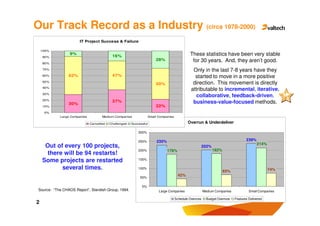
Our Track Record as a Industry (circa 1978-2000)
                       IT Project Success & Failure

    100%

    90%
                 9%
                                           16%                                               These statistics have been very stable
                                                                      28%                     for 30 years. And, they aren’t good.
    80%

    70%                                                                                        Only in the last 7-8 years have they
    60%          62%                       47%                                                  started to move in a more positive
    50%
                                                                      50%                      direction. This movement is directly
    40%
                                                                                              attributable to incremental, iterative,
    30%
                                                                                                collaborative, feedback-driven,
    20%                                    37%
                 30%                                                                           business-value-focused methods.
    10%                                                               22%
     0%
            Large Companies          Medium Companies             Small Companies

                              Cancelled   Challenged   Successful                           Overrun & Underdeliver

                                                           300%

                                                           250%        230%                                                        239%
                                                                                                                                          214%
     Out of every 100 projects,                                                                         202%
                                                           200%               178%                             182%
      there will be 94 restarts!
    Some projects are restarted                            150%

           several times.                                  100%
                                                                                                                      65%                        74%
                                                                                      42%
                                                            50%

                                                             0%
 Source: “The CHAOS Report”, Standish Group, 1994.                      Large Companies                 Medium Companies             Small Companies

                                                                                    Schedule Overruns     Budget Overruns   Features Delivered
2
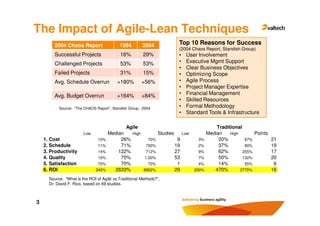
The Impact of Agile-Lean Techniques
         2004 Chaos Report                 1994        2004         Top 10 Reasons for Success
                                                                    (2004 Chaos Report, Standish Group)
         Successful Projects                16%         29%         •   User Involvement
         Challenged Projects                53%         53%         •   Executive Mgmt Support
                                                                    •   Clear Business Objectives
         Failed Projects                    31%         15%         •   Optimizing Scope
         Avg. Schedule Overrun            +180%        +56%         •   Agile Process
                                                                    •   Project Manager Expertise
         Avg. Budget Overrun              +164%        +84%         •   Financial Management
                                                                    •   Skilled Resources
           Source: “The CHAOS Report”, Standish Group, 2004.
                                                                    •   Formal Methodology
                                                                    •   Standard Tools & Infrastructure

                                               Agile                                   Traditional
                        Low           Median   High        Studies    Low          Median    High       Points
    1. Cost                     10%        26%         70%          9        3%         20%         87%        21
    2. Schedule                 11%        71%        700%         19        2%         37%         90%        19
    3. Productivity             14%       122%        712%         27        9%         62%        255%        17
    4. Quality                  10%        70%       1,00%         53        7%         50%        132%        20
    5. Satisfaction             70%        70%         70%          1        4%         14%         55%         6
    6. ROI                    240%      2633%       8852%          29       200%      470%        2770%        16
      Source: “What is the ROI of Agile vs Traditional Methods?”,
      Dr. David F. Rico, based on 69 studies.


3
Quantifying the Return

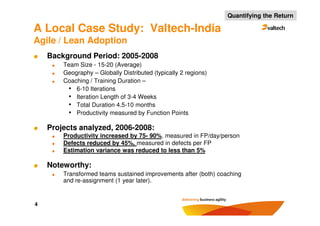
A Local Case Study: Valtech-India
Agile / Lean Adoption
    Background Period: 2005-2008
        Team Size - 15-20 (Average)
        Geography – Globally Distributed (typically 2 regions)
        Coaching / Training Duration –
         • 6-10 Iterations
         • Iteration Length of 3-4 Weeks
         • Total Duration 4.5-10 months
         • Productivity measured by Function Points

    Projects analyzed, 2006-2008:
        Productivity increased by 75- 90%, measured in FP/day/person
        Defects reduced by 45%, measured in defects per FP
        Estimation variance was reduced to less than 5%

    Noteworthy:
        Transformed teams sustained improvements after (both) coaching
        and re-assignment (1 year later).


4
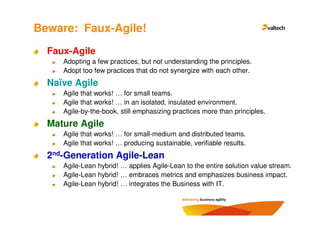
Beware: Faux-Agile!
  Faux-Agile
     Adopting a few practices, but not understanding the principles.
     Adopt too few practices that do not synergize with each other.
  Naïve Agile
     Agile that works! … for small teams.
     Agile that works! … in an isolated, insulated environment.
     Agile-by-the-book, still emphasizing practices more than principles.
  Mature Agile
     Agile that works! … for small-medium and distributed teams.
     Agile that works! … producing sustainable, verifiable results.
  2nd-Generation Agile-Lean
     Agile-Lean hybrid! … applies Agile-Lean to the entire solution value stream.
     Agile-Lean hybrid! … embraces metrics and emphasizes business impact.
     Agile-Lean hybrid! … integrates the Business with IT.
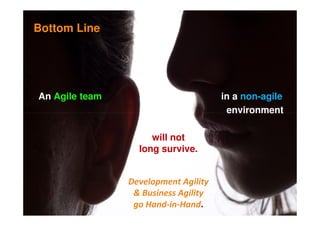
Bottom Line


An Agile team                         in a non-agile
                                       environment

                     will not
                  long survive.


                Development Agility
                 & Business Agility
                 go Hand-in-Hand.
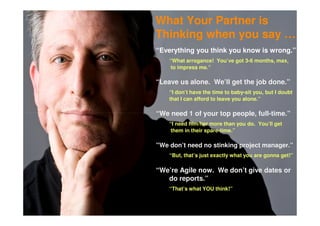
What Your Partner is
Thinking when you say …
“Everything you think you know is wrong.”
    “What arrogance! You’ve got 3-6 months, max,
     to impress me.”

“Leave us alone. We’ll get the job done.”
    “I don’t have the time to baby-sit you, but I doubt
    that I can afford to leave you alone.”

“We need 1 of your top people, full-time.”
    “I need him/her more than you do. You’ll get
     them in their spare-time.”

“We don’t need no stinking project manager.”
    “But, that’s just exactly what you are gonna get!”

“We’re Agile now. We don’t give dates or
   do reports.”
    “That’s what YOU think!”
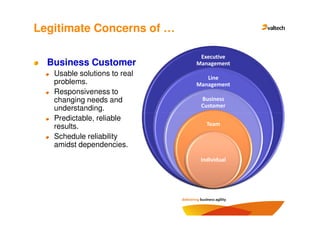
Legitimate Concerns of …

                               Executive
  Business Customer           Management
   Usable solutions to real
                                 Line
   problems.                  Management
   Responsiveness to
   changing needs and          Business
   understanding.              Customer

   Predictable, reliable
   results.                      Team

   Schedule reliability
   amidst dependencies.
                               Individual
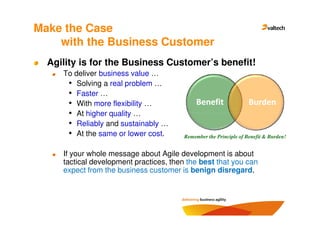
Make the Case
    with the Business Customer
  Agility is for the Business Customer’s benefit!
     To deliver business value …
      • Solving a real problem …
      • Faster …
      • With more flexibility …               Benefit               Burden
      • At higher quality …
      • Reliably and sustainably …
      • At the same or lower cost.       Remember the Principle of Benefit & Burden!


     If your whole message about Agile development is about
     tactical development practices, then the best that you can
     expect from the business customer is benign disregard.
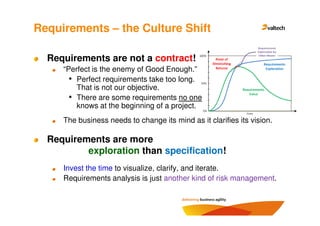
Requirements – the Culture Shift

  Requirements are not a contract!
     “Perfect is the enemy of Good Enough.”
       • Perfect requirements take too long.
         That is not our objective.
       • There are some requirements no one
         knows at the beginning of a project.
     The business needs to change its mind as it clarifies its vision.

  Requirements are more
          exploration than specification!
     Invest the time to visualize, clarify, and iterate.
     Requirements analysis is just another kind of risk management.
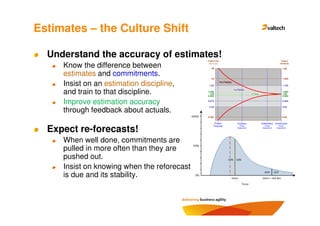
Estimates – the Culture Shift

  Understand the accuracy of estimates!      Project Cost                                                                      Project


     Know the difference between              (effort & size)


                                                  4X
                                                                                                                              Schedule

                                                                                                                                1.6X

     estimates and commitments.                   2X                                                                            1.25X

     Insist on an estimation discipline,       1.5X
                                                                No-Fidelity
                                                                                                                                1.15X


     and train to that discipline.           1.05X
                                              1.0X
                                             0.95X
                                                                              Lo-Fidelity
                                                                                              Hi-Fidelity
                                                                                                                                1.05X
                                                                                                                                1.0X
                                                                                                                                0.95X


     Improve estimation accuracy             0.67X

                                               0.5X
                                                                                                                                0.85X

                                                                                                                                0.8X

     through feedback about actuals.
                                             0.25X                                                                              0.6X

                                                      Project                    Inception                  Elaboration Construction


  Expect re-forecasts!
                                                     Proposal                      Phase                       Phase        Phase
                                                                                 Assessment                  Assessment   Assessment


     When well done, commitments are
     pulled in more often than they are
     pushed out.
     Insist on knowing when the reforecast
     is due and its stability.
Legitimate Concerns of …

                               Executive
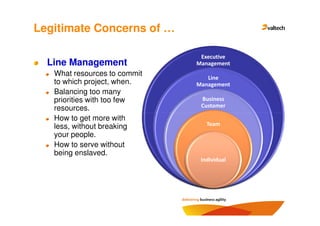
  Line Management             Management
   What resources to commit
                                 Line
   to which project, when.    Management
   Balancing too many
   priorities with too few     Business
   resources.                  Customer

   How to get more with
   less, without breaking        Team
   your people.
   How to serve without
   being enslaved.
                               Individual
Accountability – the Culture Shift
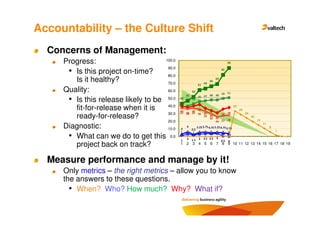
  Concerns of Management:
     Progress:                       100.0
                                                                                      90
                                      90.0
      • Is this project on-time?      80.0
                                                                                81


        Is it healthy?                70.0
                                                                      66
                                                                           69
                                                            61 63

     Quality:                         60.0            52
                                                                                50 51
                                                 47         46 47 48 48
      • Is this release likely to be 50.0    43
                                             38 40
                                                   43

                                      40.0
        fit-for-release when it is           40 38 40
                                                      42
                                                                                            33
                                                                                                 29
                                      30.0   37 36 37 36 37       36 38                               24
        ready-for-release?                               33 34
                                                            30 31    28
                                                                                                           20
                                                                                                                15
                                      20.0                     26 27
                                                                                                                     11
     Diagnostic:                      10.0   3
                                                 6
                                                   2.5
                                                            5.25 5.75 4.75 5.25 4.75 3.75                                 6
                                                                                                                              1
                                             0   0 0         0 0 0 0 0 0
      • What can we do to get this 0.0       1   3    1.5    3   3.5 3.5    4
                                                                                0.5   0
        project back on track?               1   2 3         4 5       6 7 8          9 10 11 12 13 14 15 16 17 18 19


  Measure performance and manage by it!
     Only metrics – the right metrics – allow you to know
     the answers to these questions.
       • When? Who? How much? Why? What if?
Responsibilities – the Culture Shift

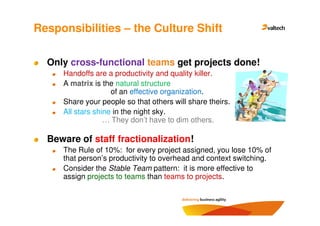
  Only cross-functional teams get projects done!
     Handoffs are a productivity and quality killer.
     A matrix is the natural structure
                    of an effective organization.
     Share your people so that others will share theirs.
     All stars shine in the night sky.
                  … They don’t have to dim others.

  Beware of staff fractionalization!
     The Rule of 10%: for every project assigned, you lose 10% of
     that person’s productivity to overhead and context switching.
     Consider the Stable Team pattern: it is more effective to
     assign projects to teams than teams to projects.
Planning – the Culture Shift

  The Plan is not the Product!
     Keep your eye on the prize.                        Prefer Checklists to Plans!
     “The plan is worthless.                            Don’t tell me what you plan to do;
      The planning is priceless.” - Eisenhower            tell me what you have done!
     Planning is risk management, too!

  Planning may proceed forward or backward!

              Acme Project Reality Machine
                                                                      [Depth]

                                                                      [Risk]

                 Function      Resource      Schedule

          The 3+2 Dimensions of the “Triple Constraint”
Legitimate Concerns of …

                                Executive
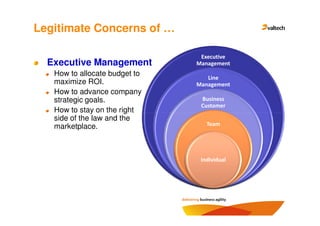
  Executive Management         Management
   How to allocate budget to
                                  Line
   maximize ROI.               Management
   How to advance company
   strategic goals.             Business
                                Customer
   How to stay on the right
   side of the law and the
   marketplace.                   Team


                                Individual
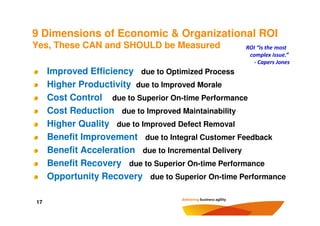
9 Dimensions of Economic & Organizational ROI
Yes, These CAN and SHOULD be Measured              ROI “is the most
                                                    complex issue.”
                                                      - Capers Jones
     Improved Efficiency due to Optimized Process
     Higher Productivity due to Improved Morale
     Cost Control due to Superior On-time Performance
     Cost Reduction due to Improved Maintainability
     Higher Quality due to Improved Defect Removal
     Benefit Improvement due to Integral Customer Feedback
     Benefit Acceleration due to Incremental Delivery
     Benefit Recovery due to Superior On-time Performance
     Opportunity Recovery due to Superior On-time Performance

17
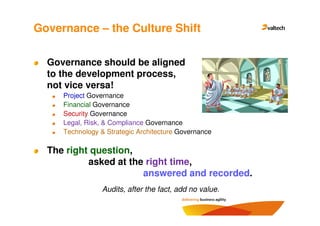
Governance – the Culture Shift

  Governance should be aligned
  to the development process,
  not vice versa!
     Project Governance
     Financial Governance
     Security Governance
     Legal, Risk, & Compliance Governance
     Technology & Strategic Architecture Governance

  The right question,
           asked at the right time,
                       answered and recorded.
                 Audits, after the fact, add no value.
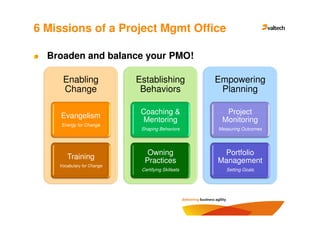
6 Missions of a Project Mgmt Office

  Broaden and balance your PMO!

     Enabling               Establishing            Empowering
     Change                  Behaviors               Planning

                             Coaching &               Project
    Evangelism
                             Mentoring               Monitoring
     Energy for Change
                             Shaping Behaviors      Measuring Outcomes


                               Owning                Portfolio
       Training               Practices             Management
    Vocabulary for Change
                             Certifying Skillsets      Setting Goals
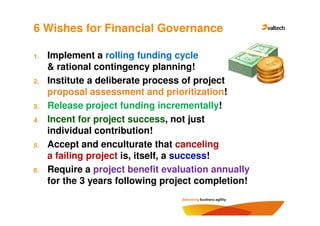
6 Wishes for Financial Governance

1.   Implement a rolling funding cycle
     & rational contingency planning!
2.   Institute a deliberate process of project
     proposal assessment and prioritization!
3.   Release project funding incrementally!
4.   Incent for project success, not just
     individual contribution!
5.   Accept and enculturate that canceling
     a failing project is, itself, a success!
6.   Require a project benefit evaluation annually
     for the 3 years following project completion!
As for the rest, …

  Security, Legal-Risk-Compliance, &
  Technology-Architecture governance
  processes should be facilitative and
  consultative, not juridical.

  The issues that are important to these
  governance groups must be articulated
  if they are to be constructively complied with!
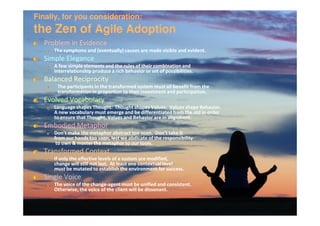
Finally, for you consideration:
the Zen of Agile Adoption
  Problem in Evidence
     The symptoms and (eventually) causes are made visible and evident.
  Simple Elegance
     A few simple elements and the rules of their combination and
     interrelationship produce a rich behavior or set of possibilities.
  Balanced Reciprocity
      The participants in the transformed system must all benefit from the
      transformation in proportion to their investment and participation.
  Evolved Vocabulary
     Language shapes Thought. Thought shapes Values. Values shape Behavior.
     A new vocabulary must emerge and be differentiated from the old in order
     to ensure that Thought, Values and Behavior are in alignment.
  Embodied Metaphor
     Don’t make the metaphor abstract too soon. Don’t take it
     from our hands too soon, lest we abdicate of the responsibility
      to own & master the metaphor to our tools.
  Transformed Context
     If only the affective levels of a system are modified,
     change will still not last. At least one contextual level
     must be mutated to establish the environment for success.
  Single Voice
     The voice of the change-agent must be unified and consistent.
                      change-
     Otherwise, the voice of the client will be dissonant.
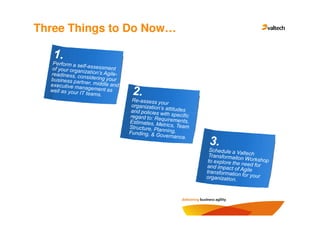
Three Things to Do Now…
Thank you for attending!


                         Questions???


     Contacts:

                             Al Goerner                          Jonathan Cook
             Principal Emterprise Consultant   Business Development, United Kingdom
                    al.goerner@valtech.com               jonathan.cooke@valtech.com
                           +01 214 724 7240                           +44 7748638031

Adopting Agile In The Organization

  • 1.
    Adopting Agile inthe Organization Al Goerner Agile Edge - UK 30 April 2009
  • 2.
    Our Track Recordas a Industry (circa 1978-2000) IT Project Success & Failure 100% 90% 9% 16% These statistics have been very stable 28% for 30 years. And, they aren’t good. 80% 70% Only in the last 7-8 years have they 60% 62% 47% started to move in a more positive 50% 50% direction. This movement is directly 40% attributable to incremental, iterative, 30% collaborative, feedback-driven, 20% 37% 30% business-value-focused methods. 10% 22% 0% Large Companies Medium Companies Small Companies Cancelled Challenged Successful Overrun & Underdeliver 300% 250% 230% 239% 214% Out of every 100 projects, 202% 200% 178% 182% there will be 94 restarts! Some projects are restarted 150% several times. 100% 65% 74% 42% 50% 0% Source: “The CHAOS Report”, Standish Group, 1994. Large Companies Medium Companies Small Companies Schedule Overruns Budget Overruns Features Delivered 2
  • 3.
    The Impact ofAgile-Lean Techniques 2004 Chaos Report 1994 2004 Top 10 Reasons for Success (2004 Chaos Report, Standish Group) Successful Projects 16% 29% • User Involvement Challenged Projects 53% 53% • Executive Mgmt Support • Clear Business Objectives Failed Projects 31% 15% • Optimizing Scope Avg. Schedule Overrun +180% +56% • Agile Process • Project Manager Expertise Avg. Budget Overrun +164% +84% • Financial Management • Skilled Resources Source: “The CHAOS Report”, Standish Group, 2004. • Formal Methodology • Standard Tools & Infrastructure Agile Traditional Low Median High Studies Low Median High Points 1. Cost 10% 26% 70% 9 3% 20% 87% 21 2. Schedule 11% 71% 700% 19 2% 37% 90% 19 3. Productivity 14% 122% 712% 27 9% 62% 255% 17 4. Quality 10% 70% 1,00% 53 7% 50% 132% 20 5. Satisfaction 70% 70% 70% 1 4% 14% 55% 6 6. ROI 240% 2633% 8852% 29 200% 470% 2770% 16 Source: “What is the ROI of Agile vs Traditional Methods?”, Dr. David F. Rico, based on 69 studies. 3
  • 4.
    Quantifying the Return ALocal Case Study: Valtech-India Agile / Lean Adoption Background Period: 2005-2008 Team Size - 15-20 (Average) Geography – Globally Distributed (typically 2 regions) Coaching / Training Duration – • 6-10 Iterations • Iteration Length of 3-4 Weeks • Total Duration 4.5-10 months • Productivity measured by Function Points Projects analyzed, 2006-2008: Productivity increased by 75- 90%, measured in FP/day/person Defects reduced by 45%, measured in defects per FP Estimation variance was reduced to less than 5% Noteworthy: Transformed teams sustained improvements after (both) coaching and re-assignment (1 year later). 4
  • 5.
    Beware: Faux-Agile! Faux-Agile Adopting a few practices, but not understanding the principles. Adopt too few practices that do not synergize with each other. Naïve Agile Agile that works! … for small teams. Agile that works! … in an isolated, insulated environment. Agile-by-the-book, still emphasizing practices more than principles. Mature Agile Agile that works! … for small-medium and distributed teams. Agile that works! … producing sustainable, verifiable results. 2nd-Generation Agile-Lean Agile-Lean hybrid! … applies Agile-Lean to the entire solution value stream. Agile-Lean hybrid! … embraces metrics and emphasizes business impact. Agile-Lean hybrid! … integrates the Business with IT.
  • 6.
    Bottom Line An Agileteam in a non-agile environment will not long survive. Development Agility & Business Agility go Hand-in-Hand.
  • 7.
    What Your Partneris Thinking when you say … “Everything you think you know is wrong.” “What arrogance! You’ve got 3-6 months, max, to impress me.” “Leave us alone. We’ll get the job done.” “I don’t have the time to baby-sit you, but I doubt that I can afford to leave you alone.” “We need 1 of your top people, full-time.” “I need him/her more than you do. You’ll get them in their spare-time.” “We don’t need no stinking project manager.” “But, that’s just exactly what you are gonna get!” “We’re Agile now. We don’t give dates or do reports.” “That’s what YOU think!”
  • 8.
    Legitimate Concerns of… Executive Business Customer Management Usable solutions to real Line problems. Management Responsiveness to changing needs and Business understanding. Customer Predictable, reliable results. Team Schedule reliability amidst dependencies. Individual
  • 9.
    Make the Case with the Business Customer Agility is for the Business Customer’s benefit! To deliver business value … • Solving a real problem … • Faster … • With more flexibility … Benefit Burden • At higher quality … • Reliably and sustainably … • At the same or lower cost. Remember the Principle of Benefit & Burden! If your whole message about Agile development is about tactical development practices, then the best that you can expect from the business customer is benign disregard.
  • 10.
    Requirements – theCulture Shift Requirements are not a contract! “Perfect is the enemy of Good Enough.” • Perfect requirements take too long. That is not our objective. • There are some requirements no one knows at the beginning of a project. The business needs to change its mind as it clarifies its vision. Requirements are more exploration than specification! Invest the time to visualize, clarify, and iterate. Requirements analysis is just another kind of risk management.
  • 11.
    Estimates – theCulture Shift Understand the accuracy of estimates! Project Cost Project Know the difference between (effort & size) 4X Schedule 1.6X estimates and commitments. 2X 1.25X Insist on an estimation discipline, 1.5X No-Fidelity 1.15X and train to that discipline. 1.05X 1.0X 0.95X Lo-Fidelity Hi-Fidelity 1.05X 1.0X 0.95X Improve estimation accuracy 0.67X 0.5X 0.85X 0.8X through feedback about actuals. 0.25X 0.6X Project Inception Elaboration Construction Expect re-forecasts! Proposal Phase Phase Phase Assessment Assessment Assessment When well done, commitments are pulled in more often than they are pushed out. Insist on knowing when the reforecast is due and its stability.
  • 12.
    Legitimate Concerns of… Executive Line Management Management What resources to commit Line to which project, when. Management Balancing too many priorities with too few Business resources. Customer How to get more with less, without breaking Team your people. How to serve without being enslaved. Individual
  • 13.
    Accountability – theCulture Shift Concerns of Management: Progress: 100.0 90 90.0 • Is this project on-time? 80.0 81 Is it healthy? 70.0 66 69 61 63 Quality: 60.0 52 50 51 47 46 47 48 48 • Is this release likely to be 50.0 43 38 40 43 40.0 fit-for-release when it is 40 38 40 42 33 29 30.0 37 36 37 36 37 36 38 24 ready-for-release? 33 34 30 31 28 20 15 20.0 26 27 11 Diagnostic: 10.0 3 6 2.5 5.25 5.75 4.75 5.25 4.75 3.75 6 1 0 0 0 0 0 0 0 0 0 • What can we do to get this 0.0 1 3 1.5 3 3.5 3.5 4 0.5 0 project back on track? 1 2 3 4 5 6 7 8 9 10 11 12 13 14 15 16 17 18 19 Measure performance and manage by it! Only metrics – the right metrics – allow you to know the answers to these questions. • When? Who? How much? Why? What if?
  • 14.
    Responsibilities – theCulture Shift Only cross-functional teams get projects done! Handoffs are a productivity and quality killer. A matrix is the natural structure of an effective organization. Share your people so that others will share theirs. All stars shine in the night sky. … They don’t have to dim others. Beware of staff fractionalization! The Rule of 10%: for every project assigned, you lose 10% of that person’s productivity to overhead and context switching. Consider the Stable Team pattern: it is more effective to assign projects to teams than teams to projects.
  • 15.
    Planning – theCulture Shift The Plan is not the Product! Keep your eye on the prize. Prefer Checklists to Plans! “The plan is worthless. Don’t tell me what you plan to do; The planning is priceless.” - Eisenhower tell me what you have done! Planning is risk management, too! Planning may proceed forward or backward! Acme Project Reality Machine [Depth] [Risk] Function Resource Schedule The 3+2 Dimensions of the “Triple Constraint”
  • 16.
    Legitimate Concerns of… Executive Executive Management Management How to allocate budget to Line maximize ROI. Management How to advance company strategic goals. Business Customer How to stay on the right side of the law and the marketplace. Team Individual
  • 17.
    9 Dimensions ofEconomic & Organizational ROI Yes, These CAN and SHOULD be Measured ROI “is the most complex issue.” - Capers Jones Improved Efficiency due to Optimized Process Higher Productivity due to Improved Morale Cost Control due to Superior On-time Performance Cost Reduction due to Improved Maintainability Higher Quality due to Improved Defect Removal Benefit Improvement due to Integral Customer Feedback Benefit Acceleration due to Incremental Delivery Benefit Recovery due to Superior On-time Performance Opportunity Recovery due to Superior On-time Performance 17
  • 18.
    Governance – theCulture Shift Governance should be aligned to the development process, not vice versa! Project Governance Financial Governance Security Governance Legal, Risk, & Compliance Governance Technology & Strategic Architecture Governance The right question, asked at the right time, answered and recorded. Audits, after the fact, add no value.
  • 19.
    6 Missions ofa Project Mgmt Office Broaden and balance your PMO! Enabling Establishing Empowering Change Behaviors Planning Coaching & Project Evangelism Mentoring Monitoring Energy for Change Shaping Behaviors Measuring Outcomes Owning Portfolio Training Practices Management Vocabulary for Change Certifying Skillsets Setting Goals
  • 20.
    6 Wishes forFinancial Governance 1. Implement a rolling funding cycle & rational contingency planning! 2. Institute a deliberate process of project proposal assessment and prioritization! 3. Release project funding incrementally! 4. Incent for project success, not just individual contribution! 5. Accept and enculturate that canceling a failing project is, itself, a success! 6. Require a project benefit evaluation annually for the 3 years following project completion!
  • 21.
    As for therest, … Security, Legal-Risk-Compliance, & Technology-Architecture governance processes should be facilitative and consultative, not juridical. The issues that are important to these governance groups must be articulated if they are to be constructively complied with!
  • 22.
    Finally, for youconsideration: the Zen of Agile Adoption Problem in Evidence The symptoms and (eventually) causes are made visible and evident. Simple Elegance A few simple elements and the rules of their combination and interrelationship produce a rich behavior or set of possibilities. Balanced Reciprocity The participants in the transformed system must all benefit from the transformation in proportion to their investment and participation. Evolved Vocabulary Language shapes Thought. Thought shapes Values. Values shape Behavior. A new vocabulary must emerge and be differentiated from the old in order to ensure that Thought, Values and Behavior are in alignment. Embodied Metaphor Don’t make the metaphor abstract too soon. Don’t take it from our hands too soon, lest we abdicate of the responsibility to own & master the metaphor to our tools. Transformed Context If only the affective levels of a system are modified, change will still not last. At least one contextual level must be mutated to establish the environment for success. Single Voice The voice of the change-agent must be unified and consistent. change- Otherwise, the voice of the client will be dissonant.
  • 23.
    Three Things toDo Now…
  • 24.
    Thank you forattending! Questions??? Contacts: Al Goerner Jonathan Cook Principal Emterprise Consultant Business Development, United Kingdom al.goerner@valtech.com jonathan.cooke@valtech.com +01 214 724 7240 +44 7748638031