Why Most IT Projects Fail
How Projects Really Work


1/21/2013
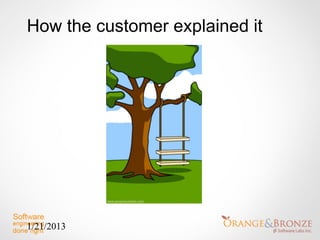
How the customer explained it


1/21/2013
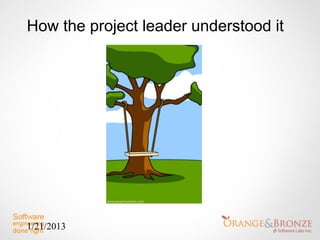
How the project leader understood it


1/21/2013
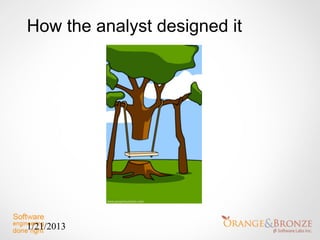
How the analyst designed it


1/21/2013
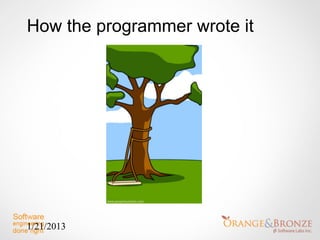
How the programmer wrote it


1/21/2013
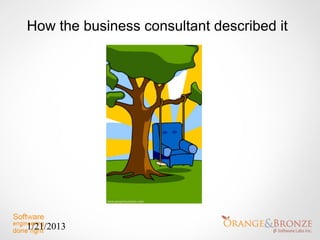
How the business consultant described it


1/21/2013
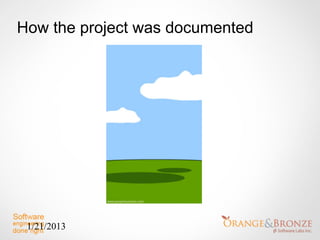
How the project was documented


 1/21/2013
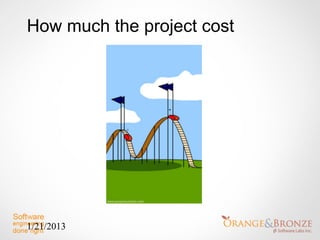
How much the project cost


1/21/2013
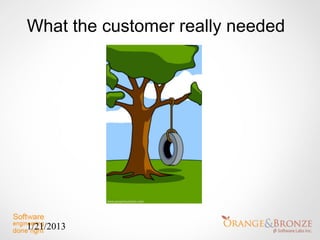
What the customer really needed


1/21/2013
1995 – The CHAOS Report
First comprehensive study on success and
  failure of software projects
  – Conducted by The Standish Group
  – Updated roughly every two years
Survey of IT executive managers
  – large and small businesses
  – various industries
     • inc. banking, securities, manufacturing, retail,
       wholeale, health care, insurance, services and
       government
Classifications
• “Successful”
  – On time, on budget, all features
• “Challenged”
  – Completed but over-budget, over time estimate,
    missing features
• “Impaired”
  – Canceled
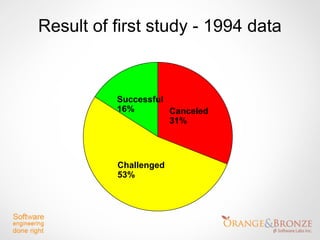
Result of first study - 1994 data


          Successful
          16%        Canceled
                     31%


          Challenged
          53%
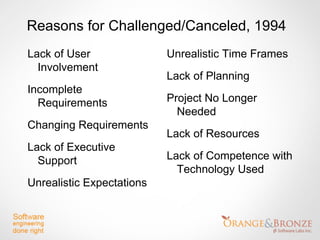
Reasons for Challenged/Canceled, 1994
Lack of User               Unrealistic Time Frames
  Involvement
                           Lack of Planning
Incomplete
  Requirements             Project No Longer
                             Needed
Changing Requirements
                           Lack of Resources
Lack of Executive
  Support                  Lack of Competence with
                             Technology Used
Unrealistic Expectations
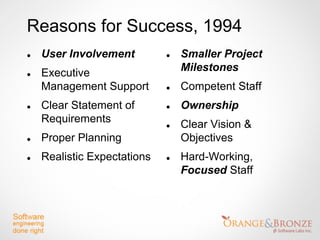
Reasons for Success, 1994
   User Involvement            Smaller Project
   Executive                    Milestones
    Management Support          Competent Staff
   Clear Statement of          Ownership
    Requirements                Clear Vision &
   Proper Planning              Objectives
   Realistic Expectations      Hard-Working,
                                 Focused Staff
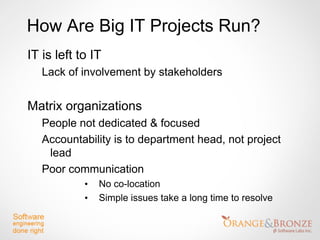
How Are Big IT Projects Run?
IT is left to IT
   Lack of involvement by stakeholders


Matrix organizations
   People not dedicated & focused
   Accountability is to department head, not project
    lead
   Poor communication
            •   No co-location
            •   Simple issues take a long time to resolve
How Are Big IT Projects Run?
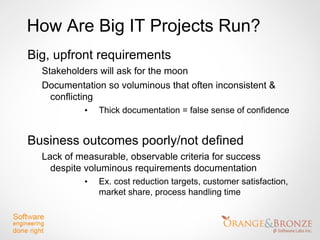
Big, upfront requirements
  Stakeholders will ask for the moon
  Documentation so voluminous that often inconsistent &
    conflicting
           •   Thick documentation = false sense of confidence


Business outcomes poorly/not defined
  Lack of measurable, observable criteria for success
    despite voluminous requirements documentation
           •   Ex. cost reduction targets, customer satisfaction,
               market share, process handling time
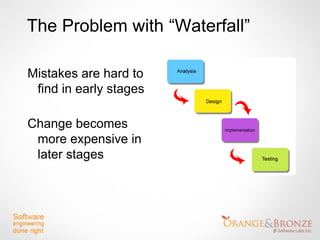
The Problem with “Waterfall”

Mistakes are hard to
 find in early stages

Change becomes
 more expensive in
 later stages
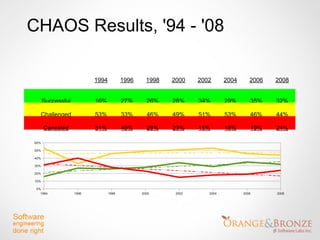
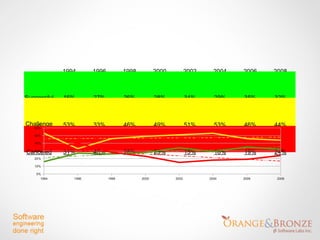
CHAOS Results, '94 - '08

                          1994          1996     1998   2000    2002      2004      2006   2008


      Successful          16%           27%      26%    28%     34%       29%       35%    32%

   Challenged             53%           33%      46%    49%     51%       53%       46%    44%

      Canceled            31%           40%      28%    23%     15%       18%       19%    24%

60%

50%

40%

30%

20%

10%

 0%
   1994            1996          1998          2000      2002      2004          2006      2008
1994      1996          1998          2000          2002     2004   2006   2008


Successful   16%       27%           26%           28%           34%      29%    35%    32%


Challenge
    d        53%       33%           46%           49%           51%      53%    46%    44%
  60%

   50%

   40%

Canceled
  30%
             31%       40%           28%           23%           15%      18%    19%    24%
   20%

   10%

    0%
      1994      1996          1998          2000          2002          2004     2006    2008
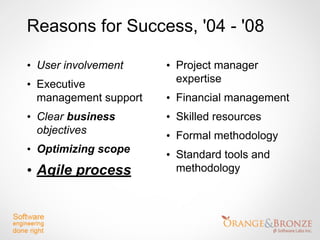
Reasons for Success, '04 - '08

• User involvement     • Project manager
• Executive              expertise
  management support   • Financial management
• Clear business       • Skilled resources
  objectives           • Formal methodology
• Optimizing scope     • Standard tools and
• Agile process          methodology
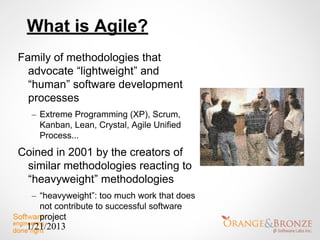
What is Agile?
Family of methodologies that
  advocate “lightweight” and
  “human” software development
  processes
  – Extreme Programming (XP), Scrum,
    Kanban, Lean, Crystal, Agile Unified
    Process...
Coined in 2001 by the creators of
 similar methodologies reacting to
 “heavyweight” methodologies
  – “heavyweight”: too much work that does
    not contribute to successful software
    project
 1/21/2013
What is Agile?
Emphasis on
   Customer satisfaction
   Job satisfaction
   Removal of things that do not contribute to above


1/21/2013
What is Agile?
Culture
   Values and attitude of people involved are just as
    important as processes


Automation for Quick Feedback
   Automated tests, code quality metrics, acceptance
    criteria, automated build & deployment...


1/21/2013
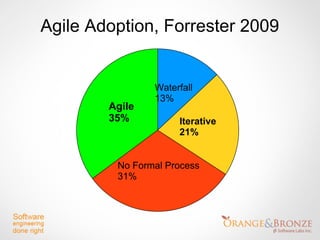
Agile Adoption, Forrester 2009


                Waterfall
                13%
        Agile
        35%          Iterative
                     21%


         No Formal Process
         31%
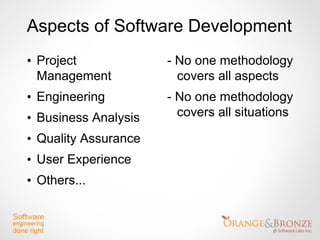
Aspects of Software Development
• Project             - No one methodology
  Management            covers all aspects
• Engineering         - No one methodology
• Business Analysis     covers all situations

• Quality Assurance
• User Experience
• Others...
Some Agile Practices
Interdisciplinary, co-located teams
  Ex. Qwest Communications project
Short iterations
  Deliver working systems for customer feedback
Test-Driven Development
  Define success before you build, down to the
   smallest unit
Some Agile Practices
Continuous Integration
  Automatically build and deploy entire system
   multiple times a day, running automated tests
   and other quality tools
Refactoring
  Constantly improving code design to make it easy
   to accommodate change
DevOps
  Integrate development and operations into a
    seamless, automated practice
Are Agile Practices the Answer?


                NO

Many organizations have adopted Agile
       practices with poor results
Are Agile Practices the Answer?


 Beware of the hype surrounding Agile
Why Agile Fails
• Culture of mistrust
• Performance measures not aligned towards
  collaboration
• Capability of personnel
• Agile authors and consultants that preach
  silver bullets & snake oil
  – Example... “leaderless teams”... what?
Improving the Success Rate
• No silver bullets
  – Slow and steady changes
  – Each company is different
• Changing not just practices, but also culture
  and performance measures
  – Align towards collaboration
     • Ex: Reward overall project success, not just specific
       department deliverables
• Smaller project scopes, measurable
  outcomes
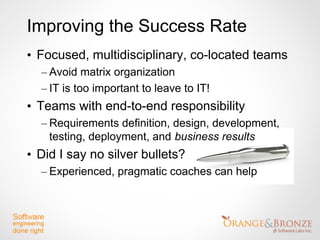
Improving the Success Rate
• Focused, multidisciplinary, co-located teams
  – Avoid matrix organization
  – IT is too important to leave to IT!
• Teams with end-to-end responsibility
  – Requirements definition, design, development,
    testing, deployment, and business results
• Did I say no silver bullets?
  – Experienced, pragmatic coaches can help
The Agile Manifesto
We are uncovering better ways of developing software
  by doing it and helping others do it. Through this
  work we have come to value:
Individuals and interactions over processes and
  tools
Working software over comprehensive
  documentation
Customer collaboration over contract negotiation
Responding to change over following a plan
That is, while there is value in the items on the right,
  we value the items on the left more.

1/21/2013
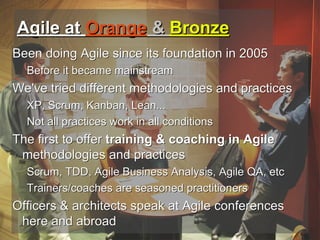
Agile at Orange & Bronze
Been doing Agile since its foundation in 2005
  Before it became mainstream
We've tried different methodologies and practices
  XP, Scrum, Kanban, Lean...
  Not all practices work in all conditions
The first to offer training & coaching in Agile
 methodologies and practices
  Scrum, TDD, Agile Business Analysis, Agile QA, etc
  Trainers/coaches are seasoned practitioners
Officers & architects speak at Agile conferences
 here and abroad
  1/21/2013
Some of Our Clients
Software Development          Training & Coaching


                       Both

Why Most IT Projects Fail

  • 1.
    Why Most ITProjects Fail
  • 2.
    How Projects ReallyWork 1/21/2013
  • 3.
    How the customerexplained it 1/21/2013
  • 4.
    How the projectleader understood it 1/21/2013
  • 5.
    How the analystdesigned it 1/21/2013
  • 6.
    How the programmerwrote it 1/21/2013
  • 7.
    How the businessconsultant described it 1/21/2013
  • 8.
    How the projectwas documented 1/21/2013
  • 9.
    How much theproject cost 1/21/2013
  • 10.
    What the customerreally needed 1/21/2013
  • 11.
    1995 – TheCHAOS Report First comprehensive study on success and failure of software projects – Conducted by The Standish Group – Updated roughly every two years Survey of IT executive managers – large and small businesses – various industries • inc. banking, securities, manufacturing, retail, wholeale, health care, insurance, services and government
  • 12.
    Classifications • “Successful” – On time, on budget, all features • “Challenged” – Completed but over-budget, over time estimate, missing features • “Impaired” – Canceled
  • 13.
    Result of firststudy - 1994 data Successful 16% Canceled 31% Challenged 53%
  • 14.
    Reasons for Challenged/Canceled,1994 Lack of User Unrealistic Time Frames Involvement Lack of Planning Incomplete Requirements Project No Longer Needed Changing Requirements Lack of Resources Lack of Executive Support Lack of Competence with Technology Used Unrealistic Expectations
  • 15.
    Reasons for Success,1994  User Involvement  Smaller Project  Executive Milestones Management Support  Competent Staff  Clear Statement of  Ownership Requirements  Clear Vision &  Proper Planning Objectives  Realistic Expectations  Hard-Working, Focused Staff
  • 16.
    How Are BigIT Projects Run? IT is left to IT Lack of involvement by stakeholders Matrix organizations People not dedicated & focused Accountability is to department head, not project lead Poor communication • No co-location • Simple issues take a long time to resolve
  • 17.
    How Are BigIT Projects Run? Big, upfront requirements Stakeholders will ask for the moon Documentation so voluminous that often inconsistent & conflicting • Thick documentation = false sense of confidence Business outcomes poorly/not defined Lack of measurable, observable criteria for success despite voluminous requirements documentation • Ex. cost reduction targets, customer satisfaction, market share, process handling time
  • 18.
    The Problem with“Waterfall” Mistakes are hard to find in early stages Change becomes more expensive in later stages
  • 19.
    CHAOS Results, '94- '08 1994 1996 1998 2000 2002 2004 2006 2008 Successful 16% 27% 26% 28% 34% 29% 35% 32% Challenged 53% 33% 46% 49% 51% 53% 46% 44% Canceled 31% 40% 28% 23% 15% 18% 19% 24% 60% 50% 40% 30% 20% 10% 0% 1994 1996 1998 2000 2002 2004 2006 2008
  • 20.
    1994 1996 1998 2000 2002 2004 2006 2008 Successful 16% 27% 26% 28% 34% 29% 35% 32% Challenge d 53% 33% 46% 49% 51% 53% 46% 44% 60% 50% 40% Canceled 30% 31% 40% 28% 23% 15% 18% 19% 24% 20% 10% 0% 1994 1996 1998 2000 2002 2004 2006 2008
  • 21.
    Reasons for Success,'04 - '08 • User involvement • Project manager • Executive expertise management support • Financial management • Clear business • Skilled resources objectives • Formal methodology • Optimizing scope • Standard tools and • Agile process methodology
  • 22.
    What is Agile? Familyof methodologies that advocate “lightweight” and “human” software development processes – Extreme Programming (XP), Scrum, Kanban, Lean, Crystal, Agile Unified Process... Coined in 2001 by the creators of similar methodologies reacting to “heavyweight” methodologies – “heavyweight”: too much work that does not contribute to successful software project 1/21/2013
  • 23.
    What is Agile? Emphasison Customer satisfaction Job satisfaction Removal of things that do not contribute to above 1/21/2013
  • 24.
    What is Agile? Culture Values and attitude of people involved are just as important as processes Automation for Quick Feedback Automated tests, code quality metrics, acceptance criteria, automated build & deployment... 1/21/2013
  • 25.
    Agile Adoption, Forrester2009 Waterfall 13% Agile 35% Iterative 21% No Formal Process 31%
  • 26.
    Aspects of SoftwareDevelopment • Project - No one methodology Management covers all aspects • Engineering - No one methodology • Business Analysis covers all situations • Quality Assurance • User Experience • Others...
  • 27.
    Some Agile Practices Interdisciplinary,co-located teams Ex. Qwest Communications project Short iterations Deliver working systems for customer feedback Test-Driven Development Define success before you build, down to the smallest unit
  • 28.
    Some Agile Practices ContinuousIntegration Automatically build and deploy entire system multiple times a day, running automated tests and other quality tools Refactoring Constantly improving code design to make it easy to accommodate change DevOps Integrate development and operations into a seamless, automated practice
  • 29.
    Are Agile Practicesthe Answer? NO Many organizations have adopted Agile practices with poor results
  • 30.
    Are Agile Practicesthe Answer? Beware of the hype surrounding Agile
  • 31.
    Why Agile Fails •Culture of mistrust • Performance measures not aligned towards collaboration • Capability of personnel • Agile authors and consultants that preach silver bullets & snake oil – Example... “leaderless teams”... what?
  • 32.
    Improving the SuccessRate • No silver bullets – Slow and steady changes – Each company is different • Changing not just practices, but also culture and performance measures – Align towards collaboration • Ex: Reward overall project success, not just specific department deliverables • Smaller project scopes, measurable outcomes
  • 33.
    Improving the SuccessRate • Focused, multidisciplinary, co-located teams – Avoid matrix organization – IT is too important to leave to IT! • Teams with end-to-end responsibility – Requirements definition, design, development, testing, deployment, and business results • Did I say no silver bullets? – Experienced, pragmatic coaches can help
  • 34.
    The Agile Manifesto Weare uncovering better ways of developing software by doing it and helping others do it. Through this work we have come to value: Individuals and interactions over processes and tools Working software over comprehensive documentation Customer collaboration over contract negotiation Responding to change over following a plan That is, while there is value in the items on the right, we value the items on the left more. 1/21/2013
  • 35.
    Agile at Orange& Bronze Been doing Agile since its foundation in 2005 Before it became mainstream We've tried different methodologies and practices XP, Scrum, Kanban, Lean... Not all practices work in all conditions The first to offer training & coaching in Agile methodologies and practices Scrum, TDD, Agile Business Analysis, Agile QA, etc Trainers/coaches are seasoned practitioners Officers & architects speak at Agile conferences here and abroad 1/21/2013
  • 36.
    Some of OurClients Software Development Training & Coaching Both