COMPETENCY MAPPING FRAMEWORK  
                                               FOR HRD EXECUTIVES OF POWER HR FORUM MEMBER ORGANIZATIONS 


                       Types of Competencies: 
                               1.      FUNCTIONAL COMPETENCIES  
                               2.      BEHAVIOURAL COMPETENCIES 
                                         2.1. THRESHOLD COMPETENCIES    
                                         2.2. DIFFERENTIATING COMPETENCIES  
                                            

                                                                                                            LEVELS
              COMPETENCIES                             1                             2                           3                            4                              5
 DOMAIN                                           Knowledge                   Understanding                   Application                  Analysis                    Proficiency
 1.   FUNCTIONAL / TECHNICAL COMPETENCIES
     1.1. TRAINING / LEARNING
1.1.1 Training need        • Sources of training needs.                                         • Formulation of a training needs                     • Identification of operational training needs:
      Assessment           • Individual training needs:                                           identification form:                                     o Individual performance gaps.
                                o Training needs form.                                               o Individual                                          o Group performance gaps.
                                o Performance appraisal.                                             o Group.                                              o Organizational performance gaps.
                           • Group training needs                                                    o Organization.                                  • Identification of strategic training needs:
                           • Organizational training needs                                      • Consolidation of training needs                          o Resolving organizational
                           • ISO 10015                                                            from performance appraisals.                                  problems.
                                                                                                • Segregation of training needs                            o Creating and sustaining a
                                                                                                  into training programs.                                       competitive advantage.
                                                                                                • Formulation of training plan.                            o Technology shifts.
                                                                                                                                                           o Paradigm shifts.
1.1.2 Training & Learning            • Segregation and classification of:                       • Formulation of performance                          • Designing customized programs on
      Design                              o Individual training needs.                            objectives for each training                          the basis of :
                                          o Group training needs.                                 program                                                  o Range of competency
                                          o Organizational Training                             • Formulation of training programs                              requirements.
                                            needs.                                                on the basis of:                                         o Level of competency
                                     • Alignment of training needs to                                o Individual training needs.                               requirements.
                                       performance objectives                                        o Group training needs.                          • Formulation of programs on the
                                                                                                     o Organizational training                          basis of performance and strategic
                                                                                                       needs.                                           needs of groups.
                                                                                                                                                      • Formulation of programs on the
                                                                                                                                                        basis of performance and strategic
                                                                                                                                                        needs of the organization.
                                                                                                                                                      • Program redesign on the basis of
                                                                                                                                                        assessment of effectiveness.
1.1.3 Instructional Design           • Bloom's taxonomy and                                     • Program designing in alignment                      • Designing of all learning aids in
                                       competency development process.                            with the competency                                   consonance with the competency
                                     • Gagne’s 9 events                                           development process and                               development process:
                                     • Dale’s Cone                                                performance objectives of each                           o Presentation.
                                     • Competency mapping.                                        training program.                                        o Training material.
                                     • Catalyzing each stage of the                             • Facilitating program content                        • Designing of exercises /content for
                                       competency development process.                            design for catalyzing each stage                      catalyzing each stage of the
                                                                                                  of the competency development                         competency development process.
                                                                                                  process (Bloom level).                              • Innovating the components of the
                                                                                                                                                        learning system.
  
 Legend: [J] is for Junior Level (experience <5 years), [M] is for Middle Level (experience 5‐15 years) & (S) is for Senior Level (experience >15years)                                    
                                                                                                                                                                                              1 of 6 
COMPETENCY MAPPING FRAMEWORK  
                                             FOR HRD EXECUTIVES OF POWER HR FORUM MEMBER ORGANIZATIONS 


                                                                                                            LEVELS
              COMPETENCIES                              1                            2                           3                            4                            5
 DOMAIN                                           Knowledge                   Understanding                   Application                  Analysis                  Proficiency
1.1.4 Training Delivery              • Facilitation of training programs.                       • Pre and post training.                              • Internal marketing of training
                                     • Training aids.                                           • Elements of the training delivery                     programs.
                                     • Training administration.                                   system:                                             • Identifying participants whose
                                                                                                     o Briefing of trainers                             training needs are aligned to
                                                                                                     o Application of Audio/Visual                      program objectives.
                                                                                                        aids:                                         • Influencing attendance of
                                                                                                        - LCD projector                                 participants whose performance
                                                                                                        - White board.                                  needs are aligned to program
                                                                                                        - Flip chart.                                   contents.
                                                                                                        - Training material.                          • Database of trainers for all
                                                                                                        - Laptops.                                      domains.
                                                                                                • Internet Participant feedback of                    • Check list of all elements of the
                                                                                                  training operations.                                  training delivery system.
                                                                                                • Supervision of training                             • Check list of training administration
                                                                                                  administration.                                       points.
                                                                                                                                                      • Integration of innovations in training
                                                                                                                                                        delivery systems.
1.1.5 Training Evaluation            • Kirkpatrick's training evaluation                        • Formulation of participant                          • Level 2 assessment: Formulation of
                                       system                                                     feedback forms.                                       pre and post test on the basis of
                                     • Participant feedback form.                               • Formulation of pre and post test                      competencies.
                                     • Pre and post test administration                           as per performance objectives.                      • Level 3 assessment: Assessment
                                       and analysis.                                            • Feedback to trainer.                                  of behavioral change.
                                                                                                • Feedback to trainees.                               • Level 4 assessment: Impact of
                                                                                                                                                        program.
                                                                                                                                                      • RoI on training investment
                                                                                                                                                      • Broadcasting of training metrics to
                                                                                                                                                        decision makers.
1.1.6 e-Learning                     • e-Learning methodology.                                  • Formulation of instruction design                   • Formulation of an e-Learning
                                     • Components of e-Learning.                                  for e-Learning and class room                         strategy.
                                     • Utility of e-Learning.                                     learning training programs                          • Deployment of a learning
                                     • Parameters of a successful e-                            • Application of Learning                               management system.
                                       Learning system.                                           Management System (LMS).                            • Deployment of blended learning
                                     • Methodology of integrating e-                            • Assessment and certification of                       programs. (e-Learning & classroom
                                       Learning with class room learning                          participants doing programs on                        learning).
                                                                                                  the LMS.                                            • Training of e-trainers on Learning
                                                                                                • Deploying desktop based stand-                        Management System.
                                                                                                  alone e-learning programs.                          • Continuous up-gradation of the
                                                                                                                                                        LMS.


 Legend: [J] is for Junior Level (experience <5 years), [M] is for Middle Level (experience 5‐15 years) & (S) is for Senior Level (experience >15years)                                    
                                                                                                                                                                                          2 of 6 
COMPETENCY MAPPING FRAMEWORK  
                                             FOR HRD EXECUTIVES OF POWER HR FORUM MEMBER ORGANIZATIONS 


                                                                                                            LEVELS
              COMPETENCIES                             1                             2                           3                            4                            5
 DOMAIN                                           Knowledge                   Understanding                   Application                  Analysis                  Proficiency
1.1.7 HRD Metrics                    •   Competency metrics.                                    • Assimilation and utilization of                     • Utilization of training metrics for
                                     •   Training metrics.                                        training metrics at                                   influencing participation in training
                                     •   OD metrics.                                              individual/group/organization                         programs.
                                     •   Talent metrics.                                          levels.                                             • Calculation of training metrics at
                                                                                                • Calculation of training metrics at                    Level 3 and Level 4(Kirkpatrick).
                                                                                                  Level 1 and Level 2.(Kirkpatrick)                   • Competency metrics related to
                                                                                                • Calculation, assimilation and                         competency gaps at group and
                                                                                                  application of OD metrics.                            organization level.
                                                                                                • Calculation of talent metrics at                    • Competency development metrics.
                                                                                                  group level.                                        • Change metrics related to OD
                                                                                                                                                        interventions.
                                                                                                                                                      • Calculation of talent metrics at the
                                                                                                                                                        organization level.
                                                                                                                                                      • Broadcasting of training/ OD/Talent
                                                                                                                                                        metrics to decision makers and
                                                                                                                                                        stakeholders.
     1.2. ORGANIZATIONAL DEVELOPMENT
1.2.1 Competency Mapping             • Distinction between competence                           • Sources for identifying                             • Formulation of competency maps
                                       and competency.                                            competencies.                                         for persons, positions or
                                     • Ingredients of competency.                               • Method for identifying the                            performance.
                                     • Utility of competency mapping.                             expected level of competency for                    • Integration of competency maps
                                     • Kinds of learning that results in                          a position.                                           into all HR systems related to
                                       competency formation.                                    • Scales for assessing competency                       person, position or performance.
                                                                                                  level.                                              • Formulation of competency maps
                                                                                                • Utilization of competency maps                        for strategic organization needs:
                                                                                                  for training and recruitment.                            o Resolution of organizational
                                                                                                • Formulation of competency maps                              problems.
                                                                                                  for training programs.                                   o Technology /Paradigm shifts.
                                                                                                                                                      • Synthesis of behavioral indicators
                                                                                                                                                        in competency maps.
1.2.2 Knowledge                      • Components and kinds of                                  • Deployment of a knowledge                           • Collection and analysis of metrics
      Management                       Knowledge Management System.                               management system.                                    regarding the knowledge
                                     • Parameters of a successful                               • Training of input providers and                       management system.
                                       knowledge management system.                               users of the knowledge                              • Broadcasting of KMS metrics to
                                                                                                  management system.                                    stakeholders and decision makers.
                                                                                                • Parameters for monitoring the                       • Identification of knowledge needs
                                                                                                  knowledge management system.                          of strategic positions/strategic
                                                                                                                                                        teams/operational teams and
                                                                                                                                                        designing the knowledge
                                                                                                                                                        management process, accordingly.
                                                                                                                                                      • Continuous up-gradation of the
                                                                                                                                                        technology and the capabilities of the
                                                                                                                                                        knowledge management system.
 Legend: [J] is for Junior Level (experience <5 years), [M] is for Middle Level (experience 5‐15 years) & (S) is for Senior Level (experience >15years)                                    
                                                                                                                                                                                          3 of 6 
COMPETENCY MAPPING FRAMEWORK  
                                              FOR HRD EXECUTIVES OF POWER HR FORUM MEMBER ORGANIZATIONS 


                                                                                                            LEVELS
              COMPETENCIES                              1                            2                           3                            4                            5
 DOMAIN                                            Knowledge                  Understanding                   Application                  Analysis                  Proficiency
1.2.3 Organizational Survey          •   Employee satisfaction survey.                          • Design of survey objectives.                        • Broadcasting of survey inferences
                                     •   Employee engagement survey.                            • Design of data collection                             to stakeholders and decision
                                     •   Customer satisfaction survey.                            process.                                              makers.
                                     •   Organizational climate survey.                         • Design of data collection                           • Facilitation of action planning on
                                     •   Organizational culture survey.                           instruments.                                          the basis of survey inferences.
                                     •   Service effectiveness survey                           • Analysis and synthesis of data.                     • Facilitating the design of the
                                                                                                • Report preparation.                                   execution and review system of the
                                                                                                • Presentation of survey                                action plan.
                                                                                                  inferences.                                         • Deployment of Web based surveys.
                                                                                                • Checking reliability and validity                   • Design of all the components of the
                                                                                                                                                        web based organizational survey.
1.2.4 Mentoring                      • Components of the Mentoring                              • Parameters for identifying                          • Collection and analysis of metrics
                                       system.                                                    mentors.                                              related to impact of mentoring.
                                     • Parameters of a successful                               • Training of mentors.                                • Broadcasting of mentoring metrics
                                       deployment of a mentoring                                • Training of mentees.                                  to decision makers and
                                       system.                                                  • Facilitation of the mentor-mentee                     stakeholders.
                                     • Stage of maturity in mentoring                             relationship.                                       • Review of mentoring and
                                       system                                                   • Monitoring of the mentor-mentee                       reassigning of mentors/mentees if
                                                                                                  action plan.                                          required.
                                                                                                • Preparation of a manual for                         • Design and deployment of
                                                                                                  mentors, mentees and                                  recognition systems for
                                                                                                  stakeholders.                                         mentors/mentees.
1.2.5 Employer Branding              • Processes that impact employer                           • Segregation of the target                           • Designing the target population
                                       brand.                                                     population.                                           experience while interacting with
                                     • Unique Selling Proposition of the                        • Identification of personnel who                       the organization.
                                       employer.                                                  are the face of the organization                    • Alternative media for
                                     • Points of interaction between the                          during employer-target                                communicating with the target
                                       employer and the target                                    population interaction.                               population.
                                       population.                                              • Training of personnel who are                       • Designing of the message for the
                                     • Communication systems for                                  interacting with the target                           alternative via media for
                                       communicating the USP/strengths                            population.                                           communicating with the target
                                       of the employer to the target                            • Presentation of organizational                        population.
                                       population.                                                strengths to the target                             • Assimilation, broadcast and review
                                                                                                  population.                                           of metrics related to brand strength.


 Legend: [J] is for Junior Level (experience <5 years), [M] is for Middle Level (experience 5‐15 years) & (S) is for Senior Level (experience >15years)                                    
                                                                                                                                                                                          4 of 6 
COMPETENCY MAPPING FRAMEWORK  
                                            FOR HRD EXECUTIVES OF POWER HR FORUM MEMBER ORGANIZATIONS 


                                                                                                            LEVELS
              COMPETENCIES                            1                              2                           3                            4                            5
 DOMAIN                                           Knowledge                   Understanding                   Application                  Analysis                  Proficiency
     1.3. CAREER DEVELOPMENT
1.3.1 Talent Management      • Appreciative inquiry process.                                    • Talent identification.                              • Design of strategy for converting
      (Appreciative Inquiry) • Talent components.                                               • Design of vision on the basis of                      talent into performance.
                             • Vision building on the basis of                                    talent and opportunity.                             • Formulation of a talent inventory at
                               strengths.                                                       • Formulation of talent                                 the organizational level.
                                                                                                  development plans.                                  • Calculation and communication of
                                                                                                • Formulation of a talent inventory                     talent related metrics to decision
                                                                                                  at the departmental level.                            makers.
                                                                                                                                                      • Monitoring execution of talent
                                                                                                                                                        development plans.
1.3.2 Assessment and                 • Objectives for setting up an                             • Parameters of an effective                          • Design of assessment system for
      Development Centre               assessment centre / development                            assessment and development                            different employee segments.
                                       centre.                                                    centre.                                             • Facilitation of the formulation of
                                     • Components of an assessment                              • Deployment of an assessment                           competency development plans.
                                       and development centre.                                    and development centre for a                        • Selection of tools for competency
                                     • Metrics of an assessment and                               niche employee segment.                               assessment.
                                       development centre.                                      • Competency assessment                               • Selection and training of assessors.
                                     • Stakeholders in an assessment                              process.                                            • Collection, review and
                                       and development centre.                                  • Competency development                                communication of metrics to key
                                     • Tools for assessment of                                    process.                                              stakeholders.
                                       competency                                               • Development and application of                      • Ascertaining validity and reliability
                                                                                                  tools for competency assessment                       of assessment systems.
1.3.3 Coaching and                   • Coaching process.                                        • Coaching skills.                                    • Collation of coaching metrics.
      Counseling                     • Parameters of an effective coach.                        • Identification of coaches.                          • Broadcasting of coaching metrics
                                     • Parameters for selecting                                 • Identification of coachees.                           to decision makers and
                                       coachees.                                                • Forming coach-coachee pairs.                          stakeholders.
                                     • Elements of a coaching plan.                             • Facilitation of the formulation of                  • Reviewing the progress and
                                                                                                  coaching plans by each coach.                         performance of coach-coachee
                                                                                                • Deployment of the counseling                          pairs and taking corrective action.
                                                                                                  process.                                            • Facilitation of learning sessions
                                                                                                                                                        among coaches.
                                                                                                                                                      • Facilitation of learning sessions
                                                                                                                                                        among coachees.


 Legend: [J] is for Junior Level (experience <5 years), [M] is for Middle Level (experience 5‐15 years) & (S) is for Senior Level (experience >15years)                                    
                                                                                                                                                                                           5 of 6 
COMPETENCY MAPPING FRAMEWORK  
                                             FOR HRD EXECUTIVES OF POWER HR FORUM MEMBER ORGANIZATIONS 


                                                                                                            LEVELS
              COMPETENCIES                              1                            2                           3                            4                             5
 DOMAIN
                                    Knowledge                                 Understanding                   Application                  Analysis                   Proficiency
 2.   BEHAVIORAL COMPETENCIES
     2.1 THRESHOLD BEHAVIORAL COMPETENCIES
2.1.1 Coordination &    • Makes self available                                                  • Prepares oneself& others                            • Tracks the work progress,
      Planning          • Follows systems and procedures                                        • Coordinates with others                               senses problems, sustains
                        • Executes when directed/ when                                          • Prioritizes and schedule          (J)                 focus
                                                                                                                                                      • Foresightedness, Ready    (M, S)
                          asked to do                                                             multiple task for self and others
                                                                                                • Does advance planning                                 with the team
                                                                                                • Timely Delivery
2.1.2 Analytical Thinking            • Aware of the organization                                • Understands the problem,                            • Analysis of trends/projections
                                     • Aware of rules & policies                                  need, analysis of pros & cons                       • Strategizes and translates into
                                     • Collects Data and facts                                  • Takes Decision (Present View)      (J)     (M)        action (Future View)                     (S)
                                       (Past view)                                              • Separates facts from perception;                    • Able to assess the risk
                                                                                                • Brings in new ideas                                 • Appreciates creativity and
                                                                                                                                                        encourages new ideas
2.1.3 Team Work                      • Generally works by himself                               •  Involves others                                    • Collaborates, leads, develops,
                                     • Just listens to the ideas of others                      •  Support ideas of others                              engages team members
                                       (Team Worker)                                            •  Learns from others           (J)                   • Engages team, motivates (Team Leader) (M, S)
                                                                                                •  Shares information                                 • Creates a feeling of
                                                                                                •  Resolves conflicts                                   belongingness in the team,
                                                                                                   (Team Player)                                        shares wins and successes
2.1.4 Presentation Skills            • Just presents information as                             • Understands the issue,                              • Articulates outcomes
                                       gathered without ownership                                 presents with conviction,                              effectively
                                                                                                  uses variety of methods to                          • Owns responsibility
                                                                                                  support the views                  (J)                                                       (M, S)
                                                                                                                                                      • Translates organizations
                                                                                                • Builds reputation by                                   vision into various initiatives
                                                                                                  designing and delivery                              • Focuses on brand building
                                                                                                • Focuses on image building
2.1.5 Learning Orientation           • Aware of news and views                                  • Shares trends, stays abreast                        • Resilience, appreciates
                                                                                                • Learns from others                                    learning from the past and
                                                                                    (J)         • Sees into the merit of ideas of others     (M)        takes action, translates and (S)
                                                                                                • Promotes the learning                                 builds system and procedures
                                                                                                   environment                                        • Emerges as change agent
     2.2 DIFFERENTIATING BEHAVIORAL COMPETENCIES
2.2.1 Openness           • Is approachable                                                      • Empathizes, transparent                             • Sensitive to the needs of others
                         • Listens to others                                        (J)         • Does counseling                            (M)
                                                                                                                                                        and organization, demonstrates
                         • Shows warmth                                                         • Assesses strength & weakness                          coaching skills, develops others (S)
                                                                                                  of others, motivate others                          • Has long term perspective
2.2.2 Influencing Skills             • Establishes internal and external                        • Initiates, negotiates, asserts                      • Is proactive, creates impact on merit
                                       contacts                                                   persuades                                           • Influences others, has good sense of
                                     • Communicates and sells ideas                             • wins consensus and builds trust                       timing                                (M, S)
                                                                                    (J)           and is enthusiastic                                 • Builds credibility, focused on brand
                                                                                                                                                        building
  
 Legend: [J] is for Junior Level (experience <5 years), [M] is for Middle Level (experience 5‐15 years) & (S) is for Senior Level (experience >15years)                                    
                                                                                                                                                                                            6 of 6 
COMPETENCY MAP  
                                                 FOR HRD EXECUTIVES OF POWER HR FORUM MEMBER ORGANIZATIONS 


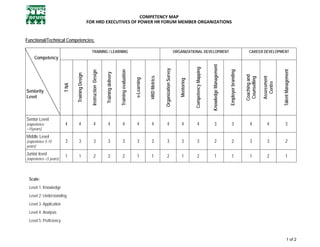
Functional/Technical Competencies:

                                                   TRAINING / LEARNING                                                                                                 ORGANIZATIONAL DEVELOPMENT                                                         CAREER DEVELOPMENT
     Competency


                                                                                                                                                                                                           Knowledge Management
                                                                                                                                                                                      Competency Mapping
                                                                                                                                                 Organization Survey


                                                                                                                                                                                                                                                                                  Talent Management
                                                                                                                                                                                                                                  Employer branding
                                                                                            Training evaluation
                                                   Instruction Design


                                                                        Training delivery
                               Training Design


                                                                                                                                                                                                                                                      Coaching and
                                                                                                                               HRD Metrics


                                                                                                                                                                                                                                                                     Assessment
                                                                                                                                                                                                                                                       Counselling
                                                                                                                  e-Learning


                                                                                                                                                                          Mentoring


                                                                                                                                                                                                                                                                       Centre
                        T NA


Seniority
Level


Senior Level
(experience              4         4                    4                    4                   4                   4            4                   4                     4              4                     3                     3                  4              4             3
>15years)
Middle Level
(experience 5-15         3         3                    3                    3                   3                   3            3                   3                     3              3                     2                     2                  3              3             2
years)
Junior level             1         1                    2                    2                   2                   1            1                   2                     1              2                     1                     1                  1              2             1
(experience <5 years)


 Scale:
 Level 1: Knowledge
 Level 2: Understanding
 Level 3: Application
 Level 4: Analysis
 Level 5: Proficiency
  
  
                                                                                                                                                                                                                                                                                          1 of 2 
  
COMPETENCY MAP  
                                   FOR HRD EXECUTIVES OF POWER HR FORUM MEMBER ORGANIZATIONS 


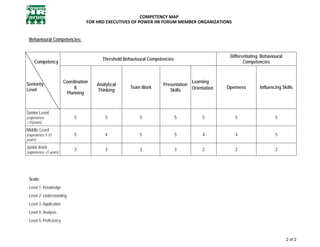
 Behavioural Competencies:


                                                                                                   Differentiating Behavioural
                                         Threshold Behavioural Competencies
     Competency                                                                                           Competencies


                        Coordination                                                Learning
Seniority                              Analytical                      Presentation
Level                        &                        Team Work                     Orientation   Openness        Influencing Skills
                                       Thinking                           Skills
                         Planning


Senior Level
(experience                  5             5              5                   5          5           5                    5
>15years)
Middle Level
(experience 5-15             5             4              5                   5          4           4                    5
years)
Junior level                 3             3              3                   3          2           2                    2
(experience <5 years)


 Scale:
 Level 1: Knowledge
 Level 2: Understanding
 Level 3: Application
 Level 4: Analysis
 Level 5: Proficiency
  
  
                                                                                                                                 2 of 2 
  

Competency mapping hrd power hr forum

  • 1.
    COMPETENCY MAPPING FRAMEWORK   FOR HRD EXECUTIVES OF POWER HR FORUM MEMBER ORGANIZATIONS    Types of Competencies:  1. FUNCTIONAL COMPETENCIES   2. BEHAVIOURAL COMPETENCIES  2.1. THRESHOLD COMPETENCIES     2.2. DIFFERENTIATING COMPETENCIES         LEVELS COMPETENCIES 1 2 3 4 5 DOMAIN Knowledge Understanding Application Analysis Proficiency 1. FUNCTIONAL / TECHNICAL COMPETENCIES 1.1. TRAINING / LEARNING 1.1.1 Training need • Sources of training needs. • Formulation of a training needs • Identification of operational training needs: Assessment • Individual training needs: identification form: o Individual performance gaps. o Training needs form. o Individual o Group performance gaps. o Performance appraisal. o Group. o Organizational performance gaps. • Group training needs o Organization. • Identification of strategic training needs: • Organizational training needs • Consolidation of training needs o Resolving organizational • ISO 10015 from performance appraisals. problems. • Segregation of training needs o Creating and sustaining a into training programs. competitive advantage. • Formulation of training plan. o Technology shifts. o Paradigm shifts. 1.1.2 Training & Learning • Segregation and classification of: • Formulation of performance • Designing customized programs on Design o Individual training needs. objectives for each training the basis of : o Group training needs. program o Range of competency o Organizational Training • Formulation of training programs requirements. needs. on the basis of: o Level of competency • Alignment of training needs to o Individual training needs. requirements. performance objectives o Group training needs. • Formulation of programs on the o Organizational training basis of performance and strategic needs. needs of groups. • Formulation of programs on the basis of performance and strategic needs of the organization. • Program redesign on the basis of assessment of effectiveness. 1.1.3 Instructional Design • Bloom's taxonomy and • Program designing in alignment • Designing of all learning aids in competency development process. with the competency consonance with the competency • Gagne’s 9 events development process and development process: • Dale’s Cone performance objectives of each o Presentation. • Competency mapping. training program. o Training material. • Catalyzing each stage of the • Facilitating program content • Designing of exercises /content for competency development process. design for catalyzing each stage catalyzing each stage of the of the competency development competency development process. process (Bloom level). • Innovating the components of the learning system.   Legend: [J] is for Junior Level (experience <5 years), [M] is for Middle Level (experience 5‐15 years) & (S) is for Senior Level (experience >15years)                                       1 of 6 
  • 2.
    COMPETENCY MAPPING FRAMEWORK   FOR HRD EXECUTIVES OF POWER HR FORUM MEMBER ORGANIZATIONS          LEVELS COMPETENCIES 1 2 3 4 5 DOMAIN Knowledge Understanding Application Analysis Proficiency 1.1.4 Training Delivery • Facilitation of training programs. • Pre and post training. • Internal marketing of training • Training aids. • Elements of the training delivery programs. • Training administration. system: • Identifying participants whose o Briefing of trainers training needs are aligned to o Application of Audio/Visual program objectives. aids: • Influencing attendance of - LCD projector participants whose performance - White board. needs are aligned to program - Flip chart. contents. - Training material. • Database of trainers for all - Laptops. domains. • Internet Participant feedback of • Check list of all elements of the training operations. training delivery system. • Supervision of training • Check list of training administration administration. points. • Integration of innovations in training delivery systems. 1.1.5 Training Evaluation • Kirkpatrick's training evaluation • Formulation of participant • Level 2 assessment: Formulation of system feedback forms. pre and post test on the basis of • Participant feedback form. • Formulation of pre and post test competencies. • Pre and post test administration as per performance objectives. • Level 3 assessment: Assessment and analysis. • Feedback to trainer. of behavioral change. • Feedback to trainees. • Level 4 assessment: Impact of program. • RoI on training investment • Broadcasting of training metrics to decision makers. 1.1.6 e-Learning • e-Learning methodology. • Formulation of instruction design • Formulation of an e-Learning • Components of e-Learning. for e-Learning and class room strategy. • Utility of e-Learning. learning training programs • Deployment of a learning • Parameters of a successful e- • Application of Learning management system. Learning system. Management System (LMS). • Deployment of blended learning • Methodology of integrating e- • Assessment and certification of programs. (e-Learning & classroom Learning with class room learning participants doing programs on learning). the LMS. • Training of e-trainers on Learning • Deploying desktop based stand- Management System. alone e-learning programs. • Continuous up-gradation of the LMS.       Legend: [J] is for Junior Level (experience <5 years), [M] is for Middle Level (experience 5‐15 years) & (S) is for Senior Level (experience >15years)                                       2 of 6 
  • 3.
    COMPETENCY MAPPING FRAMEWORK   FOR HRD EXECUTIVES OF POWER HR FORUM MEMBER ORGANIZATIONS          LEVELS COMPETENCIES 1 2 3 4 5 DOMAIN Knowledge Understanding Application Analysis Proficiency 1.1.7 HRD Metrics • Competency metrics. • Assimilation and utilization of • Utilization of training metrics for • Training metrics. training metrics at influencing participation in training • OD metrics. individual/group/organization programs. • Talent metrics. levels. • Calculation of training metrics at • Calculation of training metrics at Level 3 and Level 4(Kirkpatrick). Level 1 and Level 2.(Kirkpatrick) • Competency metrics related to • Calculation, assimilation and competency gaps at group and application of OD metrics. organization level. • Calculation of talent metrics at • Competency development metrics. group level. • Change metrics related to OD interventions. • Calculation of talent metrics at the organization level. • Broadcasting of training/ OD/Talent metrics to decision makers and stakeholders. 1.2. ORGANIZATIONAL DEVELOPMENT 1.2.1 Competency Mapping • Distinction between competence • Sources for identifying • Formulation of competency maps and competency. competencies. for persons, positions or • Ingredients of competency. • Method for identifying the performance. • Utility of competency mapping. expected level of competency for • Integration of competency maps • Kinds of learning that results in a position. into all HR systems related to competency formation. • Scales for assessing competency person, position or performance. level. • Formulation of competency maps • Utilization of competency maps for strategic organization needs: for training and recruitment. o Resolution of organizational • Formulation of competency maps problems. for training programs. o Technology /Paradigm shifts. • Synthesis of behavioral indicators in competency maps. 1.2.2 Knowledge • Components and kinds of • Deployment of a knowledge • Collection and analysis of metrics Management Knowledge Management System. management system. regarding the knowledge • Parameters of a successful • Training of input providers and management system. knowledge management system. users of the knowledge • Broadcasting of KMS metrics to management system. stakeholders and decision makers. • Parameters for monitoring the • Identification of knowledge needs knowledge management system. of strategic positions/strategic teams/operational teams and designing the knowledge management process, accordingly. • Continuous up-gradation of the technology and the capabilities of the knowledge management system. Legend: [J] is for Junior Level (experience <5 years), [M] is for Middle Level (experience 5‐15 years) & (S) is for Senior Level (experience >15years)                                       3 of 6 
  • 4.
    COMPETENCY MAPPING FRAMEWORK   FOR HRD EXECUTIVES OF POWER HR FORUM MEMBER ORGANIZATIONS            LEVELS COMPETENCIES 1 2 3 4 5 DOMAIN Knowledge Understanding Application Analysis Proficiency 1.2.3 Organizational Survey • Employee satisfaction survey. • Design of survey objectives. • Broadcasting of survey inferences • Employee engagement survey. • Design of data collection to stakeholders and decision • Customer satisfaction survey. process. makers. • Organizational climate survey. • Design of data collection • Facilitation of action planning on • Organizational culture survey. instruments. the basis of survey inferences. • Service effectiveness survey • Analysis and synthesis of data. • Facilitating the design of the • Report preparation. execution and review system of the • Presentation of survey action plan. inferences. • Deployment of Web based surveys. • Checking reliability and validity • Design of all the components of the web based organizational survey. 1.2.4 Mentoring • Components of the Mentoring • Parameters for identifying • Collection and analysis of metrics system. mentors. related to impact of mentoring. • Parameters of a successful • Training of mentors. • Broadcasting of mentoring metrics deployment of a mentoring • Training of mentees. to decision makers and system. • Facilitation of the mentor-mentee stakeholders. • Stage of maturity in mentoring relationship. • Review of mentoring and system • Monitoring of the mentor-mentee reassigning of mentors/mentees if action plan. required. • Preparation of a manual for • Design and deployment of mentors, mentees and recognition systems for stakeholders. mentors/mentees. 1.2.5 Employer Branding • Processes that impact employer • Segregation of the target • Designing the target population brand. population. experience while interacting with • Unique Selling Proposition of the • Identification of personnel who the organization. employer. are the face of the organization • Alternative media for • Points of interaction between the during employer-target communicating with the target employer and the target population interaction. population. population. • Training of personnel who are • Designing of the message for the • Communication systems for interacting with the target alternative via media for communicating the USP/strengths population. communicating with the target of the employer to the target • Presentation of organizational population. population. strengths to the target • Assimilation, broadcast and review population. of metrics related to brand strength.       Legend: [J] is for Junior Level (experience <5 years), [M] is for Middle Level (experience 5‐15 years) & (S) is for Senior Level (experience >15years)                                       4 of 6 
  • 5.
    COMPETENCY MAPPING FRAMEWORK   FOR HRD EXECUTIVES OF POWER HR FORUM MEMBER ORGANIZATIONS          LEVELS COMPETENCIES 1 2 3 4 5 DOMAIN Knowledge Understanding Application Analysis Proficiency 1.3. CAREER DEVELOPMENT 1.3.1 Talent Management • Appreciative inquiry process. • Talent identification. • Design of strategy for converting (Appreciative Inquiry) • Talent components. • Design of vision on the basis of talent into performance. • Vision building on the basis of talent and opportunity. • Formulation of a talent inventory at strengths. • Formulation of talent the organizational level. development plans. • Calculation and communication of • Formulation of a talent inventory talent related metrics to decision at the departmental level. makers. • Monitoring execution of talent development plans. 1.3.2 Assessment and • Objectives for setting up an • Parameters of an effective • Design of assessment system for Development Centre assessment centre / development assessment and development different employee segments. centre. centre. • Facilitation of the formulation of • Components of an assessment • Deployment of an assessment competency development plans. and development centre. and development centre for a • Selection of tools for competency • Metrics of an assessment and niche employee segment. assessment. development centre. • Competency assessment • Selection and training of assessors. • Stakeholders in an assessment process. • Collection, review and and development centre. • Competency development communication of metrics to key • Tools for assessment of process. stakeholders. competency • Development and application of • Ascertaining validity and reliability tools for competency assessment of assessment systems. 1.3.3 Coaching and • Coaching process. • Coaching skills. • Collation of coaching metrics. Counseling • Parameters of an effective coach. • Identification of coaches. • Broadcasting of coaching metrics • Parameters for selecting • Identification of coachees. to decision makers and coachees. • Forming coach-coachee pairs. stakeholders. • Elements of a coaching plan. • Facilitation of the formulation of • Reviewing the progress and coaching plans by each coach. performance of coach-coachee • Deployment of the counseling pairs and taking corrective action. process. • Facilitation of learning sessions among coaches. • Facilitation of learning sessions among coachees.                     Legend: [J] is for Junior Level (experience <5 years), [M] is for Middle Level (experience 5‐15 years) & (S) is for Senior Level (experience >15years)                                       5 of 6 
  • 6.
    COMPETENCY MAPPING FRAMEWORK   FOR HRD EXECUTIVES OF POWER HR FORUM MEMBER ORGANIZATIONS          LEVELS COMPETENCIES 1 2 3 4 5 DOMAIN Knowledge Understanding Application Analysis Proficiency 2. BEHAVIORAL COMPETENCIES 2.1 THRESHOLD BEHAVIORAL COMPETENCIES 2.1.1 Coordination & • Makes self available • Prepares oneself& others • Tracks the work progress, Planning • Follows systems and procedures • Coordinates with others senses problems, sustains • Executes when directed/ when • Prioritizes and schedule (J) focus • Foresightedness, Ready (M, S) asked to do multiple task for self and others • Does advance planning with the team • Timely Delivery 2.1.2 Analytical Thinking • Aware of the organization • Understands the problem, • Analysis of trends/projections • Aware of rules & policies need, analysis of pros & cons • Strategizes and translates into • Collects Data and facts • Takes Decision (Present View) (J) (M) action (Future View) (S) (Past view) • Separates facts from perception; • Able to assess the risk • Brings in new ideas • Appreciates creativity and encourages new ideas 2.1.3 Team Work • Generally works by himself • Involves others • Collaborates, leads, develops, • Just listens to the ideas of others • Support ideas of others engages team members (Team Worker) • Learns from others (J) • Engages team, motivates (Team Leader) (M, S) • Shares information • Creates a feeling of • Resolves conflicts belongingness in the team, (Team Player) shares wins and successes 2.1.4 Presentation Skills • Just presents information as • Understands the issue, • Articulates outcomes gathered without ownership presents with conviction, effectively uses variety of methods to • Owns responsibility support the views (J) (M, S) • Translates organizations • Builds reputation by vision into various initiatives designing and delivery • Focuses on brand building • Focuses on image building 2.1.5 Learning Orientation • Aware of news and views • Shares trends, stays abreast • Resilience, appreciates • Learns from others learning from the past and (J) • Sees into the merit of ideas of others (M) takes action, translates and (S) • Promotes the learning builds system and procedures environment • Emerges as change agent 2.2 DIFFERENTIATING BEHAVIORAL COMPETENCIES 2.2.1 Openness • Is approachable • Empathizes, transparent • Sensitive to the needs of others • Listens to others (J) • Does counseling (M) and organization, demonstrates • Shows warmth • Assesses strength & weakness coaching skills, develops others (S) of others, motivate others • Has long term perspective 2.2.2 Influencing Skills • Establishes internal and external • Initiates, negotiates, asserts • Is proactive, creates impact on merit contacts persuades • Influences others, has good sense of • Communicates and sells ideas • wins consensus and builds trust timing (M, S) (J) and is enthusiastic • Builds credibility, focused on brand building   Legend: [J] is for Junior Level (experience <5 years), [M] is for Middle Level (experience 5‐15 years) & (S) is for Senior Level (experience >15years)                                       6 of 6 
  • 7.
    COMPETENCY MAP   FOR HRD EXECUTIVES OF POWER HR FORUM MEMBER ORGANIZATIONS    Functional/Technical Competencies: TRAINING / LEARNING ORGANIZATIONAL DEVELOPMENT CAREER DEVELOPMENT Competency Knowledge Management Competency Mapping Organization Survey Talent Management Employer branding Training evaluation Instruction Design Training delivery Training Design Coaching and HRD Metrics Assessment Counselling e-Learning Mentoring Centre T NA Seniority Level Senior Level (experience 4 4 4 4 4 4 4 4 4 4 3 3 4 4 3 >15years) Middle Level (experience 5-15 3 3 3 3 3 3 3 3 3 3 2 2 3 3 2 years) Junior level 1 1 2 2 2 1 1 2 1 2 1 1 1 2 1 (experience <5 years)   Scale: Level 1: Knowledge Level 2: Understanding Level 3: Application Level 4: Analysis Level 5: Proficiency     1 of 2   
  • 8.
    COMPETENCY MAP   FOR HRD EXECUTIVES OF POWER HR FORUM MEMBER ORGANIZATIONS    Behavioural Competencies: Differentiating Behavioural Threshold Behavioural Competencies Competency Competencies Coordination Learning Seniority Analytical Presentation Level & Team Work Orientation Openness Influencing Skills Thinking Skills Planning Senior Level (experience 5 5 5 5 5 5 5 >15years) Middle Level (experience 5-15 5 4 5 5 4 4 5 years) Junior level 3 3 3 3 2 2 2 (experience <5 years)   Scale: Level 1: Knowledge Level 2: Understanding Level 3: Application Level 4: Analysis Level 5: Proficiency     2 of 2