This document summarizes key points from a training workshop on effective interviewing techniques. It discusses behavioural event interviewing and targeted selection as effective methods. Specifically, it recommends focusing interviews on evaluating candidates based on the job requirements, using past behaviour as a predictor of future performance, and asking questions that generate concrete examples from a candidate's experience. Poor interviewing can result in hiring mistakes and higher costs, while effective interviewing using behavioural techniques can help identify the best-fit candidates.
In this document
Powered by AI
Introduction to the Art of Interviewing workshop with ground rules for open sharing, respect, responsibility, and enjoyment.
Effective interviewing identifies suitable candidates, yet challenges exist due to time constraints and evaluation biases.
Challenges include misfit hires, high turnover costs, and low morale; a hiring mistake costs 40% - 60% of annual compensation.
Discusses effective interview methods from both interviewer's and interviewee's perspectives; highlights common selection errors.
Behavioral Event Interviewing principles focus on evaluating based on job capabilities and past behavior as predictors of future success.
Asks the right questions using STAR method to gather detailed examples of candidates' past behaviors and assess their qualifications.
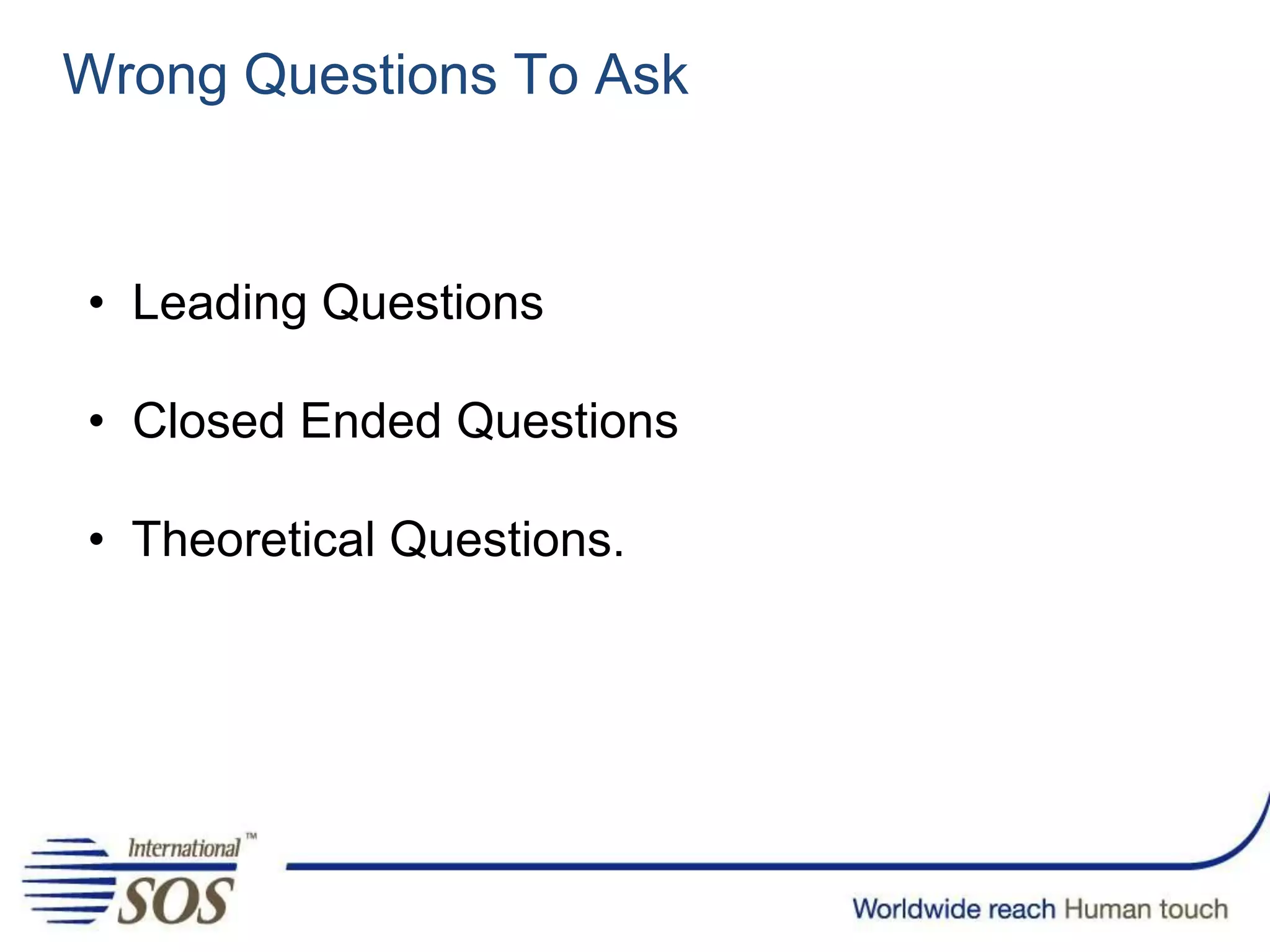
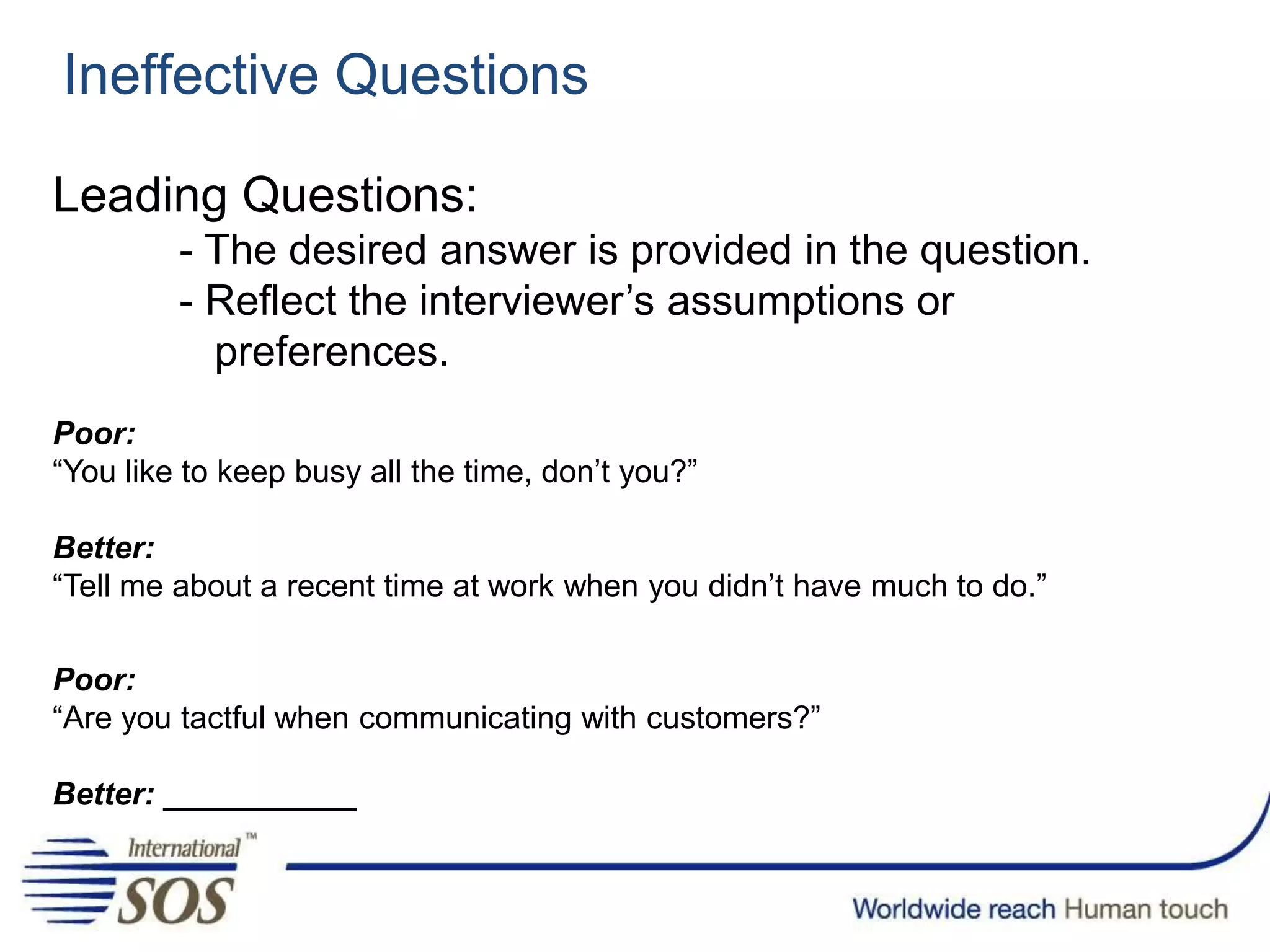
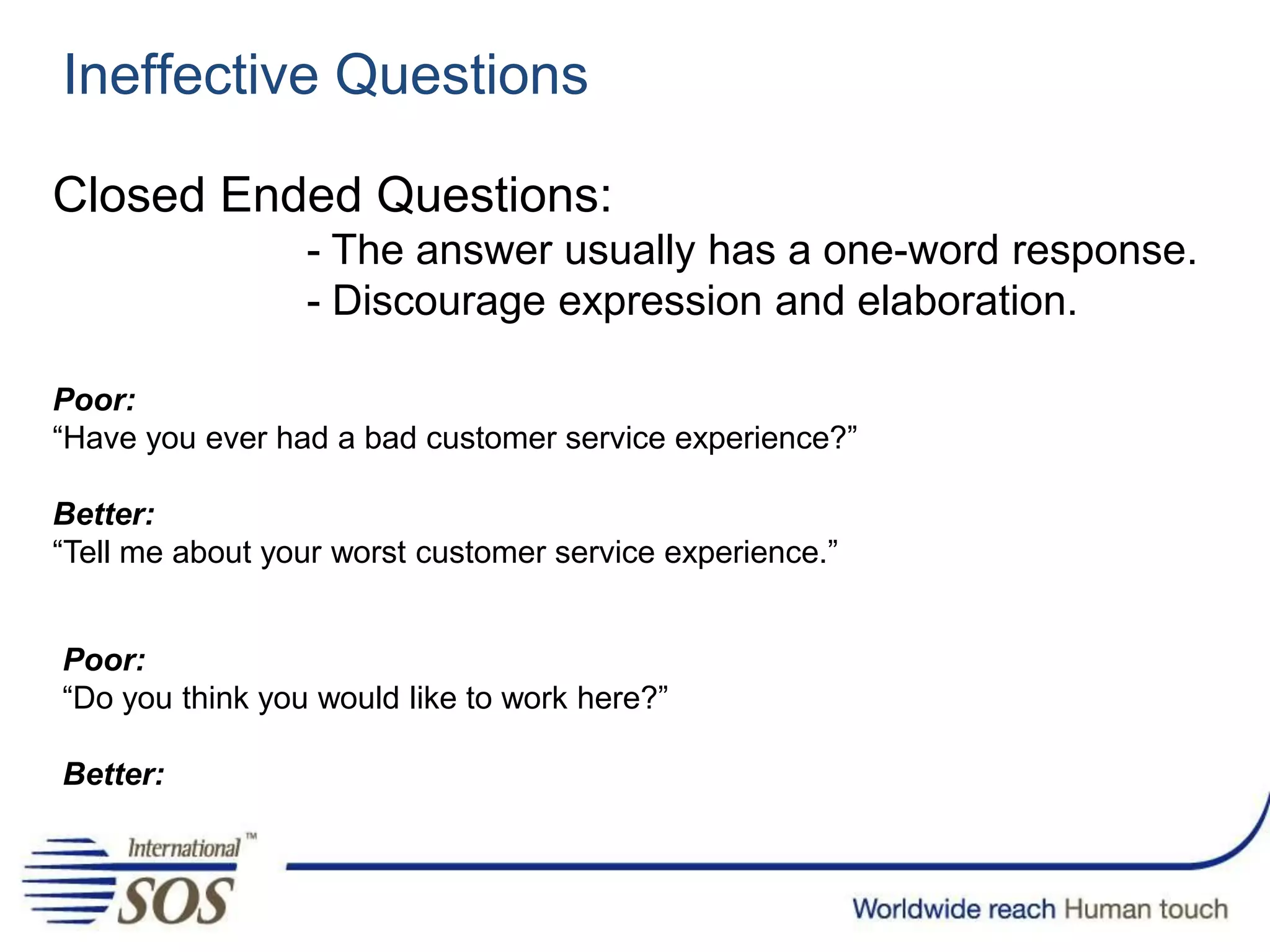
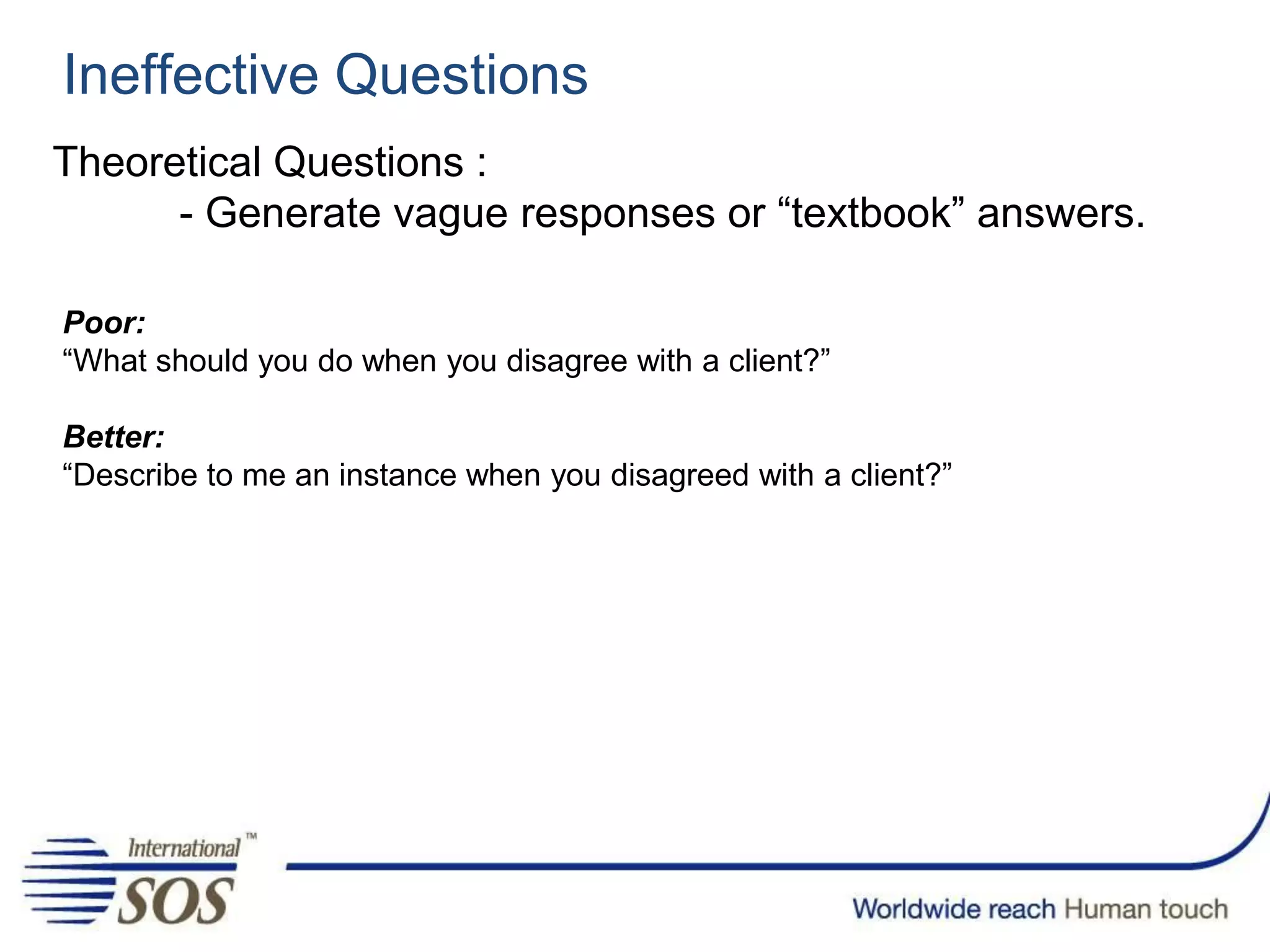
Highlights the types of ineffective questions to avoid, including leading, closed-ended, and theoretical questions.
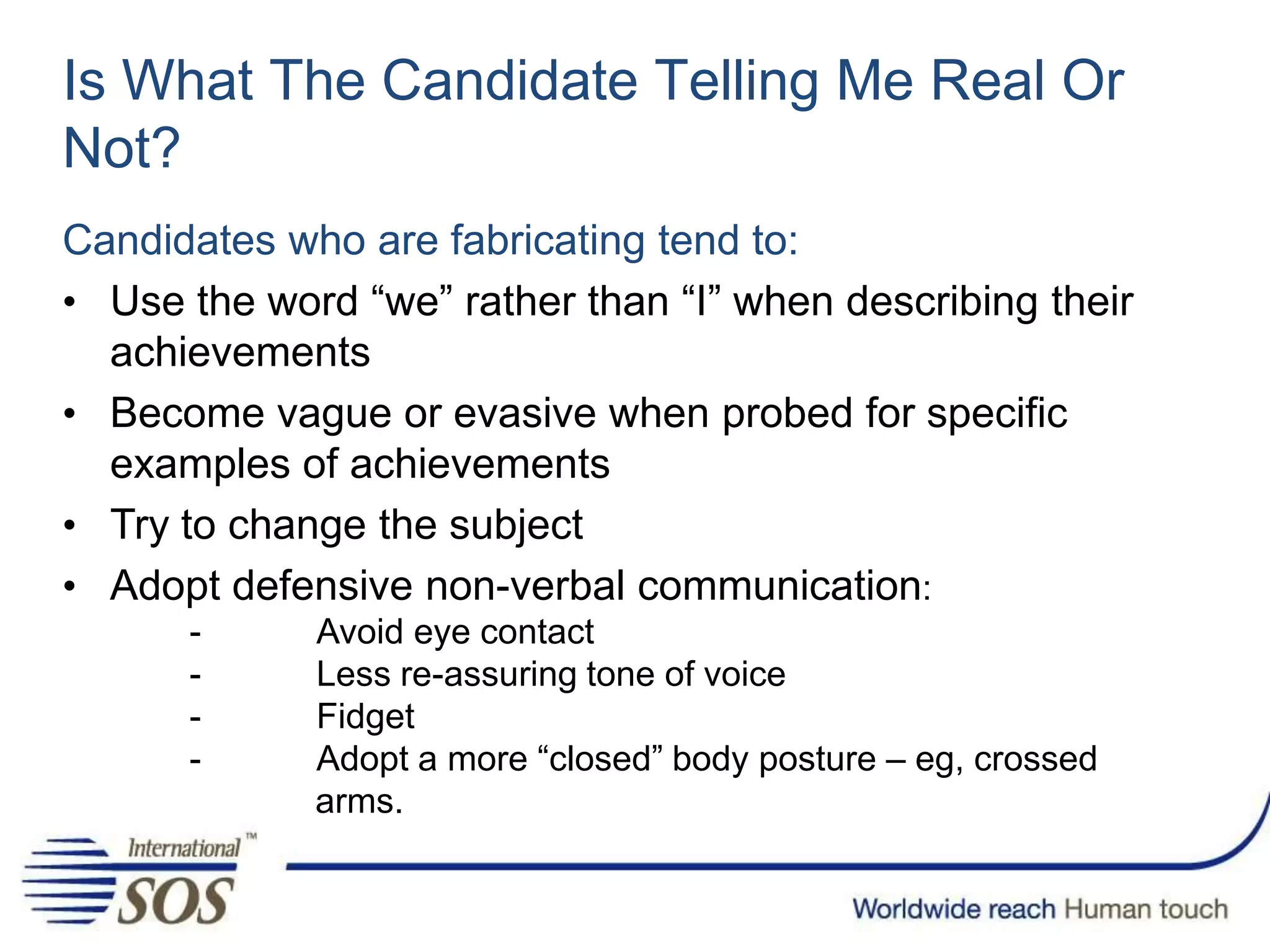
Tips for verifying candidate claims and summary of interview preparation and structure for maximum effectiveness.
Training Workshop -TheArt of Interviewing
Behavioural Event Interviewing / Targeted Selection
2.
Workshop Ground Rules
Duringthe workshop, remember to:
• Share openly
• Respect the other’s contribution
• Keep an open mind
• Be responsible for your learning
• No mobile phones !
• No meetings !
• Have FUN !!
3.
Why Focus OnInterviewing?
• Effective interviewing / selection helps identify people
who can and will do the job over a period of time.
• It is productive time invested.
4.
Interviewing – WhyIs It So Hard?
You have one hour or less to evaluate someone who:
• You probably have never met before
• May be nervous and who therefore may not do
themselves justice
• May see the interview as a “game” in which to sell
themselves and their achievements in a far more positive
way than is the case in reality.
5.
Interviewing – WhyIs It So Hard?
You, as the interviewer:
• May be short on time
• May be occupied with tasks
• May not have had time to prepare
• May be preoccupied with managing the interview process
than actually evaluating the candidate
Little wonder then that interviews so often result in hiring the wrong
candidate!
The challenge: An interview will always involve a judgement – but
how to make this judgment as objective as possible?
6.
Absence Of EffectiveInterviewing
Organization’s challenges:
• Hiring people that do not meet the organizational fit
• High employee turnover - low morale
• Disrupted customer service / threat of losing business
• Focus of leaders on filling positions
• Lack of time for coaching & contributing to goals
• Increasing pressure to achieve goals
• Costs of hiring.
7.
Consequences Of APoor Hiring Decision
Higher Cost:
• Recruitment Fees
• Separation Costs
• Training Fees
Disruption:
• Time & Energy Spent Recruiting
• Reduced Efficiency
Lower Performance:
• Service
• Quality
• Productivity and teamwork.
8.
Cost of PoorSelection
A hiring mistake costs 40% - 60%
of the position’s
annual compensation.
……as per study.
9.
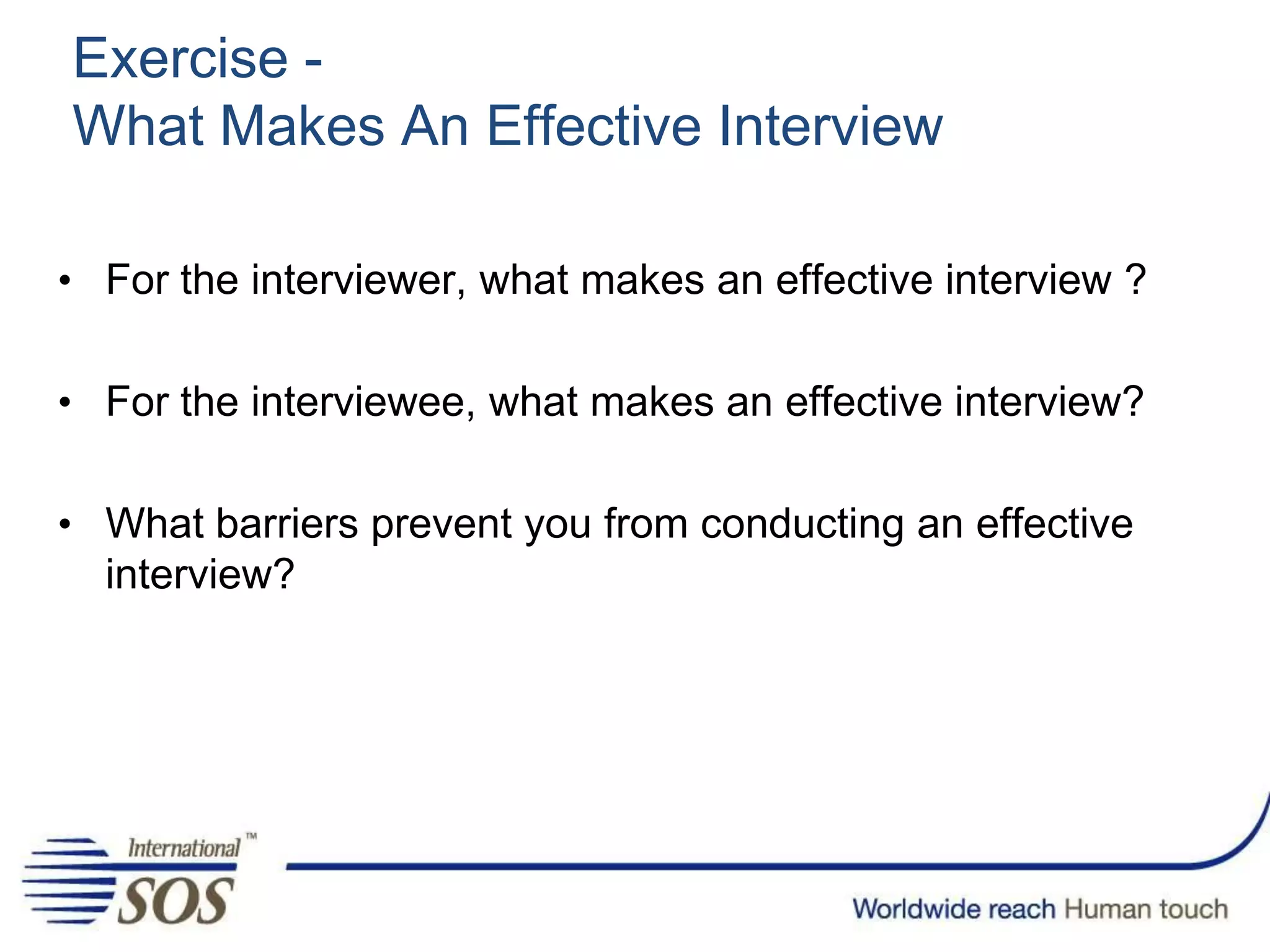
Exercise -
What MakesAn Effective Interview
• For the interviewer, what makes an effective interview ?
• For the interviewee, what makes an effective interview?
• What barriers prevent you from conducting an effective
interview?
10.
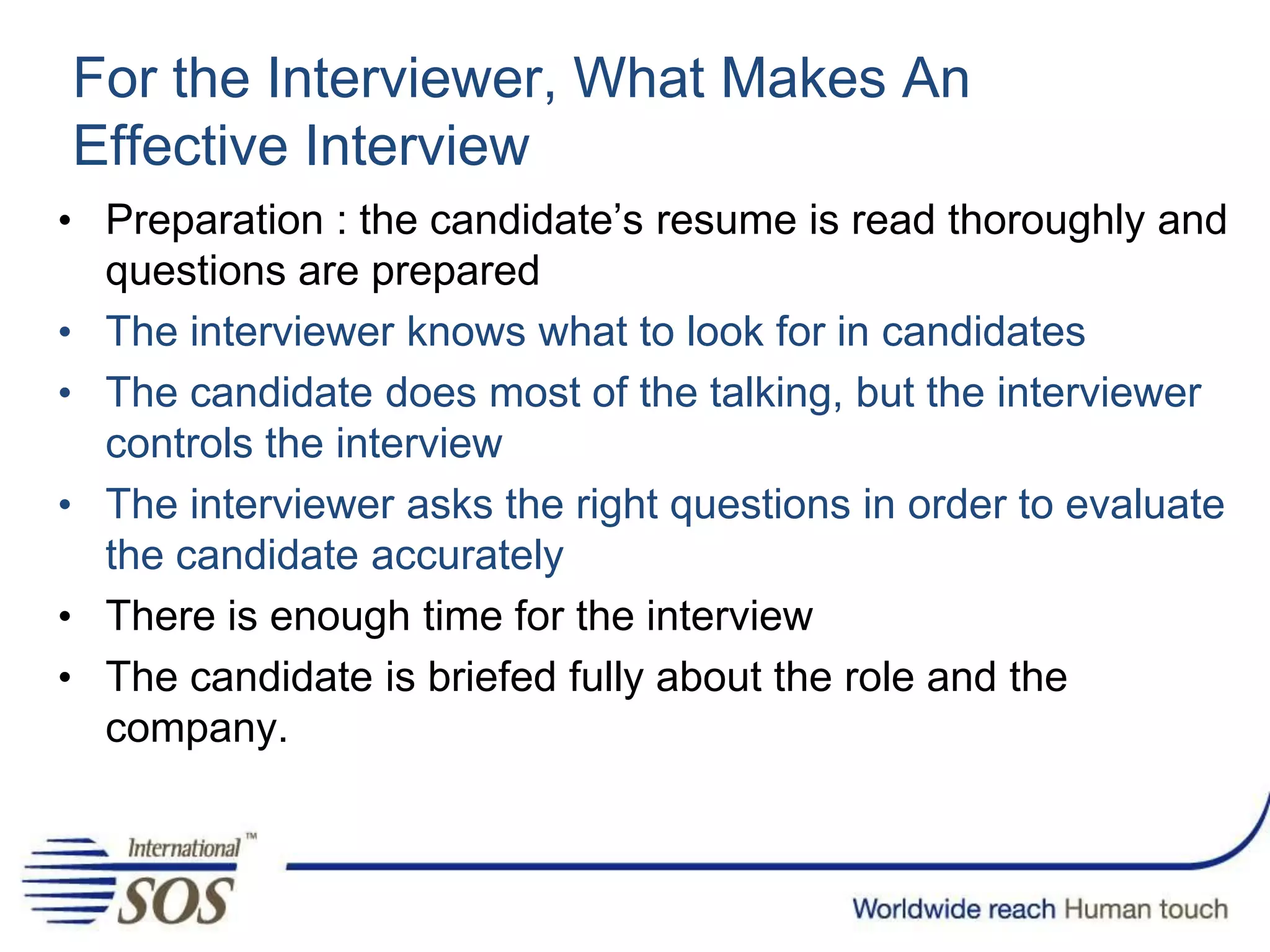
For the Interviewer,What Makes An
Effective Interview
• Preparation : the candidate’s resume is read thoroughly and
questions are prepared
• The interviewer knows what to look for in candidates
• The candidate does most of the talking, but the interviewer
controls the interview
• The interviewer asks the right questions in order to evaluate
the candidate accurately
• There is enough time for the interview
• The candidate is briefed fully about the role and the
company.
11.
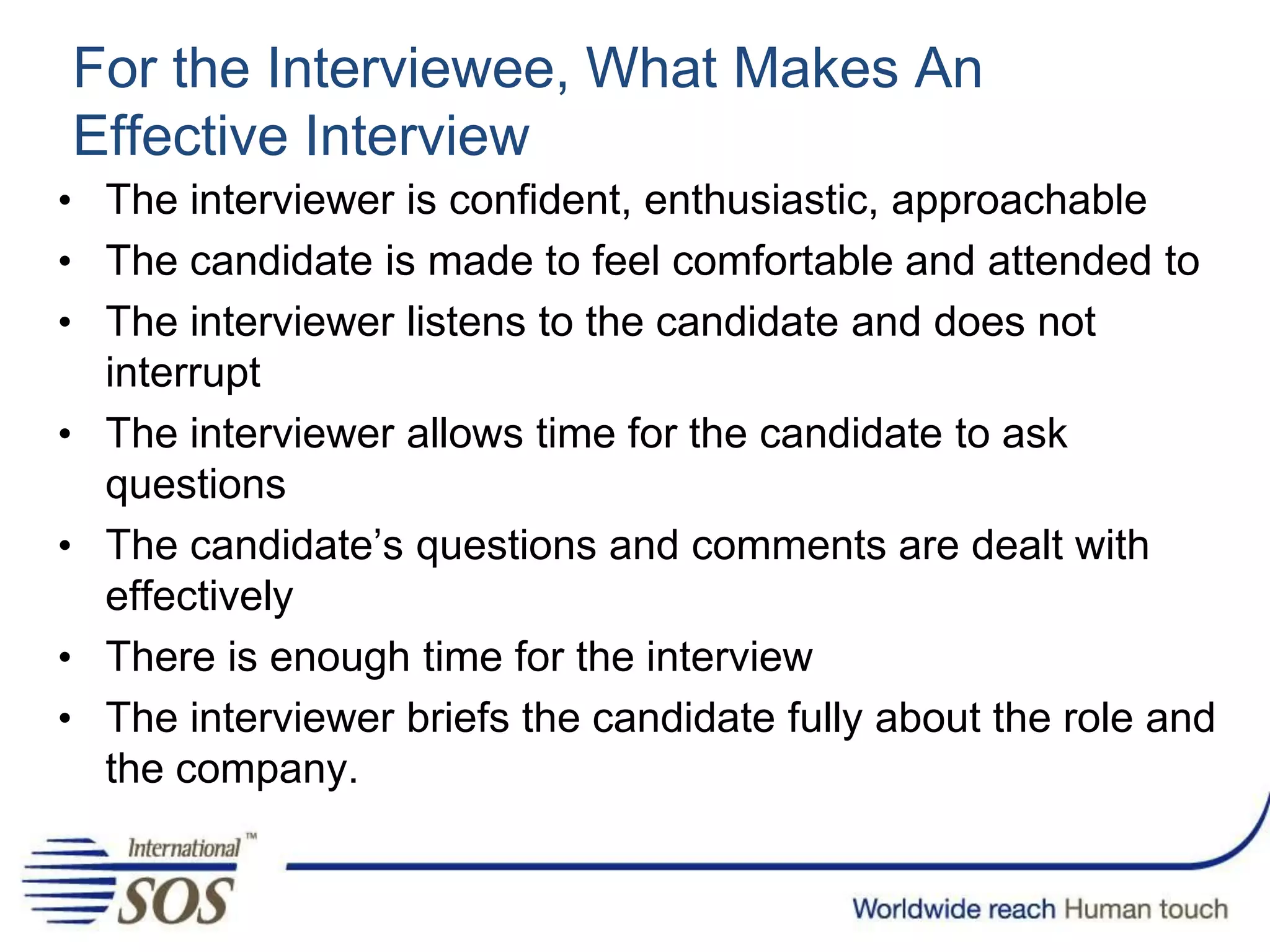
For the Interviewee,What Makes An
Effective Interview
• The interviewer is confident, enthusiastic, approachable
• The candidate is made to feel comfortable and attended to
• The interviewer listens to the candidate and does not
interrupt
• The interviewer allows time for the candidate to ask
questions
• The candidate’s questions and comments are dealt with
effectively
• There is enough time for the interview
• The interviewer briefs the candidate fully about the role and
the company.
12.
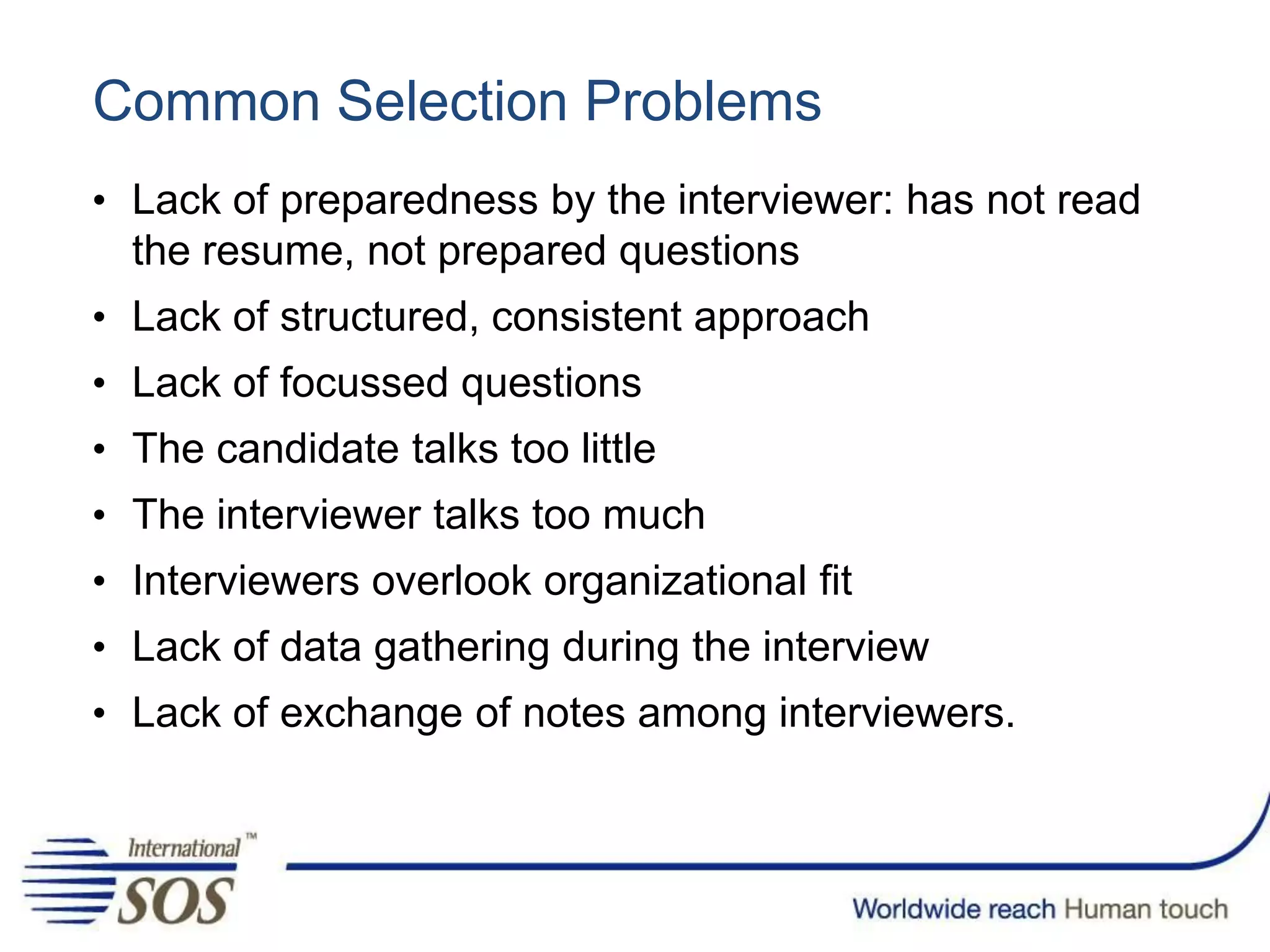
Common Selection Problems
•Lack of preparedness by the interviewer: has not read
the resume, not prepared questions
• Lack of structured, consistent approach
• Lack of focussed questions
• The candidate talks too little
• The interviewer talks too much
• Interviewers overlook organizational fit
• Lack of data gathering during the interview
• Lack of exchange of notes among interviewers.
13.
A Solution ...
TargetedSelection / Behavioural Event Interviewing
Aims to help hire the best fit candidate by :
• Building the selection process around job requirements
• Obtaining accurate behavioural information to predict
future behaviour
• Eliminating inconsistencies
• Equal treatment of all candidates.
14.
Behavioural Event Interviewing:
WhatIs It?
An interviewing technique that is based on
three fundamental principles:
• Evaluate candidates against job capabilities
• Past behaviour is the best predictor of future
behaviour
• Ask the right questions.
15.
Behavioural Event Interviewing
•First Principle:
It is essential to identify the required capabilities for the
job, and evaluate candidates against these capabilities
in a targeted way:
• Functional capabilities
• Behavioural capabilities.
16.
What To LookFor In Candidates – Functional
Capabilities
Functional capabilities are specified in Job Descriptions:
• Key functional capabilities are:
• Education: Is a degree/MBA required?
• What languages are required?
• Technical or professional qualifications:
• Are particular medical qualifications required?
• Does the job require IT skills?
• Does the job require other specialist skills?
• Work experience:
• What industry / sector / skills experience is required?
• Must the candidate have worked overseas?
• Must the candidate have lead a large team?
17.
What To LookFor In Candidates – Behavioural
Capabilities
• Behavioural capabilities are linked directly to the job/ role
• Desired behaviours to perform the job / role successfully
• Part of Job Description
• Also called Competencies.
18.
Behavioural Event Interviewing
•Second Principle:
Past behaviour and achievement is the best predictor of
future behaviour and achievement:
• What people do or have done is a far better measure of
them than what they say !
• What people have actually achieved in the past is the
best predictor of their future capability.
19.
Past Behaviour IsThe Best Predictor Of Future
Behaviour
If a candidate makes the following statements in an
interview, would you accept them at face value?
• My weakness is that I sometimes push my people too hard, because I like
to get things done
• I’m a strong leader
• I’m a good team player
• I left my last job because I was looking for a new challenge
• I like working with people
• I really like the kind of opportunity you have
• I like interacting with people / customers
• I left my last job because I was looking for a new challenge
• I’m attracted to working for an organization that helps people.
20.
Behavioural Event Interviewing
•Third Principle:
Ask the right questions:
• Questions must generate specific examples of what the
candidate has done or achieved in the past
• Specific Example = Action + Outcome (use the “STAR”
concept)
• Candidates should be selected on the basis of how well
these examples of past behaviours and achievements
match the required capabilities of the job.
21.
Behavioural Event Interviewing– Asking The
Right Questions
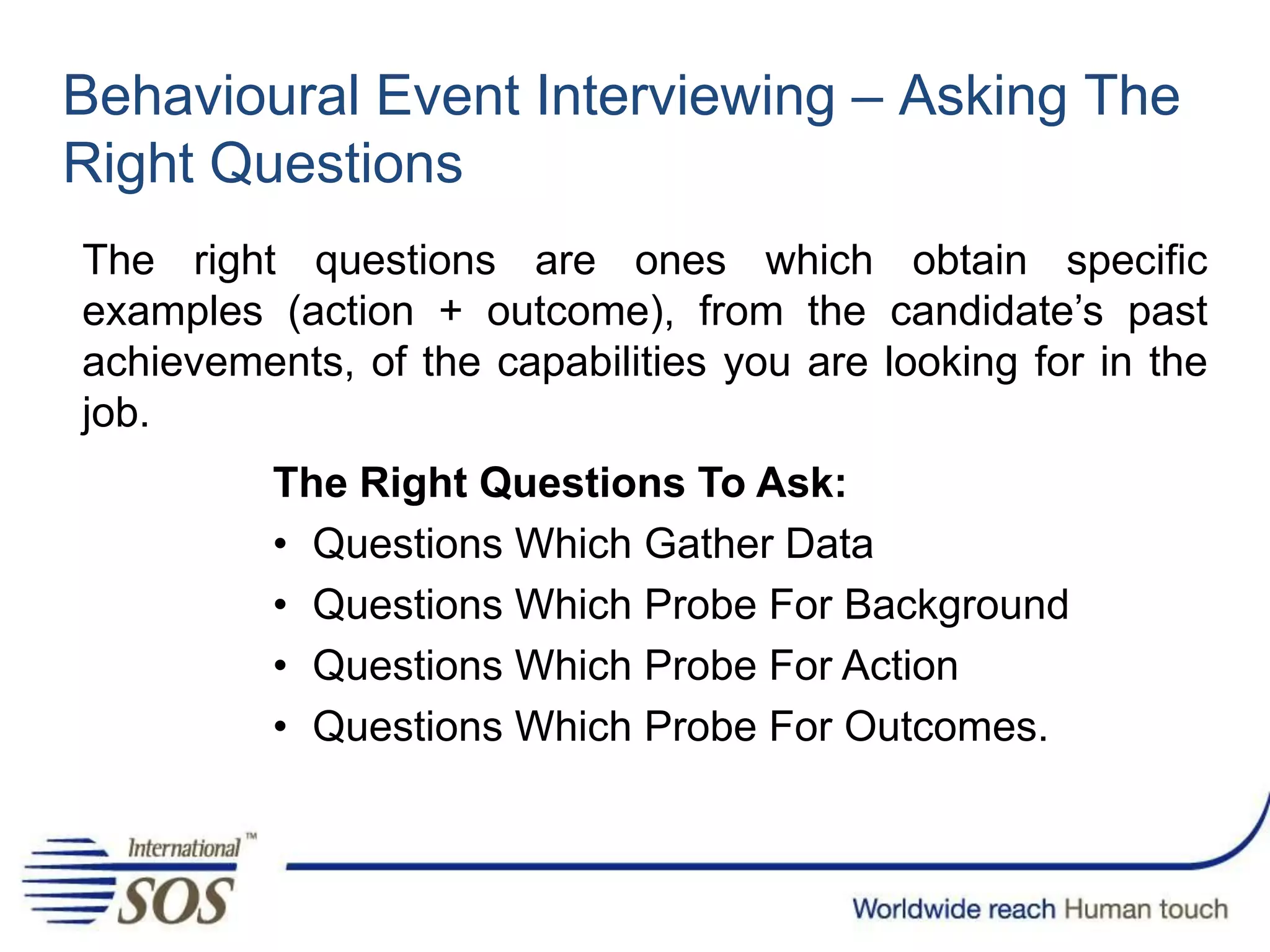
The right questions are ones which obtain specific
examples (action + outcome), from the candidate’s past
achievements, of the capabilities you are looking for in the
job.
The Right Questions To Ask:
• Questions Which Gather Data
• Questions Which Probe For Background
• Questions Which Probe For Action
• Questions Which Probe For Outcomes.
22.
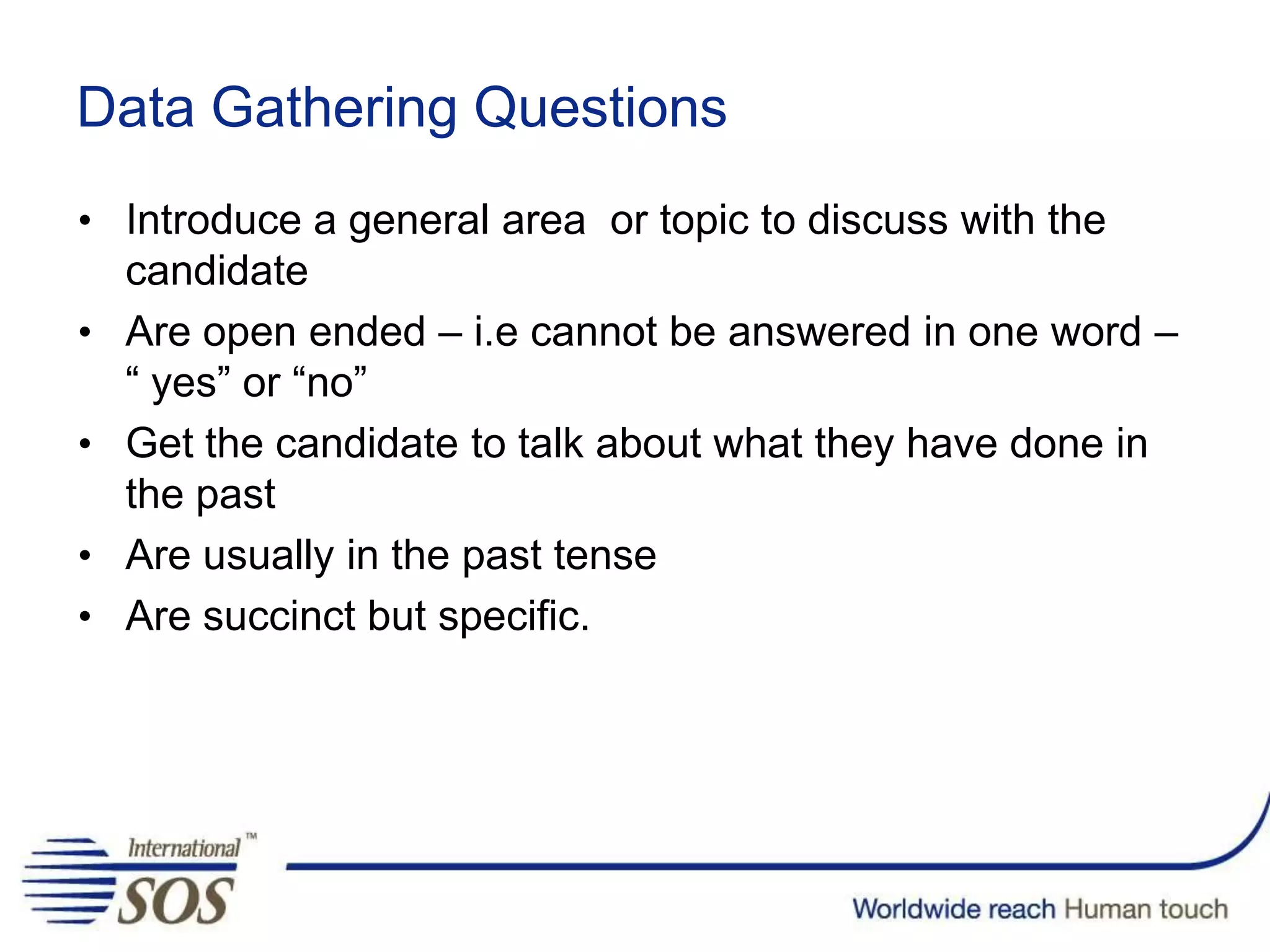
• Introduce ageneral area or topic to discuss with the
candidate
• Are open ended – i.e cannot be answered in one word –
“ yes” or “no”
• Get the candidate to talk about what they have done in
the past
• Are usually in the past tense
• Are succinct but specific.
Data Gathering Questions
23.
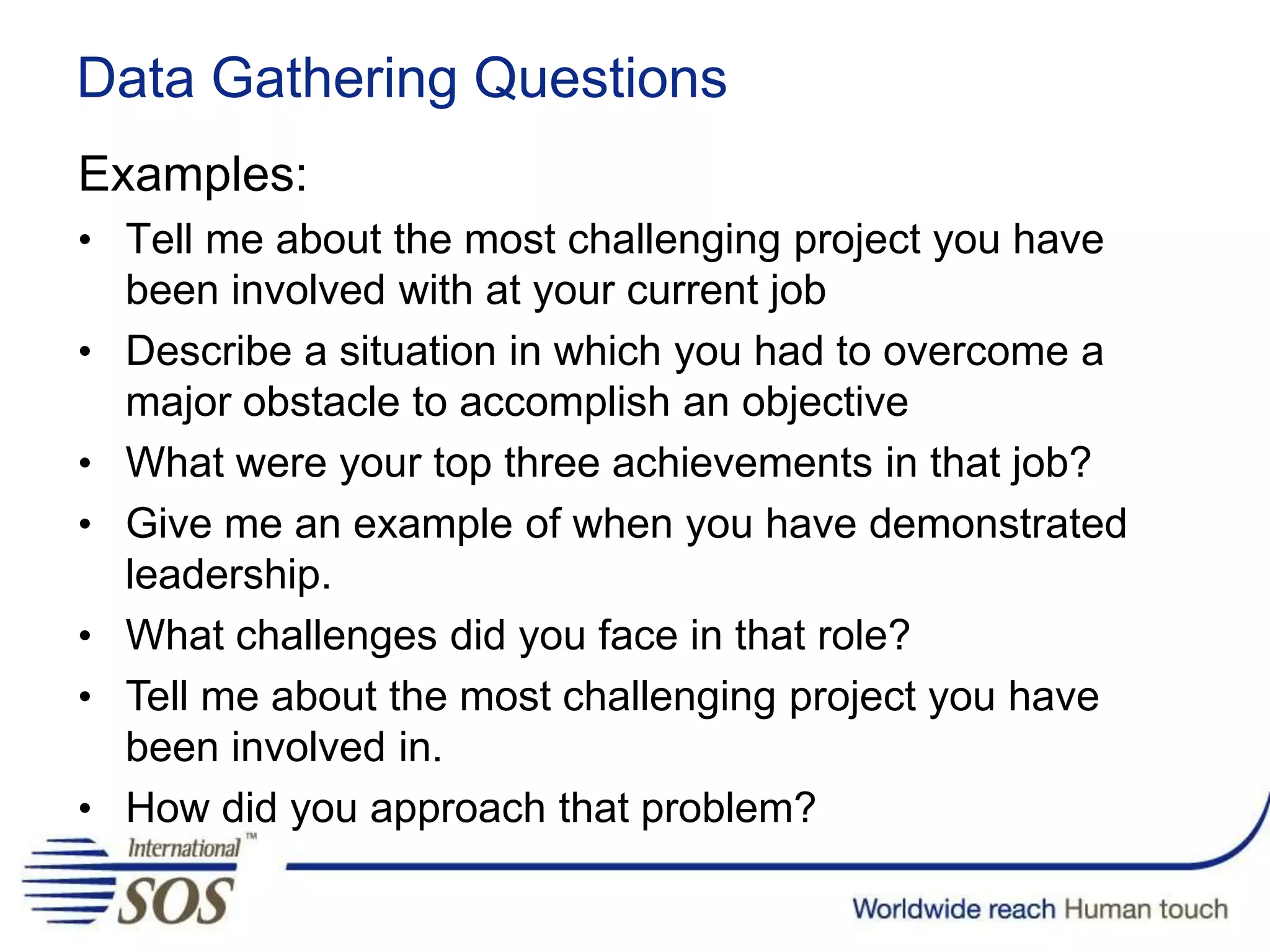
Examples:
• Tell meabout the most challenging project you have
been involved with at your current job
• Describe a situation in which you had to overcome a
major obstacle to accomplish an objective
• What were your top three achievements in that job?
• Give me an example of when you have demonstrated
leadership.
• What challenges did you face in that role?
• Tell me about the most challenging project you have
been involved in.
• How did you approach that problem?
Data Gathering Questions
24.
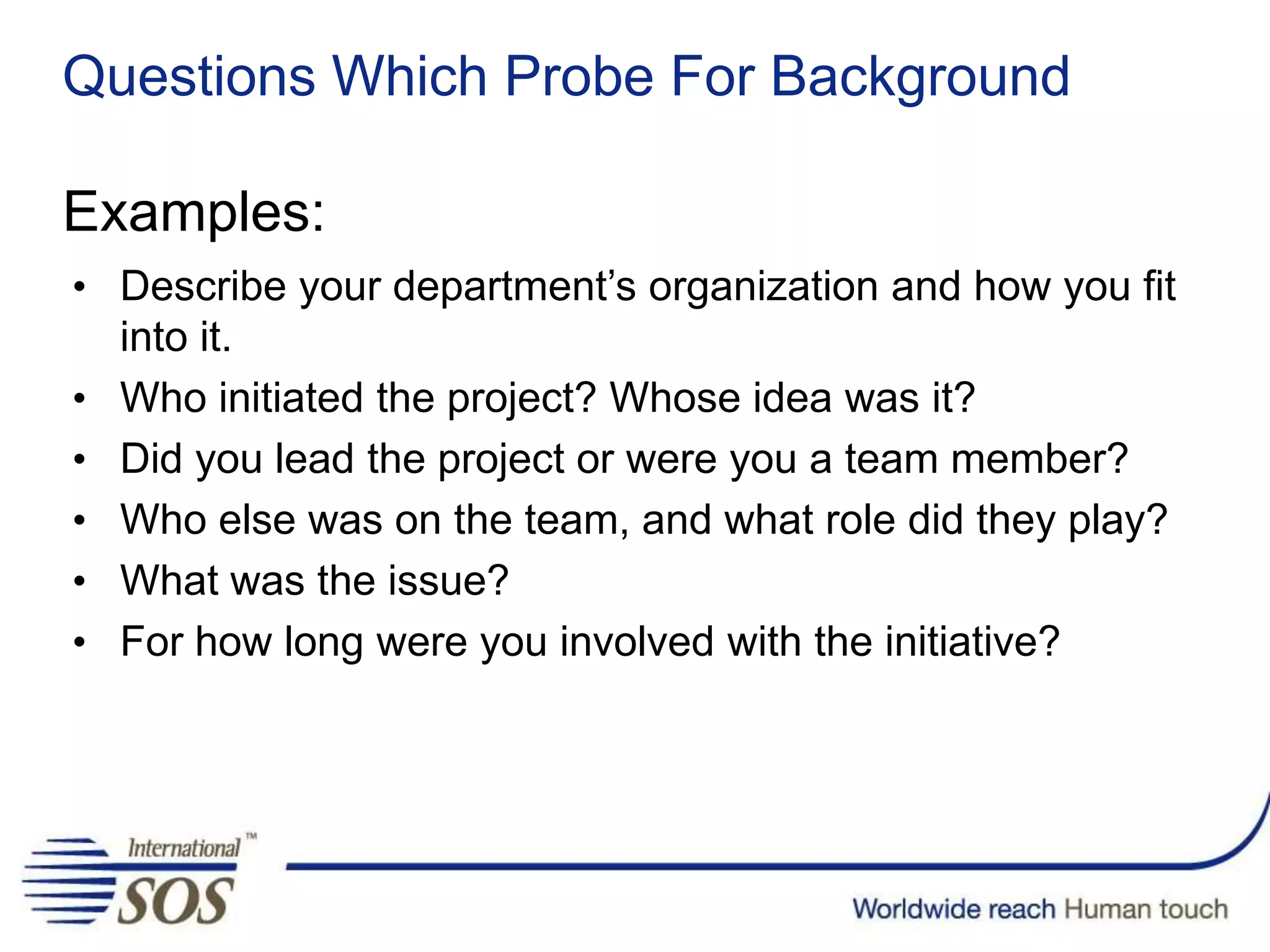
Questions Which ProbeFor Background
Examples:
• Describe your department’s organization and how you fit
into it.
• Who initiated the project? Whose idea was it?
• Did you lead the project or were you a team member?
• Who else was on the team, and what role did they play?
• What was the issue?
• For how long were you involved with the initiative?
25.
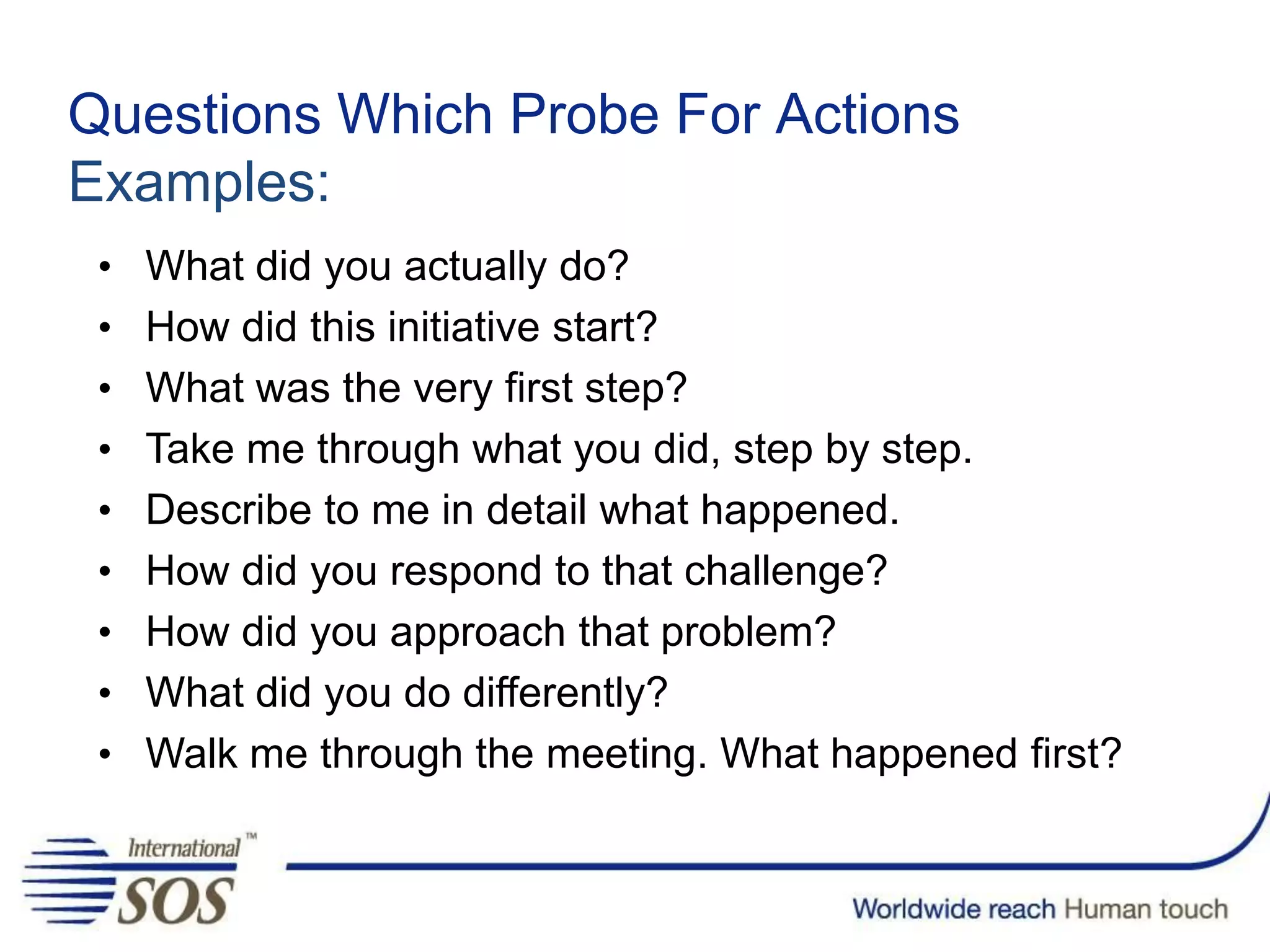
Questions Which ProbeFor Actions
• Are follow up questions from Data Gathering questions
• Elicit more data /detail about what the candidate
actually did
• Probe specifically :
• What was the Action?
• Who did What?
• Most important questions to ask to determine whether
the candidate has the required capabilities.
26.
Questions Which ProbeFor Actions
Examples:
• What did you actually do?
• How did this initiative start?
• What was the very first step?
• Take me through what you did, step by step.
• Describe to me in detail what happened.
• How did you respond to that challenge?
• How did you approach that problem?
• What did you do differently?
• Walk me through the meeting. What happened first?
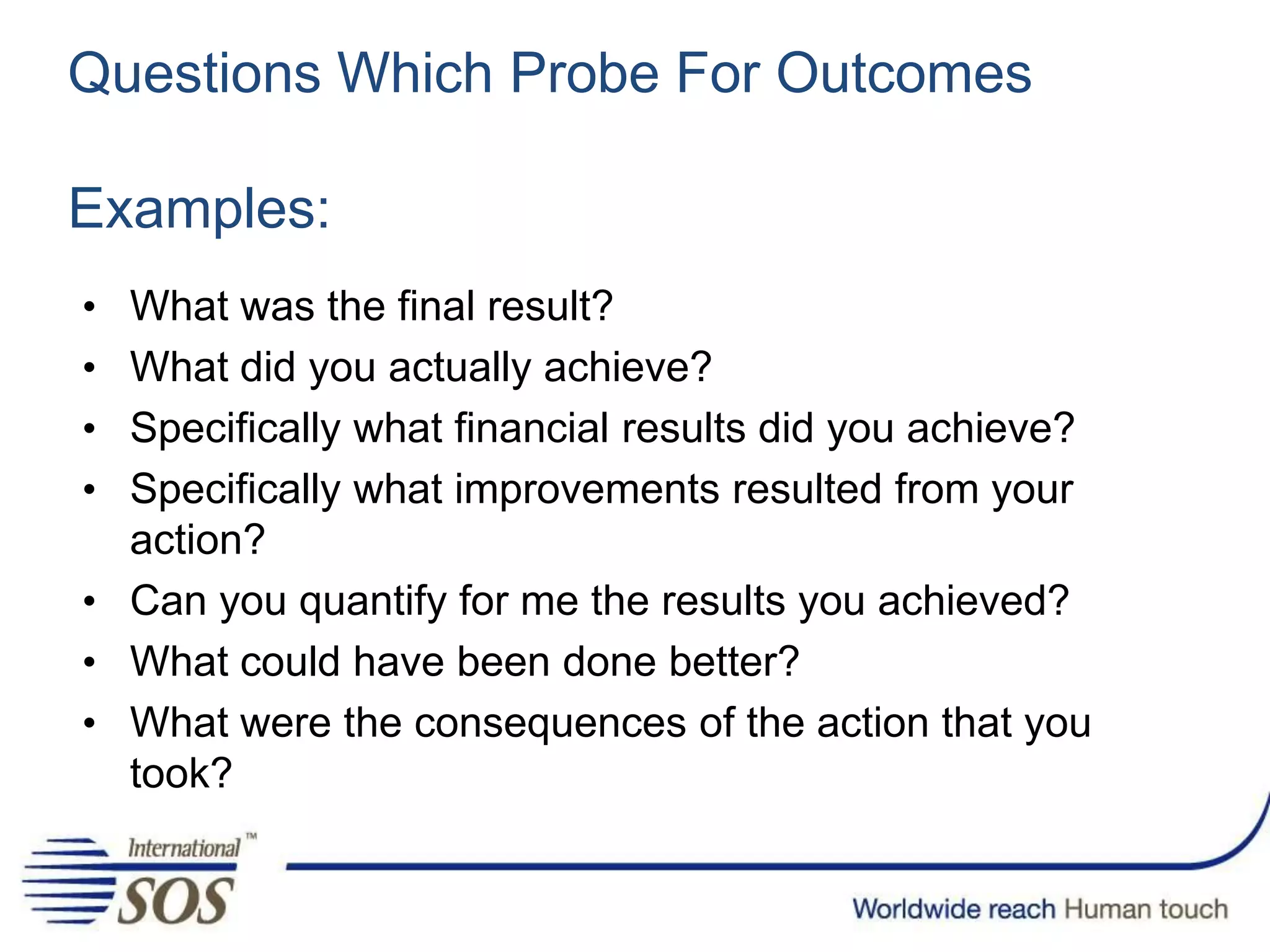
27.
Questions Which ProbeFor Outcomes
Examples:
• What was the final result?
• What did you actually achieve?
• Specifically what financial results did you achieve?
• Specifically what improvements resulted from your
action?
• Can you quantify for me the results you achieved?
• What could have been done better?
• What were the consequences of the action that you
took?
28.
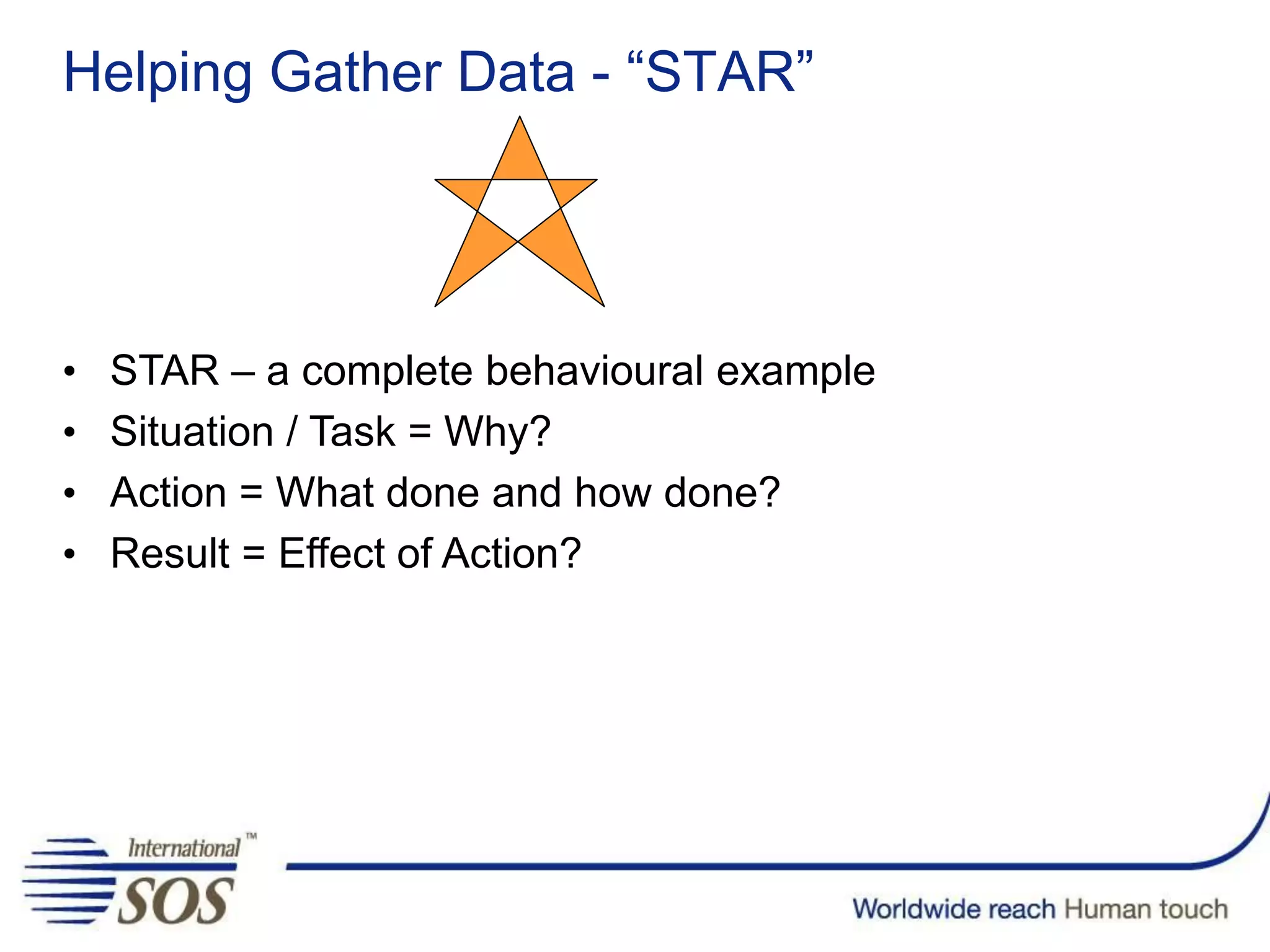
Helping Gather Data- “STAR”
• STAR – a complete behavioural example
• Situation / Task = Why?
• Action = What done and how done?
• Result = Effect of Action?
Ineffective Questions
Leading Questions:
-The desired answer is provided in the question.
- Reflect the interviewer’s assumptions or
preferences.
Poor:
“You like to keep busy all the time, don’t you?”
Better:
“Tell me about a recent time at work when you didn’t have much to do.”
Poor:
“Are you tactful when communicating with customers?”
Better: ___________
31.
Ineffective Questions
Closed EndedQuestions:
- The answer usually has a one-word response.
- Discourage expression and elaboration.
Poor:
“Have you ever had a bad customer service experience?”
Better:
“Tell me about your worst customer service experience.”
Poor:
“Do you think you would like to work here?”
Better:
32.
Ineffective Questions
Theoretical Questions:
- Generate vague responses or “textbook” answers.
Poor:
“What should you do when you disagree with a client?”
Better:
“Describe to me an instance when you disagreed with a client?”
33.
Is What TheCandidate Telling Me Real Or
Not?
Candidates who are fabricating tend to:
• Use the word “we” rather than “I” when describing their
achievements
• Become vague or evasive when probed for specific
examples of achievements
• Try to change the subject
• Adopt defensive non-verbal communication:
- Avoid eye contact
- Less re-assuring tone of voice
- Fidget
- Adopt a more “closed” body posture – eg, crossed
arms.
34.
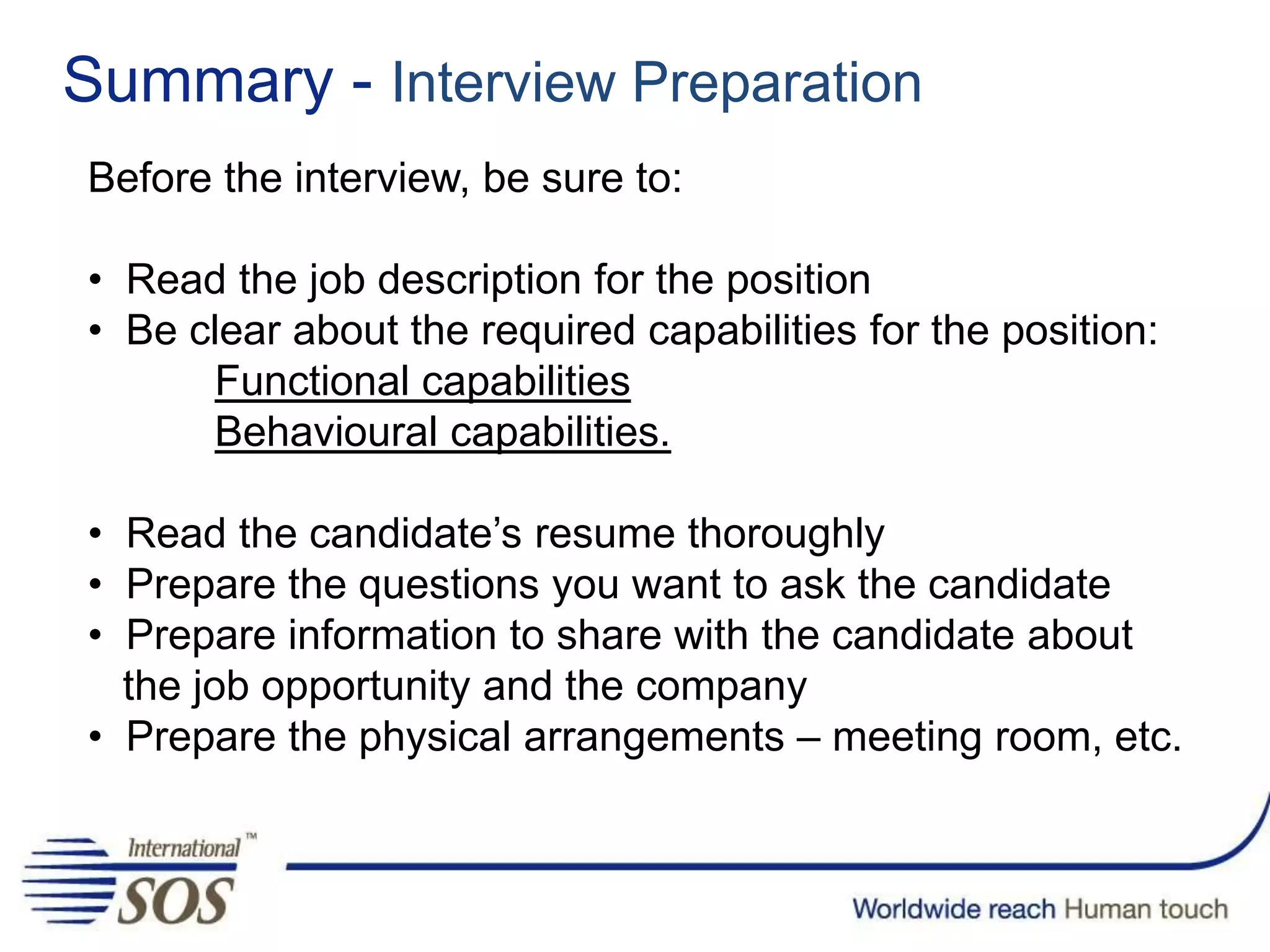
Summary - InterviewPreparation
Before the interview, be sure to:
• Read the job description for the position
• Be clear about the required capabilities for the position:
Functional capabilities
Behavioural capabilities.
• Read the candidate’s resume thoroughly
• Prepare the questions you want to ask the candidate
• Prepare information to share with the candidate about
the job opportunity and the company
• Prepare the physical arrangements – meeting room, etc.
35.
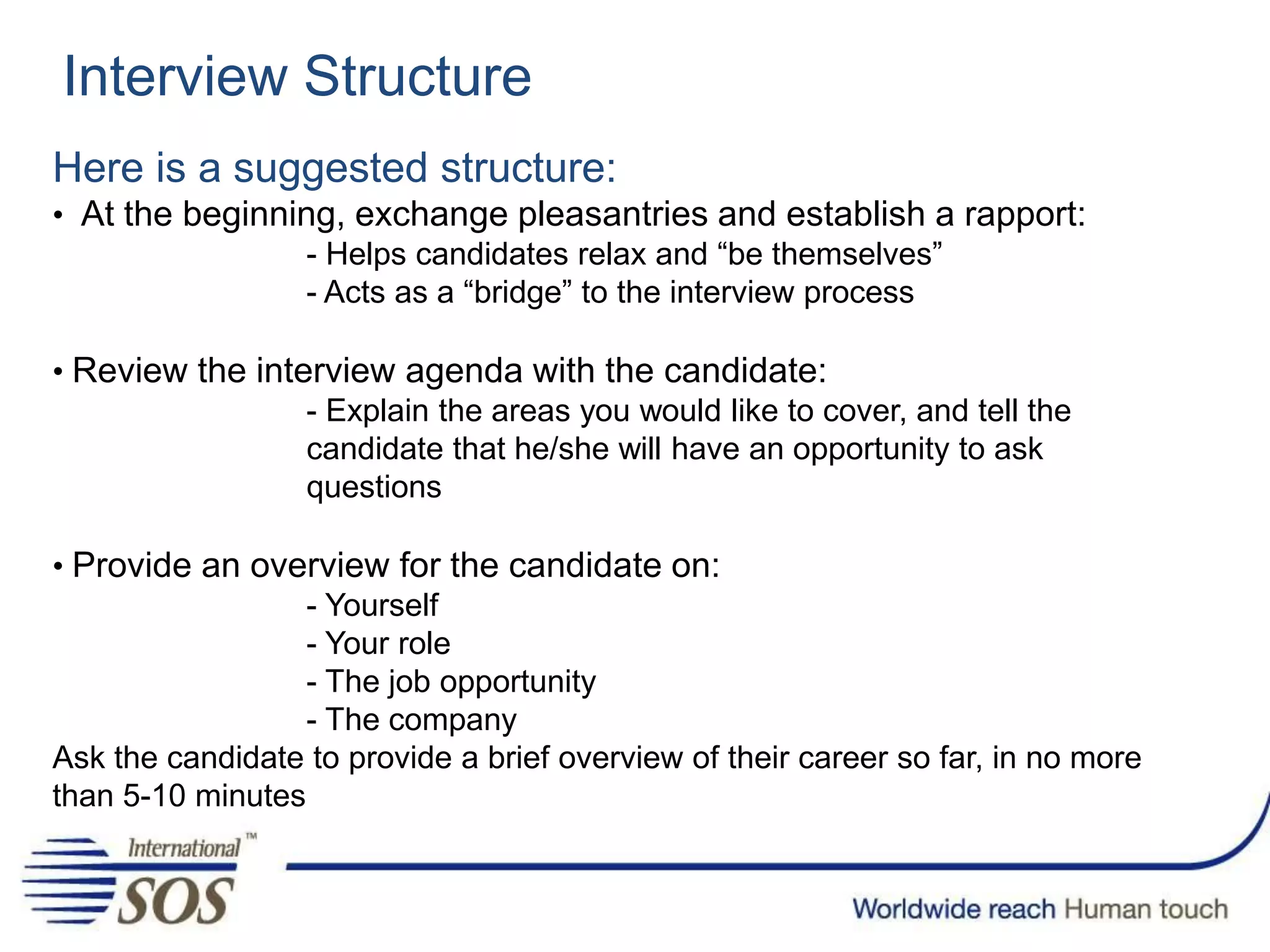
Interview Structure
Here isa suggested structure:
• At the beginning, exchange pleasantries and establish a rapport:
- Helps candidates relax and “be themselves”
- Acts as a “bridge” to the interview process
• Review the interview agenda with the candidate:
- Explain the areas you would like to cover, and tell the
candidate that he/she will have an opportunity to ask
questions
• Provide an overview for the candidate on:
- Yourself
- Your role
- The job opportunity
- The company
Ask the candidate to provide a brief overview of their career so far, in no more
than 5-10 minutes
36.
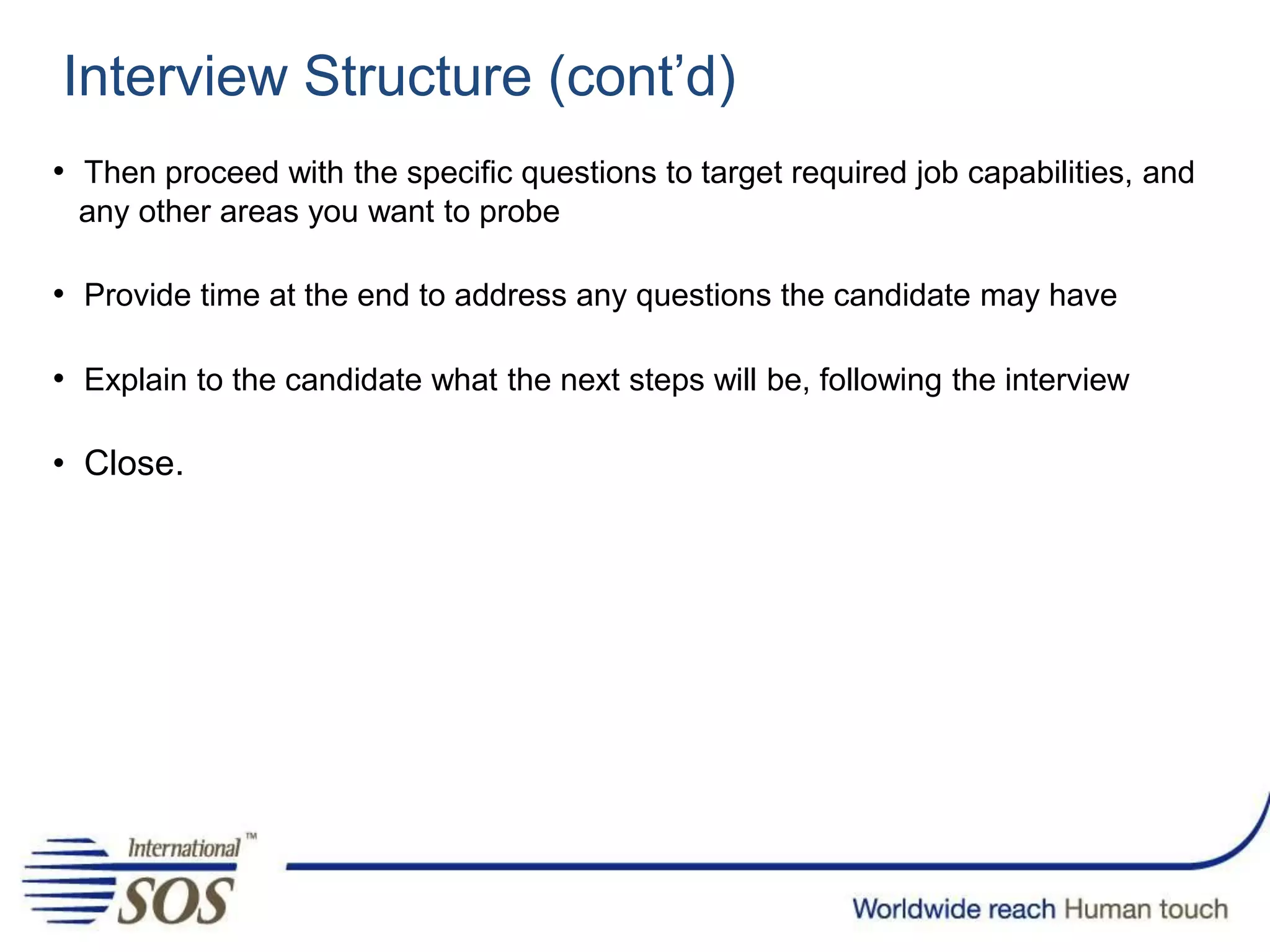
Interview Structure (cont’d)
•Then proceed with the specific questions to target required job capabilities, and
any other areas you want to probe
• Provide time at the end to address any questions the candidate may have
• Explain to the candidate what the next steps will be, following the interview
• Close.