1
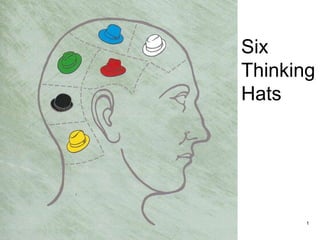
Six
Thinking
Hats
2
Vodafone
Accenture Cognizant
SKF IBM
Federal Express Hewlett-Packard
AT&T Wipro
Nokia Kellogg’s
American Express Motorola
Barclays Bank Citibank
HSBC TCS
Unilever NASA
PWC Shell
KPMG Prudential
Du Pont British Airways
What is Common ?
3
The Problem ?
 AUTHORITY suppresses discussions or questions –
no free flow of ideas
 Arguments - leads to aggression, selection of facts to
support MY POINT
 Facts are selectively used, (reinforcing point of view)
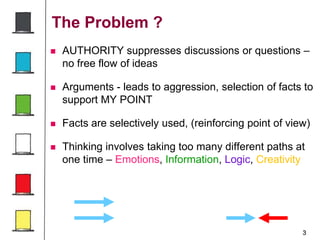
 Thinking involves taking too many different paths at
one time – Emotions, Information, Logic, Creativity
4
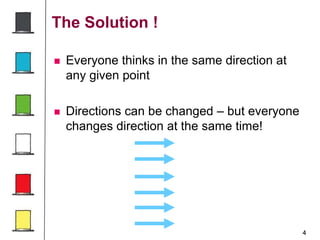
 Everyone thinks in the same direction at
any given point
 Directions can be changed – but everyone
changes direction at the same time!
The Solution !
5
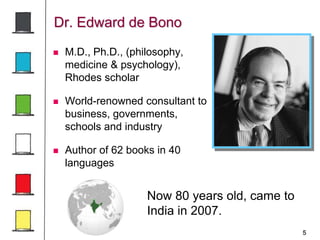
Dr. Edward de Bono
 M.D., Ph.D., (philosophy,
medicine & psychology),
Rhodes scholar
 World-renowned consultant to
business, governments,
schools and industry
 Author of 62 books in 40
languages
Now 80 years old, came to
India in 2007.
6
Cases
 Greg Chappell was using this method to improve
INDIAN CRICKET TEAM’S Performance
 A division of Siemens reduced product
development time by 50%. A must for 3,70,000
employees.
 ABB was able to reduce a series of multinational
project meetings from 30 days to 2 days.
 Sri Lanka Govt stipulates all aid agency must
learn this method.
7
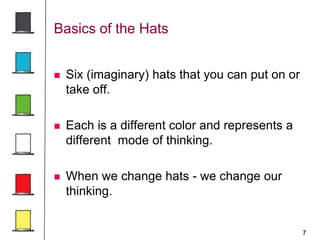
Basics of the Hats
 Six (imaginary) hats that you can put on or
take off.
 Each is a different color and represents a
different mode of thinking.
 When we change hats - we change our
thinking.
8
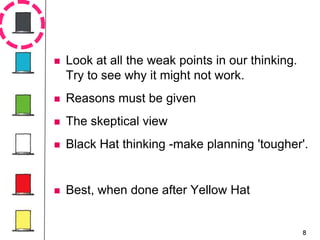
 Look at all the weak points in our thinking.
Try to see why it might not work.
 Reasons must be given
 The skeptical view
 Black Hat thinking -make planning 'tougher'.
 Best, when done after Yellow Hat
9
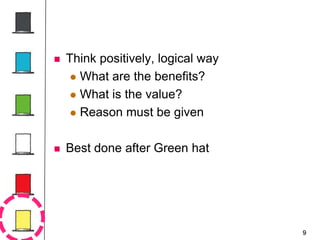
 Think positively, logical way
 What are the benefits?
 What is the value?
 Reason must be given
 Best done after Green hat
10
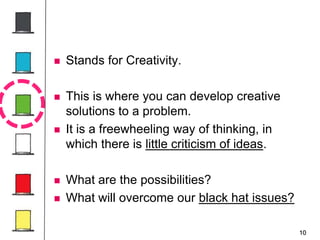
 Stands for Creativity.
 This is where you can develop creative
solutions to a problem.
 It is a freewheeling way of thinking, in
which there is little criticism of ideas.
 What are the possibilities?
 What will overcome our black hat issues?
11
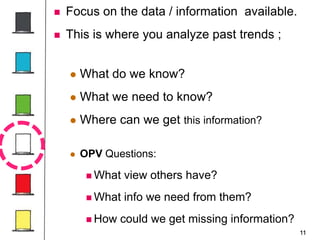
 Focus on the data / information available.
 This is where you analyze past trends ;
 What do we know?
 What we need to know?
 Where can we get this information?
 OPV Questions:
 What view others have?
 What info we need from them?
 How could we get missing information?
12
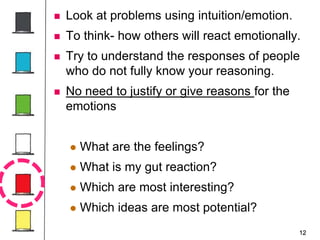
 Look at problems using intuition/emotion.
 To think- how others will react emotionally.
 Try to understand the responses of people
who do not fully know your reasoning.
 No need to justify or give reasons for the
emotions
 What are the feelings?
 What is my gut reaction?
 Which are most interesting?
 Which ideas are most potential?
13
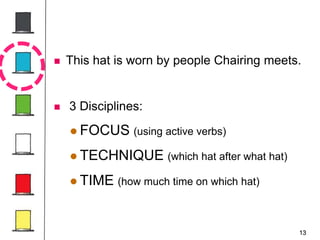
 This hat is worn by people Chairing meets.
 3 Disciplines:
 FOCUS (using active verbs)
 TECHNIQUE (which hat after what hat)
 TIME (how much time on which hat)
14
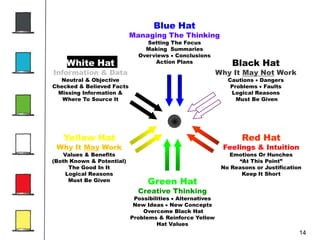
Blue Hat
Managing The Thinking
Setting The Focus
Making Summaries
Overviews Conclusions
Action Plans
Green Hat
Creative Thinking
Possibilities Alternatives
New Ideas New Concepts
Overcome Black Hat
Problems & Reinforce Yellow
Hat Values
Black Hat
Why It May Not Work
Cautions Dangers
Problems Faults
Logical Reasons
Must Be Given
Yellow Hat
Why It May Work
Values & Benefits
(Both Known & Potential)
The Good In It
Logical Reasons
Must Be Given
Red Hat
Feelings & Intuition
Emotions Or Hunches
“At This Point”
No Reasons or Justification
Keep It Short
White Hat
Information & Data
Neutral & Objective
Checked & Believed Facts
Missing Information &
Where To Source It
15
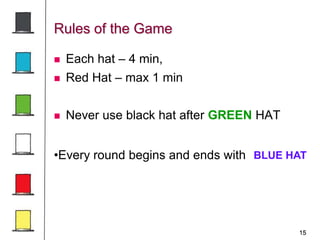
Rules of the Game
 Each hat – 4 min,
 Red Hat – max 1 min
 Never use black hat after GREEN HAT
BLUE HAT•Every round begins and ends with
16
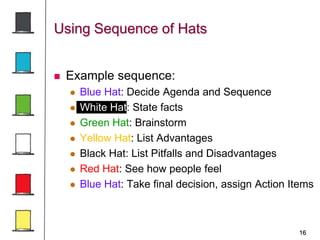
Using Sequence of Hats
 Example sequence:
 Blue Hat: Decide Agenda and Sequence
 White Hat: State facts
 Green Hat: Brainstorm
 Yellow Hat: List Advantages
 Black Hat: List Pitfalls and Disadvantages
 Red Hat: See how people feel
 Blue Hat: Take final decision, assign Action Items
17
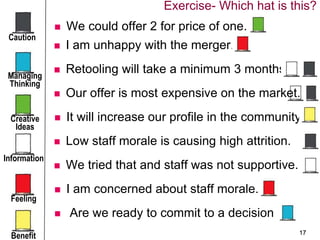
 I am unhappy with the merger.
 Retooling will take a minimum 3 months.
 Our offer is most expensive on the market.
 Low staff morale is causing high attrition.
 We tried that and staff was not supportive.
 It will increase our profile in the community.
 I am concerned about staff morale.
 Are we ready to commit to a decision
Caution
Managing
Thinking
Creative
Ideas
Information
Feeling
Benefit
 We could offer 2 for price of one.
Exercise- Which hat is this?
18
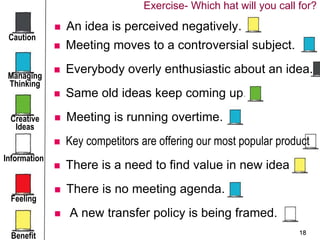
 Meeting moves to a controversial subject.
 Everybody overly enthusiastic about an idea.
 Same old ideas keep coming up.
 Key competitors are offering our most popular product
 There is a need to find value in new idea
 Meeting is running overtime.
 There is no meeting agenda.
 A new transfer policy is being framed.
Caution
Managing
Thinking
Creative
Ideas
Information
Feeling
Benefit
 An idea is perceived negatively.
Exercise- Which hat will you call for?
19
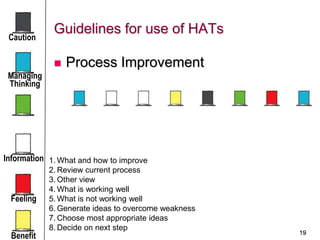
Guidelines for use of HATs
 Process Improvement
Caution
Managing
Thinking
Information
Feeling
Benefit
1. What and how to improve
2. Review current process
3. Other view
4. What is working well
5. What is not working well
6. Generate ideas to overcome weakness
7. Choose most appropriate ideas
8. Decide on next step
20
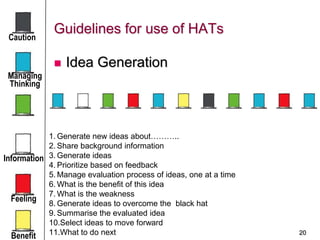
Guidelines for use of HATs
 Idea Generation
Caution
Managing
Thinking
Information
Feeling
Benefit
1. Generate new ideas about………..
2. Share background information
3. Generate ideas
4. Prioritize based on feedback
5. Manage evaluation process of ideas, one at a time
6. What is the benefit of this idea
7. What is the weakness
8. Generate ideas to overcome the black hat
9. Summarise the evaluated idea
10.Select ideas to move forward
11.What to do next
21
Let’s Think!!!

Six thinking hats

  • 1.
  • 2.
    2 Vodafone Accenture Cognizant SKF IBM FederalExpress Hewlett-Packard AT&T Wipro Nokia Kellogg’s American Express Motorola Barclays Bank Citibank HSBC TCS Unilever NASA PWC Shell KPMG Prudential Du Pont British Airways What is Common ?
  • 3.
    3 The Problem ? AUTHORITY suppresses discussions or questions – no free flow of ideas  Arguments - leads to aggression, selection of facts to support MY POINT  Facts are selectively used, (reinforcing point of view)  Thinking involves taking too many different paths at one time – Emotions, Information, Logic, Creativity
  • 4.
    4  Everyone thinksin the same direction at any given point  Directions can be changed – but everyone changes direction at the same time! The Solution !
  • 5.
    5 Dr. Edward deBono  M.D., Ph.D., (philosophy, medicine & psychology), Rhodes scholar  World-renowned consultant to business, governments, schools and industry  Author of 62 books in 40 languages Now 80 years old, came to India in 2007.
  • 6.
    6 Cases  Greg Chappellwas using this method to improve INDIAN CRICKET TEAM’S Performance  A division of Siemens reduced product development time by 50%. A must for 3,70,000 employees.  ABB was able to reduce a series of multinational project meetings from 30 days to 2 days.  Sri Lanka Govt stipulates all aid agency must learn this method.
  • 7.
    7 Basics of theHats  Six (imaginary) hats that you can put on or take off.  Each is a different color and represents a different mode of thinking.  When we change hats - we change our thinking.
  • 8.
    8  Look atall the weak points in our thinking. Try to see why it might not work.  Reasons must be given  The skeptical view  Black Hat thinking -make planning 'tougher'.  Best, when done after Yellow Hat
  • 9.
    9  Think positively,logical way  What are the benefits?  What is the value?  Reason must be given  Best done after Green hat
  • 10.
    10  Stands forCreativity.  This is where you can develop creative solutions to a problem.  It is a freewheeling way of thinking, in which there is little criticism of ideas.  What are the possibilities?  What will overcome our black hat issues?
  • 11.
    11  Focus onthe data / information available.  This is where you analyze past trends ;  What do we know?  What we need to know?  Where can we get this information?  OPV Questions:  What view others have?  What info we need from them?  How could we get missing information?
  • 12.
    12  Look atproblems using intuition/emotion.  To think- how others will react emotionally.  Try to understand the responses of people who do not fully know your reasoning.  No need to justify or give reasons for the emotions  What are the feelings?  What is my gut reaction?  Which are most interesting?  Which ideas are most potential?
  • 13.
    13  This hatis worn by people Chairing meets.  3 Disciplines:  FOCUS (using active verbs)  TECHNIQUE (which hat after what hat)  TIME (how much time on which hat)
  • 14.
    14 Blue Hat Managing TheThinking Setting The Focus Making Summaries Overviews Conclusions Action Plans Green Hat Creative Thinking Possibilities Alternatives New Ideas New Concepts Overcome Black Hat Problems & Reinforce Yellow Hat Values Black Hat Why It May Not Work Cautions Dangers Problems Faults Logical Reasons Must Be Given Yellow Hat Why It May Work Values & Benefits (Both Known & Potential) The Good In It Logical Reasons Must Be Given Red Hat Feelings & Intuition Emotions Or Hunches “At This Point” No Reasons or Justification Keep It Short White Hat Information & Data Neutral & Objective Checked & Believed Facts Missing Information & Where To Source It
  • 15.
    15 Rules of theGame  Each hat – 4 min,  Red Hat – max 1 min  Never use black hat after GREEN HAT BLUE HAT•Every round begins and ends with
  • 16.
    16 Using Sequence ofHats  Example sequence:  Blue Hat: Decide Agenda and Sequence  White Hat: State facts  Green Hat: Brainstorm  Yellow Hat: List Advantages  Black Hat: List Pitfalls and Disadvantages  Red Hat: See how people feel  Blue Hat: Take final decision, assign Action Items
  • 17.
    17  I amunhappy with the merger.  Retooling will take a minimum 3 months.  Our offer is most expensive on the market.  Low staff morale is causing high attrition.  We tried that and staff was not supportive.  It will increase our profile in the community.  I am concerned about staff morale.  Are we ready to commit to a decision Caution Managing Thinking Creative Ideas Information Feeling Benefit  We could offer 2 for price of one. Exercise- Which hat is this?
  • 18.
    18  Meeting movesto a controversial subject.  Everybody overly enthusiastic about an idea.  Same old ideas keep coming up.  Key competitors are offering our most popular product  There is a need to find value in new idea  Meeting is running overtime.  There is no meeting agenda.  A new transfer policy is being framed. Caution Managing Thinking Creative Ideas Information Feeling Benefit  An idea is perceived negatively. Exercise- Which hat will you call for?
  • 19.
    19 Guidelines for useof HATs  Process Improvement Caution Managing Thinking Information Feeling Benefit 1. What and how to improve 2. Review current process 3. Other view 4. What is working well 5. What is not working well 6. Generate ideas to overcome weakness 7. Choose most appropriate ideas 8. Decide on next step
  • 20.
    20 Guidelines for useof HATs  Idea Generation Caution Managing Thinking Information Feeling Benefit 1. Generate new ideas about……….. 2. Share background information 3. Generate ideas 4. Prioritize based on feedback 5. Manage evaluation process of ideas, one at a time 6. What is the benefit of this idea 7. What is the weakness 8. Generate ideas to overcome the black hat 9. Summarise the evaluated idea 10.Select ideas to move forward 11.What to do next
  • 21.

Editor's Notes

  • #7 Greg chappel was coach for indian cricket team in 2005-2007He recounts an incident in South Africa where a minerals company was having a problem handling a vast army of unlettered and unruly miners who would often fight against each others, resulting in large-scale casualties and even deaths. "I had some lateral thinking sessions with the miners and the officials who worked alongside them, and in a month's time the number of incidents had dropped from more than 300 to just four."
  • #9 Becoming the Devil’s Advocate
  • #12 OPV: Other People’s view
  • #15 Central black point is the focus.
  • #20 What and how to improveReview current processOther viewWhat is working wellWhat is not working wellGenerate ideas to overcome weaknessChoose most appropriate ideas