

LOGO


       From 1st March to 5th March, 2013


       Manager: Mr. Nguyen Hoang Nam
       Instructor: Ms. Phan Thi Thuy Trang
       Reporter: Nguyen Phuong Uyen
CONTENTS


       TRAINING            1
TRAINING PROCESS       2
VRG DONGWHA TRAINING
     PROGRAMS          3

 ON-THE-JOB TRAINING       4
LOGO


        Definition
       Types of Training
TRAINING

                        Definition
 The learning process whereby people acquire knowledge,
       capacities and sharpen skills to perform jobs.


                          Purpose

Improve effectiveness and productivity.
 Help employees to focus more clearly on the organizational
goals and fit the biz strategies.
 Employee motivation and retention.
TYPES OF TRAINING
 It involves introducing a new employee    Enables employees to perform their jobs well:
to its work environment:                                               • Customer service
• Introduction to colleagues                                                  • IT systems
• Explaining the firm’s activities                                  • Telecommunications
• Procedures followed in the                                             • Products details
organization


                                                             Provide long-term focus to
 Improve working relationship                                     enhance individual &
& interpersonal problems:                                       organizational capacities:
• Communications                                                              • Leadership
• Writing skills                                                         • Career planning
•Team relationships                                                      • Business trends
• Conflict Resolution                                          • Performance management
LOGO


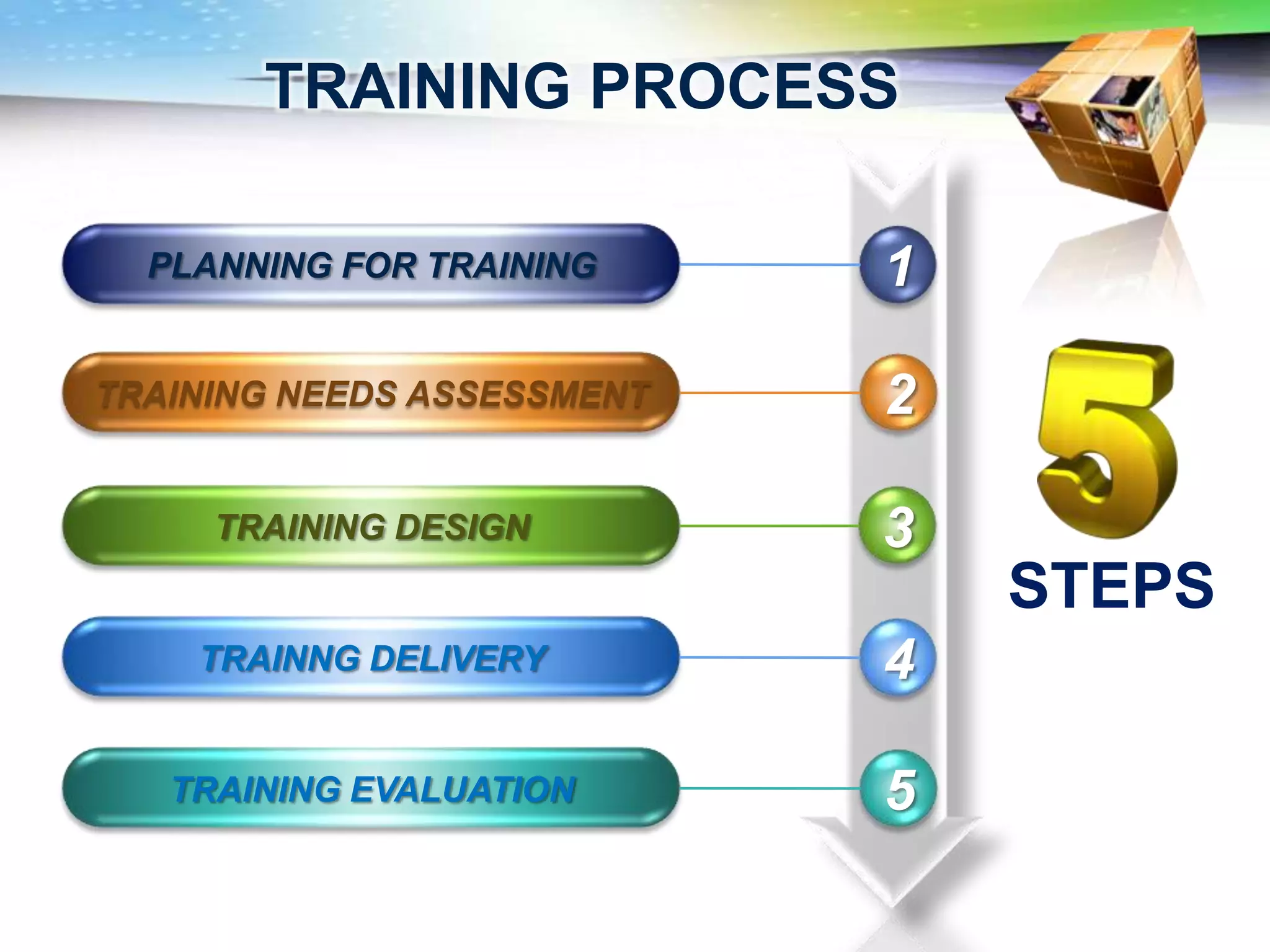
        Describes 5 steps of Training
       Process
TRAINING PROCESS

  PLANNING FOR TRAINING     1

TRAINING NEEDS ASSESSMENT   2

     TRAINING DESIGN        3
                                STEPS
    TRAINNG DELIVERY        4

   TRAINING EVALUATION      5
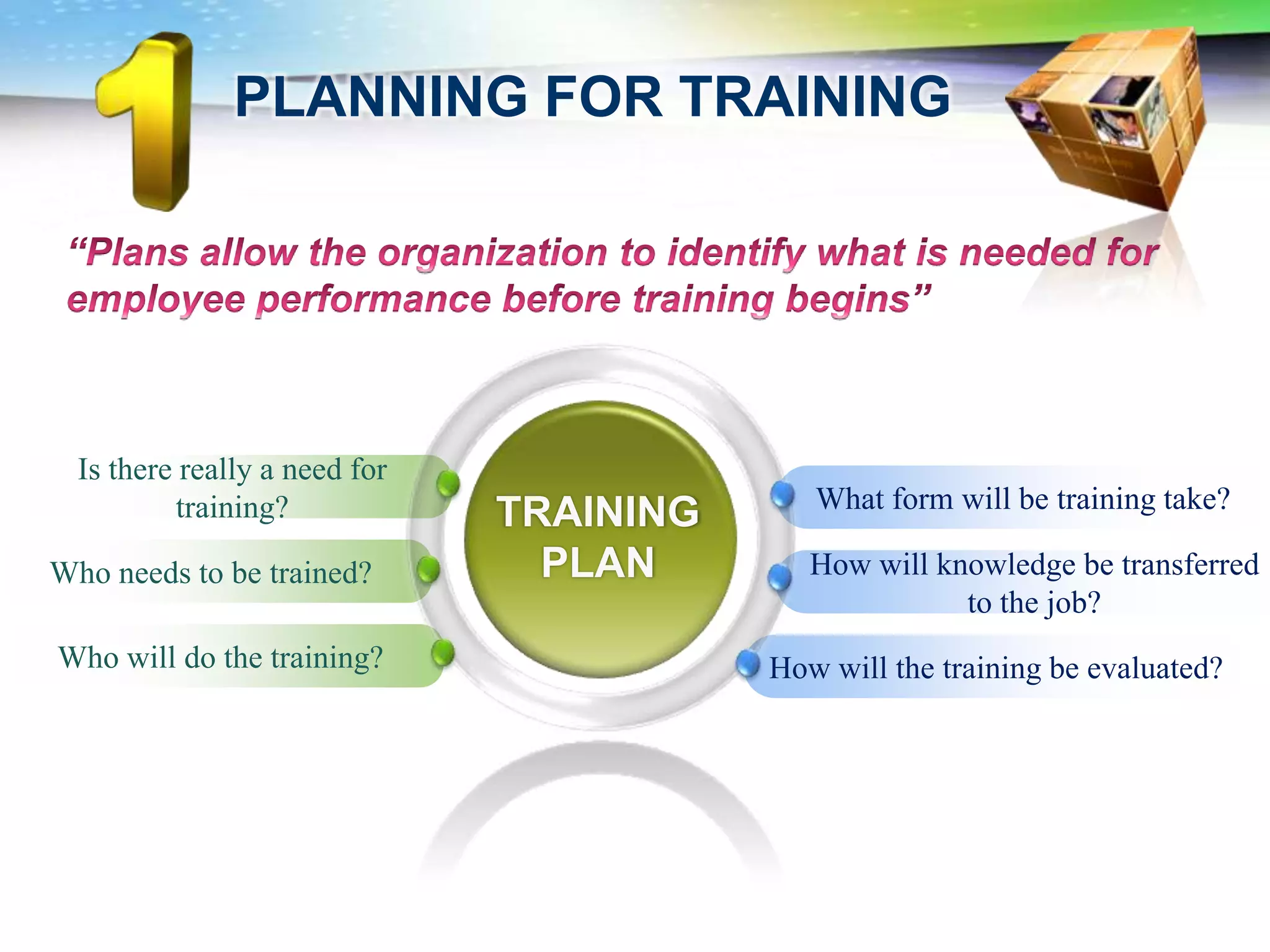
PLANNING FOR TRAINING


  Is there really a need for
          training?                          What form will be training take?
                               TRAINING
Who needs to be trained?         PLAN        How will knowledge be transferred
                                                        to the job?
Who will do the training?                 How will the training be evaluated?
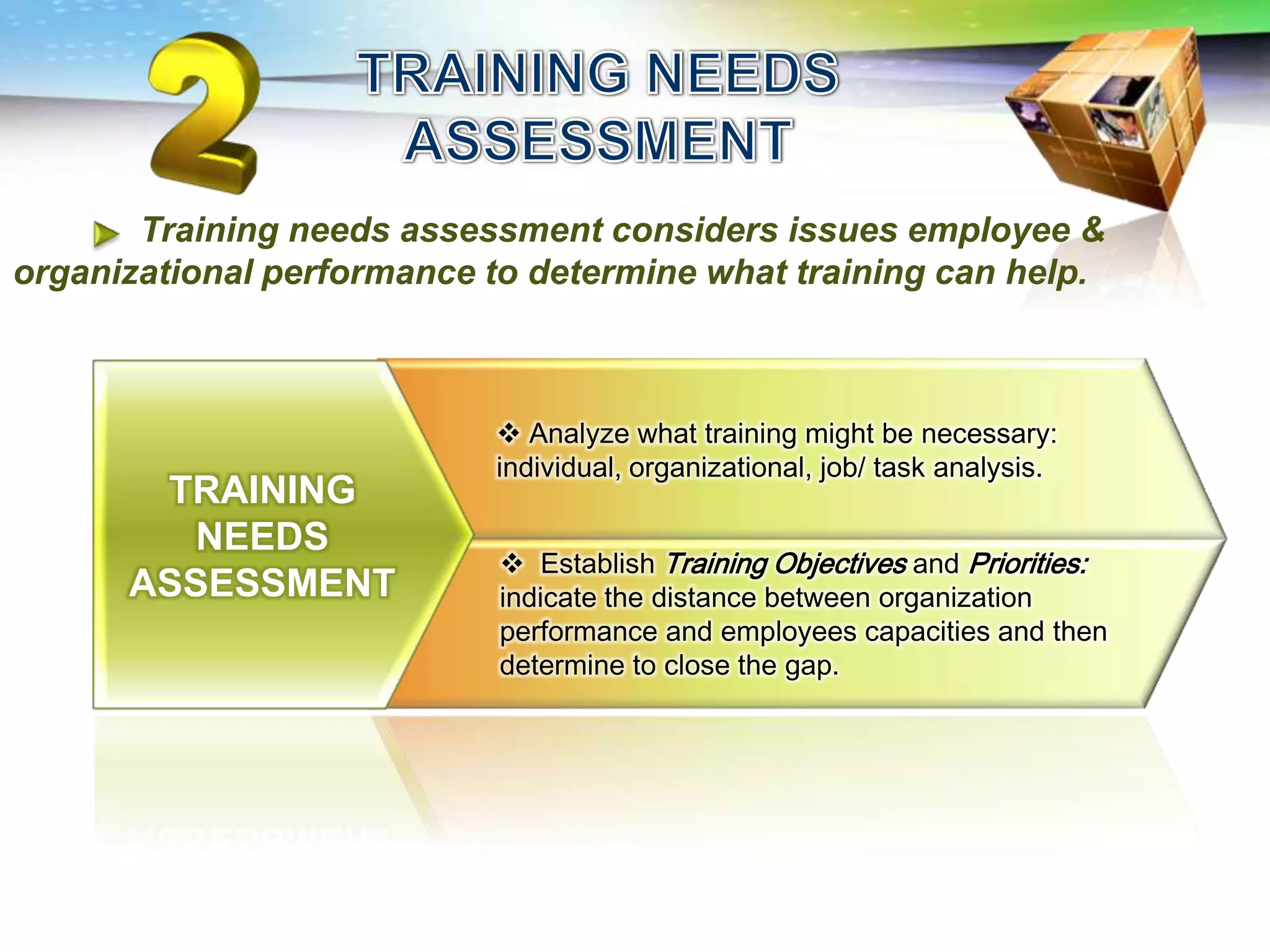
Training needs assessment considers issues employee &
organizational performance to determine what training can help.


                            Analyze what training might be necessary:
                           individual, organizational, job/ task analysis.
       TRAINING
        NEEDS
                             Establish Training Objectives and Priorities:
      ASSESSMENT            indicate the distance between organization
                            performance and employees capacities and then
                            determine to close the gap.
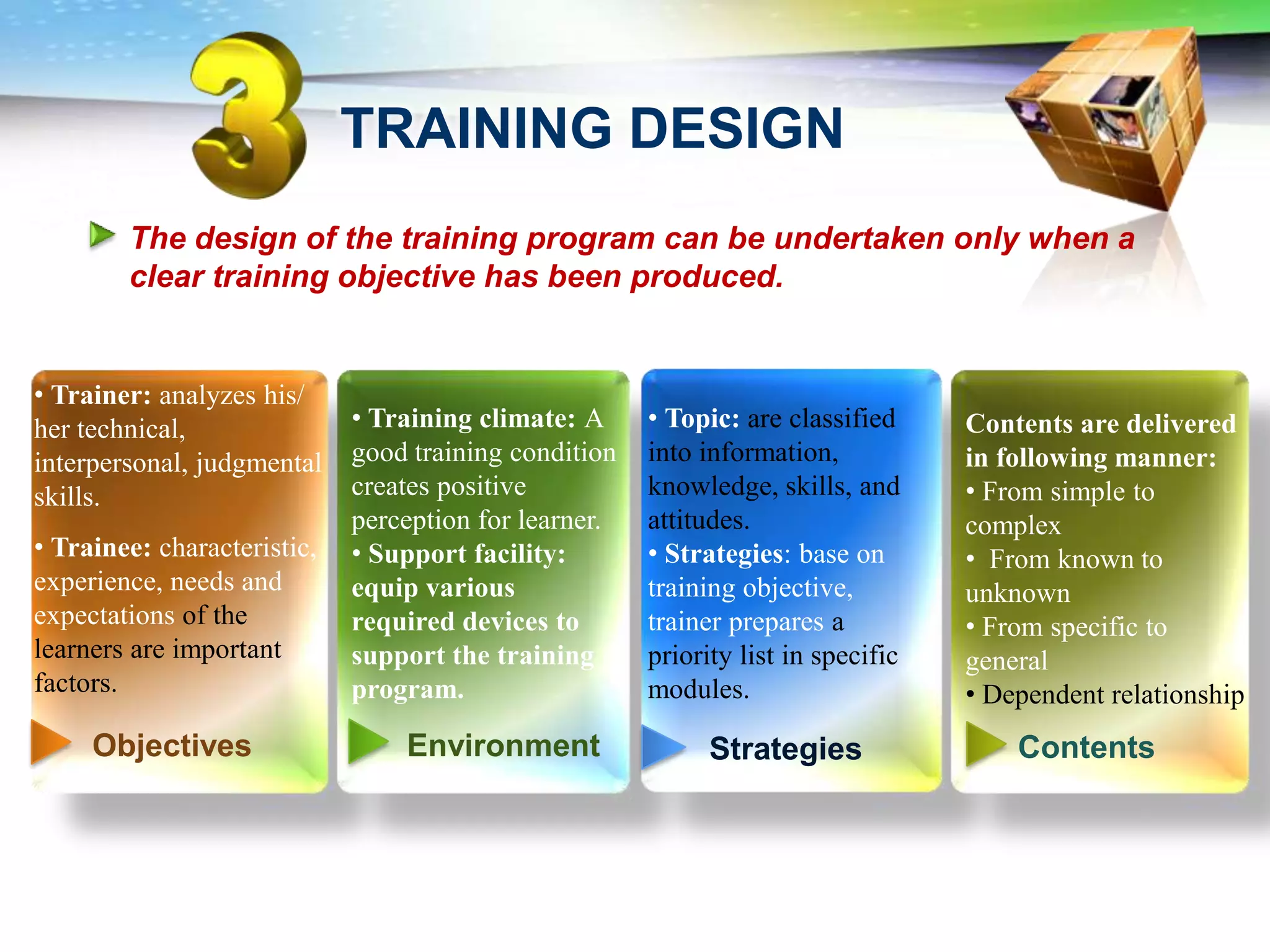
TRAINING DESIGN
        The design of the training program can be undertaken only when a
        clear training objective has been produced.


• Trainer: analyzes his/
her technical,               • Training climate: A     • Topic: are classified     Contents are delivered
interpersonal, judgmental    good training condition   into information,           in following manner:
skills.                      creates positive          knowledge, skills, and      • From simple to
                             perception for learner.   attitudes.                  complex
• Trainee: characteristic,   • Support facility:       • Strategies: base on       • From known to
experience, needs and        equip various             training objective,         unknown
expectations of the          required devices to       trainer prepares a          • From specific to
learners are important       support the training      priority list in specific   general
factors.                     program.                  modules.                    • Dependent relationship
     Objectives                  Environment                 Strategies                Contents
TRAINING DELIVERY

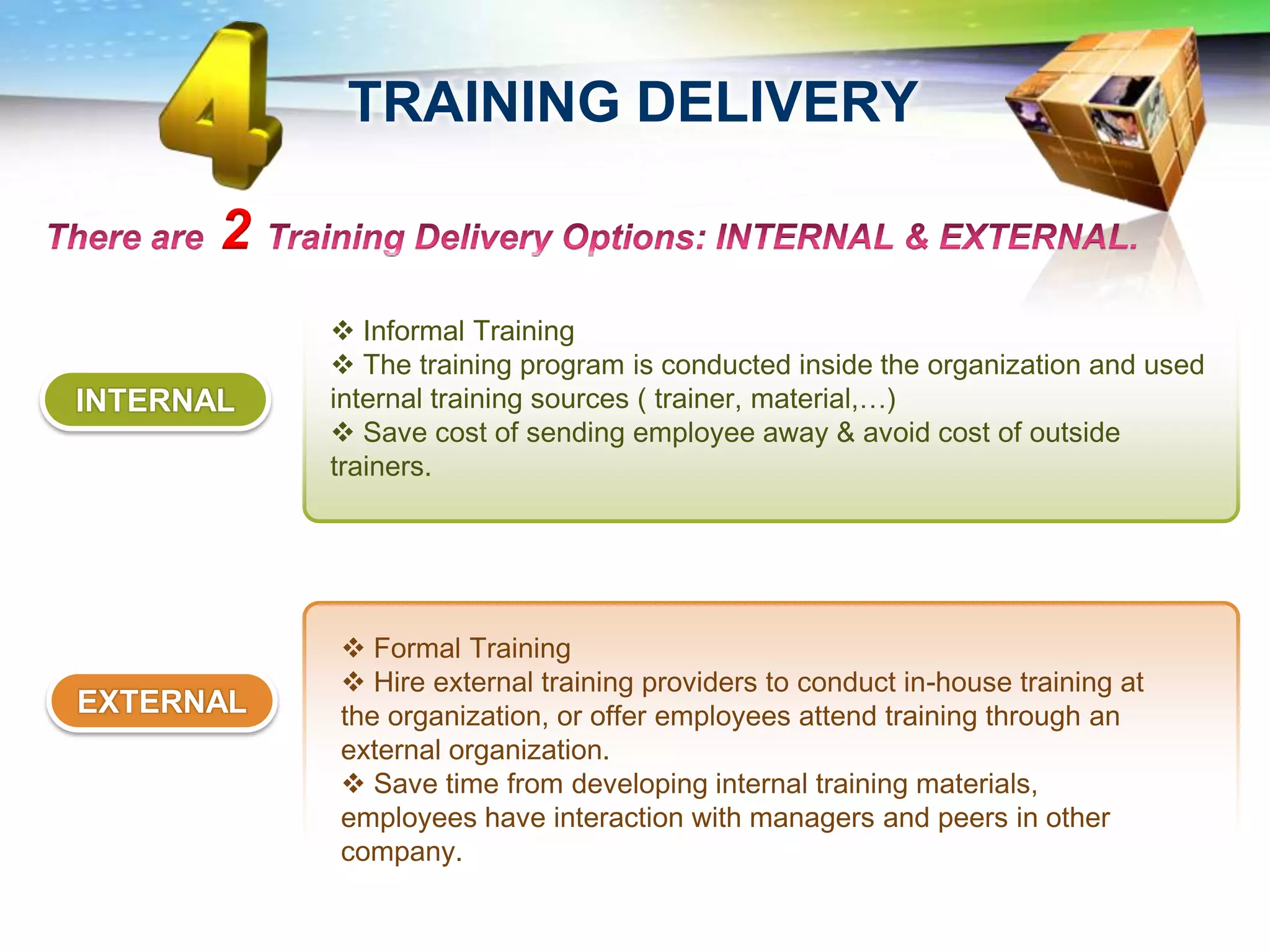
       2
            Informal Training
            The training program is conducted inside the organization and used
INTERNAL   internal training sources ( trainer, material,…)
            Save cost of sending employee away & avoid cost of outside
           trainers.


            Formal Training
            Hire external training providers to conduct in-house training at
EXTERNAL   the organization, or offer employees attend training through an
           external organization.
            Save time from developing internal training materials,
           employees have interaction with managers and peers in other
           company.
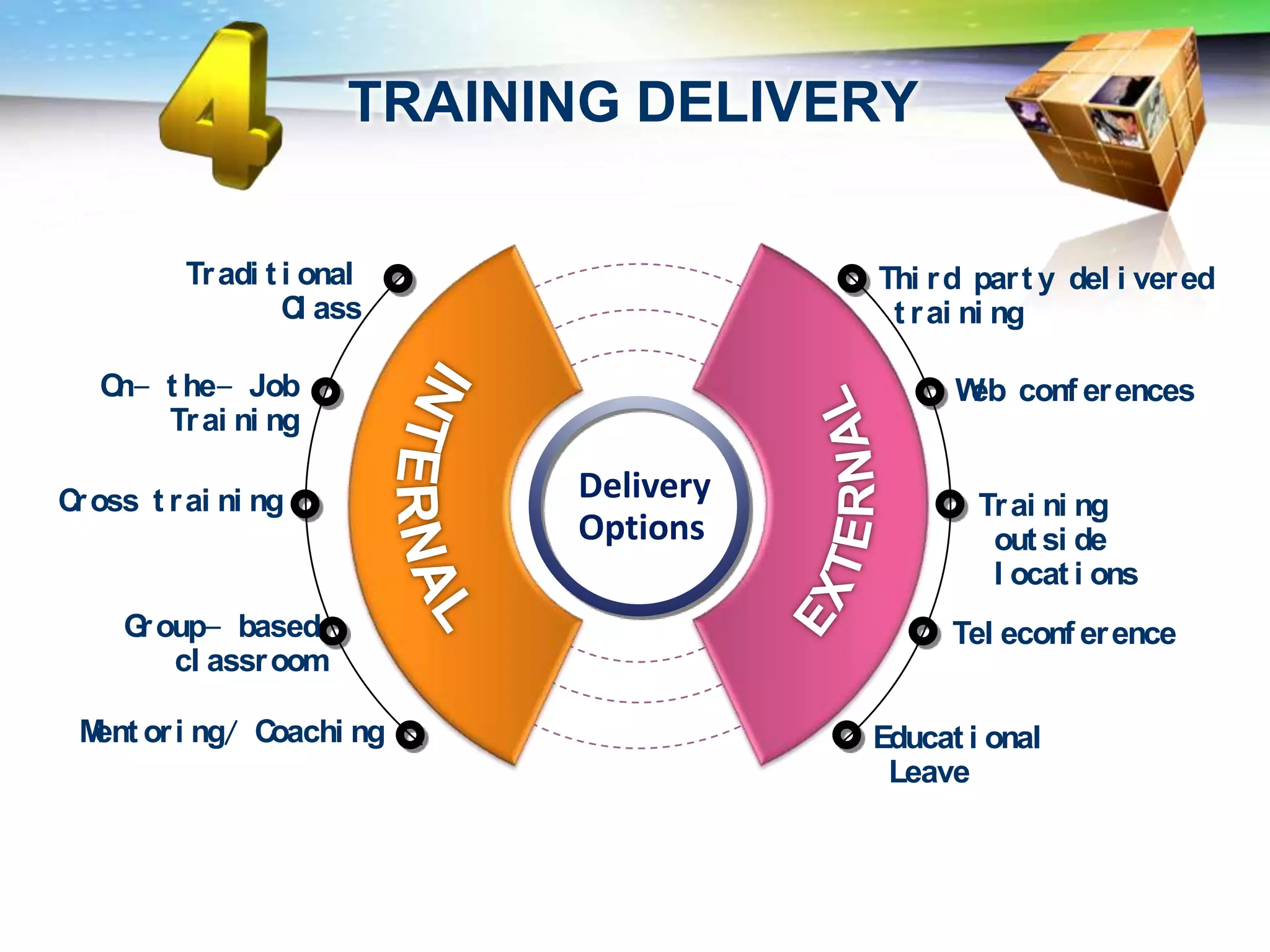
TRAINING DELIVERY

          Tr adi t i onal               Thi r d par t y del i ver ed
                   C ass
                     l                   t r ai ni ng

   O t he- Job
    n-                                        W conf er ences
                                               eb
       Tr ai ni ng

C oss t r ai ni ng
 r                           Delivery           Tr ai ni ng
                             Options             out si de
                                                 l ocat i ons
     G oup- based
      r                                       Tel econf er ence
        cl assr oom

 M or i ng/ C
  ent        oachi ng                   Educat i onal
                                         Leave
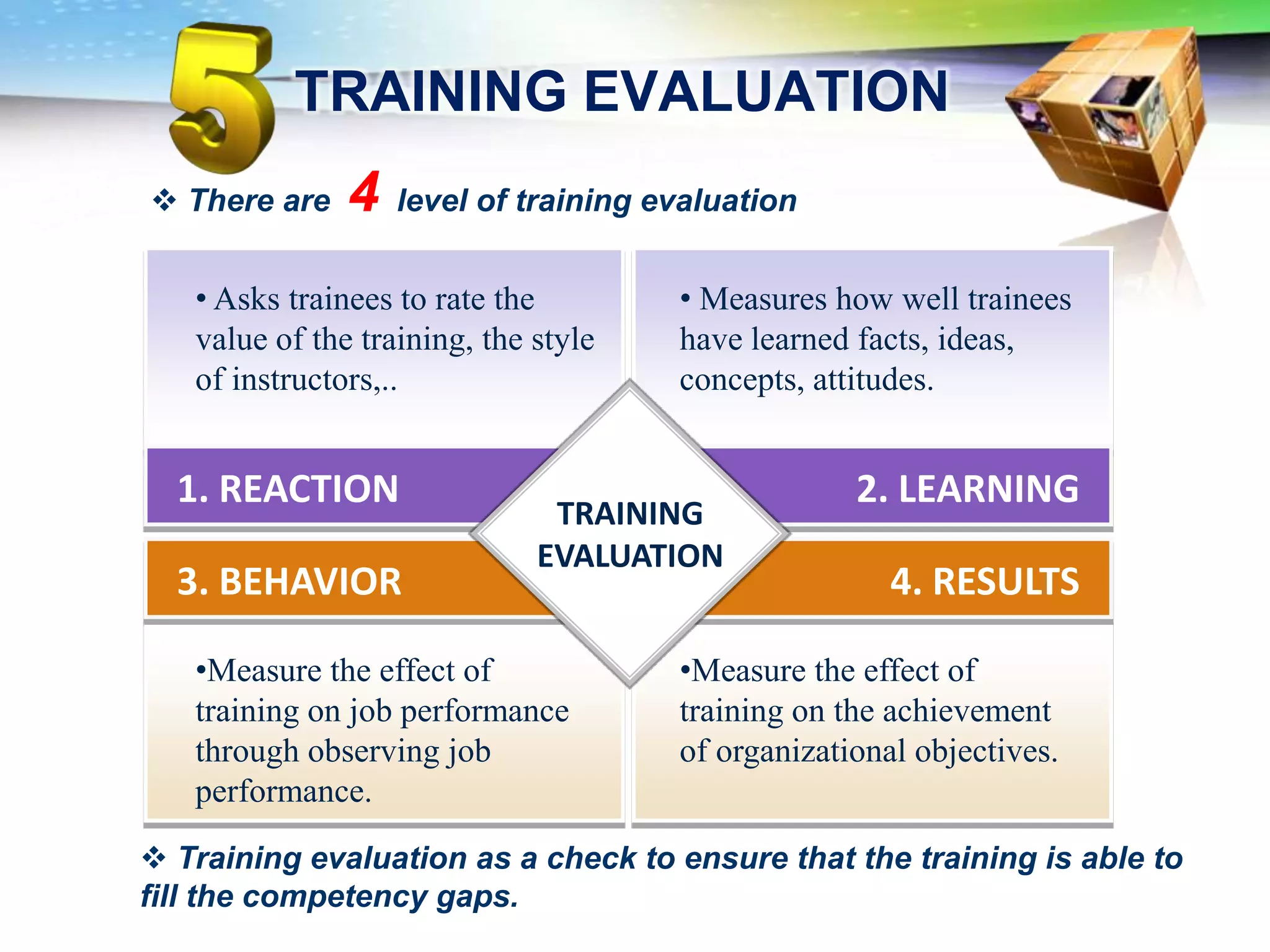
TRAINING EVALUATION
 There are    4   level of training evaluation


   • Asks trainees to rate the        • Measures how well trainees
   value of the training, the style   have learned facts, ideas,
   of instructors,..                  concepts, attitudes.


  1. REACTION                                      2. LEARNING
                               TRAINING
                              EVALUATION
  3. BEHAVIOR                                         4. RESULTS

   •Measure the effect of             •Measure the effect of
   training on job performance        training on the achievement
   through observing job              of organizational objectives.
   performance.

 Training evaluation as a check to ensure that the training is able to
fill the competency gaps.
LOGO


        Training program
        On-the-job Training
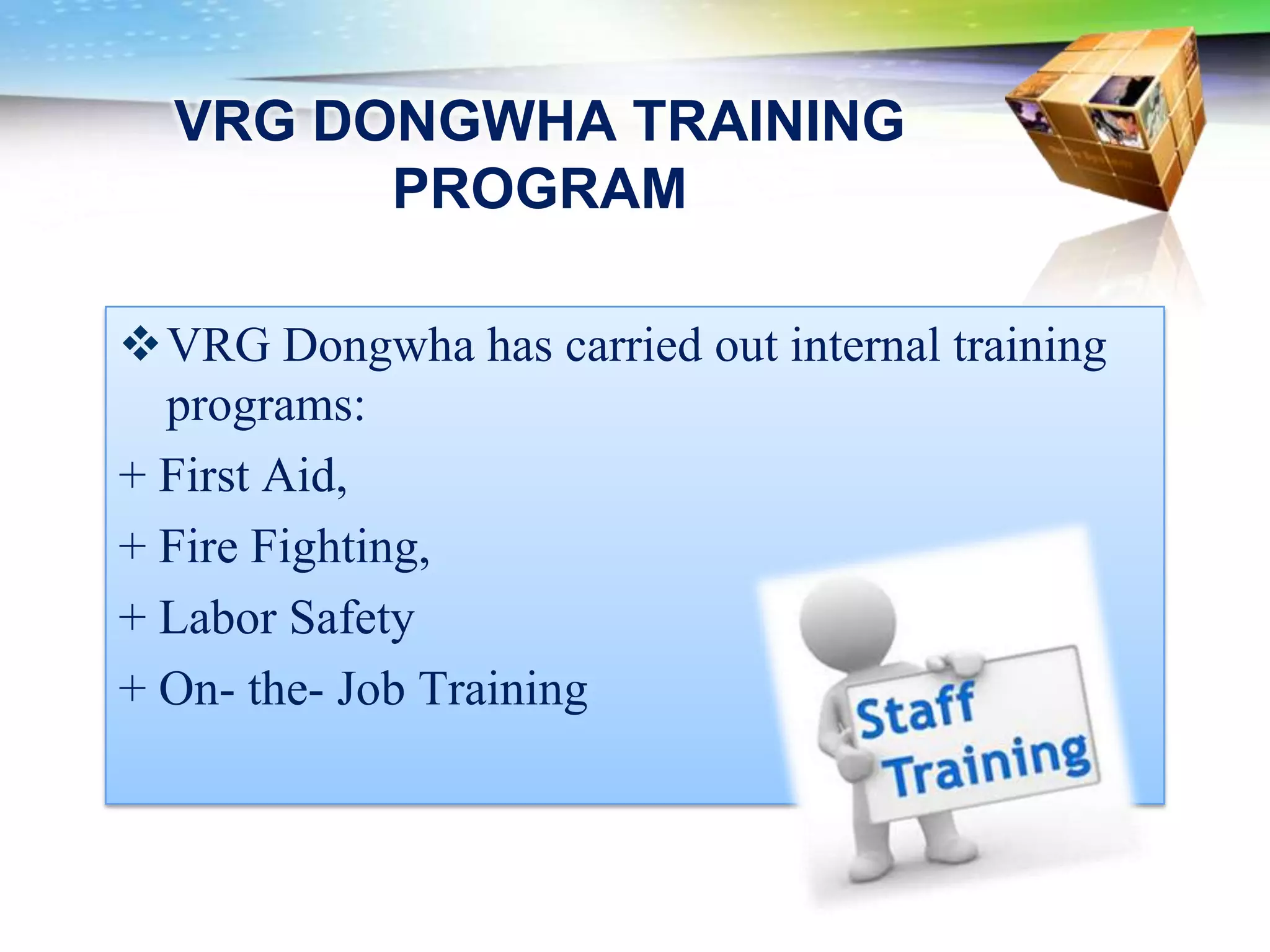
VRG DONGWHA TRAINING
        PROGRAM

VRG Dongwha has carried out internal training
  programs:
+ First Aid,
+ Fire Fighting,
+ Labor Safety
+ On- the- Job Training
ON-THE-JOB TRAINING

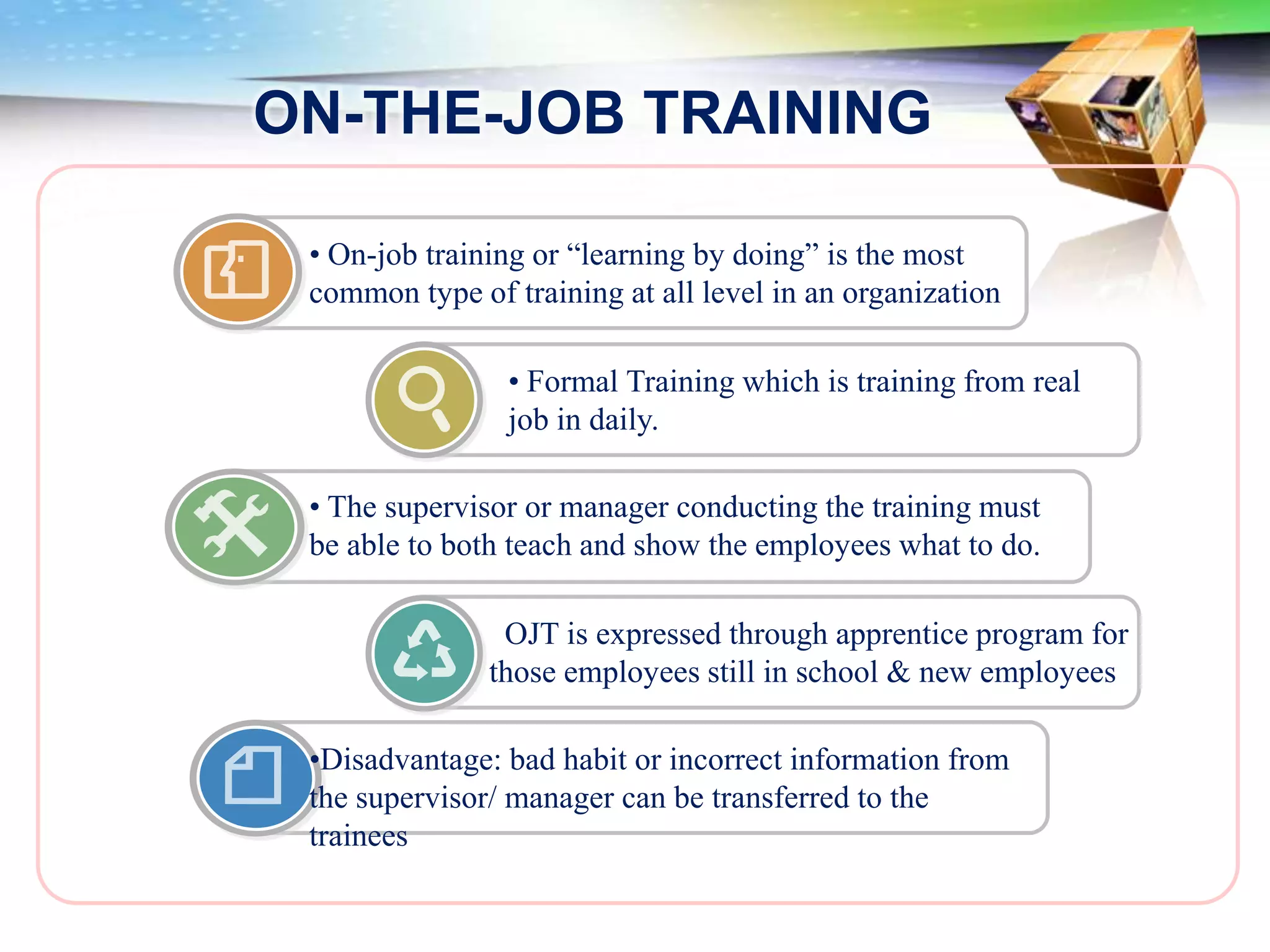
 • On-job training or “learning by doing” is the most
 common type of training at all level in an organization

                • Formal Training which is training from real
                job in daily.

 • The supervisor or manager conducting the training must
 be able to both teach and show the employees what to do.

                OJT is expressed through apprentice program for
               those employees still in school & new employees

 •Disadvantage: bad habit or incorrect information from
 the supervisor/ manager can be transferred to the
 trainees
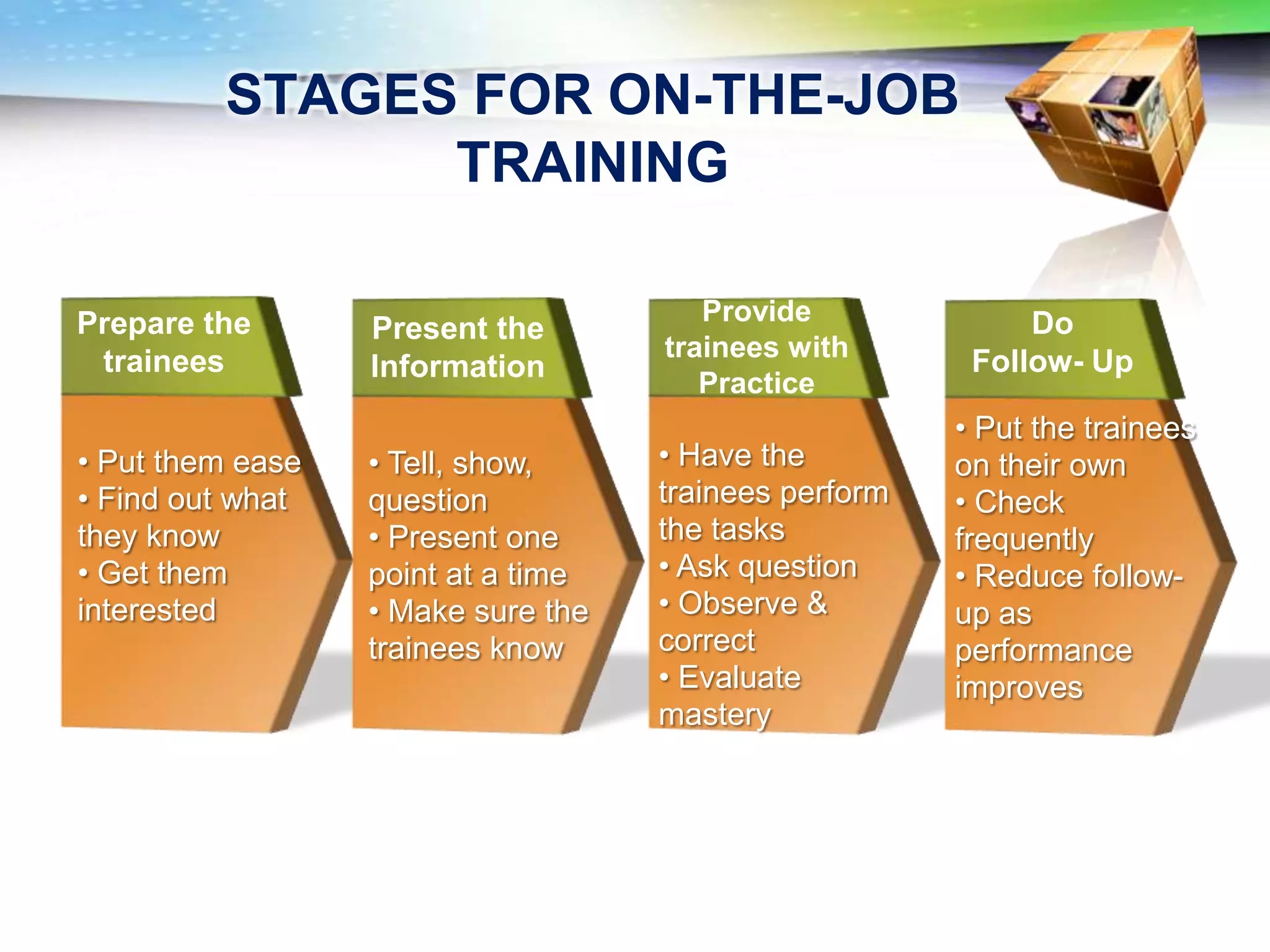
STAGES FOR ON-THE-JOB
               TRAINING

Prepare the                            Provide              Do
                  Present the
 trainees                           trainees with       Follow- Up
                  Information
                                       Practice
                                                       • Put the trainees
• Put them ease   • Tell, show,     • Have the         on their own
• Find out what   question          trainees perform   • Check
they know         • Present one     the tasks          frequently
• Get them        point at a time   • Ask question     • Reduce follow-
interested        • Make sure the   • Observe &        up as
                  trainees know     correct            performance
                                    • Evaluate         improves
                                    mastery
LOGO

Internship report from 1st to 5th april, 2013

  • 1.
    LOGO From 1st March to 5th March, 2013 Manager: Mr. Nguyen Hoang Nam Instructor: Ms. Phan Thi Thuy Trang Reporter: Nguyen Phuong Uyen
  • 2.
    CONTENTS TRAINING 1 TRAINING PROCESS 2 VRG DONGWHA TRAINING PROGRAMS 3 ON-THE-JOB TRAINING 4
  • 3.
    LOGO  Definition Types of Training
  • 4.
    TRAINING Definition The learning process whereby people acquire knowledge, capacities and sharpen skills to perform jobs. Purpose Improve effectiveness and productivity.  Help employees to focus more clearly on the organizational goals and fit the biz strategies.  Employee motivation and retention.
  • 5.
    TYPES OF TRAINING It involves introducing a new employee  Enables employees to perform their jobs well: to its work environment: • Customer service • Introduction to colleagues • IT systems • Explaining the firm’s activities • Telecommunications • Procedures followed in the • Products details organization  Provide long-term focus to  Improve working relationship enhance individual & & interpersonal problems: organizational capacities: • Communications • Leadership • Writing skills • Career planning •Team relationships • Business trends • Conflict Resolution • Performance management
  • 6.
    LOGO  Describes 5 steps of Training Process
  • 7.
    TRAINING PROCESS PLANNING FOR TRAINING 1 TRAINING NEEDS ASSESSMENT 2 TRAINING DESIGN 3 STEPS TRAINNG DELIVERY 4 TRAINING EVALUATION 5
  • 8.
    PLANNING FOR TRAINING Is there really a need for training? What form will be training take? TRAINING Who needs to be trained? PLAN How will knowledge be transferred to the job? Who will do the training? How will the training be evaluated?
  • 9.
    Training needs assessmentconsiders issues employee & organizational performance to determine what training can help.  Analyze what training might be necessary: individual, organizational, job/ task analysis. TRAINING NEEDS  Establish Training Objectives and Priorities: ASSESSMENT indicate the distance between organization performance and employees capacities and then determine to close the gap.
  • 10.
    TRAINING DESIGN The design of the training program can be undertaken only when a clear training objective has been produced. • Trainer: analyzes his/ her technical, • Training climate: A • Topic: are classified Contents are delivered interpersonal, judgmental good training condition into information, in following manner: skills. creates positive knowledge, skills, and • From simple to perception for learner. attitudes. complex • Trainee: characteristic, • Support facility: • Strategies: base on • From known to experience, needs and equip various training objective, unknown expectations of the required devices to trainer prepares a • From specific to learners are important support the training priority list in specific general factors. program. modules. • Dependent relationship Objectives Environment Strategies Contents
  • 11.
    TRAINING DELIVERY 2  Informal Training  The training program is conducted inside the organization and used INTERNAL internal training sources ( trainer, material,…)  Save cost of sending employee away & avoid cost of outside trainers.  Formal Training  Hire external training providers to conduct in-house training at EXTERNAL the organization, or offer employees attend training through an external organization.  Save time from developing internal training materials, employees have interaction with managers and peers in other company.
  • 12.
    TRAINING DELIVERY Tr adi t i onal Thi r d par t y del i ver ed C ass l t r ai ni ng O t he- Job n- W conf er ences eb Tr ai ni ng C oss t r ai ni ng r Delivery Tr ai ni ng Options out si de l ocat i ons G oup- based r Tel econf er ence cl assr oom M or i ng/ C ent oachi ng Educat i onal Leave
  • 13.
    TRAINING EVALUATION  Thereare 4 level of training evaluation • Asks trainees to rate the • Measures how well trainees value of the training, the style have learned facts, ideas, of instructors,.. concepts, attitudes. 1. REACTION 2. LEARNING TRAINING EVALUATION 3. BEHAVIOR 4. RESULTS •Measure the effect of •Measure the effect of training on job performance training on the achievement through observing job of organizational objectives. performance.  Training evaluation as a check to ensure that the training is able to fill the competency gaps.
  • 14.
    LOGO  Training program  On-the-job Training
  • 15.
    VRG DONGWHA TRAINING PROGRAM VRG Dongwha has carried out internal training programs: + First Aid, + Fire Fighting, + Labor Safety + On- the- Job Training
  • 16.
    ON-THE-JOB TRAINING •On-job training or “learning by doing” is the most common type of training at all level in an organization • Formal Training which is training from real job in daily. • The supervisor or manager conducting the training must be able to both teach and show the employees what to do. OJT is expressed through apprentice program for those employees still in school & new employees •Disadvantage: bad habit or incorrect information from the supervisor/ manager can be transferred to the trainees
  • 17.
    STAGES FOR ON-THE-JOB TRAINING Prepare the Provide Do Present the trainees trainees with Follow- Up Information Practice • Put the trainees • Put them ease • Tell, show, • Have the on their own • Find out what question trainees perform • Check they know • Present one the tasks frequently • Get them point at a time • Ask question • Reduce follow- interested • Make sure the • Observe & up as trainees know correct performance • Evaluate improves mastery
  • 18.

Editor's Notes

  • #5 Improved ProductivityThe key purpose of any training is to improve effectiveness and productivity. Everyone needs training to do their jobs well. Internal training begins with an induction program, enabling the employee to learn how to do the job, its purpose and how it fits into the corporate strategies. Ongoing support training is essential to keep up with changes to the working and corporate environment. This might be as simple as circulating company literature to update staff on current developments. This kind of informality gives employees some responsibility for their learning.RelevanceBy training staff internally, an organization can customize the learning to fit business needs exactly, adapting some elements and omitting any considered unnecessary for the job. This enables the employees to focus more clearly on the organizational goals and strategies, while sensing their individual contributions to its success. Depending on the type and scope of training, though, it is less helpful from an employability perspective. For example, a former soldier might have received exceptional training in communications and technology while in the Army, but he might need to retrain to use the same skills in a commercial environment.Employee Motivation and RetentionTraining as a reward is an effective motivator, and happy employees are more productive and less likely to think about leaving. A structured internal training program shows staff the organization recognizes their worth and it is in their interests to stay. Keeping the staff motivated and happy is one of the best public relations tools an organization can have. Employees will soon let their friends and family know if they work for an organization that doesn’t care about them. Equally, if it is the best place they have worked, they will be keen to pass on that message, too, encouraging more applications when the organization needs to hire. Using employees as a marketing force to tell the world what a great organization it is to work for sends out a clear, positive message about every aspect of the business. link: http://work.chron.com/purpose-internal-training-employees-3973.html
  • #11 http://traininganddevelopment.naukrihub.com/training-design.html